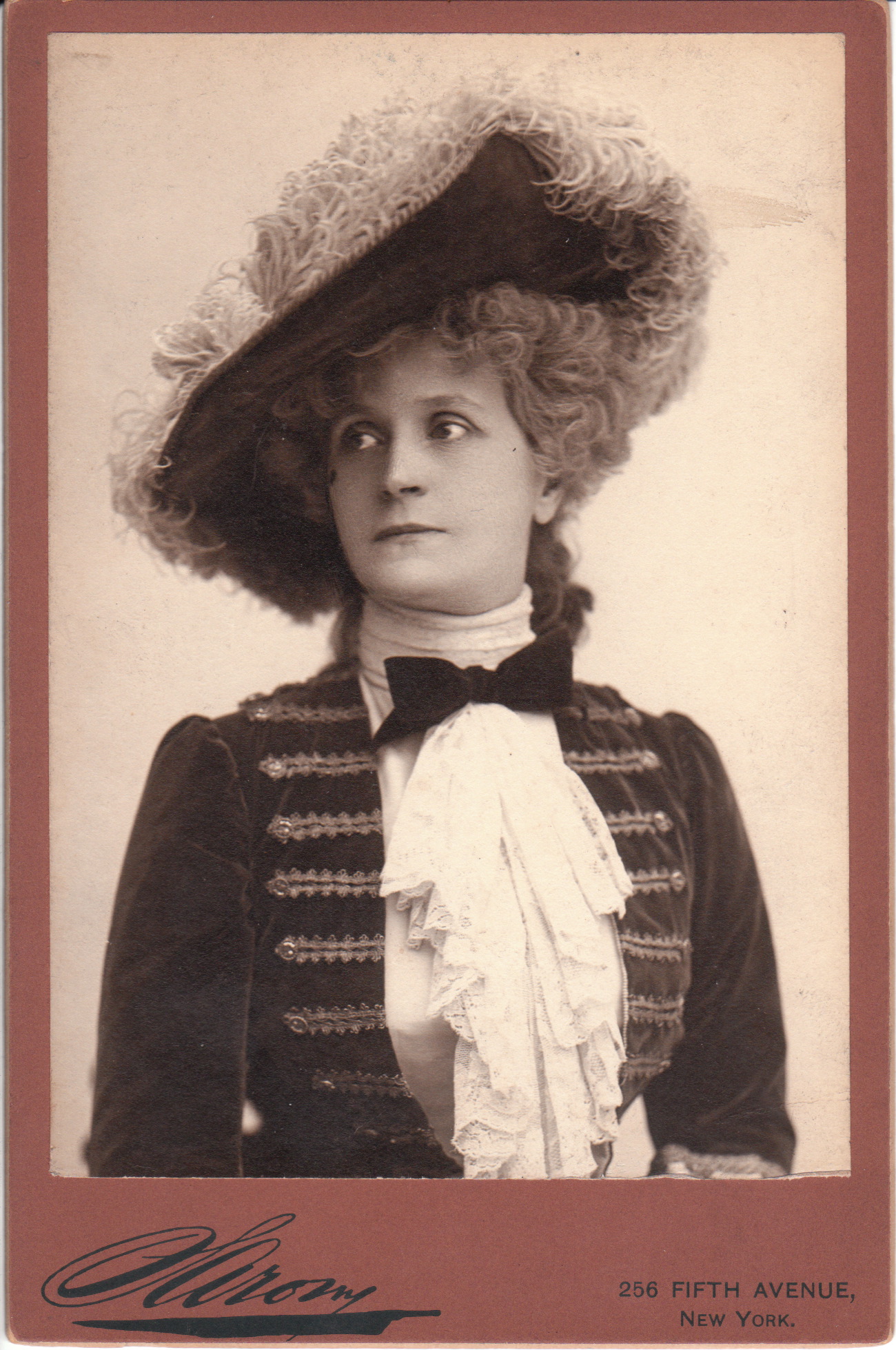
 Henrietta Crosman was a renowned American stage and film actress and she is captured beautifully in this cabinet card photographed by Napoleon Sarony. To learn more about Sarony, a famous celebrity photographer, click on the category “Photographer: Sarony”. Sarony’s subject, Miss Crosman was born In West Virginia. Her father was a civil war Major and her mother was the niece of composer Stephen Foster. She was educated in several locations as her father was stationed in a number of posts while pursuing his military career. She began acting in New York City when she joined a local theater company in 1883. Her next experience with a theater company included a national tour. In 1889 she performed Shakespeare for the first time. She performed at the Daly Theater. In the 1890’s she joined Daniel Frohman’s stock company. She excelled in adventure romances and popular drawing farces. By 1900, she had reached stardom. Her appearances included roles in such plays as “As You Like It” (1902), “Sweet Kitty Bellairs” (1903), and “The Real Thing” (1911). Crosman avoided motion pictures until 1914. She then signed a deal with Adolph Zukor’s Famous Players. Her husband, Maurice Campbell became a noted director. Crosman appeared in both silent films and “talkies”. She was in a total of 22 films between 1914 and 1937 including “Charlie Chan’s Secret” (1936),
THEATER ACTRESS HENRIETTA CROSMAN (PORTRAIT BY SARONY)

ARMED AND READY TO DEPLOY: SPANISH AMERICAN WAR SOLDIER IN MINNEAPOLIS, MINNESOTA
 This Spanish American War era soldier is dressed, armed and ready to deploy. Note his long rifle and the bayonet he is wearing on his side. He is wearing two medals, one which the previous owner of the photograph identified as signifying that he was the son of a Union civil war veteran. This photograph was taken at Dempsie Portraits which was located at 316 Nicollet Avenue in Minneapolis, Minnesota. George M. Dempsie began operating in Minneapolis in about 1887 and worked until at least 1910. He was at the Nicollet Avenue address between 1889 and 1910. He operated under the names of Dempsie’s New Photographic Rooms, Dempsie Portraits, and Dempsie & Andrews. At various times he employed his sons George R. Dempsie and Guy C. Dempsie.

UNITED STATES VOLUNTEER UNIFORMED SOLDIER AND HIS WIFE IN CHATTANOOGA, TENNESSEE
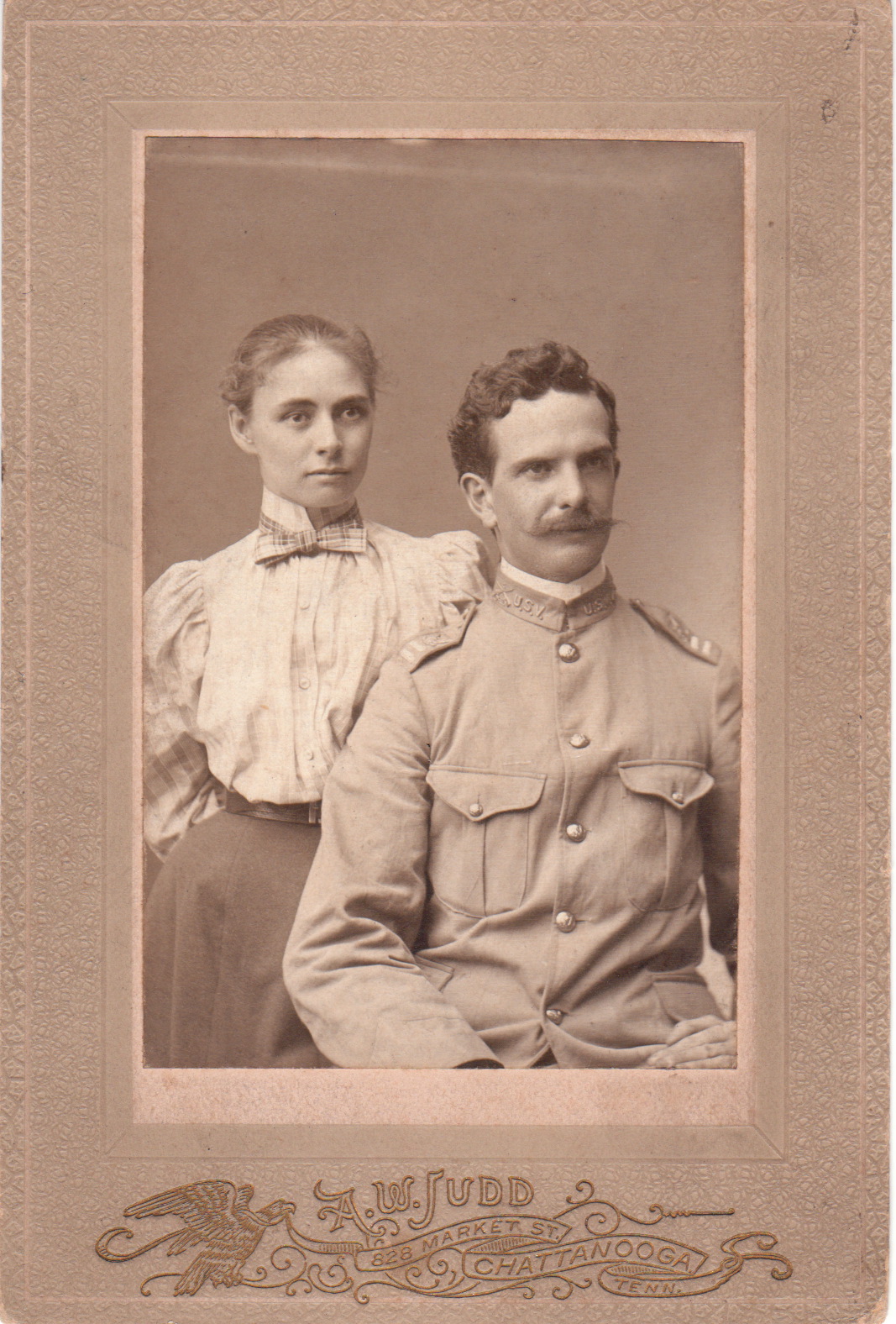
This photograph features a military man with a young woman who is likely his wife. The soldier is wearing collar pins that identify him as a member of the United States Volunteers. Members of the USV were enlisted in the army but were separate from units of the regular US Army. Although volunteer regiments existed during the civil war, the USV was not officially named until the Spanish American War in 1898. The volunteer army was a quick way to supplement the regular army during times of war and was unnecessary during times of peace. This portrait was likely taken during or just after the Spanish American War. The photograph is smaller than a cabinet card. It measures 3.5″ x 5.25″. Note that the woman is standing behind the man making him appear much more prominent. It almsost seems like that she was not even in the original pose and that she was superimposed onto his photographic portrait. The photographer is A. W. Judd of Chattanooga, Tennessee. Judd was born in 1846. The book “Chattanooga” (1996) reports that Amos Wilson Judd was a civil war veteran who began his photography business in 1877. His name and studio appears in Chattanooga’s business directories from 1890 through 1920. He died in 1929. He had two brothers who were photographers. His son succeeded him in running his studio. Judd had two portraits appear in Wilson’s Photographic Magazine (1900). The Photo Beacon (1906) states that Judd was the President of the Kentucky/Tennessee Photographers Association. Wilson’s Photographic Magazine (1908) indicates that he held a patent for a photography invention. A confederate soldier named Amos Judd was a member of the 2nd Battalion Georgia Infantry (State Guard), Company B. He mustered in as a private and left the service with the same rank.
OLD MAN AND HIS HORSE AND BUGGY IN NUNDA, ILLINOIS
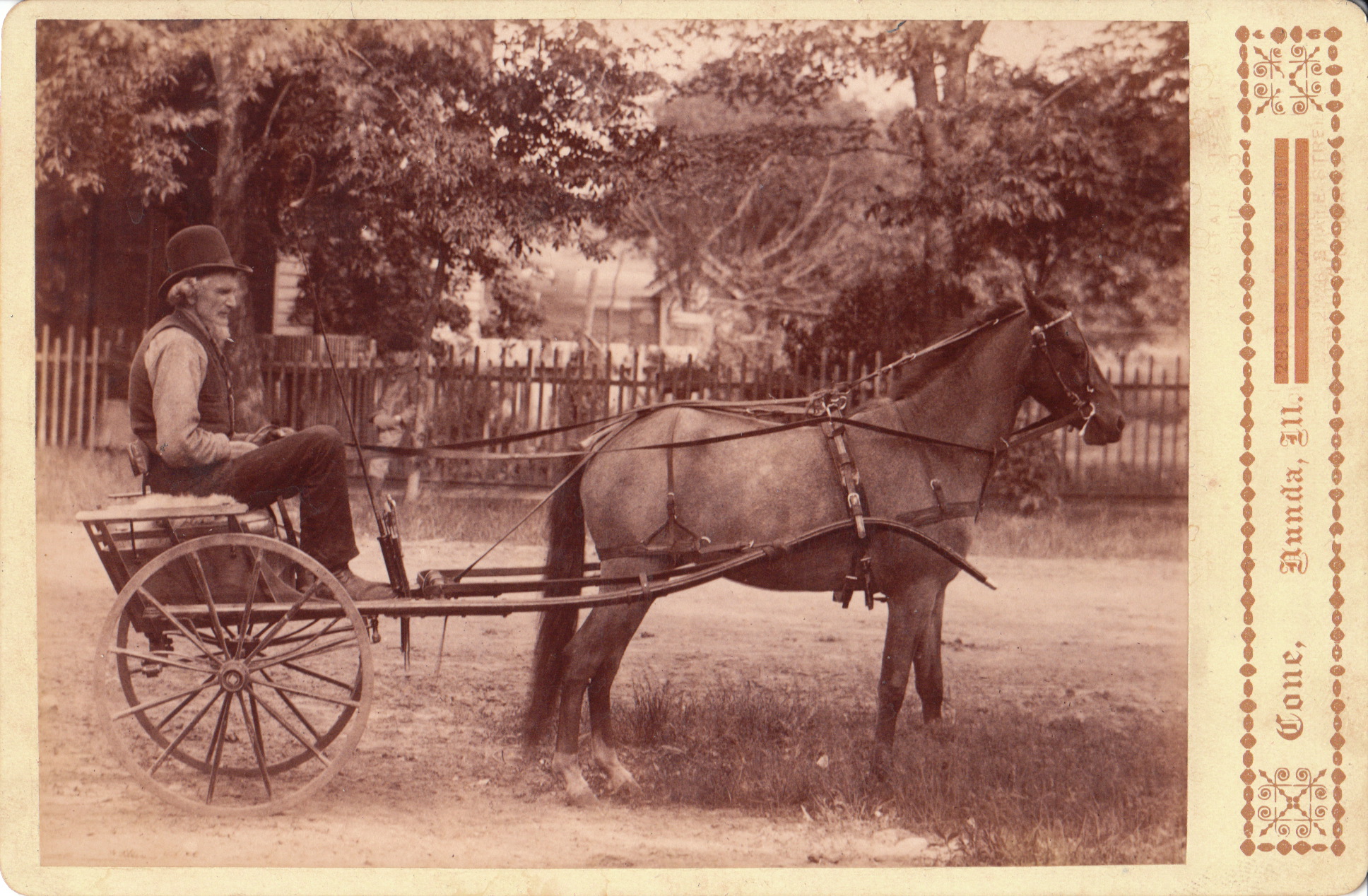 This cabinet card photograph features an old man sitting in his horse drawn cart. Note that the cart has only two wheels. The cart seems to be on a road in front of a fenced house. The gentleman is wearing a derby style hat. The photograph was produced by the Cone studio in Nunda, Illinois. The township of Nunda was established in 1849 and was originally called Brooklyn. In 1850 the name of the town was changed to Nunda to honor a community leader whose birthplace was Nunda, New York. The photographer of this photograph may be Joseph C. Cone. The Portrait and Biographical Album of Fulton County, Illinois (1890) reports that Cone was a Union soldier for three years in Company C of the 103rd Illinois Infantry and became a photographer in Farmington, Illinois. The book also states that he was married to Maria Union. Farmington and Nunda are 190 miles apart and it was not uncommon for photographers of the era to frequently move their businesses from community to community in order to find better economic opportunities. However, Joseph Cone’s identity as the photographer of this image is purely speculative.
JOSIAH BENNETT: STATE SENATOR FROM MASSACHUSETTS
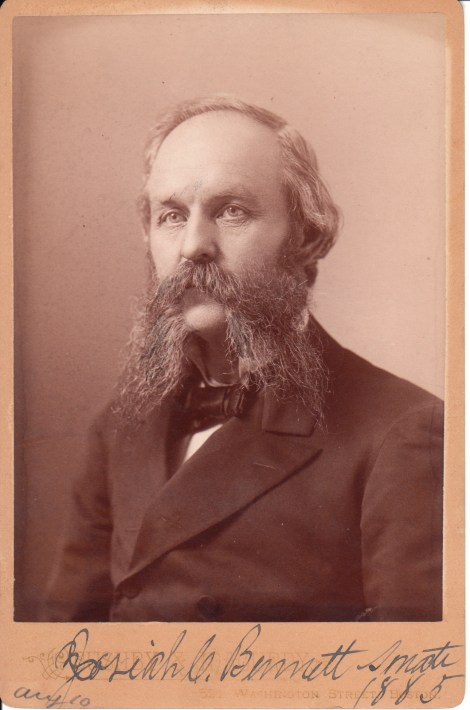
This cabinet card features a portrait of Massachusetts Senator Josiah Bennett. His mustache is very notable and earns him a spot in the cabinet card gallery category “Mustaches (Only the Best)”. Be sure to check out the collection of extraordinary mustaches. This portrait was taken in 1885 by the Bushby & Macurdy studio located on Washington Street in Boston. Asa Bushby was born in South Danvers, Massachusetts in 1834. He was a self taught portrait painter and after returning from the Civil War, he became a photographer. He opened a studio in Peabody, and then moved to Lynn, and later to Boston, Massachusetts. At some point in his career, he partnered with George W. Macurdy. He is listed in the 1889 Boston business directory. At the end of the 1880’s he moved to Tacoma, Washington and died there in 1897. Civil war buffs may be interested to know that Asa Bushby served in the 1st Regiment Massachusetts Heavy Artillery (company D). He entered, and later left the regiment as a private. To view more photographs by Bushby & Macurdy, click on the category “Photographer: Bushby & Macurdy”. Josiah Bennett served as a state senator. He was served on a committee that addressed state prison issues. Hopefully, further research will yield more information about Mr. Bennett.
A BOY AND HIS DOG SHARE A COUCH IN ALMA, WISCONSIN
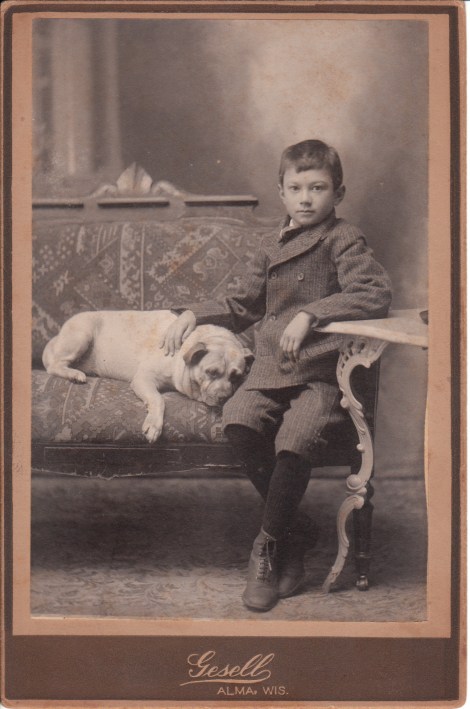 The Gesell studio of Alma, Wisconsin, produced this wonderful portrait of a boy and his dog. The boy’s love for his dog is apparent by his expression as well as by his resting his wrist and hand on the pooch’s neck. The dog appears quite tired in this photograph which certainly makes the photographer’s job easier. Photographing dogs required special talent and the photographer of this image certainly possessed that talent. The lad pictured in this photograph is identified on the reverse of the image as being named “Emil Bardil”. Emil Bardil (or Bardill) was born in 1893 in Alma, Wisconsin. His father was John Bardill and his mother was Katie Roffler. His parents were of Swiss extraction. The 1900 census finds seven year-old Emil living with a Katherine Bardill (age 54) and his two brothers John (age 11) and Eddie (age 9). The 1910 census reveals that Emil was a boarder in an Alma home and worked as an apprentice printer. The 1920 census discloses that Emil is living in Chico, California with his wife Alice, and working as a printer. The 1930 census indicates that Emil and his wife had taken a boarder into their Chico home and the boarder was employed as a school teacher. The 1940 census shows that Emil had become a foreman at a print shop and worked as a lineotype operator. Census data indicates in 1940, he remained in Chico. Two years later he registered for the draft. He lived a long life and died in California in 1985. The photographer of this portrait was Gerhard Gesell. He was an important figure in Wisconsin history and the Wisconsin Historical Society presents much biographical information about Mr Gesell. Gesell was born in Germany. He came to the United States and in 1863 he enlisted in the Army and served with “Brackett’s Battalion” of the Minnesota Cavalry on the western front. He entered the military as a private and was discharged as a saddler. After the war he returned to Reads Landing, Minnesota and worked as a saloon keeper until he entered the field of photography. He began his photography career in Reads Landing in 1873. In 1876 he relocated to Alma and opened a studio at 401 South Main Street. He operated his photography business in Alma for 30 years (he died in1906). Gesell is noted for his work of documenting the town, its people and culture, and its relationship to the Mississippi River. He took many photographs outside his studio capturing the Alma citizens in many of their activities. In 1879 he married Christine Giesen and they had five children. The couples oldest son, Arnold, became a pediatrician and well known psychologist. Arnold’s son also made a name for himself. Gerhard Gesell (named after his photographer grandfather) was a noted federal judge in Washington D.C. and he presided over many important cases including the Iran Contra Affair, the release of the Pentagon Papers., and the Watergate Scandal. How did this blog entry go from focusing on a little boy and his dog to the Watergate Scandal? Here is an answer to that question. Part of the beauty of cabinet card photography is that each image tells a story. When we look at a photograph, we use conjecture to create a story about the photograph. These created stories are based on our knowledge, as well as our psyche. A second story is created when we research the photographers, the subjects, the activities, and the times reflected in the photographs. That is the beauty of these photographs, we never know where viewing these turn of the century images will take us.
PORTRAIT OF A TIRED OLD MAN IN TEXAS (PHOTOGRAPH BY CAPTAIN HARVEY ROBERTS MARKS)
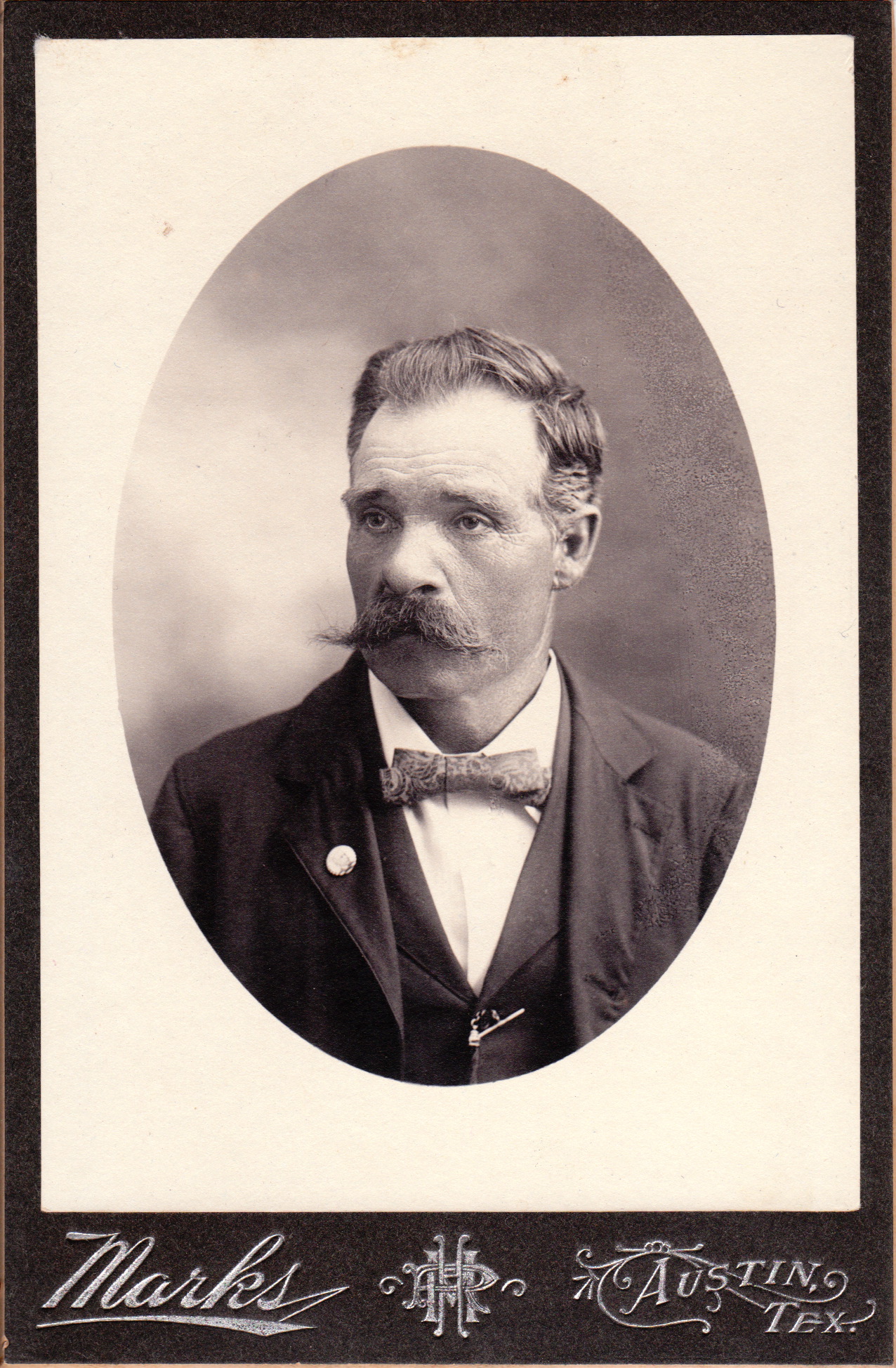
This image captures the portrait of a tired looking old man. This gentleman appears to have had better days. He looks exhausted and troubled. This photograph was taken by the Mark’s studio in Austin, Texas. The photographer of this cabinet card lived an interesting life and he was both a pioneer of Texas and a pioneer of photography. Harvey Roberts Marks (1821-1902) was a well known photographer who worked in a number of locations. He was active in Baltimore, Maryland (1849-1853), San Francisco, California (1851), Mobile, Alabama (1856-1859), Houston, Texas (1865-1870), and Austin, Texas (1870-1902). He was born in New York City. He first arrived in Texas in 1838 and received a very large land grant in Harris County (Houston). He enlisted in a company of Texas Rangers in 1840 and reached the rank of Captain. He was married to Emily H. Bassan in 1849. Research indicates that she was member of one of the most prominent families in Baltimore. In 1849 he was Jacob Shew’s partner in the Shew and Mark’s Gallery in Baltimore. He continued the gallery alone when Shew left Baltimore until 1851. The 1850 census revealed that he had three assistants in the gallery and took 5,000 daguerreotypes annually. In 1851 he took photographs of castaways from a Japanese ship involved in an incident that caught national attention. Mark’s moved to Austin in 1870 and opened a gallery a year later. During that time he became Vice President of the National Photographic Association. Marks served during the civil war. He was a member of the Houston Battalion, Texas Infantry (Detailed Men). Research was unsuccessful in gathering this Confederate regiment’s history. Marks entered the regiment and left the regiment as a Captain. Interestingly, when former Confederacy President, Jefferson Davis, visited Austin in 1875, he sat in Mark’s studio for his portrait. He died at the age of 81.
ADORABLE LITTLE GIRL IN OXFORD, INDIANA
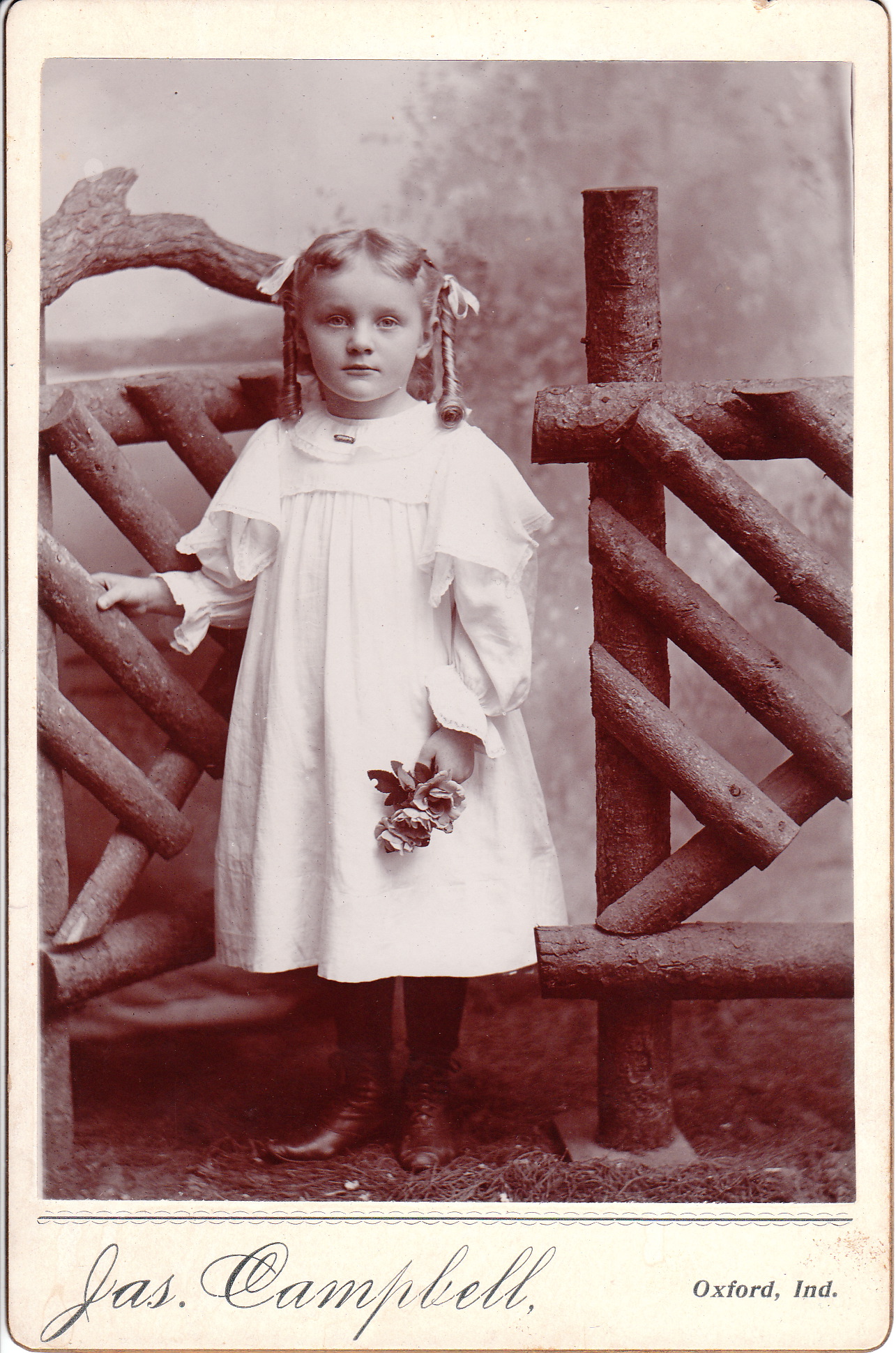 An adorable young girl poses by a wooden gate for photographer James Campbell in Oxford, Indiana. The little girl has terrific curls tied by bows and is holding flowers. The photographer of this cabinet card was a civil war veteran. The New History of the Ninety Ninth Indiana Infantry (1900) gives a brief biographical sketch of Campbell along with his photograph. James D. Campbell was born in 1845 in Fayette County, Indiana. He and his parents moved to Oxford in 1854. He was a well respected soldier in the civil war. He was a member of the 99th Indiana Infantry (Company C). He entered and left his regiment as a private. The book reports “He was one of those quiet faithful soldiers; always ready and always willing to do his duty”. His biography also describes him as married but having no children.
PORTRAIT OF A COUPLE IN CHATSWORTH, ILLINOIS (JOSEPH AND ELLA FRANCIS)
 This cabinet card features a couple posing for their portrait at the studio of A. H. Hall in Chatsworth, Illinois. The gentleman has an interesting long and narrow beard, The woman has a dress with many buttons and is wearing a pin on her collar. Note the mans hat is on the floor directly in front of where the couple is sitting. It is not uncommon to see cabinet card portraits that include hats prominently displayed on the floor. Perhaps the hats were viewed as important enough to belong in the picture but it was considered inappropriate to wear hats indoors. The couple in this photograph are identified on the reverse as Joseph and Ella Francis. Investigation reveals that Joseph Francis served in the civil war. In 1864 he enlisted as a private in Company D of the Illinois 45th Infantry Regiment.He mustered out as a private in 1865. The 1880 US census identifies Joseph S. Francis (1846-1930) as a farmer of Irish descent living in Illinois. The 1910 census finds the Ohio born, Francis living in Forrest, Illinois and working as a railroad car inspector. He was 64 years old at the time and living with his wife Ella Svedaker Williamson Francis (1862-1938) and four of their children. The 1930 census that Joseph Francis, at age 84, was still employed. He was working as an assessor for his township. Research found death certificates for both Joseph (1930) and Ella (1938). The photographer of this image was Albert H. Hall. The History of Livingston County (1878) provides a brief biography of Hall. He was born in 1849 and at age 22 went to Chicago to learn the trade of photography. In 1872 he moved to Chartsworth and opened a photography and gem gallery. He married a woman named Dora Knapp.
ANGELIC LITTLE GIRL IN ARTISTIC POSE IN DOVER, NEW HAMPSHIRE
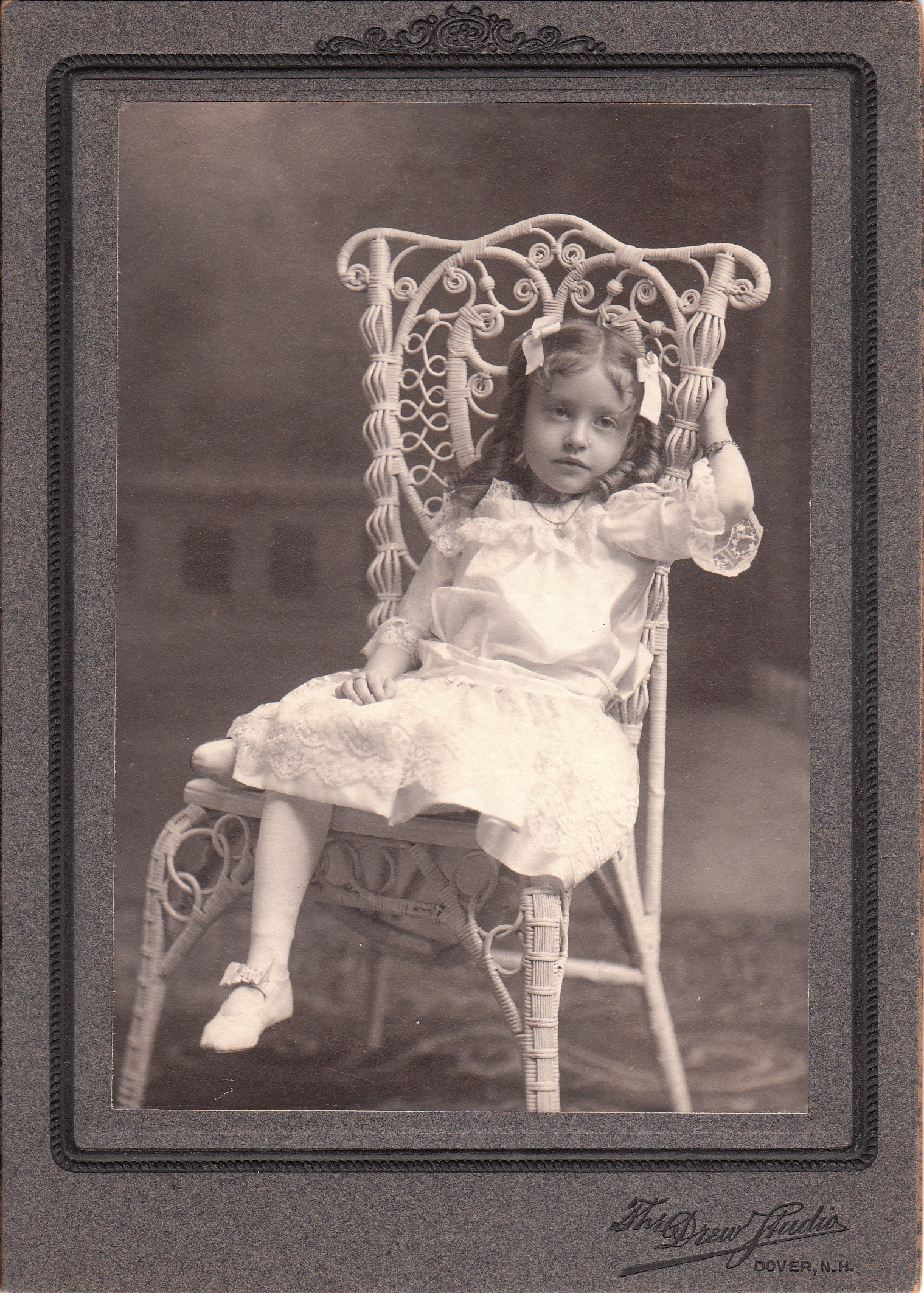
An angelic looking young girl dressed in white, poses in an artistic portrait at the Drew Studio in Dover, New Hampshire. The little girl does not appear very happy about the process of being photographed. She has corkscrew curls and is wearing hair ribbons. She is sitting cross legged in a white wicker chair. The photographer of this large format image is A. P. Drew. The Dover Enquirer (1896) has an article which mentions Alfred Palmer Drew. In 1896 a “deluge” and subsequent fire destroyed a business block and three bridges in Dover. The flooding sent the stores on the block down the Cocheco River. The photography studio Drew and Boomer was among the stores washed away. The Bulletin of Photography (1917) contains the obituary of A. P. Drew. He died at the age of 81. He had been born in Dover and had worked as a photographer there for more than 50 years. He retired in about 1914. During the civil war he had been a member of the Strafford Guards. The regiment was originally established in 1822 and a year later became part of the New Hampshire State Militia. In 1864 the Strafford Guards were mustered into service of the Union Army for a period of sixty days. They relieved a New Hampshire artillery unit that had been sent to the front. A. P. Drew served as a corporal.


