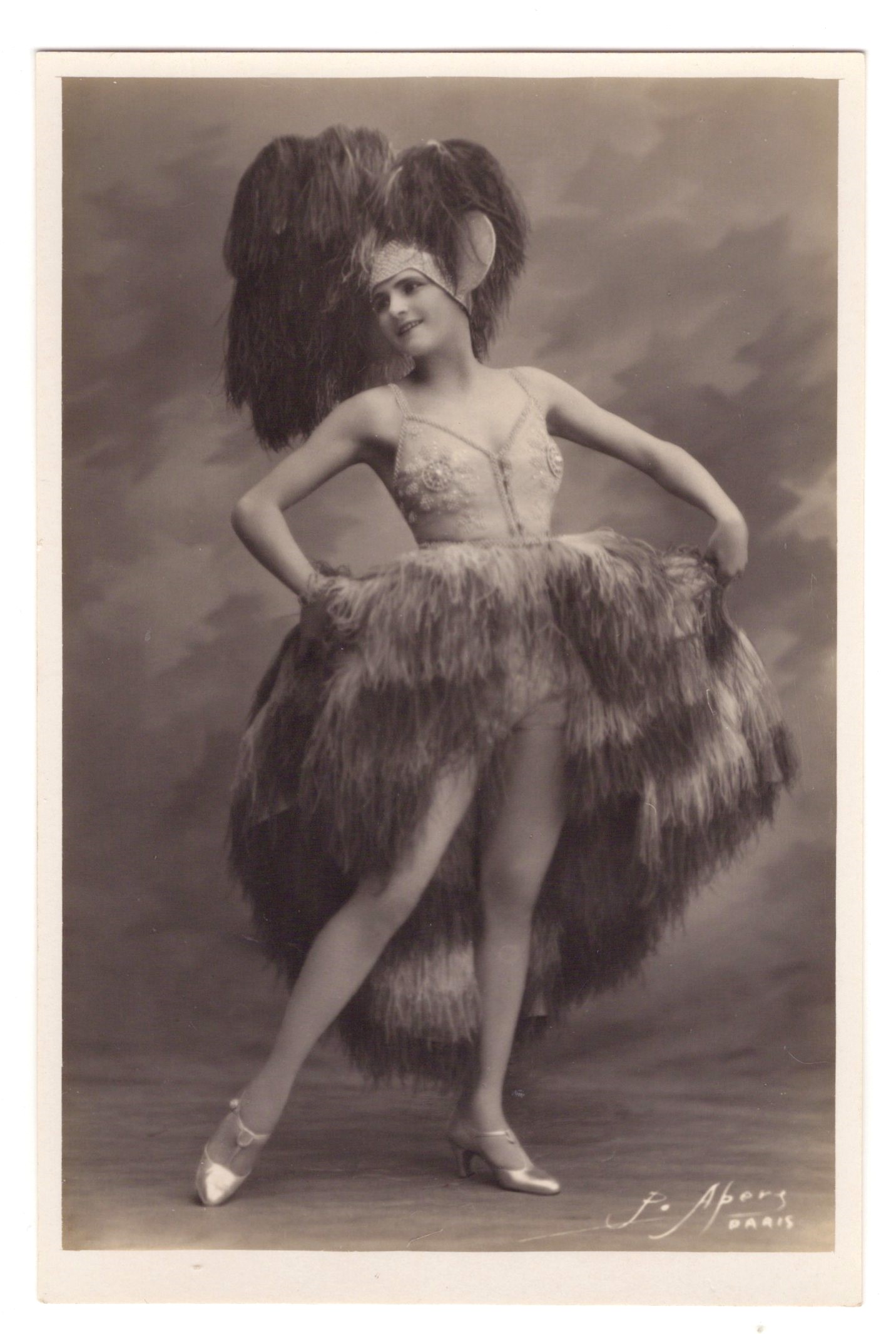
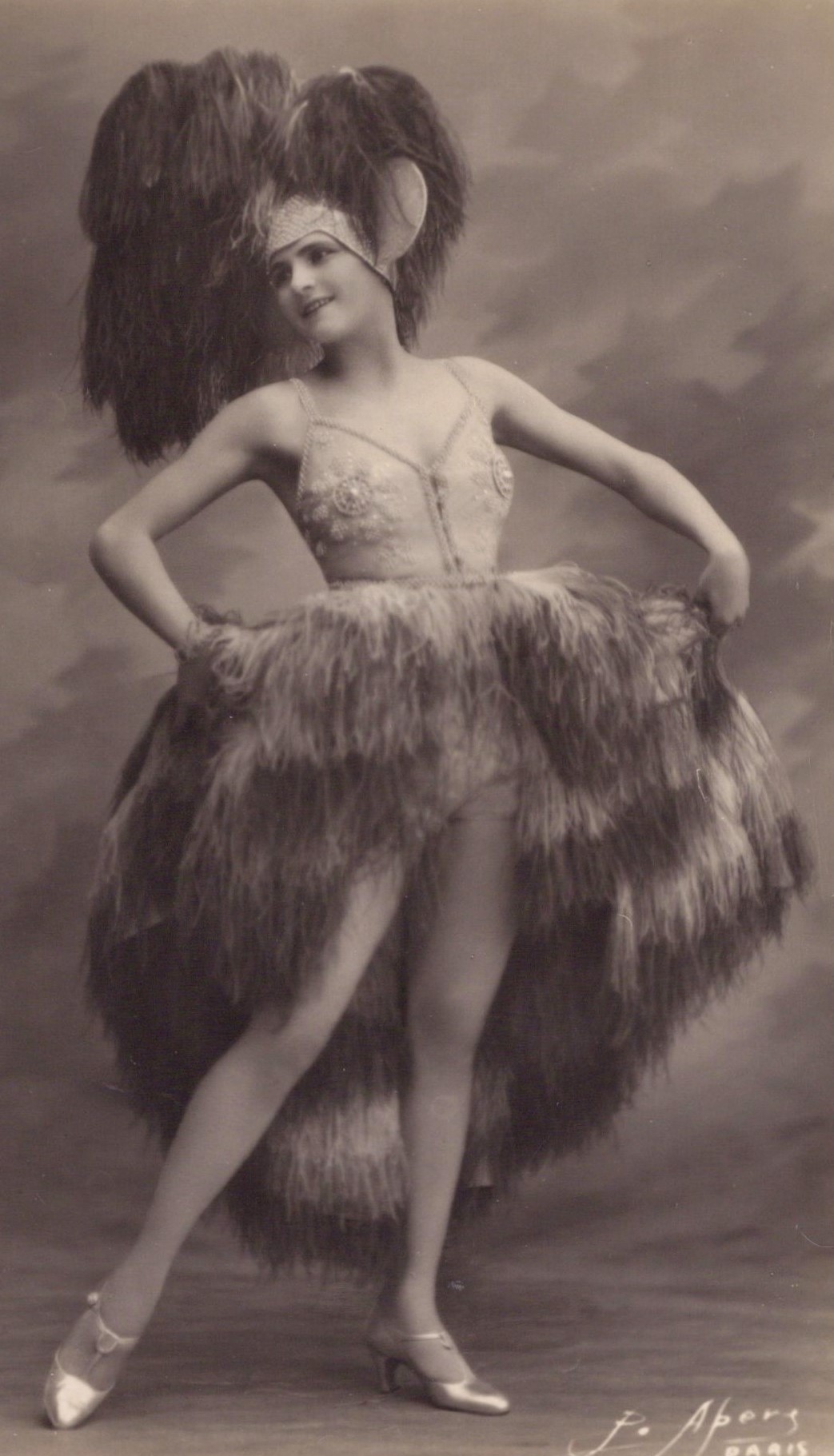
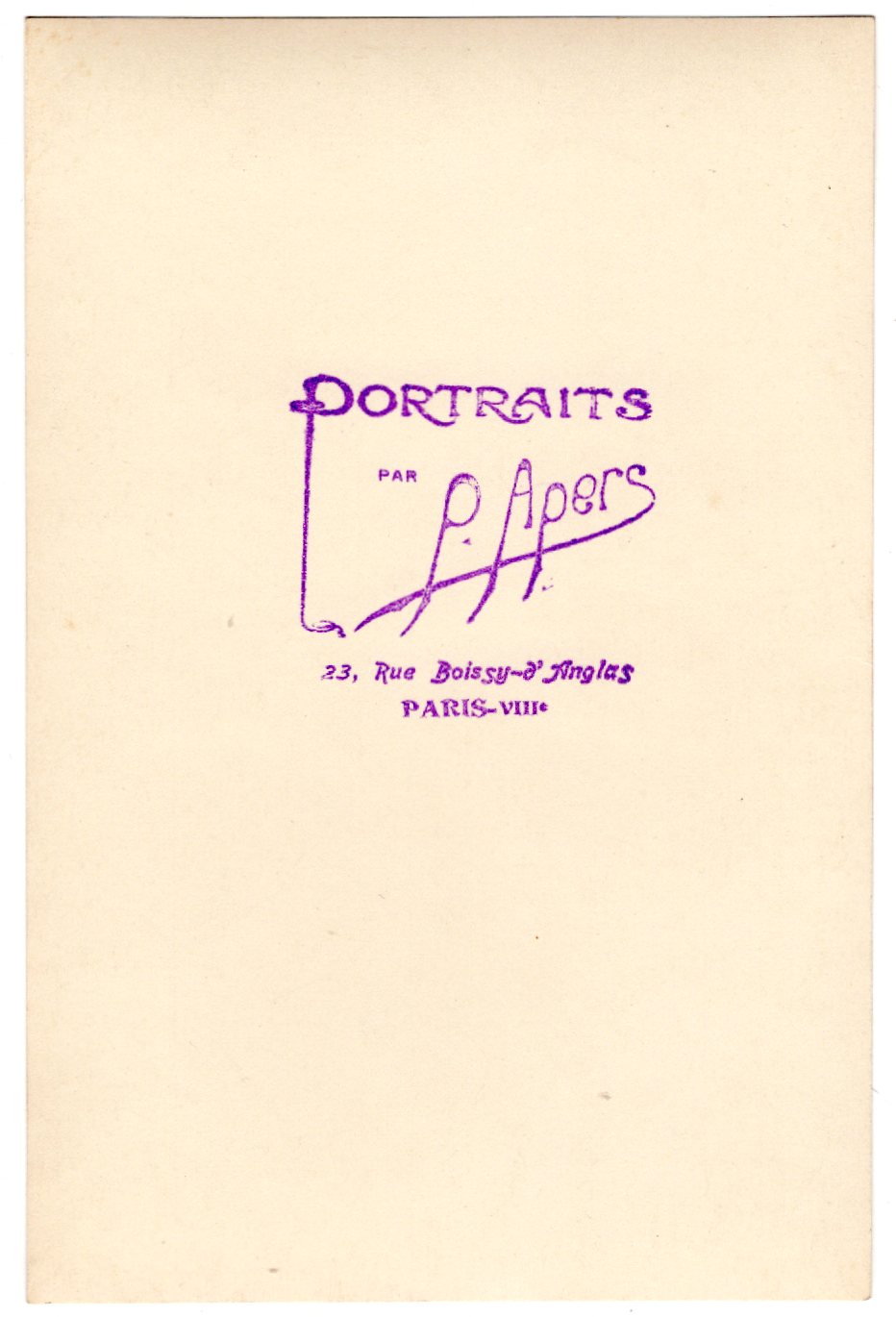
This vintage photograph features a pretty young dancer wearing a magnificent costume. I believe her hat and skirt are made of feathers. Her lithe body is accompanied by a winsome smile. This beautiful photograph comes from the Paris studio of Pierre Apers. He was a talented French photographer active in the 1920’s and 1930’s. His studio was in Paris and he specialized in portraiture. He is known for his photographs of French theatre and film stars. Some of his work is in the collection of the Bibliotech Francais in Paris. The reverse of the photograph has an ink stamp providing the address of Aper’s studio. SOLD
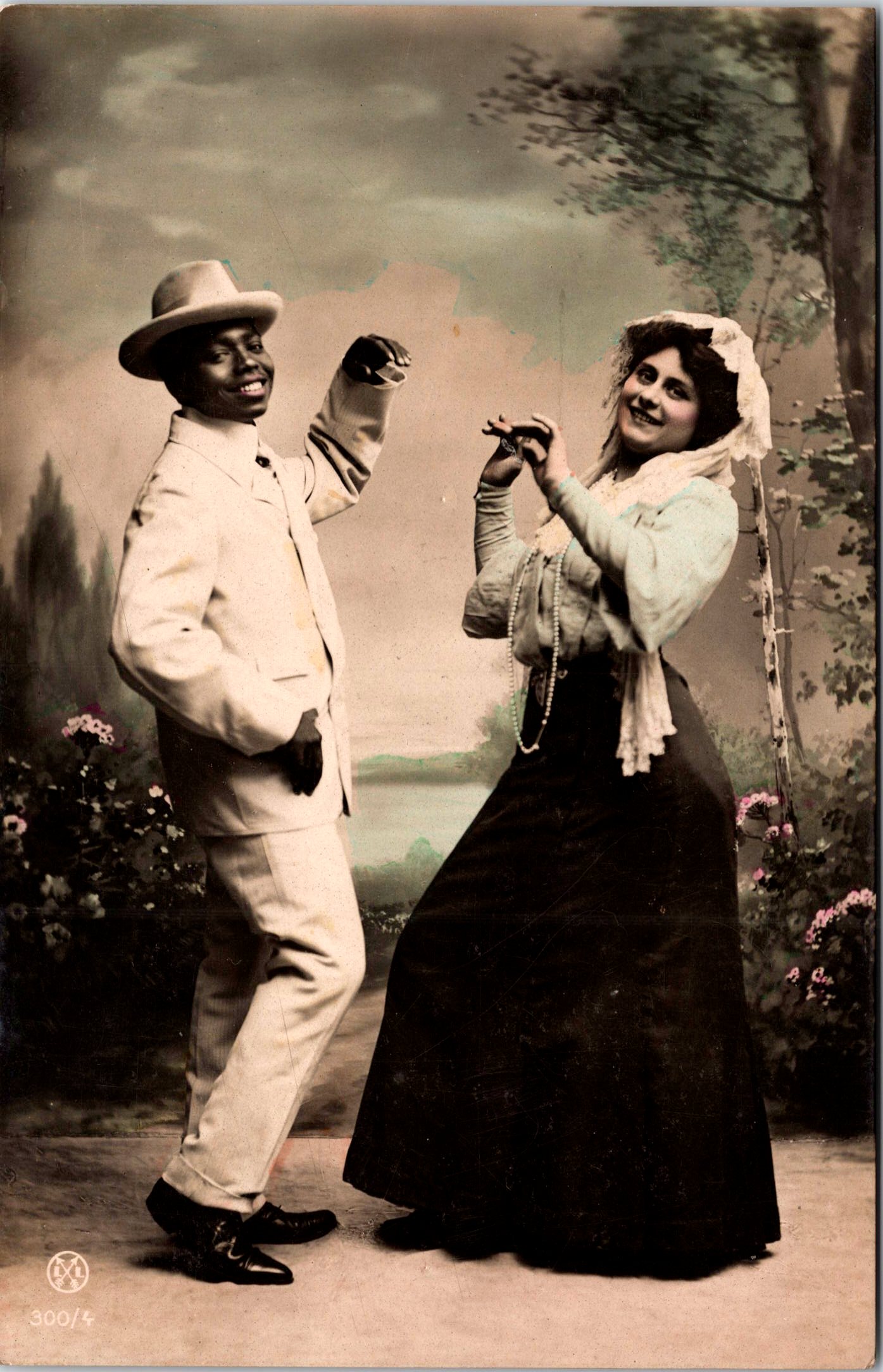
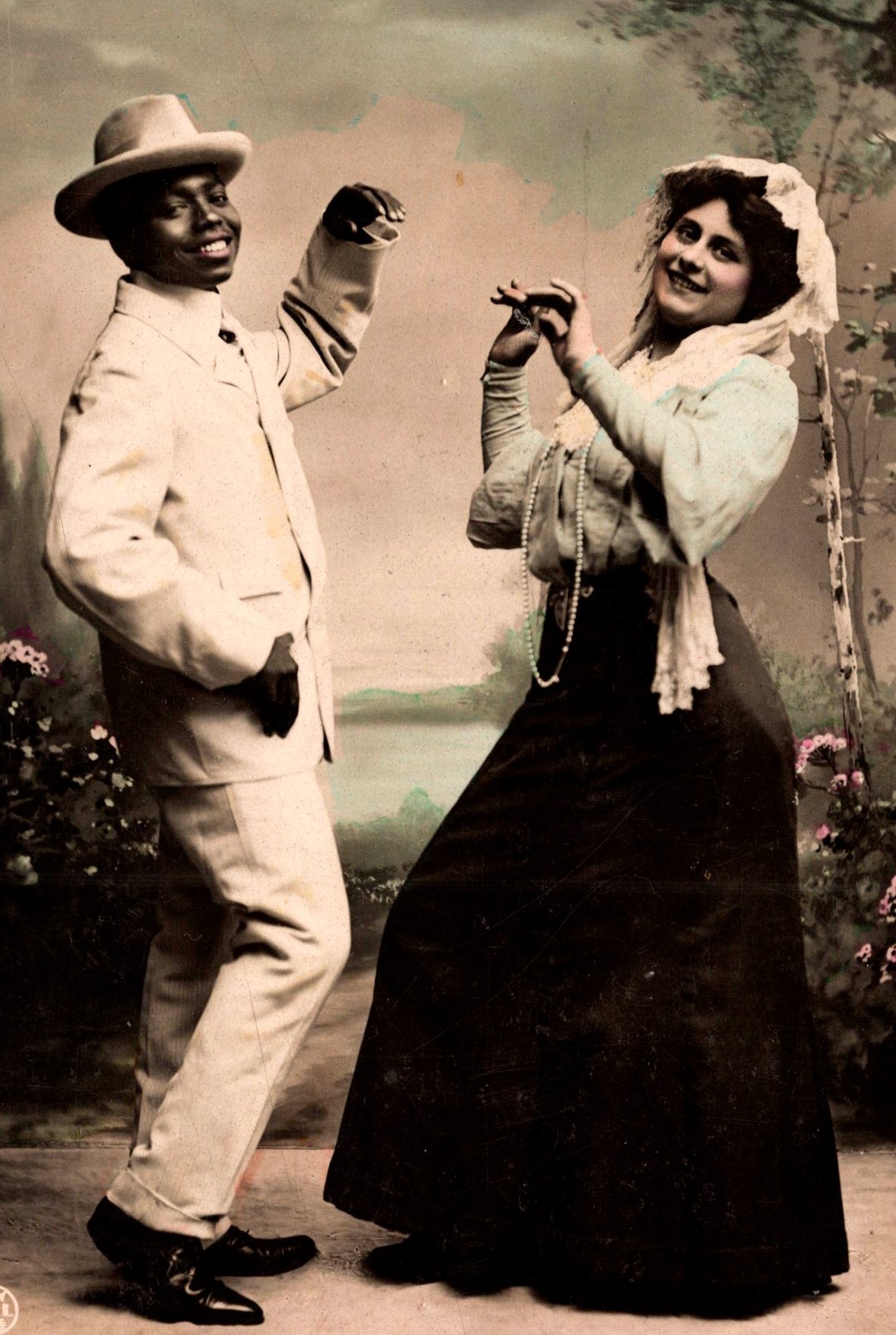
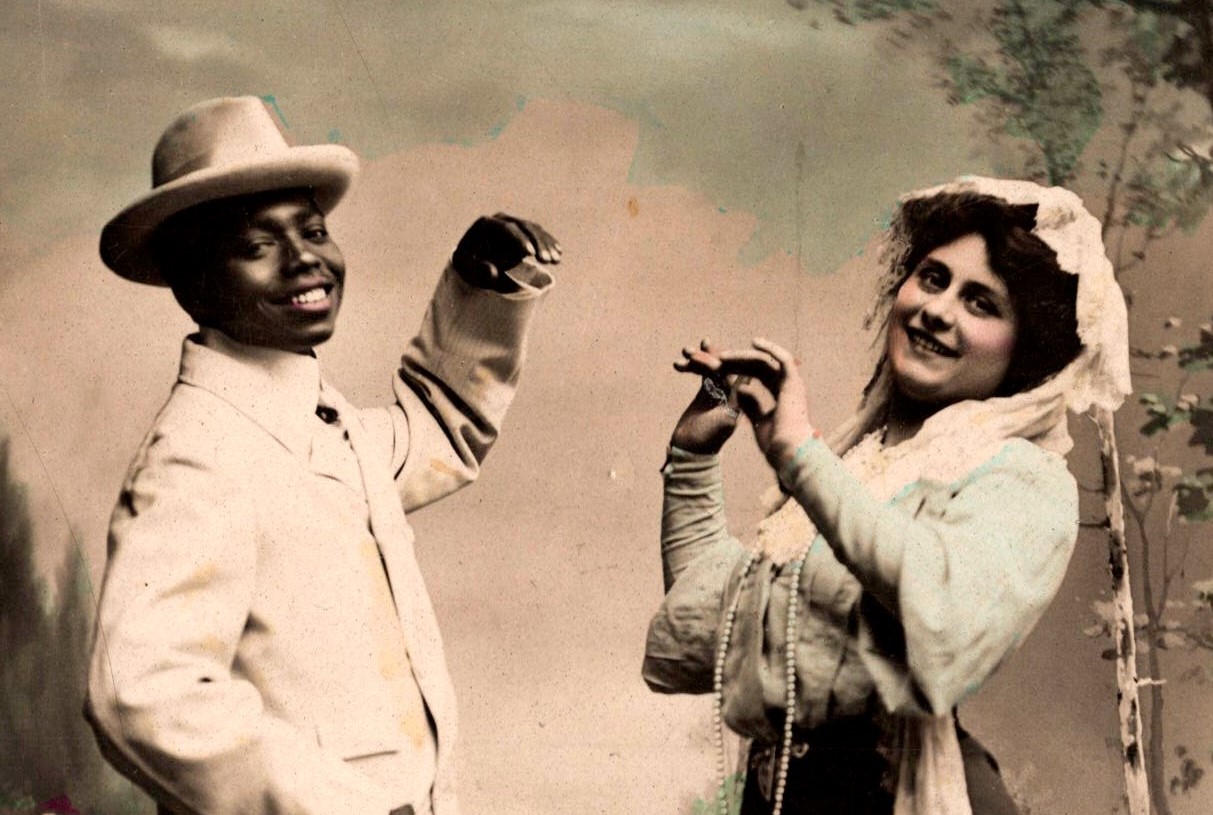
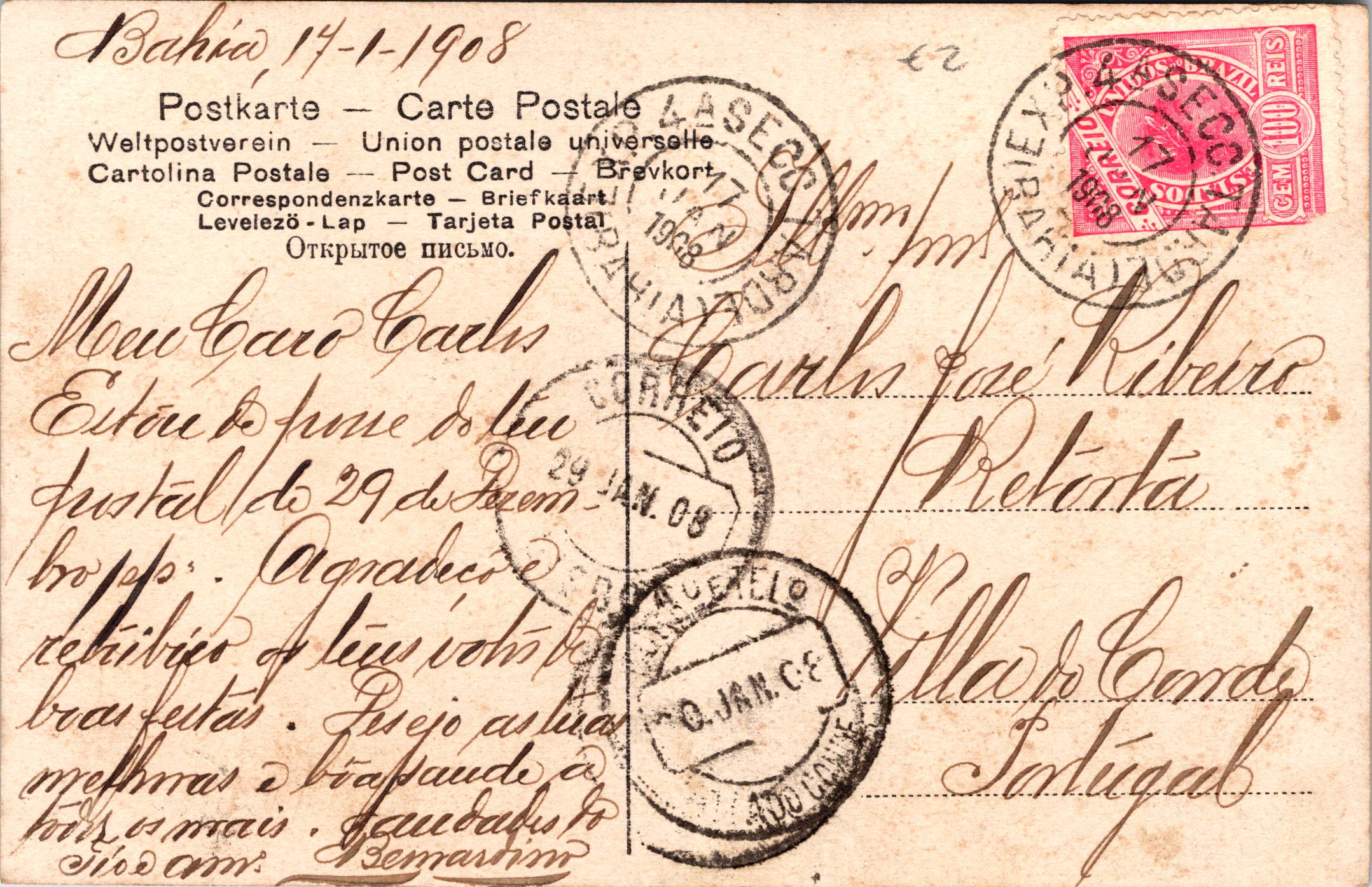
This vintage real photo postcard features an attractive dance couple. It appears that the dancers are from Brazil (judging by the postmark). The male dancer is wearing a very cool white suit while the woman is wearing traditional clothing. Both of the dancers are flashing beautiful smiles. This postcard was published by L. Langebartels. The firm was located in Berlin, Germany and also was a supplier of photographic paper and plates. The card was postmarked in 1908 in Bahia, Brazil. Bahia is in northeastern Brazil. Interestingly, the city’s annual carnaval celebration is known to bring together flamboyantly costumed dancers with samba and axe music for a massive “street party”. Could the couple seen in this postcard be carnaval dancing? SOLD
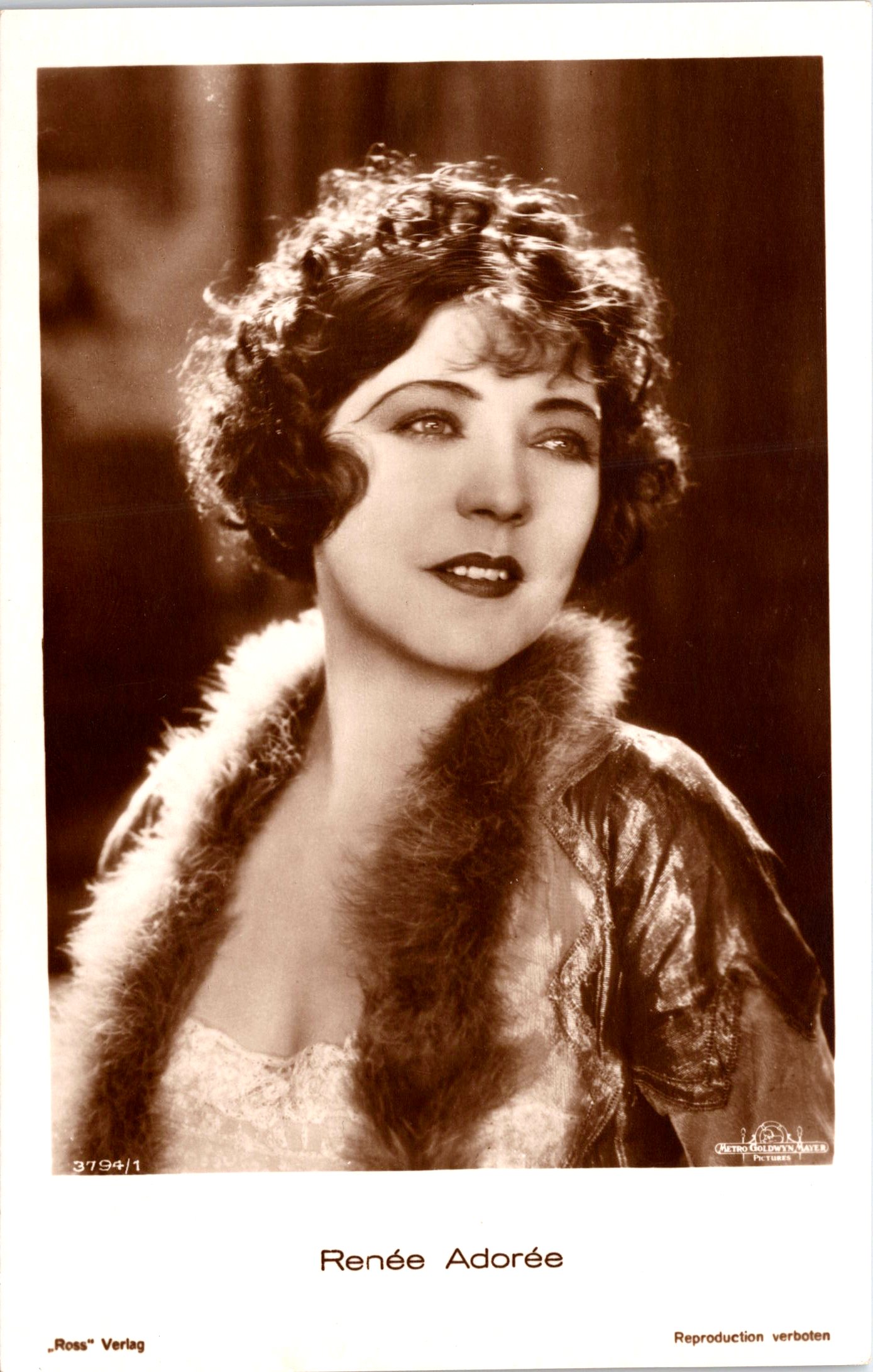
These vintage real photo postcards feature French stage and film actress, Renee Adoree (1898-1933). She also appeared in silent movies produced by Hollywood in the 1910’s. Her most well known film was the melodramatic romance and war epic, “The Big Parade”. She played the love interest of John Gilbert. Renee’s parents were circus artists. She would perform with them at times. She was a dancer, acrobat artist, and bareback rider. She perfomed throughout Europe. She made her movie debut in 1918. In 1919, she went to New York City and played in a vaudeville-style musical. Several other stage appearances followed. In 1920, she began to perform in movies again. In total, Renee performed with John Gilbert nine times. She appeared with actor Ramon Novarro four times. In a 1928 Howard Hughes film, “The Mating Call”, Renee had a brief scene in which she swam in the nude. This act created much controversy. Renee’s personal life included two marriages and two divorces between 1921 and 1929. Renee, unlike many other actresses of her time, was successful in making the transition to sound film. She appeared in four “talkies” before her early death. In all, by the end of 1920, Renee had appeared in forty-five films. The IBDb reports that she appeared in two Broadway productions, both occurred in 1919, It was in 1930 that Renee was diagnosed with tuberculosis. Despite her doctor’s advice, she continued her participation in the filming of a movie. After completing the movie, she was rushed to an Arizona sanitorium. She was flat on her back for two years during her recovery. Post discharge, Renee’s health began to deteriorate until she died in 1933. She was only about 35 years old at the time of her death.
Postcard 1 features Renee in a risque pose. She is dressed quite provocatively. This postcard was published by “Ross Verlag” as part of a series (No.4350/1). SOLD
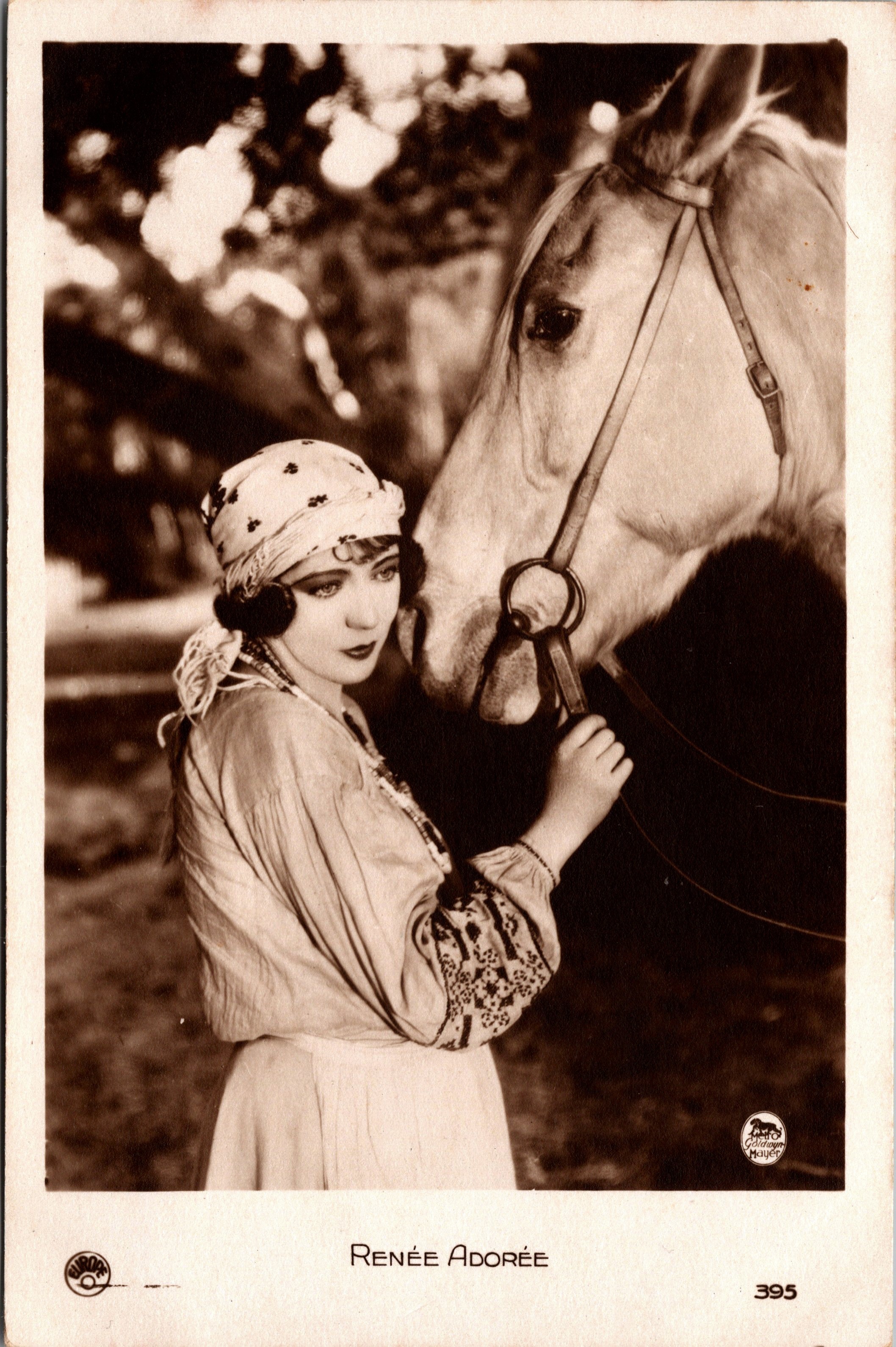
Postcard 2 features Renee standing in front of a horse. She is holding the horse’s harness. Apparently, she liked animals and possessed a sense of humor. She had a dog named “Useless”, and a cat named “Worthless”. The logo for MGM can be seen in the lower right hand corner of the image. She was under contract with MGM from 1930 until her death. This postcard was published by “Europe” as part of a series (No.395). SOLD
Postcard 3 offers a view of Renee that illustrates her beauty. She is fashionable and her attire includes a jacket with a fur collar. The card features a logo for MGM in its lower right corner. The card was published by Ross Verlag and is part of a series (No.3794/1). SOLD
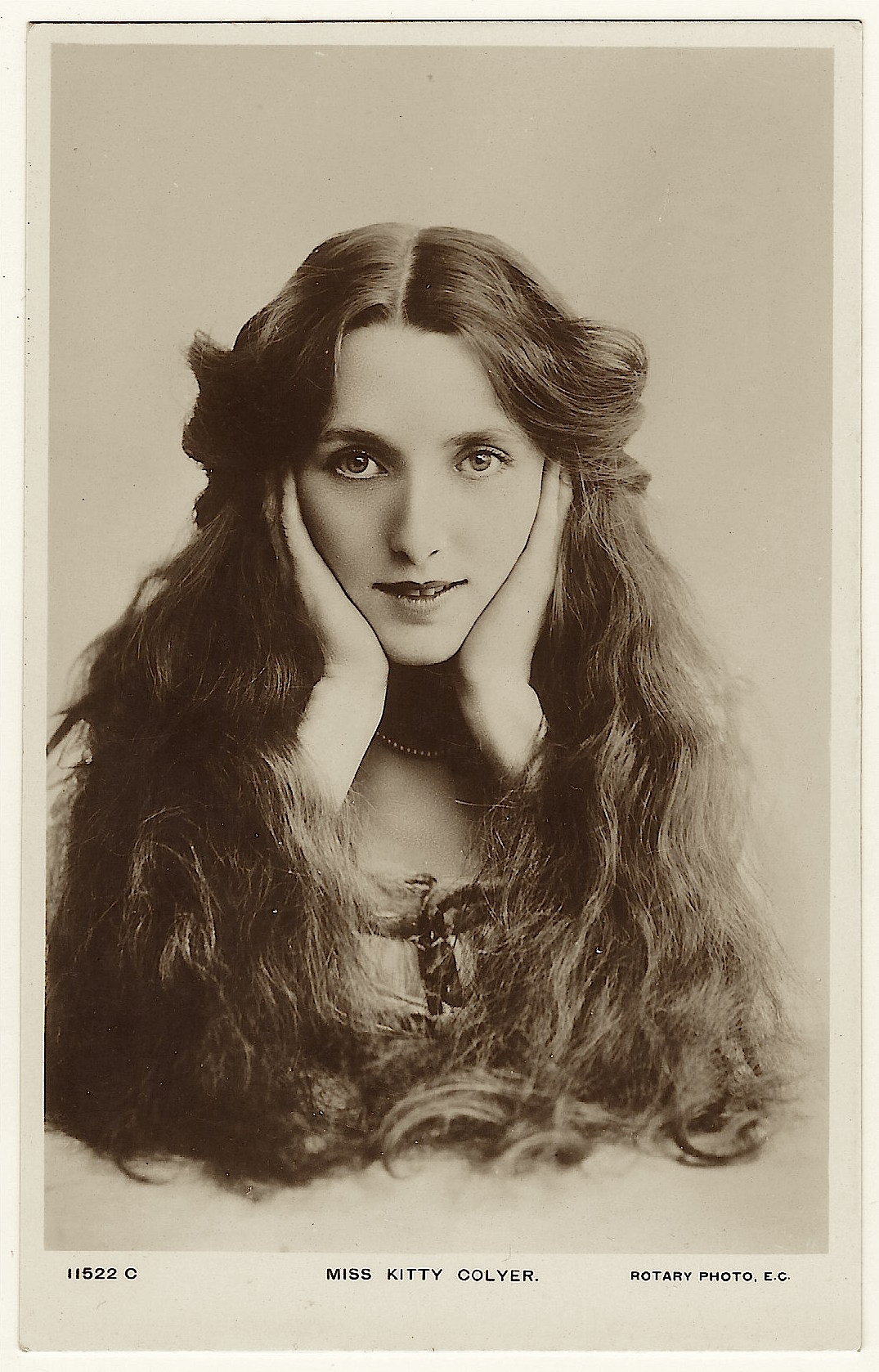
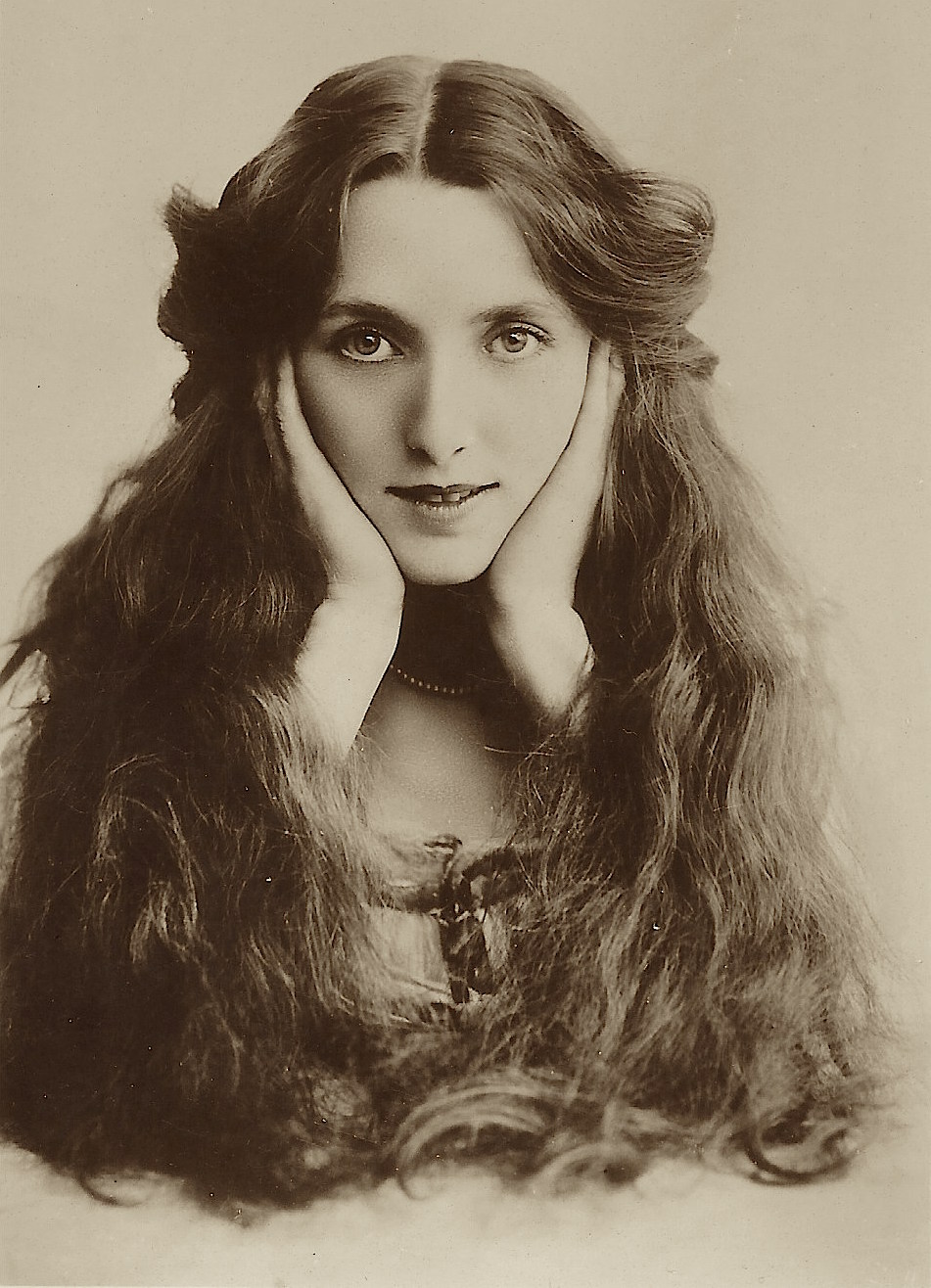
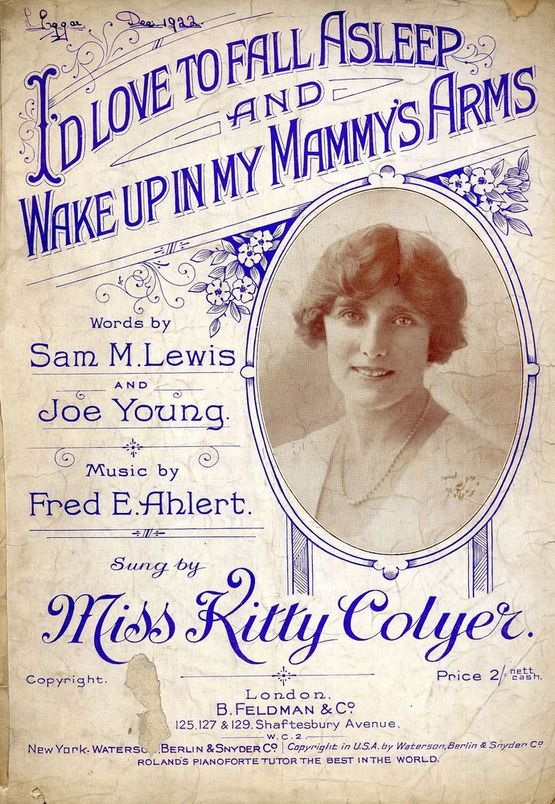
The pretty actress seen in this vintage real photo postcard, is Miss Kitty Colyer (1897-?). Here are some biographical facts that I discovered in preliminary research about the English actress. She started her career at age eleven. In addition to being an actress, she was also a dancer. She has also been described as a music hall singer and a comedian. Her dance routines were varied but her favorites were acrobatic, toe, buck, and national dancing. She performed primarily in the 1920’s. She played the role of Cinderella in “Cinderella” (1920). As the roaring twenties came to a close, her career fizzled out and she left the entertainment business. A review of Miss Colyer can be found in John Culme’s “Footlight Notes” (website). A writer from “The Era” (1911) wrote “Miss Kitty Colyer’s sensational dancing reaches its climax in some very energetic handsprings and her lissomness and activity are quite irresistible in her rendering of “By the Light of the Silvery Moon”. Look below to see an example of sheet music (1920) featuring Kitty Colyer. Now, back to the vintage postcard. It was published by Rotary Photo and is part of the Rotary Photographic Series (no. 11522 C). The photographer is unknown. SOLD
This vintage real photo postcard was mailed in 1903 and features Miss Alex, a lesser known actress or dancer of the Belle Epoque era. She was quite pretty. Many entertainers such as Miss Alex, were more or less prostitutes or “kept women”. Certainly, not all of these women were involved in such a lifestyle, and it is unknown how Miss Alex supported herself. The “Ambassadeurs”, a Paris music hall, is printed on the top right hand corner of the front of the postcard. Miss Alex was probably part of the Ambassadeur’s company of entertainers. This portrait postcard was photographed by Lucien Walery. He was a celebrated Paris photographer known for his portraits of artists and cabaret dancers from the city’s music halls. He is very well known for his portraits of Mata Hari and Josephine Baker. Walery did a lot of work in the genre of nude/erotic photography. He photographed the beautiful women of Paris between the early 1900’s and the 1920’s. This “risque” postcard is part of the Etoile 11 series. SOLD
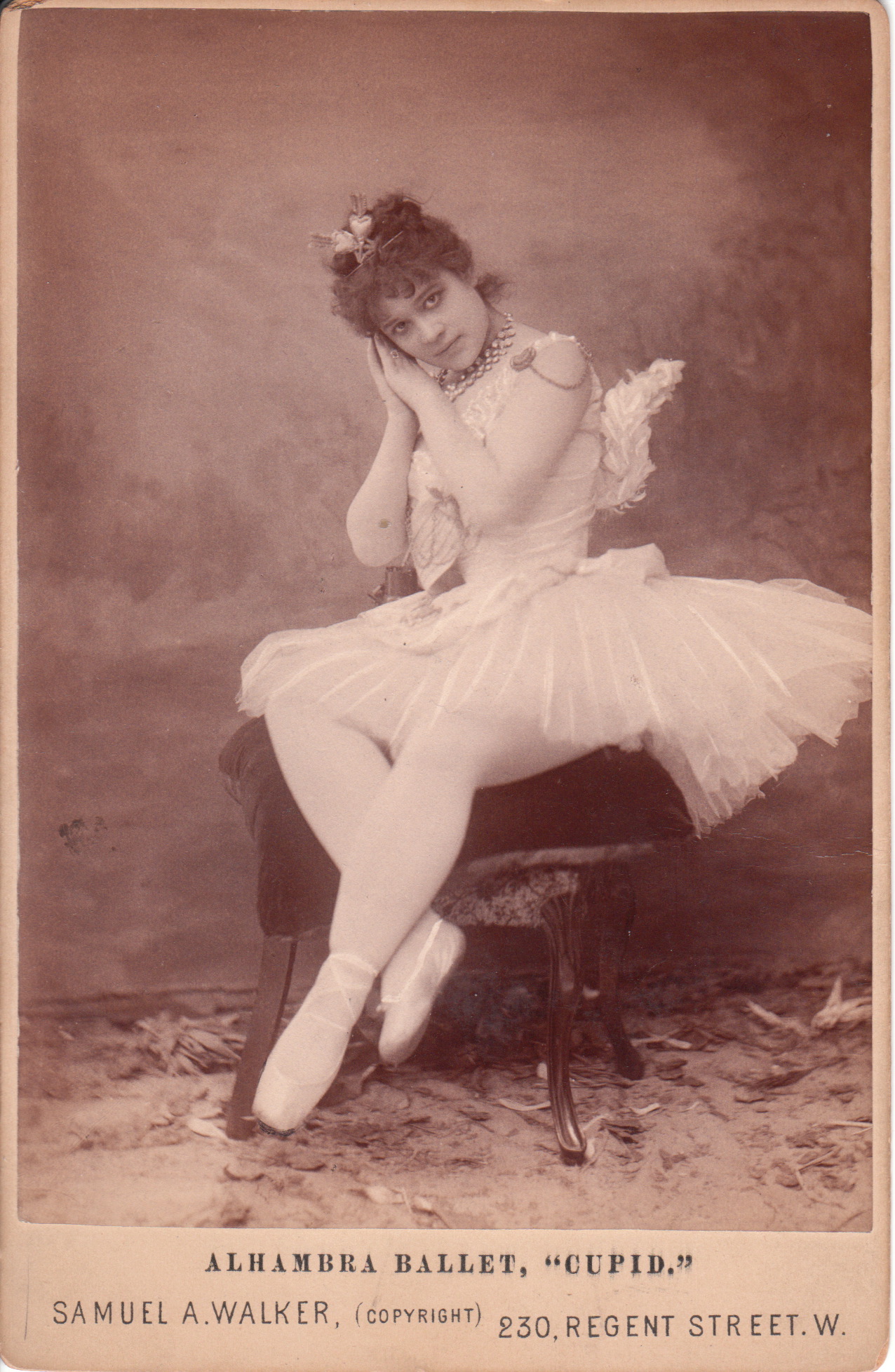
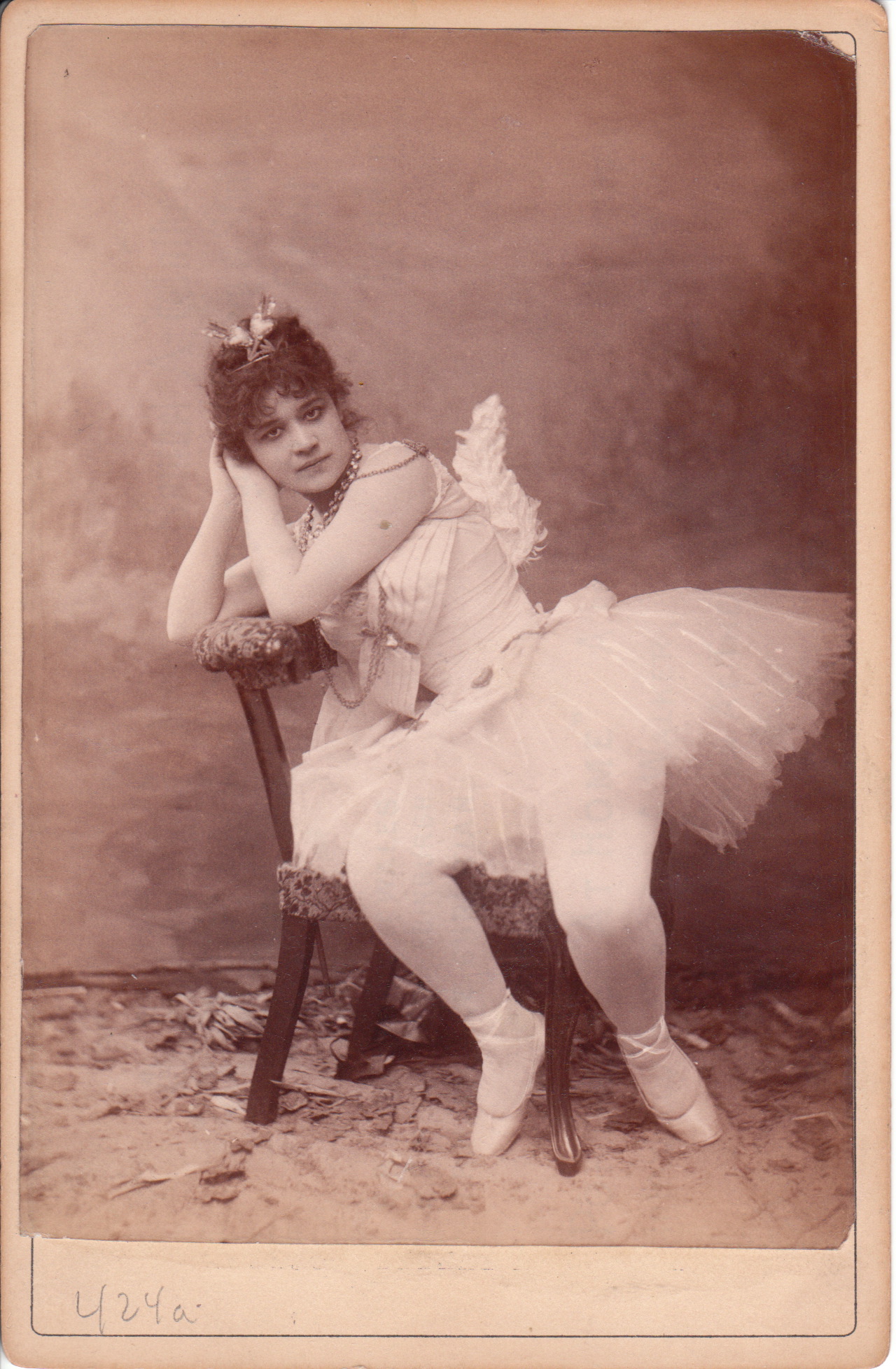
This cabinet card is quite unusual in that it has photographic images on both sides of the card. A very pretty ballet dancer is from the Alhambra Ballet production of Cupid is pictured in each image. In one photograph her legs are crossed while in the second photograph her legs are open and her undergarment is visible through her transparent tutu. The cabinet card is risque for it’s era. The Alhambra was a theatre in London, England. It was opened in 1854 as “The Royal Panopticon”. A circus ring was added and it was reopened in 1858 as the Alhambra. The theatre stage hosted music hall acts, aerial acts, ballet, light opera, and other events. The theatre was closed and demolished in 1936. This cabinet card features a dancer from the ballet, Cupid which opened at the Alhambra on 5/24/1886. The principal dancer in this production was Emma Bessone, and research reveals that the ballerina in this image is likely Emma Bessone. She was an Italian dancer who trained at La Scala and became prima ballerina for both the Maryinsky and Bolshoi companies in Russia. The photographer of this cabinet card was Samuel A. Walker whose studio was located in London. SOLD
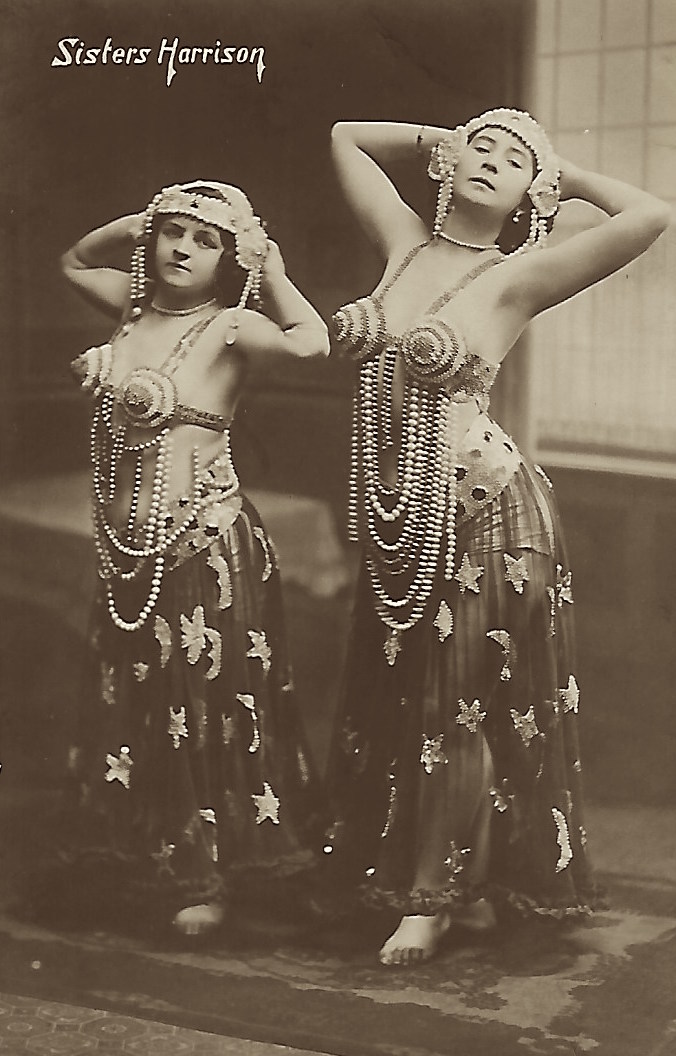
Meet the Harrison Sisters, or the “Sisters Harrison” if you prefer the title on this vintage real photo postcard. The sisters are dressed like belly dancers and perhaps that is their trademark talent. Judging by their expressions, the young women don’t appear to be too interested in their career choice. Note the dancer’s sheer skirts and abundance of jewelry. The provocative skirts and the performer’s bikini top certainly makes this a risque photograph for it’s era. Postcard images such as this often appeared with a Salome theme. Salome, the daughter of Herod II and Herodias is involved in the story of John the Baptist, or more specifically, the head of John the Baptist. Salome was a popular subject in literature, theater, and art around the time that these images were produced. Salome became a symbol for dangerous female seductiveness. To make a long story longer, I am not sure if the inspiration of this postcard’s image is Middle Eastern belly dancing or the temptress Salome. Preliminary research uncovered nothing about the “Sisters Harrison” and clearly more extensive investigation is required. Perhaps the Cabinet Card Gallery’s research department (it’s visitors) have some information to share about these dancing siblings. SOLD
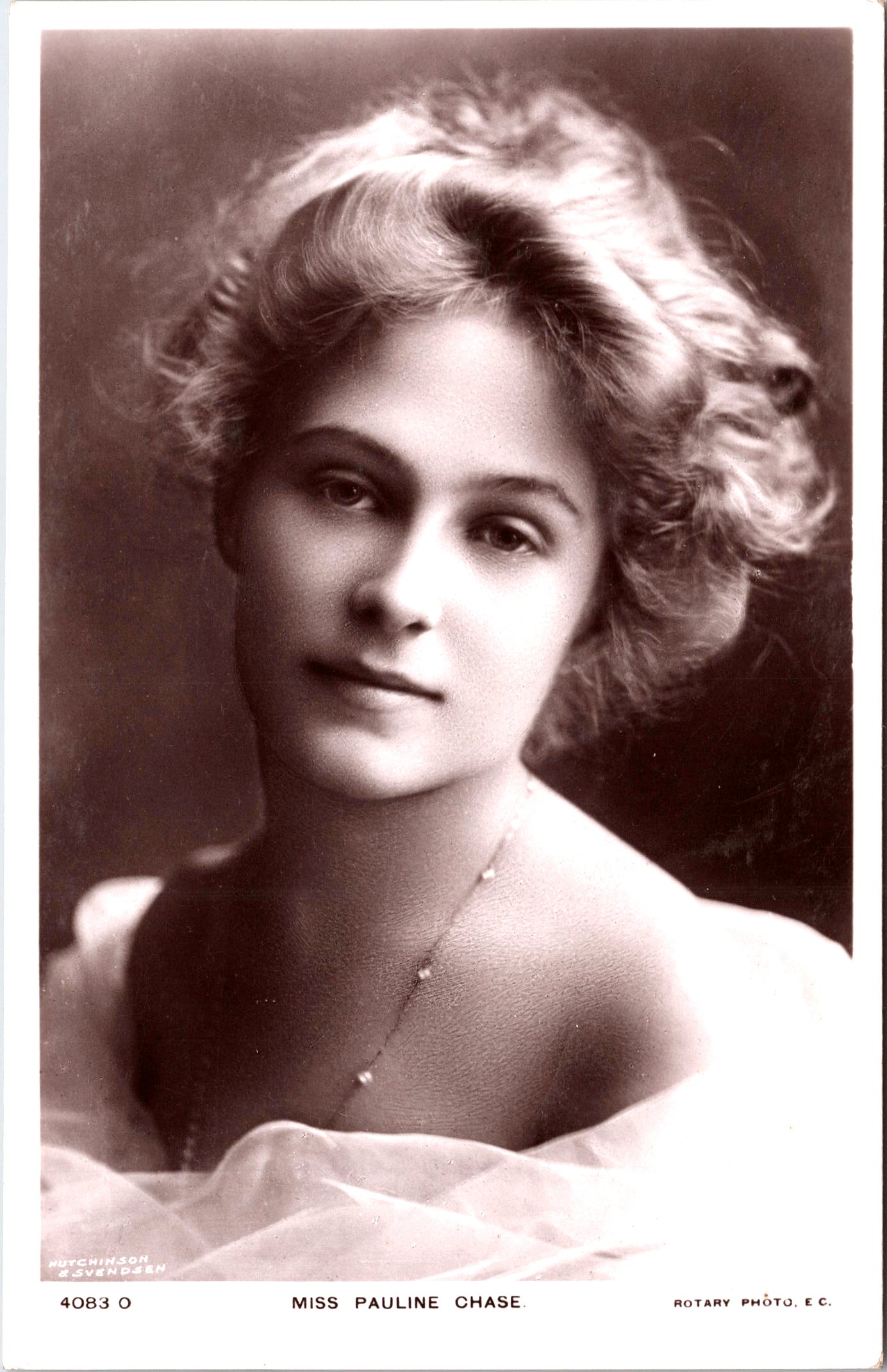
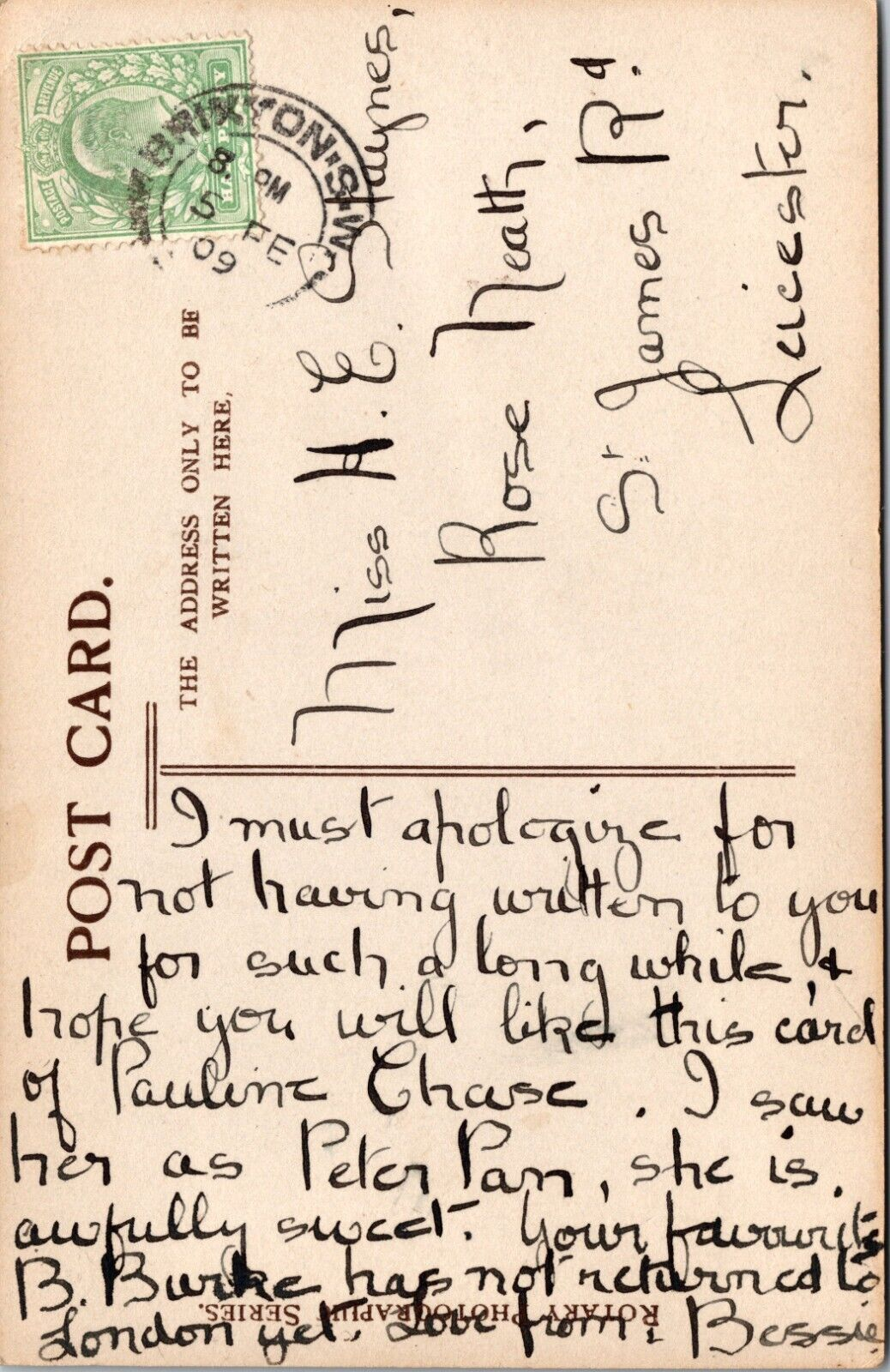
This vintage real photo Postcard 1 features pretty American actress and dancer, Pauline Chase (1885-1962). She was a regular performer both in the United States and the United Kingdom. She is especially known for her extended starring role in the British production of “Peter Pan, The Boy Who Wouldn’t Grow Up”. Her nickname was the “Pocket Venus of New York”. She was born in Washington D.C. and attended school in New York. She began acting when she was just fifteen years old. In 1901, producer, Charles Frohman recruited her to play in the London production of “The Girl From Up There”. She was just 15 years old. Upon her return to the US, she created a sensation as the “Pink Pajama Girl” in “The Liberty Belles”. She played one of the “lost boys” in the debut of Peter Pan (1904) in London. In 1906 she was chosen by producer, Charles Frohman, and playwright, J. M. Barrie, to play the title role in the production (1906-1913). This role brought her much fame and financial security. While in England, over the years, Chase developed quite a following. Charles Frohman had become her friend and mentor. Chase was a social beauty with many influential friends and admirers. She was a member of the socially elite and lived an extravagant life style. In 1913, Chase retired from the stage to marry a banker. The pair had three children. In 1916, Chase came out of retirement to play in her one and only movie appearance. There are 52 portraits of Chase in the National Portrait Gallery. The film “The Real Thing At Last” was a satirical film, based on MacBeth, written by Barrie. This postcard has a 1907 postmark. The card was published by Rotary Photo as part of a series (No.4083O). Miss Chase’s photograph was taken by the Hutchinson & Svendsen studio. (SOLD)
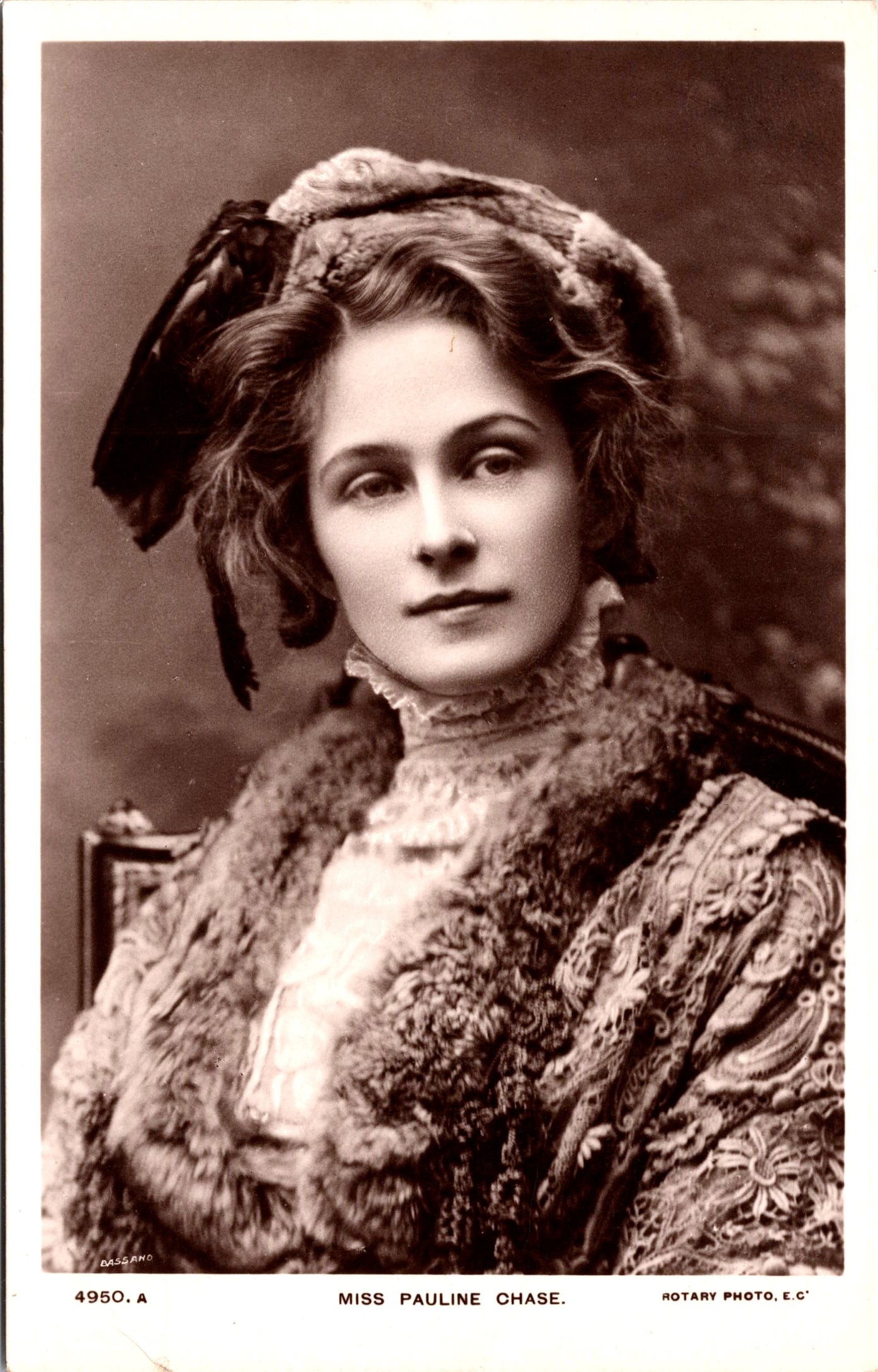
Postcard 2 was published by Rotary Photo as part of a series (No.4950A). Miss Chase’s photograph was taken by Alexander Bassano. (SOLD)
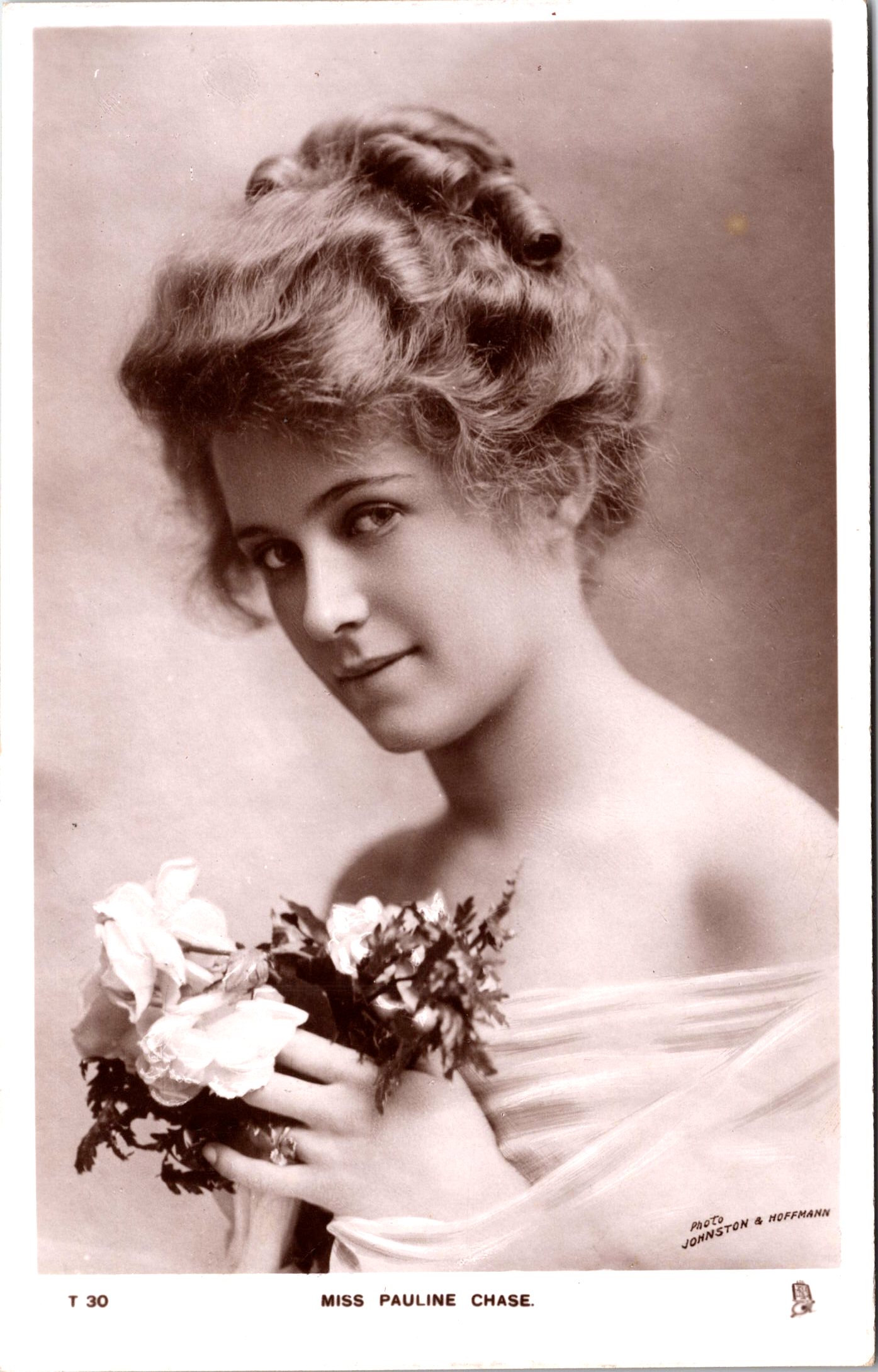
Postcard 3 has a 1907 postmark. The card was published by Raphael Tuck & Sons as part of a series (No.T30). Miss Chase’s photograph was taken by the Johnston & Hoffmann studio. (SOLD)
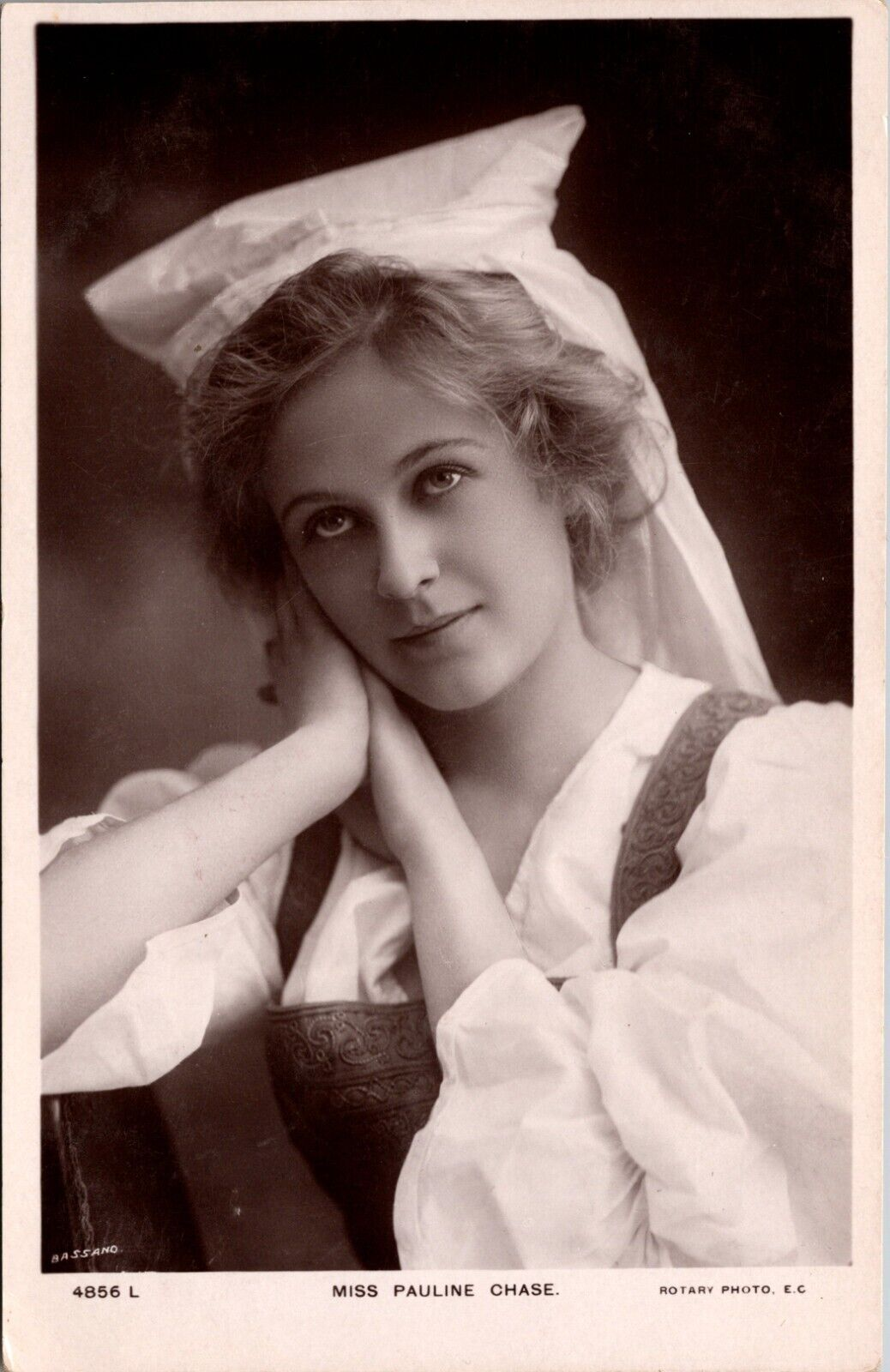
Postcard 4 features Chase wearing an interesting lace hat and she has a sweet, pure, and innocent appearance. This postcard was published circa 1909, the date of the cards postmark. The card was published by Rotary Photo as part of a series (No.4856L). Miss Chase’s photograph was taken by the Bassano studio. (SOLD)
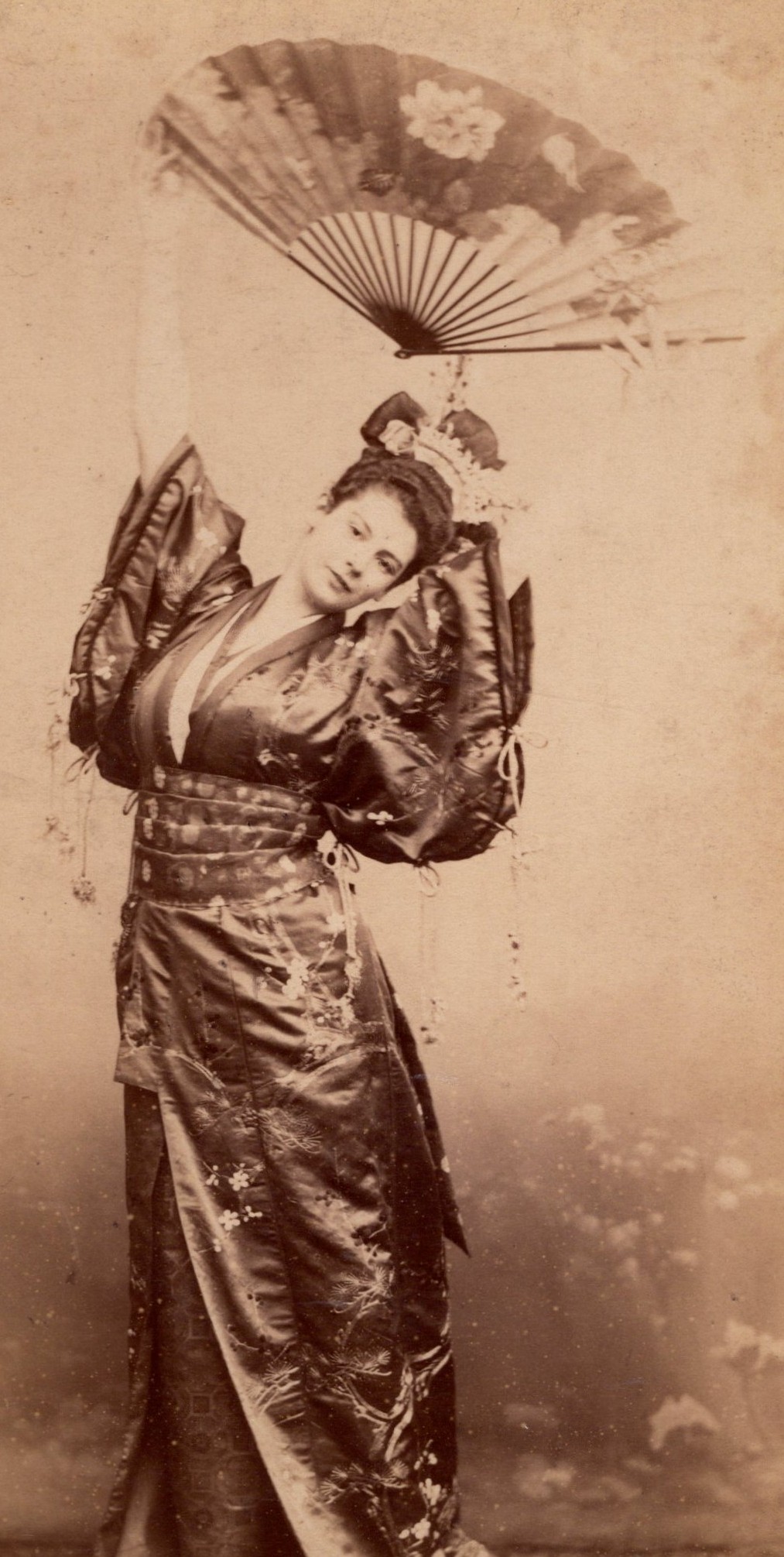
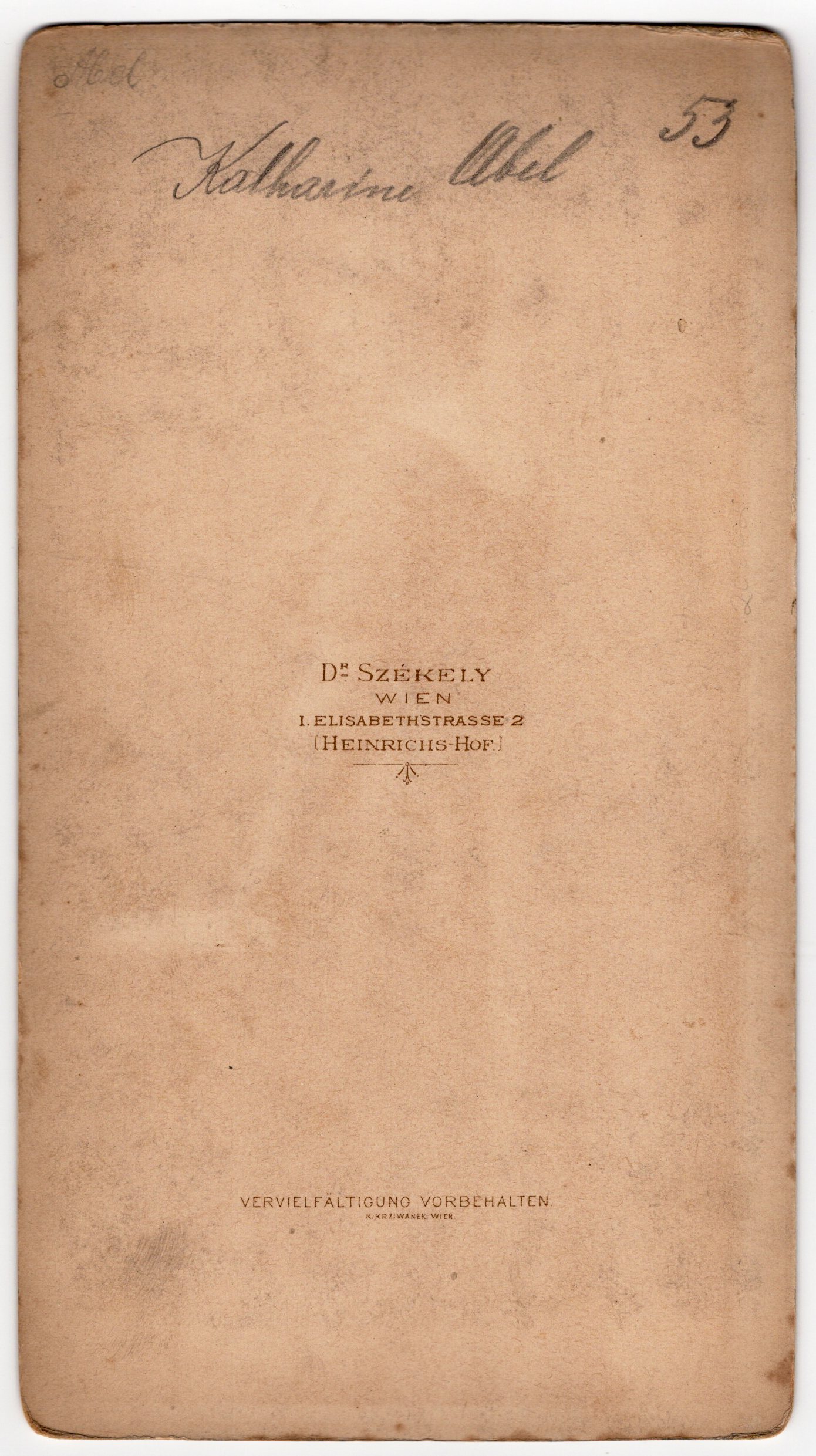
This cabinet card features Katharina Abel (1856 –1904), a distinguished Austrian ballerina renowned for her tenure as a solo dancer at the Vienna Court Opera (now the Vienna State Opera). She was born in Vienna. Abel was accepted into the ballet school of the Kärntnertortheater at the age of twelve. Under the tutelage of ballet mistress Johanna Telle, she honed her skills in classical dance. In 1871, Abel joined the Vienna Court Opera. She captivated audiences with her grace and charm, particularly excelling in pantomimic roles. Her breakthrough came on October 4, 1879, when she performed as the leader of the Amazons in the ballet “Dyellah oder die Reise nach Indien.” Her compelling performance led to her appointment as a solo dancer at the opera. Throughout her career, Abel starred in numerous productions, including the ballet “Coppélia” and the operas “Die schöne Melusine” by Louis Schindelmeisser and “Die Stumme von Portici,” where she portrayed Fenella. She also featured prominently in divertissements such as “Wiener Walzer,” “Die Puppenfee,” “Sonne und Erde,” “Fantasca,” “Fata Morgana,” and “Der Stock im Eisen. In 1890, Abel married Count Georg Orssich von Slavetich, who was ten years her junior. The couple resided on the count’s estate in Theresienfeld. Prior to her marriage, Abel had a daughter born in 1876. The father’s identity remains undisclosed. Abel’s illustrious career was abruptly halted during a performance of “Giselle” when a mechanical failure caused her to fall approximately ten feet onto the stage, resulting in a foot injury that ended her solo performances. She continued to engage audiences in pantomimic roles for a time. In 1892, she retired from the stage. Despite undergoing multiple surgeries, Abel succumbed to cancer in 1904. This photograph is a striking portrait of Abel. Abel is adorned in an elaborate costume that reflects her talent for embodying diverse and exotic roles on stage. She wears a kimono-style garment, richly embroidered with intricate floral patterns. The fabric’s texture and sheen suggest luxurious materials befitting her status as a renowned performer. Her theatrical pose, with arms gracefully extended and a large fan arched behind her head, exudes poise and fluidity. The delicate placement of her hands and the tilt of her head convey a sense of grace. This cabinet card photograph was taken in 1888 by Dr. Josef Szekely (1838-1901). He captured her performance in “The Doll Fairy”. Székely was an Austro-Hungarian chemist and photographer renowned for his contributions to early photography in Central and Southeastern Europe. He had a master’s degree in pharmacy and a doctorate in chemistry. He taught at the University of Vienna before becoming a photographer. He was very successful as a photographer. Székely’s work garnered international acclaim. He was awarded the Bronze Prize at the 1867 World’s Fair in Paris and a silver medal in 1878. His studio produced portraits of many notable figures. This photograph is in the collection of the Theater Museum in Vienna. This cabinet card measures approximately 4.25 x 8 inches, which is larger than the standard cabinet card. SOLD
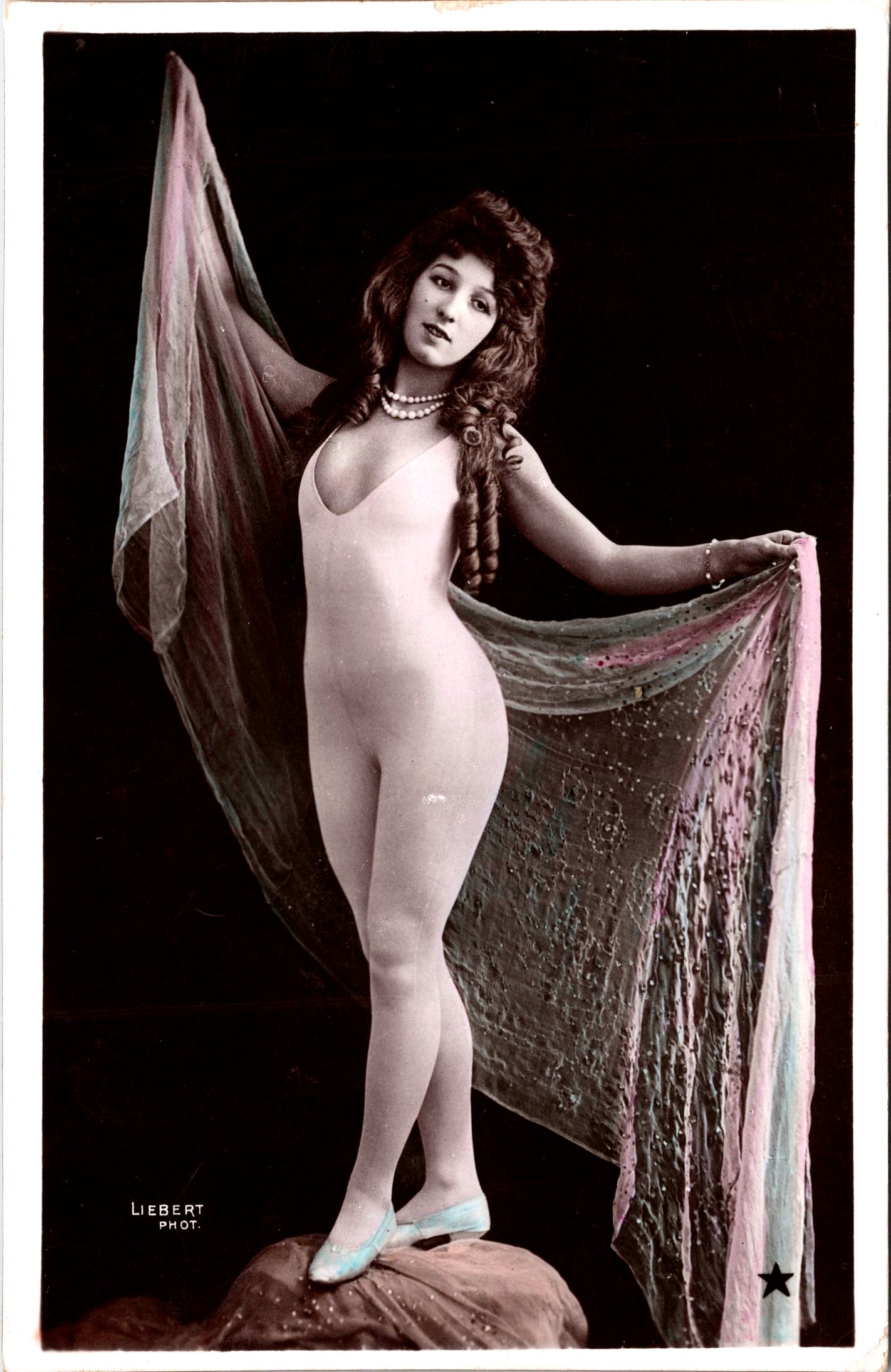
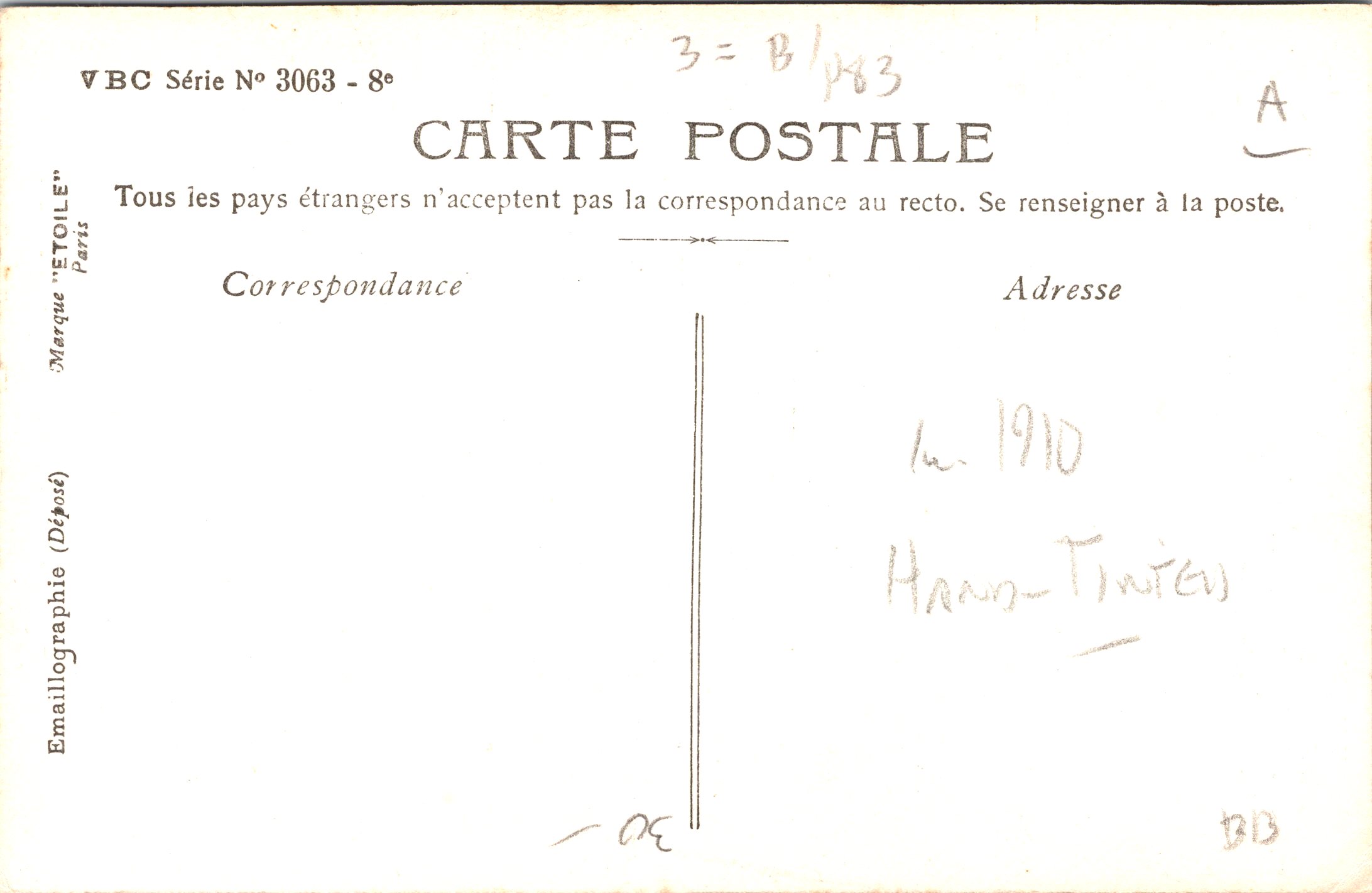
This vintage real photo postcard features an unidentified pretty performer. She is posed like a dancer. This is a risque postcard. She is wearing a flesh colored body suit and is posed in a provocative manner. The model on this card was likely a minor player based on the fact that she is not named on the postcard. This photo was taken at the studio of A. Liebert, in Paris, France. The Getty Museum, located in Los Angeles, California, as well as other fine museums, have photographs in their collections by Paris photographer, Alphonse J. Liebert (1827-1913). Many of his Parisian subjects were actresses. Perhaps Miss Lesian is one of those actresses. Mr. Liebert has an interesting story. He was a photographer in Nevada City, California (1857-1862), and later, operated in Paris (1863-1890’s). He was born in France. He became an officer in the French Navy. He left the navy in 1848 to study daguerreotypy. He must have reenlisted in the navy because In 1851, he arrived in San Francisco, as a Lieutenant on a French ship. This was a time when there was much excitement about Gold mining. As a result, there was a mass desertion of the ship’s crew. The sailors joined the rush for gold. Liebert had in mind, his own venture. He and two partners decided to take on the project of refurbishing a steamship. They sought investors and hired workers to transform the ship. However, due to the partners inexperience, the venture failed. Liebert than tried gold mining but met little success. In 1857 he opened a photo gallery in Nevada City. He lost thousands of dollars after a fire in 1858. In 1859 Liebert ridiculed a former photography pupil of his, named Louis Celarie, in the press. This started a bitter professional feud. Soon after, Liebert announced that he had won a medal at the state fair. Unfortunately, there was no evidence to confirm this claim. The competition between Liebert and Celarie was fierce. Each offered special promotions to best the other. By 1861, Liebert triumphed, evidenced by the sale of Celarie’s studio. About a year later, Liebert sold his photo gallery. By 1863, he had returned to France and opened a gallery specializing in tintypes. Liebert closely identified with his photography experience in America, and as a result, he named his Paris gallery “Photographie Americaine”. Liebert began to write photography articles and books, and ultimately, invented a prototype solar camera. In 1867, Liebert had a problem with the law. He was sentenced to two months in prison and levied a fine of 200 francs. He was charged for the intent to distribute banned post mortem photographs. These were not photos of some random person. Instead, they were images of Emperor Maximillian, who had been executed in Mexico. Liebert ultimately did exhibit these photos. Liebert was becoming more and more successful. His photo gallery was so lavish that a reviewer for the British Journal of Photography wrote that it was “worthy of the smiles of the ‘God of Light’, and a repository for some of the best productions of the photographic art”. In 1879, Liebert’s gallery was the first studio to utilize electric light. By 1880, he was considered to have the most impressive photo studio in Paris. . The card was published by Star or Etoille Publishing (Paris). This postcard image was created by a process called “emaillographie”. It is interesting to note that the first five letter of the process are “email”. This postcard was part of the V B C series (No.3063). SOLD



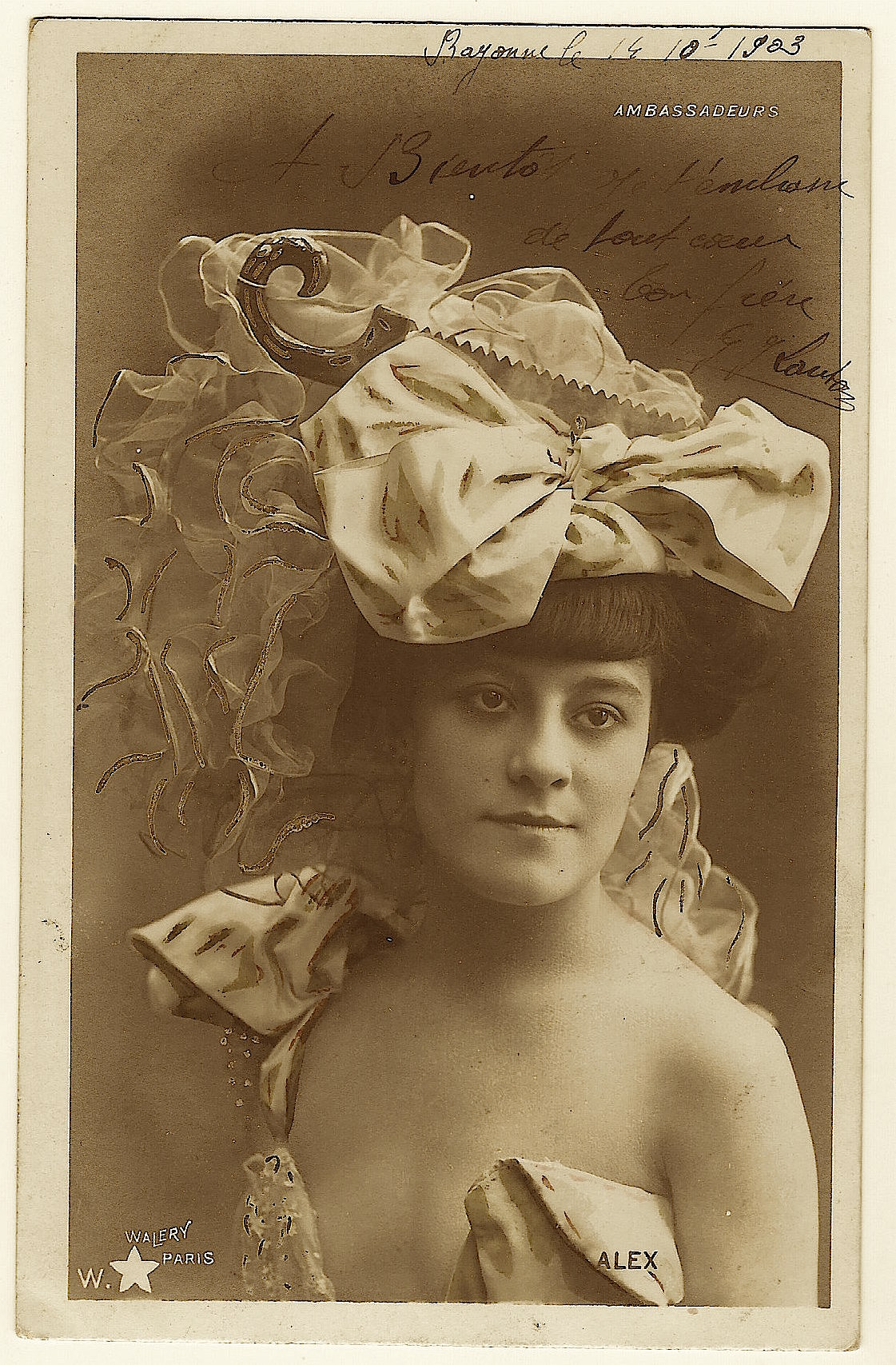 This vintage real photo postcard was mailed in 1903 and features Miss Alex, a lesser known actress or dancer of the Belle Epoque era. She was quite pretty. Many entertainers such as Miss Alex, were more or less prostitutes or “kept women”. Certainly, not all of these women were involved in such a lifestyle, and it is unknown how Miss Alex supported herself.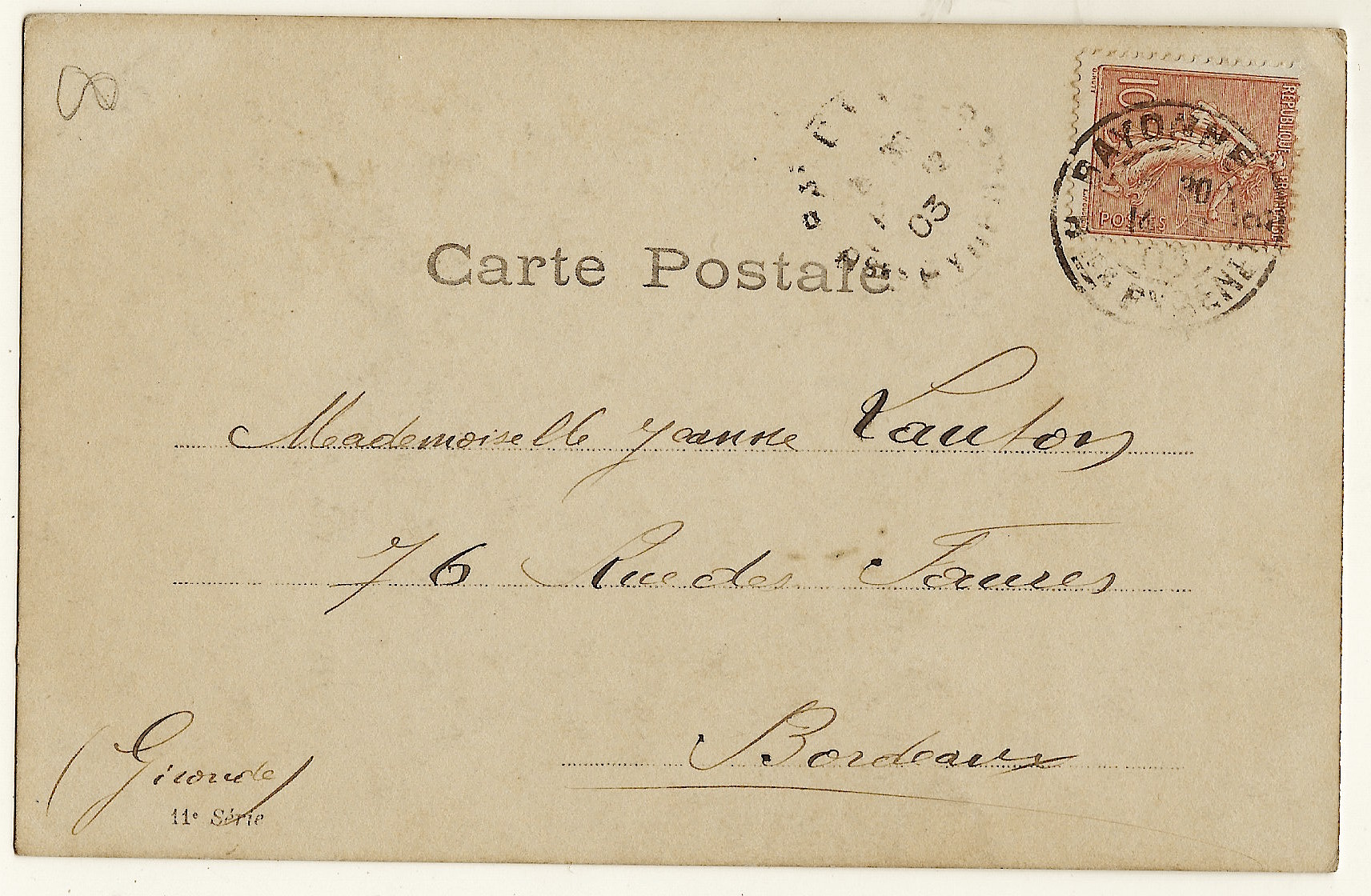



 THE CABINET CARD GALLERY