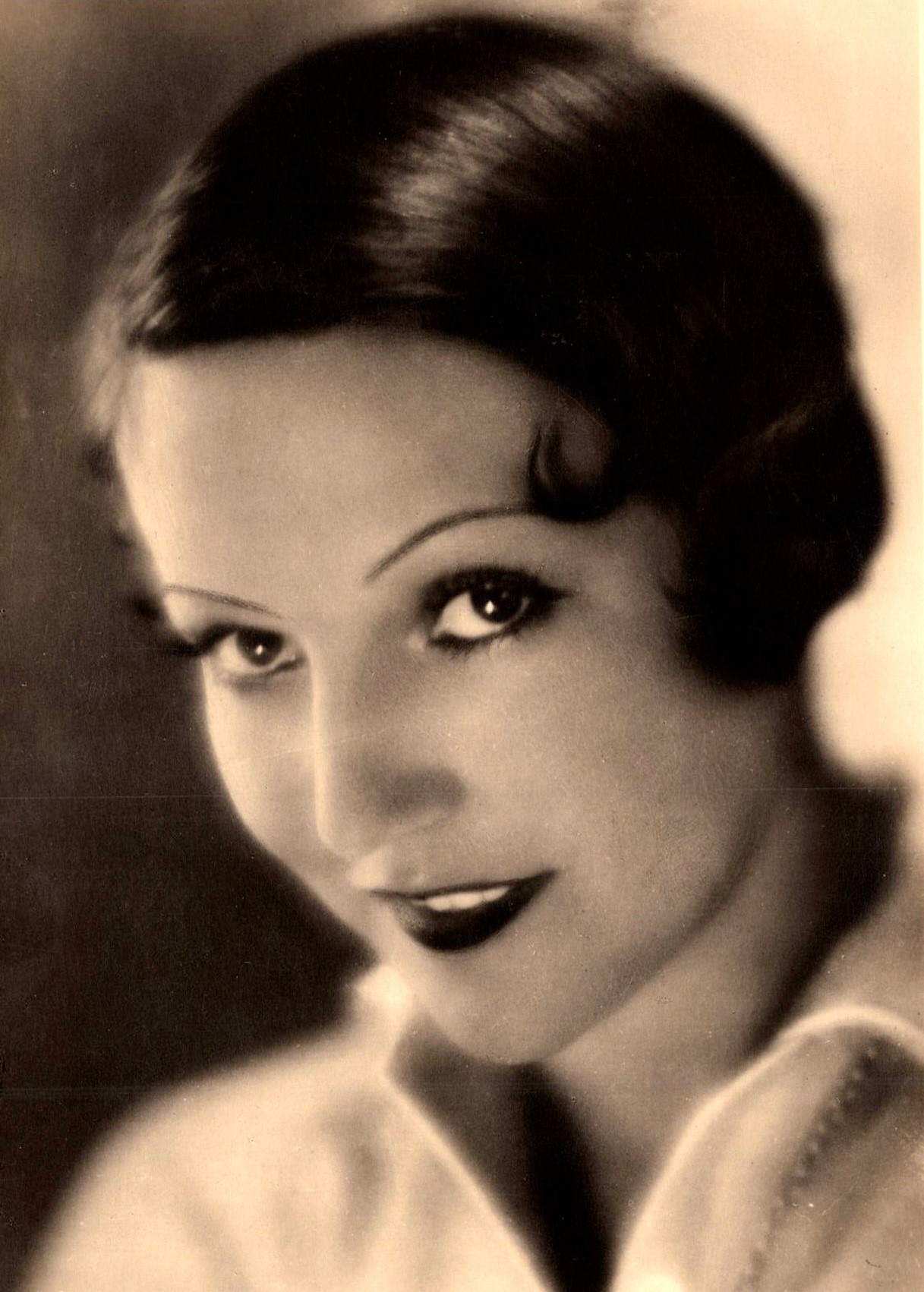
NINE PORTRAITS OF PRETTY EUROPEAN STAGE ACTRESS LIANE HAID

haid

POSTCARD 1

haid-2

POSTCARD 2

haid 3

      POSTCARD 3  (SOLD) 

estonia1

POSTCARD 4   (SOLD)

This image has an empty alt attribute; its file name is haid10.jpg

POSTCARD 5

This image has an empty alt attribute; its file name is haid1_0001.jpg

POSTCARD 6  (SOLD)

POSTCARD 7  (SOLD)

POSTCARD 8 (SOLD)
POSTCARD 9 (SOLD)

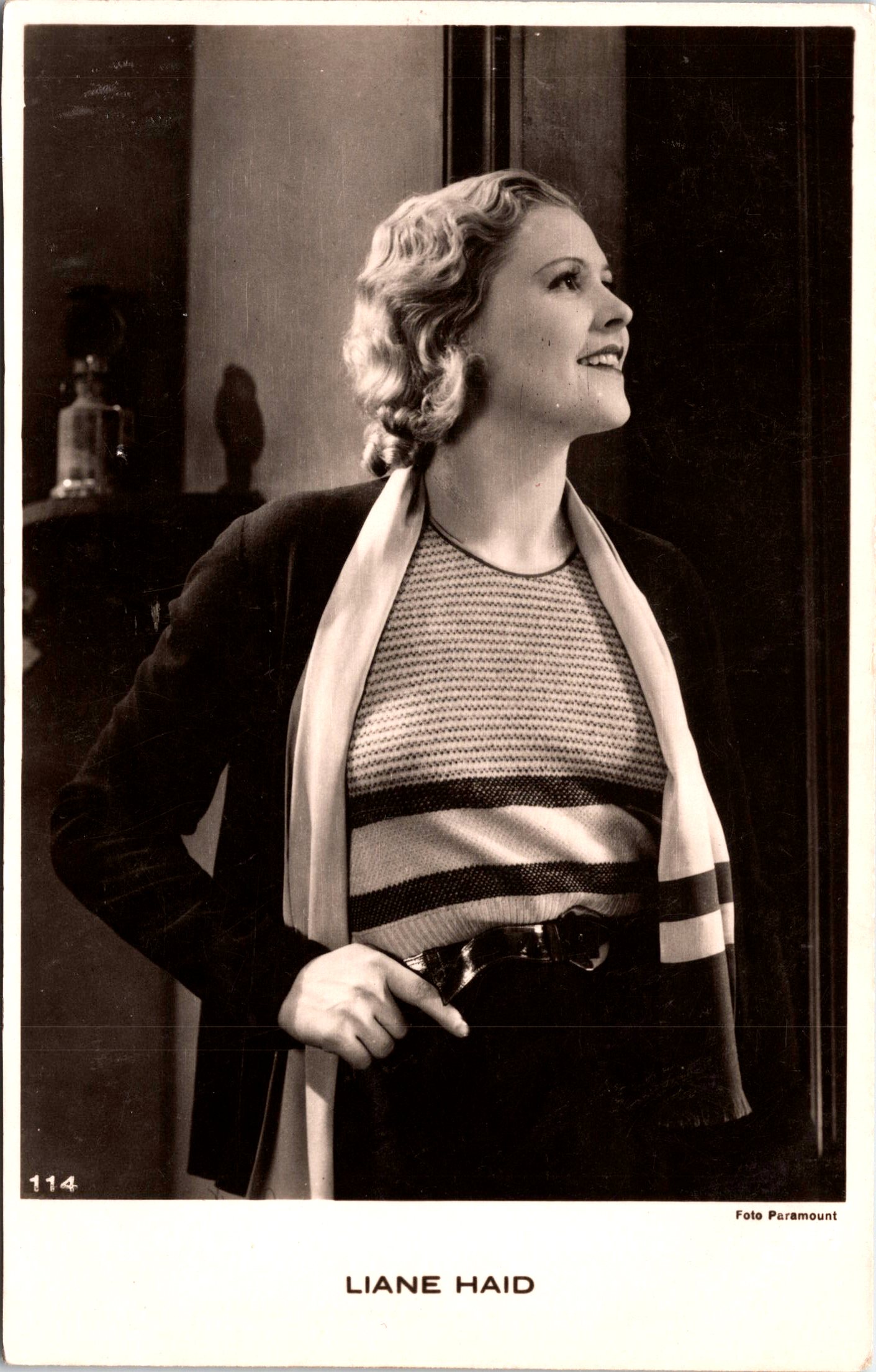
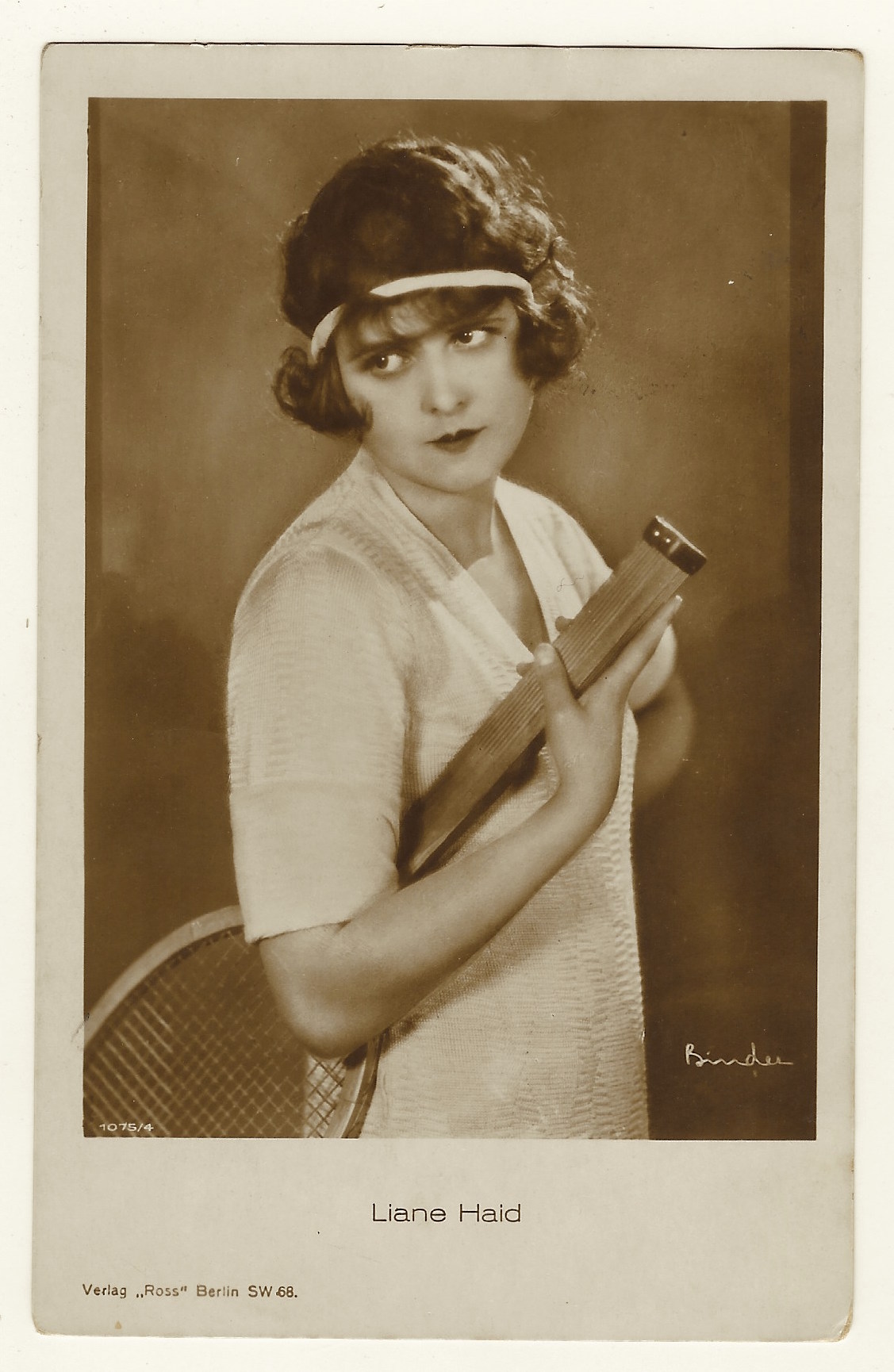
These vintage real photo postcards feature European film star Liane Haid (1895-2000). In the top postcard she poses holding a tennis racket and wearing a hair band to keep her hair out of her eyes. She is quite beautiful but how can we interpret her facial expression. To me, it looks like she is rolling her eyes as if she is bothered by something. Who is Liane Haid? She was born in Vienna, Austria and received training in both dance and singing. She gained the nickname of “Sweet Viennese Girl”. Haid was a prima ballerina, dancer, singer and stage actress. She worked in Budapest and Vienna as a dancer. Her stage career was mostly in Berlin and Vienna. She became a popular pin-up star through the 1920’s and 1930’s. Her first movie role was in a World War I propaganda film. She was employed by UFA and appeared in a number of comedy films  alongside other movie stars including Willi Forst, Bruno Kastner, and Georg Alexander. UFA was a major German Film producer and distributor that operated between 1917 through the end of World War II. Liane Haid refused a number of Hollywood offers but in 1942, she escaped Nazi Germany and went to Switzerland according to Wikipedia, “because of the regime, because everything was bombed, and because all the good directors had left”. Soon thereafter she got married and retired from films. She was married three times. The IMDB web site states that she has 92 film credits from 1915 through 1953. Notable films include “Lady Hamilton” (1921), “Lucrezia Borgia” (1926), and “The Song is Ended” (1930). The photographer of this terrific image was Alexander Binder (1888-1929). He had the largest photo studio in Europe during the late 1920’s and the 1930’s. Many of his entertainment star portraits appear on Ross Verlag postards. It is thought that Binder was of Swiss origin. He was of the Jewish faith. He studied engineering but did not complete his studies. From 1908 to 1910 he studied photography at a school in Munich, Germany. After the completion of his photography studies, he went to Berlin and in 1913 opened his first photography studio. Before long, he became one of the premier photographers in Berlin.  He primarily focussed on fashion and celebrity photography. Since Berlin was the capital of the European film industry, Binder photographed all the stars of the European film industry including, Lilian Harvey, Conrad Veidt, and Lya De Putti. Many of his images were used in popular film portrait postcards. His photographs could be seen in postcards published by Ross Verlag and Photochemie. Binder died in 1929 but new photo cards bearing his signature continued to be published until 1937. It is thought that the real photographer of these new postcards was Hubs Floeter (1910-1974) who was employed at the studio as an operator. The studio continued to be owned by Binder’s widow, Mrs. Binder Alleman and their two daughters. The studio was managed by the Jewish Elisabeth Baroness Vonhedlis Stengel who was later deported to the Theresienstadt concentration camp. In 1938 the Nazi’s closed Binder’s studio and it was later taken over by an Aryan photographer, Karl Ludwig Haenchen . Haenchen continued to produce celebrity portraits for postcards. His publishers included Film-Foto-Verlag. After World War II the studio was taken over by the Hasse und Wiese company.               

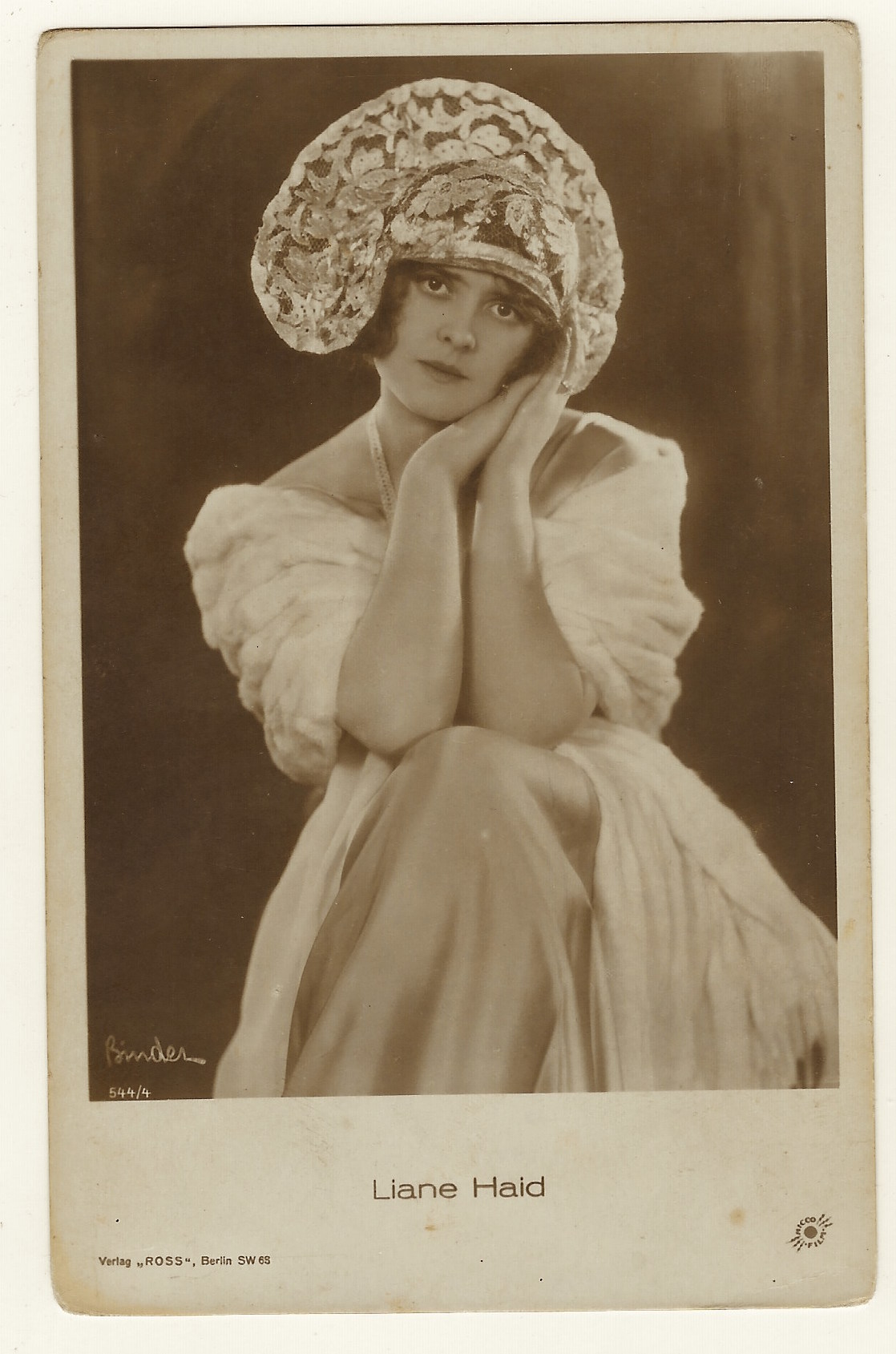
 The second vintage postcard portrait of Miss Haid was also the work of Alexander Binder. The actress looks beautiful in her art deco lace headdress. Her eyes can be described as spell binding. The postcard was published by Germany’s Ross Verlag and is part of a series (no. 544/4). Also credited for this photograph is “Micco Film”. Before working for Micco Film, Haid was employed by Kunstfilm. She was very successful working for the company but in 1920 she sued the company for physically exploiting her (placing her in dangerous situations) and for making her financially responsible for her own makeup and costuming. Haid’s husband, industrialist Fritz  von Haymerle, built her a studio (Micco-Film) in Vienna to further promote her career.                         

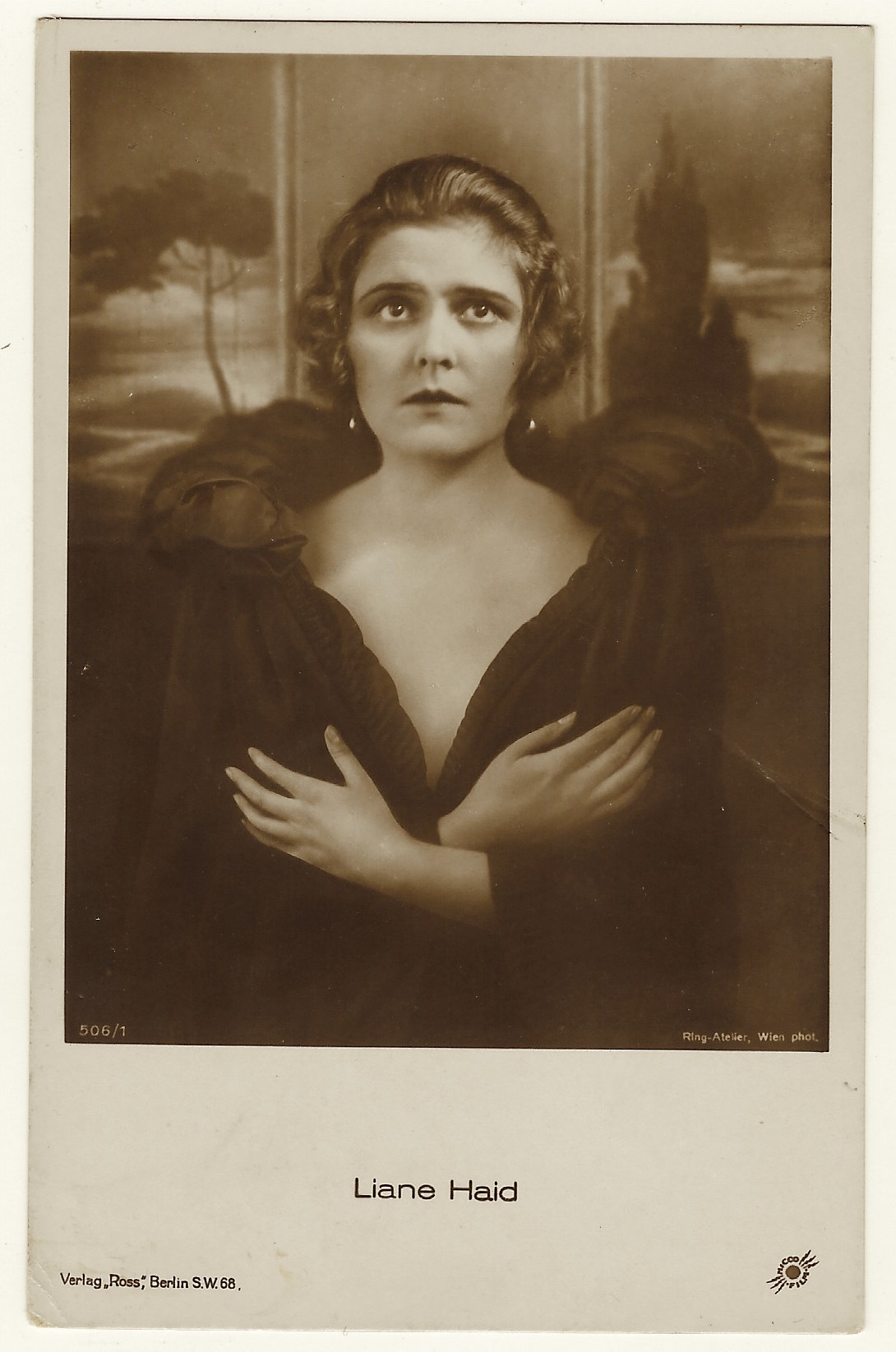
 The third real photo postcard, seen above, was produced by publisher Ross Verlag (Berlin). Once again, Liane Haid appears beautiful in her portrait. The photograph was taken by the Ring studio in Vienna, Austria. A logo for Micco-Film appears in the lower right hand corner of the postcard.  SOLD                                                                                      

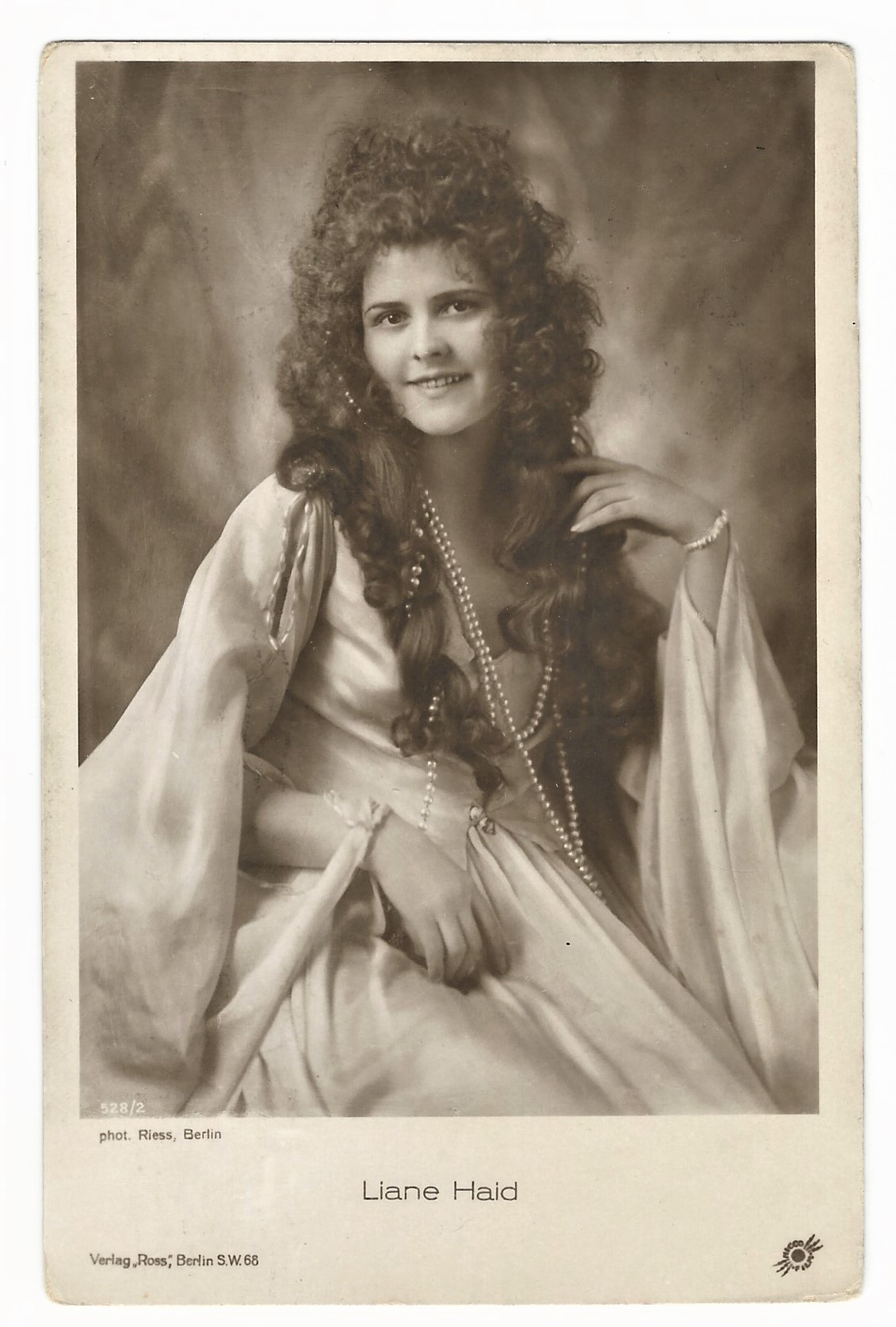
Postcard 4 is a vintage real photo postcard featuring  a young and long haired Liane Haid. She is flashing a very sweet smile. The postcard was published by Ross Verlag of Berlin, Germany. It is part of a series (No. 528/2). Miss Haid was photographed by Frieda Riess (1890-1955?), a female Berlin photographer. One of her photographs can be found in Great Britain’s National Portrait Gallery. The postcard has the logo for Micco-Film in the bottom right hand corner and is postmarked 1929. The card was mailed from Denmark to Estonia.  SOLD   

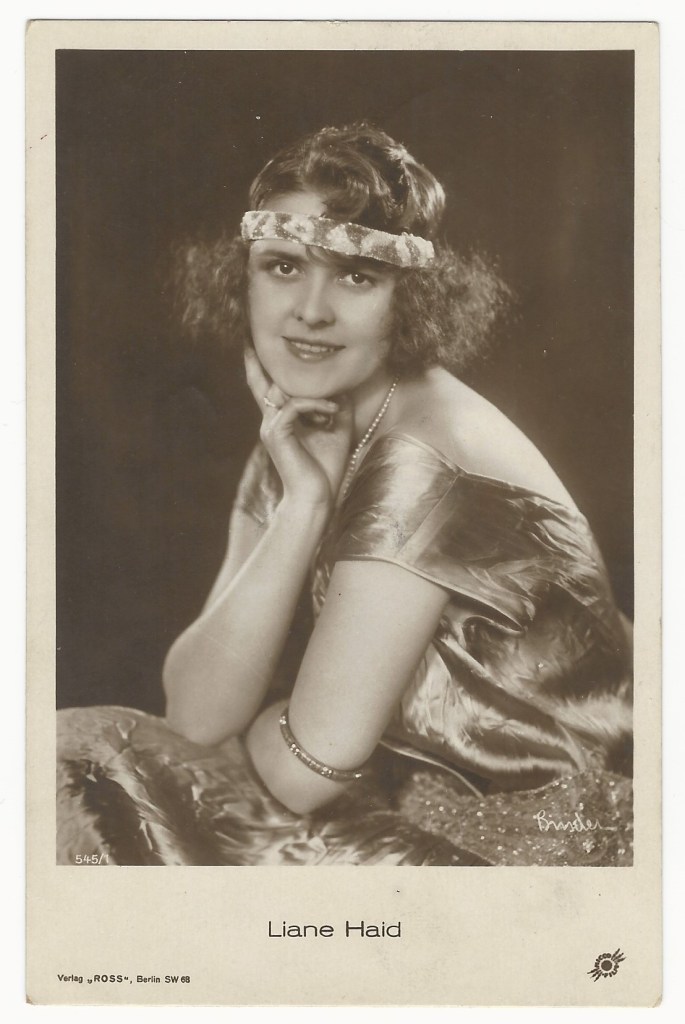
Postcard 5 features a vintage real photo of Miss Haid. As usual, she looks quite pretty. The actress is flashing a lovely smile. She is wearing a string of pearls and a hair band. This photograph was taken by the talented and prolific celebrity photographer, Alexander Binder. The postcard was published by Ross Verlag (Berlin) as part of a series (no. 545/1). The logo for Micco-Film can be seen on the bottom right hand corner of the postcard. The card was postmarked in 1925 and is in very good condition (see scans).                  

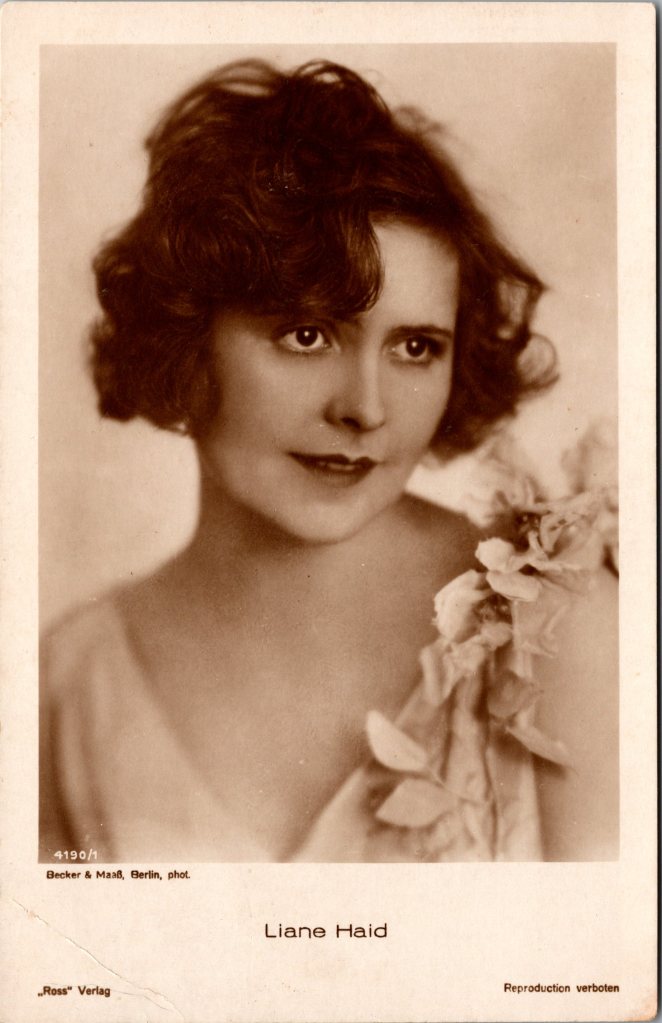
 Postcard 6 offers another view of Miss Haid. She looks beautiful as always. This photograph was taken by the Becker & Maas studio. The firm was located in Berlin Germany. The publisher of the card was Ross Verlag. The postcard is part of a series (No.4190/1).   (SOLD)

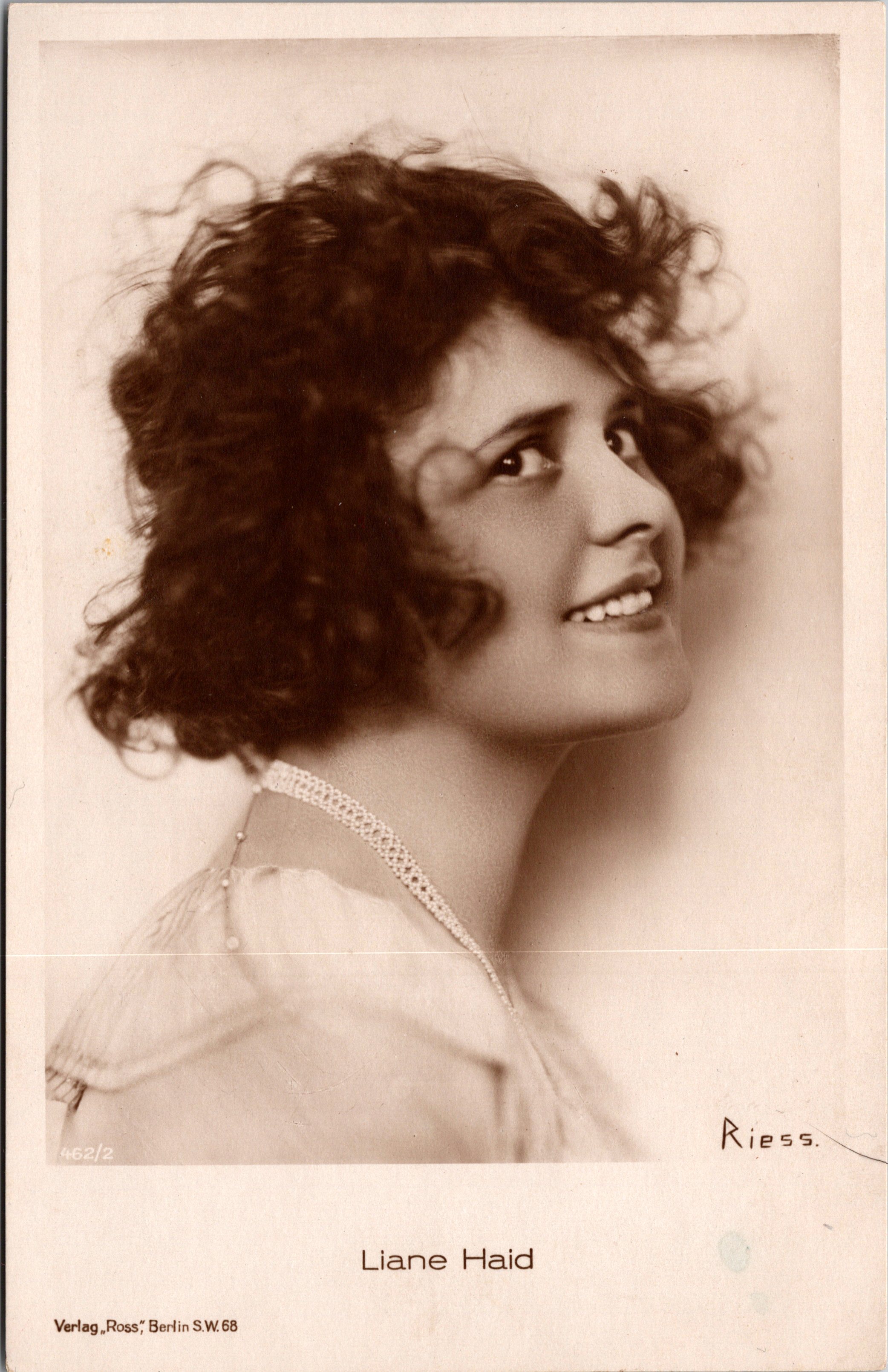
Postcard 7 features Miss Haid as photographed by Frieda Riess (1890-1955?), a female photographer located in Berlin, Germany. The publisher of the card was Ross Verlag. The postcard is part of a series (No.462/2). (SOLD)

Postcard 8 was published by Ross Verlag. The postcard is part of a series (No.1732/3). Note the logo for UFA, a German film company.  (SOLD)

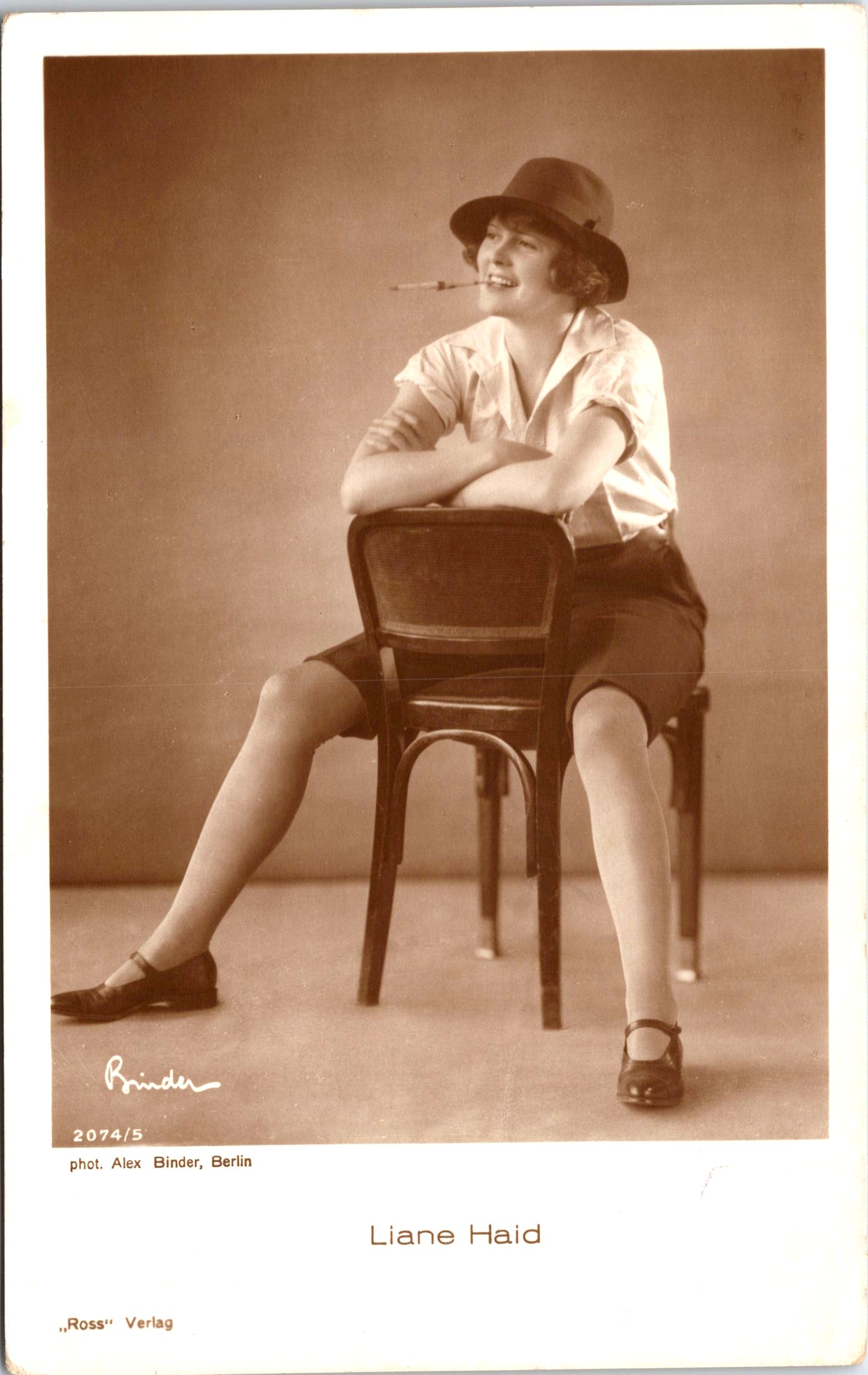
Postcard 9  features Haid sitting in a chair in a provocative manner and smoking a cigarette in a cigarette holder. This photograph portrays Haid as unconventional and seductive. The publisher of the card was Ross Verlag. The postcard is part of a series (No.2074/5). Miss Haid’s photograph appearing on this postcard was taken by Alexander Binder (Berlin, Germany). (SOLD)

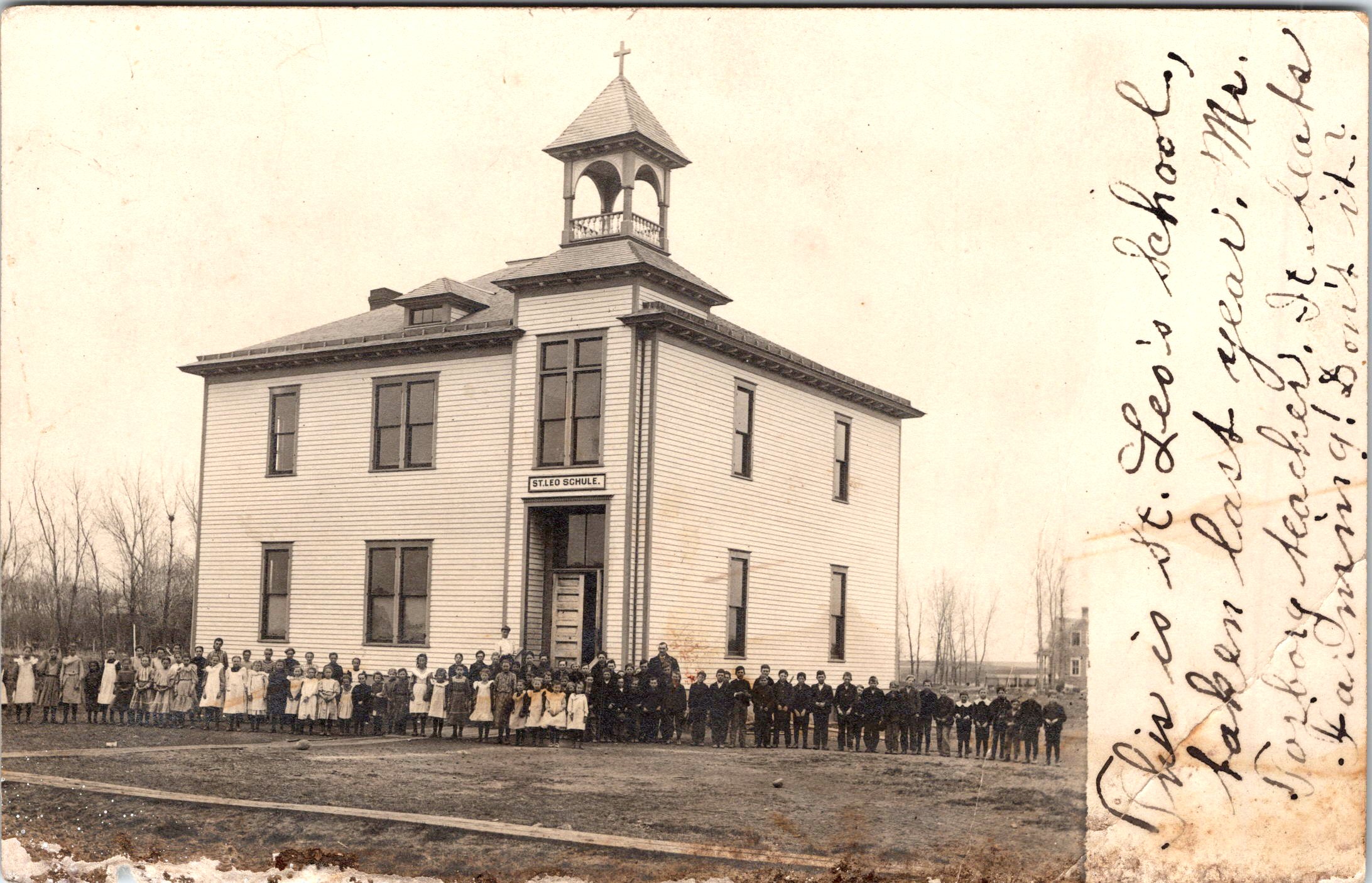
ST. LEOS SCHOOL : ST. LEO, MINNESOTA : WITH CHILDREN & TEACHER : RPPC : 1908

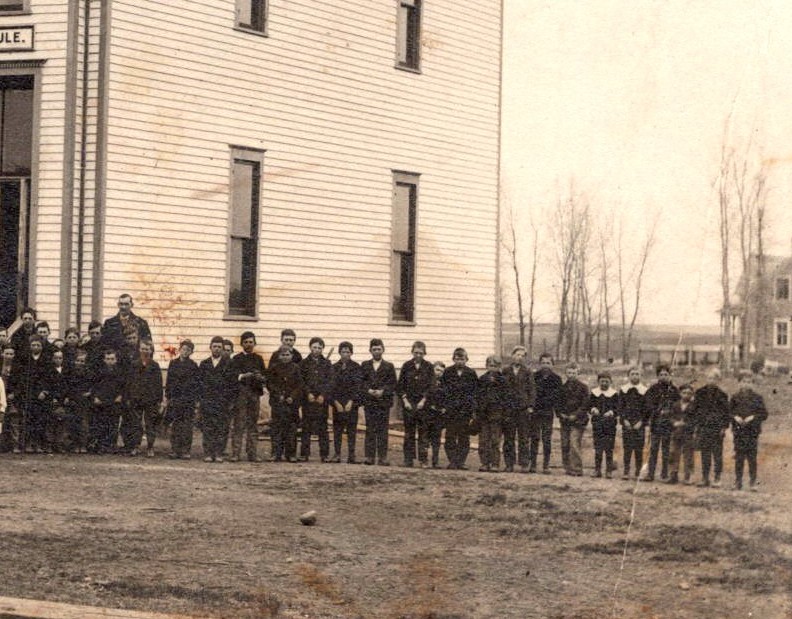
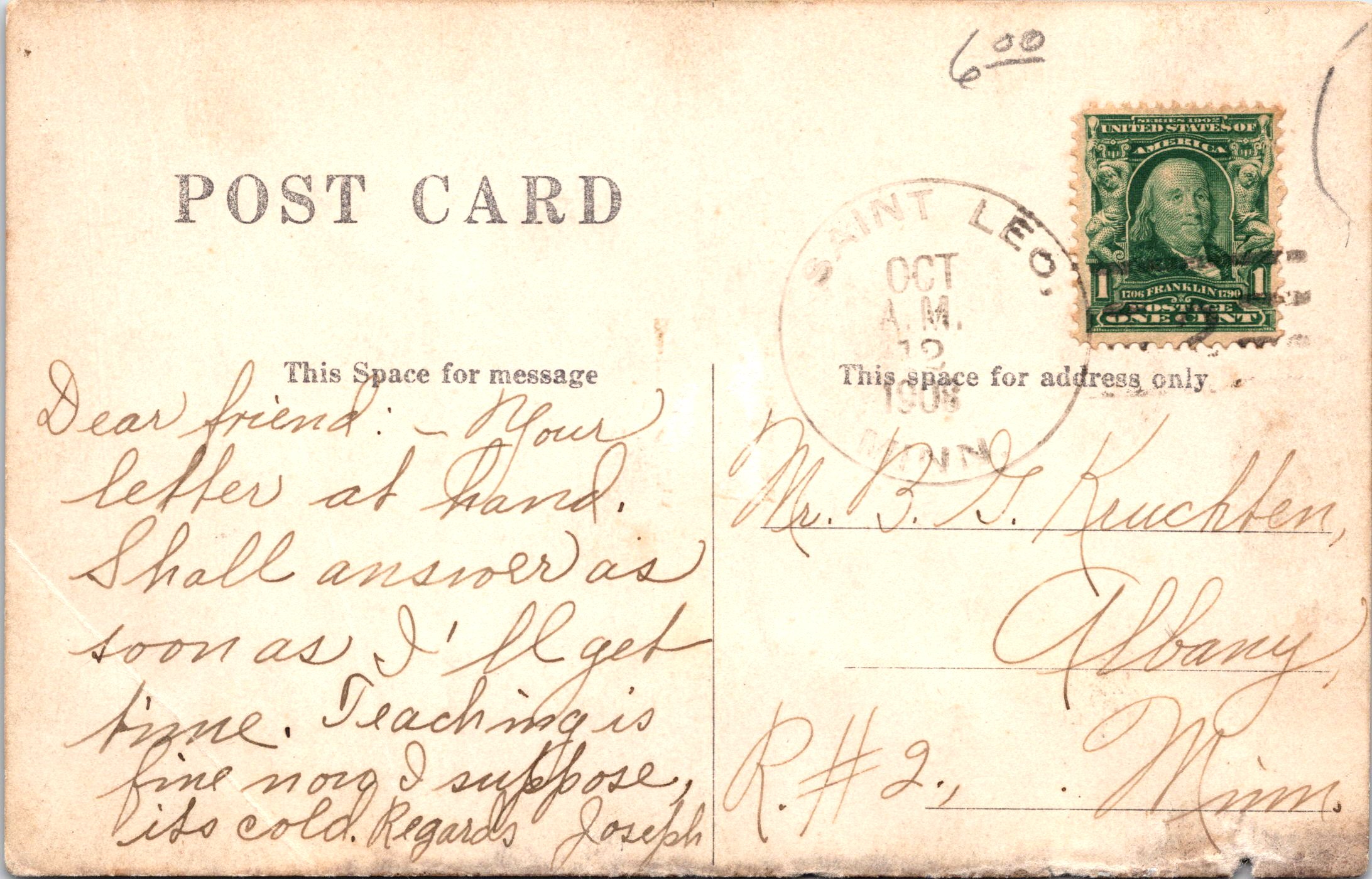
This real photo postcard captures a moment in time outside St. Leo’s School, a two-story wooden schoolhouse with a central bell tower topped by a cross. The sign above the doorway clearly reads “ST. LEO SCHULE,” suggesting a German influence in the local community. The school stands in what appears to be a rural area, with a few trees and a distant building visible in the background. In front of the school, a large group of schoolchildren—boys and girls of various ages—stand in an orderly line. The girls are dressed in long skirts or dresses, many wearing aprons over them, while the boys are attired in dark suits, jackets, and trousers, appearing more formal. A single teacher, possibly Joseph, who wrote the message on the card, stands among them, dressed in a longer coat. The handwritten inscription on the front of the postcard identifies the scene:“This is St. Leo’s School, taken last year. My school, St. Leo’s, So. Min.” On the back, a brief note is addressed to Mr. B. S. Kuchen in Albany, Minnesota, and is signed Joseph. He mentions receiving a letter and promises to respond soon, adding: “Teaching is fine now I suppose. It’s cold. Regards, Joseph.” The postmark is from Saint Leo, Minnesota, dated October 12, 1908, and features a one-cent Benjamin Franklin stamp. This postcard is a wonderful historical artifact, offering a glimpse into early 20th-century rural education in Minnesota. The presence of a German-language school sign and the formal attire of the children suggest a tight-knit immigrant community.  (SOLD)
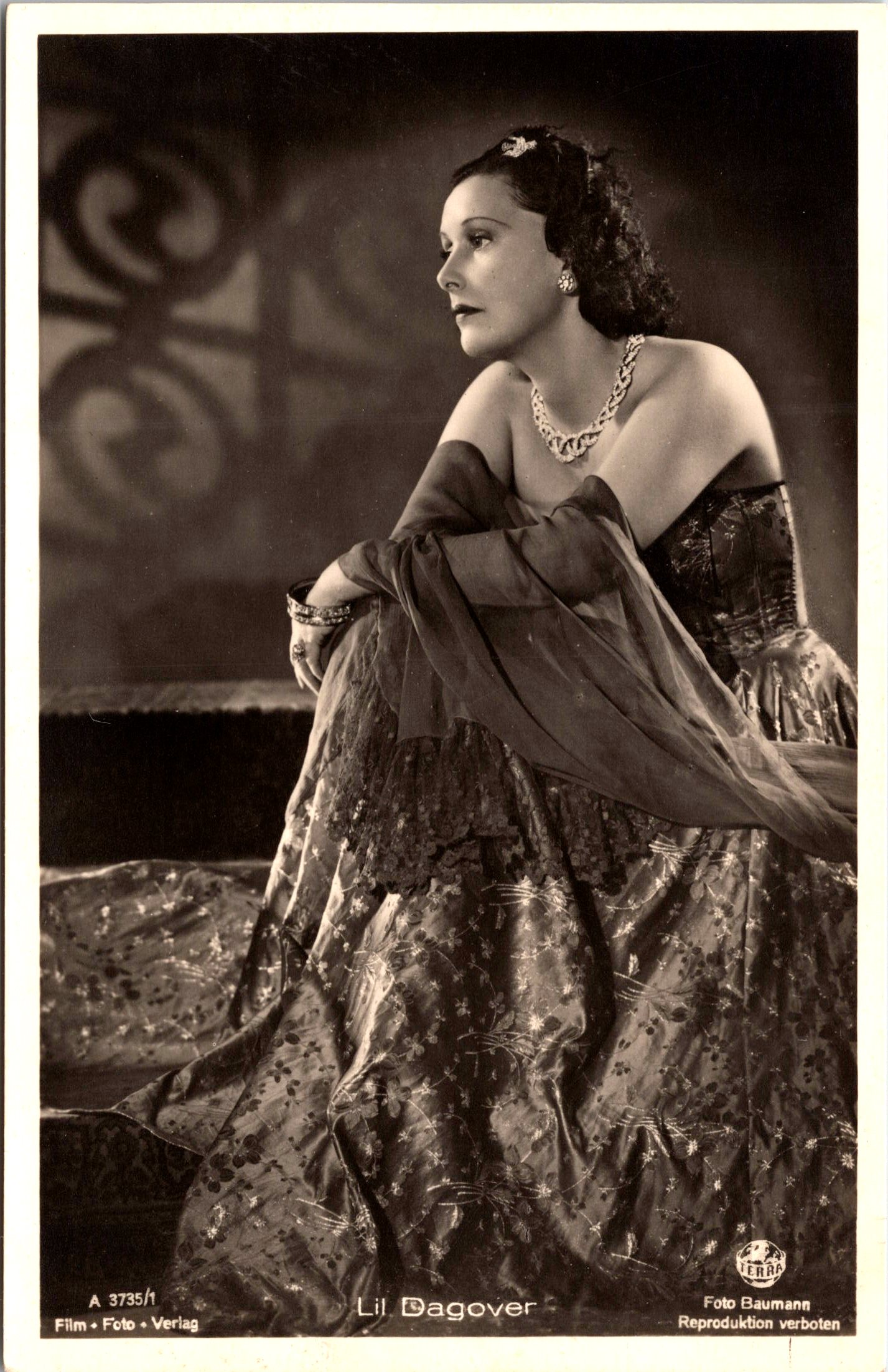
LIL DAGOVER : PRETTY GERMAN SILENT & SOUND FILM STAR : MADAME BOVARY : RPPC 1942

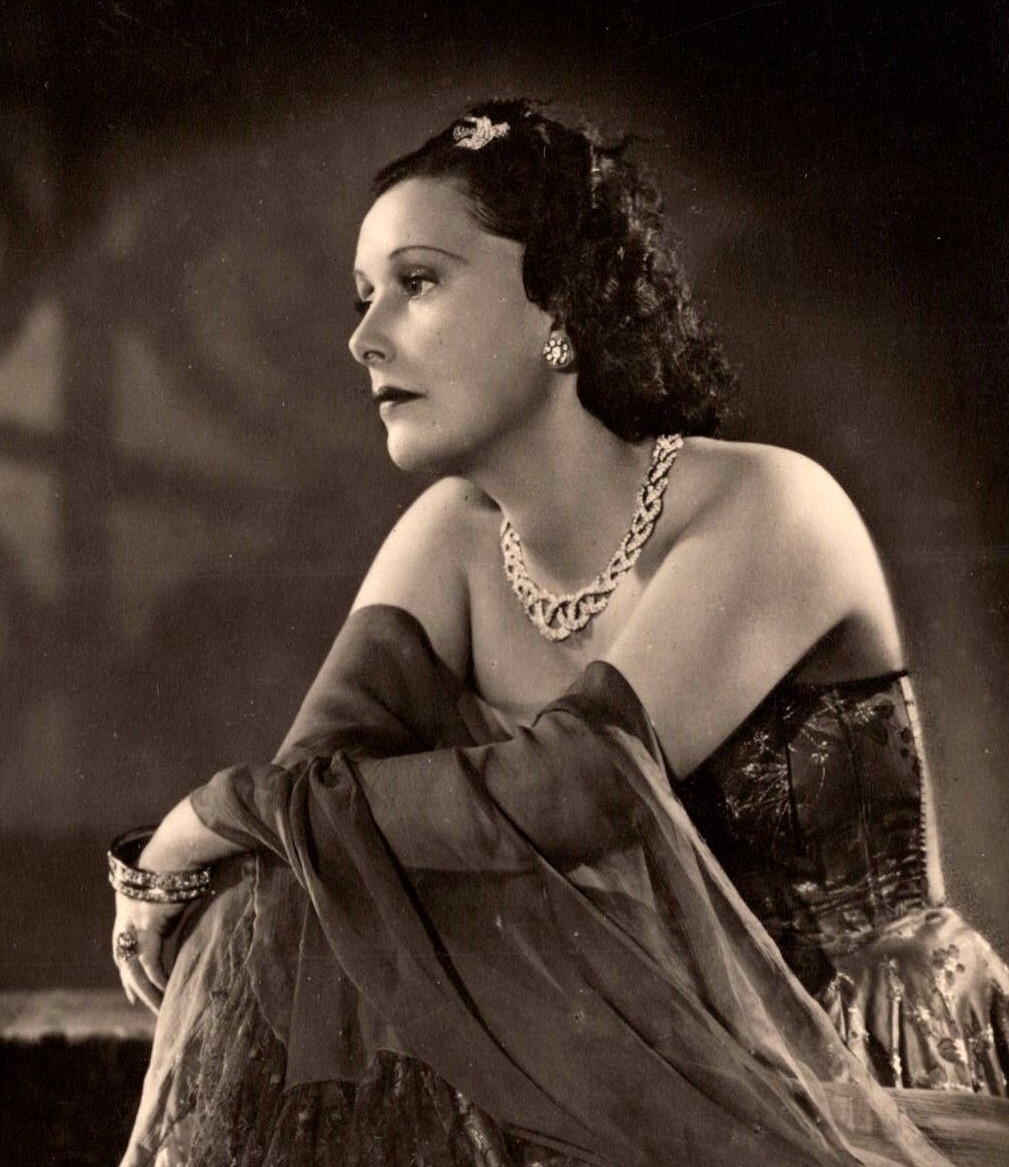
This vintage real photo postcard features celebrated German actress, Lil Dagover (1887-1980). She was renowned for her work in silent films, particularly her collaborations with key figures of German Expressionist cinema. Her striking beauty and ability to convey complex emotions made her one of the most recognizable faces of early 20th-century European cinema. Lil Dagover was born into a well-to-do family in the Dutch East Indies, where her father worked as a forestry officer. After his death, her mother relocated with the family to Europe, and Dagover spent much of her youth in Switzerland and Germany. She was orphaned at 13 years of age and was raised by relatives. She initially planned to become a painter but was drawn to the performing arts, which led her to pursue acting. Dagover’s acting career began on the stage, but her breakthrough came with the advent of film. She made her debut in 1913, though her rise to stardom began in earnest in the early 1920s when she worked with director Robert Wiene in the landmark German Expressionist film The Cabinet of Dr. Caligari (1920). Dagover became a favorite of directors such as Fritz Lang, F.W. Murnau, and Ernst Lubitsch. Her notable silent-era films include “Destiny” (1921), “Dr. Mabuse, the Gambler” (1922), and “The Chronicles of the Grey House” (1925). Her success continued during the sound era, where her aristocratic demeanor and elegance suited roles in historical dramas and comedies. Dagover remained active in German cinema during the Third Reich, a time when the industry was heavily influenced by propaganda. However, she largely avoided overtly political films, focusing instead on character-driven narratives. After World War II, she transitioned to stage work and television, continuing her career well into the 1970s. In regard to her personal life, in 1913 she married Fritz Daghofer, an Austrian officer. They had one child and the marriage ended in divorce. She married for a second time to a German film producer. This postcard was published by Film-Foto-Verlag as part of a series (No.A3735/1). Miss Dagover’s photograph was taken by Baumann between 1941 and 1944. The logo for Terra Film is in the bottom right corner of the image. Terra Film was a Berlin-based film production company. Founded in 1919, it became one of Germany’s largest film production companies in the 1930s under the Nazi regime.  SOLD

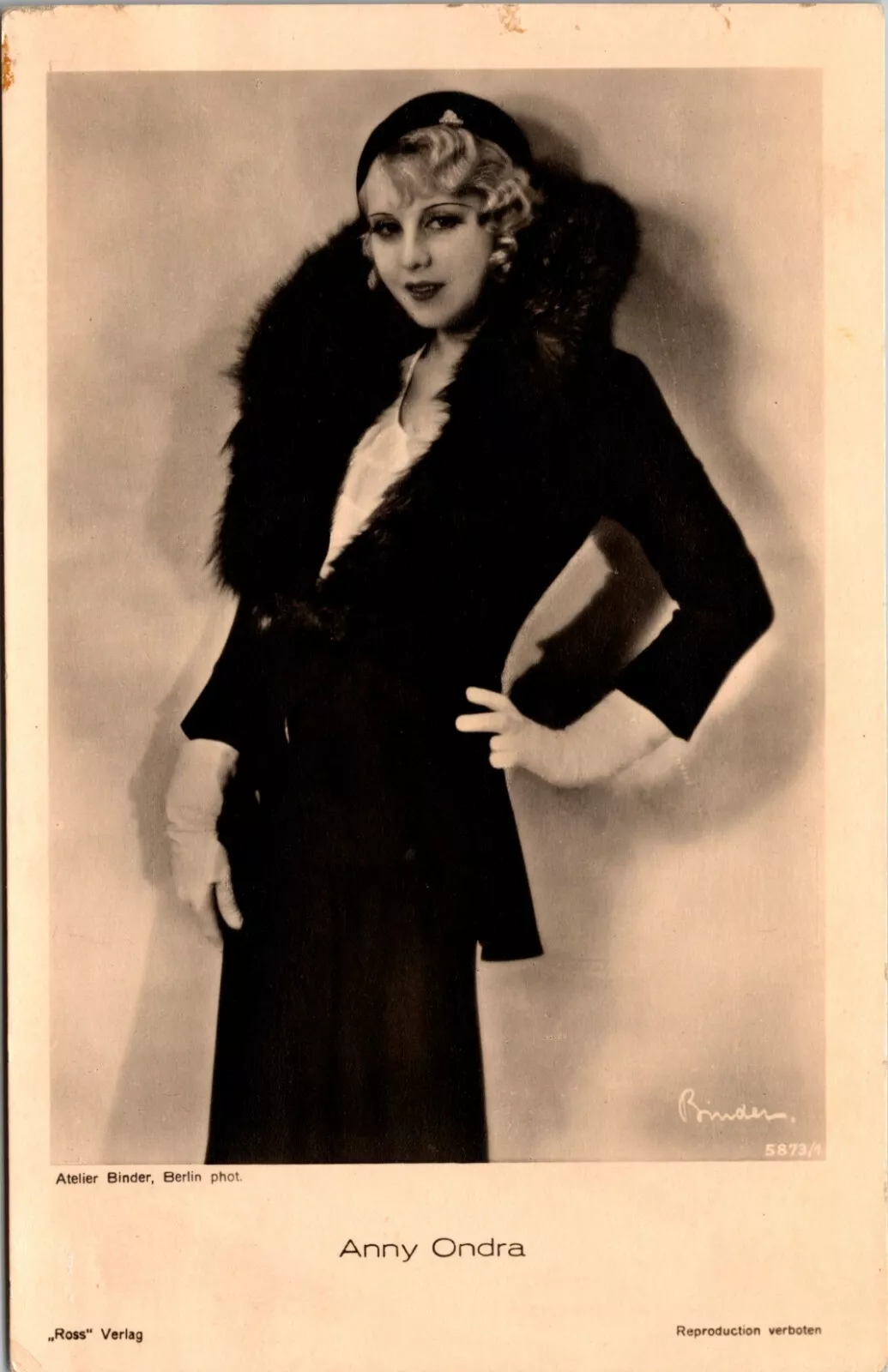
ANNY ONDRA: BEAUTIFUL TALENTED ACTRESS : WIFE OF BOXING CHAMPION MAX SCHMELING : RPPC

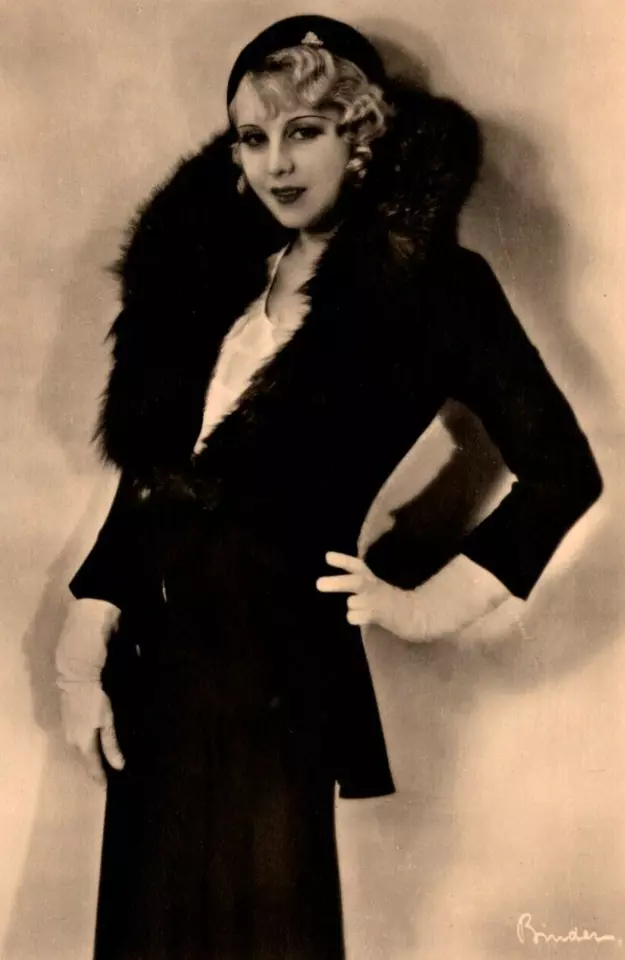
This vintage real photo postcard features actress Anny Ondra. The postcard was published by Ross Verlag. The photograph is by Alexander Binder. The postcard is part of a series (no. 5873/1). Anny Ondra (1903-1987) was a Czech film actress. She was born in Tarnow, Galicia, Austria-Hungary (now Poland). She was active in the movie industry between 1914 and 1957. She acted in Czech, Austrian, and German films in the 1920’s. She appeared in some British dramas, most notably, Alfred Hitchcock’s “The Manxman” (1929) and “Blackmail” (1929). The IMDb credits Ondra with over 90 acting credits between 1914 and 1957. She appeared in more than 40 films in the sound era. However, her career in British films was hurt by her thick accent. Check out the youtube video below. In this “test film”, Hitchcock “interviews” Ondra and makes her visibly uncomfortable and embarrassed by asking her very personal questions. She was married to German boxing champion Max Schmeling between 1933 and 1987. Schmeling was the world champion between 1930 and 1932. He is  well known for his fights with African American fighter, Joe Lewis. Ondra’s father was a Czech, Austro-Hungarian military officer and she grew up in Tarnow, Pula, and Prague. At the early age of seventeen, she acted in the theater as well as in a film. When her family learned that she had acted in a film, they were extremely angry. In fact, she reported that she was given a beating by her father. Post World War I was a time, for many people, that being an actress was akin to being a prostitute. Ondra began to live with her boyfriend (her debut film’s director) but after some time, the relationship ended because she wanted a family and he wanted nothing to do with marriage. In 1933, after a three year romance, Anny married Max Schmeling. She had been in a film with the boxer (“Knock-Out”, 1935). It was a “happy” marriage and the couple remained together until her death in 1987. Ondra and Schmeling were hot names in Nazi Germany. German fascists tried to exploit them in order to popularize their movement. Schmeling was seen as a German superman while Ondra represented the blonde Aryan type. The two celebrities refused to collaborate. Schmeling turned down honors and even helped hide two Jewish children, saving their lives. However, because of Nazi propoganda, many believed that the couple had collaborated. As a result, Schmeling and Ondra suffered financially for their fictional cooperation with the Nazis. Ondra was portrayed in two modern day movies, “Ring of Passion” (1978) and Joe and Max (2002). Miss Ondra appears quite thin in this postcards’s photo. Note her fur collared jacket. SOLD

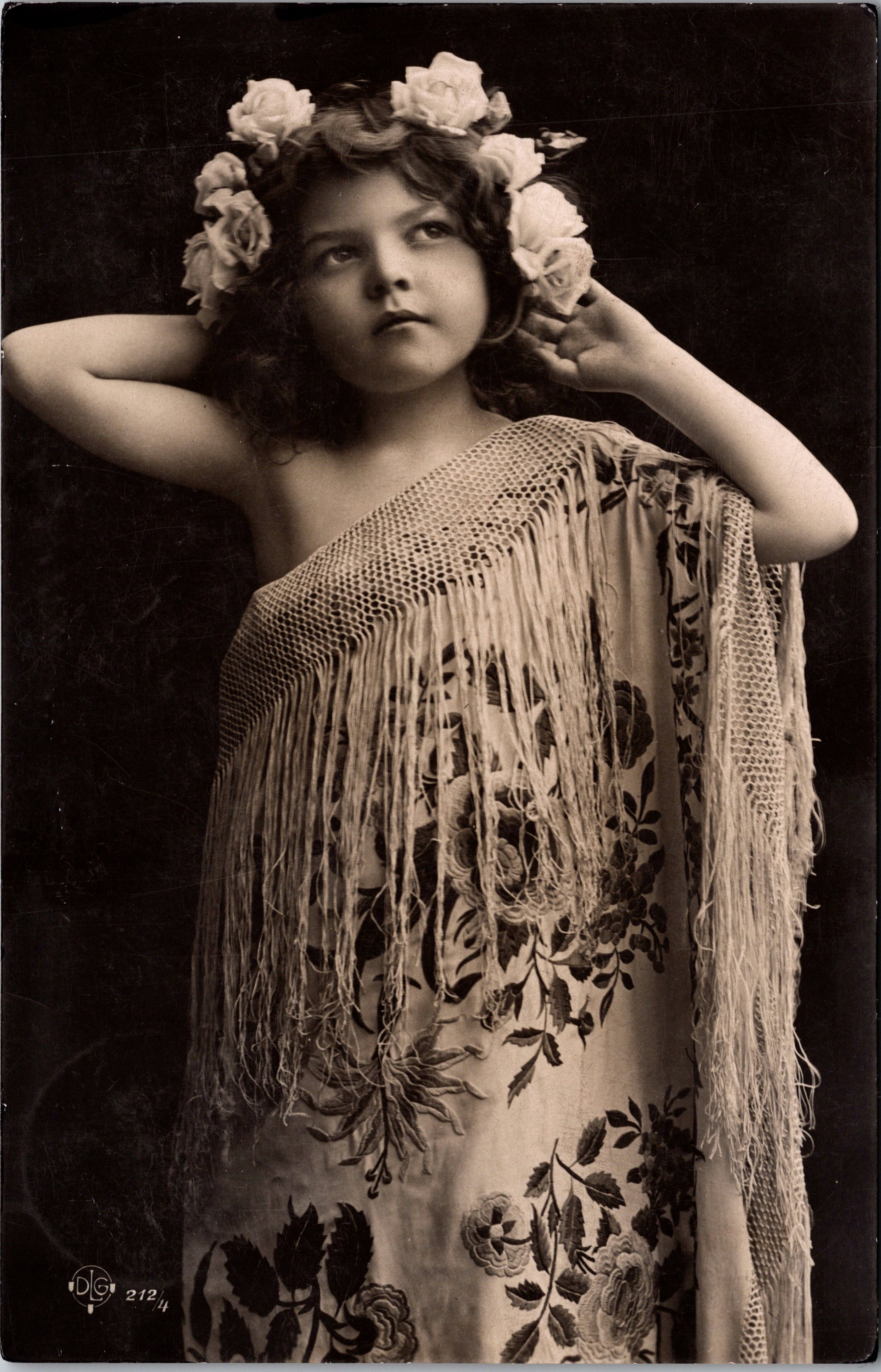
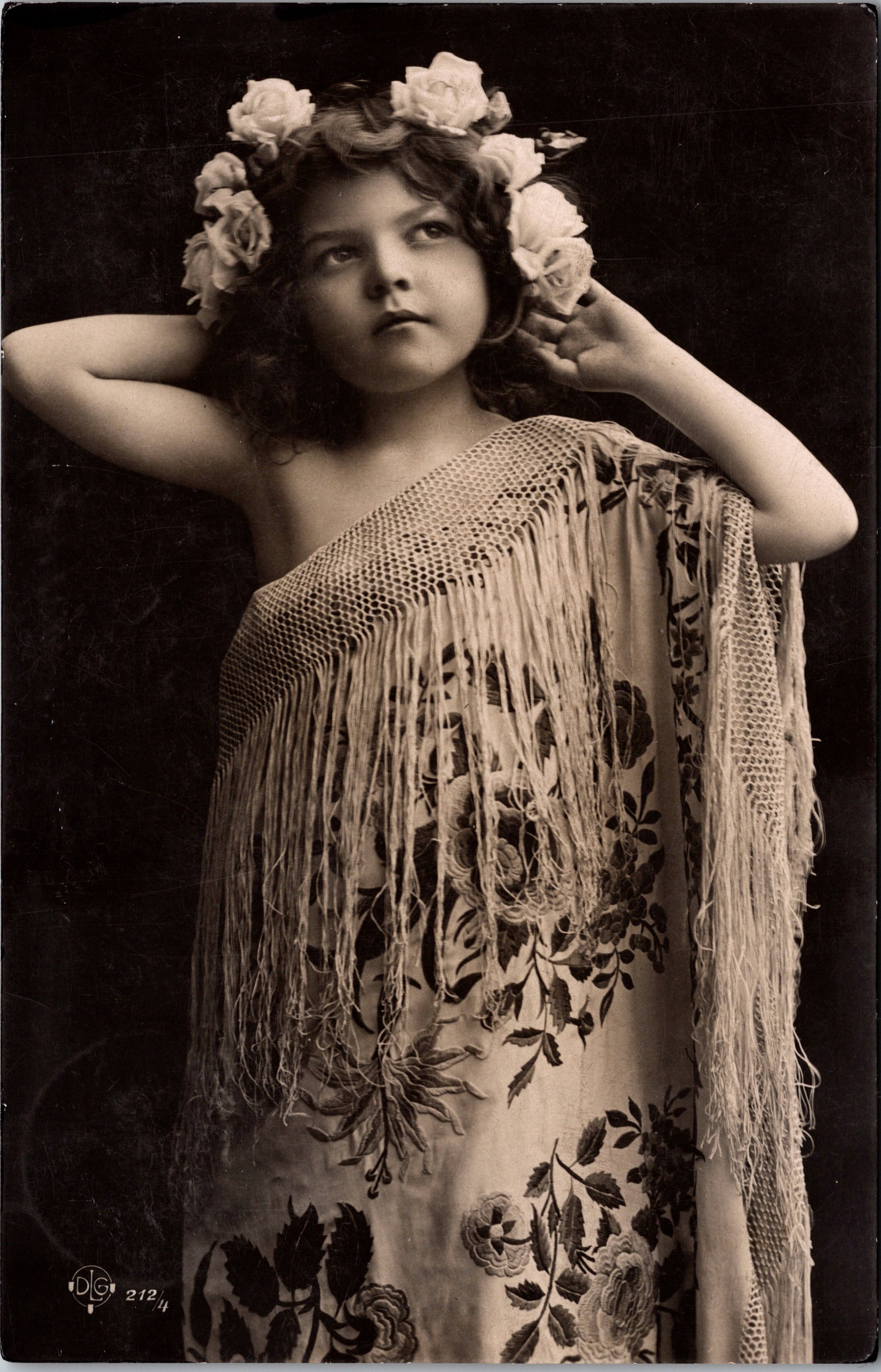
CUTE YOUNG GIRL : LOVELY FRINGED FLORAL DRESS : ROSES IN HER HAIR : RPPC : (1908)

This German vintage real photo postcard features an adorable little girl wearing a fringed dress and roses in her hair. The postcard was published by DLG (Deutsche Lichtbild-GmbH) as part of a series (No. 212/4). The firm is located in Berlin, Germany. This postcard is in very good condition (See Scans). 

DLG 212_0001

Buy this original Vintage Real Photo Postcard (includes shipping within the US) #5333

To purchase this item, click on the Pay with PayPal button below

$32.00

DLG 212_0001

Buy this original Vintage Real Photo Postcard (includes International shipping outside the US) #5333

To purchase this item, click on the Pay with PayPal button below

$42.00

Published in: on December 14, 2024 at 12:00 pm  Leave a Comment  
Tags: , ,

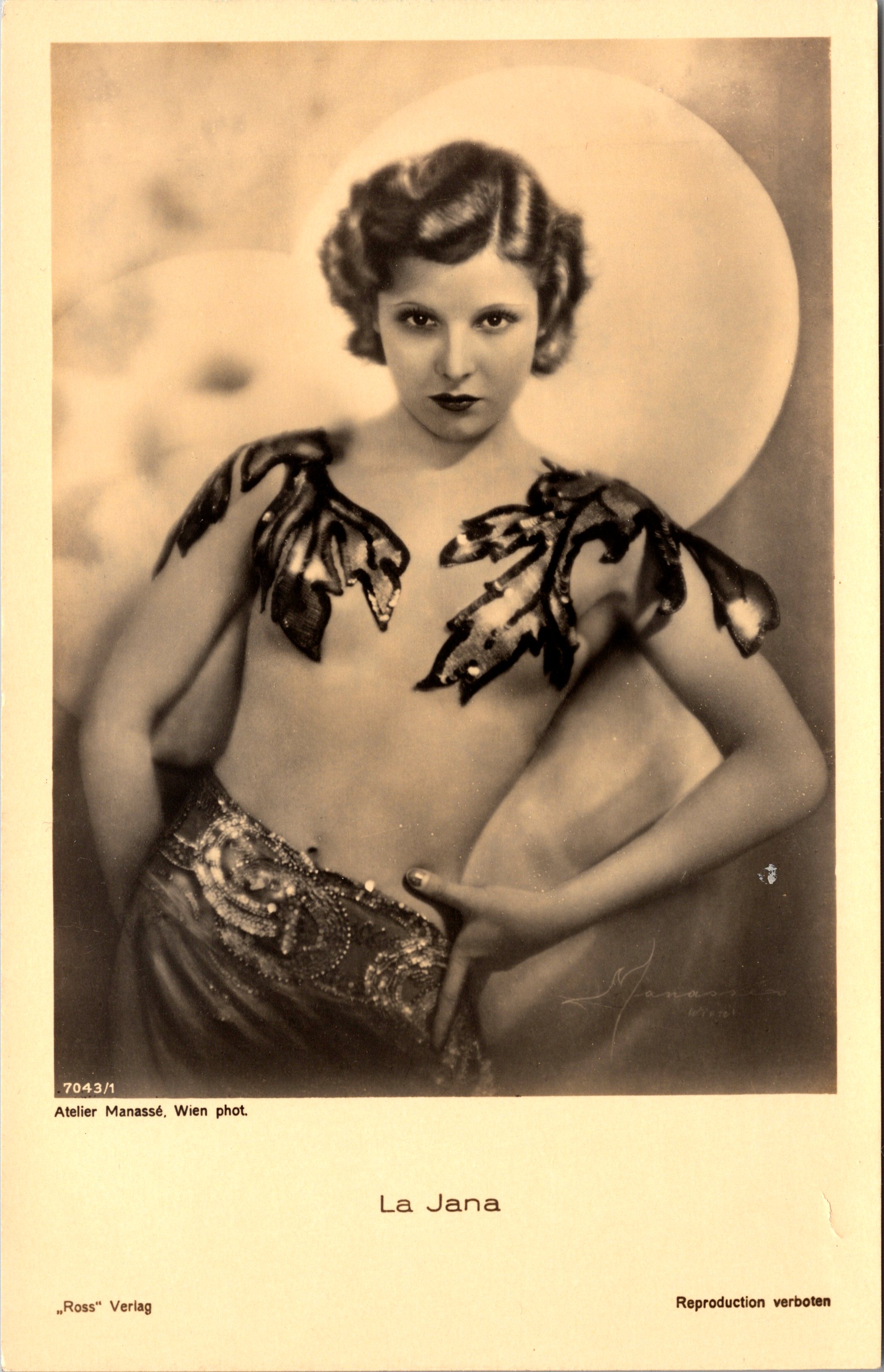
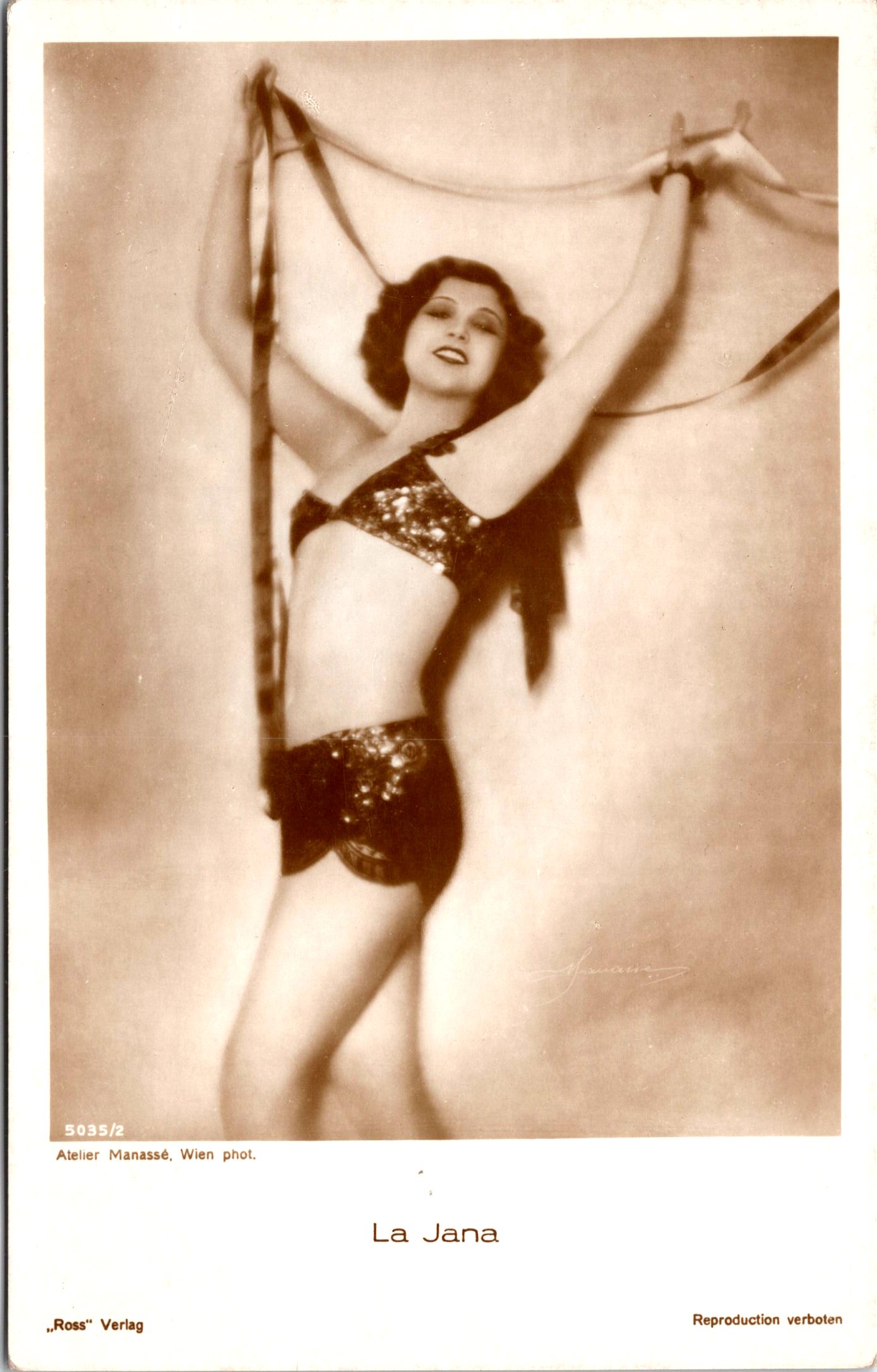
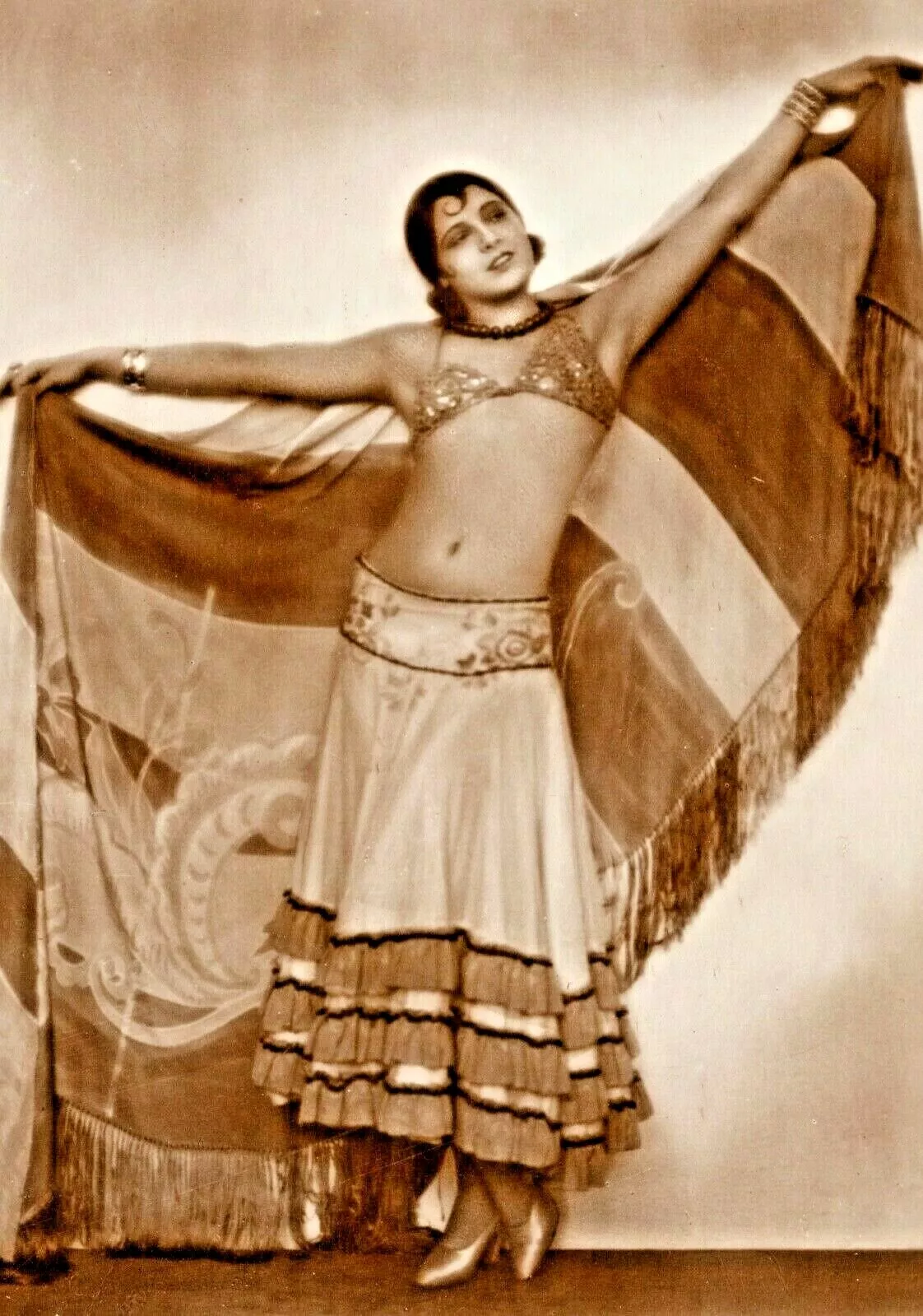
LA JANA : AUSTRO-GERMAN EXOTIC DANCER AND FILM STAR : RISQUE : RPPC

Postcard 1 (SOLD)
Postcard 2 (SOLD)

Postcard 3 (SOLD)

La Jana (1905-1940) was an actress and dancer. Her nationality was Austro-German. She was the illegitimate daughter of a master gilder and his housekeeper. Her parents wed four years after her birth. Her family was Jewish. She went by the name, Henny.. She trained as a dancer at the Frankfurt Opera Ballet and her first stage appearance was at the age of eight. She later began dancing in revues. She was “discovered” in Paris and brought to Berlin to meet with Frederic Zelnik who got her into films. The film director who “discovered” her said that the first time he saw her dance, “that woman possessed the most attractive body that I had set eyes upon” in my not all that long life. He went on to describe her as simple, nice and approachable. He added that she “had as much interest in sex as in Immanuel Kant”. meaning, none at all. As her career advanced, she danced in revues in Berlin, Stockholm, London, and many other cities. When she appeared in “Casanova” she viewed by the audience semi-naked and on a silver platter. In Berlin, she began an affair with Crown Prince Wilhelm. There were also rumors that she had an affair with Joseph Goebbels. Charlie Chaplin was also one of her lovers. Clearly, her attitude about sex changed from the earlier days of her dancing career. In 1937, her performance in a film catapulted her to film stardom. In 1940, while touring Germany, entertaining troops, she fell ill with pneumonia and passed away. The IMDb gives La Jana 23 film credits between 1926 and 1940.

La Jana’s portrait for Postcard 1 was taken by the Manasse studio in Vienna, Austria. The Manasse studio was in existence between about 1922 and 1938. The studio was run by Olga Solarics (1896-1969) and her husband Adorja’n von Wlassics (1893-1946). Olga was known for her interest in photographing nudes. The studio flourished in Vienna during the 1930’s. Many of the portraits taken by the studio had an erotic flavor. The studio attracted some of the leading ladies of film and theater. This postcard was published by Ross Verlag (no.7043/1). This vintage postcard has a small imperfection located under La Jana’s left elbow. (SOLD)

Postcard 2 was published by Ross Verlag (no.5035/2). Miss Jana’s photograph was taken by the Manasse studio in Vienna, Austria.  The Manasse studio was in existence between about 1922 and 1938. The studio was run by Olga Solarics (1896-1969) and her husband Adorja’n von Wlassics (1893-1946). Olga was known for her interest in photographing nudes. The studio flourished in Vienna during the 1930’s. Many of the portraits taken by the studio had an erotic flavor. The studio attracted some of the leading ladies of film and theater.  (SOLD)

Postcard 3 was published by Ross Verlag (no.3911/1). Miss Jana’s photograph was taken by Martin Badekow (1896-1983) in Berlin.  In the 1920’s, Badekow was a well known photographer in Berlin. He photographed portraits of many film stars and other celebrities. He also was a fashion photographer. Before she was famous, Badekow took many fashion photos of Marlene Dietrich. After World War I, he and his son Heinz, took photographs of the devastation in Berlin. Some of them can be found at Getty Images. After the 1920’s, interest in Badekow’s work waned. More recently, Badekow’s photographs from the Berlin cabarets and of the stars of German silent films, can now be found in museums and are considered symbolic images of Weimar Germany.  (SOLD)

KATHE VON NAGY : HUNGARIAN ACTRESS, DANCER, SINGER & MODEL : PHOTO BY YVA : RPPC

This vintage real photo postcard features Hungarian actress, singer, dancer, and model, Kathe von Nagy (1904-1973). She performed in both German and French films. Her father was a wealthy bank manager. At the age of sixteen, Nagy wanted to get married but her parents did not approve and sent her to a convent near Vienna, Austria. She stayed there 18 months but finished school elsewhere. Nagy wanted to become an author. She moved to Budapest and wrote articles for a magazine. She became interested in acting and enrolled in an acting school near Budapest. Her parents were none to pleased about her career choices and she was encouraged to return home where she worked in her father’s bank and secretly wrote novels. When she was about 22 years old, she moved to Berlin to pursue a career in film and worked for a Hungarian newspaper. She  was given a role in a 1927 comedy film and by 1928, she began starring in films and was considered one of Europe’s top up and coming film actresses. She became a highly successful film actress. The IMDb reports that she appeared in 57 films between 1915 and 1952. She basically retired from film during the second world war. The head of the SS., Heinrich Himmler asked Nagy to be the face and body for “sex dolls” provided to German soldiers. The premise was that the use of such dolls would lessen the syphilis problems encountered by many of the soldiers. Nagy refused the offer. This story may be apocryphal. This postcard was published by Ross Verlag as part of a series (no.6085/2). Nagy’s photo was taken by the Yva studio located in Berlin, Germany.  The name Yva is a pseudonym. The photographer was actually a woman named Else Ernestine Neulander-Simon (1900-1944). She was a German Jewish photographer and was well known for her “dreamlike, multiple exposed images”. She was a leading Berlin photographer during the Weimar Republic years of Germany. She specialized in fashion, nudes, and portraiture. Later, she became involved in the early days of producing photographs for advertising. Many of her photographs were published in magazines or were shown in international exhibitions. After the Nazis took power, she was forced to work as a radioagrapher (ie x-ray technician). In 1936 she was offered a job by Life Magazine, but her husband convinced her that life for German Jews would improve over time. He did not want to move and start a new life in a country where he did not speak the language. Unfortunately, she complied with his wishes. In 1938, Nazi regulations prohibited her from working as a photographer. In 1942, the Gestapo deported her and her husband to a death camp (probably Majdanek) where they were murdered.  SOLD

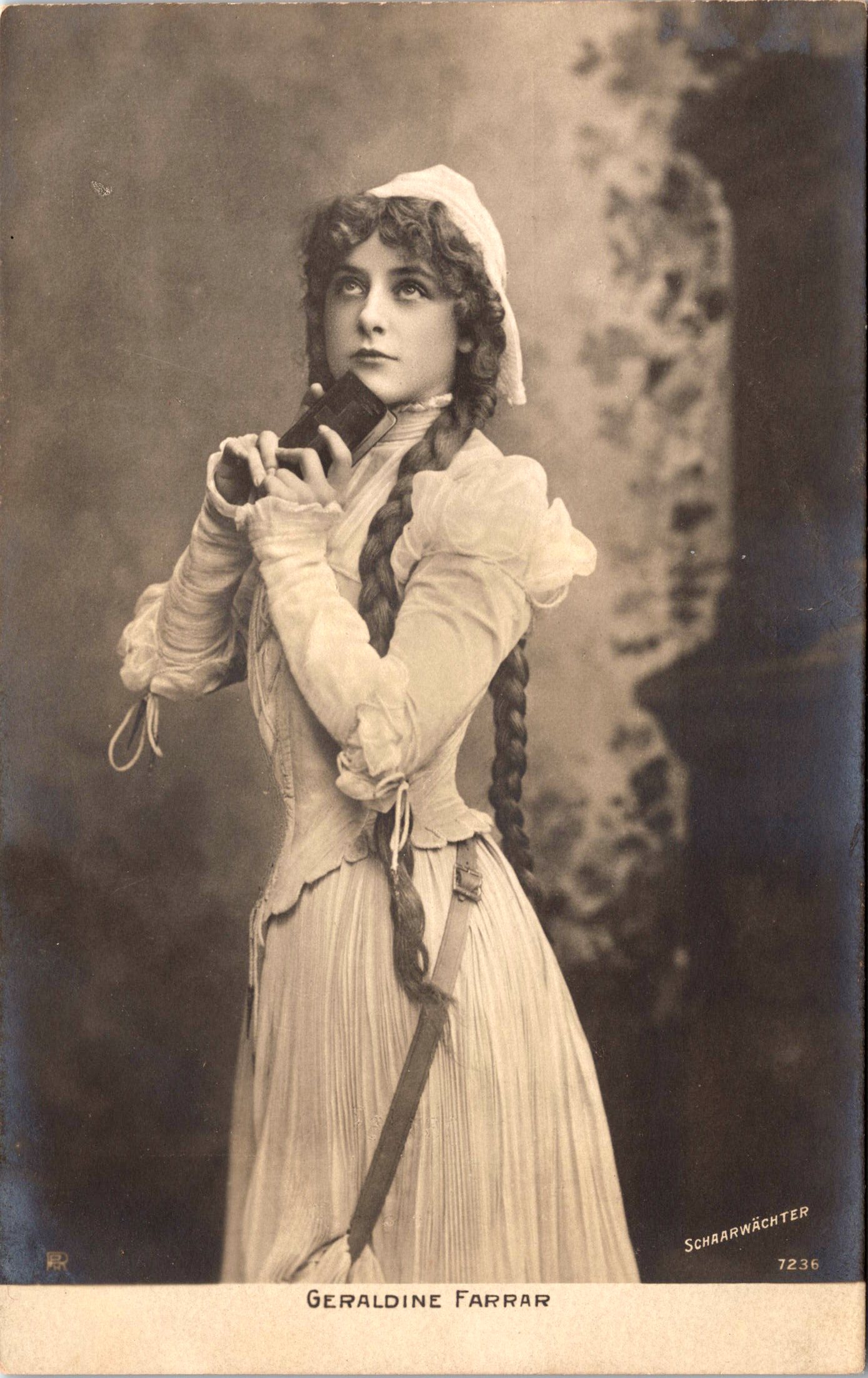
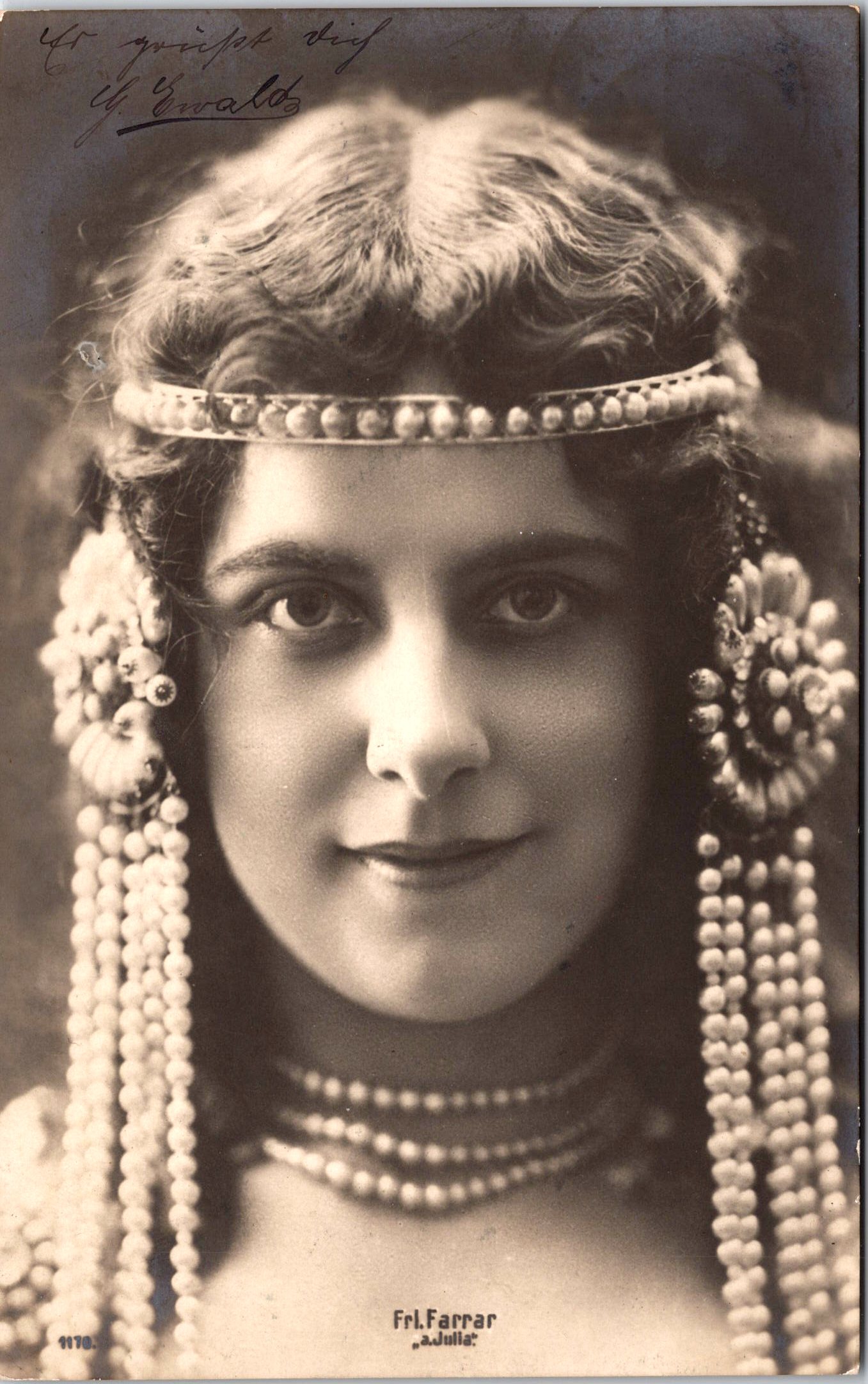
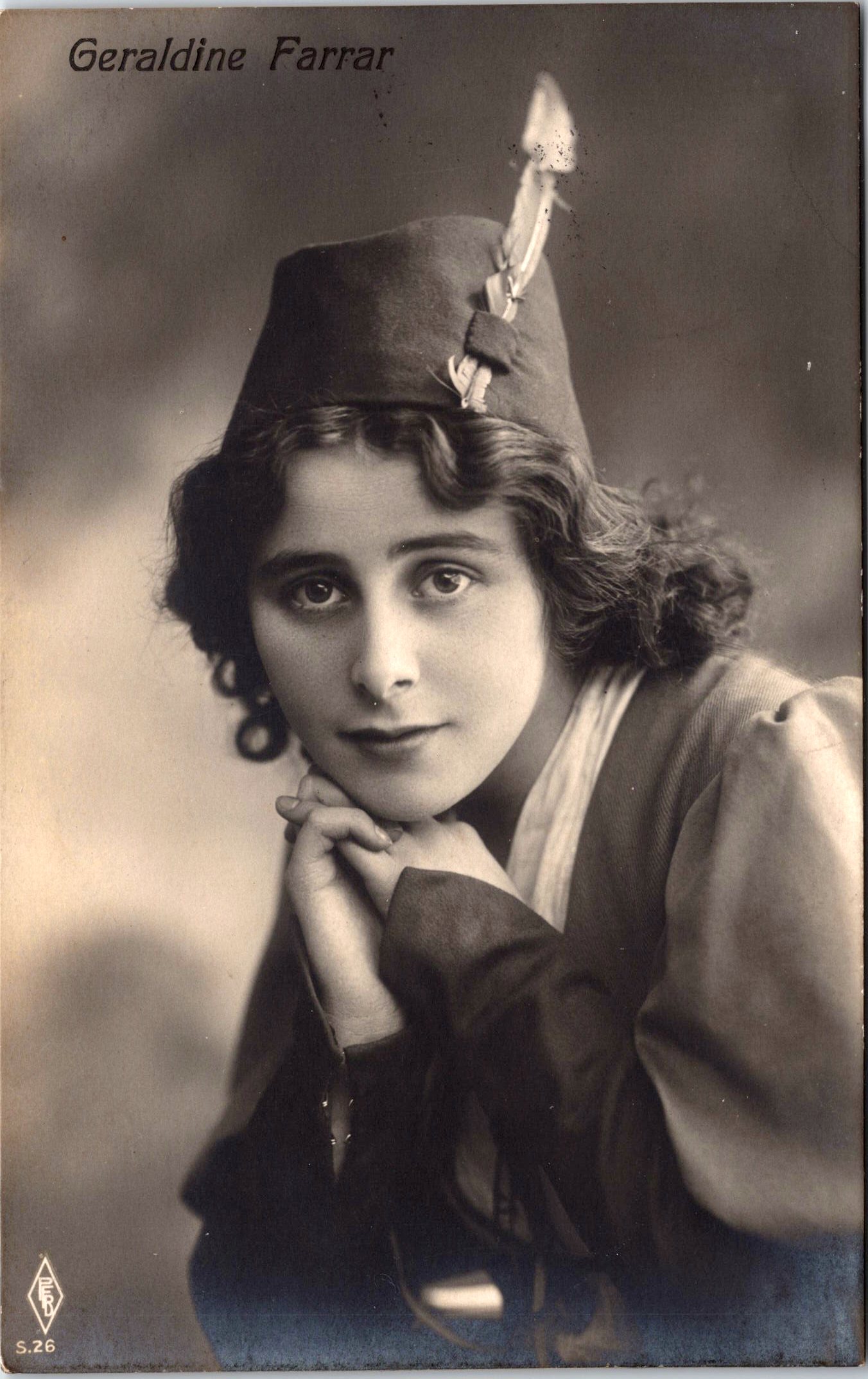
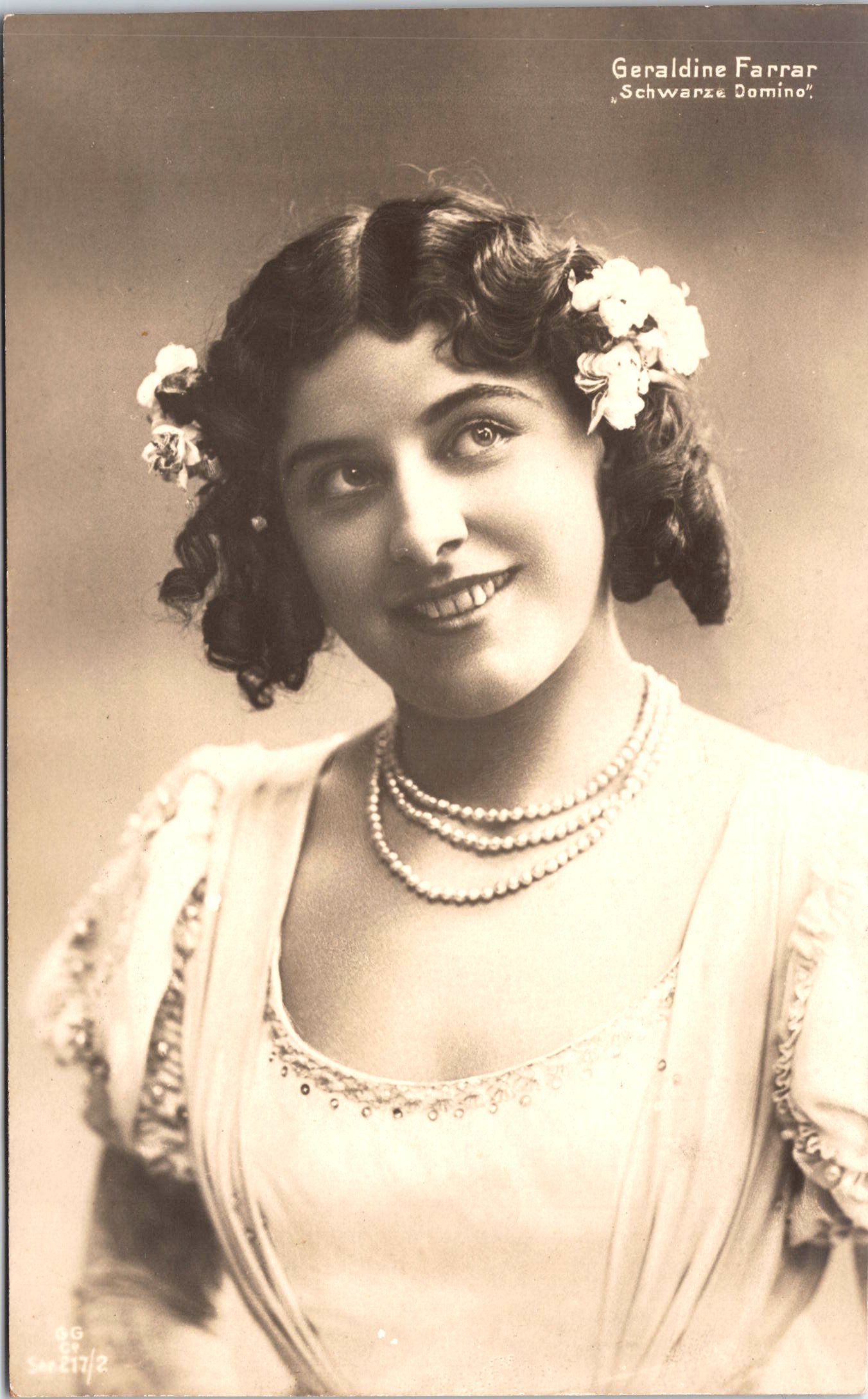
GERALDINE FARRAR : PRETTY AMERICAN OPERA SINGER AND SILENT FILM STAR

POSTCARD 1 (SOLD)

POSTCARD 2 (SOLD)

POSTCARD 3 (SOLD)

POSTCARD 4 (SOLD)

This vintage real photo, Postcard 1, features Geraldine Farrar (February 28, 1882 – March 11, 1967). She was an American soprano opera singer and film actress. She was one of the most popular singers of the early 20th century and she appeared in several silent films as well as on stage. She was also a successful recording artist and a leading figure in the world of opera. She was known for her beauty, as well as her powerful and expressive voice. She was also known for her striking stage presence and her ability to convey emotion through her singing. Farrar had a particularly successful career at the Metropolitan Opera in New York City, where she performed for many years. She also performed in many other major opera houses around the world including La Scala (Milan), The Royal Opera House (London), and the Opera-Comique (Paris). Geraldine Farrar was born in Melrose, Massachusetts, in 1882. She began her career as a singer in vaudeville and later studied voice in Paris. In 1902, she made her debut at the Metropolitan Opera in New York City, where she quickly became one of the most popular singers of her time. Farrar retired from the opera stage in 1922 and settled in New York City. She continued to perform in concerts and recitals for several more years. She also appeared in a few films, including a silent film version of Carmen, in which she played the title role. This postcard photo of Geraldine Farrar was taken by Julius Cornelius Schaarwachter (1847-1904). The photographer has five portraits in Britain’s National Portrait Gallery. Farrar is dressed in costume for her performance in the opera “Faust”, by composer, Charles Gounod. SOLD

Postcard 2 is a rare close-up portrait postcard of Miss Farrar. SOLD

Postcard 3 is a rare photo of Geraldine Farrar that was published by Paul Fink (Berlin) as part of a series (No.S26). The postcard was postmarked in 1911. SOLD

Postcard 4 was published by Georg Gerlach (Berlin) as part of a series (No.217/2). SOLD

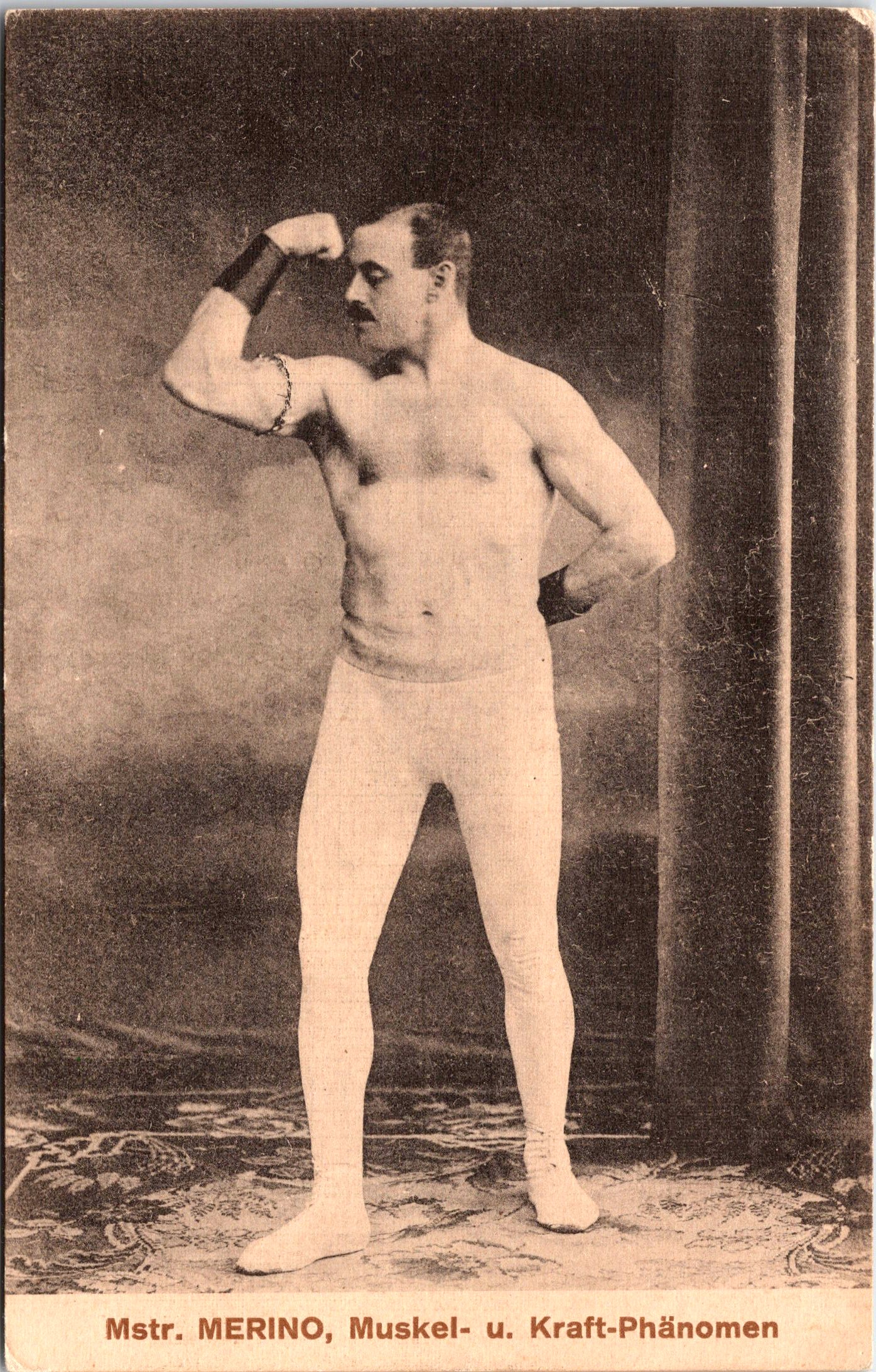
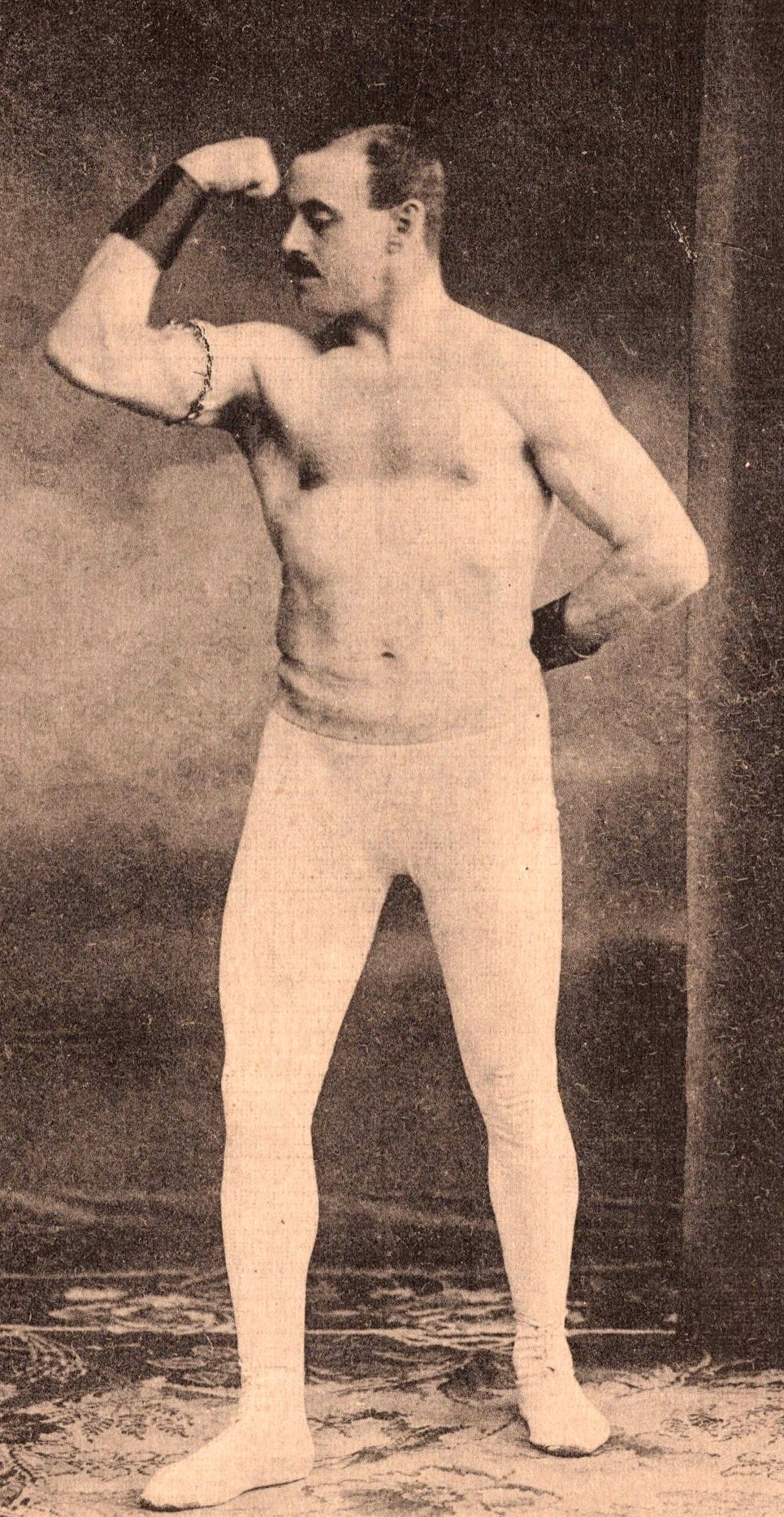
SHIRTLESS MSTR. MERINO : MUSCLE AND STRENGTH PHENOMENON : STRONGMAN : RPPC

This uncommon vintage real photo postcard features a shirtless body builder named Mstr. Merino. The caption on the postcard states “Mstr. Merino, Muscle & Strength Phenomenon”. The  body builder’s muscles have muscles. Note his right bicept. It appears that he has barbed wire looped around his right upper arm. Merino has something wrapped around his wrists. The wraps purpose is unknown to me. This postcard was published by Ernst Schneider & Company. The firm was located in Lubeck, Germany and was known for publishing a collection of postcards with portraits of male and female impersonators and cross dressers. These cards were produced between 1900 and 1930.  SOLD

NORTHPORT YACHT CLUB & HARBOR : LONG ISLAND, NEW YORK : RPPC 1906

This vintage postcard features a pretty view of the Northport Yacht Club and Northport Harbor. Although this postcard spells Northport as “North Port”, the card’s spelling is incorrect. It is not unusual for a publisher of postcards to spell the name of a town or person incorrectly. Northport is located on the Northshore of Long Island. The town is at the edge of the Long Island Sound. Connecticut is located on the other side of the Sound. Note the wooden boats in the foreground. The Northport Yacht Club was established in 1899. It was located on Bayview Avenue. The club was established by a group of affluent men who worked in New York City but had second homes in the Northport area. Just a few weeks later a second yacht club, the Independent Yacht Club, was established on Woodbine Avenue. This club was launched for and by the local townspeople. In 1927, the Independent Yacht Club changed it’s name to the Northport Yacht Club. This club closed in 1944 and was replaced by the Edgewater Yacht Club in 1945. The club had no building until 1948. In 1952 the Edgewater club changed it’s name to the Northport Yacht Club. The building seen in this postcard photo is the Northport Yacht Club (formerly the Independent Yacht Club) located on Woodbine Avenue. The message written on this postcard is a sad one. The writer states that “Charles is very much worse” and indicates that he is suffering from diabetes. Insulin was not used on humans until 1922. One can only imagine what a diabetic’s life was like before that. 
This card was printed in Germany and the publisher is not listed. This postcard, unlike Charles, is in good condition. SOLD