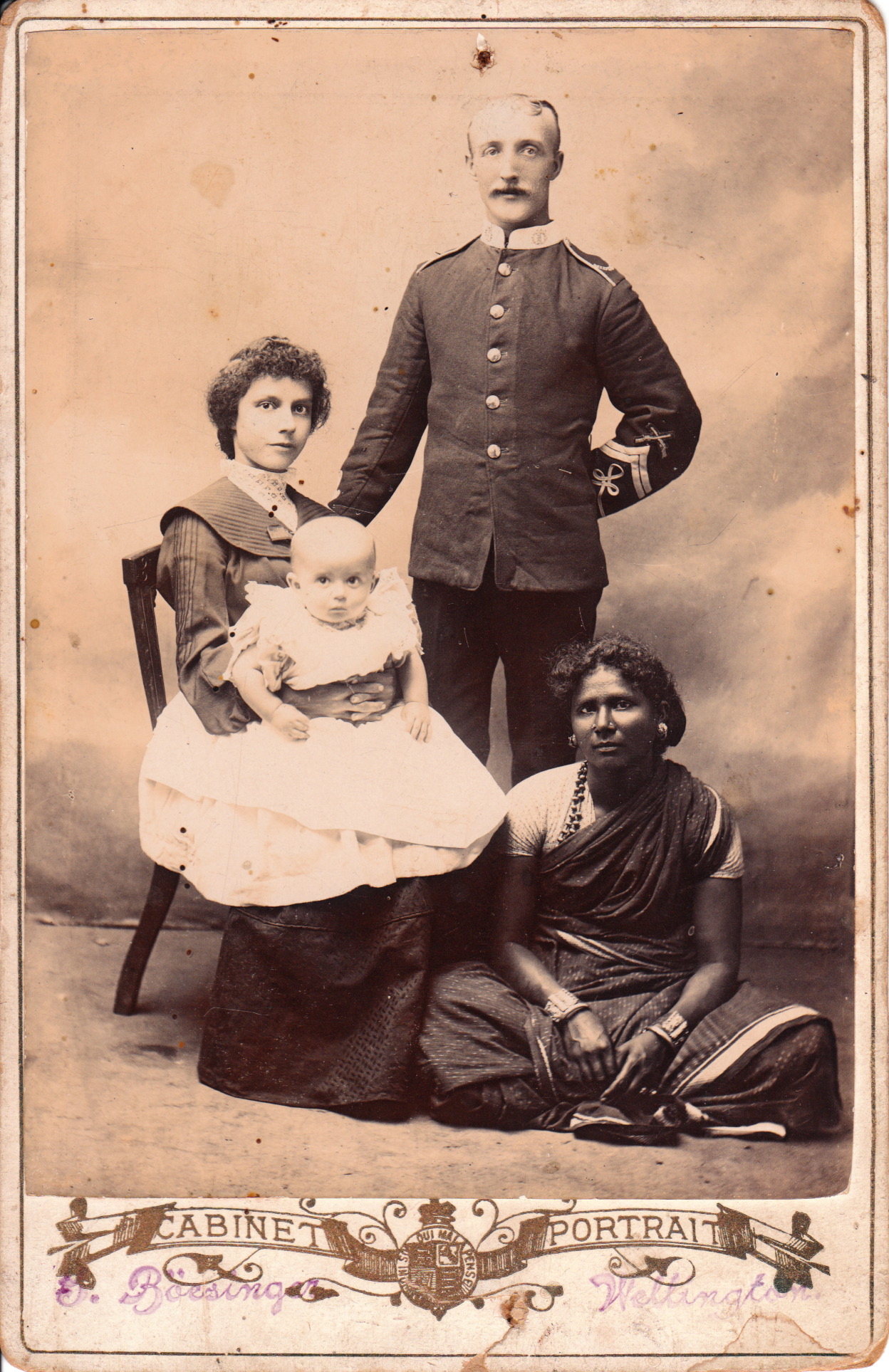
 S. Boesinger photographed this young family and their Indian servant at a studio in Tamil Nadu, India. To the right of Boesinger’s name on the bottom of the photograph is the name “Wellington”. Boesinger may have had a partner named Wellington, or perhaps had another studio in Wellington, England. The gentleman in this image appears to be a member of the British military. Note the servants jewelry. She is wearing a necklace, earrings and wide bracelets. She is also wearing nose ring. She was clearly a pioneer in nose jewelry, a practice which has made a comeback in present day times.
BRITISH MILITARY MAN AND HIS WIFE AND SERVANT POSE IN TAIL NADU, INDIA

PORTRAIT OF A LADY RIDER WITH HER HORSE AND INDIAN GROOMSMAN
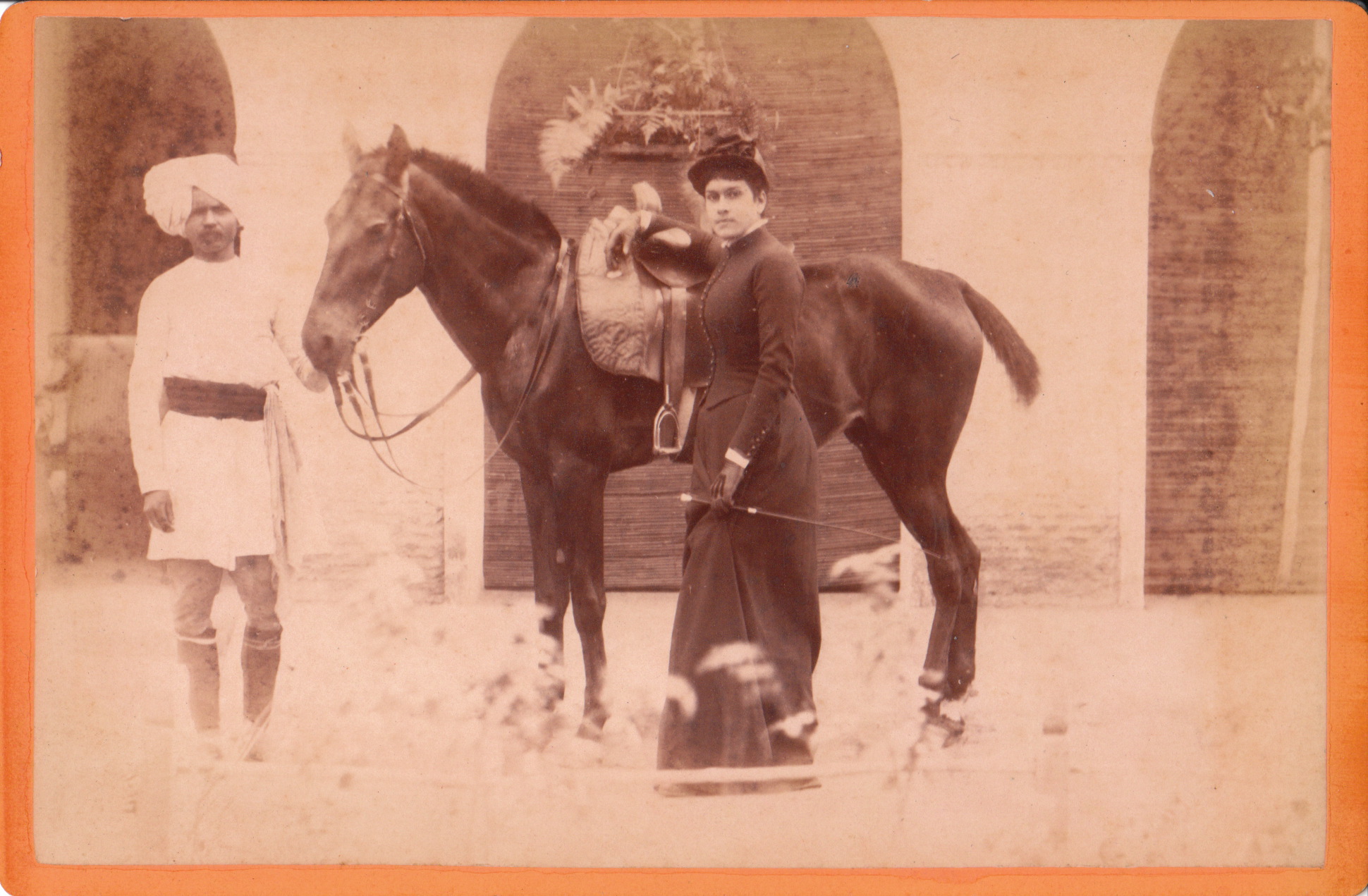 A woman in her riding habit and holding a riding crop, poses with her horse and servant. The servant is wearing a turban and holding the bridle of the lady’s mount. It is likely that this photograph was taken in India. The subjects and the photographer are unidentified.
EQUISITE PORTRAIT OF A BRITISH SOLDIER IN INDIA BY THE WELL RESPECTED STUDIO OF BOURNE AND SHEPERD

This cabinet card portrait features a uniformed British soldier in India. At least that is the opinion of the previous owner of this photograph. For all I know, this may be a photograph of a French soldier in France. Hopefully, one of Cabinet Cards Gallery’s visitors, knowledgeable about military history and uniforms, will be able to tell us with certainty which nation’s army this gentleman represents. The photographer of this crisp, clear, and riveting image is the Bourne & Sheperd studio. The Bourne & Sheperd studio was established in 1863. It is the oldest photographic studio still in operation. It was the most successful commercial firm in 19th and early 20th century India and it had outlets in Paris and London as well as a mail-order service. Samuel Bourne came to India in 1863 and partnered with an established Calcutta photographer. Charles Sheperd had partnered with a photographer in Agra in 1862. The two men joined forces in Shimla. Among his accomplishments, Bourne was known for his photographic expeditions to the Himalayans and Kashmir. He became celebrated as one of India’s best photographers. While Bourne was off making himself famous, Sheperd wasn’t just sitting home eating curried chicken and naan. Sheperd became known as a master printer. The partners opened a studio in Calcutta which became their flagship. They became the photographers of Indian Royalty and the British elite. In 1870 Bourne went back to England and opened a cotton mill and became a magistrate. In 1879 Sheperd returned to England. The partners continued to operate the Indian studios with continued success for a number of years. Since then, the studio has had multiple owners.
GROUP PORTRAIT NINE MEN IN INDIA (ETHNIC PHOTOGRAPH)
 This photograph features a portrait of a group of men, dressed in ethnic clothing (including turbans), and posing in an unidentified country. It is most likely that the location of this group photo is the nation of India. This portrait raises a number of questions on issues besides location. What is the man standing on the right side of the back row carrying in the bag hung over his shoulder? The man next to the man with the bag appears to be holding the bag man’s belt. Why is he holding the belt? There is a brick building behind the men. Is the building a business, a home, or an embassy? Are these men about to embark on a trip? Are they part of a work crew? The answer to these questions elude us but the mystery is part of what makes this photograph interesting to view.
PORTRAIT OF A PORTUGUESE FAMILY IN BOMBAY, INDIA (THE WORLD WAS FLAT EVEN BACK IN THE 1880’S)
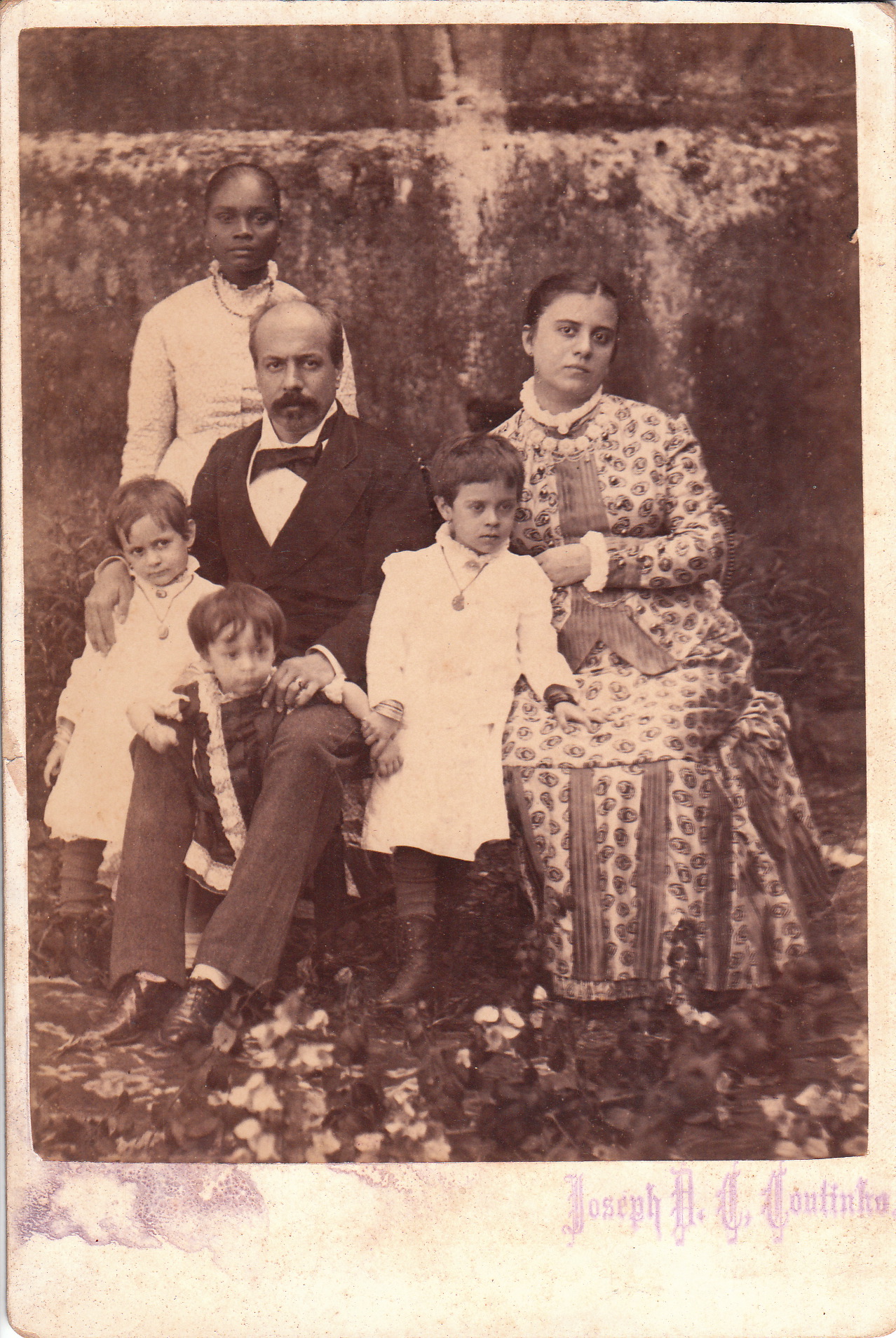 Thomas Friedman’s best selling book “The World is Flat” was published in 2005. This cabinet card photograph demonstrates that the world has been flat for a number of centuries. This image features a Portuguese family and their maid, posing for their portrait in Bombay, India. It is likely that their maid is Indian, given their location at the time of the photograph. The family consists of parents and their three sons. Five first names are written on the reverse of the cabinet card, but they can not be listed, because of legibility and language barriers. The photograph is dated 1888. The photographer is Joseph D. Coutinho of Bombay, India.
A HUNTER AND HIS GUN AND HIS DOG IN INDIA
 This cabinet card features a hunter and his gun and his dog. The young man is dressed for he hunt with his high boots and his wide brim hat. His dog is lying down and looks to be awaiting his master’s command. The photographer is John Blees, who is the author of the book, “Photography in Hindustan: or Reminiscences of a Traveling Photographer (Bombay, 1877).
ETHNIC COUPLE IN INDIA, DRESSED IN CULTURAL AND PERIOD CLOTHING AND PHOTOGRAPHED BY EARLY PHOTOGRAPHER G. W. LAURIE
 This cabinet card is a portrait of an Indian couple posing in the studio of G. W. Lawrie, a well known Scottish photographer who worked in Lucknow, India in the 1880’s and 1890’s. The front of the cabinet card advertises that he also had studios in Naini Tal, and Mussoorie, India. The gentleman in the photograph is wearing a sash and holding an umbrella. Is that a pocket watch on his coat? Note his hat; what is this type of hat called? The woman in the photograph has her head and upper body covered by her clothing. Hopefully, a visitor to this site can illuminate the details of this couples ethnic clothing.
BRITISH SOLDIER IN MUSSOORIE, INDIA
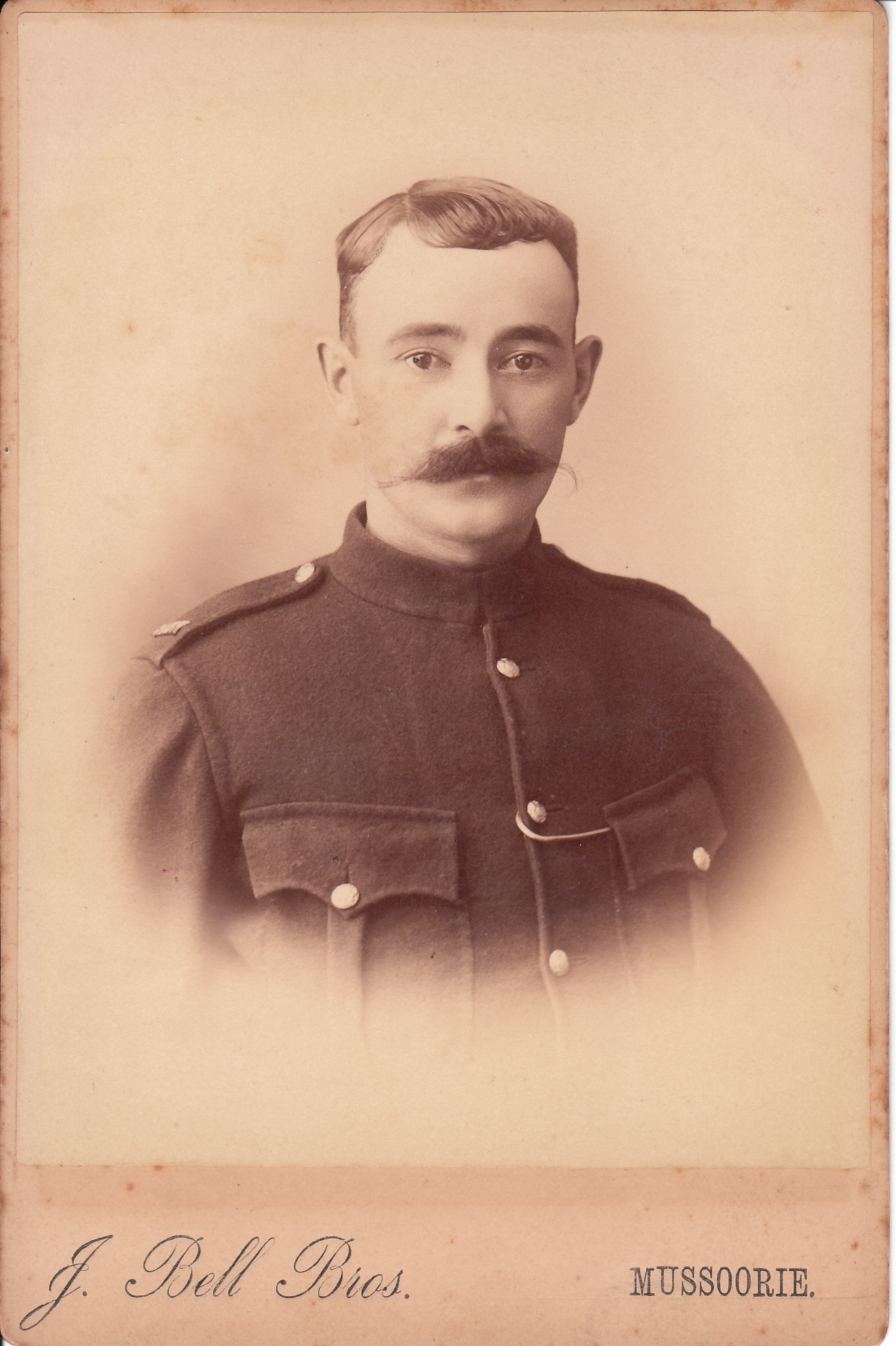 A British soldier poses for his Cabinet Card portrait in Mussoorie, India. The photographer is J. Bell Brothers. Mussoorie is a city 34 km from Dehradun in the Indian state of Uttarakhand. The city is located in the foothills of the Himalaya Mountain ranges and the city is sometimes referred to as “Queen of the Hills”.
MAN POSING FOR PHOTOGRAPHER IN CALCUTTA, INDIA
 Calcutta, India is the location at which this cabinet card photograph was taken. The studio of Johnston and Hoffmann were the photographers. The reverse of the card has the stamp of Austrian lithographer, Bernard Wachtl of Vienna. Calcutta is the current capitol of the Indian state of West Bengal located in eastern India. However, at the time of this photograph and until 1911, during the British Raj (colonial rule), Calcutta was the capitol of India. It would be interesting to know why this gentleman was in India and something about his identity, but this information has been lost over time. Research reveals some information about the photographers. Theodore Julius Hoffmann and P. A. Johnston established a commercial photography studio in Calcutta (1882) and Darjeeling (1890). Their studio is considered to be the second largest commercial photography studio in India in that period. Many of their images were of North and Northeast India as well as Sikkim and Nepal. To view other cabinet cards from India, click on the category “India”. To view other works by Bernard Wachtl, click on the category “Lithographers: Bernard Wachtl”.
LARGE INDIAN FAMILY POSING FOR CABINET CARD PORTRAIT
 This Cabinet Card is an image of an Indian family posing for their portrait in India. It is more accurate to say that this is presumably an Indian family in India since there is no family or photographic studio identification information on the reverse of the card. Nevertheless, this is an interesting portrait of what appears to be an extended family.


 THE CABINET CARD GALLERY