
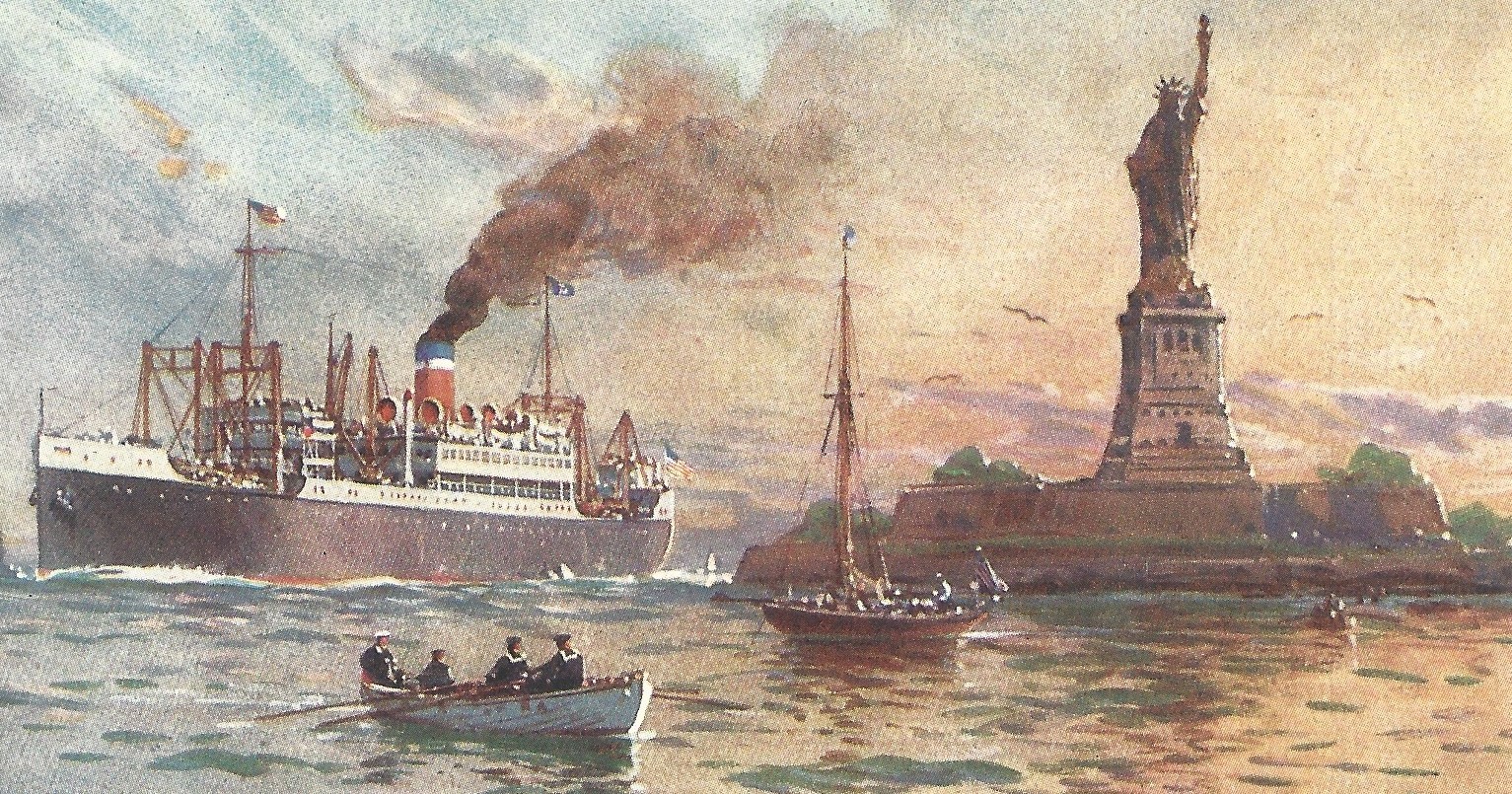
This vintage postcard features the S.S. President Harding passing the Statue of Liberty in New York harbor. The SS President Harding was the sister ship of the SS President Roosevelt and both were “Harris Class Transports” built for trooping and cargo duties during World War I by the US Shipping Board. Neither saw service in the war. The President Harding was sold to Belgian interests and was ultimately sunk in 1940 by an attack from German aircraft. The ship was built in 1921 as a passenger ship. It was launched in 1923. Originally, the ship was owned by the United States Lines, a shipping company that operated cargo services (1921-1989) and ocean liner service (until 1969). Kermit Roosevelt, son of President Theodore Roosevelt, was one of the founders of the company. The ship was in the news a number of times. In 1939, the SS President Harding answered an SOS from a French tanker (W. Emile Miguet) and rescued the crew. It was presumed that the tanker was sunk by a German U-Boat. A second newsworthy event occurred in 1939. The liner got caught in a hurricane and suffered 73 injured (23 seriously). Immediately prior to the second World War, the the SS President Harding was involved in the rescue of fifty Viennese Jewish children from the future grasp of Nazi Germany. The ship transported the children to the United States. The plan was for the parents to eventually follow them but few actually made it out of the country in time. The oilette painting reproduced on the front of this postcard was painted by the famous German marine artist, Willy Stower (1864-1931). The painting is dated some time in the 1920’s. A logo for the United States Lines can be seen on the reverse of the postcard. This postcard is in excellent condition (see scans). SOLD


 This vintage photograph features an attractive Jewish family in 1930’s Russia. The previous owner of this photo reports that this is the Robert Edelstein family. The parents in this image are well dressed and their son is wearing a sailor style outfit. The photograph measures about 3 1/4″ x 2 1/2″ and is in fair condition.

 This vintage photograph features a pretty young woman in a risque pose and wearing risque clothing. She is wearing a hat, gloves, and is holding a purse. She seems to be going somewhere but she forgot to finish getting dressed. The previous owner of this photograph thought the photographer of the image may have been the Biederer studio. I have no supporting evidence confirming his hypotheses. The Biederer brothers were major figures in photography so their story is worth telling. The studio was operated by Jacpues Biederer (1887-1942) and his brother Charles Biederer (1892-1942) during the Art deco era. Their studio was in Paris, France. Their photographs of the 1920’s and 1930’s included artistic nudes and sexual fetish studies. Their topics included erotic corporal punishment, costumed role play and images of bondage. Their postcards were signed as “JB” “B” ,”Ostra”, or a question mark in a triangle. When Germany occupied France during World War ll, the Nazis sent the brothers to a concentration camp (Auschwitz-Birkenau). Their crime was their Judaism. Their punishment was death. This vintage photo measures about 3 3/8″ x 5 3/8″ and is in very good condition.

 This vintage real photo postcard features Hungarian actress Gitta Alpar (1903-1991). She starred in operas and operettas. This photograph is risque relative to the time it was taken. Miss Alpar is wearing a tight bathing suit. Note that the swim suit has a nice design on it’s front. She is posing in front of a large rattan chair. Gitta was born in Budapest, Hungary. She was the daughter of a Jewish cantor. From an early age, she studied singing and piano at the Academy of Music. In 1923, she made her debut at the Budapest State Opera House. She had a long career and she performed at the great opera houses of Vienna, Berlin, an many other international venues. Alpar’s first films were made in Germany. In 1931 she married an actor, Gustav Frohlich. Their marriage ended in 1935 because Alpar was Jewish and the marriage was against the law in Nazi Germany. A related fact is that both of her brothers, a pianist, and a violinist, were concentration camp survivors. Alpar appeared on Hitler’s anti semitic “hit list”. She left Germany in 1933, and then did some globe hopping. She first went to Austria, followed by Hungry, England, and the United States. She continued her singing and film career in the US. The IMDb credits Alpar with nine acting credits from 1932 through 1941. Alpar’s accent ruined her chance to be a successful Hollywood actress. After the war, she primarily worked as a singing teacher. For a sample of Miss Alpar’s singing voice and acting, click on the YouTube segment below. This postcard was published by Ross Verlag and is part of a series (no.6683/2). Alpar’s photo was taken by FFG (Froehlich-Flm GmbH). (SOLD)





 THE CABINET CARD GALLERY