The dapper gentleman featured in this photograph is identified on the reverse of the cabinet card as William J Grant. Mr. Grant is quite dapper in appearance but it is a bit incongruous that he is standing next to a stack of bales of hay. The photographer’s last name is Tice and his studio was located in Janesville, Wisconsin. The Wisconsin and Minnesota Gazetteer (1865) includes an advertisement for J. A Tice of Janesville. The subject of this photograph, William J. Grant, was born in 1848 in the state of New York. The 1870 US census finds the 22 year old Grant working on the family farm. He lived with his parents, William and Ann Grant (both born in Ireland) and his three sisters Mary (age 28), Elizabeth (age 24) and Euphemia (age 20). The 1880 census reveals that Grant was married but lived without his wife in a boarding house. He worked as a teamster. The 1900 census lists Grant as single and still living in a boarding house. He was employed as a drayman. Drayman? What is a drayman? A drayman is a driver of a dray. Does that help? It didn’t help me, so here is the rest of the story. A dray is a low and flat-bed wagon without sides. The wagon is usually pulled by horses or mules to transport goods.
DAPPER GENTLEMAN IN JANESVILLE, WISCONSIN (WILLIAM J GRANT)
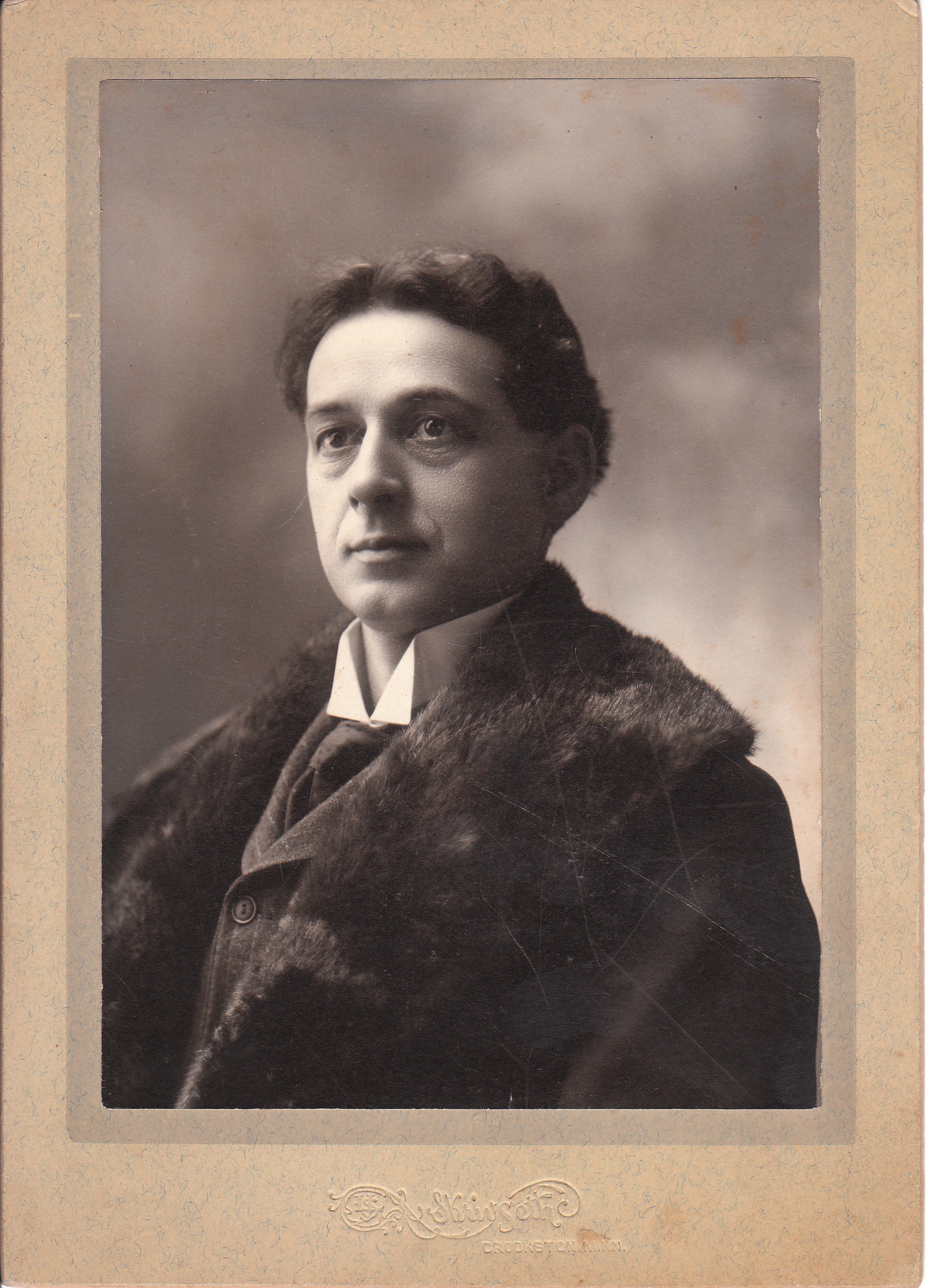
HANDSOME MAN IN CROOKSTON, MINNESOTA
This photograph features a very handsome man posing for his portrait at the studio of Skrin Seth in Crookston, Minnesota. My spelling of the photographer’s name is questionable since his name is partially illegible as printed on the front of the photograph. The subject of this photograph has glamorous looks and is wearing a fur coat. He is identified on the reverse of the card but once again there is a legibility problem. His name is either “Mr. E. McKenzie” or “N. E. McKenzie”. Research revealed no biographical information about the image’s subject or about the photographer.
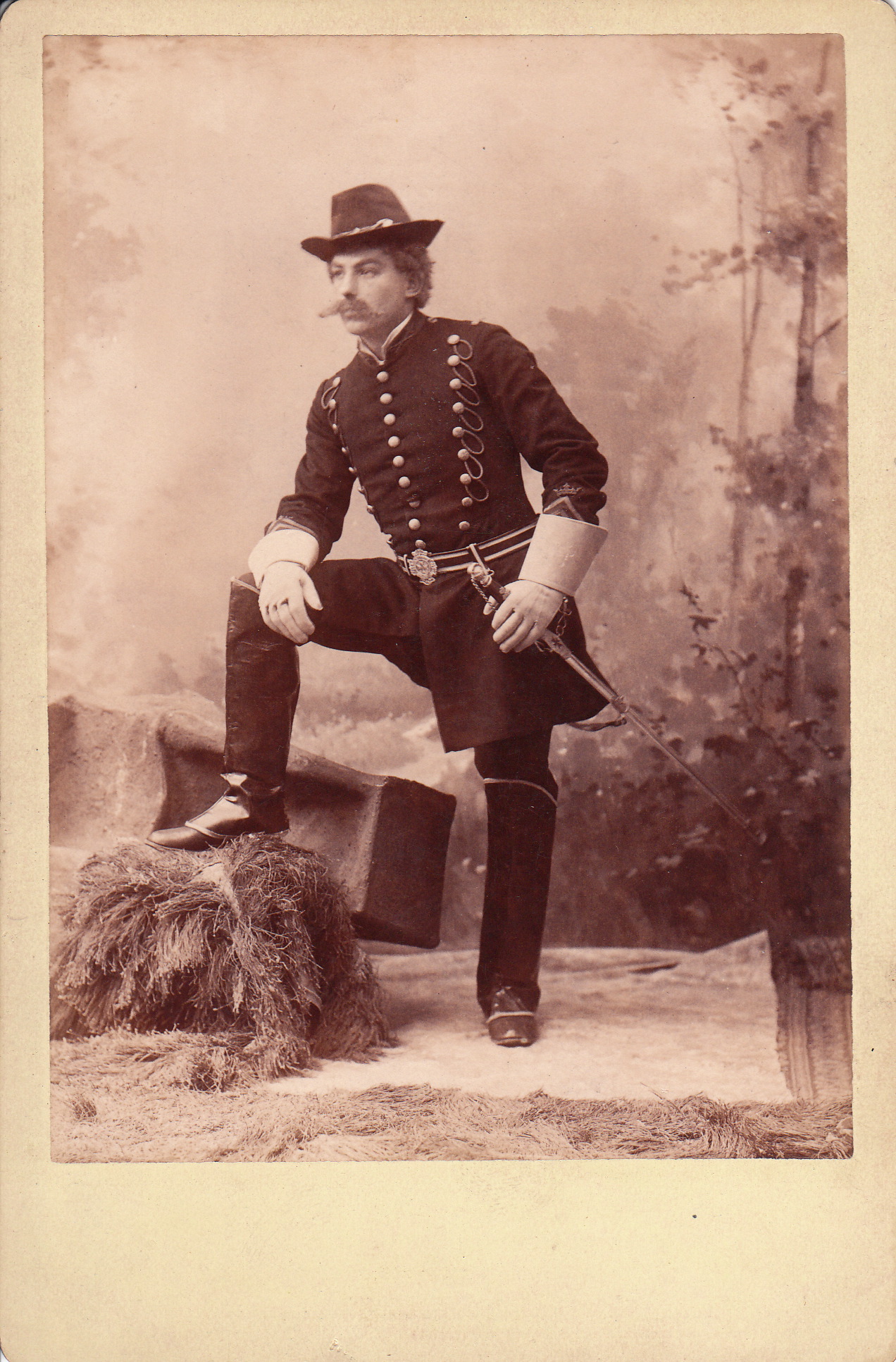
CAVALRY OFFICER WITHOUT A HORSE AND WITHOUT A COUNTRY
A cavalry officer poses for his portrait at an unknown studio in an unknown location. This handsome military man is wearing what appears to be riding gloves and a sword in a sheath on his belt. He also has a belt buckle which may provide some additional information. However, limited magnification availability has precluded uncovering further identifying information on the buckle. It is unlikely that the subject is a member of an American cavalry unit. There is an embroidered crown on his left sleeve which may indicate he served in a Canadian or British mounted brigade. Another possibility is that the subject is actually an actor wearing a theatrical costume. Hopefully, a cabinet card visitor will leave an enlightening comment concerning this man’s identity.
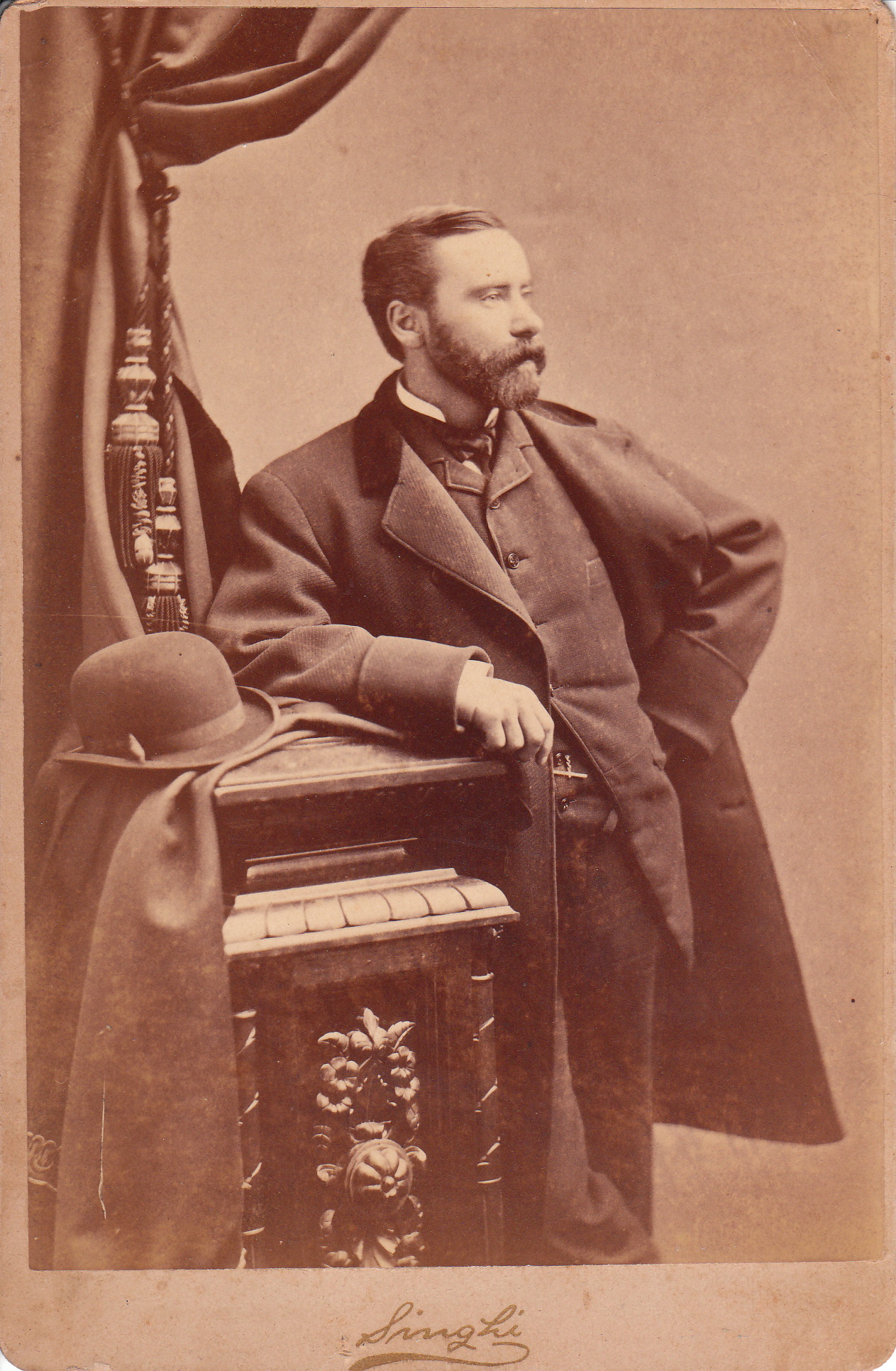
A PROFESSIONAL LOOKING GENTLEMAN IN BINGHAMTON, NEW YORK
The man in this cabinet card photograph appears to be a professional gentleman. He is wearing an overcoat and a nicely trimmed beard. He is standing next to his derby hat and has a pocket watch. Perhaps the well dressed gentleman is an attorney. Maybe its not a coincidence that the Binghamton, New York based photographer, Singhi, was located on Court Street. The reverse of the photograph has an inscription which identifies the gentleman as “Adelbert Harroun”. Research reveals that Mr. Harroun was not a lawyer but instead, he was an accountant. The 1870 census notes that Thomas Adelbert Harroun (1851-?) was the 19 year-old son of Thomas Harroun (1824-1907) and Salina King Harroun (1824-1903). His father’s occupation was listed as a “Presiding Elder” and further research found that he was a Methodist clergyman. His mother was a homemaker. Adelbert lived with his parents and two siblings in Norwich, New York. Sister Flora (age 22) was a music teacher and brother Arthur (age 11) was a student. He married his wife, Mary Winton, in 1888. The couple had two children. The 1900 census finds the 47 year old Harroun living in Dunleith, Illinois. He was living with his wife, Mary, their son N. Winton (age 10), and daughter Anna Augusta (age 9). Harroun was working as a railroad yard clerk. Further investigation revealed that daughter Anna Augusta died in 1904 in Dubuque, Illinois. The 1920 census reports that the 67 year-old Harroun was widowed and living in Waukegan Lake, Illinois with his sister Flora. He was working as an accountant. The 1930 census locates Harroun in Prineville, Oregon and living as a boarder. At 79 years of his age, he was still working (bookkeeper). The photographer of this image is Will G. Singhi. He worked in Binghamton, New York between 1872 and 1886. His albumen print “A Winter Scene” is exhibited in the online “American Museum of Photography”. Singhi had taken a photograph that appeared to capture a snowball in mid flight heading toward a newsboy who was prepared to deflect it. The museum also has on display a funny cartoon self portrait caricature that Singhi used as an advertisement. The Photographic Times and American Photographer (1883) comments on Singhi’s wonderful sense of humor.
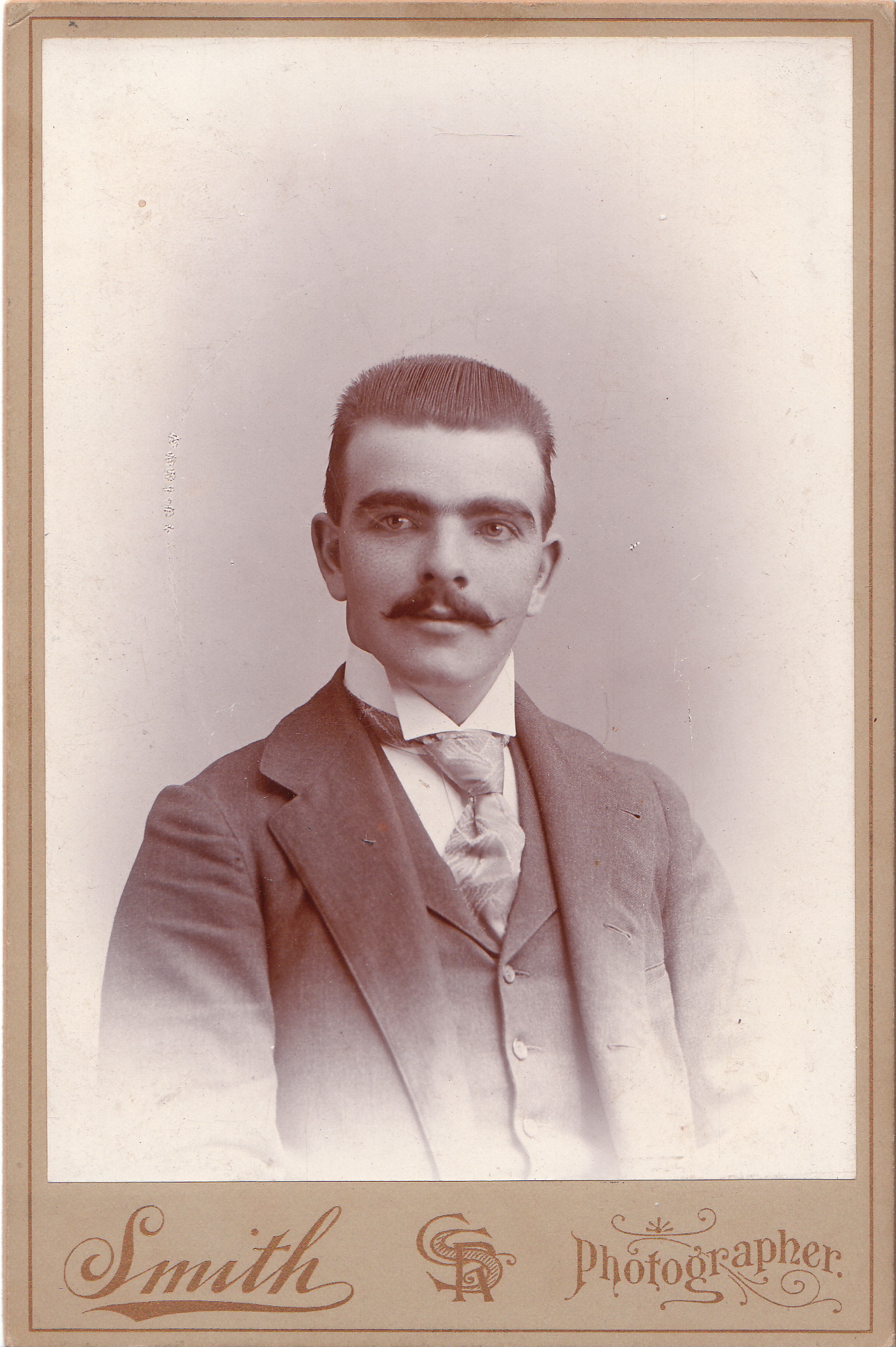
TURN OF THE CENTURY HANDSOME MAN WITH SLICKED BACK HAIR
This cabinet card features a portrait of a handsome young man with slicked back hair. He is dressed beautifully and well groomed. The photographer is named Smith but the location of his studio is not listed on the front or the reverse of the photograph. The initials on the front of the card indicate that the photographers full name is C. R. Smith. There was a photographer named C. R. Smith located in Clearwater, Minnesota. He was listed in Camera Craft (1908) and also in The Photographic Journal of America (1917). It is not confirmed that this C. R. Smith is the photographer of this cabinet card. It is interesting to note that the Cabinet Card Gallery has a number of photographs by the photographer who photographed this gentleman. All of the photographs share the same logo containing the photographer’s initials. To view these photographs, click on the category “Photographer: Smith CR”
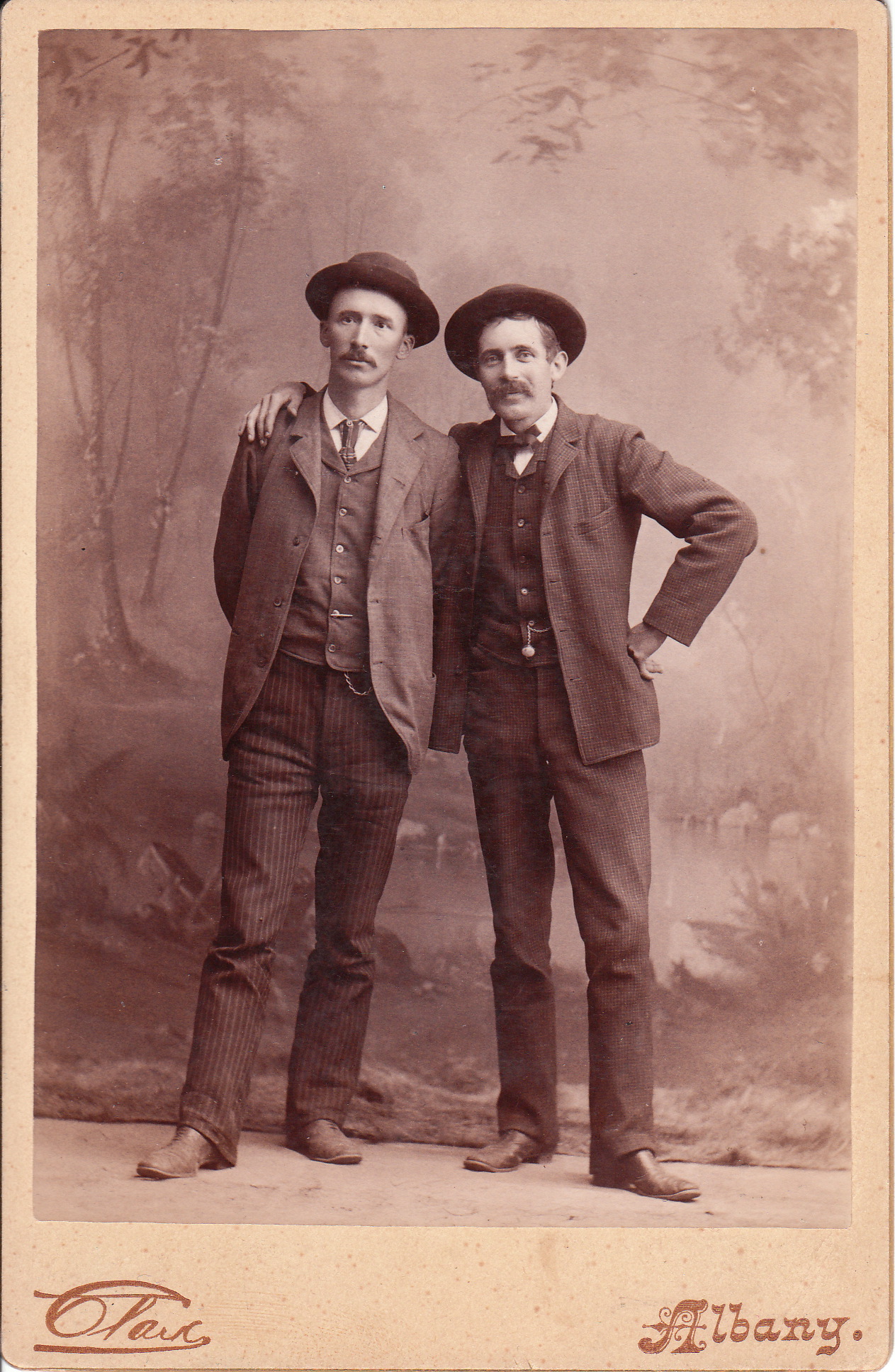
TWO FRIENDLY GUYS IN ALBANY, NEW YORK
Two men pose together at the Clark studio in Albany. It is not clear which state Albany is located in, but the most likely answer is New York. L. Wilson Clark was a photographer in Albany, New York. He may be the photographer that produced this cabinet card. The two fellows in this image seem to be well acquainted. The man on the right has a big smile, while the gentleman on the left, seems rather uncomfortable with his friend’s intimacy. The men are wearing suits with neckties and wonderful hats. Their clothing does not seem to be of the finest quality.
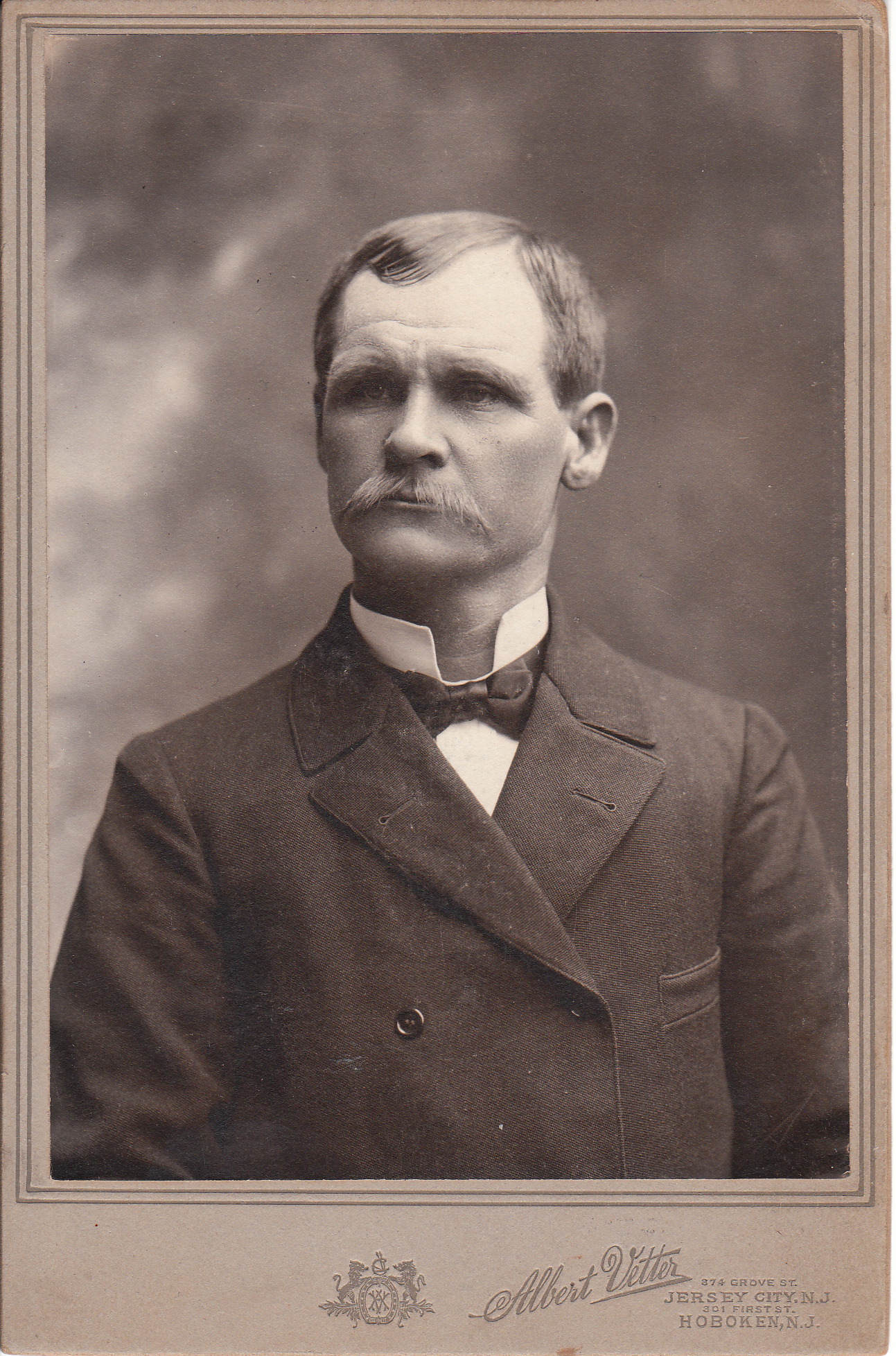
RUFFIAN LOOKING MAN POSES FOR RUFFIAN PHOTOGRAPHER WITH A NEW IDEA IN PICTURE HANGING (NEW JERSEY)
An intense looking gentleman poses for his portrait at the studio of Albert Vetter. Vetter operated two photographic galleries in New Jersey; one was in Jersey City, while the other was located in Hoboken. The man in this photograph is dressed formally, like a gentleman; but he has the look of a ruffian. Could be an interesting story about the discrepancy, but no identifying information is available about the man in this photograph. On the subject of ruffians, wait until you hear about the photographer of this image. The magazine, The Camera and the Darkroom ( 1904) reported that Vetter was at odds with the family that lived in the house that was also the home of his studio. Vetter got a picture of the head of the family, who recently died. He enlarged the picture and fastened a rope around it at the neck, and hung it out the window. The daughter of the late man, got a step ladder and removed the photograph. A “war of words” followed and Vetter was arrested. He was arraigned in front of a judge for disorderly conduct and he was put up for bond to maintain the peace. The magazine used a humorous headline to describe this incident; “New Idea in Picture Hanging”.
HANDSOME MAN WITH THICK MUSTACHE IN ALBANY, NEW YORK
This cabinet card portrait captures a handsome man with a terrific thick mustache. He is dressed impeccably. The photographer is Sterry and his studio was located at 520 & 522 Broadway, in Albany, New York. To view other interesting mustaches, click on Cabinet Card Gallery’s category “Mustaches (Only the Best). Edwin S. Sterry (1842-1900) was the successor to Mcdonald & Sterry, also located in Albany. Sterry was considered the principal photographer in Albany for 27 years, according to the journal “The Photogram (1894)”. The journal describes Sterry as the equivalent of a European court photographer. It is reported that he was patronized by all levels of politicians from both parties. It is also asserted that his photograph of the judges of the Court of Appeals generated fifteen thousand dollars in sales.
TWO DANDIES IN THE WOODS IN EVANSVILLE, INDIANA
This cabinet card features two well-dressed men posing for their portrait in a studio belonging to J. W. Ecker. The studio was located in Evansville, Indiana and at one time was called the Sunbeam Gallery. . The men in this photograph are wearing identical outfits. Note their striped pants, derby hats and canes. The man on the left is holding a cigar. They are posed in front of a nice backdrop depicting a forest.
OLDER GENTLEMAN WITH SCRUFFY BEARD IN PORTLAND, MAINE
This cabinet card features an older man with a scruffy, but nicely shaped, pointy beard. In the style of his day, he has just the top button of his jacket fastened. The photographer of this image is Howard M. Smith of Portland, Maine. Smith operated studios at 2574 Middle Street and at 478 Congress Street, in Portland. Smith’s studio is listed in an 1891 Portland business directory. To view other photographs of unusual beards, click on the category “Beards (Only the Best)”.