 A man in a plaid suit, winged collar shirt, and matching vest poses for his photograph at an unidentified studio. He is holding a horn of some kind (Trumpet?, Bugle?, or Cornet?) and wearing a cap which has the lettering “WCB”. I am guessing that the “CB” part is an abbreviation for “community band”. Inscribed on the reverse of the photograph are the following; “Burnette” and “Albion, NY”. “Burnette” is likely the subject’s name and Albion was likely his hometown. Research found too many men sharing the name “Burnette” in Albion to make a positive identification of his name and background. The over zealous previous owned of this cabinet card described the subject as a civil war veteran holding his bugle and wearing his kepi hat. Collectors of antique photographs must be careful of people making such unsubstantiated claims. Call me an optimist, but I think the majority of such people are more unaware than unscrupulous.
MAN WITH A TRUMPET IN ALBION, NEW YORK

UNIFORMED BAND MEMBER IN NEW YORK CITY
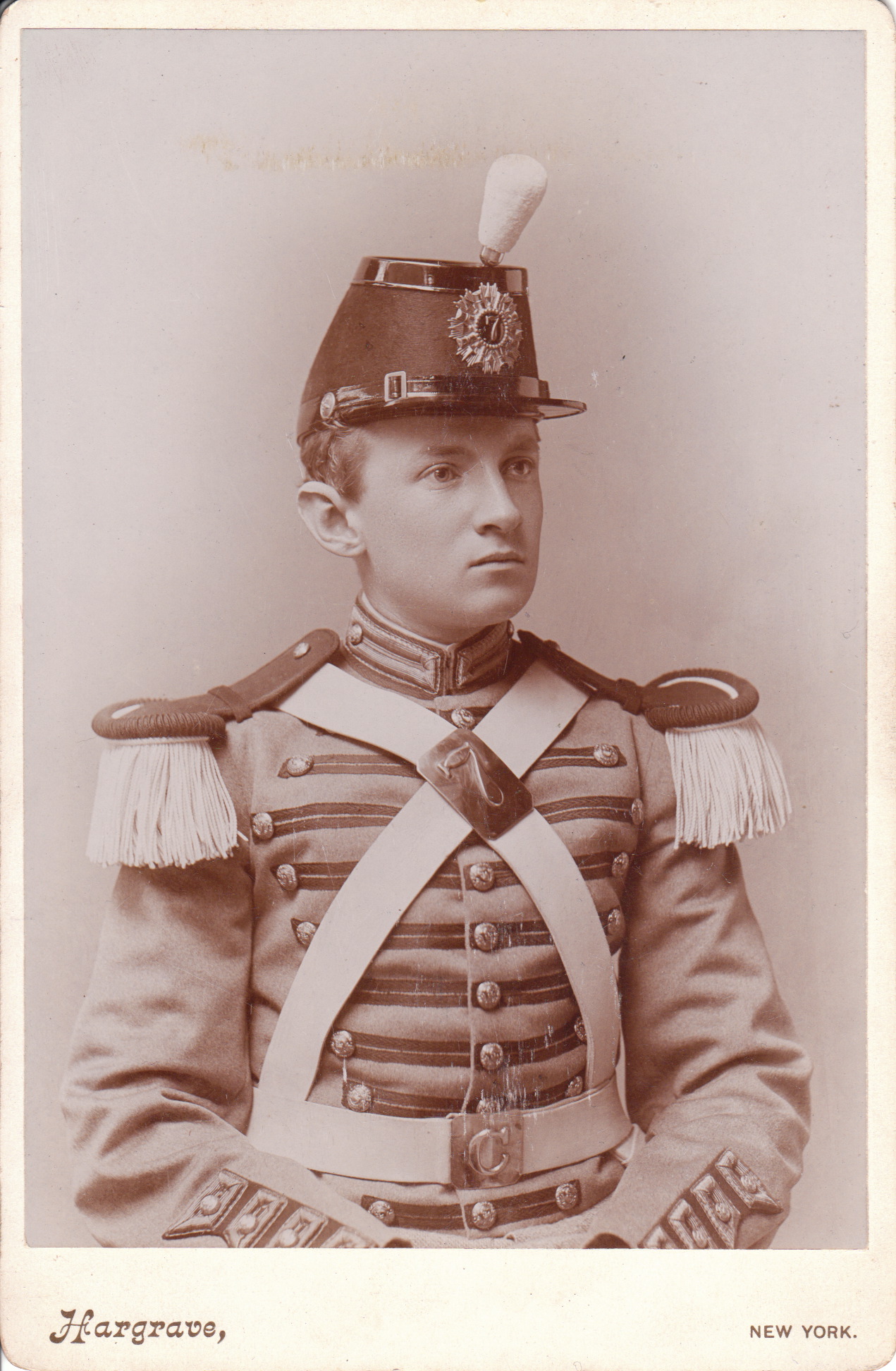 The young uniformed man in this cabinet card portrait appears to be a band member. However, it is also possible that he may be a cadet, a fireman, or a member of some other type of organization. His belt buckle has the letter “C” and the badge on his hat has the number “7”. Hopefully, a visitor to the cabinet card gallery may be able to pinpoint the exact type of unit that this subject represents. The photographer of this image is A. J. Hargrave. At the time of this photograph he was located at 68 West 23rd Street in New York City. To learn more about Hargrave and to view more of his photographs, click on the category “Photographer: Hargrave”.
UNIFORMED BAND MEMBER AND HIS TUBA IN JEWETT CITY, CONNECTICUT
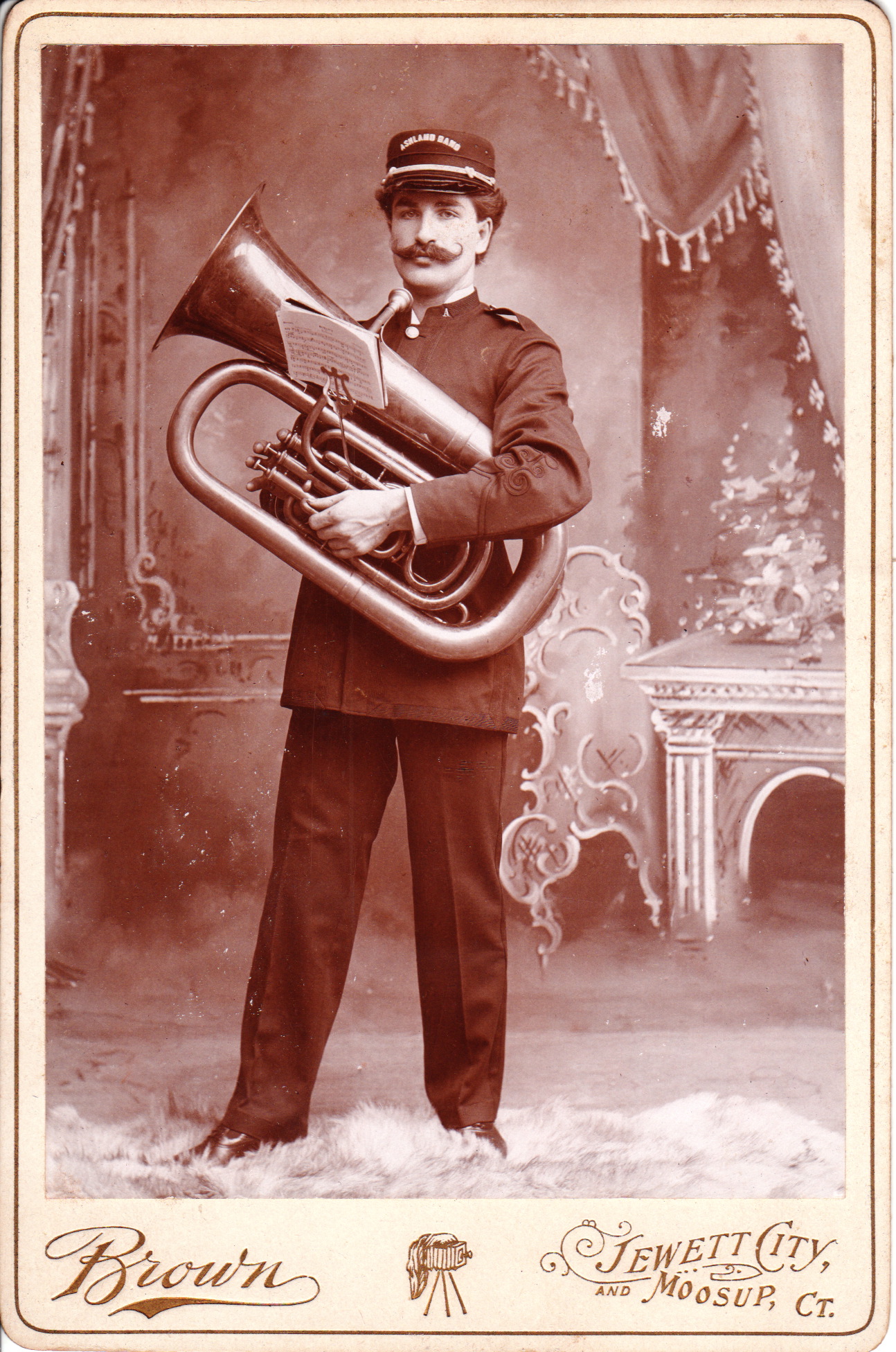
This cabinet card features a uniformed band member and his tuba. At least I think it is a tuba but I would appreciate some confirmation from a cabinet card visitor well versed in identifying musical instruments. Note the sheet music clipped to his brass instrument The musician has a terrific handlebar mustache and his cap indicates that he is a member of the “Ashland Band”. This image was produced by the Brown studio in Jewett City as well as Moosup, Connecticut. Jewett City is a borough in the town of Griswold and Moosup is located in the town of Plainfield. Jewett City and Moosup are 12 miles apart. To drive from Jewett City to Moosup, one starts off on Ashland Street. I wonder if the “Ashland Band” is related to “Ashland Street”? Research reveals that the photographer William H. Brown was born in Packerville, Connecticut in 1853. His father was an overseer in the local mill. Brown was educated in public schools and his first job was as a store clerk. After three years of working in the store, he bought it and ran it for four years until he sold it. He then went back to work as a store clerk but bought a camera and for fun, photographed his friends and others during off hours. In a short time, it was clear that Brown had much talent in the area of photography. In about 1888 he opened a photography business. He had studios in Dayville and Wauregan. Later he opened galleries in Jewett City, Taftville and Moosup. Brown was married in 1874 to Miss Lillian Bennett and the couple had two daughters, Lillian and Alice.
YOUNG GYPSY WOMAN IN ELMIRA, NEW YORK

R. F. Snyder of Elmira, New York produced this cabinet card photograph of a young gypsy woman. One can not be certain whether this image displays a young gypsy woman, or a young woman dressed to appear as a gypsy. She is wearing the appropriate ethnic clothing and is holding cymbals. The reverse of the photograph has a copyright date of 1889. This cabinet card does not represent good quality posing skills on the part of the photographer. The subject was photographed at too great a distance and she is consumed by the large blank expanse of the floor beneath her and the wall behind her. Ralph F. Snyder was born about 1852 in Berwick, Pennsylvania. His father, John Snyder, was a photographer. Ralph Snyder began his photography career at age 18 and soon had a studio in Scranton, Pennsylvania (1873). He also worked in Philadelphia before coming to Elmira, New York to open his gallery. His studio in Elmira was located at 116 Baldwin (1891).
HELENE HASTREITER: FAMED OPERA SINGER
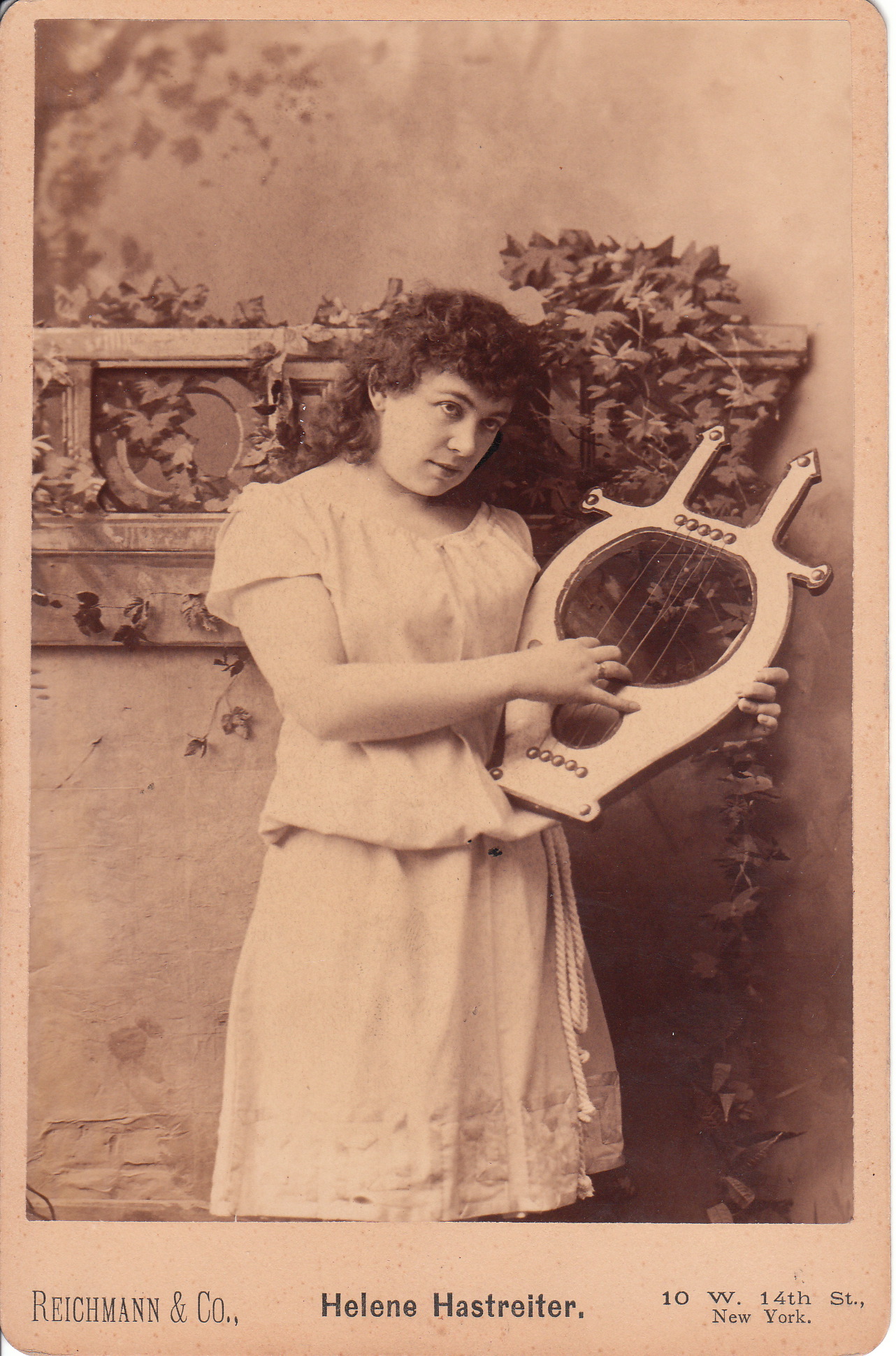 This cabinet card portrait features famed opera singer Helene Hastreiter (1858-1922). She is holding a stringed instrument that I can not identify with certainty but I believe it is a lyre. Hastreiter was born in Louisville, Kentucky. She made her opera debut in Milan, Italy. She was a mezzo soprano. The photographer of this image is Reichmann & Company. To view other photographs by this studio, click on the category “Photographer: Reichmann”.
YOUNG GIRL PRACTICES HER VIOLIN IN WARREN, ILLINOIS

This cabinet card features an unidentified young girl who appears to be deep in concentration as she practices playing her violin. Note the music stand. You may have seen similar stands at your local antique store or antique show. This image was produced at the Dobler studio in Warren, Illinois. Research yielded no information about Dobler or his studio
BAND OF MUSICIANS IN RICHLAND CENTER, WISCONSIN
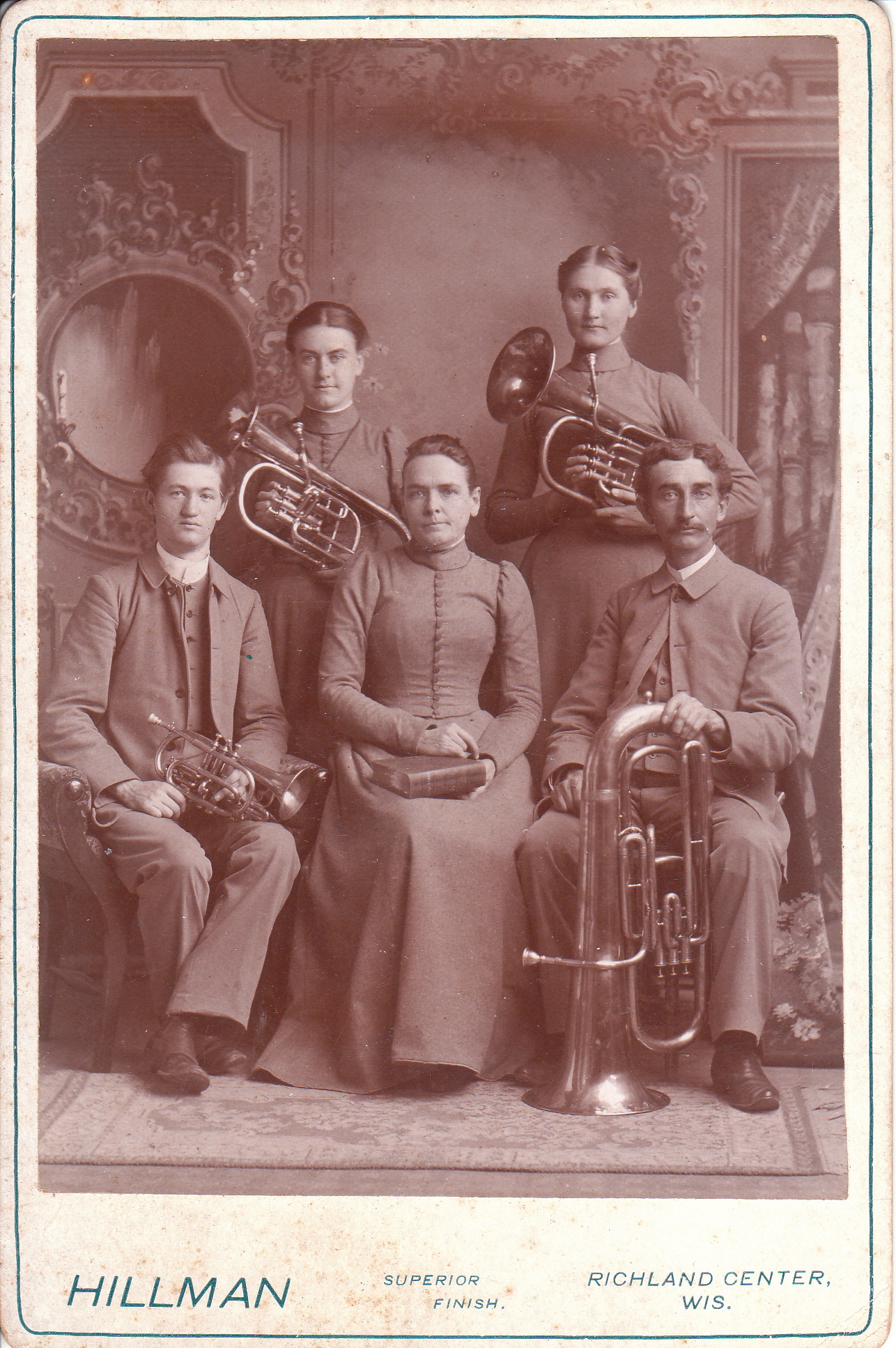 This cabinet card features five members of a brass band dressed in uniform. The band band does not appear to be an “ordinary” community band. The woman seated in the center of the bottom row has a bible on her lap. The band has the look of a salvation army band but they are not wearing salvation army uniforms. Most likely, these musicians are members of a religious based service organization. Perhaps a visitor to the cabinet card gallery will be able to identify the organization that these band members represent. This cabinet card is notable for its clarity and for the detailed view of the musical instruments. The photographer of this cabinet card was the Hillman studio of Richland Center, Wisconsin. The 1900 US census reports that William J. Hillman was a 51 year-old photographer, born in New York, and living in Richland Center with his wife Caroline (age 54) and his son Charles B. (age 22). Charles B.Hillman was listed as working as a photographer. The Photographic Times (1907) printed a paper read by Hillman. The paper was entitled ” The Successful Photographer” and the advice given in his presentation was excellent and would be relevant and helpful to modern day business owners. If Hillman was alive today, he would have been an incredible business consultant. The Bulletin of Photography (1914) contains an announcement that the Hillman studio was sold to Frank Dickson.
LADY AND A BANJO
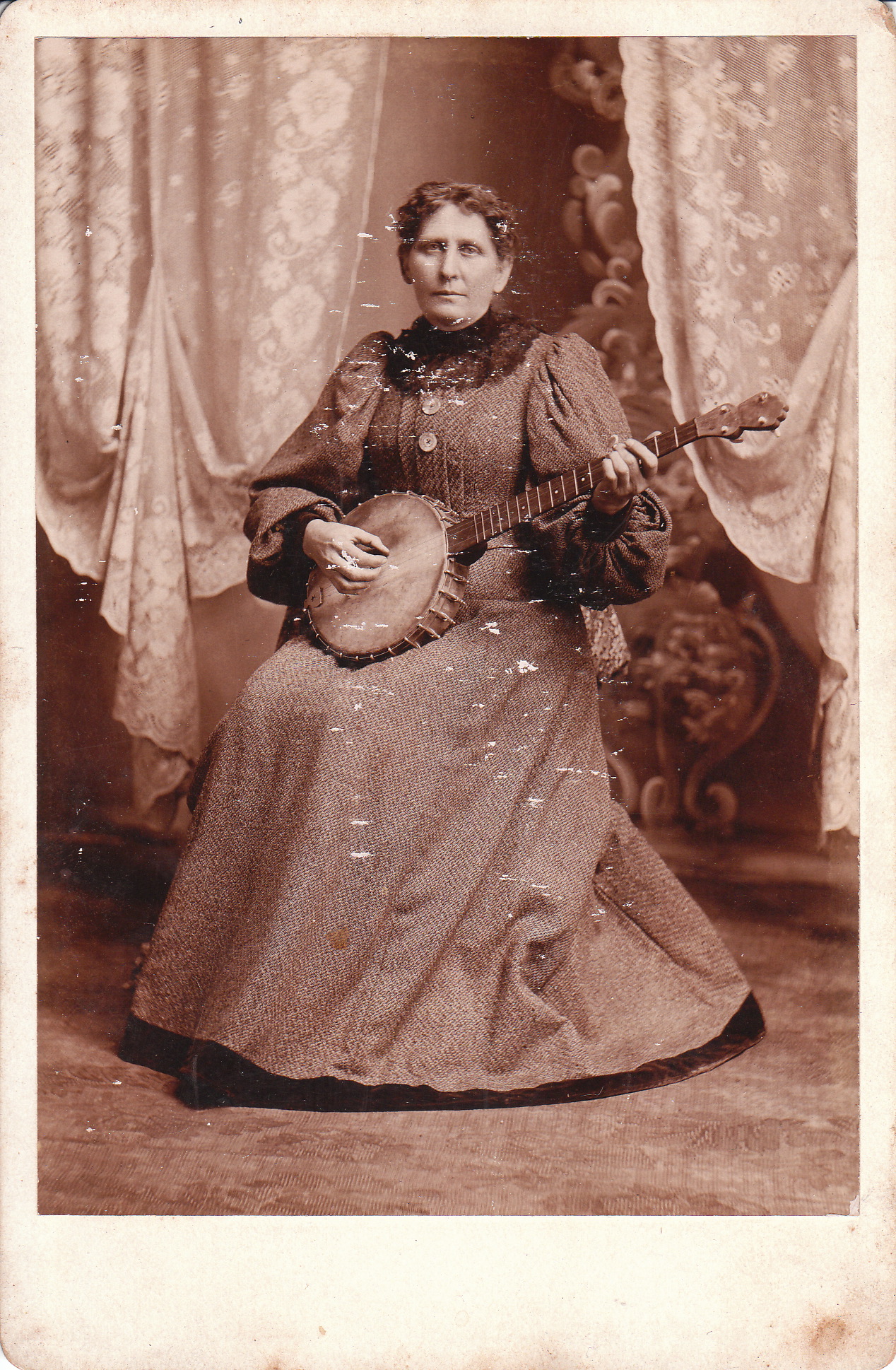
A lady and her banjo are the subject of this cabinet card portrait. She is posed as if she is performing. She sits with the banjo on her knees and curtains draped behind her. Although the photograph is marred by age, it is still a spectacular image because it captures the role music played in home entertainment at the turn of the nineteenth century. The performer and the photographer are unidentified. SOLD
SALVATION ARMY COUPLE IN UNIFORM: (INVENTOR OF THE LETTERED TEE SHIRT)

PHOTO 1
 PHOTO 2 (SOLD)
The top Cabinet Card is an image of two Salvation Army workers photographed by Suddard of Fall River, Massachusetts. The young couple are both in uniform; he has a tambourine and she is holding a trumpet. It is interesting to note that he is wearing a late 1800’s version of an embossed tee shirt. His shirt’s lettering states “NO CROSS NO CROWN”. A present day, non religious meaning of this saying would be “no pain, no gain”. The motto on the shirt was a widely used expression and an early user of the phrase was William Penn, the founder of the Quaker colong of Pennsylvania. The second photograph, also by Suddard, shows the same couple in a different studio setting. Once again, the couple is attired in a salvation army uniform. The gentleman is wearing a different style uniform than he wore in the top photograph. In the bottom photograph, the woman has taken possession of the tambourine and the man is holding papers. These two cabinet cards were purchased more than two years apart and I am fairly certain that they were purchased from different sellers. Amazingly, these images have ended up together again. A third cabinet card image by Suddard can be found elsewhere in the Cabinet Gallery. It can be accessed by clicking the category “Photographers: Suddard”.
THE SHEPARD FAMILY CONCERT COMPANY
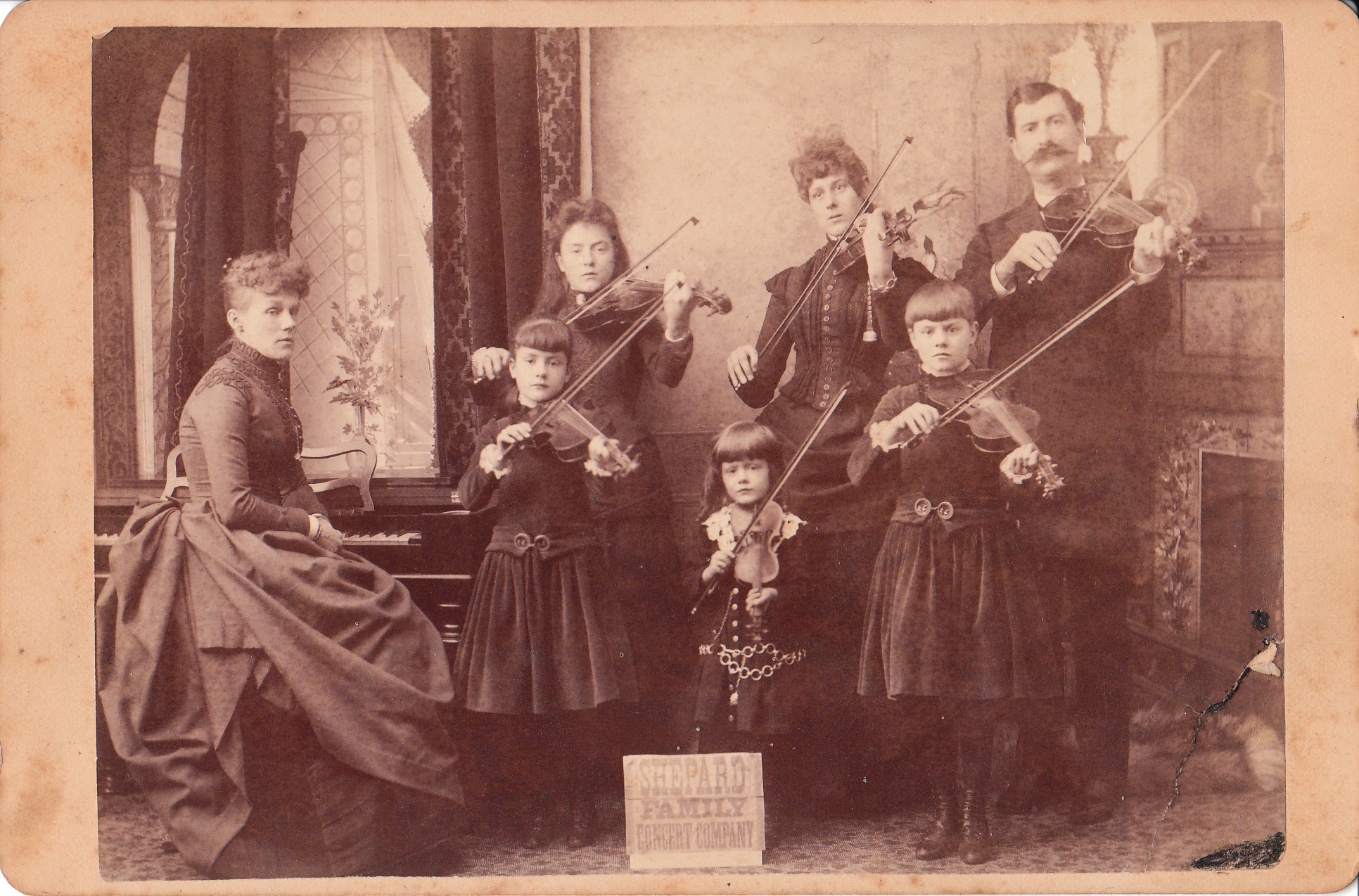 This cabinet card features a portrait of the Shepard Family Concert Company. In this photograph, mother is playing the piano (or organ) and the five children and their father are playing violins. The photographer of this cabinet card is unknown, as is the location of the studio. A photograph of the Shepard family and their instruments appears in The Henry Sheldon Museum of Vermont (located in Middlebury, Vermont). In addition, the museum possesses a “cigar ribbon quilt” serving as a piano cover. The quilt is made from silken advertising ribbons which cigar companies used to tie cigars together for packaging purposes. This particular quilt was made by Mary Emily Shepard (“Minnie”), the matriarch of the Shepard Family. The Shepard Family was Massachusetts based, and mostly toured upper New England. The musical group venues included the Town Hall Theatre, in Middlebury, Vermont. Family Musical Troupes were popular in the 1880’s and 1890’s. Mr. and Mrs. J. M. Shepard and their children, Kittie, Laura, Lessie, Georgie, and Burtin were regionally well known and appreciated in the late nineteenth century. Each family member were multi instrumentalists. The family could perform as a choral group, a brass band, or a violin ensemble with the mother playing the pump reed organ. In addition, sometimes, the children would perform as a banjo quintet.


 THE CABINET CARD GALLERY