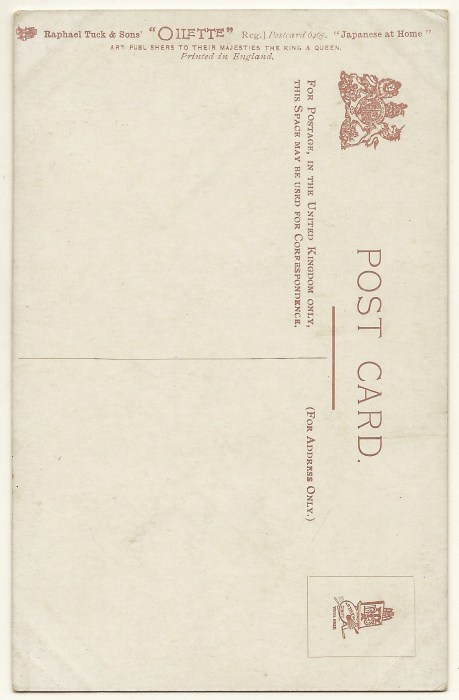
This vintage postcard was published by Raphael Tuck & Sons and is titled “Japanese Acrobats” (no. 6465). The performer in the middle has tattoos on his back, as well as on the back of his left leg. Note the acrobats are holding paper fans and that the center acrobat is wearing his fan on his head. The card is part of a sub-series named “Japanese at Home”. The postcard is also a member of the “Oilette ” series, which was introduced in 1903. The 1930 Tuck catalog states that the oilettes are “veritable miniature oil paintings;” with six designs in a packet. These postcards were printed with the “finest modern colour methods direct from original paintings”. Raphael Tuck and his wife started their photography business in 1866 in London. Their store sold pictures, greeting cards, and in time, postcards. Their success came from the sale of postcards during the late 1890’s and early 1900’s. In the early 1900’s the firm conducted postcard competitions for collectors of Tuck postcards. These competitions offered cash prizes and they were very popular. The winner of one of these competitions had a collection consisting of over twenty-five thousand cards. Three of Tuck’s four sons participated in the business. The company was devastated by German bombing during World War II. In 1959 the company merged with two other printing companies. (SOLD)
Miss Winifred Emery (1861-1924) is the subject of this vintage real photo postcard. She was an English actress and actor-manager during the late 19th and early 20th centuries. She was married to actor Cyril Maude (m. 1888). It is not hard to imagine that the fact that she was born into a family of actors, played a role in her career choice. She began as a child actress and during the 1880’s and 1890’s her career blossomed as she played many leading roles in London’s West End theatres. Interestingly, her first London appearance was in 1874 in the pantomime,”Beauty and the Beast”. She later joined Marie Litton’s company, Herbert Beerbohm Tree’s theatre company, Henry Irving’s theatre company, and Wilson Barrett’s company. She eventually started her own touring theatre company with her husband. In 1896, her husband became actor-manager of the Haymarket Theatre and Emery became his leading lady. Among the plays that Emery appeared in are number of productions of Shakespeare. Emery had a successful stage career that spanned over forty years. This postcard was published circa 1910 by Raphael Tuck & Sons’ as part of the “Stage Favourites” Series (No. 5062). The photographer of this portrait of Miss Emery was Alexander Bassano, a very respected celebrity photographer. (SOLD)
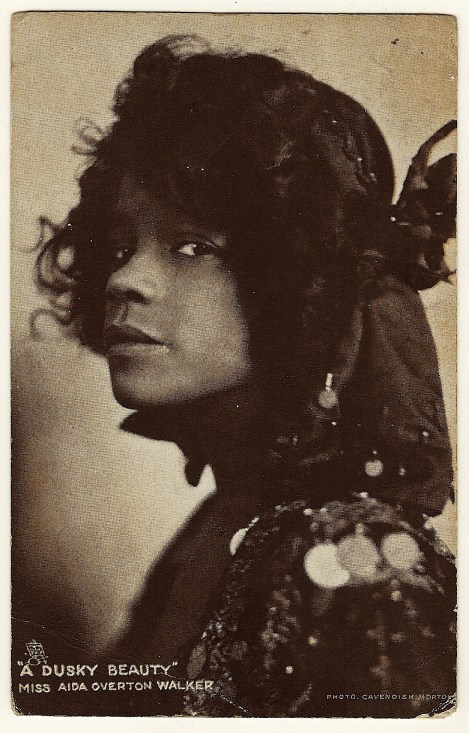
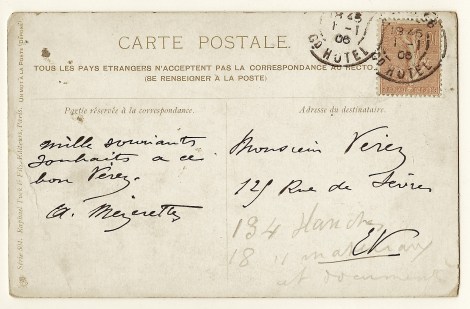
The subject of this vintage real photo postcard is Miss Aida Overton Walker. The caption above her name refers to her as “A Dusky Beauty”. Seems like a racist title to me. I don’t recall ever seeing its equivalent, “A Pasty Beauty”, on a portrait of a white female performer. Aida Overton Walker (1880-1914) was known as “The Queen of the Cakewalk”. She was African-American and an American vaudeville performer, singer, actress, and choreographer. She has been called the most famous African American female performer of the early twentieth century. She was married in 1899 to vaudeville performer, George Walker. Aida and her husband performed with the highly successful Bert Williams. They were the major black vaudeville and musical comedy act of the era. She was also a solo dancer and choreographer for a number of other vaudeville shows. Aida was well known for her 1912 performance of the ”’salome” dance. Aida was born in Richmond, Virginia and moved to New York City when she was young. She was educated there and received a great deal of musical training. When she was fifteen years old she joined the “Octoroons”, a black touring group. In 1900 she gained national notice with her performance of “Miss Hannah from Savannah” in the play, “Sons of Ham”. The song became a major hit. Overton Walker had significant theatrical success with her performances in Dahomey (1902), Abyssinia (1906), and Bandana Land (1908). Overall, Aida was praised by critics and fellow performers. She was financially successful. In 1908 she retired to care for her ill husband. In 1910 she returned to the stage as a solo act. In 1911, her husband died. By 1912, she was on tour again. That same year, she performed on Broadway as Salome. In 1914, Walker died suddenly from kidney failure. Two years before her death, she was performing in white variety theaters. She and Bert Williams were the only Black performers “permitted” to do so. At that time, African Americans were expected to confine themselves to “lower” entertainment such as comedy and ragtime. “High” art, like dramatic theater and classical dance were reserved for whites. Aida helped break that racist tradition. During her career, Aida addressed the issue of racial relations. She stated in an article in “The Colored American Magazine (1905), her view that that the performing arts could have a beneficial effect on race relations. Walker asserted “I venture to think and dare to state that our profession does more toward the alleviation of color prejudice than any other profession among colored people.” She also worked to improve working conditions, and to expand roles for black women on the stage. During the period Walker was performing, female actresses, especially black actresses, were seen as “immoral and oversexed”. Aida wrote “a woman does not lose her dignity…when she enters stage life”. Walker also worked to develop the talents of younger black performers within the framework of refinement and elegance. In 1908, she began organizing benefits to assist such causes as the Industrial Home for Colored Working Girls. This vintage postcard was published by Raphael Tuck, of Paris, France. The photographer of Miss Walker was Cavendish Morton (1874-1939). The National Portrait Gallery possesses 104 of Morton’s portraits. Morton had several careers including electrical engineering, architecture, acting, illustrating, and in the 1890’s he took up photography. He is known for his theatrical photo portraits. His son was a well known watercolor artist. This postcard was postmarked in 1908, The postcard is in good condition. See the youtube video below. It is a tribute to Aida Overton Walker. (SOLD)
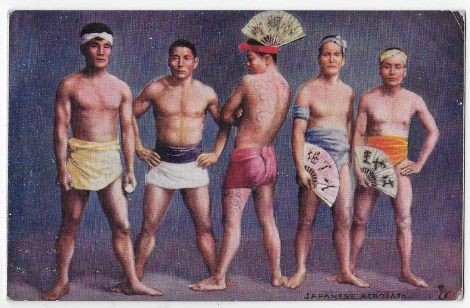 This vintage postcard was published by Raphael Tuck & Sons and is titled “Japanese Acrobats” (no. 6465). The performer in the middle has tattoos on his back, as well as on the back of his left leg. Note the acrobats are holding paper fans and that the center acrobat is wearing his fan on his head. The card is part of a sub-series named “Japanese at Home”. The postcard is also a member of the “Oilette ” series, which was introduced in 1903. The 1930 Tuck catalog states that the oilettes are “veritable miniature oil paintings;” with six designs in a packet. These postcards were printed with the “finest modern colour methods direct from original paintings”. Raphael Tuck and his wife started their photography business in 1866 in London. Their store sold pictures, greeting cards, and in time, postcards. Their success came from the sale of postcards during the late 1890’s and early 1900’s. In the early 1900’s the firm conducted postcard competitions for collectors of Tuck postcards. These competitions offered cash prizes and they were very popular. The winner of one of these competitions had a collection consisting of over twenty-five thousand cards. Three of Tuck’s four sons participated in the business. The company was devastated by German bombing during World War II. In 1959 the company merged with two other printing companies. (SOLD)

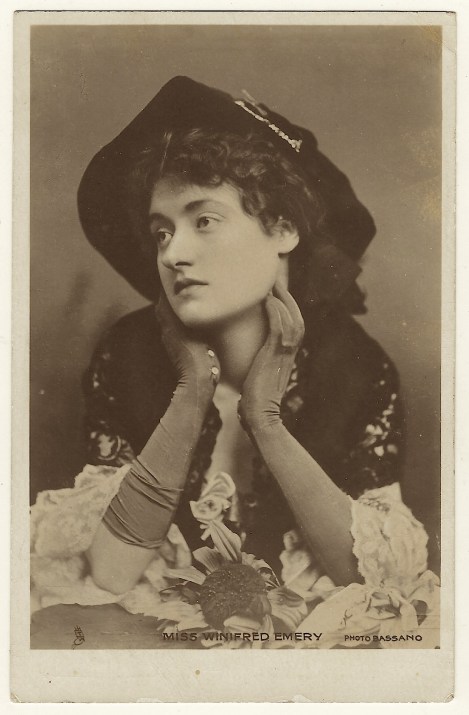
 Miss Winifred Emery (1861-1924) is the subject of this vintage real photo postcard. She was an English actress and actor-manager during the late 19th and early 20th centuries. She was married to actor Cyril Maude (m. 1888). It is not hard to imagine that the fact that she was born into a family of actors, played a role in her career choice. She began as a child actress and during the 1880’s and 1890’s her career blossomed as she played many leading roles in London’s West End theatres. Interestingly, her first London appearance was in 1874 in the pantomime,”Beauty and the Beast”. She later joined Marie Litton’s company, Herbert Beerbohm Tree’s theatre company, Henry Irving’s theatre company, and Wilson Barrett’s company. She eventually started her own touring theatre company with her husband. In 1896, her husband became actor-manager of the Haymarket Theatre and Emery became his leading lady. Among the plays that Emery appeared in are number of productions of Shakespeare. Emery had a successful stage career that spanned over forty years. This postcard was published circa 1910 by Raphael Tuck & Sons’ as part of the “Stage Favourites” Series (No. 5062). The photographer of this portrait of Miss Emery was Alexander Bassano, a very respected celebrity photographer. (SOLD)