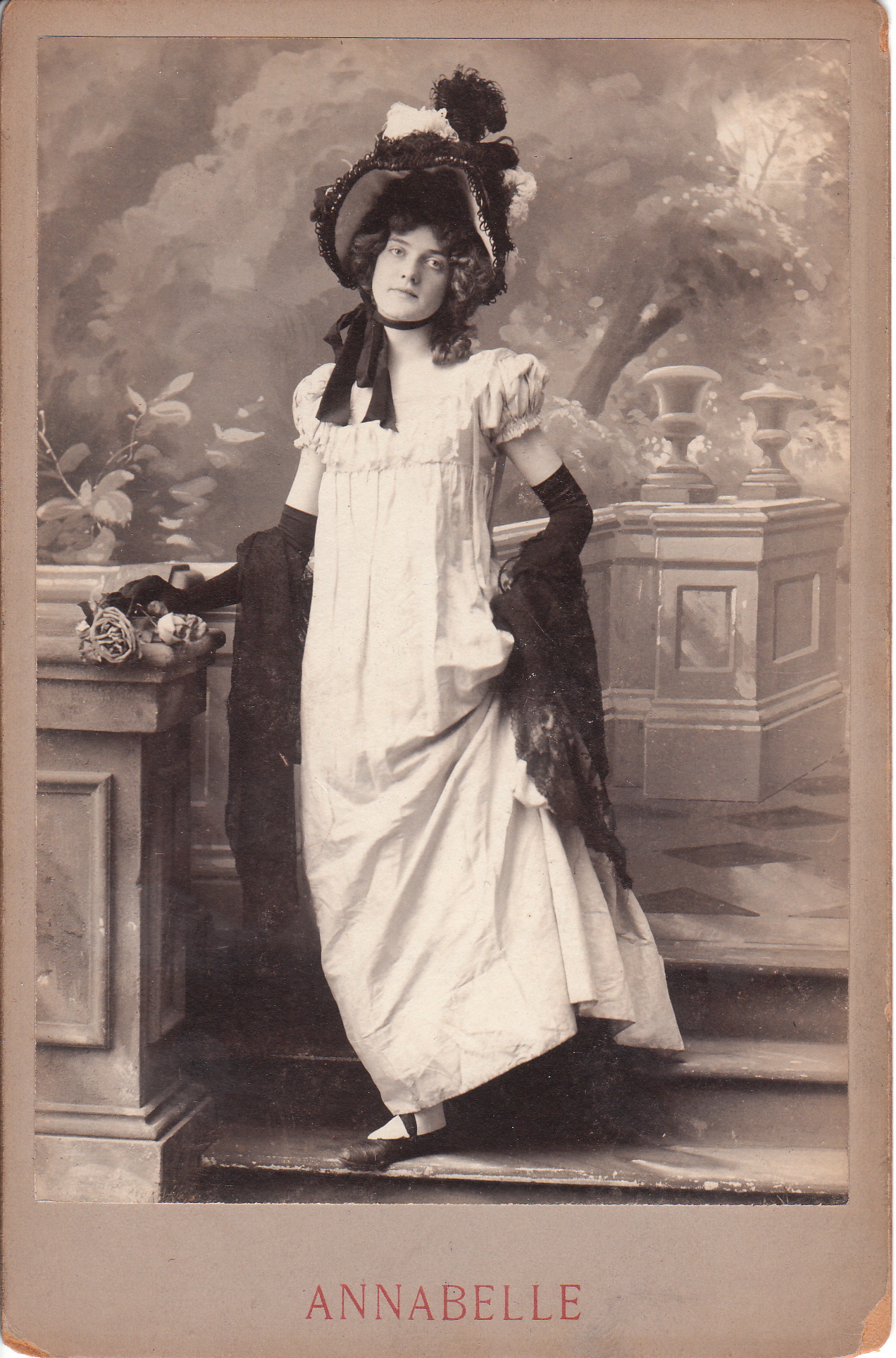
 Annabelle Moore (1878-1961) was born Annabella Whitford in Chicago, Illinois. In 1910 she married Edward James Buchan and they remained married until his death in 1958. She appeared in at least nine films beween 1894 and 1897. Film companies included Edison and Biograph. The films were dance films and included “A Mermaid Dance”, “Butterfly Dance” and “Serpentine Dance”. These films can be seen on “You Tube”. Annabelle starred as the Gibson Bathing Girl in the first of the Ziegfeld Follies (1907). She remained as part of the Ziegfeld Follies company until her marriage and retirement in 1912. The cabinet card is stamped on the reverse with the following words; “This No. 46 is the property of the American Lithographic Company” of New York.
ANNABELLE MOORE: STAGE AND EARLY FILM DANCER

RISQUE THEATRE ACTRESS SYLVIA GERRISH
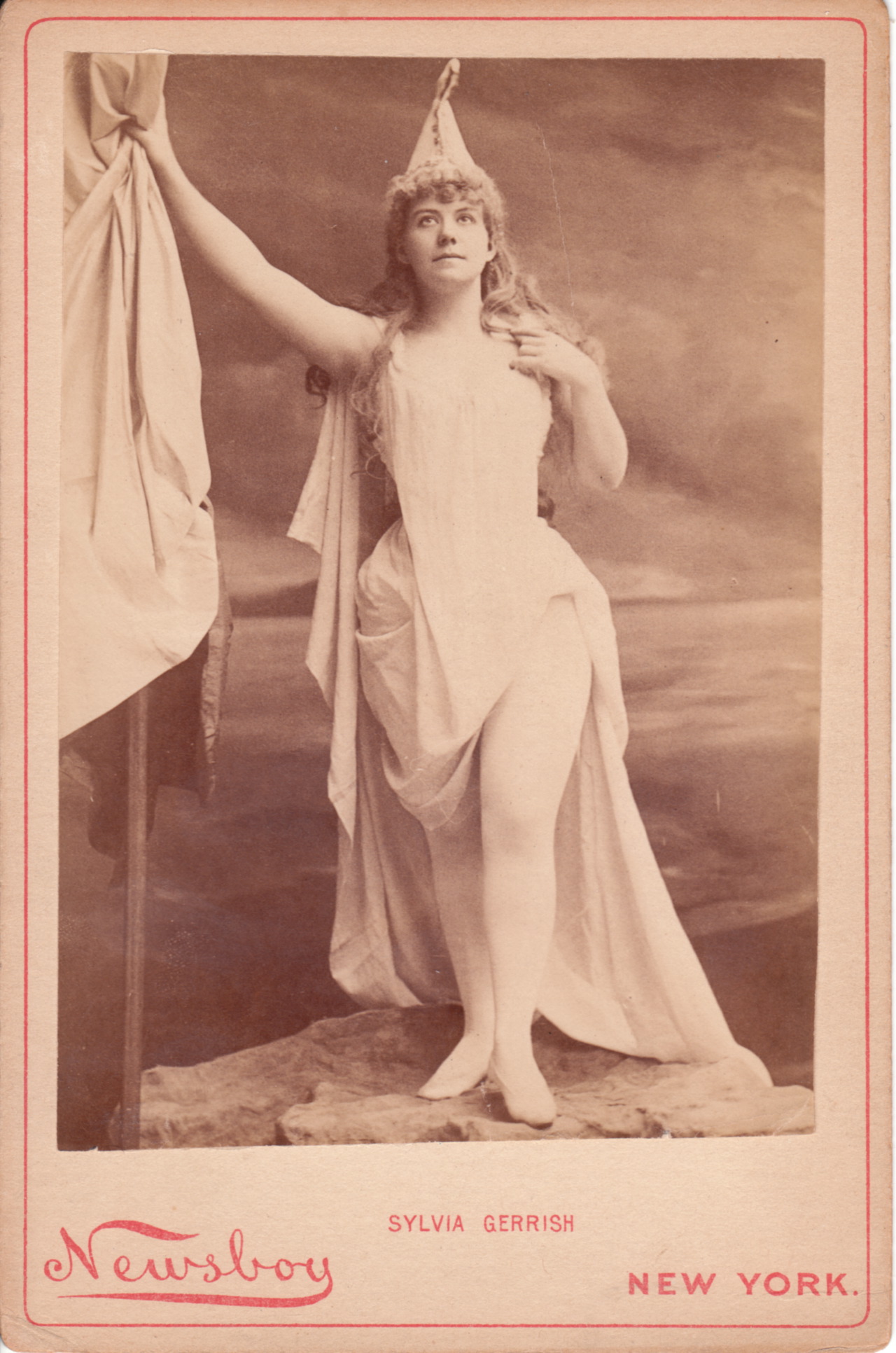 Sylvia Gerrish (1858-1906) is the subject of this Cabinet Card published by Newsboy. The photograph of the noted comic opera actress and singer was a premium given to users of Newsboy Tobacco products. Sylvia Gerrish was a stage beauty noted in the United States as well as England. She was born in California, sang in her church choir and came to New York and pursued the theatre life. Millionaire Henry Hilton became enamored of her and sacrificed his marriage and fortune to be with her. The story of their relationship was extensively covered by the newspapers of the time. Gerrish ended up dying in poverty.
Marie Tempest: English Singer and Actress
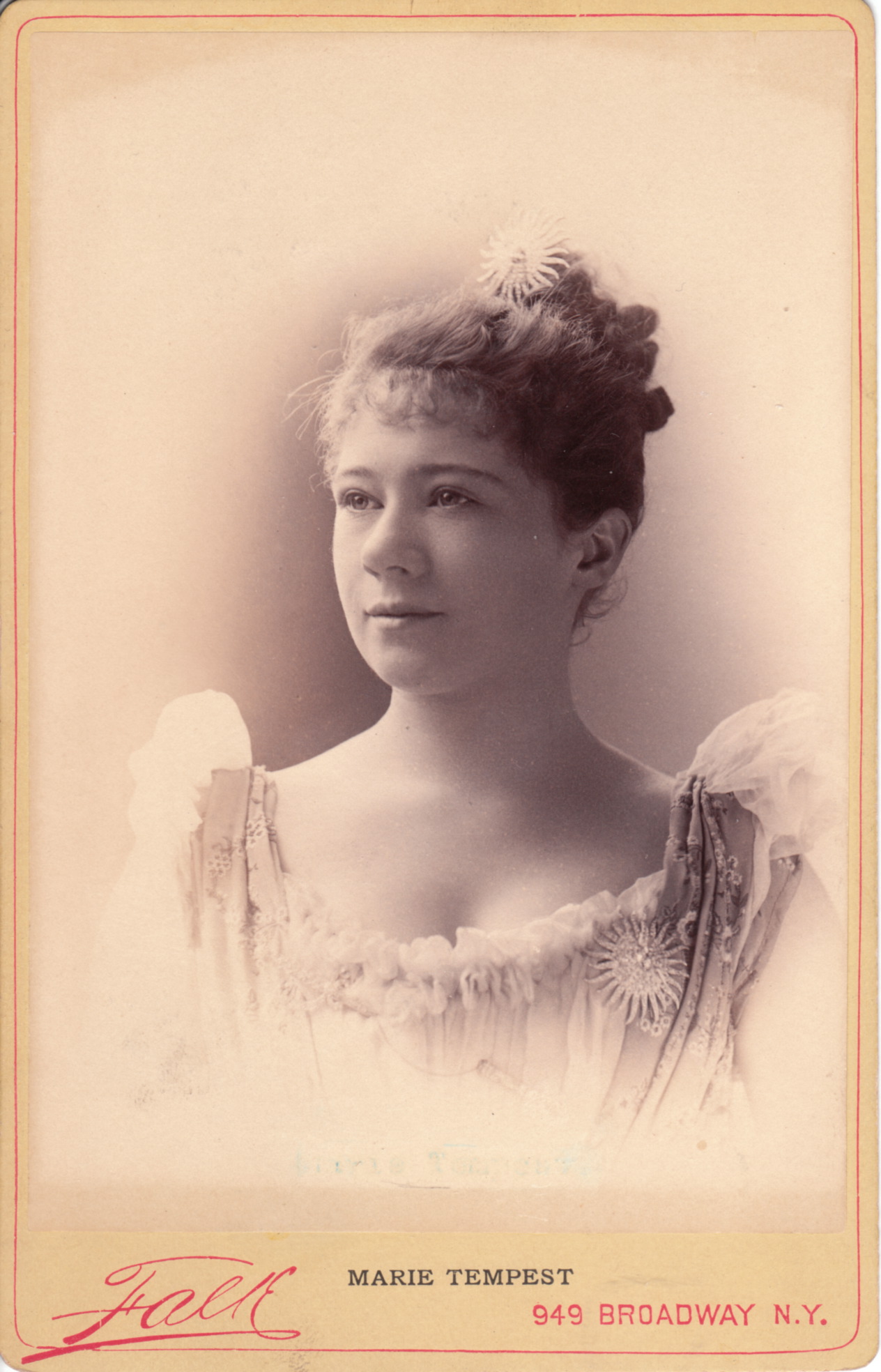
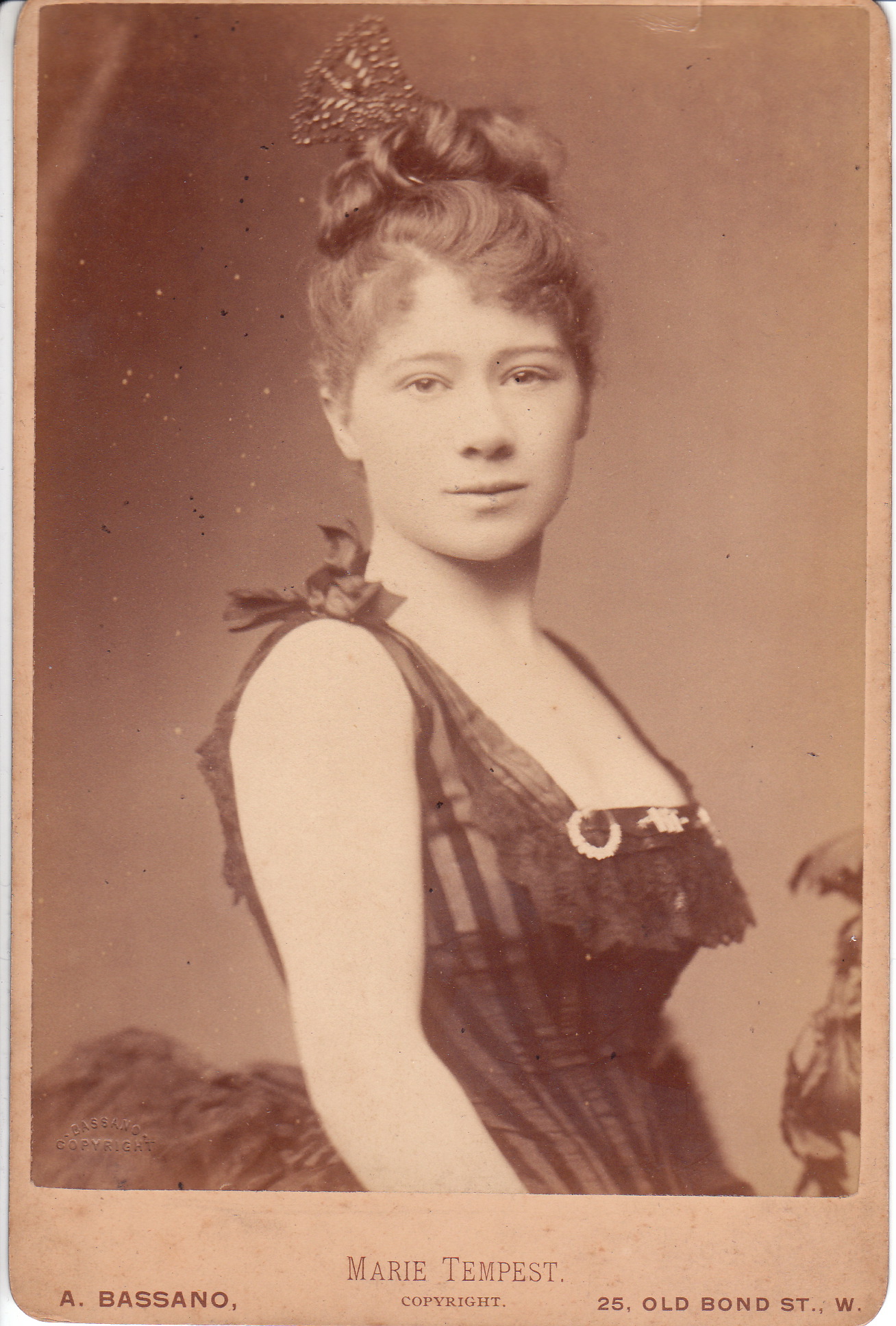
Marie Temptest (1864-1942) was a famous soprano in late Victorian light opera and Edwardian musical comedies. She later became a a leading comic actress. She toured in North America and other parts of the world. She was also a significant force behind the founding of the actors union Actors’ Equity in England. She was born in London, England and educated in Belgium. Her later musical education took place in Paris and London. She had her debut in 1885 in the operetta Boccaccio in London. After a few years in other performances, she performed on Broadway over a three year span. She was in numerous productions including The Tyrolean, and The Fencing Master. She was considered on the few rivals to Lillian Russell. Tempest was a difficult star but mellowed in middle age. She was a very active actress and performed in numerous productions over the years. She was created a Dame Commander of the British Empire in 1937. The top Cabinet Cafd was photographed by famous celebrity photographer Falk, of New York City. The bottom Cabinet Card was produced by A. Bassano of London, England.
MABEL EATON: STAGE ACTRESS AT THE HAYMARKET THEATRE IN CHICAGO, ILLINOIS
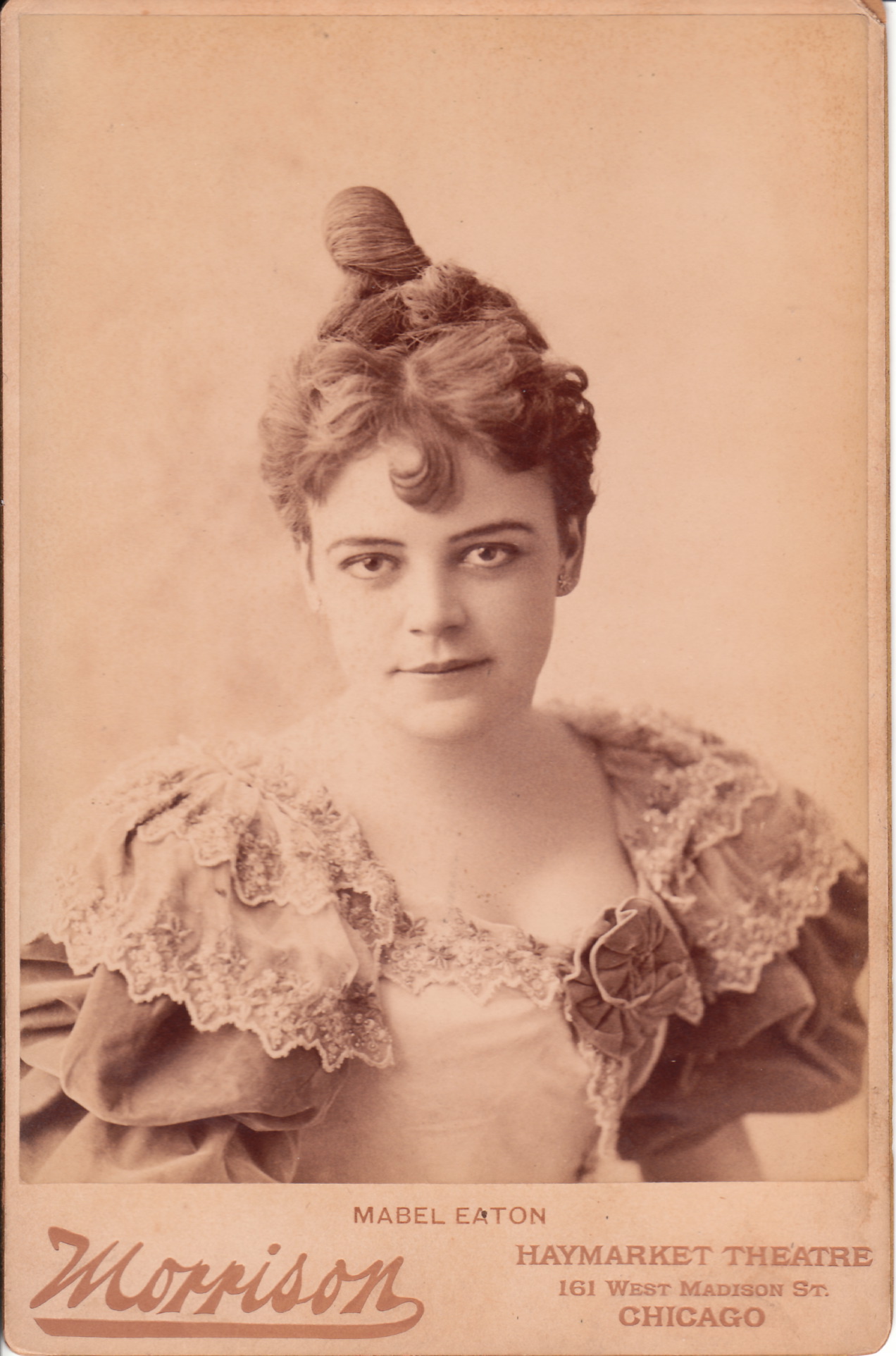 This Cabinet Card is an image of stage actress Mabel Eaton. Eaton’s appearances on Broadway in New York City included the productions of “Diplomacy” (1892) and “Woman and Wine” (1900). She appeared in many stage productions in Chicago and New York City. She appeared in Shakespeare productions. She was married to prominent stage and film star, William Farnum (1876-1953). An 1893 edition of the New York Times reported that her hotel room (Ashland House) was robbed while she was appearing in “Diplomacy” at the Fifth Avenue Theater. Eaton also appeared in a short silent film (1914). In 1916, Eaton died in Chicago, Illinois. The photographer of this Cabinet Card is celebrity photographer Morrison, located in the Haymarket Theatre. The Haymarket Theatre opened in 1887 as a legitimate playhouse with seating for an audience of 2,475. By 1896, it became a vaudeville house and between 1916 and 1932 the theatre was one of Chicago’s best known burlesque houses. Between 1932 and 1948, the Haymarket became a second-run movie theater and it was condemned in 1949. William Morrison began his photography business in 1889 at the Haymarket. He was born in Detroit in 1857 and educated in Chicago’s public schools and at the Metropolitan Business College. The New York Times reported in 1892 that there was a fire at the Haymarket that badly damaged offices, saloons and stores in the building. The article states that Morrison’s business had the worst damage of all the businesses, while the theatre itself only suffered water damage. Morrison’s studio lost 37,000 negatives. In 1899 he moved his business to the Champlain Building.
ACCIDENTALLY RISQUE WOMAN IN MCMINNVILLE, OREGON
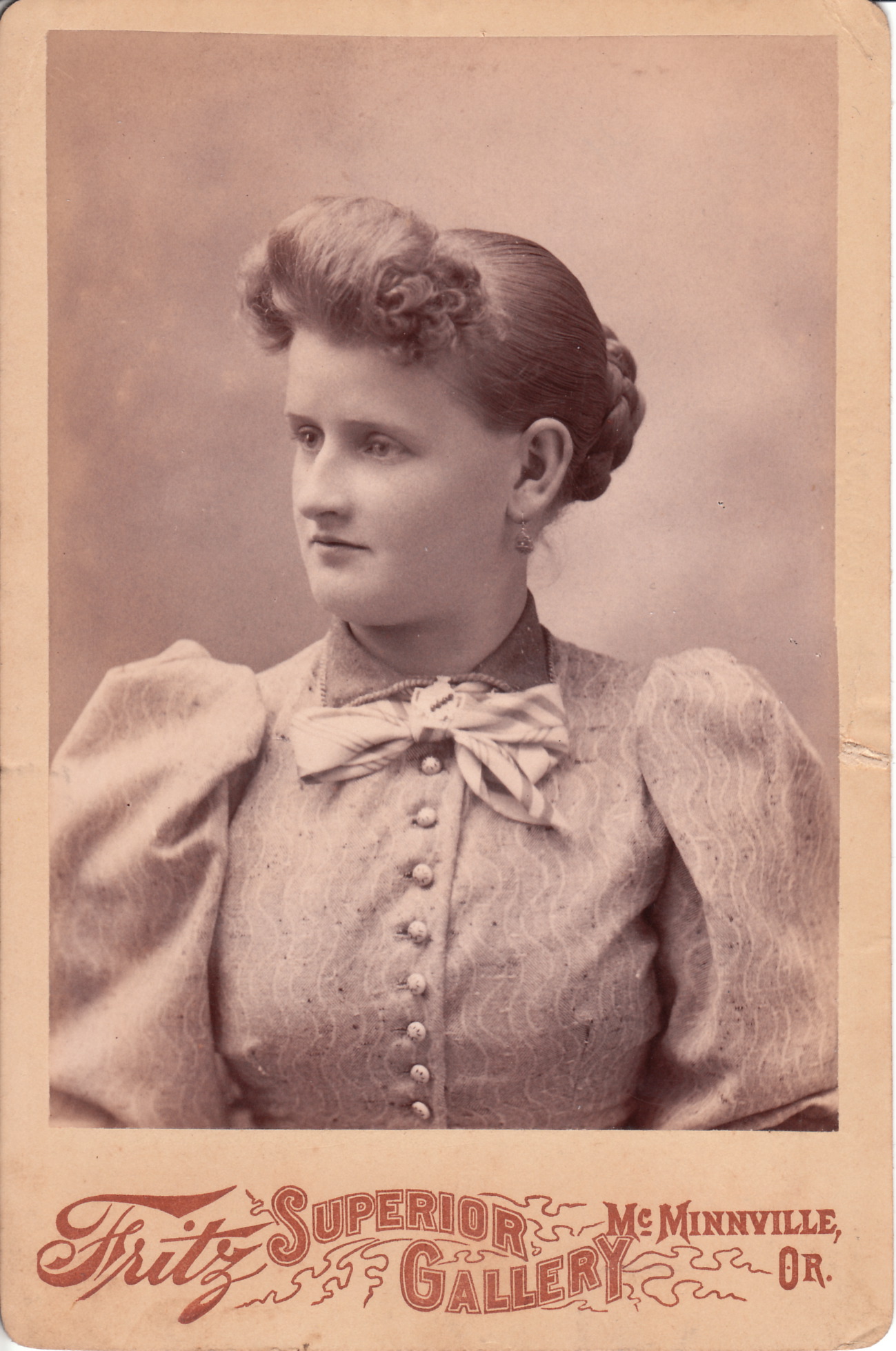 This Cabinet Card is an image of 18 year-old Mary Earhart. The reverse of the card has pencil writing with her identification as well as the information that she was 5 foot and 3 inches, and weighed 137 1/2 pounds. It is unusual to find these statistics on the reverse of a cabinet card.. This image is also unique because it appears that it shows the young woman’s ample bust in too much detail. Risque Cabinet Cards that emphasized a woman’s breasts or cleavage seems to have been typically reserved for women who were prostitutes or actresses; and of course many people did not believe there was a difference between the two occupations. Perhaps this image was saved rather than destroyed by Ms Earhart but kept in a private place. The photographer was Fritz of the Superior Gallery in McMinnville, Oregon.
YOLANDE WALLACE: THEATER ACTRESS WHOSE ONLY REDEEMING ACTING QUALITY WAS HER “GOOD LOOKS”
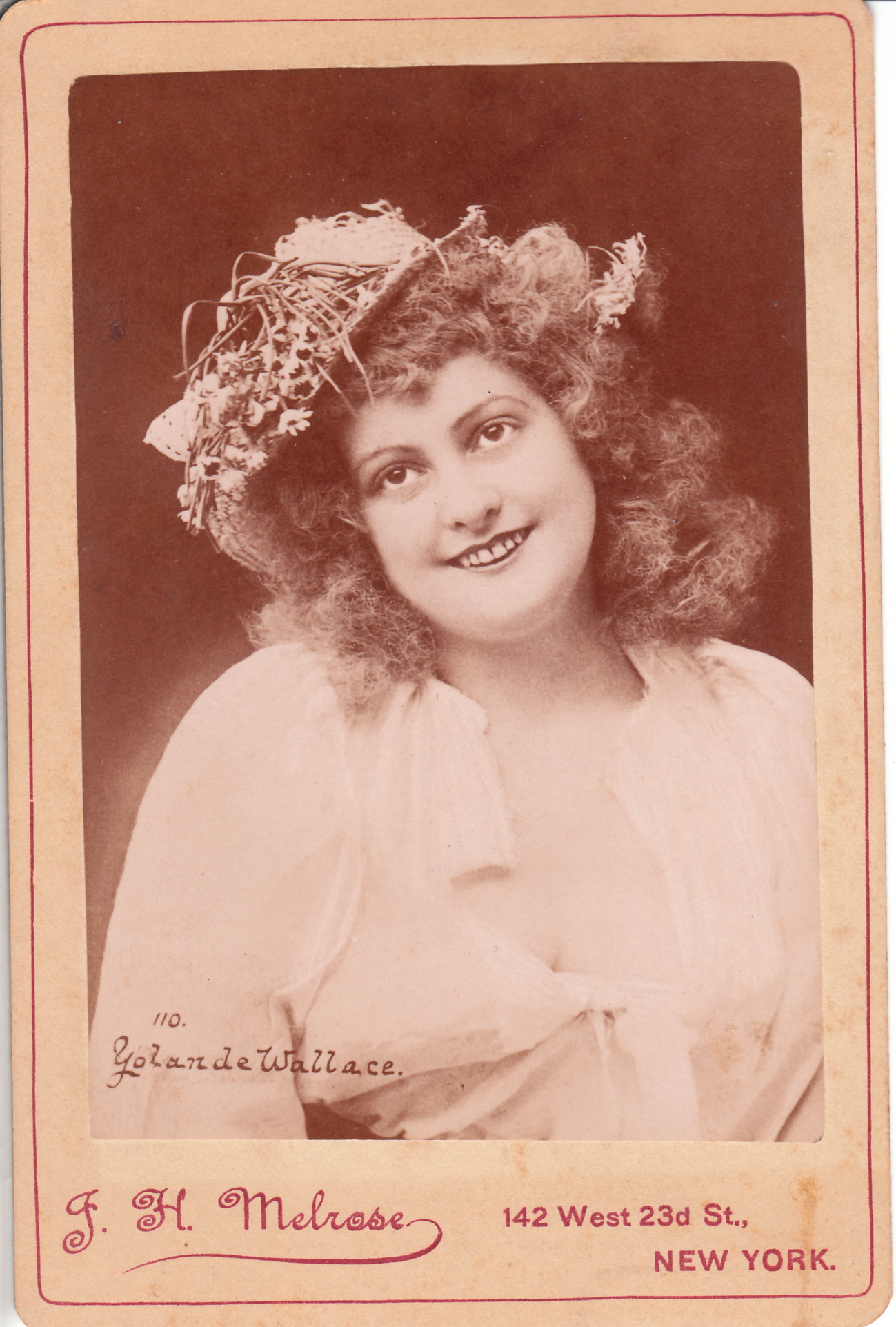 Yolande Wallace is the subject of this Cabinet Card photographed by J. H. Melrose of New York City, New York. Wallace was a stage actress and singer whose early appearances included a period with actor Henry E. Dixey. Her appearances on Broadway included “Little Christopher Columbus” (1894), “The French Maid” (1897), and “The Show Girl” (1902). In 1894 the New York Times critic panned “Little Christopher Columbus” and stated that he wished Sherlock Holmes was still alive so he could find out who could have been clapping at the shows dreadful first performance. The critic also penned that Wallace, in her role of “Guinevere”, offered only one redeeming quality and that was her “good looks”.
ADELE BELGARDE: THEATRE ACTRESS WITH QUESTIONABLE TALENT
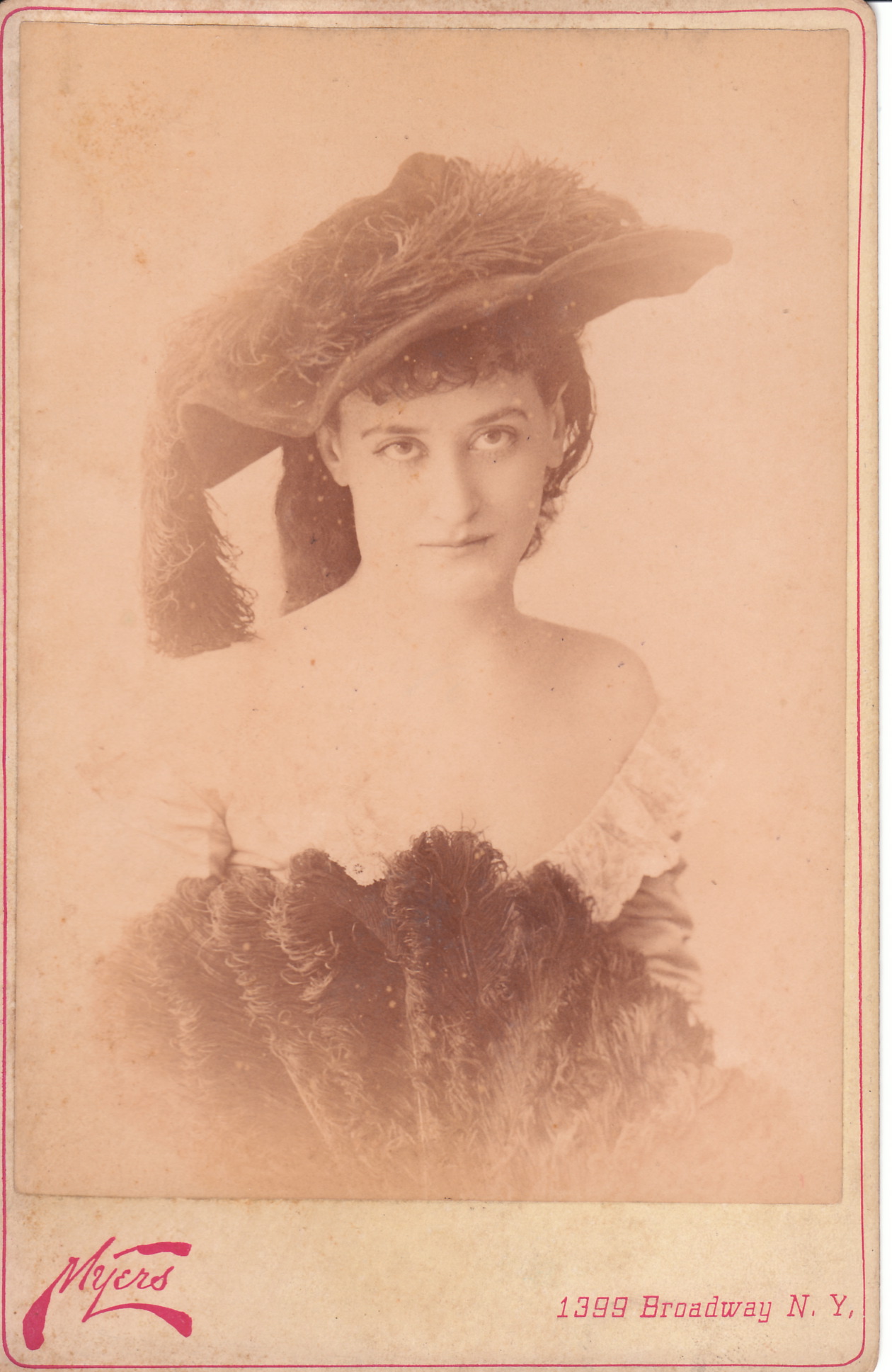 This cabinet card portrait captures Adele Belgarde, an actress of the theatre. On August 22, 1879, the New York Times critic reviewed her performance in “Julia” The critic clearly was not impressed when he wrote “there is so much she attempts that she cannot do, and possibly would never be able to do.” The critic also writes that her acting “was not sufficiently good” or warrant much praise. More information about this feather clad actress will be sought. The photographer of this cabinet card is Myers located on Broadway in New York City.
HOPE BOOTH: “FETCHING BUT HOPELESS THEATRE ACTRESS”
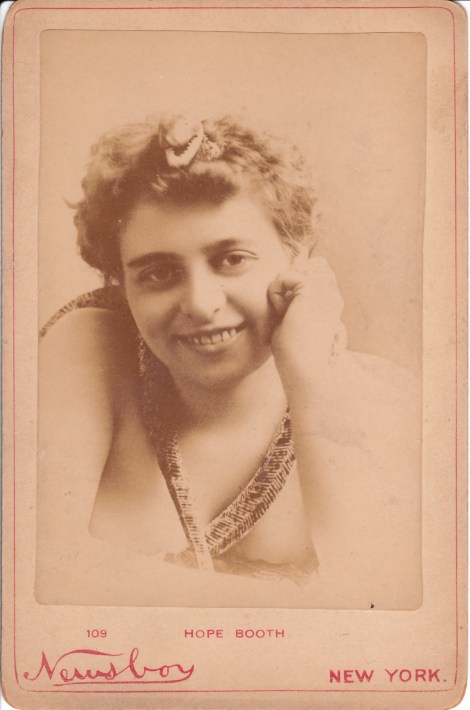 This Cabinet Card is a portrait of theatre actress, Hope Booth. This actress seems to have had a propensity for trouble. The New York Times (1896) reported that at age 23, after appearing at the “Casino Roof Gardens” in a sketch entitled “Ten Minutes in the Latin Quartier; or A Study in the Nude”, she was arrested along with the manager of the theatre. She was charged with violating public decency because of her scant costume and daring poses. Five years later, her husband, actor, James E. B. Earll was arrested after his opening appearance in a vaudeville act at Koster and Bials. Before her arrest, she appeared in George Bernard Shaw’s first play, “Widowers Houses” in 1892. A review described her as a “fetching but hopeless” actress. Shaw had seen her in an earlier show and had described her as a “young lady who can not sing, dance, or speak, but whose appearance suggests that she might profitably spend 3 or 4 years in learning the arts which are useful on stage”. Other news stories and books report that she was born in Canada, was once married to a Canadian member of Parliament, she was a distant relative of the theatrical Booth family, and that she went bankrupt bringing a play to England. She clearly led an interesting life. The Cabinet Card is part of the Newsboy Series and was used as a premium for the sale of Newsboy Plug Tobacco.
KATE STOKES: THEATRE ACTRESS WEARING SNAKE SKINS

Kate Stokes poses for this cabinet card photograph for Newsboy of New York. She is wearing snake skins on her arms and has quite an interesting veil. It would be interesting to discover what play her costume is from. The costume appears to be very middle eastern or Indian. More research or comments from visitors to this site will hopefully provide further biographical information about Kate Stokes. Newsboy cabinet cards were used as a premium to help tobacco sales for Newsboy plug tobacco.
ROSE LEMOINE: PRETTY THEATER ACTRESS AND POSSIBLE MODEL FOR THE “GIBSON GIRL”
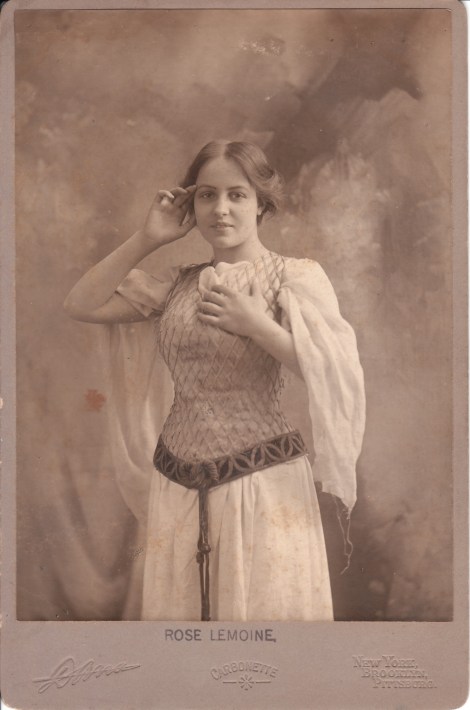 Theater actress Rose Lemoine is the subject of this Cabinet Card photographed by the Dana studio of New York. The photograph was part of the Charles L. Ritzmann collection. Ritzmann was a famous importer of theatrical photographs. The attractive Ms Lemoine was thought by some to be the model or the “Gibson Girl”. This upset some Americans because Lemoine was from Cuba, not the United States and the “Gibson Girl” was illustrator Charles Dana’s personification of the feminine ideal. The “Gibson Girl” was a popular figure for twenty years (about 1890-1910). Lemoine’s mother was Cuban and her father was a French coffee planter. In 1903, the New York Times mentions Lemoine as appearing in a Broadway play called “The Best of Friends”. Also appearing in that play was Lionel Barrymore and Agnes Booth.


 THE CABINET CARD GALLERY