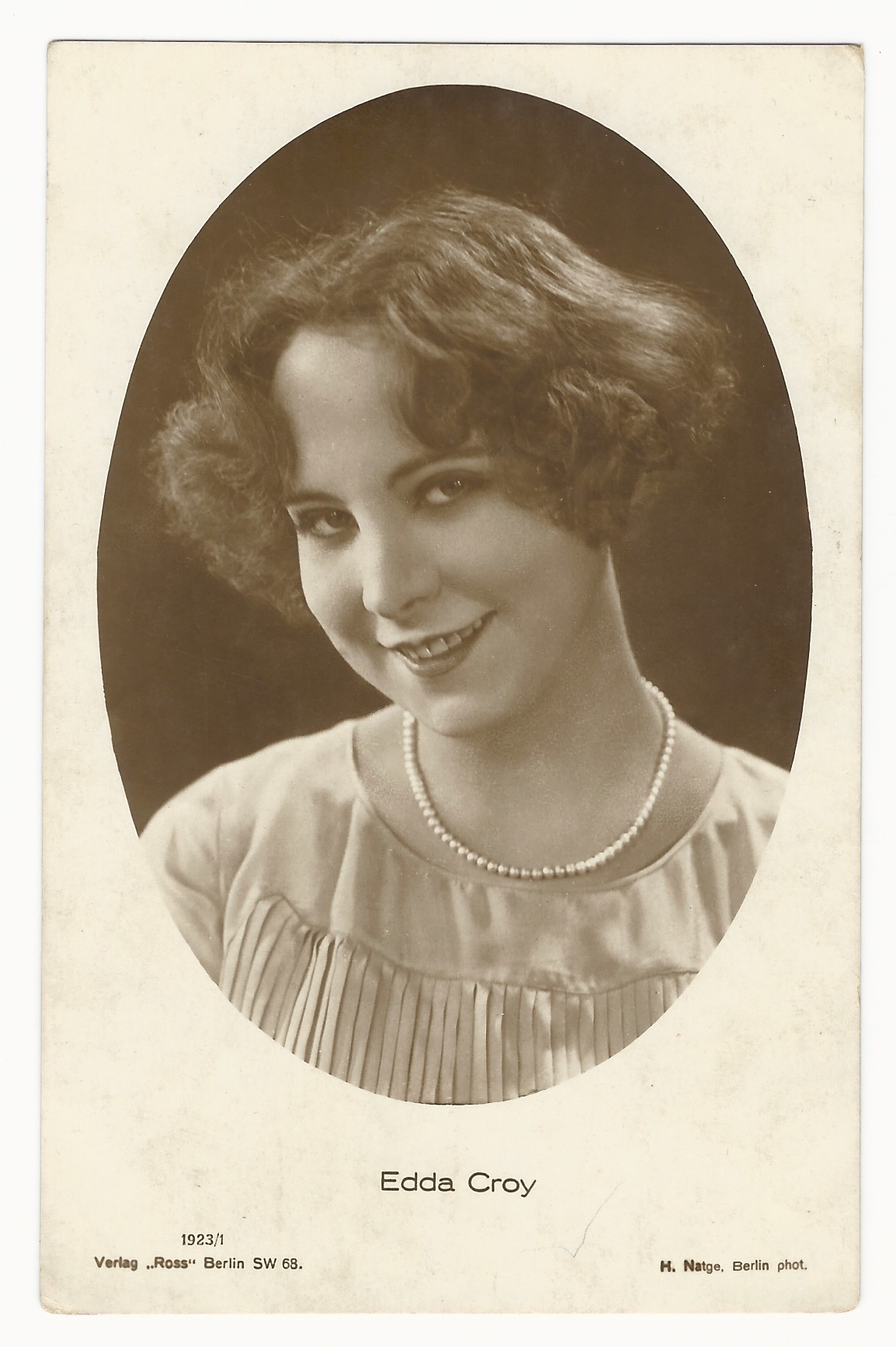
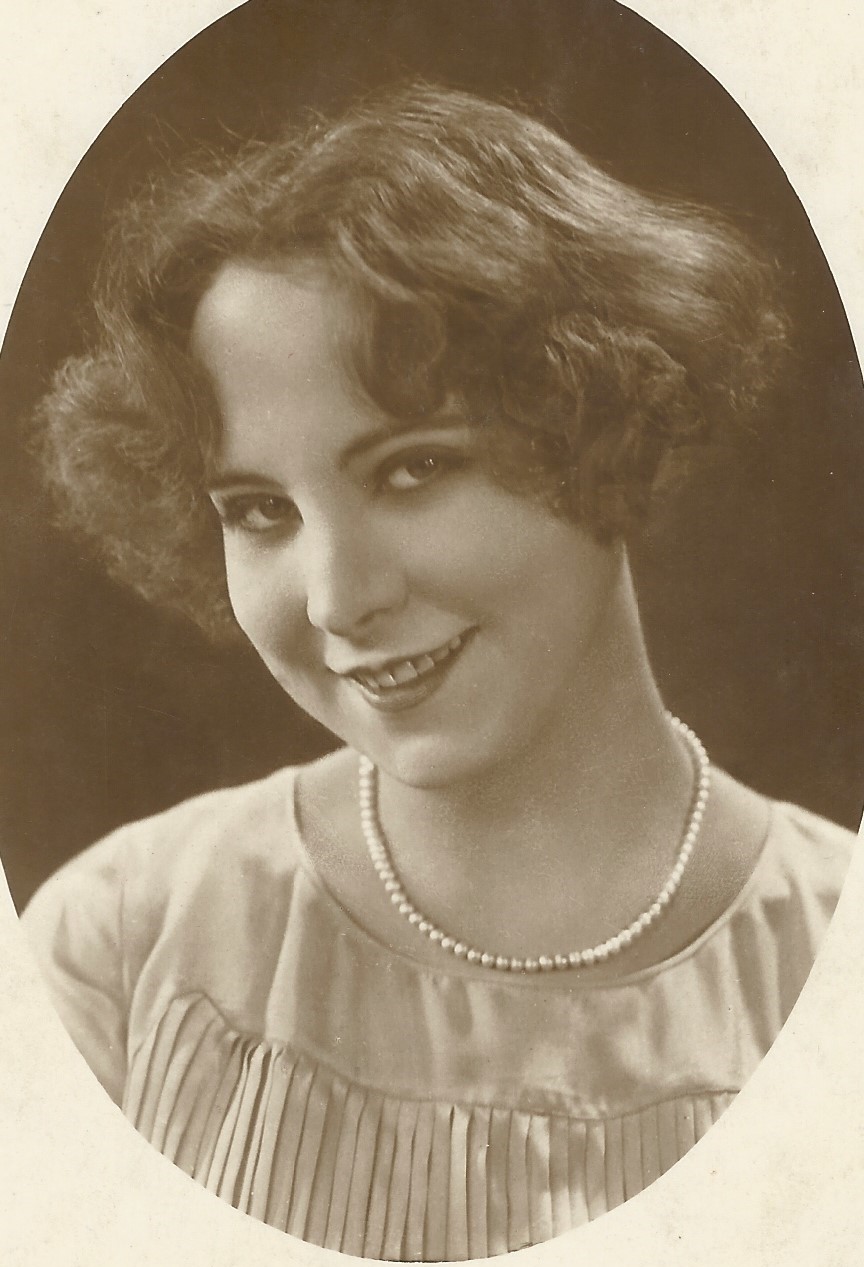
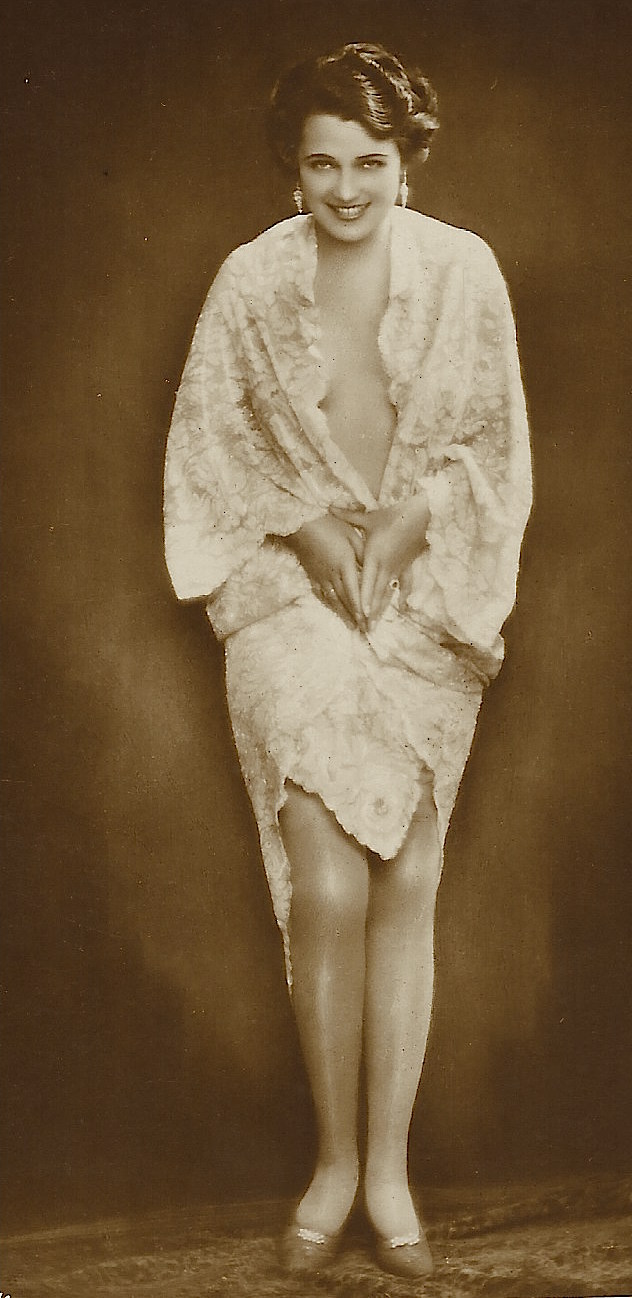
This vintage real photo postcard features silent film actress, Edda Croy. Edda has “the girl next door” look. Preliminary research uncovered little about her. Edda had a very short career. She played in three German silent films, all release in the same year (1927). One of these films was directed by Robert Wiene. He is well known for directing the silent film “The Cabinet of Dr. Caligari” (1920) and other expressionist films. Popular actor, Harry Liedtke, appeared in all three of her films. Actress Erna Morena, who’s photograph can be seen elsewhere in the Cabinet Card Gallery, apppeared in one of Edda’s films. This postcard was published by Ross Verlag (Berlin). It is part of a series (no.1923/1). Miss Croy’s photograph was taken by photographer Hans Natge. Natge was very involved in German film production. He played roles in the realm of cameras, directing and assistant directing. He was born in Berlin in 1893. His filmography on IMDb reports that he has 28 film credits between 1924 and 1949. Nineteen of these credits were for his role as the film’s “still photographer”. It is likely safe to assume that he took this photograph of Miss Croy in 1927. This vintage portrait postcard is rare and in very good condition (see scans).
Buy this original Vintage Real Photo Postcard (includes shipping within the US) #3218
To purchase this item, click on the Pay with PayPal button below
24.00 $
Buy this Vintage Real Photo Postcard (includes International shipping outside the US) 3218
To purchase this item, click on the Pay with PayPal button below
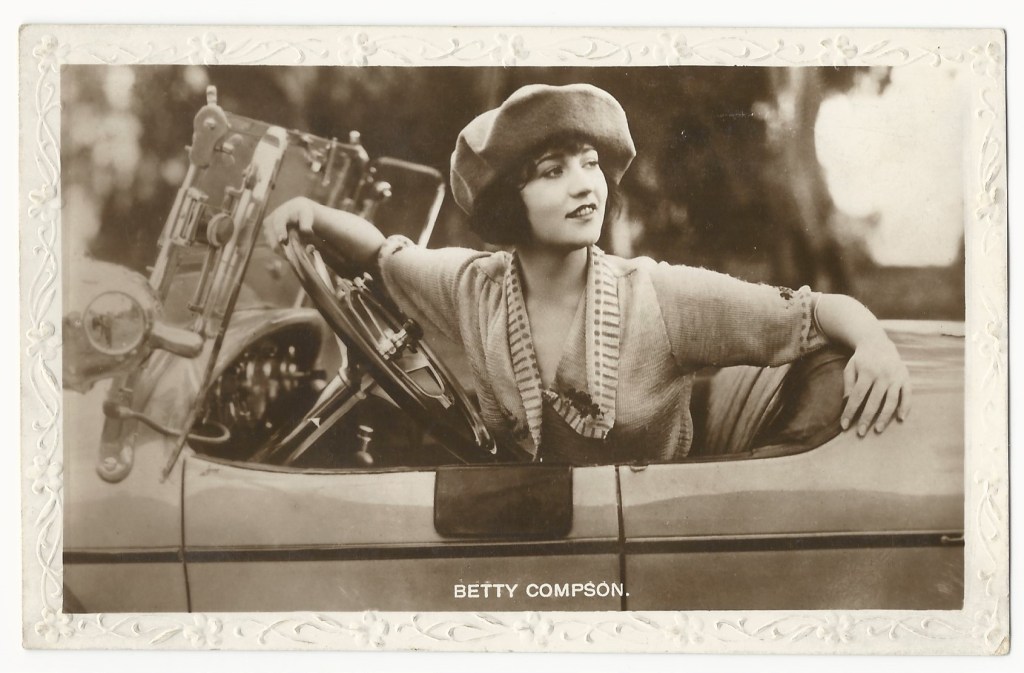
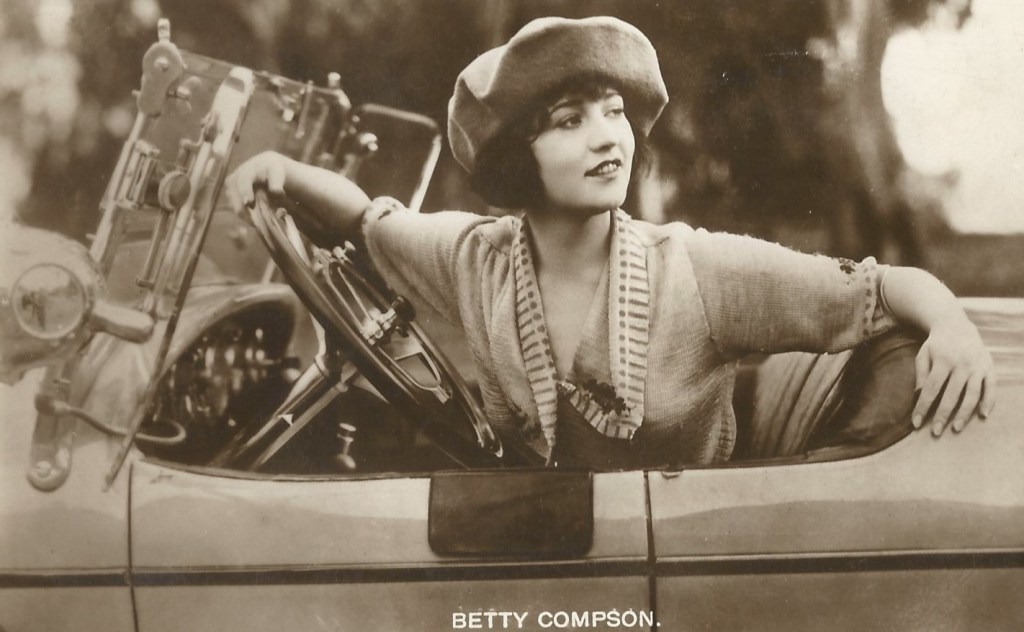
This vintage real photo postcard features American actress and film producer, Betty Compson (1897-1974). She was nicknamed “the prettiest girl in pictures”. Compson was born in a mining camp in Beaver, Utah. Her father was a mining engineer, a gold prospector, and grocery store owner. Her mother was a maid in hotels and private homes. Betty graduated from Salt Lake High School. She was hired as a violinist at age 16 in a theater in Salt Lake City. She then played in vaudeville touring companies and it was during this stint she was discovered by a film producer (Al Christie) who signed her to a contract. She began her career during Hollywoods’s silent film era. Her debut film was “Wanted, a Leading Lady” (1915). After this film, her career rocketed. She appeared in 25 film in 1916. All but one, were shorts. In 1918 she was offered a contract by studio head Mack Sennett. She rejected the offer because the salary was too low. She continued to make numerous short films until the middle of 1918. She was frequently paired with Roscoe “Fatty” Arbuckle. She started making only feature films. She became a rising star after appearing opposite Lon Chaney in “The Miracle Man” (1919). Paramount became interested in her and signed her to a five year contract. In 1921, Compson established her own production company in order to have creative control over screenplays and financing. The first movie she produced was “Prisoners of Love” (1921). After she completed acting in “The Woman With Four Faces” (1923), Paramount refused to give her a raise. She wanted an increase in her $2500 per week salary. Compson was angry enough at Paramount, to leave the company, and sign with a British film company. She made four films in England, two of them were films penned by Alfred Hitchcock. Paramount lured her back to Hollywood from England by offering her a top dollar contract. She then appeared in a movie by director, James Cruze. The pair married in 1924, but divorced four years later. The divorce from Cruze nearly ruined her financially because of debt accrued by Cruze. After Paramount did not offer her a contract renewal, she began freelancing in lower budget films. In 1928 she appeared in a “part talkie” called “The Barker”. She played a manipulative carnival girl. She was nominated for a “Best Actress” for this role by the Academy Awards. In 1929, she gained much recognition for her role in “The Docks of New York”. She played a suicidal prostitute. These two films resulted in her popularity returning to it’s previous high level. She appeared in many “talkie” films. Unlike a lot of silent film stars, Compson made a successful transition into sound films. In fact, she even appeared in a number of early musicals. When she played singing parts, her voice was dubbed. Her career flourished. In 1930, she appeared in 9 films. Her last “hit’ was in “The Spoilers”. Her costar was Gary Cooper. Her popularity waned and she only got roles in low budget, less successful studios. Her last film was in 1948. After retiring from her movie career, she started a cosmetic line and assisted her husband in a business named “Ashtrays Unlimited”. In total Compson was married three times. Her second marriage, to agent/producer Irving Weinberg ended in divorce after four years. Her third marriage was to a professional boxer. The marriage lasted 18 years and ended upon his death in 1962. She had no children. She died in 1974 after suffering a heart attack. She had much impact on the early movie industry. The IMDb reports 209 film credits between 1915 and 1948. This vintage postcard is in excellent condition (see scans). Take a look at the YouTube video below. The video features Betty Compson appearing in the silent film, “The Docks of New York” (1928). The music accompanying this video is obviously modern, but, in my opinion, it is excellent. Compson demonstrates incredible acting ability. Her facial expression and her eyes speak for her. SOLD
Betty Compson in “The Docks of New York” (1928) Music: “Marry Me” By Dave Pagett and Viv Jones (Sax)
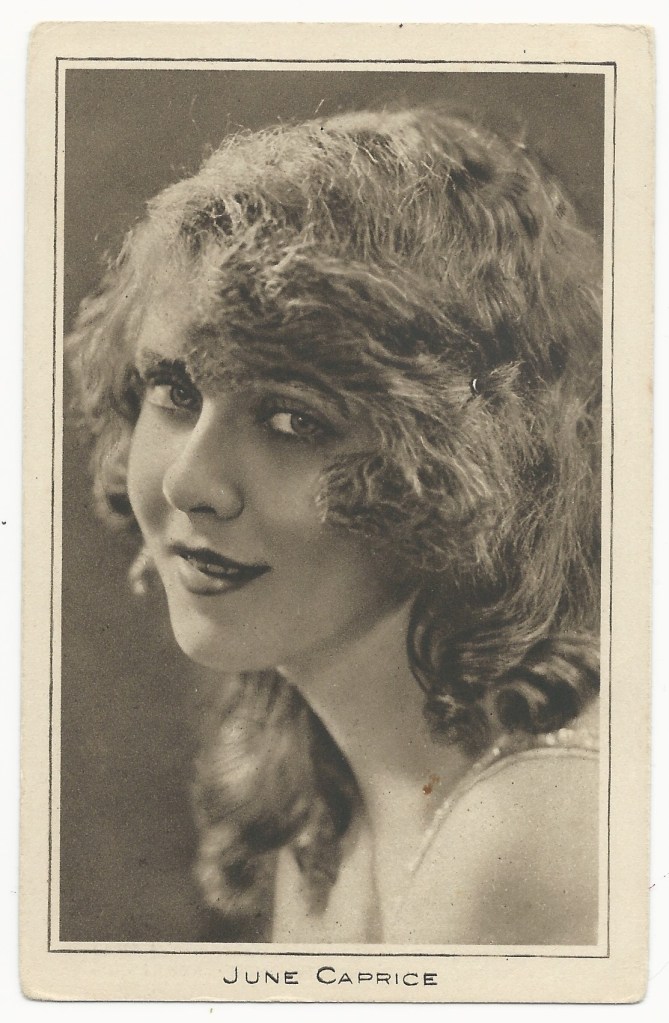
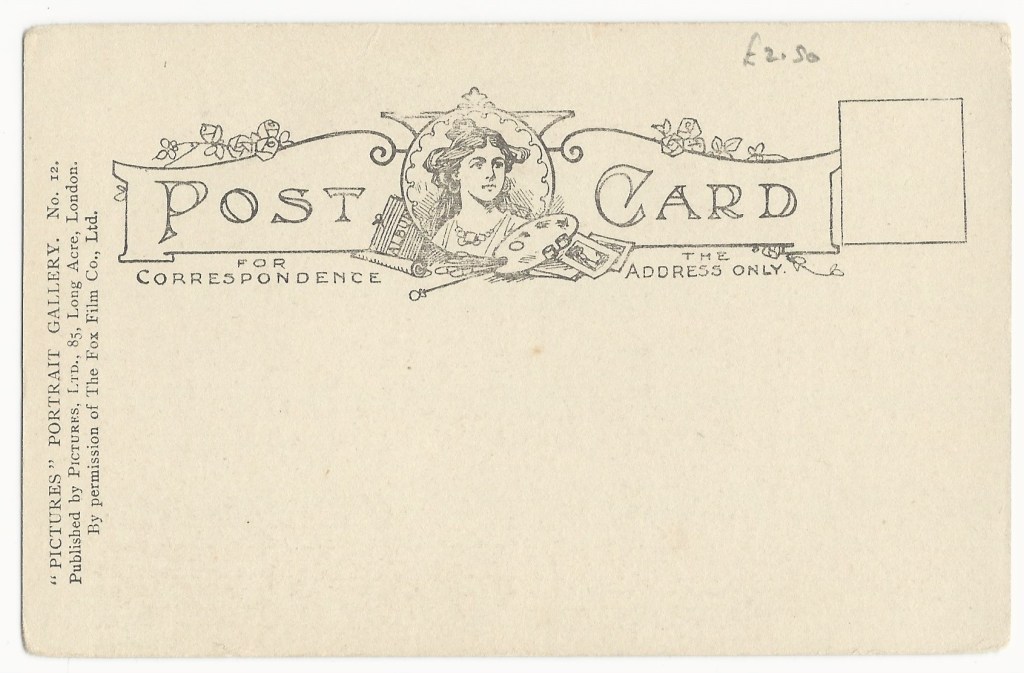
June Caprice started life named Helen Elizabeth Lawson. She was born in 1895 in Arlington, Massachusetts. June was a silent film actress. She attended school in Boston. Her acting career began on the stage. In 1916, she signed with the Fox Film Corporation to make films. William Fox had been searching for an actress to compete with Mary Pickford. Caprice had won a Boston Mary Pickford look-a-like contest. When he discovered Caprice, he boldly predicted that she would become the best known female on the screen within the upcoming six months. A press release introducing her to film fandom, stated that she was seventeen years of age. In fact, she was about twenty years old at the time. Caprice made her screen debut in a move entitled “Caprice of the Mountains” (1916). A film critic, writing in the New York Times described her as “young, pretty, graceful, petite, with an eloquence of gesture that augurs a bright future in the movies”. Her first film provided her with her stage name, “June Caprice”. June became quite popular. She received a lot of attention from fan magazines and was one of Fox’s most profitable stars toward the end of the 1910’s. She made sixteen films while with Fox. Her director for half of the movies was Harry F. Millarde. The pair began a relationship and eventually married. Caprice also worked at one time for Pathe studios. She left the film industry to begin a family and in 1922 she gave birth to a daughter. Caprice’s career took a downturn after World War I. The sweet, pure and innocent look lost popularity and was replaced by the jazz age flapper look. She later returned to working on stage and modelling. In 1931, her husband died at the young age of 46. Five years later, Caprice had a fatal heart attack while in Los Angeles. At the time, she also was suffering with cancer. She was just 40 years old at the time of her death. Caprice’s daughter was only aged 14 when she was orphaned. She was raised by her grandparents on Long Island, New York. She became a “cover girl” and actress. She used the name Toni Seven. Her photo and brief biography can be found elsewhere in the Cabinet Card Gallery. Seven inherited three million dollars from her family. The IMDb credits June Caprice with 22 film appearances between 1916 and 1921. This vintage real photo postcard was published by Pictures Ltd which was located in London, England. It was published with the perimission of the Fox Film Co. The card is part of a series (no.12) labeled “Pictures” Portrait Gallery. (SOLD)
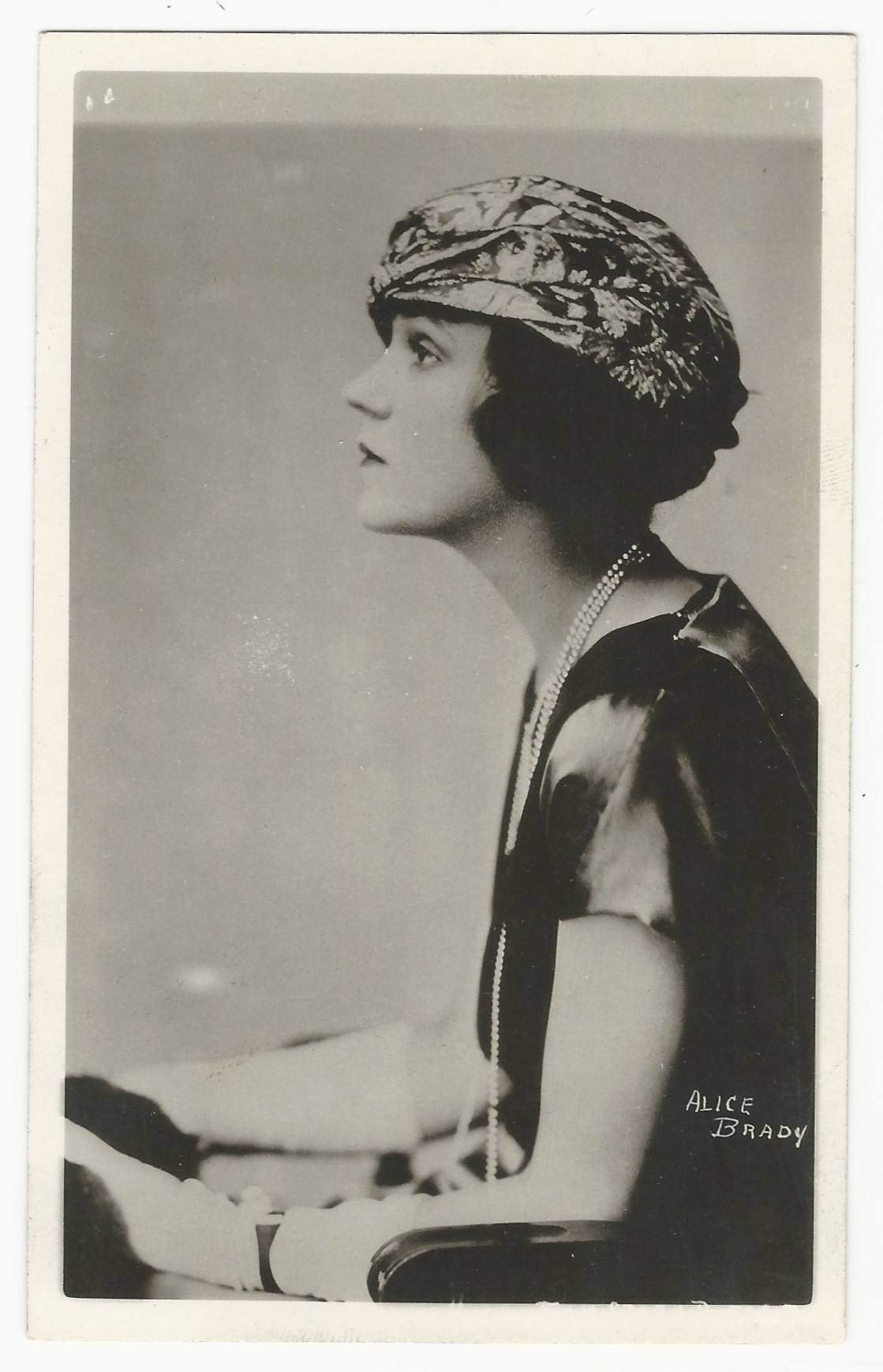
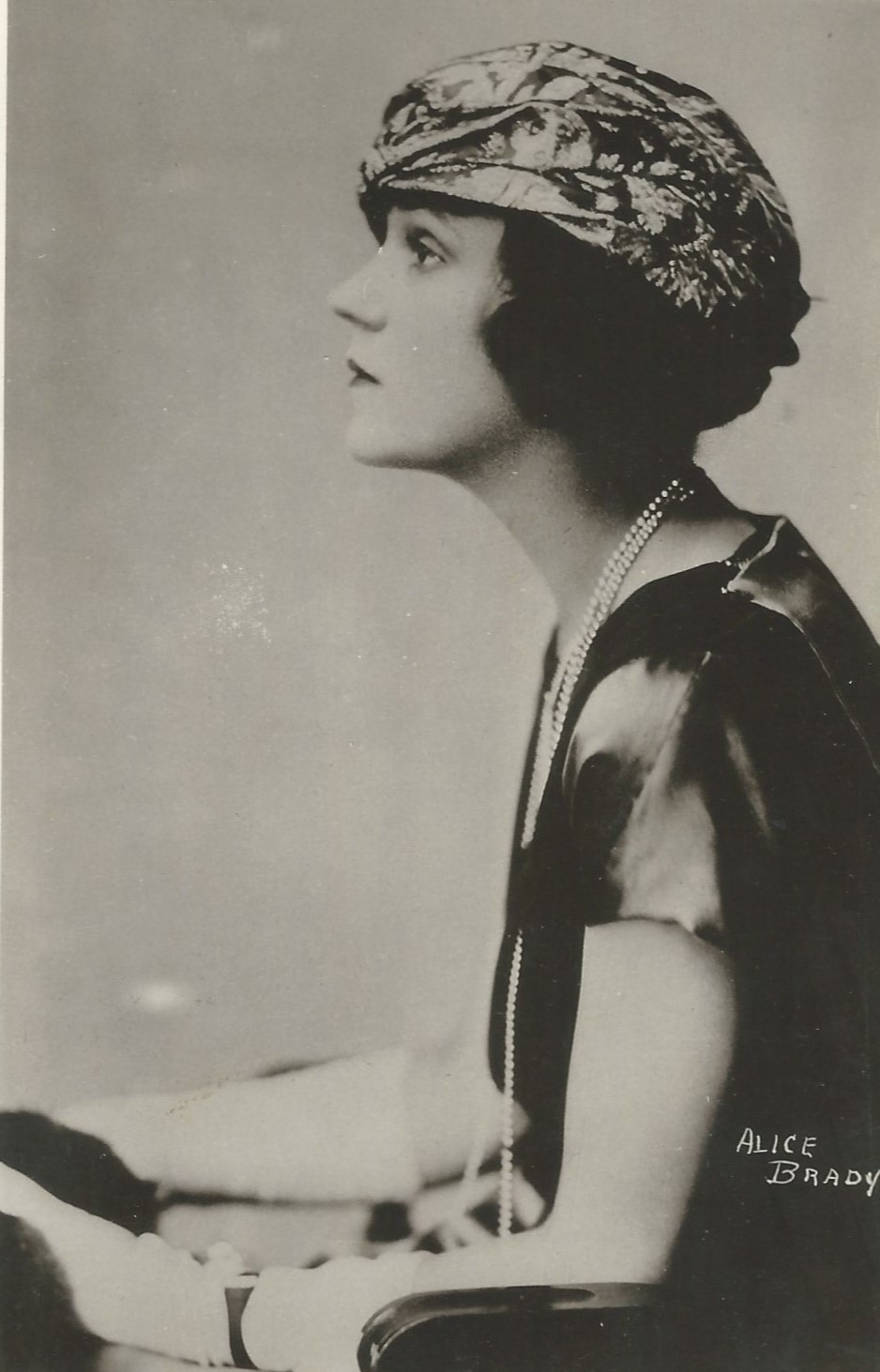
This vintage real photo postcard features film actress, Alice Brady (1892-1939). Brady was born in New York City into a theatrical family. Her father was a theatrical producer, and her mother was a French actress. When Alice was four years old, her mother died. Her father remarried and her step-mother was actress, Grace George. George (1879-1961) was a successful American stage actress. She had a long Broadway stage career and appeared in two films. Alice knew she wanted to be an actress, like her mother and step-mother, at an early age. Her first stage appearance was at the age of 14. Her first Broadway appearance was in 1911, at the age of 18. In 1913, she appeared with John Barrymore in “A Thief for The Night”. She performed on Broadway over a span of 22 years. She began her career during the silent film era and was one of the minority of actresses that successfully made the transition into sound movies. Brady’s films included “My Man Godfrey” (1936) and “In Old Chicago” (1937). Alice made her first silent feature appearance in 1914. She appeard in 53 films over the next ten years. Simultaneously, she continued to perf0orm on stage. In 1923, she took a ten year hiatus from the stage. In 1922 she made her first talkie, an MGM production. Over the next seven years, she made 25 more films. Her final film was “Young Mr. Lincoln” (1939). In 1937, Brady won the Academy Award for Best Supporting Actress for the film, “In Old Chicago”. She had been nominated for the same award the previous year. In all, Brady appeared in more than 80 films. It is important to mention Brady’s Broadway career. The IBDb reports that she appeared in over 40 Broadway productions. Some of the “Great White Way” productions (1911-1932) that included Brady were “H.M.S. Pinafore” (1911), “The Pirates of Penzance” (1912), “The Mikado” (1912), “The Yankee Princess” (1922), “A Most Immoral Lady” (1928), and “Morning Becomes Electra” (1931). Alice was married once. Her marriage to actor, James Crane, lasted from 1919 until they divorced in 1922. The marriage produced one son. Her life and career were cut short by her death from cancer just a day short of her 47th birthday. The “Cyko” stamp box on this postcard indicates that it was published between 1904 and the 1920’s. (SOLD)
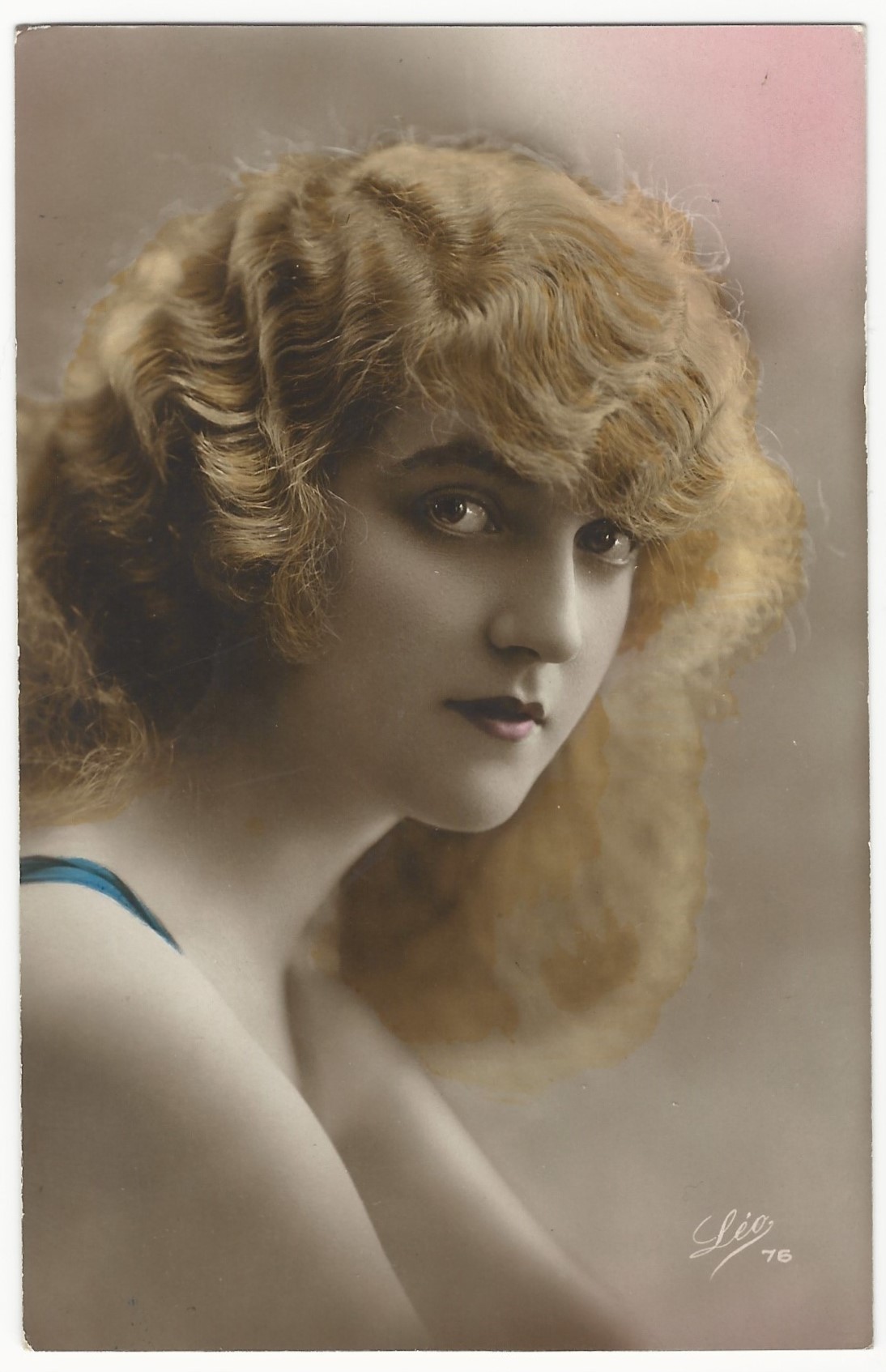
This vintage real photo postcard features French postcard model and silent film actress, Genevieve Felix (1901-?). Her filmography includes 23 acting credits including “Three Musketeers” (1932). Her acting career spanned from 1917 through 1932. This postcard was published by Leo as part of a series (no76). The firm was located in Pradot, France. The Leo firm operated in the mid 1920’s and published many types of real photo postcards. They were especially noted for producing a large amount of nude postcards. This postcard is in very good condition (see scans).
Buy this original Vintage Real Photo Postcard (includes shipping within the US) #3186
To purchase this item, click on the Pay with PayPal button below
$25.50
Buy this Vintage Photograph (includes International shipping outside the US) 3186
To purchase this item, click on the Pay with PayPal button below
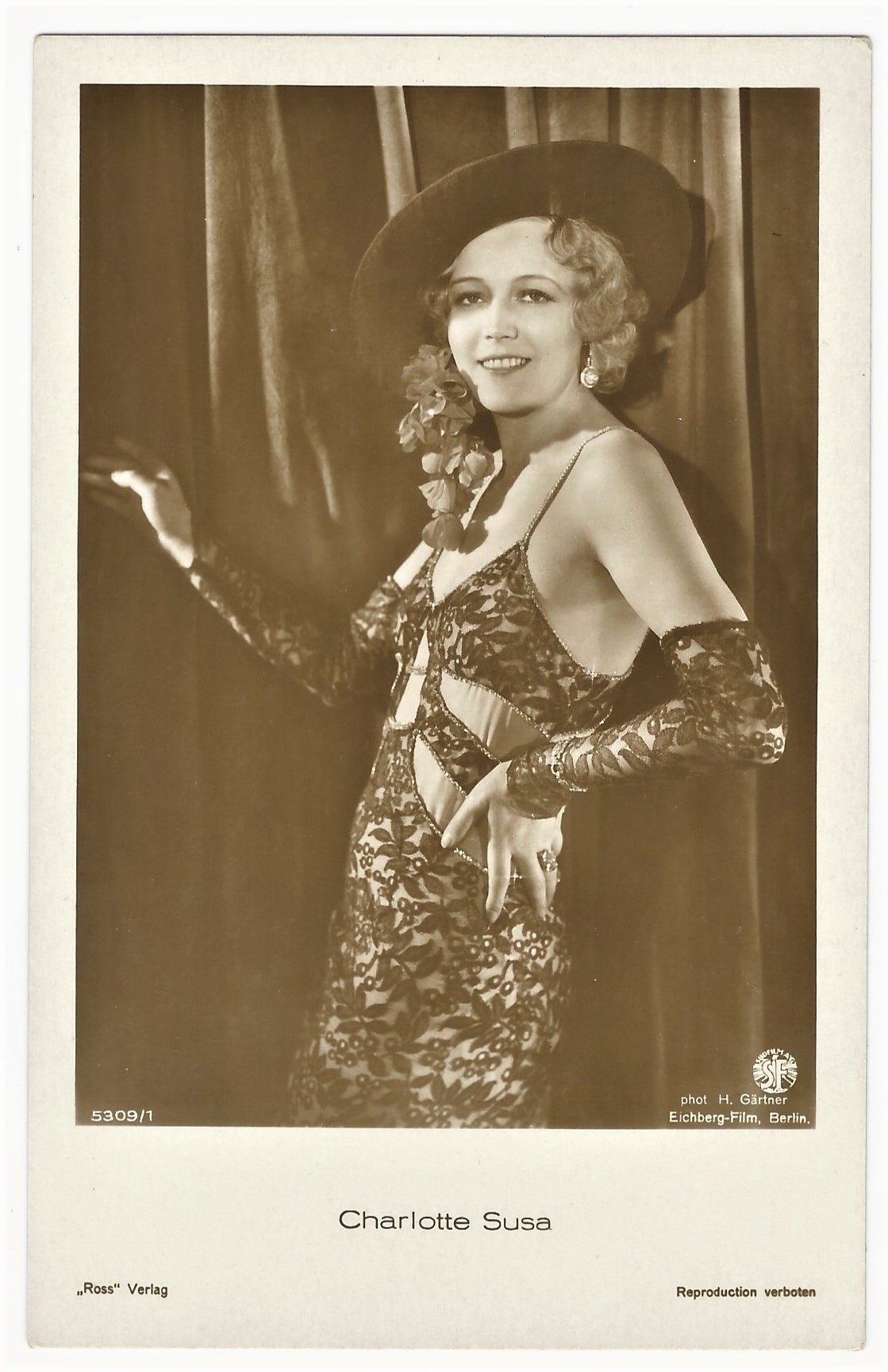
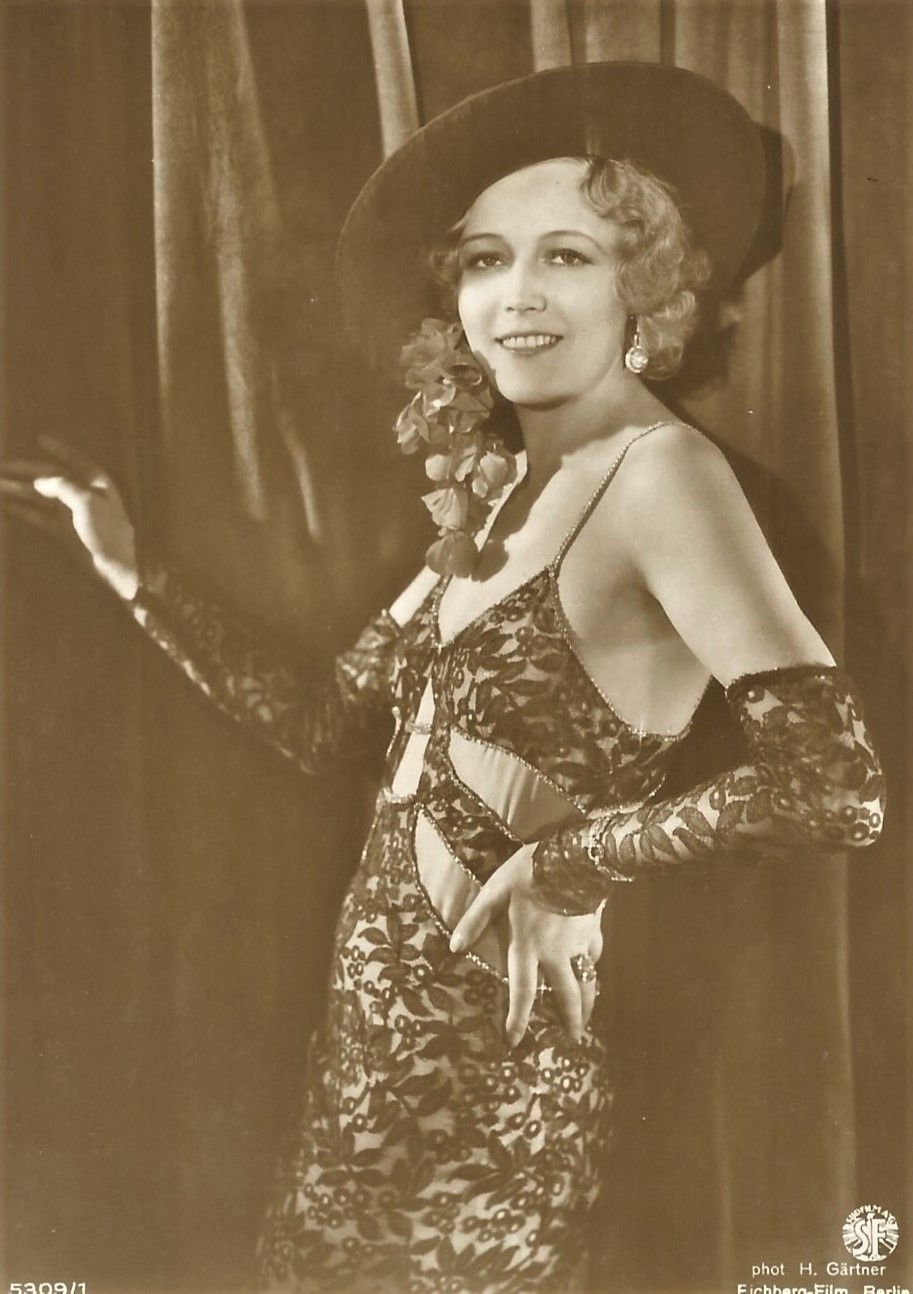
This vintage real photo postcard features German actress, Charlotte Susa (1898-1976). Sosa was very pretty and the “look” she gives the camera indicates that she knew it. She certainly has a sultry appearance in that dress. Susa was born in Memel, East Prussia. One of her parents was Italian and the other was Swiss. Her first stage appearance was in 1915. She began a successful career as both a singer and an actress. She played in a number of German opera and operetta venues. Her film debut occurred in 1926 with an appearance in a German silent movie. She became a popular actress and appeared in many femme fatale roles. After the advent of sound films, Susa began assuming leading roles. In 1932 she signed with MGM, relocated to the United States, and started an international film career. One newspaper columnist of the time wrote that Susa, Lilian Harvey, Anna Sten, and Henry Garat were all important “foreign talents” that were joining Hollywood pictures. Susa was projected to be a rival to Greta Garbo. Success in Hollywood did not come to fruition. She cancelled her contract in 1934. She stopped acting in films but returned to the stage after World War II. Susa, like many film stars, had multiple marriages. Susa stopped replacing husbands after her third marriage. Her third husband was Andrews Engelmann (1901-1992), a Russian born German actor. He appeared in German and British films during his career. Charlotte Susa died in Basel, Switzerland. The IMDb reports Susa had thirty-six film credits ranging from 1926 to 1941. This postcard portrait was photographed by H. Gartner and published by Ross Verlag as part of a series (no.5309/1). Eichberg Films is credited on this postcard. Richard Eichberg (1888-1952) began his career as an actor but became a succssful film director and producer in the German film industry. He directed 87 films and produced 77 films. At the time that Susa’s photograph was taken for this postcard, she was employed by Eichberg’s company. (SOLD)
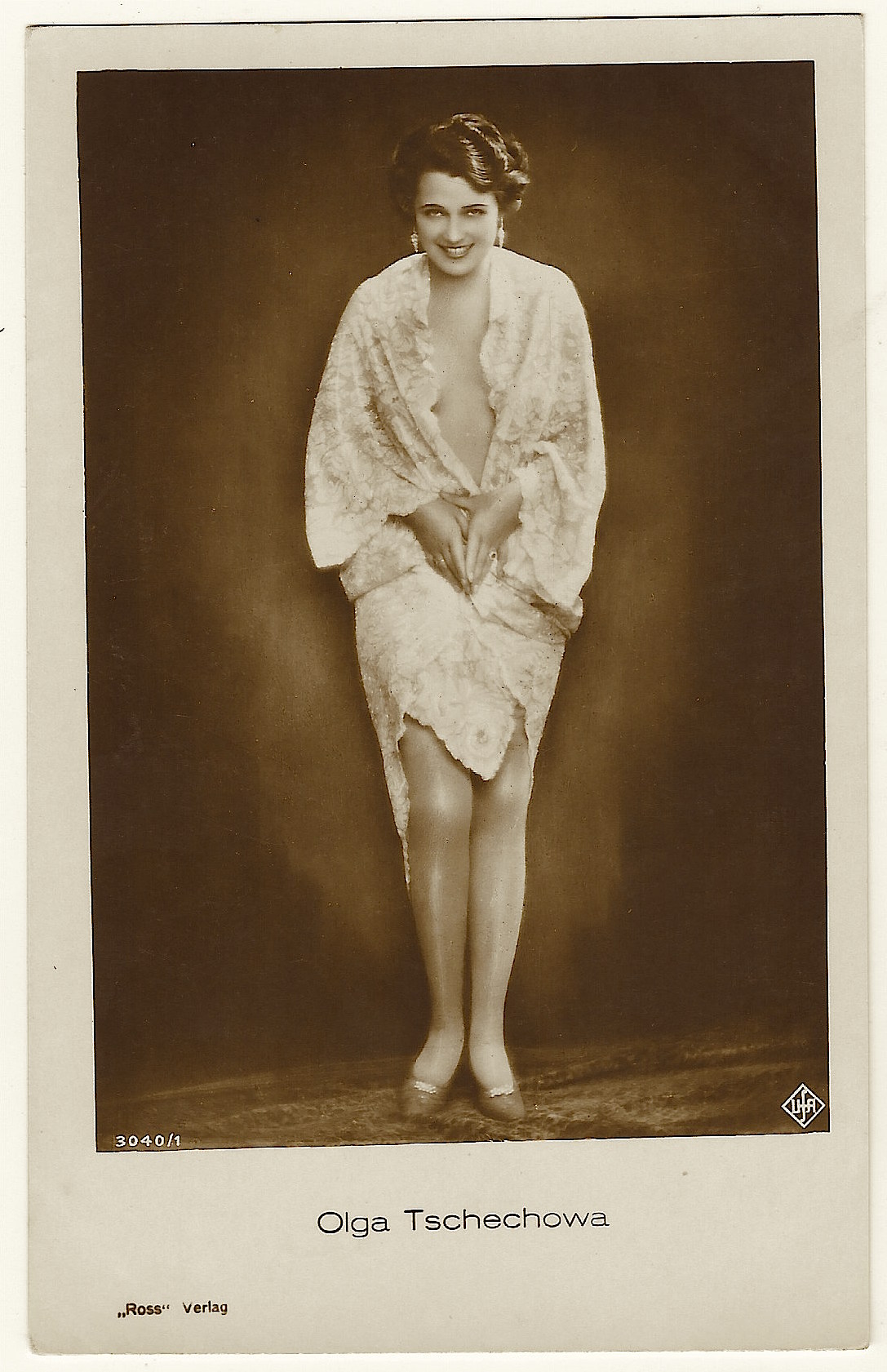
This risque vintage real photo postcard features Russian-German actress, Olga Tschechowa (1897-1980). Her father was a railway engineer who became Russia’s Minister of Railways. She was the niece of Anton Chekov’s wife. She went to school and studied art and literature at an art school in St. Petersburg. . After watching famed actress Eleonora Duse, Olga joined the Moscow Art Theare’s studio. In 1914, while at the school, she met Russian-Jewish actor Mikhail Chekov. He was the nephew of Anton Chekov. She married him the same year and they had a daughter in 1916. In 1917, during the October Revolution, she divorced her husband. It is reported that he had an affair while Olga was pregnant. Olga would marry three more times. She joined a cabaret group and was offered a part in a silent movie. She travelled to Vienna and moved to Berlin in 1920, She continued to perform in films. She was one of the fortunate actresses who successfully made the transition from silent to sound movies. In the 1930’s she became one of the leading actresses of the Third Reich and was admired by Adolf Hitler. Olga was courted by Hermann Goring and Joseph Goebbels. Goebbels introduced her to Hitler in 1933 and she and Hitler became friends. In 1936, she was named “State Actress” of the Third Reich and she was made a German citizen. Olga’s brother was sent from Russia to Germany on a secret mission to assassinate Hitler. Stalin got cold feet and called off the “hit”.The brother ended up in a Nazi concentration camp, but survived the war. At one point, Olga was accused of being a Russian agent in Nazi Germany. Himmler ordered an investigation of Olga by the SS. She was often kept under surveillance by both Nazi and Soviet agents. In 1945, Himmler planned to arrest her but Hitler intervened. Olga survived the war through lying, acting, and disguise. She protected her daughter from the concentration camps by hiding the fact that she had a Jewish father. At the war’s end, Olga was arrested by the Red Army and brought to Moscow for a debriefing. She was interrogated for two months and then taken to Berlin to assist the Soviet Army. She established herself in East Berlin. She played in dramas but preferred comedies. Olga was very successful in the film business,. Her filmography reveals that she has 138 credits as an actor, director, and producer between the years of 1917 and 1974. After the World War II, she lived in Soviet occupied Berlin and in 1949 she moved to Munich, Bavaria. In Munich she started a cosmetics company. Simultaneously she continued to act in more than 20 films. She published a book of memoirs and retired from acting in the 1970’s. In 1966, her daughter died in a plane crash. Olga suffered from depression and alcohol abuse. She died in Munich and just before she died, she had her granddaughter bring her a glass of champagne, Her last words were purported to be “Life is beautiful”. This postcard was published by Ross Verlag and is part of a series (no. 3040/1). The front of the card has the logo for UFA, a German film company. This vintage portrait postcard is uncommon. (SOLD)
This vintage real photo postcard features Russian actress Vera Vasilyevna Kholodnaya (1893-1919). Sometimes she is referred to as Holodnaja). She was the first star of Russian silent film. The number of films that she appeared in, is unknown. It is estimated the number of appearances is somewhere between fifty and one hundred. It is unfortunate that only five of her films survived the passage of time. She was born in Poltava which was part of the Russian Empire, and is now located in the Ukraine. At the age of two, she moved to Moscow to live with her grandmother. As a child, she fantasized about becoming a classical ballerina. She eventually enrolled in the Bolshoi Theatre ballet school From early childhood, she participated in family theater productions, While attending her school prom to celebrate her graduation she met Vladimir Kholodny, whom she married in 1910. He is known as one of Russia’s first race car drivers. The pair had two children. In 1908, after seeing actress Vera Komissarzhevskaya in a stage role, she decided that she wanted to pursue a career in films. She sought out Vladimir Gardin, a major Russian film director, and he gave her a minor role in Anna Karenina. In 1915, film director Yevgeni Bauer was searching for an actress who possessed great beauty. After meeting Vera Kholodnaya, he found the enchantress that he was looking for. Bauer’s film was a resounding success. He then made a second film starring Kholodnaya. These two Bauer films made Vera a major celebrity. She soon became known as “the Queen of Screen” and had great successes with other films. By 1918, she was a film phenom. When Russia entered World War I, her husband joined the military. She participated in charity concerts to support the soldiers and their families. It is reported that she was “worshipped” by soldiers. By the time of the Russian Revolution (1917), a new Kholodnaya film was released every three weeks and she continued to experience acclaim and success. Around this time, the actress moved with her film company to Odessa. She died there, at age 25, during the 1918 flu pandemic.This version of the flu, was known as the “Spanish Flu” and it infected 500 million people around the world between 1918 and 1920. Estimates are that between 50 and 100 million people died during the pandemic. (SOLD)
This vintage real photo postcard features American silent and sound film star, Virginia Brown Faire (1904-1980). She was born in Brooklyn, New York. In 1919, after being a winner of the Motion Picture Classic magazine’s “Fame and Fortune” contest, she went to Hollywood. At age 15, she was hired by Metro studio. She then appeared in movies for Fox, followed by Universal. Her first film “Runnin’ Straight” (1920) was a Hoot Gibson short western. She was the leading lady for John Gilbert in Monte Cristo (1922). She was chosen as one of the WAMPAS Baby Stars in 1923. Included in this group of beautiful actresses was Laura La Plante and Evelyn Brent. La Plante and Brent both had successful acting careers. She is most remembered for her role as Tinker Bell in Peter Pan (1924). Faire made a successful transition into sound films. Her first successful talkie was her role in Frank Capra’s “The Donovan Affair” (1929). She appeared in several westerns. Among the western stars that she played opposite to; was John Wayne,Hoot Gibson, and Buck Jones. In the late 1930’s she left Hollywood and moved to Chicago and worked in radio and industrial films. She retired in about 1935. According to the IMDb, she appeared in 74 films between 1920 and 1935. Faire had three marriages. The first, was to actor Jack Dougherty and the marriage lasted just over a year. She then married director Duke Worne, a film director. He died after three years and she then married William Bayer, a furniture manufacturer. She died of cancer in 1980. This vintage postcard was published by Ross Verlag of Berlin, Germany. It is part of a series (no, 736/1). SOLD
This vintage real photo postcard features pretty French film actress, Louise Lagrange (1898-1979). She was born in Oran, France, which is now in Algeria. Her movie debut occurred when she was nine years of age. Her first marriage was to film director Maurice Tourneur. Her second marriage was to actor, William Elliot. The IMDb credits her with 48 film credits between 1907 and 1952. Her appearances included such films as “A Roman Orgy” (1911), “The Nude Woman” (1926), “In the Shadow of the Harem” (1928), and “Cage of Girls” (1949). Do I detect a pattern here? Lagrange certainly acted in a large number of films with sexually provocative movie titles. Cinemagazine (Paris Edition) is the publisher of this card. It was part of a series (no. 425). SOLD




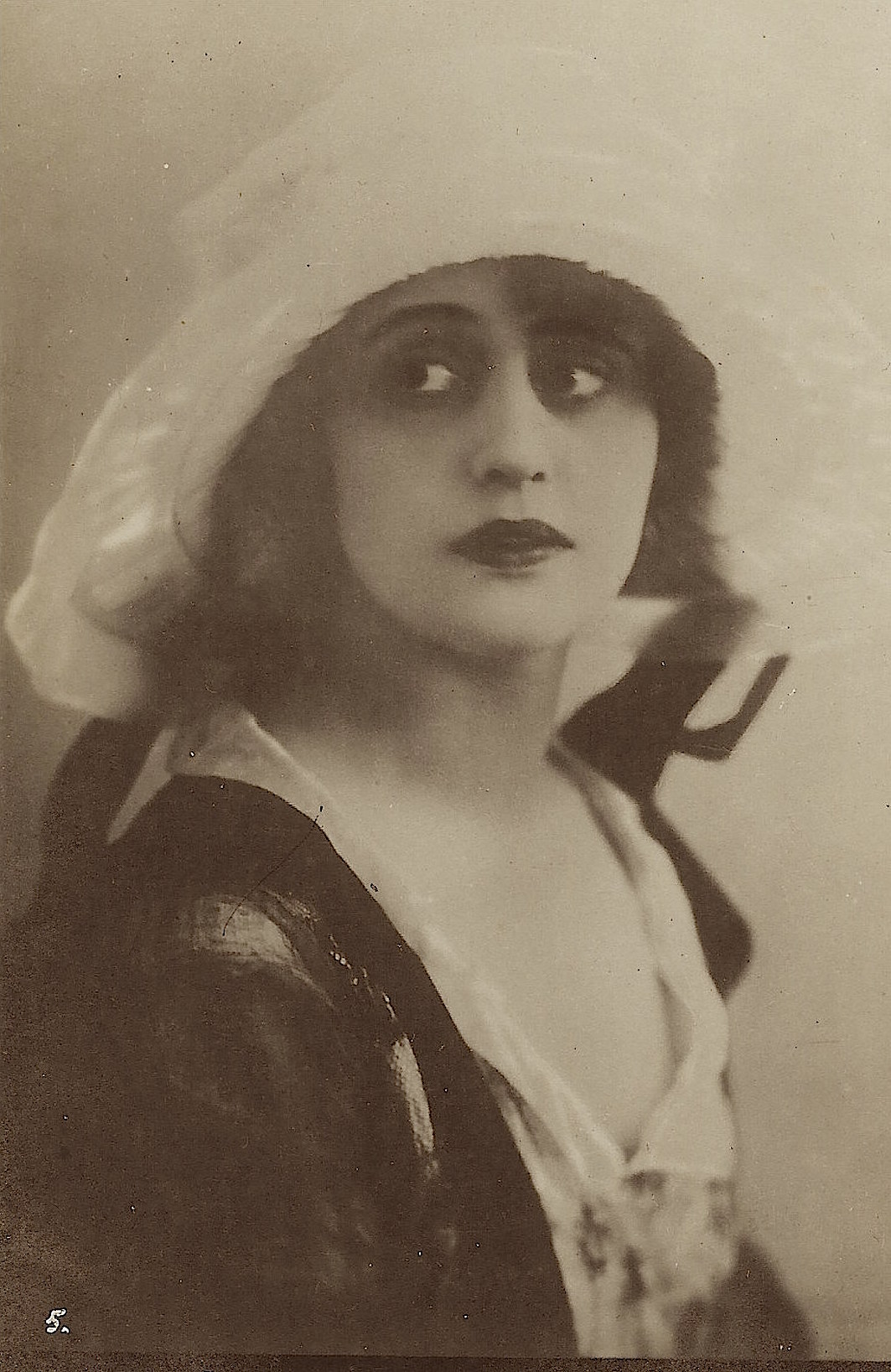 This vintage real photo postcard features Russian actress Vera Vasilyevna Kholodnaya (1893-1919). Sometimes she is referred to as Holodnaja). She was the first star of Russian silent film. The number of films that she appeared in, is unknown. It is estimated the number of appearances is somewhere between fifty and one hundred. It is unfortunate that only five of her films survived the passage of time. She was born in Poltava which was part of the Russian Empire, and is now located in the Ukraine. At the age of two, she moved to Moscow to live with her grandmother. As a child, she fantasized about becoming a classical ballerina. She eventually enrolled in the Bolshoi Theatre ballet school From early childhood, she participated in family theater productions, While attending her school prom to celebrate her graduation she met Vladimir Kholodny, whom she married in 1910. He is known as one of Russia’s first race car drivers. The pair had two children. In 1908, after seeing actress Vera Komissarzhevskaya in a stage role, she decided that she wanted to pursue a career in films. She sought out Vladimir Gardin, a major Russian film director, and he gave her a minor role in Anna Karenina. In 1915, film director Yevgeni Bauer was searching for an actress who possessed great beauty. After meeting Vera Kholodnaya, he found the enchantress that he was looking for. Bauer’s film was a resounding success. He then made a second film starring Kholodnaya. These two Bauer films made Vera a major celebrity. She soon became known as “the Queen of Screen” and had great successes with other films. By 1918, she was a film phenom. When Russia entered World War I, her husband joined the military. She participated in charity concerts to support the soldiers and their families. It is reported that she was “worshipped” by soldiers. By the time of the Russian Revolution (1917), a new Kholodnaya film was released every three weeks and she continued to experience acclaim and success. Around this time, the actress moved with her film company to Odessa. She died there, at age 25, during the 1918 flu pandemic.This version of the flu, was known as the “Spanish Flu” and it infected 500 million people around the world between 1918 and 1920. Estimates are that between 50 and 100 million people died during the pandemic. (SOLD)
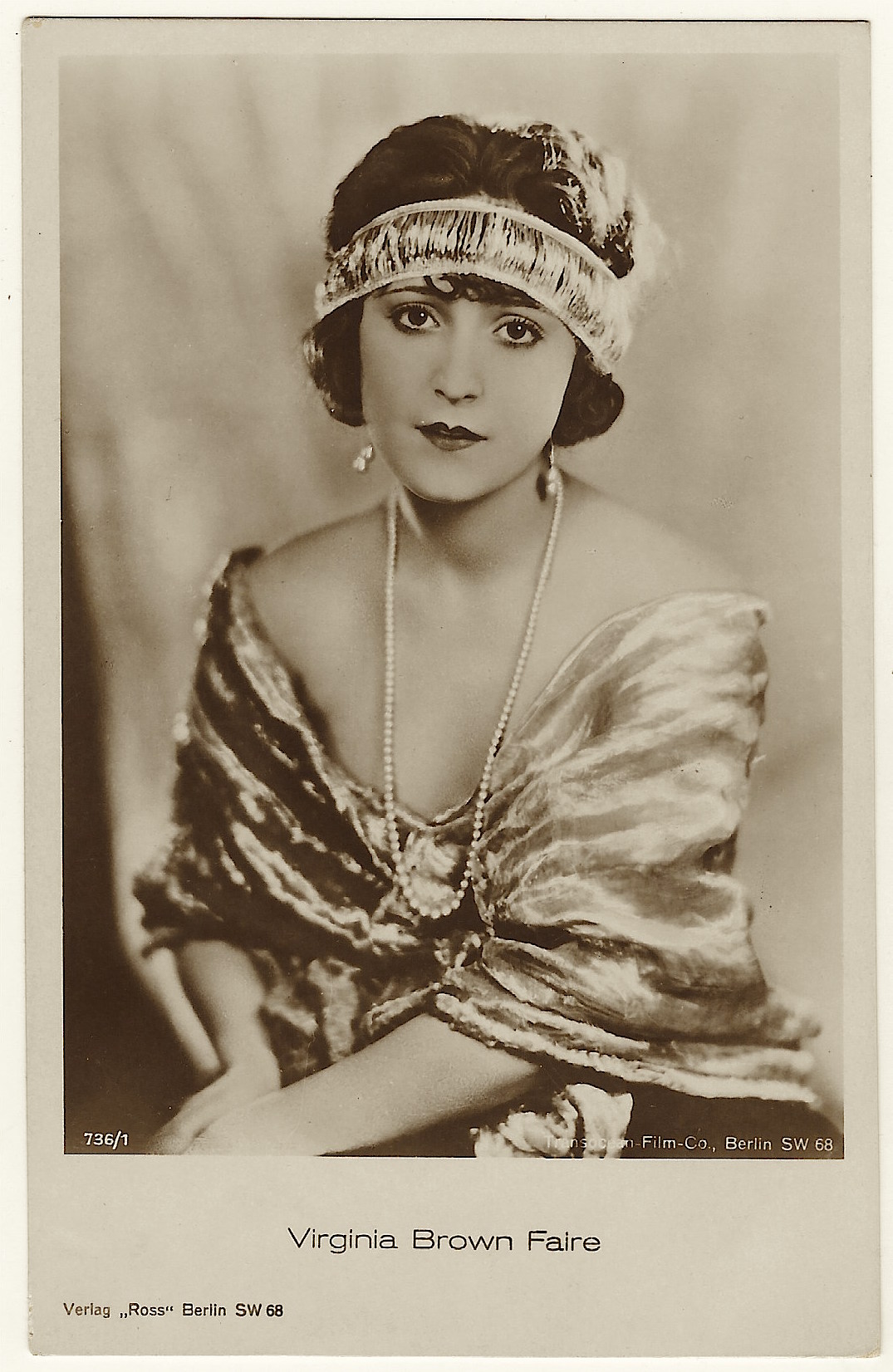
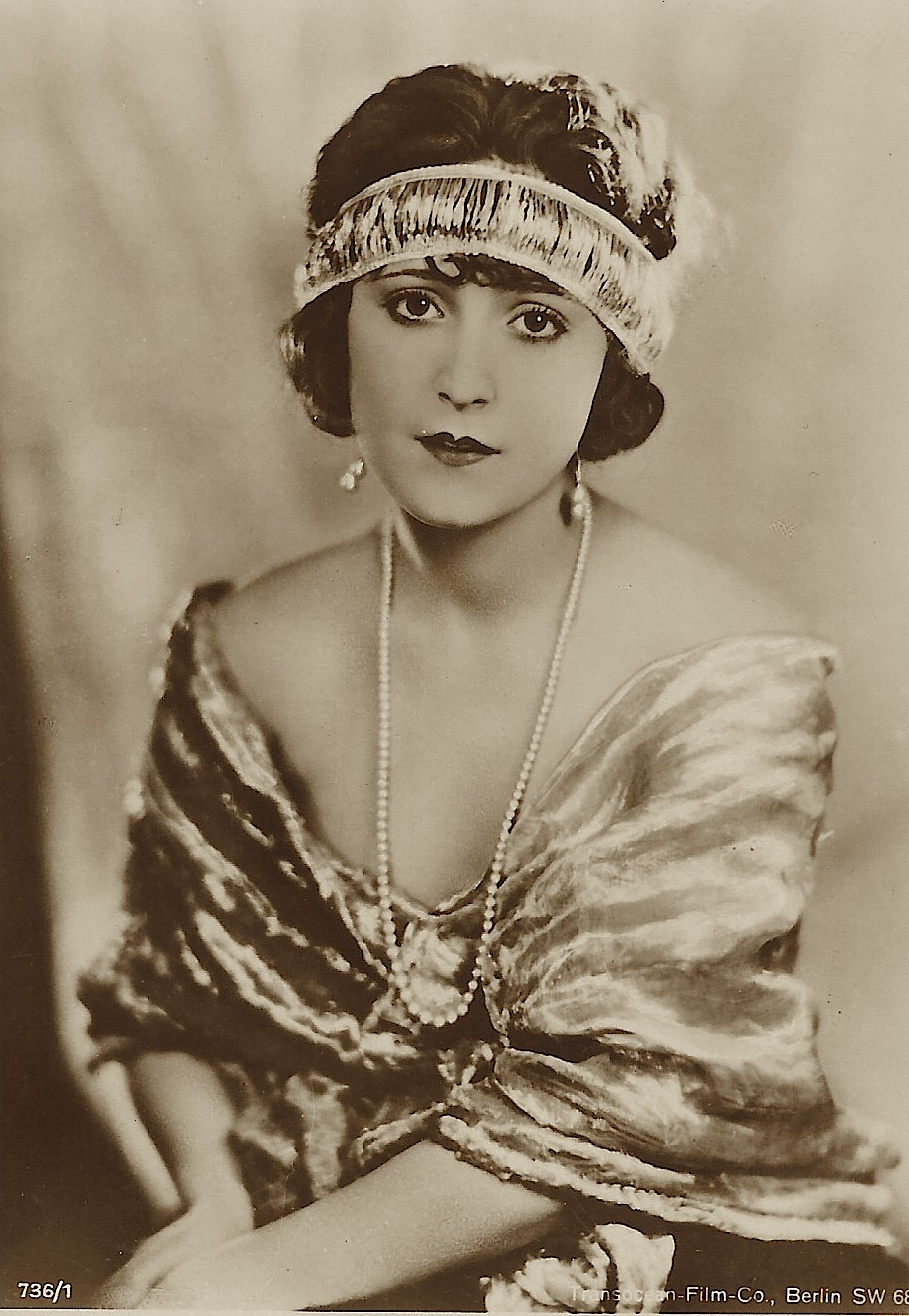 This vintage real photo postcard features American silent and sound film star, Virginia Brown Faire (1904-1980). She was born in Brooklyn, New York. In 1919, after being a winner of the Motion Picture Classic magazine’s “Fame and Fortune” contest, she went to Hollywood. At age 15, she was hired by Metro studio. She then appeared in movies for Fox, followed by Universal. Her first film “Runnin’ Straight” (1920) was a Hoot Gibson short western. She was the leading lady for John Gilbert in Monte Cristo (1922). She was chosen as one of the WAMPAS Baby Stars in 1923. Included in this group of beautiful actresses was Laura La Plante and Evelyn Brent. La Plante and Brent both had successful acting careers. She is most remembered for her role as Tinker Bell in Peter Pan (1924). Faire made a successful transition into sound films. Her first successful talkie was her role in Frank Capra’s “The Donovan Affair” (1929). She appeared in several westerns. Among the western stars that she played opposite to; was John Wayne,Hoot Gibson, and Buck Jones. In the late 1930’s she left Hollywood and moved to Chicago and worked in radio and industrial films. She retired in about 1935. According to the IMDb, she appeared in 74 films between 1920 and 1935. Faire had three marriages. The first, was to actor Jack Dougherty and the marriage lasted just over a year. She then married director Duke Worne, a film director. He died after three years and she then married William Bayer, a furniture manufacturer. She died of cancer in 1980. This vintage postcard was published by Ross Verlag of Berlin, Germany. It is part of a series (no, 736/1). SOLD
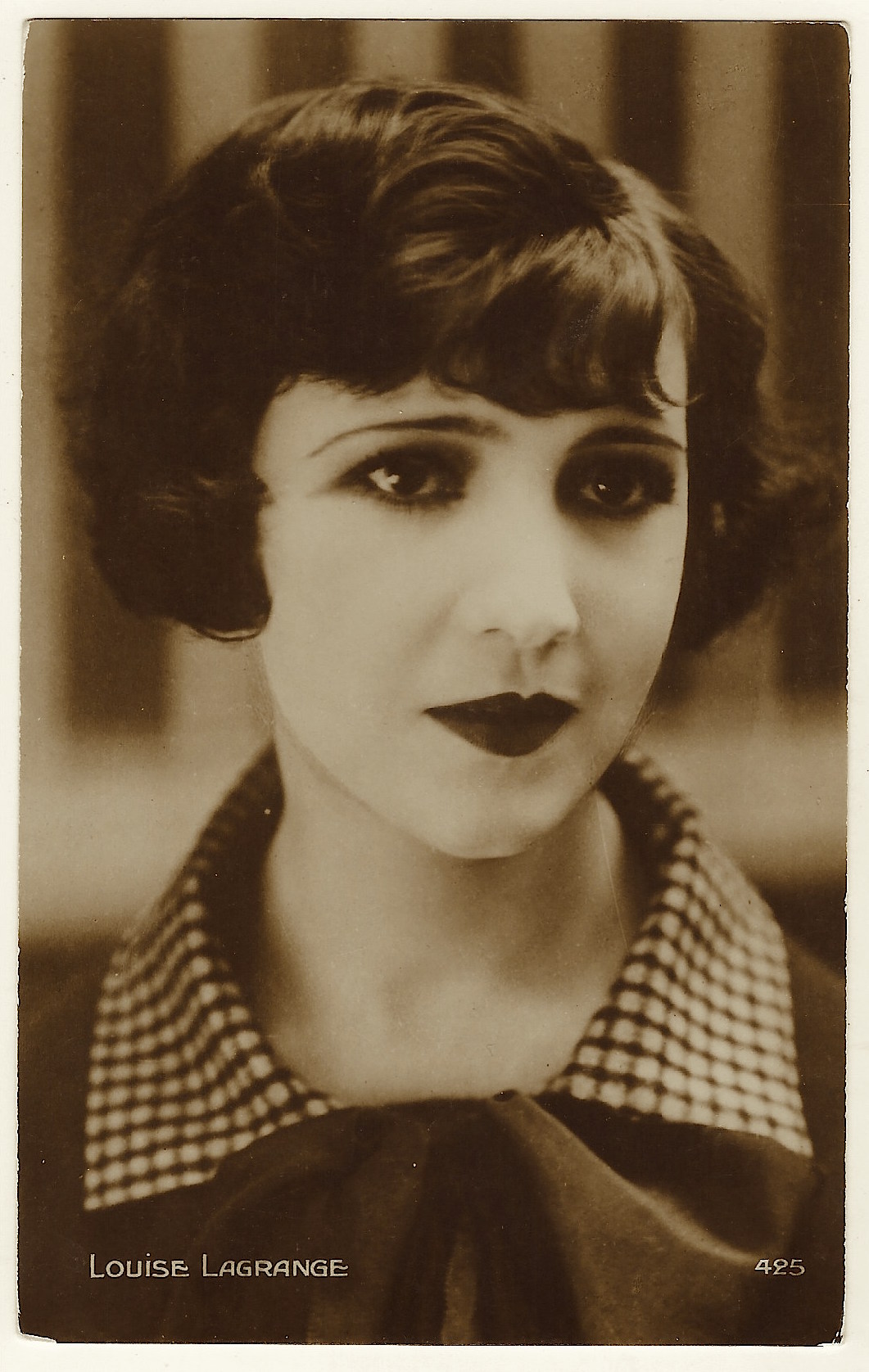 This vintage real photo postcard features pretty French film actress, Louise Lagrange (1898-1979). She was born in Oran, France, which is now in Algeria. Her movie debut occurred when she was nine years of age. Her first marriage was to film director Maurice Tourneur. Her second marriage was to actor, William Elliot. The IMDb credits her with 48 film credits between 1907 and 1952. Her appearances included such films as “A Roman Orgy” (1911), “The Nude Woman” (1926), “In the Shadow of the Harem” (1928), and “Cage of Girls” (1949). Do I detect a pattern here? Lagrange certainly acted in a large number of films with sexually provocative movie titles. Cinemagazine (Paris Edition) is the publisher of this card. It was part of a series (no. 425). SOLD