 Charles S. Rabineau of Albany, New York, produced this cabinet card portrait of a non expressive woman. She is wearing a lace collar and earrings. To learn more about Rabineau and to view more of his images, click on the category “Photographer: Rabineau”.
NON EXPRESSIVE WOMAN IN ALBANY, NEW YORK

INTENSE WOMAN IN ALBANY, NEW YORK
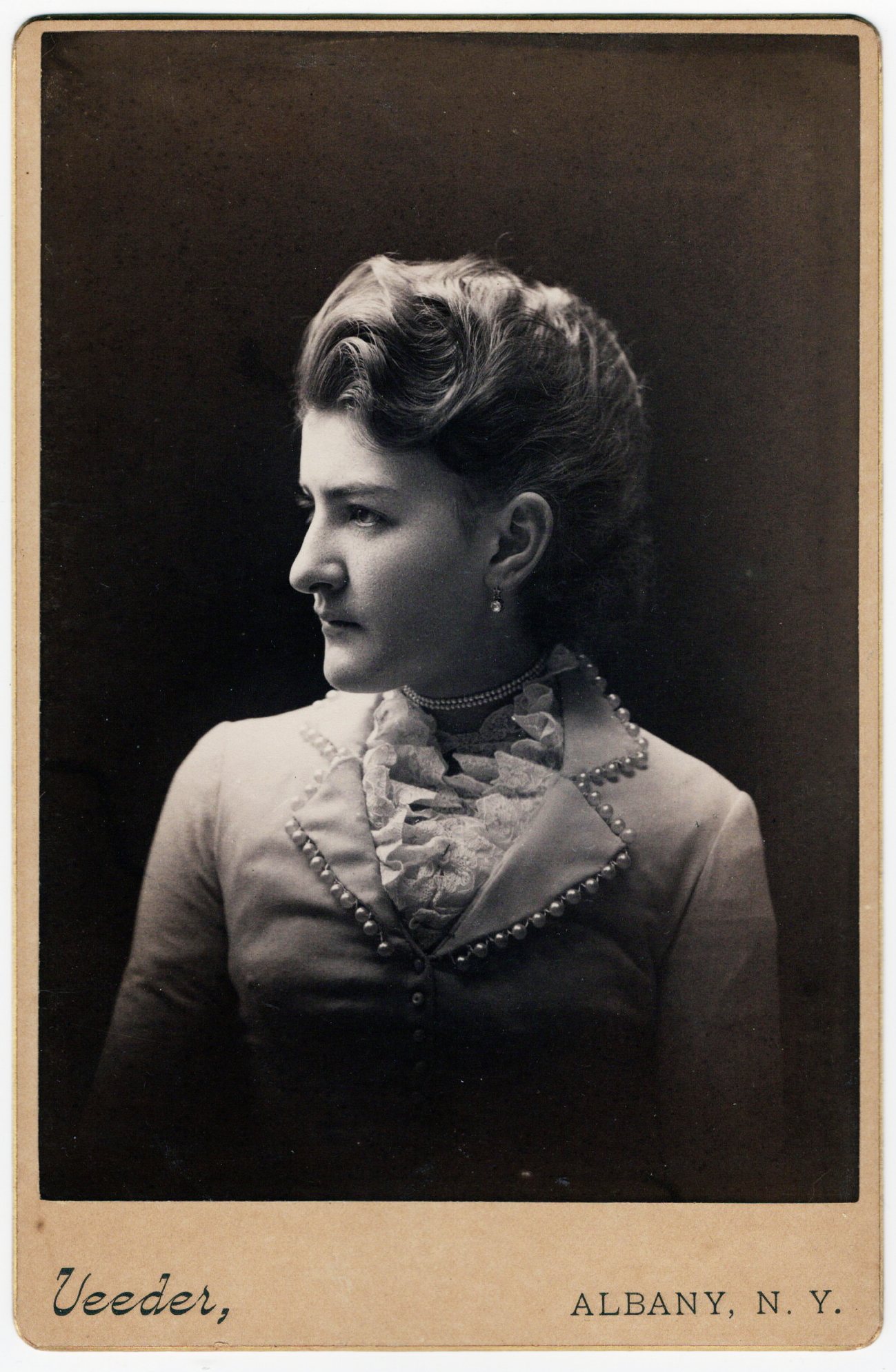

This cabinet card portrait captures the profile of a well coiffed woman posing at the studio of Aaron Veeder, located at 32 North Pearl Street in Albany, New York. Veeder did an excellent job of using lighting in creating this photograph of this fashionable lady. Aaron Veeder was a native of Albany and according to the Bicentennial History of Albany (1886), he devoted himself to landscape photography until 1881 when he developed a specialty in portrait photography. (SOLD)
LOVELY LADY AND A TRAIN WRECK IN ASHTABULA, OHIO
 This cabinet card features a portrait of a very lovely lady posing in the studio of Blakeslee & Moore in Ashtabula, Ohio. The town of Ashtabula was the site of a major train wreck in 1876 and one of the firemen who responded to the resulting blaze was Frederick W. Blakeslee. Besides being a firefighter, he was also a photographer and he used his camera to record the aftermath of the disaster. The image he made has become legendary in the history of disasters and the history of Ashtabula. He sold thousands of prints of the scene. Fred W. Blakeslee was in business in Ashtabula from 1870 to 1897. Blakeslee was born in Ohio in 1843. He was a lifelong resident of Ashtabula. At the end of the civil war he opened a photography studio in the town. Beginning the 1870’s he was joined by Frank C Moore (1851-1907). For a time, they operated a branch in Geneva, Ohio. Moore began his photography career as an apprentice in Ashtabula and then ran his own studio in Lima, Ohio between 1870 and 1875. Moore’s partnership with Blakeslee ended in 1894. Blakeslee’s son Frederick K Blakeslee (1880-?) also became a photographer in Ashtabula. The story of the “Ashtabula Train Disaster” is immensely tragic. The accident is thought to have been caused mainly by the collapse of a bridge owned by the Lake Shore and Michigan Railroad. The bridge was a joint creation by Charles Collins (engineer) and Amasa Stone (architect and designer). On a winter night in 1876, a train carrying 159 passengers and crew crossed over the bridge and when the first engine just passed the far side of the bridge, the bridge began to collapse and the rest of the train fell into the ravine. Ninety-two people were killed in the accident and most died from fires that were started from the train car’s oil lamps and stoves. The passengers were trapped in the burning crushed cars. The accident happened after a heavy snow storm and the rescuers were ill prepared and not equipped to help the poor victims of the train wreck. Charles Collins testified about the bridge design to an investigative jury and after finishing his tearful testimony, went home and shot himself in the head. Amasa Stone was held partially responsible for the accident, but he refused to accept blame. He theorized that the train jumped its tracks and destroyed the bridge. However, it is probable that he suffered severely from the incident, and about seven years later, he shot himself in the heart.
WOMAN STANDS BY FENCE POST IN LEBANON, PENNSYLVANIA
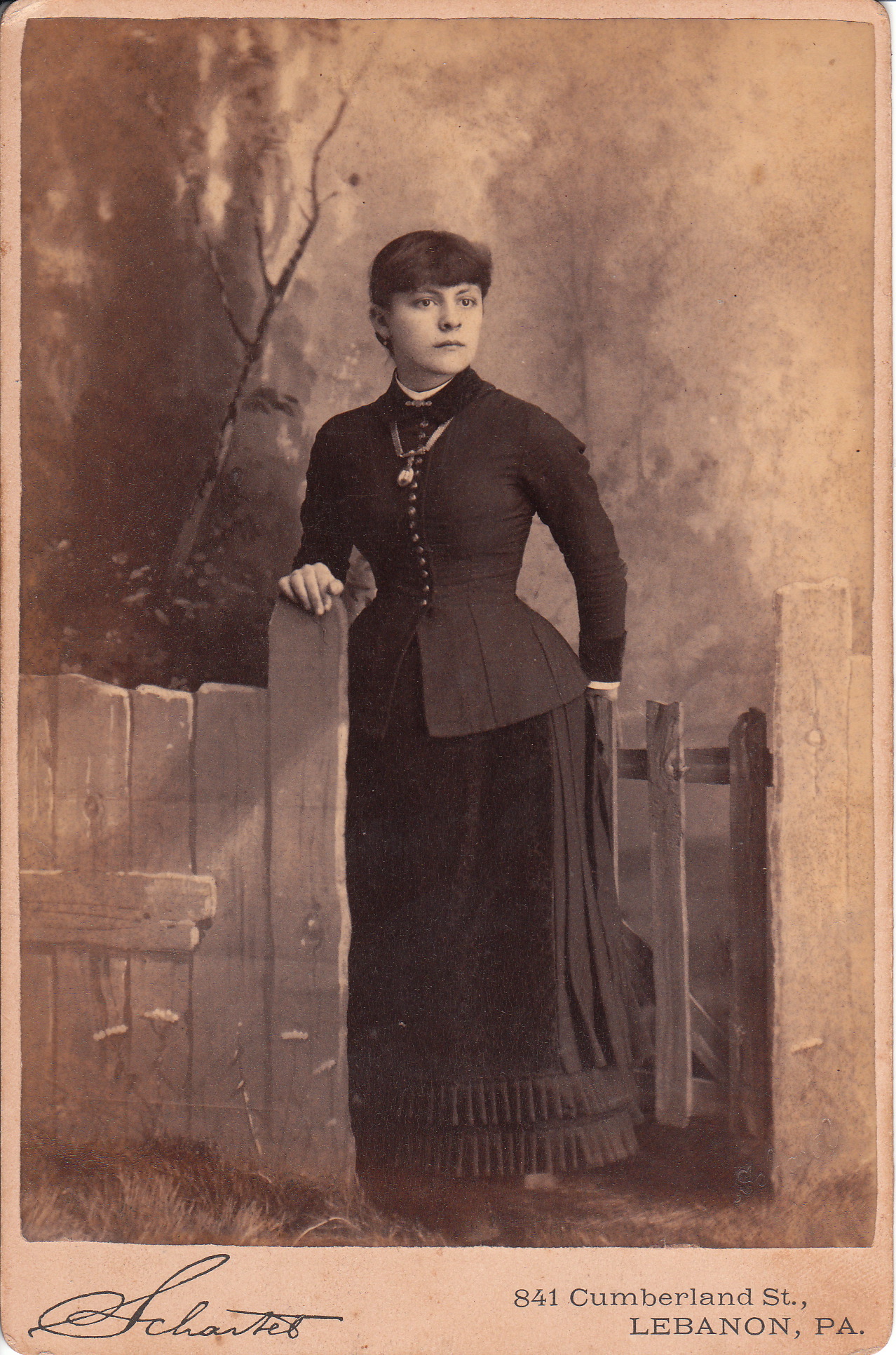 Elvin E. Schartel, a photographer from Lebanon, Pennsylvania, produced this image of an intense looking young woman standing at a gate. She is wearing a necklace with a locket. Schartel is listed in the 1889 Lebanon business directory as a photographer.
BEAUTY FROM THE PLAINS: LENA BRINGS HIGH FASHION TO GRAFTON, NORTH DAKOTA
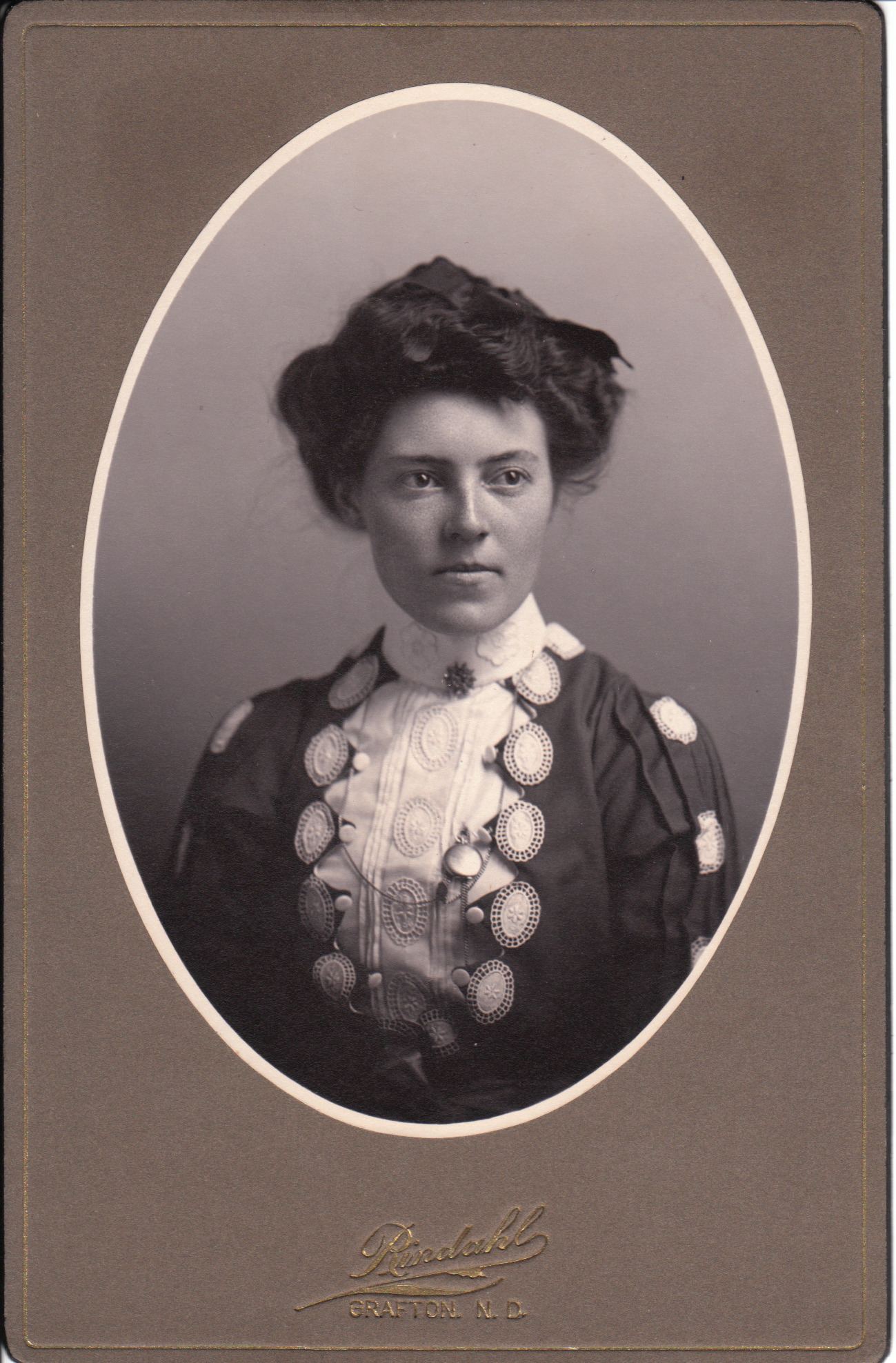
A pretty young woman wearing an unusual dress poses for her portrait at the Rindahl studio in Grafton, North Dakota. This plains beauty is anything but plain in her dress which features giant buttons and a high collar. She is wearing a collar pin. The reverse of the photograph lists the name of this fashionable lady as “Lena Larson”. Lena B. Larson appears in the 1920 and 1930 United States census. Lena was born in 1884 and was married to Olaf Larson who was a farmer and two years her junior. In 1920 and 1930 she was living in Kensington, North Dakota. The 1930 census indicates that Lena had six children aged three to seventeen. Records indicate that she died in 1967 at the age of 83 and was buried in Park River, North Dakota. The photographer of this image is J. O. Rindahl. According to the book, “North Dakota of Today” (1919), Rindahl (1862-?) was born on a farm in Wisconsin. He had a childhood interest in painting but because of strains caused by being a member of a family of twelve, he had limited art instruction. He “drifted” into photography, a field in which he was quite successful. In 1895 he went abroad and visited a number of “renowned art galleries”. This experience caused his passion for painting to reemerge and when he returned to Grafton he used his spare time to pursue painting. The book features some of his paintings and several North Dakota churches displayed his paintings. In addition to religious paintings, he was known as a landscape painter. Rindahl had a partner in his photography business for fifteen years. Henry Ball and Rindahl occupied a studio on Main Street for at least some of those years. The St. Louis & Canadian Photographer (1902) announced that Ball sold the studio to Rindahl. The Bulletin of Photography (1922) reported that Rindahl sold the studio in Grafton, after operating it there for thirty-three years. The buyer was Arvid Rydholm of Minneapolis, Minnesota.
,
TWO YOUNG WOMAN WITH PAINED EXPRESSIONS IN HOOPESTON, ILLINOIS
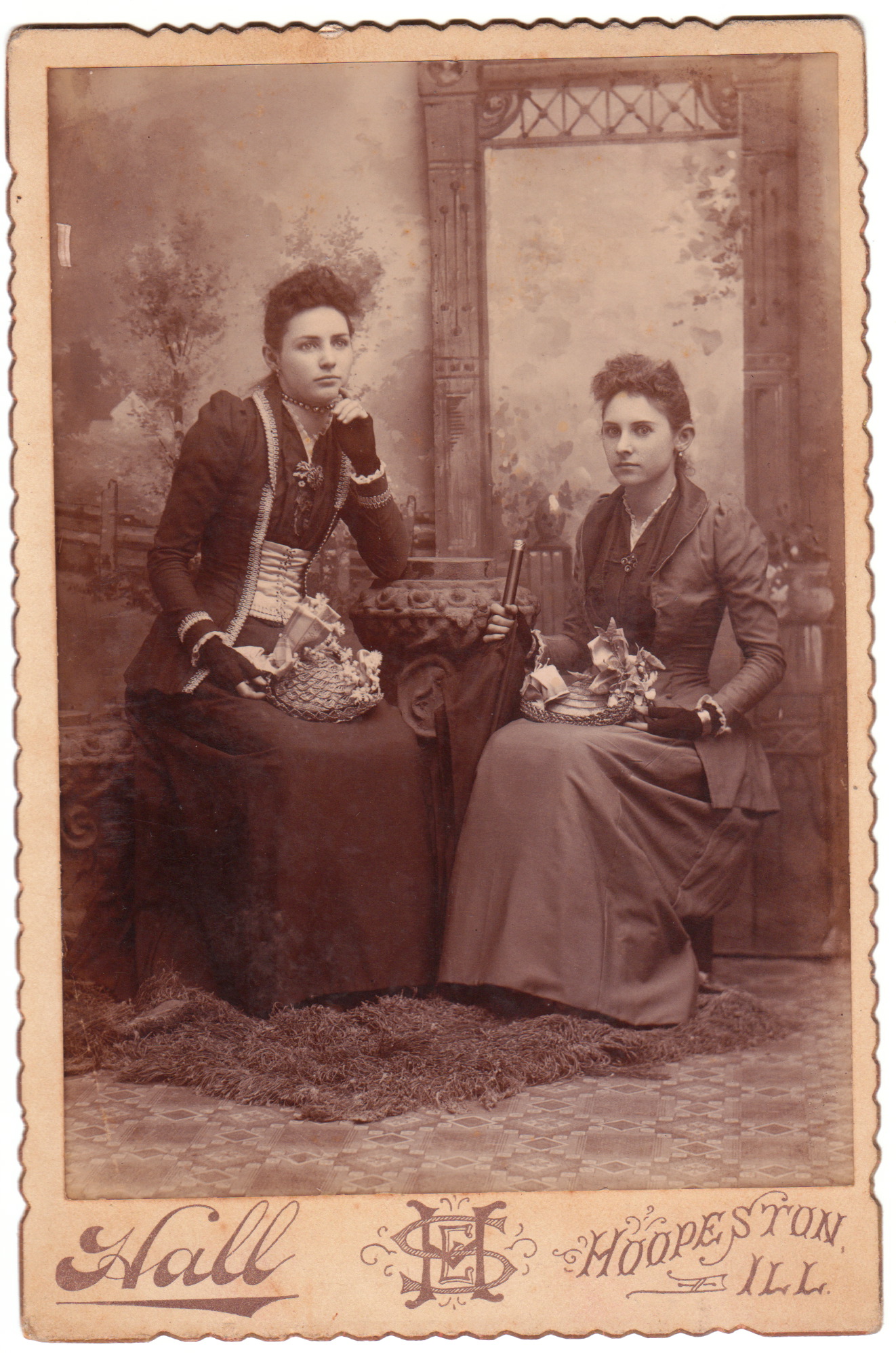 Two pretty young woman pose for their portrait in this scalloped cabinet card produced by the Hall studio in Hoopeston, Illinois. The women do not seem very enthusiastic about having their photograph taken. Each of the subjects have baskets of flowers on their laps and are wearing fingerless gloves. The woman seated on the right in the image is holding what appears to be an umbrella. Both of these ladies have very thin waists. They are probably wearing corsets. Perhaps those corsets are a little too tight and that would explain the pained expressions they display in the photograph. The photographer, Ervin S. Hall, appears in the 1880 US census. Hall was 25 years old and married (1877) to Violetta Hall (age 27). Hall’s parents were born in Maine but he and his wife were Illinois natives. The couple lived in Hoopeston and Hall worked as a photographer. The 1900 US census found Hall and his wife living in Grant, Illinois with their two children, Ellis (age 17) and Ethel (age 15). Ervin was still working as a photographer. The 1910 US census lists Hall and his wife living in Urbana, Illinois and Ervin still employed as a photographer. The 1920 US census reveals that the couple was living in Kissimmee, Florida and Ervin was working as a hardware salesman. The 1930 US census indicates that Ervin was retired and he and his wife remained in Kissimmee. Research uncovers the story of Hoopeston, Illinois. The town was created in 1871 and named for Thomas Hoopes who had offered his land to be the site of the crossing of two railroads. The business and manufacturing that developed in Hoopeston centered around agriculture. The Illinois Canning Company (1875) and the Hoppeston Canning Company (1878) were established there. Greer College (1890) was also established in Hoopeston.
PRETTY YOUNG WOMAN SITTING ON PRETTY UNUSUAL CHAIR IN CANTON, OHIO
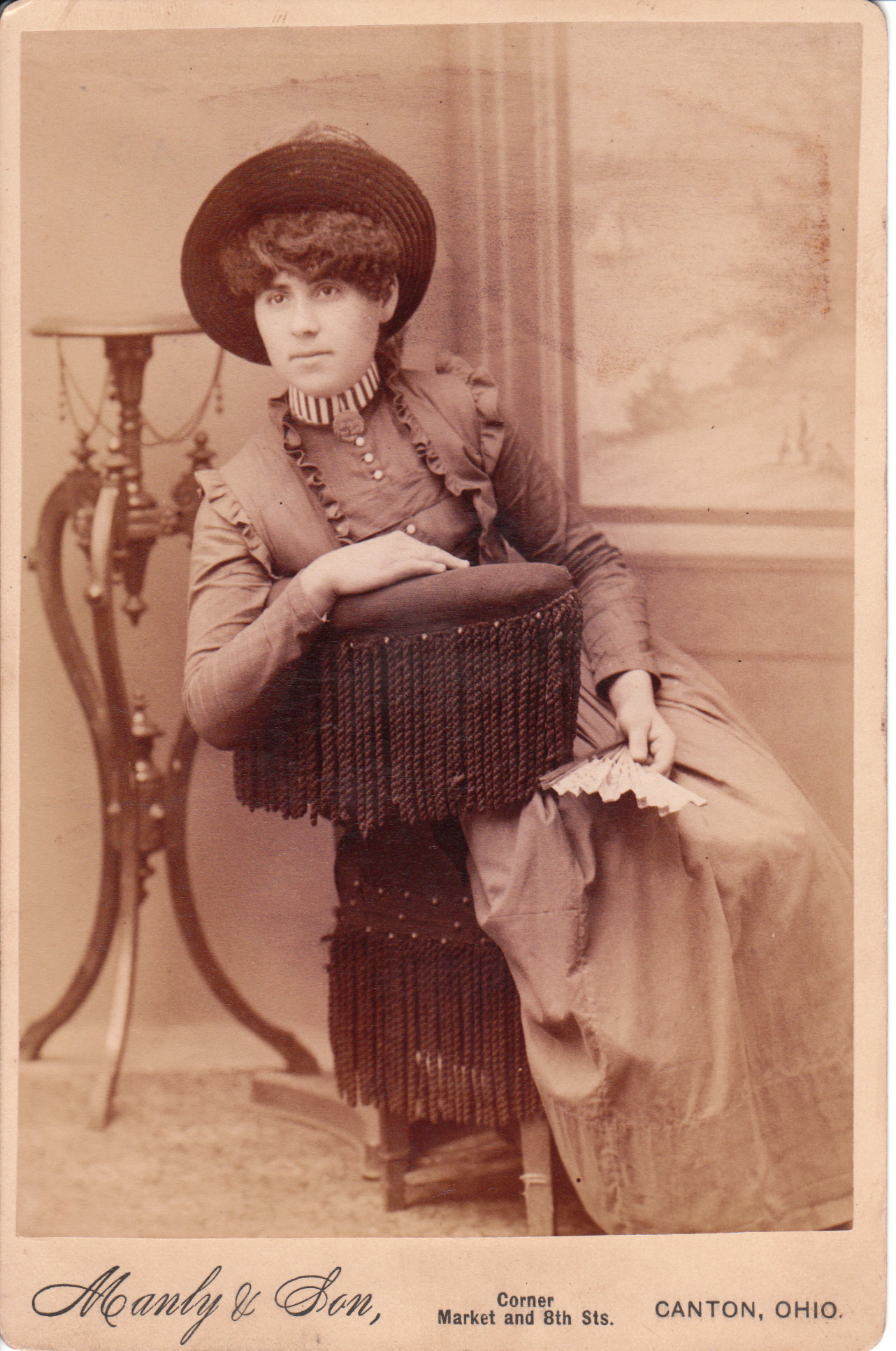
A pretty young woman appears to be comfortable enough as she sits on an unusual chair and poses for her portrait at the Manly & Son studio in Canton, Ohio. She is holding a small fan and displays a faint smile as she leans toward the camera. She is wearing a ruffled dress with a striped collar and is also wearing a pin. Note the fringed chair and also notice the floor lamp. At least it appears to be a floor lamp. Could it possibly be an odd looking table? The woman is wearing a hat, but due to her puffy curly hair, the hat appears to be floating on her head. Research provided some information concerning photographer George Watson Manly but the more interesting story concerns his wife Angeline Stewart Manly. George was born in New York in about 1824. George appears to have begun his photography career in Akron, Ohio. He started out as a dagguerreotypist beginning 1859. The 1870 US census confirms that George was working as a photographer in Akron and that he was married to Angeline who was seven years his junior. The couple had three children in the household; Sabray (age 24), William (age 18), and Clifford (age 10).The boys were presumably George and Angeline’s sons. Also in the household was a young relative of Angeline and a young Irish couple. The husband of the Irish couple was listed as a photographer and he was likely an assistant to George. One source asserts that George stayed in Akron until 1873, and during some of his time in Akron he also had a studio in Salem, Ohio. It is not clear when he moved to Canton, but he is listed in Canton business directories by at least 1881. So what is the story concerning George’s wife, Angeline? The story is that Angeline Stewart Manly was a major figure in the temperance crusade in both the city of Akron and in the state of Ohio. She served as Akron’s city representative to the first state convention. The convention organized the Women’s Temperance League of Ohio and Manly was elected President. In 1883, Manly published a novel called “Hit and Miss: A Story of Real Life”. It is not known why George and Angeline moved to Canton from Akron. George died in Canton in 1900 and Angeline died there in 1913.
PRETTY WOMAN WITH FRIZZY HAIR IN MILWAUKEE, WISCONSIN
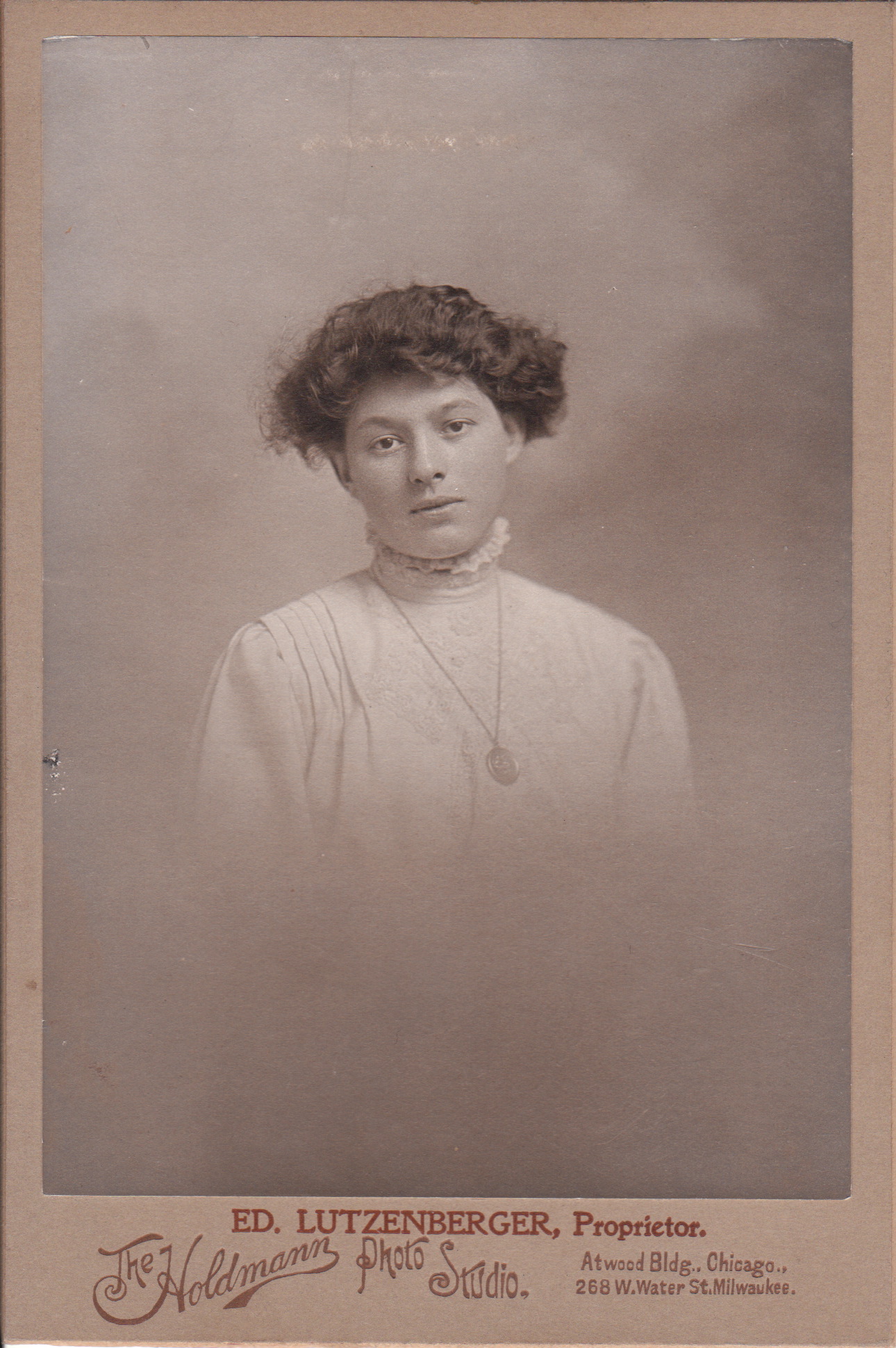 This cabinet card features a pretty woman with frizzy hair. She is wearing a dress with a high collar and a long necklace. The photographer did an excellent job of capturing the woman’s facial expressiveness. The Holdmann Photo Studio produced this image. The propietor of the studio was Edward Lutzenberger and the studio had a location in both Chicago, Illinois and Milwaukee, Wisconsin. Printing on the reverse of the photograph indicates that this image came from the Milwaukee studio. Also on the reverse of the photograph is printed guarantee and request for feedback that could be seen on any internet auction site. Lutzenberger guarantees that photographic portraits from his studio would not fade. The statement that sounds like it could be from modern day times is “If you are pleased tell others, if not tell us.” Lutzenberger probably purchased his studio from Charles Holdmann (1851-?). Holdmann’s studio was located at 224 Grand Avenue in Milwaukee. The 1900 US census reveals that Edward Lutzenberger lived at his mother-in-law’s house with his wife Anna Drager Lutzenberger and their one year-old daughter Norma. Lutzenberger and his wife married in 1897. Both Edward and Anna were born in Wisconsin. Edward was of German descent. He was employed as a photographer. The 1910 US census reports that Edward and his wife and daughter remained in Milwaukee and Edward was still working as a photographer. The 1920 census lists Edward and Anna as still living in Milwaukee with their, then 20 year old daughter Norma. There was a new addition to the household. Norma had a six year old son named Edward. It seems young Edward was born when Norma was around 14 years old. Norma was employed at the time of the census as a stenographer. The 1930 and 1940 census found Edward and Anna living in Milwaukee and Edward was working for the Railroad police. Milwaukee business directories list Edward as a photographer from 1894 through 1913. He certainly may have worked as a photographer in additional years but research could not document other years.
A WOMAN IN A LONG DRESS POSES WITH HER BICYCLE
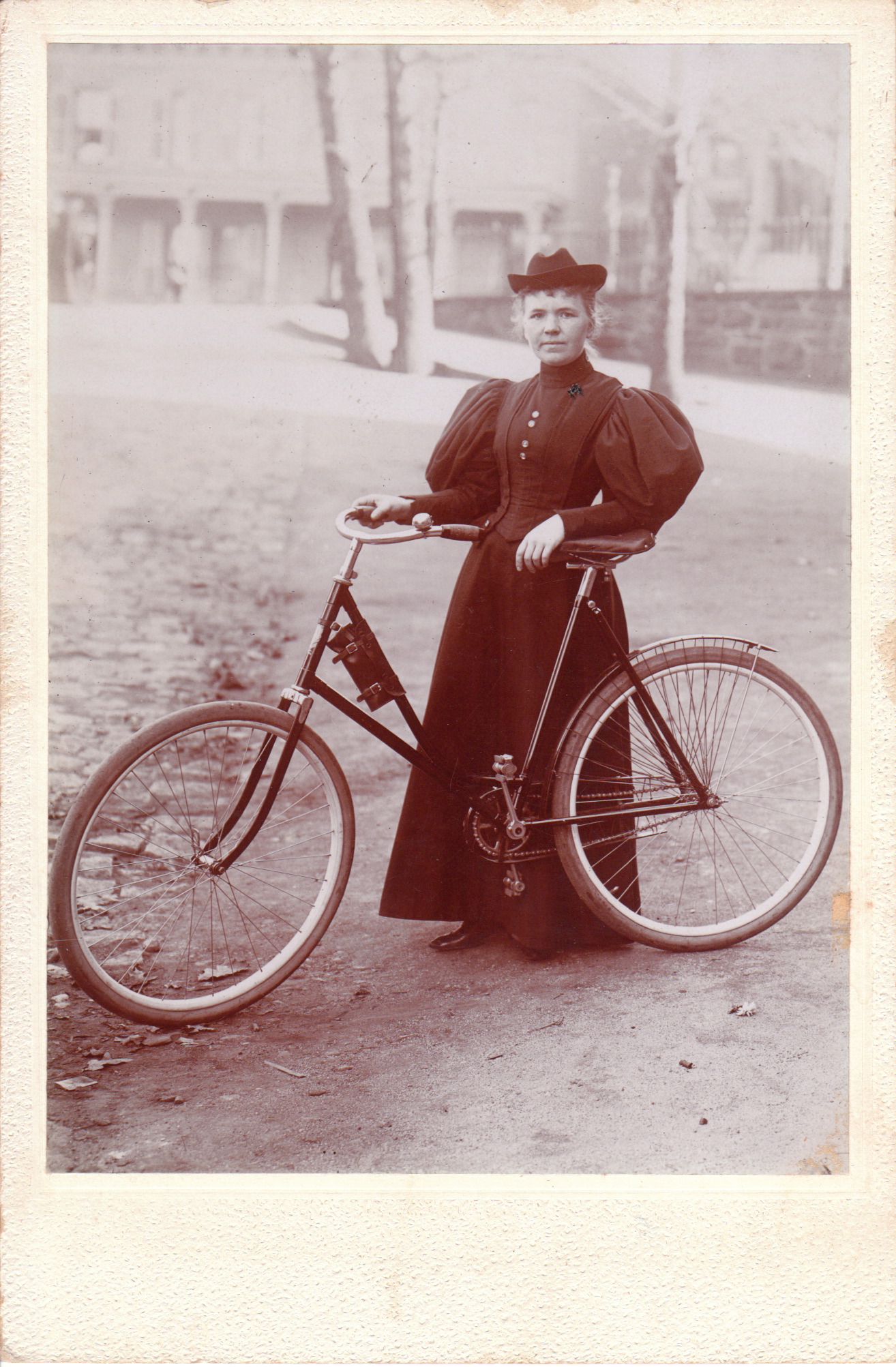
This photograph features a woman and her bicycle. It must have been very difficult for a woman to ride a bike in a such a long dress. Hand printed on the reverse of the photograph is the message “A Merry Xmas”. This photograph has been trimmed and as a result, the photographer is unknown.
WOMAN IN BUSTLE STYLE DRESS IN OMAHA, NEBRASKA
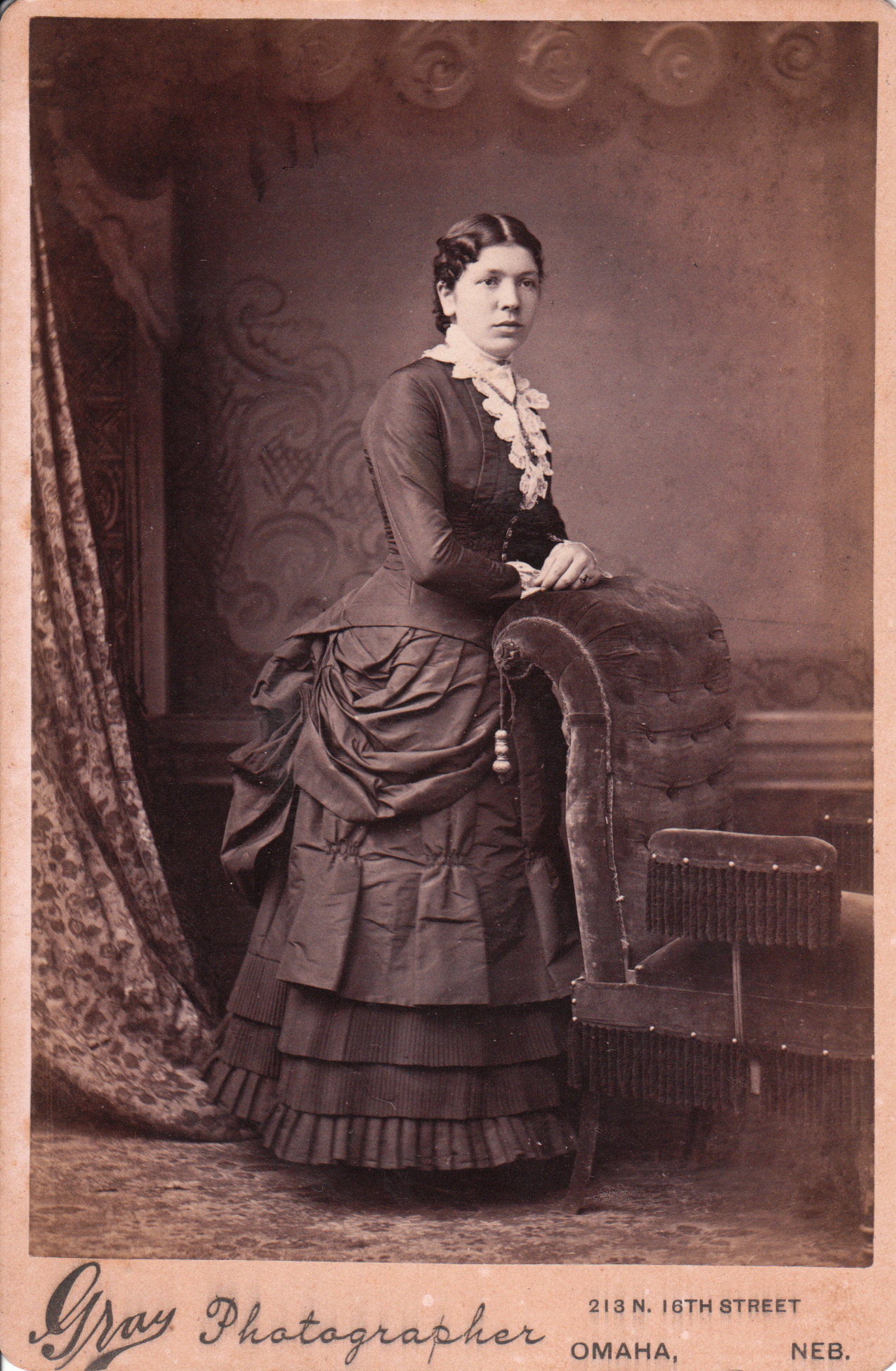
This photograph features a woman in a bustle style dress posing for a full length portrait at the Gray studio in Omaha, Nebraska. The dress seems to play a more prominent role than the subject in this cabinet card image. In 1884 Howard E. Gray took over the Bee Hive Gallery at the address listed on this cabinet card. In about 1886 he changed the name of the studio to the H. E. Gray Studio. Omaha business directories indicate that he was operating a photography studio in Omaha from 1884 through 1896. The 1896 directory announces that Gray had moved to Houston, Texas. Research was able to pick up Gray’s trail in Houston. Business directories state that he was a photo retoucher in in 1897 and from 1899 through 1911 operated a photography studio. Research yielded no definitive information about his family. He may be listed in the 1900 US census but there is no confirmation that Howard E. Gray listed is the same Howard E. Gray who worked as a photographer. The 1900 census Mr. Gray was 36 years-old and married to Maggie Gray (age 38). The couple was married in 1885 and had a son named Elmont (age 12). Interestingly, the census Mr Gray was listed as working as a stenographer. To view other photographs by Gray, click on the category “Photographer: Gray (NE)”.


 THE CABINET CARD GALLERY