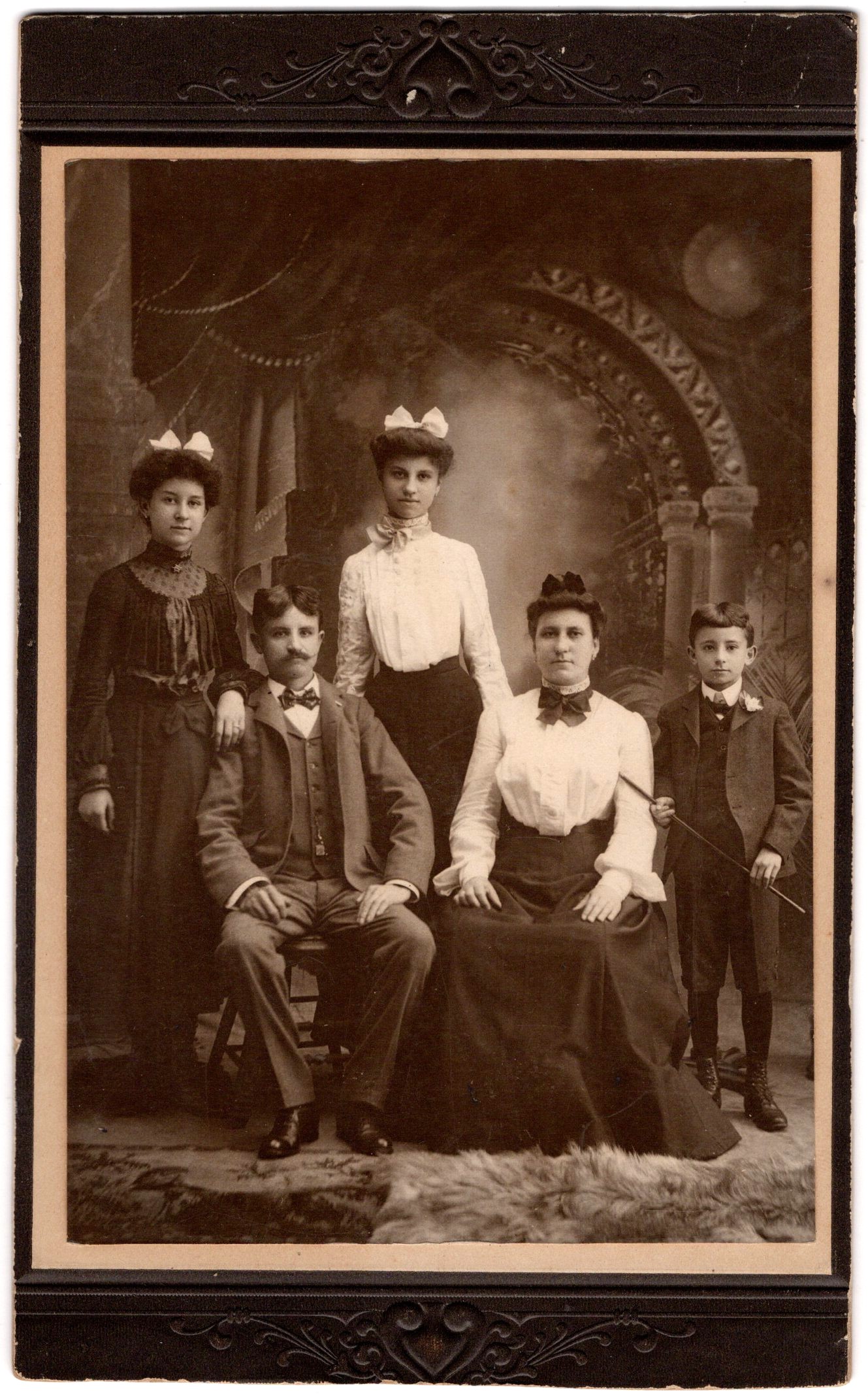
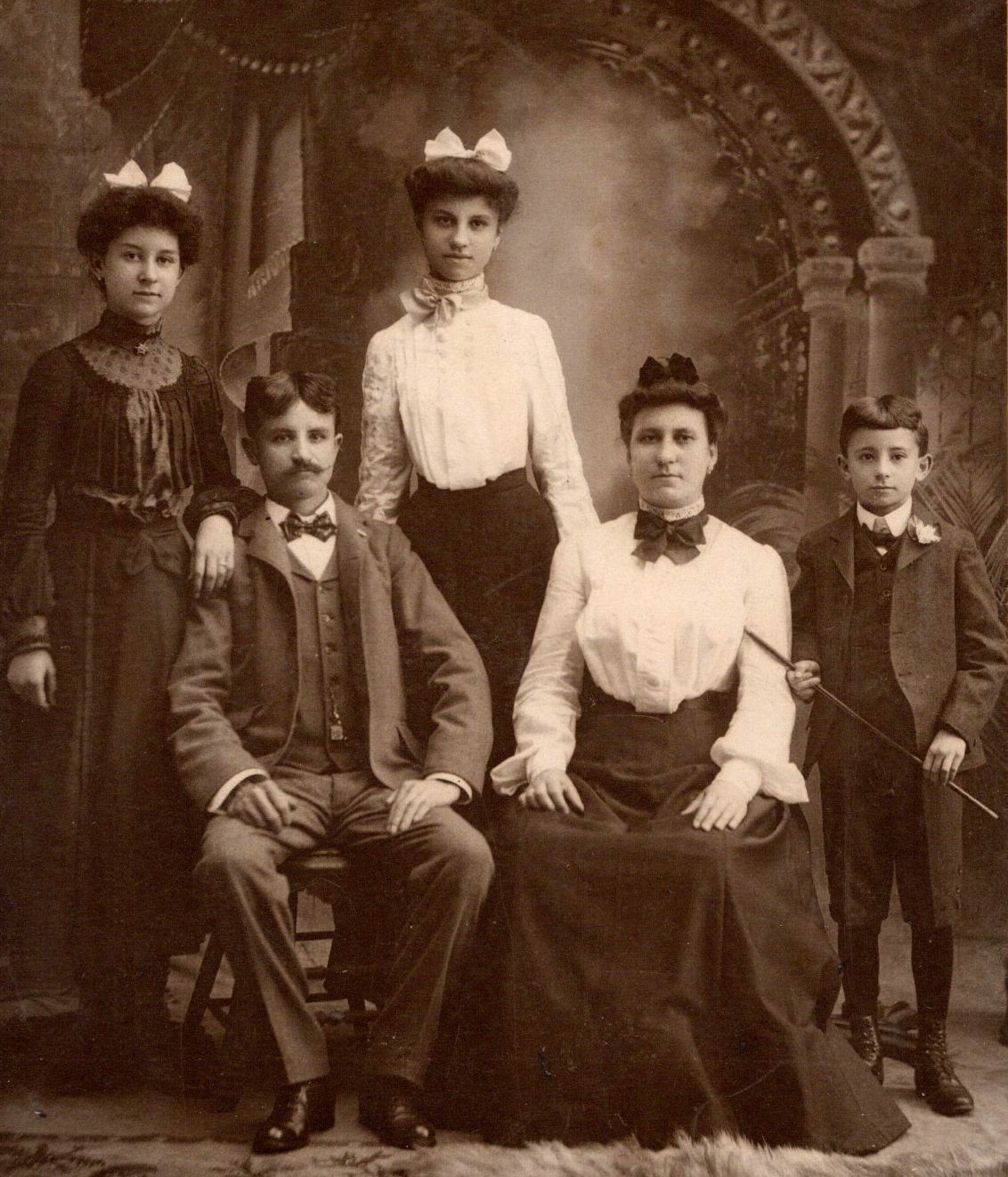
This handsome late nineteenth-century cabinet card presents a formal studio portrait of a family group, likely parents with their three children, posed against an elaborately painted architectural backdrop featuring arches, columns, and draped elements. The composition is carefully balanced, with the seated adults at center and the children arranged standing and seated around them, a conventional and deliberate arrangement that emphasized family unity and social stability during the Victorian era. The father is seated at left, wearing a tailored three-piece suit with vest, bow tie, and neatly groomed mustache, while the mother sits beside him in a high-necked blouse and long skirt, holding a slender object that may be a parasol or riding crop—an accessory sometimes used to lend formality or composure to studio portraits. The children are dressed in refined, period-appropriate clothing: the girls wear high-collared dresses with decorative bows in their hair, and the boy at right appears in a suit with knee-length trousers, stockings, and lace-up boots, suggesting a late Victorian to very early Edwardian date. Their expressions are composed and serious, typical of the era’s long exposure times and social expectations of photographic portraiture. The photograph was almost certainly taken in a professional studio, rather than in a private home, as indicated by the theatrical painted backdrop and controlled lighting. While no studio imprint is visible on the card itself, the style of backdrop, clothing, and posing strongly suggests a North American or Western European studio, most likely in the United States or Canada, where such cabinet cards were extremely popular. Without a photographer’s mark, the exact location cannot be determined, but the aesthetic aligns closely with American studio work of the 1890s. The cabinet card measures approximately 4¼ by 6 1/4 inches, which is slightly taller than the most common standard cabinet card size. This dimension places it very close to what collectors often refer to as a boudoir-format cabinet card or a transitional oversized cabinet, a format that gained popularity in the late 1880s and 1890s for larger, more impressive family portraits intended for parlor display. While not a full boudoir card (which are typically larger still), the proportions suggest a deluxe presentation rather than a basic cabinet card. Based on clothing styles, hair arrangements, and the studio setting, this photograph was most likely taken circa 1890 to 1898. The high collars, structured bodices, and tailored men’s wear firmly anchor it in the late Victorian period, just before Edwardian fashions began to soften silhouettes and lower necklines. SOLD

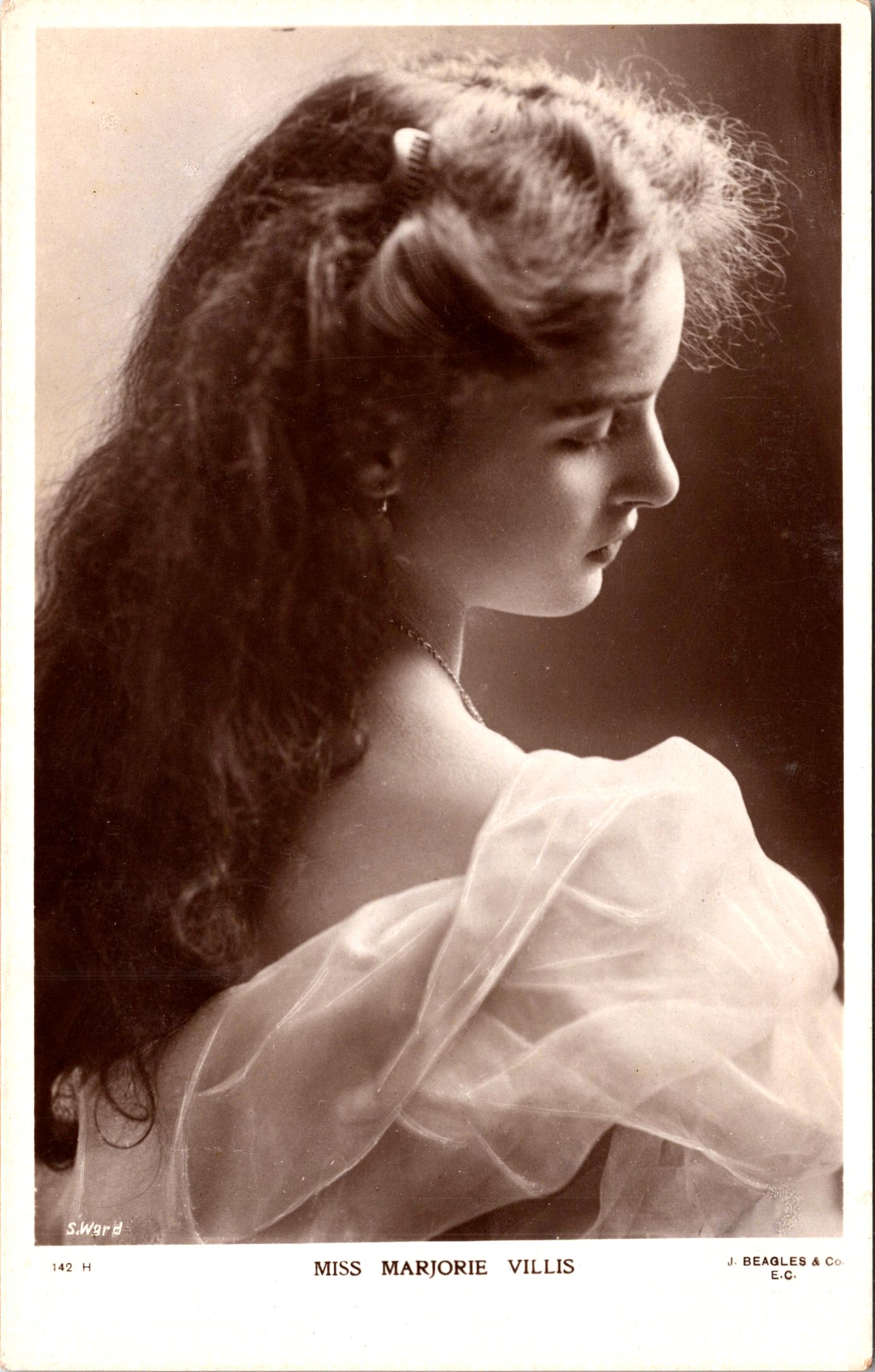
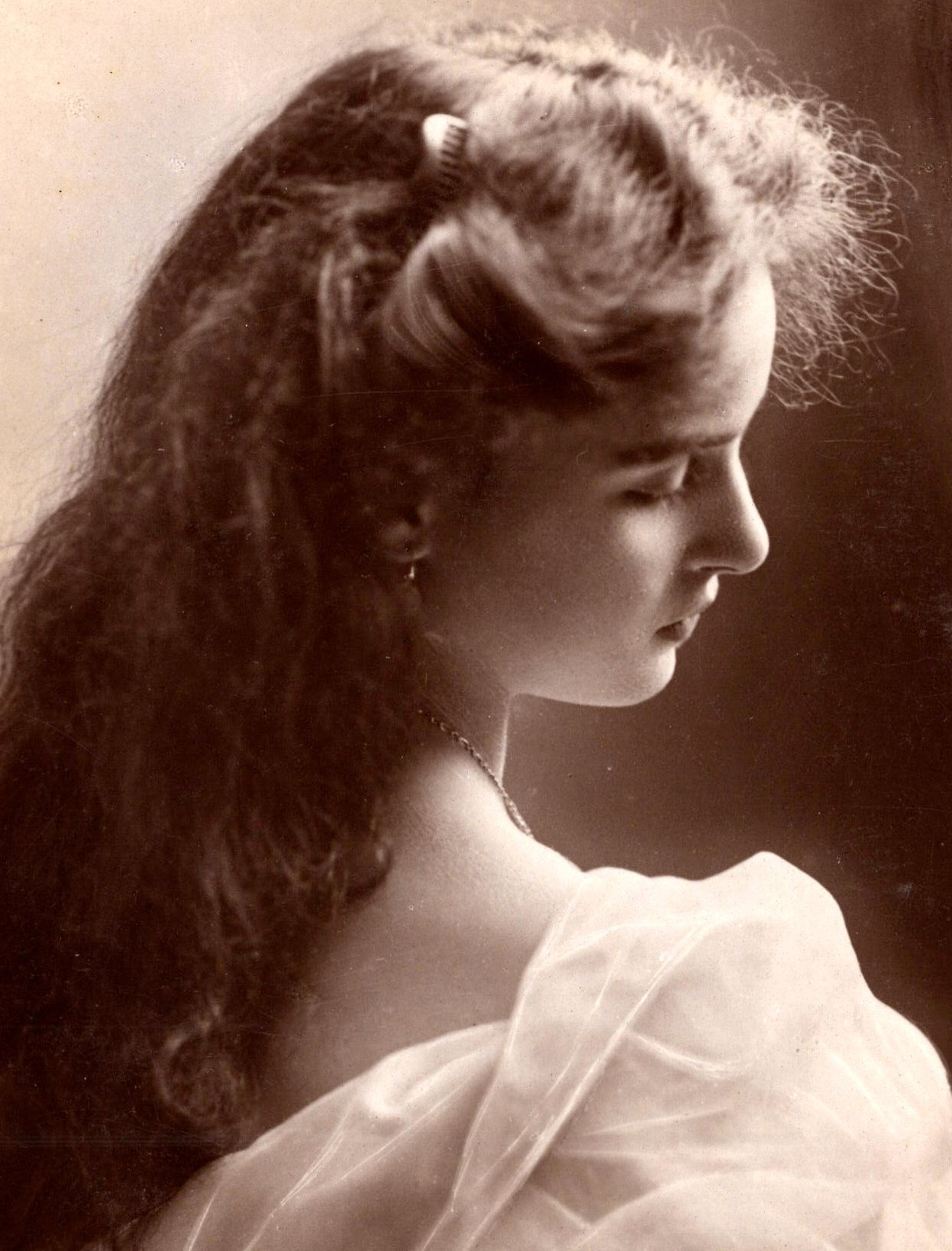
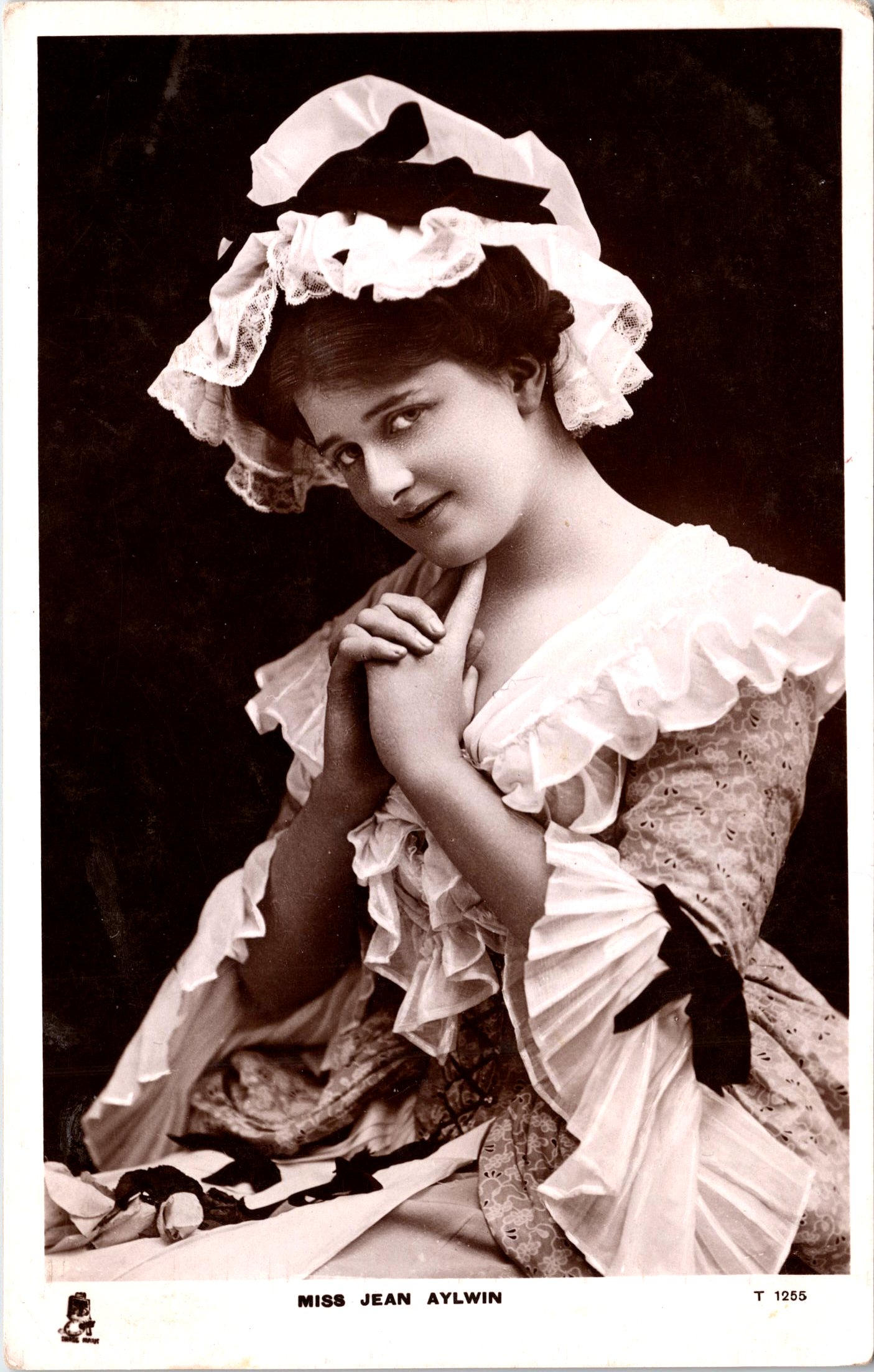
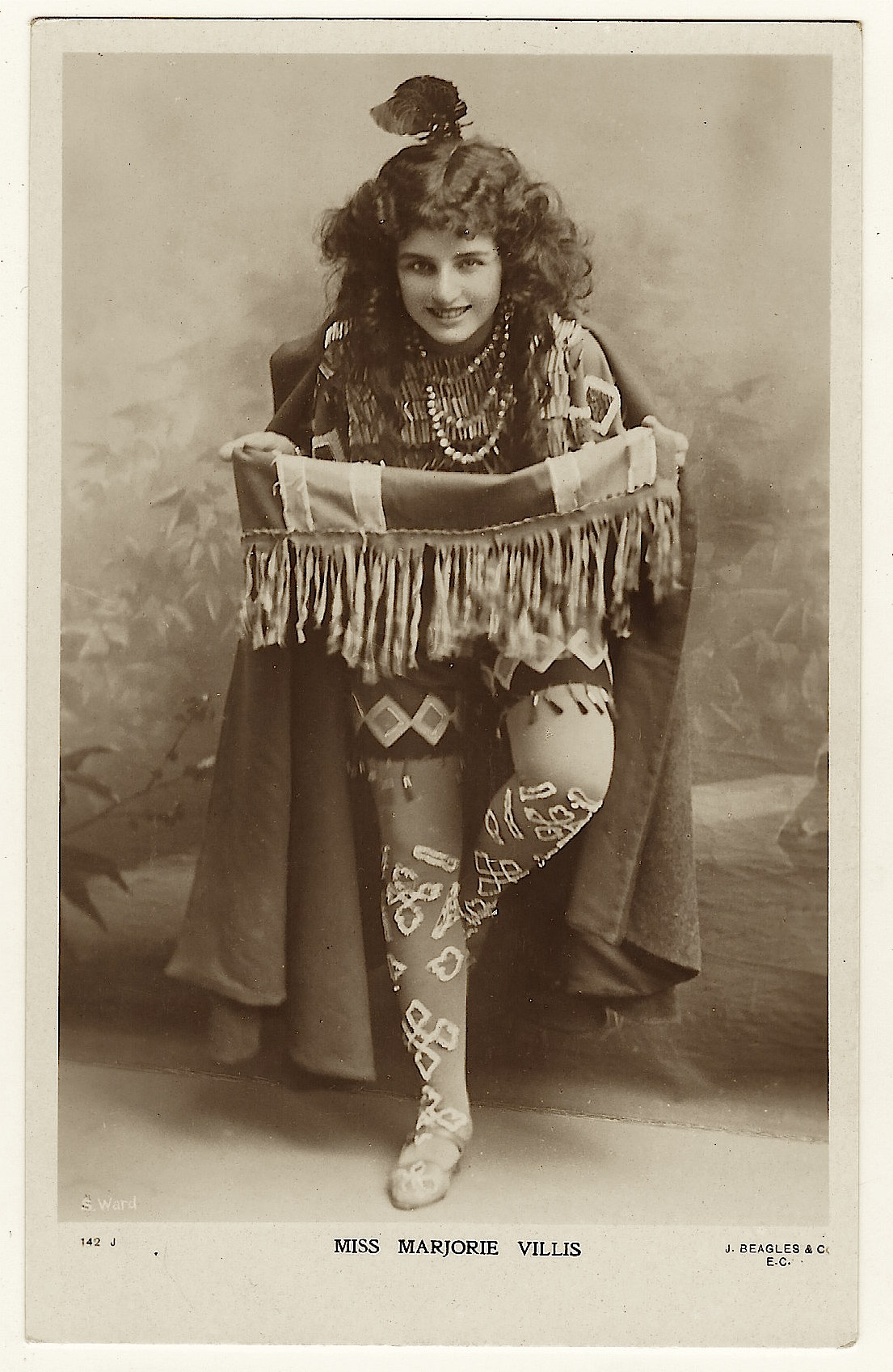
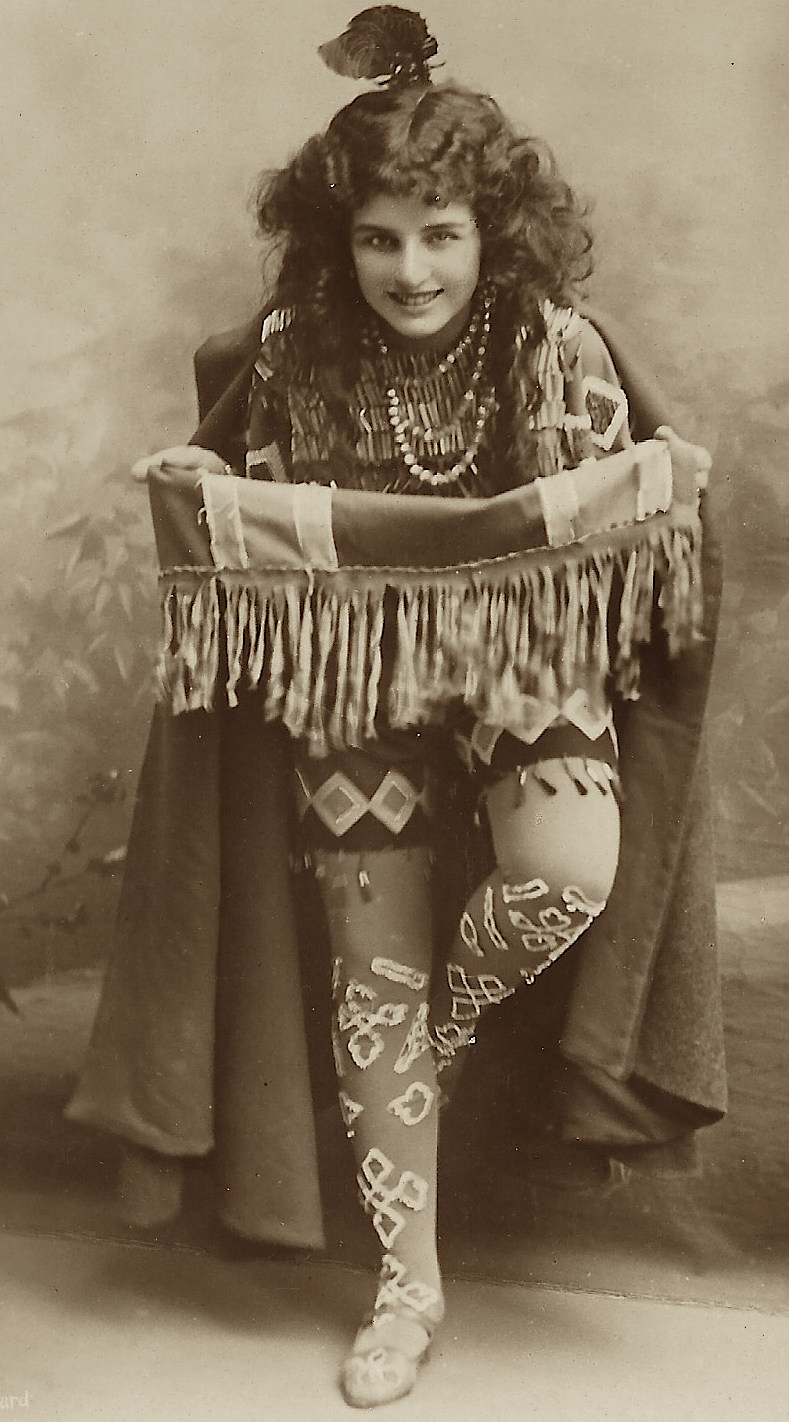 This vintage real photo postcard portrait feature British silent film actress, Marjorie Villis (1891-1981). Miss Villis is quite pretty and has a wonderful smile. This photograph captures her in a risque pose and a risque costume. What an amazing elaborate and busy costume. When I first saw this image, I immediately became motivated to find information about this provocative actress. I met little success in learning about Marjorie Villis. Photographs of her appear to be uncommon, and I could not find the postcard above anywhere online. I did learn that she sat for seven postcard portraits that can be found in the UK’s National Portrait Gallery, All of the portraits were taken by celebrated photographer, Alexander Bassano. The IMDb credits Villis with 15 film roles between 1915 and 1922. Villis was most noted for her roles in “The Rugged Path (1918), “A Romany Lass (1918)”, and “Brenda of the Barge (1920). She had a relatively short career. I wonder why her career ended so abruptly? The first talkie feature film did not get released until 1927, so we know that, unlike many other silent film stars, Villis was not shut out of the film industry because of an unsuitable voice or foreign accent. This postcard was published by J. Beagles & Company (London) as part of a series (no.142 J). The wonderful portrait of Miss Villis was taken by S. Ward. This vintage postcard is in very good condition (see scans)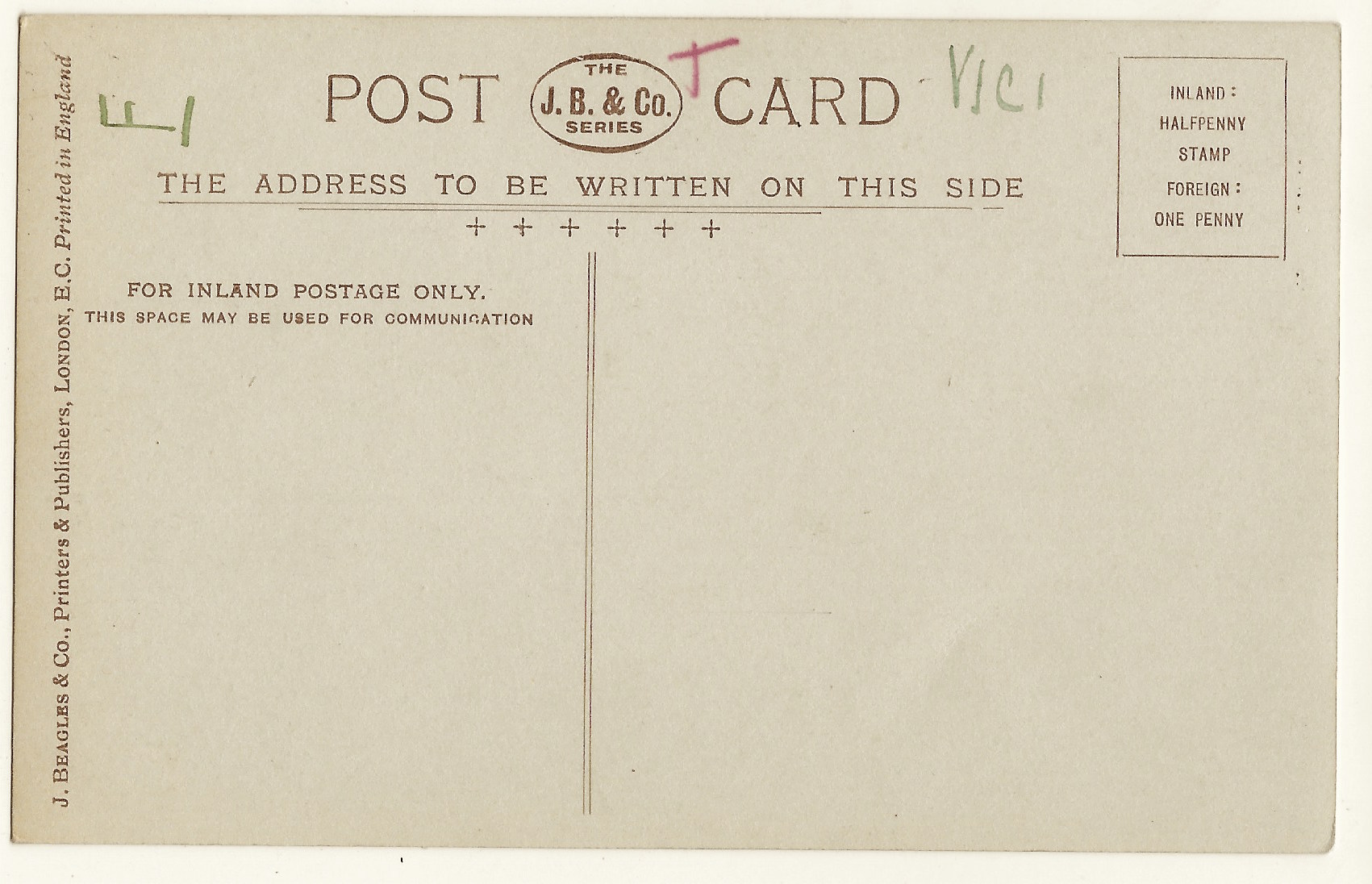


 THE CABINET CARD GALLERY