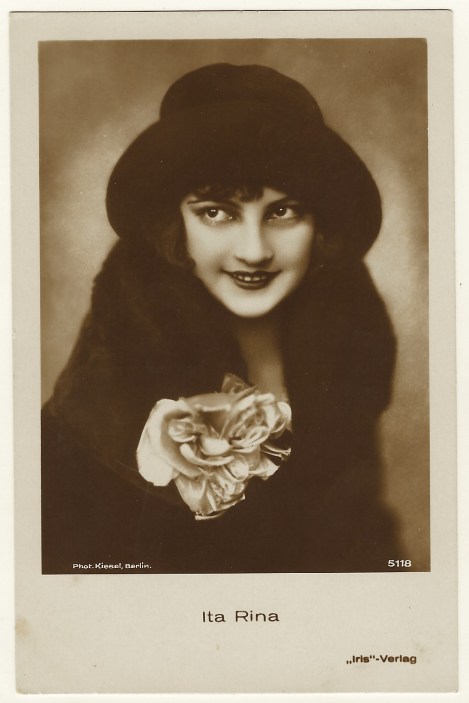
 POSTCARD 1 (SOLD)
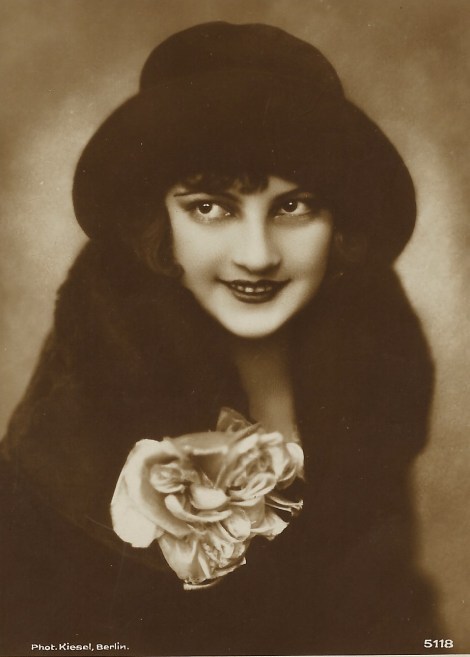 POSTCARD 1 (CLOSE-UP) (SOLD)
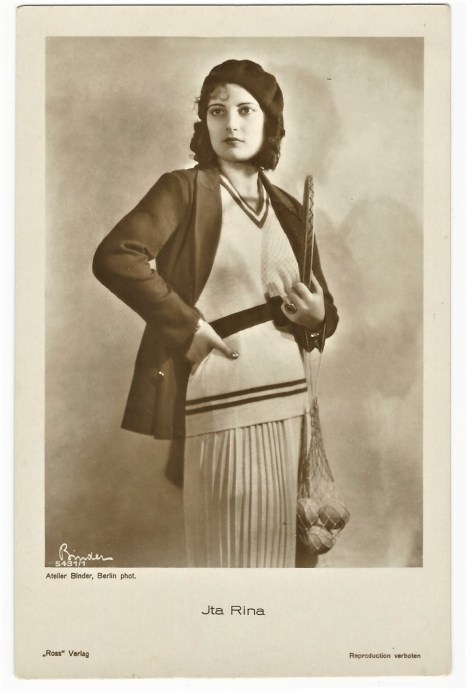 POSTCARD 2 (SOLD)
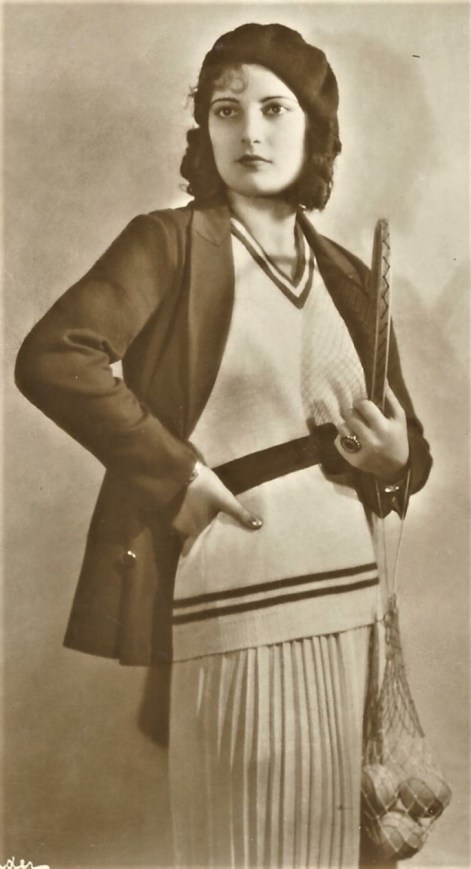 POSTCARD 2 (CLOSE-UP) (SOLD)
The pretty film actress seen in this vintage real photo postcard (postcard 1) is Ita Rina (1907-1979). Her unusual name is actually a pseudonym. Italina Lida Kravanja was her given name and it’s understandable that she used a shorter and more catchy moniker. Miss Rina was a Slovenian film actress and beauty queen. In the late 1920’s and early 1930’s she was one of the major film stars in Germany and Czechoslovakia. After getting married in 1931 she changed her name to Tamara Dordevic. Rina was a poor student as a child and knew early on that she wanted to be an actress. In 1926 she entered a beauty contest sponsored by a Slovenian magazine and Rina won. She was then slotted to compete in the next level beauty contest but she arrived late and could not participate. No worry though, she was noted by a cinema owner who sent her photograph to German film producer Peter Ostermayer who invited her to Berlin for an audition. In 1927, Rina went to Berlin without her mother’s permission. She took classes in acting and dancing. She made her debut in the film “What Do Children Hide from Their Parents” (1927). After a number of small film roles, she received some attention for her role in the film “Last Supper” (1928). Her breakthrough occurred in the film “Erotikon (Seduction)” (1929) in which she had a starring role. The film was a great success but upset some moral and Christian organizations for it’s eroticism. Some consider her best role to have been in the Czech sound film “Tonka Sibenice” (1930). Rina received an offer from Hollywood but her husband vetoed it and she decided to stay with her husband. However, she continued her film career until the beginning of World War II. Rina’s IMDB filmography asserts that she appeared in 19 films.
Postcard 1 was produced by Iris Verlag. Iris Verlag was the most important Austrian publisher of film star postcards. It operated from Vienna during the 1920’s and 1930’s. The publishing house Amag (Albrecht & Meister) is listed on the reverse of the card. The postcard is part of a series (no. 5118). The photographer was Kiesel of Berlin. (SOLD)
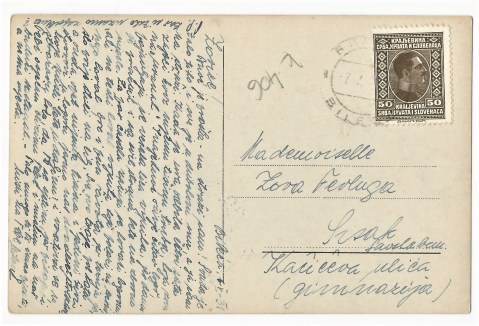
Postcard 2 features Miss Rina ready for a game of tennis. She is carrying a racquet as well as a net bag holding three tennis balls. She is truly a fashionista tennis player. Can you imagine Serena Williams or Maria Sharapova playing tennis in this attire? Postcard 2 was published by Ross Verlag and photographed by theatrical photographer Alexander Binder. Binder’s studio was located in Berlin, Germany. The postcard is part of a series (no.5431/1). The card was postmarked in 1931 and has a stamp from Yugoslavia. (SOLD)
TRIBUTE TO ITA RINA
 POSTCARD 1
 POSTCARD 2


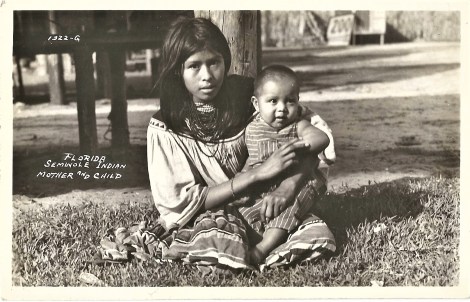
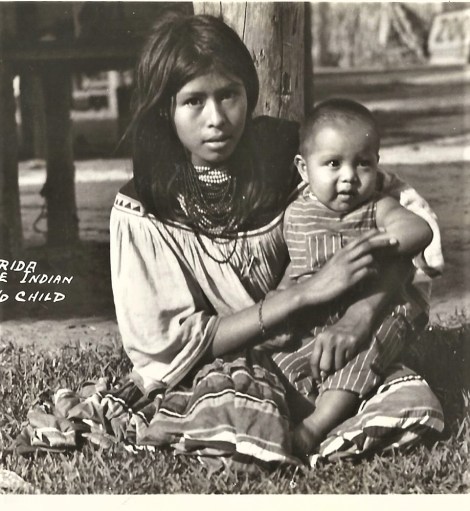 This vintage real photo postcard is striking. The photograph features a young Native American mother and her small child. The mother and her baby are members of Florida’s Seminole tribe. The mother appears quite young. My guess is that she is about sixteen years-old. She is pretty and her child is adorable. Who are the Seminole? They are a tribe that originally lived in Florida. In present times, the majority of the Seminoles live in Oklahoma. The EKC stamp box on the reverse of this photo postcard indicates it was published sometime between 1930 and 1950. The postcard is in good condition. There is a tiny pinhole located at the center bottom of the card. It is undetectable in the scans. It is only apparent if the postcard is held up to a bright light. (see scans).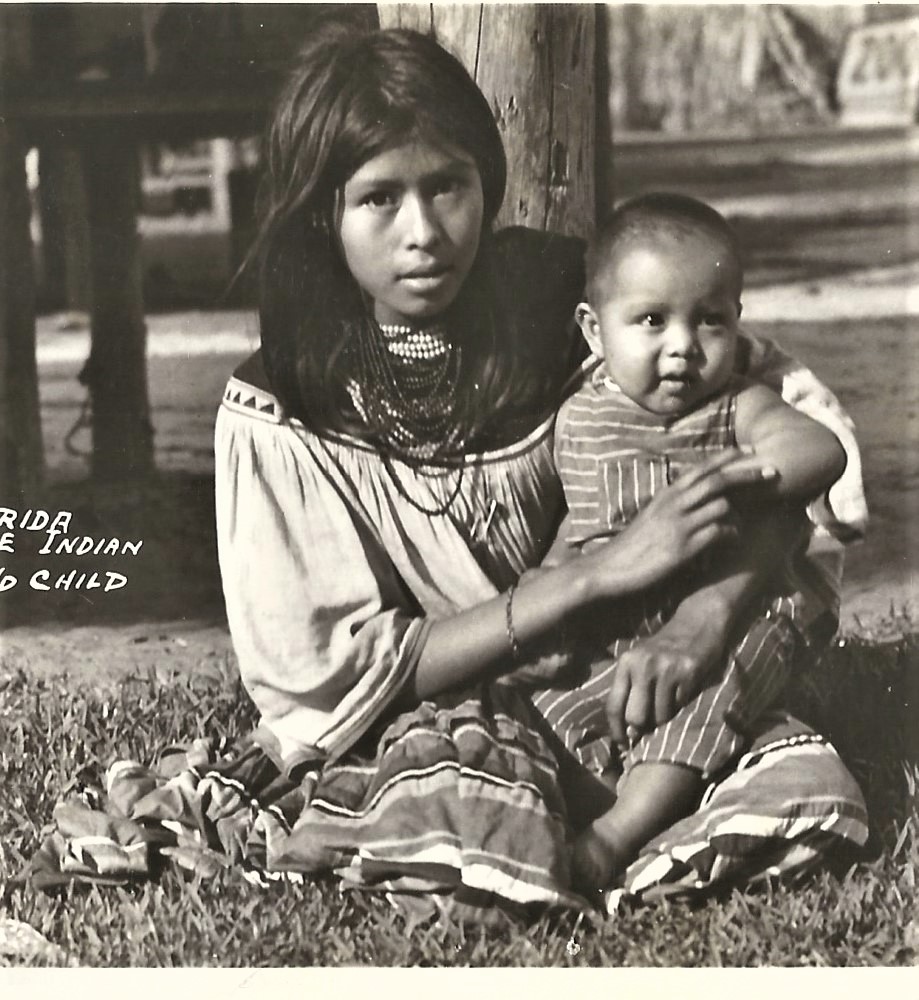

 This vintage real photo postcard features American stage and film actress, Mayo Methot (1904-1951). Until encountering this postcard, I had never heard of Miss Methot. However, a Hollywood historian would easily recognize her name. The exact reason for her name recognition will become apparent in just a bit. Methot’s acting career spanned between 1909 and 1940. She was married three times and divorced three times. Her third husband was actor Humphrey Bogart. Their seven year marriage, beginning in 1938, is one of the reasons she is known by Hollywood aficionados. Their marriage was turbulent. The press reported many of their violent fights. The press called them the “Battling Bogarts”. Methot struggled with alcoholism and was diagnosed as a paranoid schizophrenic after she attempted suicide in 1943. Methot appeared in over 30 films, as well as many Broadway productions. The IBDb credits her with 11 appearances in Broadway shows. She was raised in Portland, Oregon, where she began her theater career at the age of 5. She was a prolific child actress and continued to perform in Portland through the 1910’s and 1920’s. In 1922 she moved to New York to pursue a career in Broadway theater. After starring in more than ten Broadway shows, she relocated to Los Angeles in 1930. She emigrated to the west coast to begin a film career. She was signed by Warner Brothers and appeared in a variety of supporting roles. She often portrayed hard edged women. The IMDb credits Methot with 28 film appearances between 1930 and 1940. After divorcing Bogart, Methot’s film career stalled and she returned to Portland. Her drinking and depression worsened and she died there from complications from alcoholism. This card was published by Societe Industrielle de Photograpie (SIP) of Rueil, France. It is part of the 77 series (no.5). Methot’s photograph was taken by celebrity photographer Jacob Schloss (1856-1938) in his Manhattan studio. Schloss received his education at the Cooper Union in New York City. He graduated in 1872 as an etcher. He joined Benjamin J. Falk’s photography studio and worked there in the mid 1870’s. He left Falk’s employ to open his own studio (54 West 23rd Street) where like Falk, he specialized in theatrical photography. He tended to favor photographing actresses in costume in front of generic studio furnishings. He produced many cabinet card photographs but also was active in the production of magazine images. By the 1890’s he was particularly known for his photographs of beautiful women, much like photographer Jose Maria Mora. Schloss also was an activist for photographers rights. He was very involved in the movement to copyright images. He sued those who used his photographs without crediting or paying him. He was very involved in national photographer associations and was an active photographer until the 1910’s. This postcard formerly resided in a postcard album. SOLD
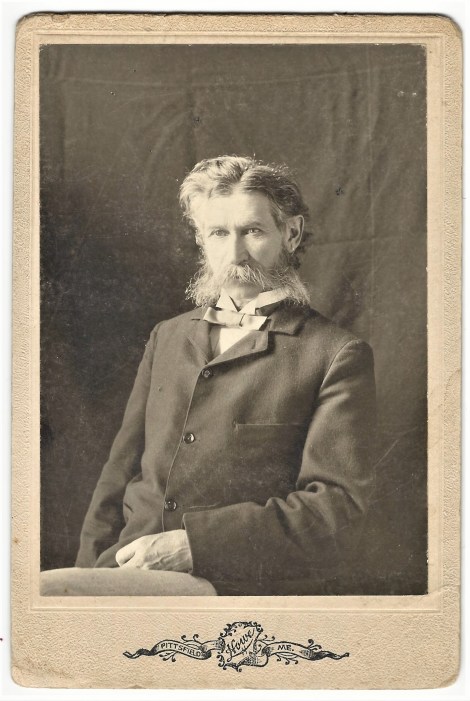
 This cabinet card portrait features a well dressed gentleman with an extremely bushy mustache. In addition, his hair is longer than most men of his era. This photograph was produced by the Howe studio in Pittsfield, Maine. W. H. Howe is listed as a photographer in the Pittsfield Register (1904). SOLD
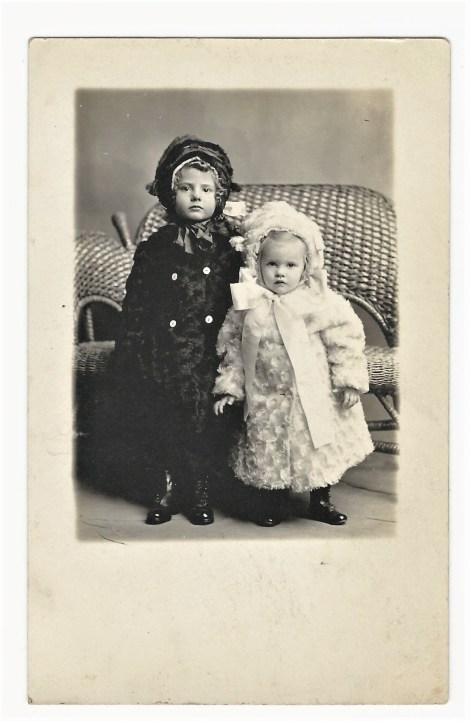
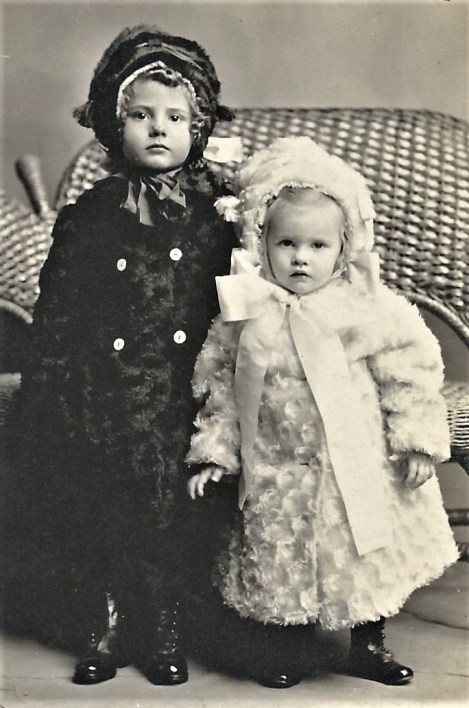 This vintage real photo postcard features two adorable sisters wearing fancy winter clothing. These kids are an illustration of what it means to be “bundled up”. Note the children’s boots and hats. The youngest child is wearing a scarf that gives the appearance of a big ribbon. The ribbon makes her look like a wrapped Christmas gift. This postcard has an Artura stamp box which indicates that the card was published sometime between 1908 and 1924. (SOLD)
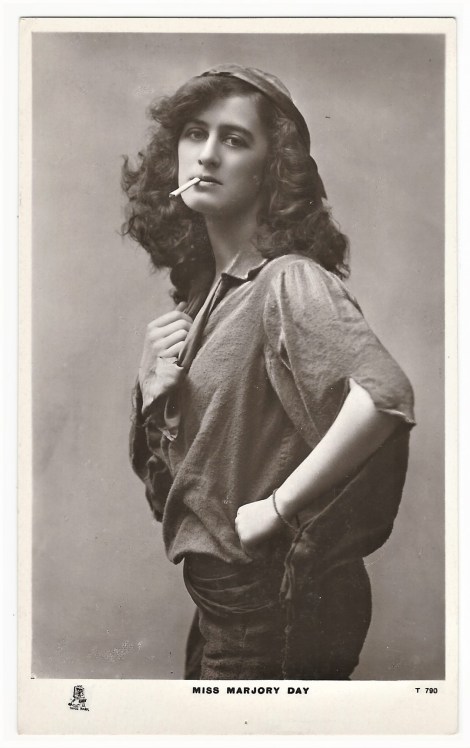 This vintage real photo postcard features actress Marjory Day (1887-1940). She was born in New Zealand. She was an actress and was known for “The Woman Who Was Nothing” (1917), “The Life of Lord Byron” (1922), and “The Fighting Marine” (1926). Miss Day was married and divorced from producer/actor George Desmond (1881-1969). The National Portrait Gallery has 15 portraits of Miss Day in their collection. This postcard captures Day exhibiting socially inappropriate behavior. Day’s deviant behavior is the fact that she is smoking a cigarette. She also seems to be wearing pants which is also a violation that could get her in trouble with the fashion police. To top things off, she is rebelliously staring at the photographer as this photo was taken. At first, I thought that Marjory Day was one of those “bad girls” of the theatre (there were also “bad boys”). However, I later learned that this photograph was taken while Day was in costume for playwright George Bernard Shaw’s “Devil’s Disciple” (1897). This postcard was published by Rafael Tuck as part of the “Celebrities of the Stage” series (no. T 790).

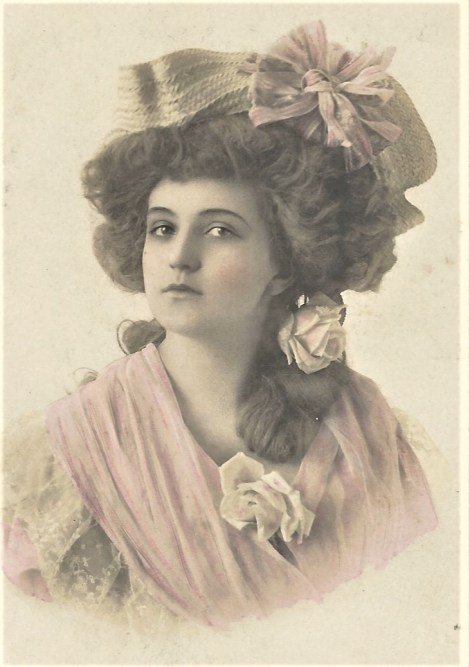 This vintage postcard features a portrait of a beautiful young woman. She is very well dressed and wearing a flower in her hair as well as on her collar. Note her fancy hat. The postcard is color tinted. This postcard was published by EPR as part of a series (no.327). The card has a French stamp and is dated 1911. The message on the postcard is roughly sending “our best regards. (SOLD)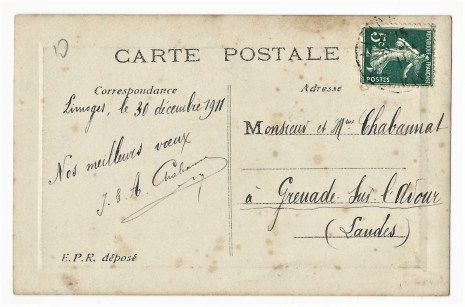


 THE CABINET CARD GALLERY