This cabinet card features stage and film actress Mabel Trunnell (1879-1981). The reverse of the photograph is inscribed “Yours Truly, Mabel Trunnell 1898”. Therefore, this image captures Miss Trunnell at about age nineteen. Mabel Trunnell was born in Dwight, Illinois. She began her career as an actress of the stage but at age thirty-two she began to appear in films. In 1911 she appeared in “A Modern Cinderella, In the Days of Chivalry” and in “The Star Spangled Banner”. Her last film was in 1923 when she was in the movie “The Love Trap”. Her filmography on IMDb indicates that she acted in 199 different films. At the age of forty-four she returned to the stage. She was married to Herbert Prior, an early British film star. Trunnell was one of Hollywood’s first movie stars as was identified with Edison Studios. A magazine article in “The Moving Picture World” (1915) reviews one of her performance. The reviewer wrote “Mabel Trunnell becomes more attractive as the course of time silvers her hair”. An interesting sociological comment was also made by the reviewer which was in regard to the admirable strength portrayed by Trunnell’s character. The reviewer notes “most of us are tired of seeing women pictured as incurable weaklings”. The reviewer was certainly a man who was ahead of his time. This cabinet card was produced by the Barrows studio in Fort Wayne, Indiana. It appears that Miss Trunnell was photographed in a costume from one of her performances. She is dressed very much like a maid and seems a bit troubled in her pose. The photographer, Frank Rufus Barrows operated a studio in Fort Wayne between 1880 and 1900. He is considered one of the city’s most prolific photographers and had several locations while in business there. He was born in Sturgis, Michigan in 1854. He came to Fort Wayne in 1880 and partnered with Frank H. Clayton in operating a photographic studio. In about a years time he became the sole proprietor of the studio. He had many photos appear in Fort Wayne Illustrated (1897). He left Indiana for Medford, Massachusetts and operated a studio there until 1910 when he moved to Eugene, Oregon where he died in 1920.
THE MAGNIFICENT SEVEN: MEET THE MEN OF SLEEPY EYE, MINNESOTA
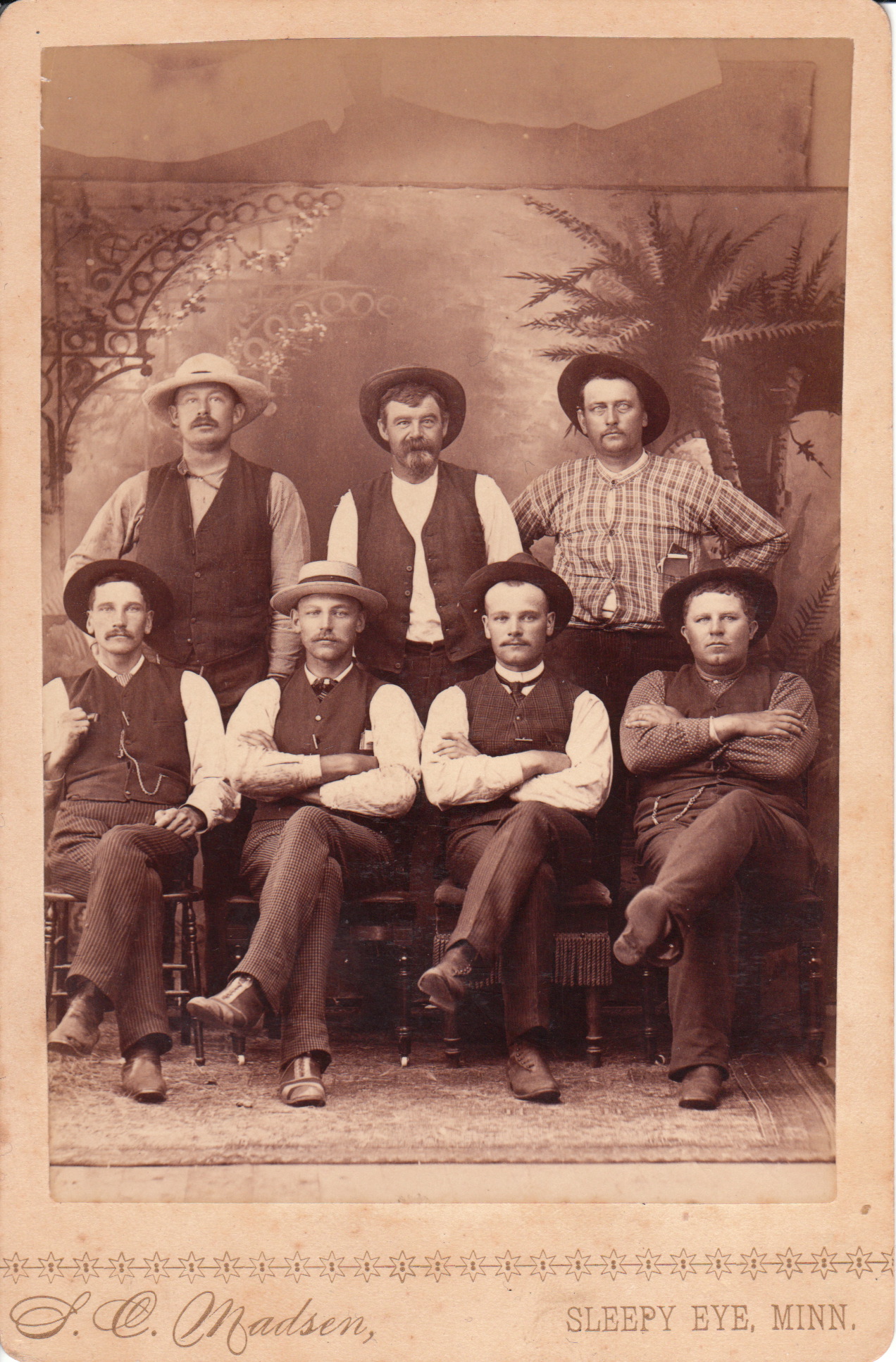
Members of the cast of the American Western movie “The Magnificent Seven” (1960) pose for a group picture in Sleepy Eye, Minnesota. These seven gunmen were hired to protect a small Mexican agricultural village from a gang of marauding bandits. The cast included Charles Bronson (back row left), Steve McQueen, Yul Brynner, James Coburn, Robert Vaughn, and Eli Wallach. Wait a minute! Even though the Charles Bronson guy really looks like Charles Bronson, how could the cast of a 1960 movie appear in a turn of the century cabinet card photograph? In addition, what would Hollywood actors be doing in Sleepy Eye, Minnesota if they are in a film where the locale is Mexico? Besides that, is there really a town called Sleepy Eye? It’s time for a confession. The men in this photograph are not members of a movie cast even though I could almost swear that the guy in the back row is Charles Bronson. In regard to the existence of a town named Sleepy Eye; yes it does exist. The town of Sleepy Eye is named after Chief Sleepy Eye, or Ishtakhaba. He was a chief of the Sioux tribe and happened to have droopy eye lids. He was one of four Sioux Indians to meet President James Monroe in 1824 in Washington D.C.. This image was produced by Sleepy Eye photographer S. C. Madsen who also had a studio in New Ulm, Minnesota. He operated in Sleepy Eye between 1884 and 1892 and had a studio in New Ulm in 1888. Since this cabinet card advertises the New Ulm studio on the reverse of the photograph, this photograph was likely taken in 1888. Who are the men in the picture? Unfortunately, they are not identified. They appear to be businessmen from town but that of course is just a guess (two of the men have papers in their shirt pocket). Three of the men in the bottom row have their arms crossed resting on their abdomen. The fourth gentleman apparently didn’t get the message from the photographer who posed them. The man on the far right of the top row must have just finished the all you can eat buffet at the Silver Dollar Saloon judging by the tightness of his shirt.
MISS LILLIAN RAYMOND: PRETTY STAGE ACTRESS WHOSE LIFE WAS CUT SHORT BY TUBERCULOSIS
On July 17th, 1911, the New York Times printed the following obituary, reporting from Louisville, Kentucky. “Lillian Dolfinger, known to the theatrical world as Lillian Raymond, who appeared in “The Girl of the Golden West’, and several other New York productions, died today at the home of her father here from tuberculosis. She was 25 years old. Miss Raymond was to appear in one of the New York productions this Fall, but became ill”. Investigation revealed that Miss Raymond appeared on Broadway on three occassions. She appeared in “Wonderland” (1905), “About Town” (1906), and “The Girl Behind the Counter” (1907). All three shows were musicals. No other information about Miss Raymond could be found during preliminary research. The photographer of this image is C. J. Horner who described himself through his advertising as a “European Photographer. His studio was located at 11 Winter Street in Boston, Massachusetts. It is tragic that Lillian Raymond’s stage career and life was cut short by illness. We will never know to what heights this pretty young actress may have climbed in the theatrical world. The photographer of this image rose to lofty heights in his profession. Swedish born Carl Joseph Horner (1864-1926) was probably the best sports photographer of his era. He was particularly known for his baseball photographs, many of which appeared on tobacco company issued baseball cards. Among the players he photographed were Cy Young and Tris Speaker. His panoramic portrait of the 1912 “Red Sox Champions” is well known among collectors.
LOVELY COUPLE IN EVANSVILLE, INDIANA (GEORGE AND ANNA SCHMIDT)
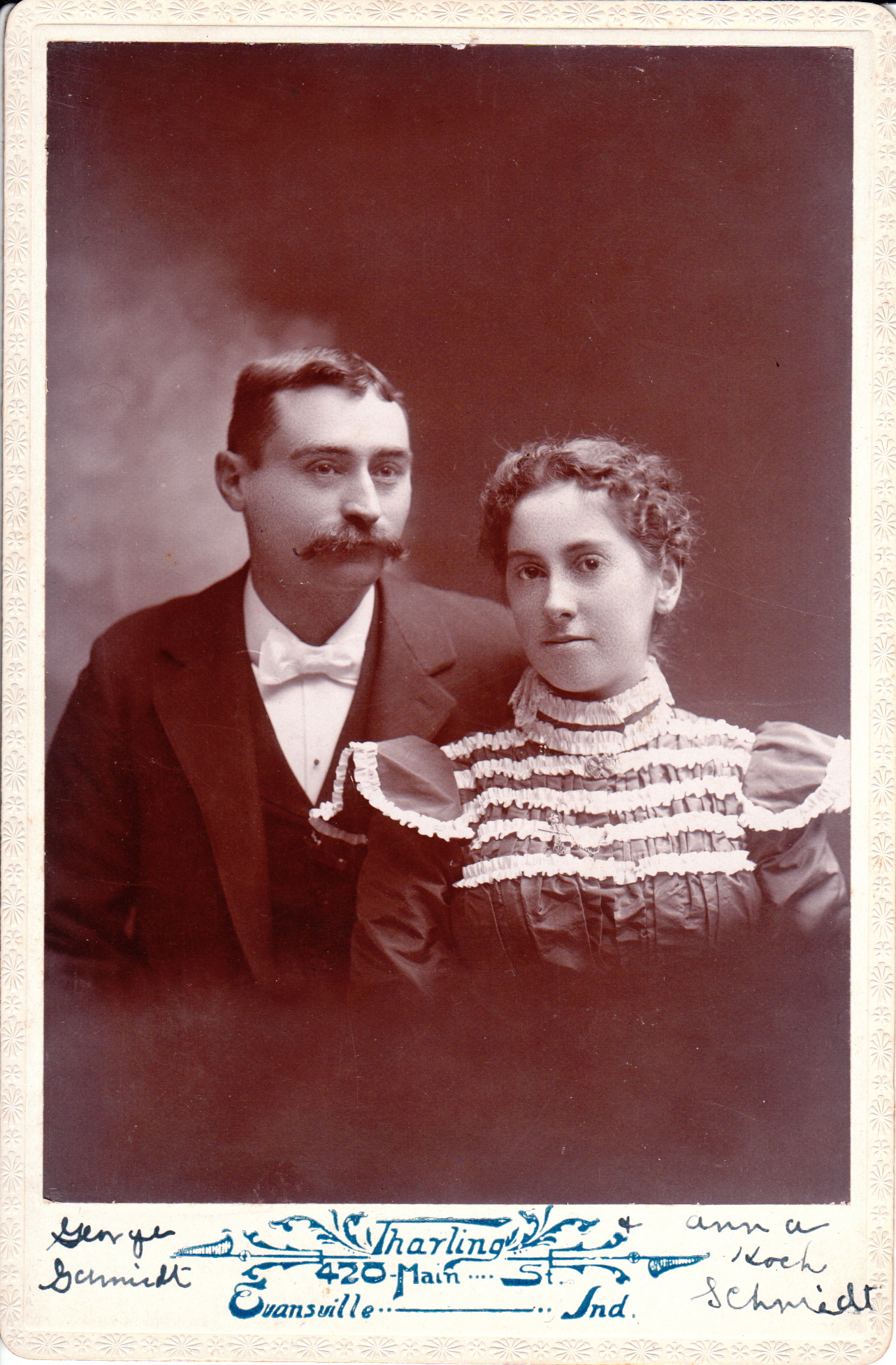
A lovely formally dressed couple is featured in this cabinet card portrait by the John W. Tharling in Evansville, Indiana. The man and woman are identified as George Schmidt and Anna Hoch Schmidt. The 1900 census reveals that George and Anna were married in 1897. They made their home in Pigeon, Indiana. George worked as a stocker at the gas works. George was born in 1878 and was educated through the eighth grade. Anna was born in 1872. Both were natives of Indiana and were of German heritage. The 1910 US census finds the couple living in Knight, Indiana and George working as a farmer. The couple had two children, Hubert (age 9) and Idella (age 4). The couple also had a nineteen year-old live-in housekeeper. As a side note, Knight, Indiana was named in anticipation of the University of Indiana’s basketball program having great success under the leadership of coach Bobby Knight. He coached the Indiana Hoosiers between 1971 and 2000 and led the team to three NCAA championships. Sorry. I couldn’t resist telling the mythical origin of the naming of Knight, Indiana. The 1920 census discloses that the couple had added a third child, Miranda (age 3). They were living in Evansville. By the time the 1940 census was taken, Anna had died and George was living in Knight with his daughter Miranda (Grennan) and her family.
LADY LIBERTY AND HER TWO APATHETIC CHILDREN
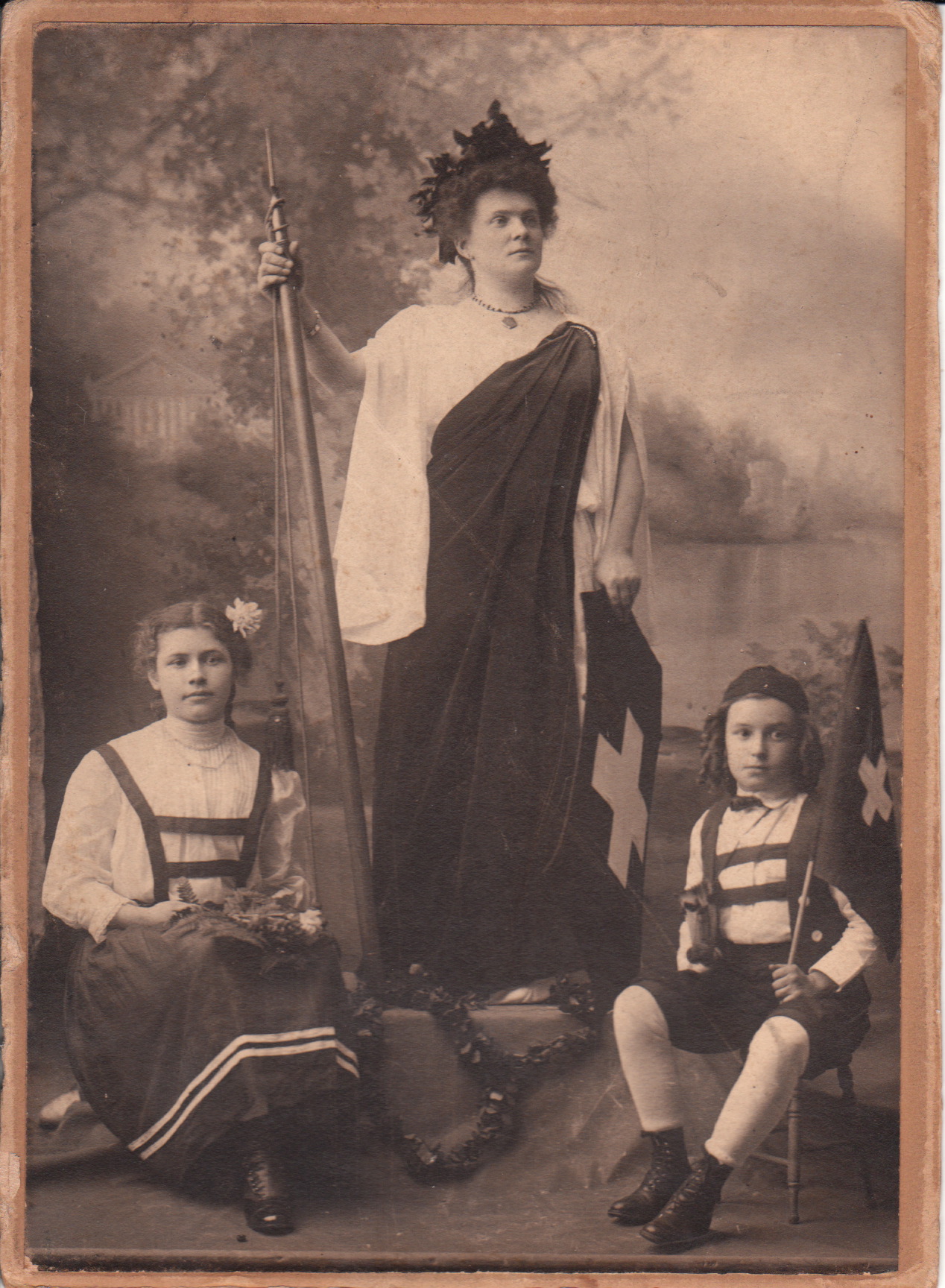
This photograph presents an interesting mystery. What exactly is going on in this image? It appears that this is a photograph of a theatrical presentation or possibly a costumed mother and her costumed children having fun and posing at a photographic gallery. Their clothing appears to be European. The mother is dressed in some sort of patriotic costume. She is holding a black flag with a white cross and a pole that may be a flag staff. The young boy is holding an identical flag to his mother. What is the origin of this flag? Some assistance from an informed cabinet card gallery visitor to answer this question would be greatly appreciated. A similar flag to the pictured flag is Saint Piran’s Flag. Saint Piran’s Flag is the flag of Cornwall. The people of Cornwall used the flag as a symbol of identity. Saint Piran is supposed to have created the flag from seeing the molten tin spilling out of the black ore in his fire. It is a white cross on a black background but the cross part covers the whole flag rather than float in the background like the crosses on the flags in this image. The woman in this image looks rather intense while the children appear uninterested. The subjects of this photograph are unidentified as is the photographer. The photograph has been trimmed to fit into a frame or album and it is likely that the name of the photographer and studio were removed in the process.
THEATRE ACTRESS: LIZZIE WEBSTER AT THE BEACH
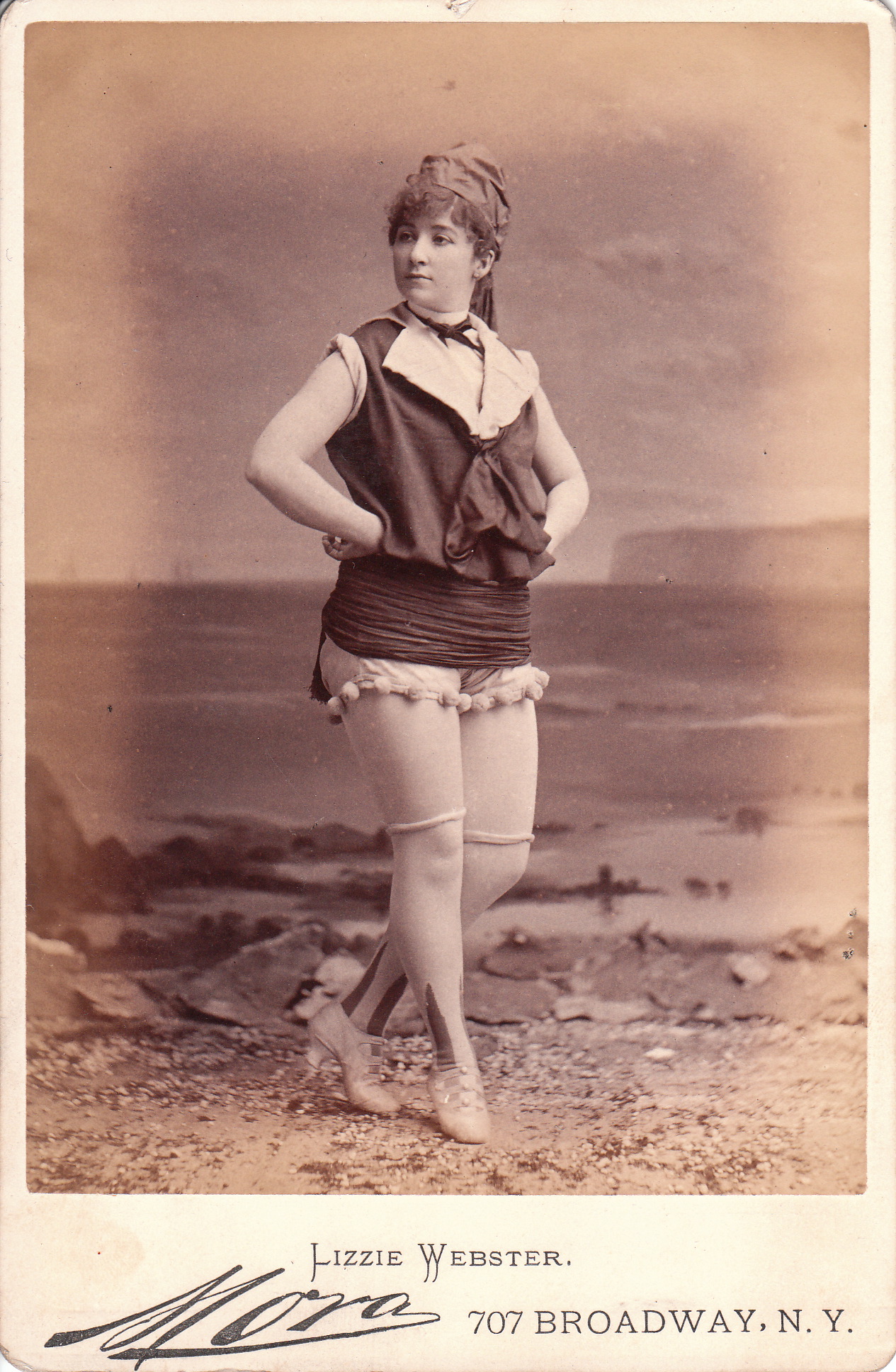
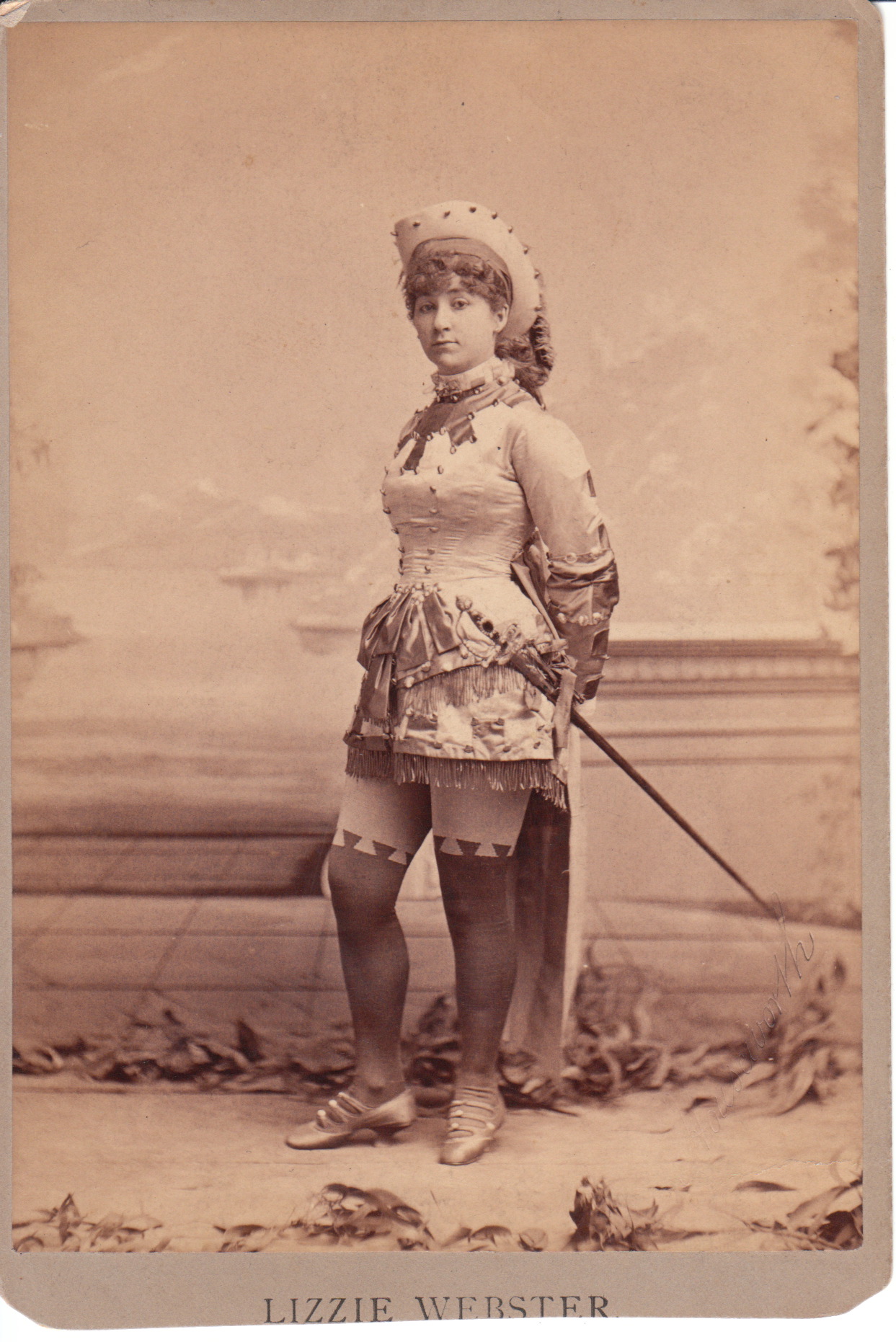
The top cabinet card features theatre actress Lizzie Webster posing at the beach. OK; its not the beach, but it is a fake beach, at the studio of celebrity photographer, Mora, in New York City, New York. Webster appeared on the American stage in the late 1870’s and early 1880’s. She appeared on tour in Edward Rice’s popular show, “Evangeline”. The Brooklyn Daily Eagle (1878) described Miss Webster as a “shapely brunette”, and a “beautiful being”. However, the article states that she did not possess a good voice. In 1893, Lizzie Webster died in Milwaukee, Wisconsin. To see other photographs by Mora, click on Cabinet Card Gallery’s category “Photographer: Mora”.
The second cabinet card features Miss Webster in costume, complete with a sword at her side. This image as well as the top image demonstrates that Lizzie Webster was not too modest to exhibit her legs. Both photographs are a bit risque because of this immodesty. The photographer of this image is unknown because the photograph has been trimmed and the reverse of the photo card has a large sticker covering much of the cards back. The sticker identifies the photograph as the property of Culver Pictures of New York City. The firm owned the rights to the image and would allow the media to use the image, if they paid for the privilege.
NINE GUYS DRESSED TO THE NINES
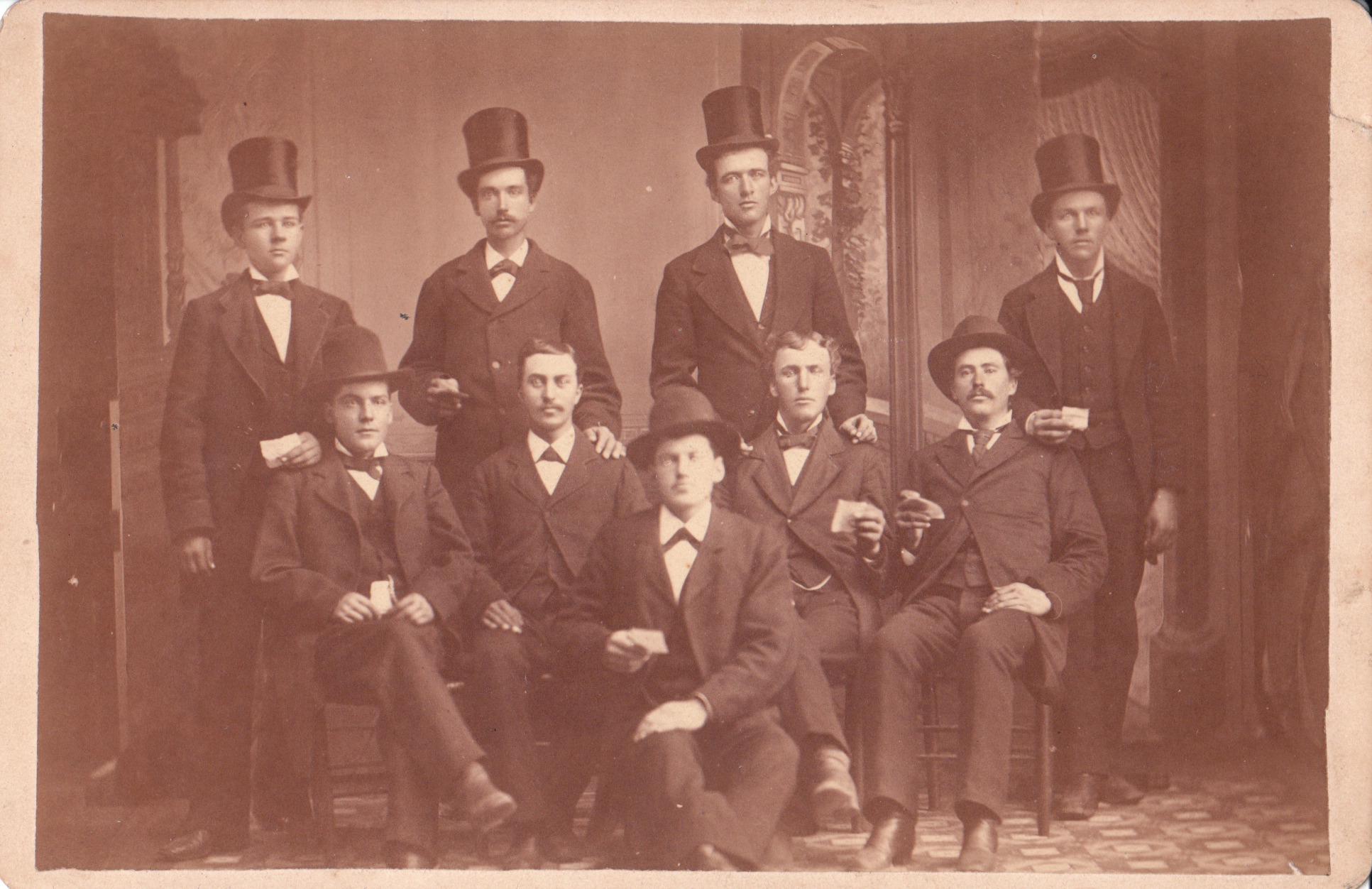
This photograph features nine men “dressed to the nines”. What does “dressed to the nines” mean and where does the term derive from? It basically means that these guys are fashionably and elaborately dressed. Research reveals that the derivation of the phrase “dressed to the nines” is unknown. There are a lot of theories but no real evidence to support a single theory. So who are these guys and what group do they represent? We run into another wall in an attempt to answer these questions. The men in this image are unidentified and the photographer is unknown. This photograph is one of those images that is similar to a psychological projective test. We have to make up our own story to better understand the photograph. The story we create is a reflection of our experiences and personality. The story I tell myself is that these men are part of a club or organization. They are dressed formally for some sort of special organizational event. The papers that they are holding are possibly certificates for some type of accomplishment, ballots, or invitations. What’s the story you tell yourself about this image? You are invited to leave a comment with your impressions
PORTRAIT OF A PRETTY UNIDENTIFIED ACTRESS IN NEW YORK CITY
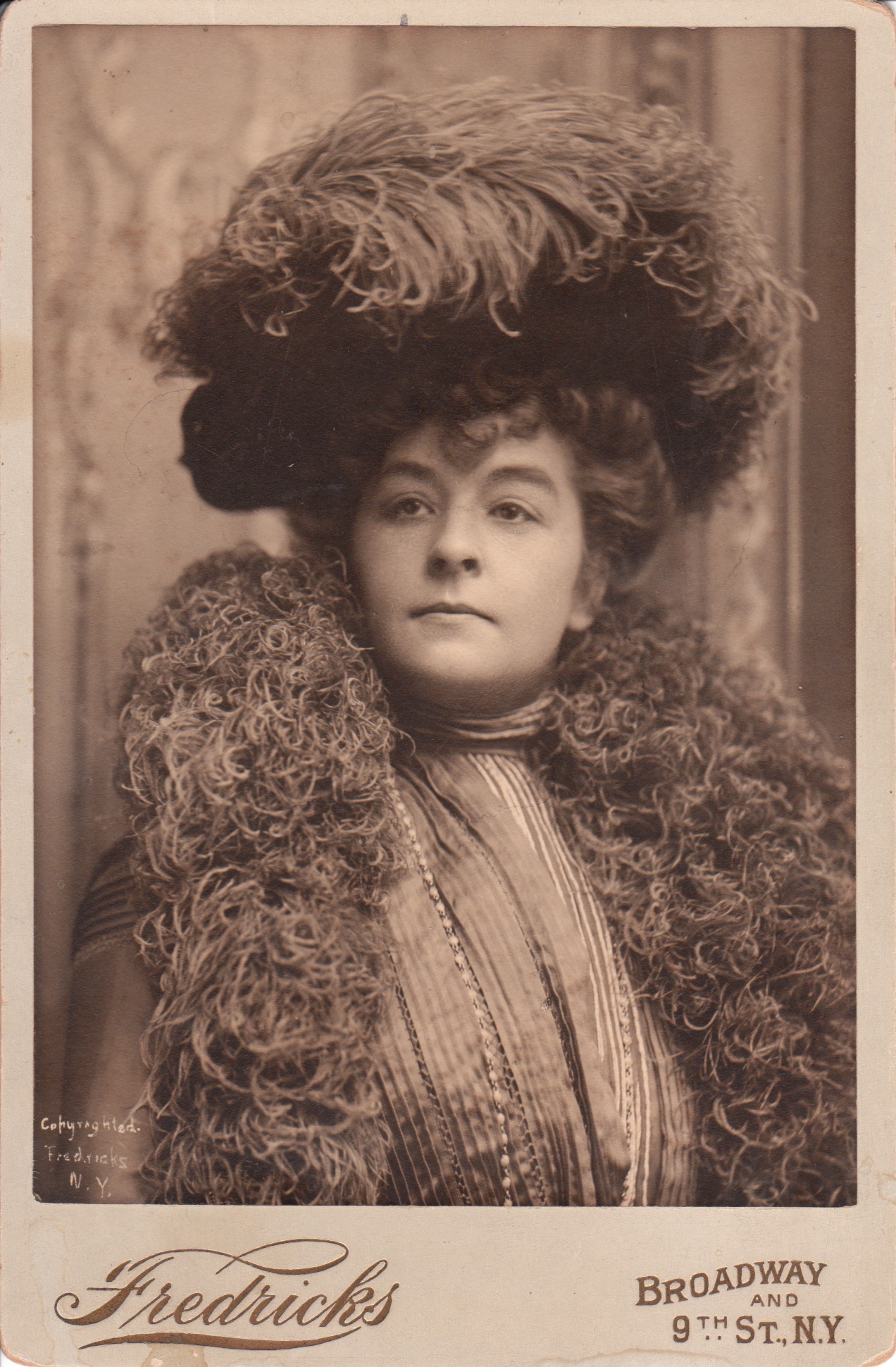
This portrait features an attractive unidentified actress. This woman seems to love texture. Note the fabrics she is wearing. She has a wonderful feathered hat and a shaggy stole. At least I think its a stole but I am uncertain and welcome intervention from a cabinet card gallery visitor knowledgeable about woman’s fashion. The woman looks quite handsome in her high collar dress and lovely accessories. The photograph was taken at Fredricks Knickerbocker Family Portrait Gallery in New York City (770 Broadway). To learn more about Mr. Fredricks and to view more of his images, click on the category “Photographer: Fredricks”.
MERCHANT SHIP CAPTAIN IN NEW BEDFORD, MASSACHUSETTS
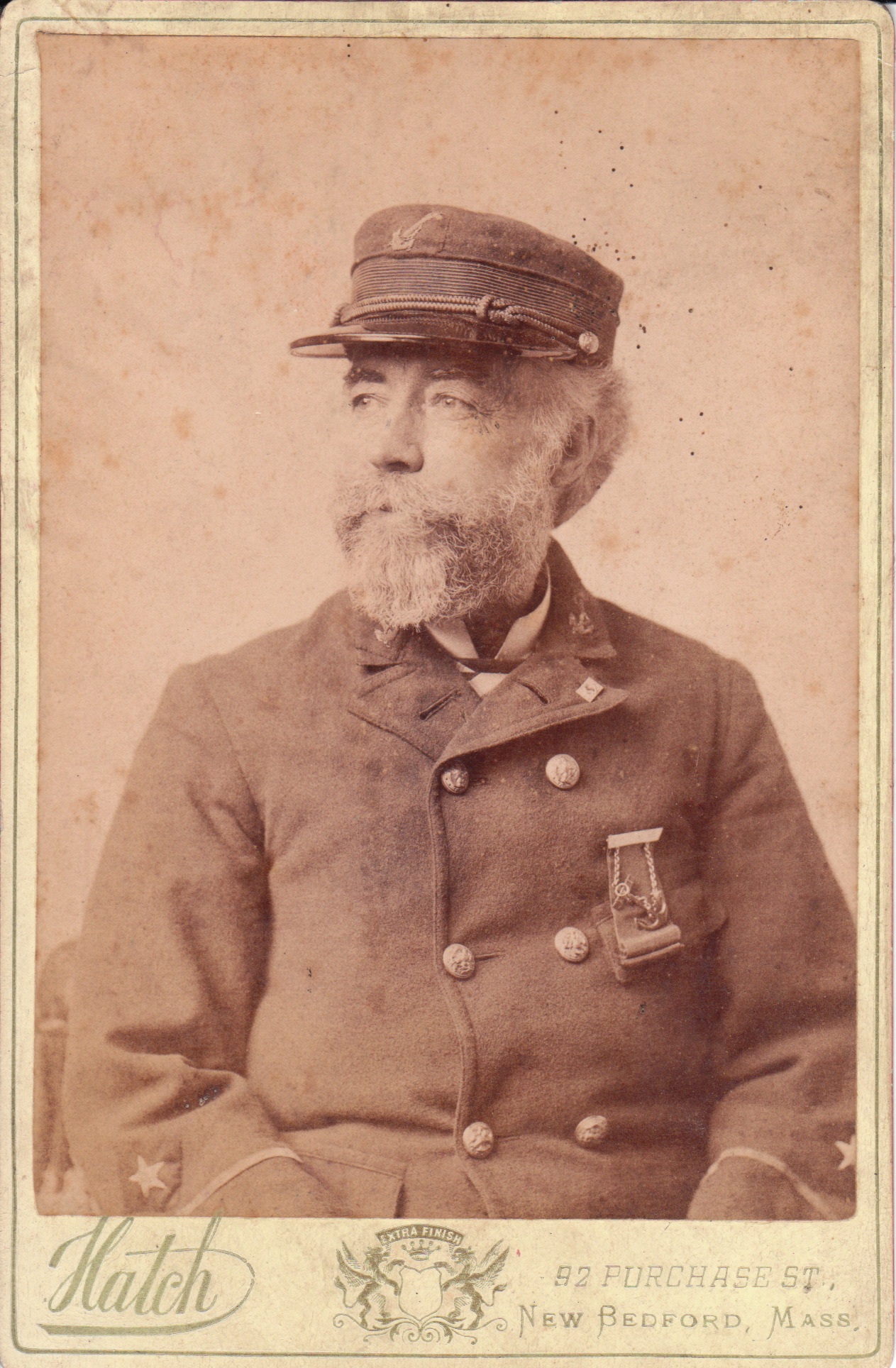
The salty gentleman featured in this cabinet card photograph appears to be a uniformed US merchant ship captain. The seaman is wearing a badge depicting an anchor on his chest. He also has stars on his sleeves and is wearing lapel pins. H. F. Hatch of New Bedford, Massachusetts is the photographer. An advertisement on the reverse of the image advertises that the gallery sells one dozen cabinet cards for five dollars. Such a deal! Henry F. Hatch is listed in the 1880 census. The document reports that he was born in Massachusetts in 1837. He was married to Etta Hatch and they were living together in New Bedford with their daughter Cecila (age 18). Henry was working as a photographer. Business directories from New Bedford indicate that he worked as a photographer from at least 1865 through 1895. Research uncovered an 1880’s advertising trade card for Hatch’s studio. The advertising copy on the card must have put fear in the hearts of the young mothers of New Bedford. The trade card’s copy stated that “Hatch loves to take babies”. It would be amazing if the trade card encouraged any parents to take their babies to the studio. However, it is not amazing that a New Bedford photographic studio produced a portrait of a ship captain. New Bedford is nicknamed “The Whaling City” because in the nineteenth century it was one of the most important whaling and fishing ports in the United States.
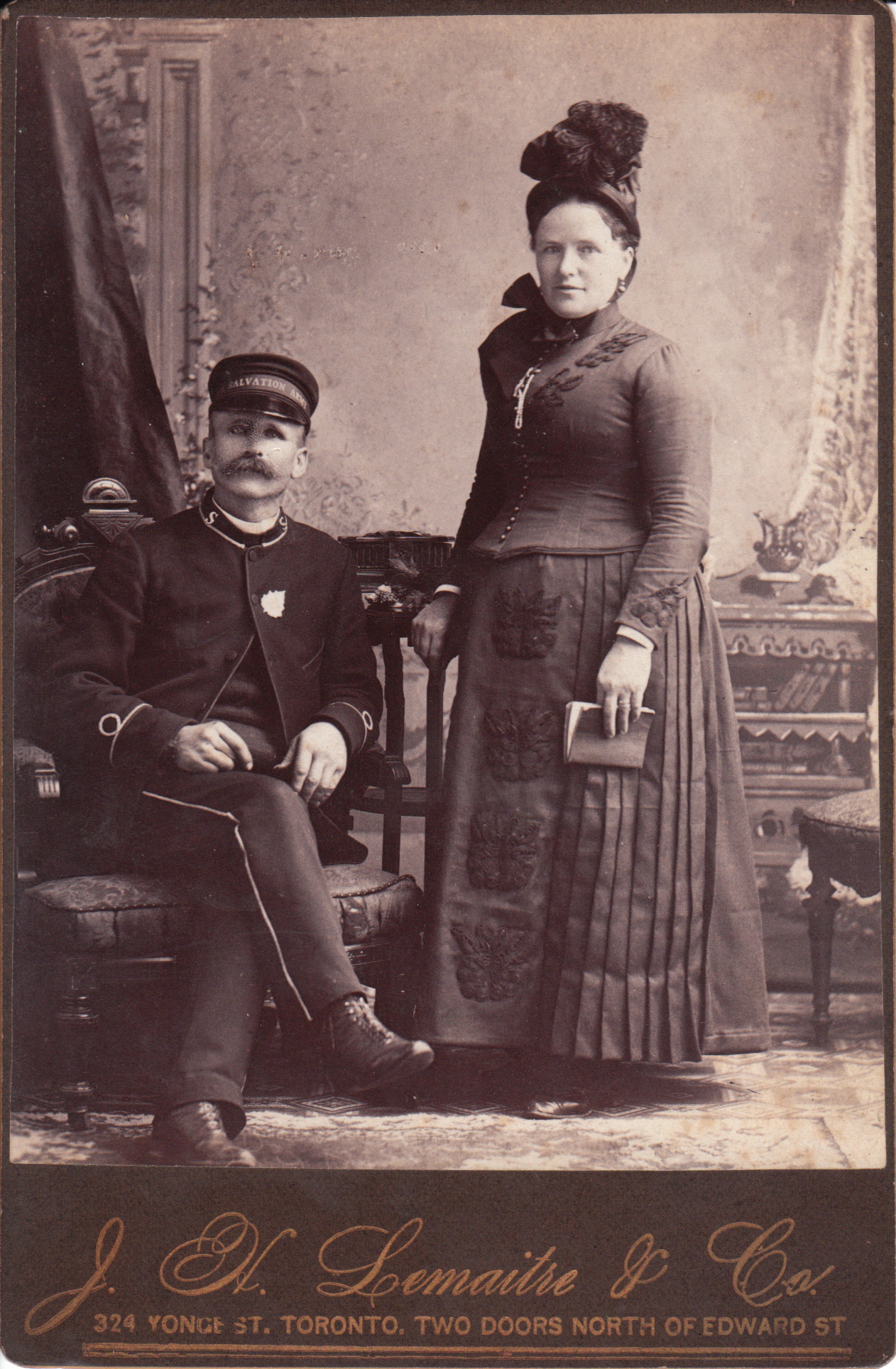
SALVATION ARMY OFFICER AND A PRAYER BOOK HOLDING WOMAN IN TORONTO, CANADA
This cabinet card photograph features a Salvation Army officer and a middle aged woman. It is not clear whether she is a Salvation Army worker because unlike the gentleman, she is not wearing an insignia of the organization. The gentleman has a “S” badge on each shoulder and a “Salvation Army” band on his hat. The woman is holding what appears to be a worn prayer book. This photograph was taken at the J. H. Lemaitre & Company studio in Toronto, Canada. The cabinet card gallery has an extensive collection of photographs of uniformed Salvation Army workers. Click on the category “Salvation Army” to view the collection.