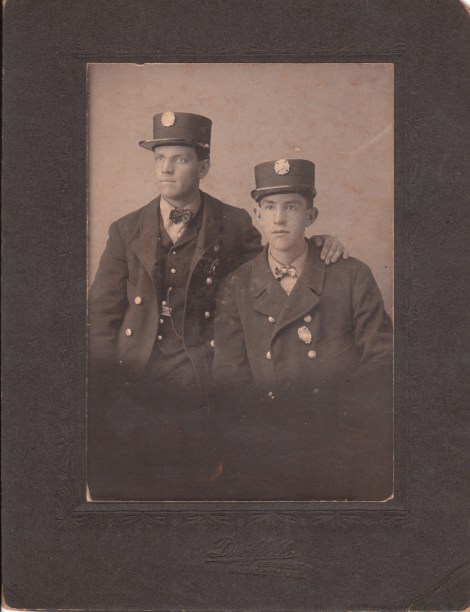
Two uniformed men strike an affectionate pose for a studio photographer in Kansas City, Missouri. Magnifying the photograph did not help definitively determine if the men were railroad conductors, firemen, police officers, or some other uniformed occupation. The photographer of this image is the Driffill studio. Mrs. Kittie Driffill operated a photography studio at 615 West 6th Street, in Kansas City. City business directories confirm that she had a studio in Kansas City between at least 1887 and 1910. According to the 1900 United States Census, Kittie worked the business with her son Edward Mack. In 1907 she worked with her husband Thomas Driffill.. Kittie Driffill also used the first name of Katherine.
SMALL BOY AND HIS BIG DOG IN NEW YORK CITY, NEW YORK.
A long haired and very well dressed young lad poses with his dog at the Rockwood studio in New York. The boy is wearing interesting leggings and a terrific hat. His dog appears to be a Burmese Mountain Dog but that is simply an uninformed guess. There is an unusual notation below the image; “Printed on N. P. S. extra brilliant albumen paper”. The photographer, George Rockwood of New York City was a noted celebrity photographer. It is possible that the boy featured in this image may have been a child actor. To learn more about the photographer, click on the category “Photographer: Rockwood”.
A BOY AND HIS DOG: BOY IDENTIFIED AS “ELDEN McFARLAND (I THINK)”
A little curly haired boy in a rufflled shirt poses at the Twasaki studio along with his large white and black spotted dog. The boy is wearing a checkered bow tie. The dog appears to be resting comfortably as it sprawls on a rug in front of his young master. The boy has a sparkle in his eyes and his foot is resting lightly on the dog’s back.The reverse of the photograph has a handwritten inscription that identifies the child as “Elden McFarland (I think)”. The writer of the inscription was unusually honest about his lack of conviction in the identification. The dog pictured in this photograph is a St. Bernard (I think). If I am wrong, someone more informed than me about dog breeds will assuredly correct me via a comment.The photographer’s name on the bottom of this image is illegible. It appears to be Twasaki or Iwasaki but research was of no value in identifying the photographer or the location of his studio. The name Elden McFarland was too common to find biographical information about the subject. Knowing the location of the studio would have facilitated finding background information concerning young Master McFarland.
A PORTRAIT OF A BOY AND A CHAIR BY MISS LIBBY IN NORWAY, MAINE (NOTED FEMALE PHOTOGRAPHER)
A young boy dressed in a double breasted jacket and wearing a tie poses for this portrait by Miss Libby of Norway, Maine. Minnie Libby (1863-1947) had a sixty year business career in Norway, Maine. She was a very able photographer and also an eccentric. She was the daughter of a Maine born blacksmith who was also a carriage maker and dealer. The 1880 census lists her at age sixteen as being an artist. She was sent to the Boston Museum of Fine Arts and developed an interest in photography. She worked as a studio photo retoucher while living in Boston. In 1882 she worked as a photo retoucher at the Anthony Crockett Picture Studio in Norway. In 1885 her father constructed a building to house her first studio. By the 1890’s Miss Libby was quite successful. In 1905 her father helped her buy a new studio which caused some controversy in the town of Norway. The seller of the building neglected to tell his tenant, a photographer, that the building was sold. The tenant photographer took ads out in the local paper denouncing the underhanded business practices of Miss Libby who ultimately occupied the building. Miss Libby’s response to the ads was to take out her own ads in which she said that she would use the advertising space to talk about her business, and not to make misleading statements about her competitors. In 1940, Life Magazine discovered Miss Libby. They did a feature on her life as a photographer, both past and present. Minnie Libby also produced oil paintings while working as a photographer. She was a talented artist and did many paintings of plants and flowers as well as landscapes. The Life Magazine article describes Miss Libby’s appearance. She most often wore knickers, men’s shirts, and a flowing bow tie. She was also described as a “first class photographer”. To view other photographs by Miss Libby, click on the category “Photographer: Libby”.
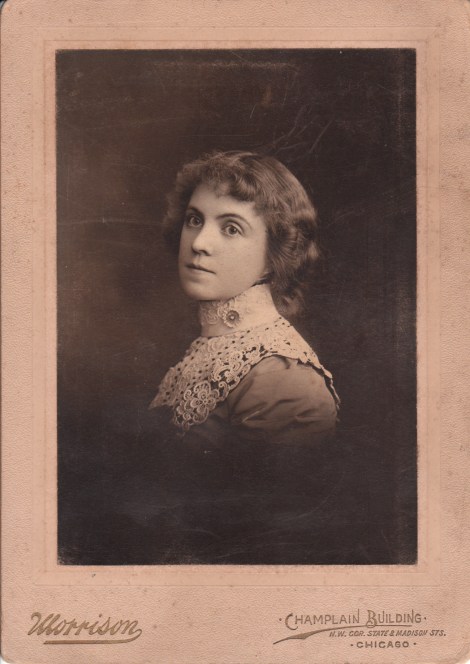
PORTRAIT OF BEAUTIFUL ACTRESS EVANGELINE IRVING (BY CELEBRITY PHOTOGRAPHER WILLIAM McKENZIE MORRISON OF CHICAGO, ILLINOIS)
The previous owner of this photograph, reported the subject to be theatrical actress Evangeline Irving. Visual comparison to other portraits of Evangeline Irving support this identification. Evangeline Irving was an theater actress and the sister of a more successful theater actress named Isabel Irving. See Isabel’s portrait by searching for it in the Cabinet Card Gallery. This photograph was produced by William McKenzie Morrison, the Chicago, Illinois, based celebrity photographer. View other Morrison photographs by clicking on category “Photographer: Morrison”. The New York Times (1895) reported that Evangeline substituted for Isabel in a matinee performance of “The Case of Rebellious Susan”. Isabel was suffering from hoarseness. A number of New York Times (1895, 1896) articles describes a banking fiasco that Evangeline Irving was able to resolve. Her mother had gone to the Lincoln Safe Deposit Company to get twenty thousand dollars worth of bonds out of her box. When she could not find the bonds in the box, she ran out of the vault screaming that she had been robbed. She went home ill, and took to bed. She complained around town and soon her Senator contacted the bank demanding she be compensated with a check replacing her loss. The situation caused many people to run to their banks to see if their safety deposit box holdings had disappeared. Mrs. Irving caused a mini run on the city banks. It took awhile for Mrs. Irving’s daughters to get involved because both of the women were performing out west. Isabel was playing roles with the Lyceum Company and Evangeline was part of Stuart Robson’s Company. Soon, Evangeline came to the bank and after opening the safe deposit box found the bonds tied up in a bundle in the box. An apology was issued to the bank and made public.
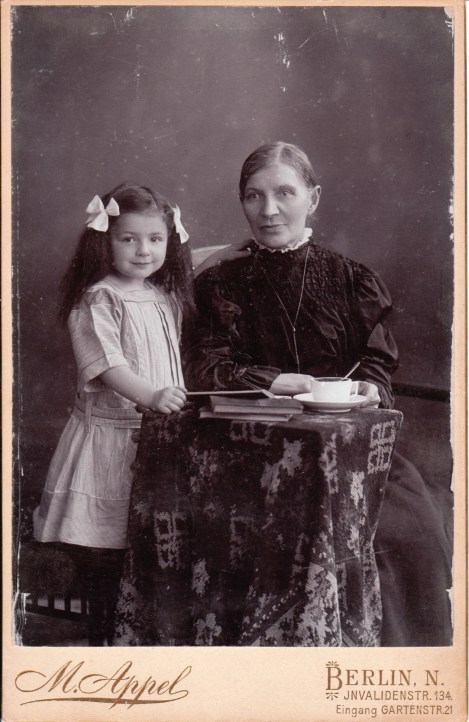
MOTHER AND YOUNG DAUGHTER ENJOYING SOME MOMENTS IN BERLIN, GERMANY
Photographer M. Appel does a masterful job in this photograph capturing a scene, albeit in a studio, that is nearly universal. This image shows a mother and daughter enjoying spending time together. Mother is reading with her adorable little girl while drinking a cup of tea or coffee. The daughter is wearing bows in her hair and a priceless expression. She affectionately rests her left arm on her mother’s shoulder. The reverse of the photograph has printing announcing that Mr. Appel had studios in three locations in Berlin, Germany.
LOVING AFRICAN AMERICAN GRANDMOTHER AND HER TWO ADORABLE GRAND DAUGHTERS
This photograph is emotionally moving and it elicits a story that we tell ourselves. Most people will likely see it as a story about a grandmother and her grandchildren. Grandma has a tight loving grasp around the waist of her youngest granddaughter while the older granddaughter clings to grandma’s shoulder for security. This is a portrait of a tight knit family. The little girls are adorable. They are wearing bows in their hair; and both girls are wearing necklaces. It is difficult to tell for sure, but grandma seems to be containing a smile. The girls however, seem a bit bewildered by their experience of being photographed. Grandma was not living in easy times. At the time of this photograph, slavery had already ended but prejudice and discrimination was prevalent. There is dearth of early photographs of African American individuals and families. This image certainly serves a role in representing African American history. Unfortunately, the photographer and subjects of this image are unidentified.
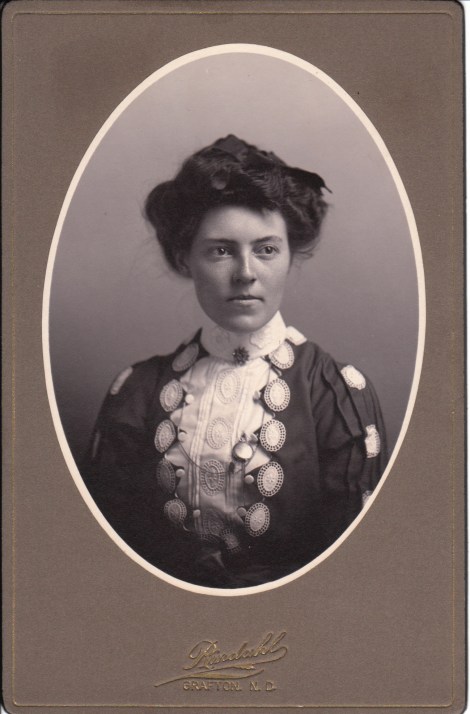
BEAUTY FROM THE PLAINS: LENA BRINGS HIGH FASHION TO GRAFTON, NORTH DAKOTA
A pretty young woman wearing an unusual dress poses for her portrait at the Rindahl studio in Grafton, North Dakota. This plains beauty is anything but plain in her dress which features giant buttons and a high collar. She is wearing a collar pin. The reverse of the photograph lists the name of this fashionable lady as “Lena Larson”. Lena B. Larson appears in the 1920 and 1930 United States census. Lena was born in 1884 and was married to Olaf Larson who was a farmer and two years her junior. In 1920 and 1930 she was living in Kensington, North Dakota. The 1930 census indicates that Lena had six children aged three to seventeen. Records indicate that she died in 1967 at the age of 83 and was buried in Park River, North Dakota. The photographer of this image is J. O. Rindahl. According to the book, “North Dakota of Today” (1919), Rindahl (1862-?) was born on a farm in Wisconsin. He had a childhood interest in painting but because of strains caused by being a member of a family of twelve, he had limited art instruction. He “drifted” into photography, a field in which he was quite successful. In 1895 he went abroad and visited a number of “renowned art galleries”. This experience caused his passion for painting to reemerge and when he returned to Grafton he used his spare time to pursue painting. The book features some of his paintings and several North Dakota churches displayed his paintings. In addition to religious paintings, he was known as a landscape painter. Rindahl had a partner in his photography business for fifteen years. Henry Ball and Rindahl occupied a studio on Main Street for at least some of those years. The St. Louis & Canadian Photographer (1902) announced that Ball sold the studio to Rindahl. The Bulletin of Photography (1922) reported that Rindahl sold the studio in Grafton, after operating it there for thirty-three years. The buyer was Arvid Rydholm of Minneapolis, Minnesota.
,
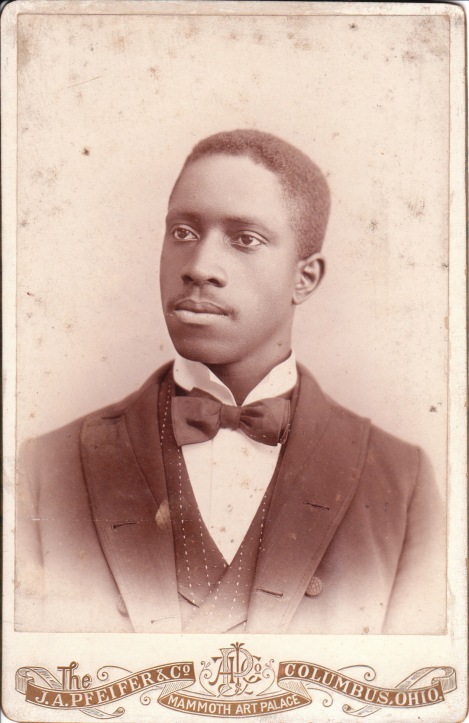
YOUNG WELL DRESSED AFRICAN AMERICAN MAN IN COLUMBUS, OHIO
A well dressed African American man poses for his portrait at the J. A. Pfeifer & Company gallery. He is wearing a dress jacket, a pin striped vest, winged collar and bow tie. This handsome young man is unidentified. The reverse of the cabinet card lists Pfeifer’s name but also the names Smith and Mulligan Brothers. Presumably these three names belong to photographers who were employed the the Pfeifer studio. The address of the gallery is also printed on the reverse of the card. The business was located at 262, 264, and 266 South High Street in Columbus, Ohio. According to the book “Artists in Ohio” (2000), the photographer of this image, John A. Pfeifer (1859-1932), was active in the Columbus area from 1882 to at least 1913. During much of that time, he was partners with George C. Urlin of the “Mammoth Art Palace” on High Street. To view images by Urlin, click on the category “Photographer: Urlin”. The Oberlin Review (1888) noted that the Urlin & Pfeifer studio won the contract to be the class of 1888’s photographer. A competitor in the bidding was the Cleveland firm of Urlin & Becker. Urlin’s participation in the bidding under two different studios, caused the students to raise some ethical questions about the bidding process. Pfeifer proved to the students that he had the legal right to use Urlin’s name and the class “was convinced of his honesty and integrity” and retained him as class photographer. In 1891 Pfeifer and George D. Saas (1854-1924) founded Pfeifer & Saas Printers. In 1905 Pfeifer became the sole owner of the firm and renamed it the Pfeifer Show Print Company.