PENSIVE AND PRETTY GIRL WITH LONG HAIR IN LINCOLN, NEBRASKA

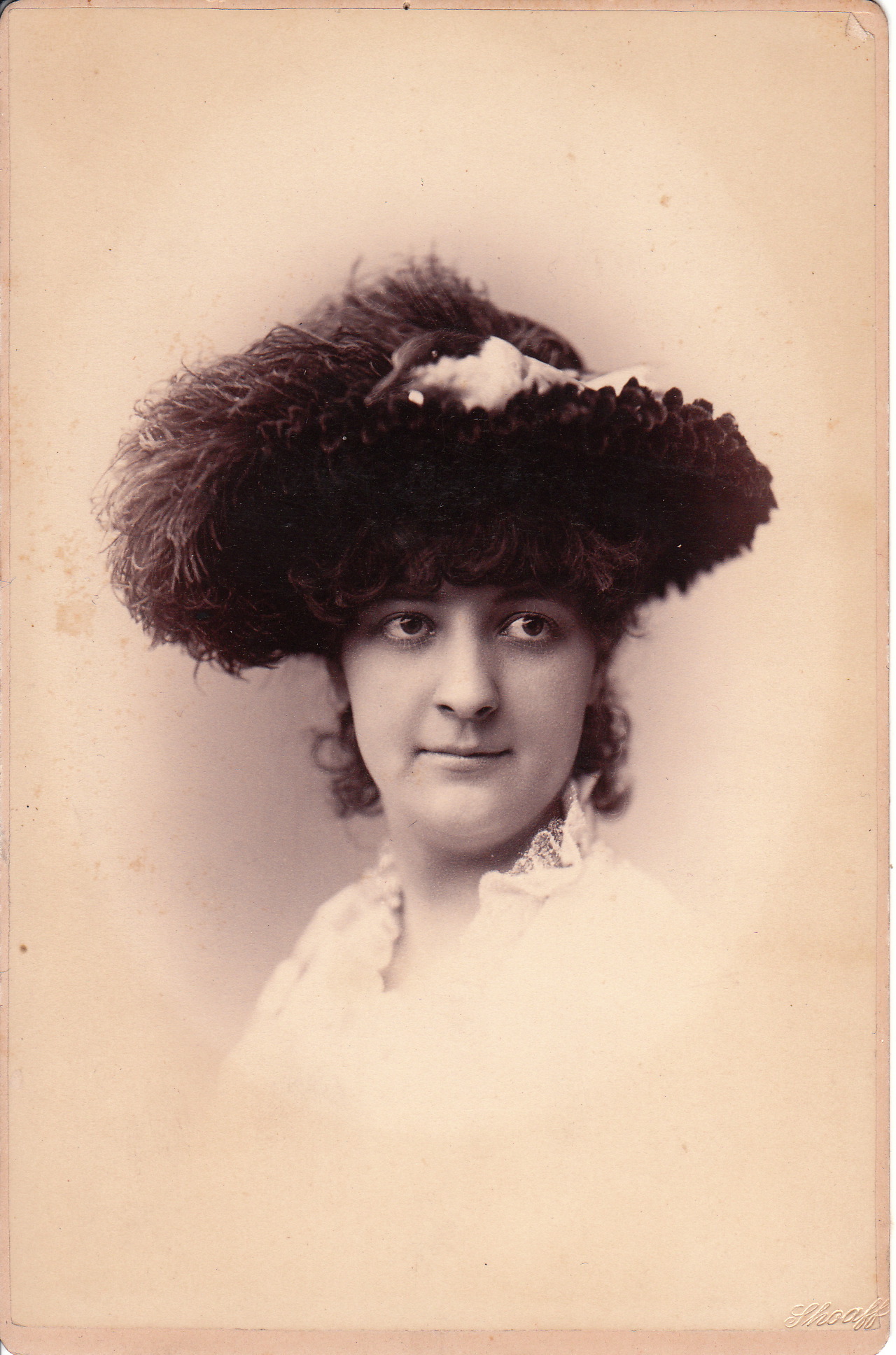
A pensive and pretty young girl with very long hair poses for her portrait at the LeGrande studio in Lincoln, Nebraska.  She is wearing a necklace,  a collar pin, and a dark dress. Resarch found information concerning the LeGrande Studio to be sparse. At one point in time, the studio was located at 1245 Twelfth Street in Lincoln and its proprietors were named Speake and Peirson. Jefferson Grant Speake (1863-?) was listed in the 1891 and 1893 Lincoln Business Directory. He was listed as a photographer and owned the LeGrande studio. He is noted in the 1900 US census, and both he and his wife of 13 years, Hattie E. Speake (1863-?) appear in the census as living in Omaha, Nebraska and both Jefferson and Hattie were reported to be photographers. The 1902 Omaha business directory also lists Jefferson Speake as a photographer. No information could be found about Mr. Peirson, Speake’s Lincoln business partner.


Published in: on December 6, 2012 at 12:01 am  Comments (1)  
Tags: , , , , , , ,

A BOY AND HIS DOG SHARE A COUCH IN ALMA, WISCONSIN

emilanddogThe Gesell studio of Alma, Wisconsin, produced this wonderful portrait of a boy and his dog. The boy’s love for his dog is apparent by his expression as well as by his resting his wrist and hand on the pooch’s neck. The dog appears quite tired in this photograph which certainly makes the photographer’s job easier. Photographing dogs required special talent and the photographer of this image certainly possessed that talent. The lad pictured in this photograph is identified on the reverse of the image as being named “Emil Bardil”.  Emil Bardil (or Bardill) was born in 1893 in Alma, Wisconsin. His father was John Bardill and his mother was Katie Roffler. His parents were of Swiss extraction. The 1900 census finds seven year-old Emil living with a Katherine Bardill (age 54) and his two brothers John (age 11) and Eddie (age 9). The 1910 census reveals that Emil was a boarder in an Alma home and worked as an apprentice printer. The 1920 census discloses that Emil is living in Chico, California with his wife Alice, and working as a printer. The 1930 census indicates that Emil and his wife had taken a boarder into their Chico home and the boarder was employed as a school teacher. The 1940 census shows that Emil had become a foreman at a print shop and worked as a lineotype operator. Census data indicates in 1940, he remained in Chico. Two years later he registered for the draft. He lived a long life and died in California in 1985. The photographer of this portrait was Gerhard Gesell. He was an important figure in Wisconsin history and the Wisconsin Historical Society presents much biographical information about Mr Gesell.  Gesell was born in Germany. He came to the United States and in 1863 he enlisted in the Army and served with “Brackett’s Battalion” of the Minnesota Cavalry on the western front. He entered the military as a private and was discharged as a saddler. After the war he returned to Reads Landing, Minnesota and worked as a saloon keeper until he entered the field of photography. He began his photography career in Reads Landing in 1873. In 1876 he relocated to Alma and opened a studio at 401 South Main Street. He operated his photography business in Alma for 30 years (he died in1906). Gesell is noted for his work of documenting the town, its people and culture, and its relationship to the Mississippi River. He took many photographs outside his studio capturing the Alma citizens in many of their activities. In 1879 he married Christine Giesen and they had five children. The couples oldest son, Arnold, became a pediatrician and well known psychologist. Arnold’s son also made a name for himself. Gerhard Gesell (named after his photographer grandfather) was a noted federal judge in Washington D.C. and he presided over many important cases including the  Iran Contra Affair, the release of the Pentagon Papers., and the Watergate Scandal.  How did this blog entry go from focusing on a little boy and his dog to the Watergate Scandal? Here is an answer to that question. Part of the beauty of cabinet card photography is that each image tells a story. When we look at a photograph, we use conjecture to create a story about the photograph. These created stories are based on our knowledge, as well as our psyche. A second story is created when we research the photographers, the subjects, the activities, and the times reflected in the photographs. That is the beauty of these photographs, we never know where viewing these turn of the century images will take us.

TWO YOUNG WOMAN WITH PAINED EXPRESSIONS IN HOOPESTON, ILLINOIS

Two pretty young woman pose for their portrait in this scalloped cabinet card produced by the Hall studio in Hoopeston, Illinois. The women do not seem very enthusiastic about having their photograph taken. Each of the subjects have baskets of flowers on their laps and are wearing fingerless gloves. The woman seated on the right in the image is holding what appears to be an umbrella. Both of these ladies have very thin waists. They are probably wearing corsets. Perhaps those corsets are a little too tight and that would explain the pained expressions they display in the photograph.  The photographer, Ervin S. Hall, appears in the 1880 US census. Hall was 25 years old and married (1877) to Violetta Hall (age 27). Hall’s parents were born in Maine but he and his wife were Illinois natives. The couple lived in Hoopeston and Hall worked as a photographer. The 1900 US census found Hall and his wife living in Grant, Illinois with their two children, Ellis (age 17) and Ethel (age 15). Ervin was still working as a photographer. The 1910 US census lists Hall and his wife living in Urbana, Illinois and Ervin still employed as a photographer. The 1920 US census reveals that the couple was living in Kissimmee, Florida and Ervin was working as a hardware salesman. The 1930 US census indicates that Ervin was retired and he and his wife remained in Kissimmee. Research uncovers the story of Hoopeston, Illinois. The town was created in 1871 and named for Thomas Hoopes who had offered his land to be the site of the crossing of two railroads. The business and manufacturing that developed in Hoopeston centered around agriculture. The Illinois Canning Company (1875) and the Hoppeston Canning Company (1878) were established there. Greer College (1890) was also established in Hoopeston.

Published in: on December 4, 2012 at 12:01 am  Comments (1)  
Tags: , , , , , , ,

PRETTY YOUNG WOMAN SITTING ON PRETTY UNUSUAL CHAIR IN CANTON, OHIO

canton lady_0002

A pretty young woman appears to be comfortable enough as she sits on an unusual chair and poses for her  portrait at the Manly & Son studio in Canton, Ohio. She is holding a small fan and displays a faint smile as she leans toward the camera. She is wearing a ruffled dress with a striped collar and is also wearing a pin. Note the fringed chair and also notice the floor lamp. At least it appears to be a floor lamp. Could it possibly be an odd looking table? The woman is wearing a hat, but due to her puffy curly hair, the hat appears to be floating on her head. Research provided some information concerning photographer George Watson Manly but the more interesting story concerns his wife Angeline Stewart Manly. George was born in New York in about 1824. George appears to have begun his photography career in Akron, Ohio. He started out as a dagguerreotypist beginning 1859. The 1870 US census confirms that George was working as a photographer in Akron and that he was married to Angeline who was seven years his junior. The couple had three children in the household; Sabray (age 24), William (age 18), and Clifford (age 10).The boys were presumably George and Angeline’s sons. Also in the household was a young relative of Angeline and a young Irish couple. The husband of the Irish couple was listed as a photographer and he was likely an assistant to George. One source asserts that George stayed in Akron until 1873, and during some of his time in Akron he also had a studio in Salem, Ohio. It is not clear when he moved to Canton, but he is listed in Canton business directories by at least 1881. So what is the story concerning George’s wife, Angeline? The story is that Angeline Stewart Manly was a major figure in the temperance crusade in both the city of Akron and in the state of Ohio. She served as Akron’s city representative to the first state convention. The convention organized the Women’s Temperance League of Ohio and Manly was elected President. In 1883, Manly published a novel called “Hit and Miss: A Story of Real Life”. It is not known why George and Angeline moved to Canton from Akron. George died in Canton in 1900 and Angeline died there in 1913.

Published in: on December 3, 2012 at 12:01 am  Comments (1)  
Tags: , , , , , ,

PRETTY WOMAN WITH FRIZZY HAIR IN MILWAUKEE, WISCONSIN

This cabinet card features a pretty woman with frizzy hair. She is wearing a dress with a high collar and a long necklace. The photographer did an excellent job of capturing the woman’s facial expressiveness. The Holdmann Photo Studio produced this image. The propietor of the studio was Edward Lutzenberger and the studio had a location in both Chicago, Illinois and Milwaukee, Wisconsin. Printing on the reverse of the photograph indicates that this image came from the Milwaukee studio. Also on the reverse of the photograph is printed guarantee and request for feedback that could be seen on any internet auction site. Lutzenberger guarantees that photographic portraits from his studio would not fade. The statement that sounds like it could be from modern day times is “If you are pleased tell others, if not tell us.”  Lutzenberger probably purchased his studio from Charles Holdmann (1851-?).  Holdmann’s studio was located at 224 Grand Avenue in Milwaukee. The 1900 US census reveals that Edward Lutzenberger lived at his mother-in-law’s house with his wife Anna Drager Lutzenberger and their one year-old daughter Norma. Lutzenberger and his wife married in 1897. Both Edward and Anna were born in Wisconsin. Edward was of German descent. He was employed as a photographer. The 1910 US census reports that Edward and his wife and daughter remained in Milwaukee and Edward was still working as a photographer. The 1920 census lists Edward and Anna as still living in Milwaukee with their, then 20 year old daughter Norma. There was a new addition to the household. Norma had a six year old son named Edward. It seems young Edward was born when Norma was around 14 years old. Norma was employed at the time of the census as a stenographer. The 1930 and 1940 census found Edward and Anna living in Milwaukee and Edward was working for the Railroad police. Milwaukee business directories list Edward as a photographer from 1894 through 1913. He certainly may have worked as a photographer in additional years but research could not document other years.

Published in: on December 2, 2012 at 12:01 am  Leave a Comment  
Tags: , , , ,

UNIFORMED BAND MEMBER IN NEW YORK CITY

The young uniformed man in this cabinet card portrait appears to be a band member. However, it is also possible that he may be a cadet, a fireman, or a member of some other type of organization. His belt buckle has the letter “C” and the badge on his hat has the number “7”. Hopefully, a visitor to the cabinet card gallery may be able to pinpoint the exact type of unit that this subject represents. The photographer of this image is A. J. Hargrave. At the time of this photograph he was located at 68 West 23rd Street in New York City. To learn more about Hargrave and to view more of his photographs, click on the category “Photographer: Hargrave”.

Published in: on December 1, 2012 at 12:01 am  Comments (2)  
Tags: , , ,

A WOMAN IN A LONG DRESS POSES WITH HER BICYCLE

This photograph features a woman and her bicycle. It must have been very difficult for a woman to ride a bike in a such a long dress. Hand printed on the reverse of the photograph is the message “A Merry Xmas”. This photograph has been trimmed and as a result, the photographer is unknown.

Published in: on November 30, 2012 at 12:01 am  Leave a Comment  
Tags: ,

WOMAN IN BUSTLE STYLE DRESS IN OMAHA, NEBRASKA

This  photograph features a woman in a bustle style dress posing for a full length portrait at the Gray studio in Omaha, Nebraska. The dress seems to play a more prominent role than the subject in this cabinet card image. In 1884 Howard E. Gray took over the Bee Hive Gallery at the address listed on this cabinet card. In about 1886 he changed the name of the studio to the H. E. Gray Studio. Omaha business directories indicate that he was operating a photography studio in Omaha  from 1884 through 1896. The 1896 directory announces that Gray had moved to Houston, Texas. Research was able to pick up Gray’s trail in Houston. Business directories state that he was a photo retoucher in in 1897 and from 1899 through 1911 operated a photography studio. Research yielded no definitive information about his family. He may be listed in the 1900 US census but there is no confirmation that Howard E. Gray listed is the same Howard E. Gray who worked as a photographer. The 1900 census Mr. Gray was 36 years-old and married to Maggie Gray (age 38). The couple was married in 1885 and had a son named Elmont (age 12). Interestingly, the census Mr Gray was listed as working as a stenographer. To view other photographs by Gray, click on the category “Photographer: Gray (NE)”.

Published in: on November 29, 2012 at 12:01 am  Leave a Comment  
Tags: , , , , ,

PORTRAIT OF A TIRED OLD MAN IN TEXAS (PHOTOGRAPH BY CAPTAIN HARVEY ROBERTS MARKS)

This image captures the portrait of a tired looking old man. This gentleman appears to have had better days. He looks exhausted and troubled. This photograph was taken by the Mark’s studio in Austin, Texas. The photographer of this cabinet card lived an interesting life and he was both a pioneer of Texas and a pioneer of photography. Harvey Roberts Marks (1821-1902) was a well known photographer who worked in a number of locations. He was active in Baltimore, Maryland (1849-1853), San Francisco, California (1851), Mobile, Alabama  (1856-1859), Houston, Texas (1865-1870), and Austin, Texas (1870-1902). He was born in New York City. He first arrived in Texas in 1838 and received a very large land grant in Harris County (Houston). He enlisted in a company of Texas Rangers in 1840 and reached the rank of Captain. He was married to Emily H. Bassan in 1849. Research indicates that she was  member of one of the most prominent families in Baltimore. In 1849 he was Jacob Shew’s partner in the Shew and Mark’s Gallery in Baltimore. He continued the gallery alone when Shew left Baltimore until 1851. The 1850 census revealed that he had three assistants in the gallery and took 5,000 daguerreotypes annually. In 1851 he took photographs of castaways from a Japanese ship involved in an incident that caught national attention. Mark’s moved to Austin in 1870 and opened a gallery a year later. During that time he became Vice President of the National Photographic Association. Marks served during the civil war. He was a member of the Houston Battalion, Texas Infantry (Detailed Men). Research was unsuccessful in gathering this Confederate regiment’s history. Marks entered the regiment and left the regiment as a Captain.  Interestingly, when former Confederacy President, Jefferson Davis, visited Austin in 1875, he sat in Mark’s studio for his portrait. He died at the age of 81.

THREE PRECIOUS KIDS IN TEKAMAH, NEBRASKA

This cabinet card features three precious little children wearing adorable outfits. The child in the center of the image is holding a rake and wearing a large bow tie and a straw hat. The two girls are flanking the little boy in the middle and each girl is holding their hat. There is a basket of flowers on the floor in front of the trio of children. The photographer of this image is the Mathison studio in Tekamah, Nebraska. Ingbert L. Mathison (1868-1935) was born in Denmark in 1868. He came to America with his parents at the age of 2. He grew up in Iowa and came to Tekamah, Nebraska in 1891. He became a photographer and later added furniture sales to his business. The 1900 US census reveals that Mathison was married to Grace Theodoria Christy (1870-1902) and the couple had four children between the ages of 3 and 9. Two years after this census, Grace died, leaving Ingbert with four young children. Ingbert soon got remarried. His new bride was Mary Etta Slaughter (1873-1939). The Mathison family then moved to a community outside of Denver, Colorado. Ingbert worked as a farmer, and later, a grocer, in Colorado. He died in a Denver hospital in 1935 at the age of 67. The cause of death was hemorrhages of the stomach.