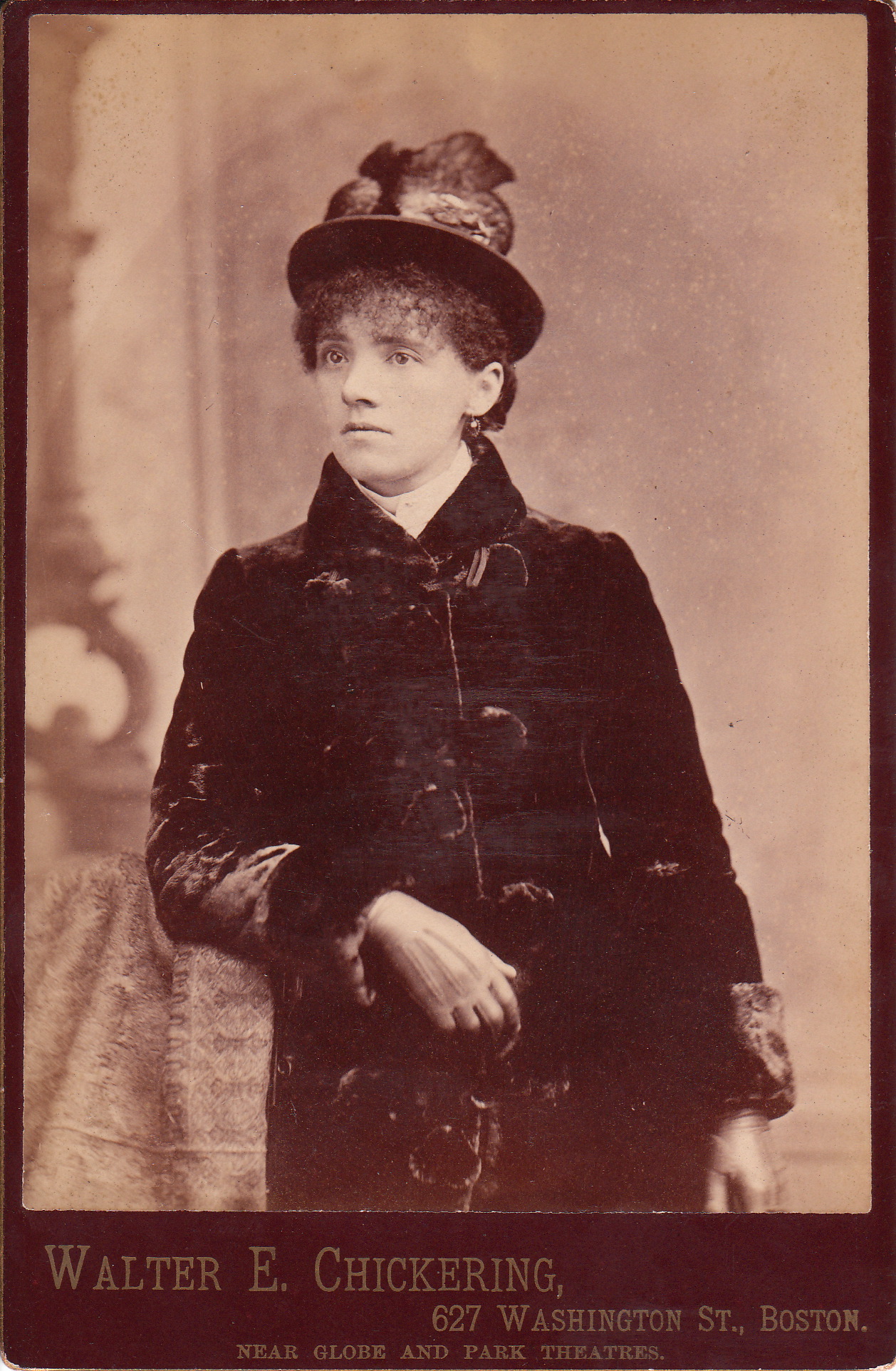
A pretty young woman poses for her portrait at the studio of Walter E. Chickering in Boston, Massachusetts. The woman is wearing a winter coat which appears to be made from fur. Her sleeves are definitely fur trimmed. She is wearing gloves and a lovely hat. The subject of this portrait is unidentified. Walter E. Chickering was a well known Boston photographer. He was concerned about being confused with a photographer named Elmer Chickering, who also operated a studio in Boston. The reverse of this image has a printed advertisement describing Walter Chickering as “the original photographer of that name”. The ad is a bit grandiose in its description of Walter Chickering’s studio as being “mammoth” in size. To view other photographs by the Chickering (both Walter and Elmer), and to learn more about them, click on the category “Photographer: Chickering, W.”.
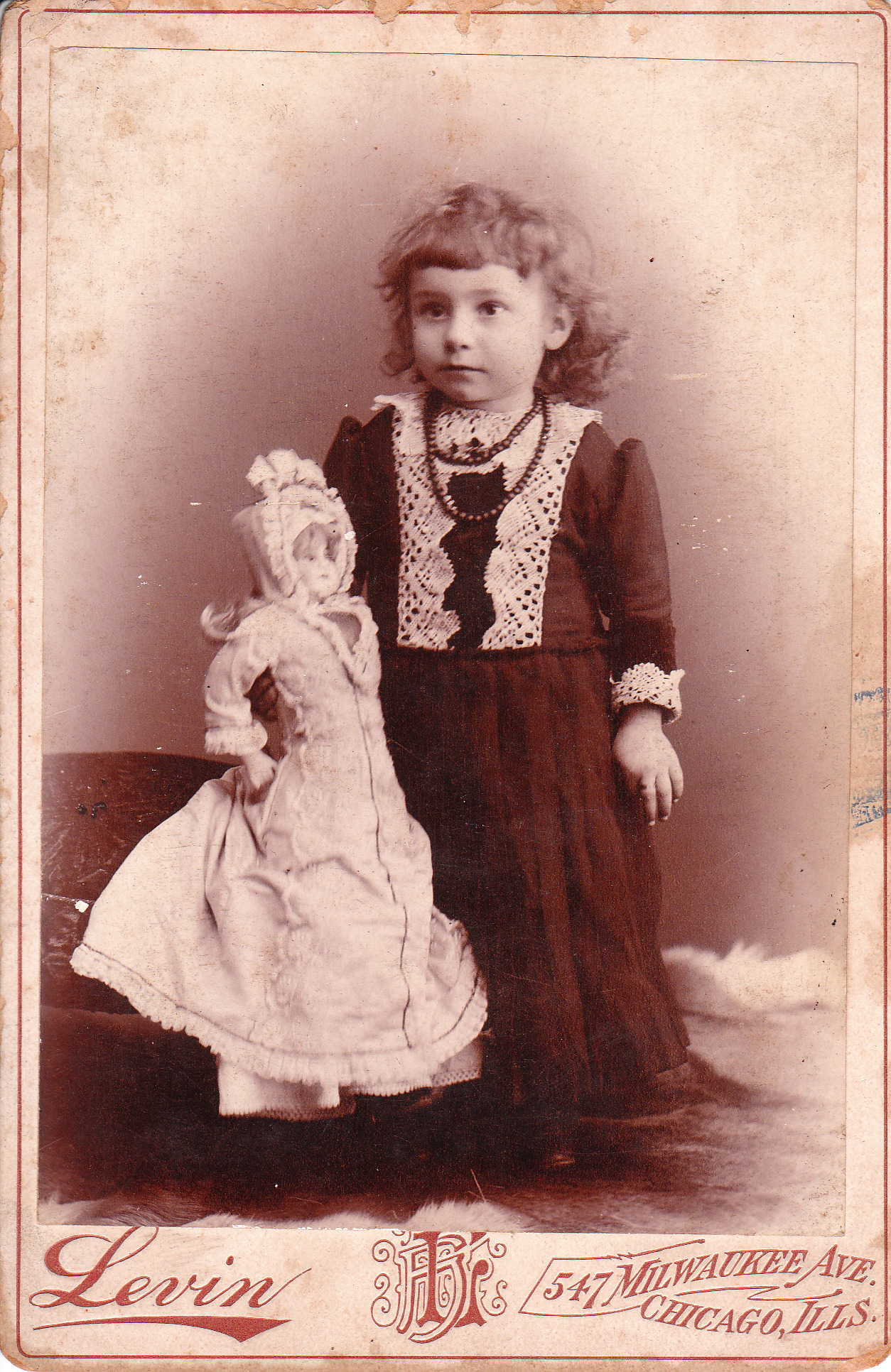
SWEET LITTLE GIRL AND HER FANCY DOLL IN CHICAGO, ILLINOIS
This cabinet card features a nicely dressed cute little girl posing with her large fancy doll. The curly haired girl is wearing plenty of lace and a necklace. Note how fashionably the doll is dressed. The photographer of this image is Henry Levin of Chicago, Illinois. The child’s last name is identified as Werner on the reverse of the photograph. Her first name is illegible. The inscription states that the girl was two and half years old at the time of the photograph.
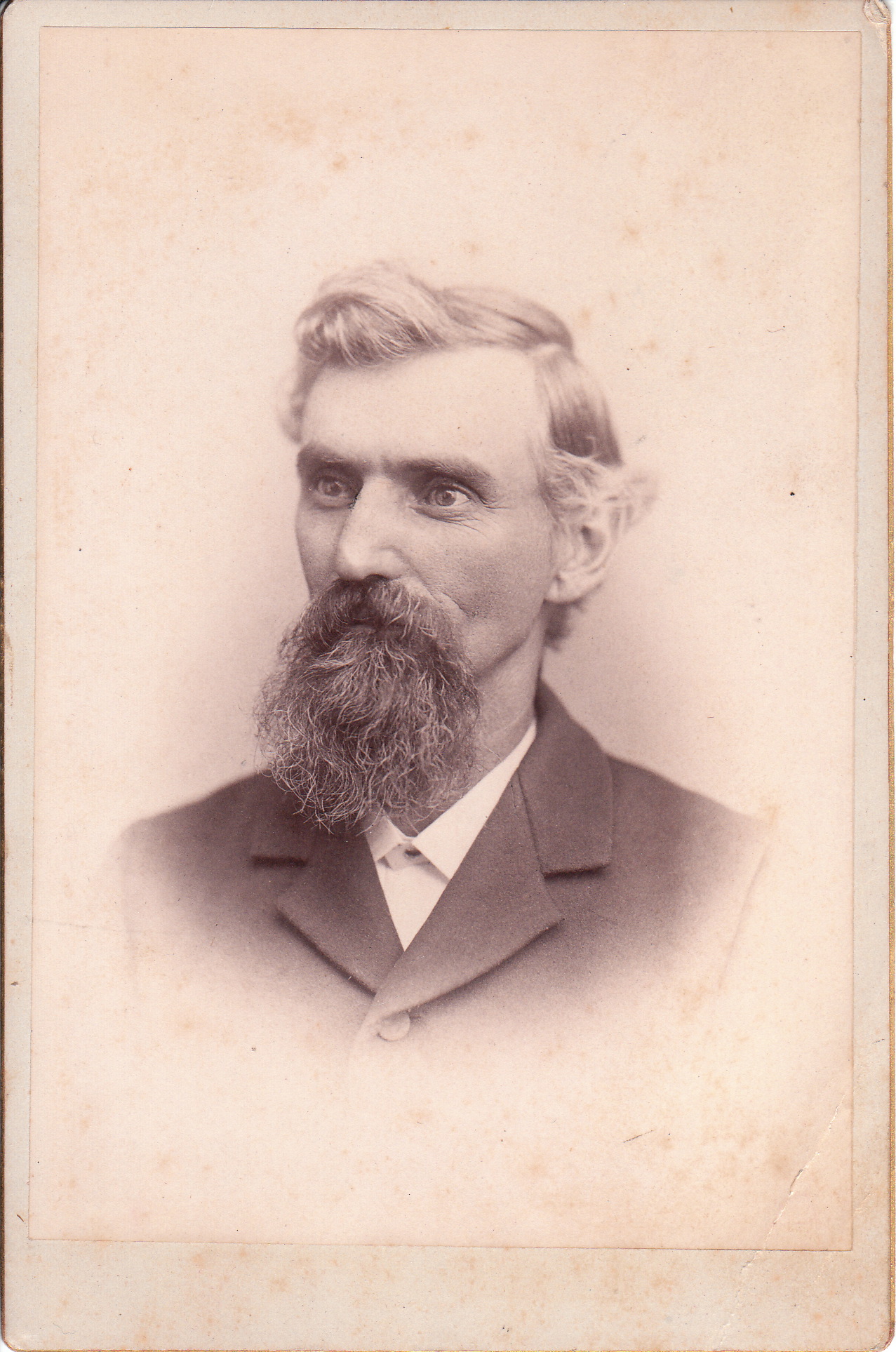
BEARDED MAN WITH INTENSE EYES IN BELOIT, KANSAS
The subject of this cabinet card portrait is an intense looking man with piercing eyes. He has a handsome beard and wavy hair. He wore his fancy clothing for his encounter with the photographer. The photographer of this image is a studio called Dobler Brothers of Beloit, Kansas. C. W. Dobler (1860-?) is listed in the 1880 census as a 20 year-old photographer living with his sister and brother-in-law. His brother-in-law, Frank Dawson, was 26 years old and also worked as a photographer. Directories show that by 1885, Dobler had married a woman named Sarah (age 22) and had a baby daughter named Pearl (age 1). The city of Beloit was settled in 1868 with the aim of improving water power in the area. Legend has it that local Native Americans advised the settlers to locate the town at a certain bend of the Solomon River to protect the town from tornadoes. The settlers followed their advice and the town has never been hit by a tornado while nearby areas have been less fortunate.
FASHIONABLE TEENAGE GIRL IN NEW YORK CITY, NEW YORK
A young woman poses for her portrait at the Bostnick studio. Printing on the reverse of the photograph indicates that the studio was located at 98 Sixth Avenue, between 8th and 9th Streets in New York City, New York. The subject appears to be a teenager. She is dressed fashionably and wearing a collar broach, earrings, and a ring. No biographical information about photographer Bostnick could be located. SOLD
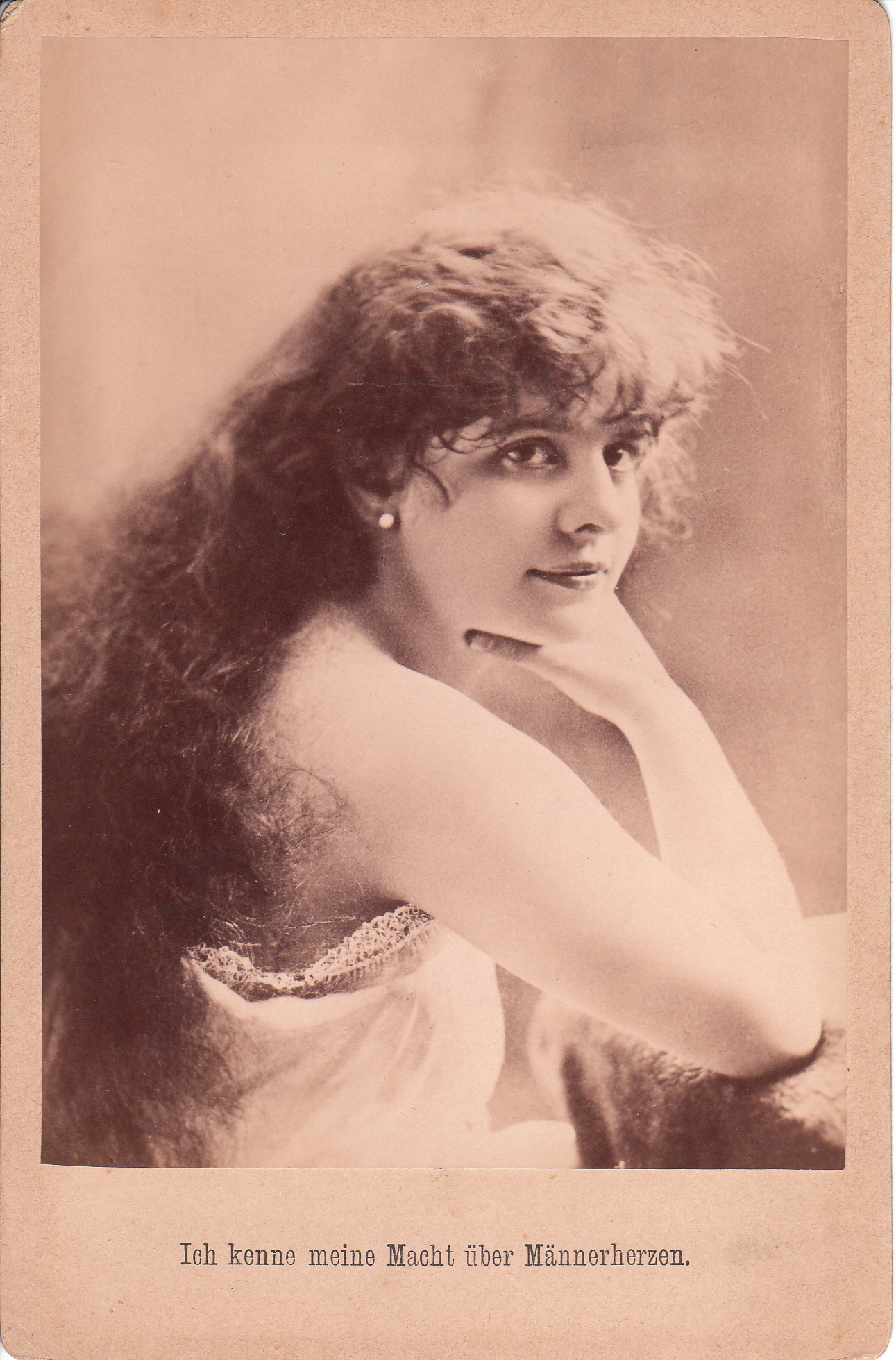
THE POWER OF BEAUTY SEEN IN PORTRAIT OF GERMAN ACTRESS
A pretty young woman is the subject of this cabinet card. She is posed in a provocative manner, relative to the time of this photograph. She is likely a German actress/model. The previous owner of this cabinet card translated the German text below the image as stating “I know my power over men’s hearts”. Printing on the reverse of the photograph identifies the photographer as S. B. Farren and Son. The image is identified as number 233 of a series. Farren may be the photographer of this cabinet card but it is also possible that he purchased it from the original photographer and sold it to collectors from his studio. SOLD
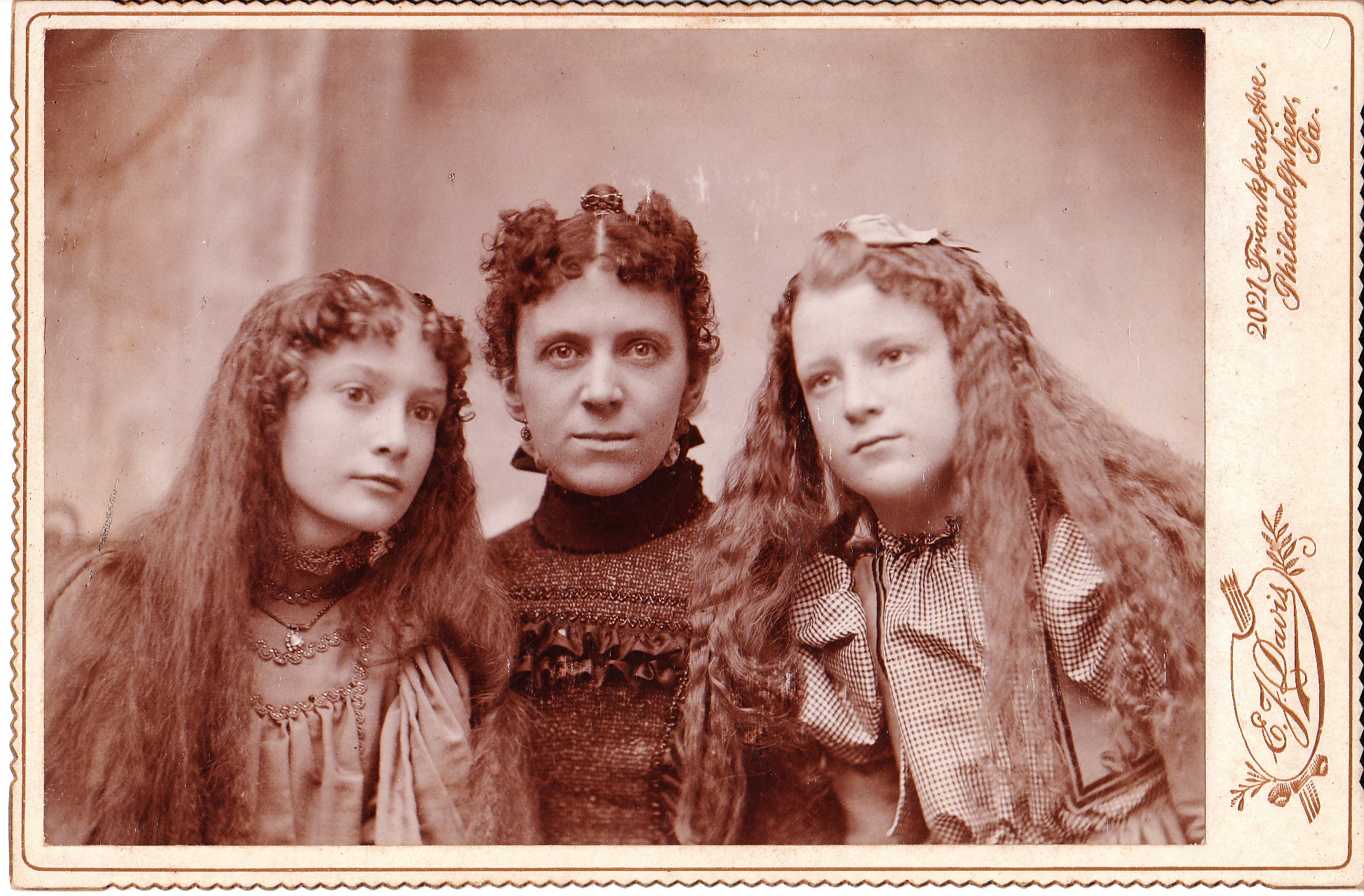
MOTHER AND TWO DAUGHTERS EXPERIENCE A BAD HAIR DAY IN PHILADELPHIA, PENNSYLVANIA
A mother and her two long haired daughters pose for their portrait at the studio of E. J. Davis in Philadelphia, Pennsylvania. The young girls don’t just have long hair, they have long frizzy hair. Are they having a bad hair day? One can only guess what the girls thought about their hair before they sat for this photograph. What do you think about the dynamics between the family members in this portrait? It appears to me that this is one very detached family. The lack of connection between mother, older daughter, and younger daughter is striking. All three individuals appear to be very much in their own world. Little information could be found about photographer E. J. Davis. The only information uncovered concerning Davis, was an ad he placed in a photography journal, Snap Shots (1908). The ad listed some of his photography equipment for sale. The subjects of this photograph are not identified. SOLD
WOMAN MODELS REPTILIAN WEAR IN PENACOOK, NEW HAMPSHIRE
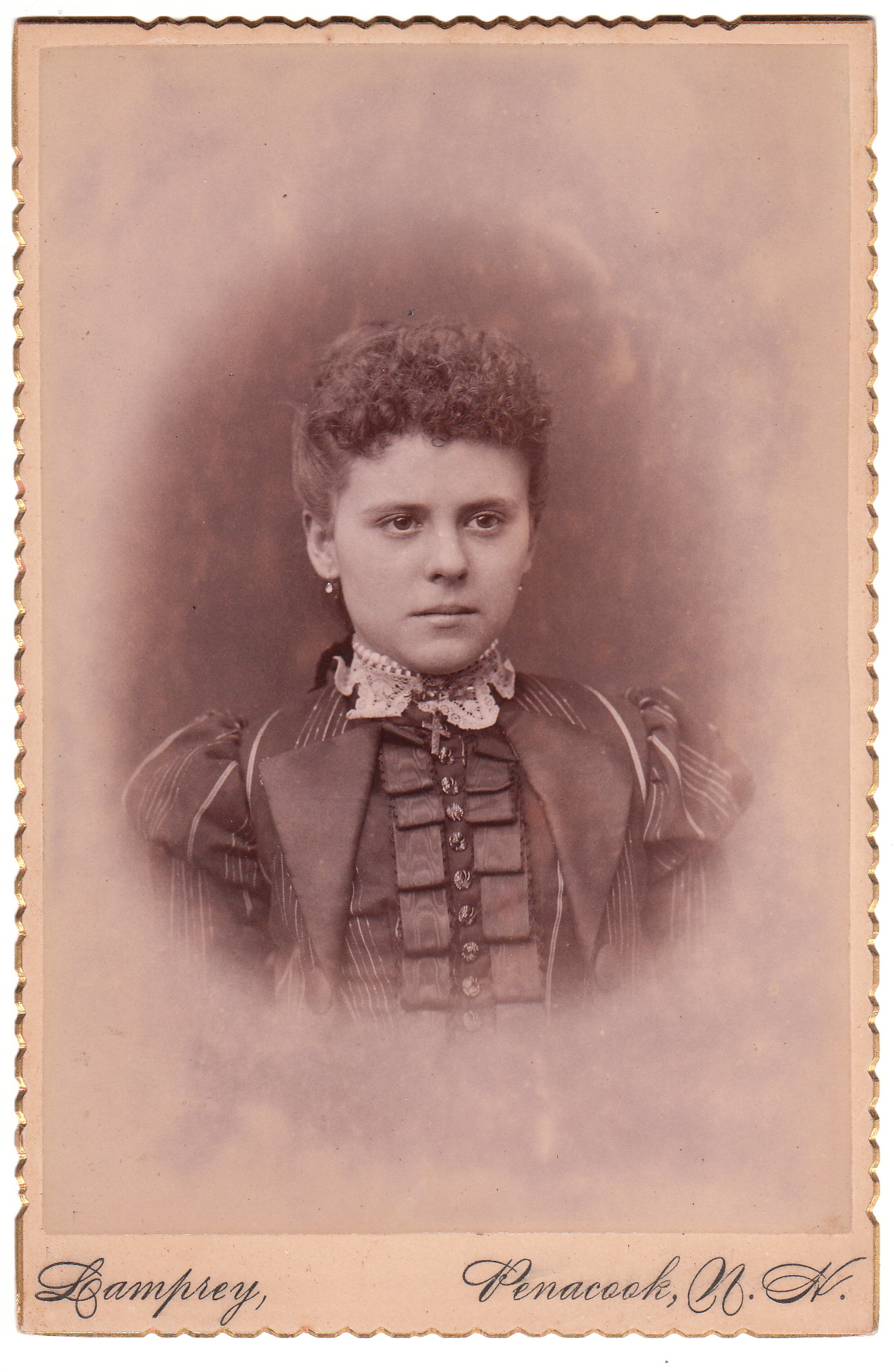
Most people don’t think of Penacook, New Hampshire as the center of turn of the century fashion. However, in 1890, a new fashion trend was born in tiny Penacook. Traditional fashion centers like Paris and New York City were blindsided by the innovative dress designs coming out of Penacook. Reptilian Wear was introduced in 1890 and was overwhelmingly the most well received of all these designs. Penacook area photographers quickly were called upon to sharpen their skills in fashion photography because their services were in high demand by the rapidly growing local clothing industry. This cabinet card was produced by the studio of M. S. Lamprey who began operating in Penacook in 1858. The woman in this image is wearing an excellent example of a Reptilian Wear dress. This particular dress was sold under the Iguana label. The model in this photograph was not identified. She is wearing a necklace from which hangs a cross. If you doubt the veracity of this story; you would be correct to do so. Here is some non fiction commentary about this cabinet card. The photographer is Maurice S. Lamprey (1835-1912). The 1860 census finds Lamprey living with his parents and siblings and working as a varnisher. He enlisted in the 10th New Hampshire Volunteer Infantry in 1862 as a private and was transferred to the Signal Corp which is where he remained throughout the war. The earliest city directory found that lists him as a photographer was from 1872. The 1900 US census reports that Lamprey was 64 years old, living alone, and working as a photographer in Concord. The town of Penacook was named after the Penacook Native American tribe which lived in the area. The town was a village located within the city of Concord. Penacook was involved in the textile industry. The town was located along the Contoocook River. This location attracted the hydro power industry and Penacook became a mill town.
A PROFESSIONAL LOOKING GENTLEMAN IN BINGHAMTON, NEW YORK
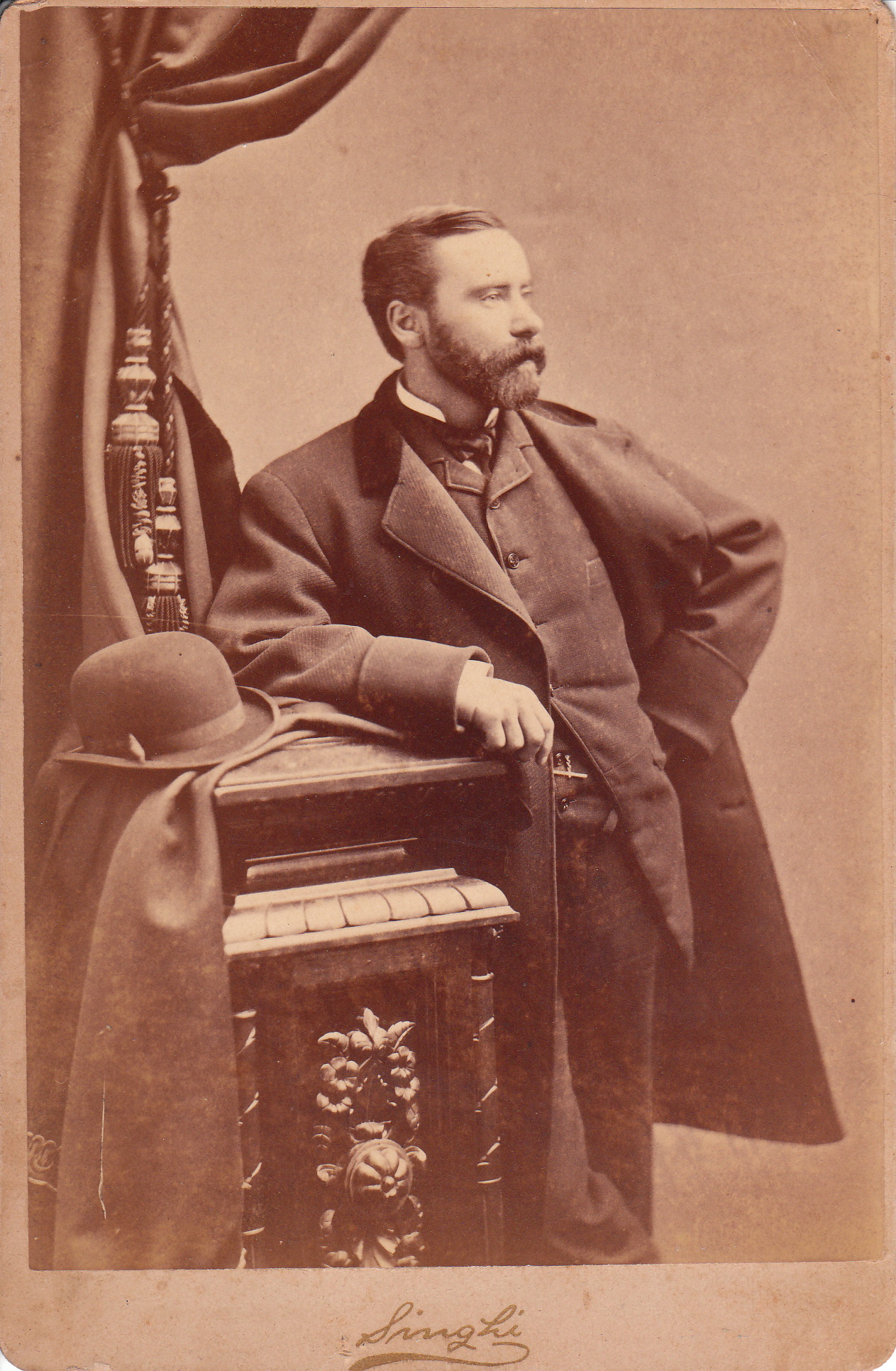
The man in this cabinet card photograph appears to be a professional gentleman. He is wearing an overcoat and a nicely trimmed beard. He is standing next to his derby hat and has a pocket watch. Perhaps the well dressed gentleman is an attorney. Maybe its not a coincidence that the Binghamton, New York based photographer, Singhi, was located on Court Street. The reverse of the photograph has an inscription which identifies the gentleman as “Adelbert Harroun”. Research reveals that Mr. Harroun was not a lawyer but instead, he was an accountant. The 1870 census notes that Thomas Adelbert Harroun (1851-?) was the 19 year-old son of Thomas Harroun (1824-1907) and Salina King Harroun (1824-1903). His father’s occupation was listed as a “Presiding Elder” and further research found that he was a Methodist clergyman. His mother was a homemaker. Adelbert lived with his parents and two siblings in Norwich, New York. Sister Flora (age 22) was a music teacher and brother Arthur (age 11) was a student. He married his wife, Mary Winton, in 1888. The couple had two children. The 1900 census finds the 47 year old Harroun living in Dunleith, Illinois. He was living with his wife, Mary, their son N. Winton (age 10), and daughter Anna Augusta (age 9). Harroun was working as a railroad yard clerk. Further investigation revealed that daughter Anna Augusta died in 1904 in Dubuque, Illinois. The 1920 census reports that the 67 year-old Harroun was widowed and living in Waukegan Lake, Illinois with his sister Flora. He was working as an accountant. The 1930 census locates Harroun in Prineville, Oregon and living as a boarder. At 79 years of his age, he was still working (bookkeeper). The photographer of this image is Will G. Singhi. He worked in Binghamton, New York between 1872 and 1886. His albumen print “A Winter Scene” is exhibited in the online “American Museum of Photography”. Singhi had taken a photograph that appeared to capture a snowball in mid flight heading toward a newsboy who was prepared to deflect it. The museum also has on display a funny cartoon self portrait caricature that Singhi used as an advertisement. The Photographic Times and American Photographer (1883) comments on Singhi’s wonderful sense of humor.
TURN OF THE CENTURY HANDSOME MAN WITH SLICKED BACK HAIR
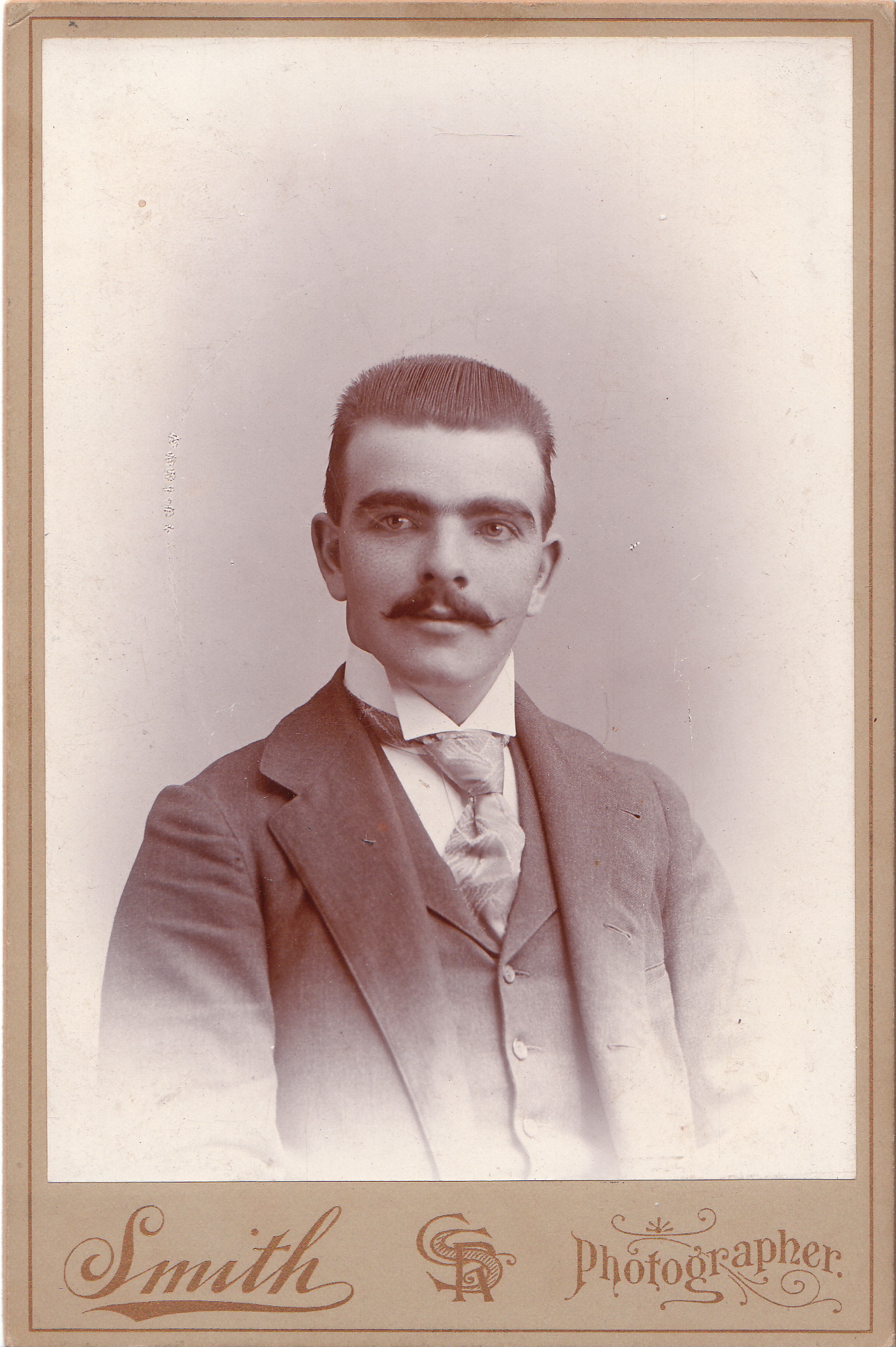
This cabinet card features a portrait of a handsome young man with slicked back hair. He is dressed beautifully and well groomed. The photographer is named Smith but the location of his studio is not listed on the front or the reverse of the photograph. The initials on the front of the card indicate that the photographers full name is C. R. Smith. There was a photographer named C. R. Smith located in Clearwater, Minnesota. He was listed in Camera Craft (1908) and also in The Photographic Journal of America (1917). It is not confirmed that this C. R. Smith is the photographer of this cabinet card. It is interesting to note that the Cabinet Card Gallery has a number of photographs by the photographer who photographed this gentleman. All of the photographs share the same logo containing the photographer’s initials. To view these photographs, click on the category “Photographer: Smith CR”
YOUNG MAN WEARING SALVATION ARMY UNIFORM IN MARSHALLTOWN, IOWA
A young man wearing a Salvation Army uniform poses for his portrait at the Cottage Gallery in Marshalltown, Iowa. The photographer is named Beverage. The uniform is well decorated with Salvation Army identification. He is wearing a badge on his jacket, S’s on his collars,a badge on his hat, and lettering stating Salvation Army on a band around his hat. An inscription on the reverse of the cabinet card states that the subject’s name is “Charlie Phillips” and that he is the brother of the writer’s mother, “Uncle Charlie”. The 1890 Iowa census reveals that a Charlie Phillips, born in Marshalltown, was living in Lake Creek, Iowa. This eighteen year old young man, may be the subject of this photograph. The 1900 United States census reports that Maurice C. Beverage was born in 1841 in the state of Maine and was living with his 20 year old daughter in Marshalltown. He was of Scottish and French Canadian descent. The census listed his occupation as a photographer. Beverage began his photography career in Oconto, Wisconsin. In 1871 he was married to Hattie Crum and they had four children. The Oconto shop was at the corner of Maine and Section Streets. He worked in Oconto between 1869 and 1876. he then moved to Marshalltown where he opened the Beverage Cottage Gallery. He had partnerships there with Benjamin Jarvis and S. E. Jessup. In 1931, Beverage’s obituary appeared in the Times Republican, a Marshalltown newspaper. The obituary states that Beverage lived in Canada from infancy to age 15, when he went to Michigan, and then Oconto where he learned photography. He ran the Cottage Gallery from 1876 until 1912. His son Herbert Morris Beveridge was a photographer in Butte, Montana in 1900. The Cabinet Card Gallery has a large collection of Salvation Army cabinet cards. To view these photographs, click on the category “Salvation Army”. SOLD