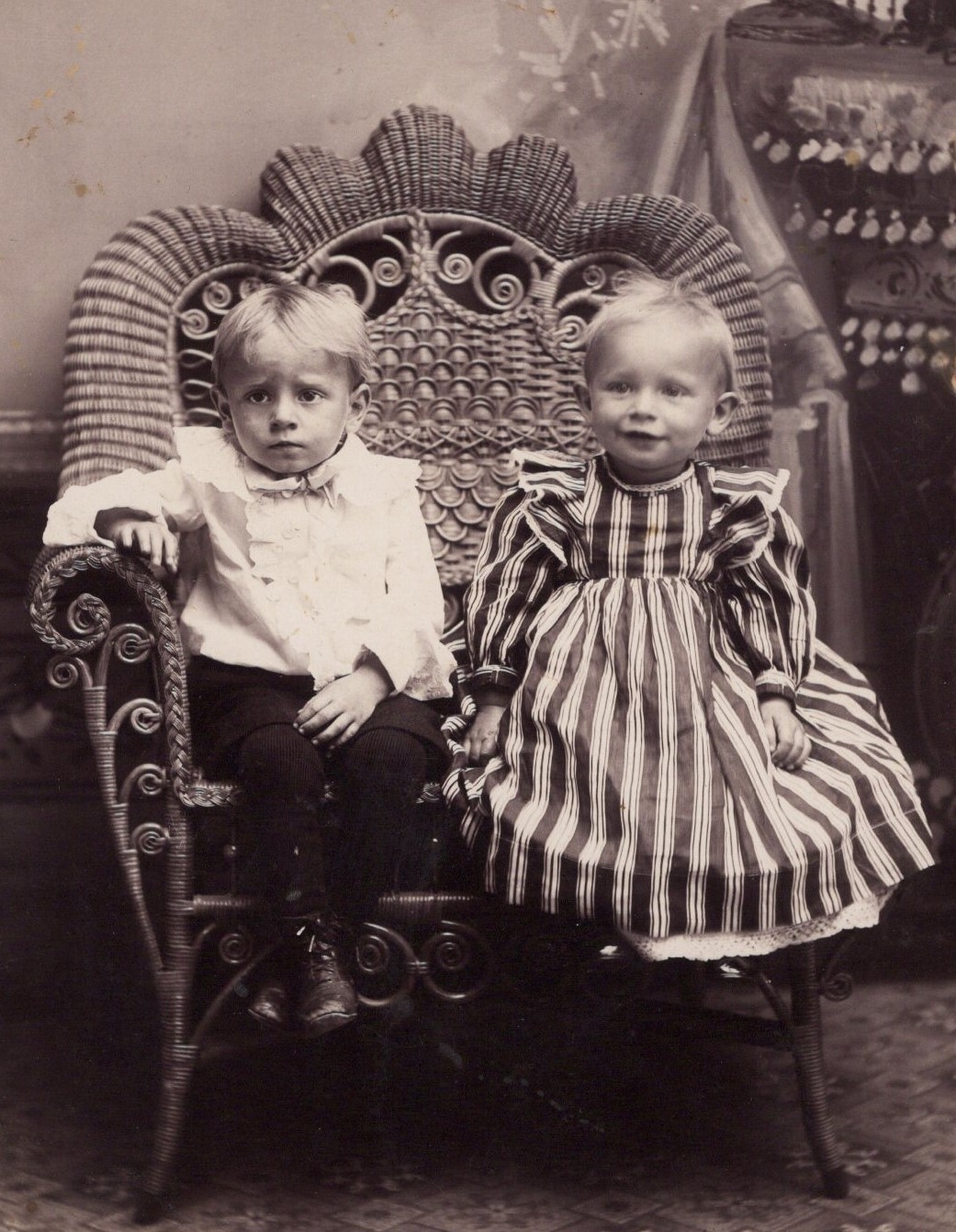
Two adorable kids pose for their cabinet card portrait at the studio of Myer, in Shell Rock, Iowa. The children are most likely siblings; possibly even twins. They are sitting on a large wicker chair. The young girl is smiling and wearing a cute striped dress. The young boy appears less happy than his sister and is wearing a white shirt with ruffles. This cabinet card portrait has some foxing and corner wear and is in fair condition.
Buy this Cabinet Card Photograph (includes shipping within the US) #6543
To purchase this item, click on the Pay with Paypal button below
$22.48
Buy this Vintage Original Cabinet Card (includes International shipping outside the US) #6543
To purchase this item, click on the Pay with Paypal button below
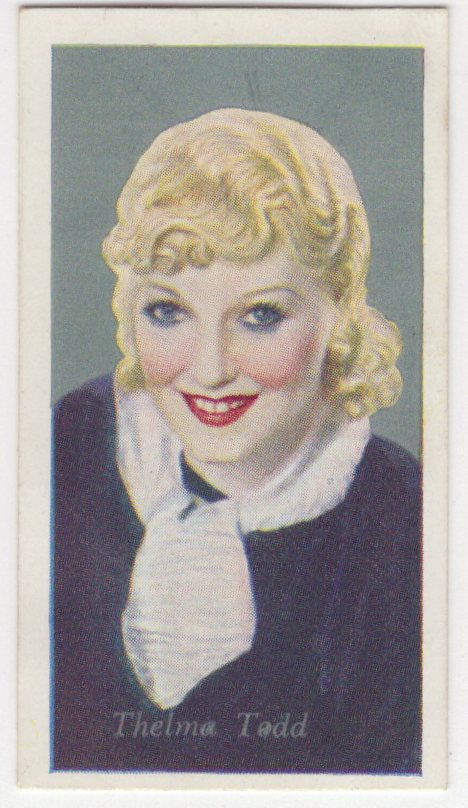
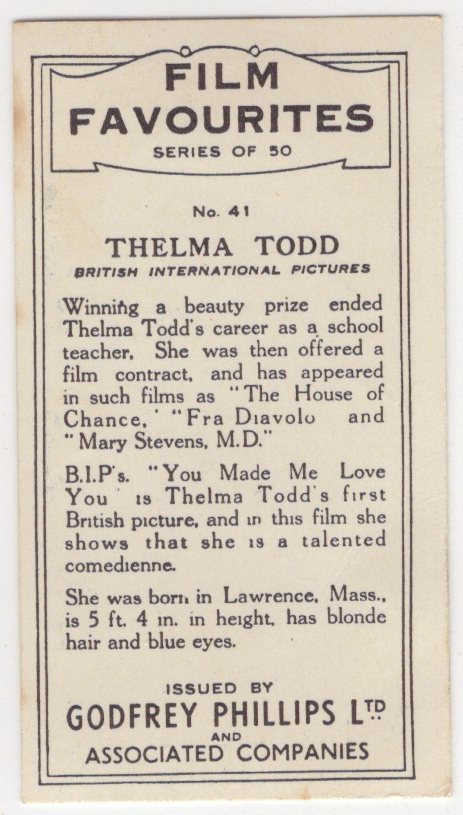
This vintage tobacco card features American silent and talkie film actress, Thelma Todd (1906-1935). She was also a businesswoman. Her nicknames included “The Ice Cream Blonde” and “Hot Toddy”. She appeared in about 120 feature films and shorts between 1926 and 1935. She was known for her comedienne talent. Among the performers she worked with are the Marx Brothers, Laurel & Hardy, and Buster Keaton. In 1934 she opened a restaurant in Los Angeles with two partners. In 1935 she was found dead in her Lincoln automobile. The car was in a garage and had died from carbon monoxide poisoning. Her death was ruled to be accidental but there was much speculation about whether she committed suicide or had been murdered. This cigarette card was published by Godfrey Philips Ltd. The firm was a British tobacco importer and manufacturer of cigars and Cigarettes. The business was established in 1844 and was one of the first tobacco companies to issue cigarette cards. Their first set was published in 1904. The cards were meant to stiffen cigarette packaging, to serve as a collectible, and to advertise the cigarette brand. This cigarette card was issued in 1934. SOLD
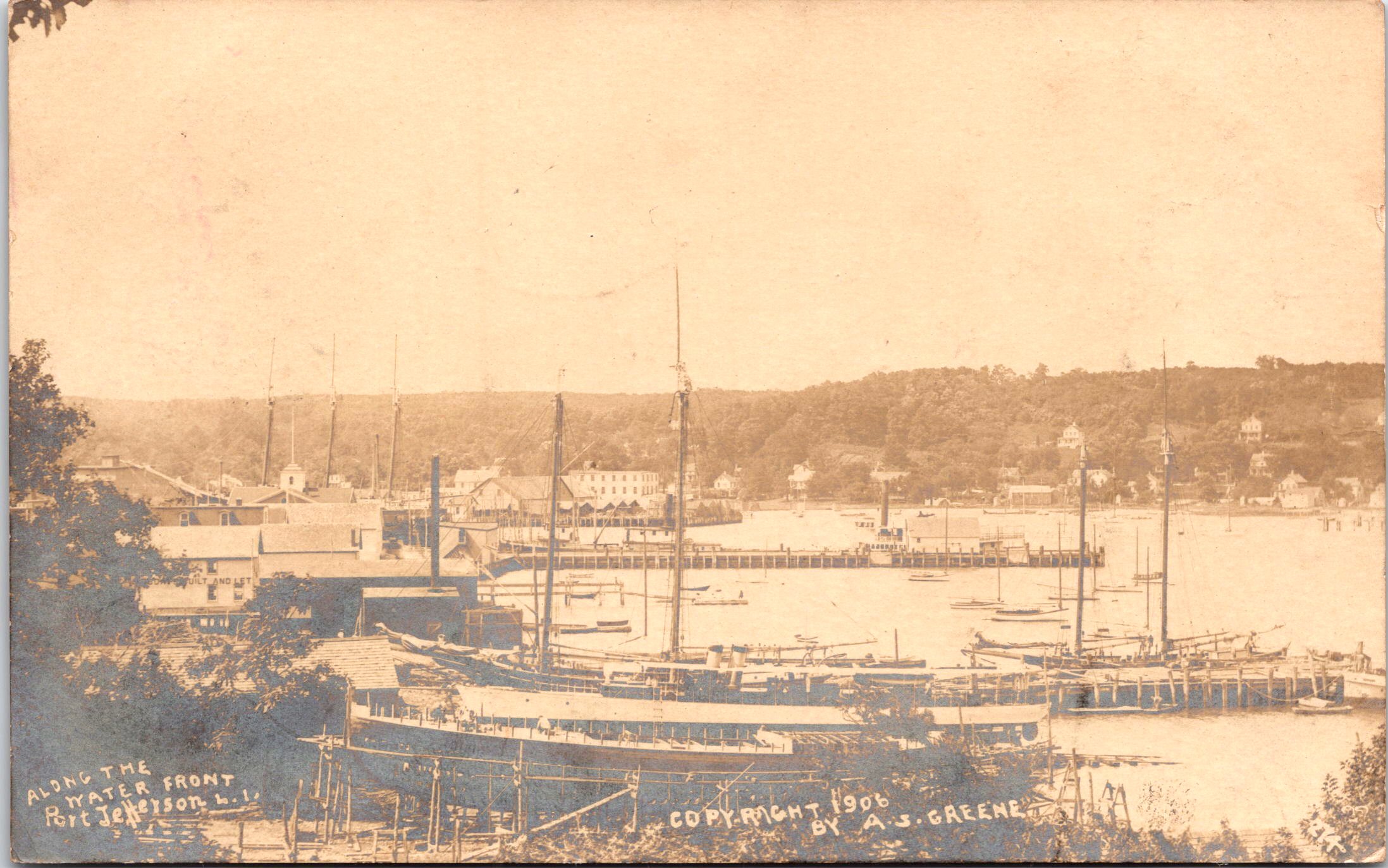
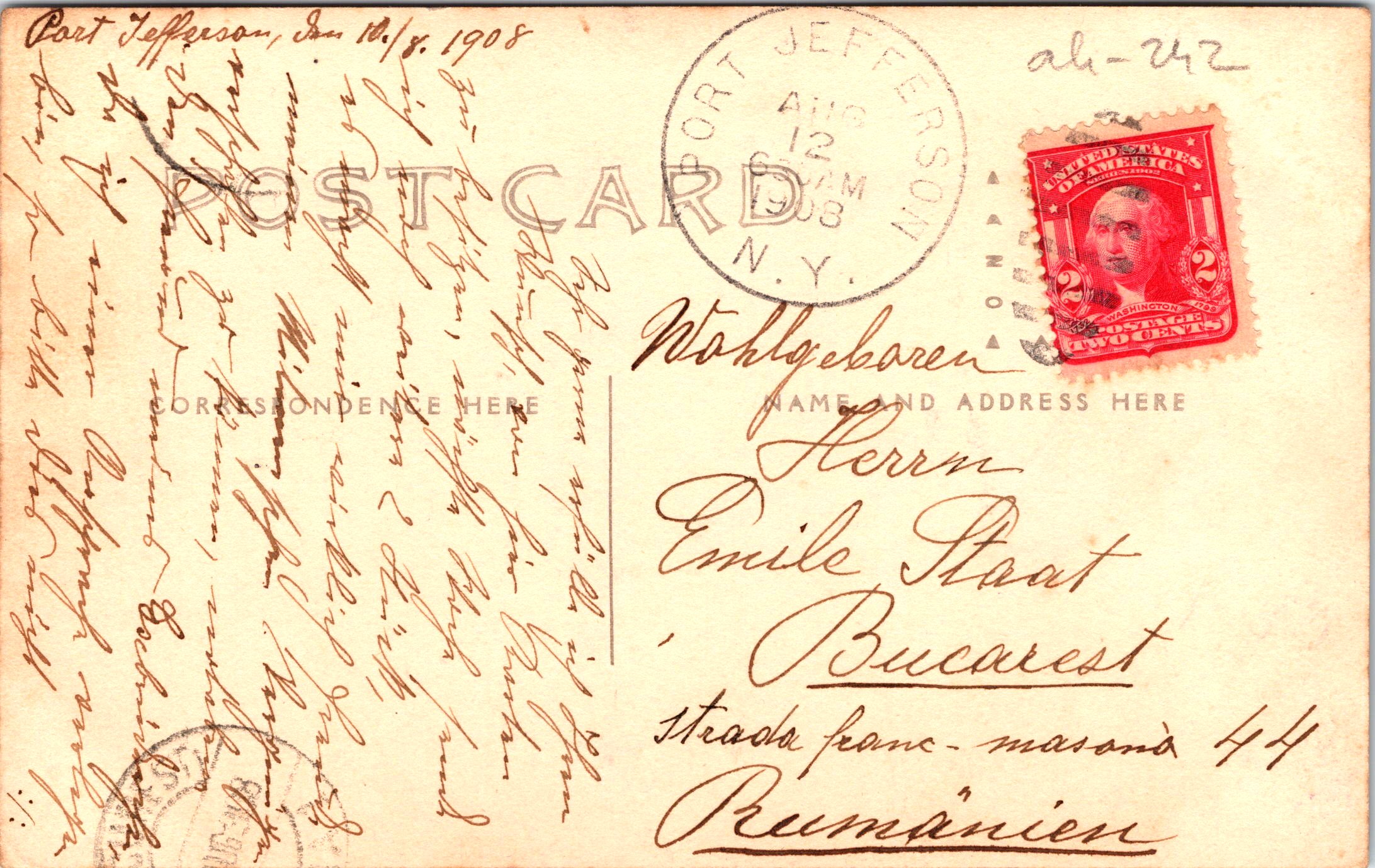
This vintage real photo postcard features a view along the waterfront of the town of Port Jefferson. The town is located in eastern Long Island, New York. The town is located on the Northshore of Long Island and was a port on Long Island Sound. The photo seen on this card, shows many sailing ships. Some of the ships are in dock while others are attached to moorings. The postcard also shows many of the buildings that comprise the town of Port Jefferson. Port Jefferson harbor is the home of “The Bridgeport (Connecticut) & Port Jefferson Ferry”. The firm was established in 1883 and the ferry was originally a steamboat. The ferry company transported passengers but also agricultural goods. One of the founders of the ferry company was entrepreneur and circus owner, P. T. Barnum. This postcard was published by A. J. Greene. The postcard was dated and postmarked in 1908. SOLD
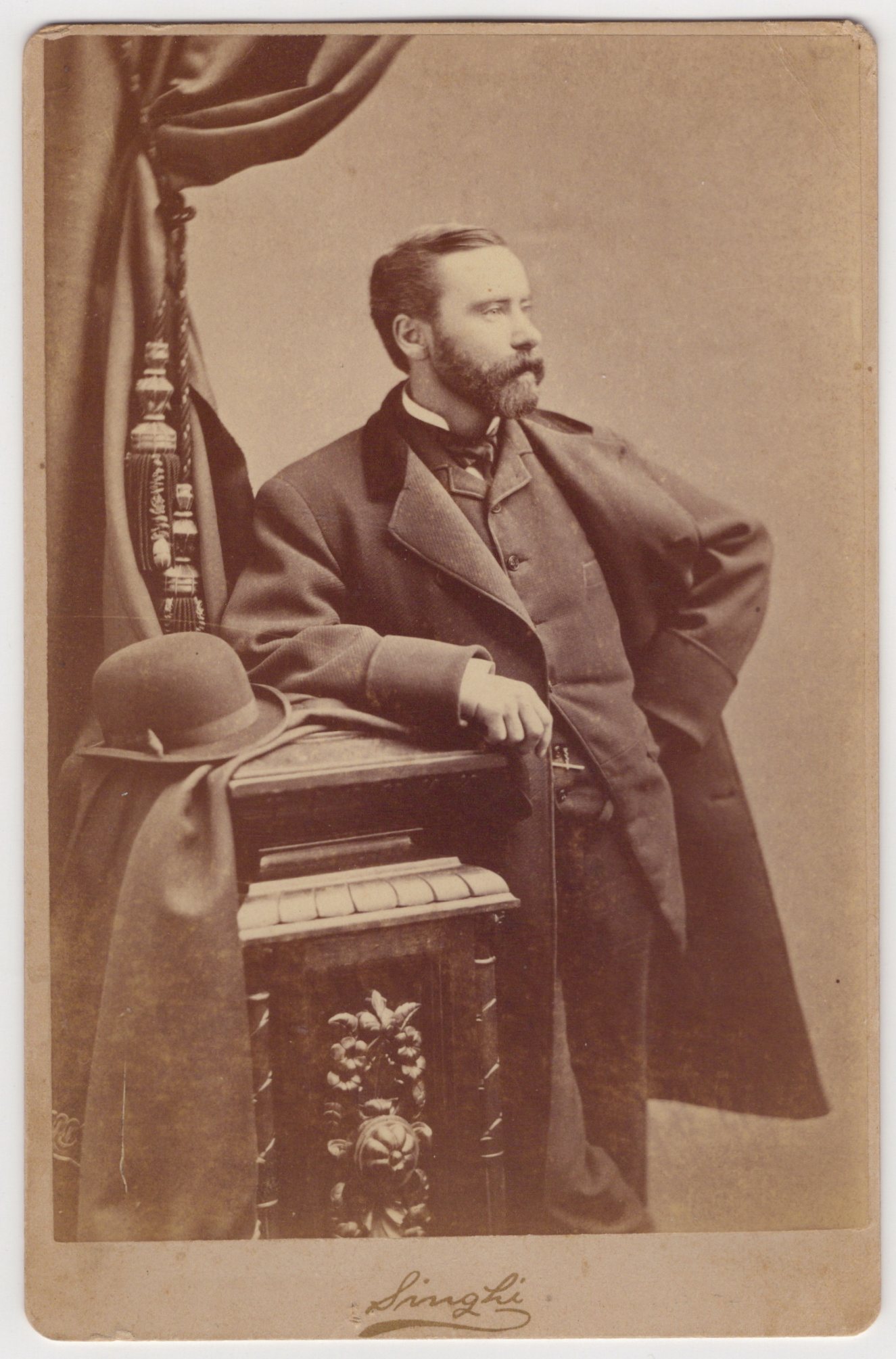
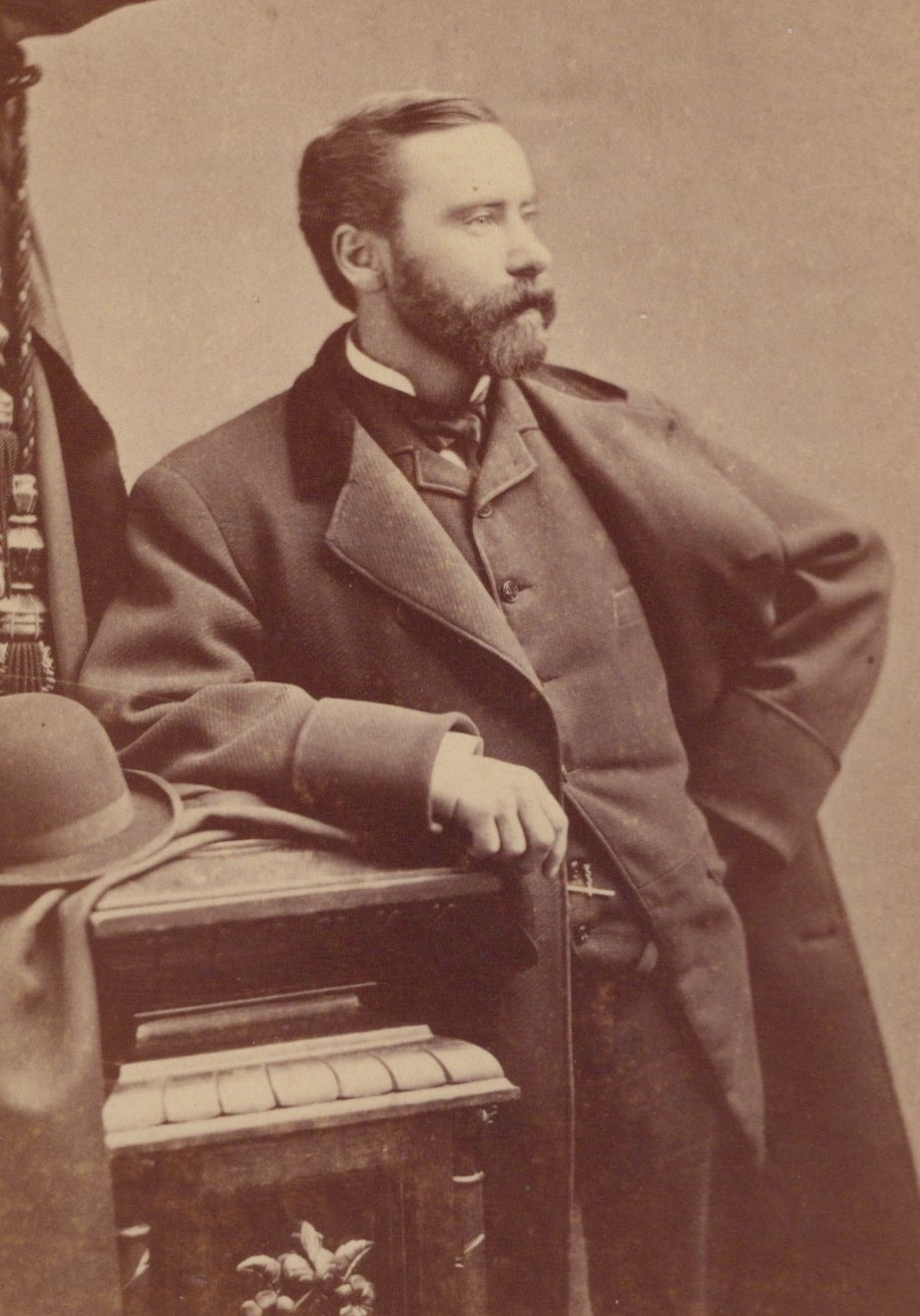
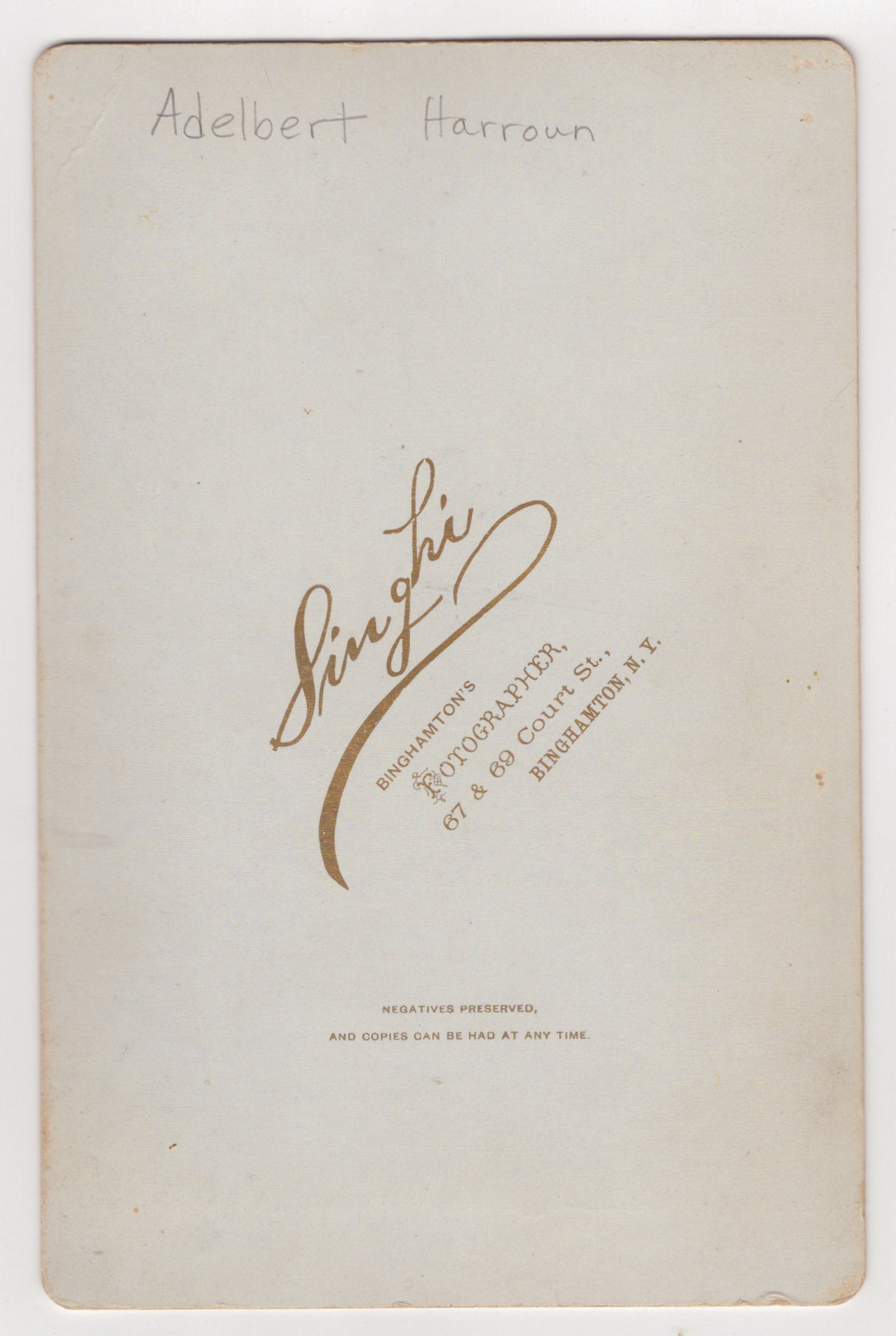
The man in this cabinet card photograph appears to be a professional gentleman. He is wearing an overcoat and a nicely trimmed beard. He is standing next to his derby hat and has a pocket watch. Perhaps the well dressed gentleman is an attorney. Maybe its not a coincidence that the Binghamton, New York based photographer, Singhi, was located on Court Street. The reverse of the photograph has an inscription which identifies the gentleman as “Adelbert Harroun”. Research reveals that Mr. Harroun was not a lawyer but instead, he was an accountant. The 1870 census notes that Thomas Adelbert Harroun (1851-?) was the 19 year-old son of Thomas Harroun (1824-1907) and Salina King Harroun (1824-1903). His father’s occupation was listed as a “Presiding Elder” and further research found that he was a Methodist clergyman. His mother was a homemaker. Adelbert lived with his parents and two siblings in Norwich, New York. Sister Flora (age 22) was a music teacher and brother Arthur (age 11) was a student. He married his wife, Mary Winton, in 1888. The couple had two children. The 1900 census finds the 47 year old Harroun living in Dunleith, Illinois. He was living with his wife, Mary, their son N. Winton (age 10), and daughter Anna Augusta (age 9). Harroun was working as a railroad yard clerk. Further investigation revealed that daughter Anna Augusta died in 1904 in Dubuque, Illinois. The 1920 census reports that the 67 year-old Harroun was widowed and living in Waukegan Lake, Illinois with his sister Flora. He was working as an accountant. The 1930 census locates Harroun in Prineville, Oregon and living as a boarder. At 79 years of his age, he was still working (bookkeeper). The photographer of this image is Will G. Singhi. He worked in Binghamton, New York between 1872 and 1886. His albumen print “A Winter Scene” is exhibited in the online “American Museum of Photography”. Singhi had taken a photograph that appeared to capture a snowball in mid flight heading toward a newsboy who was prepared to deflect it. The museum also has on display a funny cartoon self portrait caricature that Singhi used as an advertisement. The Photographic Times and American Photographer (1883) comments on Singhi’s wonderful sense of humor. SOLD
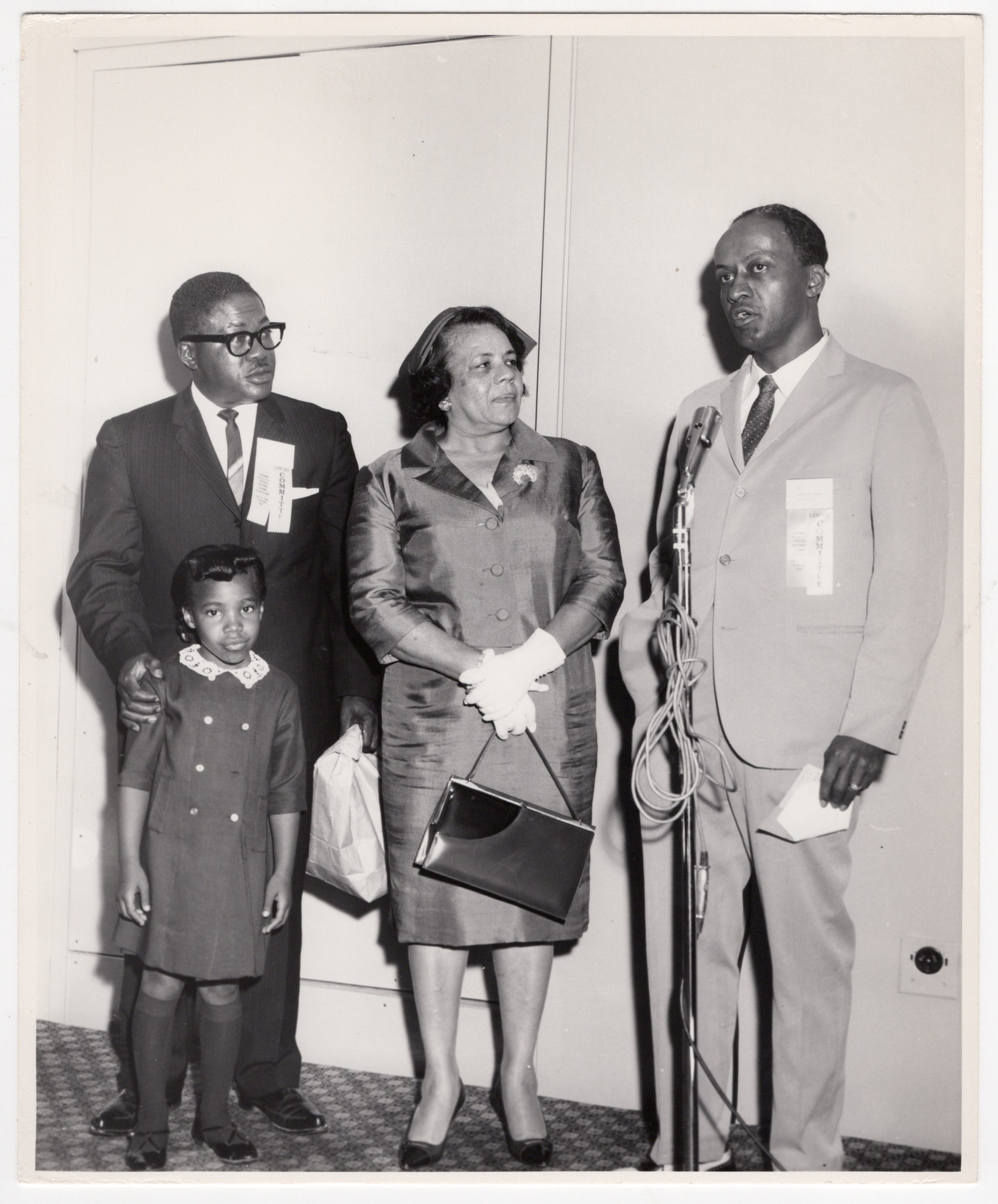
This original black-and-white press photograph was taken by noted Cleveland photo journalist Jimmy Baynes, whose stamp appears on the reverse. Baynes was a prolific photojournalist and chronicler of Cleveland’s African American community during the mid-20th century. His work documented civic events, political gatherings, cultural programs, and the everyday lives of African Americans in Cleveland. His images today stand as a vital record of local history and are increasingly valued by collectors of press photography and African American ephemera. In this photograph, Baynes captures an intimate and historically significant moment at what appears to be a civic or organizational event. The image shows four African American subjects—an elegantly dressed woman wearing white gloves and a matching hat, a man beside her holding the hand of a young girl, and another man standing at a microphone delivering remarks. Close examination of the image reveals that two of the adults are wearing ribbons pinned to their lapels, both reading “COMMITTEE.” The man on the right, speaking into the microphone, also wears an additional ribbon with partial text visible, suggesting this was a formal banquet, conference, or community leadership meeting—possibly church-affiliated or sponsored by a civic organization. The photograph’s composition and tone suggest a moment of recognition or introduction, possibly honoring the central woman—whose dignified attire and central position imply she was a guest of distinction. The expressions of all four subjects convey a deep sense of formality and pride typical of mid-century African American community gatherings. The photo bears the distinctive stamped credit on reverse: “PHOTO BY JIMMY BAYNES”. Jimmy Baynes (1909–2004) was a pioneering African American photographer and journalist based in Cleveland, Ohio, who chronicled the city’s Black community for decades. His work documented social, political, and cultural life—from church events to visits by civil rights leaders. Baynes was known for his ability to capture the essence of African American life, culture, and entertainment from the 1950s through the 1980s. Originally a postal worker, Baynes pursued photography as a passion, ultimately founding Baynes Foto Service. His work chronicled the vibrancy of mid-century African American social life, from intimate gatherings and beauty contests to the pulsating energy of live music performances and political events. Baynes photographed some of the most iconic figures in entertainment history, including Aretha Franklin, Louis Armstrong, Count Basie, Mahalia Jackson, Louis Jordan, Jerry Lee Lewis, the Platters, and the Drifters. His ability to capture both candid and staged moments gave his work a lasting impact, preserving the rich history of Cleveland’s African American community. His legacy is recognized today by institutions such as the Western Reserve Historical Society, the African American Museum of Cleveland, the Rock and Roll Hall of Fame and the Museum Library and Archives in Cleveland, which houses a collection of his photographs, primarily focusing on music and entertainment. In 2010, shortly before his passing, his work was featured in the “Polaroid: Instant Joy” exhibition in Brooklyn, New York, reaffirming his role as a visual storyteller of African American life in the mid-20th century. (SOLD)
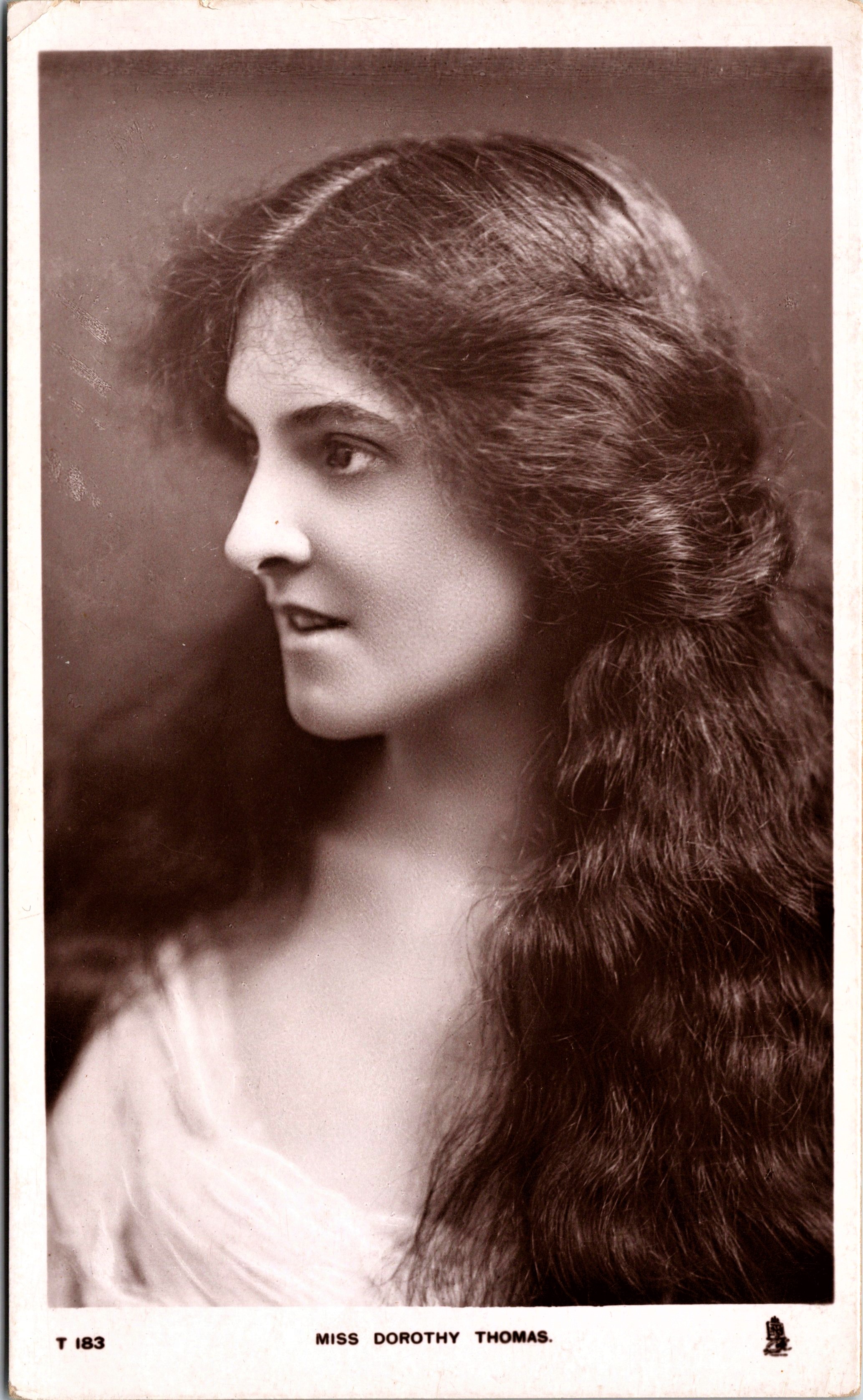
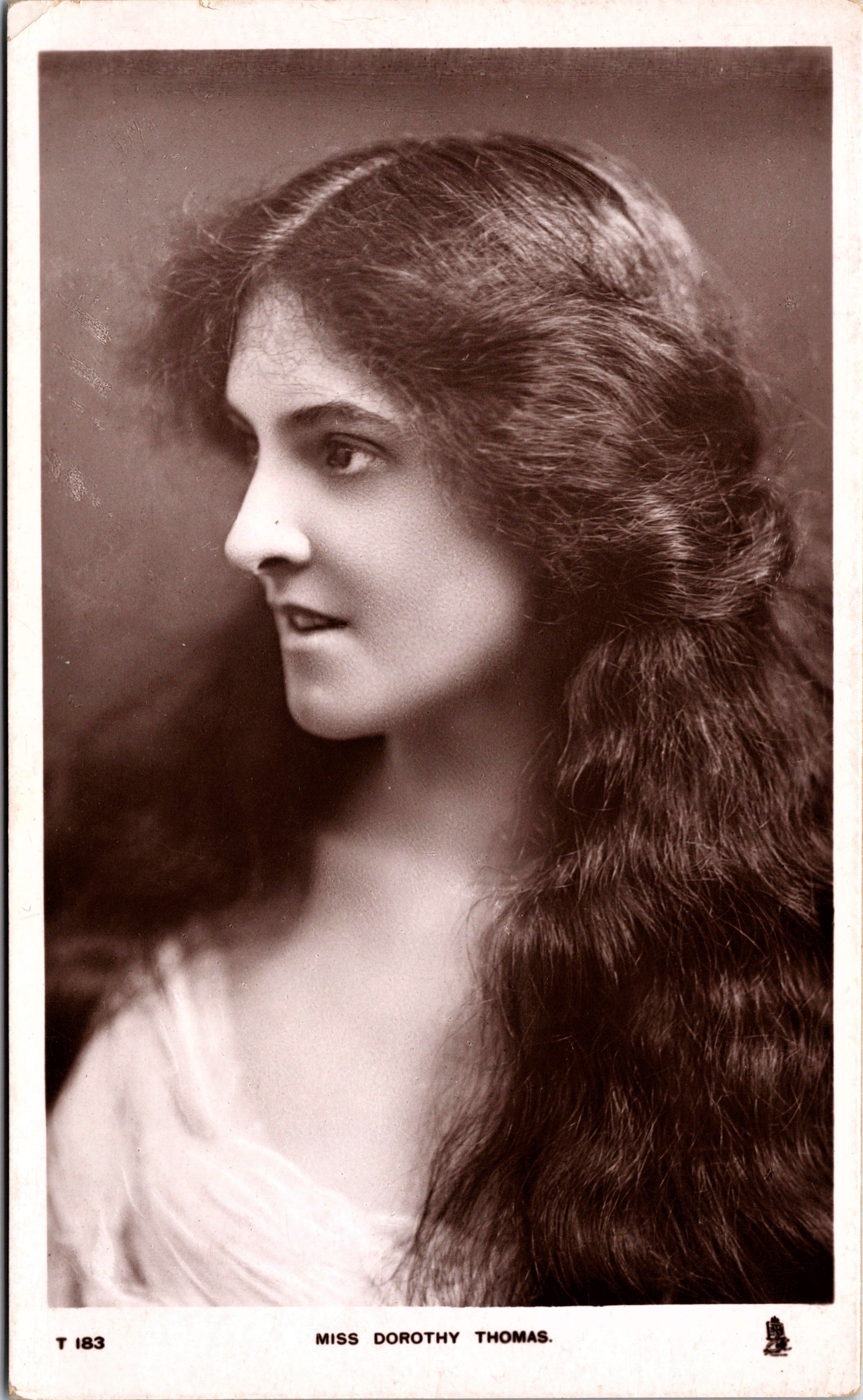
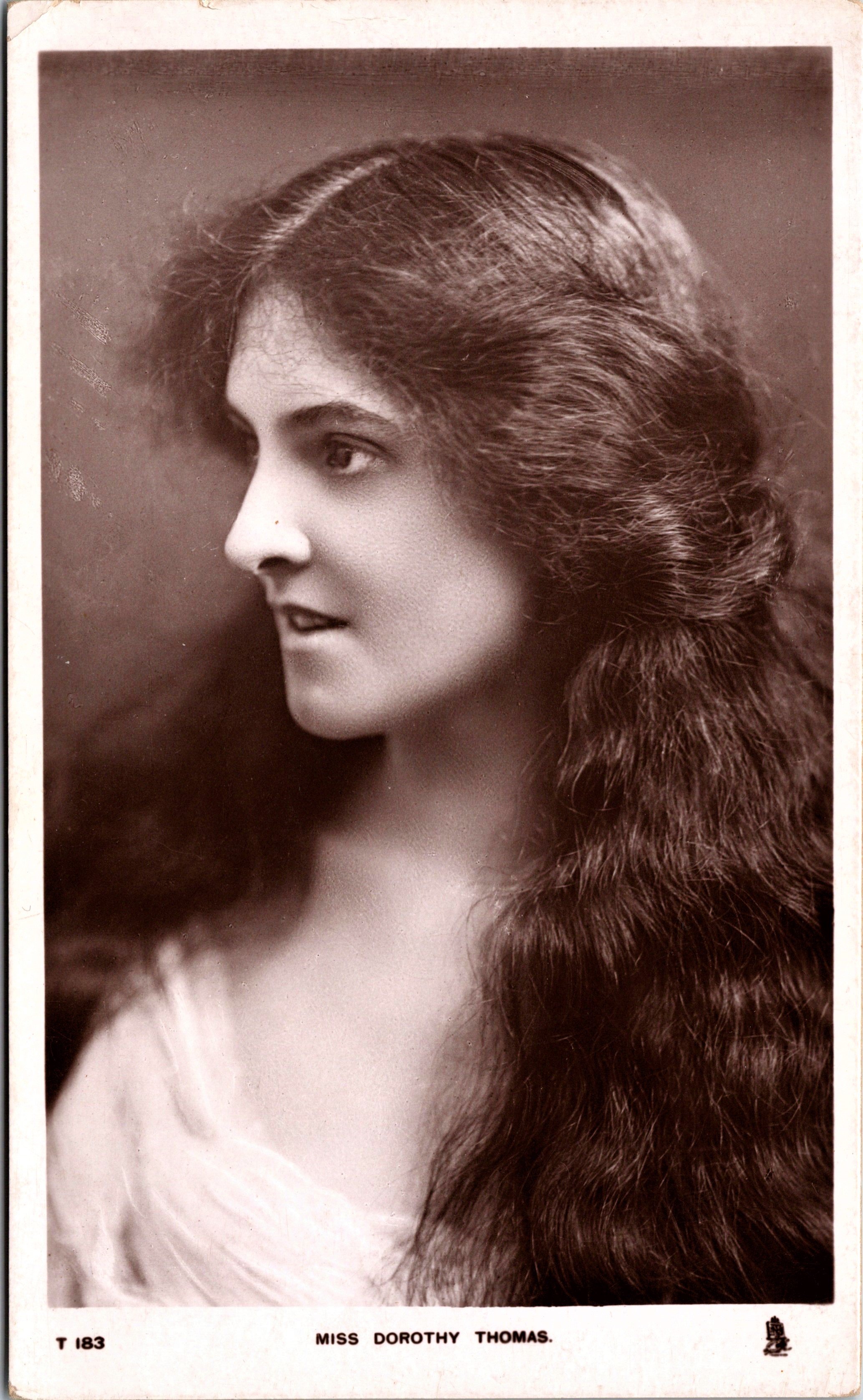
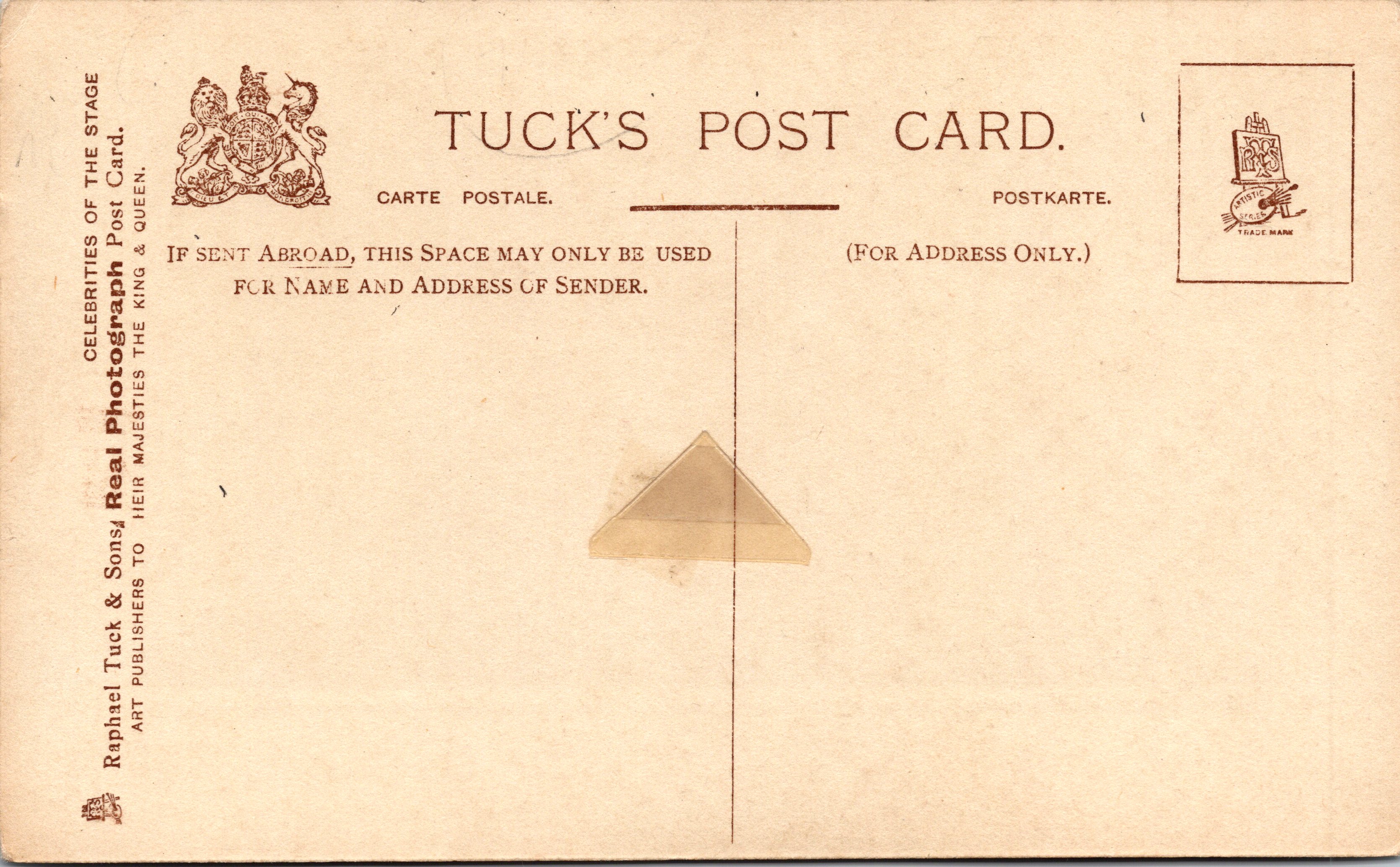
This vintage real photo postcard features stage actress, Dorothy Thomas (1882-?). She sat for five photographs in the collection of England’s National Portrait Gallery. She appeared in “The Prisoner of the Bastille” in 1909. Further research is needed to illuminate details of the pretty actress’s life. This postcard was published by Raphael Tuck & Sons as part of the “Celebrities of the Stage” series (T183).This portrait postcard is in overall good condition. Note the album hinge on the reverse of the card.
Buy this Vintage Real Photo Postcard (includes shipping within the US) #5321
To purchase this item, click on the Pay with PayPal button below
$14.40
Buy this Vintage Real Photo Postcard (includes International shipping outside the US) #5321
To purchase this item, click on the Pay with PayPal button below
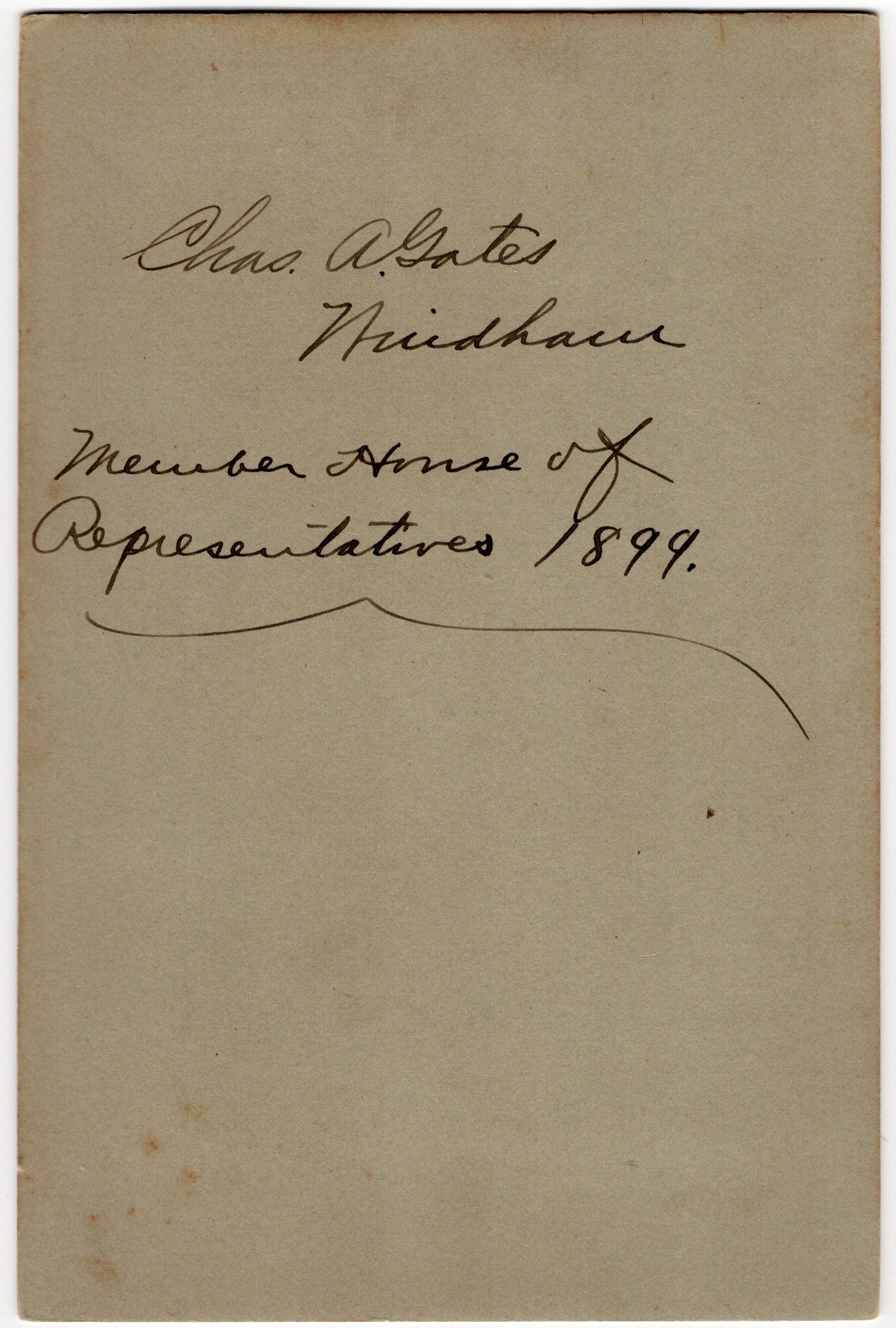
This vintage cabinet card features American politician, Charles Winslow Gates (1856-1927). Gates served in the Vermont House of Representatives (1899-1900), the Vermont Senate (1901-1902), as the state Highway Commissioner, and as the 55th governor of Vermont (1915-1917). He was a progressive Republican governor. In 1916, Gates ran for the US Senate, but lost the election. Gates was born in Vermont. Upon graduation from St. Johnsbury Academy (1880), he became a teacher and then a principal at Franklin Academy until 1884. He than purchased an managed a store while maintaining his farm. He married in 1890. He became a Director of the Enosburg Falls Savings Bank and founded the Franklin Telephone Company in 1895. This cabinet card portrait is in very good condition (see scans).
Buy this Cabinet Card Photograph (includes shipping within the US) #6539
To purchase this item, click on the Pay with Paypal button below
$48.00
Buy this Vintage Original Cabinet Card (includes International shipping outside the US) #6539
To purchase this item, click on the Pay with Paypal button below
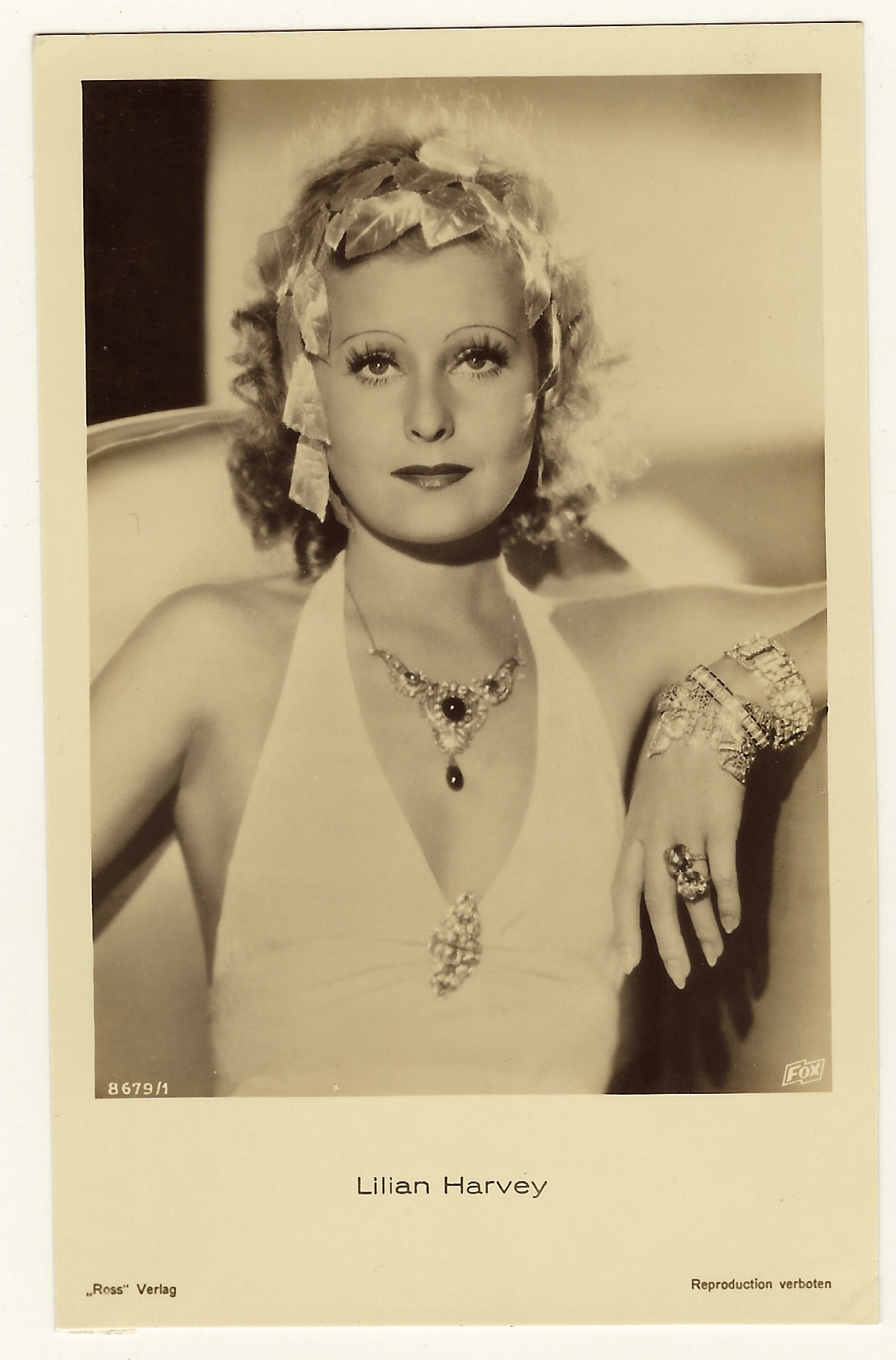
Real photo postcard #1 features Anglo-German actress and singer, Lillian Harvey (1906-1968). Her acting base was in Germany. Harvey was born in Hornsey, England to an English mother and a German father. During World War I her family was “trapped” in Magdeburg, Germany and Harvey was sent to live with her Swiss aunt. After the war she finished school in Berlin and than studied voice and dance at the Berlin State Opera. In 1924 she earned a role as a revue dancer in Vienna. This was followed by her first movie role which was in an Austrian film named “The Curse”. Thereafter, she starred in multiple silent films. Her first leading role was in “The Passion” (1925). Because of her voice training, Harvey was able to make the transition into “talkies”. She and actor Willy Fritsch became the “dream couple” of German movies. The pair acted together in eleven movies. In the 1930’s Harvey’s films appeared in both German and English and she became popular outside of Germany. She went to Hollywood and made four movies for the Fox Film Corporation (this postcard is from that period). In 1935, Harvey returned to Germany. She appeared in several more films and soon she was under the watchful eye of the Gestapo. Harvey had many Jewish friends in the film industry and she was supportive of them. By 1939, Miss Harvey was forced to leave Germany, leaving behind valuable real estate holdings. She went to France where, in 1940, she made two movies for director Jean Boyer. In 1943 she was stripped of her German citizenship because she had performed for French troops. When southern France was occupied by the Nazis in 1942, she emigrated to the United States. During the war she did some theatre acting and also worked as a homeside volunteer nurse. After the war, Harvey relocated to Paris. She went on a world tour as a singer and in 1949 made appearances in West Germany. She spent her retirement on the French Riviera (Antibes) where she had a souvenir shop and raised snails for escargot. Harvey was married one time. Her four year marriage to theater director Hartvig Valeur-Larsen ended in divorce. Eventually she settled down with her female partner Else Pitty Wirth (1907-2007). Interestingly, the two women are buried together in Antibes. The imdb gives Harvey 54 acting credits between 1925 and 1940. Interestingly, Lillian Harvey’s name is mentioned in Quentin Tarantino’s film “Inglorious Bastards” (2009). One of her songs is played on a phonograph and in addition one of the characters in the film mentions liking Harvey’s performance in a film and Joseph Goebbels becomes angry and insists her name never be mentioned in his presence. Click on the link below to hear the Lillian Harvey/Willy Fritsch duet used in the Tarantino movie. The 1936 song is titled “Ich Wollt Ich War Ein Huhn” (I Wish I Was A Chicken). Now would be a good time to discuss this postcard portrait of Miss Harvey. She is looking quite decorated in this photograph. She is wearing a garland of leaves in her hair, a very ornate necklace, a number of large bracelets, two giant rings, and a jeweled clasp on her dress near her cleavage. Note her very notable eye lashes. She is wearing a somewhat provocative dress and it is clear that the aim of the photographer is to emphasize Miss Harvey’s sexiness. The photographer and Miss Harvey succeeded in accomplishing this goal. The postcard was published by the German firm Ross Verlag and was part of a series (no. 8679/1). The postcard credits Fox films. SOLD
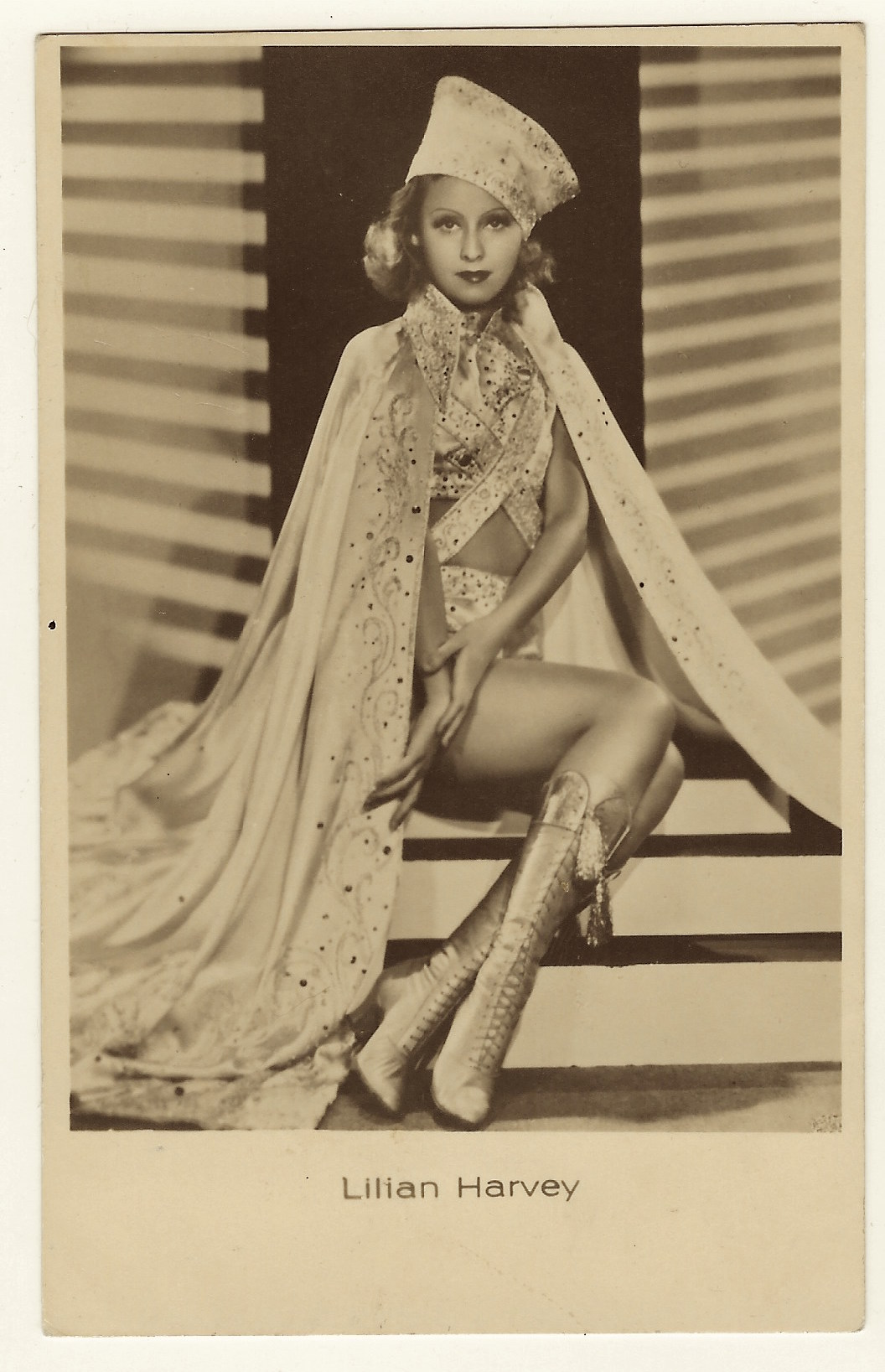
The second postcard (postcard 2) features Miss Harvey in a risque costume. She is showing a “lot of leg” which is quite provocative for her time. It is likely that this image captures her in one of her film roles. The postcard was published by Argenta, which was located in Munich, Bavaria. SOLD
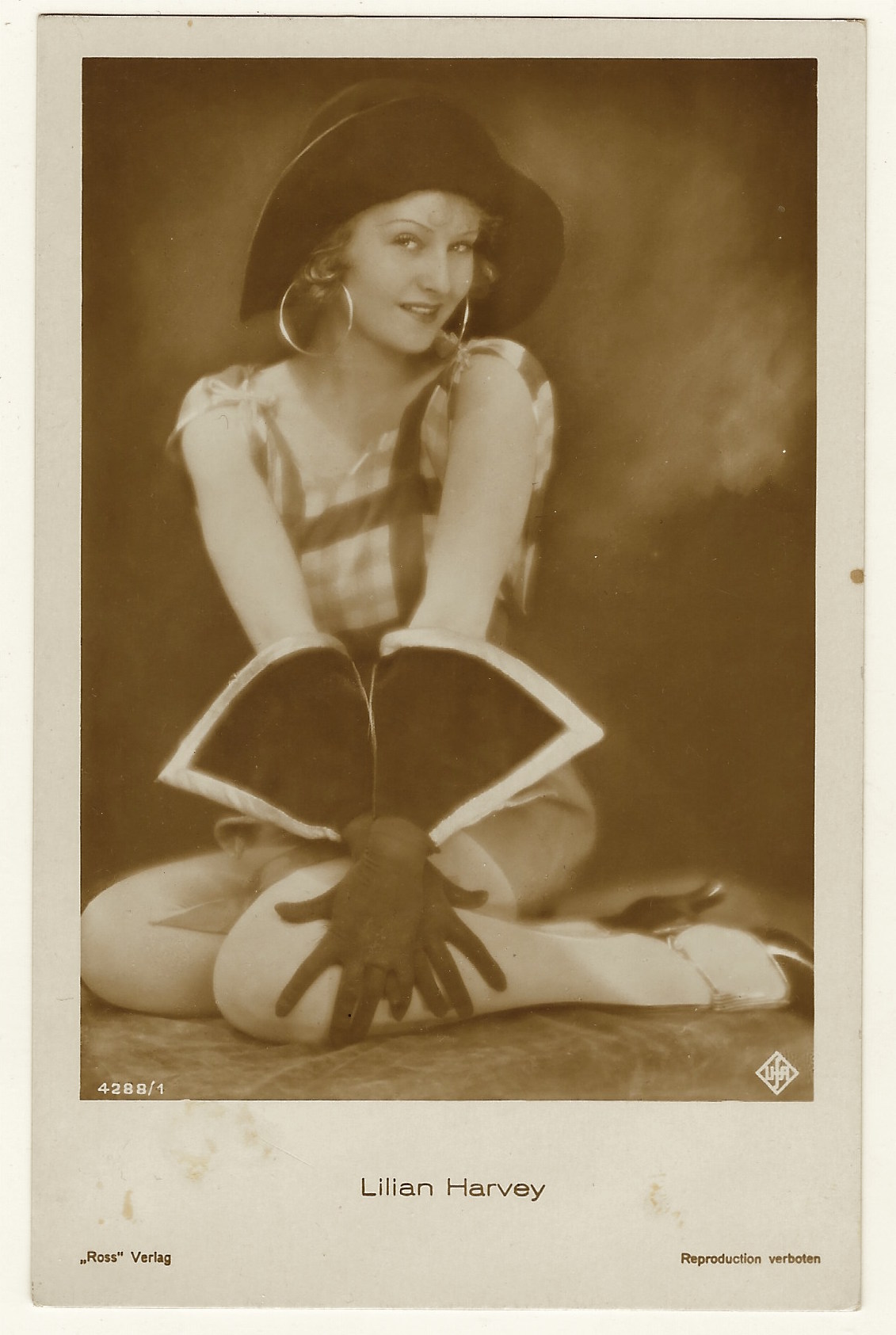
The third postcard (postcard 3) presents Miss Harvey is a sexy pose. Note her dark gloves and large hoop earrings. The postcard was published by Ross Verlag and is part of a series (no. 4288/1). Note the advertising logo for the German film company UFA, located on the bottom right hand corner of the image. (SOLD)
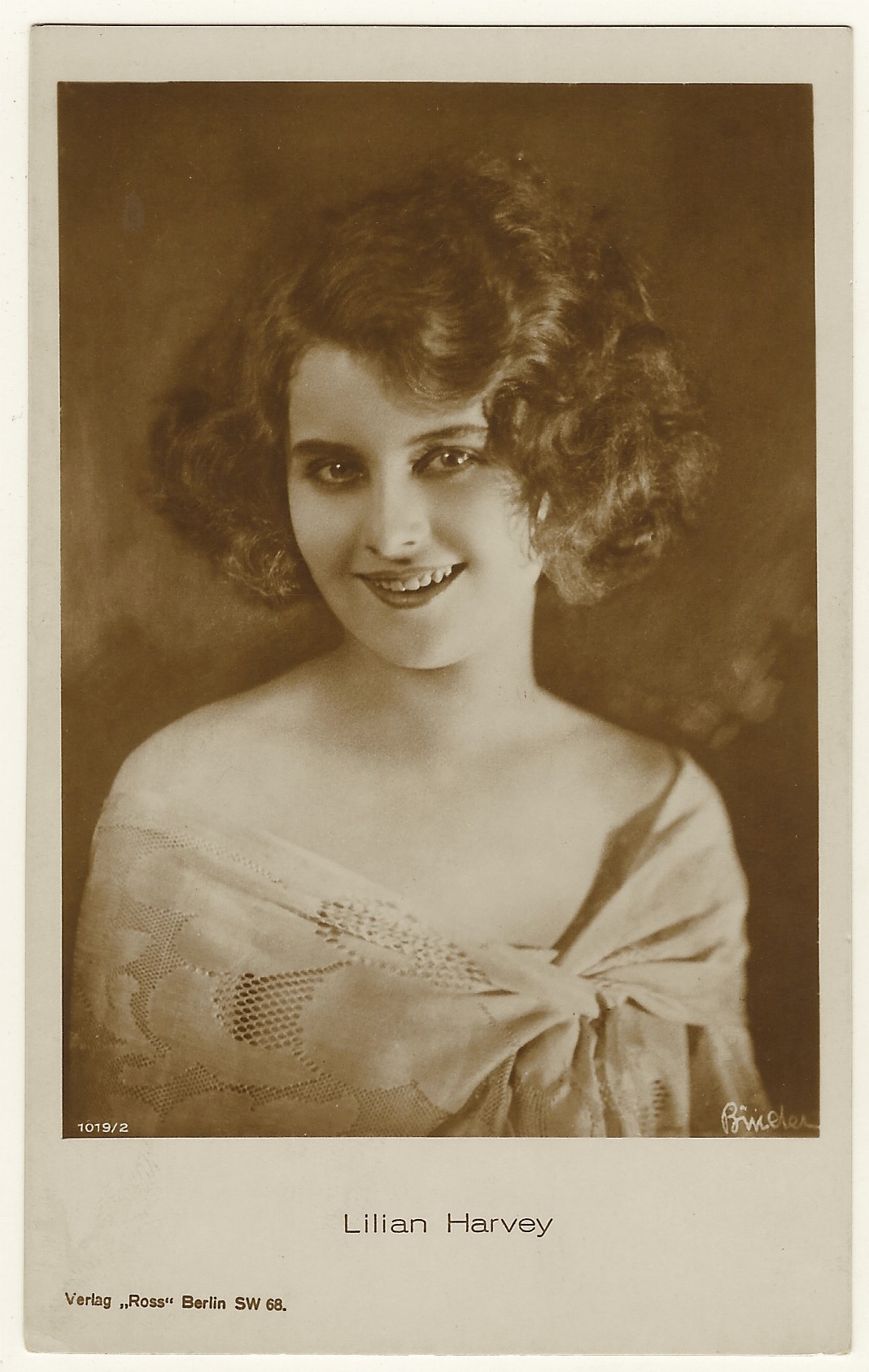
The fourth postcard (postcard 4) showcases Lillian Harvey’s beautiful smile. Miss Harvey’s not quite plunging neckline was clearly aimed to add a bit of a risque element to the photograph. This postcard was published by Ross Verlag (Berlin) and is part of a series (no. 1019/2). This portrait was taken by the talented photographer, Alex Binder. The photographer of this terrific image was Alexander Binder (1888-1929). He had the largest photo studio in Europe during the late 1920’s and the 1930’s. Many of his entertainment star portraits appear on Ross Verlag postards. It is thought that Binder was of Swiss origin. He was of the Jewish faith. He studied engineering but did not complete his studies. From 1908 to 1910 he studied photography at a school in Munich, Germany. After the completion of his photography studies, he went to Berlin and in 1913 opened his first photography studio. Before long, he became one of the premier photographers in Berlin. He primarily focussed on fashion and celebrity photography. Since Berlin was the capital of the European film industry, Binder photographed all the stars of the European film industry including, Lilian Harvey, Conrad Veidt, and Lya De Putti. Many of his images were used in popular film portrait postcards. His photographs could be seen in postcards published by Ross Verlag and Photochemie. Binder died in 1929 but new photo cards bearing his signature continued to be published until 1937.
Buy this original Real Photo Postcard (includes shipping within the US) #2490
To purchase this item, click on the Pay with PayPal button below
$27.50
Buy this original Real Photo Postcard (includes International shipping outside the US) #2490
To purchase this item, click on the Pay with PayPal button below
$35.50
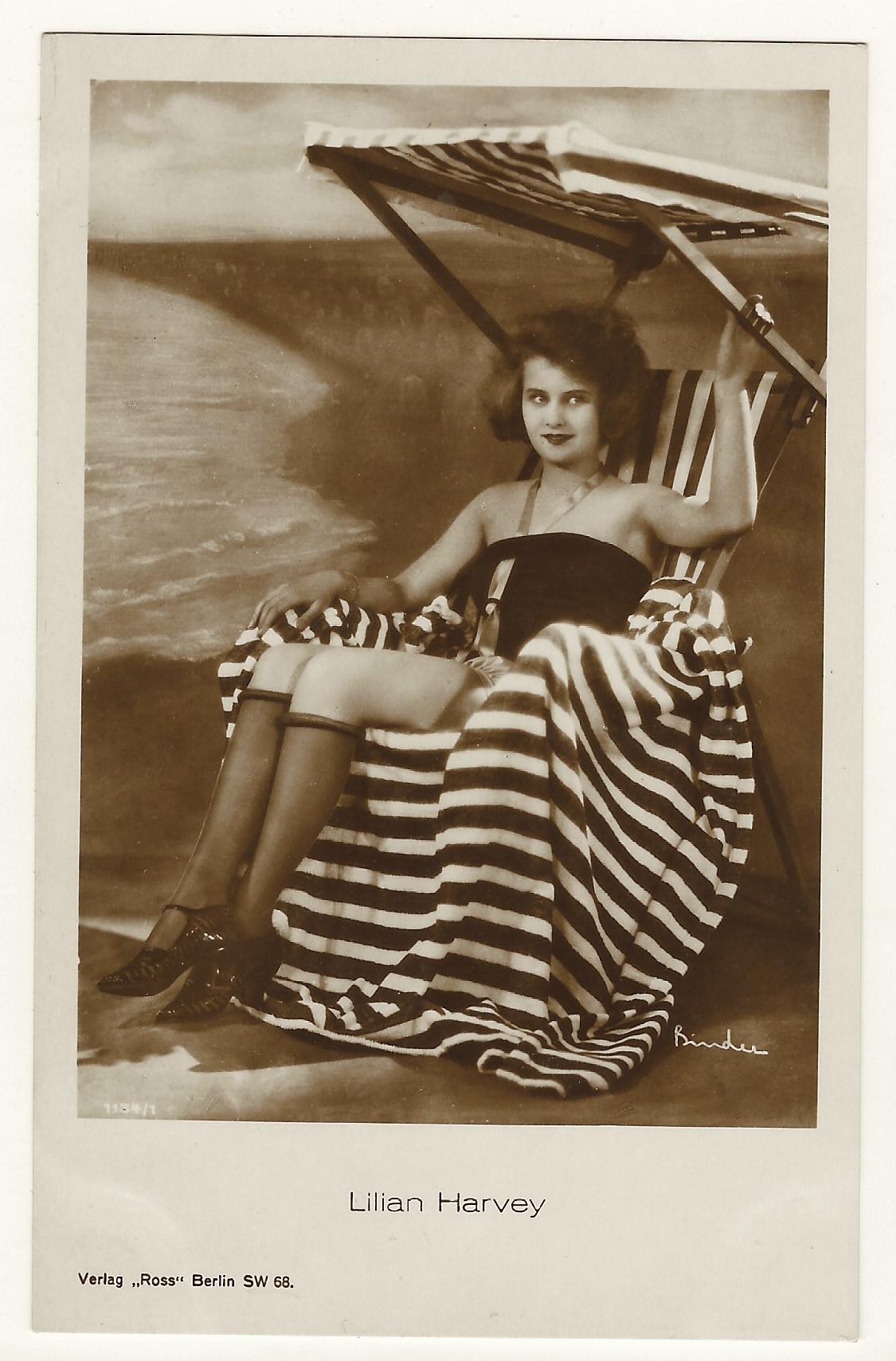
The fifth real photo postcard (postcard 5) features Miss Harvey wearing a bathing suit and sitting in a beach chair. Her shoes and stockings don’t seem very appropriate for the beach so it is a good thing that she is actually in a photographer’s studio and sitting in front of a beach backdrop. Obviously, the mission of the photographer was not to convince viewers that Miss Harvey was at the beach. The intent of photographer Alexander Binder was to present Lilian Harvey in a provocative and sexy pose. Mr. Binder certainly succeeded in accomplishing his goal. This photo postcard was published by Ross Verlag. (SOLD)
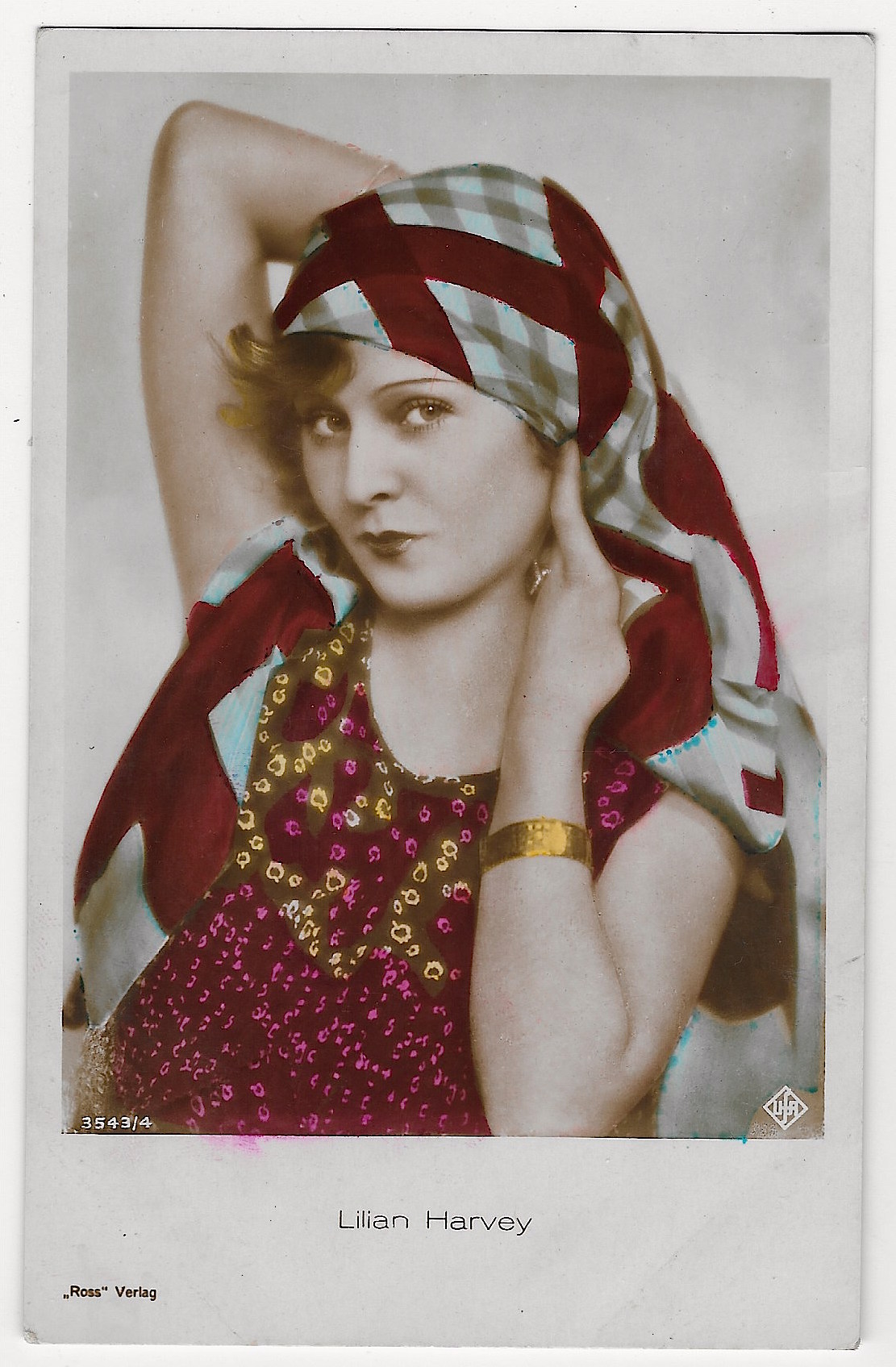
Postcard 6 featuring Miss Harvey, is published by Ross Verlag. The postcard is part of a series (no. 3543/4). She looks fantastic wearing her print dress and plaid long scarf. I’m not convinced the dress and scarf are matching, but her beauty overcomes any mismatch. As in Postcard #3, the logo for the German film company UFA, can be seen on the lower right hand corner of the image. This photo postcard is from the 1930’s and is in very good condition (see scans).
Buy this original Real Photo Postcard (includes shipping within the US) #2488
To purchase this item, click on the Pay with PayPal button below
$35.50
Buy this original Real Photo Postcard (includes International shipping outside the US) #2488
To purchase this item, click on the Pay with PayPal button below #2488
$43.50
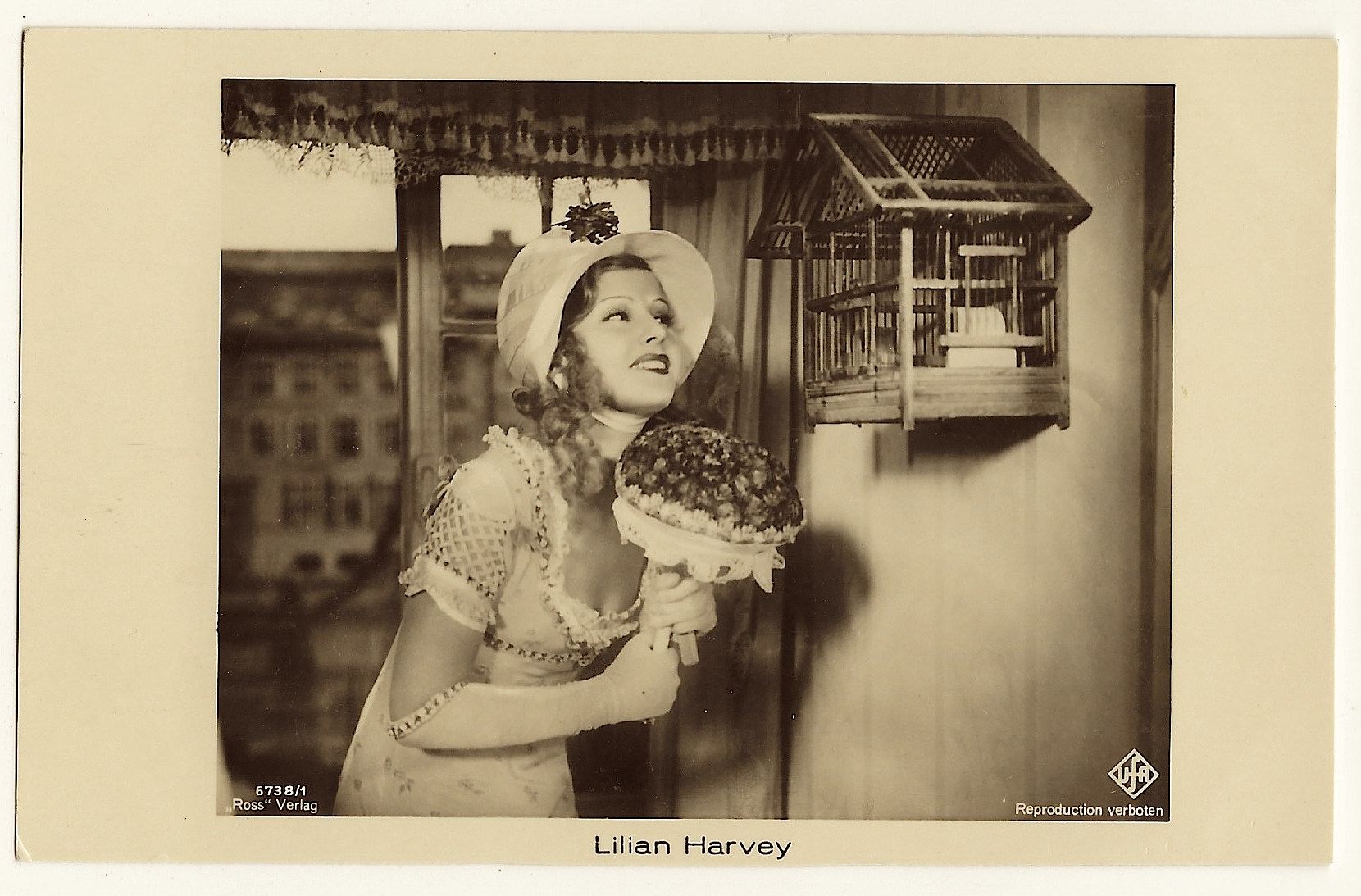
Postcard #7 features Lillian Harvey leaning forward as she looks into a hanging bird cage. The photographer likely chose this pose to inject some sexuality into the image. The pose reveals a small amount of the actress’s cleavage. She is wearing a relatively low-cut dress for this time period. Print on the reverse of the postcard reveals that the photograph of Miss Harvey comes from the film “Congress Dances” (1931). Her costar in the film was Willy Fritsch. The postcard was published by Ross Verlag and is part of a series (no. 6738/1). On the right hand bottom corner of the postcard is the logo for “UFA”, a German film company. This postcard is in excellent condition.
Buy this original Real Photo Postcard (includes shipping within the US) #2520
To purchase this item, click on the Pay with PayPal button below
$28.00
Buy this original Real Photo Postcard (includes International shipping outside the US) #2520
To purchase this item, click on the Pay with PayPal button below
$36.00
Postcard 8 was photographed by Alexander Binder and published by Ross Verlag as part of a series (no.1019/4). Ballerini & Fratini (Florence, Italy) are credited on the reverse of this postcard. (SOLD)
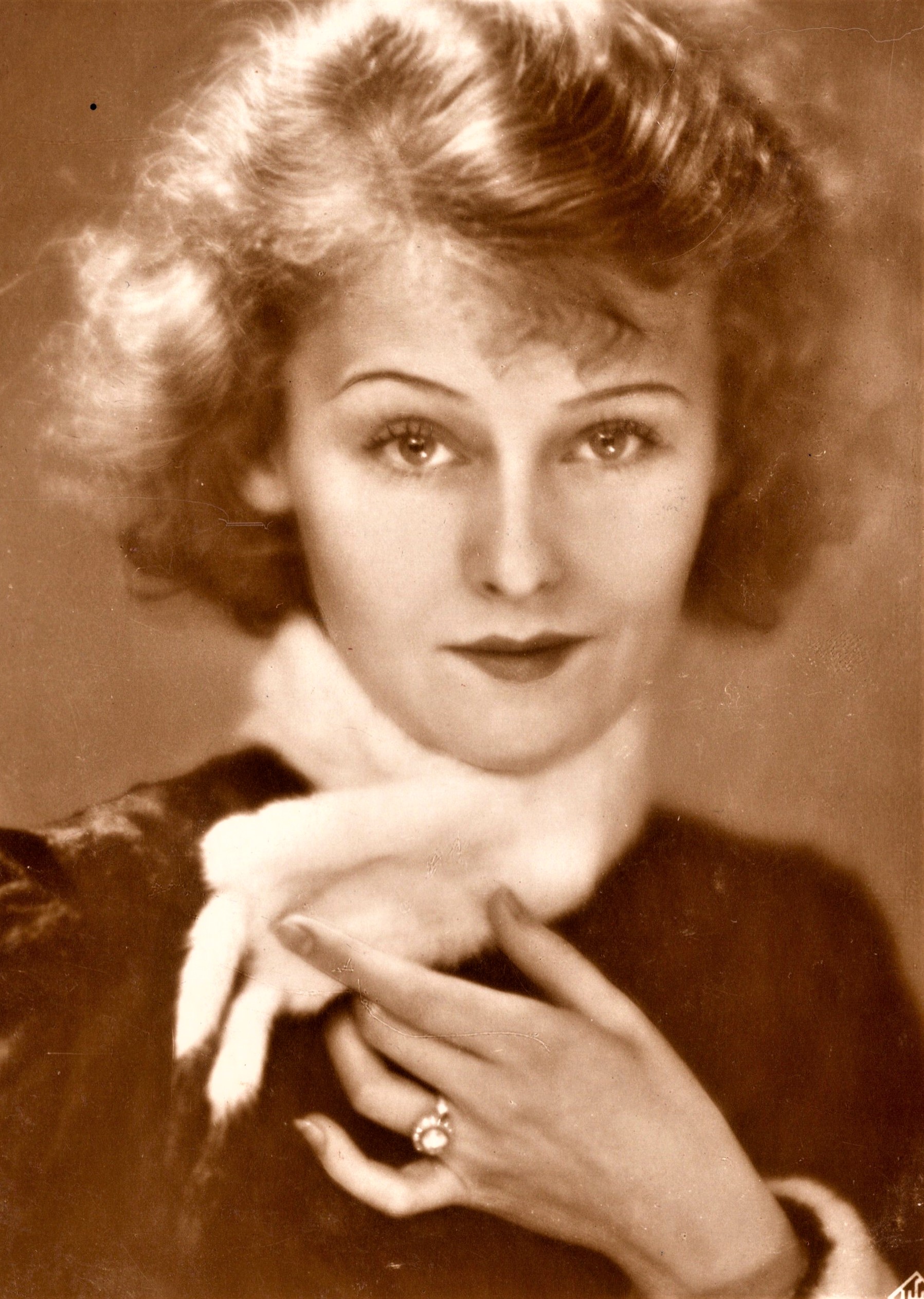
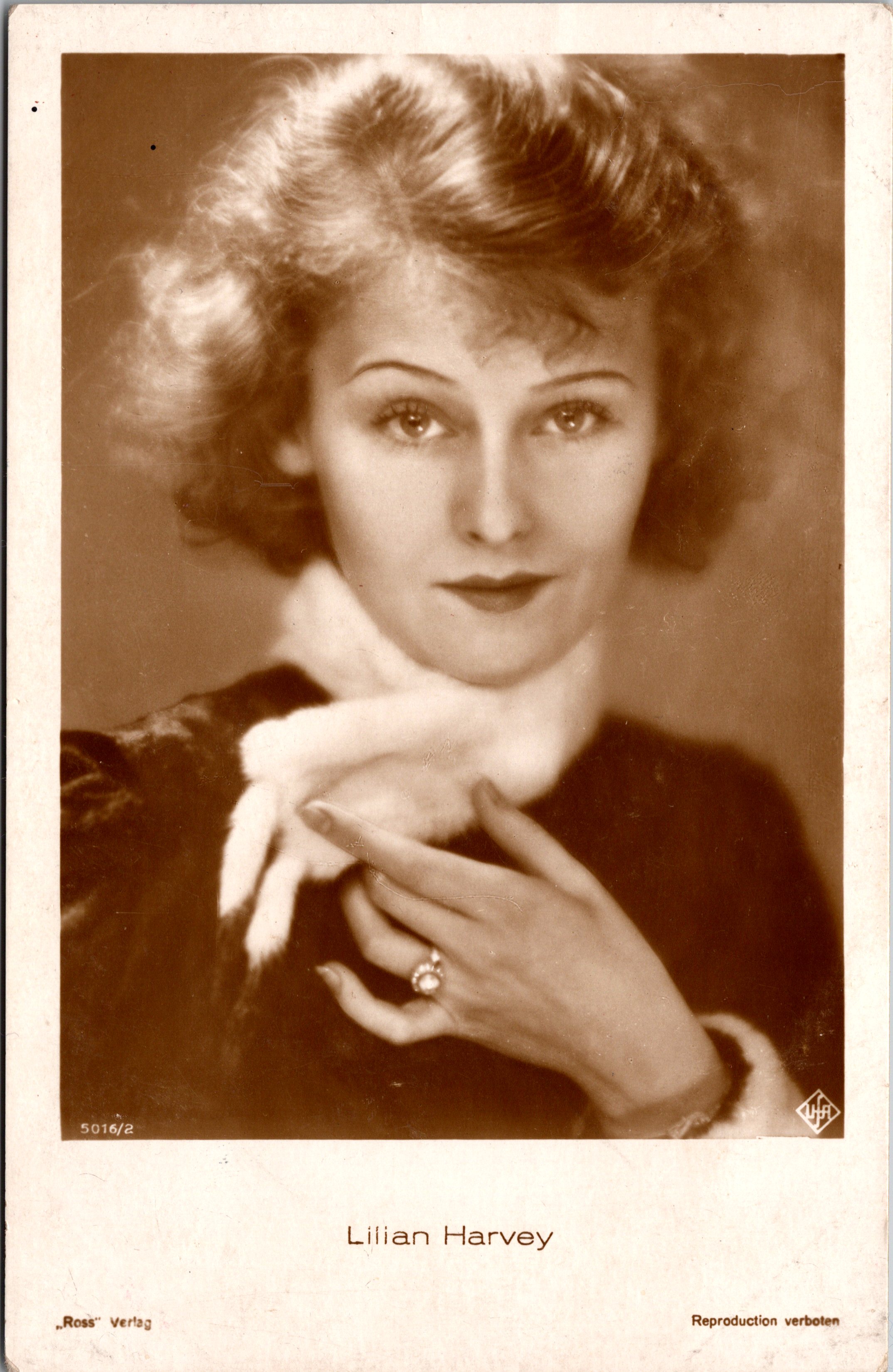
Postcard 9 offers a pretty portrait of Lilian Harvey that was published by Ross Verlag as part of a series (no.5016/2). Note the logo for UFA, the German film company, in the bottom right hand corner of the image. This vintage postcard is in very good conditon (see scans).
Postcard 10 is meant to be risque. Harvey is wearing a provocative dress and it is clear that the aim of the photographer is to emphasize Miss Harvey’s sexiness. The photographer and Miss Harvey succeeded in accomplishing this goal. This card has the logo of Fox Films. She made four films for the company beginning 1931. Lillian Harvey was a popular postcard model and there are many postcard images of her in existence. However, this particular card is very uncommon and one of the more suggestive photographs of Miss Harvey published on a postcard. This postcard portrait was published by Ross Verlag (Germany) as part of a series (No.8000/1). SOLD
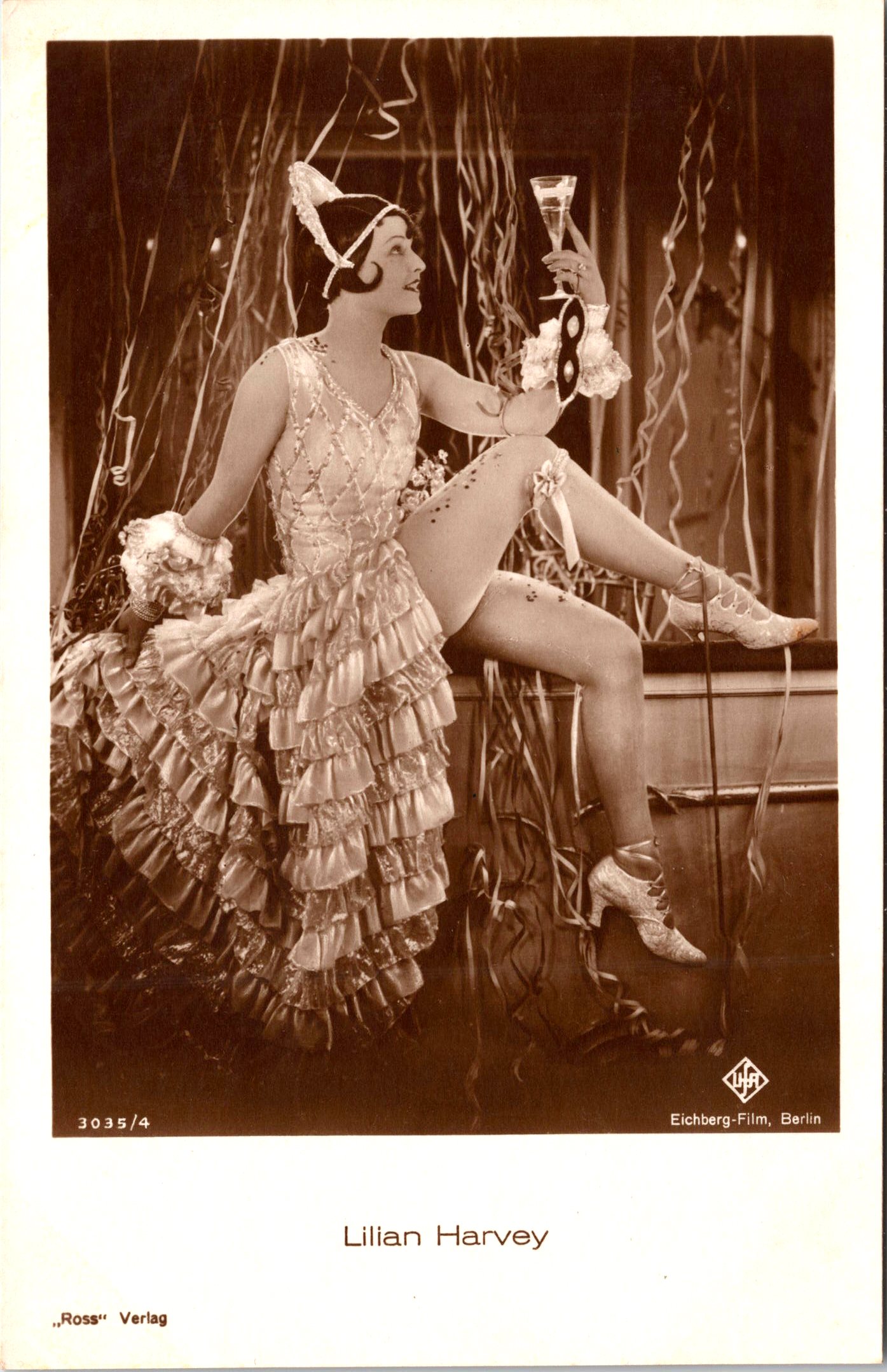
Postcard 11 was published by the German firm Ross Verlag and was part of a series (no. 1393/4). Eichberg Films is credited on the bottom right hand corner of the image. The company was located in Germany. Richard Eichberg was a moderately successful actor who became a director/producr in 1915. (SOLD)
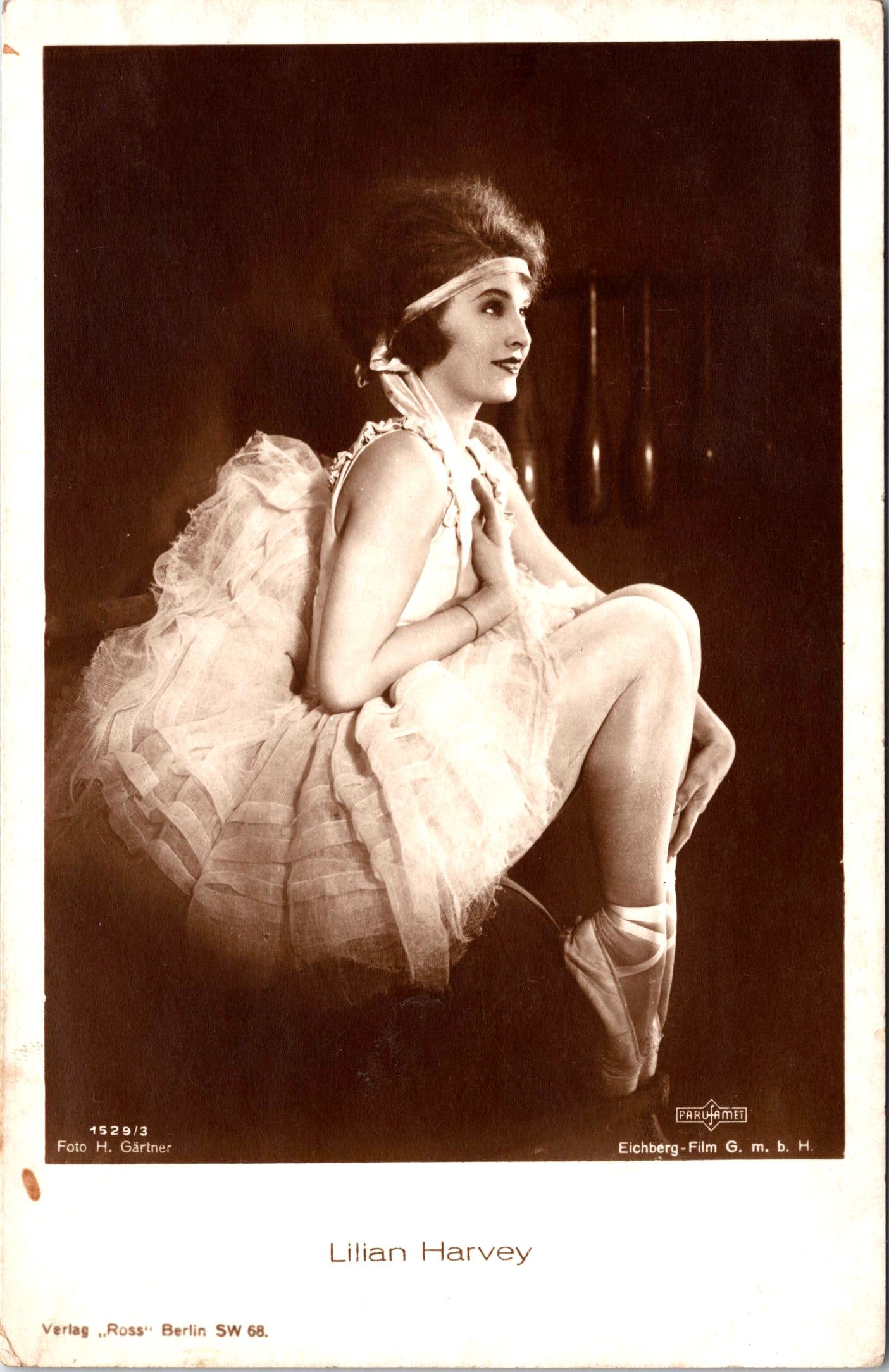
Postcard 12 was published by the German firm Ross Verlag and was part of a series (no. 8679/1). She is posed in a bit of a provocative pose and is smoking a pipe. This postcard portrait was photographed by H. Gartner and published by Ross Verlag as part of a series (no.1529/1). Eichberg Films is credited on this postcard. Richard Eichberg (1888-1952) began his career as an actor but became a succssful film director and producer in the German film industry. He directed 87 films and produced 77 films. (SOLD)
Buy this Real Photo Vintage Postcard (includes shipping within the US) #5112
To purchase this item, click on the Pay with PayPal button below
$15.79
Buy this Vintage Real Photo Postcard (includes International shipping outside the US) #5112
To purchase this item, click on the Pay with PayPal button below
$25.04
POSTCARD 13
POSTCARD 14 (SOLD)
POSTCARD 15 (SOLD)
POSTCARD 16(SOLD)
Postcard 13 was published by Ross Verlag and features Miss Harvey posed in a provocative manner. This postcard has a French stamp and was postmarked in 1929 in Paris, France.(SOLD)
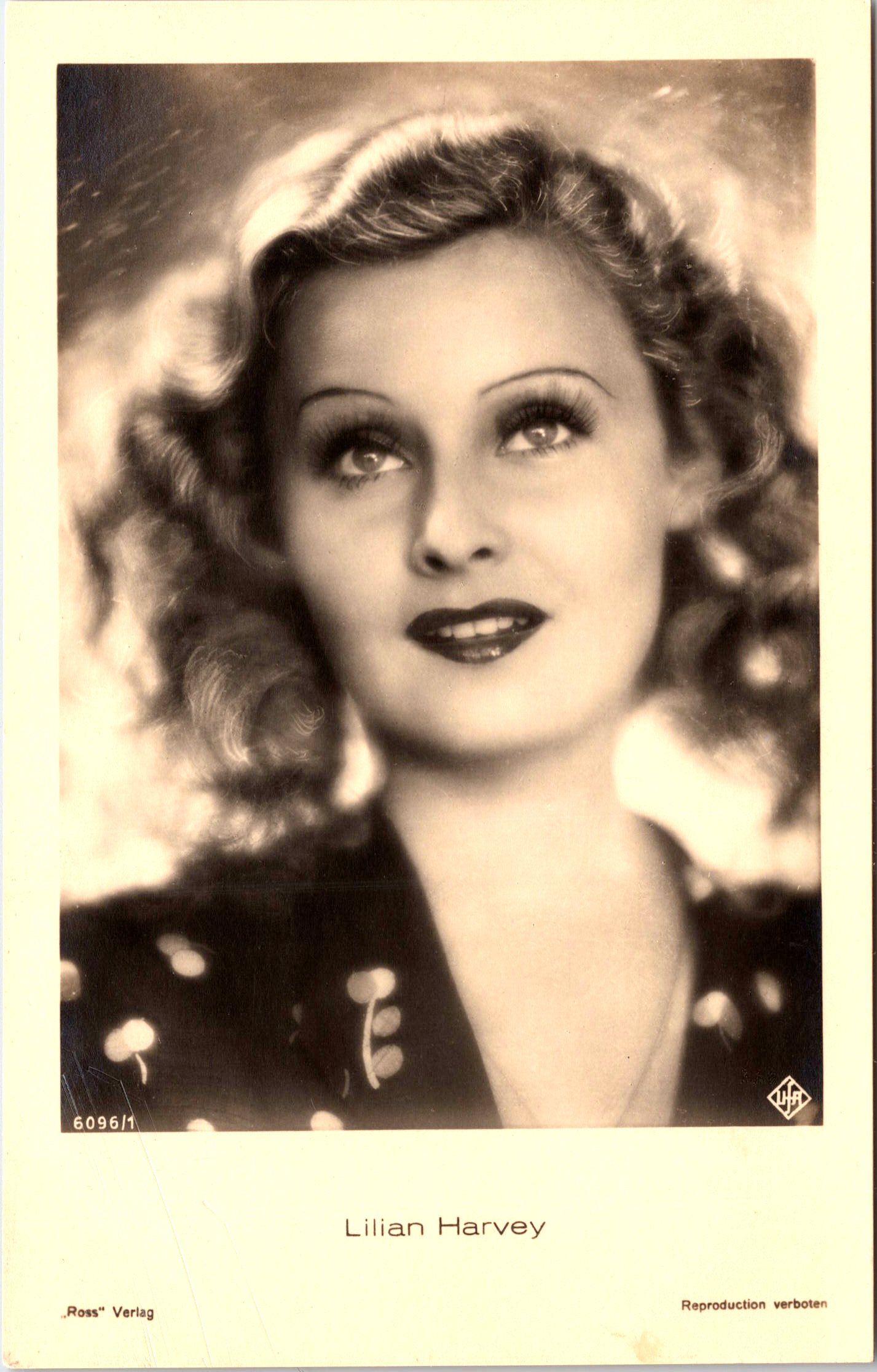
Postcard 14 was published by the German firm Ross Verlag and was part of a series (no. 6096/1). UFA Films is credited on the bottom right hand corner of the image. The company was located in Germany. SOLD
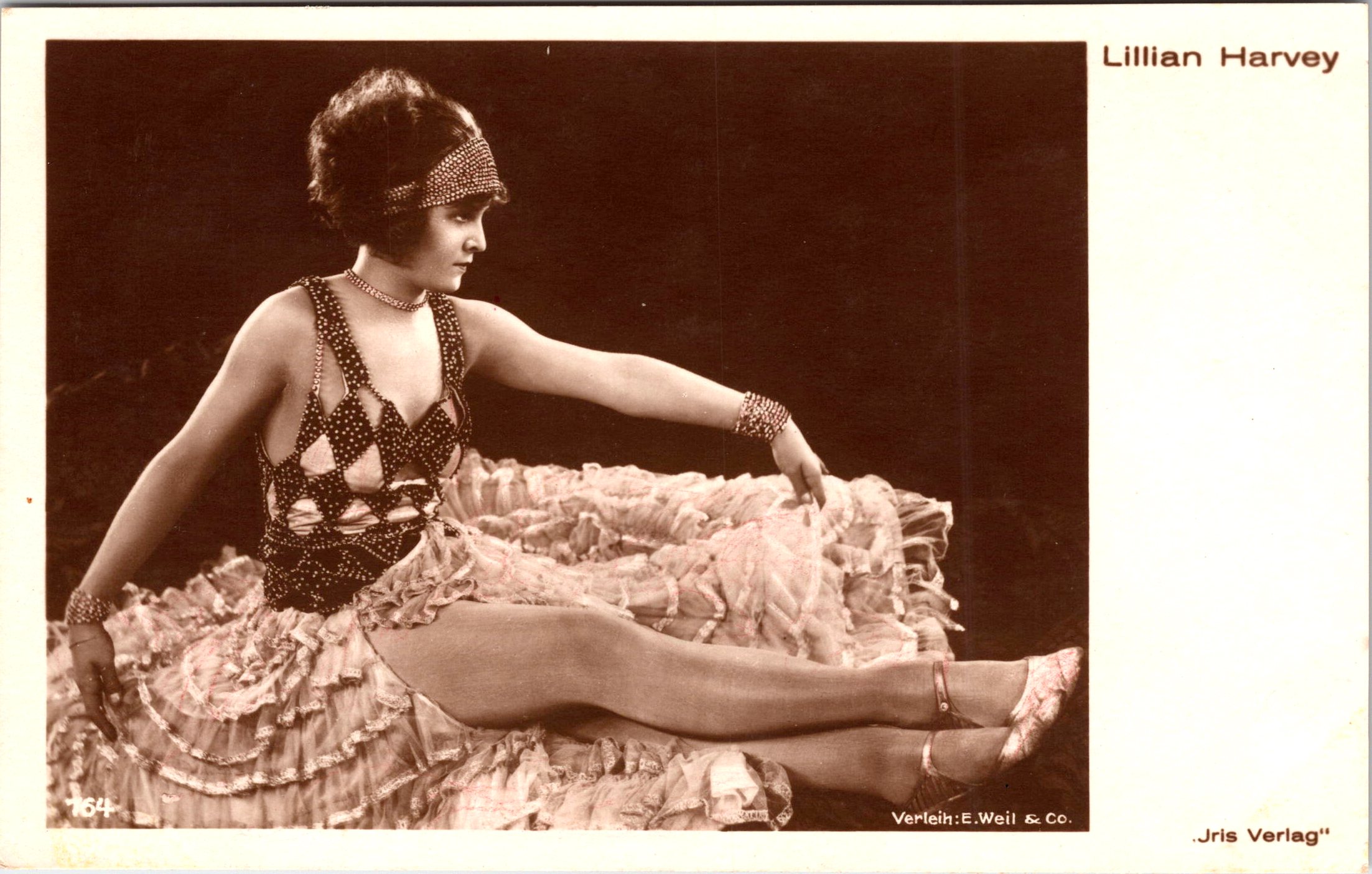
Postcard 15 shows Lillian Harvey wearing a ballerina costume and it is clear that the aim of the photographer is to emphasize Miss Harvey’s sexuality. The photographer and Miss Harvey succeeded in accomplishing this goal. The postcard was published by the Austrian firm Iris Verlag and was part of a series (no.764). Iris Verlag in Vienna was the most important Austrian publisher of film star postcards. The photographer of this portrait was E. Weil & Co. SOLD
Postcard 16 was published by Ross Verlag. It was part of a series (no.2033/1). The postcard has the logo of “Fanamet” in the lower right hand corner of the image. “Fanamet Films” was an Austrian film distribution company. The logo for “First National Pictures” is located on the bottom left hand corner of the image. First National Pictures was an American motion picture production and distribution company. The company was founded in 1917 as a theater chain. It then began distributing movies and in 1924 it began producing films. In 1929 the company was absorbed by Warner Brothers. (SOLD)
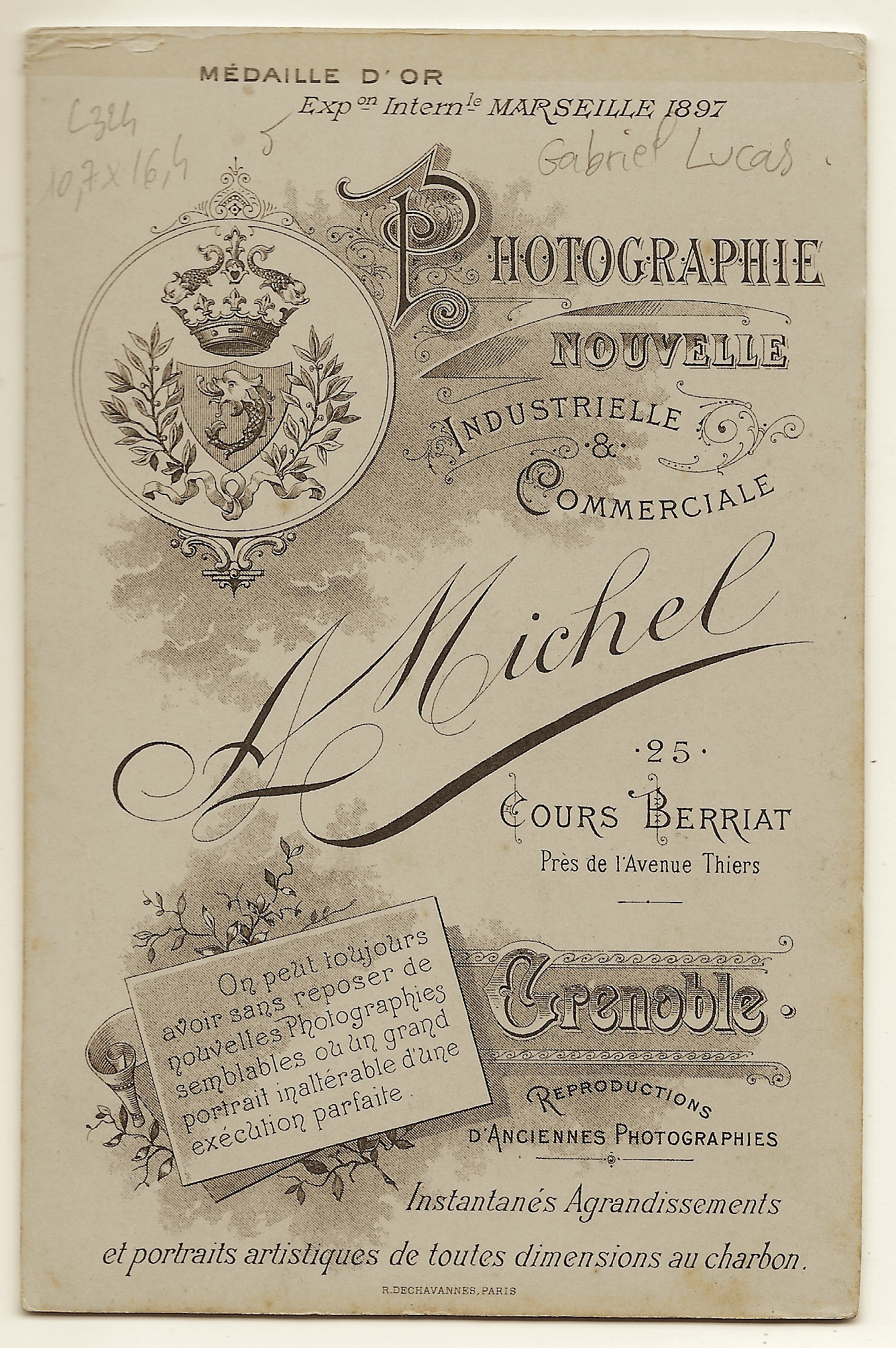
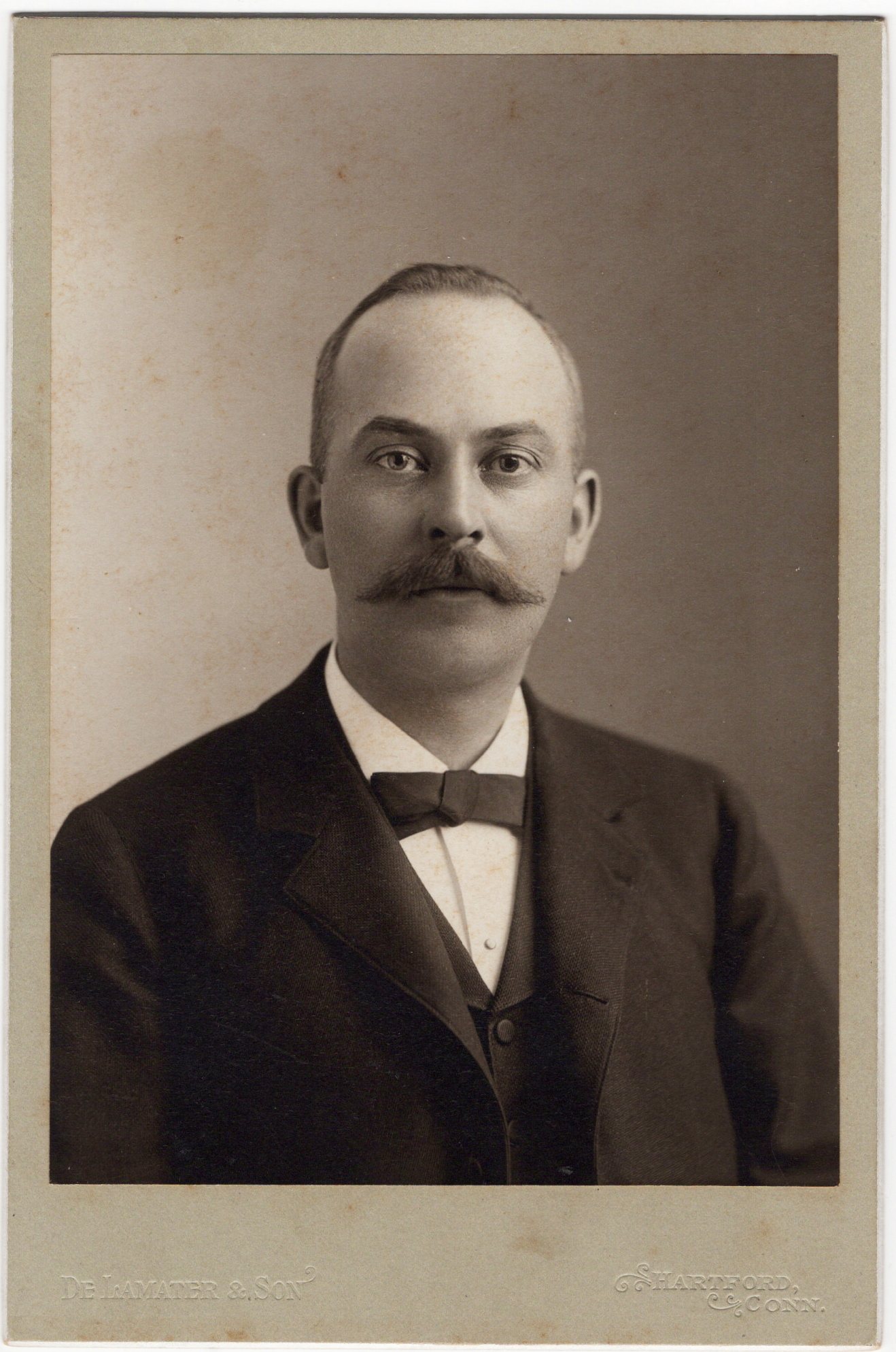
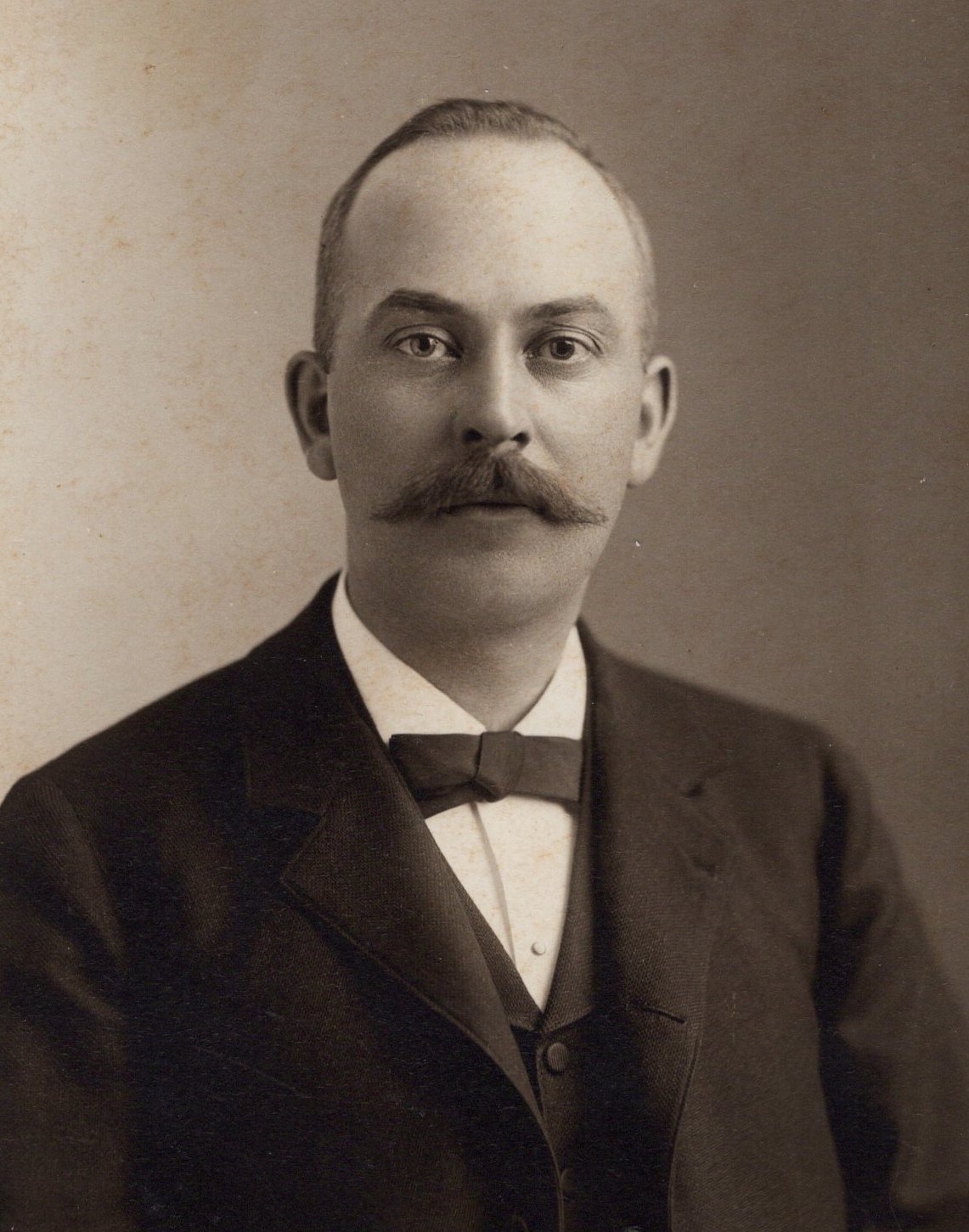
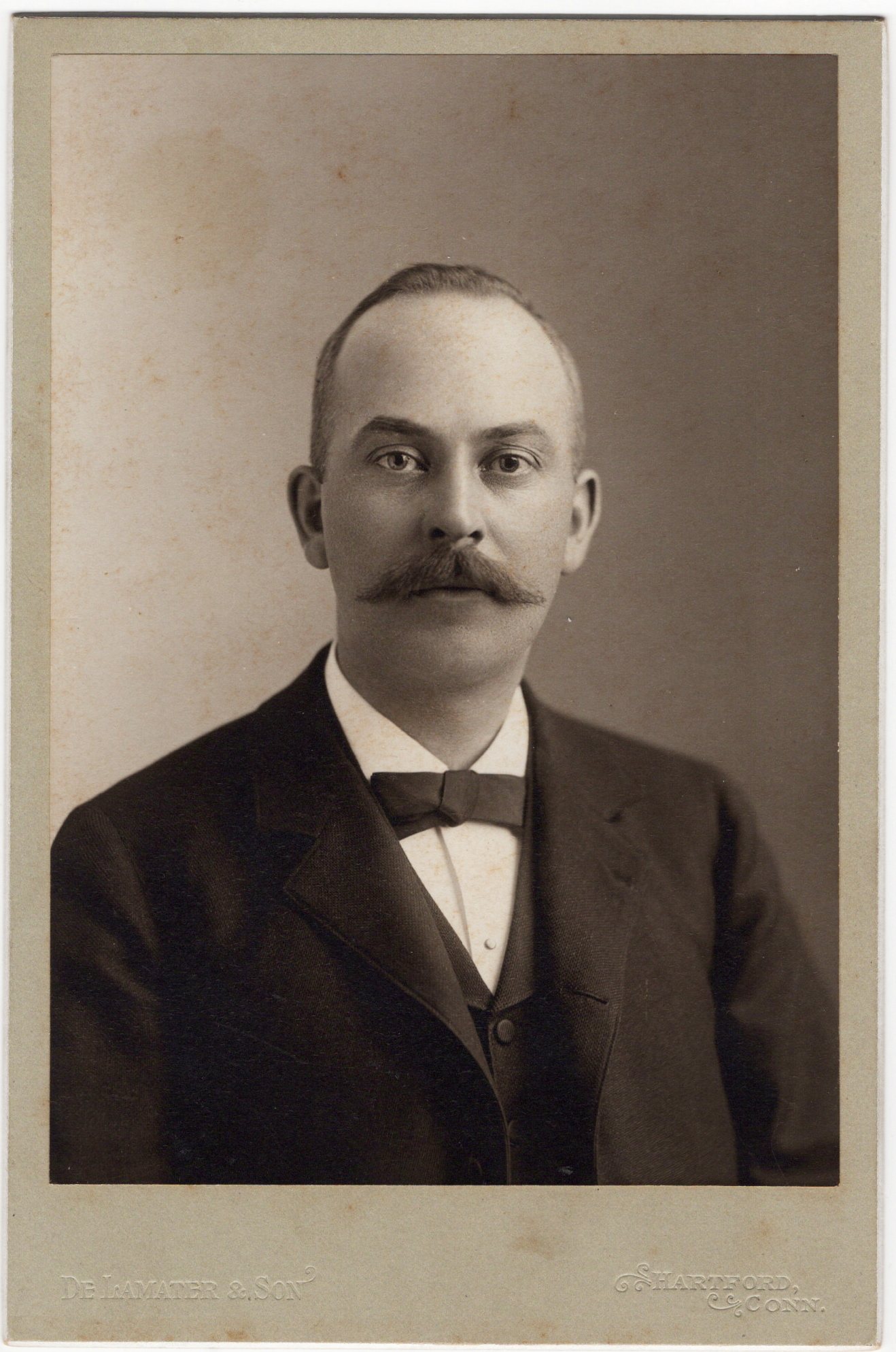
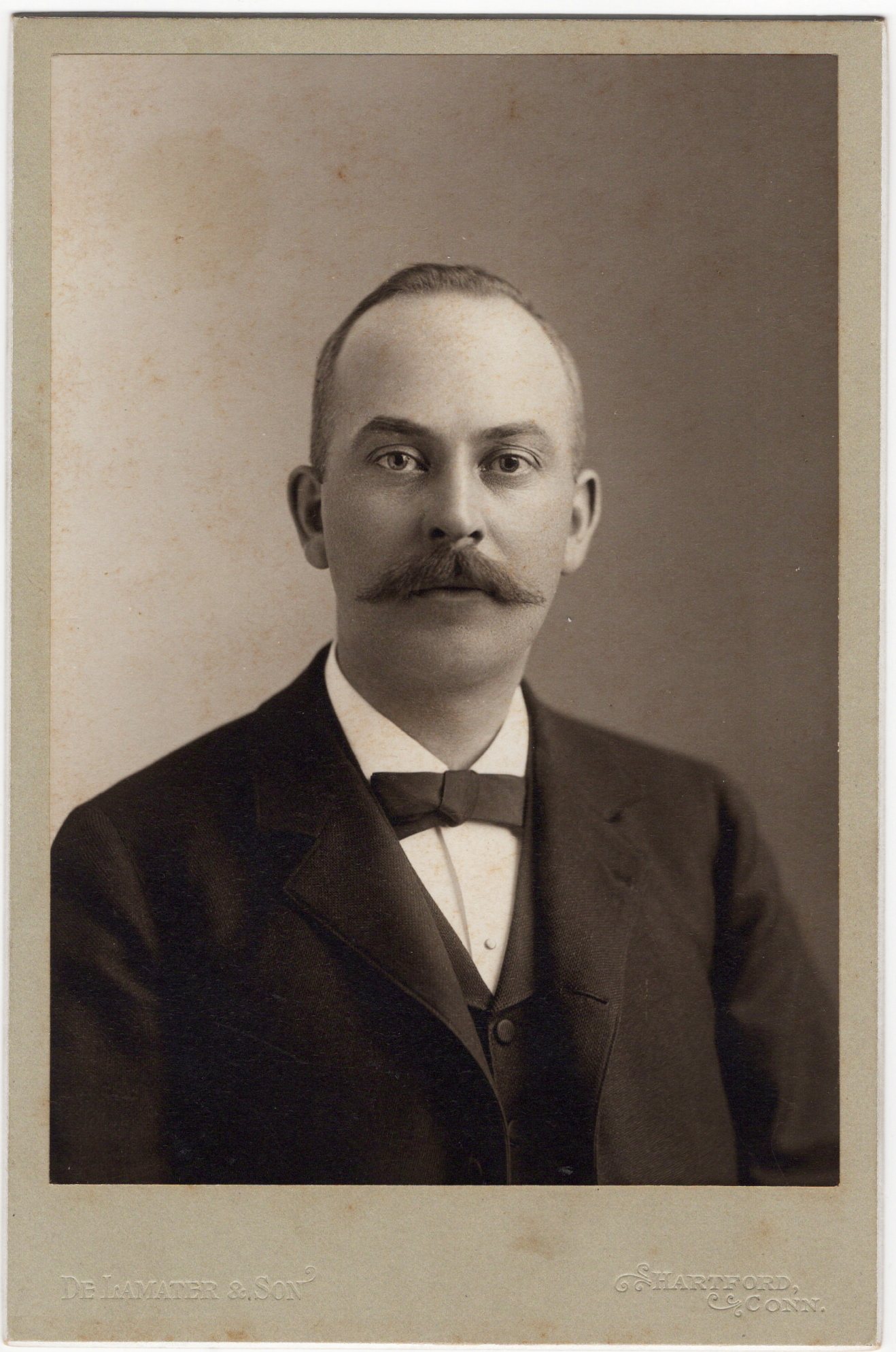
This cabinet card photograph features a dapper older man with an exquisite mustache. The gentleman’s impressive mustache may be one of the widest mustaches that I have ever seen. He has a sparkle in his eyes but it is impossible to ascertain if he is smiling because his lip sweater is blocking our view. The photographer of this cabinet card portrait is A. Michel. He operated a studio in Grenoble, France. Grenoble is in the Auvergne-Rhone-Alpes region of southeastern France. It is known as a center for winter sports. Advertising on the reverse of the cabinet card indicates that Maichel won a medal at an exhibit in Marseille in 1897. The gentleman in the photograph is identified on the verso as Gabriel Lucas. This portrait was likely taken circa 1900. SOLD
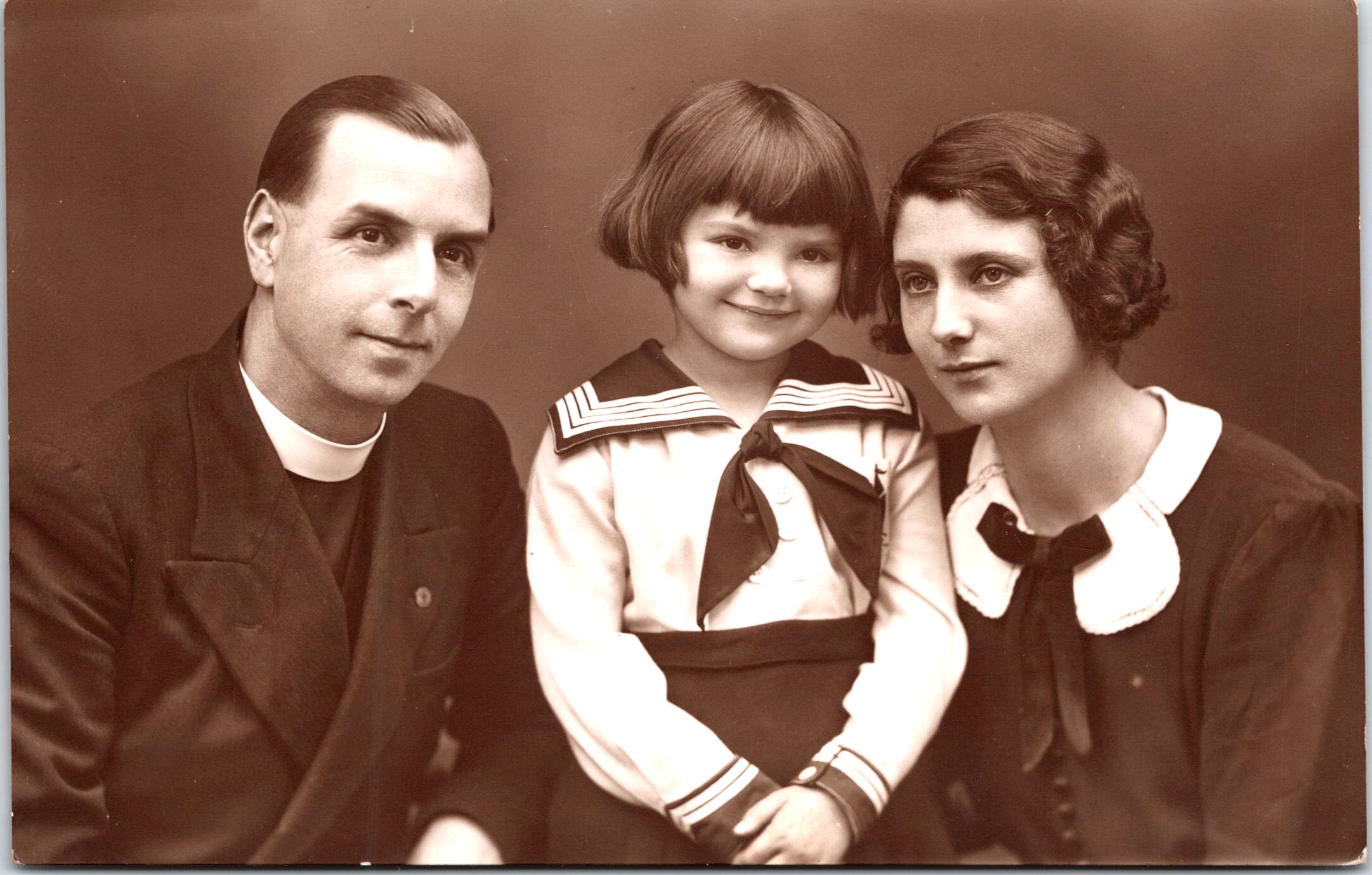
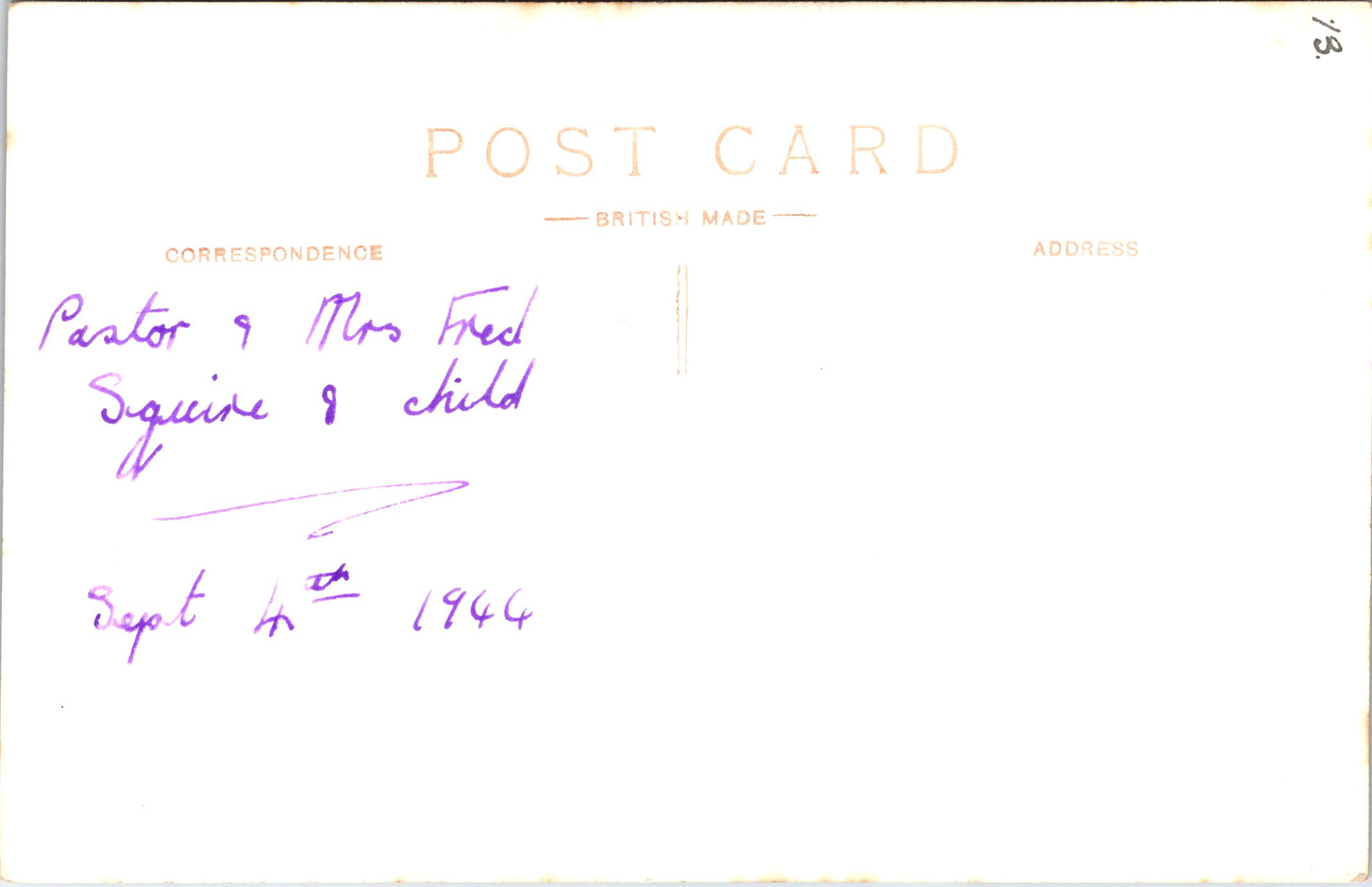
This vintage sepia-toned studio real photo postcard features a family of three, posed together with formal yet warm expressions. The man, identified as “Pastor Fred Squire,” appears to be in his late 30s to early 40s. He is dressed in clerical attire, including a dark suit with a clerical collar, giving him a dignified and professional appearance. His expression is calm and approachable, reflecting a kind personality. His neatly combed hair adds to his composed look. The woman, identified as “Mrs. Squire,” sits beside her husband. She wears a dark dress with a white Peter Pan collar and a ribbon tie, reflecting the fashion of the era. Her short, styled hair frames her face elegantly. Her expression is soft and slightly reserved, hinting at a caring and supportive nature. The child, likely their daughter, sits between them, radiating joy with a cheerful smile. She wears a sailor-style dress with a large bow at the neckline, a popular children’s fashion in the early to mid-20th century. Her short, straight haircut adds to her youthful charm. The three are closely positioned, suggesting a strong family bond. The setting is a professional studio, evident from the even lighting and neutral background. The reverse side of the postcard indicates that it is “British Made”. Written in purple ink is the identification of the subjects: “Pastor & Mrs. Fred Squire & child.” The date “Sept 4th 1944” is also inscribed, likely marking the time the photo was taken or sent. SOLD




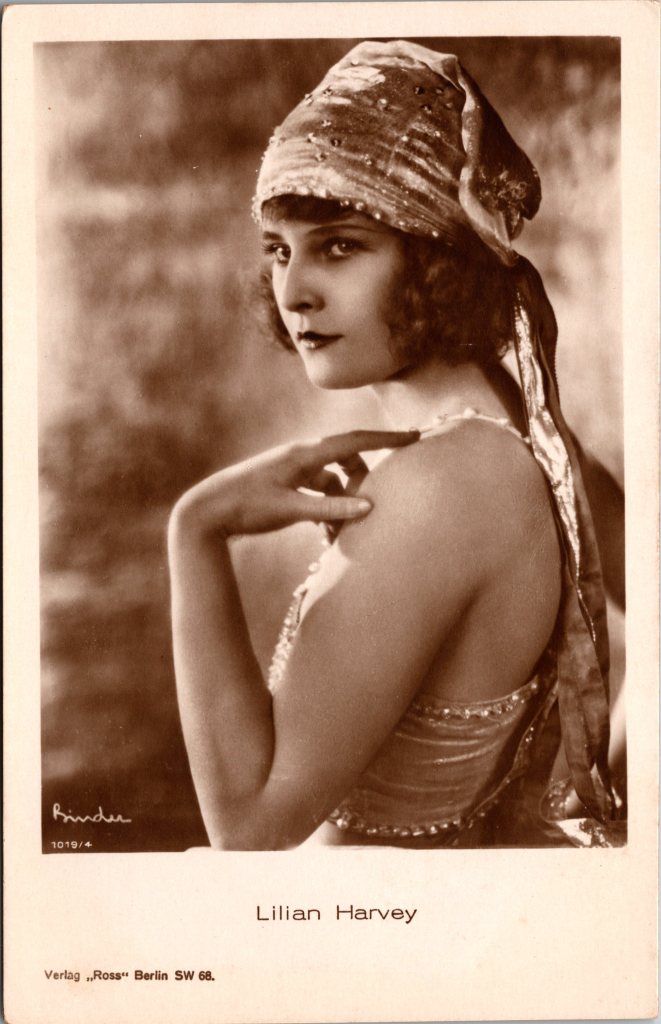 POSTCARD 8 (SOLD)
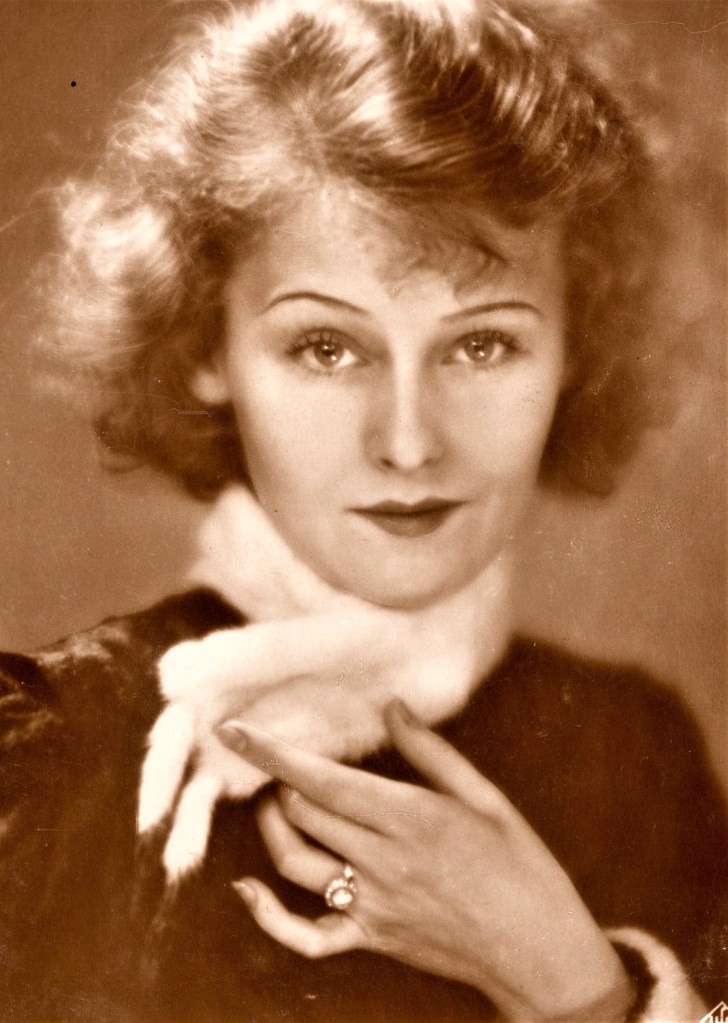 POSTCARD 9
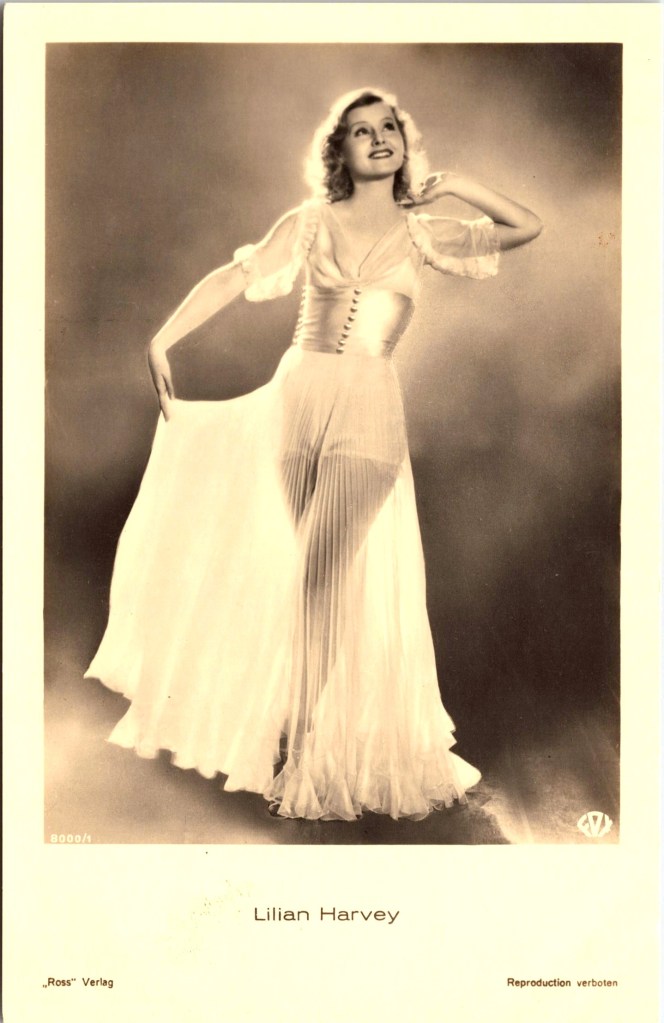 POSTCARD 10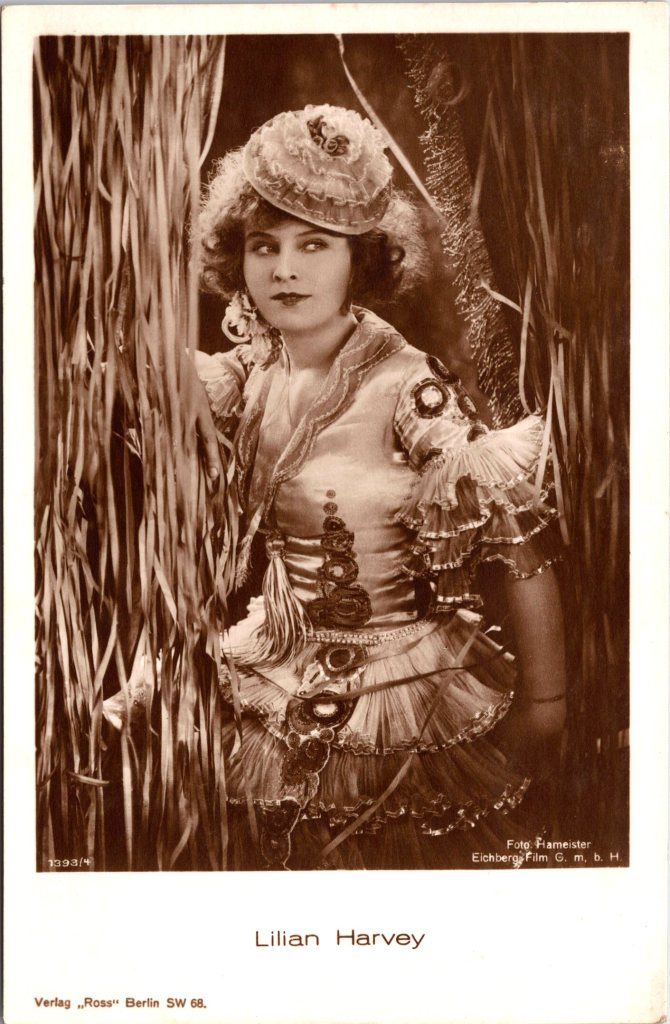

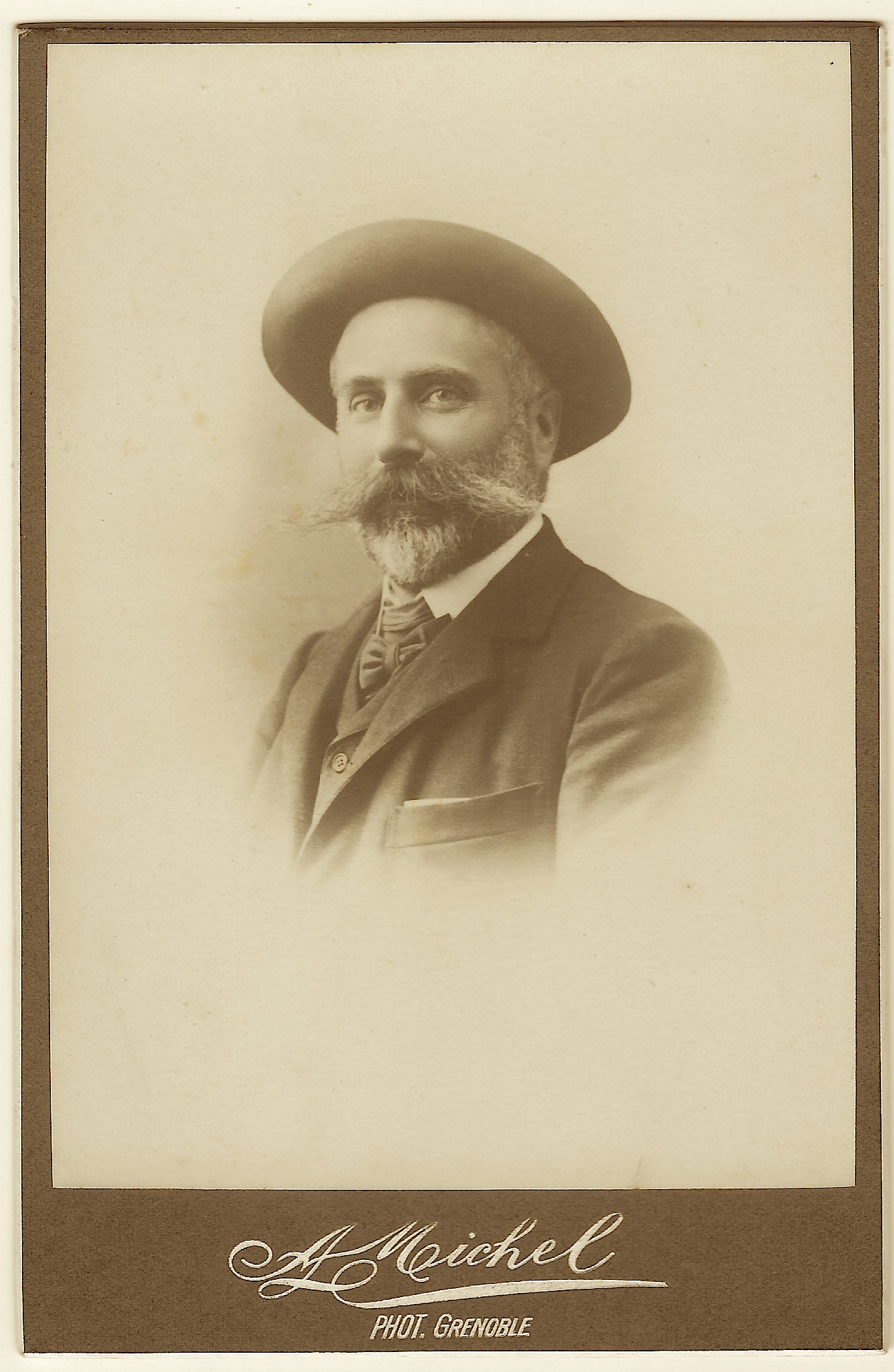
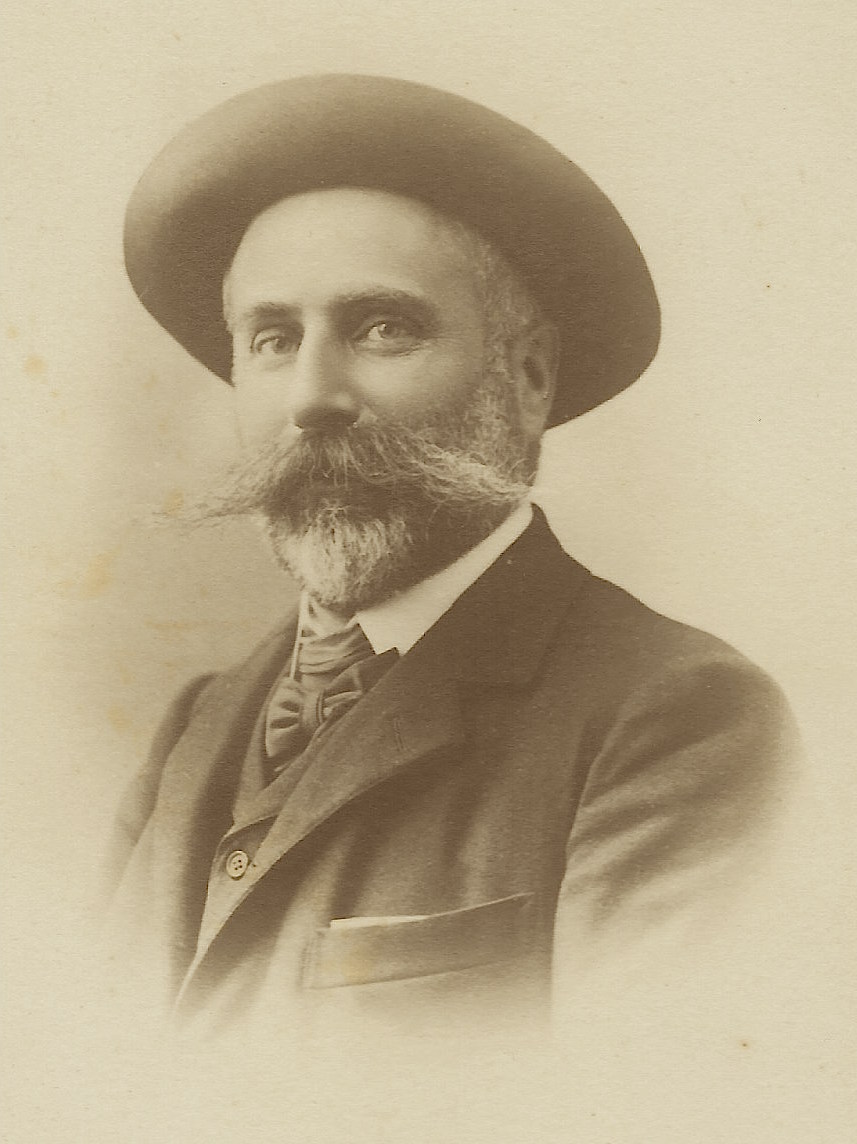 This cabinet card photograph features a dapper older man with an exquisite mustache. The gentleman’s impressive mustache may be one of the widest mustaches that I have ever seen. He has a sparkle in his eyes but it is impossible to ascertain if he is smiling because his lip sweater is blocking our view. The photographer of this cabinet card portrait is A. Michel. He operated a studio in Grenoble, France. Grenoble is in the Auvergne-Rhone-Alpes region of southeastern France. It is known as a center for winter sports. Advertising on the reverse of the cabinet card indicates that Maichel won a medal at an exhibit in Marseille in 1897. The gentleman in the photograph is identified on the verso as Gabriel Lucas. This portrait was likely taken circa 1900. SOLD