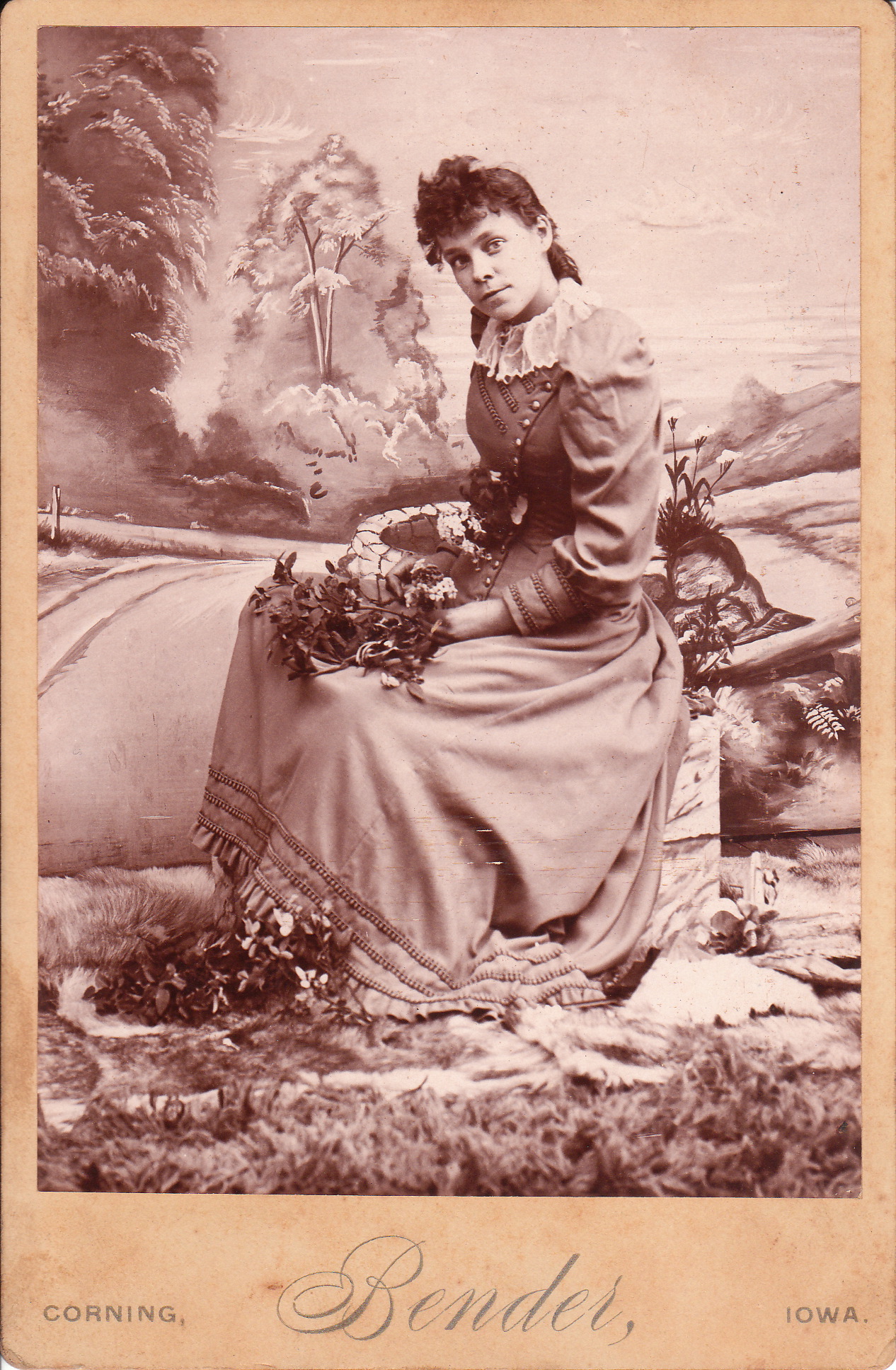
 A pretty dark haired young woman in a lovely dress poses for her portrait at the Bender studio in Corning, Iowa. She is holding flowers on her lap and has additional flowers lying at her feet. She is sitting in front of a poorly painted backdrop. It looks like it was painted by a Corning elementary school class rather than professionally done. The history of Corning is quite interesting. The first Europeans that came to the Corning area were a group of French Icarians who arrived from Illinois in 1854. A town was formed and named Icaria. The small and french-speaking community was dedicated to the utopian principles of Etienne Cabet (French philosopher and Utopian Socialist). combined with the democratic principles of the American and French Revolutions. In the 1860’s the community became divided between “traditionalists” and “progressives”. The progressives left town to form their own community, which was close to Corning (surveyed for development in the 1850’s).
DARK HAIRED BEAUTY IN LOVELY DRESS IN CORNING. IOWA

THE “SPRING LAKE GYPSIES” IN WAVERLY, IOWA
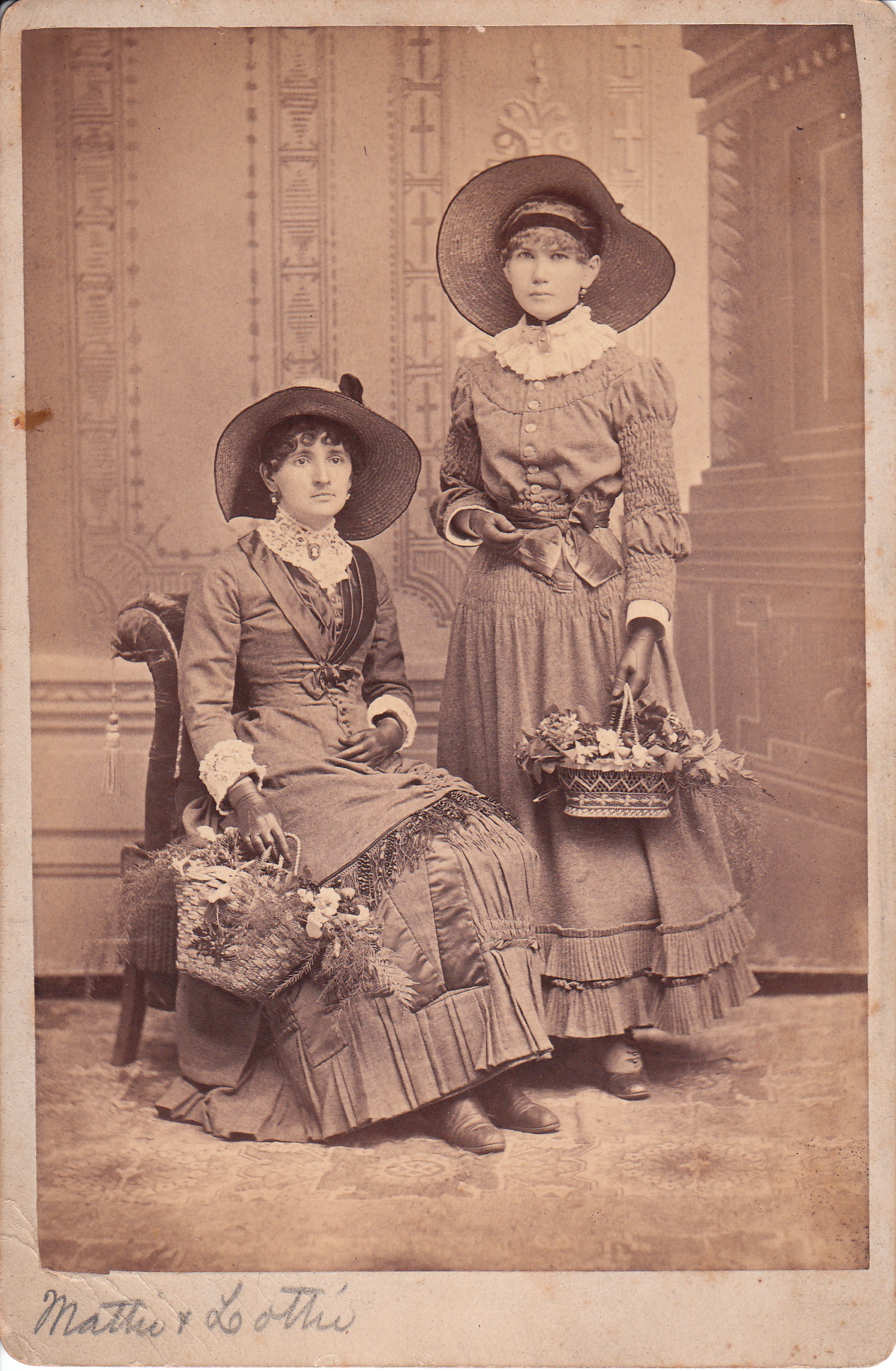
This cabinet card features two pretty young woman dressed in multiple layers of clothing and holding baskets of flowers. The pair are wearing large straw hats. The subject’s names, Mattie and Lottie, are written below the photograph. The reverse of the photograph has an inscription which states “These are Spring Lake Gypsies”. Although these women could be gypsies it seems more likely that the writer of the inscription was commenting about these women’s propensity to travel around a lot. A printed advertisement on the back of the cabinet card names the photographer as the A. Garner Art Gallery, located in Waverly, Iowa (“Four Doors East of Breemer House”). No information could be found about “Breemer House”. Interestingly, the town of Waverly is located in “Bremer” county. Is there a connection between Breemer and Bremer? As a side note, Bremer County received it’s name from Governor Hempstead who admired Swedish feminist writer Fredrika Bremer. The phrase “Spring Lake Gypsies” was researched and no information was uncovered. In addition, investigation yielded no last names for Miss Mattie or Miss Lottie. Little could be learned about photographer A. Garner other than the discovery of an article in the Report of the Iowa State Horticultural Society (1890) which includes the text of his speech to the group. The topic of his lecture was “Photography and Horticulture”.
YOUNG MAN WEARING SALVATION ARMY UNIFORM IN MARSHALLTOWN, IOWA

A young man wearing a Salvation Army uniform poses for his portrait at the Cottage Gallery in Marshalltown, Iowa. The photographer is named Beverage. The uniform is well decorated with Salvation Army identification. He is wearing a badge on his jacket, S’s on his collars,a badge on his hat, and lettering stating Salvation Army on a band around his hat. An inscription on the reverse of the cabinet card states that the subject’s name is “Charlie Phillips” and that he is the brother of the writer’s mother, “Uncle Charlie”. The 1890 Iowa census reveals that a Charlie Phillips, born in Marshalltown, was living in Lake Creek, Iowa. This eighteen year old young man, may be the subject of this photograph. The 1900 United States census reports that Maurice C. Beverage was born in 1841 in the state of Maine and was living with his 20 year old daughter in Marshalltown. He was of Scottish and French Canadian descent. The census listed his occupation as a photographer. Beverage began his photography career in Oconto, Wisconsin. In 1871 he was married to Hattie Crum and they had four children. The Oconto shop was at the corner of Maine and Section Streets. He worked in Oconto between 1869 and 1876. he then moved to Marshalltown where he opened the Beverage Cottage Gallery. He had partnerships there with Benjamin Jarvis and S. E. Jessup. In 1931, Beverage’s obituary appeared in the Times Republican, a Marshalltown newspaper. The obituary states that Beverage lived in Canada from infancy to age 15, when he went to Michigan, and then Oconto where he learned photography. He ran the Cottage Gallery from 1876 until 1912. His son Herbert Morris Beveridge was a photographer in Butte, Montana in 1900. The Cabinet Card Gallery has a large collection of Salvation Army cabinet cards. To view these photographs, click on the category “Salvation Army”. SOLD
PROUD COUPLE AND A DIPLOMA IN VAN WERT, OHIO
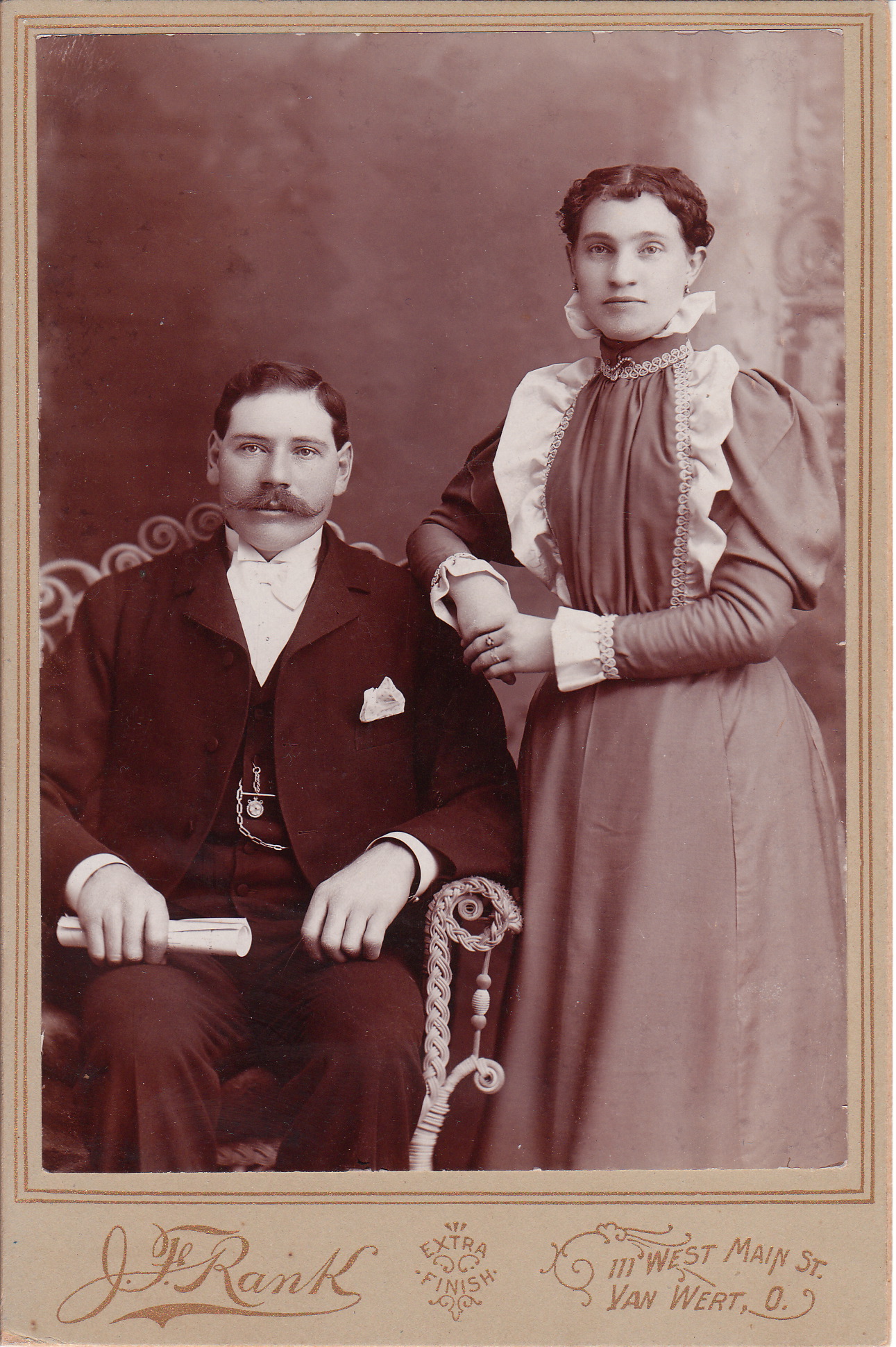
A young couple poses for their portrait in this cabinet card photographed by J. F. Rank of Van Wert, Ohio. The man in the image is holding a rolled document that appears to be a diploma. He is dressed in formal clothing which suggests that the portrait may be a graduation picture. He has a fine handle bar mustache and is wearing a pocket watch. The woman in this picture is nicely dressed and well adorned with jewelry. Jeremiah F. Rank (1847-1913) was born in Shelby, Ohio. He learned the trade of photography from I. S. Hartsock in Van Wert, Ohio, in 1872. After being trained, he quickly bought Hartsock’s studio and operated the business until 1892 when he sold the gallery. After traveling around the United States for two years, he opened galleries in Schuyler and Lincoln, Nebraska. He eventually returned to Van Wert and opened another studio there. In 1874, Rank was married to Mary I. McBride of Oskaloosa, Iowa. To view other photographs by this photographer, click on the category “Photographer: Rank”.
A WOMAN POSES WITH POSIES IN WELLMAN, IOWA
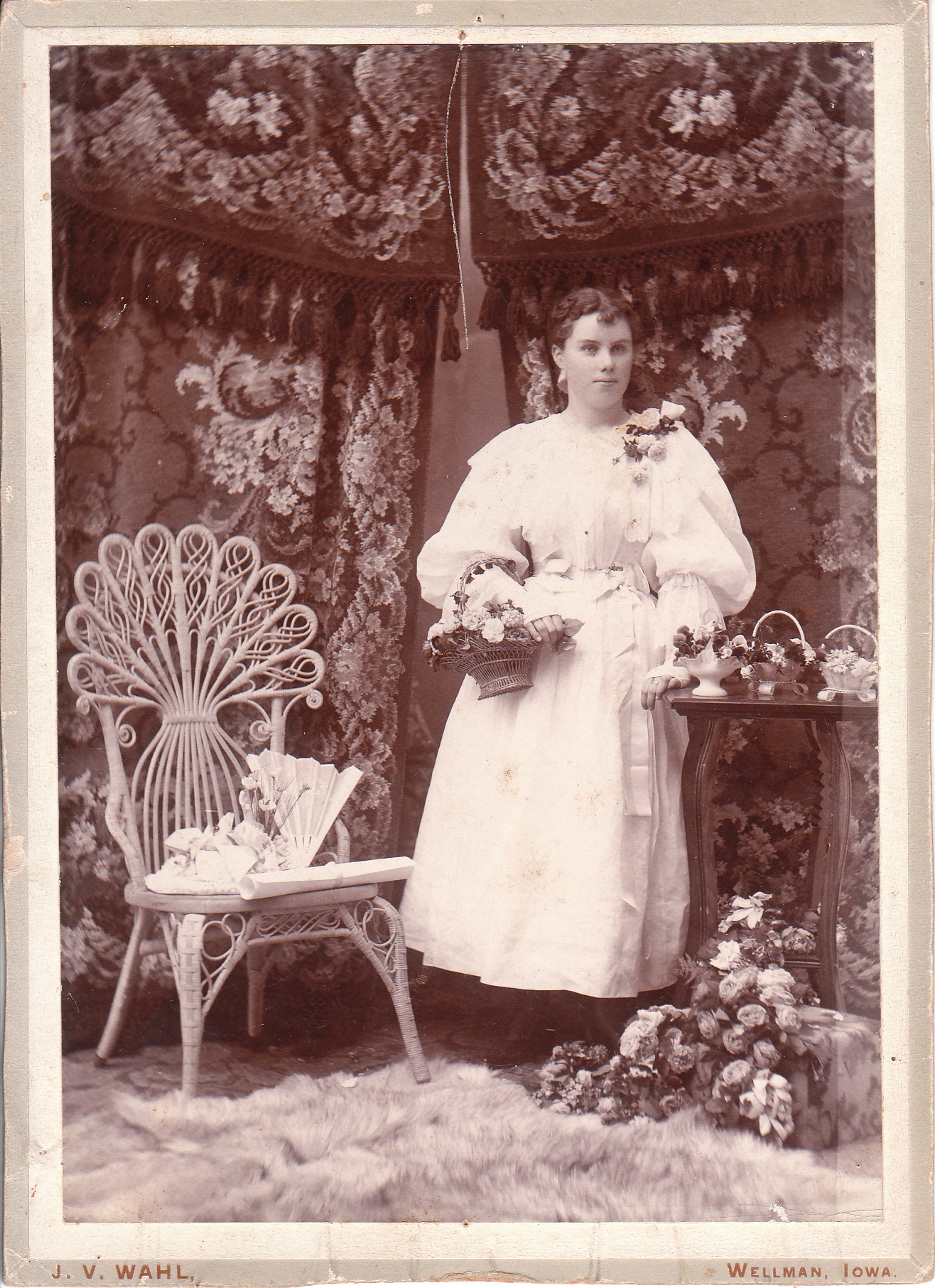 A woman surrounded by flowers is the subject of this cabinet card portrait by J. V. Wahl, of Wellman, Iowa. A dark patterned curtain serves as the background in this photograph. The patterned curtains, the multitude of flowers, the patterned chair, and the young woman; make for a very busy image. In fact, the viewer’s eyes don’t know where to focus. An inscription on the reverse of the photograph indicates that the subject of this cabinet card is Miss Edith Ash of Washington, Iowa. The photograph was taken in January, 1898. Edith Ash (1878-?) is listed in the census of 1880 through 1920 as a resident of Washington County, Iowa. She is most likely the subject in this image. She was married to Howard Cooper, circa 1899.
LADY PINNED BY A CONDUCTOR IN SIOUX CITY, IOWA
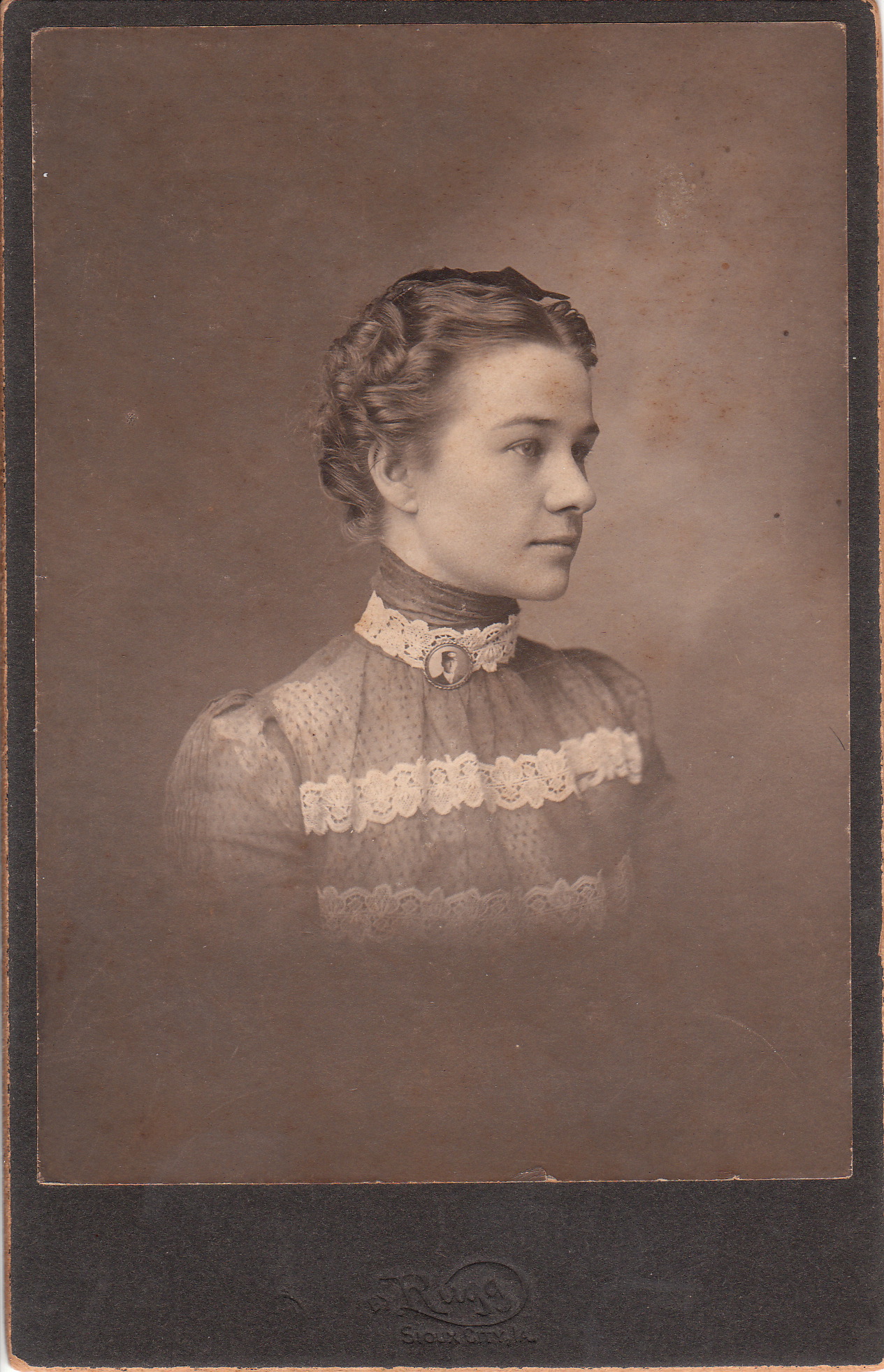 This cabinet card portrait features a young nicely dressed woman wearing a tintype pin or brooch. The jewelry holds a photograph of a train conductor; presumably the woman’s husband or suitor. The cabinet card was photographed by Rugg, whose studio was located in Sioux City, Iowa. Research reveals little to assist in gathering information about Rugg. Investigation found that there was an artist that resided in Sioux City named Elliott I. Rugg (1862-?). There is a reasonable possibility that he is the photographer that produced this image. Elliott Rugg was a relative of another photographer, Arthur Rugg, who operated out of Minneapolis, Minnesota. To view photographs by Arthur Rugg, click on category “Photographer: Arthur Rugg”.
ADORABLE AND BEAUTIFULLY DRESSED LITTLE GIRL IN CHICAGO, ILLINOIS
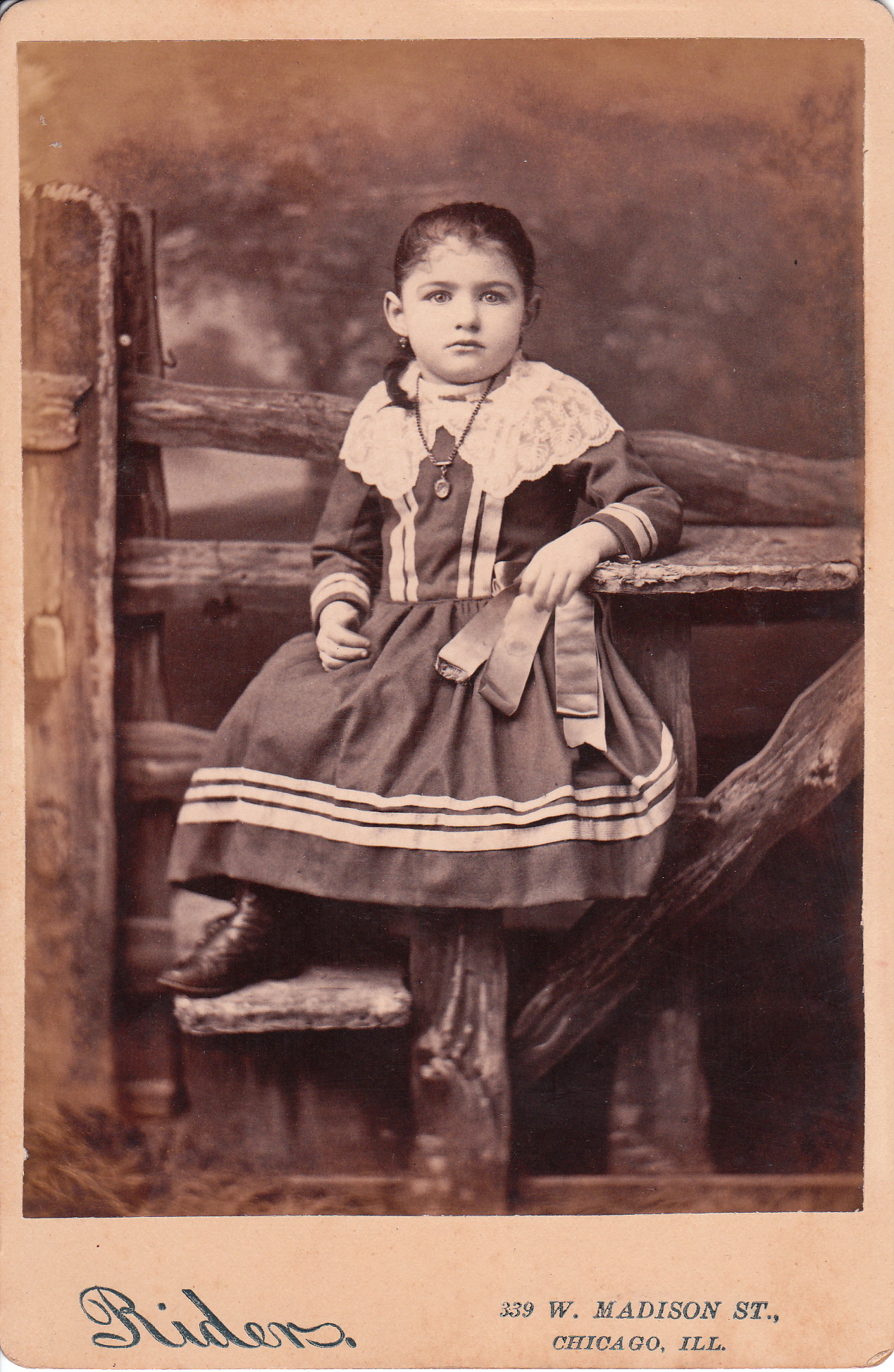 A cute little girl poses for her portrait at the studio of Briggs L. Rider, of Chicago, Illinois. The child is wearing a very cute outfit that includes lace and ribbons. The photographer, Rider, was active in Tipton, Iowa (1855), Des Moines, Iowa (1856-1860), and Chicago, Illinois (1864-1896?). During part of his tenure in Chicago, Rider was partners with photographer, Joseph Gehrig. Rider was a daguerreoist and cabinet card photographer. He also copied paintings, drawings and daguerreotypes; and taught daguerreotype art. The address listed on this cabinet card indicates that it was produced sometime between 1878 and 1890.
ADORABLE LITTLE GIRL IN WAUBEEK, IOWA
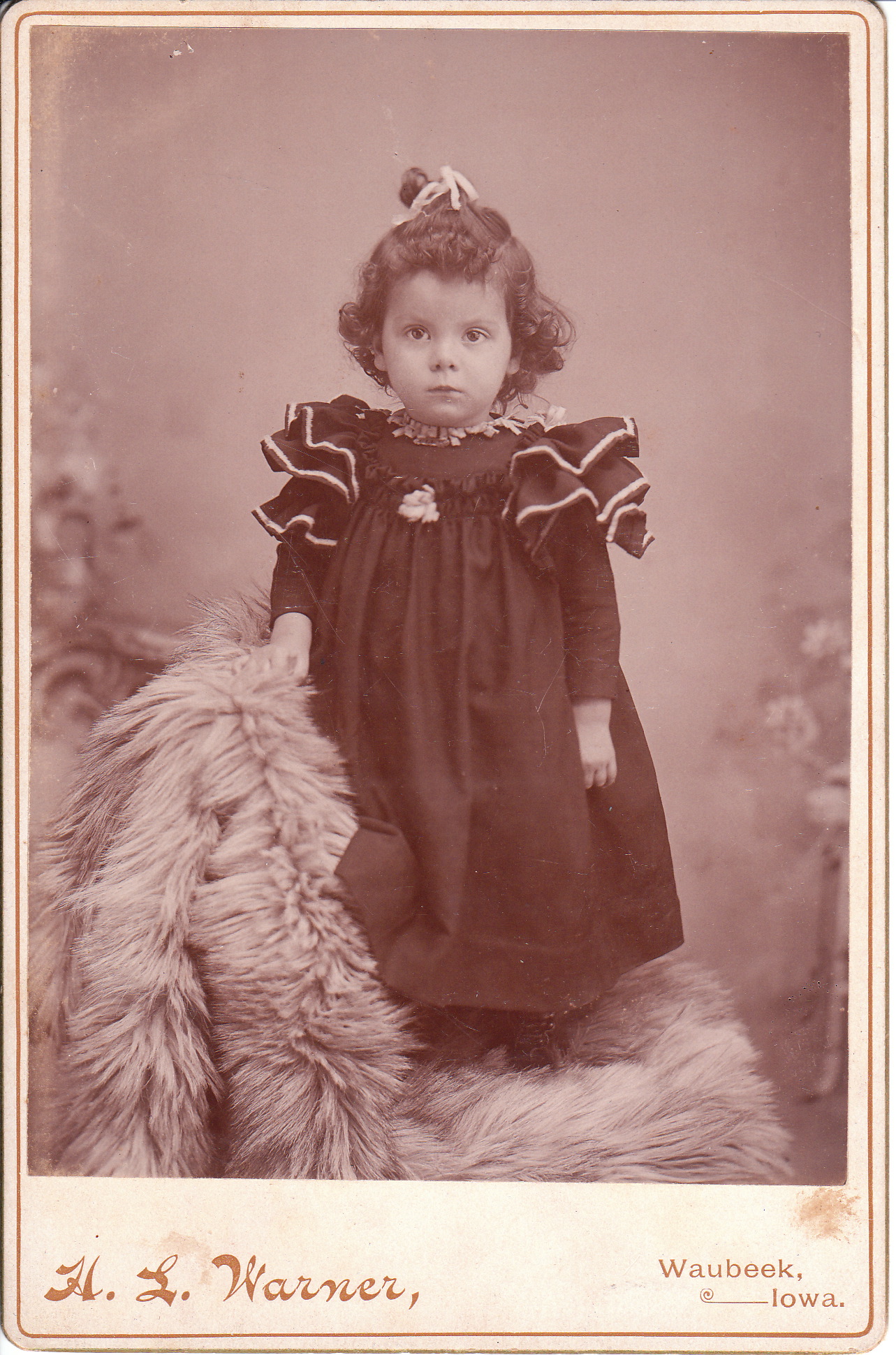 This cabinet card features a very adorable young girl. She is standing on a fur draped chair and wearing a fancy dress. A hair ribbon decorates her hair and adds to her “cutie pie” appearance. Handwriting on the reverse of the photograph identifies the child as “Elva Hemenway”. The 1900 Federal Census identifies a seven year-old named Elva L.Hemenway, who resided in Linn County, Iowa. Waubeek is in Linn County. The photographer is H. L. Warner of Waubeek, Iowa.
CROSS DRESSER IN MONTEZUMA, IOWA (AND SO IS LOLA)
 The previous owner of this cabinet card believed that the woman in the image may be a man. Perhaps the jacket and tie that she is wearing is the predominant evidence that she/he is a cross dresser. I am not very convinced that the subject of this photograph is a man, but it certainly is a possibility. Never forget the wise words of the well respected group of philosophers known as the Kinks; “Well I’m not the world’s most masculine man, but I know what I am, and I’m glad I’m a man, so is Lola”. An interesting side note is that the photographer of this image, Will C. Fryatt, is responsible for a number of other unusual photographs taken at his studio in Montezuma, Iowa. It is entirely possible that Fryatt never took the photograph, but instead, bought the rights to sell it at his studio. There is also a possibility that the individual in this image is an actor/actress from a touring theatre company. Another mystery that this cabinet card presents is as follows: Why does a town in Iowa get named after an Aztec Emperor of Mexico? Stay tuned, research is in progress. A visitor to the cabinet card gallery commented that the woman in this cabinet card looked very much like male impersonator, Ella Wesner (1851-1917) who was popular in the 1880’s. She was a part of the Gilded Age vaudeville circuit. You can view an image of Miss Wesner below. The assertion that the portraits of the two women in these photographs look similar, is very true. Do you think that they are one and the same person?

THREE CUTE SIBLINGS IN OSSIAN, IOWA
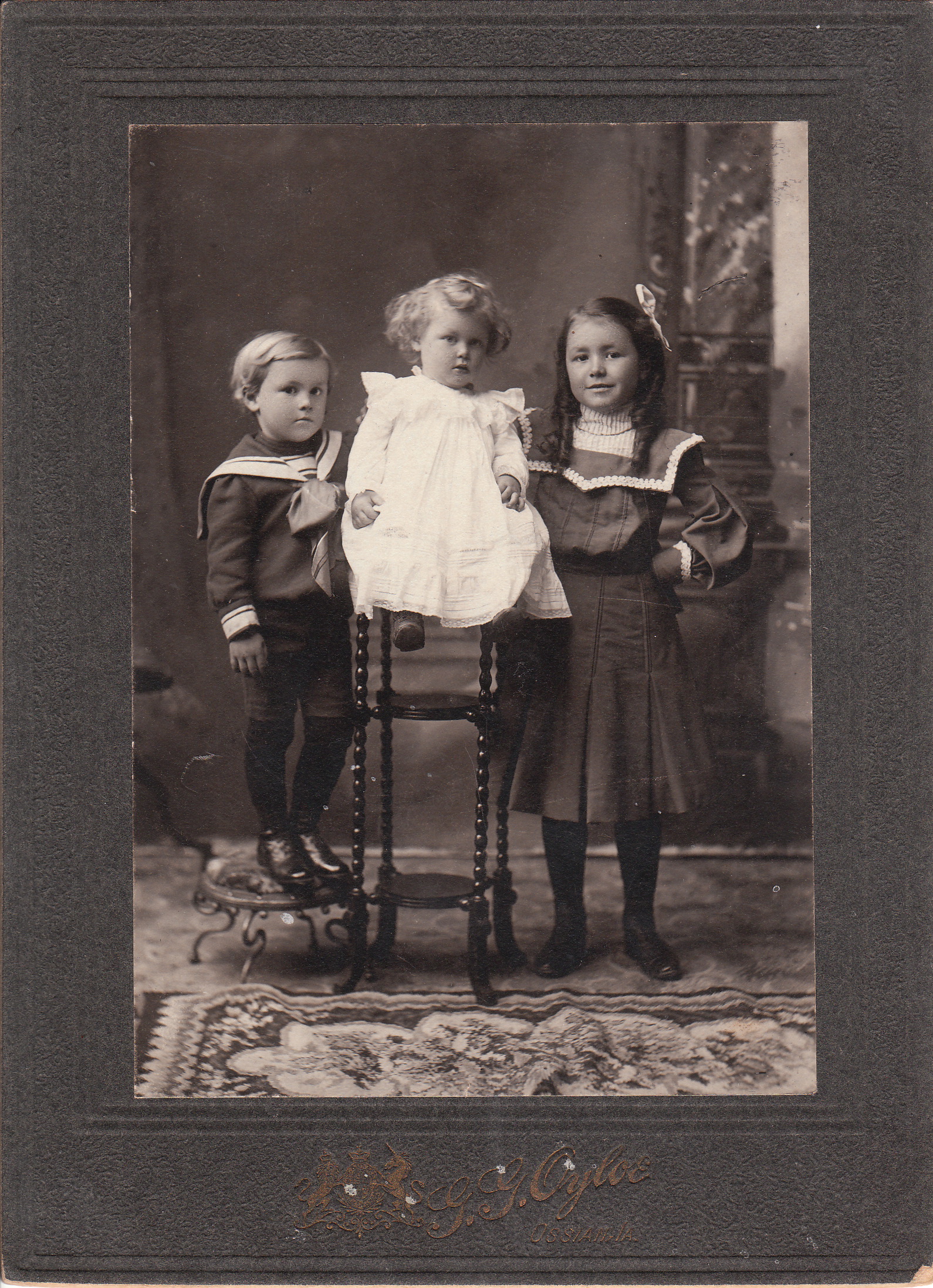 Three adorable siblings pose for their portrait at a photography studio in Ossian, Iowa. The children are wearing wonderful outfits. The young boy is wearing a sailor suit, and the older girl looks very cute in her dress. The youngest child has abundantly longish blonde hair. Research reveals that the photographer’s name is Gilbert G. Oyloe (1851-1927). Oyloe had a studio in Ossian during the 1880’s and 1890’s.


 THE CABINET CARD GALLERY