ARMED AND READY TO DEPLOY: SPANISH AMERICAN WAR SOLDIER IN MINNEAPOLIS, MINNESOTA

SPAN AM WAR SLDR_0002This Spanish American War era soldier is dressed, armed and ready to deploy. Note his long rifle and the bayonet he is wearing on his side. He is wearing two medals, one which the previous owner of the photograph identified as signifying that he was the son of a Union civil war veteran. This photograph was taken at Dempsie Portraits which was located at 316 Nicollet Avenue in Minneapolis, Minnesota. George M. Dempsie began operating in Minneapolis in about 1887 and worked until at least 1910. He was at the Nicollet Avenue address between 1889 and 1910. He operated under the names of Dempsie’s New Photographic Rooms, Dempsie Portraits, and Dempsie & Andrews. At various times he employed his sons George R. Dempsie and Guy C. Dempsie.

store


FAMILY PORTRAIT IN DULUTH, MINNESOTA

duluth family_0003A well dressed family looks quite handsome as they pose for their portrait at the Christensen studio in Duluth, Minnesota. The father is wearing an unusual tie while the son is wearing a more traditional tie and a wing tipped collar shirt. The mother is wearing a pin on the neckline of her dress. The photographer of this cabinet card is John Christensen. The Bulletin of Photography (1916) reported that Christensen was one of several Duluth photographers who signed a petition urging the licensing of traveling photographers who passed through the city. The petition stated that these traveling photographers enlarged pictures at very low prices but then compelled people to purchase very expensive frames. They also charged customers in advance to enlarge family photos and then left town without doing the work or returning the treasured photographs.

Published in: on March 21, 2013 at 12:01 am  Comments (1)  
Tags: , , ,

THE MAGNIFICENT SEVEN: MEET THE MEN OF SLEEPY EYE, MINNESOTA

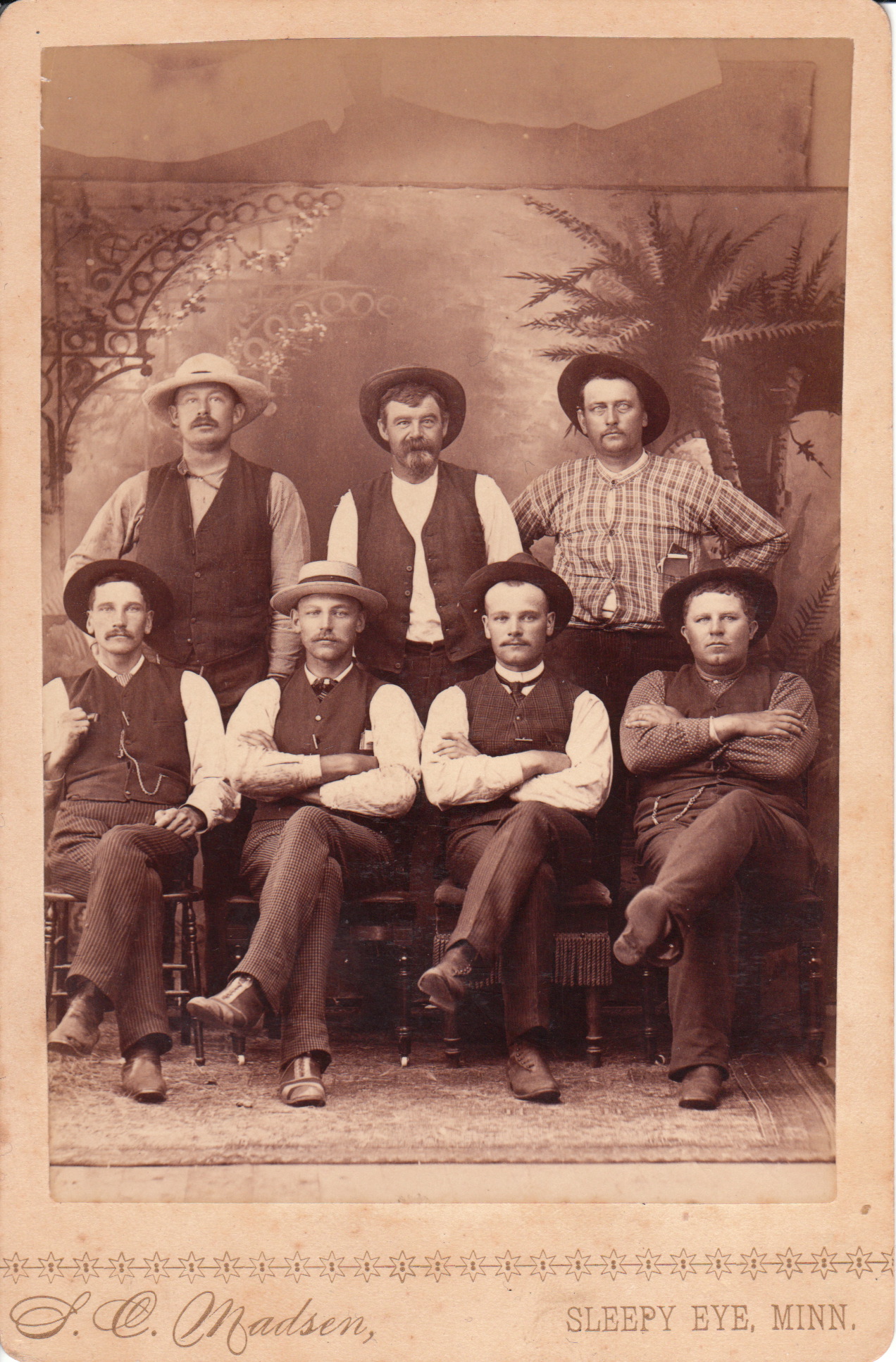
SLEEPYEYE_0001Members of the cast of the American Western movie “The Magnificent Seven” (1960) pose for a group picture in Sleepy Eye, Minnesota. These seven gunmen were hired to protect a small Mexican agricultural village from a gang of marauding bandits. The cast included Charles Bronson (back row left), Steve McQueen, Yul Brynner, James Coburn, Robert Vaughn, and Eli Wallach. Wait a minute! Even though the Charles Bronson guy really looks like Charles Bronson, how could the cast of a 1960 movie appear in a turn of the century cabinet card photograph? In addition, what would Hollywood actors be doing in Sleepy Eye, Minnesota if they are in a film where the locale is Mexico? Besides that, is there really a town called Sleepy Eye? It’s time for a confession. The men in this photograph are not members of a movie cast even though I could almost swear that the guy in the back row is Charles Bronson. In regard to the existence of a town named Sleepy Eye; yes it does exist. The town of Sleepy Eye is named after Chief Sleepy Eye, or Ishtakhaba. He was a chief of the Sioux tribe and happened to have droopy eye lids. He was one of four Sioux Indians to meet President James Monroe in 1824 in Washington D.C.. This image was produced by Sleepy Eye photographer S. C. Madsen who also had a studio in New Ulm, Minnesota. He operated in Sleepy Eye between 1884 and 1892 and had a studio in New Ulm in 1888. Since this cabinet card advertises the New Ulm studio on the reverse of the photograph, this photograph was likely taken in 1888. Who are the men in the picture? Unfortunately, they are not identified. They appear to be businessmen from town but that of course is just a guess (two of the men have papers in their shirt pocket). Three of the men in the bottom row have their arms crossed resting on their abdomen. The fourth gentleman apparently didn’t get the message from the photographer who posed them. The man on the far right of the top row must have just finished the all you can eat buffet at the Silver Dollar Saloon judging by the tightness of his shirt.

HANDSOME MAN IN CROOKSTON, MINNESOTA

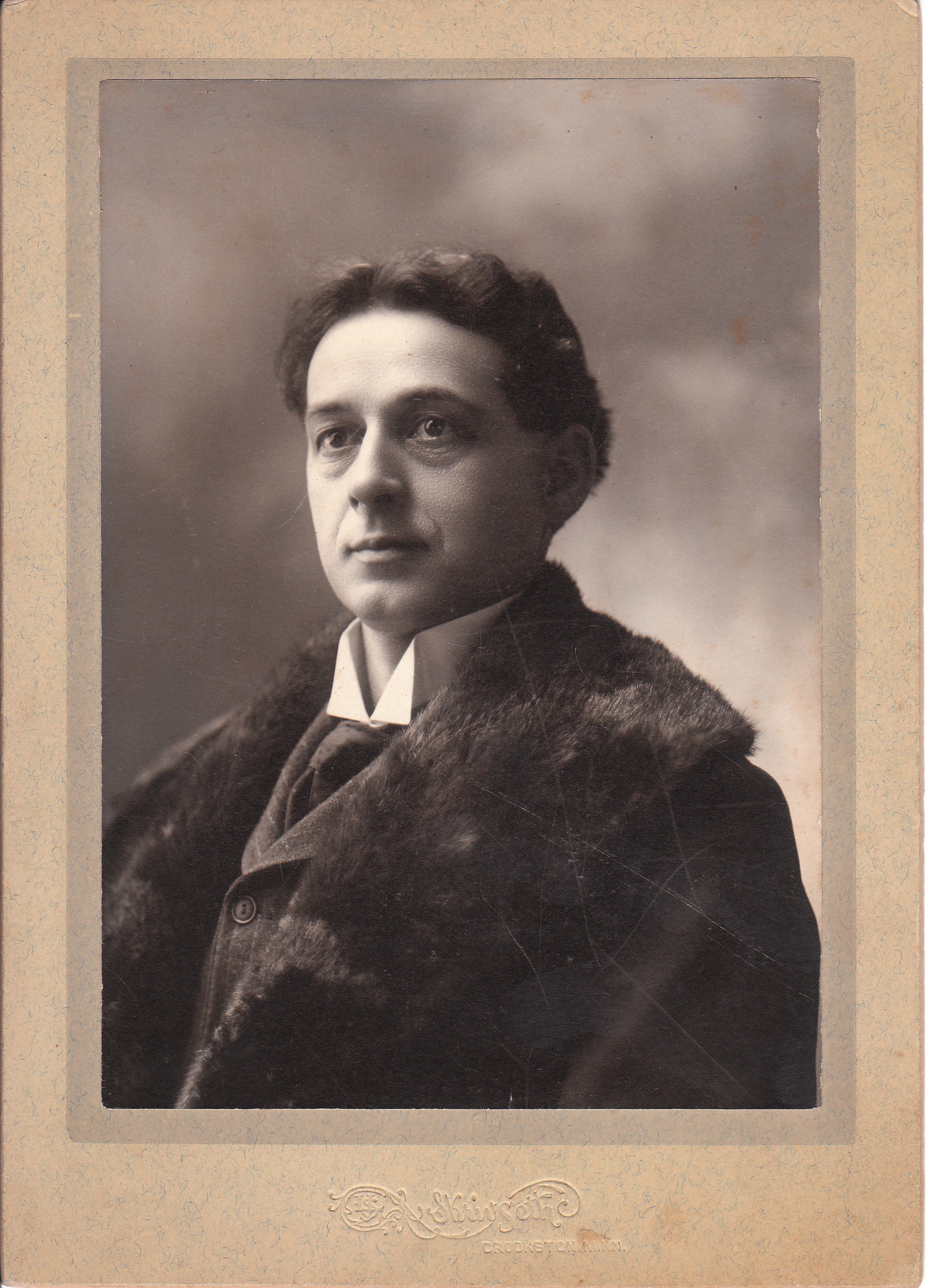
This photograph features a very handsome man posing for his portrait at the studio of Skrin Seth in Crookston, Minnesota. My spelling of the photographer’s name is questionable since his name is partially illegible as printed on the front of the photograph. The subject of this photograph has glamorous looks and is wearing a fur coat. He is identified on the reverse of the card but once again there is a legibility problem. His name is either “Mr. E. McKenzie” or “N. E. McKenzie”. Research revealed no biographical information about the image’s subject or about the photographer.

Published in: on September 7, 2012 at 12:01 am  Comments (7)  
Tags: , , , ,

YOUNG WOMAN UNDER AN UMBRELLA AND EVEN YOUNGER BOY DRESSED IN “LITTLE LORD FAUNTLEROY” STYLE IN LITTLE FALLS, MINNESOTA

A young woman and an even younger boy pose for their portrait at Moe’s Studio in Little Falls, Minnesota. One can only guess about their relationship. Are they mother and son? Could they be brother and sister? The answer to these questions will likely remain unknown. The woman under the umbrella appears pensive. She is wearing a hat and holding gloves. The boy is dressed in the popular “Little Lord Fauntleroy” style that was in fashion at the time of the photograph. No information could be found about Moe or Moe’s Studio. The last name “Moe” appears to have been a popular name in Little Falls around the turn of the century. The name was of Norwegian origin.

Published in: on July 28, 2012 at 12:01 am  Comments (1)  
Tags: , , , ,

TWO WOMEN AND THEIR BOOKS IN WEST SUPERIOR, WISCONSIN (WINTER SCENE)

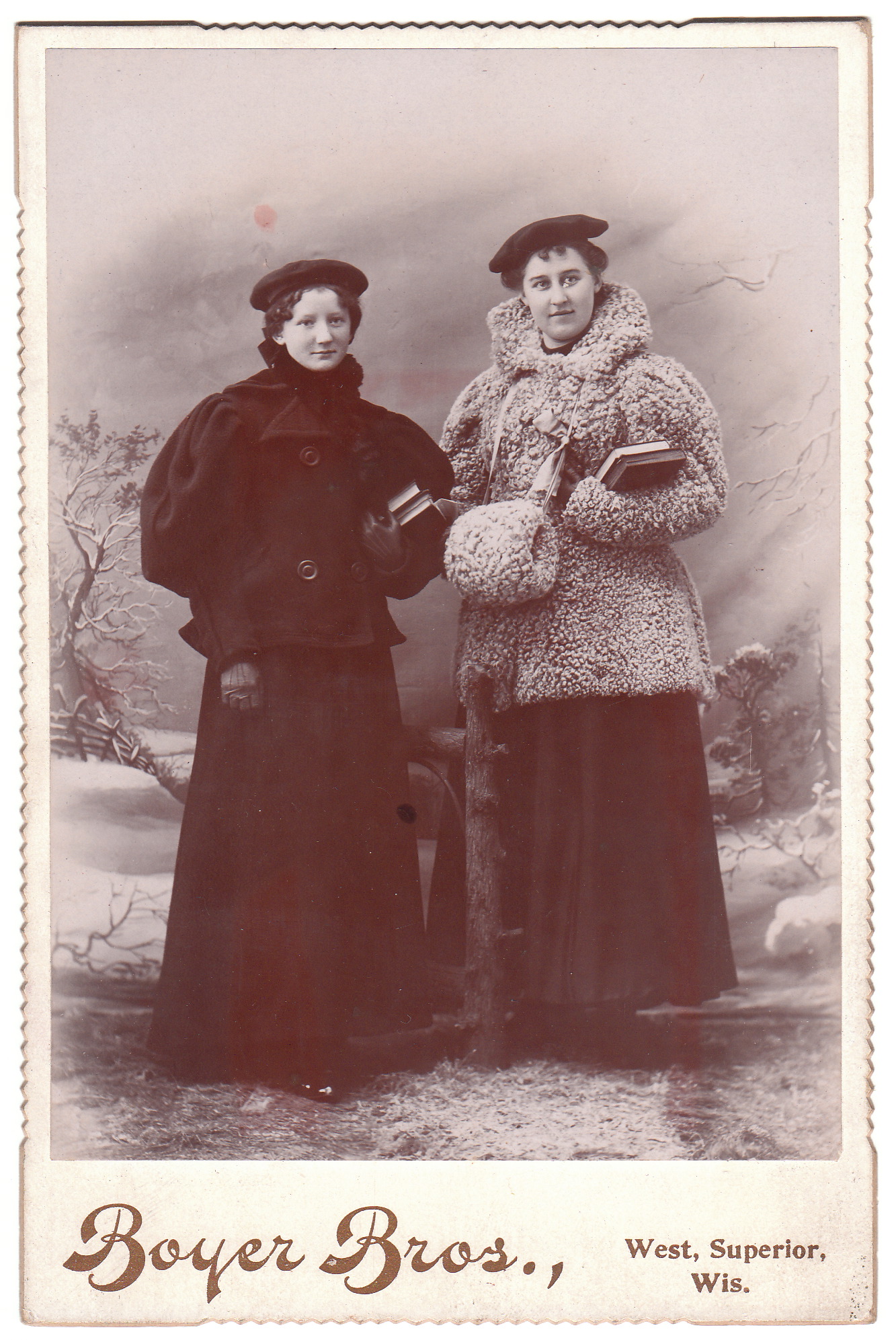
Two women dressed in winter coats pose for their portrait at Boyer Brothers studio in West Superior, Wisconsin. They appear well prepared for the winter scene that is hanging behind them. Both women are holding books in their arms. Unlike most subjects appearing in cabinet cards, these two ladies are smiling. The Boyer Brothers include Hans R. Boyer, Henry Boyer, and Robert H. Boyer. The brothers worked in various combinations and in a number of partnerships in Superior, Wisconsin and Duluth, Minnesota. They were associated with studios from the 1880s through the 1910’s.

Published in: on June 21, 2012 at 12:01 am  Leave a Comment  
Tags: , , , , ,

THE ENIGMATIC SISTERS OF MONTAGUE, MICHIGAN

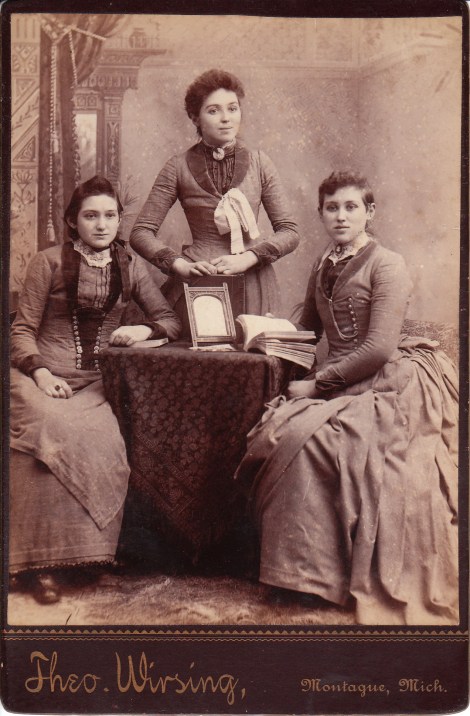
This cabinet card presents an enigma. How can this photograph be interpreted? The image features, what are likely, three sisters, gathered around a table. Each of the young woman is holding a book, but only one of the three has their book open. So? What’s the enigma? The mystery concerns the fact that prominently displayed on the table is a picture frame without a picture. The missing picture hasn’t wandered too far away. It can be seen lying on the table, face up, in front of the frame. Hopefully, a cabinet card gallery visitor will leave a comment with their hypothesis as to why the frame and picture are separated in this image. The photographer of this portrait was Theodore A.Wirsing (1865-1938) of Montague, Michigan. Research about Wirsing yielded confusing information. He is reported to have had a studio in Annandale, Minnesota in 1902  and a studio in Maple Lakes, Minnesota in 1902 and 1914. Another source states that Wirsing ran his gallery in Montague between 1890 and 1910. He and his wife, Lillian Bovee Wirsing (1865-1930) are buried in Michigan. Wirsing can also be found in four United States census reports. In 1900, he was living in a boarding house in Corinna, Minnesota, and working as a photographer. He was unmarried. In 1910, Wirsing was living in Annandale, Minnesota and listed as a photographer. .He was also married. In 1920, he was still living in Annandale, Minnesota and he was managing a photographic gallery. In 1930, the 64 year-old, Wirsing, and his wife, were living in Bellingham, Washington. The census also states that Theodore Wirsing was working as a carpenter in Bellingham.

Published in: on February 29, 2012 at 12:01 am  Comments (4)  
Tags: , , , , , , , ,

LITTLE GIRL RIDING A GIANT TRICYCLE IN MONTEVIDEO, MINNESOTA

A little girl sits high atop a giant tricycle in this cabinet card photograph by Andreas Brandmo. Brandmo’s studio was located in Montevideo, Minnesota. The little girl won’t be able to ride very far on her  monster bike. Unfortunately her feet do not seem to reach the bike’s pedals. She also doesn’t look particularly comfortable on her perch, as she poses for the photographer. The 1900 United States census reveals that Brandmo was born in Norway in 1855. He came to the United States in 1882 and married his wife Martha in 1885. Apparently, Brandmo and his wife were producing children at a rapid pace. After 15 years of marriage, the couple had eight children spanning between three and twelve years of age. The census also indicated that Brandmo’s niece, Lucy Husaby, worked as a photographer in his studio. The family lived in Appleton, Minnesota. Research found that Brandmo operated his Montevideo studio between 1886 and 1896. It was also reported that he ran a gallery in Appleton in 1898. At some point he had a partner and their studio was named Brandmo & Lodgaard. The 1910 census reveals that Andreas Brandmo changed his name to Andrew Brandmo. Perhaps when he realized he had eight children and a wife depending on him, he changed his name and entered the Federal Witness Protection Program. More likely though, he probably Americanized his name for business purposes. The 1910 census also notes that his son Alf, had joined him in the business and was working as a photographer.

YOUNG COUPLE LACKS INTIMACY IN MINNEAPOLIS, MINNESOTA

A young couple poses for their portrait at the studio of photographer, H. Larson, in Minneapolis, Minnesota.                The gentleman has long hair and glasses.  He has a scholarly appearance. The woman’s  figure is improved by a corset. She appears uncomfortable, illustrated behaviorally by the position of her arms and hands on her abdomen. This couple appears emotionally separated from each other. There is no intimacy captured in this photograph. Although the couple is posed together, they do not seem to be together. Perhaps the couple is really not physically together in the studio and this image was doctored by the photographer, who added the gentleman to an existing photograph of the woman. Herman Larson was a Swedish immigrant who came to America through Sweden in the early 1900’s. In Sweden, he held a degree of Master Photographer and was knighted by the King of Sweden for his excellent work there in the late 1800’s. In 1904 he established his photography studio in downtown Minneapolis. Much of Larson’s work came from the theological, church and public schools in the area. The studio remains in business today and its web site discloses that it still possesses Larson’s panoramic circuit camera. The site also reports that Larson semi retired in the early 1950’s.To view other photographs by Larson, click on the category “Photographer: Larson”.

Published in: on January 18, 2012 at 12:01 am  Comments (1)  
Tags: , , , ,

IMMIGRANT FAMILY OF UNKNOWN ETHNIC ORIGIN IN MADISON, MINNESOTA

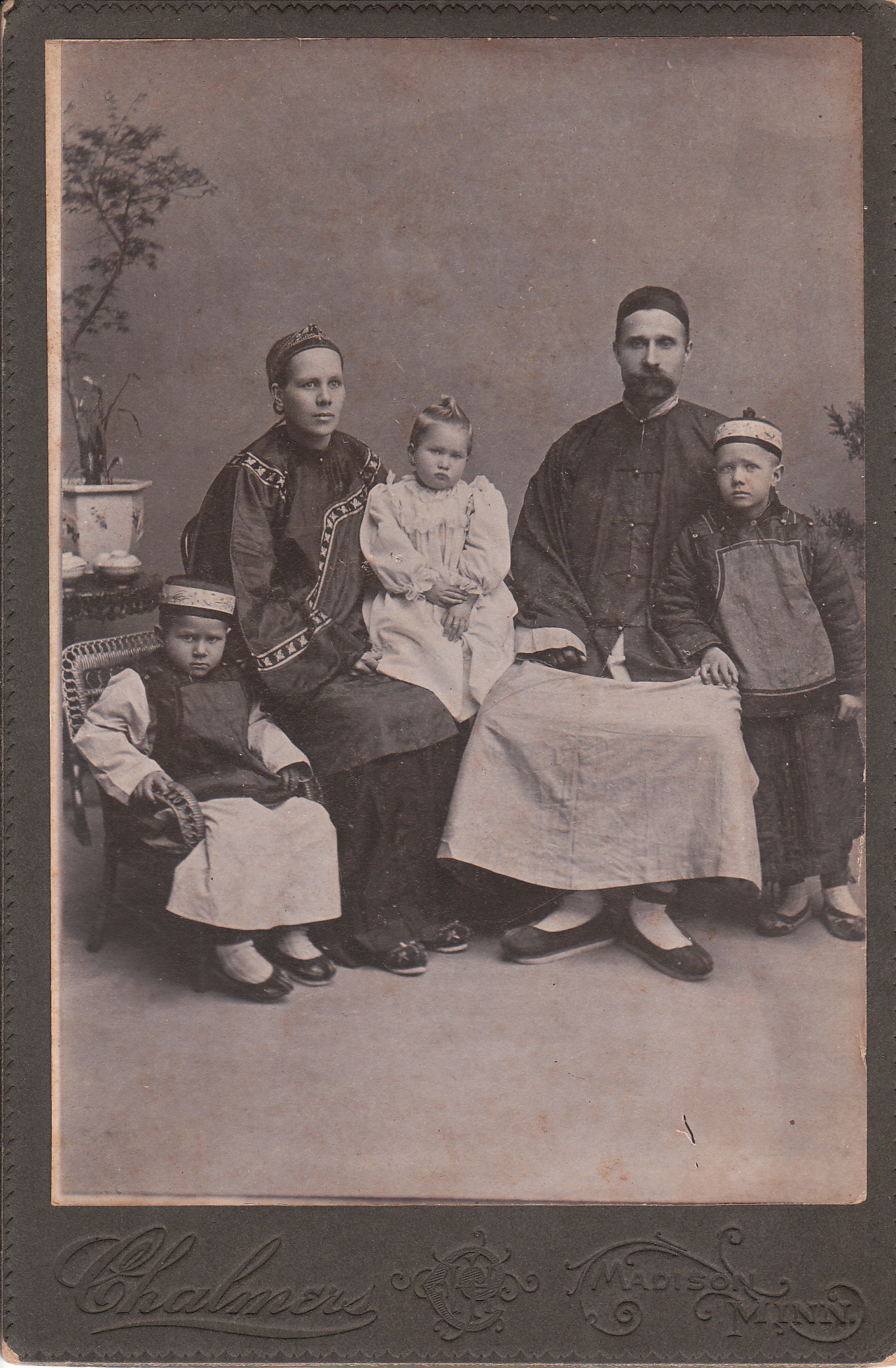
This photograph captures a family in unknown ethnic clothing, at the Chalmers studio in Madison, Minnesota. Hopefully, a visitor to the cabinet card gallery will be able to identify the country of origin of this attractive family. The parents and their two sons, and daughter, are likely immigrants to the United States. An uninformed guess is that the family is from Afghanistan. The Chalmers studio was certainly a family affair. The business was started by Hugh J Chalmers (1844-1910) who was born in New Brunswick, Canada. He operated a photography studio in Lac Qui Parie (1882-1886) and in Madison (1886,  1894-?). Both businesses were located in Minnesota. He was succeeded by his son, James H. Chalmers (1874-?) who worked in Madison between 1904 and 1922. A third generation was involved with the business. James Kenneth Chalmers (1905-1966) also operated the studio.

Published in: on October 22, 2011 at 9:55 am  Comments (2)  
Tags: , , , , ,