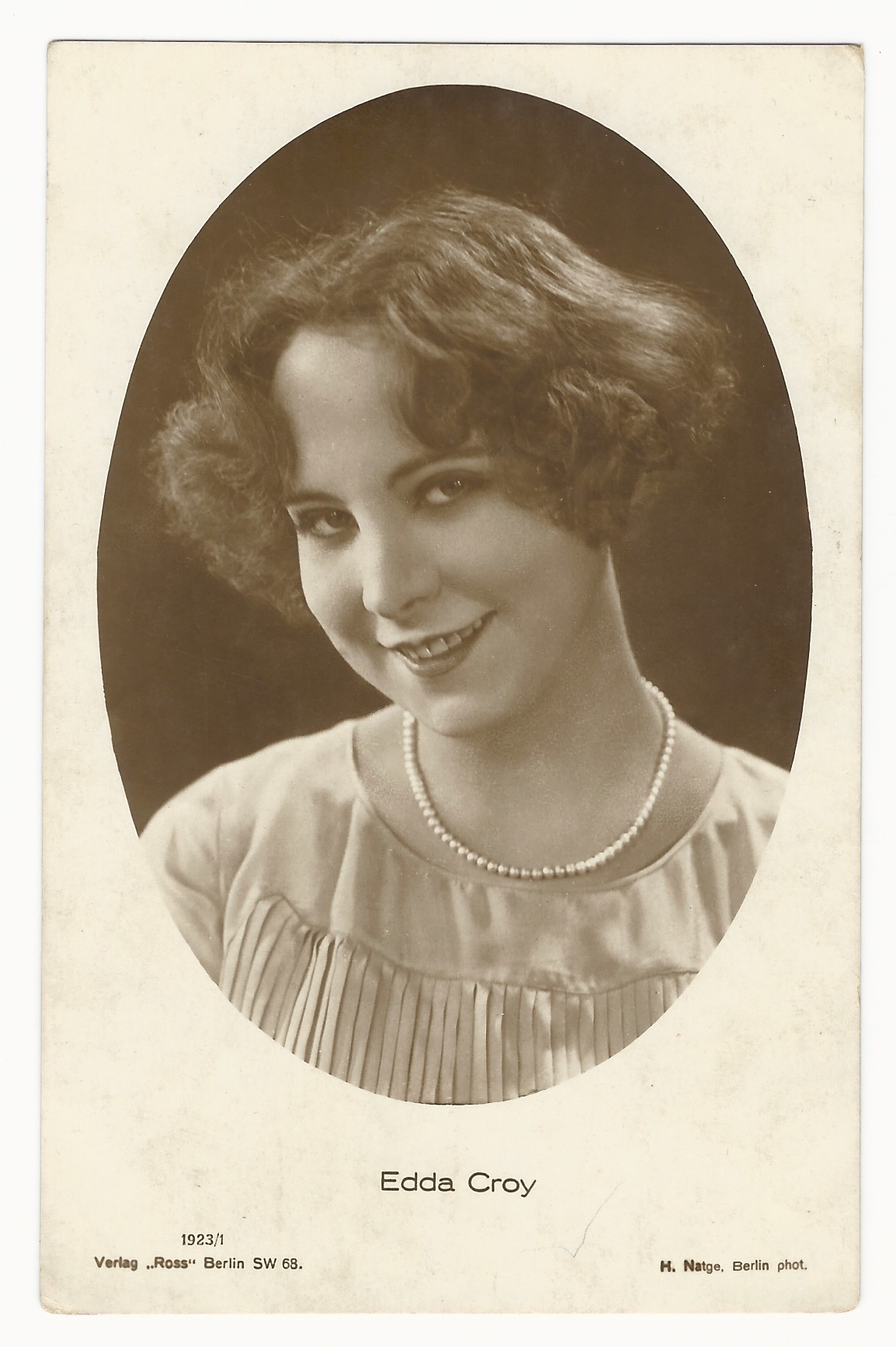
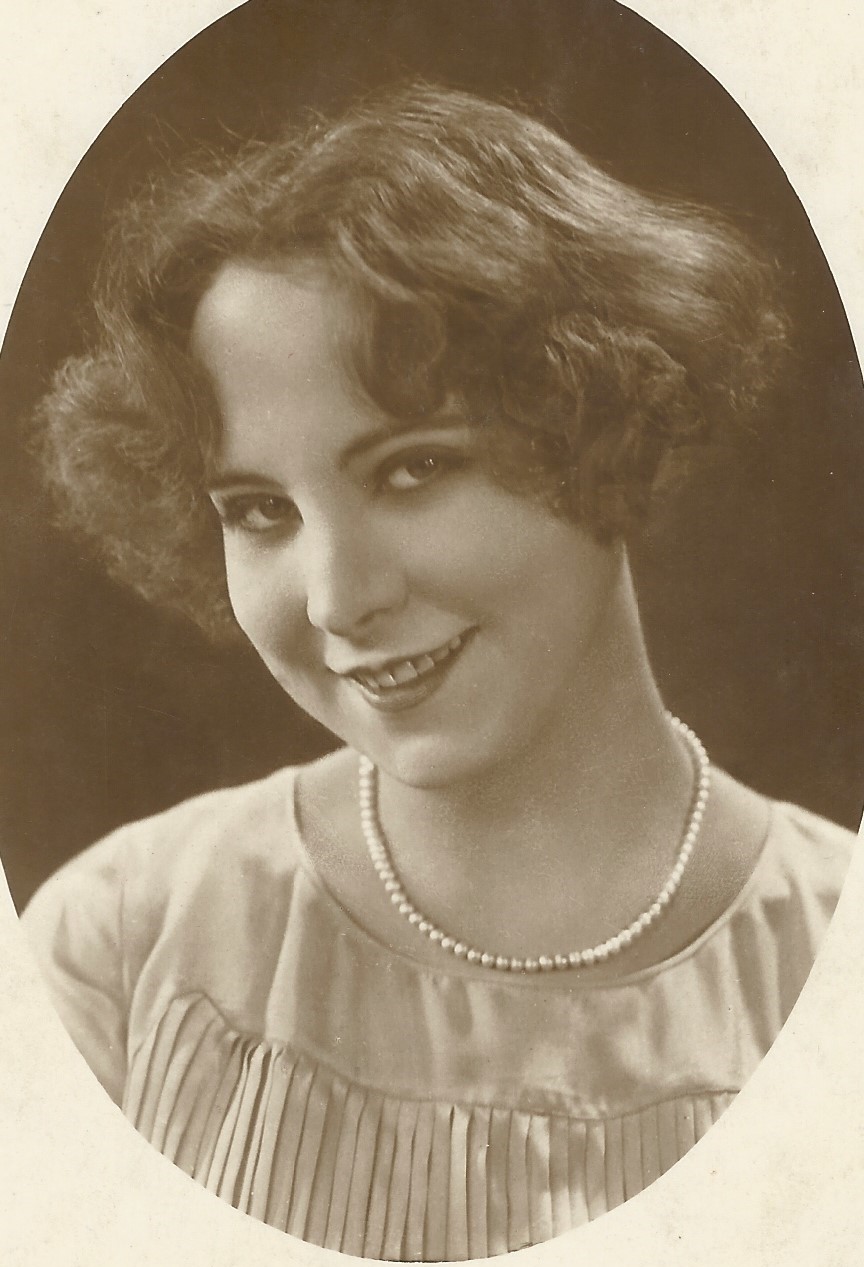
This vintage real photo postcard features silent film actress, Edda Croy. Edda has “the girl next door” look. Preliminary research uncovered little about her. Edda had a very short career. She played in three German silent films, all release in the same year (1927). One of these films was directed by Robert Wiene. He is well known for directing the silent film “The Cabinet of Dr. Caligari” (1920) and other expressionist films. Popular actor, Harry Liedtke, appeared in all three of her films. Actress Erna Morena, who’s photograph can be seen elsewhere in the Cabinet Card Gallery, apppeared in one of Edda’s films. This postcard was published by Ross Verlag (Berlin). It is part of a series (no.1923/1). Miss Croy’s photograph was taken by photographer Hans Natge. Natge was very involved in German film production. He played roles in the realm of cameras, directing and assistant directing. He was born in Berlin in 1893. His filmography on IMDb reports that he has 28 film credits between 1924 and 1949. Nineteen of these credits were for his role as the film’s “still photographer”. It is likely safe to assume that he took this photograph of Miss Croy in 1927. This vintage portrait postcard is rare and in very good condition (see scans).
Buy this original Vintage Real Photo Postcard (includes shipping within the US) #3218
To purchase this item, click on the Pay with PayPal button below
24.00 $
Buy this Vintage Real Photo Postcard (includes International shipping outside the US) 3218
To purchase this item, click on the Pay with PayPal button below
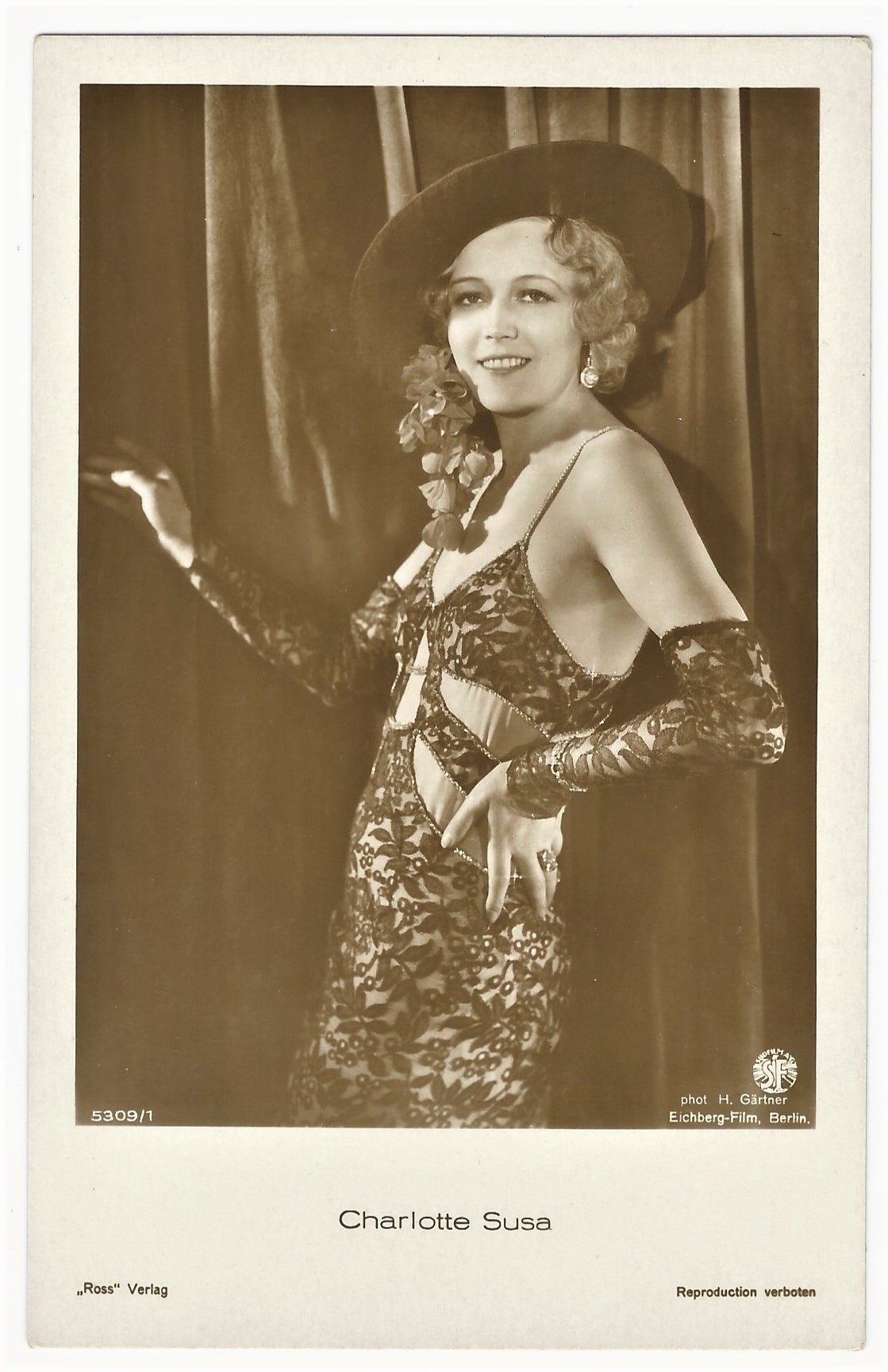
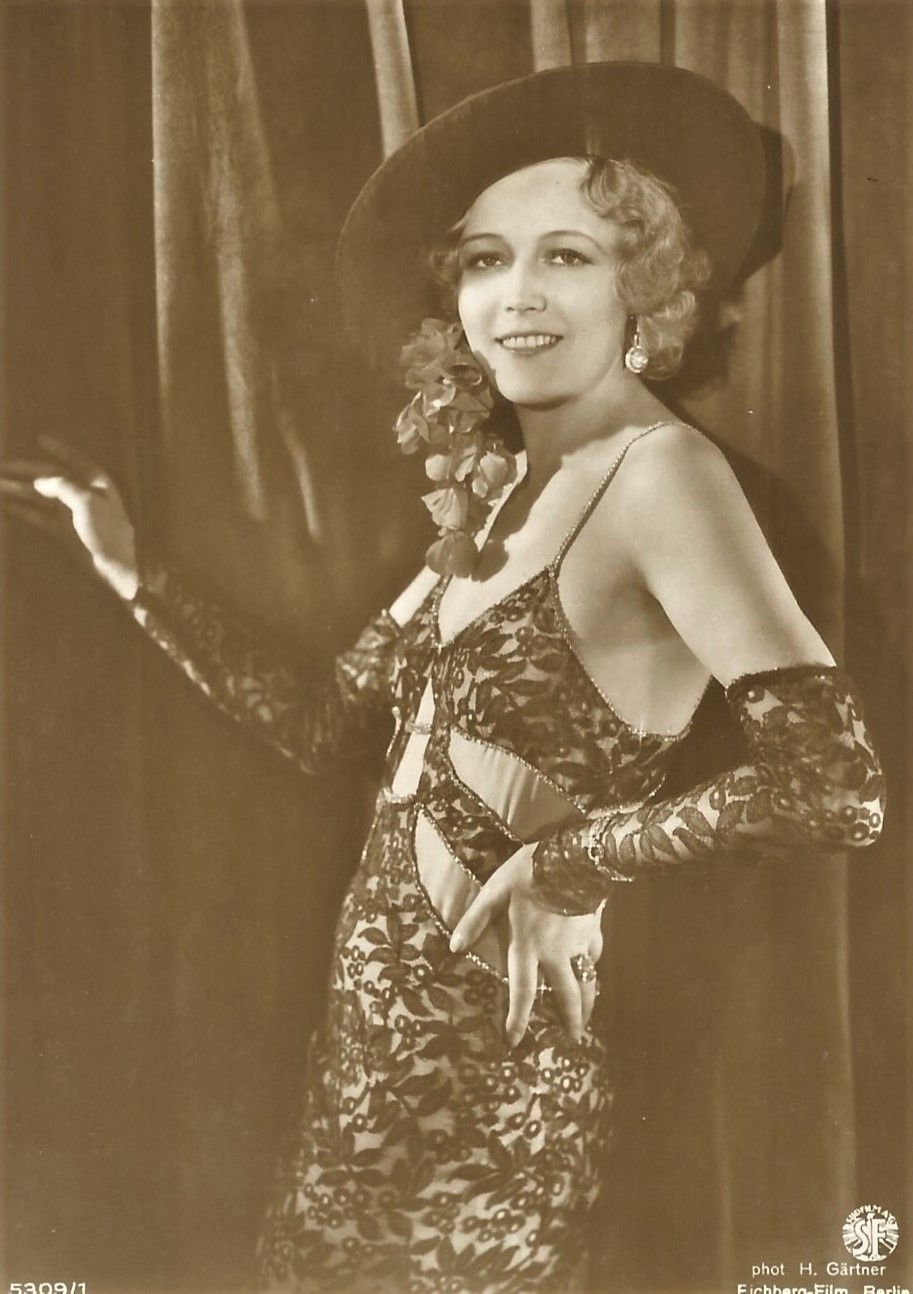
This vintage real photo postcard features German actress, Charlotte Susa (1898-1976). Sosa was very pretty and the “look” she gives the camera indicates that she knew it. She certainly has a sultry appearance in that dress. Susa was born in Memel, East Prussia. One of her parents was Italian and the other was Swiss. Her first stage appearance was in 1915. She began a successful career as both a singer and an actress. She played in a number of German opera and operetta venues. Her film debut occurred in 1926 with an appearance in a German silent movie. She became a popular actress and appeared in many femme fatale roles. After the advent of sound films, Susa began assuming leading roles. In 1932 she signed with MGM, relocated to the United States, and started an international film career. One newspaper columnist of the time wrote that Susa, Lilian Harvey, Anna Sten, and Henry Garat were all important “foreign talents” that were joining Hollywood pictures. Susa was projected to be a rival to Greta Garbo. Success in Hollywood did not come to fruition. She cancelled her contract in 1934. She stopped acting in films but returned to the stage after World War II. Susa, like many film stars, had multiple marriages. Susa stopped replacing husbands after her third marriage. Her third husband was Andrews Engelmann (1901-1992), a Russian born German actor. He appeared in German and British films during his career. Charlotte Susa died in Basel, Switzerland. The IMDb reports Susa had thirty-six film credits ranging from 1926 to 1941. This postcard portrait was photographed by H. Gartner and published by Ross Verlag as part of a series (no.5309/1). Eichberg Films is credited on this postcard. Richard Eichberg (1888-1952) began his career as an actor but became a succssful film director and producer in the German film industry. He directed 87 films and produced 77 films. At the time that Susa’s photograph was taken for this postcard, she was employed by Eichberg’s company. (SOLD)
Maria Corda (1898-1976) was a Hungarian actress and a star during the silent film era in German and Austria. She began her career in acting in the theaters of Budapest during the beginning period of World War I. One of her gigs was working as a dancer with the Royal Opera in Budapest. When the Austria-Hungary Empire fell apart, she began working in the film industry. She appeared in her first film in 1919 ;under the direction of Hungarian, Korda Sandor, who later changed his name to Alexander Korda. Korda was the leading movie director in Hungary and he featured her in three of his films in 1919. Maria became the most famous actress in Hungary. Hungary’s leader had Alexander seized by the secret police. Maria and her brother-in-law exerted pressure on the British Military consulate and was able to get her husband freed. The couple fled Hungary and settled in Vienna, Austria. It was in Vienna that the pair changed their names. He became Alexander Korda and she, for some unknown reason, became Maria Corda. In 1920, Alexander began directing films in Austria and Maria became an Austrian silent screen star. Alexander directed Maria in a number of films including “Samson and Delila” (1923). In 1926, the couple moved to Germany the couple teamed up again and were able to continue their film career success. The caught the attention of First National, a Hollywood movie studio. Alexander and Maria were offered a package deal to come to American and make movies. They settled in Beverly Hills. Maria did not encounter the success that she had in Europe. Her Hollywood career aspirations were crushed in 1928 by the advent of sound pictures. She knew little English and had a thick accent. In addition to her movie career, her turbulent marriage also came to an end. They divorced in 1930. Her husband returned to Europe where he had a long successful career in British filmmaking. Maria moved to New York and wrote a number of novels. She spent her later years in Switzerland. In 1942, her husband was knighted and she insisted upon being called “Lady Korda”, even though Alexander was remarried. When Alexander died in 1956, he was onto his third marriage, but that did not stop Maria from trying to claim an inheritance. Maria had an interesting personality. Writers have asserted that she was temperamental and ambitious. She had a tendency to embellish her background. She often described herself as the “Hungarian Garbo”, an opinion reflecting aggrandizement. The IMDb reports that Maria had 28 film credits between 1919 and 1929. —–Postcard 1 was published by Ross Verlag (Berlin), The card was part of a series (no.1633/1). Note the “Fox” logo on the bottom right hand corner of the image. Maria starred in a Korda film for a Berlin based subsidiary of Fox in 1926. Therefore, this postcard is likely from 1926. The film was entitled “Madame Wants No Children”. The postcard was sold exclusively by Ballerini & Fratini of Florence, Italy. SOLD —–Postcard 2 was published by “Europe” which I believe was based in France. It is part of a series (no.315). This photograph of Corda is risque. She is barely covering herself with what appears to be a blanket. Only her strategically placed arm shields her from crossing the risque border. At the time that this photograph was taken, Maria Corda was under contract with Mercure Film. The logo of the company can be seen in the lower right corner of the card. This photo postcard features Corda in costume for her starring role in “The Private Life of Helen of Troy (1927). The film was directed by her husband, Alexander Korda. (SOLD)
This vintage real photo postcard features American silent and sound film star, Virginia Brown Faire (1904-1980). She was born in Brooklyn, New York. In 1919, after being a winner of the Motion Picture Classic magazine’s “Fame and Fortune” contest, she went to Hollywood. At age 15, she was hired by Metro studio. She then appeared in movies for Fox, followed by Universal. Her first film “Runnin’ Straight” (1920) was a Hoot Gibson short western. She was the leading lady for John Gilbert in Monte Cristo (1922). She was chosen as one of the WAMPAS Baby Stars in 1923. Included in this group of beautiful actresses was Laura La Plante and Evelyn Brent. La Plante and Brent both had successful acting careers. She is most remembered for her role as Tinker Bell in Peter Pan (1924). Faire made a successful transition into sound films. Her first successful talkie was her role in Frank Capra’s “The Donovan Affair” (1929). She appeared in several westerns. Among the western stars that she played opposite to; was John Wayne,Hoot Gibson, and Buck Jones. In the late 1930’s she left Hollywood and moved to Chicago and worked in radio and industrial films. She retired in about 1935. According to the IMDb, she appeared in 74 films between 1920 and 1935. Faire had three marriages. The first, was to actor Jack Dougherty and the marriage lasted just over a year. She then married director Duke Worne, a film director. He died after three years and she then married William Bayer, a furniture manufacturer. She died of cancer in 1980. This vintage postcard was published by Ross Verlag of Berlin, Germany. It is part of a series (no, 736/1). SOLD
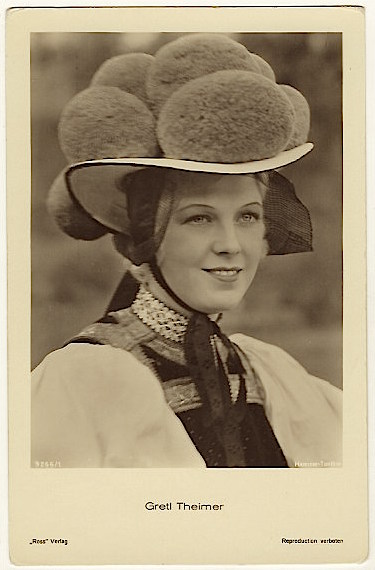
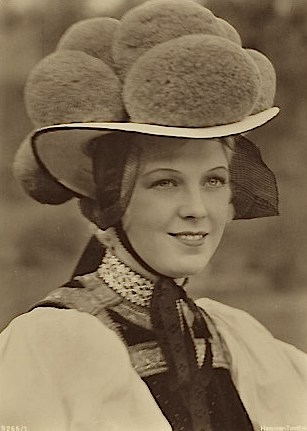
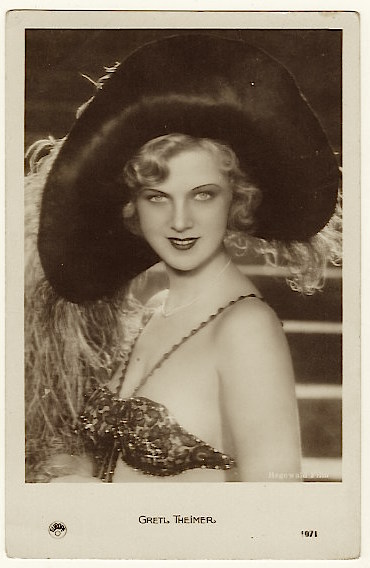
This vintage real photo postcard features Austrian actress, Gretl Theimer (1910-1972). She was a leading lady and singer of operatic films in the 1930’s. She was trained as a ballerina and she began her performing career as a child.She danced in the children’s ballet of the State Opera in Vienna. The IMDb reports that she has 57 film credits between 1930 and 1969. Her roles after World War II were predominately minor parts. Postcard 1 features Miss Theimer wearing a most interesting hat in this portrait. It looks like her hat is covered with dragon eggs, or giant dustballs. This photo postcard was published by Ross Verlag. The publisher was located in Berlin, Germany. The postcard is part of a series (no. 9266/1). The postcard has the logo of Hammer-Ton films. This photo postcard has excellent clarity and is in excellent condition. Postcard 2 offers a more risque view of Gretl Theimer. She is wearing a bikini top and a beautiful smile. She is accessorized with a string of pearls. Note her large hat and it’s plume of feathers. This photo postcard, judging by the logo on the front of the card, was published by “Europe”. It is part of a series (no. 1071). Embedded in the image is the words “Hegewald Film”. Liddy Hegewald (1884-1950) was a German film producer. She worked between 1919 and 1931. She worked in both the silent and early sound eras. Hegewald film was Liddy Hegewald’s own production company. To view Miss Theimer singing in a 1930 film, see the Youtube video below.
Buy this original Vintage Real Photo Postcard (includes shipping within the US) #2826
To purchase this item, click on the Pay with PayPal button below
$23.50
Buy this original Vintage Real Photo Postcard (includes International shipping outside the US) #2826
To purchase this item, click on the Pay with PayPal button below
$32.00
Buy this original Vintage Real Photo Postcard (includes shipping within the US) #2831
To purchase this item, click on the Pay with PayPal button below
$33.50
Buy this original Vintage Real Photo Postcard (includes International shipping outside the US) #2831
To purchase this item, click on the Pay with PayPal button below
The lovely actress seen in this vintage real photo postcard is named Gerda Maurus (1903-1968). She is posed next to a beautiful Airedale terrier. This unusual profile photograph was taken by celebrity photographer Alex Binder. His studio was located in Berlin, Germany. Maurus was active in film and television between 1928 and 1968. She was an Austrian actress of Croatian descent. Maurus was the daughter of an engineer/inventor. She grew up in Vienna and received training as a singer and dancer. She hit the stage at age fifteen. The IMDb biography of Maurus describes her as ” a strikingly beautiful blonde with high cheekbones an expressive blue eyes”. She began her career on the stages of Vienna. She was “discovered” by director Fritz Lang and he cast her in the female lead in the silent film “Spione” (1928). Lang was smitten by maurus and his marriage was destroyed. She then appeared in a number of German films during the Weimar and Nazi eras. Maurus married director Robert A. Stemmie in 1937. He directed her in “Daphne and the Diplomat” (1937). Like many actresses of her time, her acting career was hurt by the introduction of “talkies”. Further complicating matters was her nebulous association with Nazi propaganda minister Joseph Goebbels. This relationship had negative impact on her career after World War II. Due to lack of film offers, Maurus retreated to the German stage. The IMDb filmography of Gerda Maurus lists 33 credits. Here is a side note about Airedales. The first World War increased the popularity of Airedales because they became famous for their bravery on the battlefield. In the US, Presidents Theodore Roosevelt, Calvin Coolidge, and Warren Harding all owned Airedales. In the 1920’s, Airedales became the most popular dog in the US. This postcard was published by Ross Verlag and is part of a series (no. A1320/1). (SOLD)
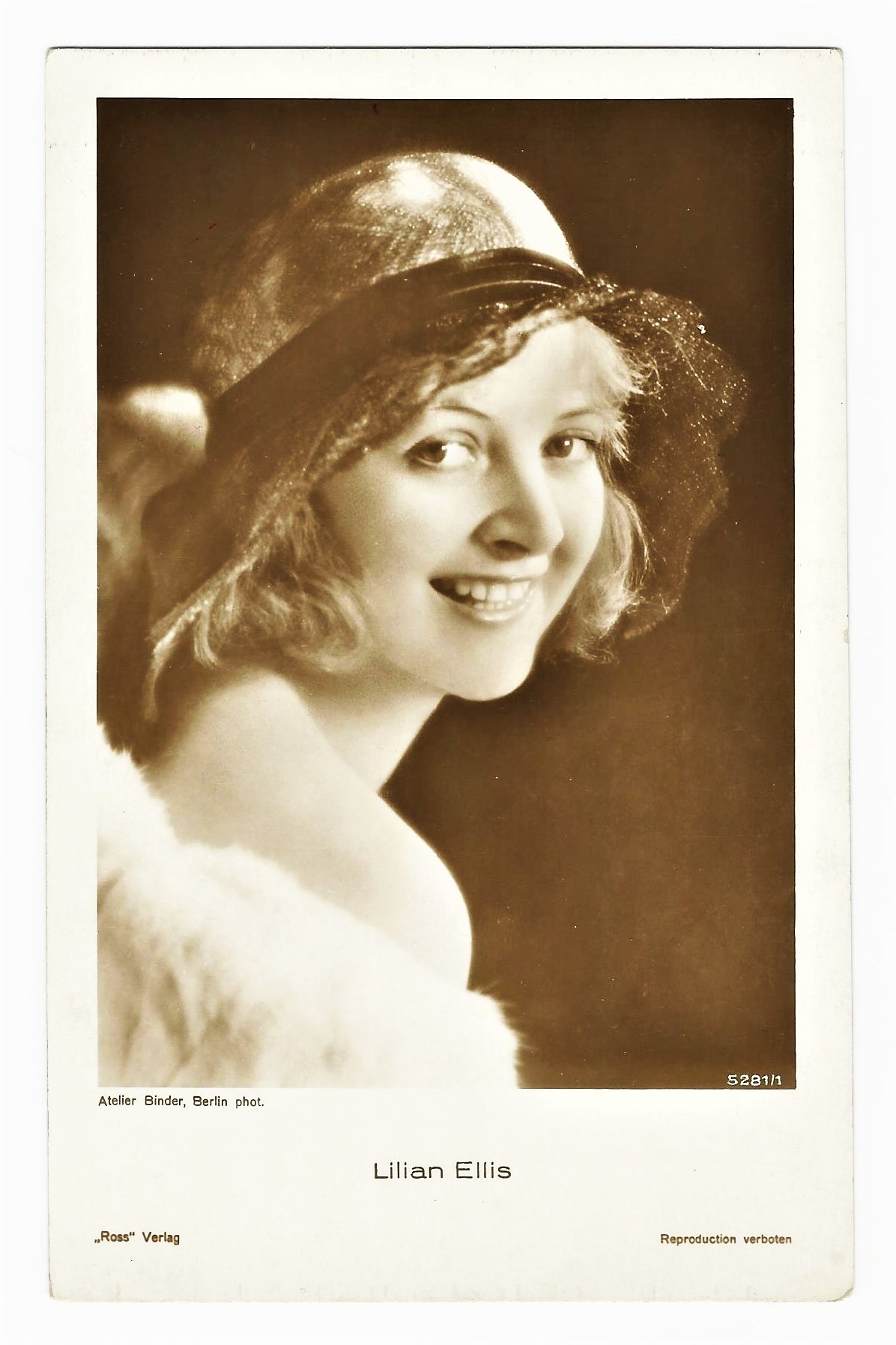
This vintage real photo postcard features Danish actress, Lillian Ellis (1907-1951). She made fer film debut in 1928. Many of her roles were in German films. Her stardom in Germany peaked at the end of the 1920’s. The IMDb credits Ellis with 18 acting roles between 1928 and 1959. This vintage postcard was published by Ross Verlag and was part of a series (no. 5281/1). The photographer who took this photograph was Alex Binder, a celebrity photographer located in Berlin, Germany. This portrait postcard is in very good condition.
Buy this original Vintage Real Photo Postcard (includes shipping within the US) #2687
To purchase this item, click on the Pay with PayPal button below
$20.00
Buy this original Real Photo Postcard (includes International shipping outside the US) 2687
To purchase this item, click on the Pay with PayPal button below
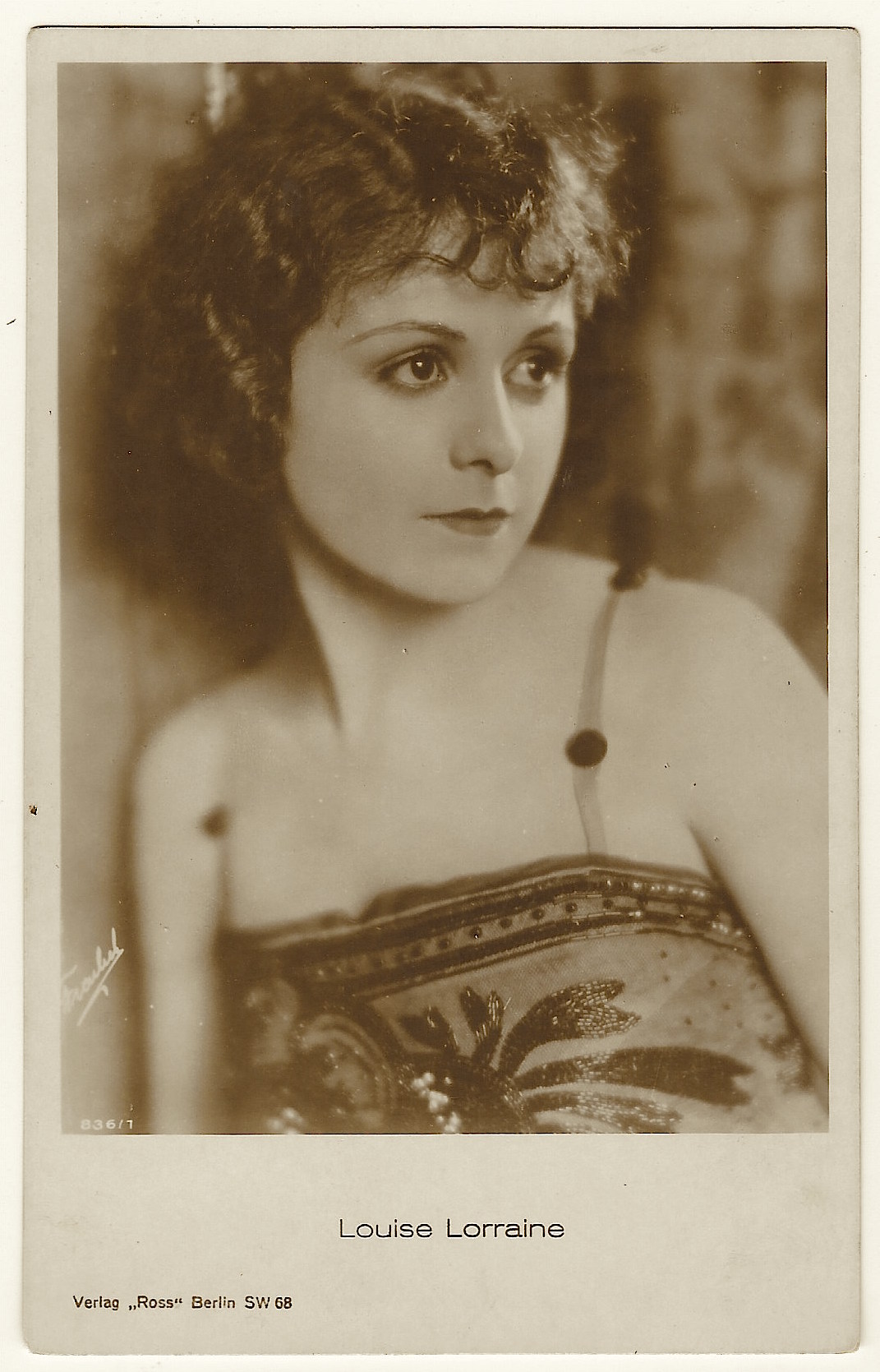
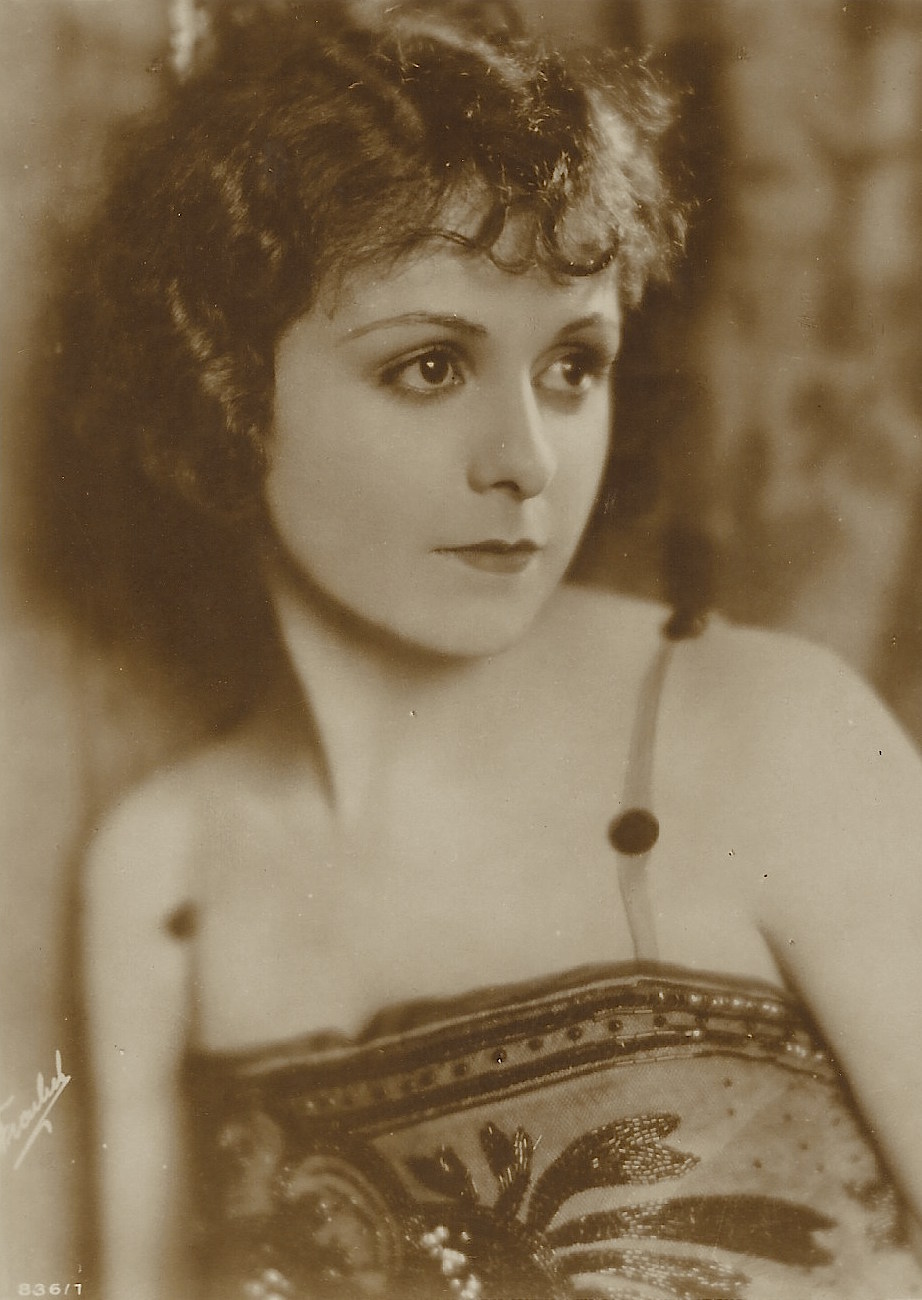
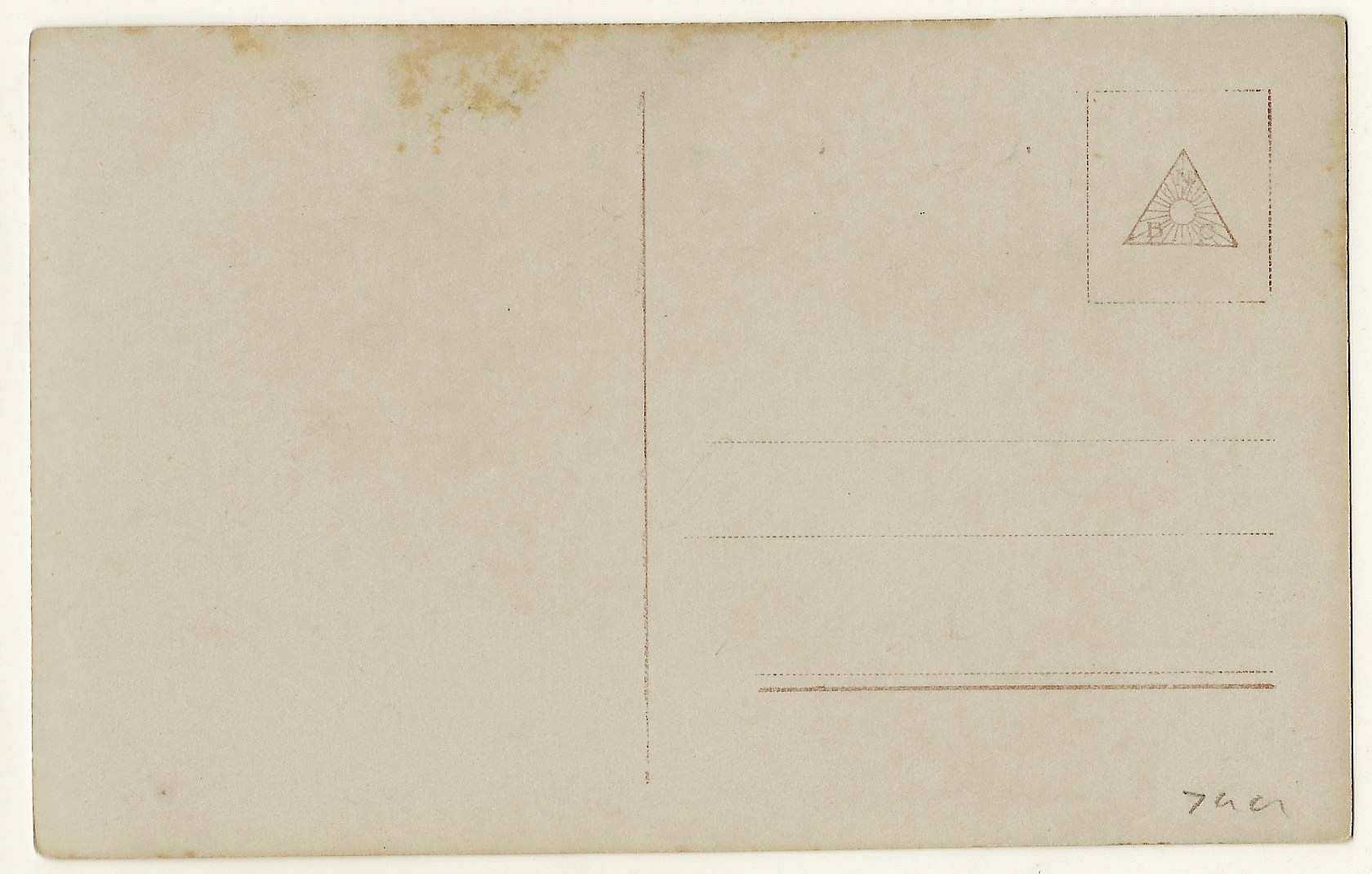
This vintage real photo postcard features beautiful American film actress, Louise Lorraine (1904-1981). She was born in San Francisco and was discovered by a photography salesman who had knocked at the door of her home and was met by Louise. The salesman was startled by her good looks and her winning personality He told Louise’s mother that her daughter should be in films. Her widowed mother had five other children and after some time, she agreed to allow Louise to investigate becoming an actress. The salesman used a contact, and before long, Louise was in independent two-reel comedies. That was followed by stints with MGM and Universal. She became very popular for her roles in action-packed serials such as “The Radio King” (1922) and “With Stanley in Africa” (1922). She starred in eleven serials and was known for her energy and charisma. Her small stature and delicate beauty were unlikely characteristics expected in a serial heroine. However, she starred these physically demanding serials. In 1921, she became the third actress to portray “Jane”. She starred in the movie serial “The Adventures of Tarzan’ (1921). She was selected as a “Wampas Baby Star” in 1922. The organization was very successful at identifying future stars. Among their “finds” was Clara Bow and Joan Crawford. She starred in only five talkies during her film career including “Near the Rainbow’s End’ (1930). After this film appearance, she retired to spend time with her husband and two children. The IMDb reports that Louise Lorraine appeared in 83 films between 1922 and 1930. Lorraine was married twice. Marriage number one was to actor Art Acord, Her second marriage was to Chester Hubbard. She had two children. This vintage postcard was published by Ross Verlag and was part of a series (no. 836/1). The photographer of this portrait was Roman Freulich (1898-1974). Freulich was born in Poland and immigrated to the United States at the age of 14. He learned his trade from New York photographer Samuel Lumiere. He moved to Hollywood in the mid 1920’s where his brother Jack was a portrait photographer at Universal Pictures. Roman became a still photographer for Universal and produced many portraits of their major stars. He stayed at Universal until 1944 when he moved to Republic Studios. After Republic stopped production, Freulich did much work for United Artists.The stamp box of this postcard has an interesting story. “NBC” (Neue Bromsilber Convention) was a price cartel established in 1909 that continued until the 1930’s. The purpose of the cartel was to ensure that the minimum price charged for postcards was kept at a sufficiently profitable level. A number of postcard publishing companies joined the cartel in an effort to stave off the effect of competition on the pricing of postcards. This postcard has excellent clarity and is in very good condition (see scans).
Buy this original Vintage Real Photo Postcard (includes shipping within the US) #2630
To purchase this item, click on the Pay with PayPal button below
$25.50
Buy this original Vintage Real Photo Postcard (includes international shipping outside the US) #2630
To purchase this item, click on the Pay with PayPal button below
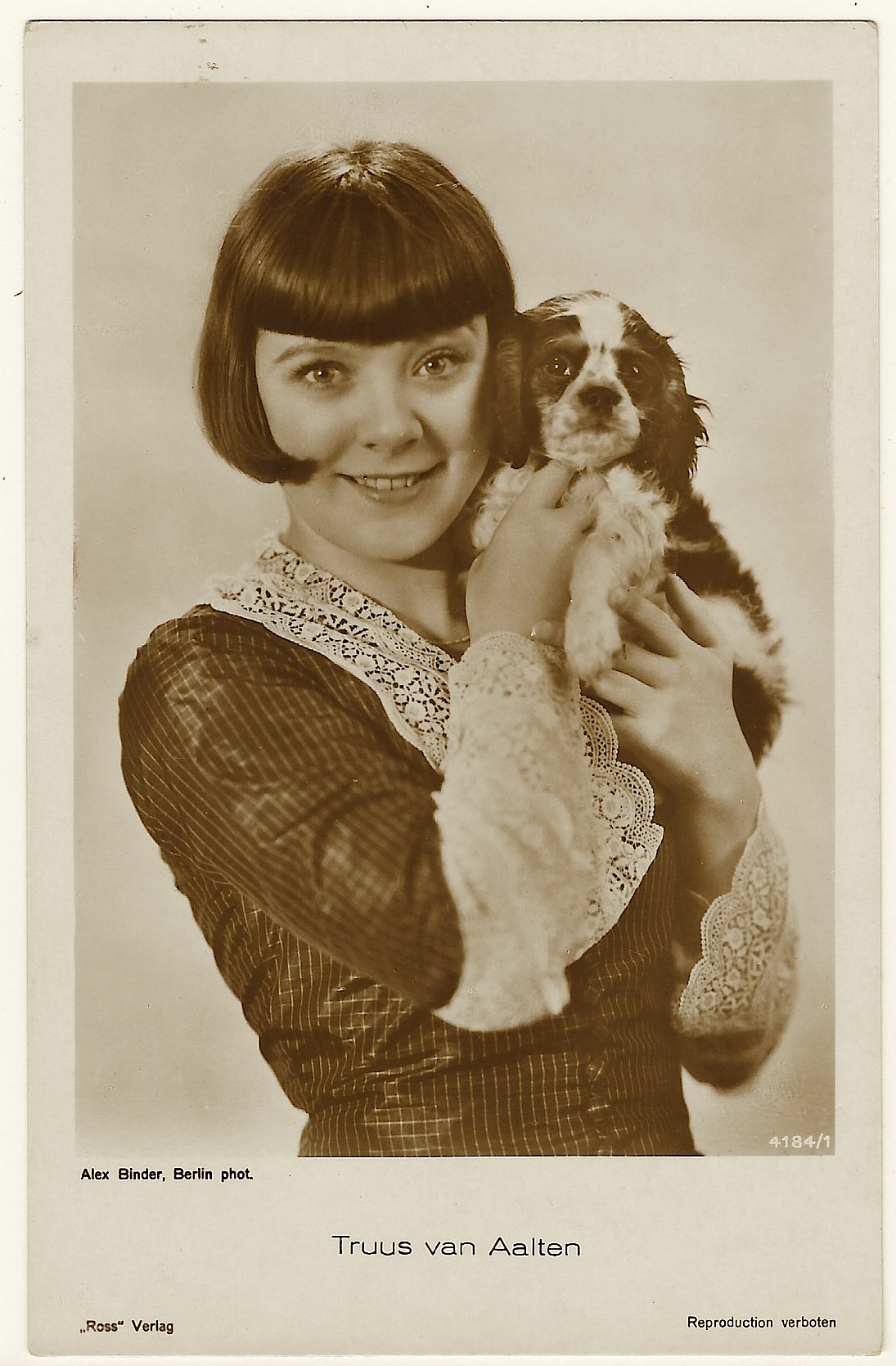
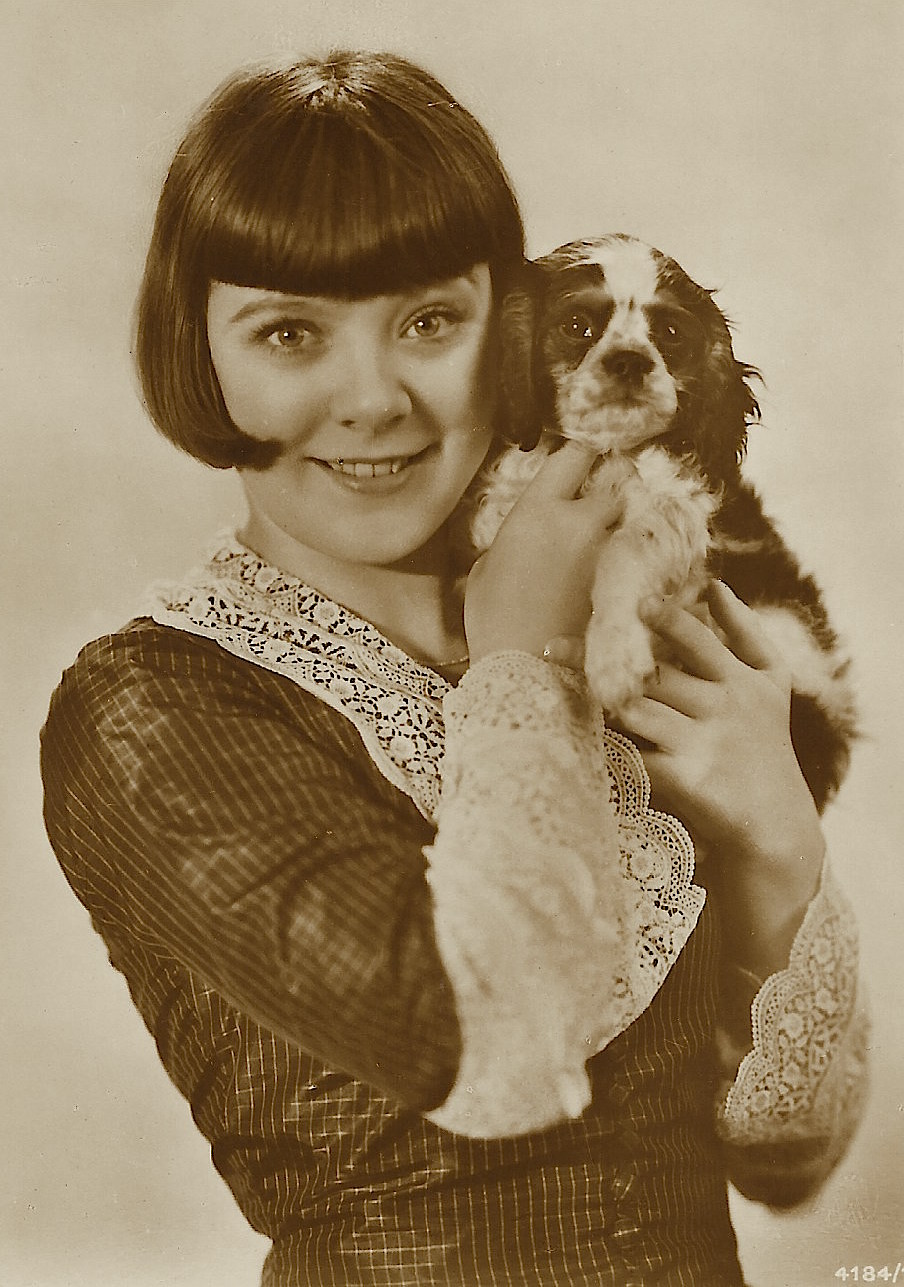
The top vintage real photo postcard features Dutch actress, Truus van Aalten (1910-1999). She appeared in many German films in the 1920’s and 1930’s. She is flashing a wonderful smile as she holds a cute little dog. Truus worked as a milliner after finishing school and then worked as a salesgirl in a clothing store in Amsterdam. What she really wanted to do, was to become a movie actress. Unfortunately, at the time, the movie industry was not producing many films in the Netherlands. In 1896, Truus entered a beauty contest sponsored by a Dutch magazine. The winner of this contest would be given the opportunity to audition for a film role. Truus was selected and joined about two hundred other women in Berlin to try out for the film part. She excelled on the screen test and won the role. The movie was being produced by Ufa, a German film company. The cast of the film included Betty Balfour and Willy Fritsch. Three photos of Miss Balfour can be found in the Cabinet Card Gallery by searching for “Balfour”. The name of Truus’s first movie was “A Sister of Six” (1926). Keep in mind, Truus had no training or experience as an actress. Even though Truu’s command of the German language was weak, Ufa offered her a contract and promised to train her and offer her opportunities in other films. The Ufa executives appreciated her sparkly and funny personality as well as her photogenic appearance. Truus’s father signed the contract and she moved to Berlin. The celebrated actress Olga Tschechowa took Truus under her wing and became her unofficial mentor and mother figure in the film industry. Olga nicknamed the young actress “Trulala”. Truus second film appearance was in “His Late Excellency” (1927). This movie included Willy Fritsch and Olga Tschechowa among it’s stars. Truus appeared in five movies that were released in 1928. She was certainly a busy actress. As Truus started to appear in more and more silent films, it became clear that she was talented; pretty, spunky, and funny. Truus’s greatest talent was seen in her comedic roles. She slowly became a fan favorite. She was the subject of interviews and photos in movie magazines. She also got work appearing in advertisements. Truus had “a look” of her own. She was described in one article as having a “mixture of boyish yet feminine energy”. Her bobbed hair and her uninhibited style was similar to actress Colleen Moore. Truus made a successful transition into “talkies”, despite her Dutch accent. By 1930, she was a very well known actress. Her photograph appeared in many postcards and tobacco cards. As Nazism rose in Germany, members of the film industry felt extremely vulnerable. Her film appearances became less frequent, partially because the parts written for females, during the Hitler era, were not particularly desirable to Truus. In 1934, she starred in her only film in Dutch and she was well received. Her next film wasn’t until 1939 and it turned out to be her final film appearance. In 1940, she returned to live in German occupied Netherlands. She was offered movie roles there, but refused them, because they were propaganda films. After the war, there was little activity in film production in Germany or Netherlands. Finding roles in English or American movies was unsuccessful. In 1954, Truus established a successful importing and exporting business in the Netherlands. The IMDb credits Truus with 28 film appearances from 1926 to 1939. The YouTube video below demonstrates just how cute and engaging Truus was as an actress. She was incredibly adorable. Postcard 1 was published by Ross Verlag. The postcard is part of a series (no. 4184/1). Miss van Aalten’s portrait was taken by photographer Alex Binder, who operated a studio in Berlin. He was one of Berlin’s premier photographers and photographed many stars of the stage and film. This postcard is in excellent condition (see scans). Postcard 2 was also published by Ross Verlag. The card is part of a series (no. 3884/1). The portrait was taken by photographer Hanni Schwarz of Berlin. Schwarz was a German female photographer and her work was praised in “American Photography” (1909). She was a well known professional photographer in Germany during the early 1900’s. Before becoming a photographer, she was a teacher at her father’s school in Basel. In 1904 , she and Anna Walter took over the photo studio of Johannes Hulsen in Berlin. In 1908, she and Wilhelm von Gloeden presented nude photographs at an exhibit in Berlin. Sometime around 1909 she ran her studio with photographer Marie Luise Schmidt. During the Brussels World’s Fair in 1910, Schwarz exhibited nudes In 1914, she began working with color photography. In 1919 the studio’s name only included Miss Schwarz, and she was reported to specialize in portrait and dance photography. The last known year of Schwarz’s work was 1930. This vintage postcard is in excellent condition (see scans).
Buy this original Vintage Real Photo Postcard (includes shipping within the US) #2610 (Postcard 1)
To purchase this item, click on the Pay with PayPal button below
$31.50
Buy this original Real Photo Postcard (includes international shipping outside the US) #2610 (Postcard 1)
To purchase this item, click on the Pay with PayPal button below
$39.50
Buy this original Vintage Real Photo Postcard (includes shipping within the US) #2611 (Postcard 2)
To purchase this item, click on the Pay with PayPal button below
$28.00
Buy this original Vintage Real Photo Postcard (includes international shipping outside the US) #2611 (Postcard 2)
To purchase this item, click on the Pay with PayPal button below
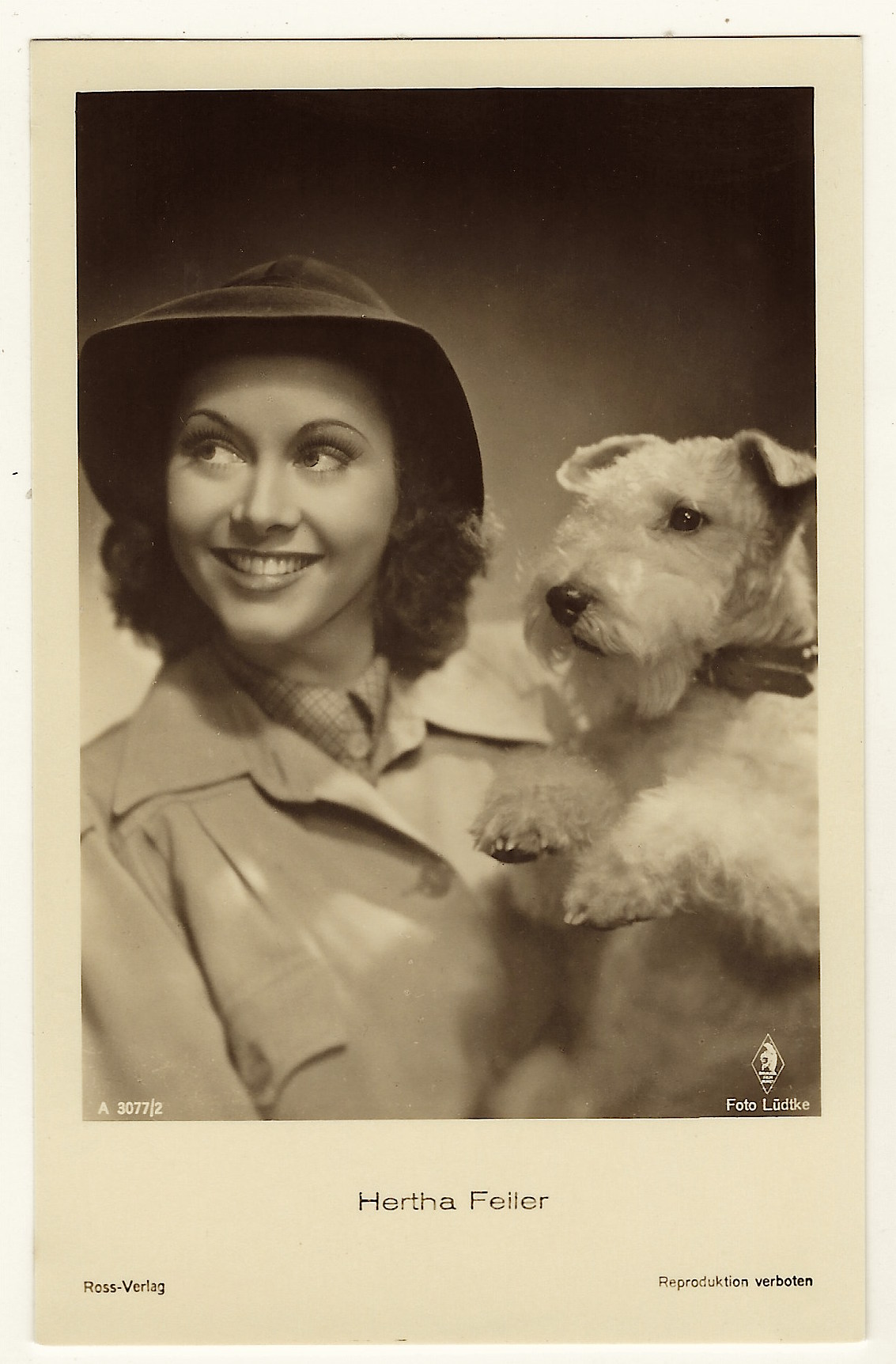
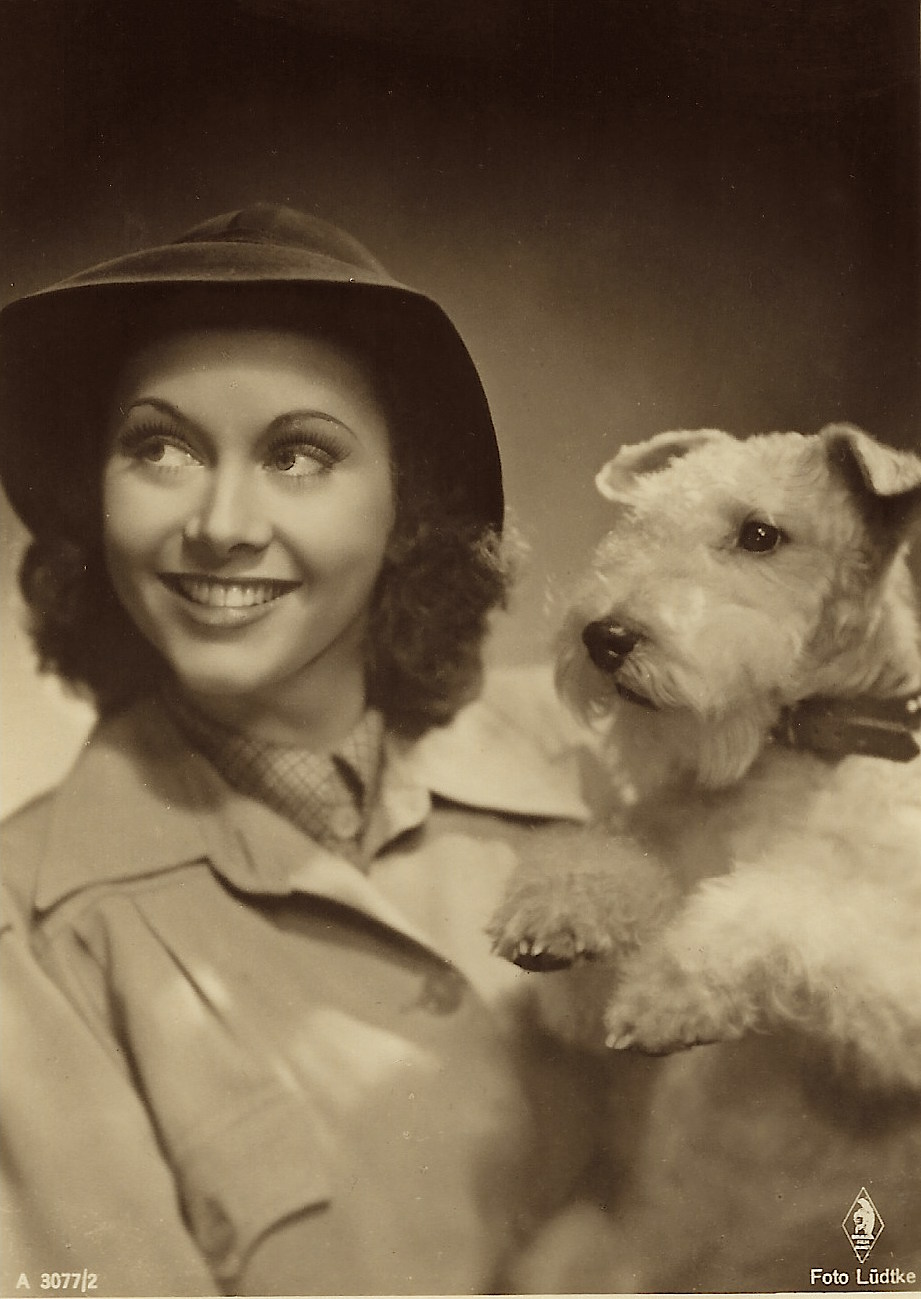
Hertha Feiler (1816-1970) was an Austrian actress. She was of Jewish descent. Feiler was married to comedian Heinz Ruhmann. The pair starred in several films together. The IMDb credits Feiler with appearing in 33 films between 1937 and 1968. Originally, Feiler wanted to be a pianist but a medical problem (inflamation in her arm) caused her to look for another artistic profession. She made her film debut at the age of 21. Over time, she became a popular actress. She often played “ladylike and cheerful roles with charm”. She fell in love with Ruhmann while he was directing her in “Louder Lies (translation)” (1938). The Nazis considered Feiler to be one fourth Jewish so there were limits placed on her acting opportunities. In the 1950’s she took on more mature roles. She tended to play women who were confident and cheerful but pragmatic. She retired from acting in 1968 due to illness (cancer). Feiler was known to be an excellent swimmer and equestrian. Miss Feiler is very pretty in this photograph. Her dog, possibly a wire haired terrier, is adorable. The postcard was published by Ross Verlag as part of a series (no. A 3077/2). The photographer was Ludke. There is a logo of a film studio in the lower right hand corner of the image. Look below to see a youtube video featuring Hertha Feiler and Heinz Ruhmann. (SOLD)

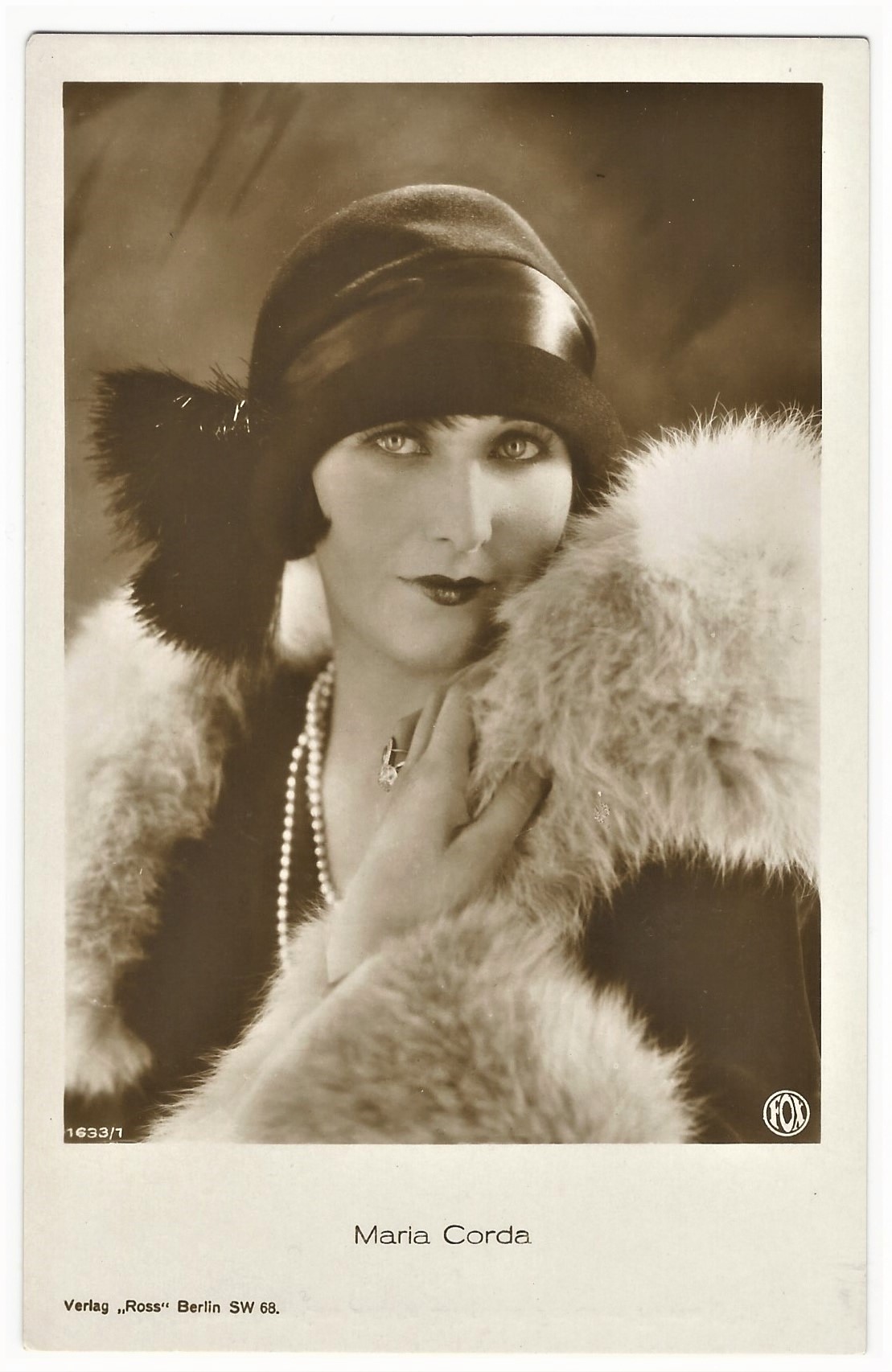 POSTCARD 1 (SOLD)
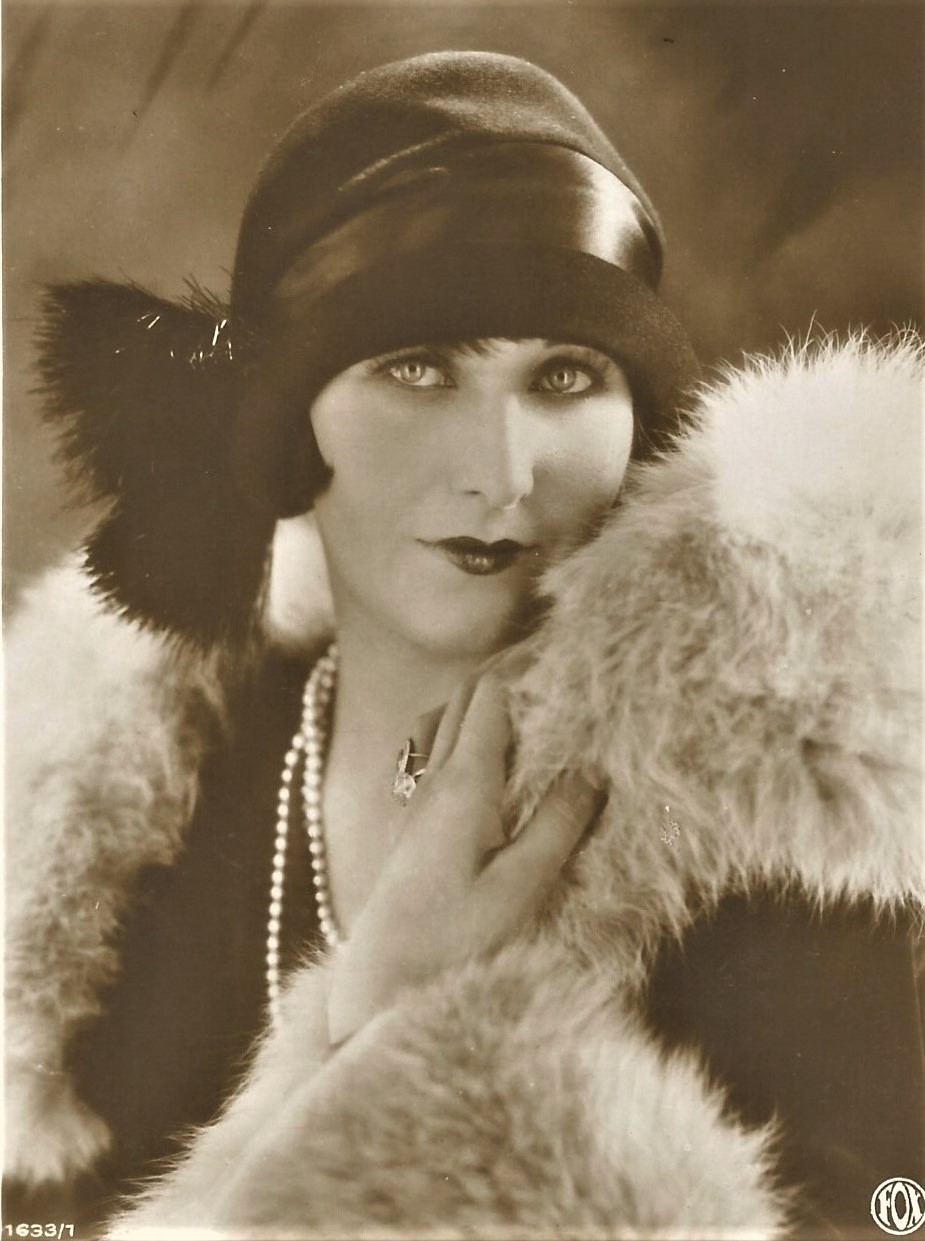 POSTCARD 1 (CLOSE-UP) (SOLD)
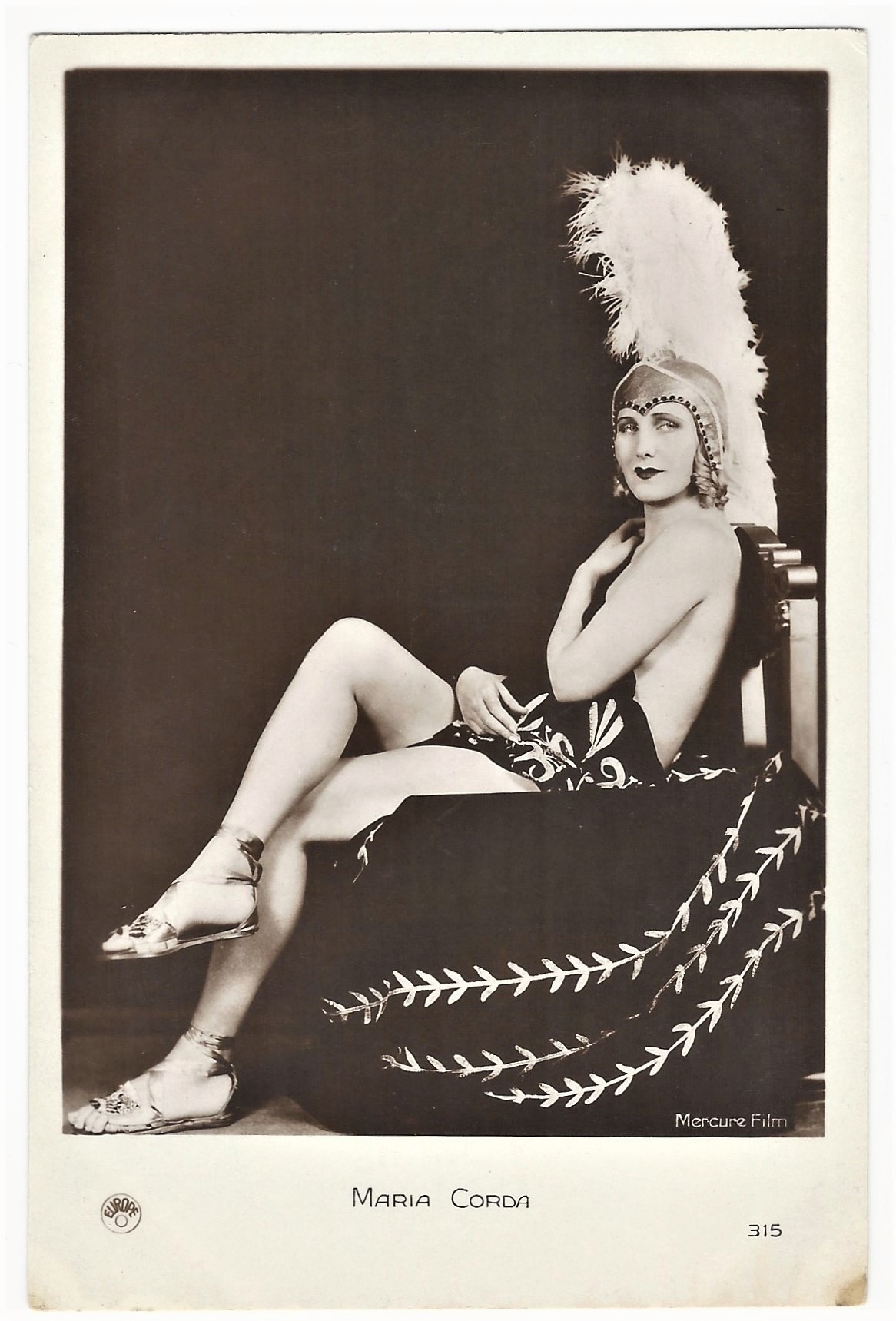 POSTCARD 2 (SOLD)
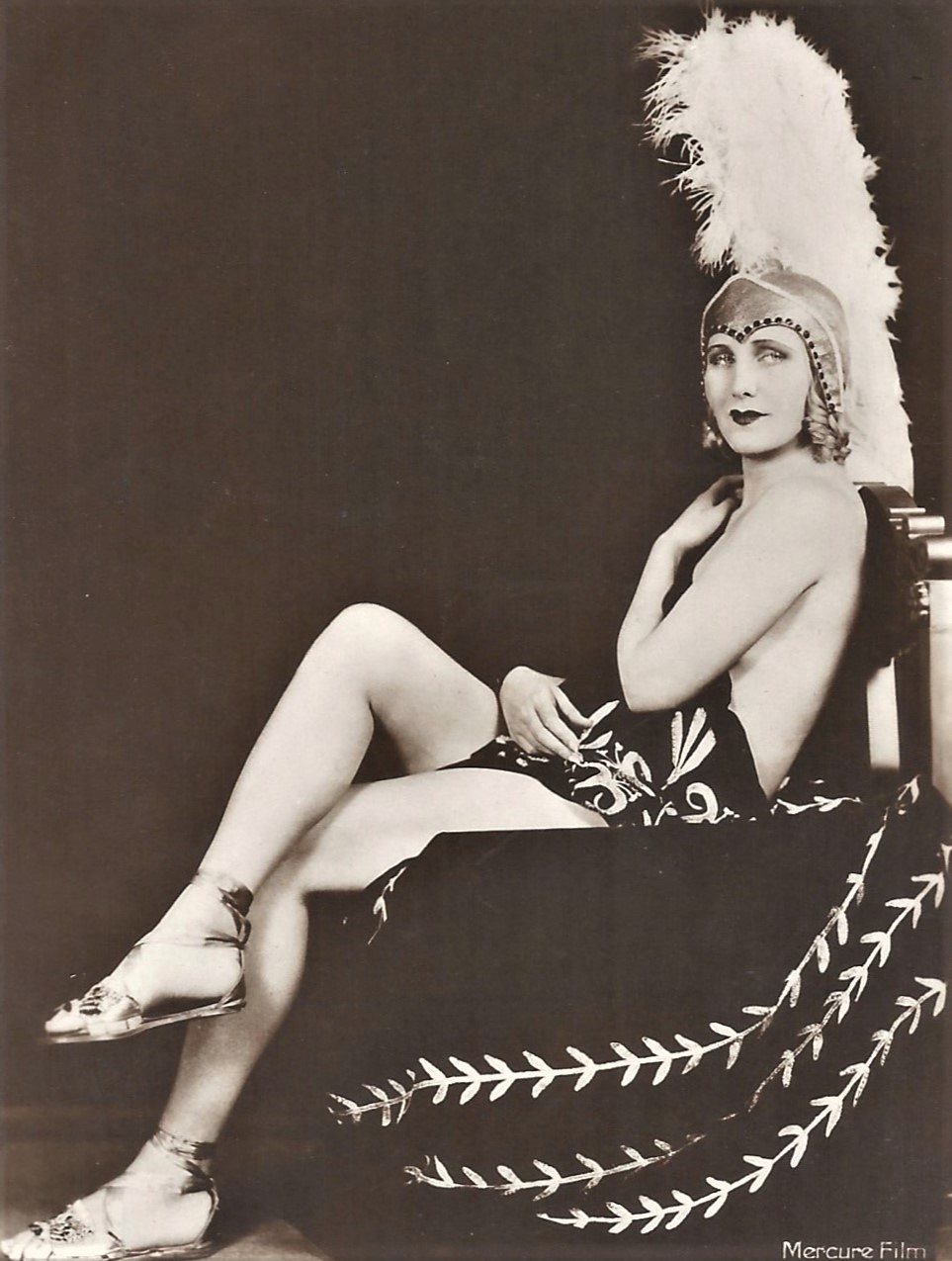 POSTCARD 2 (CLOSE-UP) (SOLD)
 POSTCARD 1 (REVERSE)
 POSTCARD 2 (REVERSE)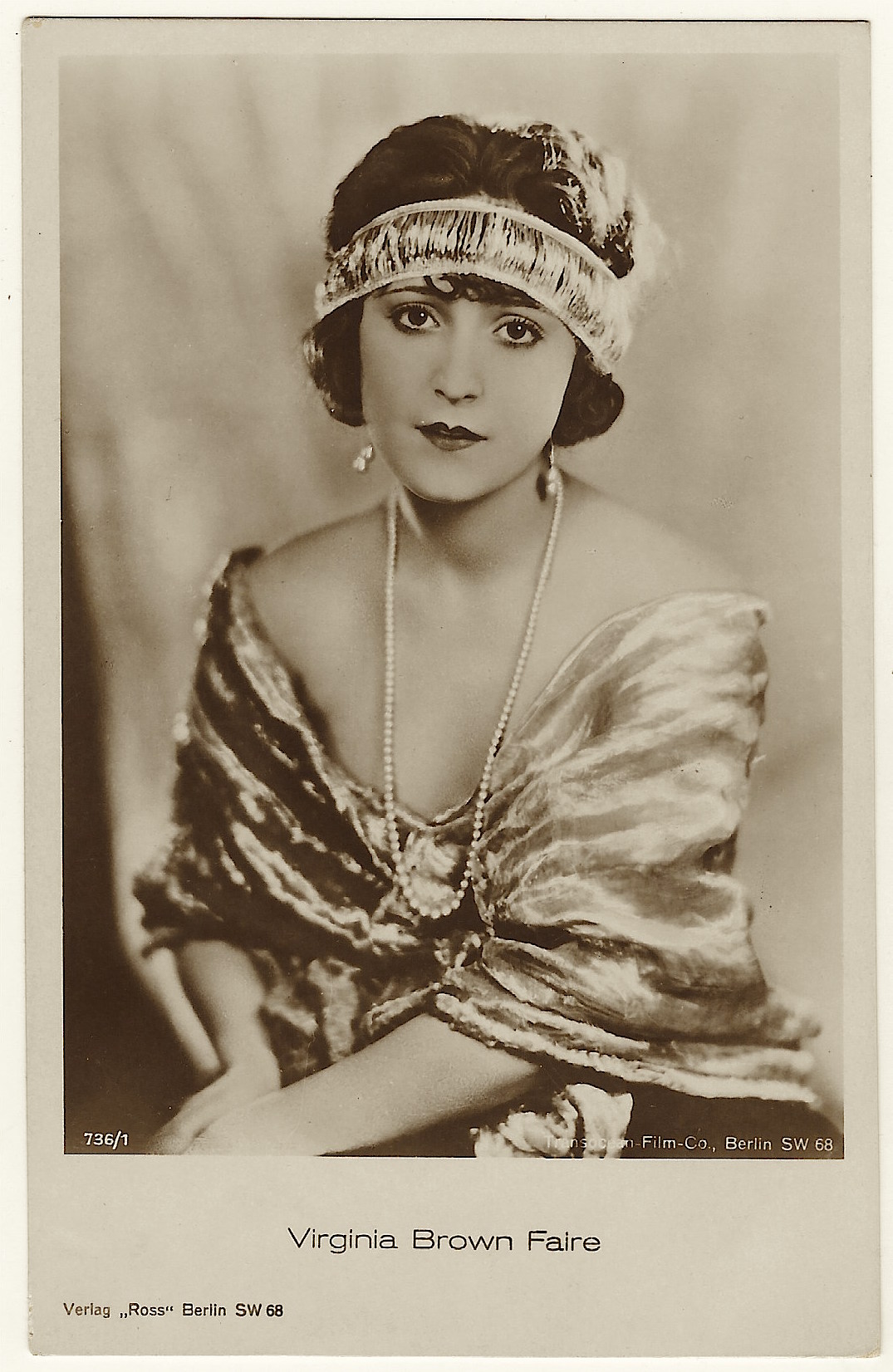
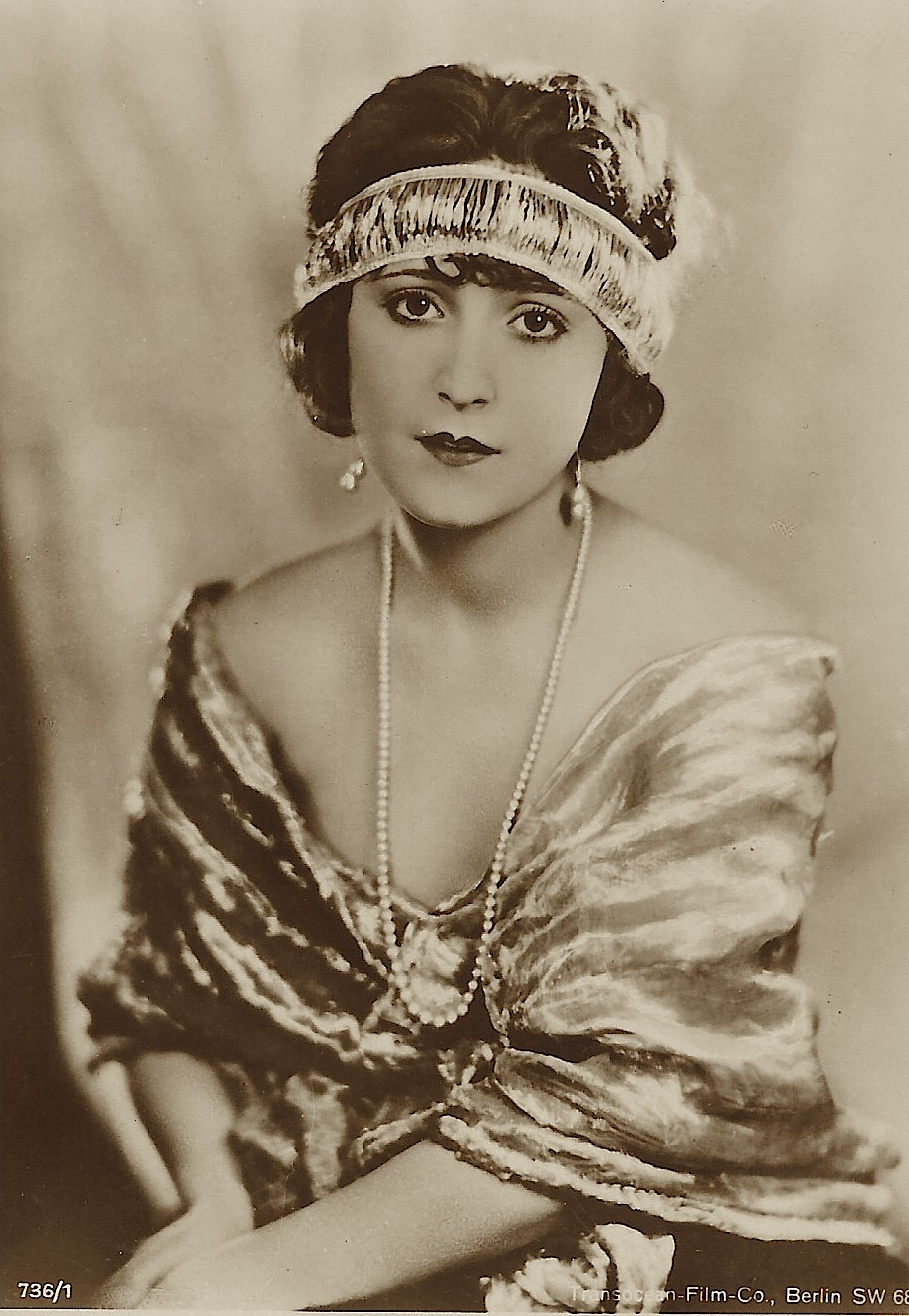 This vintage real photo postcard features American silent and sound film star, Virginia Brown Faire (1904-1980). She was born in Brooklyn, New York. In 1919, after being a winner of the Motion Picture Classic magazine’s “Fame and Fortune” contest, she went to Hollywood. At age 15, she was hired by Metro studio. She then appeared in movies for Fox, followed by Universal. Her first film “Runnin’ Straight” (1920) was a Hoot Gibson short western. She was the leading lady for John Gilbert in Monte Cristo (1922). She was chosen as one of the WAMPAS Baby Stars in 1923. Included in this group of beautiful actresses was Laura La Plante and Evelyn Brent. La Plante and Brent both had successful acting careers. She is most remembered for her role as Tinker Bell in Peter Pan (1924). Faire made a successful transition into sound films. Her first successful talkie was her role in Frank Capra’s “The Donovan Affair” (1929). She appeared in several westerns. Among the western stars that she played opposite to; was John Wayne,Hoot Gibson, and Buck Jones. In the late 1930’s she left Hollywood and moved to Chicago and worked in radio and industrial films. She retired in about 1935. According to the IMDb, she appeared in 74 films between 1920 and 1935. Faire had three marriages. The first, was to actor Jack Dougherty and the marriage lasted just over a year. She then married director Duke Worne, a film director. He died after three years and she then married William Bayer, a furniture manufacturer. She died of cancer in 1980. This vintage postcard was published by Ross Verlag of Berlin, Germany. It is part of a series (no, 736/1). SOLD
 POSTCARD 1
 POSTCARD 1 (CLOSE-UP)
 POSTCARD 2
 Postcard 2 (Close=up)
 POSTCARD 1
 POSTCARD 2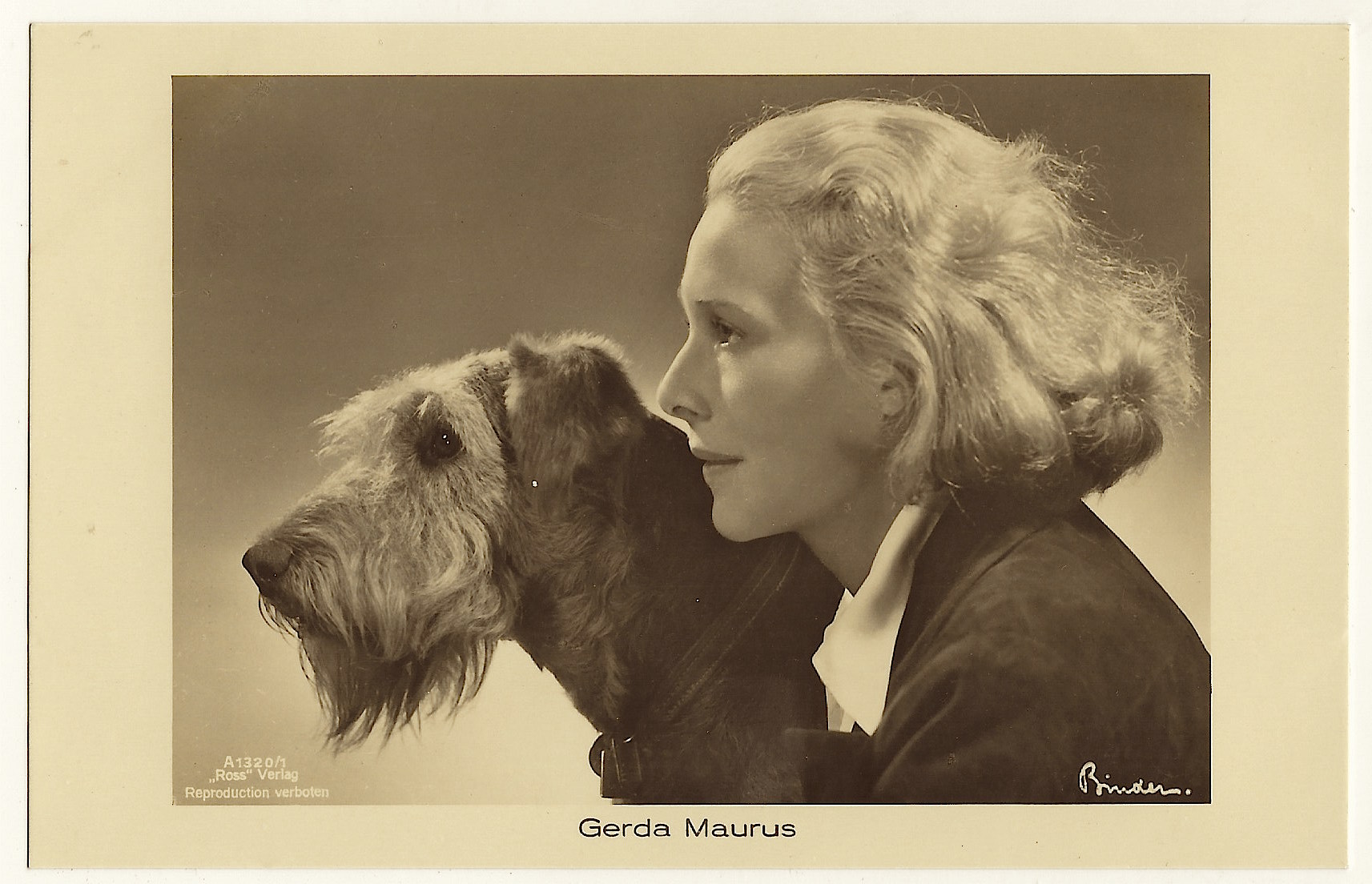
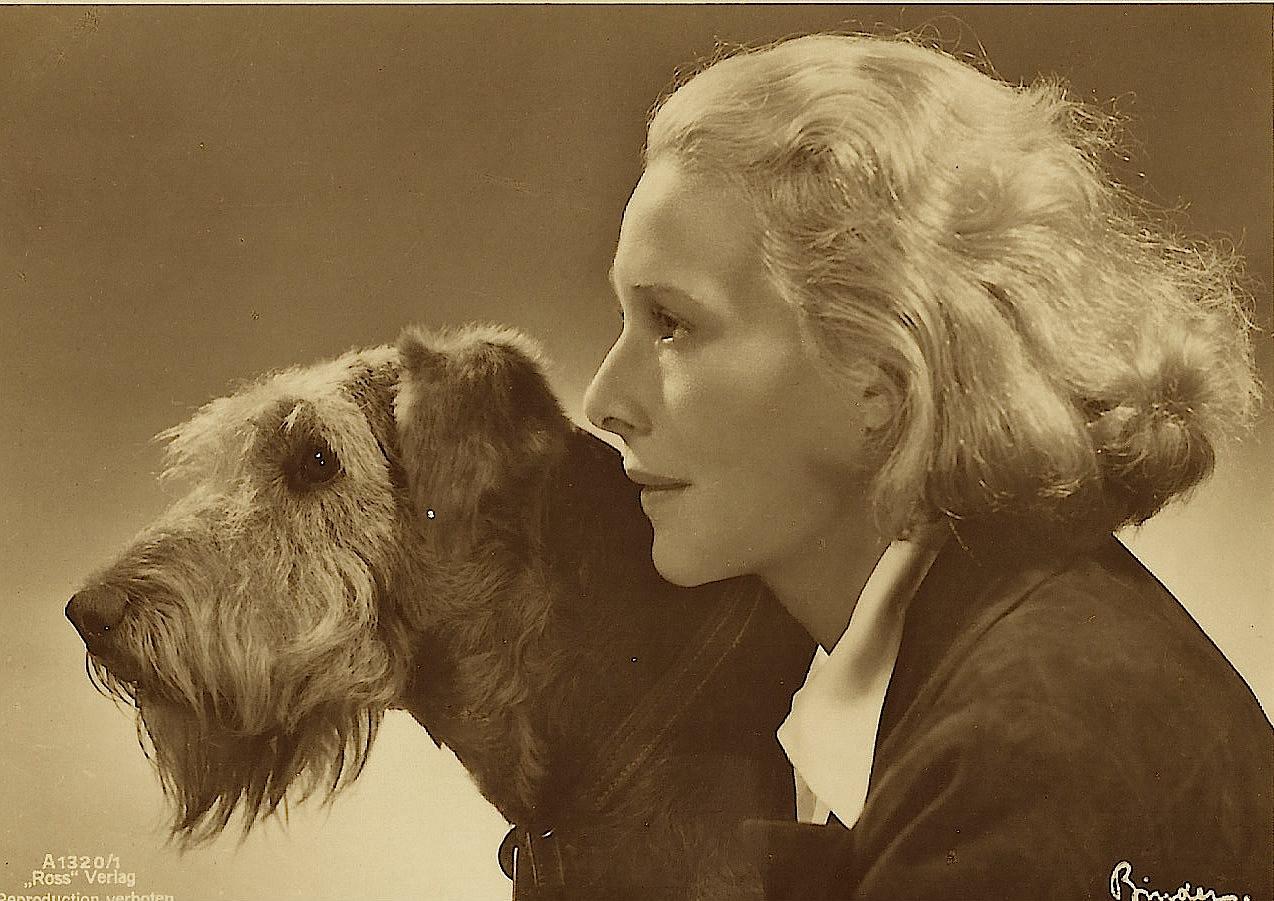 The lovely actress seen in this vintage real photo postcard is named Gerda Maurus (1903-1968). She is posed next to a beautiful Airedale terrier. This unusual profile photograph was taken by celebrity photographer Alex Binder. His studio was located in Berlin, Germany. Maurus was active in film and television between 1928 and 1968. She was an Austrian actress of Croatian descent. Maurus was the daughter of an engineer/inventor. She grew up in Vienna and received training as a singer and dancer. She hit the stage at age fifteen. The IMDb biography of Maurus describes her as ” a strikingly beautiful blonde with high cheekbones an expressive blue eyes”. She began her career on the stages of Vienna. She was “discovered” by director Fritz Lang and he cast her in the female lead in the silent film “Spione” (1928). Lang was smitten by maurus and his marriage was destroyed. She then appeared in a number of German films during the Weimar and Nazi eras. Maurus married director Robert A. Stemmie in 1937. He directed her in “Daphne and the Diplomat” (1937). Like many actresses of her time, her acting career was hurt by the introduction of “talkies”. Further complicating matters was her nebulous association with Nazi propaganda minister Joseph Goebbels. This relationship had negative impact on her career after World War II. Due to lack of film offers, Maurus retreated to the German stage. The IMDb filmography of Gerda Maurus lists 33 credits. Here is a side note about Airedales. The first World War increased the popularity of Airedales because they became famous for their bravery on the battlefield. In the US, Presidents Theodore Roosevelt, Calvin Coolidge, and Warren Harding all owned Airedales. In the 1920’s, Airedales became the most popular dog in the US. This postcard was published by Ross Verlag and is part of a series (no. A1320/1). (SOLD)
 This vintage real photo postcard features Danish actress, Lillian Ellis (1907-1951). She made fer film debut in 1928. Many of her roles were in German films. Her stardom in Germany peaked at the end of the 1920’s. The IMDb credits Ellis with 18 acting roles between 1928 and 1959. This vintage postcard was published by Ross Verlag and was part of a series (no. 5281/1). The photographer who took this photograph was Alex Binder, a celebrity photographer located in Berlin, Germany. This portrait postcard is in very good condition.
 POSTCARD 1
 POSTCARD 1 (CLOSE-UP)
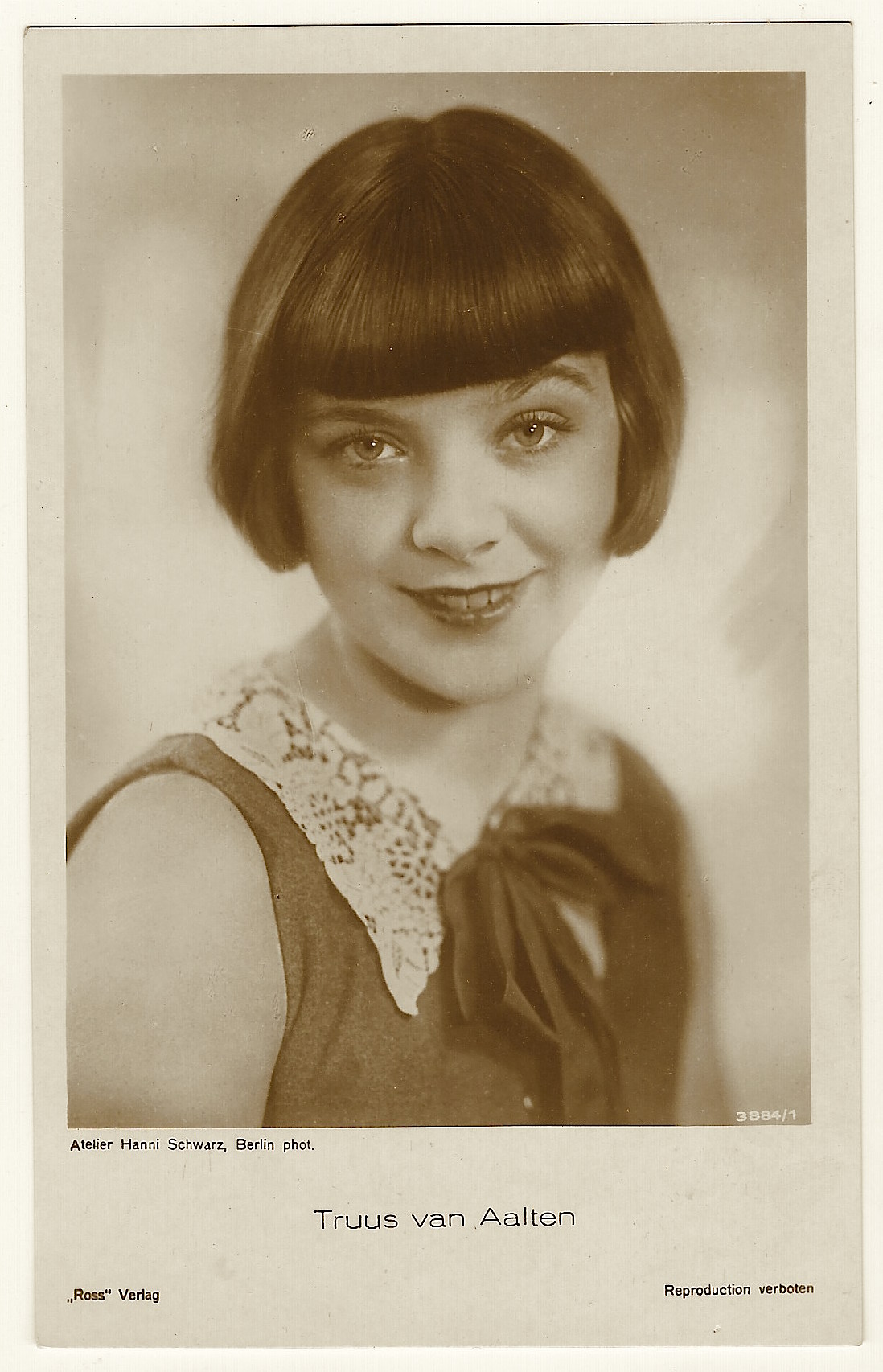 POSTCARD 2
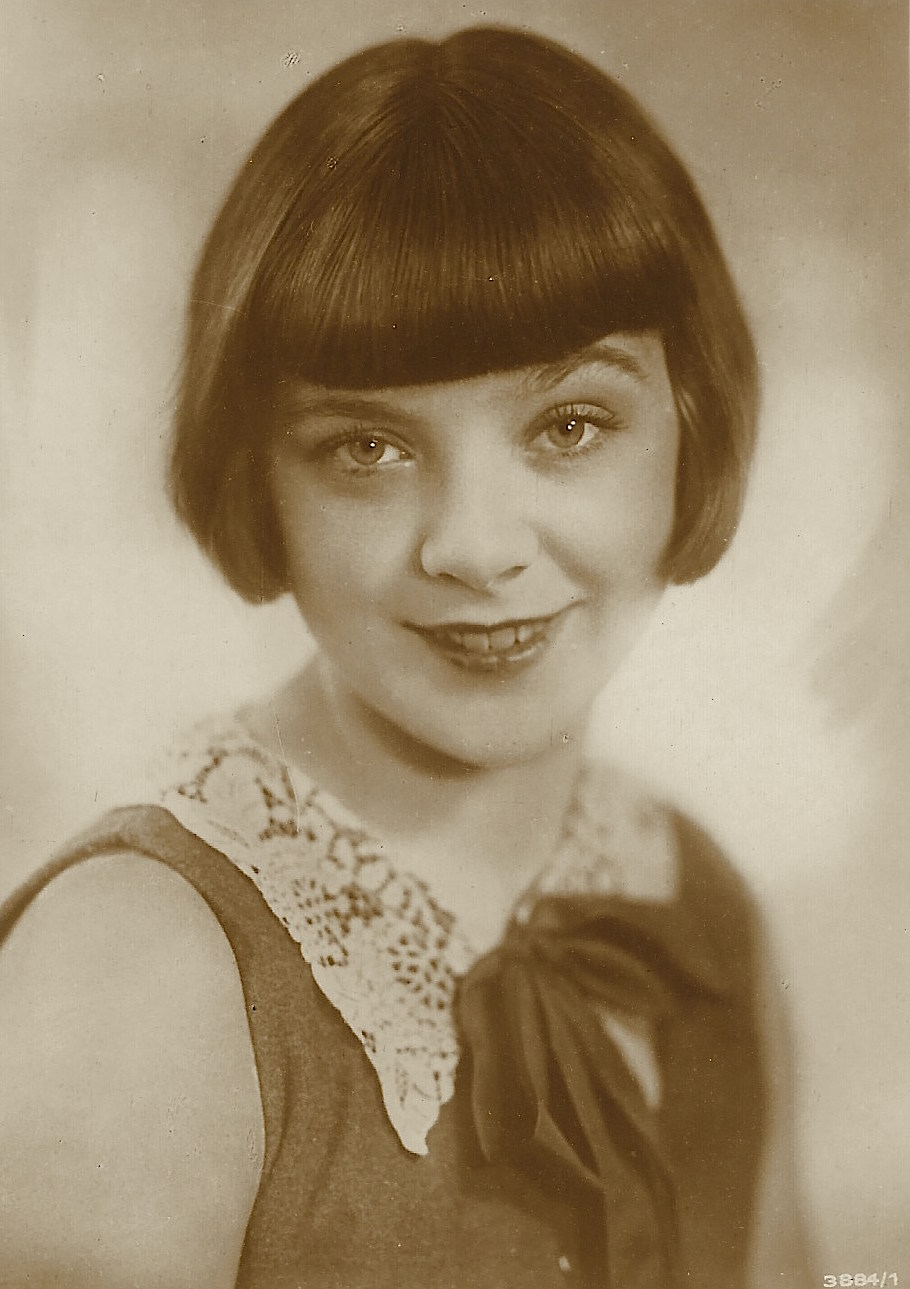 POSTCARD 2 (CLOSE-UP)
 Postcard 1
  POSTCARD 2