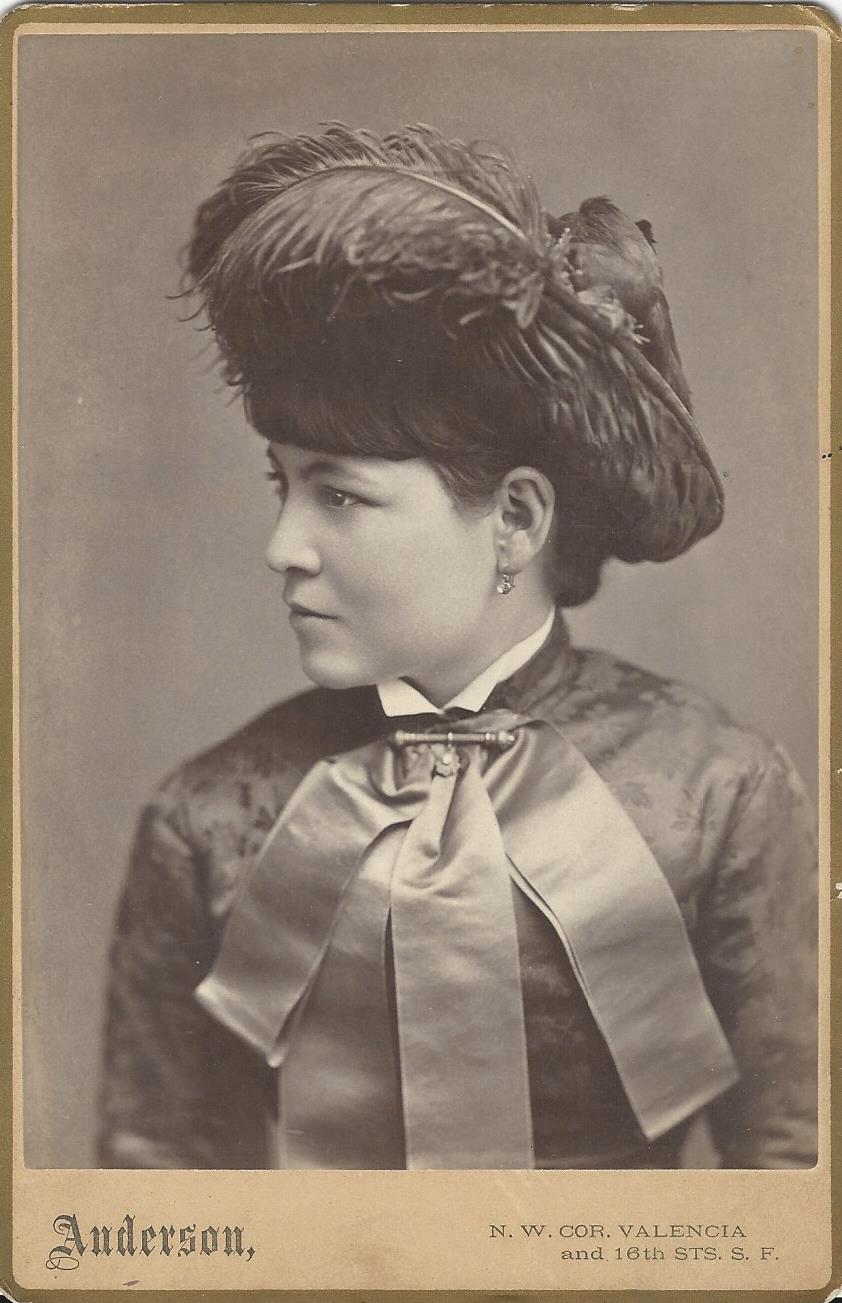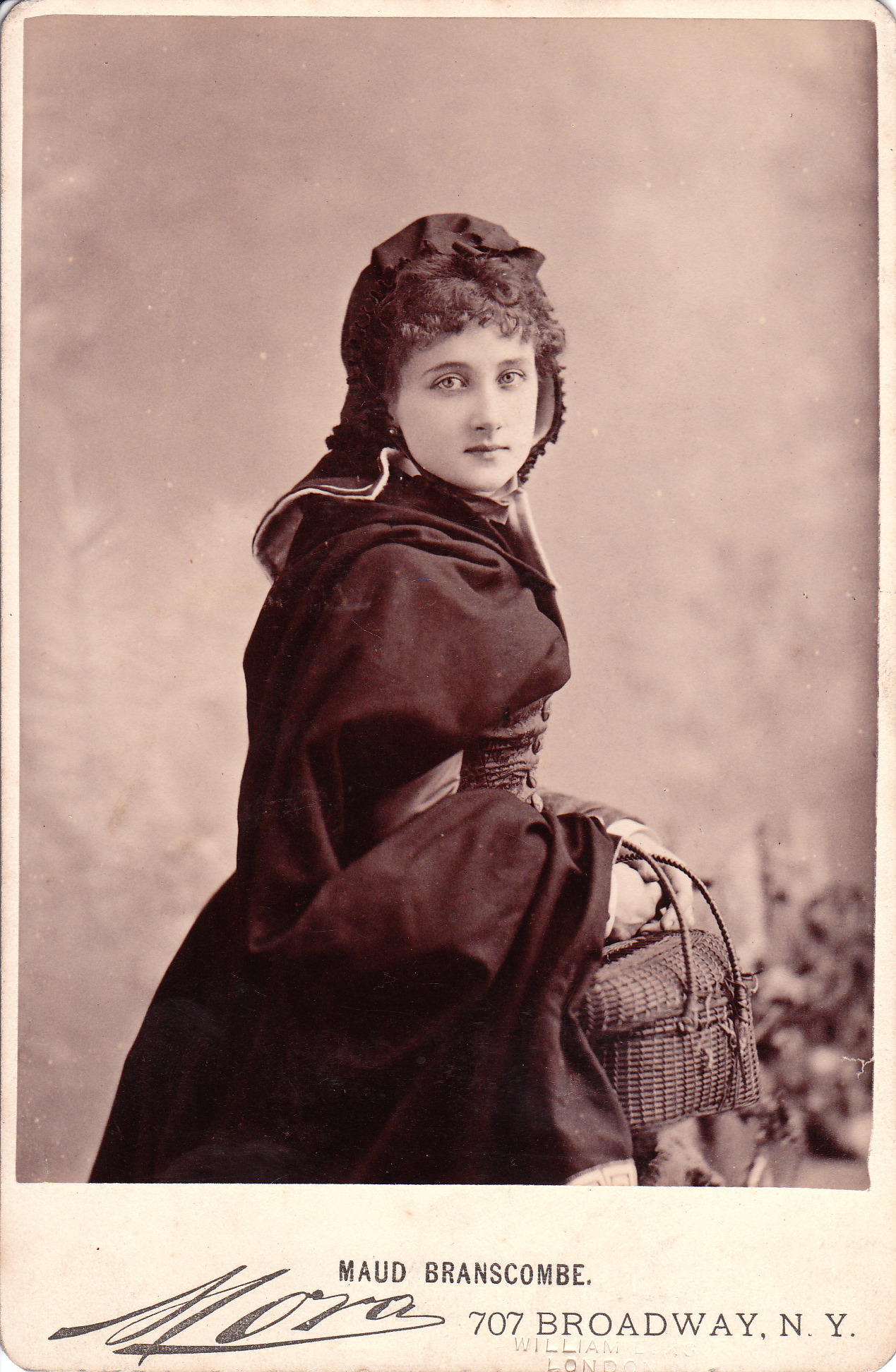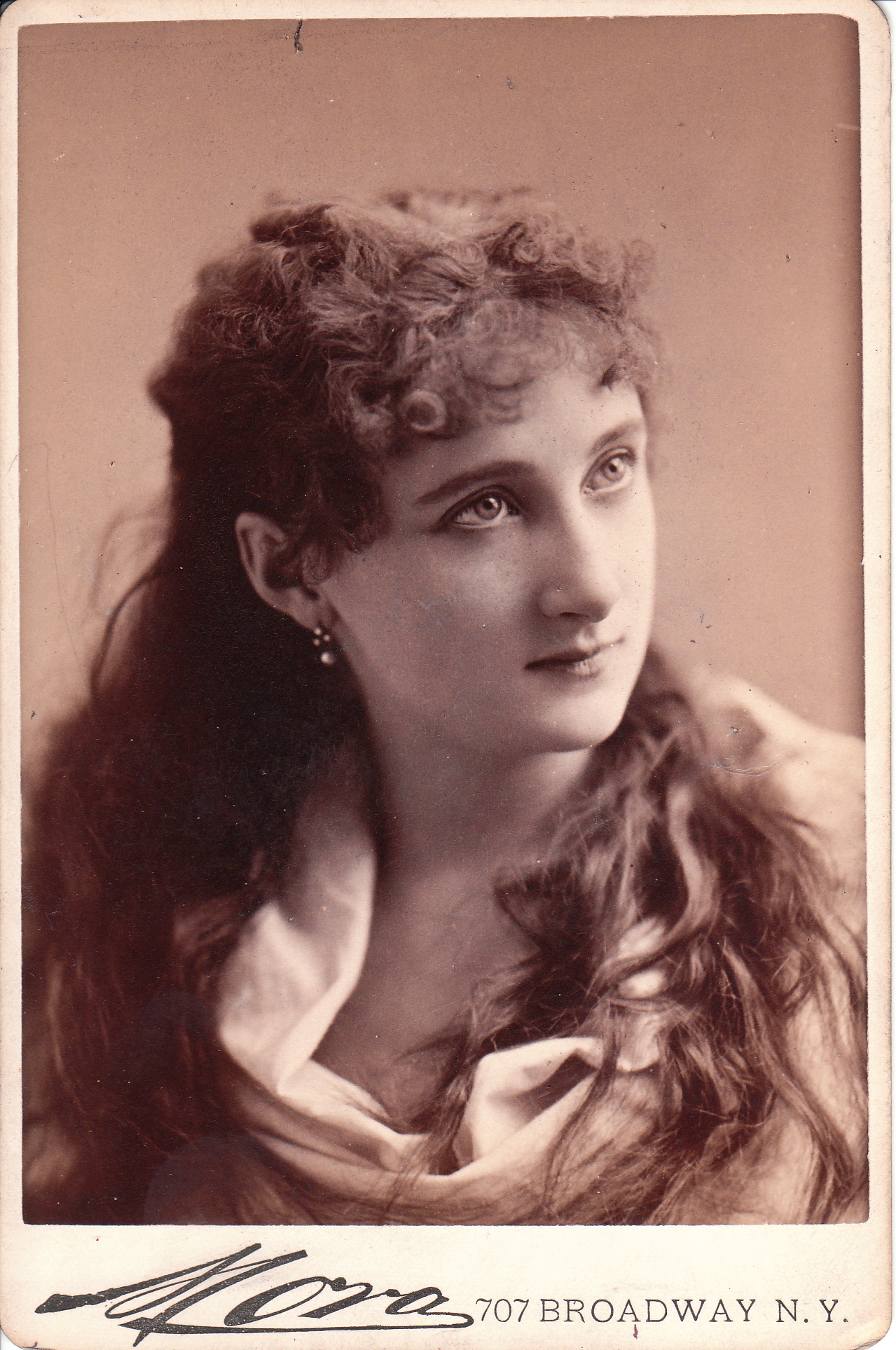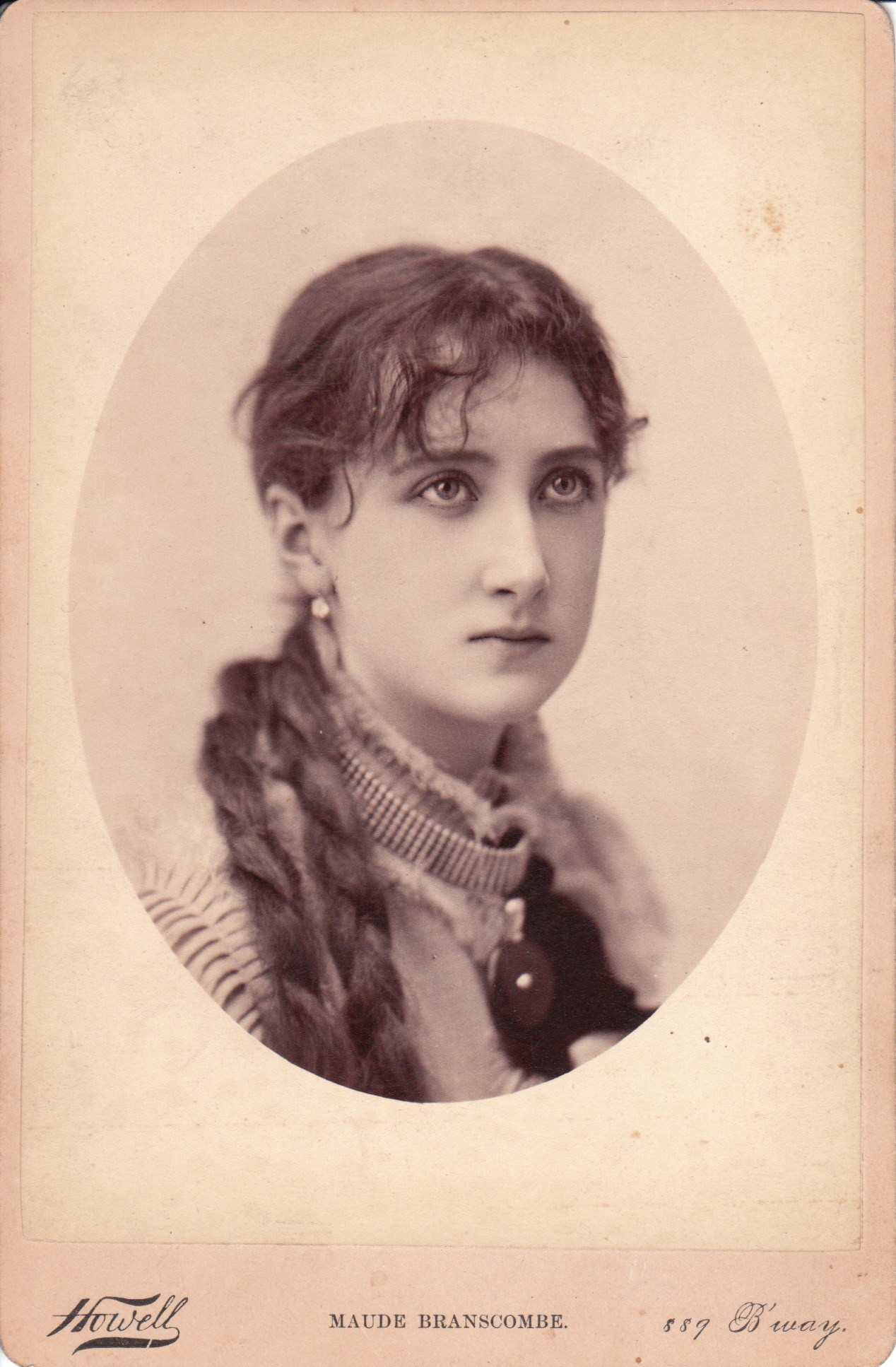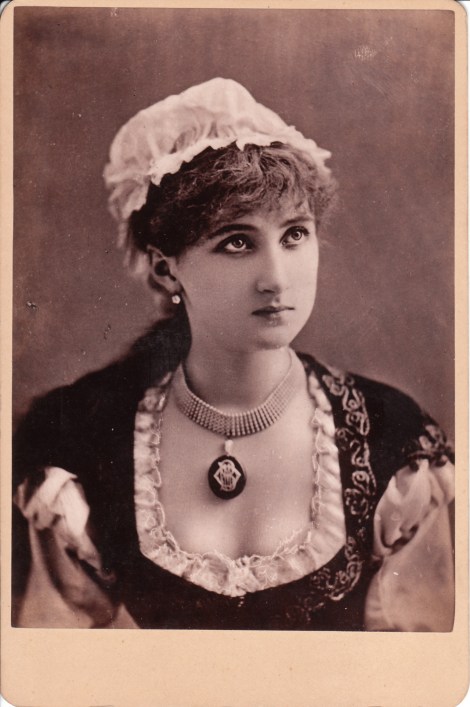
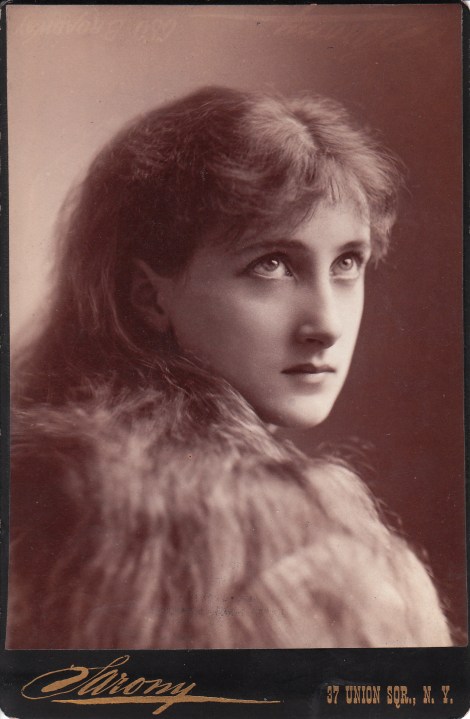
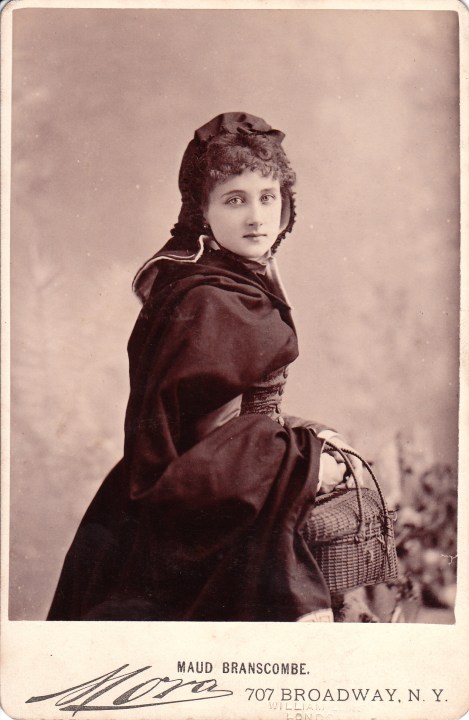
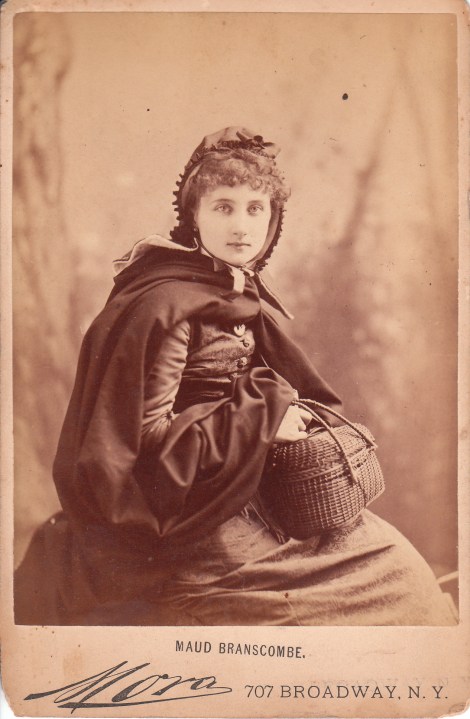
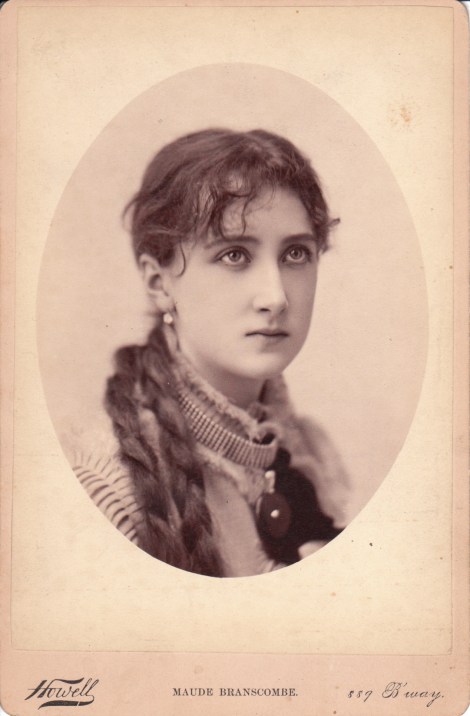
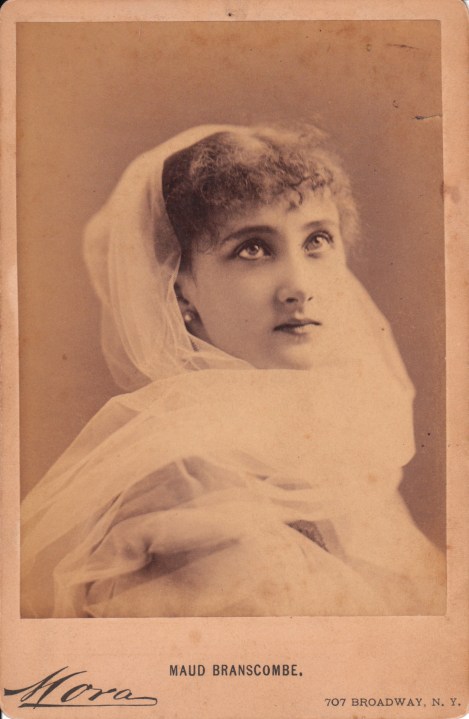
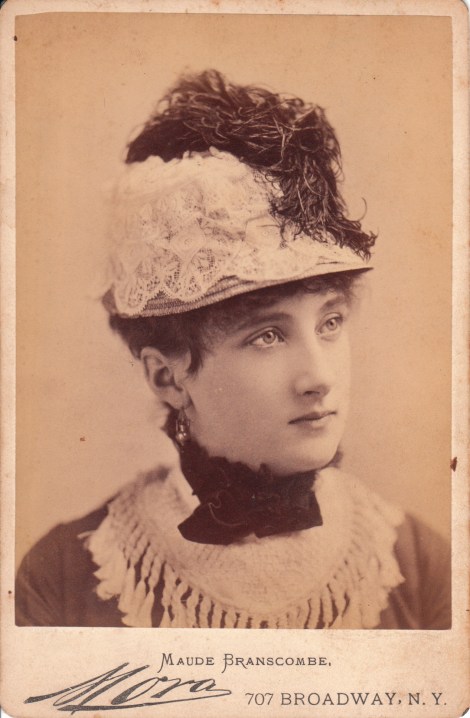
A pretty well dressed young woman poses for her portrait at the Anderson studio in San Francisco, California. She is wearing a beautiful dress with a large bow and a feathered hat sits atop her head. She is also wearing what appears to be diamond earrings and a collar pin. I would guess, and it’s only a guess, that the woman in this photograph is an actress. The woman’s beauty, attire, and poise leads me to hypothesize her theatrical background. Perhaps a visitor to the cabinet card gallery will recognize her and be able to provide the rest of us with her identity. The photographer of this image is Hugh S. Anderson. He was born in Scotland sometime between 1820 and 1828. Anderson was a California photographer who operated studios in Eureka (1858-1865), Hydesville (1859-1860), San Francisco (1866-c1895), and Petaluma (1875). The Valencia Street studio that produced this photograph operated between 1879 and 1884. SOLD
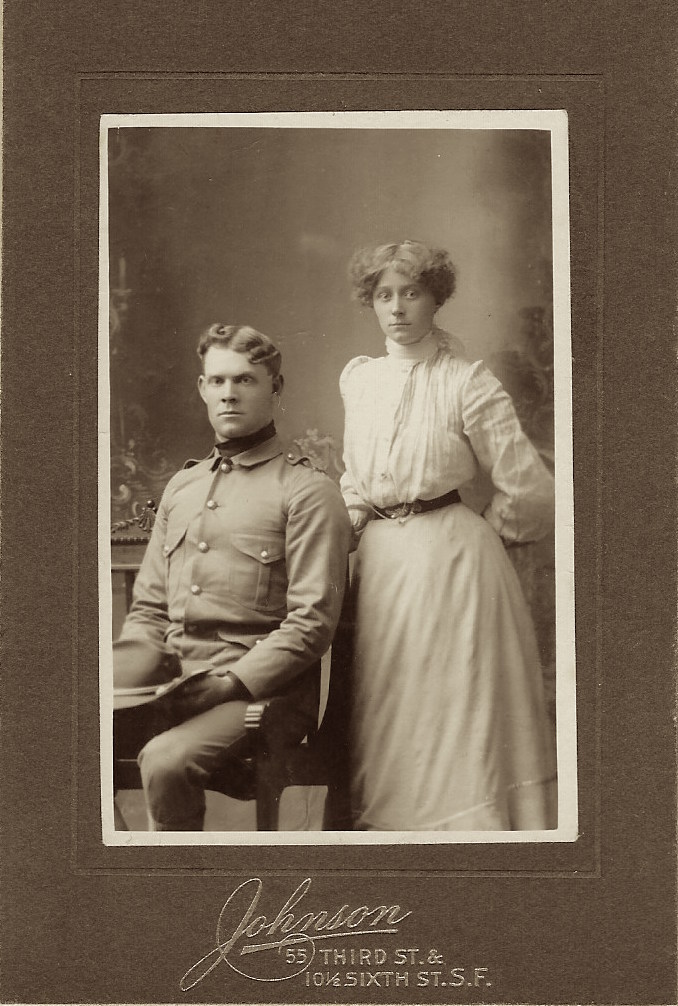
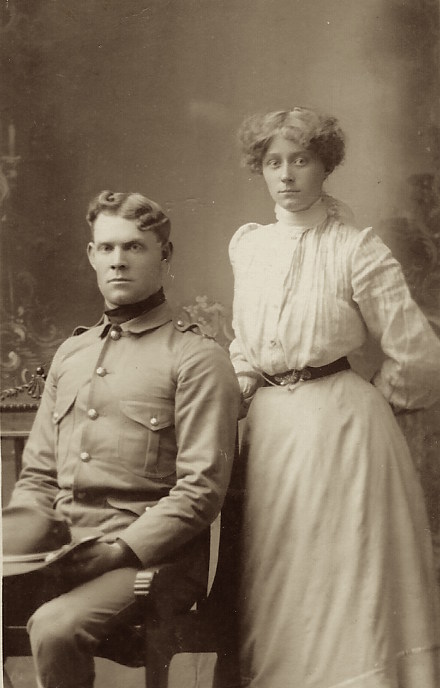
PORTRAIT OF A YOUNG SOLDIER AND A YOUNG WOMAN IN SAN FRANCISCO, CALIFORNIA
This vintage photograph features a uniformed American soldier and a young woman who is likely either his girl friend, wife, or sister. The young man is handsome and his uniform is crisp. His expression has a military air about it. The young woman in this image does not seem very comfortable with the process of being photographed. This portrait was produced by the Johnson studio which was located in San Francisco, California. This photograph measures 3 1/2″ x 5″. A close-up of the soldier and his companion can be found below. (SOLD)
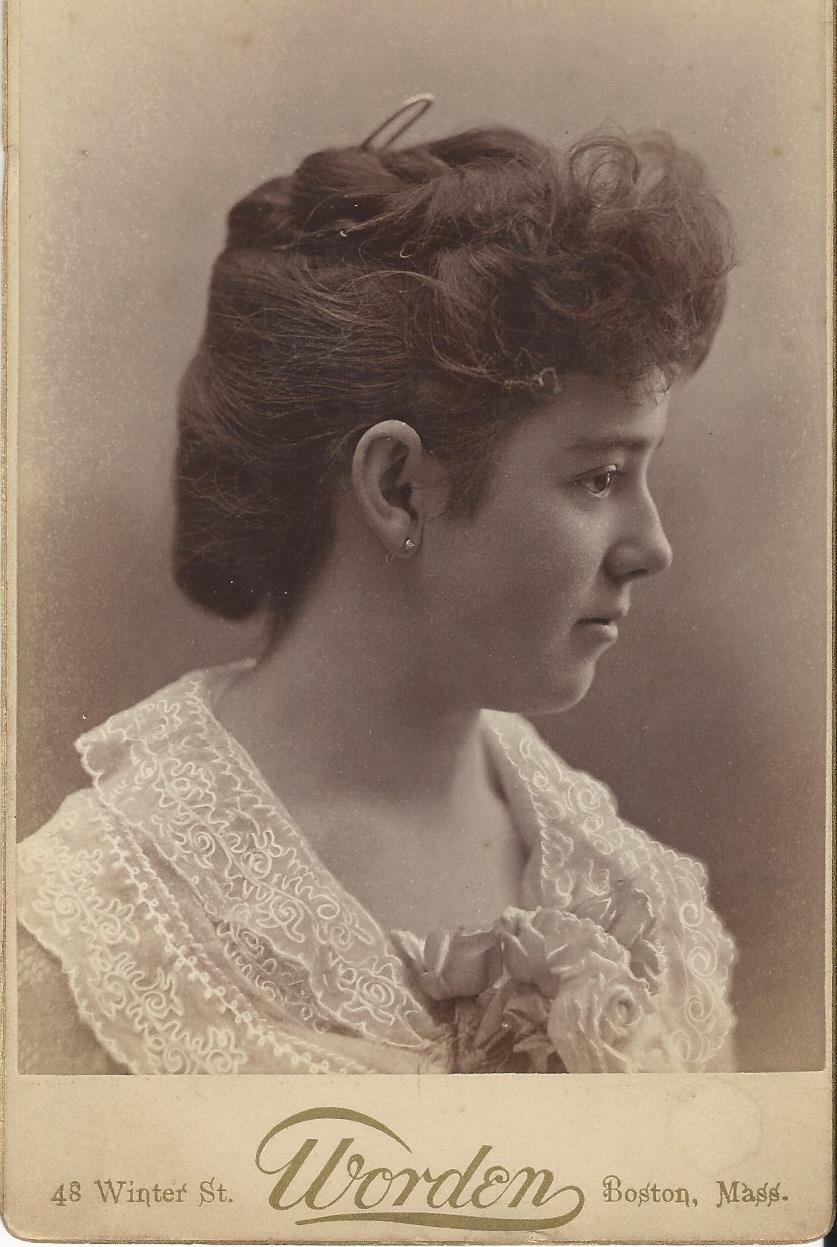
COMPLIMENTS FROM MISS GERTRUDE FOSTER IN BOSTON, MASSACHUSETTS
A pretty young woman poses for a cabinet card portrait at the Worden studio in Boston, Massachusetts. This profile portrait provides a nice view of her lacy dress and pinned flowers. The reverse of the photograph has an inscription that states “Compliments of Miss Gertrude Foster”. Research was unable to find an actress, dancer, or singer with the name of Gertrude Foster. It seems likely that the Gertrude Foster seen in this cabinet card was not a celebrity. Researching Miss Foster was unproductive because her name is too common in the Boston area. To view more photographs from the Worden studio, click on the category “Photographer: Worden”. ADDENDUM: I stumbled upon some biographical data about Miss Foster. It turns out that Gertrude Foster was a stage actress during the cabinet card era. The Capital (1898) reported that she was the “leading lady actress” at the Alcazar Theater in San Francisco before accepting a place in the touring Belasco & Thall Theater Company. Miss Foster is mentioned again in the San Francisco Call (1900). The newspaper reports her marriage to Edward W. Mansfield who was the manager of the Fisher Opera House in San Diego, California. Apparently Mansfield was smitten with her when they met professionally some years before. Mansfield reportedly waited to pursue her until she had an opportunity to garner some “fame”.
LLOYD BRUNDAGE: A TWO YEAR OLD POSES IN FRONT OF A PLAYHOUSE IN SAN FRANCISCO, CALIFORNIA (1888)
A very young child, holding a box by the handle, poses for his portrait at the Morse Studio in San Francisco, California. The child is standing in front of a small house. The faux house is a studio prop. Note that that the number “1888” is above the open window. The number likely indicates the year that this portrait was taken. The reverse of the cabinet card has inscription with the name “Lloyd Brundage” and a note that states that Master Brundage was 21 months old at the time he was photographed. Research reveals that the subject of this image, Lloyd Jeffers Brundage was born in San Francisco on New Years day in 1887. He appears in many US censuses. In 1900 he was thirteen years old and living in Bridgeport, California with his father and mother. His father was named Marshal and was a 46 year-old laborer who was a native Canadian. Lloyd’s mother was named Nillie and she was 31 years old and a native Californian. Her maiden name was Smallwood. Lloyd had a five year-old sister named Delphine. The 1920 census found Lloyd living in Chico, California, with his wife Anna. He was employed as an “agriculturist”. Ten years later he was working as a mechanic in an industiral plant. He and his wife remained in Chico. The 1940 census discovers Lloyd working in a governmental general maintenance position. Lloyd died in 1955 in Butte, California. To learn more about the photographer, George Daniels Morse, and to see other examples of his work, click on the category “Photographer: Morse”.
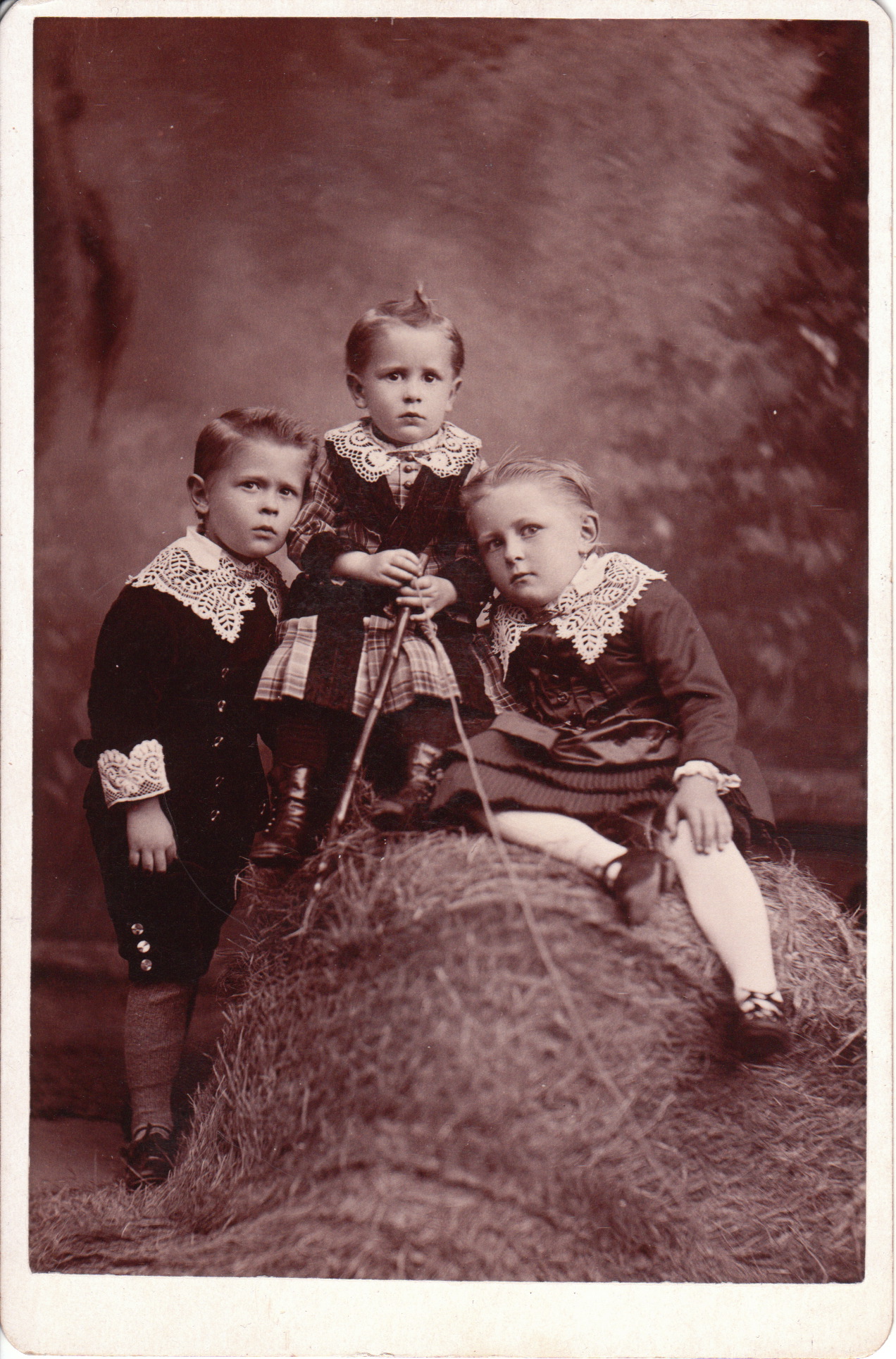
THREE CUTE KIDS AND A STRING IN SAN FRANCISCO, CALIFORNIA
Three adorable kids wearing doilies (just kidding) around their neck pose for their portrait at the Williams & Norton studio in San Francisco. The studio was located at 914 Market Street. The child in the middle is holding a walking stick with a string. All three kids are sitting on a pile of hay. It is likely that the children are siblings. W. I. Williams was partners with Norton between 1885 and 1886.
PRETTY WOMAN MAKES A FASHION STATEMENT IN SAN FRANCISCO, CALIFORNIA
A very pretty woman poses at the Thors studio in San Francisco, California. She is quite fashionable in her attractive large buttoned coat and her hat. Note her ruffled collar and cuffs. She is wearing earrings. The reverse of the photograph is dated “November 1879”. To learn more about Louis Thors and to view more of his photographs, click on the category “Photographer: Thors”.
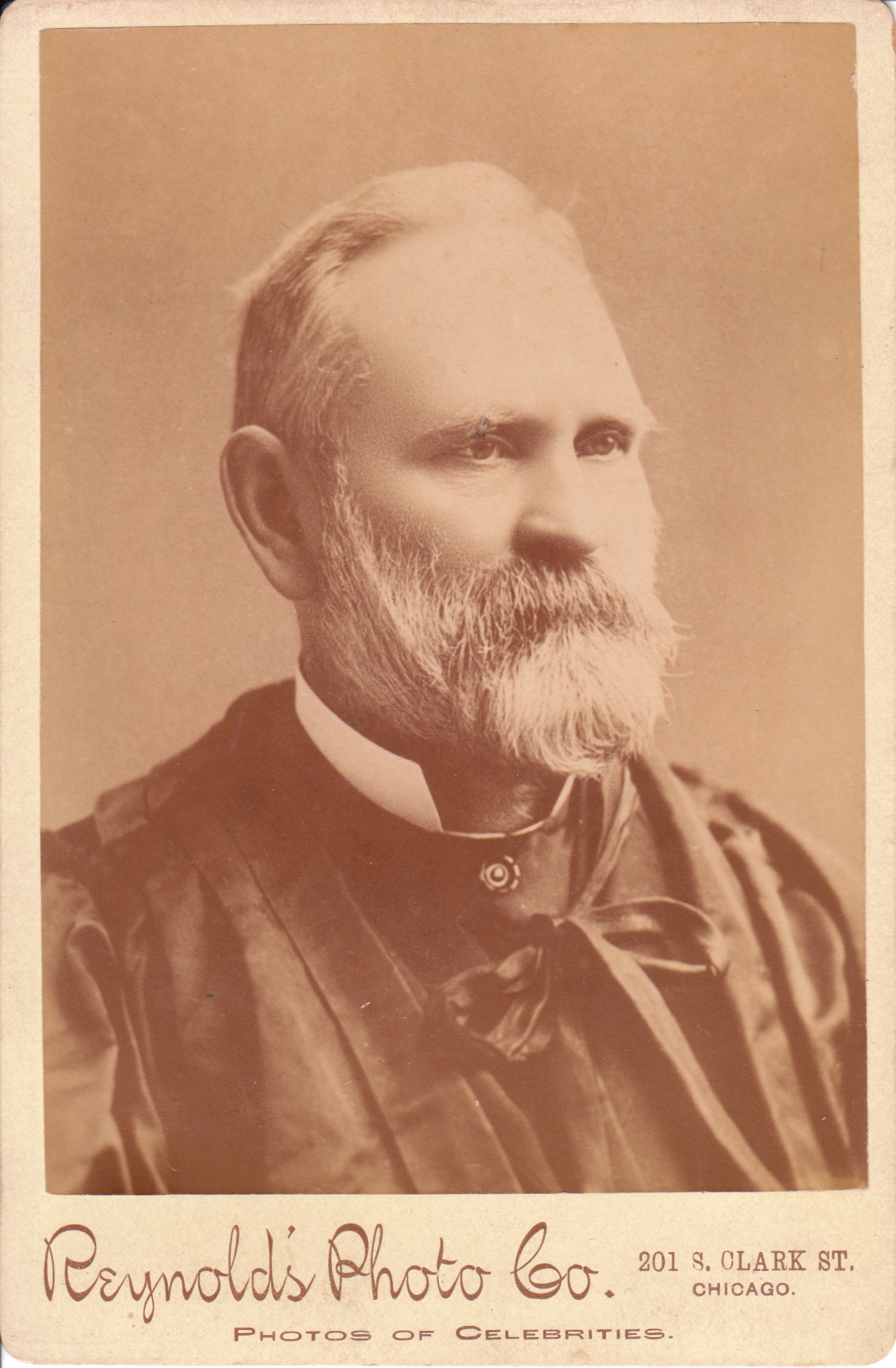
US SUPREME COURT JUDGE, US SENATOR, AND CIVIL WAR COLONEL: MEET STANLEY MATTHEWS
This cabinet card portrait features Stanley Matthews (1824-1889). This image was produced by the Reynolds Photo Company of Chicago, Illinois, and shows Matthews wearing his judicial robe. The photograph was part of the “Photo of Celebrities” series. Matthews served as a Supreme Court Justice from 1881 until his death. He was appointed by President James Garfield. At the time of his appointment he was a United States Senator from Ohio. Matthews was born in Cincinnati, Ohio. He attended Kenyon College and then practiced law in Ohio, and later on, in Tennessee. He was the editor of the Cincinnati Herald for two years. He served in the Ohio State senate and then became a US Attorney until 1861 when he resigned to become a Lieutenant Colonel in the 23rd Ohio Infantry. At the time that Matthews was appointed a Supreme Court Justice, his nomination passed Congress by just one vote. As a judge in the nation’s highest court, he wrote the decision in the Yick Wo vs. Hopkins case. Politicians in San Francisco had passed a law asserting that laundries could not be operated in wooden buildings without a special permit. This permit would be required in addition to the other permits already required. This new law had much impact considering that ninety-five percent of the city’s laundries were in wooden buildings. Two thirds of these laundries were owned by Chinese businessmen. When the new permits were issued, all non Chinese owners received permits and all Chinese owners were denied the permits. Yik Wo continued to operate his laundry without the permit and was convicted, fined, and later jailed for refusing to pay the fine. His case rose up the hierarchy of courts until it reached the Supreme Court. In his decision, Matthews wrote that the permit statute was discriminatory and that the Chinese laundry owners were entitled to equal protection under the fourteenth amendment of constitution.
KNIGHTS OF THE TEMPLAR MEMBER IN SAN FRANCISCO, CALIFORNIA
The previous owner of this photograph asserted that the subject of this image is dressed in the uniform of the “Knights of the Templar”. Note the gentleman’s sword , gloves, belt, sash, and feathered hat. The Knights of the Templar was a fraternal group that originated shortly after the first crusade. To view other photographs of members of this organization, enter “templar” on this sites search box. This image was produced by Rieman & Company which was located in San Francisco. The photograph is larger than a cabinet card. It measures 5″x8″. Advertising on the reverse of the card includes the quote “Rieman’s Babies” and “When Others Fail, Try Rieman”. These boastful statements refer to Rieman’s general photographic prowess as well as his special talent for the difficult task of photographing babies. To view other photographs by Rieman and to learn more about him, click on cabinet card gallery’s category “Photographer: Rieman”.
PORTRAIT OF A TIRED OLD MAN IN TEXAS (PHOTOGRAPH BY CAPTAIN HARVEY ROBERTS MARKS)
This image captures the portrait of a tired looking old man. This gentleman appears to have had better days. He looks exhausted and troubled. This photograph was taken by the Mark’s studio in Austin, Texas. The photographer of this cabinet card lived an interesting life and he was both a pioneer of Texas and a pioneer of photography. Harvey Roberts Marks (1821-1902) was a well known photographer who worked in a number of locations. He was active in Baltimore, Maryland (1849-1853), San Francisco, California (1851), Mobile, Alabama (1856-1859), Houston, Texas (1865-1870), and Austin, Texas (1870-1902). He was born in New York City. He first arrived in Texas in 1838 and received a very large land grant in Harris County (Houston). He enlisted in a company of Texas Rangers in 1840 and reached the rank of Captain. He was married to Emily H. Bassan in 1849. Research indicates that she was member of one of the most prominent families in Baltimore. In 1849 he was Jacob Shew’s partner in the Shew and Mark’s Gallery in Baltimore. He continued the gallery alone when Shew left Baltimore until 1851. The 1850 census revealed that he had three assistants in the gallery and took 5,000 daguerreotypes annually. In 1851 he took photographs of castaways from a Japanese ship involved in an incident that caught national attention. Mark’s moved to Austin in 1870 and opened a gallery a year later. During that time he became Vice President of the National Photographic Association. Marks served during the civil war. He was a member of the Houston Battalion, Texas Infantry (Detailed Men). Research was unsuccessful in gathering this Confederate regiment’s history. Marks entered the regiment and left the regiment as a Captain. Interestingly, when former Confederacy President, Jefferson Davis, visited Austin in 1875, he sat in Mark’s studio for his portrait. He died at the age of 81.