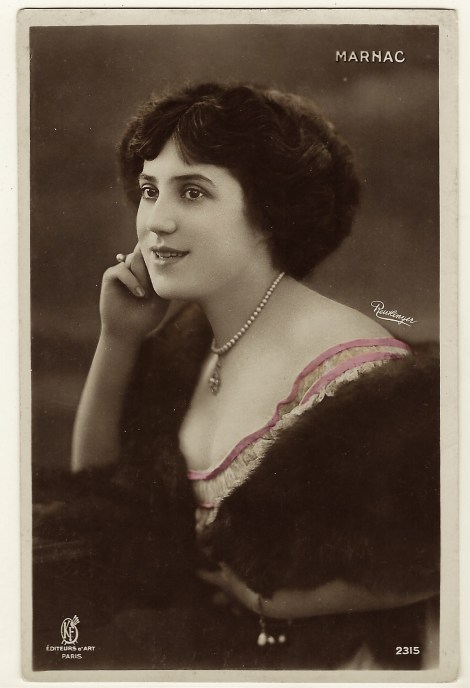
This vintage real photo postcard features pretty Belgian stage and film actress, Jane Marnac (1892-1976). She appeared in dozens of parts on stage and sang in numerous operettas. She is well known for appearing in “Au temps des valses ” (1930), a play by Noel Coward that played at the Apollo Theater. She is also remembered for her role in “The Darling of Paris” (1931). Wikipedia provides a list of twenty of her play appearances (1912-1938) and notes that it is an incomplete list. Wikipedia also lists six films (1911-1931) in which Marnac made appearances. In regard to her personal life, she was born in Brussels, Belgium. She married an English officer in 1927. This postcard was published by K.F. (Kunzli Freres) of Paris, France and is part of a series (no. 2315). The company was one of the largest pioneer postcard publishing houses. The company was established in 1874. It had offices in Zurich and Paris. Beginning 1898, it became known for publishing postcard maps throughout Europe. The photographer who took Miss Marnac’s portrait seen on this postcard, was Leopold Reutlinger.
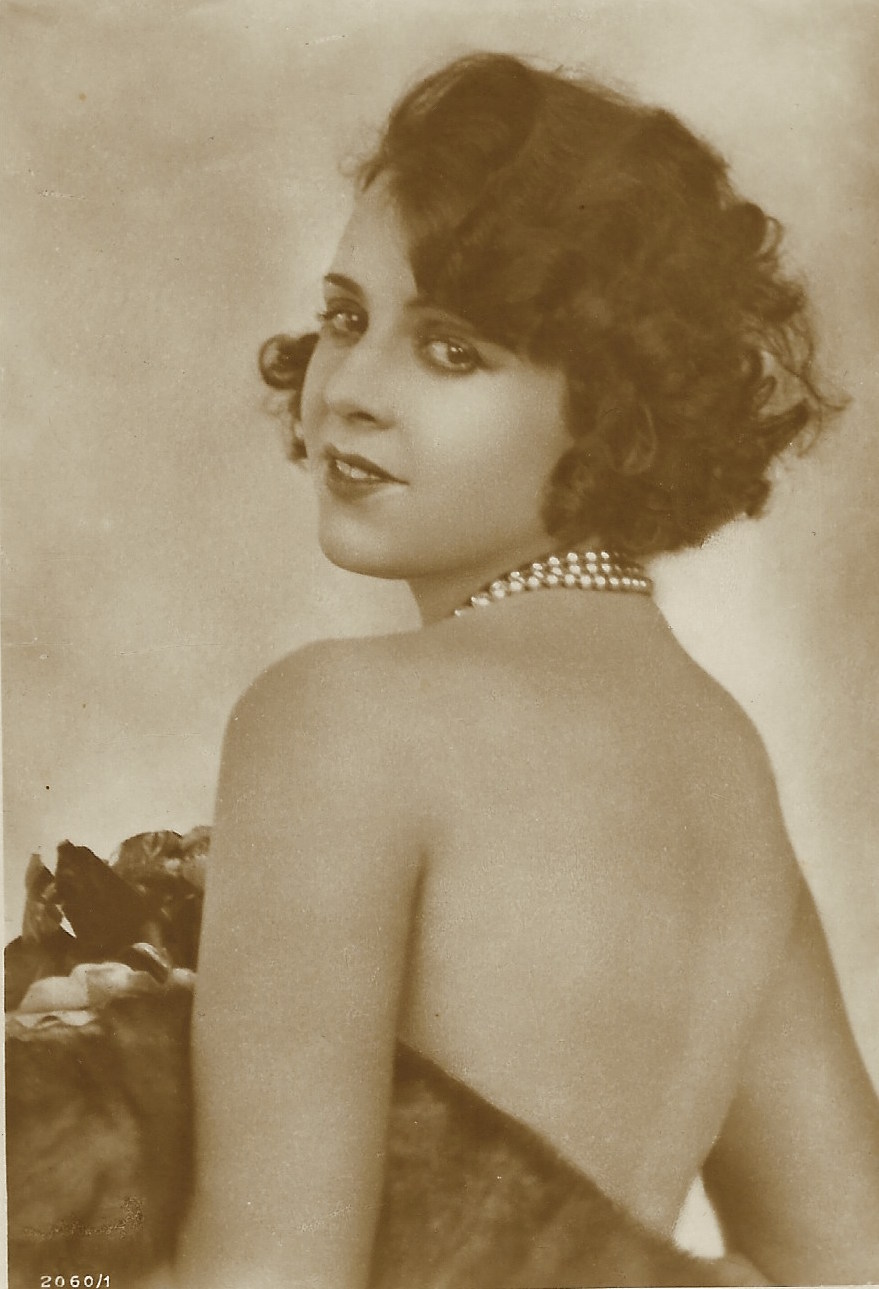
This vintage real photo postcard features German actress Elisabeth Pinajeff (1900-1995). In the 1920’s and 1930’s she starred in French and German films. Her first sound film was in 1929. The actress was born in Russia. Her father was an architect and her mother was a countess. In the 1910’s Pinajeff studied drama in the Ukraine. When she was 19 years old she married an engineer and his career required the couple to move to Germany. In 1929, Pinajeff met Austrian photographer, Alex Binder. Binder will be a familiar name to those that follow the cabinet card gallery. Many of his beautiful postcard portraits of theater stars can be found in the gallery (you can see his photos by placing his name, “Binder”, in the search box). Binder had the largest photo studio in Europe during the 1920’s. Pinajeff modeled for Binder and later, married him. The couple lived in Paris. There is some debate about the years that they were together.The IMDb reports that Pinajeff appeared in 35 films between 1922 and 1938. After appearing in a bit part in a 1938 film about Rasputin, she retired from acting and focused on her painting. In 1950, Pinajeff became a friend of Andre Le Troquer, a “very connected” lawyer and politician. The couple surrounded themselves with political, artistic, and intellectual leaders. In 1959, she was involved in a scandal known as the “Ballets Roses Scandal”. She was one of more than twenty people enmeshed in the scandal. She was accused of organizing erotic ballets with underaged girls for an “elite” audience. Some prospective show biz mother’s had consented to their daughters participation in this ballet with hopes that it would help launch their performance career. Although Pinajeff was not convicted. Miss Pinajeff had artistic talent. She painted a number of famous personalities including the British Queen. She successfully exhibited a number of her paintings. This postcard is somewhat risque in that the photograph shows Miss Pinajeff’s bare back. The actress was a very pretty woman and had an engaging smile. This postcard was published by Russ Verlag and is part of a series (no. 2060/1). The photographer was the aforementioned Alex Binder and the photo was taken in Berlin. SOLD
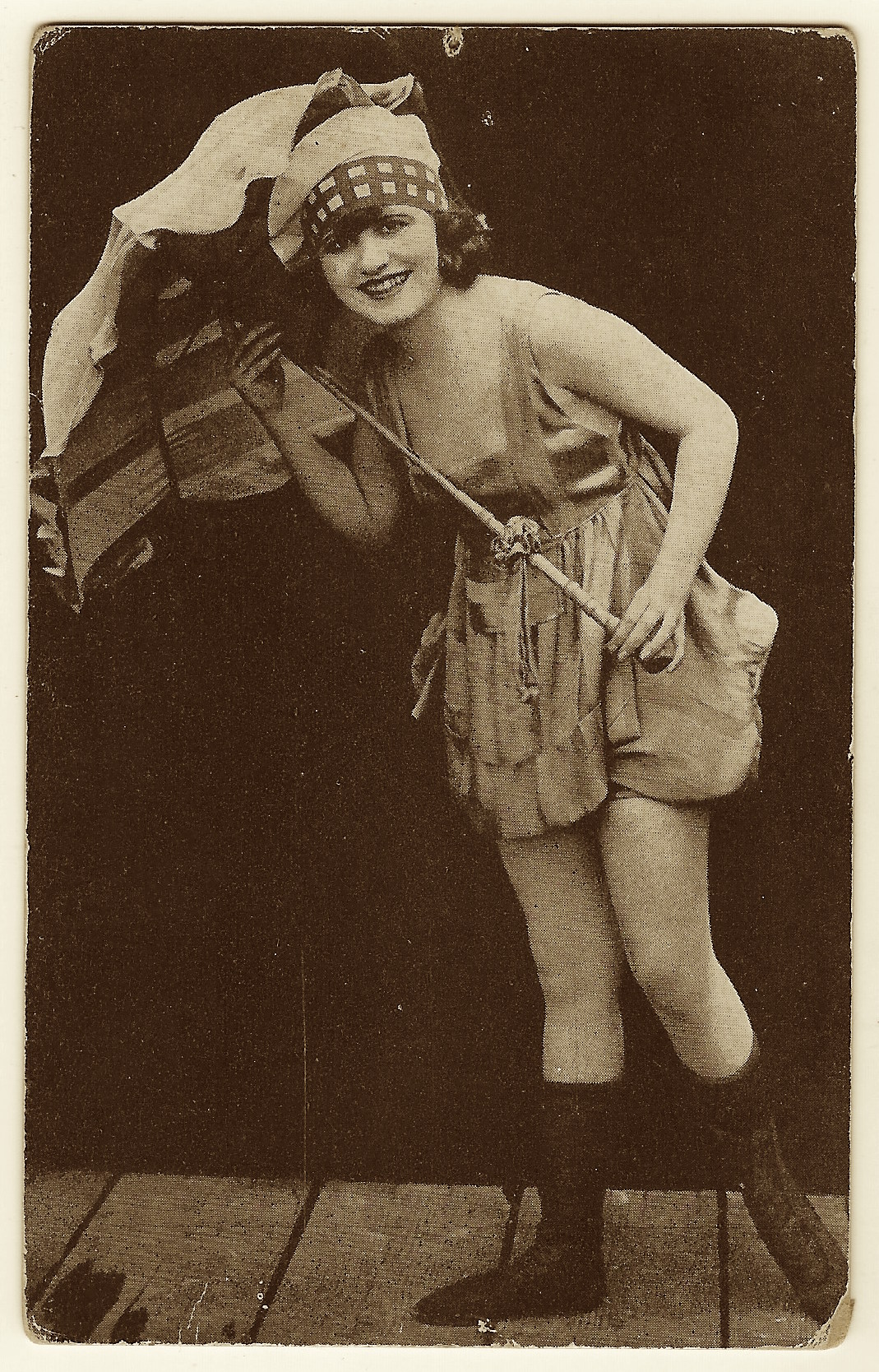
This vintage bawdy photograph features a young woman scantily clothed and flashing a terrific smile. Her expression is very inviting. I wish I knew the story associated with this risque image. My hypothesis is that the woman is an actress and part of a vaudeville show. Her act was likely focused on bringing men into the theater. She may have been a dancer or a singer. Perhaps she was talented in both dance and song. Note her dress. It certainly didn’t require a lot of material to produce. It shows a lot of the performer’s body, but it is tastefully done. The dress covers “the essentials”. Vaudeville acts were very popular in the United States from the early 1880’s through the early 1930’s. Vaudeville was a genre of theater that was composed of a series of separate and unrelated acts that were presented together at one performance. It is difficult to determine when this photograph was taken. It certainly was produced sometime in the early period of vaudeville. This photograph is not a postcard. I do not believe that the image is a trimmed cabinet card, though it has a cabinet card type board. An examination of the photos edges reveal that they are straight and smooth. The photograph measures about 5 1/4″ x 3 1/4″. There is a small pinhole through the top center of the image. Someone, decades ago, appreciated this wonderful photograph enough, to hang it on their wall. ADDENDUM : I have been informed that the woman seen in this photograph is part of Mack Sennetts bathing beauty troupe. This has not yet been confirmed but worth noting.
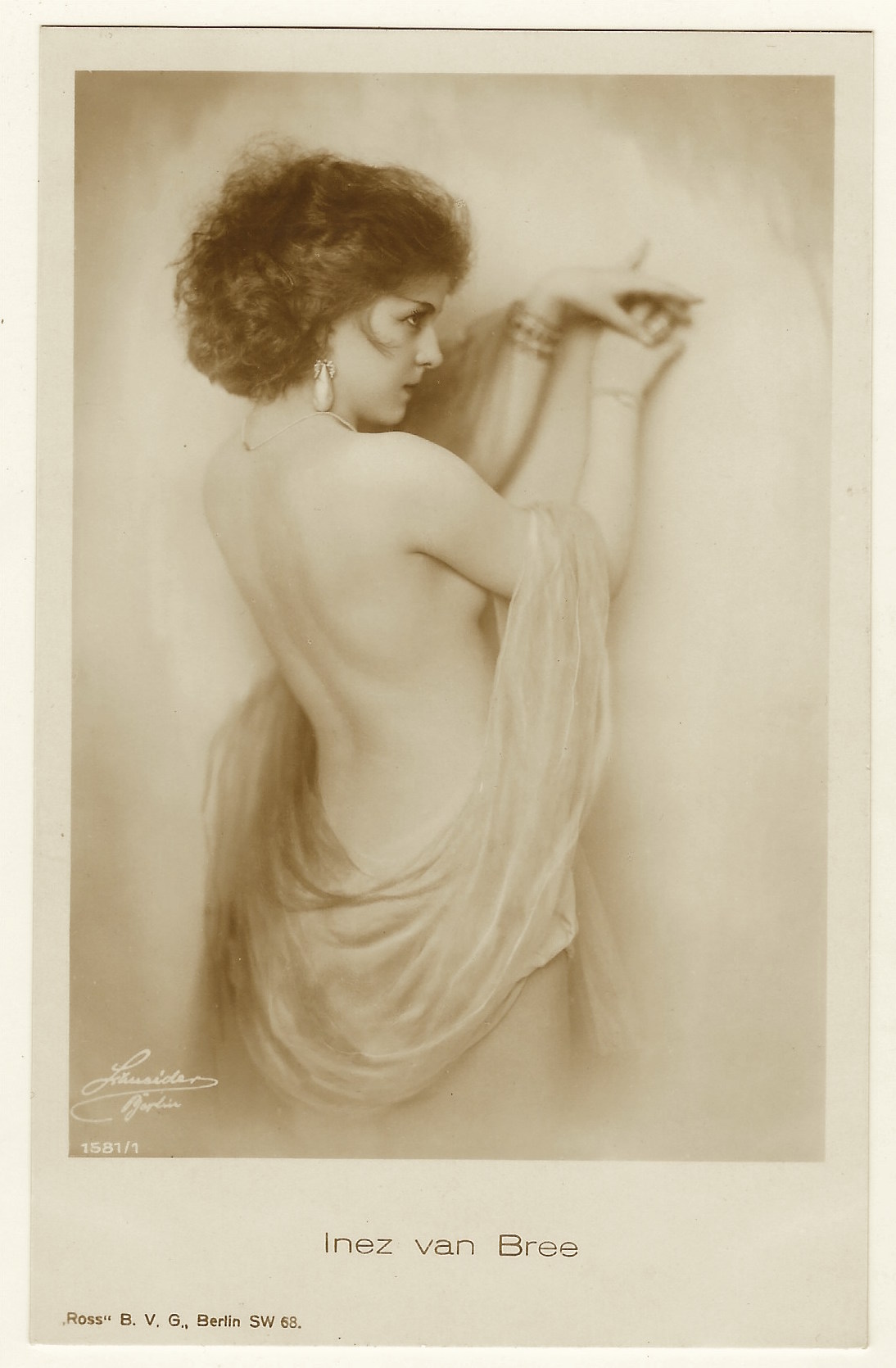
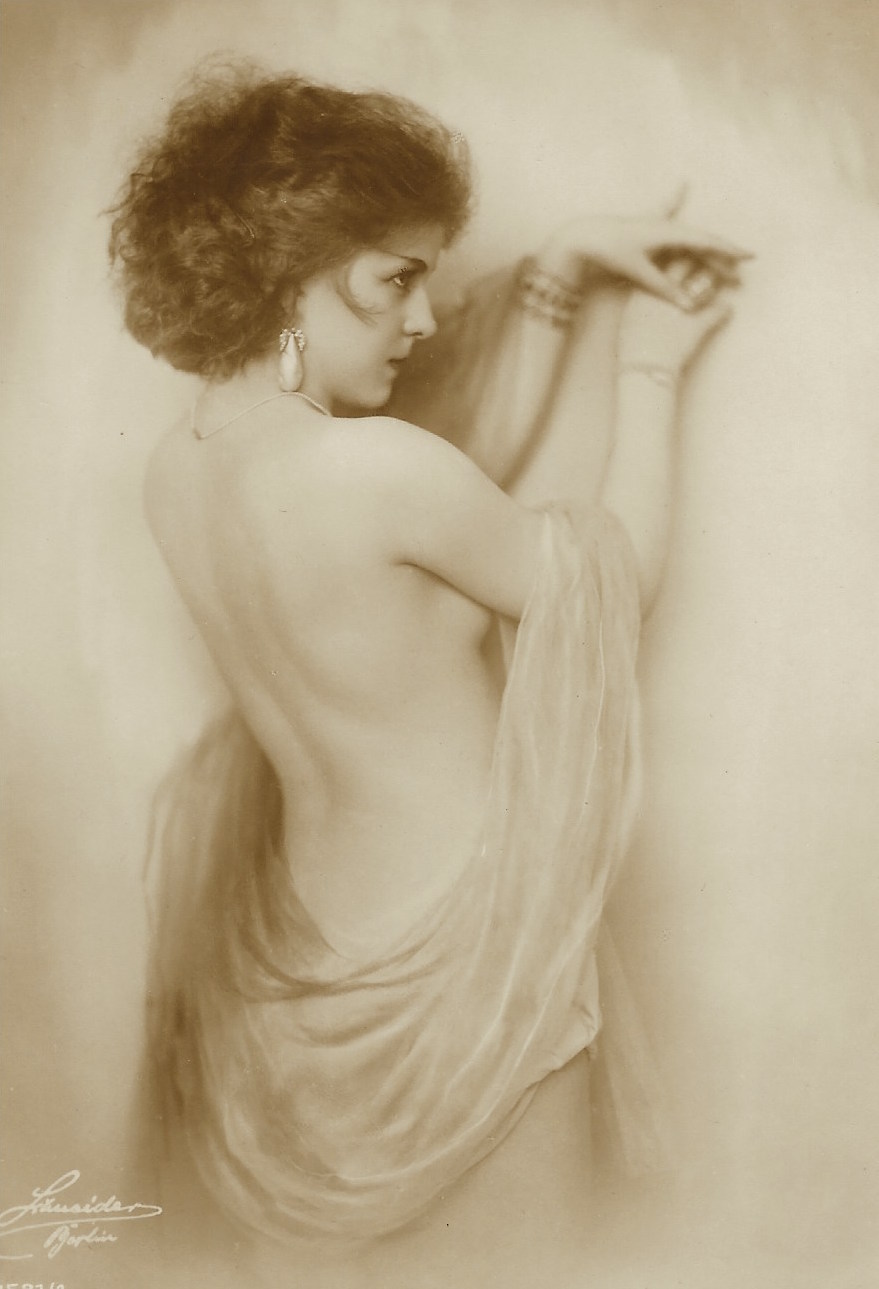
This vintage real photo postcard is one of the more risque Ross Verlag postcards in the Cabinet Card Gallery. The postcard is of German origin and is part of a series (no. 1581/1). It was published between 1927 and 1928. Preliminary research found little information about Inez Van Bree. A defunct University of Toronto website labels Miss Bree as a silent movie siren/star. The photographer of this portrait appears to be Ernst Schneider and the photograph was taken in Berlin, Germany. Research about Mr Schneider yielded a great deal of information. He was considered to be one of the most celebrated studio photographers in Berlin during three decades (1900’s, 1910’s, 1920’s. He photographed many celebrities from the world of theater, opera, circuses, and film. He was also one of the most prominent fashion photographers in Berlin. In addition, he was well known for his nude photography and he published books showcasing his work in this domain. Sometime around 1908 Schneider began working with postcard publishers “Rotophot” and “Neue Photographische Gesellschaft” (NPG). In 1919 he began working with Ross Verlag. SOLD
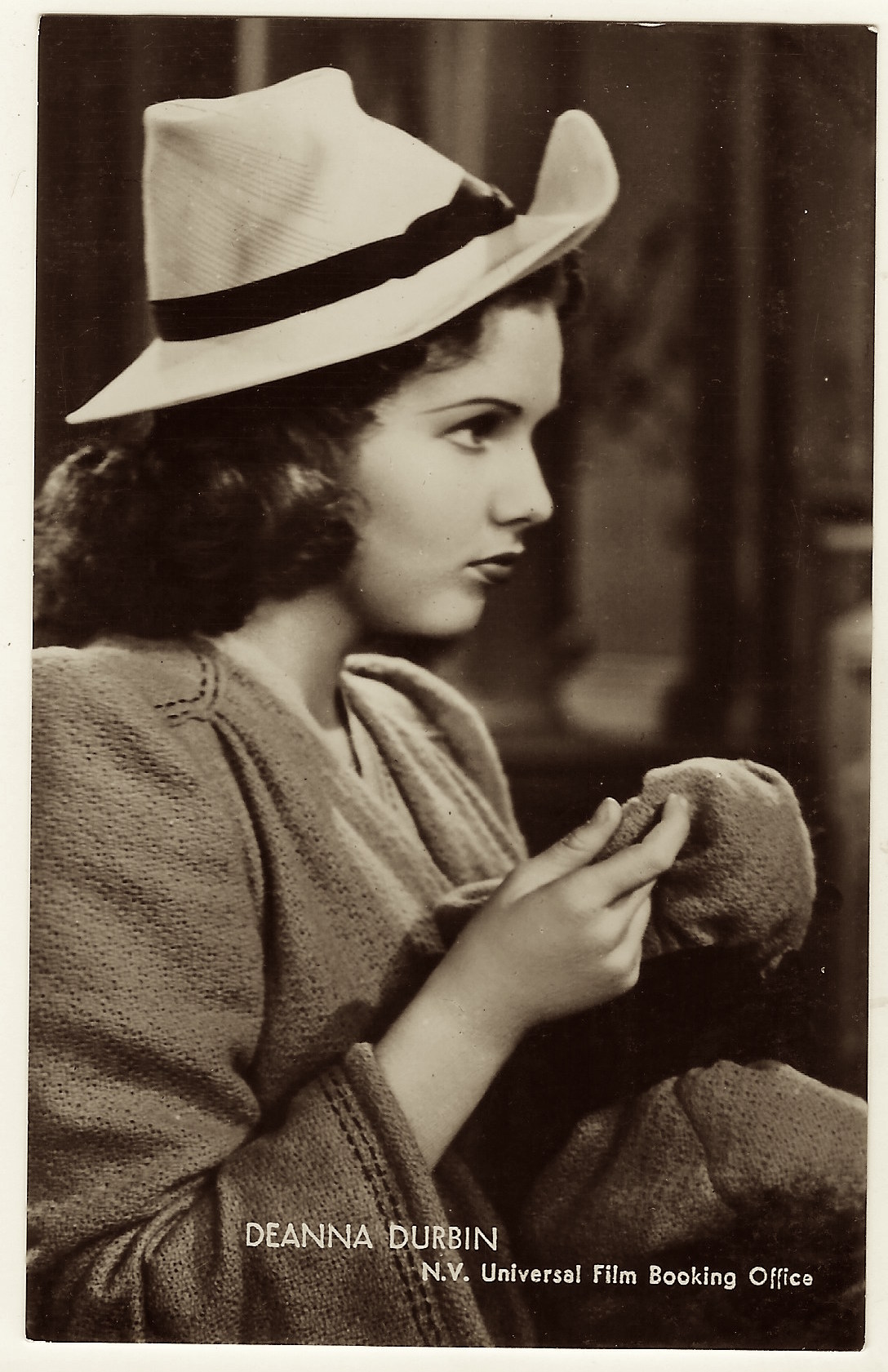
This vintage real photo postcard features Canadian born American singer and actress, Deanna Durbin (1921-2013). She is beautifully dressed. Her hat is a nice touch. Deanna Durbin looks quite pretty in this photo portrait. The postcard notes her affiliation with Universal Films. The postcard was published by Echte Foto, a Dutch company. Miss Durbin was an active performer between 1936 and 1948. She appeared in musical films and had the technical skill and vocal range of a legitimate soprano. She sang multiple styles of music including popular standards and operatic arias. Durbin’s first film appearance was with Judy Garland in MGM’s “Every Sunday” (1936). A YouTube clip of the two young actresses performing a duet from this film can be seen below. Shortly after her debut movie, she was given a contract by Universal Studios. She had great success with the studio playing “the ideal teenage daughter” is such films as “Three Smart Girls” (1936). She was only 14 years old when she appeared in “Three Smart Girls” and became an established star. Afterward, she had a string of successful musical films. In 1936, Deanna was offered an audition for the Metropolitan Opera but she rejected the offer because she believed she needed more operatic training. From 1936 through 1938, Durbin did a radio collaboration with Eddie Cantor. In 1938, Durbin was awarded an Academy Juvenile Award. Her co-winner was actor Micky Rooney.Durbin tired of her girl-next-door roles and by 1945, had appeared in a couple of films in more sophisticated roles. Unfortunately, she was not well received in these more mature roles. In 1946, Durbin was the second highest paid woman in the United States, second to Bette Davis. Durbin became the highest paid female in America in the year 1948. By 1949, she retired from acting and singing and never returned to public life. In fact, she never again agreed to be interviewed by the press, with just one exception. Durbin hated the adulation she received in her career and yearned for a “life of nobody”. She wanted to be anonymous. During her acting career, Durbin appeared in 23 films and even more sound recordings. Durbin had three marriages. Her husbands were assistant director Vaughn Paul (1941), writer-producer-actor Felix Jackson (1945) , and film producer-director Charles Henri David (1950). (SOLD)
Judy Garland & Deanna Durbin – Americana (Every Sunday, 1936)
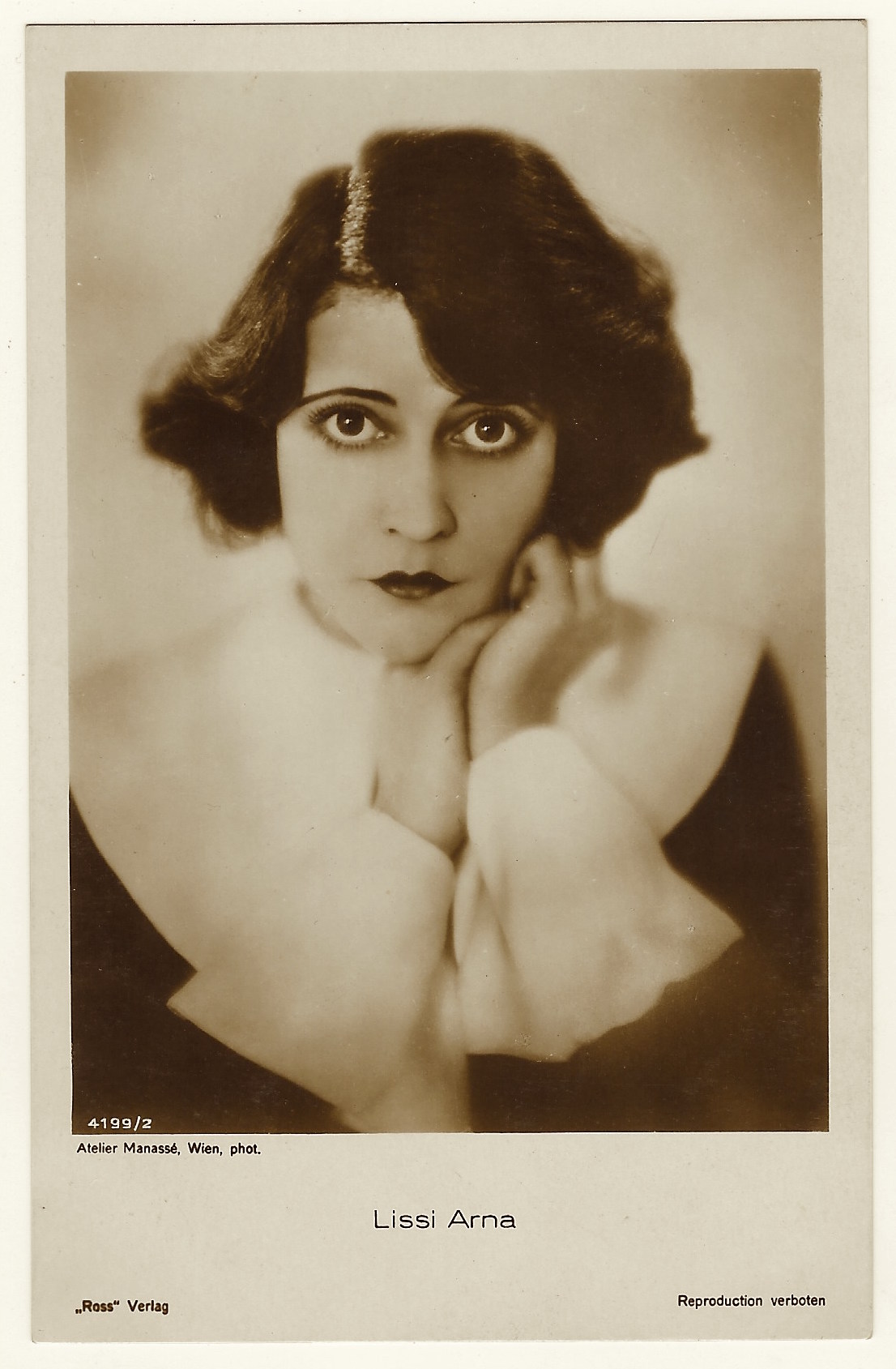
These vintage real photo postcards feature German actress Lissi Arna (1900-1964). She is known for the films “Harbor Drift” (1929, The Squeeker (1931), and Under the Lantern (1928). She appeared in German silent films and entered US films in 1930. She was an exotic femme fatale in German silents She was married to a doctor in 1939 and the couple lived in Venezuela until his death. She appeared in Hollywood in German language versions of American films. She was in the US for only one year and failed to get significant offers from any of the major studios. In the sound era she gradually lost her popularity and was confined to supporting roles through the 1930’s. The IMDb credits her with 62 films between 1915 and 1962. View the YouTube video below to see Lissi Arne appearing in “Under the Lantern” (1928).The first postcard was published by Ross Verlag as part of a series (no. 4199/2). Miss Arna’s portrait was taken by the Manasse studio which was located in Vienna, Austria. There also was a branch of the studio in Berlin. The Manasse studio was in existence between about 1922 and 1938. The studio was run by Olga Solarics (1896-1969) and her husband Adorja’n von Wlassics (1893-1946). Olga was known for her interest in photographing nudes. The studio flourished in Vienna during the 1930’s. Many of the portraits taken by the studio had an erotic flavor. The studio attracted some of the leading ladies of film and theater. The studio was also involved in producing photographs for advertising. This husband and wife team of photographers were very talented and very successful in their profession.
The second portrait postcard features a somewhat risque photograph of Miss Arna. The photograph reveals her bare back and shoulders as well as as a bare view above her breast. She is flashing a sly smile and smoking a cigarette at the end of a cigarette holder. The photo was taken by German photographer Kiesel in Berlin, Germany. The second postcard (no. 3091/1) is part of the same series as the first postcard. This postcard is published by Ross Verlag (Berlin, Germany).
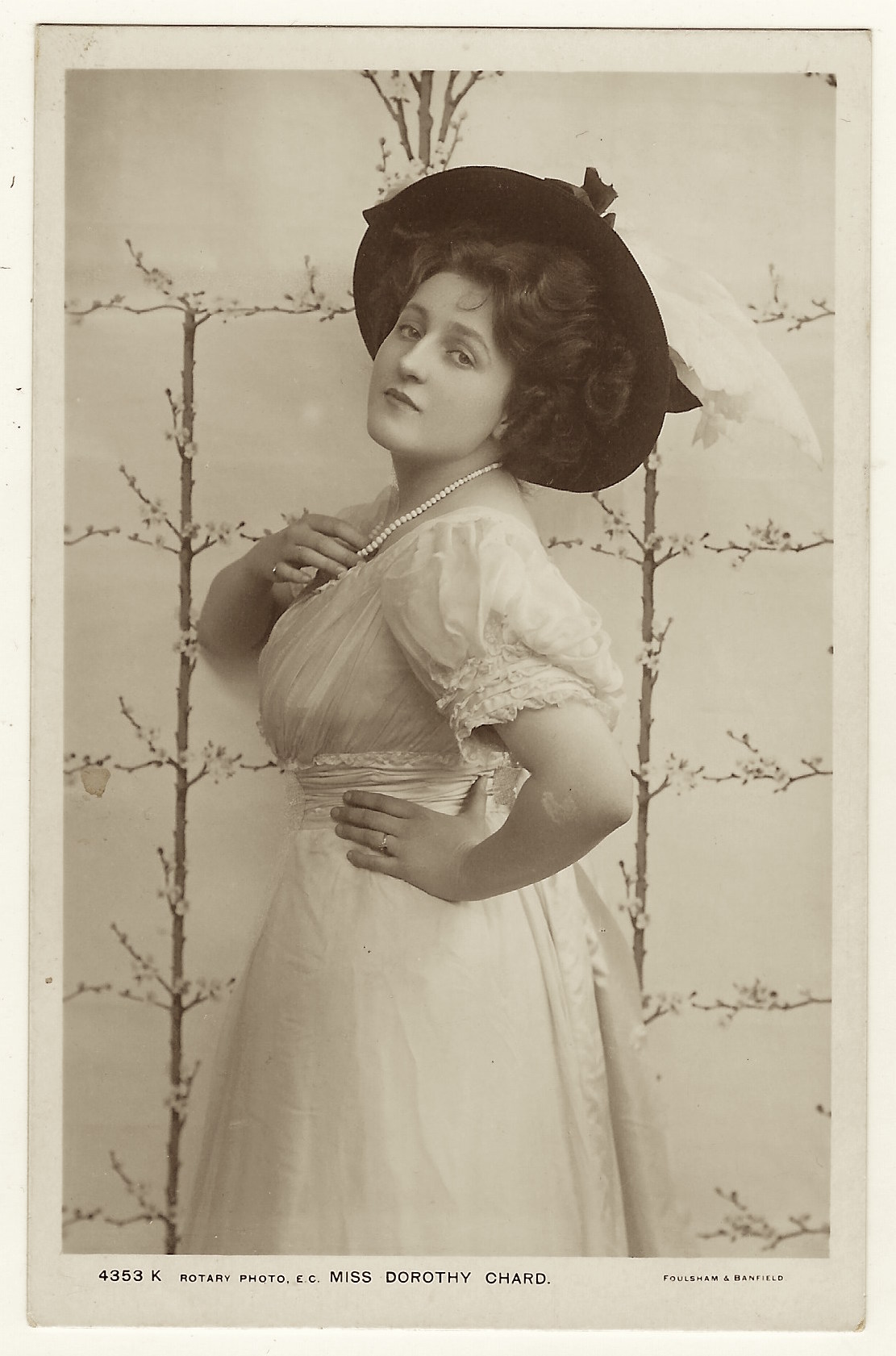
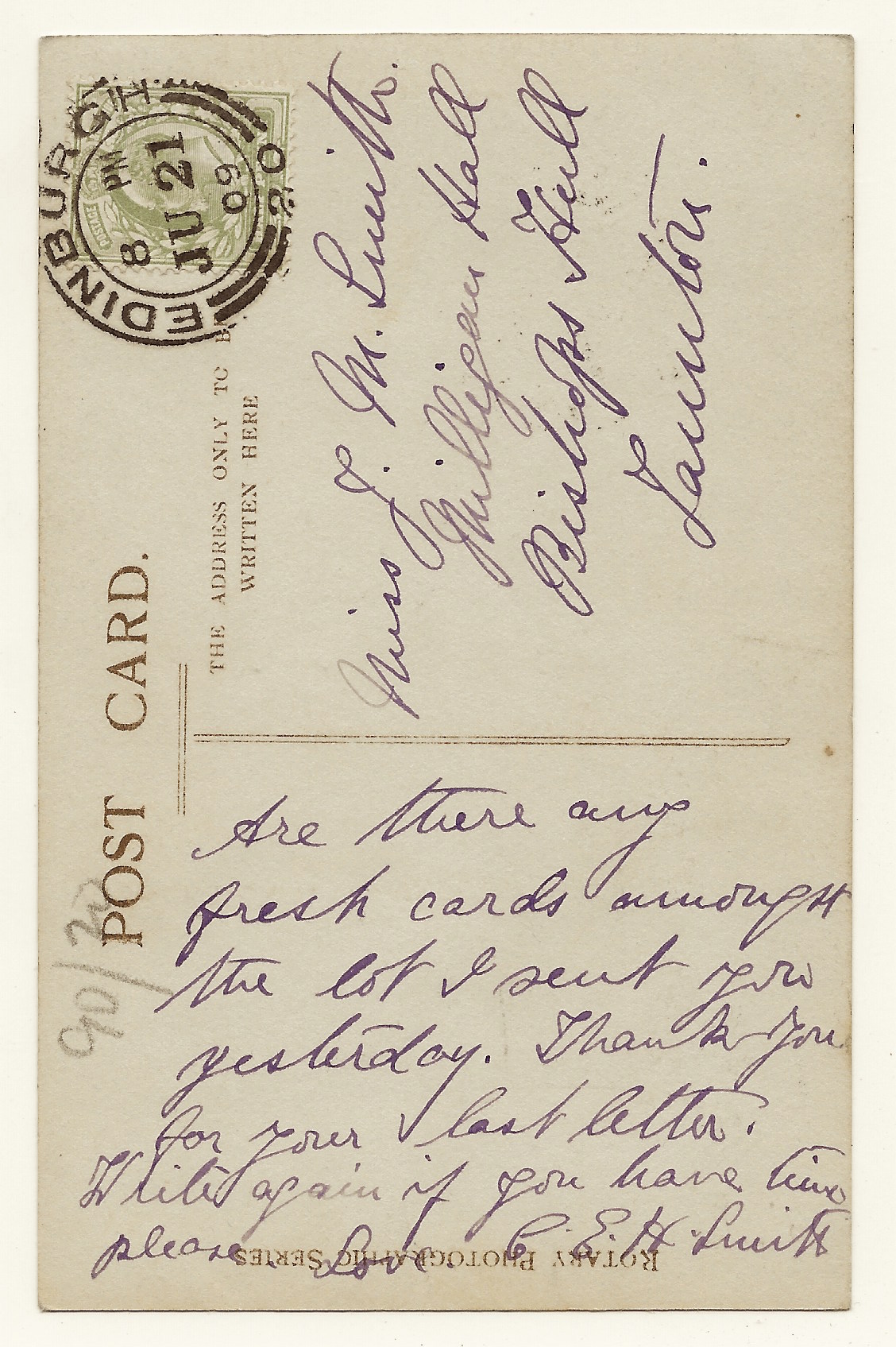
This vintage real photo postcard features Edwardian theater actress Miss Dorothy Chard. Preliminary research yielded little information about her life and her career. More intensive research is required to uncover biographical information. The Internet Broadway Data Base (IBDB) notes that Miss Chard appeared in eleven Broadway shows from 1926 through 1930. She played in musicals but she primarily appeared in comedies. Among her credits are “Merry-Go-Round” (1927) and “Cinderelative” (1930). The dearth of information about Miss Chard reveals that she certainly was not a leading actress of her time but she certainly was beautiful and well known enough to merit the publishing of a photo postcard by the Rotary Postcard company. This postcard was part of the Rotary Photographic series (no. 4353 A). The photograph of Dorothy Chard appearing on this postcard was taken by the Foulsham & Banfield Studio.The pair were well known celebrity photographers. Frank Foulsham and A. C. Banfield operated a studio from the 1900’s through the 1920’s. The postcard is postmarked 1909 from Edinburg, Scotland. Edinburg is Scotland’s capital city. The content of the message on this postcard mentions “fresh cards” referring to newly released photo postcards. Collecting such cards was a popular hobby during this era. I guess this hobby was a precursor to collecting pokemon. I prefer collecting photo portraits. Call me “old school”. (SOLD)
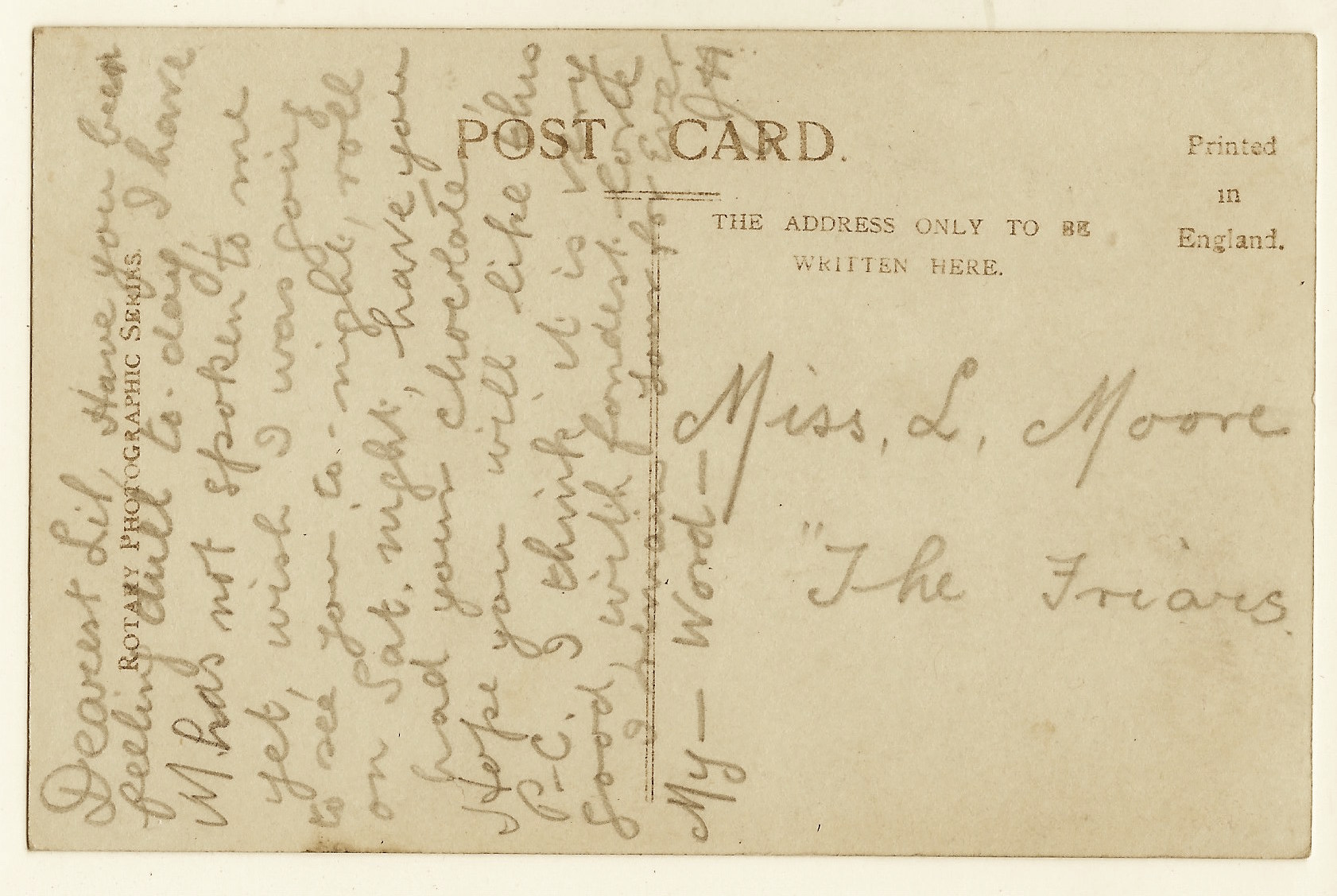
The second vintage postcard features a portrait of Dorothy Chard from the same series as the top postcard. This Rotary postcard (no. 4353 K) presents a more complete view of the actress. Miss Chard was dressed in different clothing and accessories for the two portraits. She looks very friendly in card 1 but has an arrogant expression in card 2. The message on the reverse of this postcard states “Dearest Lil, Have you been feeling well today. I have. M. has not spoken to me yet. Wish I was going to see you tonight. –?– on saturday night. Have you had your chocolates? Hope you will like the P-C (postcard). I think it is very good. With fondest love. I remain yours forever. (JM?) My- Word -” It is interesting that the writers of postcard 1 and 2 both mention the photo postcard that they are sending. It would be interesting to know what “My-Word-” means. Does it mean “I will remain yours forever, you have my word”. Hopefully, a Cabinet Card Gallery visitor will be able to offer an explanation, (SOLD)
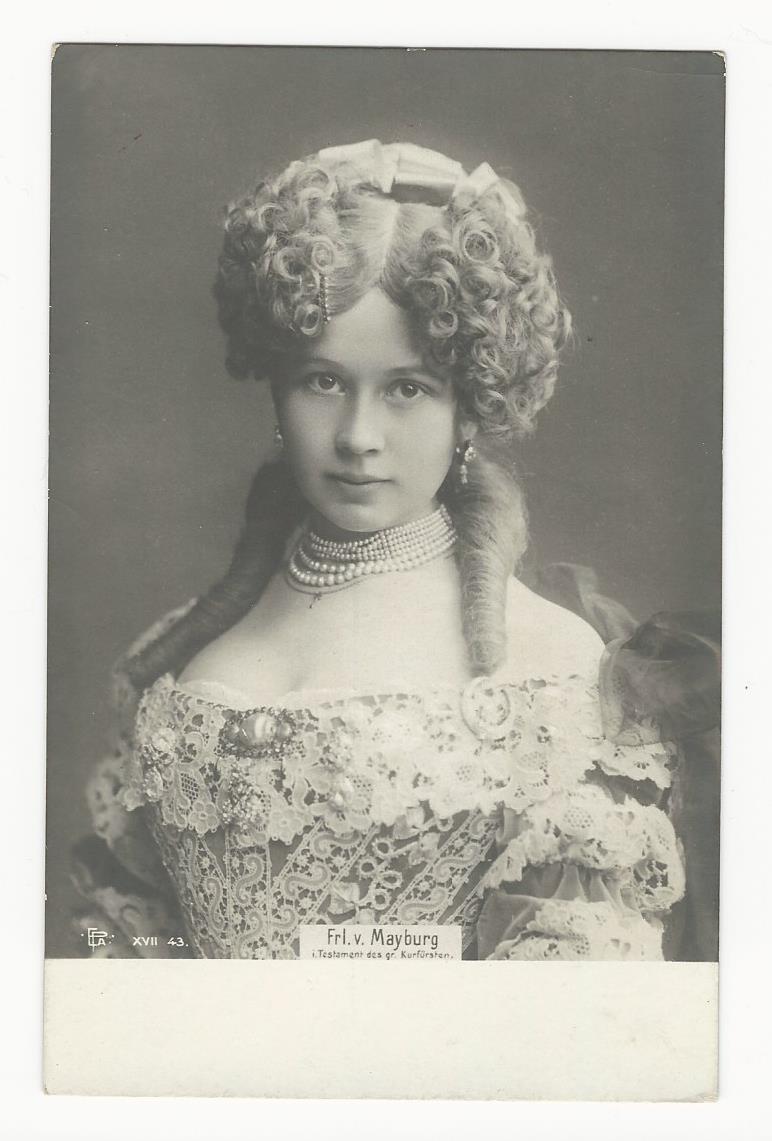
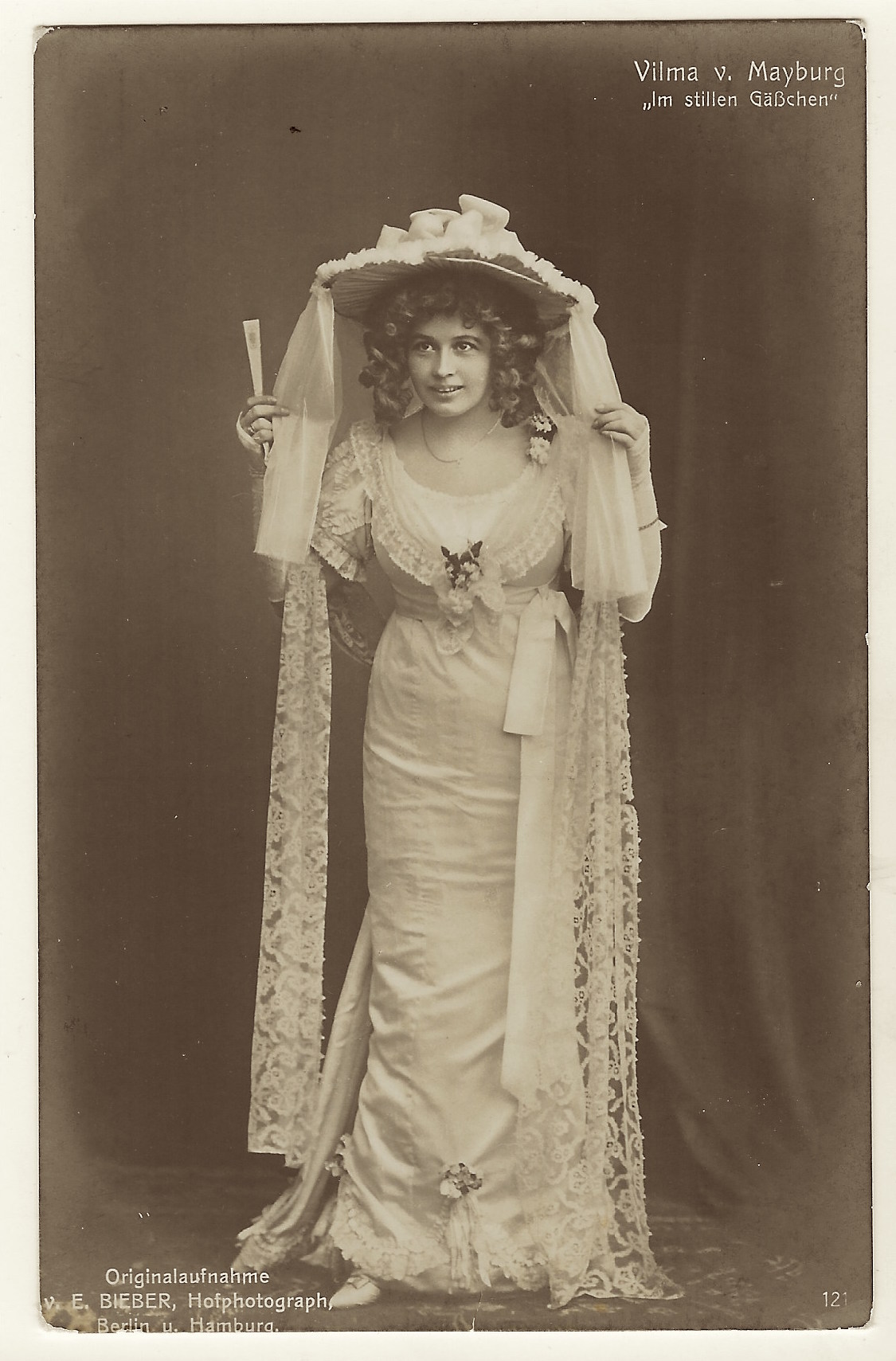
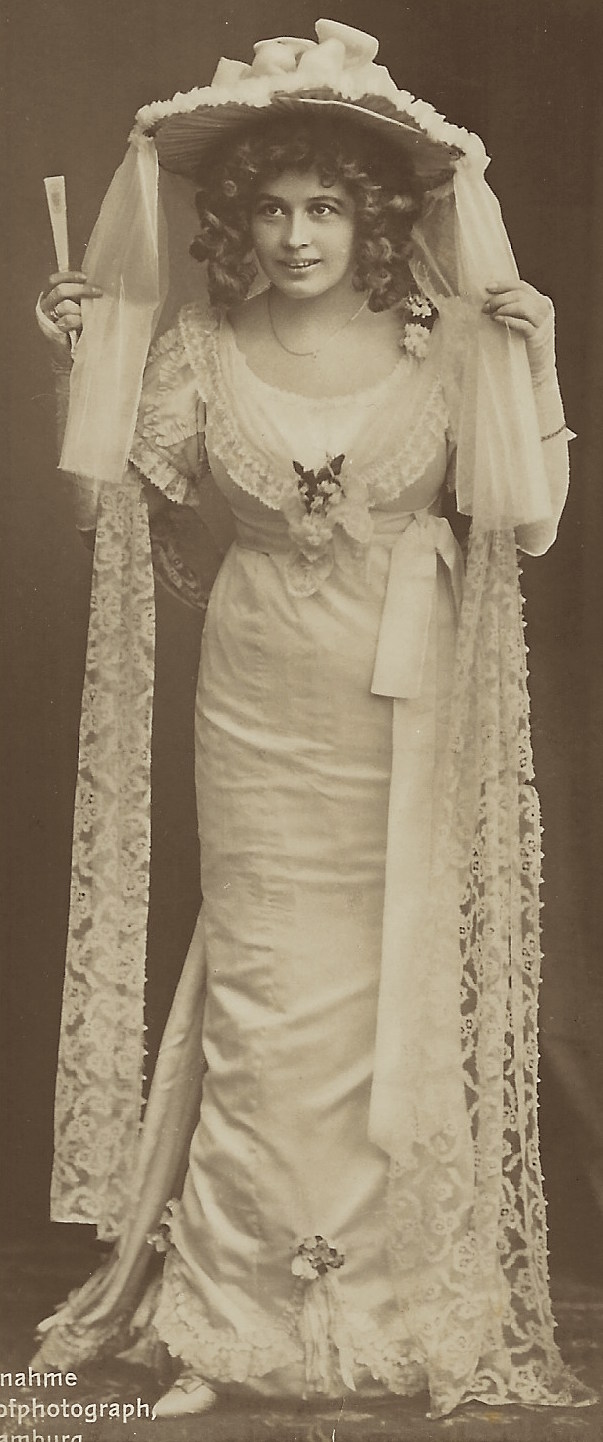
A costumed Vilma Von Mayburg poses for her portrait in the top vintage real photo postcard. The beautiful German stage and silent film actress is known for “Die Erbin des Grafen von Monte Christo (1919)”, Der siebente kub (1918)”, and “Menschen in Ketten (1919)”. Her film career began in 1916. This postcard was published by “EPA” which is the Albert Phototype Establishment. The company was located in Algers, Algeria. The second photo postcard shows a standing Miss Mayburg. She is quite pretty and well dressed. She is adorned with flowers and holding a fan. After I purchased this photograph, I had a nice surprise. I realized that the photograph was taken by one of my favorite photographers, Emilie Bieber. She was quite successful and quite talented. Bieber had two studios in Germany; Berlin and Hamburg. The Hamburg studio operated from 1852 through 1872 when she was joined by her nephew, Leonard Berlin-Bieber, Emilie Bieber died in 1884. .
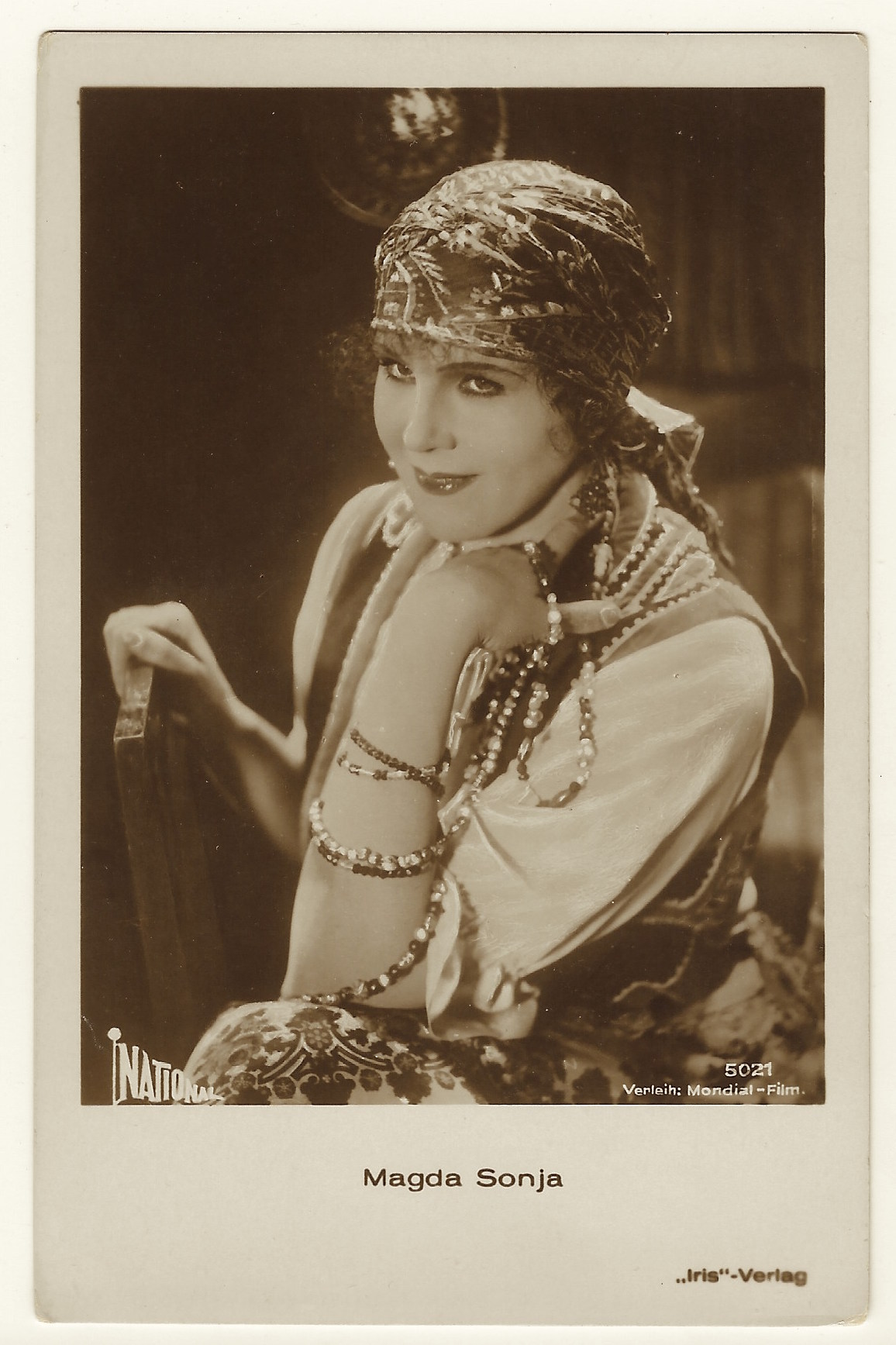
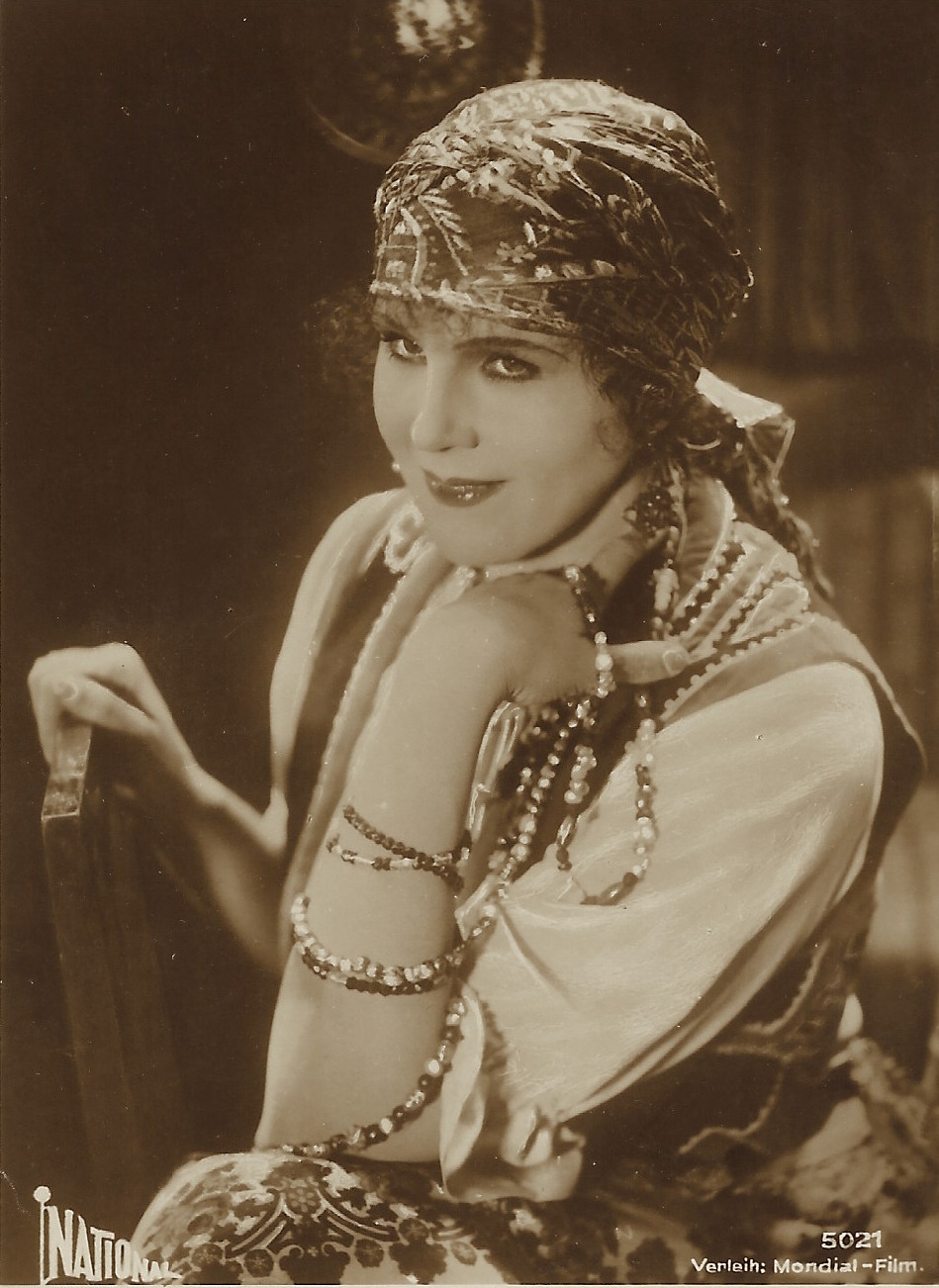
This vintage real photo postcard features Austrian actress Magda Sonja (1886-1974). She was married to film director Friedrich Feher. Her acting career began when she was twenty years of age when she appeared in a production in Vienna. She then appeared in a number of Cabaret performances. She began her silent film career in 1917 in the film “About A Woman”. By 1918 she was a star of Austrian silent films along with Liane Haid. In fact, Sonja was the actress with the most appearances for the very productive Sasch-Film company. Among her films were “The Other Me” (1918), “Don Juan’s Last Adventure” (1918), “The Venus” (1922), and “Drakula halala” (1923). She is considered to have reached the height of her career in (“Mata Hari, The Red Dancer”). The IMDb credits Sonja with appearing in 43 films between 1917 and 1937. Magda Sonja was another actress who’s career cooled off after the advent of sound movies. In 1933, she and her husband emigrated to England to avoid the persecution of Jews. In 1937 they moved to the United States. Sonja was the mother of actor Hans Feher. It is unfortunate that Sonja and her husband had no success in resuming their careers in Hollywood. This postcard was published by Iris Verlag as part of a series (no, 5021). Logos for “National” and “Mondial-Film appears on the front of the postcard. Mondial-Film was a production company and a film distributor.
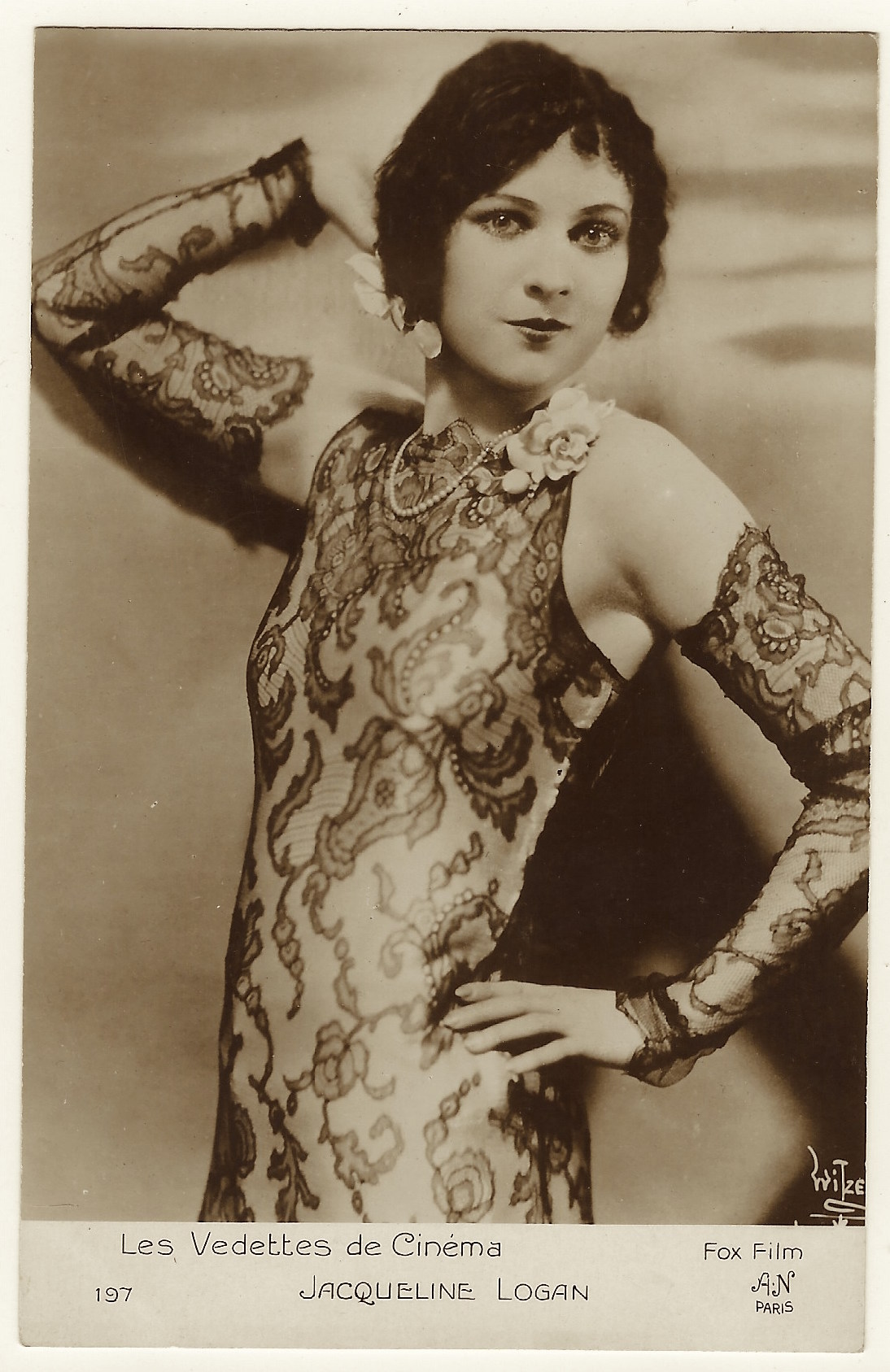
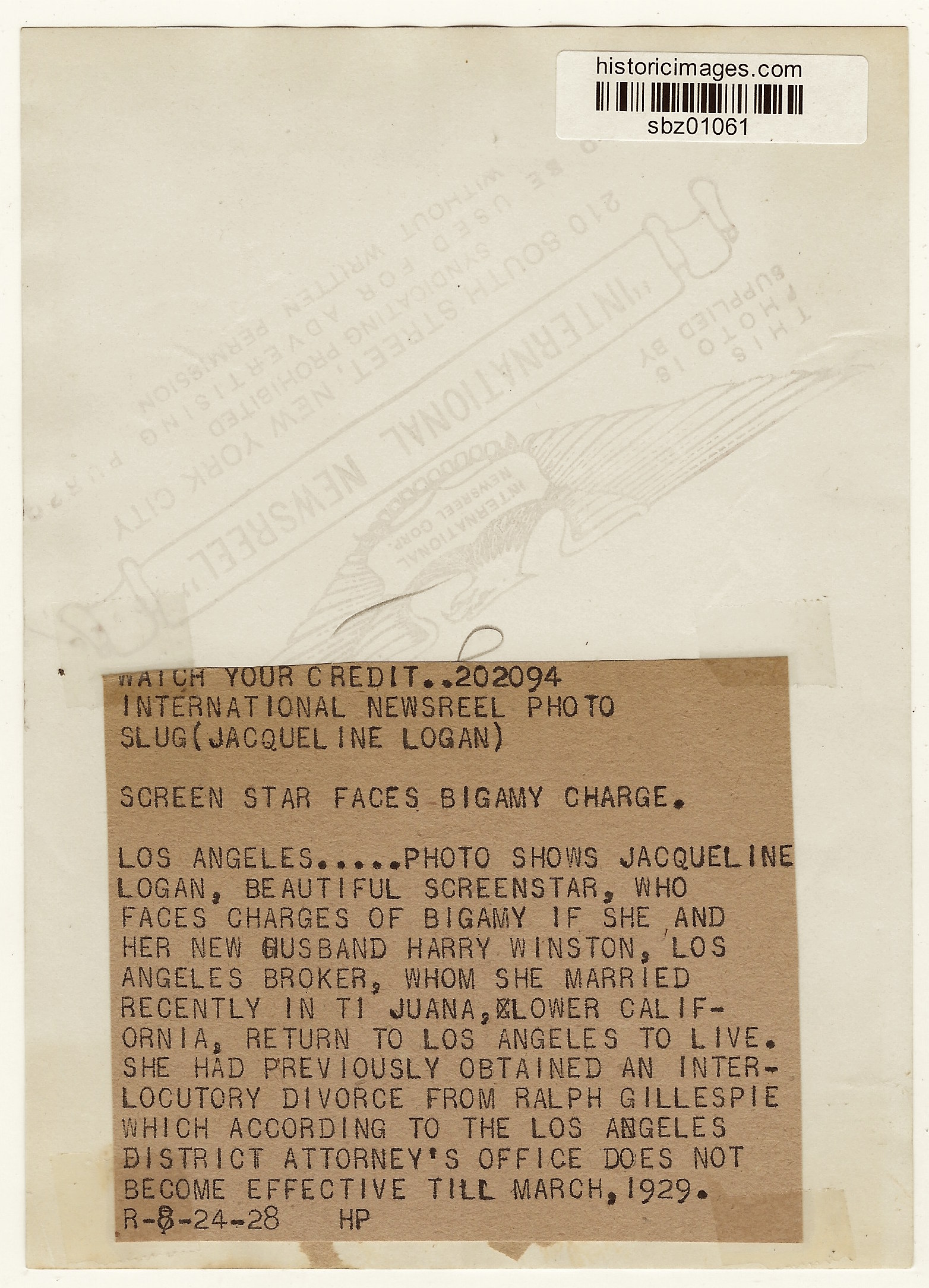
This vintage real photo postcard features silent film star Jacqueline Logan (1904-1983). Logan had auburn hair and green eyes. She was considered to be very beautiful. Logan was a “WAMPAS Baby Star” of 1922. The Western Association of Motion Picture Advertisers sponsored the WAMPAS promotional campaign. Each year between 1922 and 1934 the promotion honored 13-15 young actresses who were predicted to be on the cusp of movie stardom. Other honorees besides Logan included Clara Bow, Joan Crawford, Fay Wray, and Ginger Rogers. Jacqueline Logan was born in Corsicana, Texas and grew up in Nebraska. She worked briefly as a journalist in Scottsbluff, Nebraska and than went to Colorado Springs for health issues. She took a journalism course there and than moved to Chicago where she found a job dancing in a stage production. She had told her family she was going to Chicago to attend college. She then went of New York City with a theater troupe. While in New York, she received a small part in the Broadway musical “Florodora (1920). She was noticed by Flo Ziegfeld who hired her as a dancer. She also was selected to model in photographs by Alfred Cheney Johnston. By 1921, she began appearing in films. Her first role was in “The Perfect Crime”. Also featured in the film was Carole Lombard, who at the time, was a child actress. Cecile B. DeMille selected Logan to play Mary Magdalene in the film “King of Kings” (1927). The movie broke audience attendance records. With the advent of “talkies”, Logan had less success. However, she did appear in “Show of Shows” (1929) in which she was a member of an all-star cast. Next, she went to England to do stage work. She received many good reviews. She was then hired by British International Pictures to write and direct films. She was successful in her writing and directing. When she returned to Hollywood she found that studios were not interested in hiring her for behind the camera work. Their resistance was likely predominately due to not wanting a female to direct films. Back in America, she appeared in several Broadway shows including “Merrily We Roll Along” and “Two Strange Women”. In 1934, after her marriage to an industrialist, she retired from films. The IMDB web site reports that Logan has 61 film credits between 1921 and 1931. The Internet Broadway Database lists 3 Broadway play credits for the actress between 1920 and 1935. In her later years, Logan became a conservative political activist and member of the John Birch Society. This real photo portrait postcard was produced in France. It was part of a series (no. 197) called “Les Vedettes de Cinema (Stars of the Cinema)”. The photograph was taken at the Alfred Noyer studio (AN) in Paris. The actual photographer may have been Witze. The postcard includes an advertisement for Fox Film, indicating Logan’s affiliation with the studio at the time of the photograph. The second photograph of Miss Logan is a press photo from 1928. Judging by the title of the text on the reverse (see below), this image appeared in a newsreel. Jacquline Logan had made the news because she had committed bigamy. Apparently she married Larry Winston before her divorce from Ralph Gillespie had become finalized. It appears she was too impatient to wait for the ink to dry on her divorce decree.







 Postcard 2
 close up of postcard 2
 reverse of top postcard
 reverse of bottom postcard