THE POWER OF BEAUTY SEEN IN PORTRAIT OF GERMAN ACTRESS

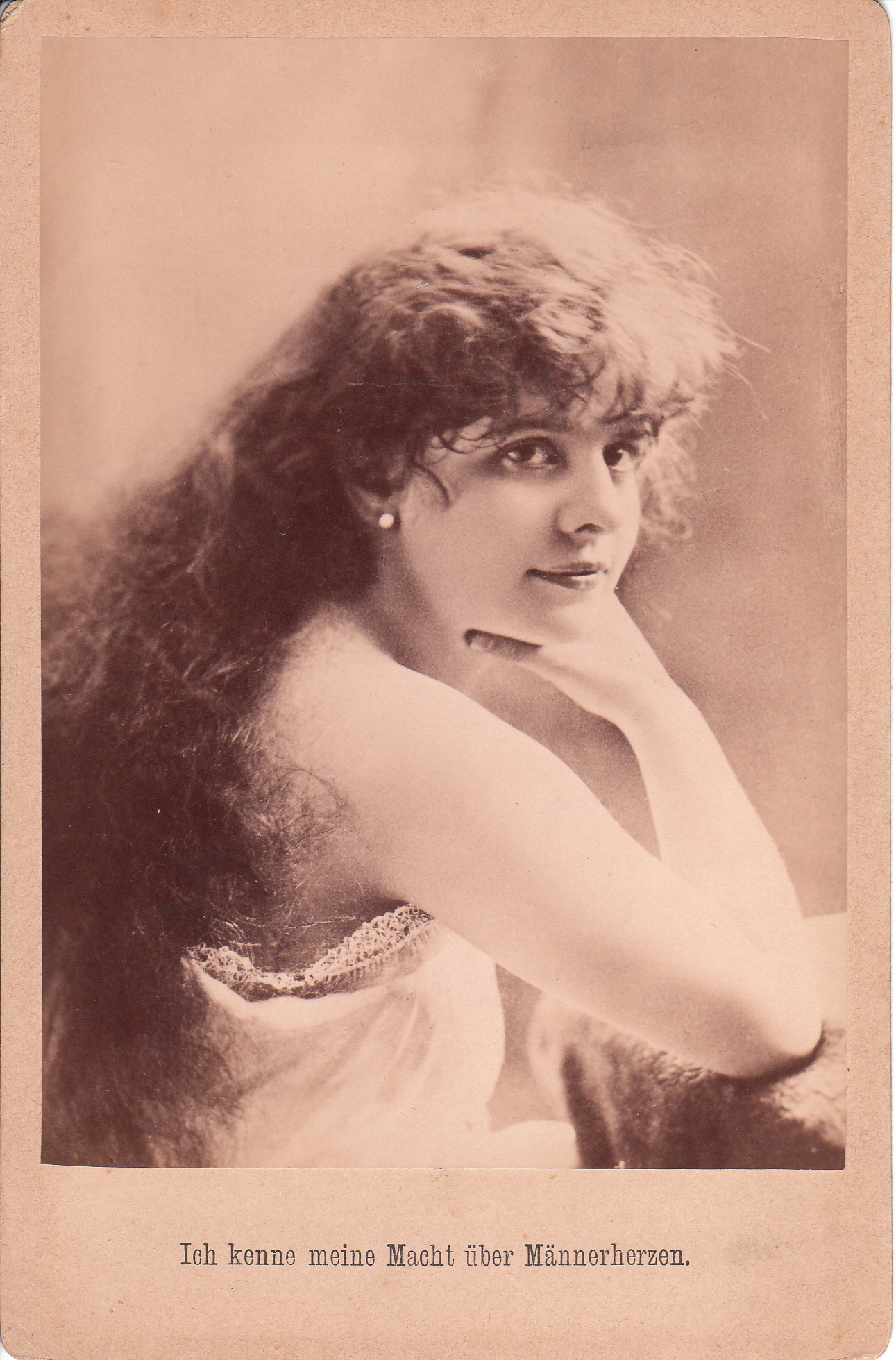
A pretty young woman is the subject of this cabinet card. She is posed in a provocative manner, relative to the time of this photograph. She is likely a German actress/model. The previous owner of this cabinet card translated the German text below the image as stating “I know my power over men’s hearts”. Printing on the reverse of the photograph identifies the photographer as S. B. Farren and Son. The image is identified as number 233 of a series. Farren may be the photographer of this cabinet card but it is also possible that he purchased it from the original photographer and sold it to collectors from his studio.  SOLD

Published in: on June 8, 2012 at 10:25 pm  Comments (1)  
Tags:

ELISE DE VERE: PORTRAIT OF A BEAUTIFUL SOUBRETTE BY REUTLINGER

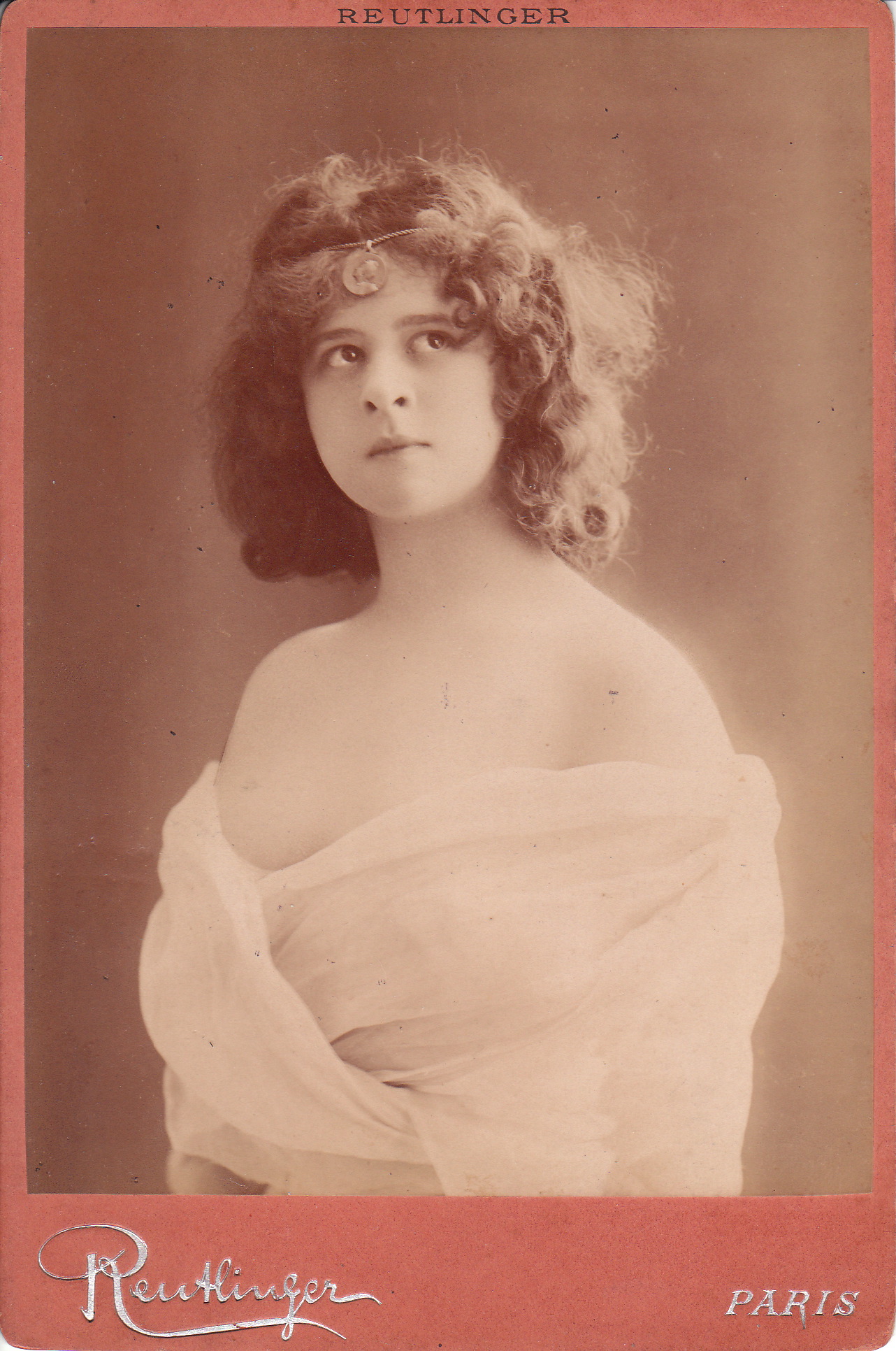
Elise De Vere was indeed a very pretty woman and her pose in this image can be described as risque. She poses in this cabinet card photograph for famed celebrity photographer, Charles Reutlinger. Reutlinger’s studio was located at 21 Boulevard in Paris, France. The photograph was published in 1899.  Small print located at the bottom of the reverse of the card states R. Dechavannes. He may be in fact the actual photographer of the portrait. Perhaps the photograph was published by Reutlinger but not actually photographed by him. The facts concerning the role of Reutlinger and Dechavannes are not clear. To view other photographs by Dechavannes, click on the category “Photographer: Dechavannes”. To view other photographs by Reutlinger, click on the category “Photographer: Reutlinger”. Elise De Vere was an English actress/singer who performed in music halls and operas around 1900. The previous year she had won second place in a beauty contest at the Paris Olympia Theatre. She was described at the contest as a “Chanteuse Excentrique”  (Eccentric Singer). Around 1900 she was a stage diva in Europe and America. In 1903-1904 she performed in the Flo Ziegfeld Broadway opera “Red Feather” which played at the Lyrical Theatre and then the Grand Opera Theatre. In announcing De Vere’s arrival in America to play in “Red Feather”,  The New York Times (1903) writes that although she was a Parisienne, she spoke excellent English (shouldn’t have been a surprise, she was English). The article added that De Vere had recently learned to sing in German. In a later article, the New York Times (1903) labelled De Vere as a “Soubrette” in the “Red Feather”. A soubrette is a stock character in opera or theatre. A soubrette is frequently a comedic character who is often portrayed as vain, girlish, mischievous, gossipy and light hearted.  SOLD

JENNIE JOYCE: TROUBLED STAGE STAR PHOTOGRAPHED BY FALK FOR NEWSBOY

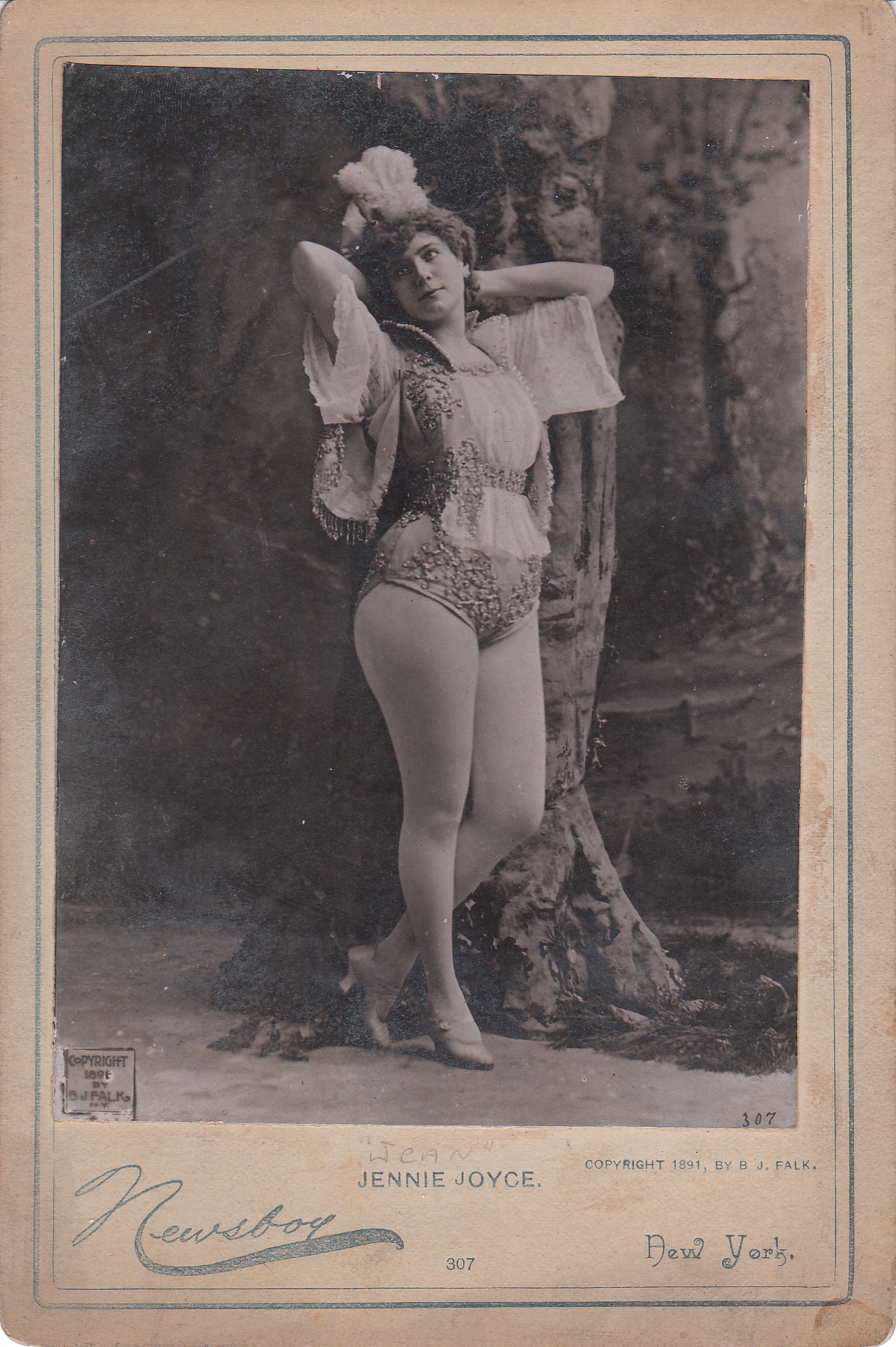
This photograph, by celebrity photographer B. J. Falk, features stage star Jennie Joyce. She was photographed for the Newsboy tobacco company and the image was used as a premium to reward purchasers for buying Newsboy products. The image has a copyright date of 1891 and is number 307 in the Newsboy series. This photograph is risque for its era. Miss Joyce is showing much of her nearly bare legs and is exhibiting a sexually provocative pose. The New York Times (1892) published an article reporting that Jennie Joyce was sued by her husband for divorce. John E. Stanley’s request for a divorce was uncontested. The newspaper described Jennie Joyce as a variety actress and singer. An 1899 article in the same newspaper reported a story about problems in the marriage of Joyce and sportsman Phil Daly Jr..  Daly had told Joyce that he would be out all night but according to plan, returned home at two in the morning only to find his wife with another man (Phillip Wood). Daly fired a number of shots at Wood but missed. Daly’s parting shot was to file for divorce and end his five year marriage. The bad publicity caused by Joyce’s marital problems cause her to speculate in another 1899 Times article that she planned to leave the United States to perform pantomime in London until the fallout from her divorce had diminished. An additional conflict was in the news when the New York Times (1901) printed a story about Joyce successfully suing theatre manager, Alexander Hashim for unpaid salary. Jennie Joyce was clearly  a gossip magnet for the press and she provided  them with a lot of material.   SOLD

CONCHITA GELABERT: BEAUTIFUL OPERA STAR IN PARIS, FRANCE

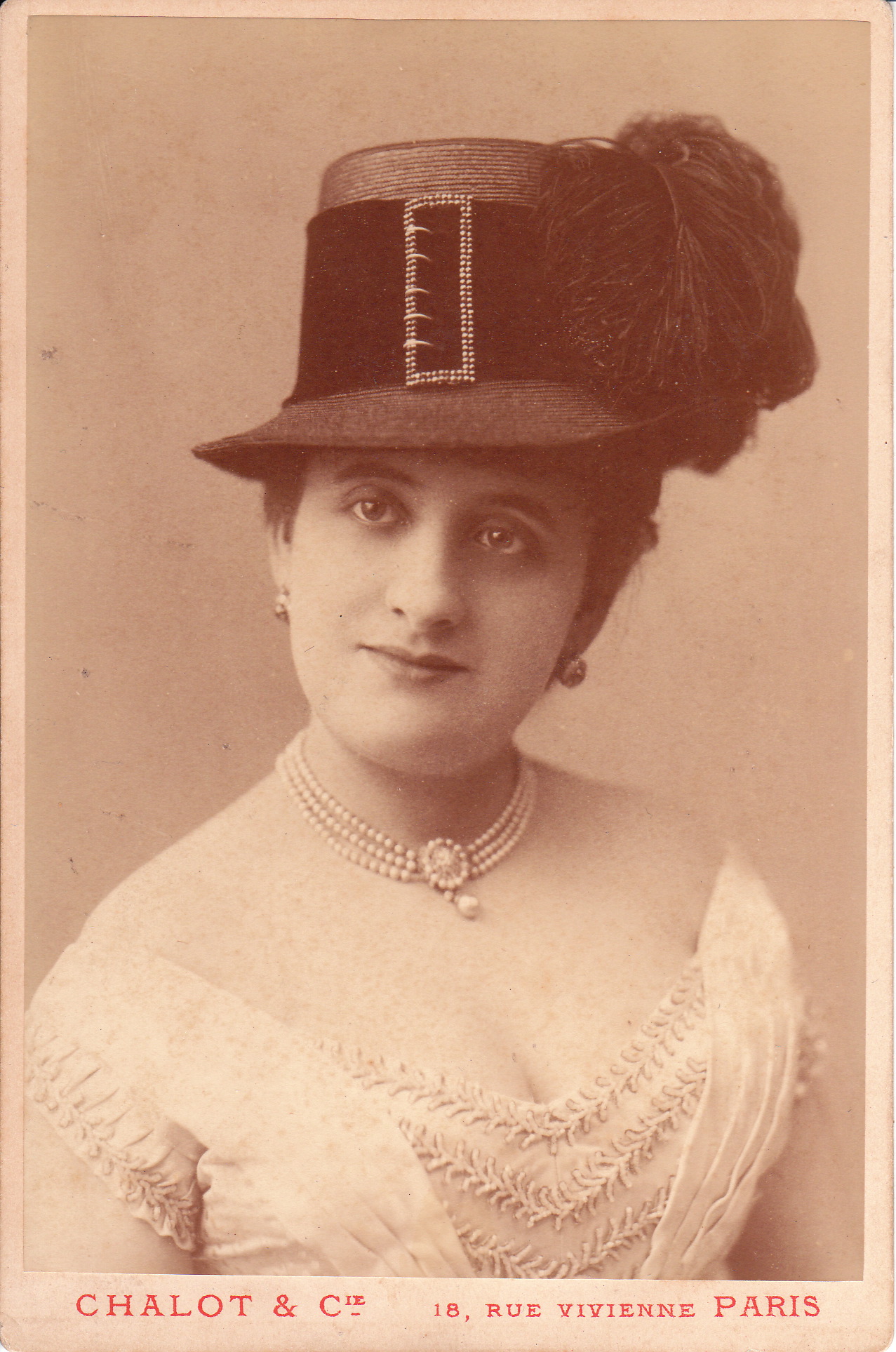
This cabinet card features the lovely Conchita Gelabert, soprano and operetta actress. Marie “Conchita” Gelabert was born in Madrid in 1857 and died in Paris in 1922. She was educated in the Paris Conservatory of Music. An article in the New York Times (1922) announced her death. She was described as a “Spanish Comic Opera singer. who for many years was one of the most celebrated of Paris stars”. The article states that Gelabert “died today alone and forgotten”. Apparently, she had left the stage in 1890 and went into seclusion for the rest of her life. The cause of her abandoning her career and becoming an isolate, was an unhappy love affair. The article credits Gelabert with creating many roles, including “The Beautiful Person”and “The Grand Mogul”. This portrait was photographed by Chalot and Company of Paris, France. Ms. Gelabert is a stage beauty with eyes and an expression that can best be described as playful. She is wearing an interesting hat and well adorned with jewelry. Her dress is a bit risque but by Paris standards, this is a tame photograph.  The photographer of this image, Isadore Alphonse Chalot was one of the subjects of an article appearing in the American Journal of Photography (1890). The article was entitled “Photographers in Paris- Their Studios and Workshops”.  SOLD

PRETTY ACTRESS TRYING TO GET LUCKY IN PHILADELPHIA, PENNSYLVANIA

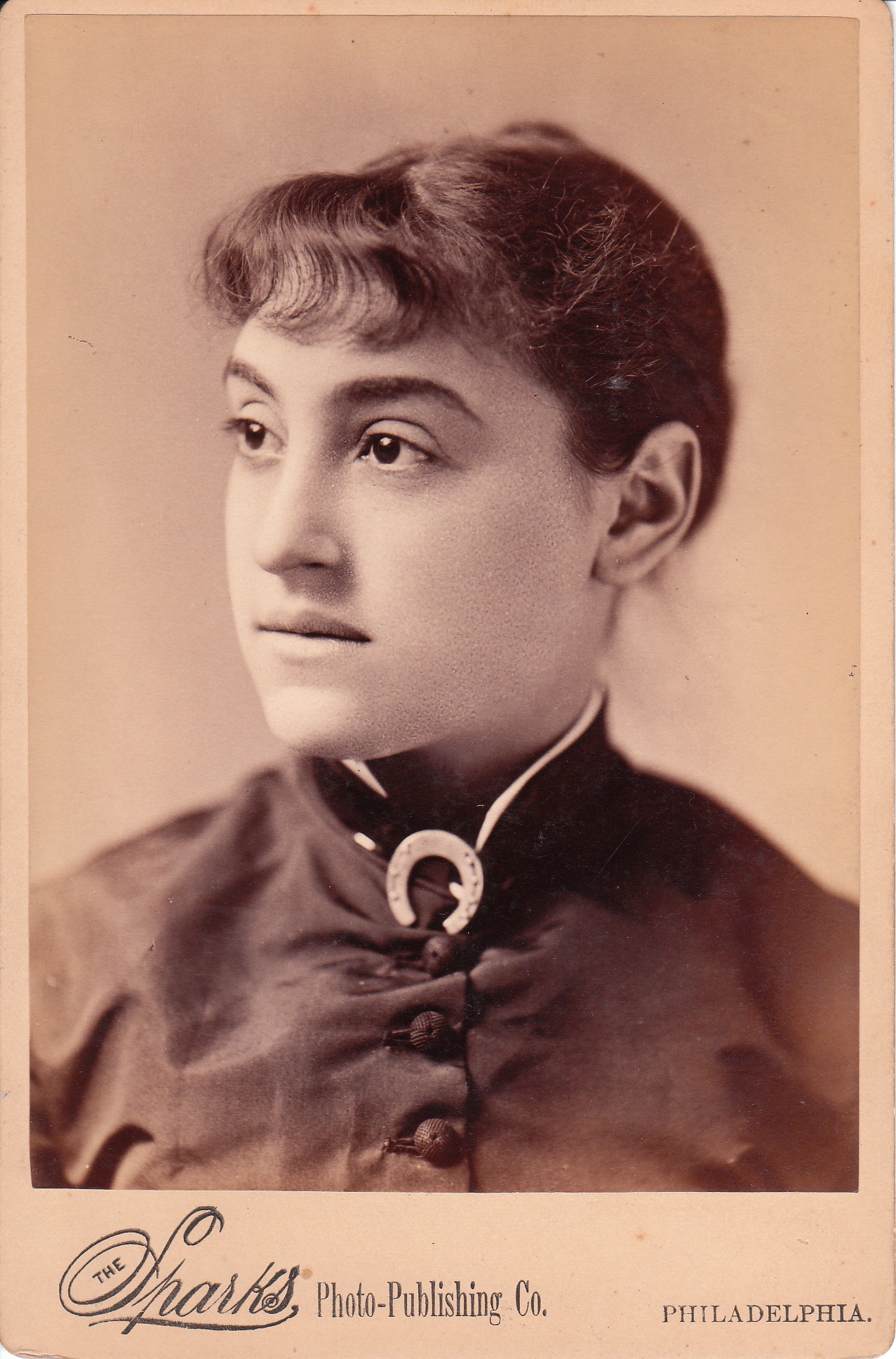
A beautiful young actress poses for her portrait at The Sparks studio in Philadelphia, Pennsylvania. She is wearing a horseshoe broach which probably was supposed to bring her good luck. This actress’s name was Marion Elmore. She was born in 1860 in a tent in Sandhurst, Australia. Her parent were English and they were in Australia because they were hoping to hit it big in the Gold Rush. Elmore began her acting career at age three. She played in Rip Van Winkle with touring American actor, Joseph Jefferson. In the 1870’s she was a member of Lydia Thompson’s famous burlesque troupe. “The Blondes” performed a risque mix of songs, dance and comedy. They also were very well known for showing a great deal of leg in their revealing costumes. She came to the United States in 1878 with the troupe but soon went off on her own as an actress and vaudeville performer. Her first starring role was in Chispa (1883). This play was poorly reviewed. The “Virtual Dime Museum” quotes the journal “Music and Drama” which wrote that the play “was dramatic rubbish, and that it does not fit Marion Elmore any better than her straw hat, which was continually falling off”. The New York Times (1882)  also lambasted the play. The critic had mixed feelings about Miss Elmore, but stressed her negatives. He blamed actress Maggie Miller for perpetuating a type of actress that he found abhorrent. These actresses were seen as stock actresses who rose to “money making dignity” by performing in troupes like Lydia Thompson’s Blondes. He described Elmore as a “vivacious exponent of the high art of leg burlesque”. The critic asserts that the craze surrounding Lydia Thompson, and other similar troupes, was one of the worst stupidities of the stage” and that he was pleased that the popularity of this type of entertainment had become “extinct”. On the positive side, the critic enjoyed Elmore’s sense of humor and her “brightness”.  One fortuitous outcome of her acting in Chispa was that she fell in love with, and in 1884, married her co star, Frank Losee. Another actress in Chispa was Lina Merville. Her portrait can be found in the Cabinet Card Gallery via the search box. As Elmore’s career continued, she acted in many plays in the New York area. She was active through the 1890’s and the early twentieth century. She died at age ninety in 1950. To view other photographs of actresses by Sparks, click on the category “Photographer: Sparks Photo Publishing Co.”.

ACTRESS MARY ANDERSON: BEAUTIFUL STAR OF THE AMERICAN AND ENGLISH STAGE


Cabinet Card 1  (SOLD)

These cabinet cards feature American stage actress, Mary Anderson (1859-1940). Interestingly, Anderson’s father was an Oxford educated New Yorker who after Mary was born, moved his family to Kentucky. He then joined the Confederate army and was killed in action when Mary was just three years old. Mary was not much of a student but loved to read Shakespeare. Her step father sent her to New York at age 14 to take ten professional acting lessons. In 1875, at age 16, Mary Anderson began her stage acting career in a Kentucky production of Romeo and Juliet. She continued acting in Kentucky and then appeared in a number of other cities, including New York. Her critical reviews tended to be mixed but she was well loved by the public. She then worked the New York and touring company stages for twelve years until she spent the next six years on the English stage (appearing in a lot of Shakespeare productions). She then returned to the United States, and at age 30, collapsed on  stage with a case of nervous exhaustion.   This experience, likely coupled with less than favorable reviews, caused her to retire from acting.

Cabinet Card 1 features Anderson in the role of  Galatea. A review of Mary Anderson’s performance in this role appeared in the New York Times in a September 1884 edition. She was appearing opposite British actor William Terriss, in the play “Pygmalion and Galatea”,  at the Lyceum Theatre in London. Many notables were in attendance, including Oscar Wilde. The review states ” Miss Anderson surpassed herself and that the performance was throughly artistic and finished”. The cabinet card was photographed by The Vanderweyde Light of London, England (182 Regent Street W.). Henry Van Der Weyde (1838-1924) was an artist and photographer. In 1877, he became the first photographer to install and take photographs by electric light.  (SOLD)

The second cabinet card was photographed by celebrity photographer, Sarony. The image reflects Mary Anderson’s great beauty. To view other photographs by Sarony, click on Cabinet Card Gallery’s category “Photographer: Sarony”.

The third cabinet card was photographed by “The Sparks Studio”. The studio was located in Philadelphia, Pennsylvania and the artist/manager was Elliott Houseworth. This cabinet card offers a profile portrait of the attractive Ms. Anderson. The 1880 census lists Elliott A. Houseworth as being born in 1855, residing in San Francisco, California, and working as a photographer. Houseworth also appears in the 1900 census as living in Norwood, Pennsylvania and working as a manager. These demographics fit the photographer of this image, since Houseworth managed Sparks Photography Studio and Norwood is only about eleven miles from Philadelphia.  To view other photographs of actresses by Sparks, click on the category “Photographer: Sparks Photo Publishing Co.”.

The  fourth cabinet card features a smartly dressed Mary Anderson and was photographed by George Rockwood, of New York City. To learn more about Rockwood and to view more of his photographs, click on the category “Photographer: Rockwood”.  A sticker on the reverse of the photograph indicates that the image was once part of the Kean Archives in Philadelphia, Pennsylvania. The Kean Archives was a company that served as a source of illustrations and photographs for various modes of media. They eventually were purchased by Getty Images.
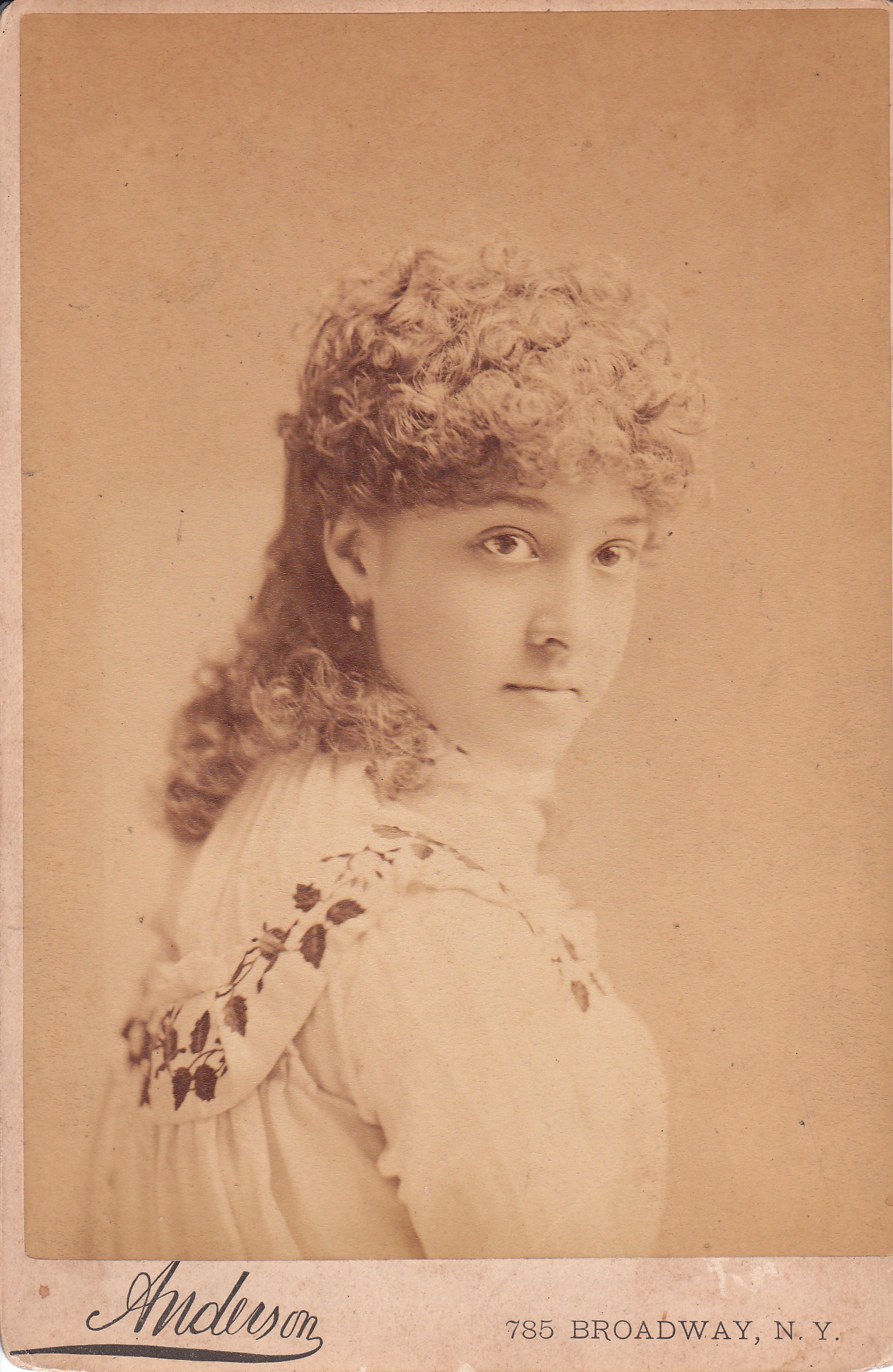
EMMA LORAINE: STAGE ACTRESS POSES ON BROADWAY IN NEW YORK CITY

Emma Loraine appears to have been a minor stage star. The New York Times (1879) reported that Wallack’s Theatre production of “Our Girls” included Ms. Loraine in the cast. Also in the cast was Maurice Barrymore. The New York Times (1881) has a story about the Wallach company going on tour because their new theatre was under construction. The company was planning to perform “She Stoops to Conquer” and “The School for Scandal” while on tour. Performing as part of the touring company was Osmond Tearle, Rose Coghlan, and Emma Lorraine. The cabinet card gallery has images of both Tearle and Coghlan that can be viewed by typing each of their names in the search box. Their names must be searched separately. Both cabinet card portraits of Loraine were photographed by celebrity photographer, D. H. Anderson of New York City. To view other images by Anderson, click on the category “Photographer: Anderson (New York)”. An article in the Photographic Times and American Photographer (1883) describes Anderson’s studio at 785 Broadway in New York City. The location was formerly the studio operated by famed photographer, Mathew Brady. Anderson is considered a pioneer in early photography. He made his first pictures (daguerreotypes) in Paducah, Kentucky in 1855. He later worked in Cincinnati (Ohio), Dayton (Ohio), New Orleans (Louisiana), Louisville (Kentucky), and various other cities. He finally settled for awhile in Richmond, Virginia in 1865. In 1881, he sold his studio and moved to New York City. The previously cited article described a “composition group” portrait that Anderson was working on during the magazine writers visit to his studio. The photograph was described as measuring eleven feet by fourteen feet and picturing the 7th Regiment posing in their new armory. The image included over a thousand soldiers.

RADIANT ACTRESS: CISSY FITZ GERALD (ONE OF THE GAIETY GIRLS)

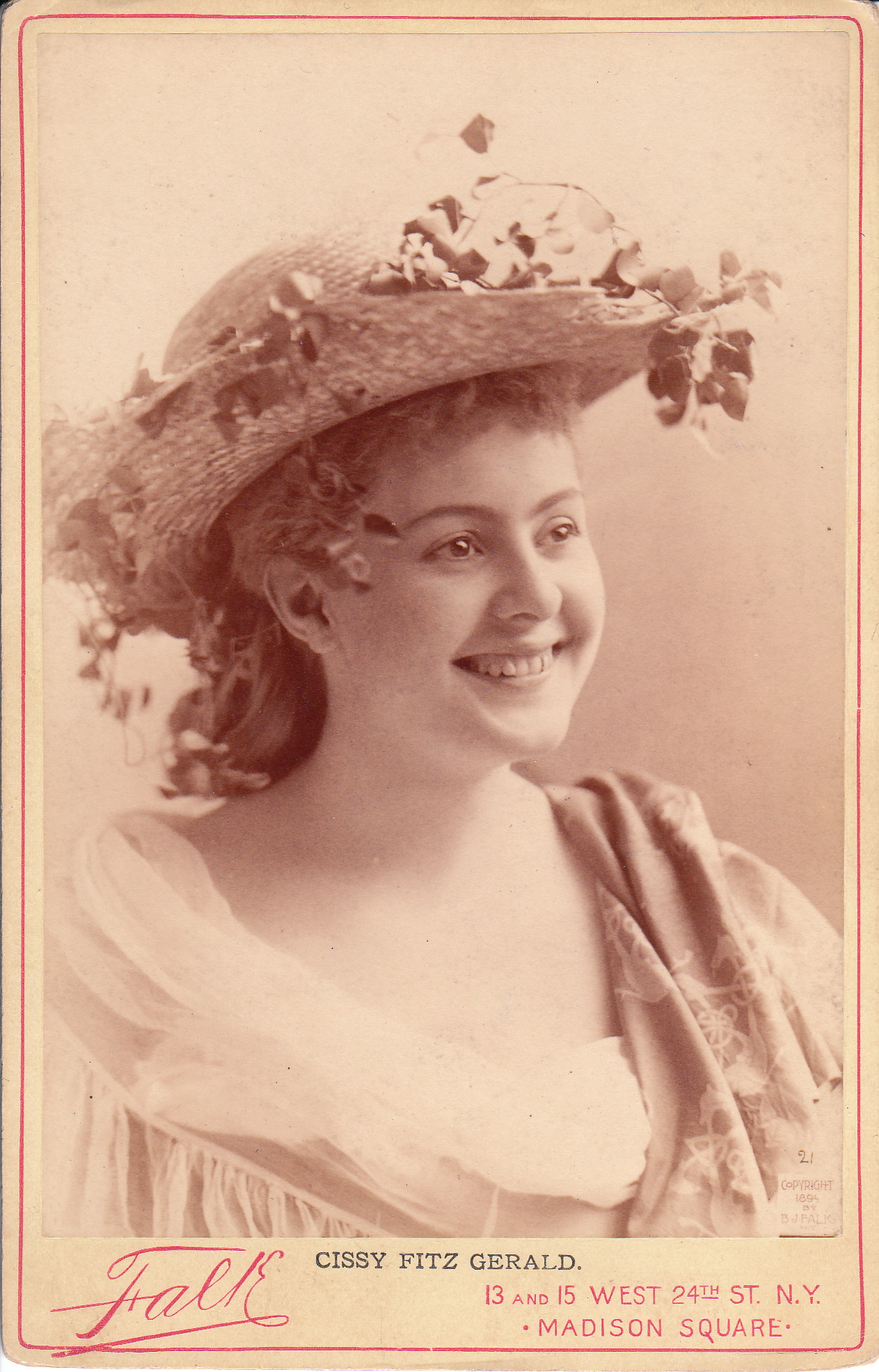
B. J. Falk, the celebrity photographer from New York City, produced this cabinet card portrait of Cissy Fitz Gerald (1873-1941). Fitz Gerald was an English American vaudeville and film actress, dancer, and singer. She appeared in both silent and sound films. Her first movie was made in 1896 by Thomas Edison. In 1914 she signed with the Vitagraph company. The IMDb lists a filmography of seventy films spanning from 1914-1932. Her movies included a film series entitled “Cissy”. Her nickname was “girl with the wink”. She is described by the website of the Victoria and Albert Museum (London, England) as one of the original “Gaiety Girls” of the 1890’s. These actresses tended to appear in the choruses of productions. The web based museum exhibit describes the “Gaiety Girls”  as “fashionable elegant young ladies and not at all like the corseted actresses from the burlesques”. The exhibit also declares that the “Gaiety Girls” were polite, beautifully dressed and well behaved young women, who were much sought after by the ‘stage door Johnnies’ of the 1890’s”. As apparent in the photograph; Ms Fitz Gerald was quite a beautiful woman and had a beautiful smile. She was, simply put, a radiant woman. This photograph was formerly owned by Culver Service, a company that commercially provided celebrity photos  to different modes of media. The photographs reverse has a stamp indicating ownership by the Culver company. To view other photographs by B. J. Falk, click on the category “Photographer: Falk”.

MAE BRANSON: PROVOCATIVELY POSES IN CHICAGO, ILLINOIS

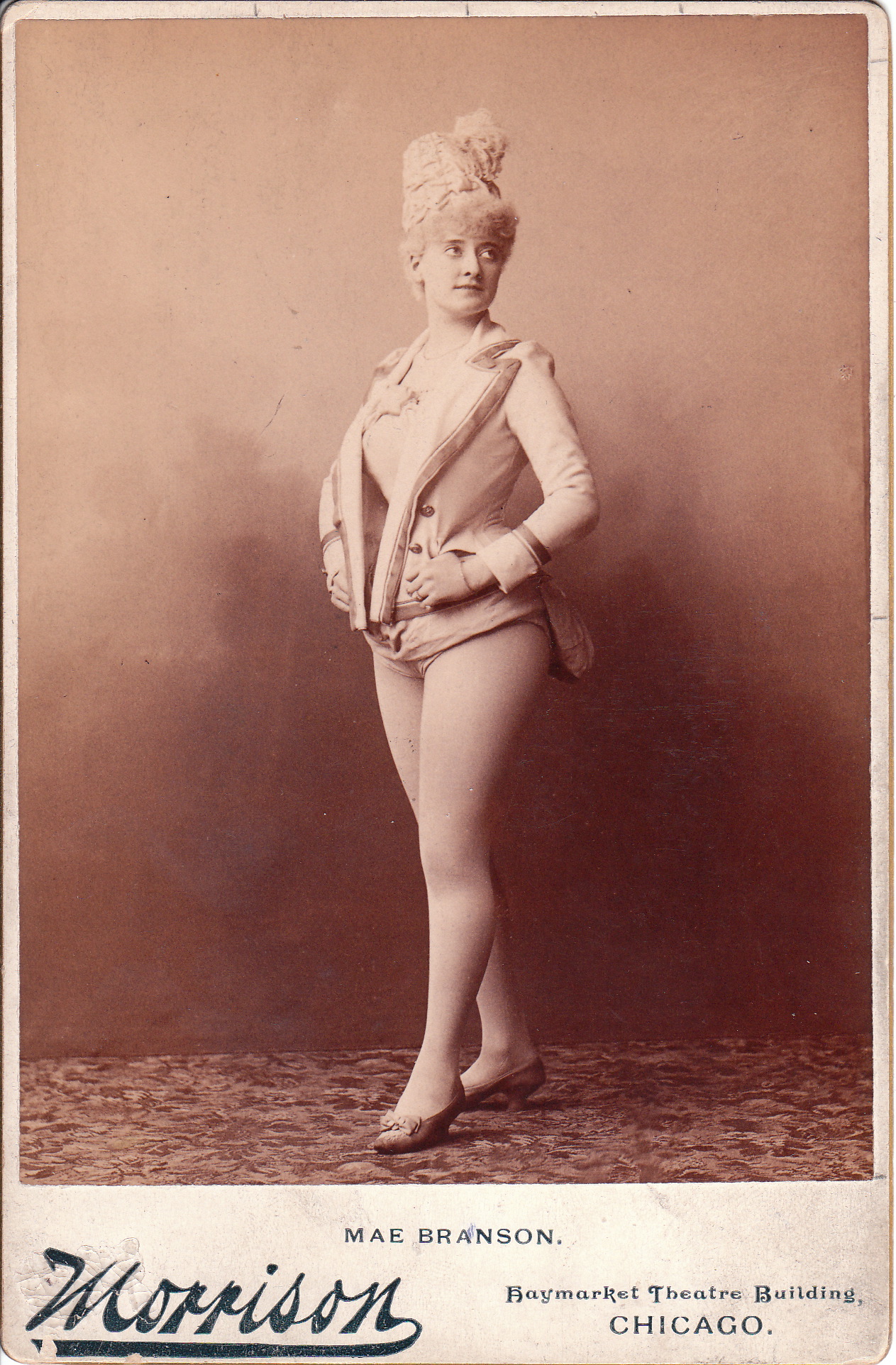
A sexy, busty, and leggy, blonde Mae Branson poses for celebrity photographer, William McKenzie Morrison, in Chicago, Illinois. The photographer’s studio was located in the Haymarket Theatre Building. To learn more about this well known photographer, click on the category “Photographer: Morrison”. A stamp on the reverse of this photograph indicates that the cabinet card  was formerly owned by Culver Pictures. Culver was located in New York City, and for a fee, provided images to newspapers, films, and other forms of media. Research yielded little biographical information about stage beauty, Miss Branson. The National Police Gazette (1892) reports the bathing exploits of four actresses at Long Brauch. The article was written in poetry form and the verses included the following lines: “and in the surf she daily dips in jaunty bathing dress; That fits her like a glovelet – not an inch the more or less”. The actresses described were Minnie Seligman, Geraldine McCann, Della Fox, and Mae Branson. The site of the sexy swimming exhibition was likely Long Branch, New Jersey;  “Long Brauch” was likely a misspelling. It appears that MTV’s reality TV show, “Jersey Shore“, is a remake; because there seems to have been plenty of provocativeness at the Jersey Shore in 1892.  Mae Branson’s name also appears in an article in a Maine newspaper,  The Lewiston Daily Sun (1893). The article appeared in the Music and Drama section. A review of the play “1492” describes Miss Branson as exhibiting “agreeable singing and artistic work” which obtained “prompt and hearty recognition”.  (SOLD)

“LADIES AND GENTLEMEN, BOYS AND GIRLS, CHILDREN OF ALL AGES, LOOK AT THE GIRL ON THE FLYING TRAPEZE” …ROSE AUSTIN, AERIAL PERFORMING STAR

This cabinet card features a pretty, Rose Austin, of the Austin Sisters, who were well known trapeze artists. On the reverse of the photograph is a pencilled notation that states the performer’s name and “Bath Beach, Long Island, New York” (Bath Beach is in Brooklyn). The image was published by the Robinson & Roe studio which had galleries in both Chicago and New York City. The Circus Historical Society’s web site cites the “Austin Family”. Its members included R.G., Aimee (1870-1907), George E., and Rose. Among their venues were Orrin Brothers (1883-1884), W. W. Cole (1885), Coney Island (1892), and Bentley’s (1895). Aimee Austin, born in London, was an aerialist who was known as the “Human Fly” for her talent of “ceiling walking”. She began performing with Rose Austin, at nine years of age, as part of the Austin Sisters aerial act which played at the Circus Rentz, in Berlin, Germany. The act was managed by R. G. Austin. The aerialist performed with various European circuses before coming to the United States. Rose Austin was the subject of three articles in the New York Times. A 1892 article was entitled “Cannot Find Rose Austin”. The article reported that the disappearance of Ms. Austin from her home in Bath Beach. She was described as a well known trapeze performeer and leader of the “clever” Austin Sisters. It was also metioned that she was the wife of R. G. Austin; the manager of the Australian Theatrical Company. At the time of her disappearance, she and her sister were performing at Vaceas’s West End Casino in Coney Island, New York. She had been last seen boarding a ferry bound for New York City. The article points out that Ms. Austin had suffered from epilepsy for the previous four or five years and had experienced a severe attack about ten days earlier.(An acrobat with epilepsy? Doesn’t seem like a terrific career choice.). The article closes with a statement that both Rose Austin’s husband and her doctor, believed that she was either in a hospital, or had fallen off the ferry and drowned. A follow up article (1892) revealed that Ms. Austin had been found and was currently confined to bed as “she is wandering in her mind”. She couldn’t account for her whereabouts or activities during the time she was missing and last remembered falling ill on the ferry. A third article in the New York Times (1894) reports that Rose fell from a trapeze while performing with her brother George in Coney Island. She fell after fainting (one would imagine she had a epileptic seizure). She and her brother fell into a net together and knocked heads, rendering them both unconscious. George recovered quickly but Rose was brought home to Bensonhurst (Brooklyn) in a delirious condition. To view other photographs by Robinson and Roe, and to learn a little about them, click on the category “Photographer: Robinson & Roe”.  SOLD