Photographer P. Veling & Bro produced this portrait of a boy and his tricycle. Note the clarity of the trike in this image. The child is dressed adorably and is wearing a wonderful hat. This studio photograph was taken in Beaver Dam, Wisconsin. The photographer, Peter Veling was born in Germany in 1855. He immigrated to the United States as a baby. He married his wife, Theresa, in 1881. He is listed as a photographer in the 1880, 1900, and 1910 US censuses. However, the 1920 census indicates that Veling had became the postmaster of Beaver Dam.
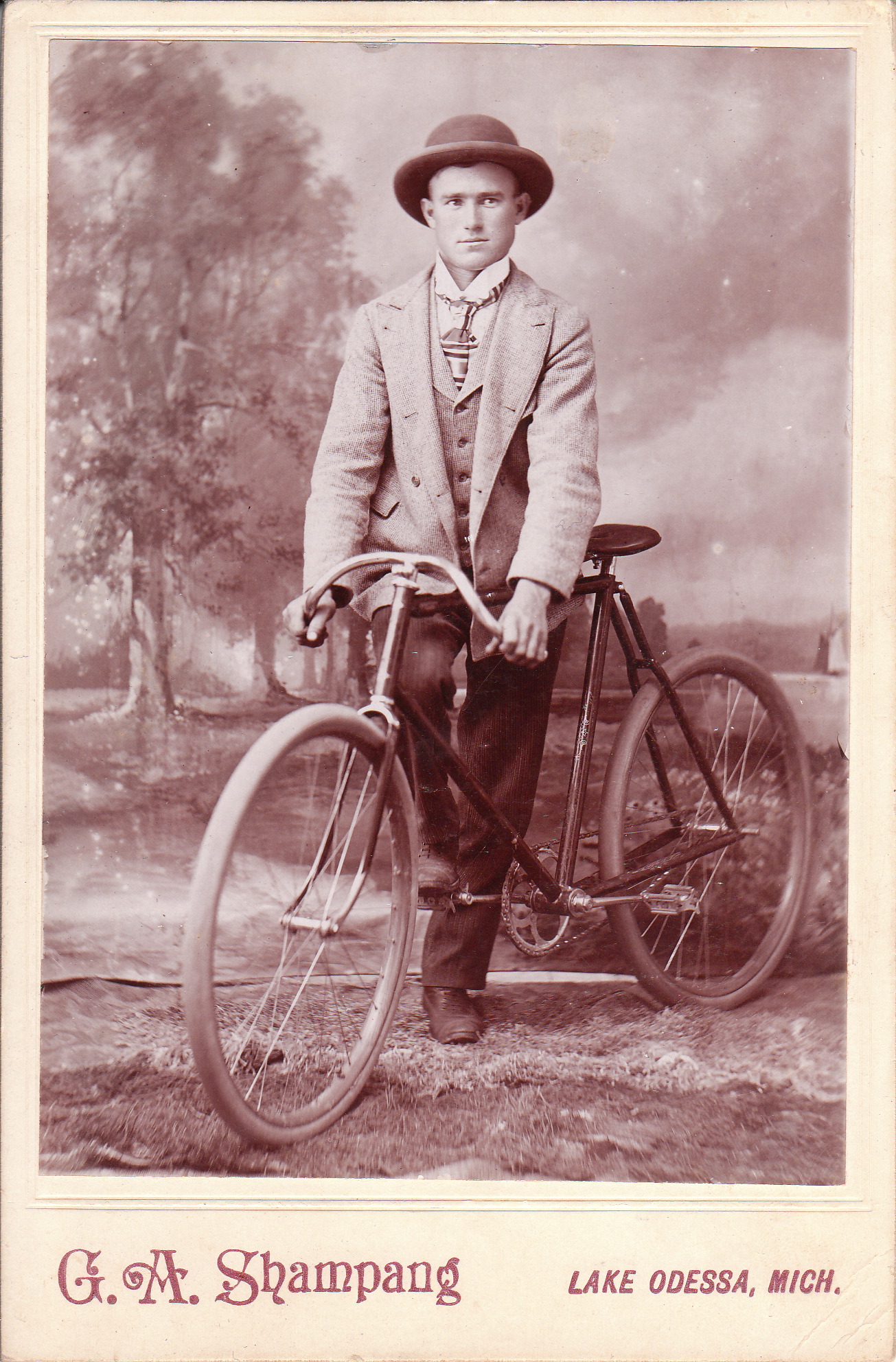
NICELY DRESSED BIKE RIDER IN LAKE ODESSA, MICHIGAN
A young man poses holding a bicycle at the studio of G. A. Shampang in Lake Odessa, Michigan. The good looking man is dressed in what is probably his finest clothing. Take note of where the backdrop screen reaches the floor. The photographer was a bit careless and did not take notice or action to insure the backdrop touched the floor properly to promote a more credible background. Oops! G. A. Shampang located in Lake Odessa in the late 1890’s. According to an ad in the Lake Odessa Wave, the studio was located above the Lake Odessa Savings Bank on the corner of Fourth Avenue and Second Street. In late 1898 Shampang took on Mr. Mead as a partner, forming Shampang & Mead. Something apparently went wrong with the partnership because Shampang bought back Mead’s shares in the business after just three months of joint ownership. Shampang operated the gallery until about 1910. In 1911 he moved to California and later on, moved to Saginaw, Oregon where he owned an oil station. In 1931 he succumbed to a stroke. His wife, Ada Ema Rozell, survived him. To learn more about Shampang, visit the web site for the Ionia County Genealogical Society. SOLD
LITTLE GIRL RIDING A GIANT TRICYCLE IN MONTEVIDEO, MINNESOTA
A little girl sits high atop a giant tricycle in this cabinet card photograph by Andreas Brandmo. Brandmo’s studio was located in Montevideo, Minnesota. The little girl won’t be able to ride very far on her monster bike. Unfortunately her feet do not seem to reach the bike’s pedals. She also doesn’t look particularly comfortable on her perch, as she poses for the photographer. The 1900 United States census reveals that Brandmo was born in Norway in 1855. He came to the United States in 1882 and married his wife Martha in 1885. Apparently, Brandmo and his wife were producing children at a rapid pace. After 15 years of marriage, the couple had eight children spanning between three and twelve years of age. The census also indicated that Brandmo’s niece, Lucy Husaby, worked as a photographer in his studio. The family lived in Appleton, Minnesota. Research found that Brandmo operated his Montevideo studio between 1886 and 1896. It was also reported that he ran a gallery in Appleton in 1898. At some point he had a partner and their studio was named Brandmo & Lodgaard. The 1910 census reveals that Andreas Brandmo changed his name to Andrew Brandmo. Perhaps when he realized he had eight children and a wife depending on him, he changed his name and entered the Federal Witness Protection Program. More likely though, he probably Americanized his name for business purposes. The 1910 census also notes that his son Alf, had joined him in the business and was working as a photographer.
A BOY AND HIS WOODEN TRICYCLE IN CLINTON, MASSACHUSETTS
This cabinet card features a well dressed young boy posing next to a wooden tricycle in the Jenness Studio, in Clinton, Massachusetts. The lad is wearing a suit, bow tie, and hat. Note the decorated wooden handlebars on the tricycle and the fancy seat. The first tricycle was invented in 1680 by a disabled German man who wanted to maintain his mobility. There were many versions invented over time until Starley developed the first rotary chain drive tricycle in 1877. After the introduction of this model, tricycle riding became very popular. Tricycles and bicycles can be found in many cabinet card photographs. To view examples of such images, click on the category of “Bicycle”.
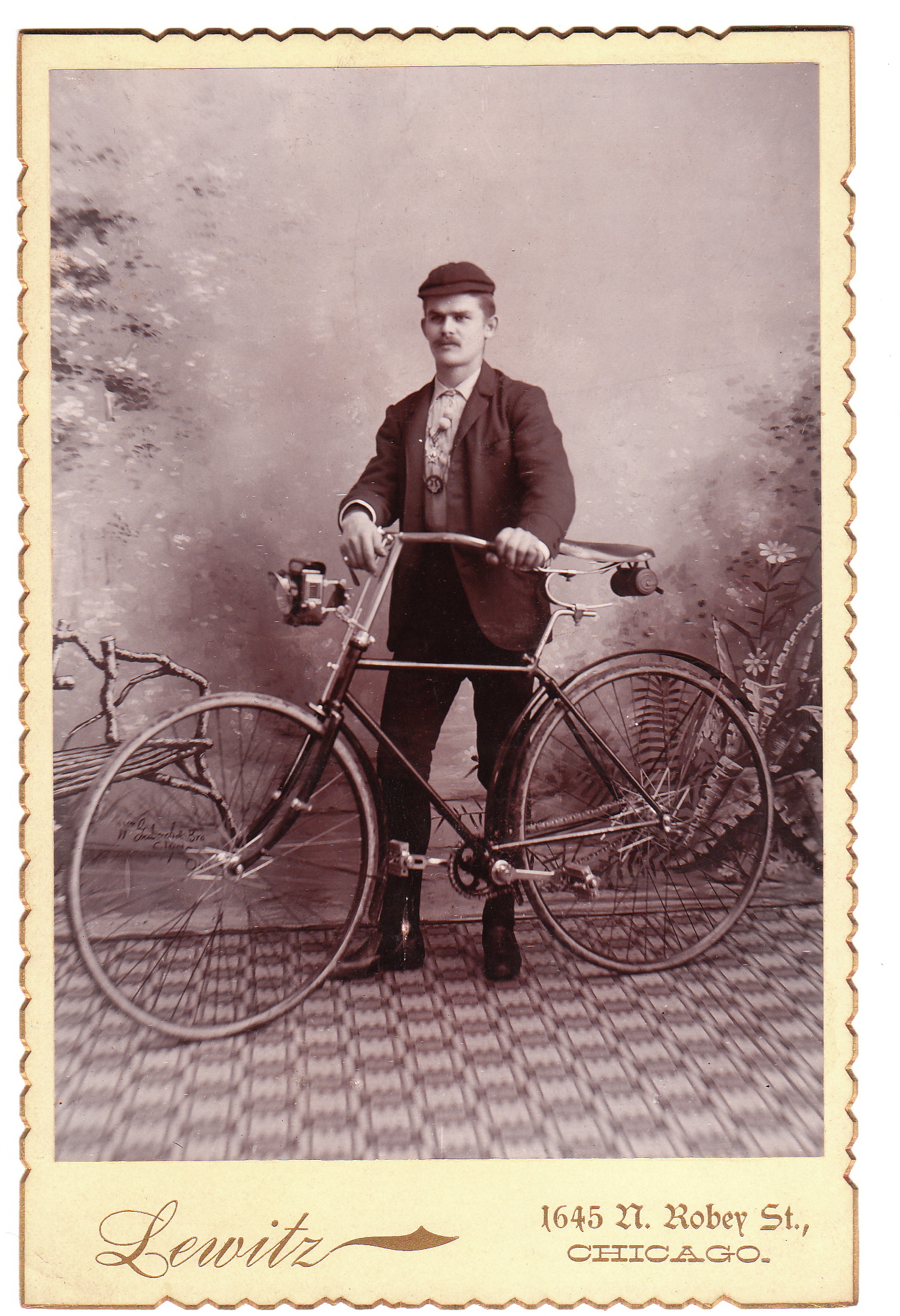
A MAN AND HIS BIKE IN CHICAGO, ILLINOIS
This cabinet card features a young man posing with his bicycle. His “ride” is very “tricked out”. Check out the accessories. The bike has a large headlight and something that looks like a “fanny pack” hanging from the seat. Hopefully, a visitor to the cabinet card gallery can explain the purpose of the “fanny pack”. Visitor feedback would also be appreciated concerning the gentleman’s necktie. One hesitates to call it a necktie because it seems to be a collection of items including cotton balls, and possibly, a small round framed photograph. The tie is sort of like a “charm tie”. The gentleman’s cap looks great and will help keep his hair in place while riding. The photographer is Lewitz whose studio was located in Chicago, Illinois. Research found two photographers in Chicago sharing the name of Lewitz. Charles Lewitz operated a studio at 1643 North Robey Street. This address was next door to where this cabinet card was photographed; indicating that Charles was the likely photographer of this image. However, life is rarely that simple. Complicating matters is the fact that Emil Lewitz was a photographer who had a gallery at 1843 North Robey Street. Most likely, Charles and Emil were related and ran all three studios, each one at different points of time. It appears that the photographer of this cabinet card was an enterprising man. An advertisement on the reverse of the card notes “Photographs Taken of Houses and Groups”. To view other photographs by the Lewitzs’, click on the category “Photographer: Lewitz”.
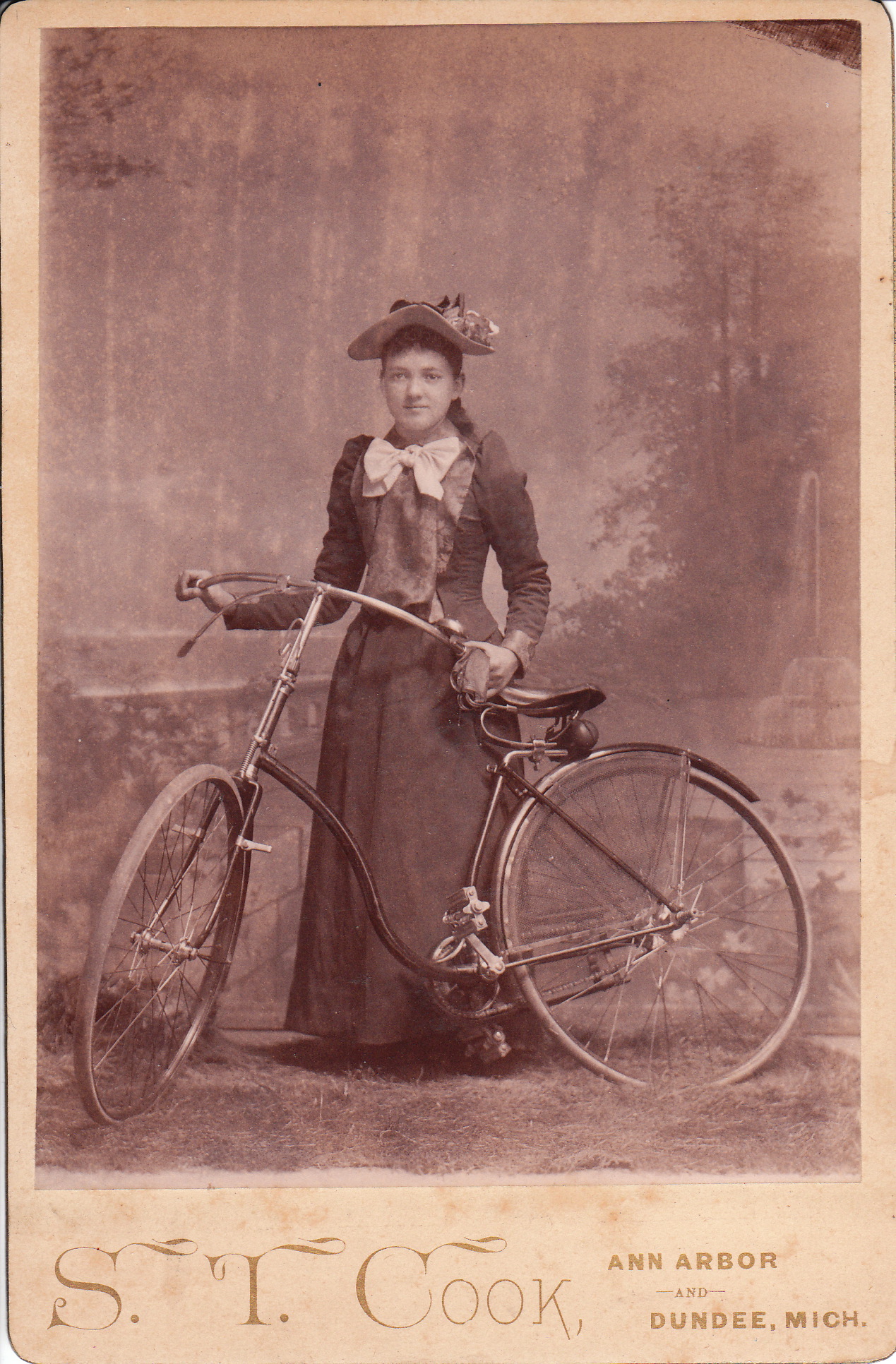
JULIA BLAESS KLAGER: MICHIGAN BICYCLIST (PHOTOGRAPHED BY FEMALE PHOTOGRAPHER)
An inscription on the reverse of this cabinet card, indicates that the young woman posed with the bicycle, is Julia Blaess Klager. Note the bell on the handlebars of the bike. Julia is beautifully dressed for her portrait at the studio of Susan T. Cook. Cook had galleries in both Ann Arbor and Dundee, Michigan. She is listed in an 1890 Ann Arbor directory. An attempt to find biographical information about Julia Klager, produced uncertain results. The 1920 US census lists a Julia Klager, residing in Washtenaw, Michigan. Her date of birth was listed as 1877, which could be a match for the woman in this cabinet card. A Julia Klager was also found to be associated with the University of Michigan. A woman with that name received a music degree (piano teacher) in 1907 and is also listed as a music patroness in the 1908 University of Michigan Yearbook. This musically inclined woman, may, or may not be, the woman in this photograph.
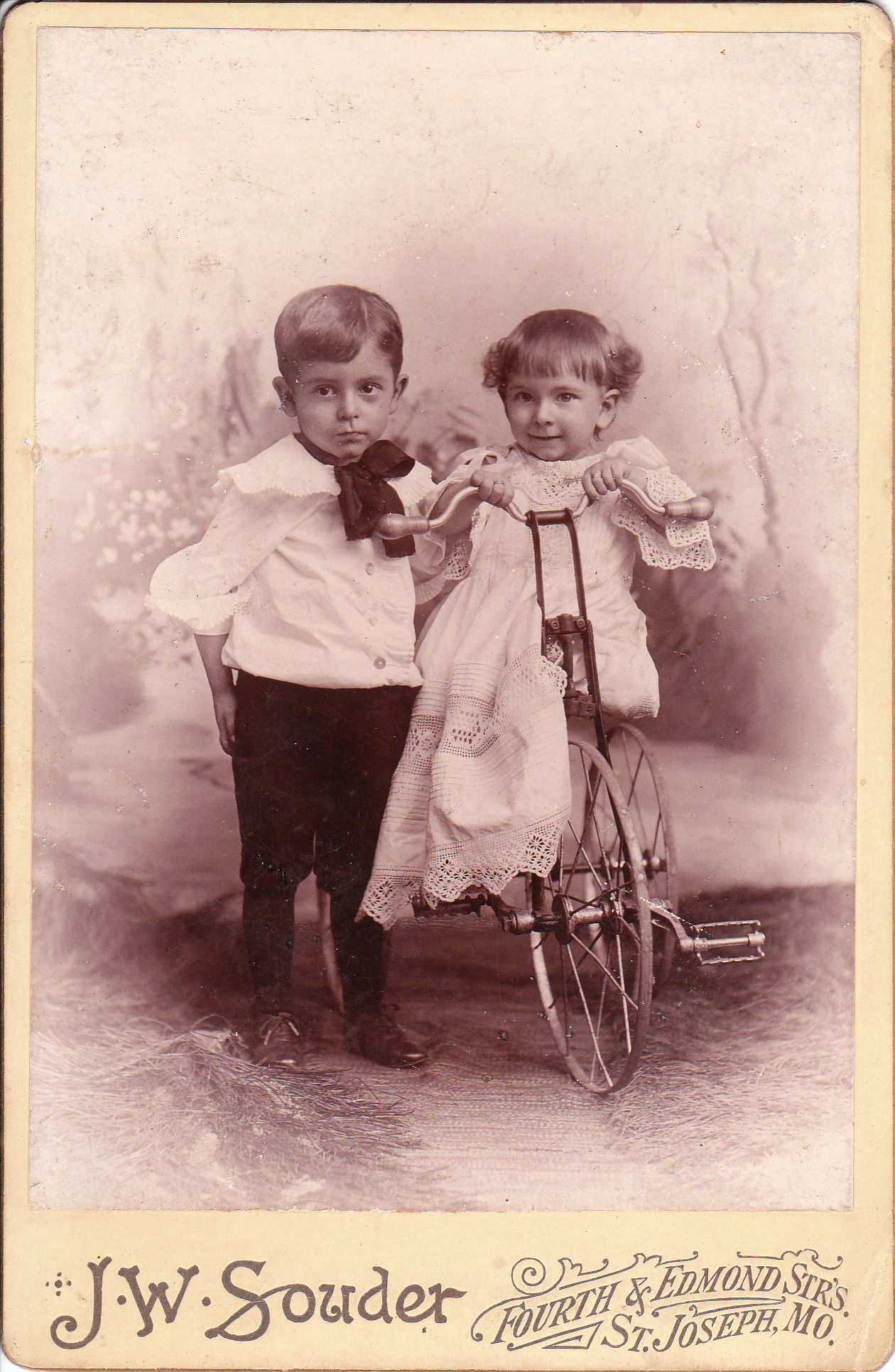
TWO YOUNG CHILDREN AND A TRICYCLE IN ST. JOSEPH, MISSOURI
This cabinet card captures two young children posing for photographer, J. W. Souder, of St. Joseph, Missouri. The children are adorable and they are most probably, siblings. The boy is wearing a bow tie and the girl is riding a tricycle. John W. Souder’s photography business was listed in St. Joseph directories between 1887 and 1896. It is unknown whether he was there during other years.
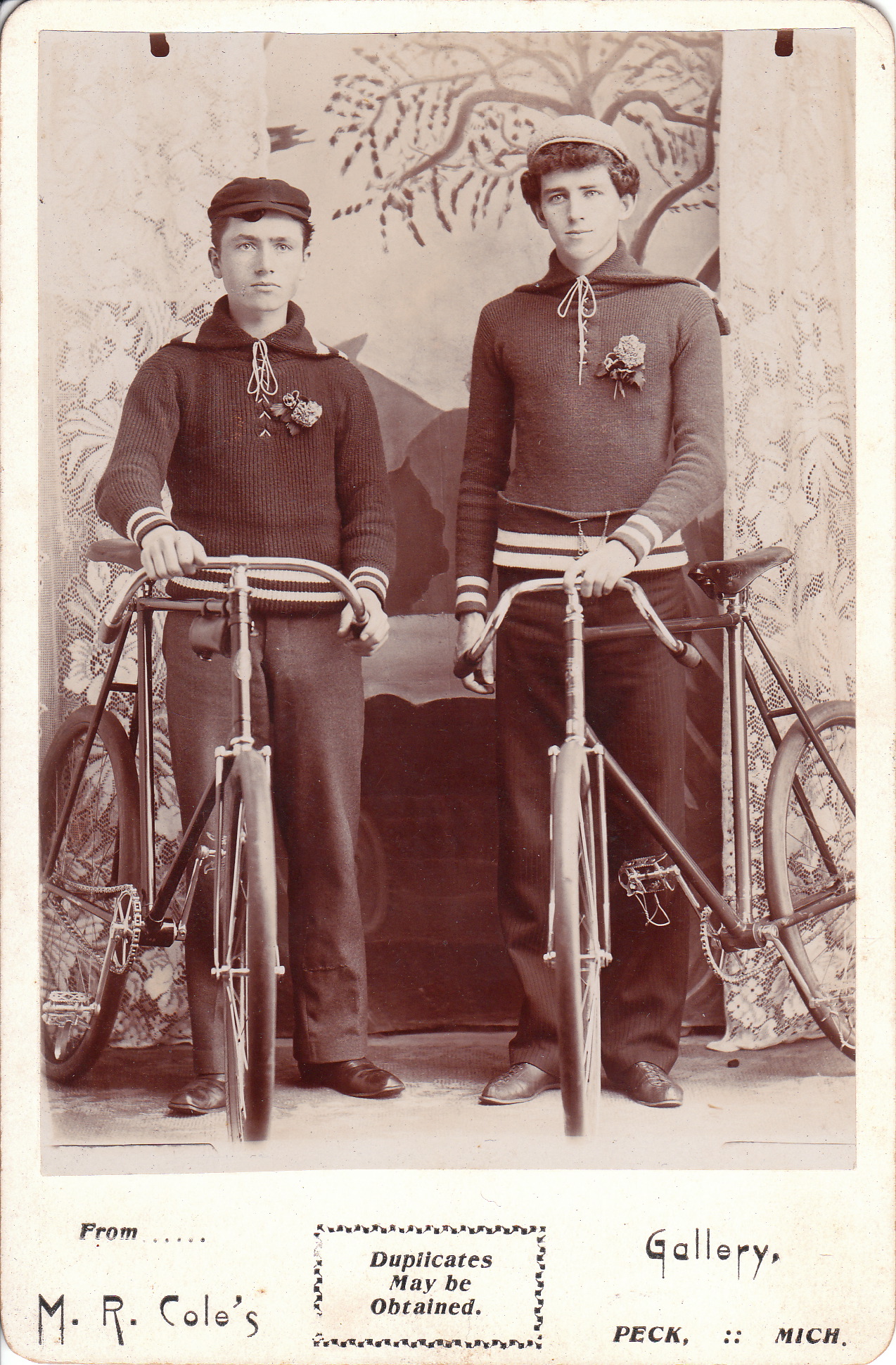
TWO YOUNG MEN POSE WITH THEIR BIKES AND UNUSUAL RIDING CLOTHES IN PECK, MICHIGAN
This cabinet card photograph captures two young men posing with their bicycles. They are wearing similar and unusual outfits. it looks like they are wearing the predecessor to “hoodies”. However, rather than hoods, it appears that they are wearing capes. Both guys are also wearing flowers pinned to their chest. Are these fellows about to ride in a parade? Are they wearing typical bike riding outfits? Hopefully, a visitor to the cabinet card gallery will leave an informative comment concerning the subjects outfits. The photographer of this image is M. R. Cole of Peck, Michigan. Cole is listed in a 1904 Michigan directory as a photographer and a jeweler.
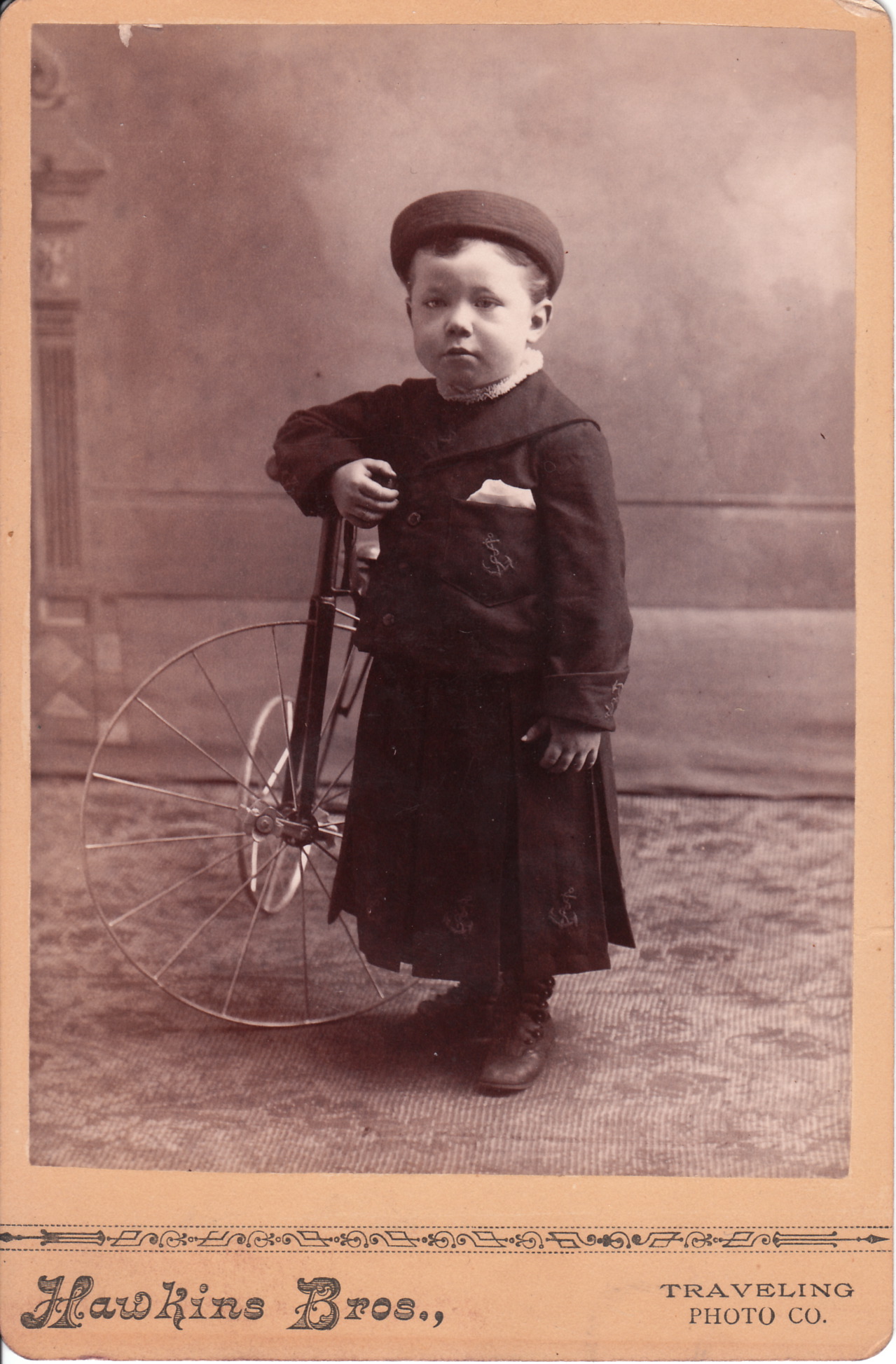
MARCUS AINEY AND HIS TRICYLCE CAPTURED BY A TRAVELING PHOTOGRAPHER
A young lad, Marcus Ainey poses for his Cabinet Card photograph for the Hawkins Brothers who were traveling photographers. Marcus is looking quite serious as he rests his arm on the handlebars of his prized tricycle. He is dressed up for the occasion wearing an interesting cap and outfit. He has his handkerchief neatly tucked into his pocket ready for any nasal emergencies.
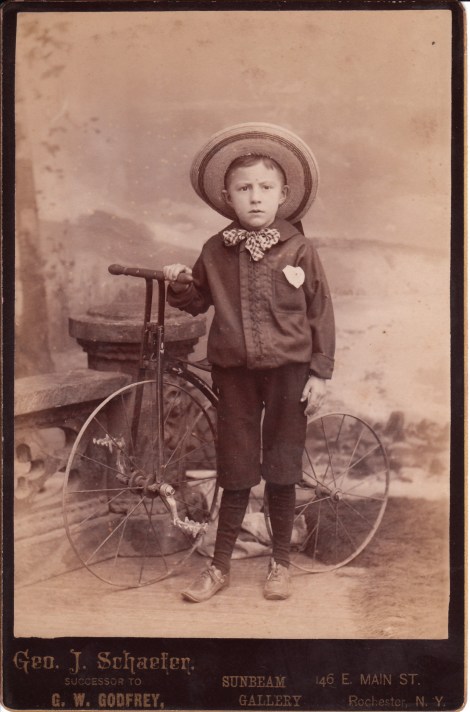
A BOY AND HIS BICYCLE IN ROCHESTER, NEW YORK
A serious looking boy poses for his cabinet card photograph with his bicycle. He is wearing a straw hat, colorful bow tie and appears to have a handkerchief in his shirt pocket. The youth is holding up his bicycle as photographer George J Schaefer of the Sunbeam Gallery takes his portrait.