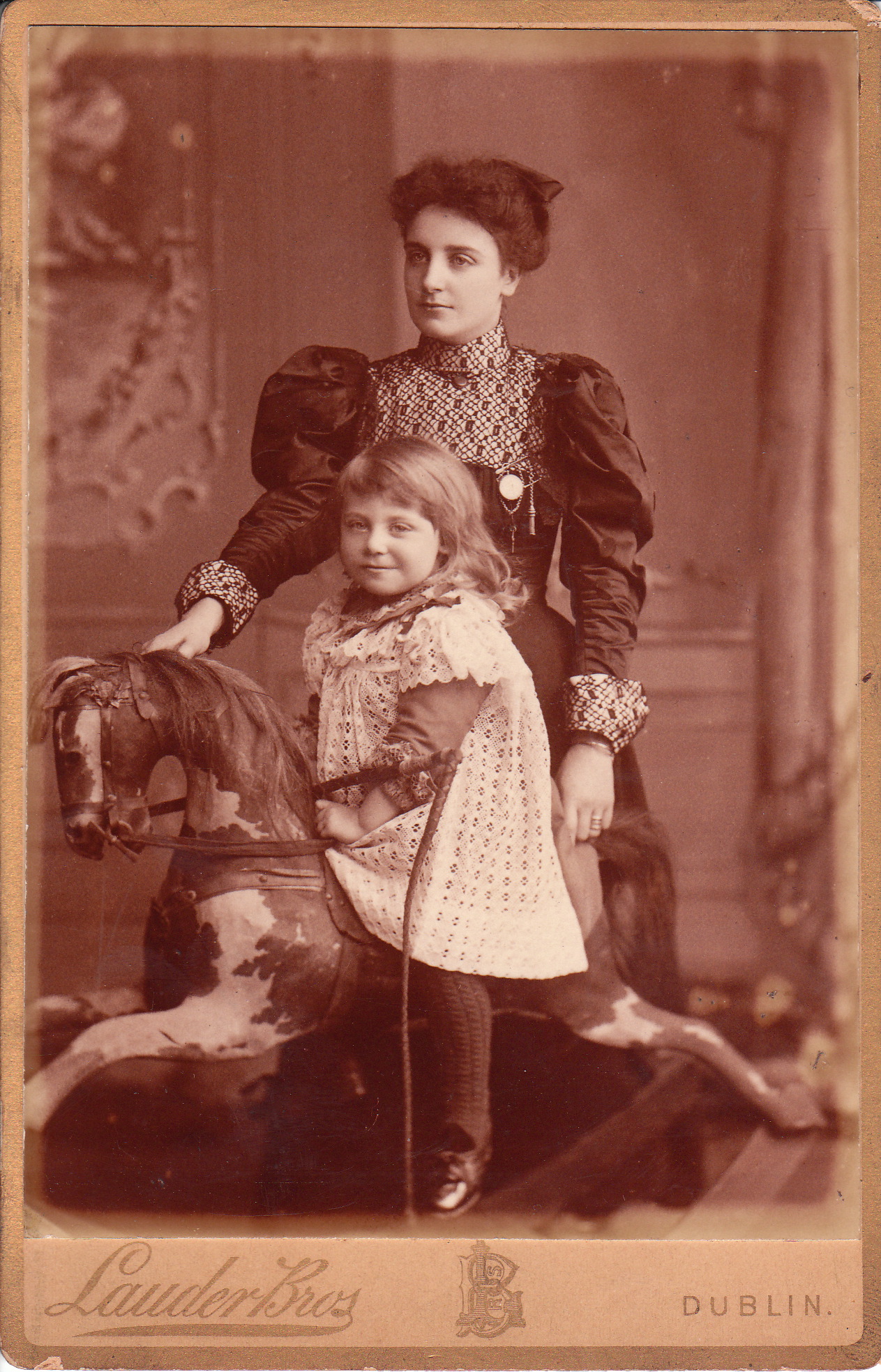
A cute little girl with a wonderful smile sits atop a rocking horse at Lauder Brothers studio in Dublin, Ireland. She is holding the reins of the very detailed rocking horse and her young mother poses behind the girl, in position to keep her daughter securely on the horse. The Lauder gallery had two locations, 32 Westmoreland Street and 45 Lower Sackville Street. Lauder Brothers studio began operation as a daguerreotype studio on Capel Street in Dublin in 1853. The owner of the studio was Edmund Stanley Lauder, who died in 1895. Lauder Brothers was in business on Lower Sackville Street between the 1850’s and 1904. It was operated by a number of members of the Lauder family. Business directories list the studio as Lauder Brothers between about 1880 and 1884.. Edmund Lauder’s son, James Stack Lauder (1853-1923), founded the Lafayette Studio in 1880. He became the first Irish photographer to be granted the Royal Warrant. He earned this honor after photographing Queen Victoria in her Golden Jubilee year (1887). James Stack Lauder had three brothers who also became photographers. The brothers names were George Marsh Lauder (1858-1922), Edmund Stanley Lauder Jr. (1859-1895), and William Harding Lauder (1866-1918). (SOLD)
FIVE BEAUTIFUL YOUNG SIBLINGS IN DUREN, GERMANY
The parents of these five siblings must have been pleased when the photographer, Robert Ophoven, gave them this portrait. The children are beautiful, well dressed, and well posed. All three girls are wearing jewelry and their hair was carefully styled for this portrait. It is also interesting to note the intimacy between the three girls. the middle girl has an arm around the shoulders of one sister while her other arm is being grasped by her other sister. This image was photographed in Duren, Germany.
LITTLE GIRL RIDING A GIANT TRICYCLE IN MONTEVIDEO, MINNESOTA
A little girl sits high atop a giant tricycle in this cabinet card photograph by Andreas Brandmo. Brandmo’s studio was located in Montevideo, Minnesota. The little girl won’t be able to ride very far on her monster bike. Unfortunately her feet do not seem to reach the bike’s pedals. She also doesn’t look particularly comfortable on her perch, as she poses for the photographer. The 1900 United States census reveals that Brandmo was born in Norway in 1855. He came to the United States in 1882 and married his wife Martha in 1885. Apparently, Brandmo and his wife were producing children at a rapid pace. After 15 years of marriage, the couple had eight children spanning between three and twelve years of age. The census also indicated that Brandmo’s niece, Lucy Husaby, worked as a photographer in his studio. The family lived in Appleton, Minnesota. Research found that Brandmo operated his Montevideo studio between 1886 and 1896. It was also reported that he ran a gallery in Appleton in 1898. At some point he had a partner and their studio was named Brandmo & Lodgaard. The 1910 census reveals that Andreas Brandmo changed his name to Andrew Brandmo. Perhaps when he realized he had eight children and a wife depending on him, he changed his name and entered the Federal Witness Protection Program. More likely though, he probably Americanized his name for business purposes. The 1910 census also notes that his son Alf, had joined him in the business and was working as a photographer.
WIDE-EYED BABY IN GREEN BAY, WISCONSIN
A wide eyed baby is photographed by F. W. Schneider, in Green Bay, Wisconsin. the baby is lying on fur and wearing a long gown. The book, “A History of Brown County, Wisconsin, Past and Present Vol. 2” (1913) reveals that Schneider was born and raised in Niederschelden, Germany. He emigrated to the United States in 1868 and settled in Green Bay in 1874. Schneider operated a photographic gallery until 1911, when his son, C. Alvin Schneider, succeeded him. “The Bulletin of Photography” (1922), noted F. W. Schneider’s death from heart disease. Schneider was 68 years old at the time of his death, and it was reported that he had operated his studio for 38 years. An interesting side note about Green Bay is that it was established in 1634 by the French as a small trading post. The town’s original name was “La Baie des Puants” (“The Stinking Bay”).
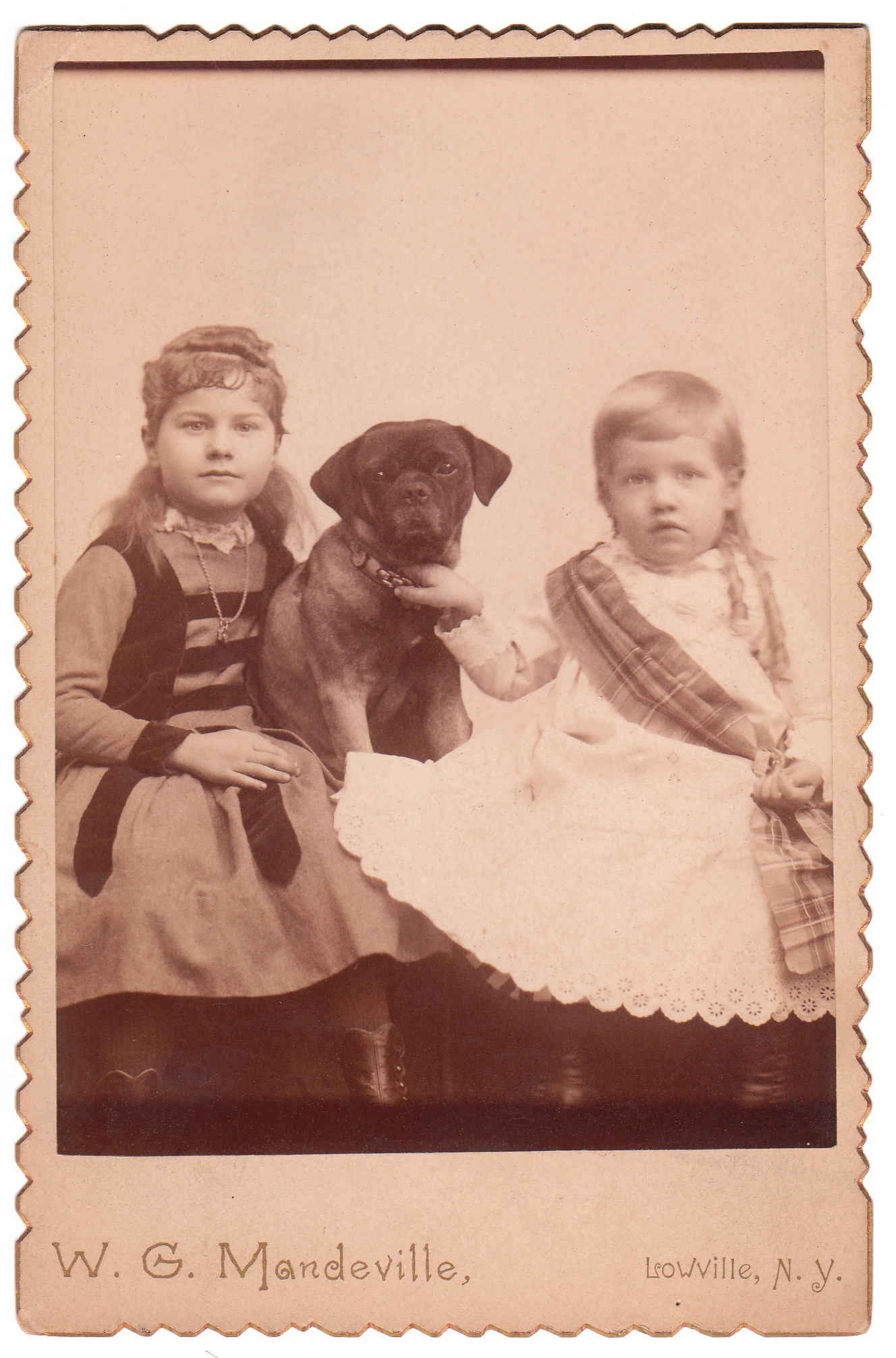
NILES AND GRACE AND THEIR PET PUG IN LOWVILLE, NEW YORK (1889)
This cabinet card portrait of two children and their pet pug, illustrates the power of the internet in identifying subjects in antique photographs. The reverse of this photograph has some identity clues in an inscription that states “Niles 3 years Grace 6 years Jan 3rd 1889”. Since the photographer of this image (W. G. Mandeville) worked out of Lowville, New York, it was assumed that the children in the photograph lived in, or around, Lowville (located in the western foothills of the Adirondack Mountains). A search of the 1900 U.S. census (Lowville) was done for siblings named Niles and Grace. A listing for Niles and Grace Bateman was found and their ages were a match for the age information on the reverse of the cabinet card. Once establishing their identity, additional biographical data was obtained. At the time of the 1900 census, Grace was seventeen years old and Niles was thirteen. Their father was Carroll Bateman and he was a proprietor of a hotel. Their mother was named Jennie Ruggles Bateman. The 1910 U. S. census found Niles working as a clerk in his father’s hotel. The 1920 U.S. census reveals that Niles had become an “Automobile Agent” and was married to a woman named Vera. The 1930 census discloses some major changes in the life of Niles Bateman. He had two children (Walter and Barbara) and had become an “Automobile Dealer”. The photographer of this image, William Garrett Mandeville (1865-1944), is one of the subjects of Robert Ogden’s book, “Exposing the Wilderness: Early Twentieth Century Adirondack Postcards” (1999). Ogden considers Mandeville one of the best photographers of the genre of scenic postcards. Mandeville was born in New York, dropped out of school at sixteen years of age, and in 1883 went to work for photographer, Ogden Hotchkiss. Hotchkiss had a studio in Norwich, New York. To view photographs by Hotchkiss, click on Cabinet Card Gallery’s category of “Photographer: Hotchkiss”. In 1886 Mandeville joined George W. Carter in operating a photography studio but he left the partnership that same year to run his own gallery. He married his wife, Bertha in 1886 and had a daughter (Dorothy). In the 1930 U. S. census, Mandeville, at 65 years of age, was still listed as a photographer.
ANGELIC GIRL IN WINONA, MISSISSIPPI
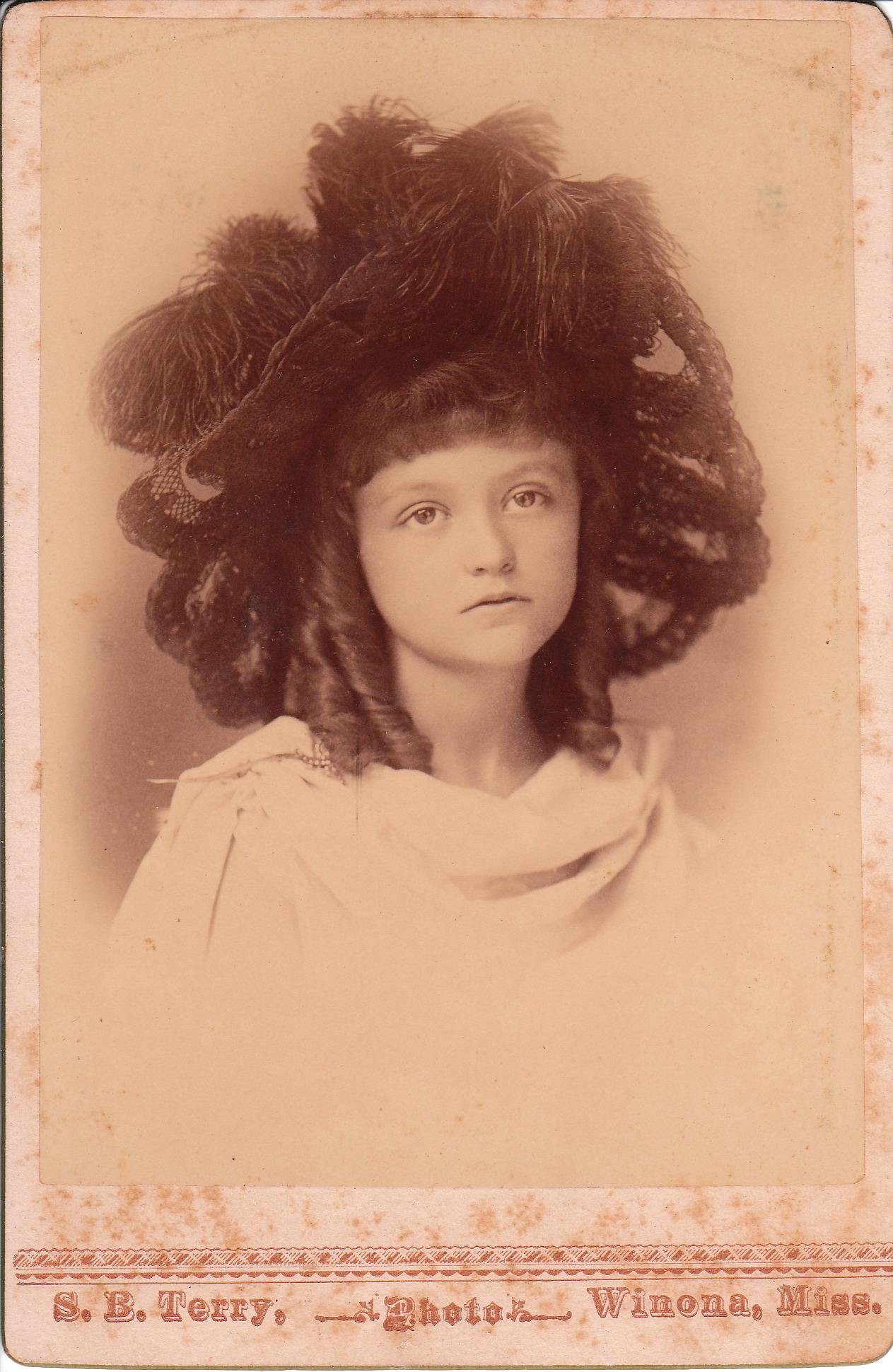
This cabinet card portrait is by S. B. Terry of Winona, Mississippi. His subject is a young girl with an angelic expression. She is wearing a fancy elaborate hat with ostrich plumes. Her hair is styled with sausage curls. She appears to be draped in white cloth. This portrait is very styled and atypical of many of the portraits of this era. The photographer, Sterling B. Terry was born in Mississippi circa 1862. He married his wife Anna in 1882. The 1900 census found him living in Winona with his wife (age 38), son William (age 15), and daughers Anne (age 11), Mary (age 10), and Clara (age 7). The 1900 and the 1910 census lists S. B. Terry’s occupation as “Photographer”. To view other photographs by this photographer, click on the category “Photographer: Terry”. (SOLD)
LITTLE GIRL AND HER RATTLE IN ROCHESTER, NEW YORK
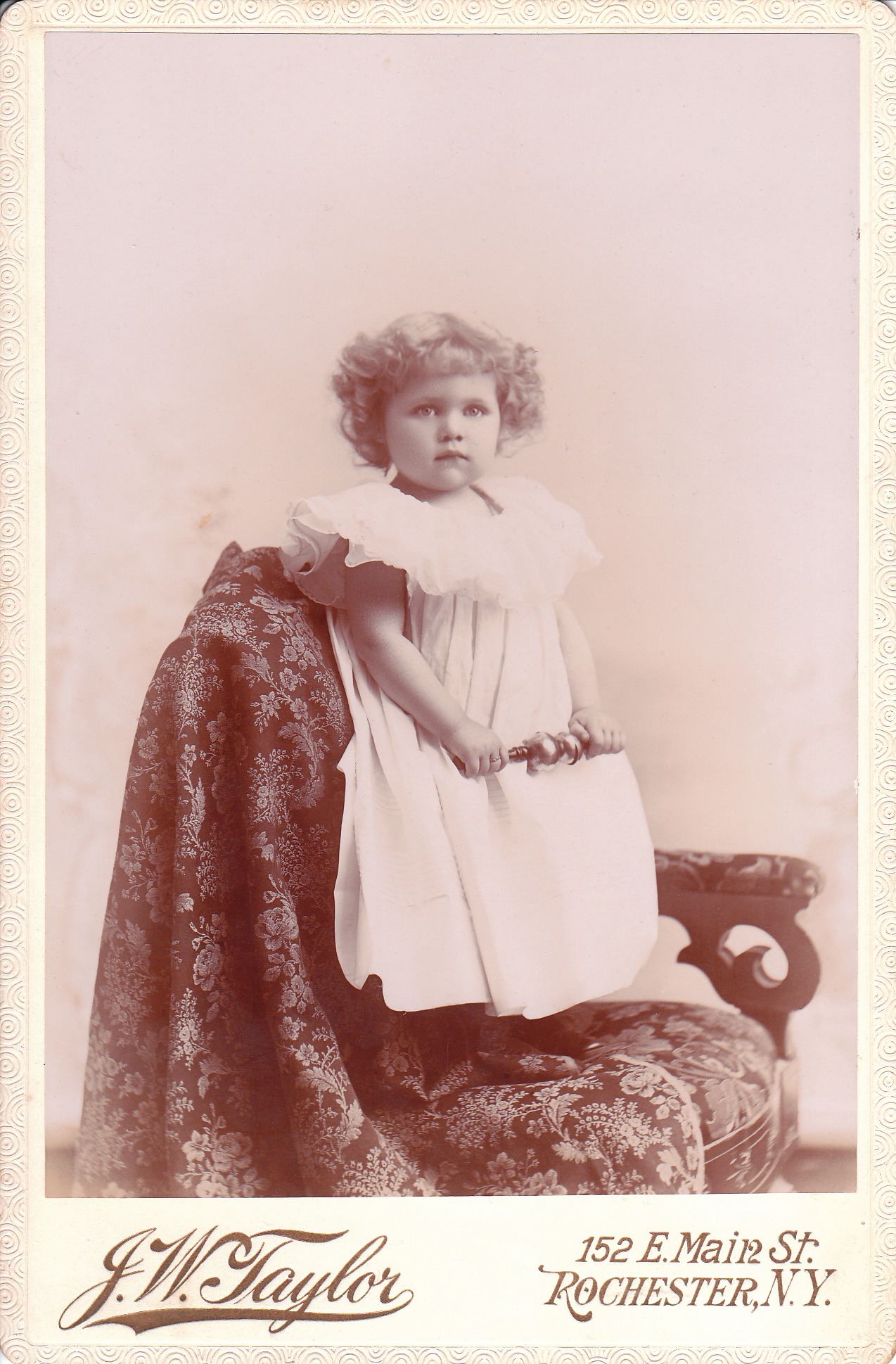
A cherubic, curly haired little girl stands on a blanket covered chair in the photographic studio of J. W. Taylor, in Rochester, New York. The girl is wearing a long gown and a very serious expression. She firmly holds a rattle with both hands. To view other photographs by Taylor, click on the category “Photographer: Taylor JW
A BOY AND HIS WOODEN TRICYCLE IN CLINTON, MASSACHUSETTS
This cabinet card features a well dressed young boy posing next to a wooden tricycle in the Jenness Studio, in Clinton, Massachusetts. The lad is wearing a suit, bow tie, and hat. Note the decorated wooden handlebars on the tricycle and the fancy seat. The first tricycle was invented in 1680 by a disabled German man who wanted to maintain his mobility. There were many versions invented over time until Starley developed the first rotary chain drive tricycle in 1877. After the introduction of this model, tricycle riding became very popular. Tricycles and bicycles can be found in many cabinet card photographs. To view examples of such images, click on the category of “Bicycle”.
AN ADORABLE BABY AND A PERAMBULATOR IN SOFIA, BULGARIA
An adorable baby peers out of a comfortable looking perambulator at the studio of photographer, Dimitr Karastoyanow, in Sofia, Bulgaria. Note the baby’s wonderful hat. A written inscription on the reverse of the photograph reveals that the image was produced in 1912. To view other turn of the century perambulators, click on Cabinet Card Gallery’s category “Baby Carriage”.
PORTRAIT OF AN ADORABLE BABY FUTURE SCHOOL TEACHER
This cabinet card photograph features a very cute baby wearing a gown and sweater. She has beautiful big eyes According to an inscription on the reverse of the image, the baby is named Atalie Jean Crum and she was five months and two days old, at the time the photograph was taken. Atalie Crum can be found on both the 1900 and 1910 U.S. census. She was born in 1890 and resided in Penn, Illinois. She lived with her parents, Brooke W. Crum, and Laura V. Crum. Both of her parents were born in Pennsylvania and her father was a farmer. The 1910 census reveals that at age twenty, Atalie was employed as a school teacher. A 1913 publication from the Illinois Office of Public Instruction, states that Atalie taught school in Stark County, Illinois (District 53). At an unknown age, she married Claude Sterling, a local farmer. An obituary in the Peoria Star (1936), reports the death of John Wesley Crandell. He died at the age of 78 in Castleton, Illinois. He was his community’s last surviving civil war veteran. A male quartet sang at the funeral and they were accompanied by a Mrs Atalie Sterling at the piano. This is likely the Atalie Sterling in the photograph. Atalie lived a long life, dying in 1969 at age eighty in Wyoming, Illinois. The photographer of this cabinet card is difficult to identify with any certainty. There was a photographer named W. H. Farley who operated in Crete and Gibson Illinois in the 1880’s. A photographer named A. Farley also had a studio in Illinois. Research uncovered another cabinet card with the same Farley logo as this cabinet card. The card was from a studio located in Tampico, Illinois. Tampico is the likely place that Atalie Crum was photographed.