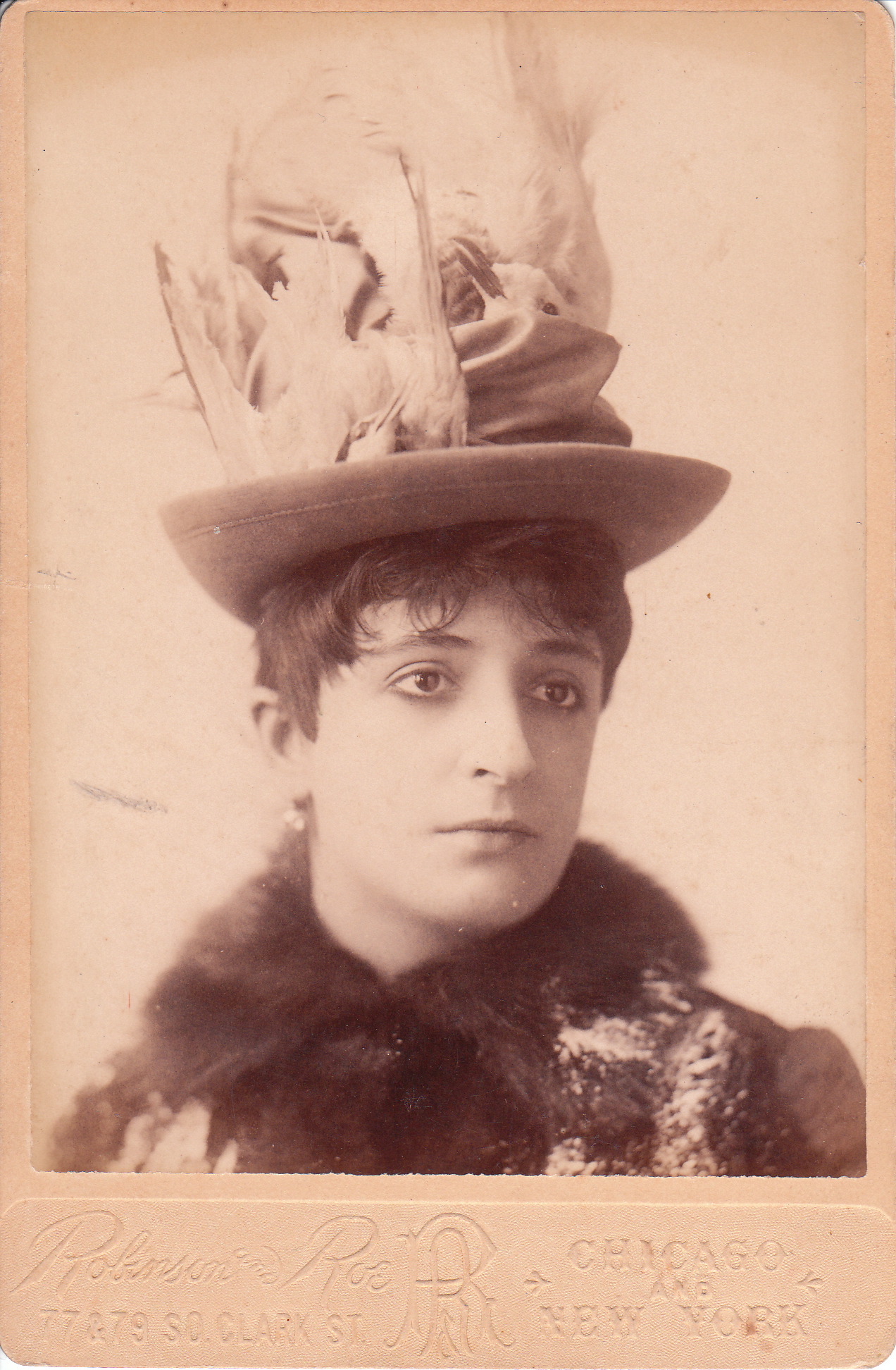
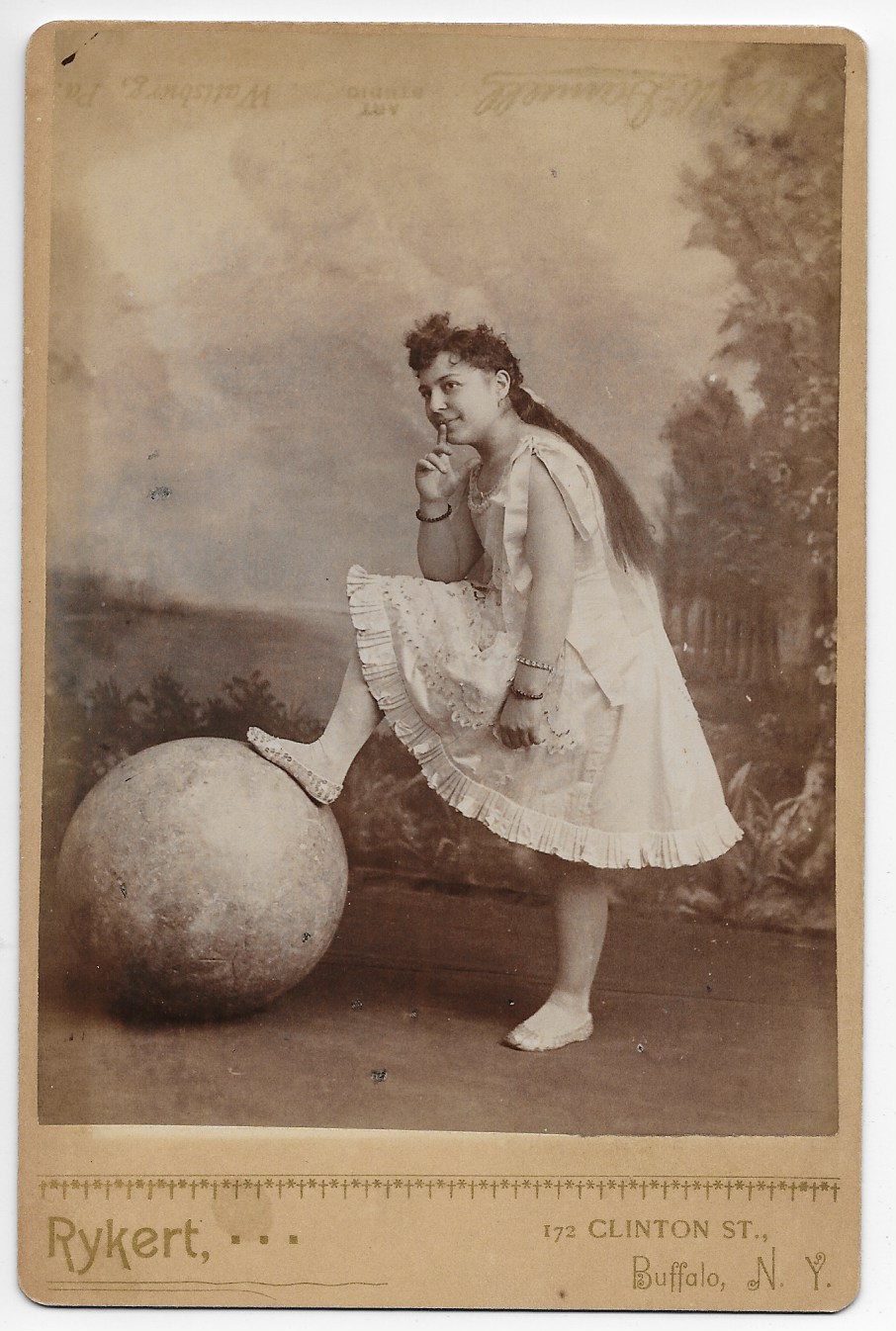
This cabinet card features a pretty, Rose Austin, of the Austin Sisters, who were well known trapeze artists. On the reverse of the photograph is a pencilled notation that states the performer’s name and “Bath Beach, Long Island, New York” (Bath Beach is in Brooklyn). The image was published by the Robinson & Roe studio which had galleries in both Chicago and New York City. The Circus Historical Society’s web site cites the “Austin Family”. Its members included R.G., Aimee (1870-1907), George E., and Rose. Among their venues were Orrin Brothers (1883-1884), W. W. Cole (1885), Coney Island (1892), and Bentley’s (1895). Aimee Austin, born in London, was an aerialist who was known as the “Human Fly” for her talent of “ceiling walking”. She began performing with Rose Austin, at nine years of age, as part of the Austin Sisters aerial act which played at the Circus Rentz, in Berlin, Germany. The act was managed by R. G. Austin. The aerialist performed with various European circuses before coming to the United States. Rose Austin was the subject of three articles in the New York Times. A 1892 article was entitled “Cannot Find Rose Austin”. The article reported that the disappearance of Ms. Austin from her home in Bath Beach. She was described as a well known trapeze performeer and leader of the “clever” Austin Sisters. It was also metioned that she was the wife of R. G. Austin; the manager of the Australian Theatrical Company. At the time of her disappearance, she and her sister were performing at Vaceas’s West End Casino in Coney Island, New York. She had been last seen boarding a ferry bound for New York City. The article points out that Ms. Austin had suffered from epilepsy for the previous four or five years and had experienced a severe attack about ten days earlier.(An acrobat with epilepsy? Doesn’t seem like a terrific career choice.). The article closes with a statement that both Rose Austin’s husband and her doctor, believed that she was either in a hospital, or had fallen off the ferry and drowned. A follow up article (1892) revealed that Ms. Austin had been found and was currently confined to bed as “she is wandering in her mind”. She couldn’t account for her whereabouts or activities during the time she was missing and last remembered falling ill on the ferry. A third article in the New York Times (1894) reports that Rose fell from a trapeze while performing with her brother George in Coney Island. She fell after fainting (one would imagine she had a epileptic seizure). She and her brother fell into a net together and knocked heads, rendering them both unconscious. George recovered quickly but Rose was brought home to Bensonhurst (Brooklyn) in a delirious condition. To view other photographs by Robinson and Roe, and to learn a little about them, click on the category “Photographer: Robinson & Roe”. SOLD
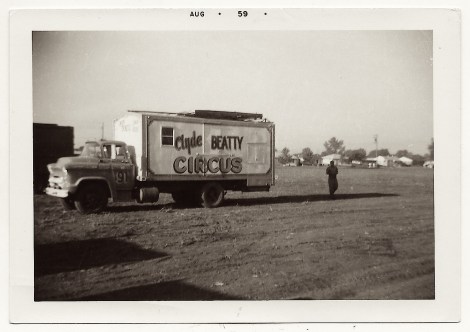
 This vintage snapshot photograph features a Clyde Beatty Circus Truck. It appears that the circus has come to town. The photo was taken in 1959. The date is printed on the top border of the photograph. Clyde Beatty (1903-1965) was an animal trainer and zoo owner in Florida. His first job at a circus was as a cage cleaner. He rose in status as he became an animal trainer. He was known for his lion taming acts. Eventually, in 1945, he became a circus owner and later merged with the Cole Brothers Circus.Beatty was famous for his “fighting act”. He would enter a cage with wild animals with a whip and a pistol strapped to his side. He demonstrated his courage by facing a cage full of animals including lions, tigers and cougars. At the peak of his career, Beatty’s act featured 40 lions and tigers. Beatty was so popular that he appeared in films between the 1930’s and the 1950’s. He appeared on television in the 1960’s. The snapshot measures 3 1/2″ x 5″ and is in very good condition.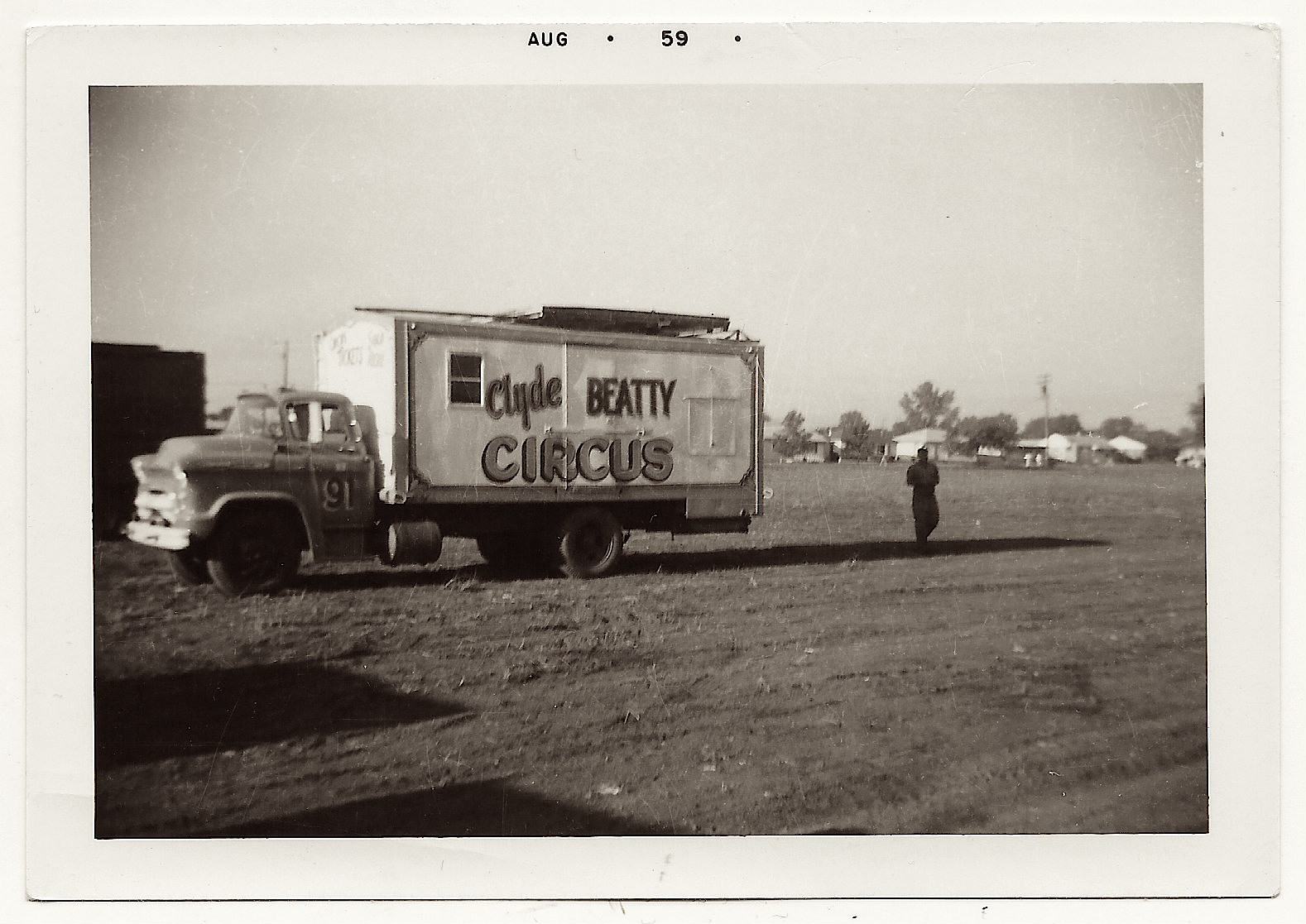


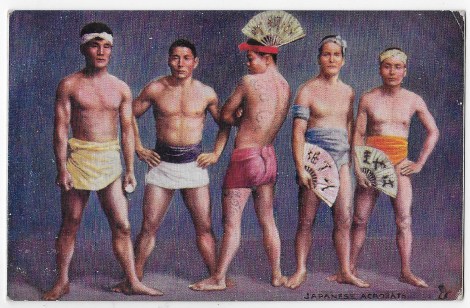 This vintage postcard was published by Raphael Tuck & Sons and is titled “Japanese Acrobats” (no. 6465). The performer in the middle has tattoos on his back, as well as on the back of his left leg. Note the acrobats are holding paper fans and that the center acrobat is wearing his fan on his head. The card is part of a sub-series named “Japanese at Home”. The postcard is also a member of the “Oilette ” series, which was introduced in 1903. The 1930 Tuck catalog states that the oilettes are “veritable miniature oil paintings;” with six designs in a packet. These postcards were printed with the “finest modern colour methods direct from original paintings”. Raphael Tuck and his wife started their photography business in 1866 in London. Their store sold pictures, greeting cards, and in time, postcards. Their success came from the sale of postcards during the late 1890’s and early 1900’s. In the early 1900’s the firm conducted postcard competitions for collectors of Tuck postcards. These competitions offered cash prizes and they were very popular. The winner of one of these competitions had a collection consisting of over twenty-five thousand cards. Three of Tuck’s four sons participated in the business. The company was devastated by German bombing during World War II. In 1959 the company merged with two other printing companies. (SOLD)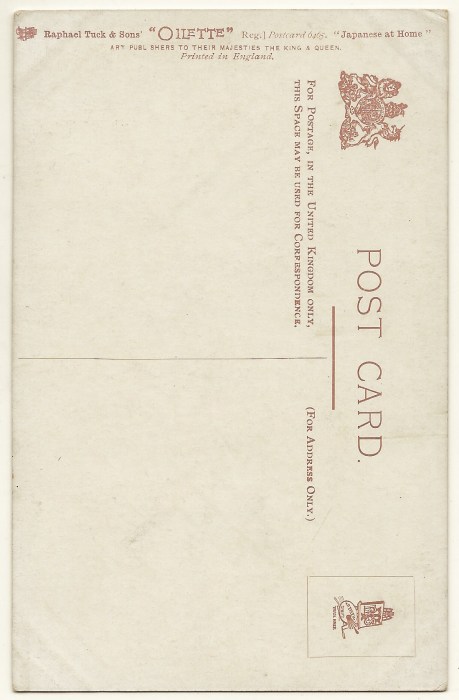
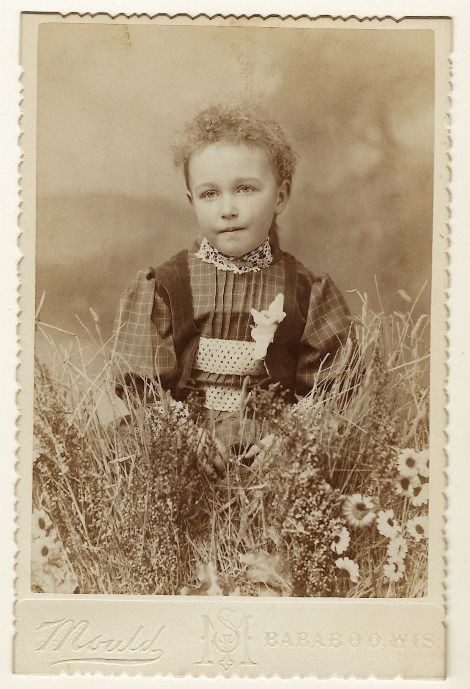
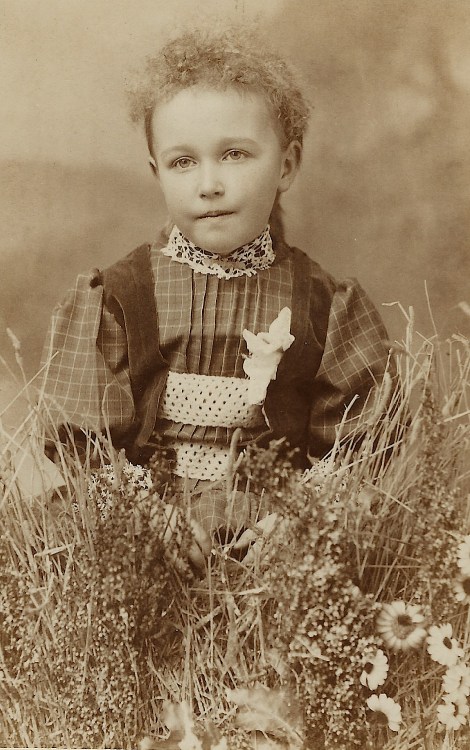 A cute little girl with curly hair poses in a studio created field of daisies for photographer Sim Mould. The studio was located in Baraboo, Wisconsin. The girl is wearing a dress wth a lace collar and has a flower pinned to the front of her dress. An inscription on the reverse of the cabinet card indicates that the child’s name is Hattie Acot. Unfortunately, no biographical information could be found about her. The photographer, Mr. Mould is mentioned in a number of photographic journals. He placed an ad for his studio in a book about Sauk County, Wisconsin (1891). The Photographic Times (1898) reports on his appointment to a lobbying committee of the Photographers Association of Wisconsin. The Encyclopedia Dubuque (1911) reveals that Sim Mould operated a photographic studio at 107 Main Street in Dubuque, Iowa. The town of Baraboo is situated on the Baraboo river. The town was settled by Abe Wood and originally called Adams. In 1852 it was renamed Baraboo. In the town’s early history it became the home of several sawmills. In the nineteenth century the town served as the headquarters of several circuses, including Ringling Brothers. Baraboo became known as “Circus City”. This cabinet card portrait is in very good condition (see scans).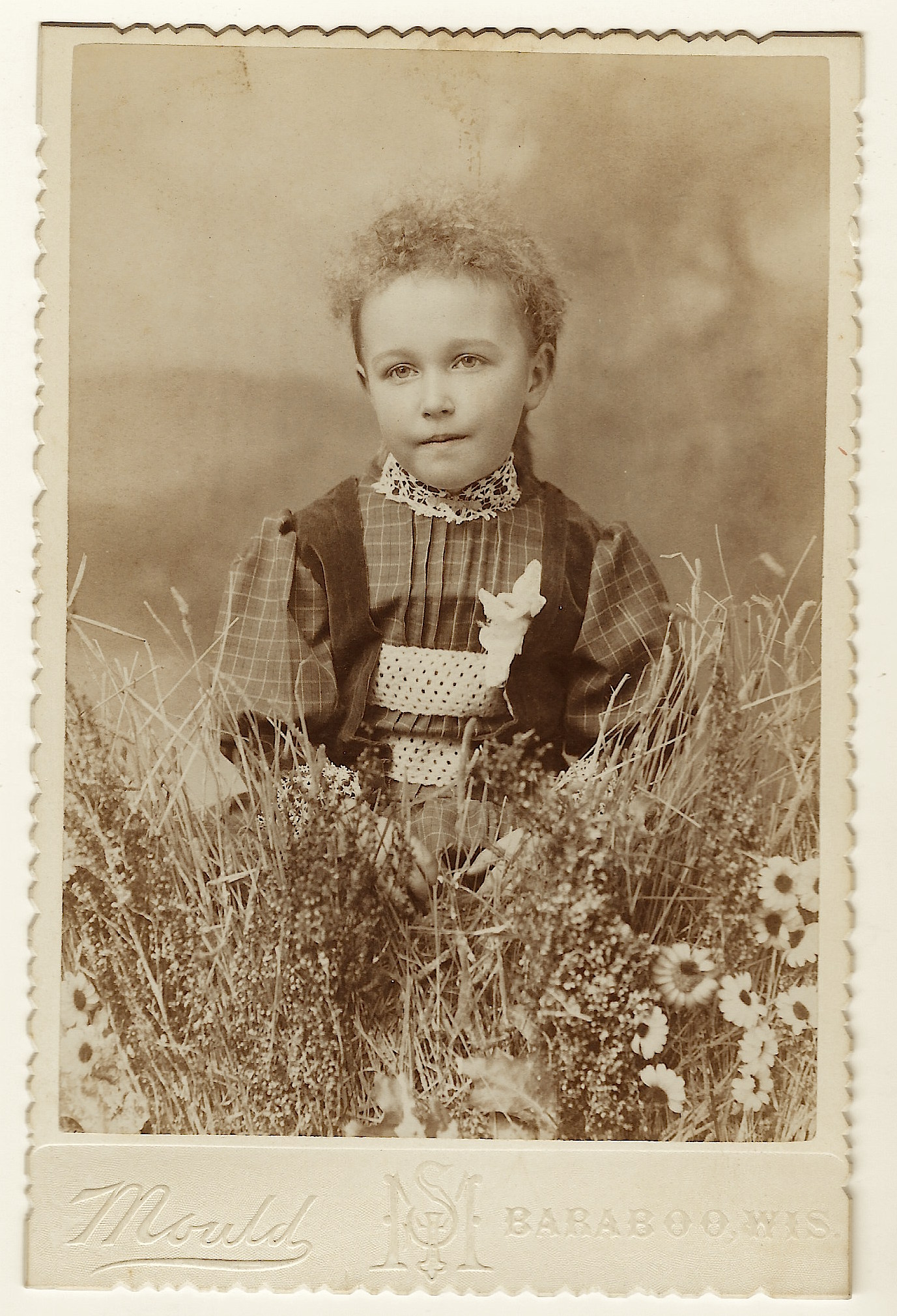






 THE CABINET CARD GALLERY