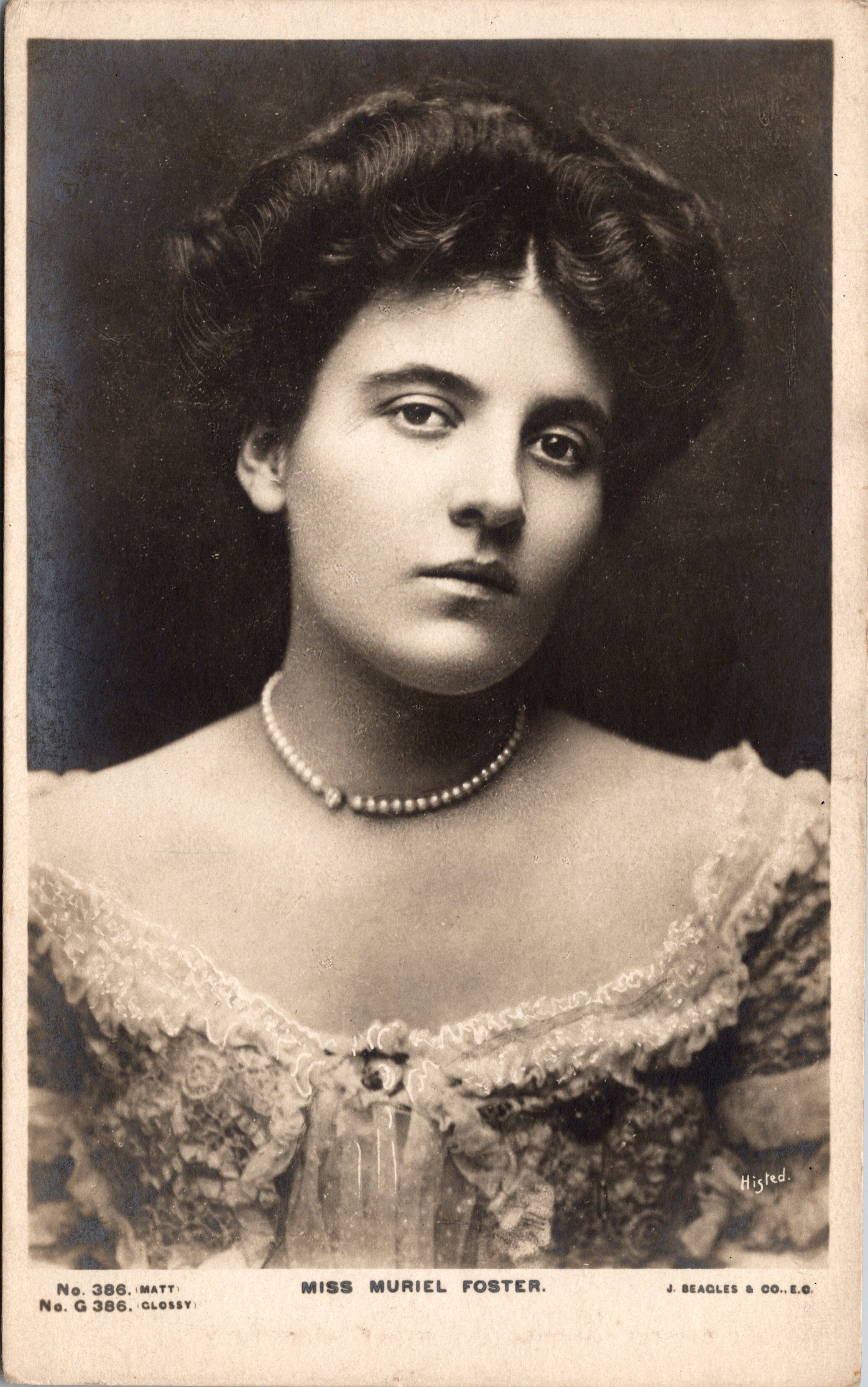
This vintage real photo postcard features English contralto, Muriel Foster (1877-1937). Foster and her twin sister, Hilda, were trained at the Royal College of Music in London. In 1896, he made her debut in the production of “King Saul”. In 1899, the sisters performed in a series of duets. In 1900, Hilda retired after getting married. Muriel, who had the command of several languages, continued her singing and had a very successful international opera career. Muriel was photographed for this portrait by Ernest Walter Histed (1862-1947). Histed was born in England but achieved his success as a photographer in Chicago, and later, in Pittsburgh. He then returned to England and opened a photography studio there. His subjects there included Clara Butt (Opera Star) Pope Pius X, and the Empress of Germany. Histed returned to the US and opened a studio on Fifth Avenue in New York City. He later moved to Palm Beach, Florida and continued his profession until 1934. The Museum of the City of New York has a large collection of his work. The National Portrait Gallery (England) has 32 of his photographs in their collection. This postcard was published by London’s J. Beagles & Co. as part of a series (No. G386).The company was started by John Beagles (1844-1909). The company produced a variety of postcards including an extensive catalog of celebrity (stage and screen) portrait postcards. After Beagle’s death, the business continued as J. Beagles & Co. until it closed in 1939. SOLD
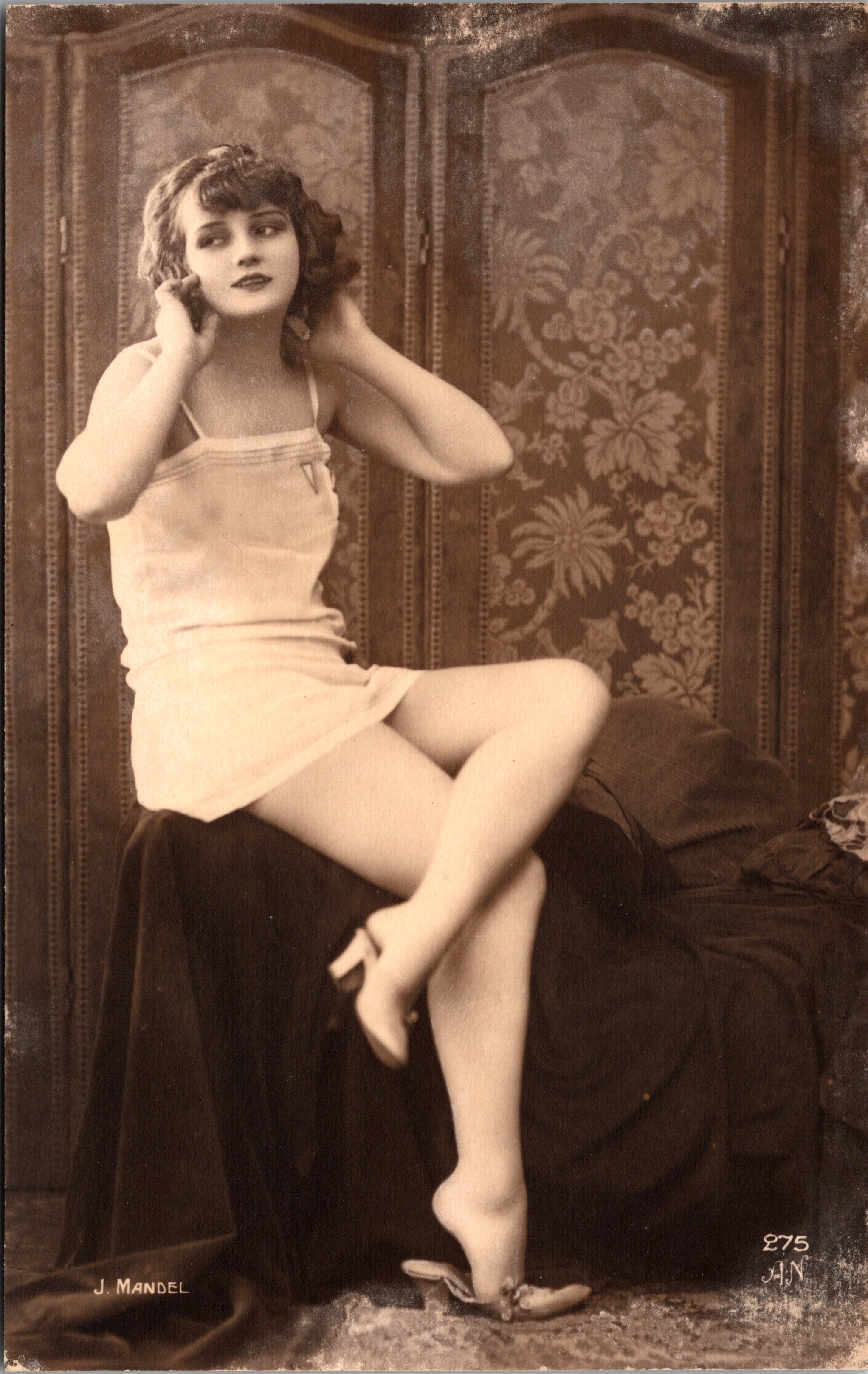
This risque photograph was taken by Julian Mandel (1872-1935). He was one of the most famous photographers of female nudes during the early twentieth century. He worked in Paris, France and his photographs became well known in the 1910’s through the 1930’s. This photograph appears on a vintage real photo postcard. The pretty model is wearing a gauzy negligee and is giving a flirtatious look. This original risque photo postcard was published by Alfred Noyer as part of a series (no.275). SOLD
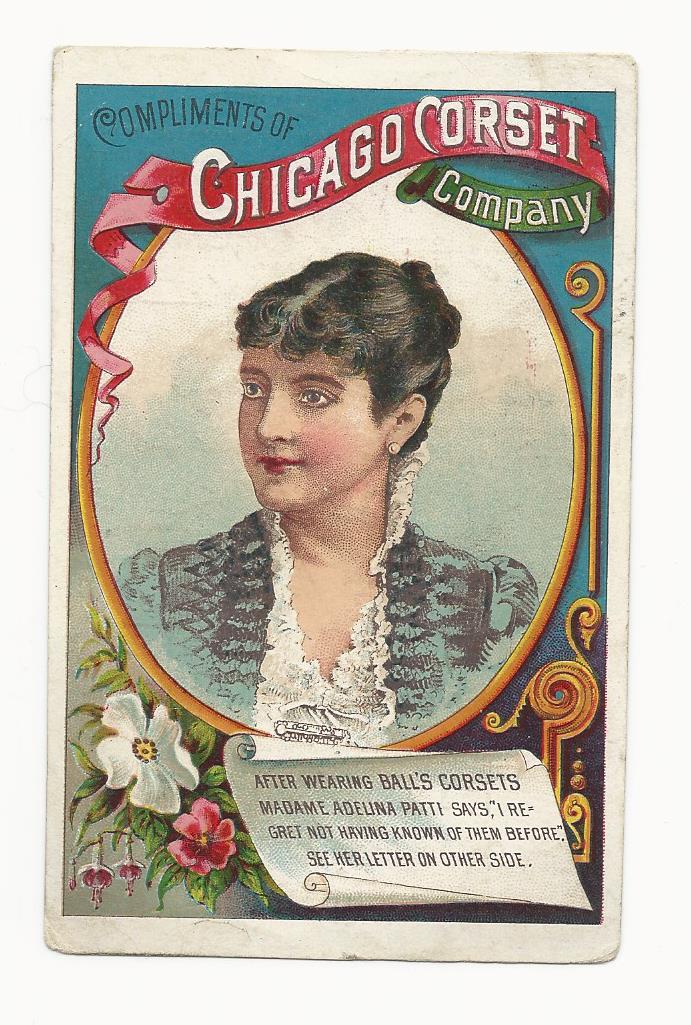
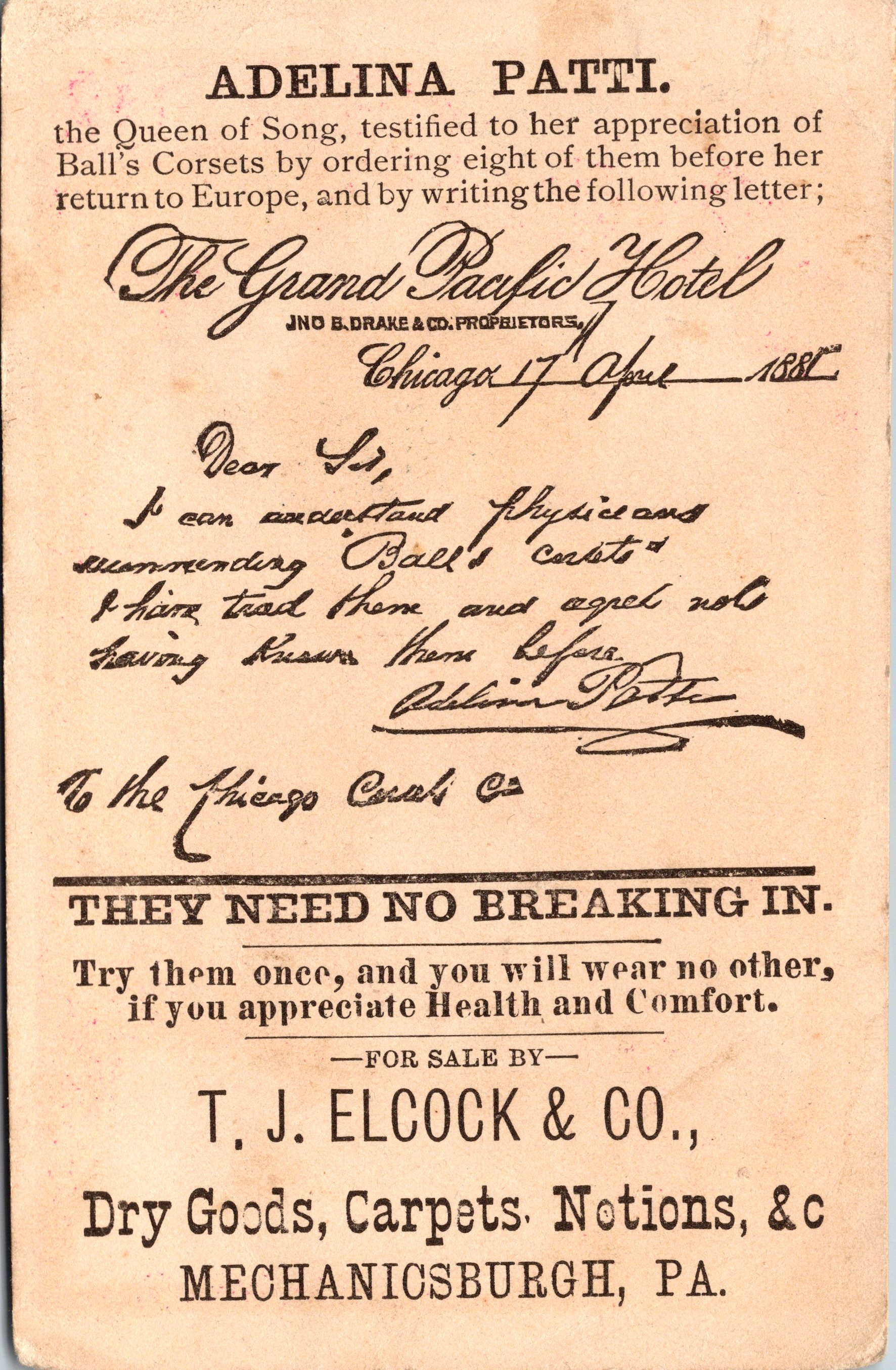
This item is a vintage trade card advertising corsets for the Chicago Corset Company. The card dates back to the 1880’s. The wasp waisted women seen in a number of the photographs of the cabinet card era, didn’t get that way from going to Jenny Craig and the gym. Their secret weapon was wearing a corset. This trade card utilizes a “celebrity spokesperson”. Adelina Patti, a famous opera singer, sings the praise of Ball’s Corsets which were manufactured by the Chicago Corset Company of Aurora, Illinois. She ordered eight corsets and testified that she wished that she had known about them sooner. The company advertising on the card brags that “they need no breaking in” and that they provide “health and comfort”. This particular trade card is also advertising the T. J. Elcock & Company which was a Dry Goods, Carpet, and Notions store in Mechanicsburgh, Pennsylvania. Here is a little information about the Chicago Corset Company, The business is cited in Robin Shepard’s “The Best Breweries and Brewpubs of Illinois (2003). The author writes that in the late 1800’s and early 1900’s Aurora was considered the corset capitol of the world. There were at least three corset companies operating their factories there and one of the largest was the Chicago Corset Company. In fact, I read elsewhere, that the company was the second largest corset company in the world. At one point, the business employed 600 people and produced 2 million corsets a year. The word “corset” began to be used in the English language in about 1828. “The Ladies Magazine” described it as a “quilted waistcoat”. The primary reason for using corsets was to slim the body and help it conform to a fashionable silhouette. Generally speaking, the corset reduces the waist and exaggerates the bust and hips. Apparently there were “overbust corsets” and “underbust corsets”. Sometimes, corsets were used for medical or for fetish purposes. I’ll refrain from elaborating about the medical and fetish purposes and leave detailed explanation to your imagination. The corset company’s spokesperson on this trade card is Adelina Patti (1843-1919). She was a celebrated 19th century opera singer who earned a great deal of money for her performances at the height of her career. She sang in both Europe and America and is probably one of the most famous sopranos in history. She was born in Madrid. Her father was tenor Salvatore Pattie and her mother was soprano Caterina Barilli. Her parents were Italian and she grew up in the Bronx, New York. She sang professionally from childhood. At sixteen years of age, she made her operatic debut at the Academy of Music in New York City. At age eighteen she began performing in Europe. She later performed “Home Sweet Home” for President Lincoln and his wife shortly after the death of their son, Willie. The bereaved parents requested an encore. She was associated with the song for her entire career. In her prime, Adelina Patti demanded to be paid five thousand dollars a night. She asked to be paid in gold, prior to each performance. She demanded top billing and that her name be in bigger font than others in the company. She also demanded that she not be obligated to attend rehearsals. Did someone say, DIVA? It was reported that she trained her parrot to say “Cash, Cash”. Be sure to look below to see some interesting images pertaining to corsets as well as an image of Miss Patti. (SOLD)
Adelina Patti
Corset Shop Window
Polaire was famous for her tiny, corseted waist, which was sometimes reported to have a circumference no greater than 16 inches (41 cm)
A woman models a corset in this 1898 photograph.
Brooklyn Museum Costume Collection at The Metropolitan Museum of Art
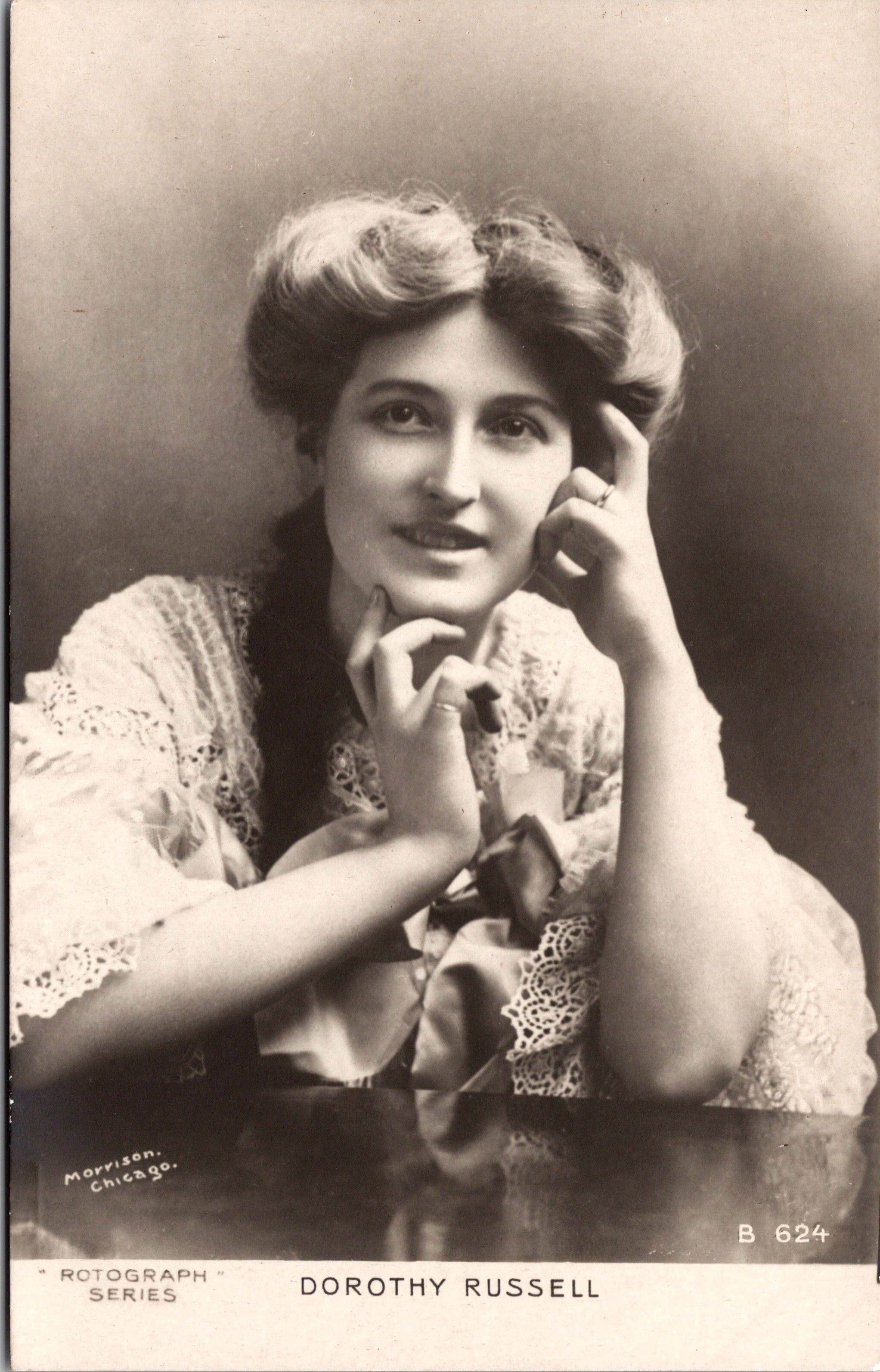
This vintage real photo postcard features actress Dorothy Russell (1883-1954). She was the notorious daughter of the ultimate diva, Lillian Russell (1860-1922). Dorothy was in three Broadway plays between 1904 and 1907. Dorothy’s trademark was her penchant for sensational hijinks, divorces, and legal fights. Dorothy was married seven times. In one civil suit, she was forced to surrender jewelry given to her mother by “Diamond Jim” Brady. The court insisted that she use the proceeds from the jewelry to pay off personal debts. A stamp on the reverse of the postcard indicates that this card was once the property of Robert S. Simmons. This postcard was published by the Rotograph Company (New York City). It is part of the Rotograph Series (No. B 624), The photographer of this image is William Mckenzie Morrison whose studio was located in the Haymarket Theatre building in Chicago, Illinois. Morrison was a well known and successful celebrity photographer. (SOLD)
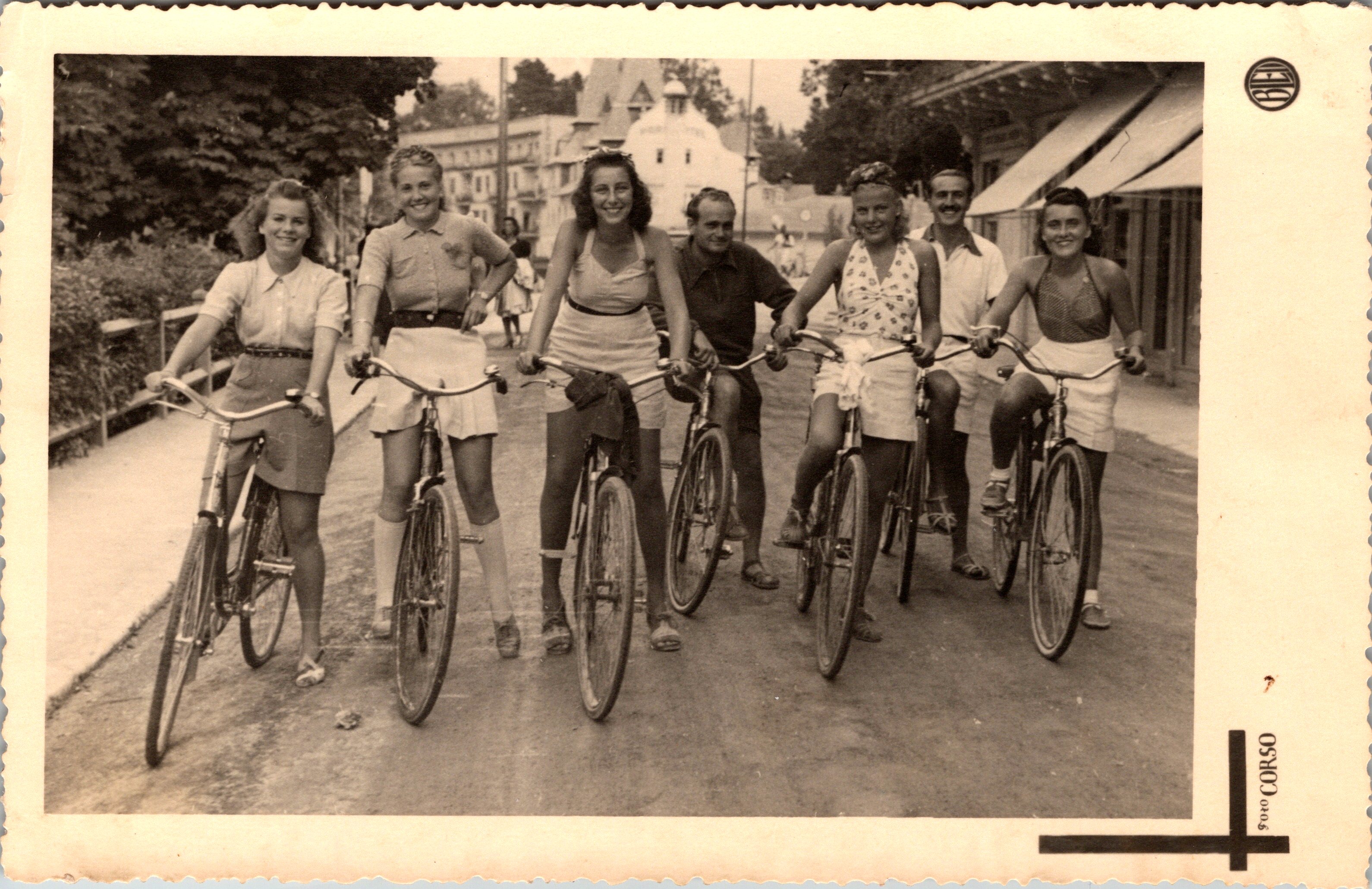
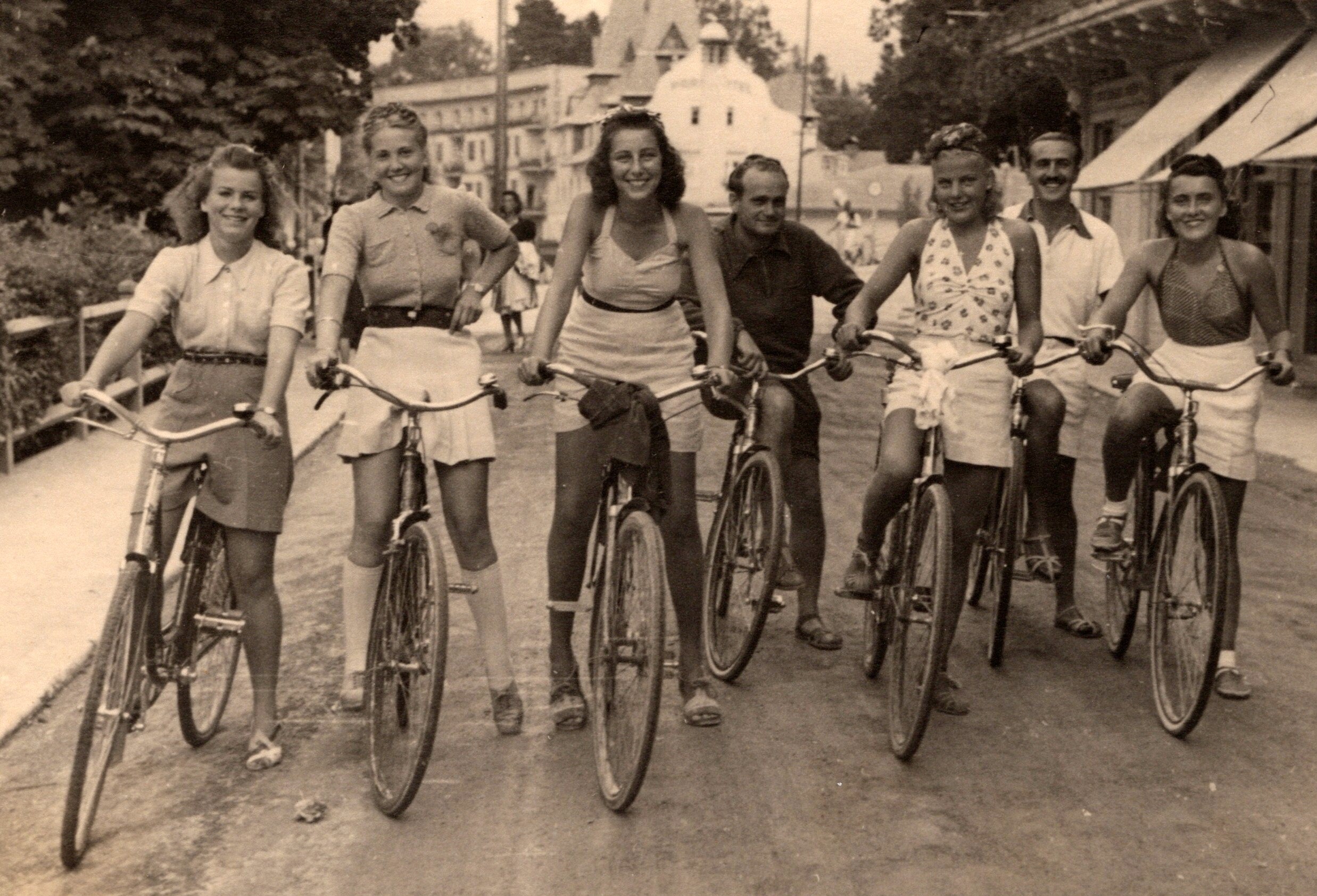
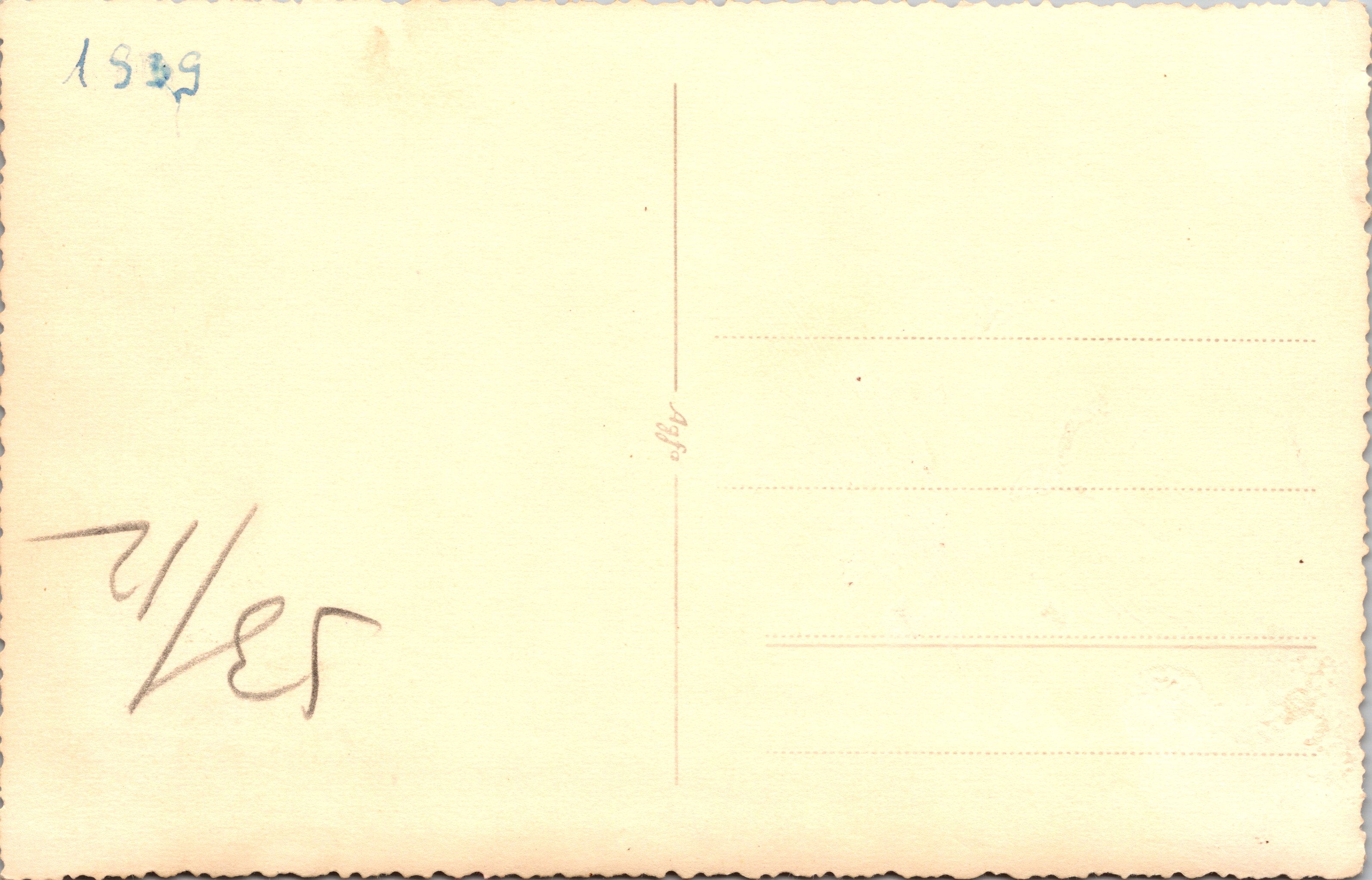
This vintage real photo postcard features five women and two men riding bicycles on an unidentified street. Judging by their smiles, they are all having fun. The riders are dressed for warm weather. Are these bicylists tourists? The caption on this postcard states “From Corso”. My assumption is that the photo was taken by the Corso studio. The location of that studio and the locale where this photo was taken, is unknown. An inscription on the reverse of the postcard indicates that the photograph was taken in 1939. SOLD
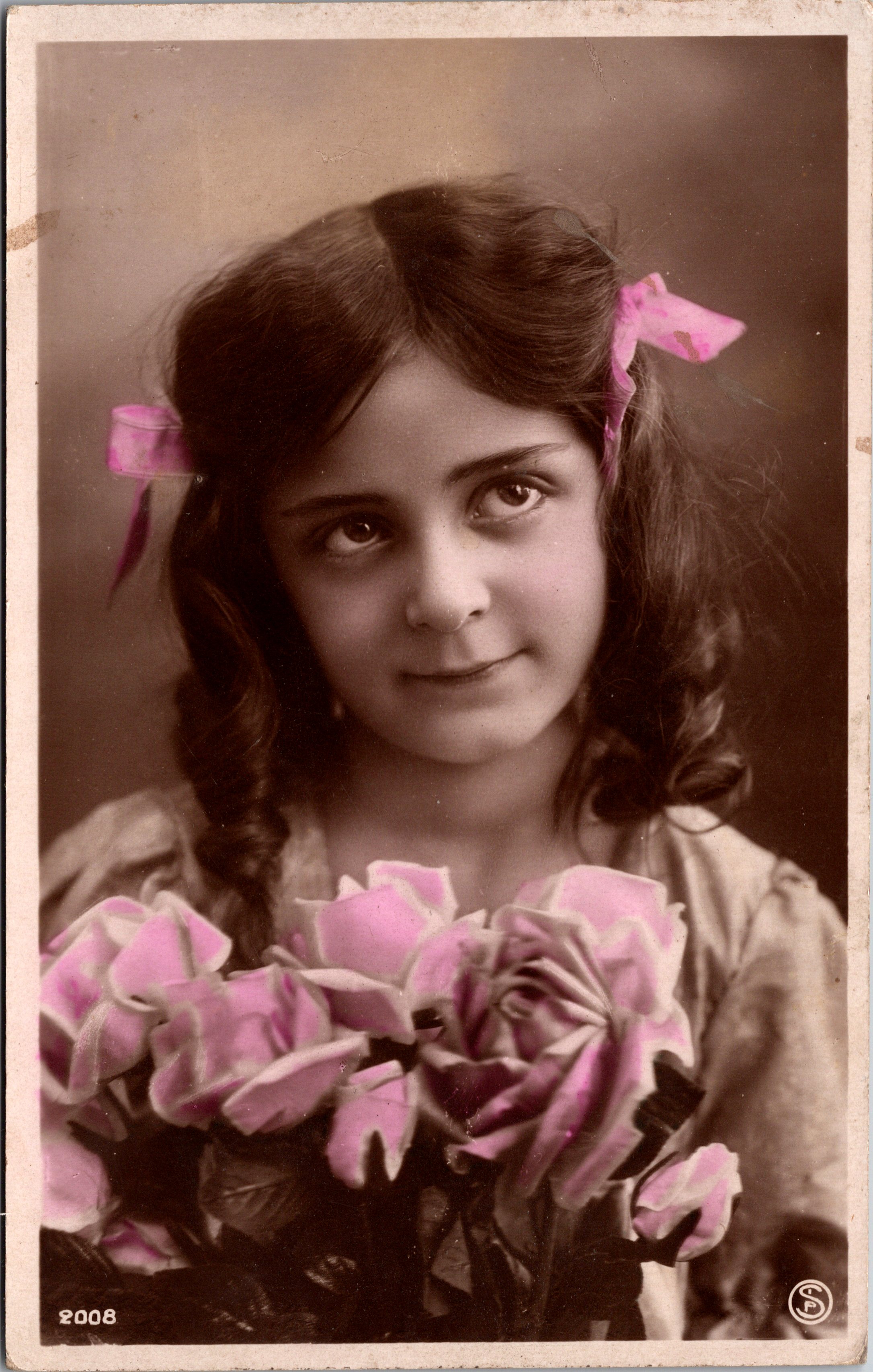
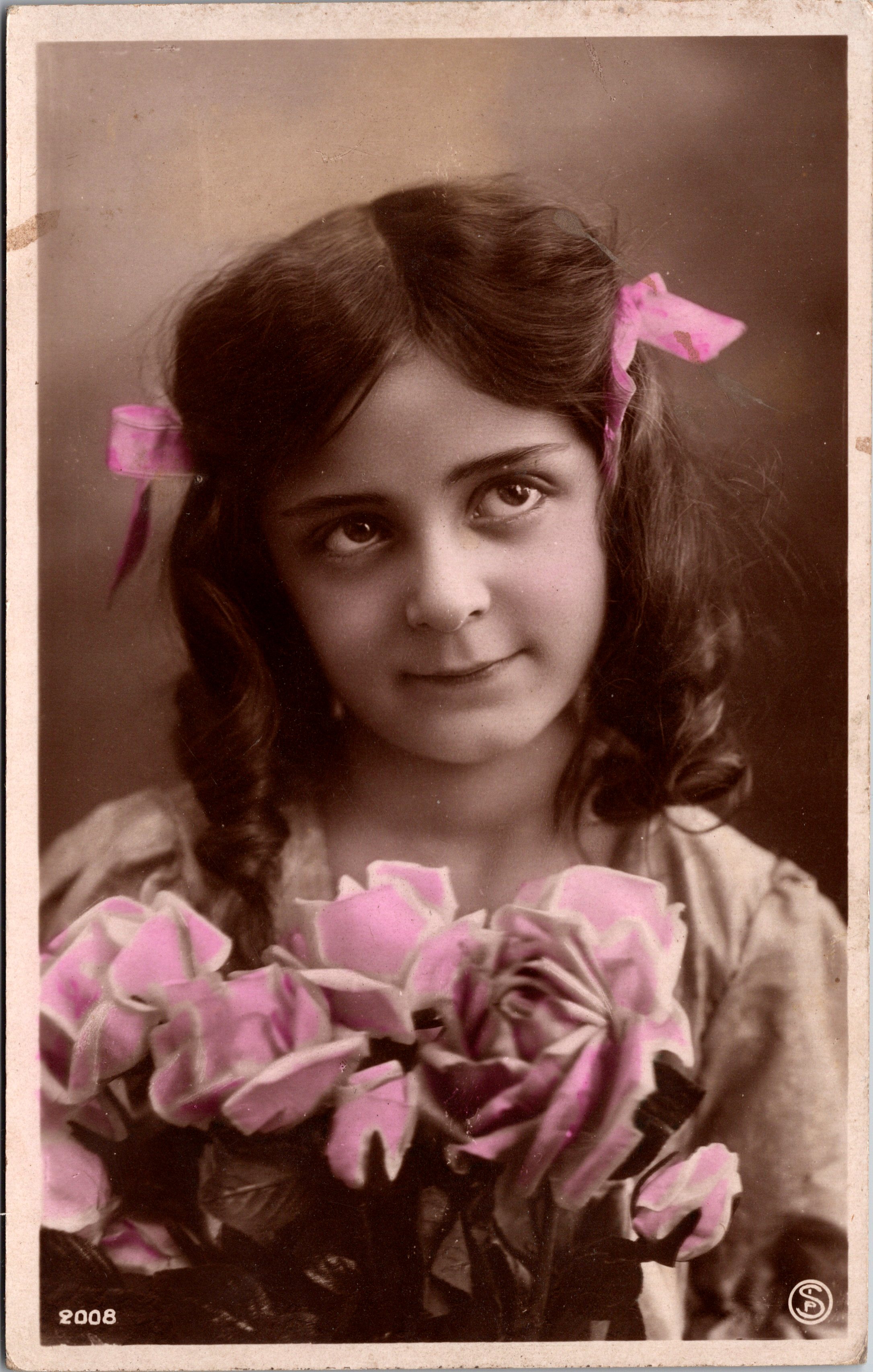
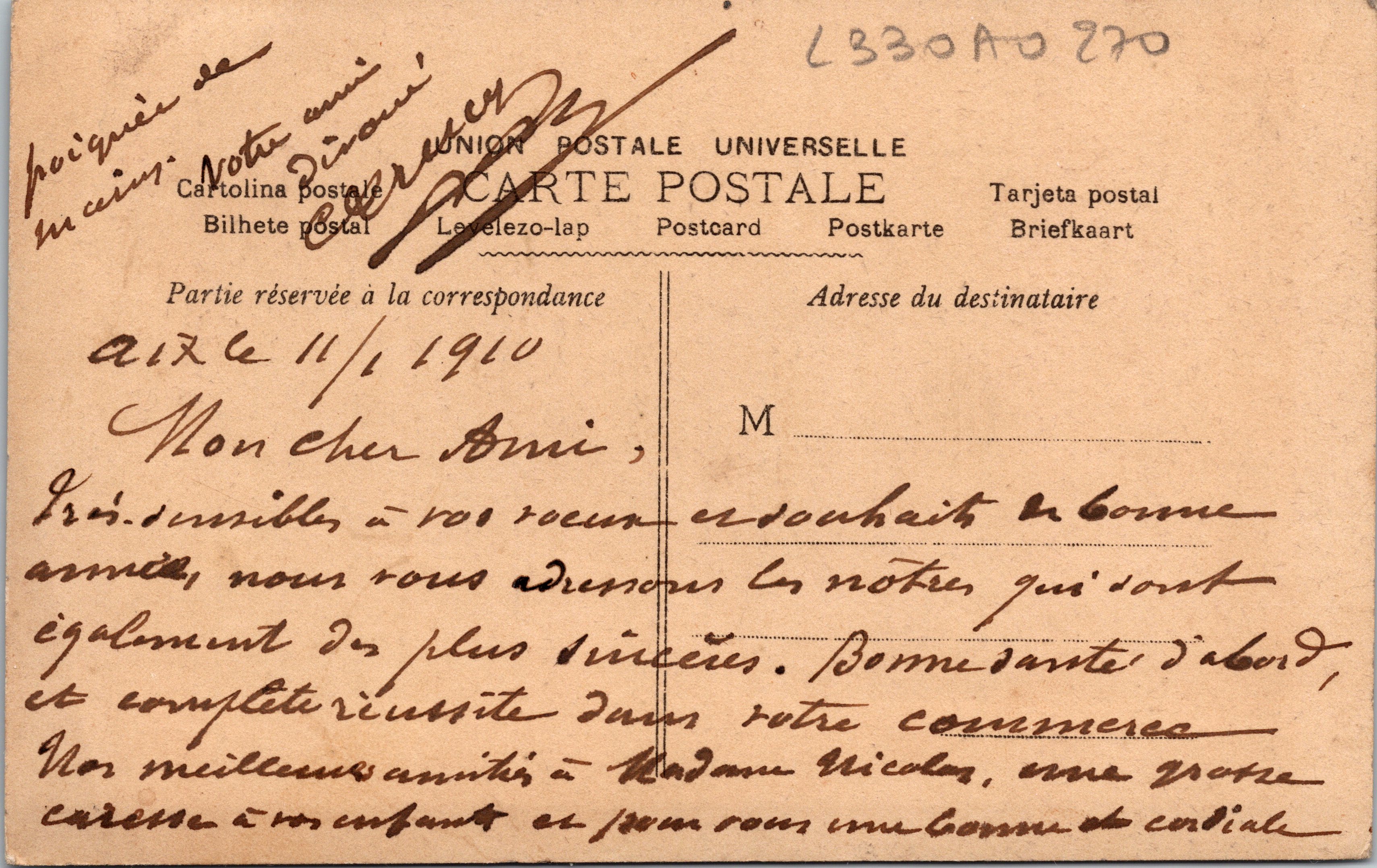
This vintage real photo postcard features an adorable photogenic young girl. She is wearing two pink bows in her hair and a sweet smile. This postcard was published by SIP (Societe Industrielle de Photograpie) of Rueil, France and was part of a series (no. 2008). This vintage portrait postcard is in very good condition (see scans).
Buy this Vintage Real Photo Postcard (includes shipping within the US) #3541
To purchase this item, click on the Pay with PayPal button below
$25.50
Buy this Vintage Real Photo Postcard (includes International shipping outside the US) 3541
To purchase this item, click on the Pay with PayPal button below
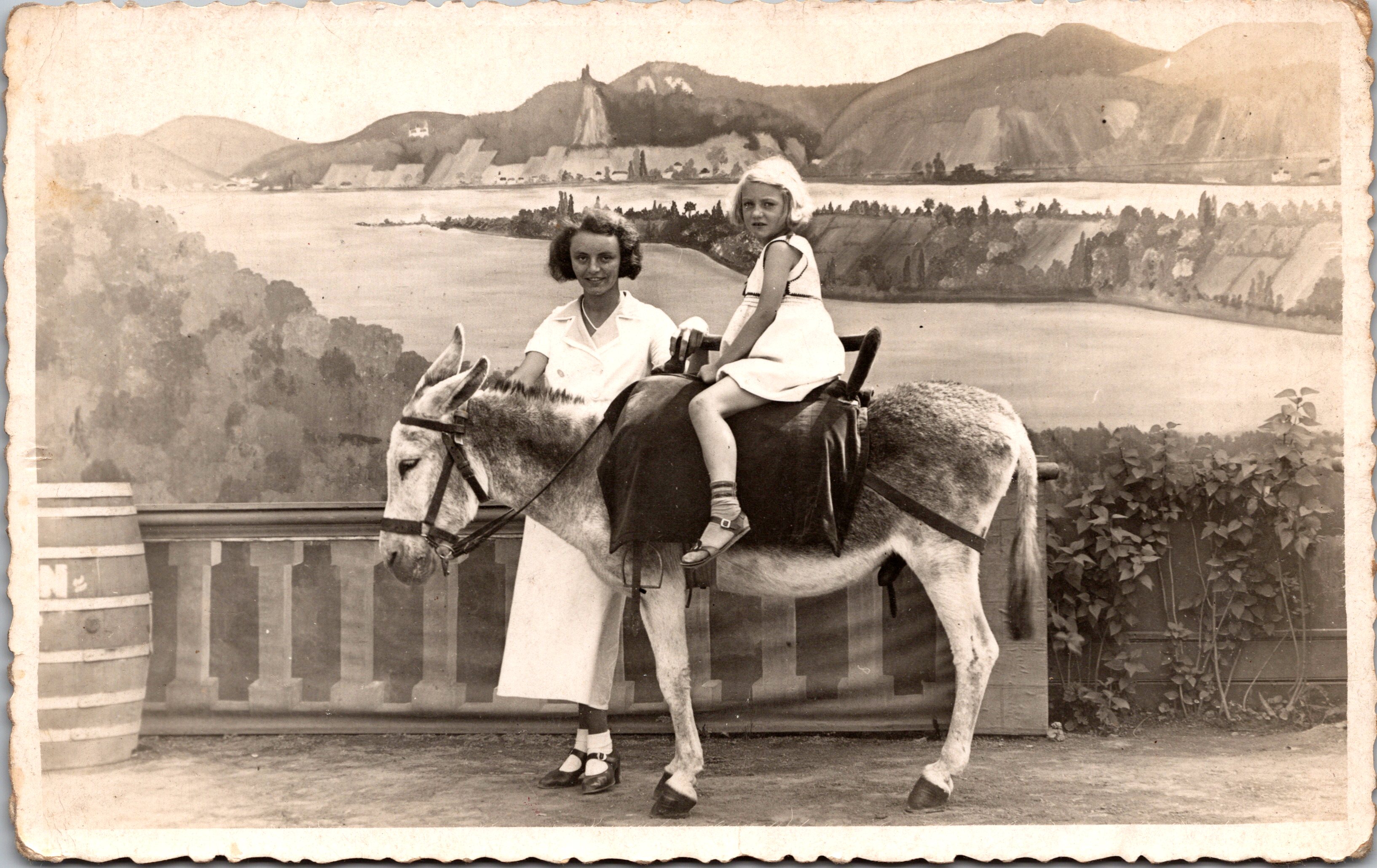
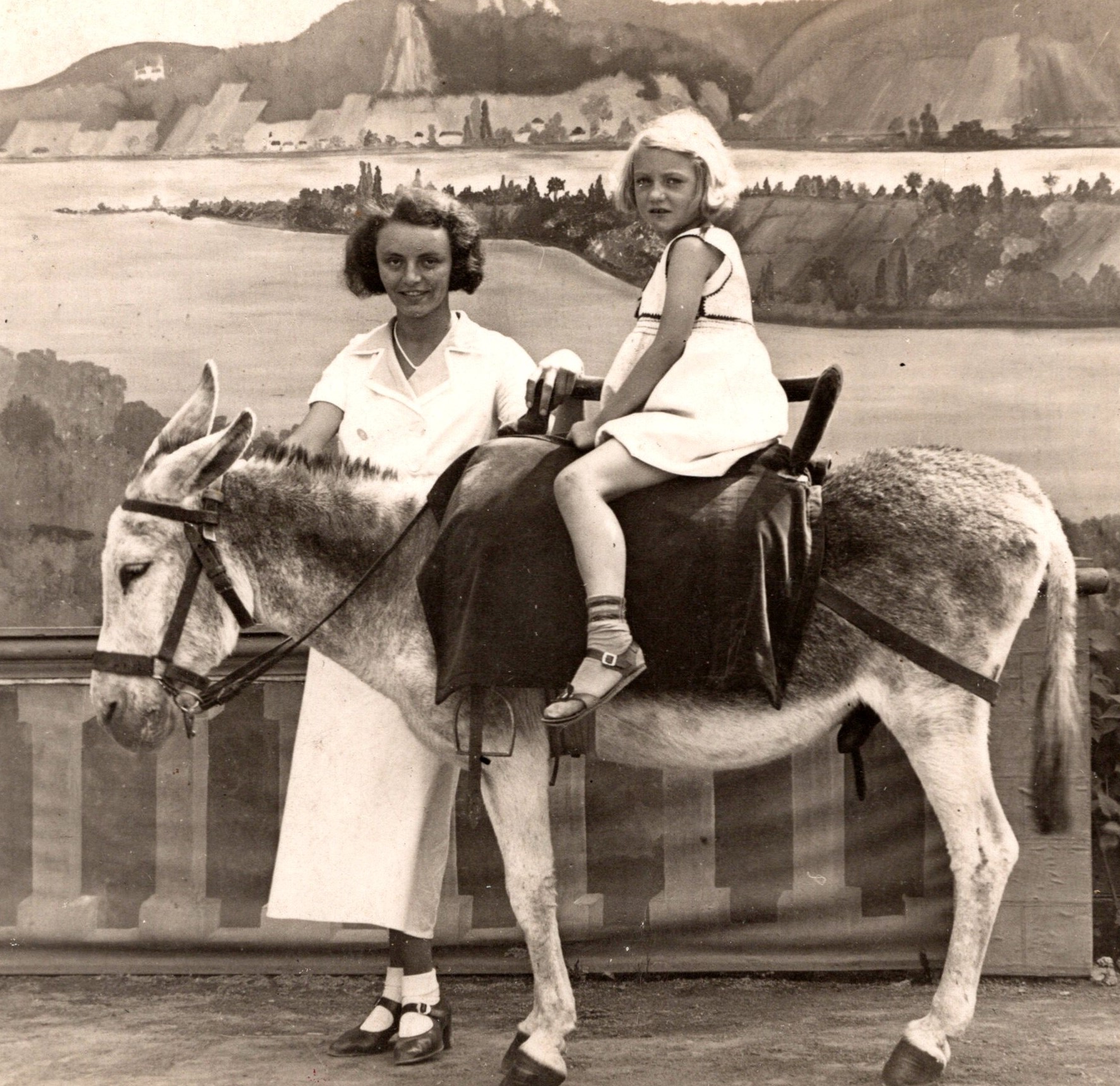
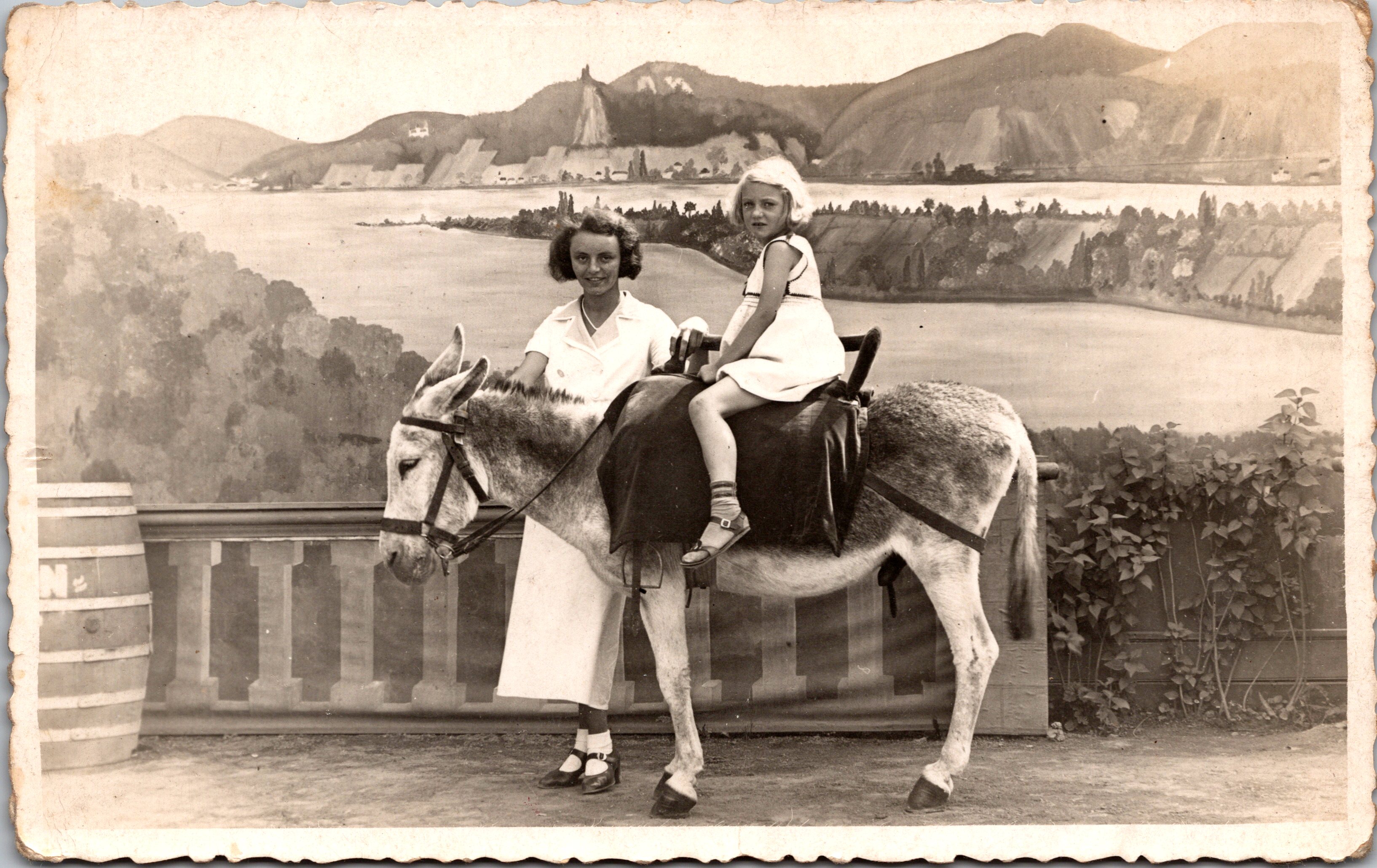
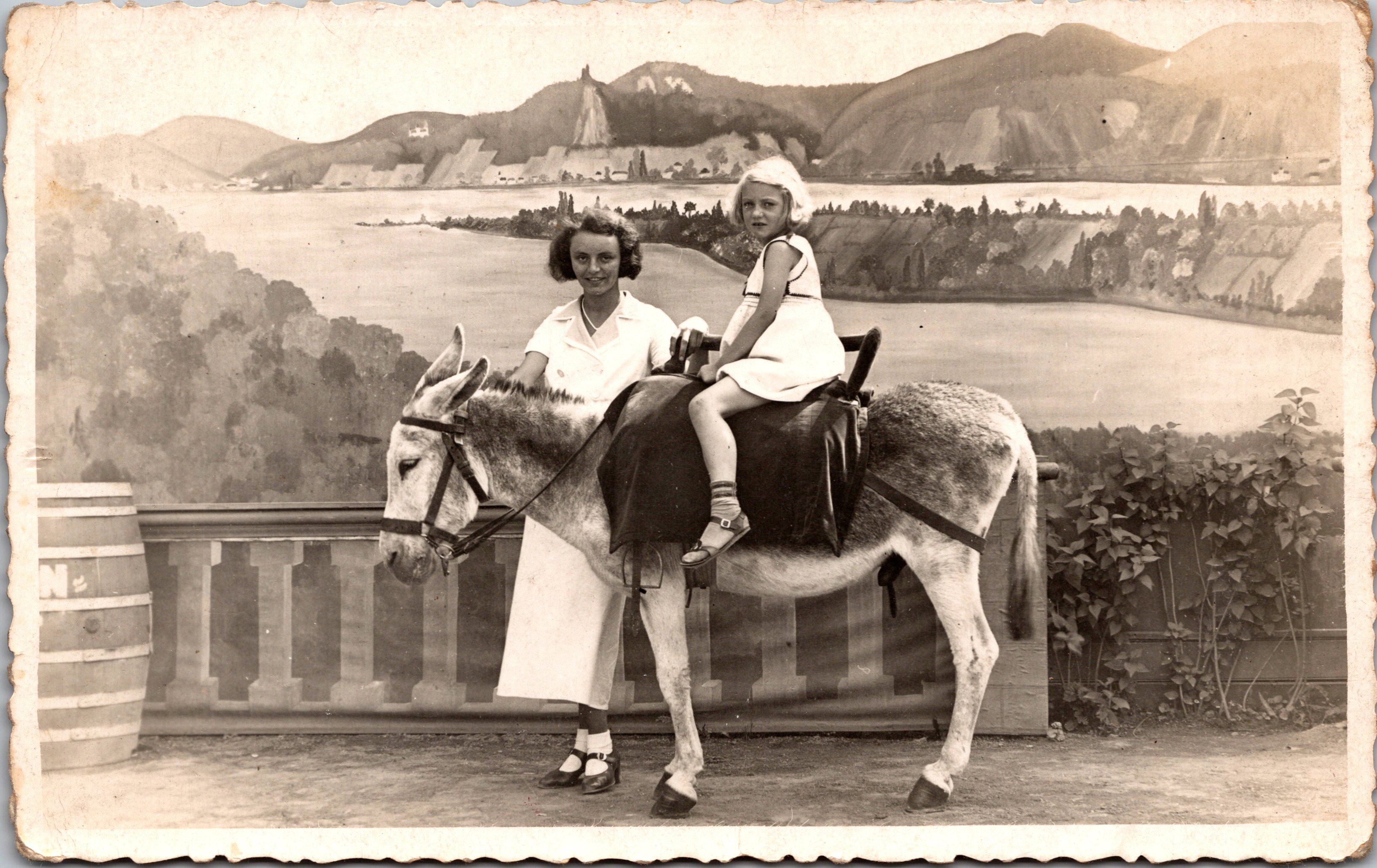
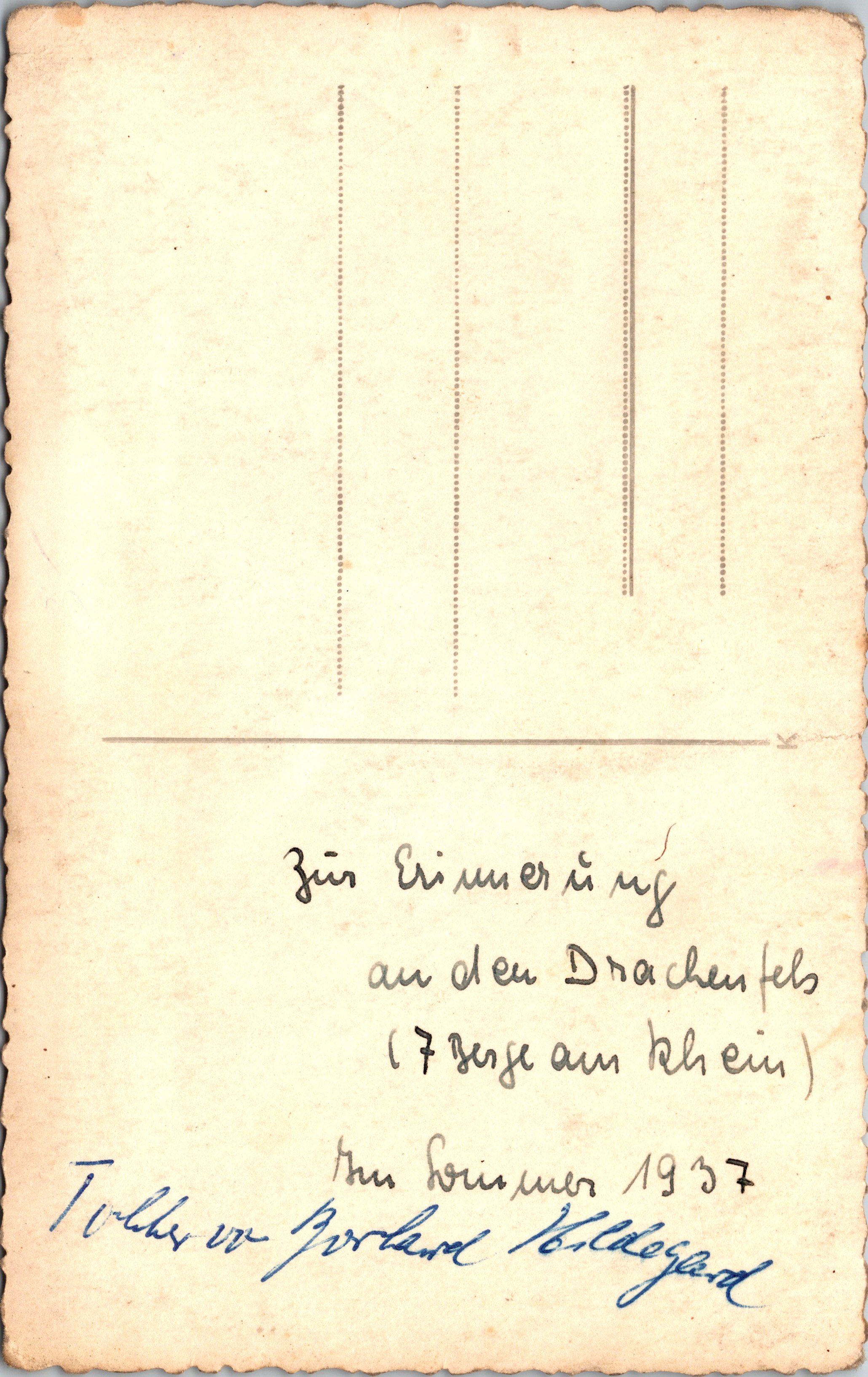
This vintage real photo postcard features a young girl riding a donkey. The child does not seem particularly comfortable. Mom is standing close-by, and she offers a pretty smile for the photographer. I have labeled the beast of burden seen in this photo, a donkey, but I am aware that the animal may be a burro or mule. In addition, I am also cognizant of the fact that the donkey, or whatever it is, may be stuffed. The backdrop reveals that the photograph was taken in a photographer’s studio. I would imagine that most photographers would not be receptive about having a live donkey inside their studio. This photo postcard is of German origin and an inscription on the reverse of the card reveals that the photograph was taken in 1937. This vintage scallop edged postcard is in very good condition (see scans).
Buy this Vintage Real Photo Postcard (includes shipping within the US) #3540
To purchase this item, click on the Pay with PayPal button below
$25.50
Buy this Vintage Real Photo Postcard (includes International shipping outside the US) 3540
To purchase this item, click on the Pay with PayPal button below
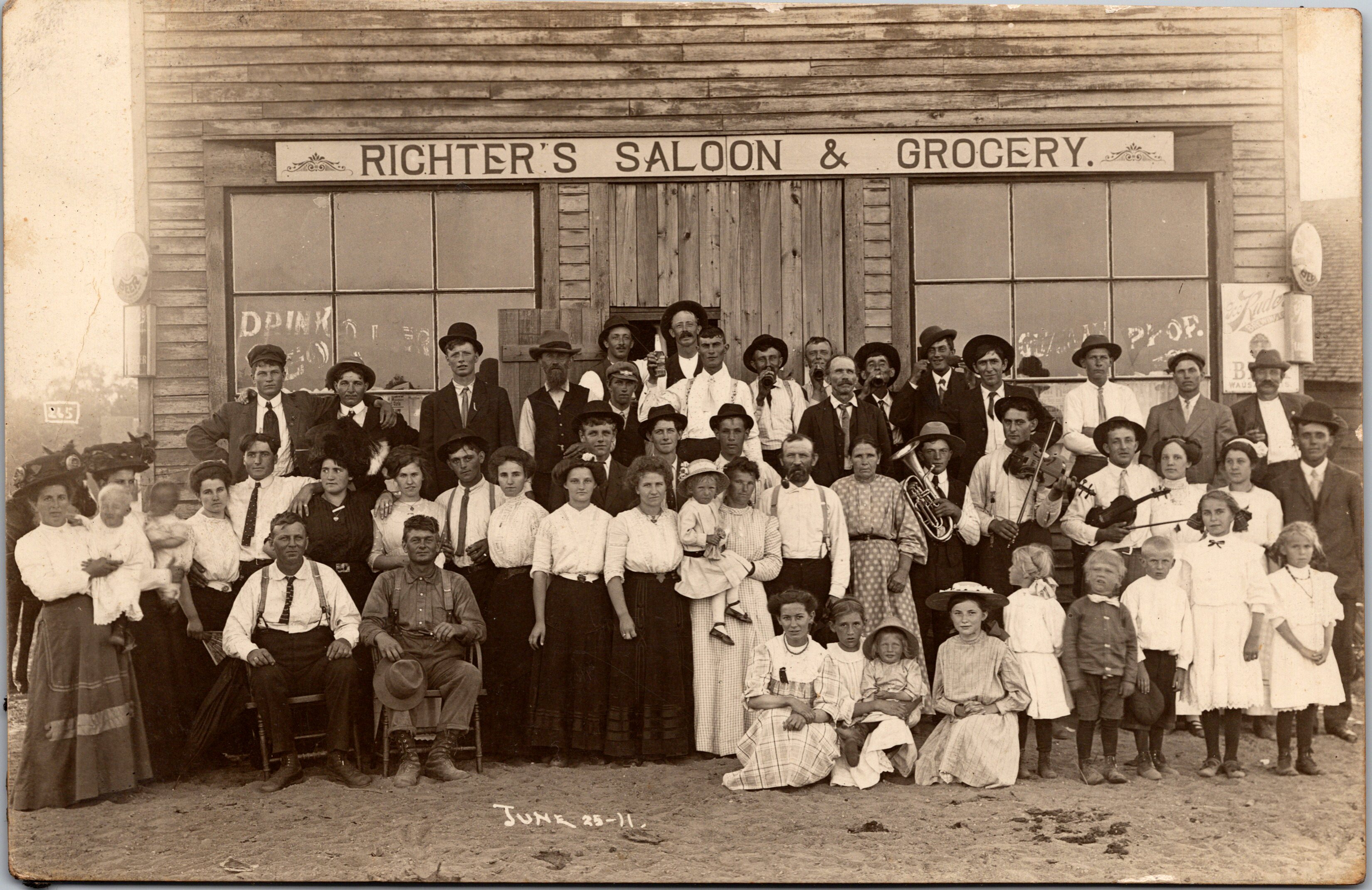
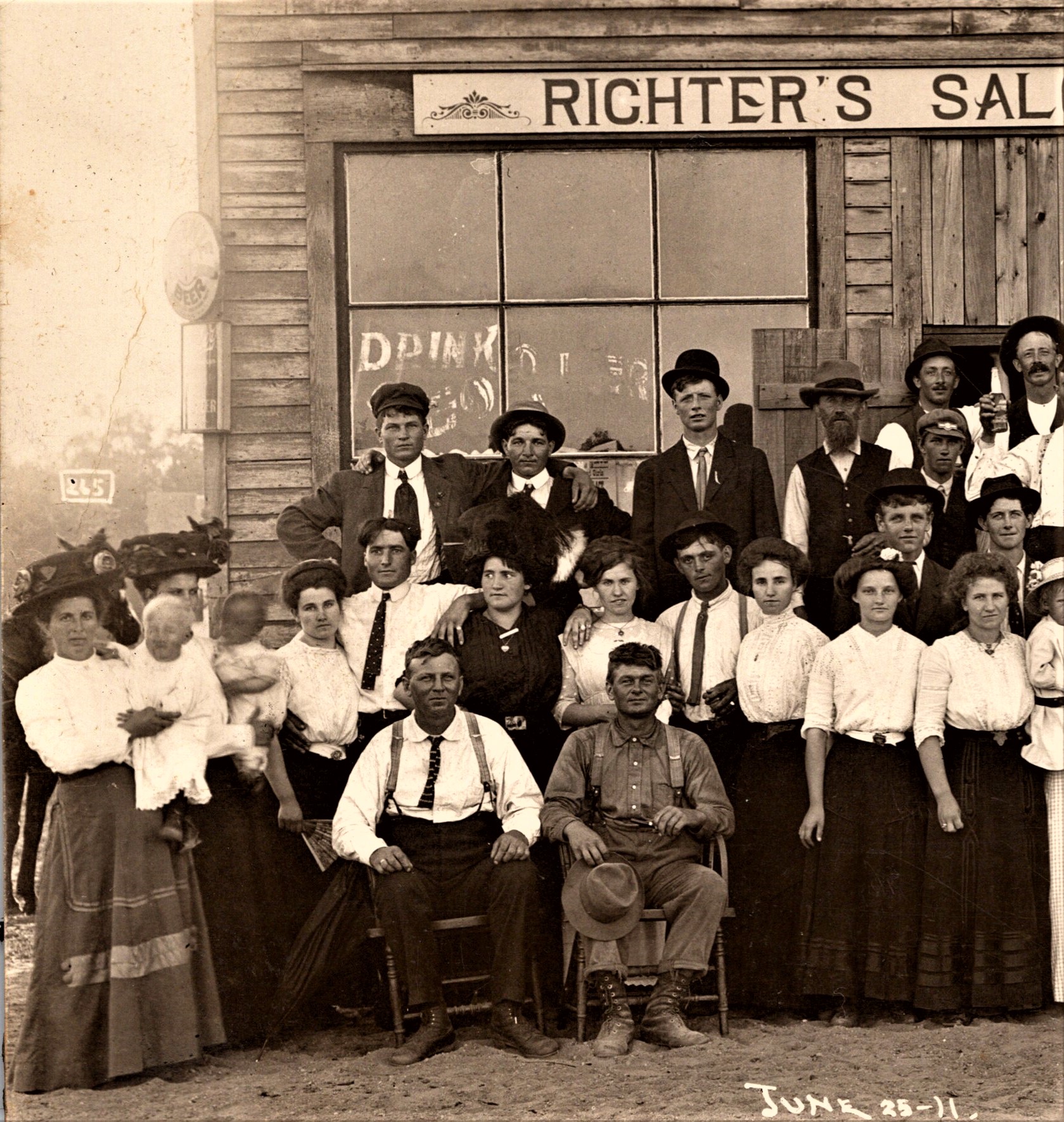
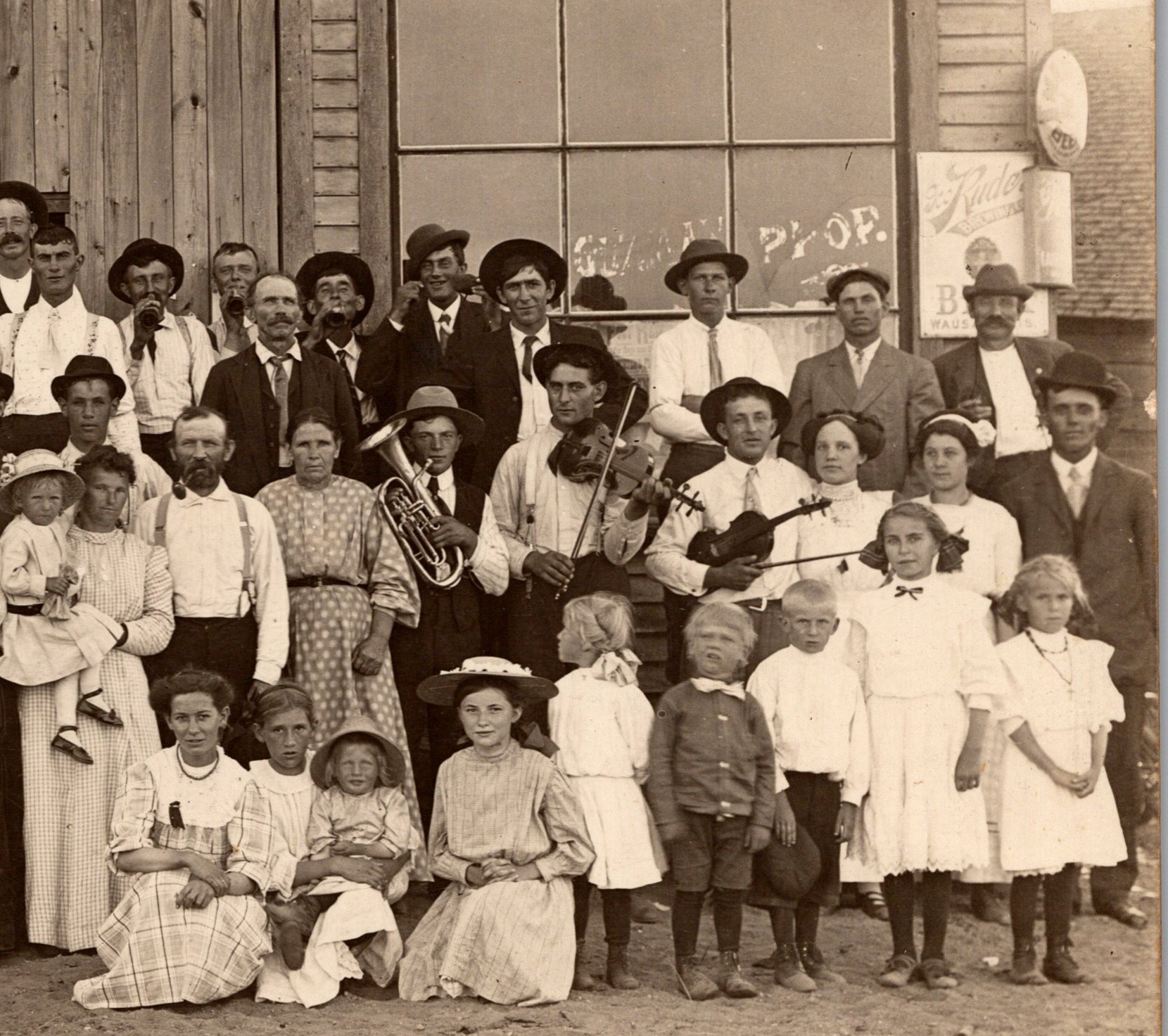
This vintage real photo postcard serves as a wonderful illustration of social history. For a reason unknown to us, the community gathered in front of Richter’s Saloon & Grocery for this photo. The whole town is represented. There are babies, children, and young and older adults. If you look carefully, you will see that there was a lot of activity occurring when this photograph was taken. First, there are a several musicians in the group. Some are playing their instruments while others are displaying them. There are a number of men in the back row drinking out of bottles. Why are they congregated in the back row? It is likely a safe assumption that they are drinking beer or some other form of alcohol. Included in the photo is an oppositional defiant little girl. She is in the first row and is the only child or adult facing the “wrong” way. I’m kidding about the “oppositional defiant disorder” diagnosis. The townspeople in this photograph are wearing an interesting assortment of hats. There is a sign advertising a brewery attached to the front of the building. The advertising is for Ruder Beer. The George Ruder Brewing Company was founded in 1892 and operated until 1920. The company was located in Wausau, Wisconsin. By now, you have probably been wondering where Richter’s Saloon & Grocery was located. I am wondering too. I found two possible locations, but there may be more. An Indianapolis, Indiana city directory lists one of the cities businesses as being William Richter & Son Grocery and Saloon. I can not determine the year of the directory. The second possibility concerning the location of Richter’s Saloon & Grocery is more remote. In 1911, there was a Emilie Richter running a saloon in Milwaukee, Wisconsin. This is the same year that the photograph was taken. I have been unable to learn the name of the saloon. The fact that Milwaukee and Wausau (home of Ruder Beer) are in Wisconsin, may be significant. The Kruxo stamp box on the reverse of this postcard, dates the card to sometime between 1908 and 1920. This supports the 1911 date printed on the front of this postcard. SOLD
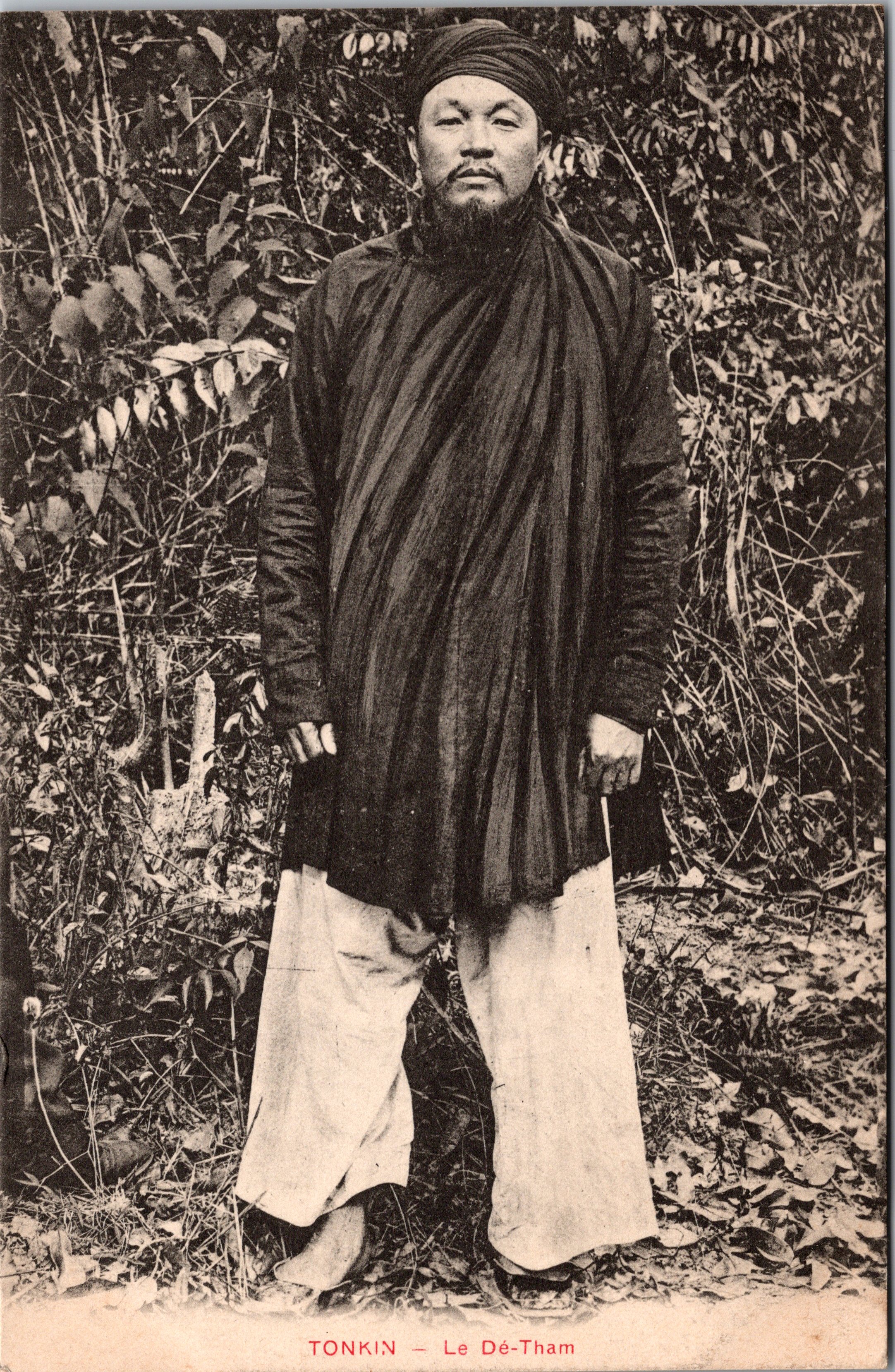
This vintage postcard features a portrait of Vietnamese feudal lord, Le De-Tham (1858-1913). His actual name was Hoang Hoa Tham and he was also known as Commander Tham. He was the leader of the “Yen The” insurrection, a 25 year long popular revolt in the “Yen The” district of Vietnam. The insurrectionists were resisting French colonial rule. Interestingly, his parents were also resistance fighters. They both died as members of a resistance group fighting against the Court of Hue. Most of Le De-Tham’s resistance forces were routed by French troops as they swept through the province in 1890-1891. The French troops suffered a significant setback when De Tham attacked the area’s railroad. The French agreed to a peace plan and that gave De-Tham a regional fiefdom. He became a symbol for other anti-French movements. De-Tham was killed in 1913 by one of his own men.
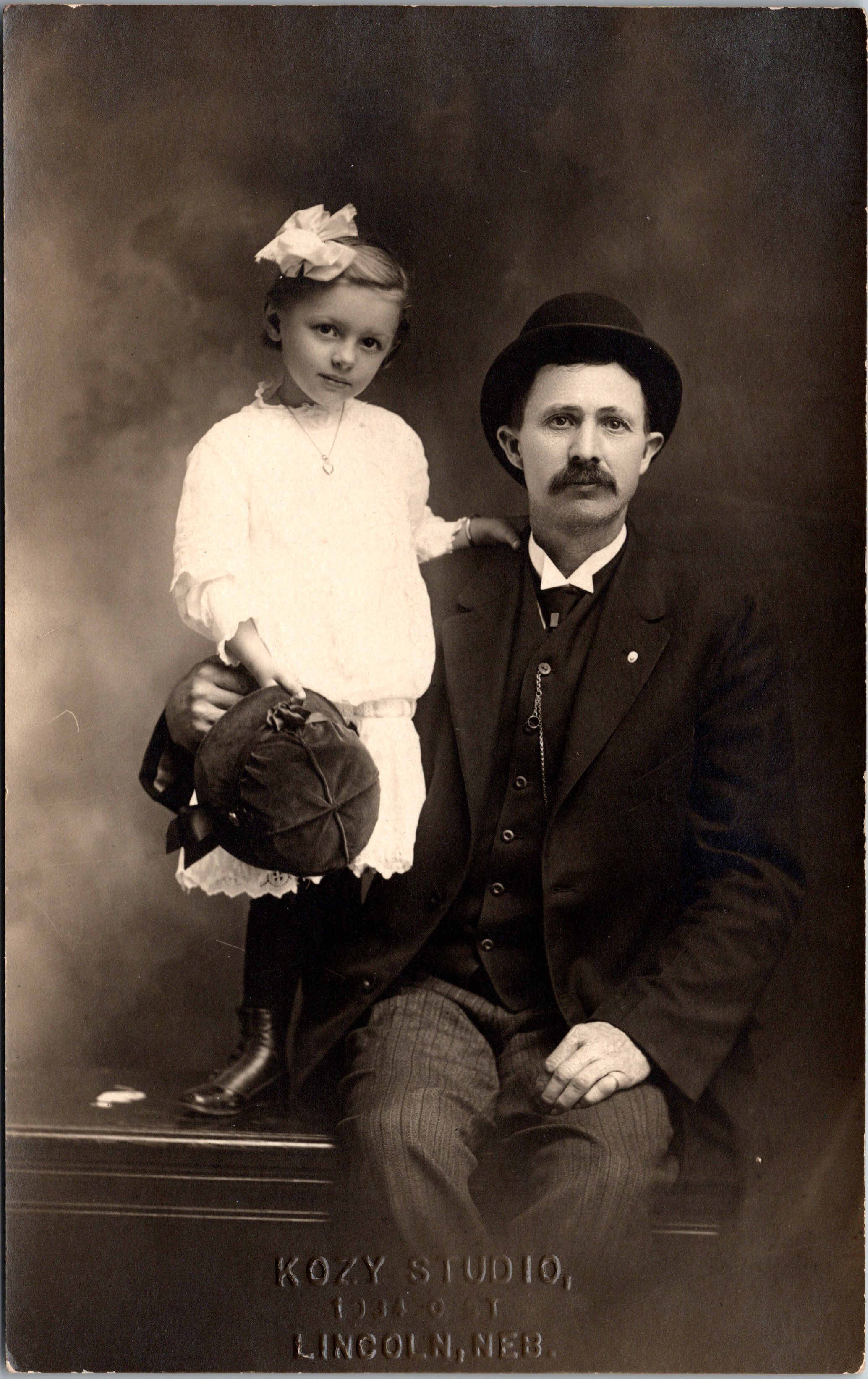
This vintage real photo postcard features a wonderful portrait of a father and daughter. The father is well dressed in a three piece suit. He also is wearing a wing collar shirt , and a bowler hat. Note the chain on his vest that leads to a pocket watch. The little girl in this photograph is beyond adorable. She is giving the photographer quite the look. The child’s name (Clara) is inscribed on the reverse of the postcard. The name of the studio that took this photograph is embossed on the bottom of the image. This family photo came from the Kozy Studio, in LIncoln, Nebraska. This vintage postcard is in very good condition (see scans). SOLD






 THE CABINET CARD GALLERY