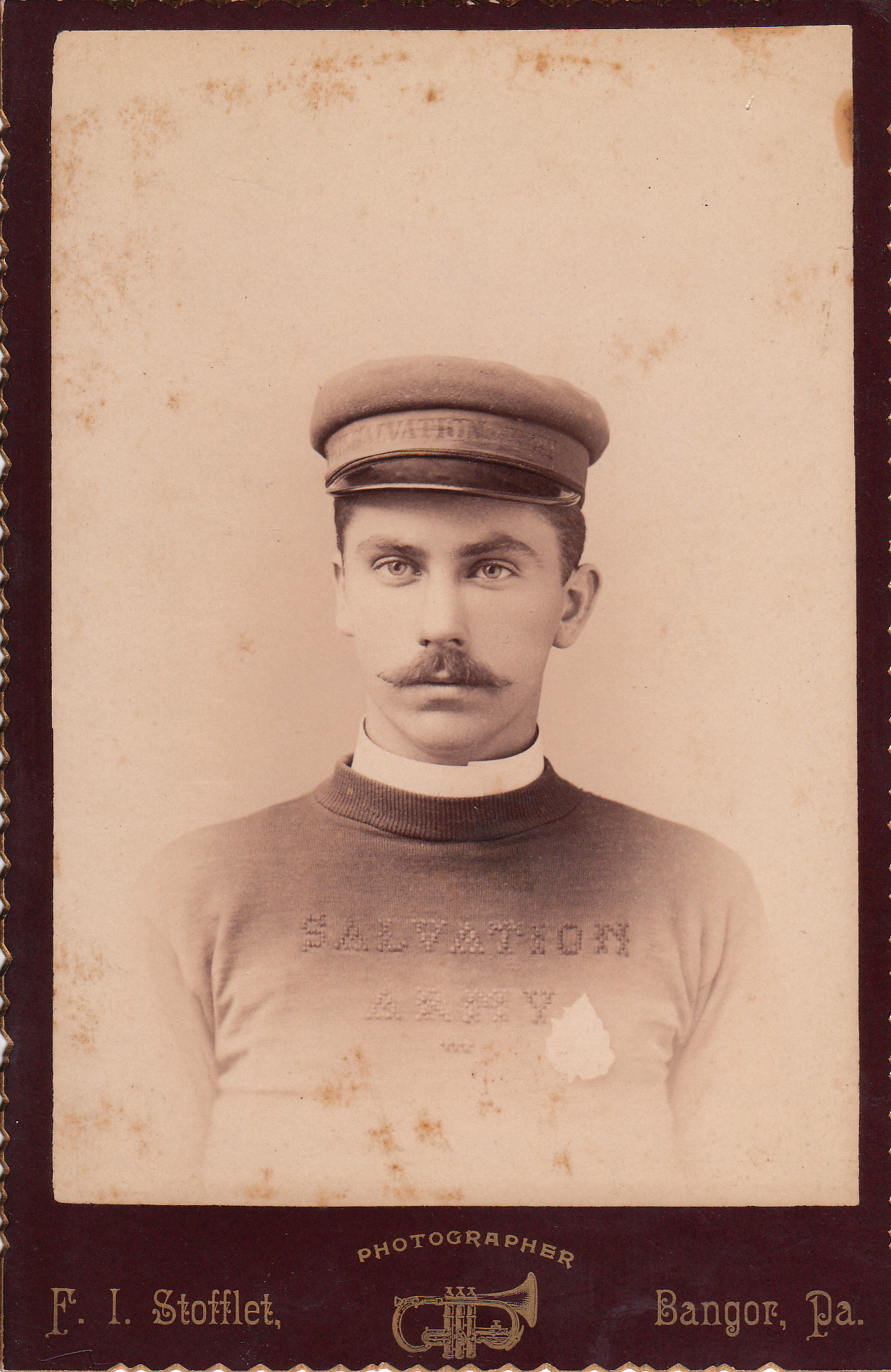
 A handsome young man poses for this portrait in his Salvation Army uniform. His embroidered shirt is labeled “Salvation Army” and has three crosses beneath the lettering. The gentleman’s hat also is labelled “Salvation Army”. The photographer is F. I. Stofflet of Bangor, Pennsylvania. Frank Stofflet was the subject of a law journal article (1894). Stofflet was the defendant against T. J. Stofflett in a case involving violation of a “no compete clause”. )To view other cabinet card images of Salvation Army workers; click on the category “Salvation Army”.
YOUNG AND HANDSOME SALVATION ARMY WORKER IN BANGOR, PENNSYLVANIA

ATTRACTIVE BULGARIAN COUPLE (CABINET CARD PORTRAIT)
 An attractive and well dressed couple pose for their portrait at a photographic studio in Bulgaria. Perhaps a visitor to the site can identify the studio and it’s location in Bulgaria.
DISTINGUISHED GENTLEMAN WITH MUTTONCHOPS IN UTICA, NEW YORK
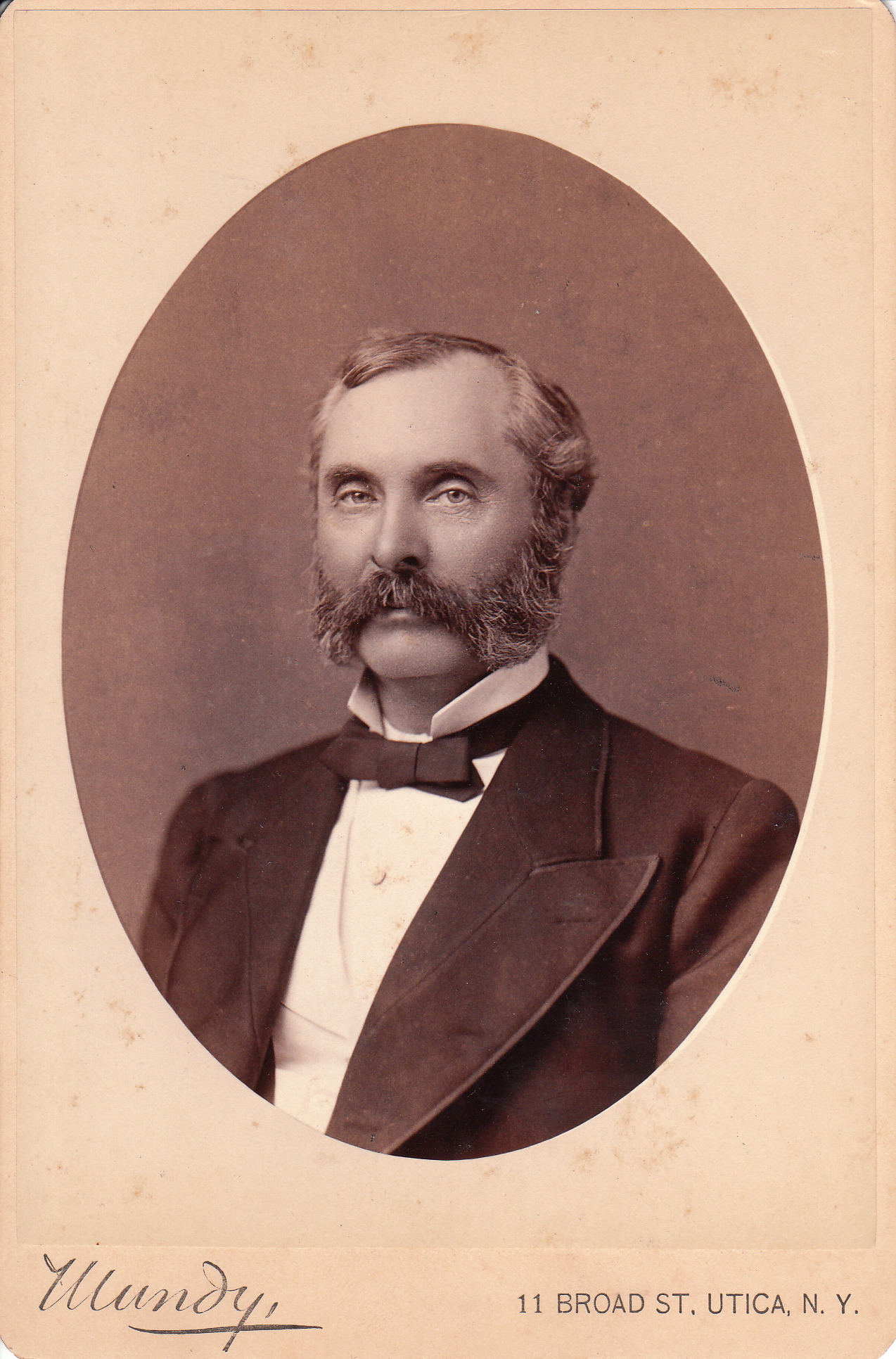 This cabinet card features a handsome and distinguished gentleman posing for his portrait at the Mundy studio in Utica, New York. The gentleman is well dressed and has a neat mustache and muttonchops. The Photographic Times (1887) has a tribute to L. C. Mundy. “Mr Mundy was a self-made man, and a striking example of what aim, firmness of will, and a steady purpose can accomplish.” The writer continues to state that at age eighy, Mundy was left alone in the world, and from that time on, he provided for himself. As an apprentice, he never needed to be told what to do. Instead, “he saw, and he did”. Mundy went from an apprenticeship to eventually become one of the most respected photographers in central New York. Mundy is also known for having employed journalist and author, Harold Frederic (1856-1898).
HOW MANY YOUNG WOMEN FROM OSHKOSH WISCONSIN CAN FIT INTO A CABINET CARD IMAGE? (ANSWER: 11)
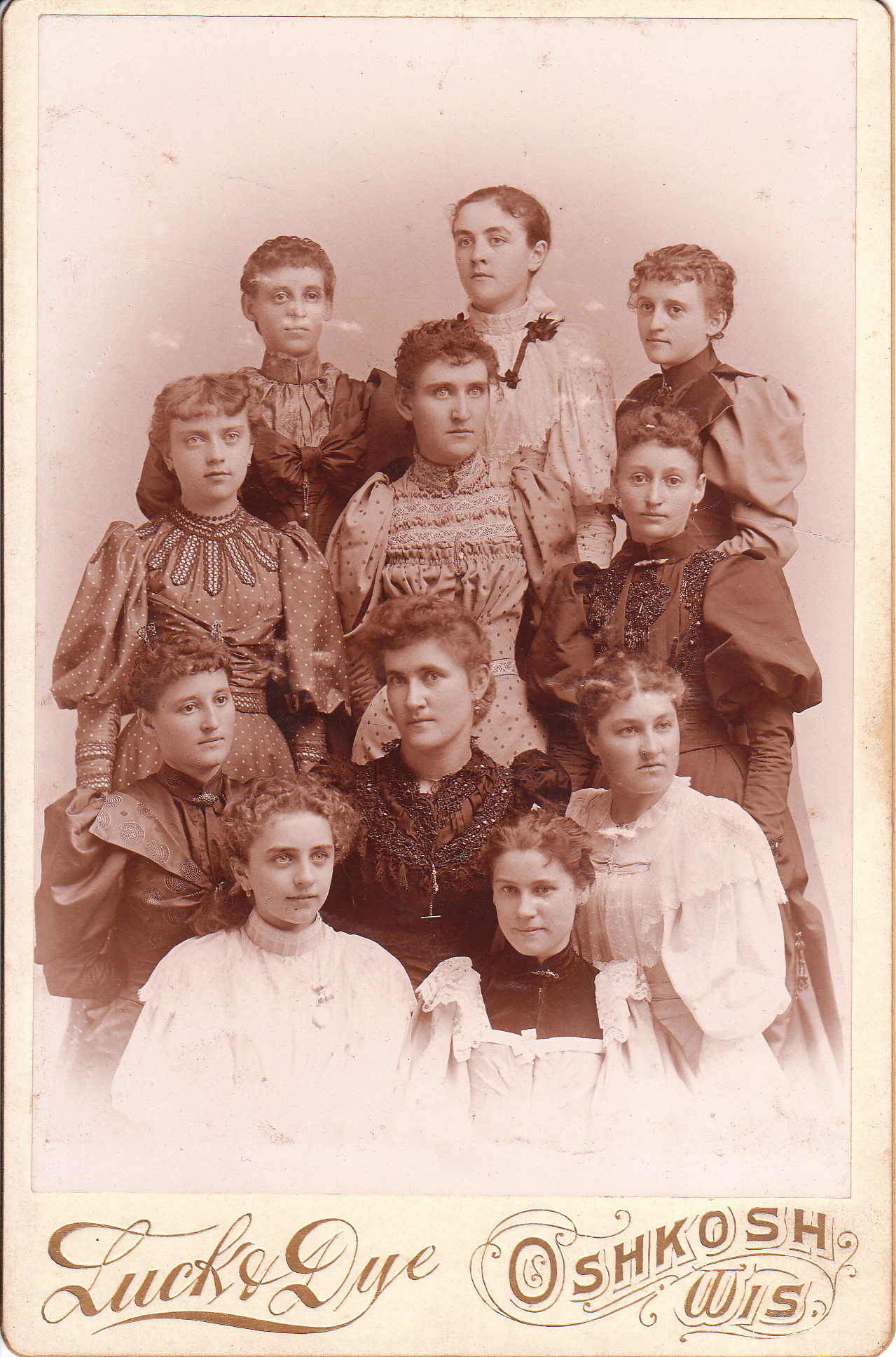 This cabinet card is not particularly artistic or in very good condition. In addition, the subjects in the photograph are not particularly striking. What makes this cabinet card interesting is that it is a portrait that fits eleven young women in the image. This photograph is a cabinet card version of the “how many clowns can you fit into a compact car?” circus act. The photographic studio responsible for this image is Luck & Dye of Oshkosh, Wisconsin. Research reveals that the two men were partners in 1895 and operated out of two locations in Oshkosh. They were headquartered at 49 Main Street and 780 Oregon Street. Tobias Luck was a photographer in Oshkosh between 1889 and 1920 while Albertus Dye operated in Oshkosh between 1889 and 1910.
FASHIONABLE WEDDING COUPLE IN VIENNA, AUSTRIA
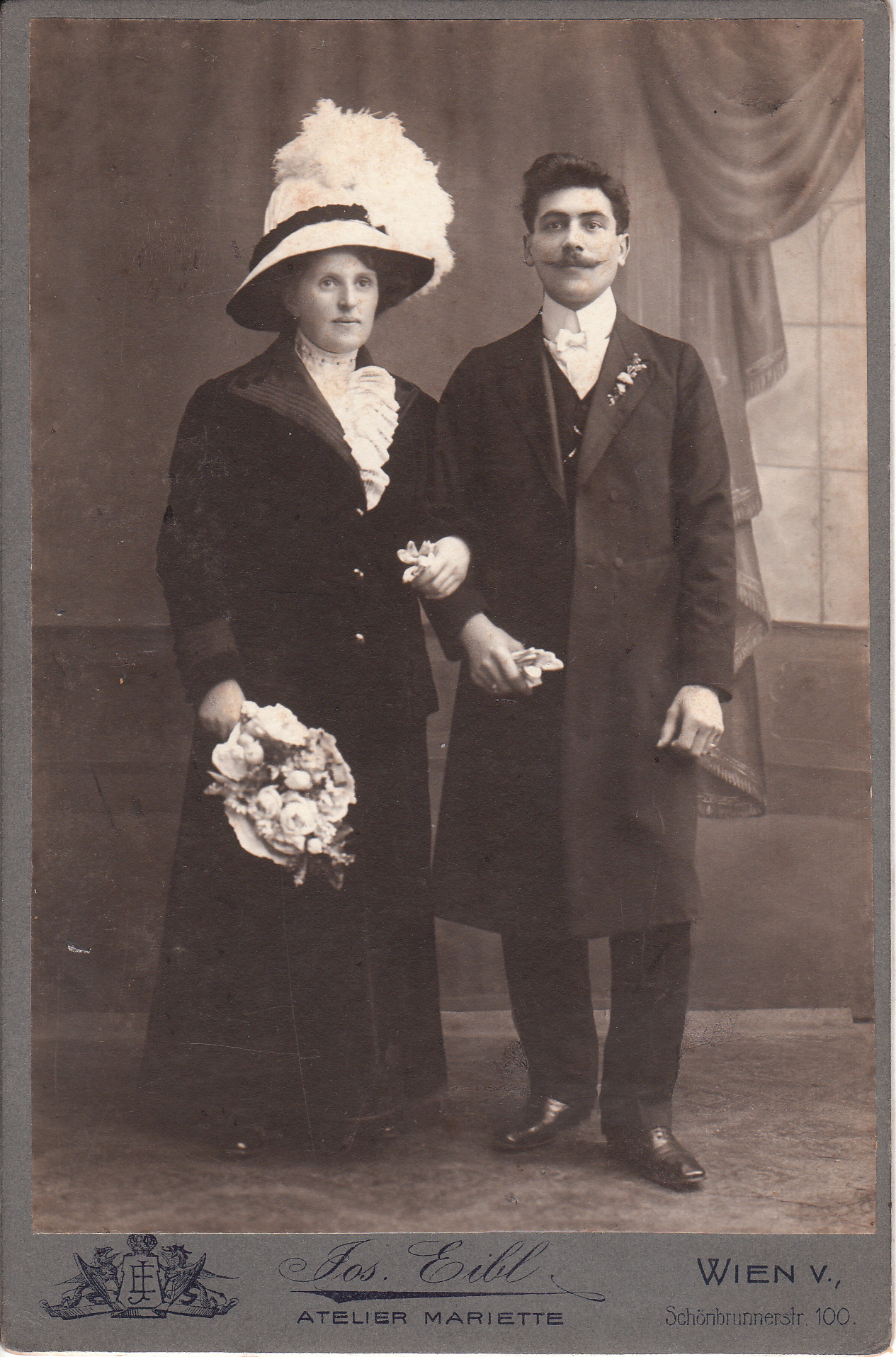 This photograph appears to be a portrait of a wedding couple. The pair are beautifully dressed for their special day. The bride is holding a large flower arrangement and a wonderful hat. The groom has a magnificent mustache. Both subjects are holding a pair of gloves. The previous owner of this photograph claims that the couple in the photograph are from the Sympa family, but no explanation regarding how they were identified, was provided. The photographer of this image is Josef Eibl of Vienna, Austria.
COSTUMED GIRLS IN SCHOOL PLAY (1883)
 This cabinet card appears to be an image of a group of girls who are members of a cast of a school play. The girls are dressed in ethnic costumes. The girl sitting closest to the photographer is dressed beautifully in gypsy garb. Two individuals in this image appear to be adults and one may surmise that they are the teachers who are directing the show. Two of the girls are holding flowered hoops. A sign made up of leaves or vines indicate that this photograph was taken in 1883. Next to the date, two letters are hanging. The letters are either “MC” or “HC”, which may be an abbreviation of the school or group that is putting on the production. The name and location of the photographer is unknown since a prior owner of this cabinet card trimmed the edges to fit into an album or frame.
WOODSMAN IN CLAUSTHAL, GERMANY
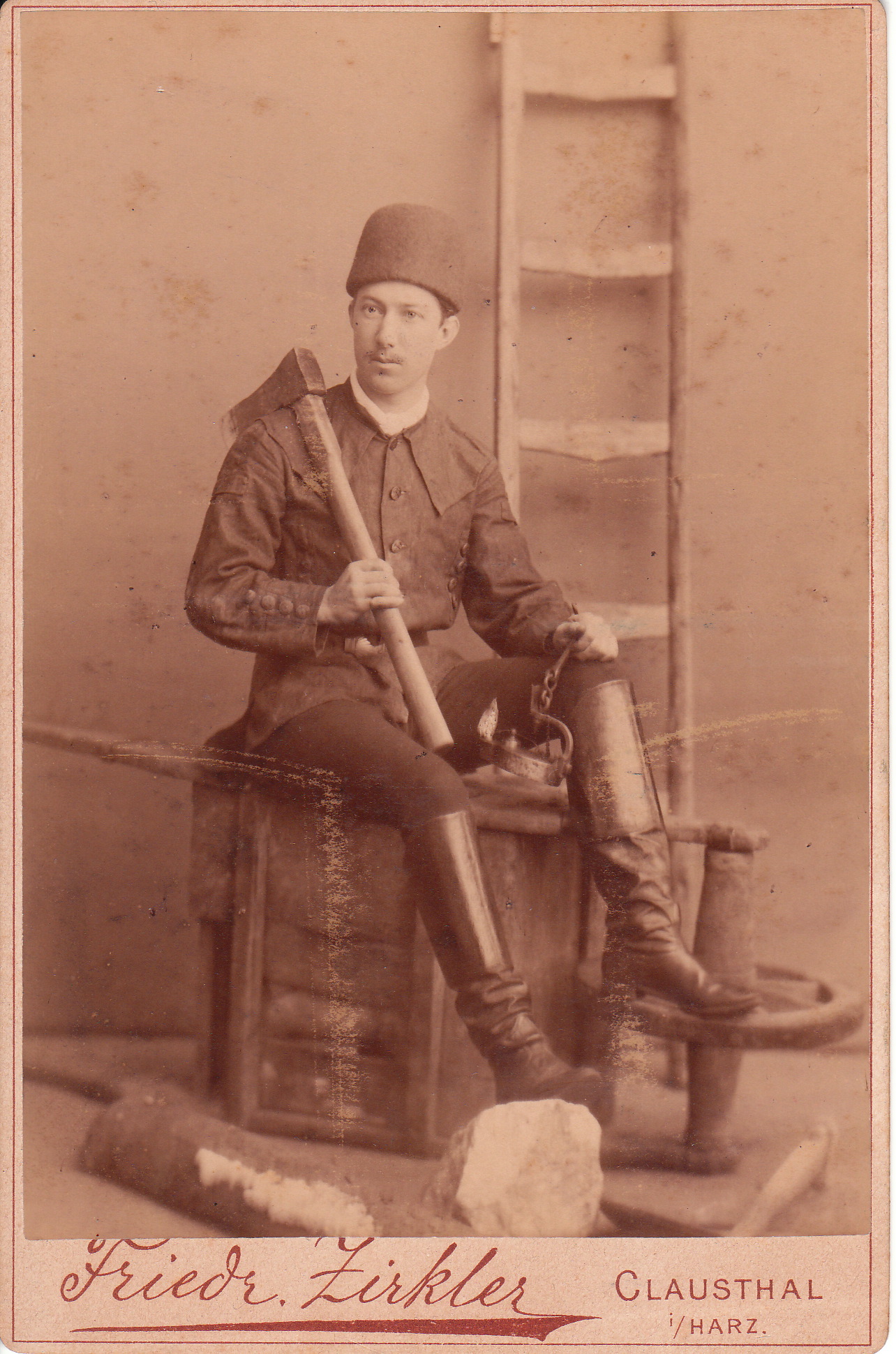 This occupational cabinet card features what appears to be a Woodsman and his axe. He is holding a metal tool in his left hand. Hopefully, a visitor to this site can identify the name and purpose of this particular tool. The mysterious object actually looks like an animal trap. Note the ladder in the background and the cut wood in front of him. He appears to be sitting on an overturned wheelbarrow. The photographer of this image is Friedrich Zirkler, of Clausthal, Germany. Clausthal is a town in Lower Saxony in the Harz Mountains. The area was known for its mining activity at the time of the photograph.
NOTABLE MUSTACHE IN MINNEAPOLIS, MINNESOTA (THE PHOTOGRAPHER WAS A SCOUNDREL)
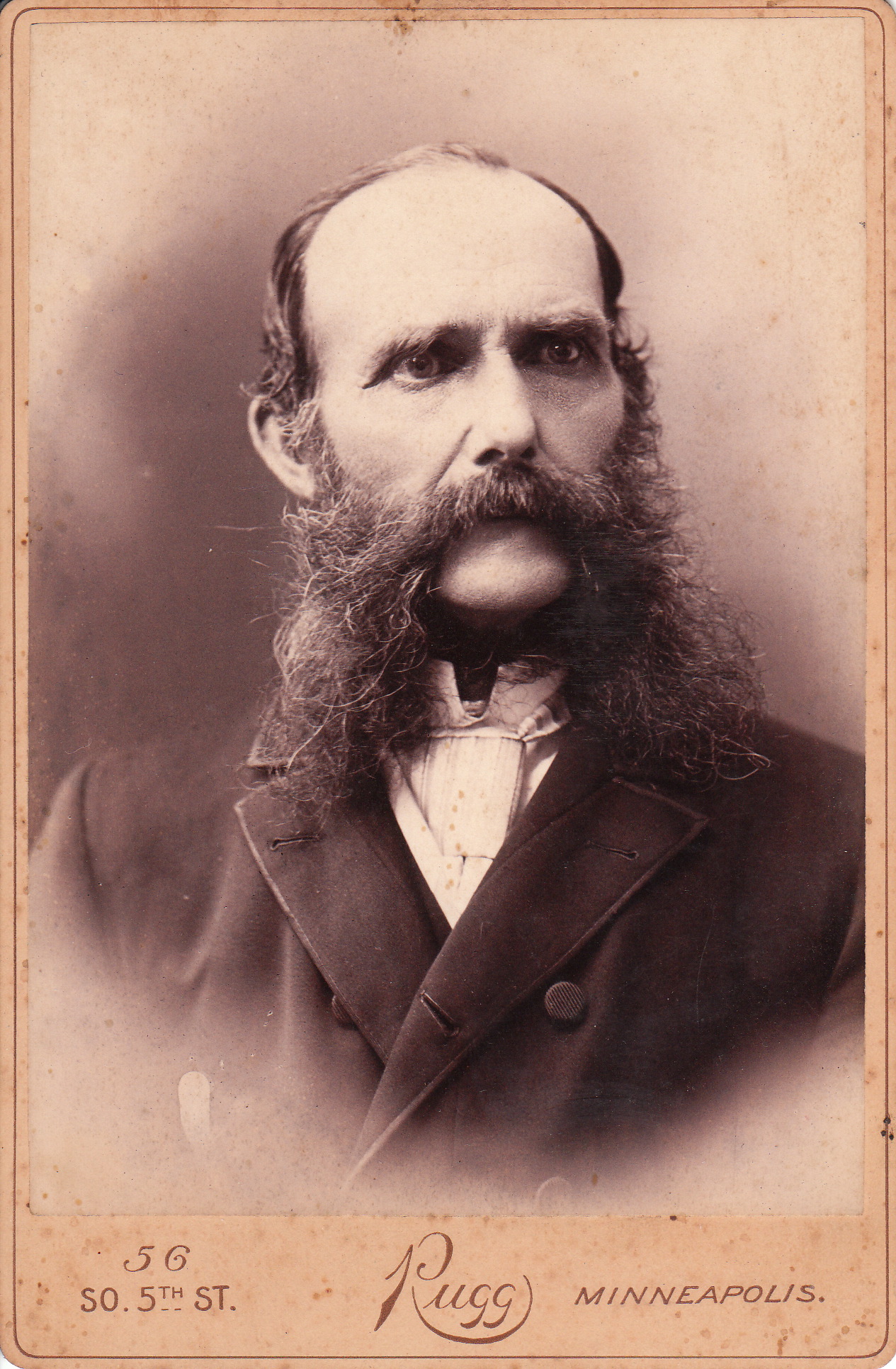 This cabinet card features a gentleman with a very notable mustache and bushy sideburns. He looks like a very intense man as he stares at the camera. The man behind the camera was Arthur B. Rugg (1853-?). Rugg’s life story is likely similar to many men who pursued the occupation of photographer. Such a life requires much change; first, working for various photographers in various locations, and finally, making enough money to finance ones own gallery. Rugg, at age 17, was an apprentice to J. C. Moulten of Fitchburg, Massachusetts. Moulton took ill just three weeks after Rugg began his apprenticeship and Rugg was forced to be a quick learner. He operated the gallery by himself and at night consulted with Moulten in his sick chamber , receiving criticisms and instructions. Rugg operated the business on his own for three weeks and the business did not suffer with him at its helm. In 1873, Rugg opened his own gallery but it did not do well, so he moved to Boston and worked for a photographer there for the next two years. He then went to Florida to become an orange grower but he lost everything when the business failed. His next stop was New Orleans where he worked for W. W. Washburn in one of the city’s leading galleries. However, after contacting malaria, he was forced to move North and ended up in LaCrosse, Wisconsin where he worked for a year and a half for a leading studio there. In 1879, he moved to Minneapolis and purchased the studio of William Brown and soon Rugg became one of the leading photographers of Minneapolis. Rugg was also noted for being involved in a major lawsuit that had impact on the profession of photography. The American Journal of Photography (1890) reported that the Supreme Court of Minnesota handed down a decision against Rugg for selling a copy of Mrs. Ida E. Moore’s photograph “which was put on exhibition in improper places, much to the discredit of the lady”. He was ruled to have had no right to the picture which legally belonged to the sitter (Ms. Moore). She won her suit for damages of five thousand dollars although it is not clear if that was the actual amount awarded. Another photography journal of that time reported more specifics of the case. It seems that Rugg had given one of Ms. Moore’s pictures to a police detective named Clark, who showed the photos in a number of houses of ill repute in the Minneapolis and St. Paul area. The court ruled that although the negatives of the photograph belonged to Rugg, he could not print photographs from those negatives without permission from Ms Moore. Mr Rugg seems to have lacked some ethics in this instance. Now, back to that great mustache. To view other photographs of unusual mustaches, click on Cabinet Card Gallery’s category of “Mustaches (Only the Best)”.
YOUNG BOY PULLING HIS TODDLER SISTER IN A WAGON (FEMALE PHOTOGRAPHER IN COUNCIL GROVE, KANSAS)
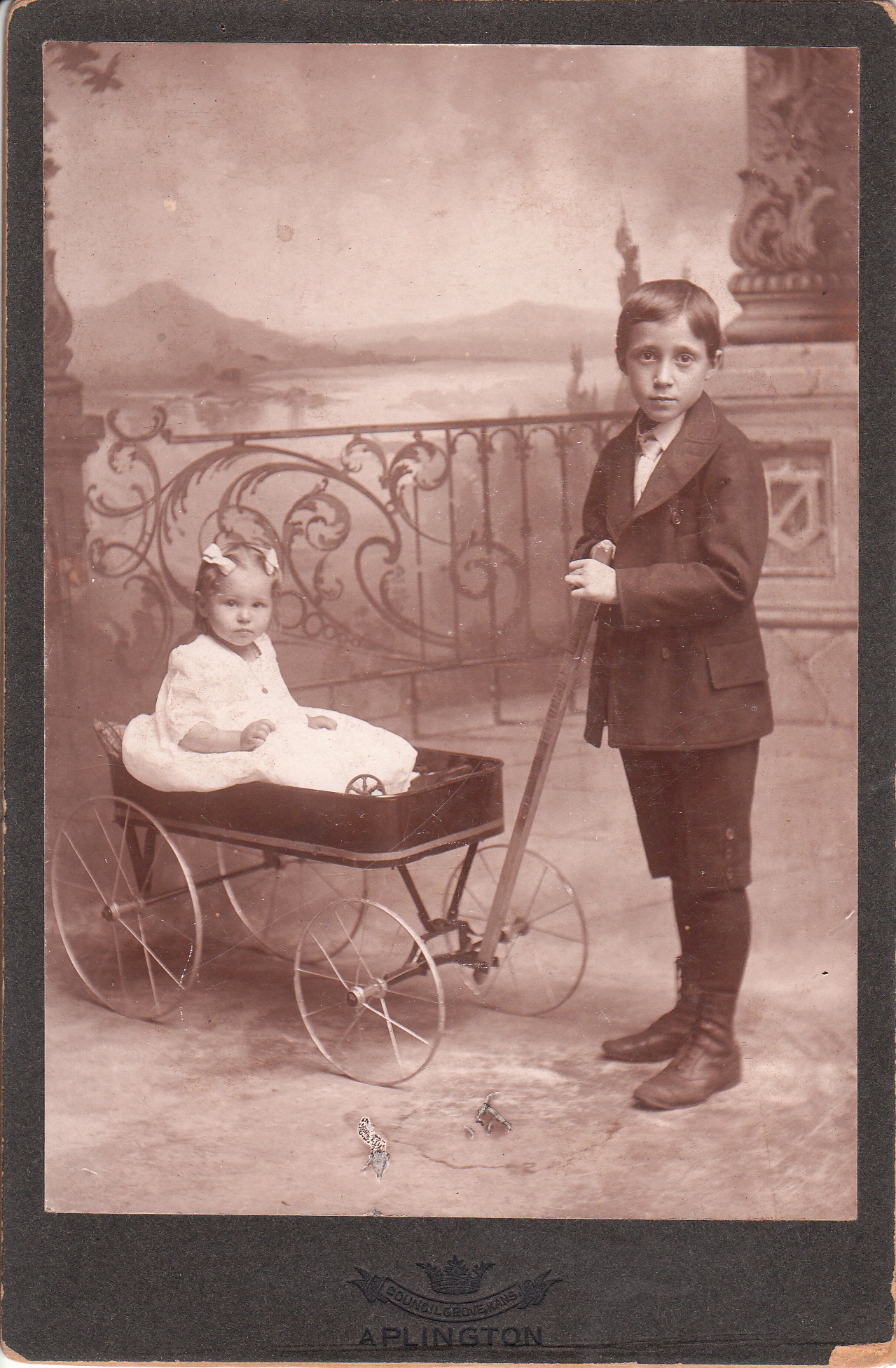 This is the likely scenario. The boys parents, at the photographers suggestion, said, “Go stand over there and pretend that you are pulling your sister in the wagon”. The boy followed his parents suggestion, but, he wasn’t too happy about it. He certainly wasn’t going to smile for the photographer. This day at the photographer’s gallery was certainly not the fun he had hoped it would be. In contrast, little sister was interested in her surroundings and she sits in the wagon taking it all in. Examination of the wagon reveals that she appears to have a pillow behind her and that there may be a toy , perhaps a spinning top, directly in front of her. The photographer of this image is Kate Adele Aplington (1859-?). Her studio was in Council Grove, Kansas. Kate Aplington was an author and an artist. She was a professional photographer between 1886 and 1900. She held office in the state suffrage association and gave lectures about suffrage issues. A photography journal indicates that she sold her photography gallery to Emma Harvey (1900). In 1901 she donated a small set of photogravures which became the nucleus of a state art study collection which was basically a travelling art gallery. It became known as the “Aplington Art Gallery”. The purpose of the traveling exhibit was to cultivate the appreciation of art in Kansas. Aplington wrote the lectures accompanying the exhibit. In 1912, she published a novel about the pioneering times. Aplington was a truely accomplished woman. As an aside, it is interesting to note that Council Grove is named after an agreement between European Americans and the Osage Nation that allowed settler’s wagon trains to pass through the area on their way out west. Council Grove was one of the last stops on the Santa Fe Trail heading southwest.
TEENAGE GIRL ON A SWING, IN PHELPS, NEW YORK
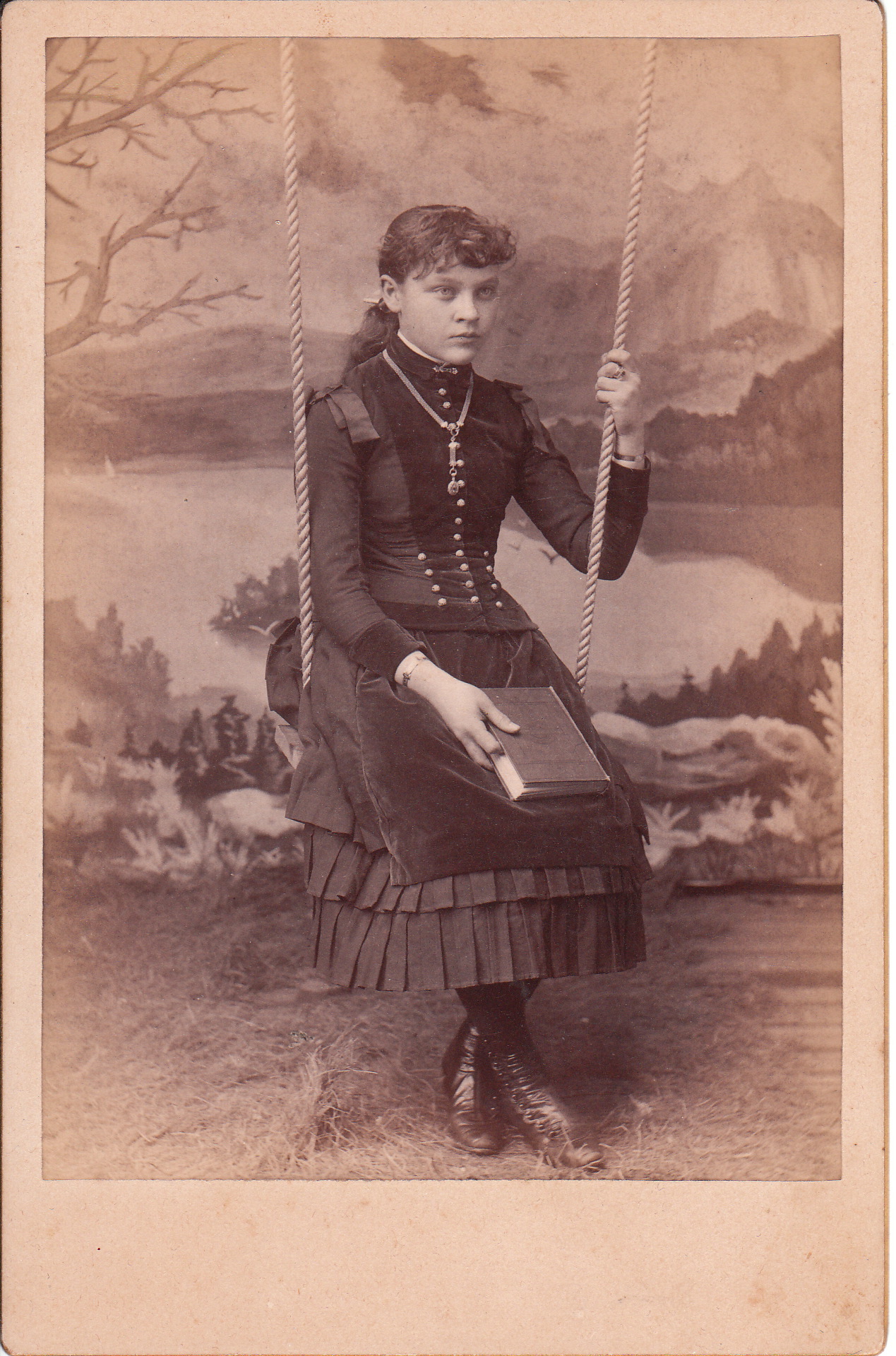 A teenage girl poses for her portrait at the studio of D. Edwin Pardee, in Phelps, New York. She sits on a swing with a book on he knees and a serious expression on her face. Swings were often used as props at photographic studios. To view other examples of people posing on swings, click on the category of “Swings”.


 THE CABINET CARD GALLERY