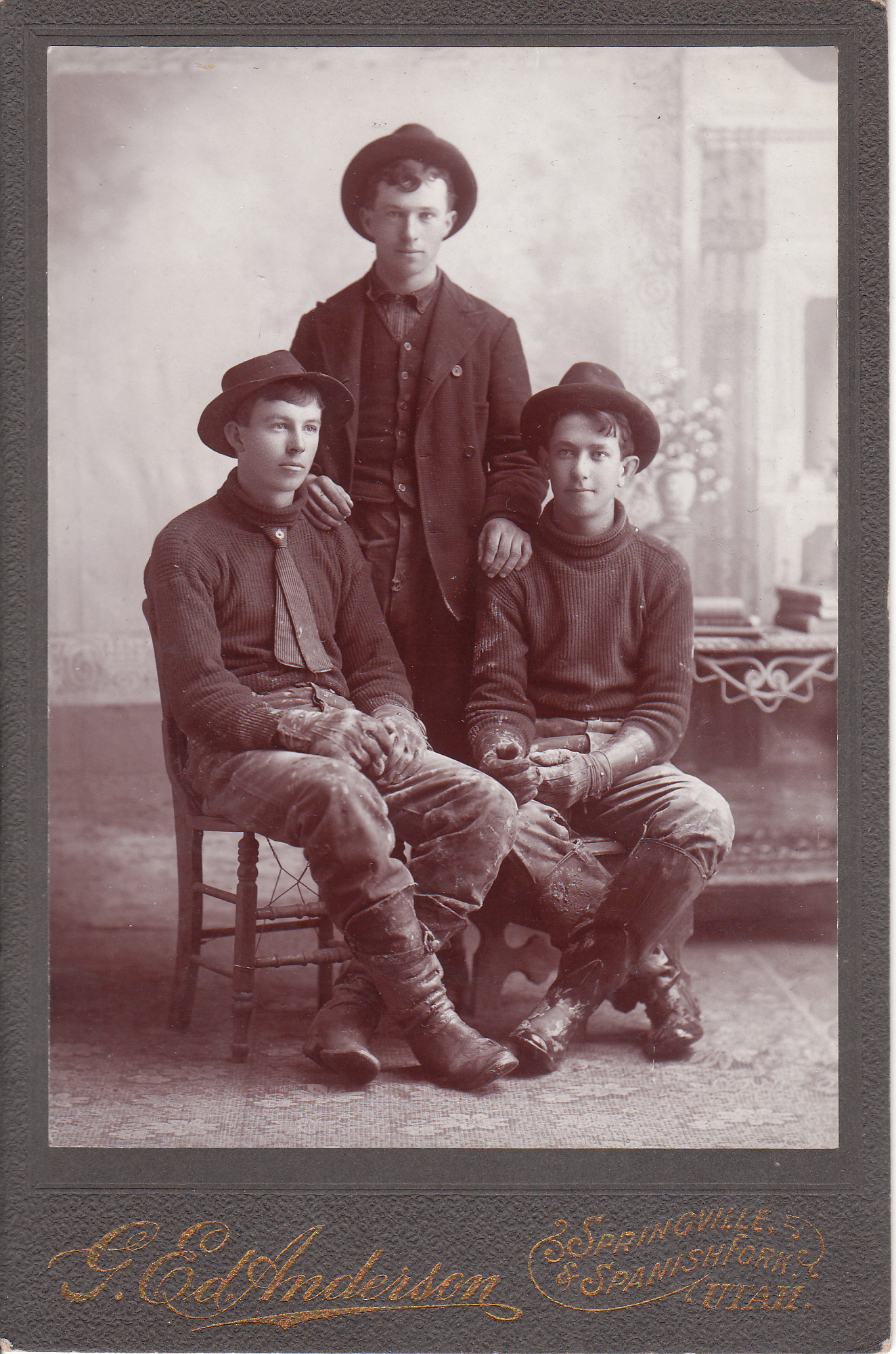
Three young men pose for their portrait at the studio of G. Ed. Anderson, located in either Springville, or Spanish Fork, Utah. The guys may have come to the studio after work. The two seated men are wearing work boots and work gloves. They are also wearing dirty trousers. Interestingly, one of the guys is wearing a turtleneck, a garment not seen often in cabinet card photographs. An inscription on the reverse of the card identifies the men as Saul Clyde, Will Rowland, and John Whiting. It would be interesting to hear some of this sites visitors opinion as to what occupation these men may have occupied. Please leave a hypothesis if you have one. Photographer, George Edward Anderson (1860-1928) was a noted photographer for his portraiture and documentary photographs of early Church of Jesus Christ of Latter-day Saints temples. He was born in Salt Lake City, Utah and was a photographer apprentice to renowned photographer Charles Roscoe Savage. At age seventeen, Anderson established a photography studio in Salt Lake City with two of his brothers. He then established a studio in Manti, Utah and in 1886, he moved his studio to Springville, Utah. Anderson became well known for his traveling tent studio which he set up in small towns throughout central, eastern and southern Utah. During that time he did an excellent job of documenting the lives of residents in the years 1884 to 1907. Although best known for his portraits, Anderson took many documentary photographs of homes, barns, businesses, Temples, mines and railroads. He went to England on his Church of Latter Day Saints mission in 1909 to 1911. After his mission, he set up a photography studio in South Royalton, Vermont, which is near the birthplace of LDS prophet Joseph Smith. In 1913, he returned to his home and family in Springville. He returned to financial and marital problems and tried to revive his traveling tent studio but met little success. The later years of his life were spent documenting families and life in Utah Valley and traveling to photograph newly constructed temples. Anderson received most of his recognition long after his death. A collection of his works is housed at Brigham Young University library.
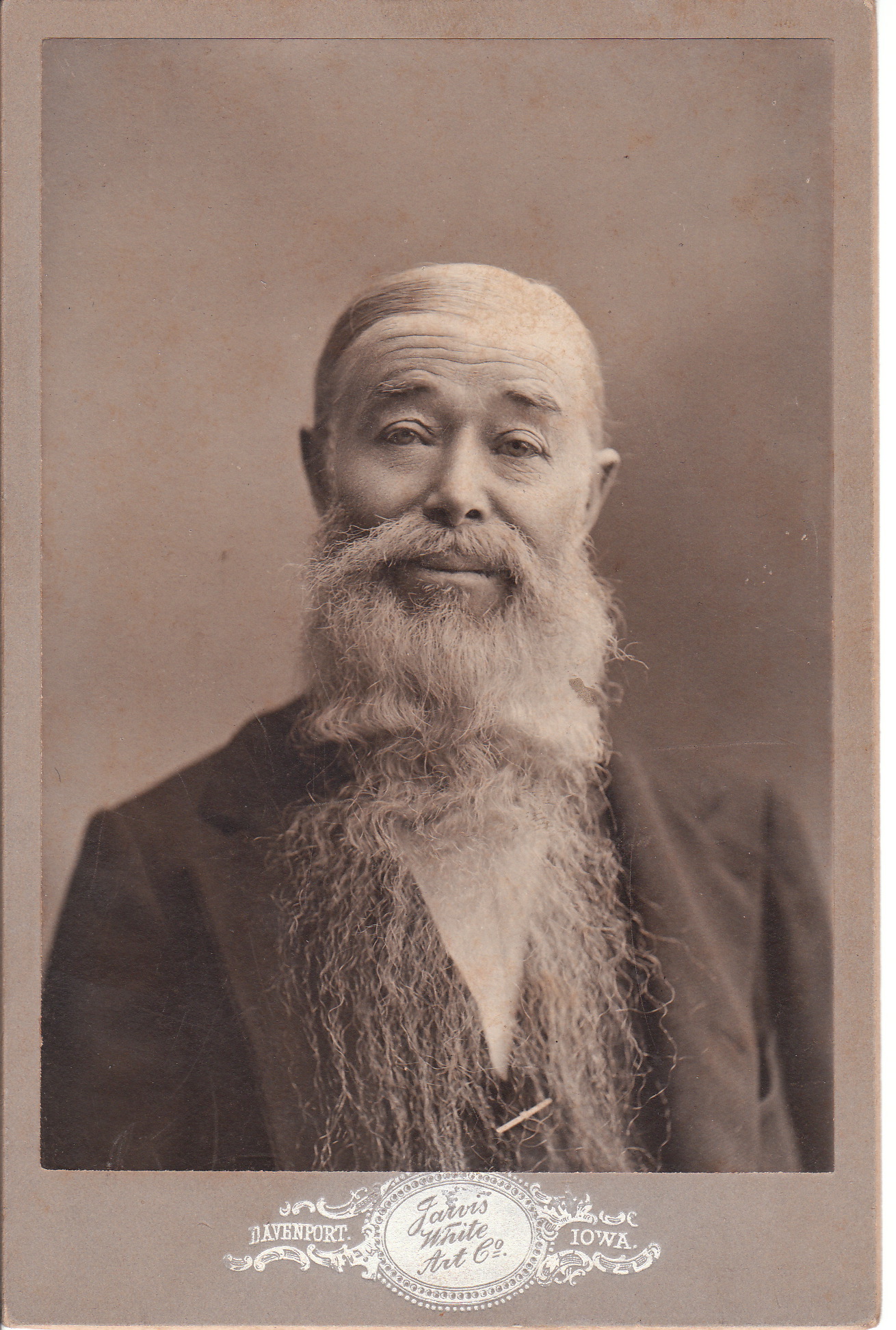
ASIAN MAN IN DAVENPORT, IOWA (IT AIN’T NECESSARILY SO!)
This photograph features a gentleman of Asian appearance posing in the studio of Jarvis White, in Davenport, Iowa. The subject may not actually be of Asian descent; the hypothesis is certainly debatable. The gentleman has a fantastic and well tended mustache and beard. The photograph has remarkable clarity. The reverse of the photo has a pencilled inscription of a woman’s first name (Grace) and an illegible last name. The card is also dated November, 1898. To view other images of interesting facial hair, click on this site’s categories of Beards: (Only the Best) and Mustaches (Only the Best). The photographer of this image established his photographic studio in 1874 and was the successor to Hastings, White & Fisher, of 320 Brady Street, in Davenport, Iowa.
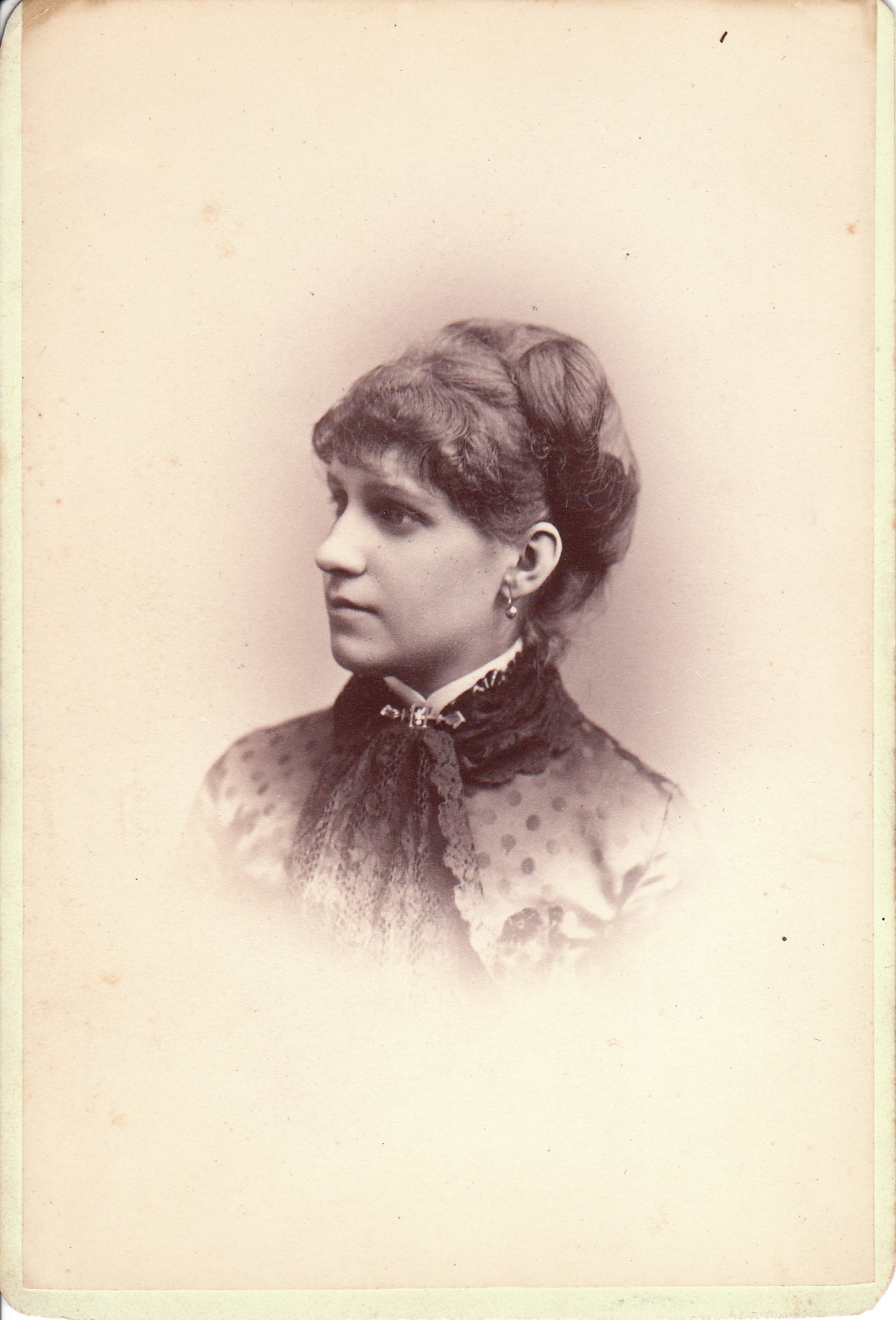
PRETTY WOMAN IN MALDEN, MASSACHUSETTS
A pretty woman poses for her portrait at the Foss Studio, on Florence Street, in Malden, Massachusetts. The subject of the photograph is named Nellie which is evident from the inscription that she made on the reverse of the card. She wrote “Patience is furnished here by, Nellie”. Below the inscription is the full name of the subject, but other than determining that the last name begins with a “C”; the writing is illegible. The photographer of this cabinet card is Eliphalet Jay Foss (1840-1923). He was born in New Hampshire and later worked as a photographer and an art restorer on Tremont Street in Boston, Massachusetts. In time, he operated a “Garden Studio” in Malden, Massachusetts. He held a photographic patent and photographed many famous people, including Ralph Waldo Emerson.
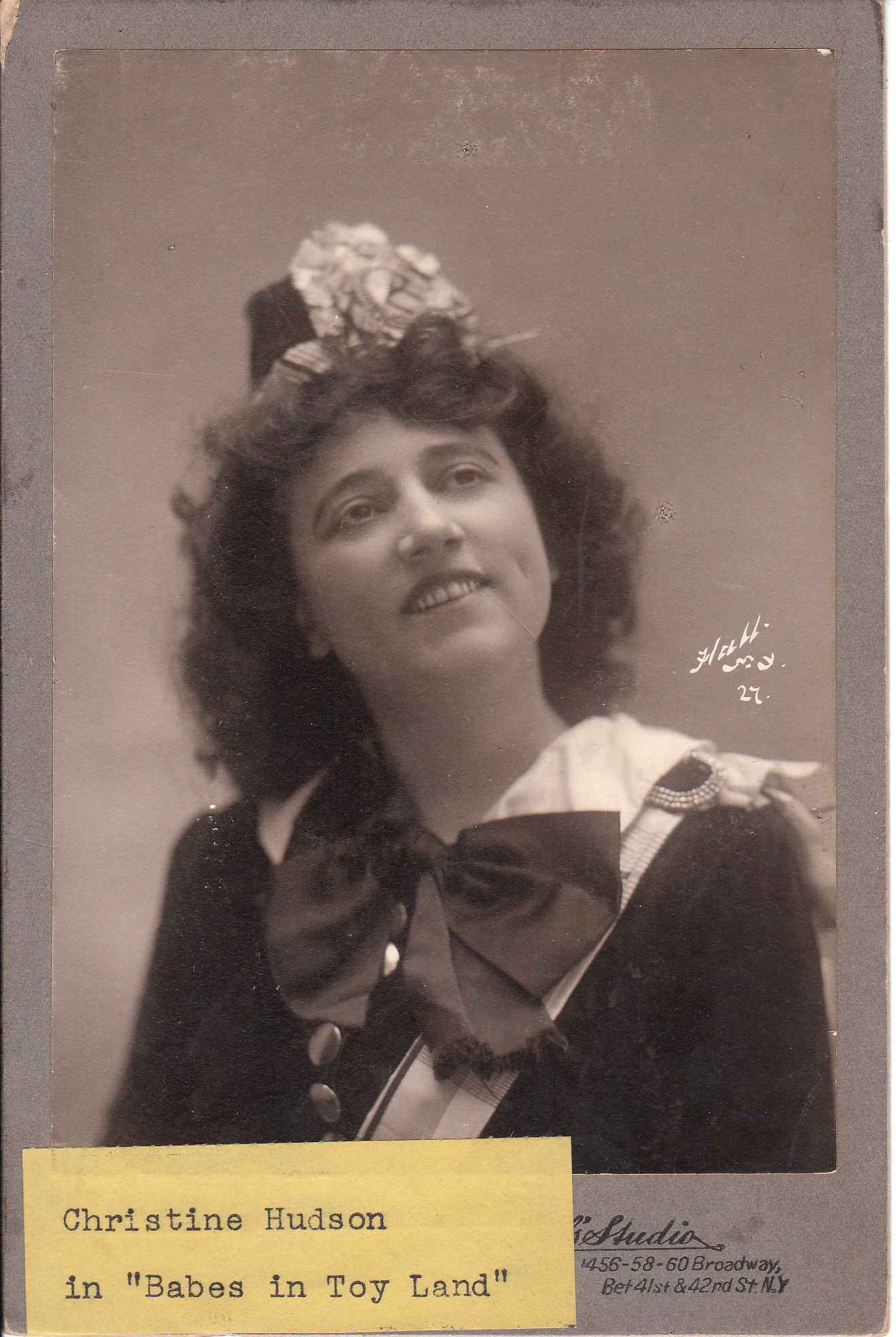
CHRISTINE HUDSON IN BABES IN TOYLAND
This Cabinet Card features stage actress Christine Hudson in costume for her role in “Babes in Toy Land”. The New York Times (9/10/1905) reports that the show was appearing at the West End Theatre and the cast included May De Sousa. An earlier edition of the New York Times (1902) announces her appearance in “Princess Chic”. The reverse of the cabinet card has an affixed label stating that the photograph is number H-16 of the “Oral M. Heffner Theatrical Collection” and the property of the Franklin County Historical Society. Research sheds some light on the Heffner collection. The Ohio State Archeological and Historical Quarterly (1953) writes that the first showing of the Oral M. Heffner Theare Collection was in 1953 and that the collection included over 700 rare photographs of early actors and actresses “who visited Columbus years ago”. The label on the front of this photograph blocks the name of the photographer. The name of the photographer etched on this image appears to be “Hall”. There was a Hall Studio located in New York City at a different Broadway address and it is possible that the studio was once at the Broadway address listed on this cabinet card. However, confirmation is needed and any verification help from a visitor to this site would be appreciated. To see other images by Hall, click on the category “Photographer: Hall”. To see other cabinet cards from the Heffner Collection, click on Cabinet Card Gallery’s category of “Oral M. Heffner Theatrical Collection”.
SAILOR BOY IN PHILADELPHIA (1890)
Meet Willie Howard Smith. He was three and a half years-old at the time of this photograph, which was in 1890. Willie is adorable as he poses for his photograph in his sailor suit. He is wearing a wonderful cap which is covering his longish hair. The photographer of this cabinet card portrait is Kuebler, who was located in Philadelphia Pennsylvania. Research discloses some interesting information about the photographic studio. The studio was co-owned and operated by brothers William Kuebler and Louis H. Kuebler. They were very successful photographers and one of their photographs of Walt Whitman is very well known among those that study the great poet. A news article in The Photographic Times (1888) announces the “largest contract ever made in the photographic line” had been awarded to William Kuebler to photograph the members of the Mexican Typical Orchestra. In all, 4,750 photographs were ordered.
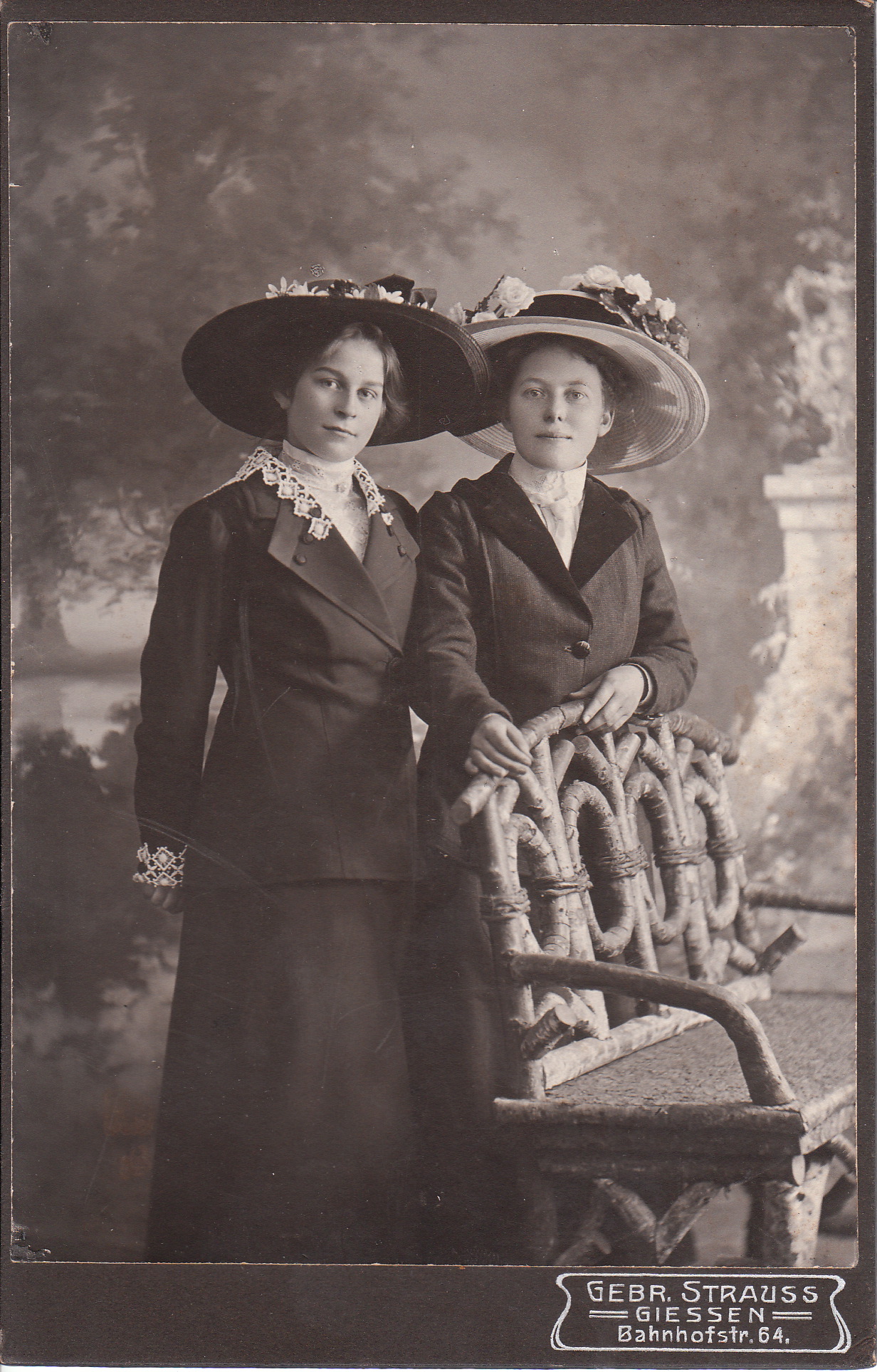
TWO FASHIONABLE LADIES : GIESSEN, GERMANY 1912
Two attractive women pose for their portrait at the studio of the Strauss Brothers, in Giessen, Germany. These ladies have a flair for fashion and apparently the financial wherewithal to support their fine taste in apparel. The woman are attractive and dressed beautifully. Note their fine hats. An inscription on the reverse of the image indicates that the image was photographed in 1912.
ATTRACTIVE AND FASHIONABLE YOUNG COUPLE IN LAINGSBURG, MICHIGAN
An attractive and fashionable young couple pose for their portrait at the studio of D. E. Denniston in Laingsburg, Michigan. The woman is wearing a belted dress with sleeves puffed at the shoulder, and the gentleman is young, dark and handsome in his striped suit. SOLD
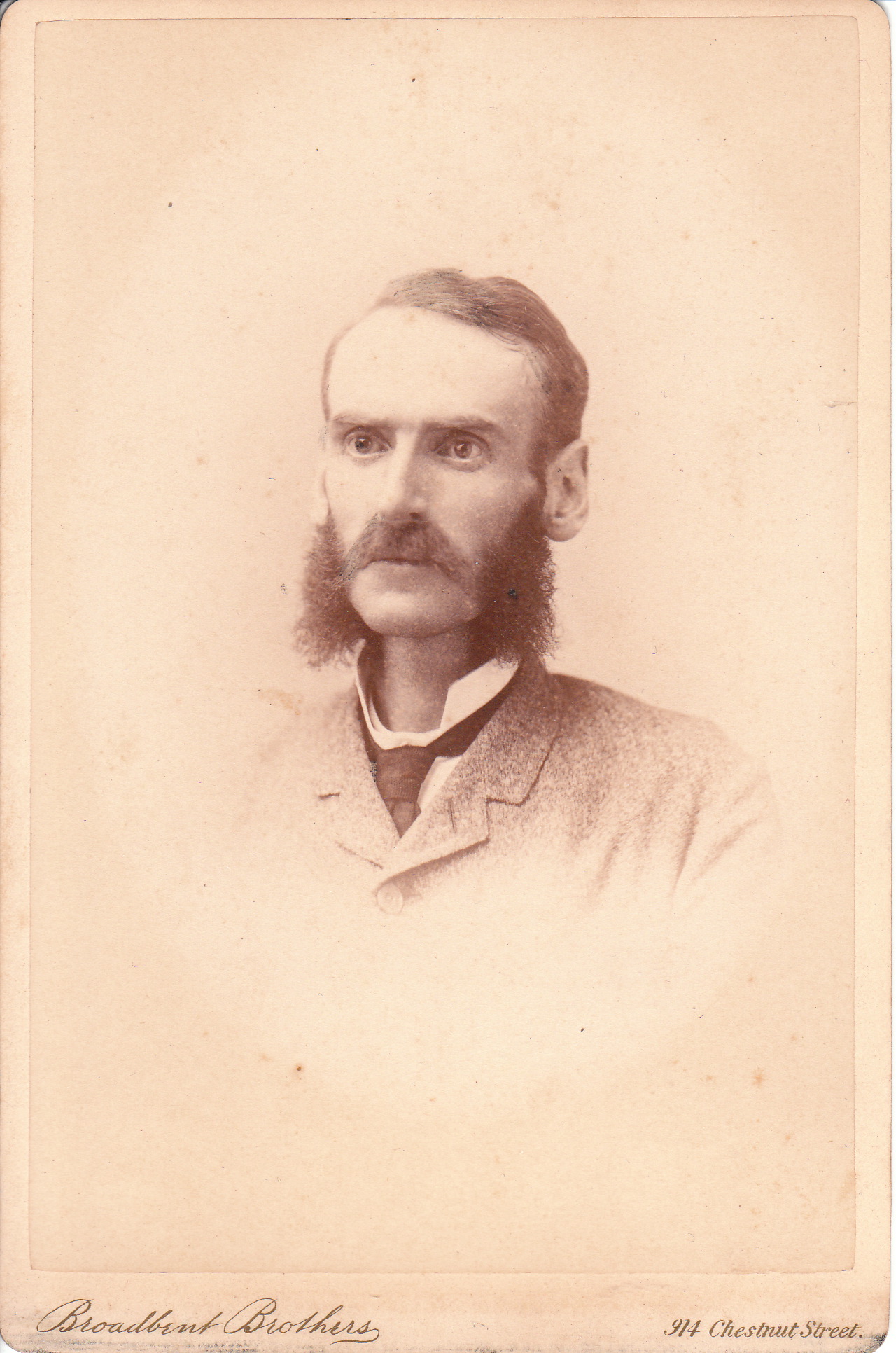
SERIOUS SIDEBURNS IN PHILADELPHIA, PENNSYLVANIA (1886)
A gentleman poses for this cabinet card portrait at the studio of the Broadbent Brothers in Philadelphia, Pennsylvania. The man has formidable bushy sideburns. The reverse of the cabinet card identifies the subject as John R. Elliot and indicates the photograph was taken in 1886. The Broadbent Brothers were the sons of prominent daguerreotype photographer, Samuel Broadbent. The elder Broadbent was in partners with W. Curtis Taylor in the photography business. Samuel Broadbent died in 1880 and Taylor then partnered with Sam’s sons until they bought out the business in 1884. To see other photographs of interesting facial hair, click on this site’s category of “Beards (Only the Best)” or “Mustaches (Only the Best)”.
HANDSOME LONG HAIRED YOUNG MAN IN FOND DU LAC, WISCONSIN
A long haired young man poses for his portrait at the studio of Miller & Chadbourne in Fond Du Lac, Wisconsin. The gentleman in this photograph is formally attired and has a very serious expression. No information has been found about photographer Miller, but research provides some information about photographer Cyrus Chadbourne. The journal, Photo Beacon (1897), reports that Chadbourne was President of the Photographers Association of Wisconsin. Other photography publications mention Chadbourne as early as 1883 and as late as 1924, when his studio was torn down.