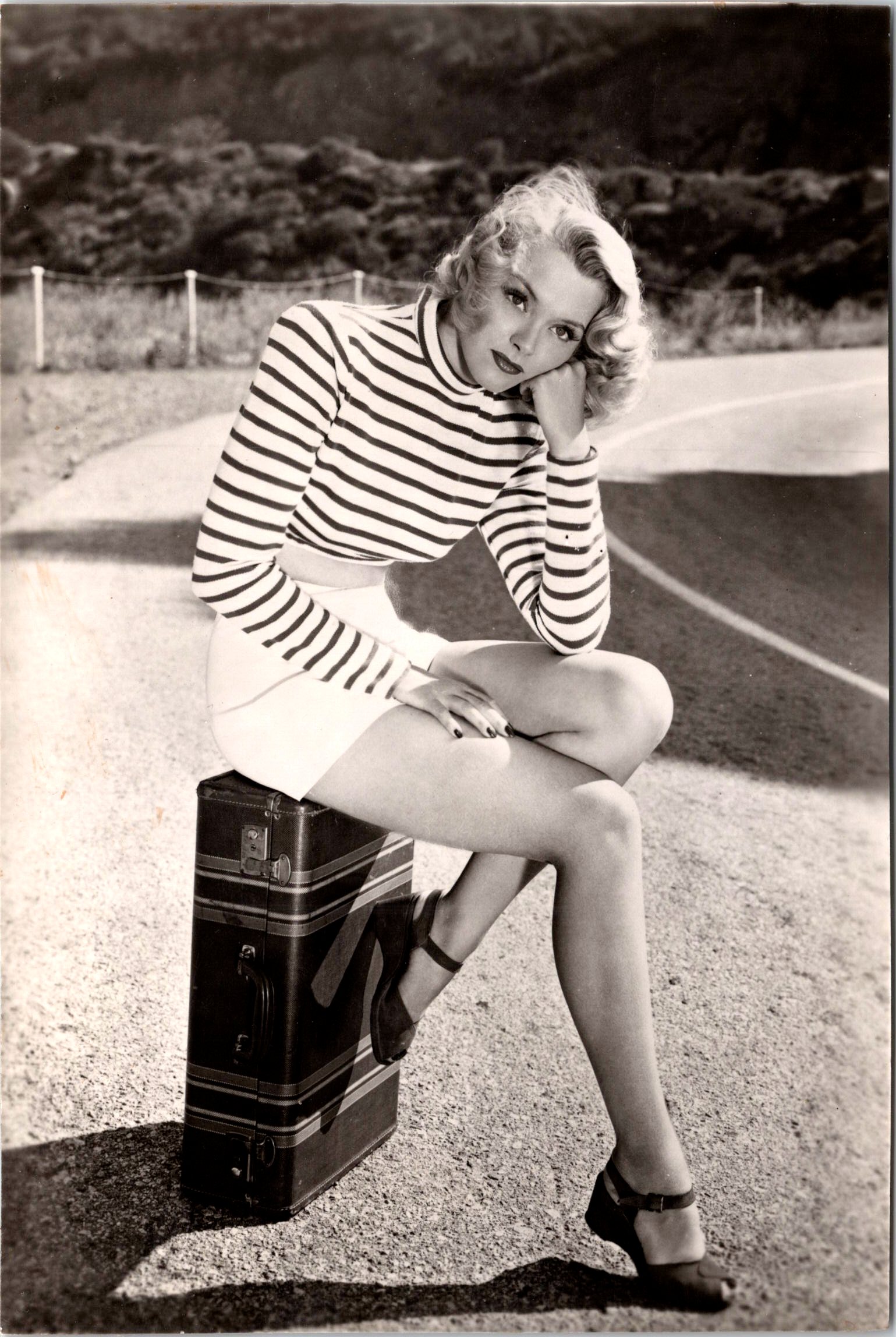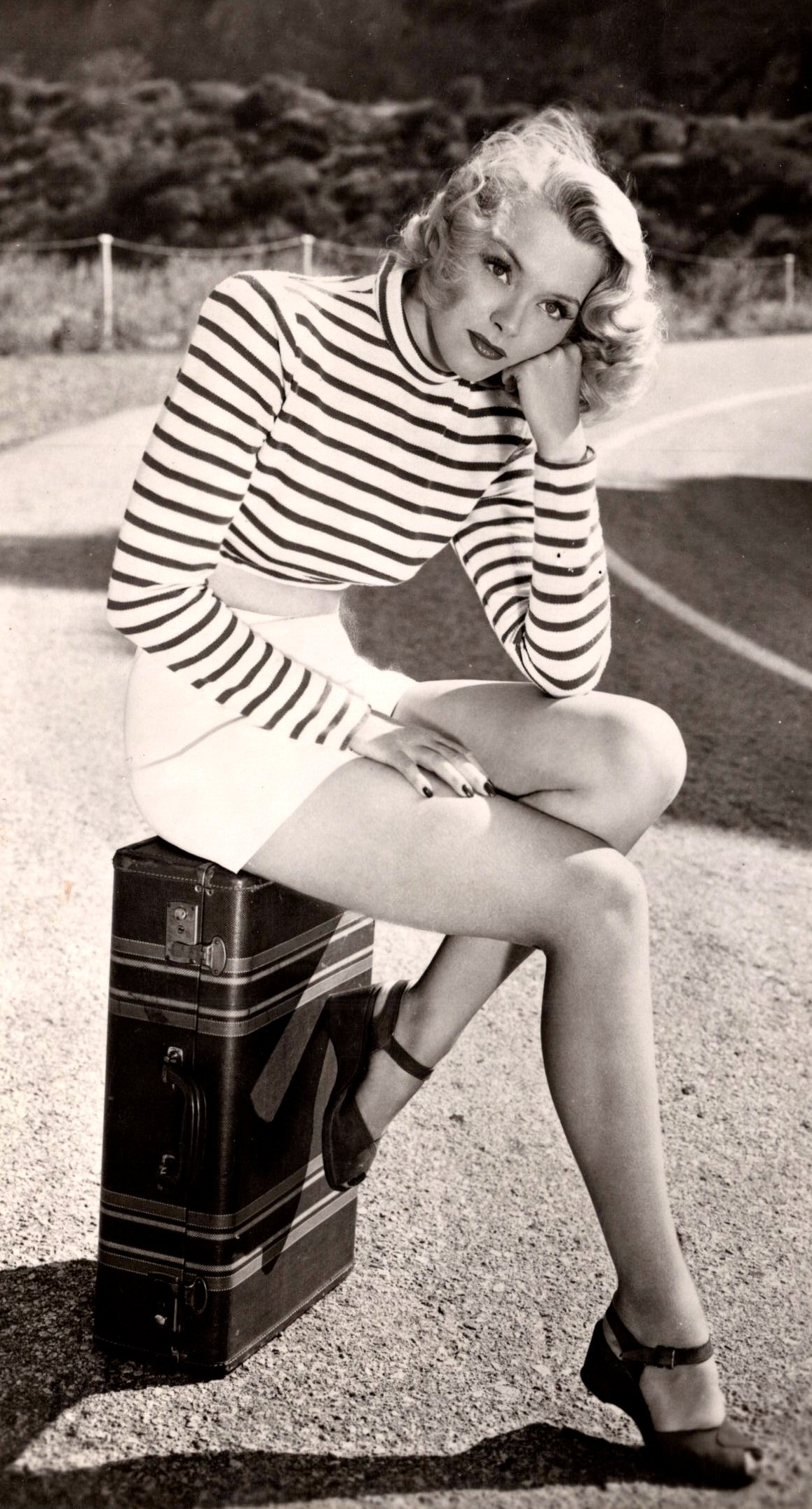
This vintage photograph features a pretty young woman sitting on a suitcase at the side of a road. A viewer of this image could hypothesize that she is looking for someone to stop and give her a ride. Her clothing emphasizes her nice figure and she is quite leggy in this cheesecake photograph. Research reveals the identity of this alluring woman. Leslie Brooks (1922-2011) was an American film actress, model an dancer. She began working as a model at age 18, began playing in bit movie parts in 1941, and by 1944 she was getting bigger roles. She played the lead in the film noir classic, “Blonde Ice” (1948). She retired from the film business in 1949. Research also discovered that this photograph captures Brooks in the film “It’s Great to be Young” (1946). The IMDb lists 29 movie credits for this actress between 1941 and 1949 and one appearance in 1971. SOLD
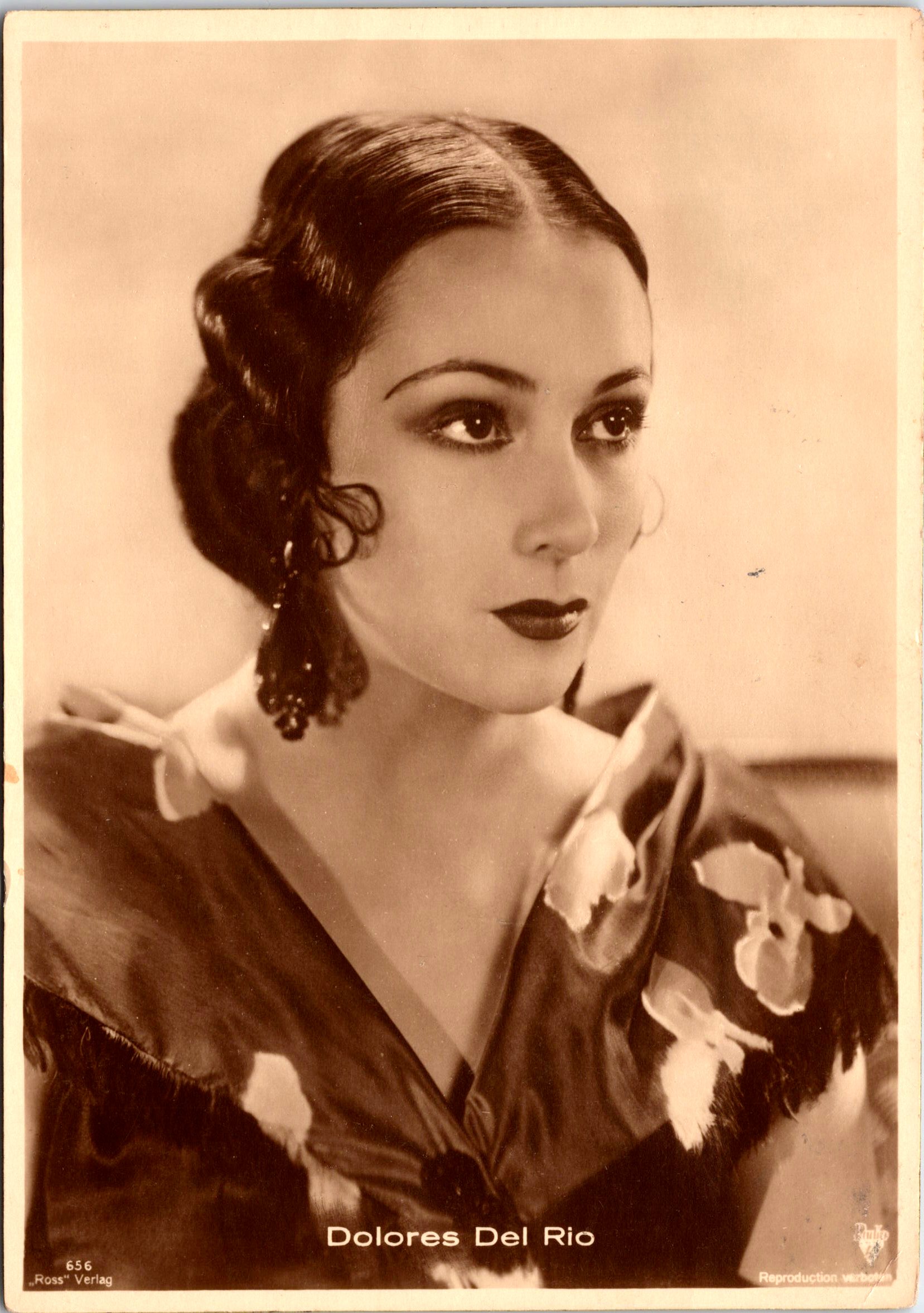
DOLORES DEL RIO : BEAUTIFUL ACTRESS : STAR OF AMERICAN AND MEXICAN CINEMA : RPPC
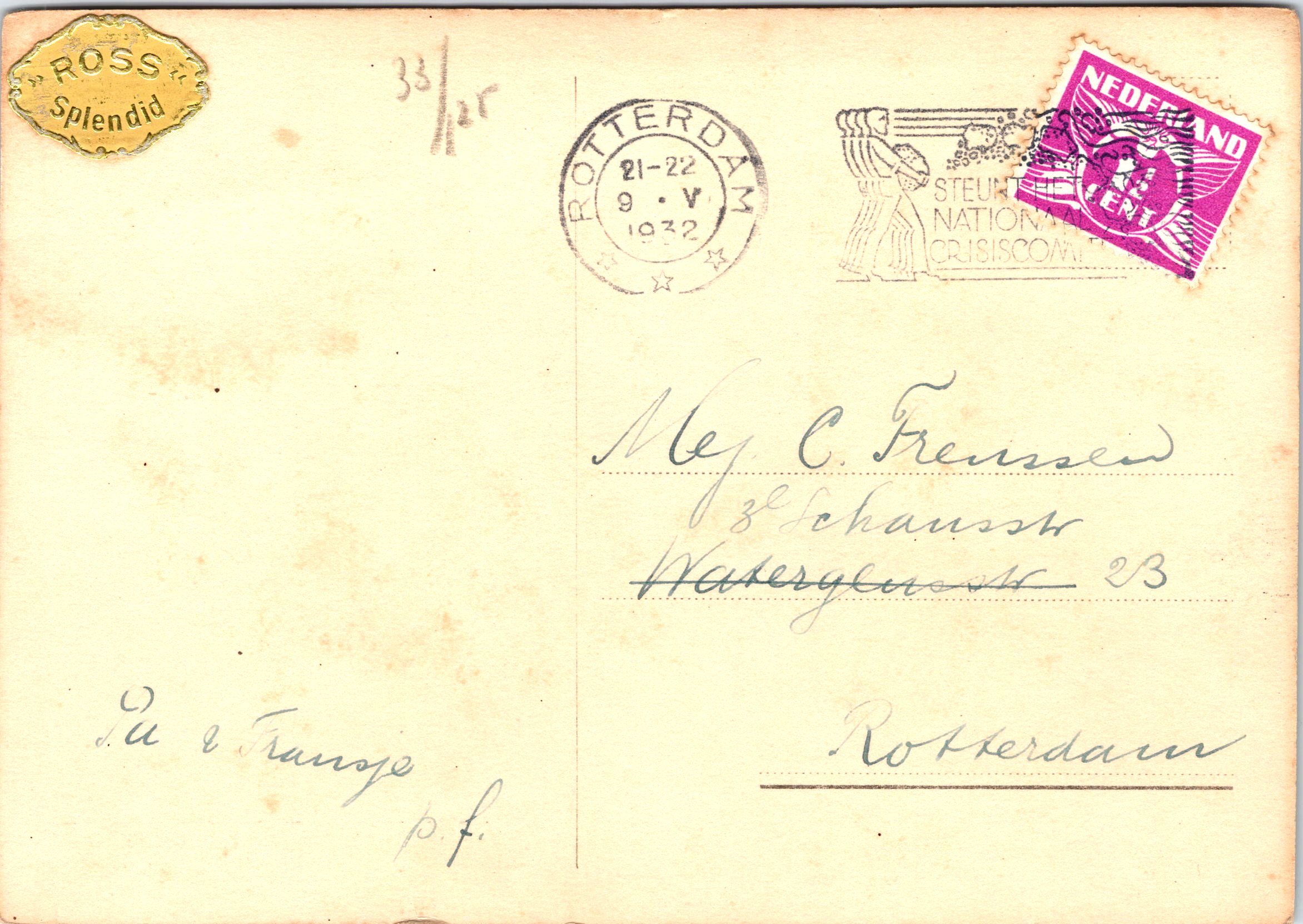
This vintage real photo postcard features pretty Mexican actress, dancer, and singer; Dolores del Rio (1904-1983). Del Rio’s performing career spanned more than half of a century. She was the first major Latin American actress to become an American film star (1920’s & 1930’s). Del Rio was also a major star in Mexican films. Dolores was known for her beauty as well as for her talent. She was discovered in Mexico and her Hollywood film career started in 1925. She began her career with a number of successful films, including “Ramona” (1928) and “Evangeline (1929). During the silent film era, she was considered the female version of “latin lover”, Rudolph Valentino. Del Rio was one of the fortunate actresses whose career was not destroyed by the advent of sound films. She acted in a wide range of film genres. “Bird of Paradise” (1932) and “Madame Du Barry” (1934) were among her successful films of the 1930’s. In the early 1940’s, her Hollywood career began to flounder sparking Del Rio to return to Mexico to become a major star of Mexican cinema. She continued acting in Mexican films through the 1950’s. Beginning 1960 she acted in both Mexican and Hollywood films. During the late 1950’s through the early 1970’s, Del Rio acted in theater and television. Dolores was born in Durango City, Mexico. Her parents were part of Mexican aristocracy whose lineage could be traced to Spain. Dolores was the cousin of actor Ramon Novarro (another silent film”latin lover”), and of Mexican cinema actress, Andrea Palma. During the Mexican Revolution (1910-1920), Dolores’s family lost its fortune. Her family felt threatened by Pancho Villa’s insurgence. It was time to “get out of town”. Her father fled to the United States while she and her mother escaped to Mexico City. Acting was an integral part of Dolores’s getaway. She and her mother felt compelled to dress as peasants to insure safe passage on the train to Mexico City. Her parents reunited there in 1912. Dolores attended a college in Mexico City operated by French nuns. After seeing Russian ballerina, Anna Pavlova perform; Dolores decided to become a dancer and took lessons from a well respected teacher. At age 17, Dolores married Jaime Martinez del Rio. He was from a wealthy family and was educated in England. The couple honeymooned in Europe for two years and Dolores formed close relationships with a number of members of European aristocracy. When the couple returned to Mexico, they settled in Mexico City. In 1925, Dolores met American filmmaker Edwin Carewe, and he was spellbound. He convinced Dolores and her husband to move to Hollywood where he promised to make Dolores a star. Her husband hoped to write screenplays there. When they arrived in Tinseltown, Carewe launched a public relations campaign to raise excitement about his beautiful find. He built up her aristocratic background by saying such gems as Dolores was “the first lady of high Mexican Society” and that she had come to Hollywood with a collection of shawls and combs valued at fifty thousand dollars. Dolores made her film debut in “Joanna” (1925), where she played a vamp of Spanish-Brazilian origin. Her first starring role was in the comedy “Pals First” (1926), directed by Carewe. That same year, Dolores appeared in the war film “What Price Glory?”. The movie was a huge financial success and helped Dolores become one of the “WAMPAS Baby Stars” of 1926. Other members of her “class” were Mary Astor, Joan Crawford, Janet Gaynor, and Fay Wray. By then, her film career was rocketing. Her role in Resurrection” (1927), a popular film based on a Tolstoy novel, further propelled her career. While her career was succeeding, her personal life was a “hot mess”. Her marriage to Del Rio ended in 1928. He had much difficulty being in the shadow of his famous and successful wife. Six months after Dolores filed for divorce, Del Rio died in Germany. While dealing with her grief, she had to deal with constant harassment from her discoverer, Edwin Carewe. He wanted to be more than her agent and her director since he had first launched her career. In 1929, Dolores announced to the press, that despite Carewe’s claims, the pair were just friends and business companions. She added that they had no plans for marriage. Soon thereafter, she cancelled her contract with him. The end result was a legal dispute that was settled out of court. Carewe’s anger did not end there. He disparaged her the press and refilmed “Resurrection” starring Lupe Velez, another popular Mexican film star. In 1930, Del Rio married MGM art director, Cedric Gibbons. They became one of Hollywood’s most followed couples of the early 1930’s. In 1932, the film, “Birds of Paradise”, was released to rave reviews. The film starred Del Rio and actor, Joel McCrea. The movie was a South Seas love story. A scandal arose from the film because of a scene featuring the pair swimming naked. Controversy continued in Del Rio’s appearance in “Flying Down to Rio” (1933). In this film, Del Rio was the first actress to wear a two piece bathing suit on screen. Fred Astaire and Ginger Rogers danced together for the first time on film, in this movie. Del Rio and Astaire also did an “intricate” dance number in the film. Del Rio found herself in political hot water when she and Ramona Novarro and Lupe Velez attended a special screening of a Mexican film which was accused of promoting Communism in California. Del Rio was accused of being a Communist for her attendance at the screening. In 1940, Del Rio began an affair with actor/filmmaker, Orson Welles. The dalliance resulted in Del Rio and Gibbons divorce. In 1954, Dolores was scheduled to co-star in a Spencer Tracy film, but the US government would not give her permission to work in the United States. The government believed she was sympathetic toward communism for attending the aforementioned film screening and for signing a petition supporting a world peace conference. After some time, she was able to remedy the problem by writing a persuasive letter to the US authorities. Later in life Del Rio did express some “political” beliefs. She stated that she wished she could play Mexican roles to show what life in Mexico was really like. She felt such an opportunity could help diminish the ugly stereotypes that existed about Mexicans in American society. She stated that it was her great wish to make fans realize the beauty, wonder, and greatness of Mexicans as a people. She asserted that the great majority of Americans view Mexicans as a “race of bandits, or laborers, dirty, unkempt, and uneducated”. Why do these false negative stereotypes sound so familiar? Del Rio wanted to show “the best that’s in my nation”. It has been pointed out by more than a few writers that Dolores del Rio was no “Latin bombshell”. Instead, she was noted for her elegance. The IMDb reports that Del Rio has 63 film credits ranging from 1925 through 1978. This vintage postcard was published by Ross Verlag as part of a series (no.656). The reverse of the card has a gold seal stating “Ross Splendid”. This postcard has a Netherlands stamp and was postmarked in Rotterdam in 1932. SOLD

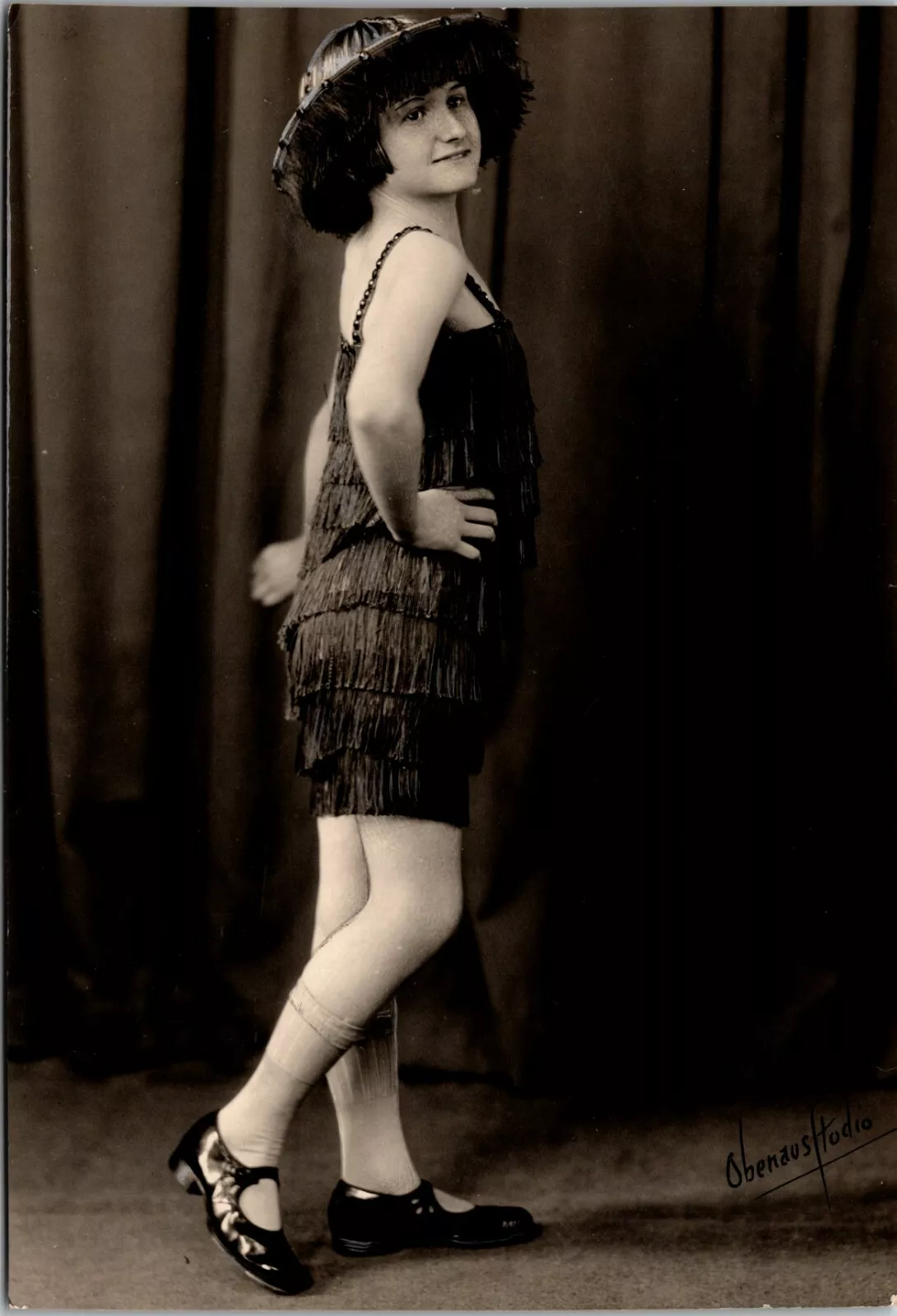
PORTRAIT OF A TEENAGE FLAPPER : DANCE STUDIO : JAZZ AGE : (1926)
This vintage photograph features a teenage dancer on stage. Her flapper dance costume fits the times. She was performing in 1926, during the Jazz Age. The photograph is signed in the lower right hand corner. It is signed, “Obenaus Studio”. Research reveals that there was an Obenhaus studio operating in the the 1920’s in three locations in upstate New York (Albany, Troy, and Schenectady). The studio has a photograph in the Library of Congress. The photograph is entitled “Miss Yonkers, 1924” and it shows a young woman wearing a bathing suit and Miss Yonkers sash. She is seated on a small table and has her feet raised and her hands behind her head. Interestingly, she is wearing the same cutesy expression as the dancer in this photograph. SOLD
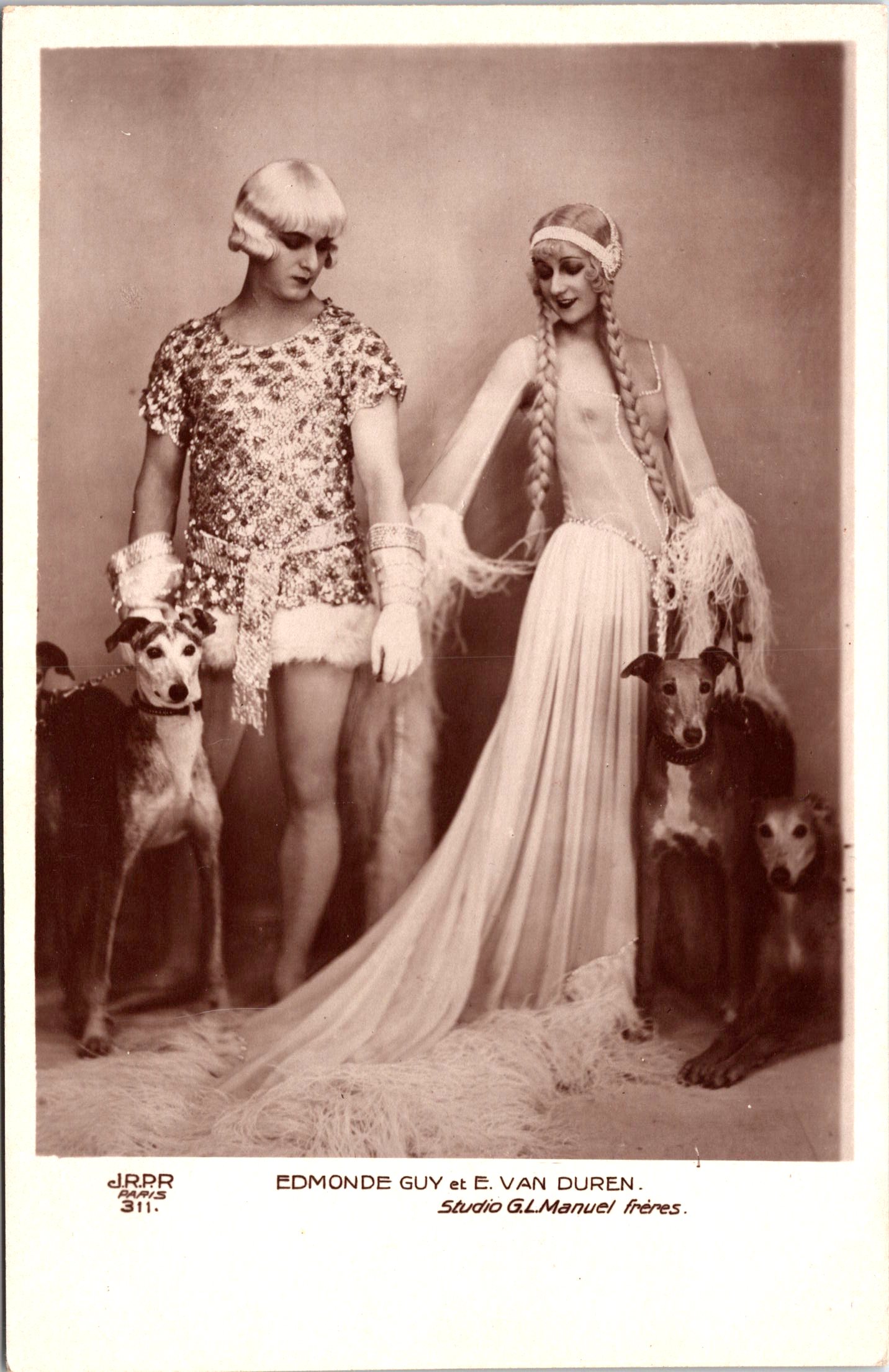
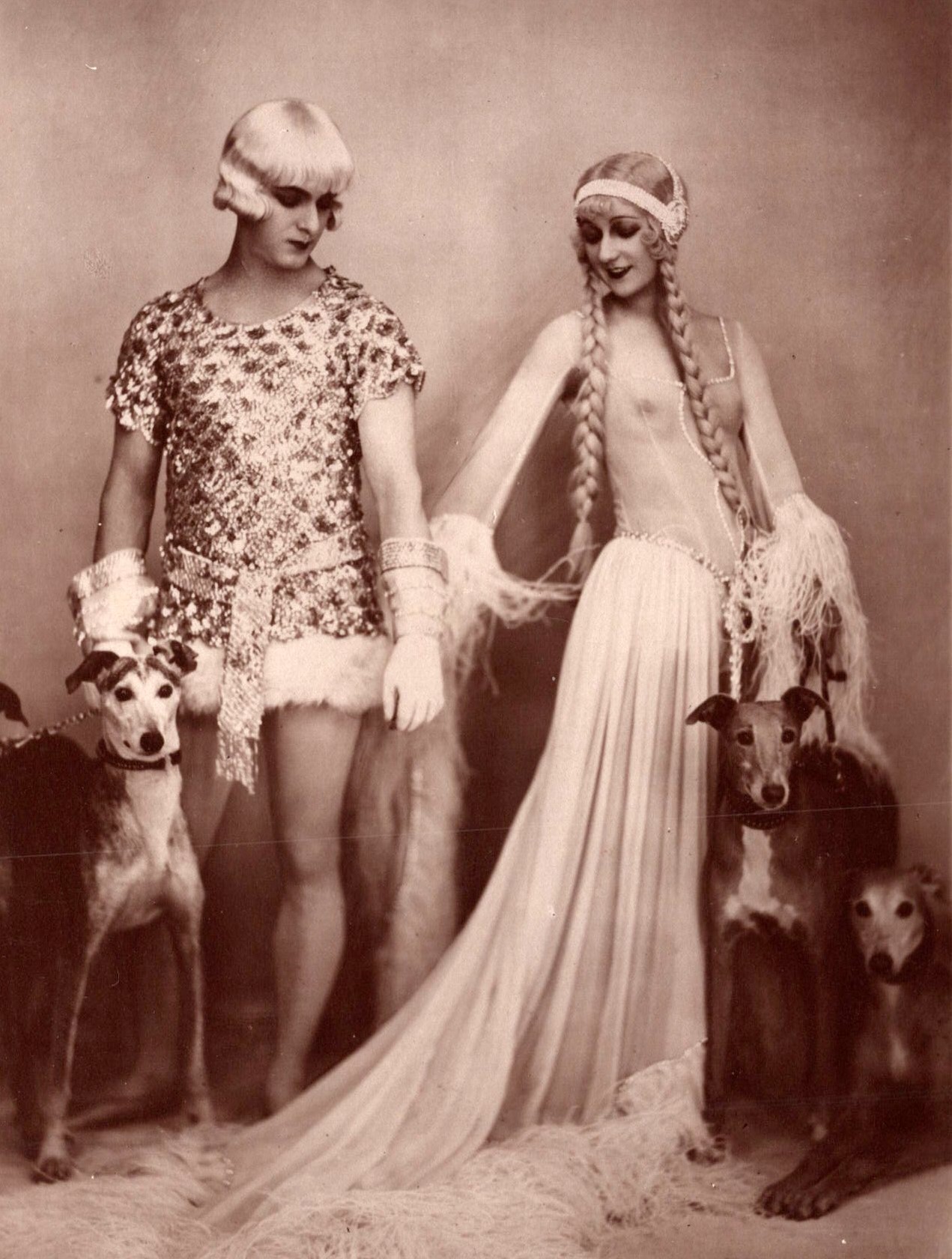
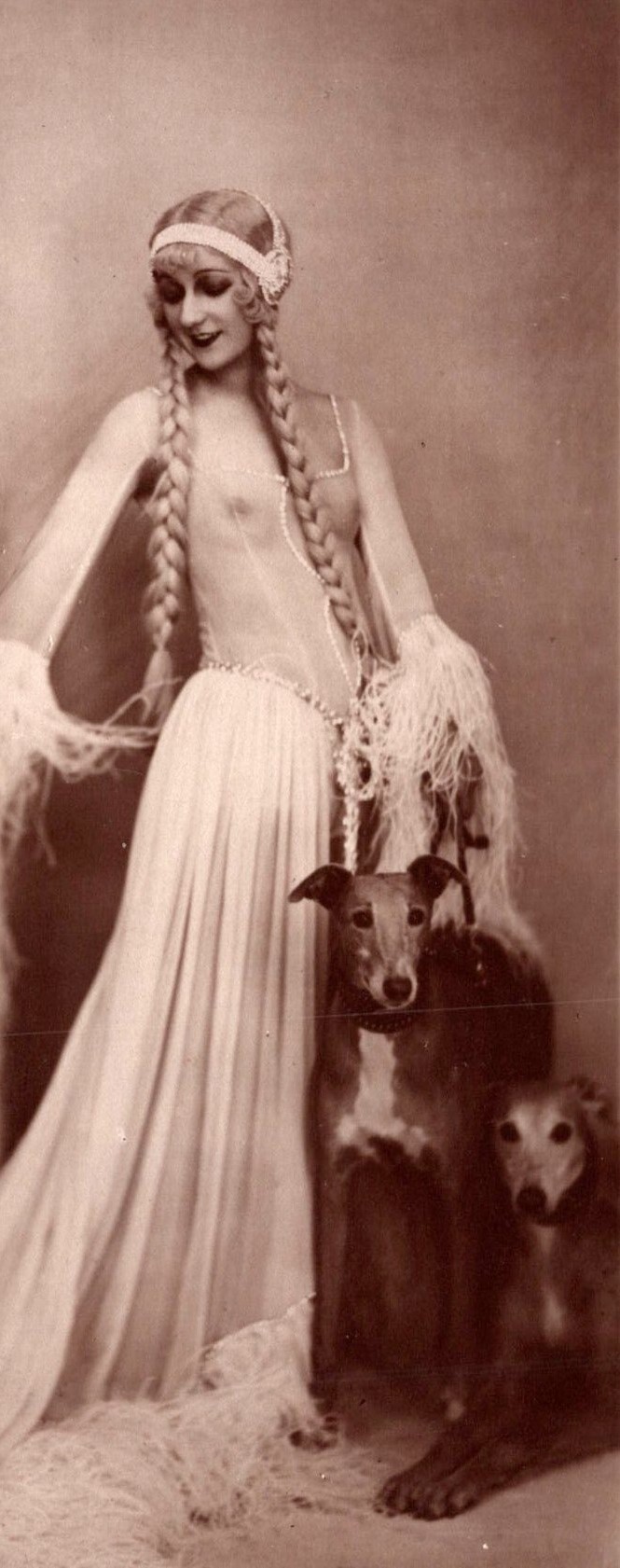
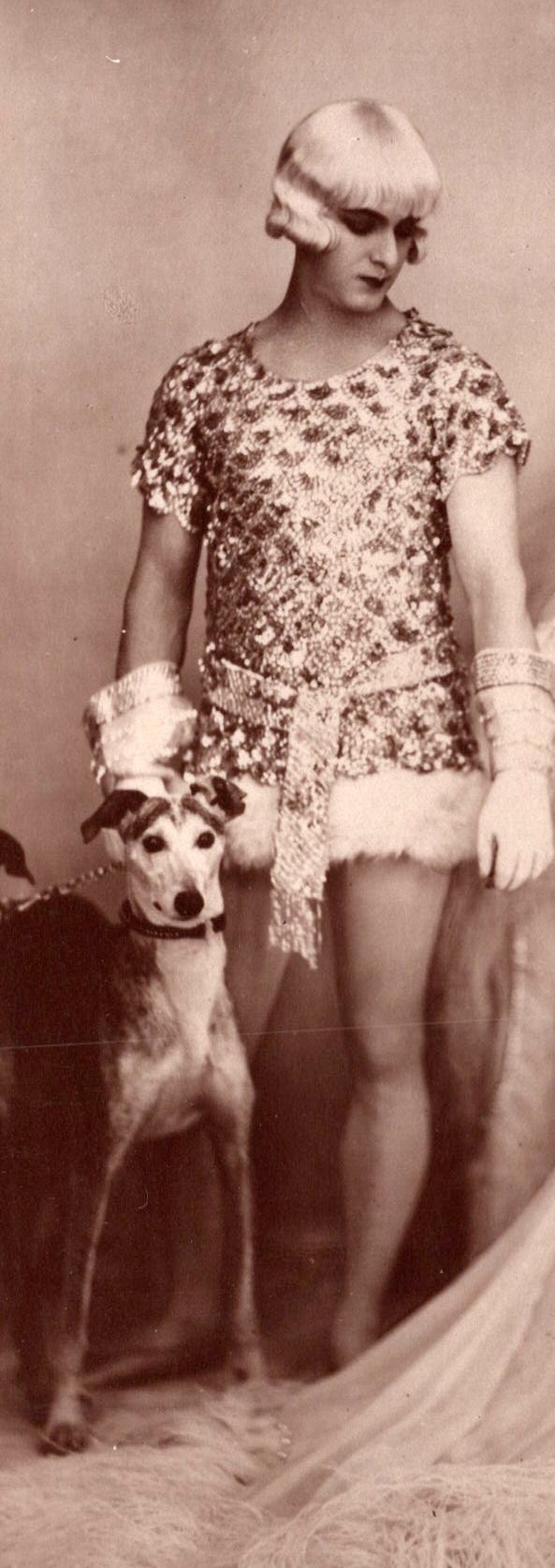
A TOPLESS EDMONDE GUY AND E. VAN DUREN : DANCERS : RISQUE : GREYHOUNDS : RPPC
This rare risque vintage real photo postcard features famous European dance partners, Edmonde Guy (1903-1951) and Ernst Van Duren (?-1930). The pair are flanked by three regal looking greyhounds. If you look closely, you will see the dogs are leashed. Edmonde Guy was a French dancer and film actress. She also was a model for paintings by Dutch artist, Kees Van Dongen. In 1921 she and Van Duren formed a dance partnership. They performed both in Europe and the United States. In 1926, they were hired by Florenz Ziegfeld for his “Palm Beach Follies”. Guy and Van Duren were famous for their daring outfits and erotic performances. Evidence of their “steamy” work can be seen via this postcard image. Guy is wearing a sheer top, but she is virtually topless. Not much is known about Van Duren. One newspaper reported that he was Hungarian but his family was originally from the Netherlands. Besides being a dancer, he also acted. His first film role was in a French silent film in 1923. He played minor roles in a few films but his break out role was in a circus film called “Manege” (1928). He then starred in a film with Edmonde Guy, with the title “Princesse Mandane” (1928). In 1930, Van Duren committed suicide. There were rumors his self destruction was caused by the end of his relationship with Edmonde. However, some writers believe his suicide was related to his relationship with American dancer, Jack Forrest. This French postcard was published by J.R.P.R. and the photographer of the two dancers was G. L. Manuel Bros. SOLD

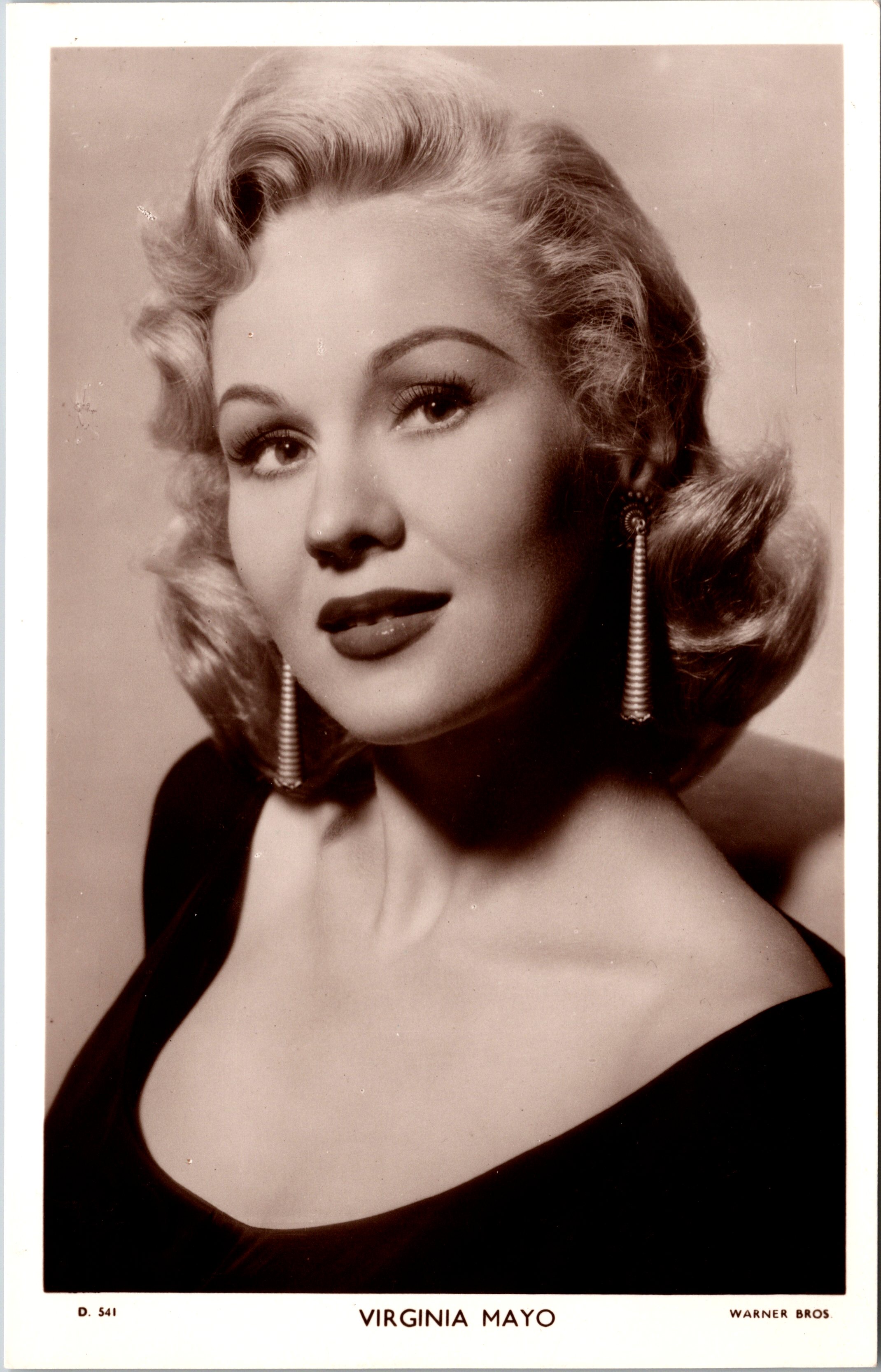
VIRGINIA MAYO : BEAUTIFUL ACTRESS : PICTUREGOER SERIES : WARNER BROTHERS
This vintage real photo postcard features American actress and dancer, Virginia Mayo (1920-2005). Virginia grew up in St. Louis. She began attending her Aunt’s acting school at age 6. She also took dancing lessons. She began her professional acting career after graduating high school. She began acting and dancing at the St. Louis Municipal Opera Theatre. She then toured the vaudeville circuit for three years. She appeared in some short films and then was “discovered” performing at a Broadway area night club, by Samuel Goldwyn. Goldwyn appreciated her for her talent as well as her beauty. He signed her to an acting contract with his company. In 1941, she appeared on the Broadway stage with Eddie Cantor. Her first starring role occured in 1944 when she appeared in a film with Bob Hope. The IMDb reports that Mayo had 70 film credits between 1939 and 1997. She performed in one Broadway play (1941-1942). This vintage postcard is part of the “Picturegoer” series (No. D 541). She posed for the postcard’s portrait while under contract with Warner Brothers. SOLD

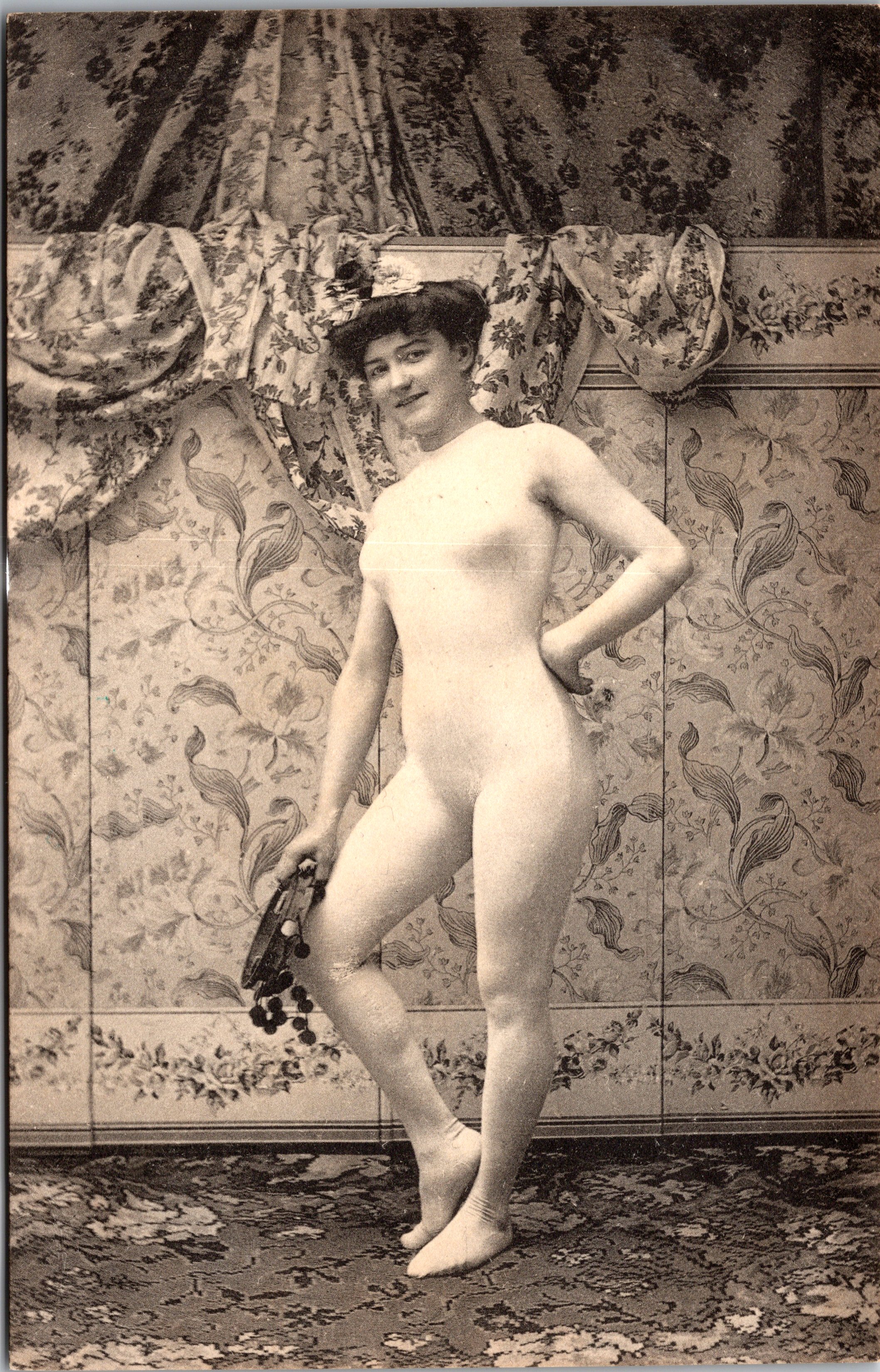
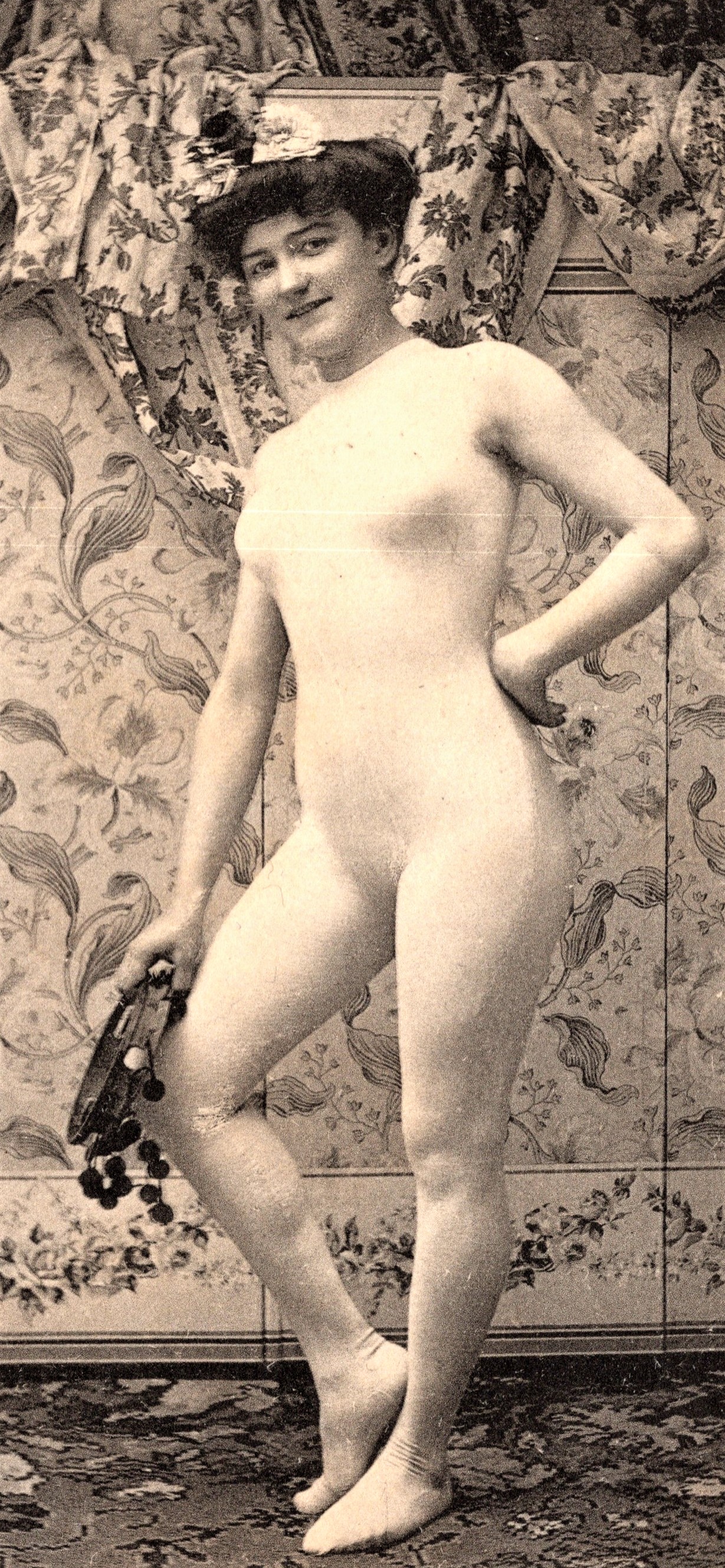
PRETTY DANCER WEARING NUDE BODY SUIT : RISQUE : RPPC : (1907)
This vintage real photo postcard features a pretty young dancer dressed in a risque body suit. The costume aims to give the appearance of nudity. The performer is holding a tambourine. The publisher of the postcard is unidentified. The reverse of this postcard shows some wear but the front of the card is in excellent condition. The postcard is in overall Good Condition (See Scans). SOLD

MARCELLE LENDER : FRENCH SINGER AND DANCER : MODELLED FOR TOULOUSE-LAUTREC

This uncommon vintage real photo postcard features French singer, dancer and entertainer, Marcelle Lender (1862-1926). Lender was also famous for her modelling in paintings by Henri de Toulouse-Lautrec. Lender began dancing at age sixteen and quickly escalated her fame by performing at the Theatre des Varietes in Paris, France. Lender was the model for several works by Lautrec. Her most notable appearance in his paintings was of her dancing the Bolero, in full costume, during an 1895 performance of “Chilperic”. That painting is today in the collection of the National Gallery of Art in Washington DC. This postcard portrait of Miss Lender was taken by the famed Reutlinger studio. The card was published by the English firm, Rotary Photo. SOLD

CARMEN SEVILLA : SPANISH ACTRESS, SINGER, AND DANCER
This vintage real photo postcard features Spanish actress, singer, and dancer, Carmen Sevilla (1930-2023). She started her career in the 1940’s and succeeded in becoming one of the most popular stars of the Spanish cinema until the 1970’s. Among her film roles were appearances in “Imperial Violets” (1952), “Vengeance” (1958), and “Antony and Cleopatra” (1972). She was also a successful singer who’s discography includes fifteen studio albums. Carmen was born in Seville, Spain. Her father was a composer. After the Spanish Civil War, she and her family moved to Madred and her father and grandfather worked as lyricists for major films. As a child, Sevilla enjoyed singing and dancing and made her stage debut at the age of twelve. In the 1940’s she studied at the Conservatory of Music and took dance lessons. She made her film debut in 1946. In 1947, she competed in the Miss Spain contest. Her first leading film role occurred in 1948 and her career quickly blossomed. Her popularity led to her being sought for advertising purposed. She was in Spain’s first Coca Cola commercial. She made her last film in 1978. In 1991 she began a new career as a television presenter. Sevilla was married twice. Her first marriage was to a well known composer / conductor. In 2012, she was diagnosed with Alzheimers. The disease led to her death just seven days before this posting. Sevilla’s photo portrait, seen on this postcard, was taken by the Harcourt studio. The card was published by the Globe (Paris) and is part of a series (No.203). SOLD

TWO PORTRAITS OF FRENCH ACTRESS REGINA BADET
POSTCARD 1
POSTCARD 2 (SOLD)
POSTCARD 3 (SOLD)
These vintage real photo postcards feature French actress and dancer, Anne Regina Badet (1876-1949). She was a major star of the Opera-Comique in Paris. She made her debut at the Grand Theatre de Bordeaux where she became a principal dancer She received much acclaim for her portrayal of Conchita Perez in “The Woman and the Puppet (1910)”. Postcard 1 shows her in this role. Her stage acting led her to a brief film career (eleven movies between 1908 and 1922). The Los Angeles Herald (1906) described Badet as the “new Paris pet” and that her dances in the Opera “Aphrodite” had “caused a furor among theater goers. A critic wrote that he went to see the performance because the opera was a “masterpiece” and because he wanted to see the star soprano, Mary Garden, interpretation of her role. Instead, he reports he was most drawn to the performance by Regina Badet. Miss Badet retired from stage and screen in the early 1920’s.
The photographer of the image on Postcard 1 is listed as “Bert”. I believe that this is a photographer who partnered with celebrated photographer Paul Boyer, renowned for his celebrity and theater images. This postcard was published by F. C. & C.
Postcard 2 offers a second portrait of Miss Badet. The pretty actress is wide eyed and wearing a lot of jewelry. The photograph was taken by Henri Manuel (1874-1947). In 1900, Manuel opened a portrait studio in Paris with his brother Gaston. He quickly became well known for his portraits of politicians, artists, and athletes. His images were used by news agencies . His studio became the largest studio in Paris and it attracted many young photographers who sharpened their skills there. In 1925 the brothers expended their business to include fashion photography. They worked for such designers as Chanel, Patou, and Lanvin. The studio shut down during World War II and many of their photographic plates were destroyed. Manuel was the official photographer for the French government from 1914 through 1944. SOLD
Postcard 3 features a photograph of Miss Badet that was taken by celebrated photographer, Paul Boyer. SOLD

Buy this Vintage Real Photo Postcard (includes shipping within the US) #3404
To purchase this item, click on the Pay with PayPal button below
$25.50

Buy this Vintage Real Photo Postcard (includes International shipping outside the US) 3404
To purchase this item, click on the Pay with PayPal button below
$34.50


POSTCARD 3
PEARL REGAY : DANCER : ISRAEL ORPHAN SOCIETY : NEW YORK : PRESS PHOTO : 1927


This vintage press photo features pretty dancer, Pearl Regay, teaching young orphans to dance. The children were under the care of the Israel Orphan Asylum in New York City. Miss Regay taught the children a few simple steps and also entertained them. Pearl Regay was a respected stage performer. She appeared in three Broadway plays between 1922 and 1928. These plays included “The Desert Song” and “George White’s Scandals”. The Israel Orphan Asylum was founded by Gustave Hartman, a municipal court judge and philanthropist. He founded the organization in 1913 and ran it until his death in 1936. The asylum cared for children ages one to six, and later in time, included girls up to the age of fourteen. Many of the children in the Asylum were orphaned by World War I. This press photo was taken by the International Newsreel Company. The photograph measures 8.25 x 6.25 inches. On the reverse of the photo is a stamp from the International Newsreel Company. In addition, there is a stamp from King Features Syndicate, which was likely the last owner of the rights of this photograph. SOLD


POSTCARD 2 (SOLD)