CAMILLE CLIFFORD : THE GIBSON GIRL : STAGE ACTRESS : HAND TINTED : ROTARY RPPC

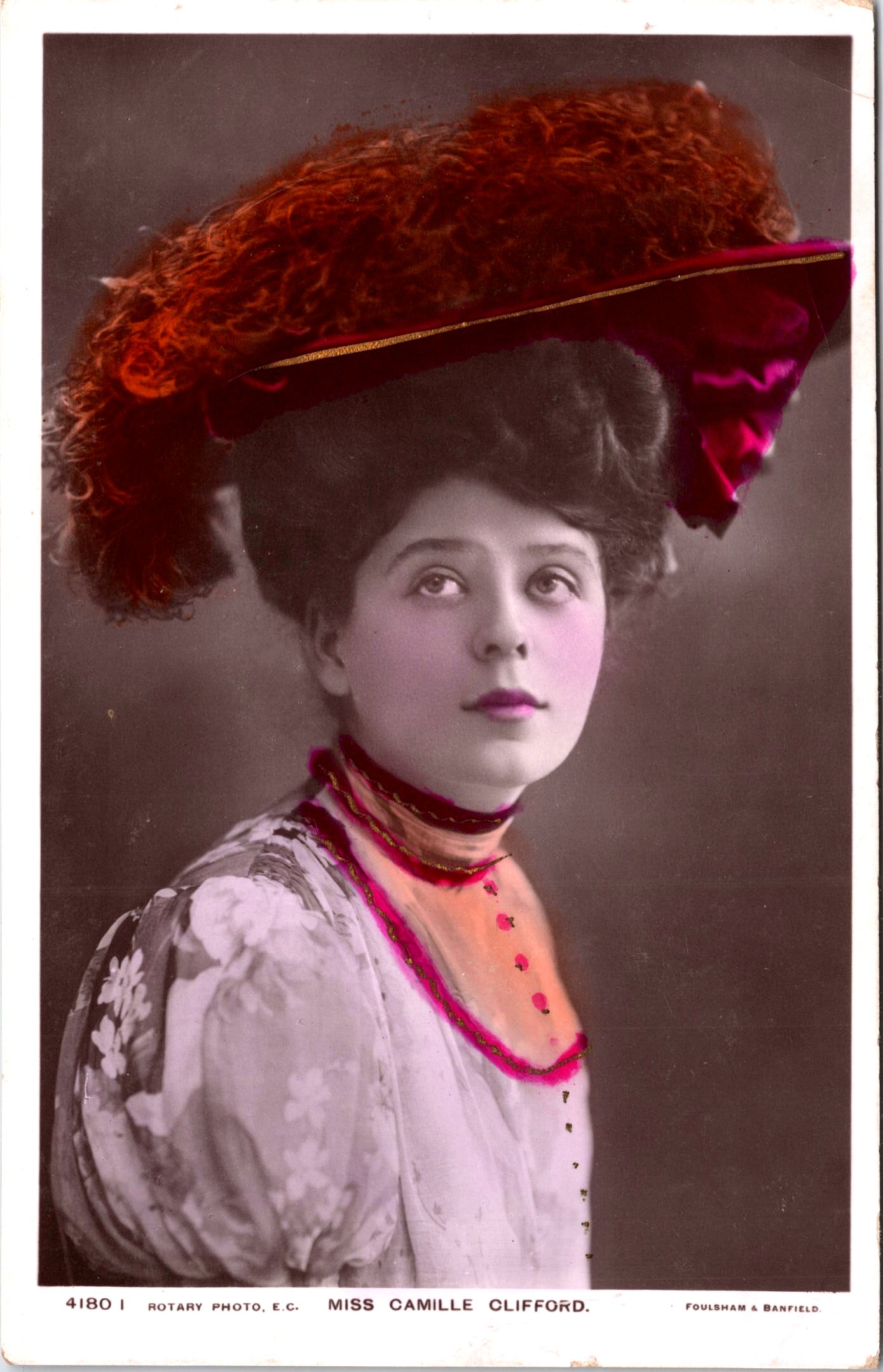
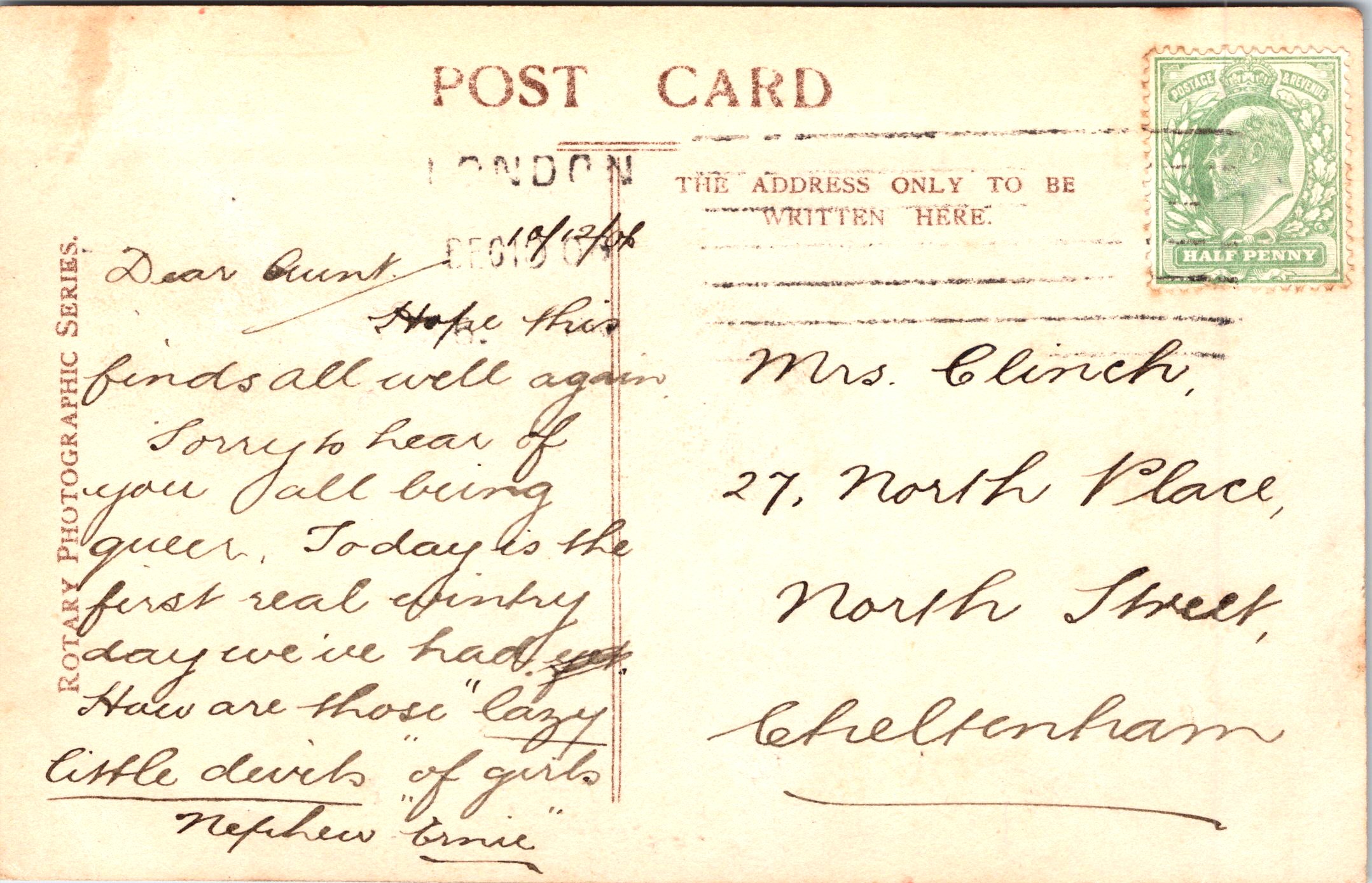
Camille Clifford (1885–1971) was a Belgian-born stage actress and fashion icon best known as the quintessential “Gibson Girl”, a feminine ideal created by American illustrator Charles Dana Gibson. Born in Antwerp, Belgium, she was raised in Sweden and later in Boston, Massachusetts. In 1902, she entered and won a contest sponsored by Gibson seeking the perfect embodiment of his Gibson Girl drawings, which rocketed her to fame. Clifford’s signature look — an hourglass figure, piled-high coiffure, and aristocratic bearing — made her an immediate sensation in Edwardian society. She soon transitioned to the London stage, where her statuesque beauty often overshadowed her acting roles. Her most famous performance was in the musical comedy The Catch of the Season (1904), where she appeared as the aristocratic Lady Crystal. In 1906, Clifford married the Hon. Henry Lyndhurst Bruce, son of the 2nd Baron Aberdare, and largely retired from the stage after marriage, though she made occasional returns in the 1910s and 1920s. After her husband’s death in World War I, she lived a quieter life but remained a symbol of Edwardian elegance. This is a striking hand tinted Rotary Photographic Series real photo postcard featuring Miss Clifford, serial number (4180 I). It was published by Rotary Photo, one of the most prolific and respected postcard publishers in early 20th-century Britain.  In this image, Camille Clifford appears wearing an immense, lavishly plumed hat in rich tones of red and deep pink, its dramatic sweep perfectly framing her elaborately coiffed dark hair. Her gown, light and sheer with a delicate floral pattern, is accented by a high ruffled collar and ribbons tinted in shades of crimson and coral. The colorist has applied subtle blush to her cheeks and a soft rose tint to her lips, heightening her serene yet alluring expression. She gazes slightly upward and away from the camera, her eyes thoughtful and composed, embodying the calm confidence and refined beauty that made her one of the most photographed women of the early twentieth century. The reverse of the postcard is written and postally used, addressed to Mrs. Clinch, in Cheltenham. The message, written in ink, reads: Dear Aunt, Hope this finds all well again. Sorry to hear of your fall being queer. Today is the first real drizzly day we’ve had yet. How are those “lazy little devils” of girls? Nephew Ernie. The postcard bears a green half-penny King George V stamp, which was first issued in 1911. The postmark is partially legible but shows London, and appears to read 1912. This dating aligns perfectly with the height of Camille Clifford’s stage fame and with the active period of Rotary Photo, E.C. and Foulsham & Banfield, the photographers credited at the right. Together these details place the postcard firmly in the early 1910s, likely around 1912, when hand-colored photographic postcards of theatrical personalities such as Clifford were immensely popular with collectors throughout Britain.  (SOLD)

VICTORIAN BEAUTY ASKS “DO YOU THINK I’M SEXY?” IN GREAT YARMOUTH, ENGLAND

VICTORIAN BEAUTY ASKS “DO YOU THINK I’M SEXY?” : GREAT YARMOUTH : CABINET CARD - Picture 2 of 3

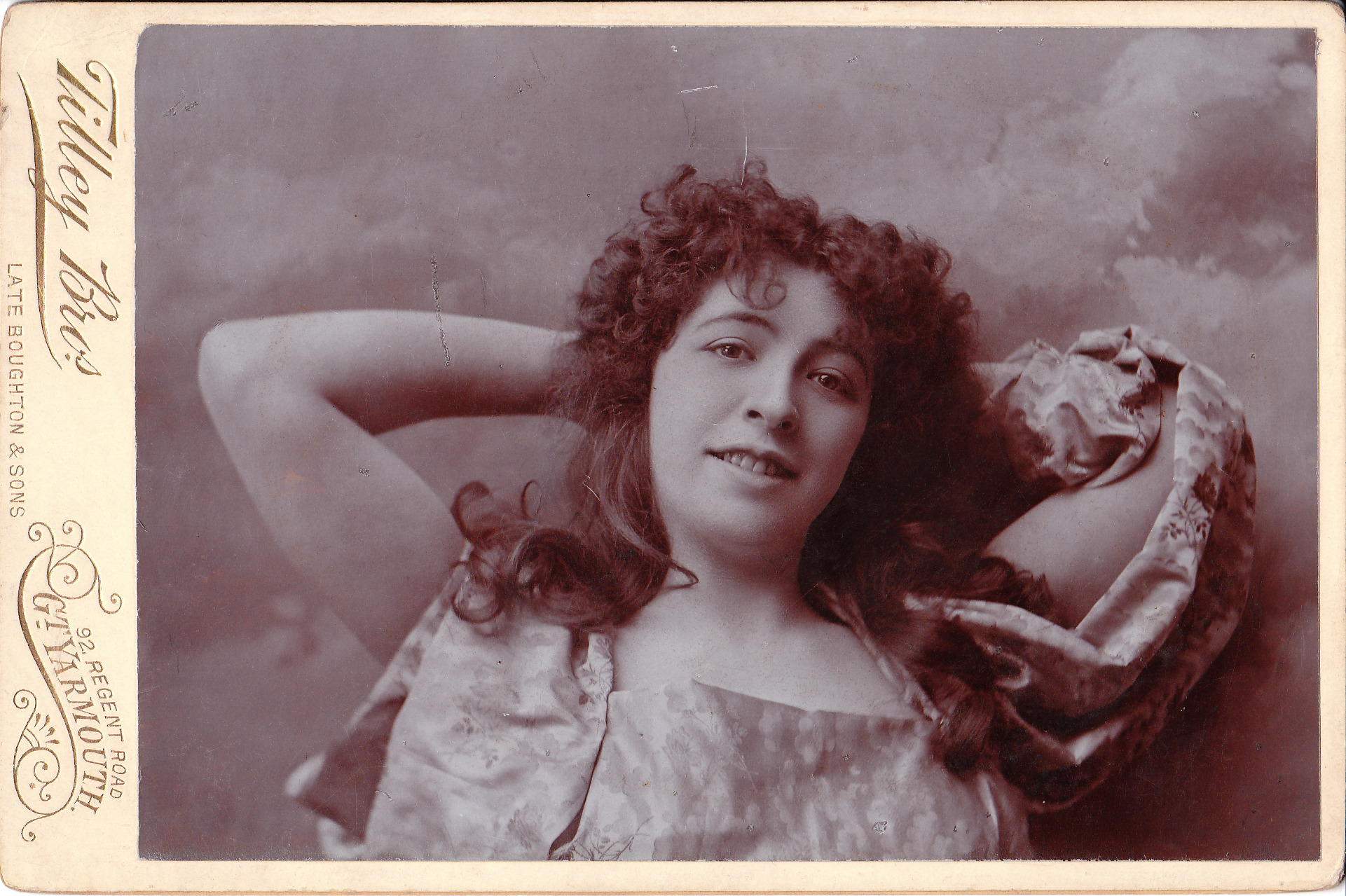
A Victorian beauty poses for her portrait in Great Yarmouth, England. She certainly has chosen a provocative pose. The young woman may be a stage actress or dancer. She is not helping the stereotypical  image of female stage performers who were viewed by much of the public as equivalent to prostitutes.  This  risqué  (for the era) image was photographed by Tilley Brothers studio. The photographers were successors to Boughton and Sons. Great Yarmouth is a coastal town in Norfolk, England. It has been a seaside resort since 1760.  SOLD

Published in: on November 9, 2025 at 12:01 pm  Leave a Comment  
Tags: , , ,

DO DO WATTS : BRITISH STAGE AND FILM ACTRESS : CAREER WOMAN

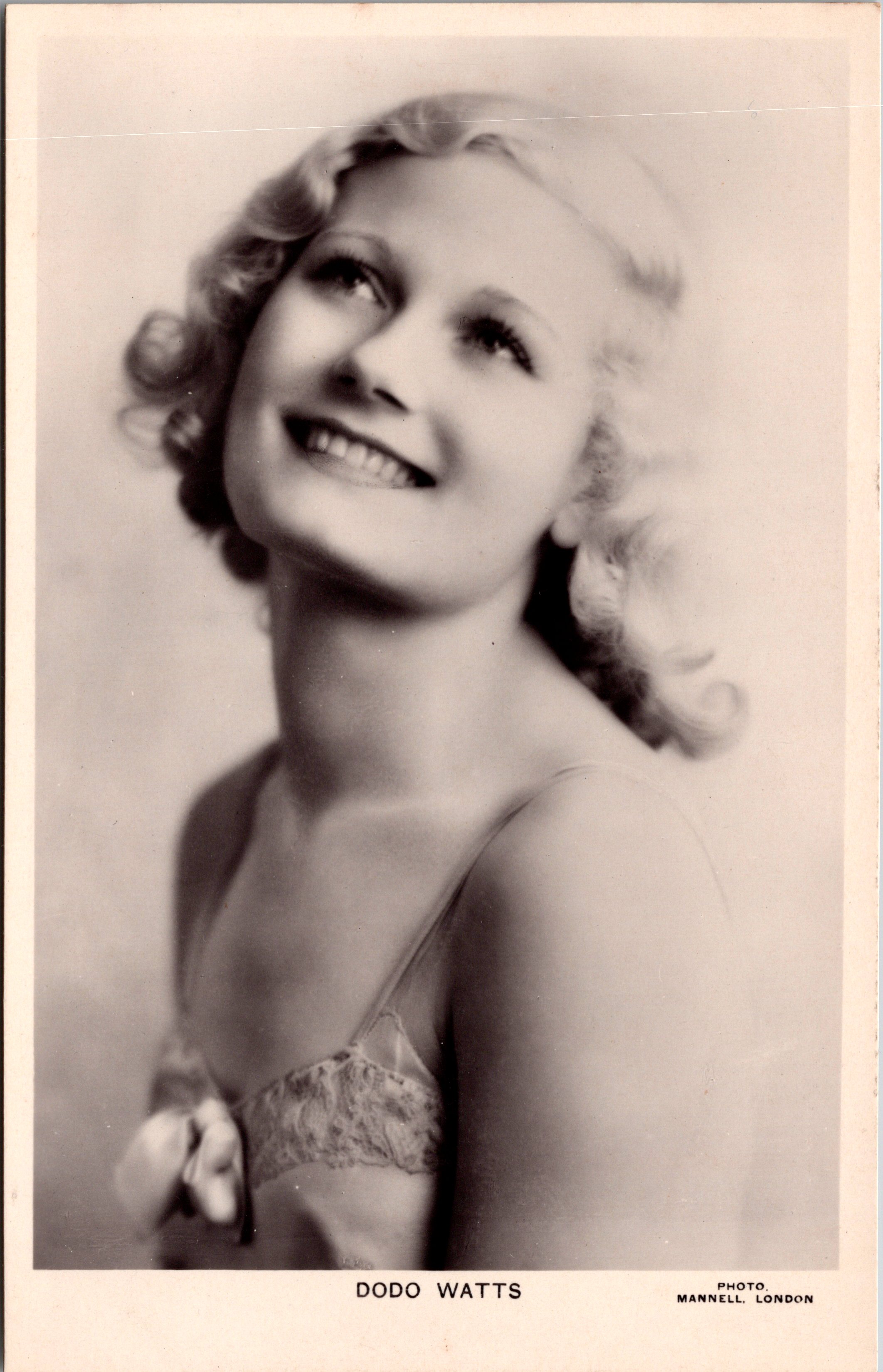
This vintage real photo postcard features British stage and film actress, Dodo Watts (1910-1990), She had one appearance on Broadway in “The Middle Watch” (1929).When she retired from acting, she became a career woman. She owned a successful millinery firm in London. She also worked as a casting director for three films. She cast Diana Rigg in her role in “The Avegers” television series. Watts also worked as a theatrical agent. The IMDb credits her with19 film credits between 1925 and 1953. This card was published by Picturegoer as part of a series (no.537). The photograph seen on this card was taken by George Mannell. His firm was located in London, England. SOLD

JEAN AYLWIN : SCOTTISH ACTRESS & SINGER : DOVER STREET STUDIOS : RPPC 1908

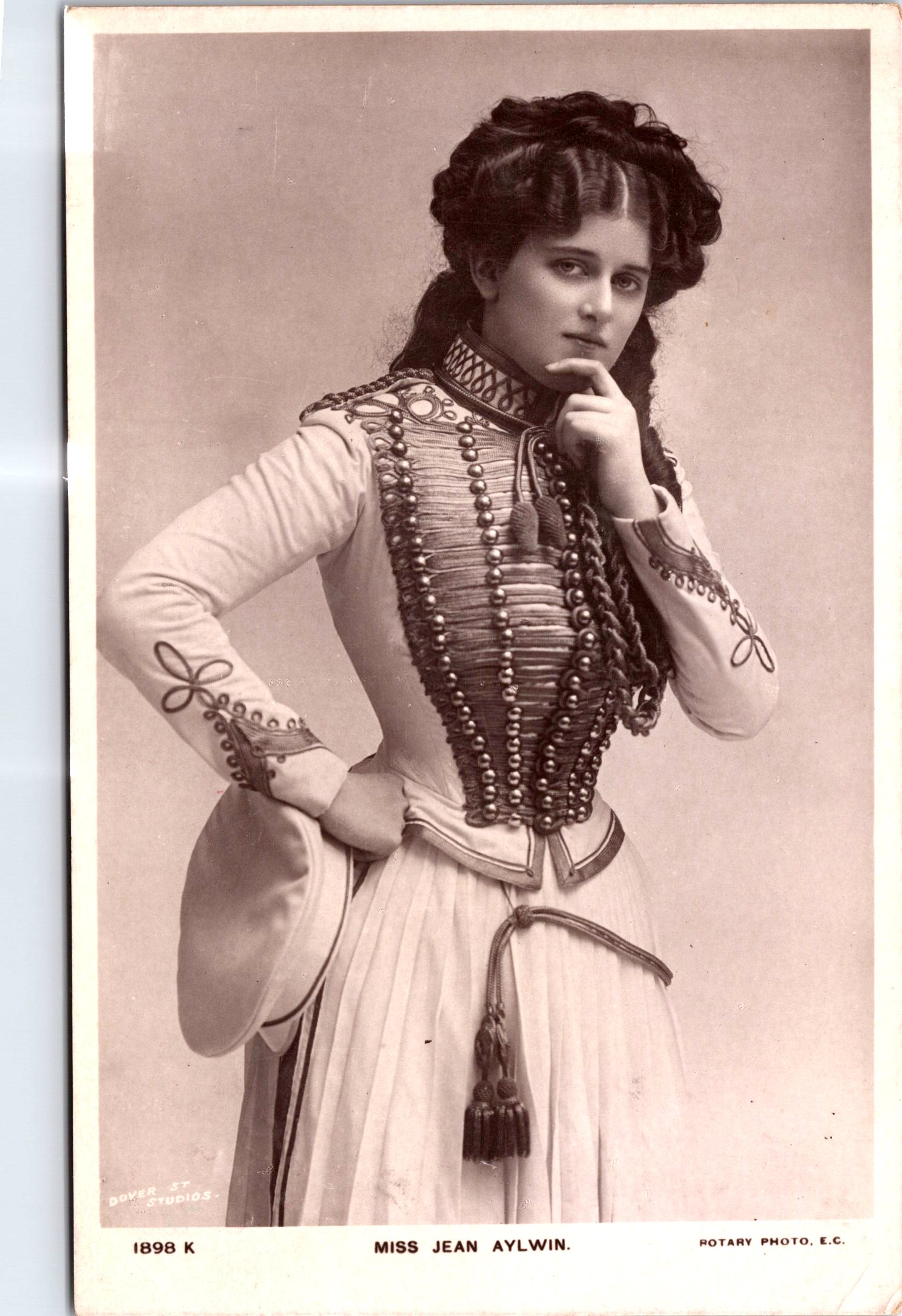
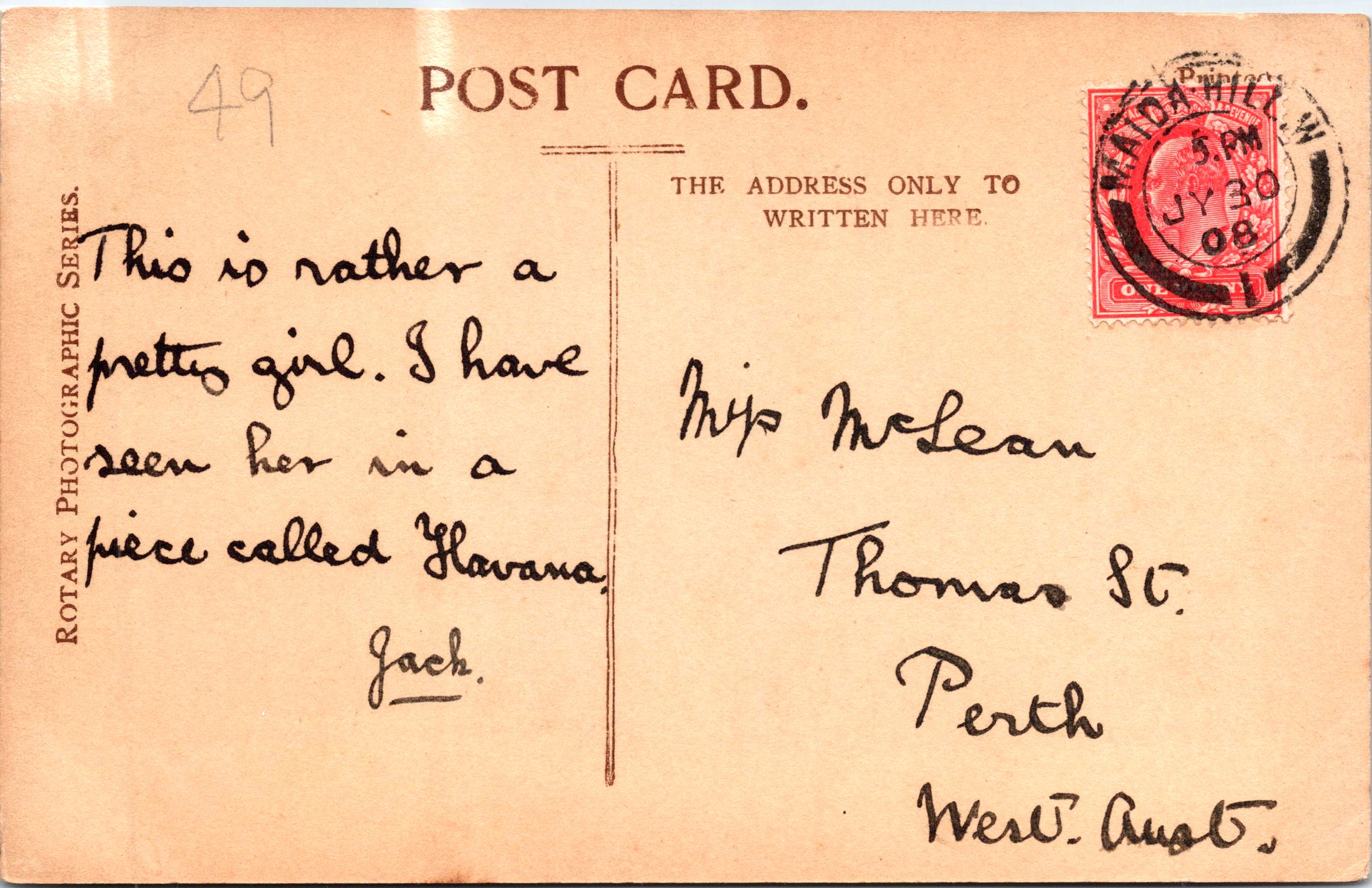
This vintage real photo postcard features a striking portrait of Jean Aylwin (1885-1964), a pretty British actress and singer from the early 20th century. She gained fame for her performances in musical comedies and plays in London and she also toured internationally. Aylwin was associated with the popular Gaiety Theater productions. She had notable performances in several successful productions including “The New Aladdin” (1906), “The Girls of Gottenberg” (1907) and “Our Miss Gibbs” (1909). Aylwin also appeared in two silent films. She married in 1913 but the marriage ended in divorce in 1924. She was accused of adultery with a noted composer of her time. After her divorce, her career declined. She later worked as a housekeeper. In 1926, she briefly worked as a BBC radio broadcaster.  Aylwin looks elegant in this dramatic studio pose. She stands three-quarter length with a thoughtful, hand-to-chin expression, the other hand set firmly at her hip. Aylwin wears a striking military-style costume—a fitted jacket heavily braided with ball buttons and tasselled cords, over a pleated skirt; a matching hat rests at her side. Her hair is dressed in full Edwardian waves, completing the theatrical look. Thd photographer of this portrait is the Dover Street Studios. The card was published by Rotary Photo as part of a series (no1898K). The postcard has a Wandsworth (London) postmark from 1908. The postcard is addressed to someone in West Australia. The message on the card is “This is rather a pretty girl. I have seen her in a piece called Havana. Jack.” The front of this card is has rich, sharp sepia tones. Holding the card at a certain angle, one can see dimples caused by the postmark. (SOLD) 

VALLI VALLI : PRETTY SILENT FILM & STAGE ACTRESS : RPPC 1908

POSTCARD 1 (SOLD)

POSTCARD 2 (SOLD)

POSTCARD 3 (SOLD)

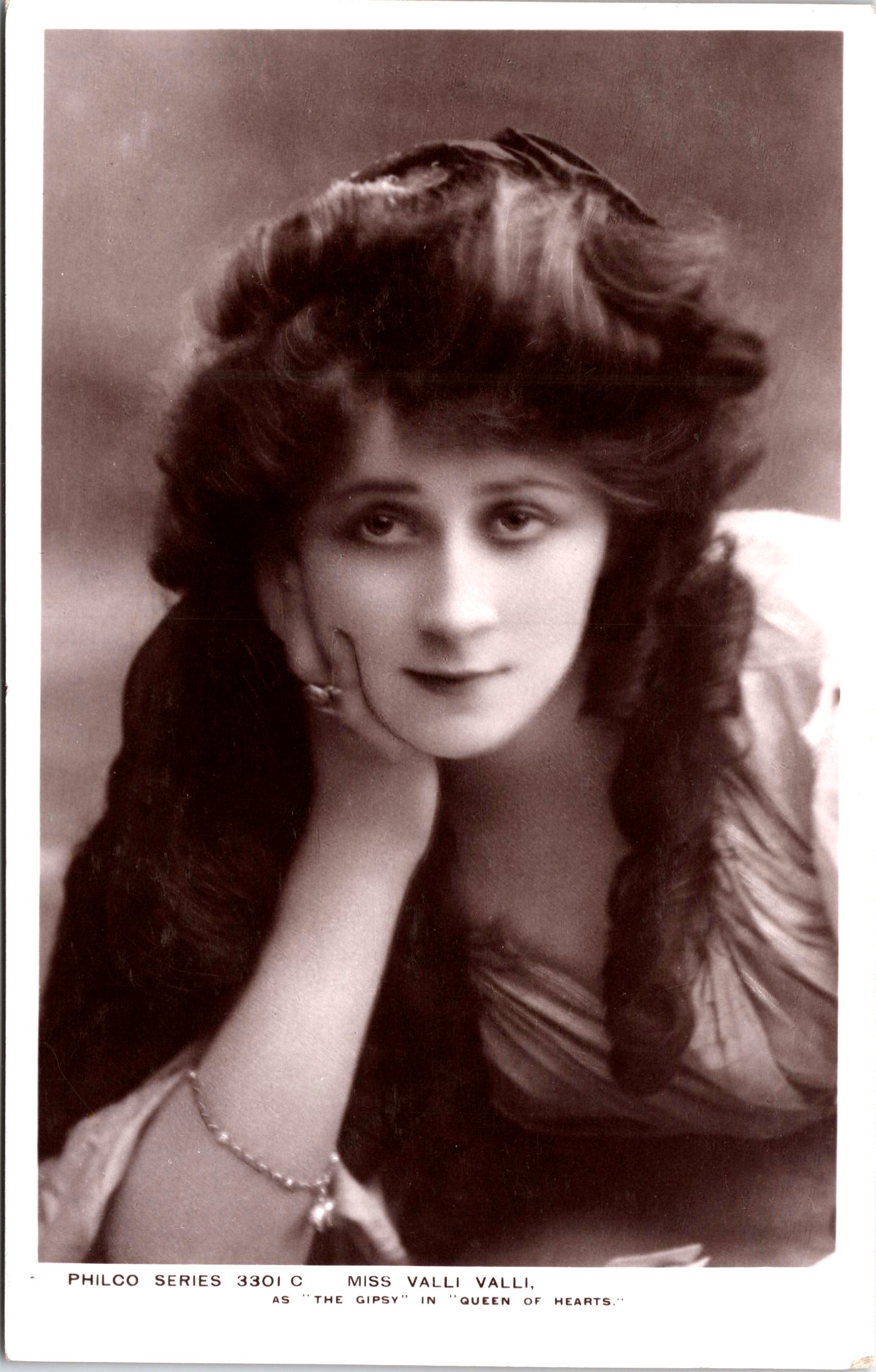
These vintage real photo postcards feature British beauty and actress, Valli Valli (1882-1927). She was a British musical comedy actress and a silent film performer. She was born in Berlin but spent most of her life in England. Her sisters, Lulu and Ida Valli were both actresses. Her father was a merchant. She was educated in London and Paris. She made her stage debut in London at the age of twelve. At thirteen years of age she had a successful run in the musical comedy “Morocco Bound” in Berlin. The next year she performed at London’s Drury Lane Theatre in a pantomime version of Cinderella. As an adult, Valli was a beautiful woman. She performed mostly on the English stage but did tour the United States a number of times. These plays include “The Dollar Princess” and her final New York City performance in “Miss Millions” (1919). In all, she appeared in seven Broadway plays between 1905 and 1920. Valli appeared in four films during 1915 and 1916. These films included “The Turmoil” which was an adaptation of a Booth Tarkington novel. In 1917, she married Louis Dreyfus, head of a music publishing house, and later, a theatrical producer. Valli died from tuberculosis at the young age of forty-five.

Postcard 1 captures Valli, in a pensive, or possibly, dejected mood. The card was published by Rotary Photo as part of a series (No.1760G). Miss Valli was photographed by the Bassano studio. (SOLD)

Postcard 2 features Valli, in a pensive or imploring mood, identical to the mood she exhibits in postcard 1. This card was published by Rotary Photo as part of a series (No.11415A).  (SOLD)

Postcard 3 captures Valli in her role as “The Gipsy” in “Queen of Hearts” . The card was published by Rotary Photo as part of a series (No.11415A). (SOLD)

POSTCARD 1 (SOLD)

POSTCARD 2 (SOLD)

POSTCARD 3 (SOLD)

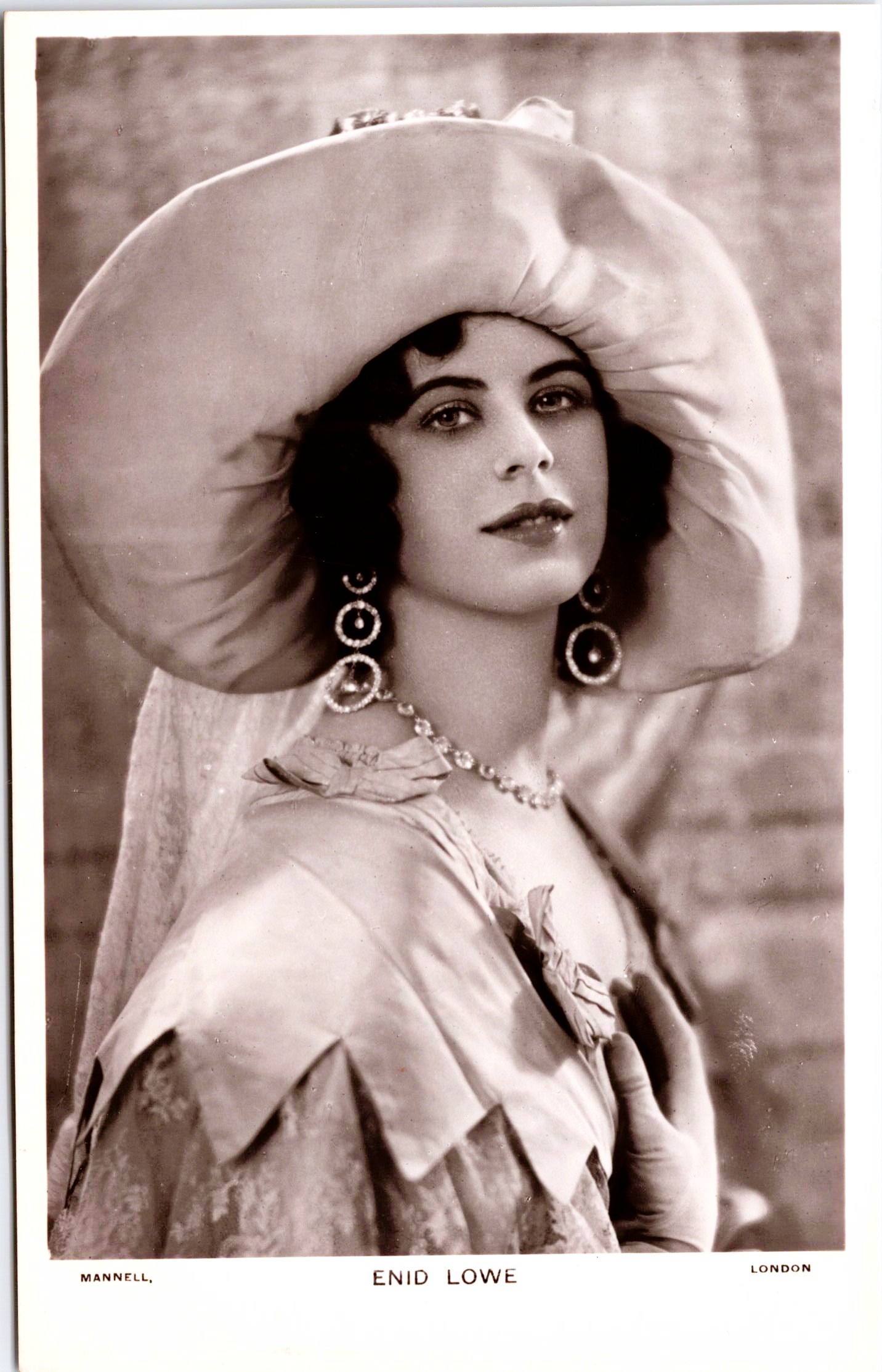
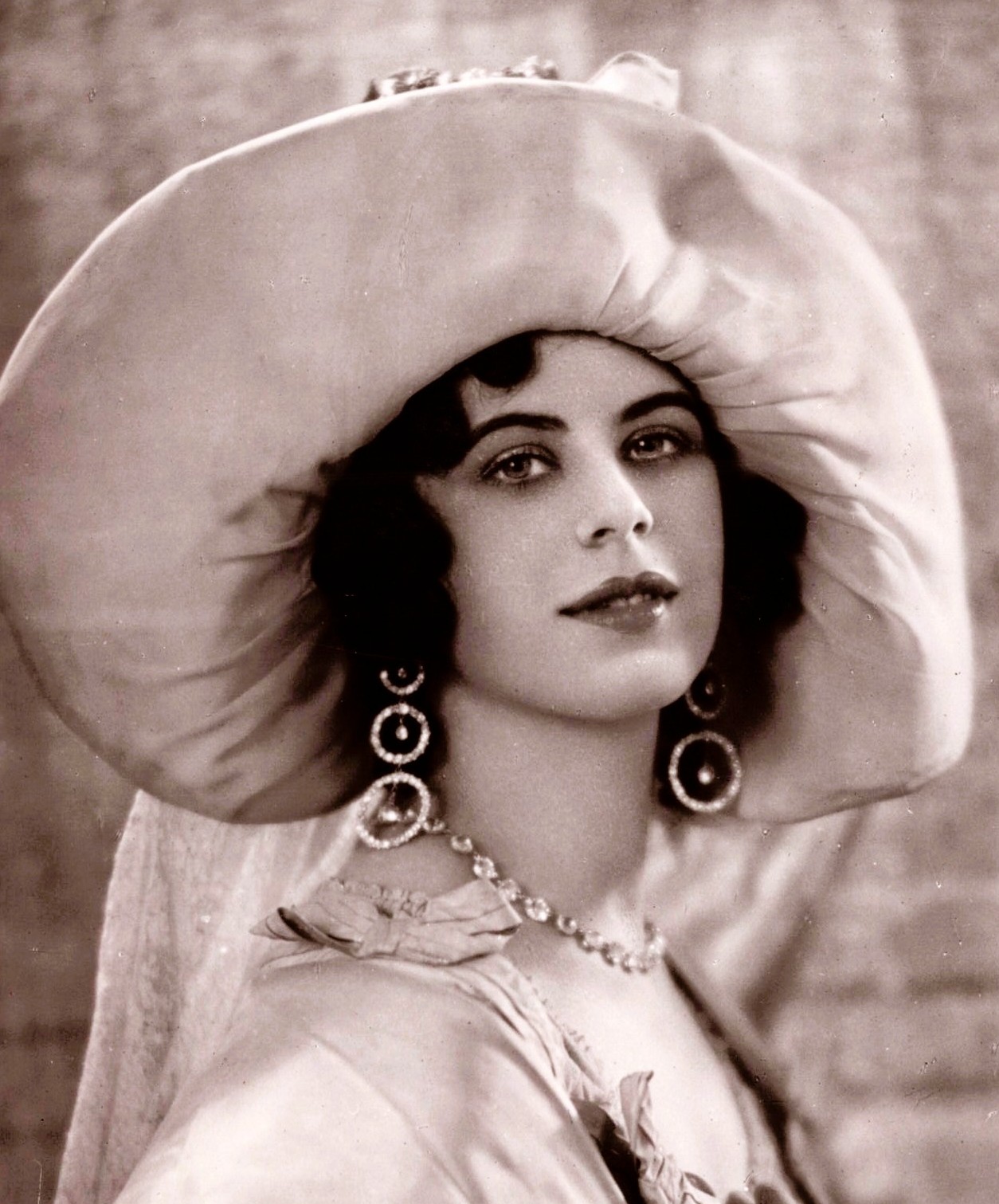
ENID LOWE : VINTAGE GLAMOUR PORTRAIT : BY GEORGE MANNELL : PRETTY ACTRESS : RARE

The photo postcard features Enid Lowe (1908-1994) in an elegant and theatrical pose. She was a British actress known for her work in television and theater, with notable appearances in productions such as “BBC Sunday-Night Theatre” (1950), “Educated Evans” (1957), and “Loot” (1970). In 1941, she performed in the musical “London Rhapsody” at The London Palladium. This postcard is a testament to Enid Lowe’s beauty. She is dressed in period-style attire. Her outfit includes a lavish gown with a soft, flowing texture, possibly made of silk or satin, adorned with delicate lace and ribbon details. The bodice has a gentle scalloped trim, and she wears long gloves, adding to the refinement of her look. Her accessories are striking—she wears an elaborate wide-brimmed hat with a voluminous, gathered crown, likely made of soft fabric. Her jewelry is ornate, consisting of large, dangling earrings with multiple tiers and a matching necklace of pearl-like beads. These accessories enhance the regal and theatrical nature of the portrait. Enid Lowe’s facial expression is poised and slightly enigmatic. Her dark, wavy hair is styled in an elegant, vintage fashion, framing her face beautifully. Her eyes, accentuated with dark makeup, have a confident and alluring gaze, and her lips are slightly parted, conveying a subtle yet engaging expression. The soft lighting highlights her delicate features, giving her a luminous and almost ethereal appearance. The photographer of this image, George Mannell, was based in London and was active in the early 20th century. He specialized in theatrical and celebrity portrait photography, producing high-quality postcards featuring actors and actresses of the time. His work captured the glamour and artistry of stage performers, often presenting them in elaborate costumes and dramatic poses to appeal to both fans and collectors. His work often appeared in publications such as the Picturegoer series, a popular British postcard collection featuring film stars and entertainers. SOLD

VESTA TILLY : FAMOUS MUSIC HALL STAR & MALE IMPERSONATOR : VINTAGE RPPC POSTCARD

POSTCARD 1 (SOLD)

POSTCARD 2 (SOLD)

Vesta Tilly (1858-1952) was one of the most beloved and influential performers of the British music hall era. She was a groundbreaking male impersonator who captivated audiences for decades with her wit, charm, and powerful stage presence. Born into modest beginnings, she rose to become a symbol of British patriotism and a pioneer for women on the stage. Tilly was born in Worcester, England. She was the second of thirteen children born to Henry Powles, a self-employed musician and fiddler, and Matilda Powles. Her father, deeply involved in local musical performances, recognized Matilda’s precocious talent at an early age and began showcasing her on stage by the time she was just three years old. The Powles family moved to London when Matilda was a child, in pursuit of more lucrative theatrical opportunities. With her father acting as her manager, she began performing under the stage name “Little Tilly” in pantomimes and variety shows. Matilda’s first male impersonation was at the tender age of six. By her teenage years, she had taken the stage name Vesta Tilly, inspired by the Roman goddess of the hearth (Vesta) and a common nickname (Tilly). Her success as a “principal boy” in pantomime was soon eclipsed by her signature act: portraying men with startling authenticity and satirical flair. What set Tilly apart was her command of the stage and her uncanny ability to adopt male gestures, mannerisms, and vocal inflections. She didn’t just mimic men—she portrayed them with intelligence, humor, and often, social critique. She frequently played dapper young men, military officers, or swells (wealthy young men), sometimes poking fun at political figures or addressing social issues. She became one of the most highly paid and respected performers in the British music hall scene during the late Victorian and Edwardian periods. Her stage appearances were so convincing that many audience members did not initially realize she was a woman. Vesta Tilly’s career spanned over four decades, and she performed in countless popular songs and sketches. Some of her most iconic performances included: “Following in Father’s Footsteps”, “Burlington Berlie”, and “The Boy in the Gallery”. She was particularly popular among working-class audiences and soldiers. During World War I, Tilly took on a new patriotic role, performing in uniform to recruit young men to the military. She was so effective that she earned the nickname “England’s Greatest Recruiting Sergeant.” In 1890, Vesta Tilly married Walter de Frece, a theatrical impresario and songwriter. Their relationship was both romantic and professional—Walter became her manager and guided much of her career. He was instrumental in helping shape her brand and ensuring her continued success on the music hall circuit. After World War I, Walter was knighted and later became a Member of Parliament. This new political role brought Vesta into a more socially prominent world, and she gradually withdrew from the stage. Vesta Tilly gave her final performance in 1920 at the London Coliseum. Her retirement was widely publicized and emotional for her devoted fan base. After stepping away from the stage, she became Lady de Frece, supporting her husband’s political ambitions and engaging in charity work. The couple eventually moved to Monte Carlo, where they lived a quieter life. Walter de Frece died in 1935, and Vesta lived on until 1952. 

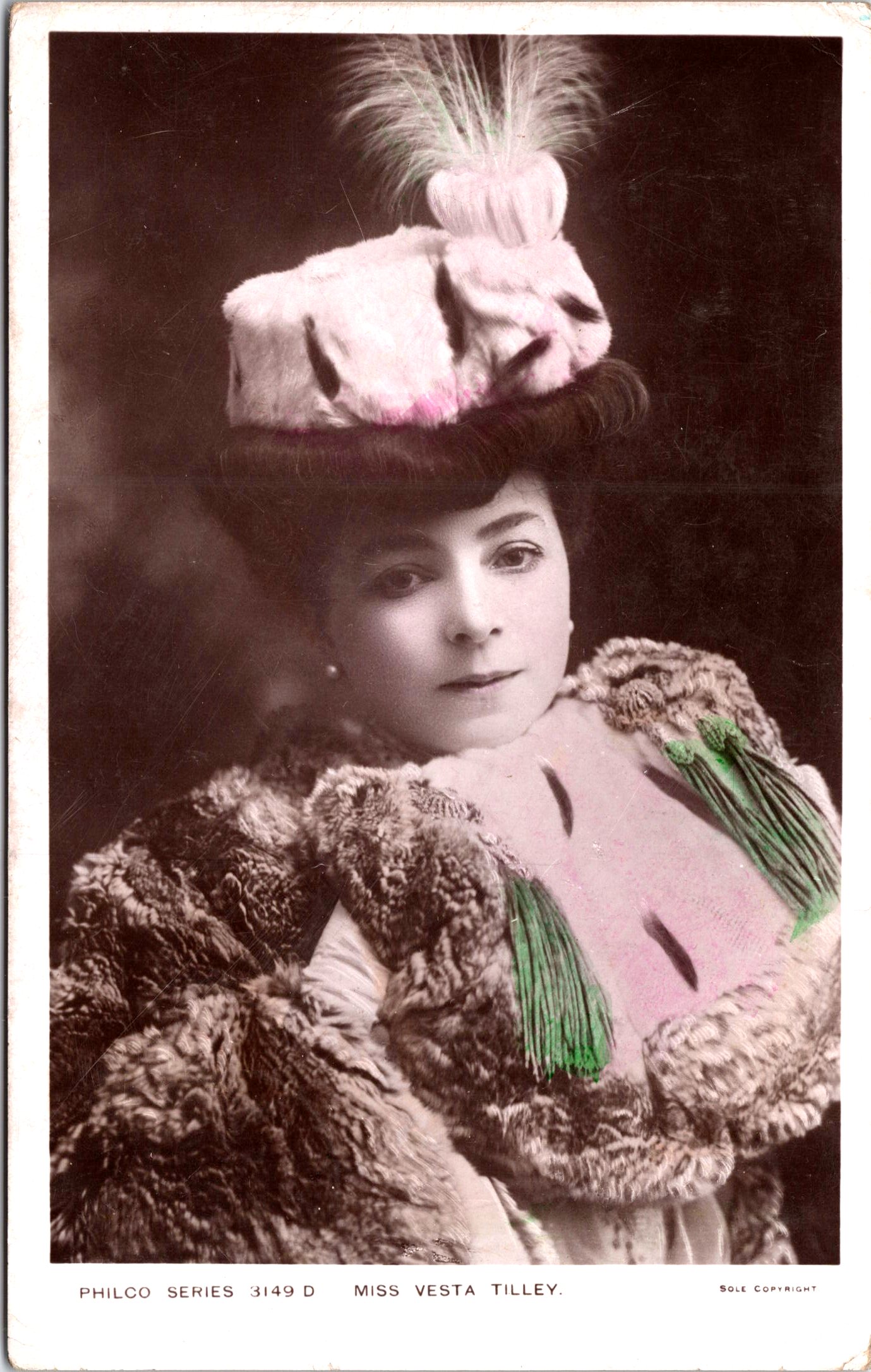
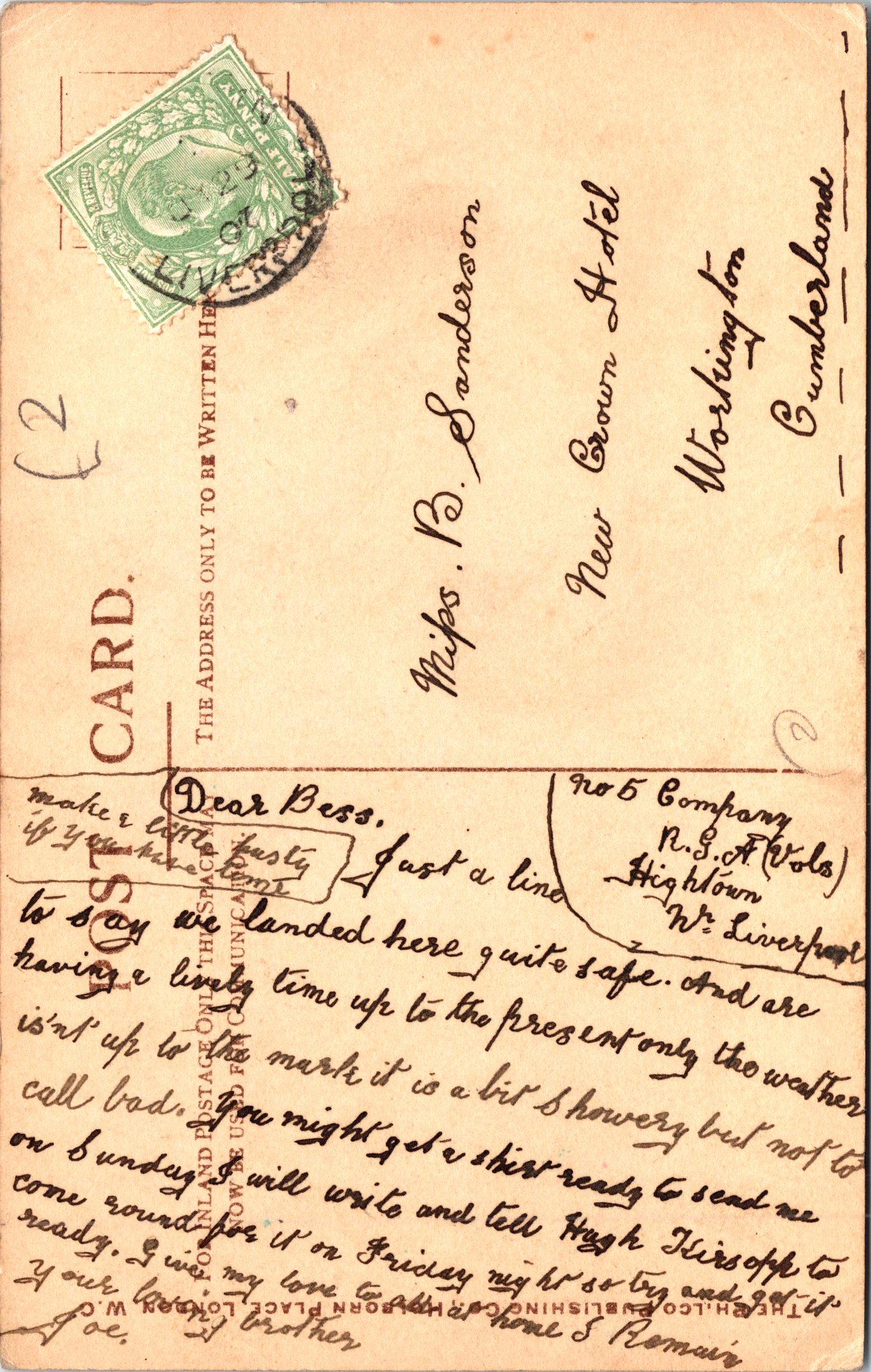
Postcard 1 shows Tilley in a fur-trimmed coat, accessorized with a hat adorned with feathers. The card has been hand-tinted, with touches of pink on her costume and hat and green on the tassels. The following is a transcription of the letter: “Dear Bess, Just a line to say we landed here quite safe. And are having a lovely time up to the present, only the weather isn’t up to the mark, it is a bit showery but not too bad. You might get a skirt ready to send me on Sunday. Will write and tell Hugh this aft to come round for it on Friday night so try and get it ready. Give my love to [all at home]. Joe” (Writer’s details also appear: No. 5 Company R.S. of Vols, Hightown, Nr. Liverpool.) This postcard was published by Philco as part of a series (No.3149D). (SOLD)

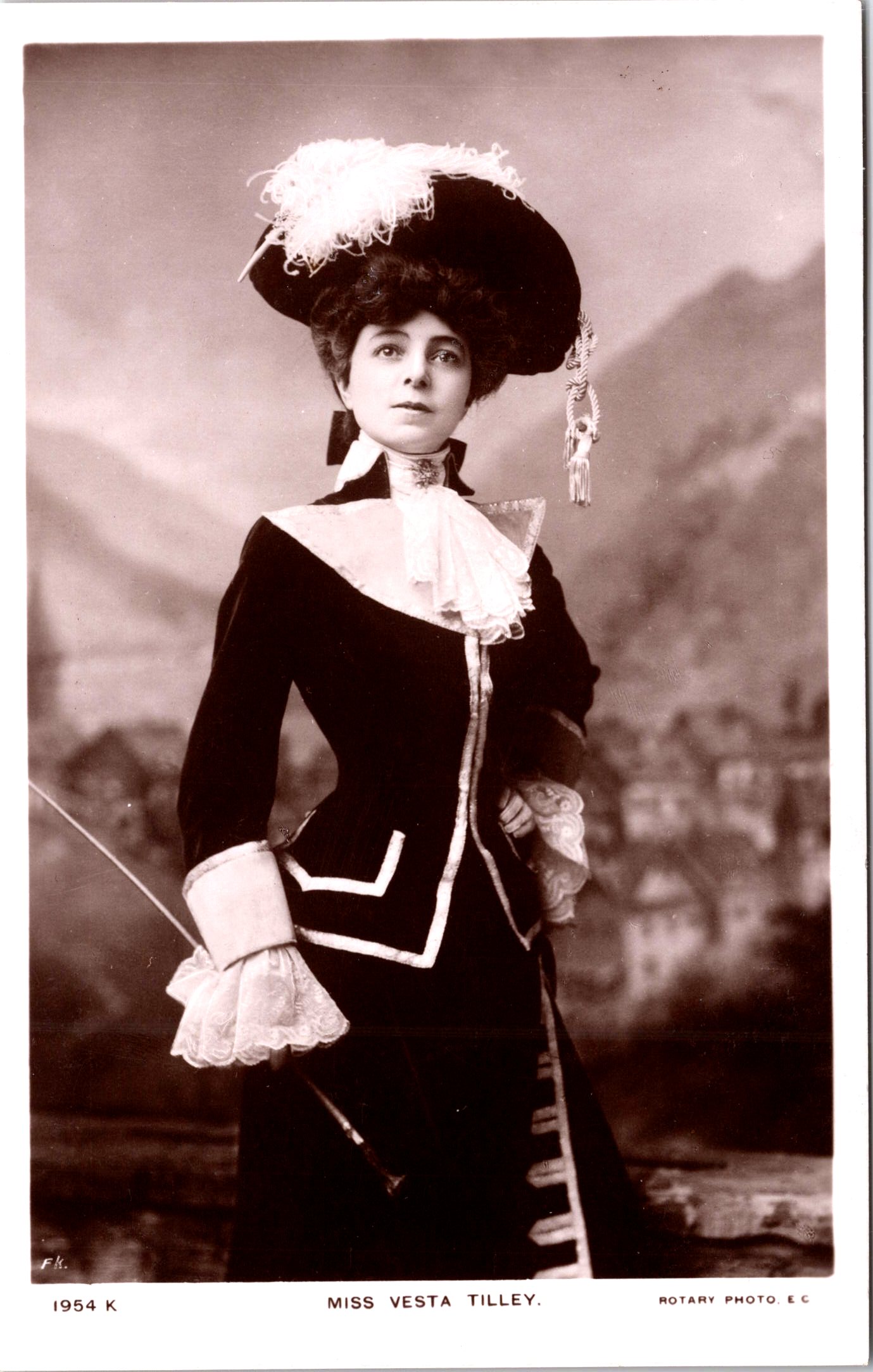
Postcard 2  features Vesta Tilley posed in an elegant stage costume—a black, tailored ensemble with white trim and lace cuffs, paired with a wide-brimmed hat boasting a dramatic plume and tassel. The scenic mountainous backdrop adds theatrical flair, and the overall presentation evokes late-Victorian or Edwardian stage portraiture. In the bottom-left corner of the image, you’ll notice the initials “F K”—identifying the photographer behind the portrait. I have been unable to further identify “F K”. This postcard was published by Rotary Photo as part of a series (No.1954K).  (SOLD)

POSTCARD 1

POSTCARD 2

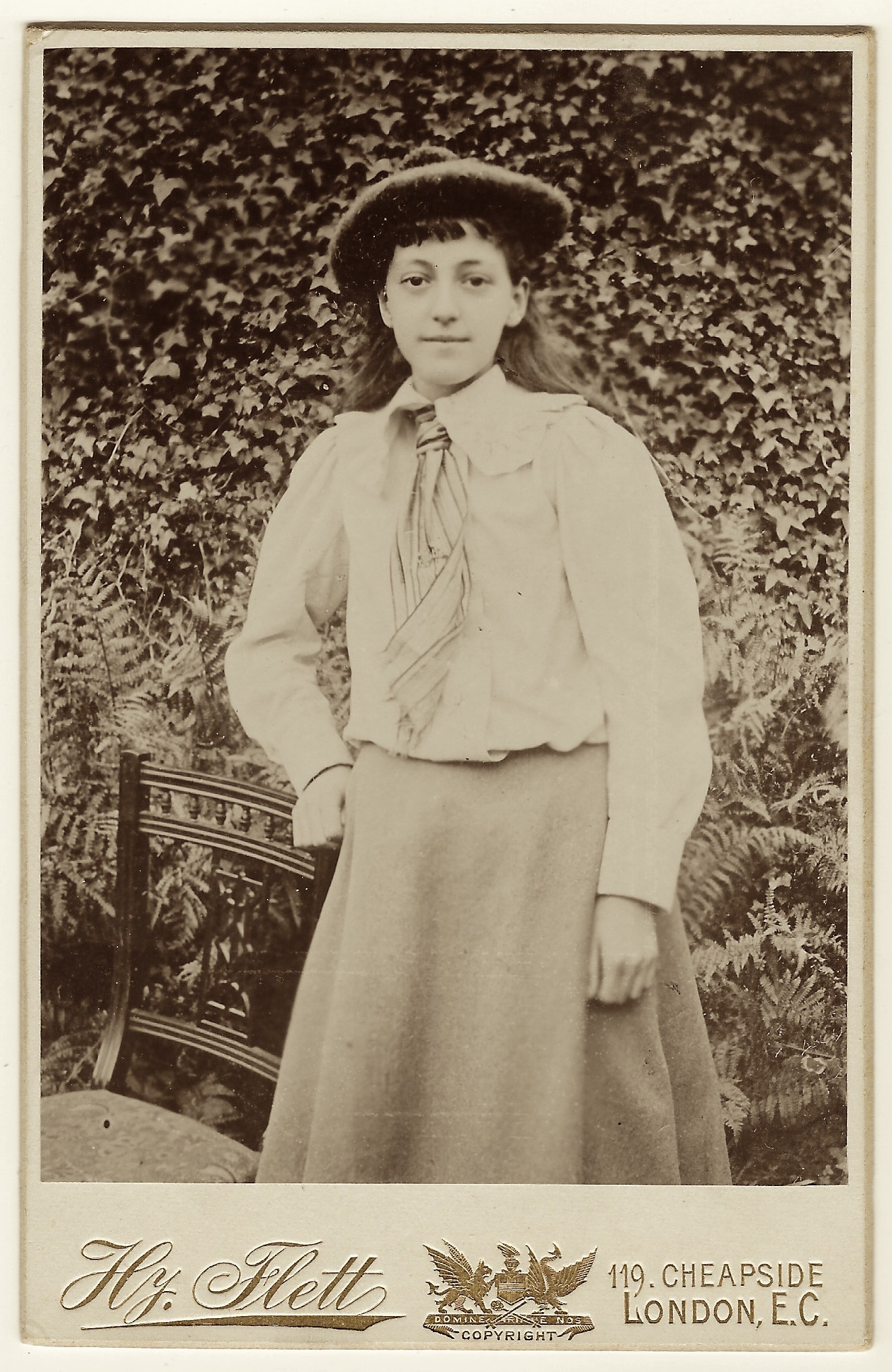
PREPPY LOOKING TEENAGE GIRL ON THE CHEAPSIDE

This cabinet card portrait features a sweet looking teenage girl dressed in what today we might call, a “preppy look”. Perhaps she is a student. Be sure to note her scarf and hat. The girl’s eyes are wide open and she appears to be suppressing a smile. The photographer’s camera captured the girl in an outdoor setting. The photographer was Hy. Flett who operated a studio in London. Interestingly, the studio was located at 119 Cheapside. This image is actually the second cabinet card in the “Cabinet Card Gallery” from a studio on Cheapside. Research revealed that  Cheapside  is the name of a street in the city of London. The name Cheapside is derived from the term “marketplace”. Henry Flett (1872-1948) was born in St. Leonards in Sussex. He operated two London studios. The Cheapside studio existed between 1897 and 1940. His second studio was located at 103 Newgate Street (1903-1909). He partnered with Arthur Frame Stevens in the 1930’s.  SOLD

Published in: on September 14, 2025 at 12:00 pm  Leave a Comment  
Tags: ,

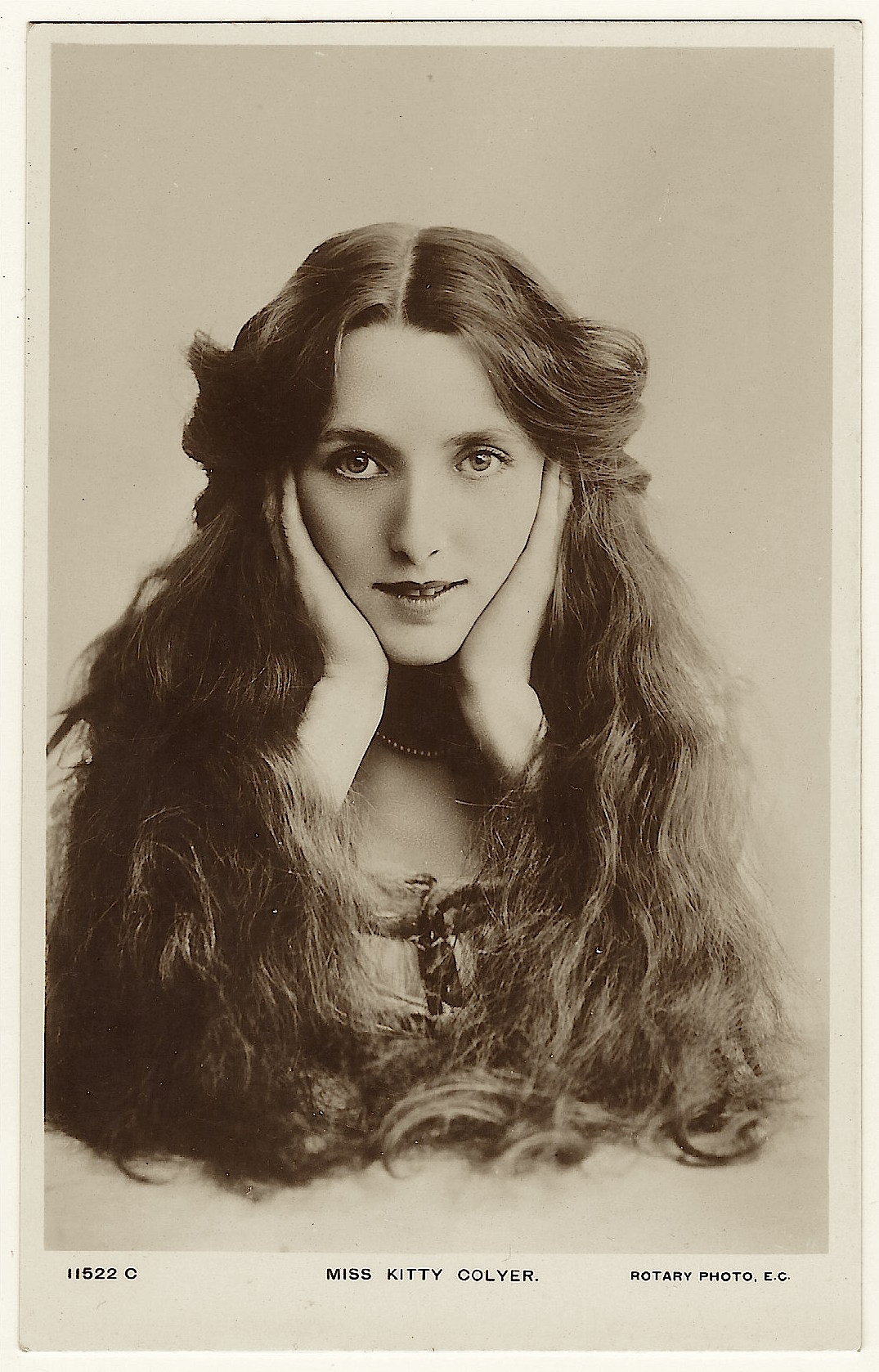
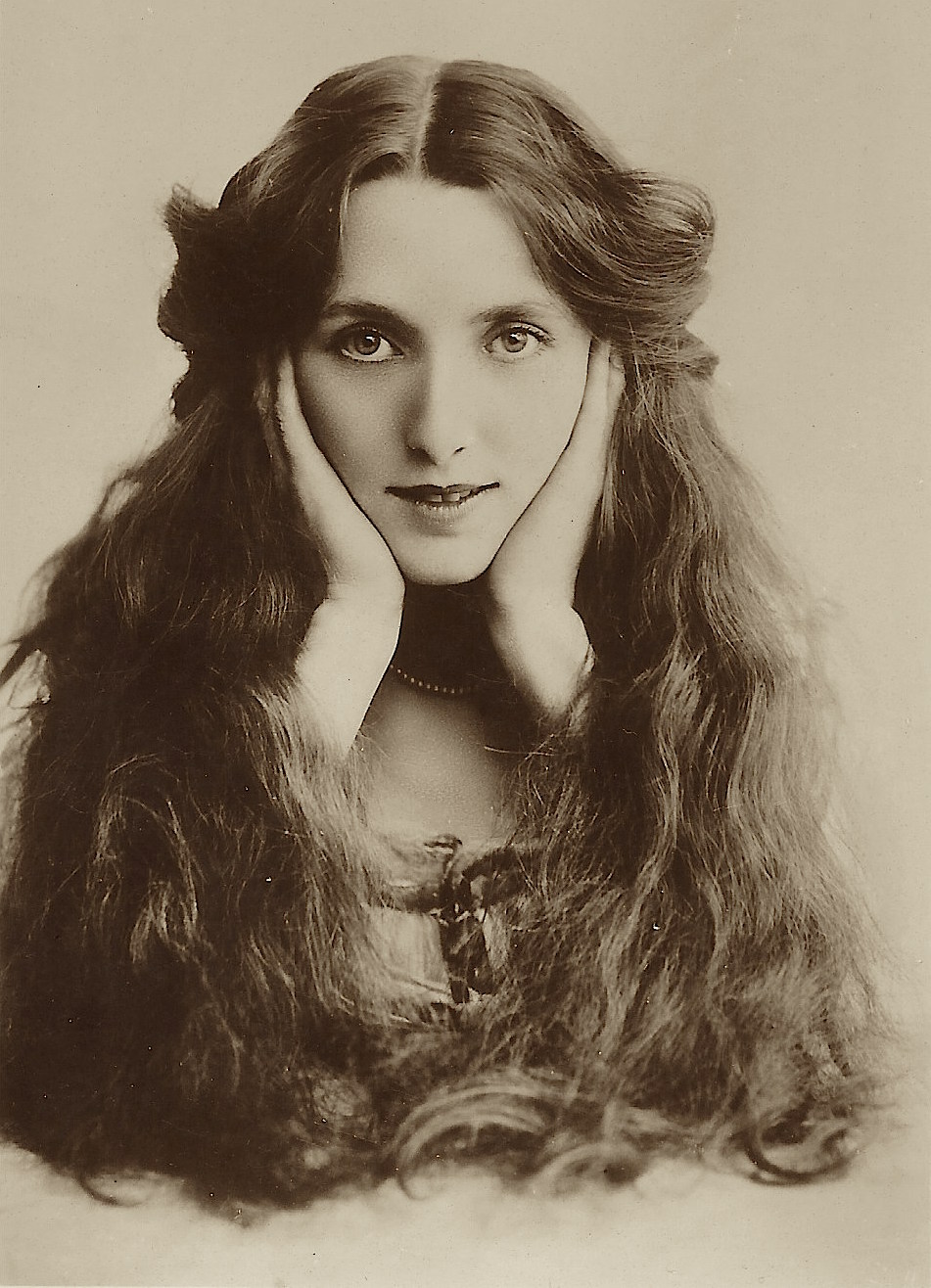
KITTY COLYER – ENGLISH TRIPLE THREAT (SINGER, DANCER, ACTRESS) – PLAYED CINDERELLA

kitty coyler

kitty coyler 2

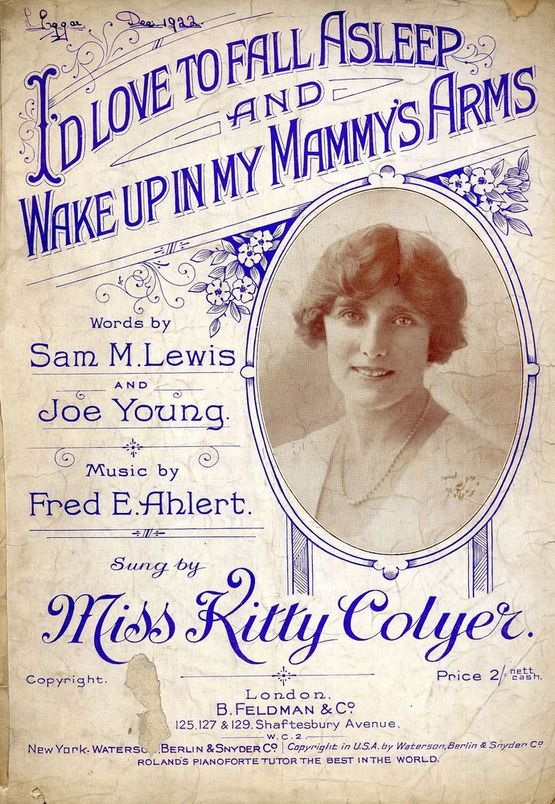
The pretty actress seen in this vintage real photo postcard, is Miss Kitty Colyer (1897-?). Here are some biographical facts that I discovered in preliminary research about the English actress. She started her career at age eleven. In addition to being an actress, she was also a dancer. She has also been described as a music hall singer and a comedian. Her dance routines were varied but her favorites were acrobatic, toe, buck, and national dancing. She performed primarily in the 1920’s. She played the role of Cinderella in “Cinderella” (1920).  As the roaring twenties came to a close, her career fizzled out and she left the entertainment business. A review of Miss Colyer can be found in John Culme’s “Footlight Notes” (website). A writer from “The Era” (1911) wrote “Miss Kitty Colyer’s sensational dancing reaches its climax in some very energetic handsprings and her lissomness and activity are quite irresistible in her rendering of “By the Light of the Silvery Moon”. Look below to see an example of sheet music (1920) featuring Kitty Colyer. Now, back to the vintage postcard. It was published by Rotary Photo and is part of the Rotary Photographic Series (no. 11522 C). The photographer is unknown.   SOLD

kitty coyler 3

MADAME KIRKBY LUNN : ENGLISH OPERA DIVA : METROPOLITAN OPERA HOUSE : RPPC

This vintage real photo postcard features English mezzo soprano, Louise Kirkby Lunn (1873-1930). She appeared in many French and Italian operas. She was best known for singing operas by Richard Wagner. She had many appearances at the Royal Opera House, Convent Garden as well as at the Metropolitan Opera in New York City. This postcard was published by Rotary Photo as part of a series (No.2025B) The card was produced around 1905.  SOLD