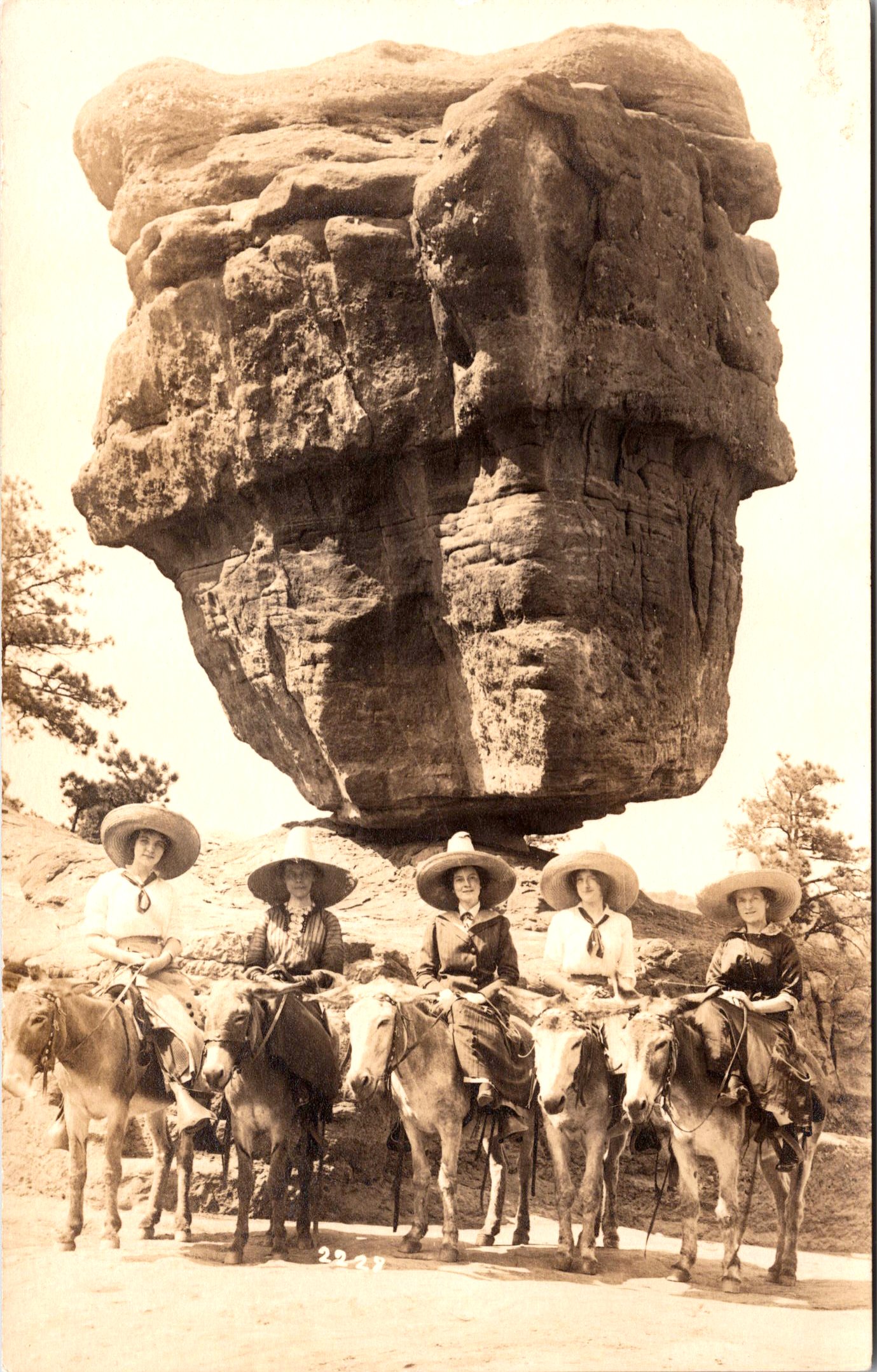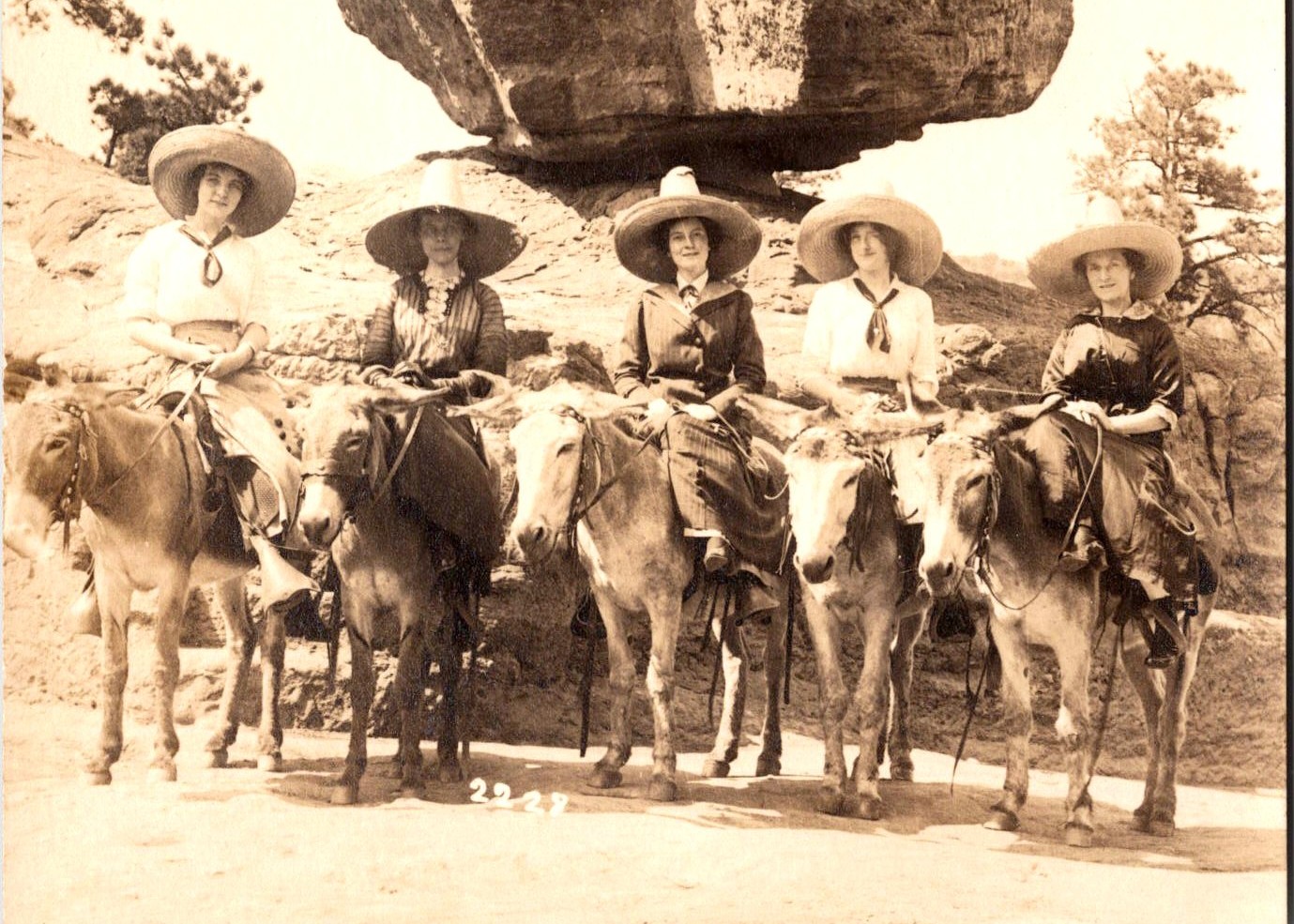
BALANCED ROCK : GARDEN OF THE GODS : COLORADO : WOMEN ON BURROS : RPPC 1920’s

You’re looking at a charming early 20th-century real photo postcard taken at one of Colorado’s most iconic natural landmarks—Balanced Rock, located in the stunning Garden of the Gods park just outside Colorado Springs. This novelty photograph captures a group of five women posing proudly on donkeys in front of the massive, gravity-defying sandstone formation. The photograph radiates the playful spirit of early Western tourism. Five women sit astride small donkeys, all lined up neatly in front of the looming shadow of Balanced Rock. Their expressions vary from reserved amusement to open cheerfulness, suggesting they are enjoying a once-in-a-lifetime travel experience in the American West. Each woman wears a wide-brimmed sombrero-style hat, likely provided by the concession for a touch of “Wild West” flair. Their clothing is modest but stylish for the era—ankle-length skirts, blouses with sailor collars or lace trim, and fitted jackets give them a slightly adventurous, yet feminine look appropriate for tourists of the 1910s or early 1920s. Despite riding donkeys—often considered humble beasts of burden—the women’s confident postures and bemused smiles give the impression that they’re enjoying their frontier fantasy. Their donkeys stand calmly, reins held loosely in the women’s hands, adding to the relaxed, posed nature of the scene. The back of the card identifies the photographer as Paul Goerke & Son, who operated a thriving photography business in Manitou, Colorado. This firm set up a concession at Balanced Rock, one of the most photographed natural features in the West. Tourists could ride donkeys or burros up to the site, don hats, and pose for a souvenir photograph, which Goerke’s team would develop and print on postcard stock. (SOLD)

ID’D FRONTIER COWBOYS: FEMALE PHOTOGRAPHER : OAKLEY, IDAHO : CABINET CARD c 1890

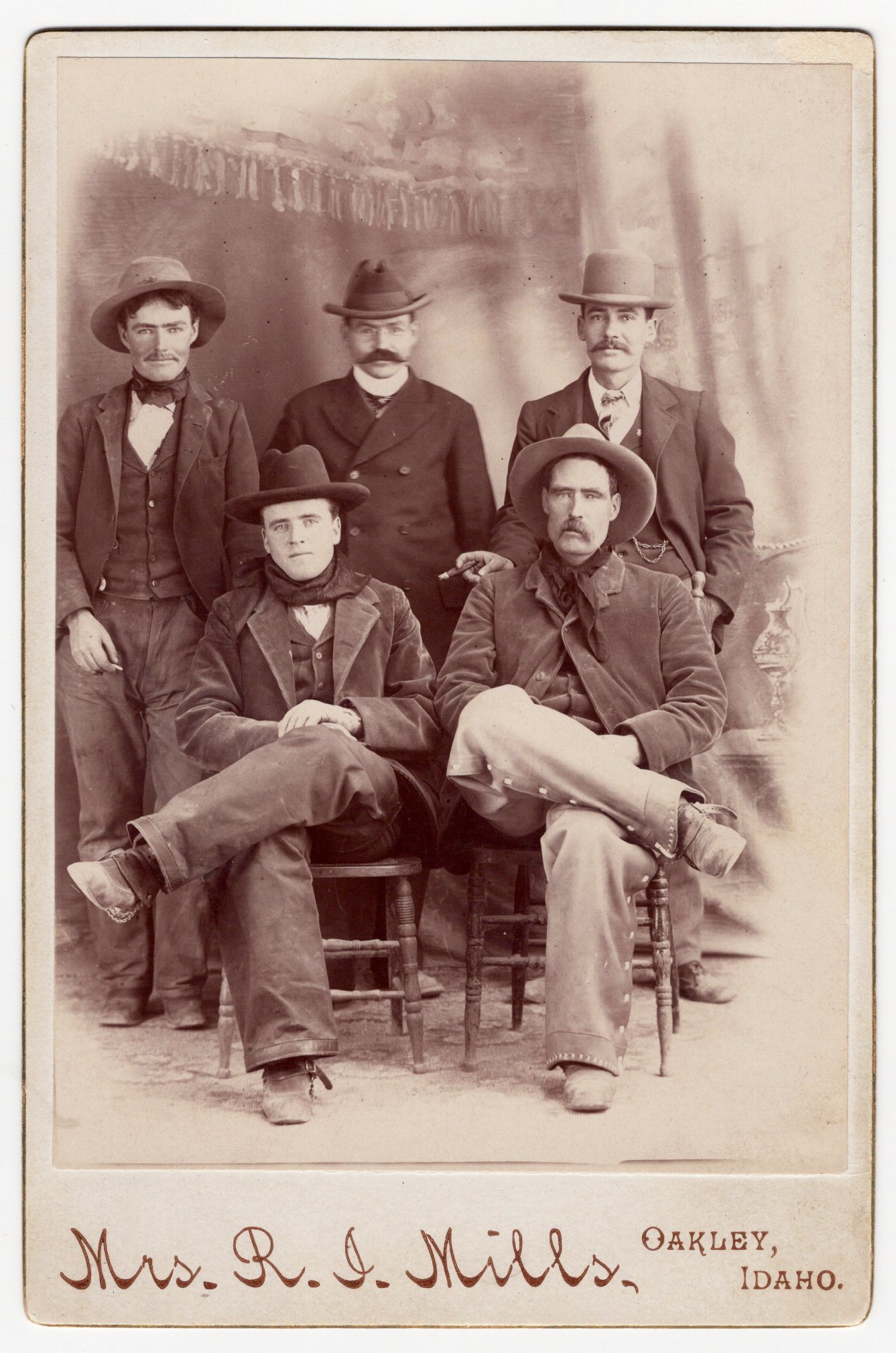
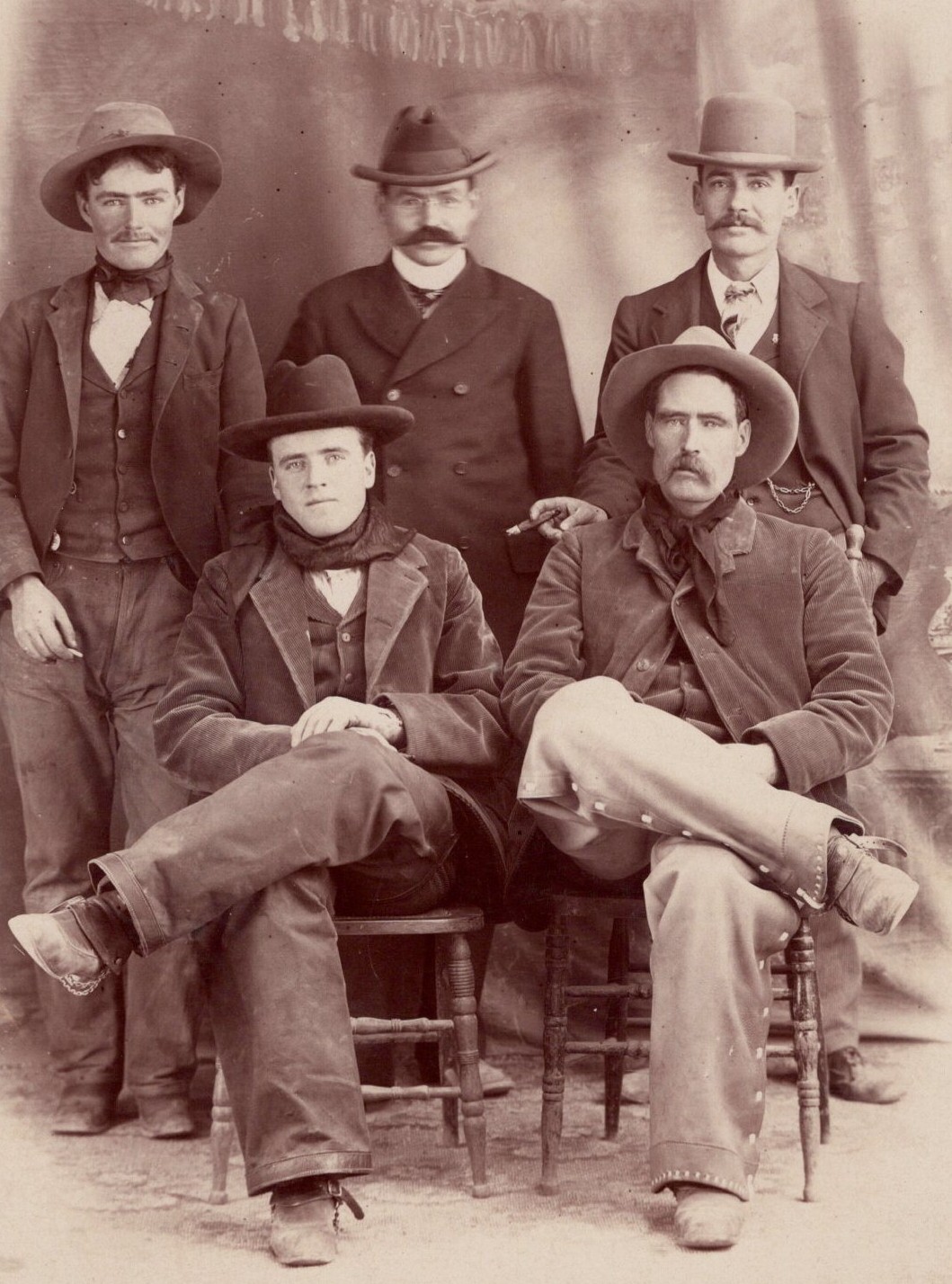
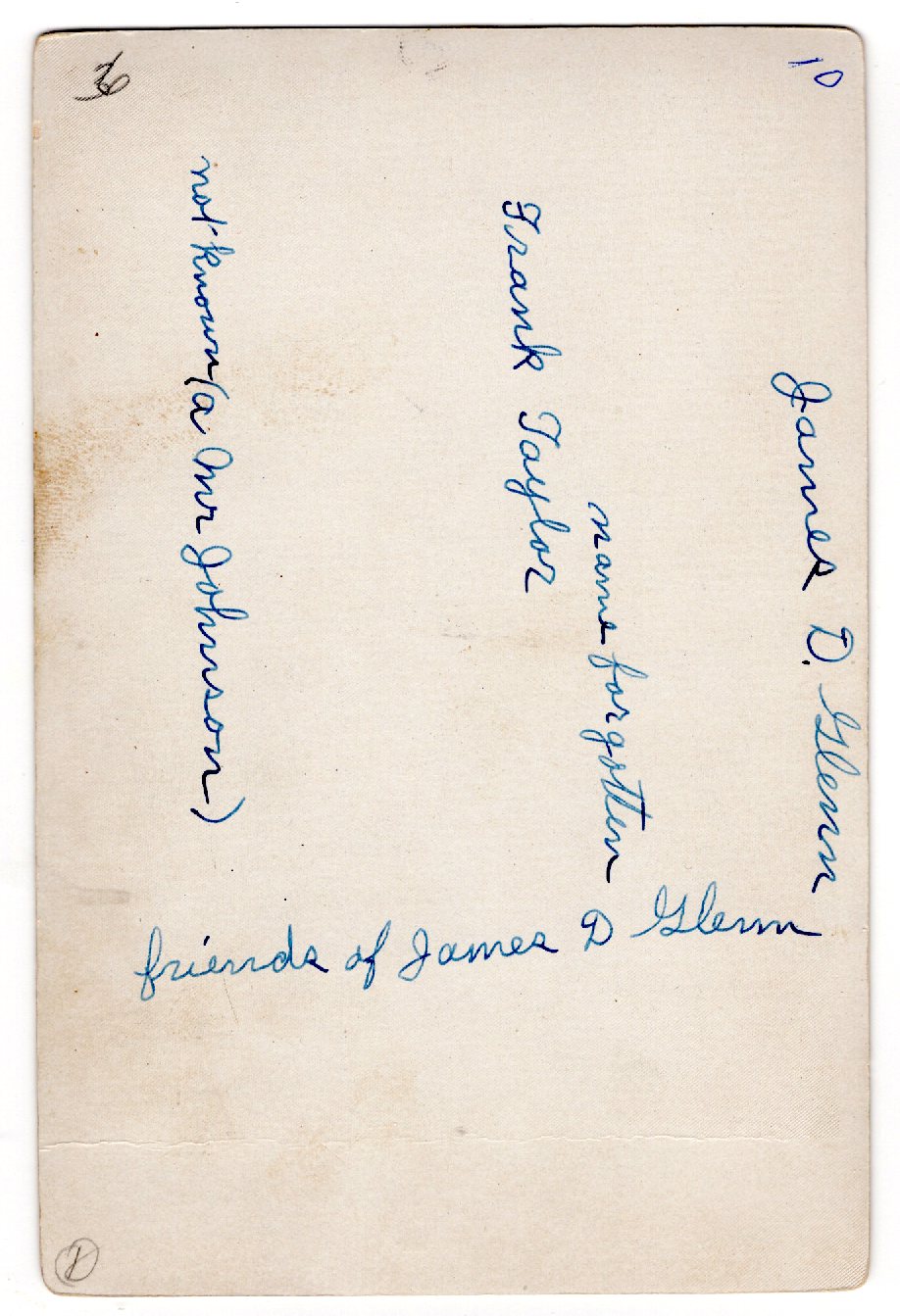
This arresting cabinet card, taken in Oakley, Idaho by the photographer Mrs. R. I. Mills, captures a vivid and timeless portrait of five rugged Western men from the late 19th or very early 20th century. The image radiates strength, camaraderie, and a quiet intensity that invites speculation about the identities and lives of its subjects. The five men are posed against a painted studio backdrop that includes drapery and a classical vase stand, subtly contrasting with the grit and rough-hewn realism of the men themselves. Two sit in the foreground, legs crossed with a relaxed authority, while three stand behind them. All are dressed in frontier attire: wide-brimmed hats, wool coats, high boots, and neckerchiefs. Their layered clothing suggests the chill of the high desert West. The expressions vary slightly—some show stoic resolve, others a more neutral bearing—but none of the men are smiling. Their faces are rugged, with prominent cheekbones, strong jaws, and thick mustaches. The man at center back smokes a cigar, and one gets the sense that these are men of action—likely cowboys, ranchers, or possibly even lawmen or miners. The man seated at the right front—wearing a wide-brimmed hat, dark scarf, and white canvas trousers with riveted side seams—commands particular attention. His intense gaze and imposing posture suggest he may have been a leader among them. The others wear expressions of cool composure, unified by the weathered look of men who knew hard labor or possibly the frontier justice of the American West. Written in blue ink on the reverse of the card is an identification key, apparently penned by someone familiar with at least some of the sitters: James D. Glenn, Frank Taylor, Mr. Johnson. An inscription reveals that the men are all friends of James Glenn. It is likely that this photograph belonged to Mr. Glenn. This photograph was taken by a female photographer. Mrs. R. I. Mills was an early female photographer working in the American West—an unusual and significant occupation for a woman at the time. Her studio was located in Oakley, Idaho, a small Mormon-founded settlement in Cassia County. Historical records show that Mrs. Rachel I. Mills operated a photography studio in Oakley in the late 19th century. She was part of a small but growing number of frontier women who ran their own commercial photography studios. Though little has been published about her biography, her studio was active around the 1880s–1890s, a time when Oakley was transitioning from a pioneer settlement into a more established town with irrigation agriculture and Mormon communal development. Founded in the early 1880s by Mormon settlers, Oakley was a rural, religiously conservative community that grew around farming and ranching. It sat on the edge of the high desert and became a local hub for commerce in southern Idaho. During the time this photograph was likely taken—circa 1890—Oakley would have been a small but lively town, with residents involved in cattle ranching, grain farming, and trade.  (SOLD)

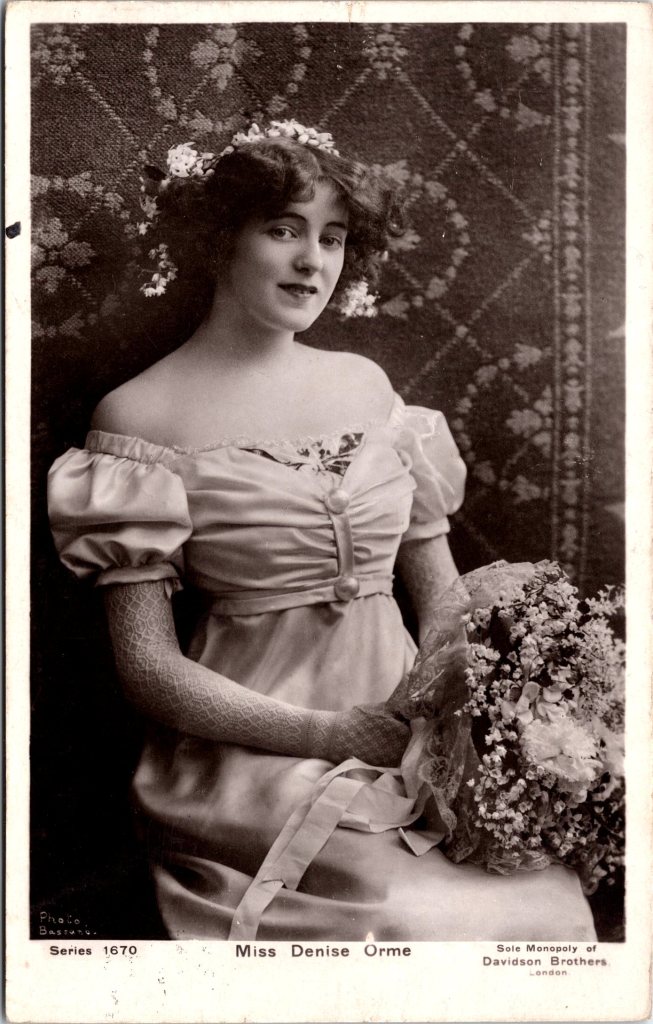
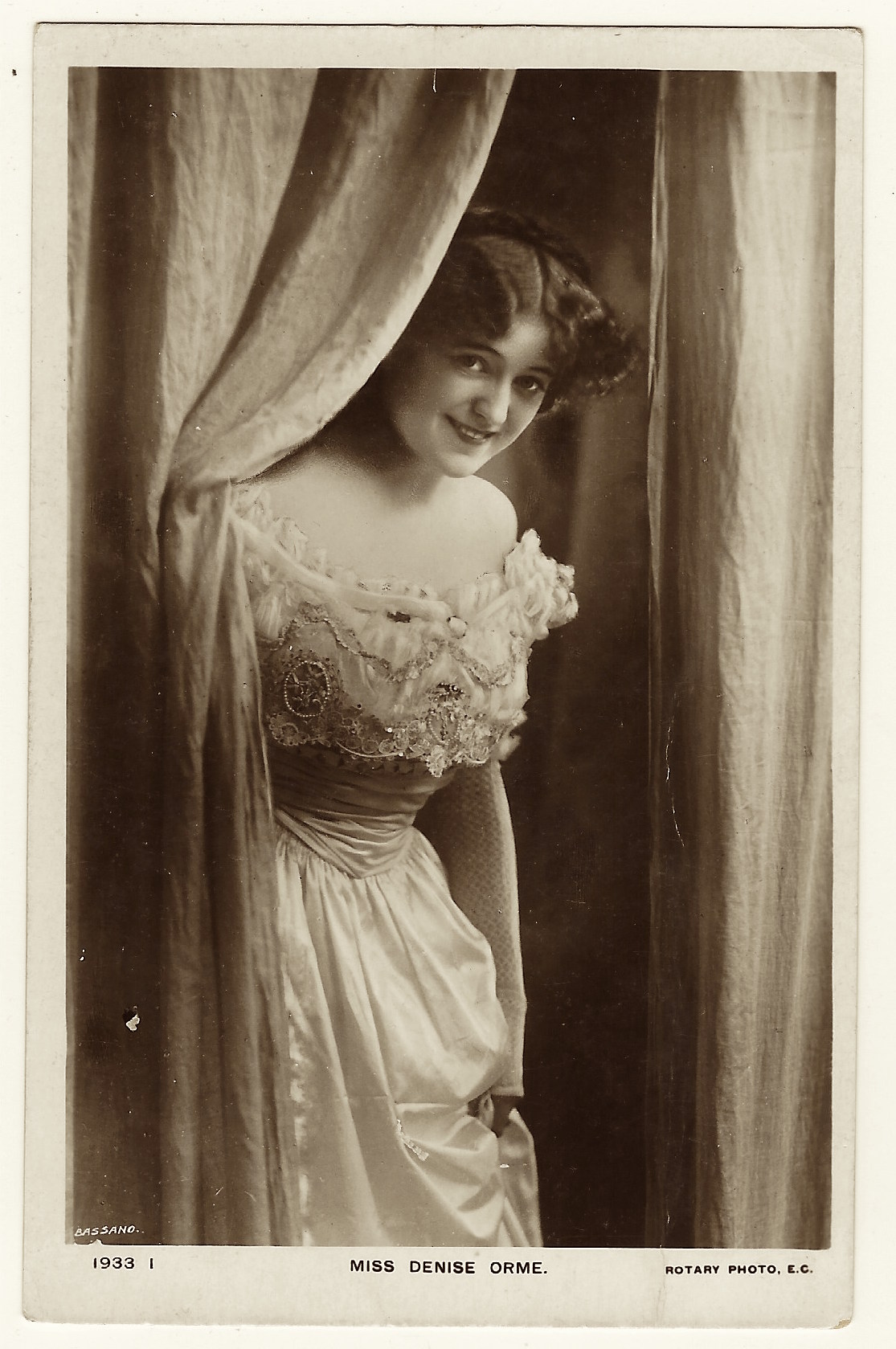
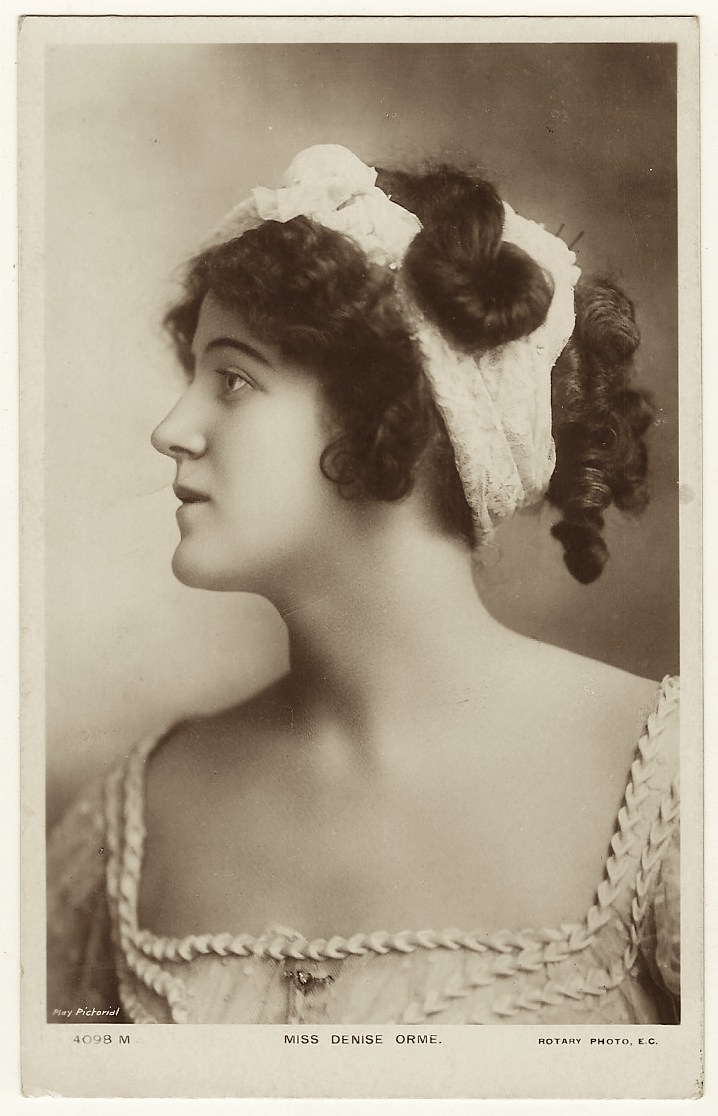
BEAUTIFUL STAGE ACTRESS DENISE ORME (THREE VINTAGE REAL PHOTO POSTCARDS)

orme

                                                                            POSTCARD 1

orme 2

                                                                              POSTCARD 2

orme-2

                                                                                 POSTCARD 3  (SOLD)

This image has an empty alt attribute; its file name is 6007_0001-1.jpg

                                                                            POSTCARD 4  (SOLD)

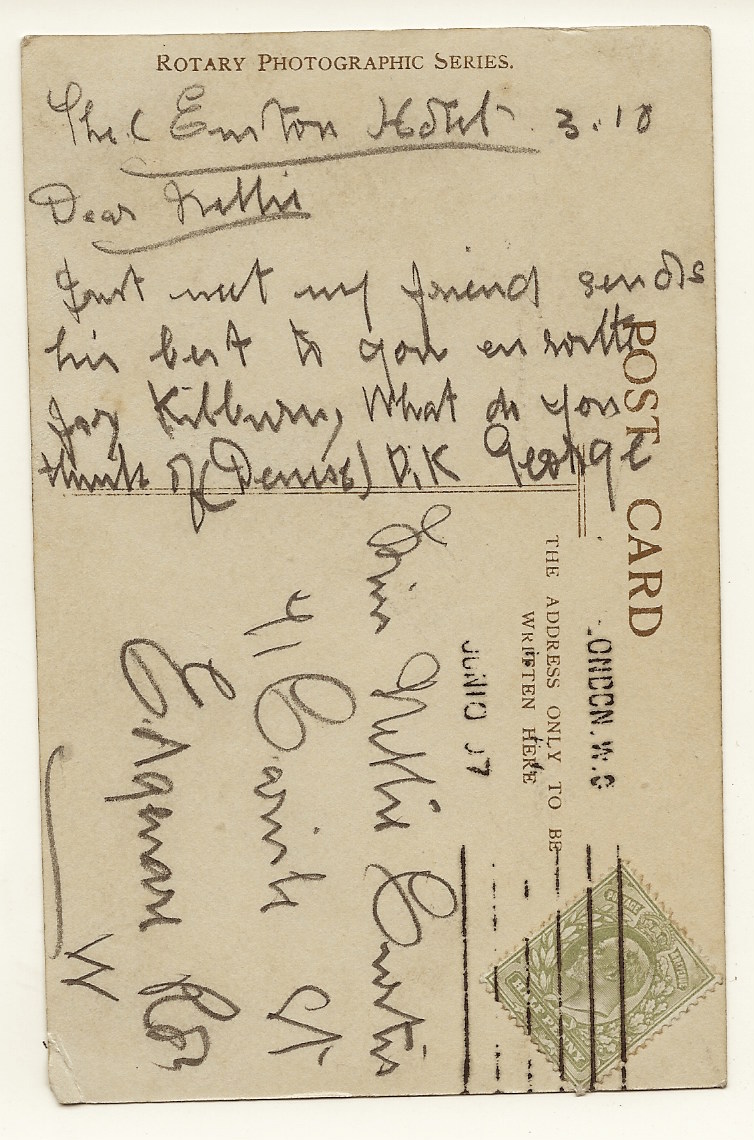
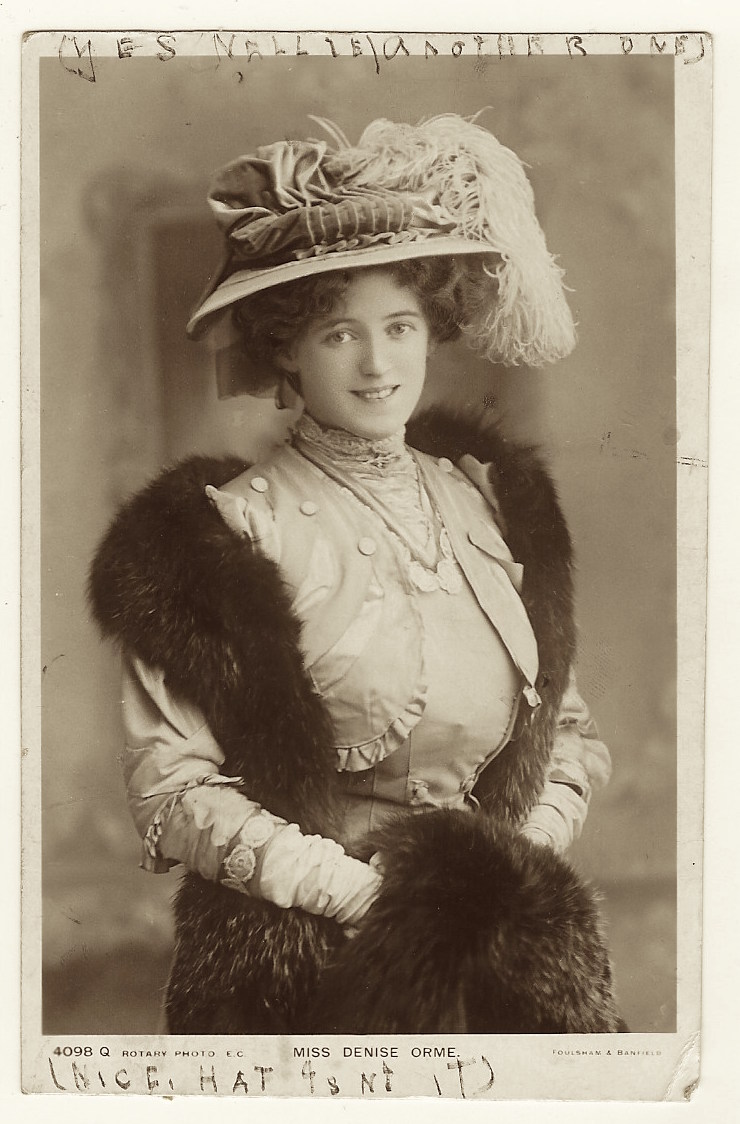
Postcard 1 features stage actress Miss Denise Orme. She is very attractive and beautifully dressed. She is wearing a fur stole and and fur muffs. She has a lovely hat and wonderful smile. Miss Orme’s given name was Jessie Smither, and was later known as Duchess of Leinster. Denise Orme (1885-1960) was an English music hall singer, actress and musician who was a regular performeer at the Alhambra and Gaiety Theatres in London during the early years of the twentieth century. Her mother was a professor of music. She trained for her theatrical career at the Royal Academy of Music and the Royal College of Music. Her stage debut was in 1906 in the chorus at Daly’s Theatre in London. Later that same year she appeared in the title role of “See See” at the Prince of Wales Theatre. In 1906 she participated in gramophone recordings of Gilbert and Sullivan’s “The Mikado”. Her marital history reveals that she had a predilection to choosing husbands that were “rich and famous”. She was married to an English Baron, A Danish millionaire, and an Irish duke. She was the maternal grandmother of Aga Khan IV.who is the current Imam of Nizari Ismailism which is a denomination of of Ismailism within Shia Islam with 15 million adherents. He is also a British business magnate. Miss Orme’s photographic portrait was taken by the Foulsham and Banfield Studio. Foulsham & Banfield were well known celebrity photographers. Frank Foulsham and A. C. Banfield operated a studio in the 1900’s through the 1920’s. The postcard was published by Rotary Photo and is part of the Rotary Photographic Series (#4098 Q). The postcard has a postmark from London, England, and dated 1907. The postmark date reveals that this portrait of Miss Orme was taken at the beginning of her stage career. In the message section of the postcard, the sender asks the receiver, “What do you think of Denise?”. In addition, the sender asserts on the front of the postcard “Nice hat, isn’t it?”. I have to agree; not only is Miss Orme lovely, so is her hat…….  

Postcard 2 shows the beautiful and well dressed Miss Orme peeking out from behind a curtain. The photographer is Alexander Bassano (1829-1913) who was a leading royal and high society photographer located in London. This postcard, like the first was published by Rotary Photo and is part of the Rotary Photographic Series (no. 1933 I).

Postcard 3 presents a close-up profile view of this stunningly pretty young actress. Like the first two photo postcards, this one is also published by the Rotary Photo company and is part of the Rotary Photographic Series (no. 4098 M). The photograph was taken by “Play Pictorial” which was an English theatre magazine published in London between 1902 and 1939. The publication provided a pictorial presentation of West End theatrical productions with each issue focusing on just one play.  (SOLD)

Postcard 4 presents a close-up profile view of this stunningly pretty young actress. It is published by the Davidson Brothers and is part of the Real Photographic Series (no.1670). The photograph was taken by Alexander Bassano. Bassano  (1829 –1913) was a leading royal and high society photographer in Victorian London.  (SOLD)

orme 2

REVERSE OF FIRST POSTCARD

orme 2 1

REVERSE OF SECOND POSTCARD

orme-1

REVERSE OF THIRD POSTCARD

REVERSE OF POSTCARD 4

MISS VIOLET CAMERON: SCANDALOUS STAGE ACTRESS

CABINET CARD 1

cameron

CABINET CARD 2
V CAMERON 3_0002CABINET CARD 3

CAMERON FRONTCABINET CARD 4 MISS VIOLET CAMERON : SCANDALOUS STAGE ACTRESS : CDV ; AD FOR MINERAL WATER - Picture 1 of 2CARTE de VISITE 1

Violet Cameron (1862-1919), was an English stage star. She was the niece of burlesque legend Lydia Thompson. Cameron  began her stage career as a child in 1871. She played several child roles at the Drury Lane Pantomime theatre. As an adult, she played many prominent roles in the most important English theatres. In 1886 she came to America and played in “The Commodore” and “Kenilworth”. In 1893 she had great success in the stage play “Morocco Bound”. She was involved in several scandalous love affairs during her stage career.  

Cabinet Card 1 is a product of Elliot & Fry, a prominent London photography studio.

Cabinet Card 2 was produced at the studio of W & D Downey in London, England.

Cabinet Card 3 is also by Downey. She looks lovely in her ruffly dress and her plunging neckline (relative to the cabinet card era) highlights her necklace. The reverse of the cabinet card has the stamp of Charles Ritzmann of New York City indicating that it was once owned by the esteemed purveyor of theatrical photographs.

Cabinet Card 4 also comes from the Downey studio. Cameron appears to be wearing a wedding dress in this cabinet card portrait. 

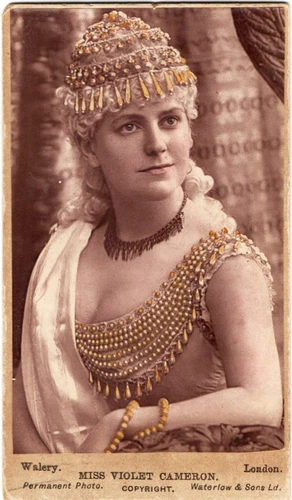
The reverse of Carte de Visite 1 has an advertisement for Taunus Mineral Water. The natural sparkling water came from Springs located near Frankfurt, Germany. Miss Cameron’s portrait for this carte de visite was taken by the celebrated Walery studio in London, England.

MISS VIOLET CAMERON : SCANDALOUS STAGE ACTRESS : CDV ; AD FOR MINERAL WATER - Picture 2 of 2

CARTE de VISITE 1

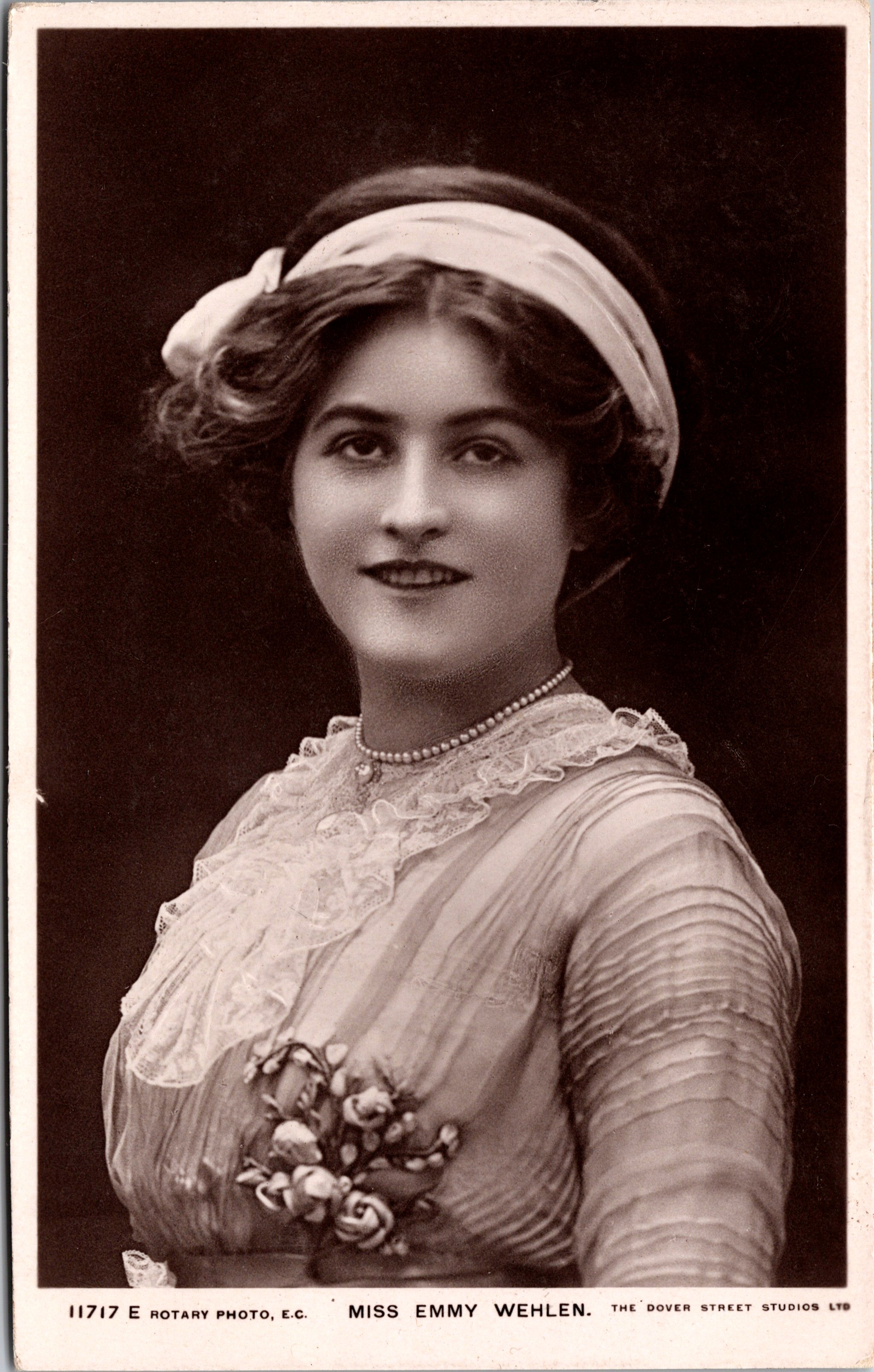
MISS EMMY WEHLEN : PRETTY THEATRE AND SILENT FILM STAR : BROADWAY : RPPC

POSTCARD 1

POSTCARD 2 (SOLD)

POSTCARD 3 (SOLD)

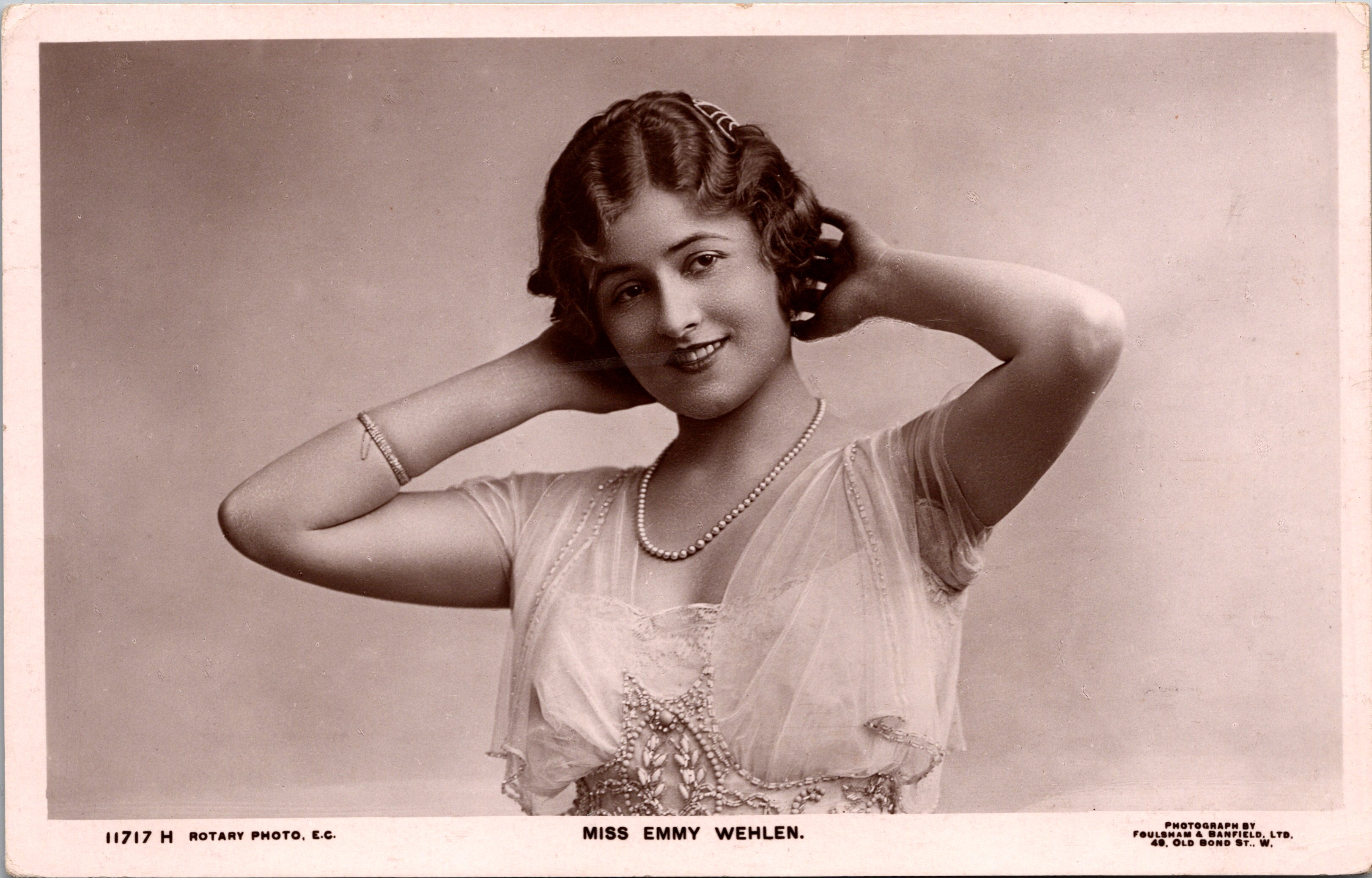
Postcard 1 features German actress, Emily “Emmy” Wehlen (1887-1977). She was a Edwardian musical comedy and silent film actress. She retired from acting at a young age (early 30’s), Wehlen received her musical training at the Mannheim Conservatory. She then joined the Thalia-Theatre and performed in musical comedies in several German cities. She was then invited to London and was considered as a possible successor to Lily Elsie. Wehlen played the lead role in “The Merry Widow” (1909). Later that year she appeared in the hit musical “The Dollar Princess” which ran for 428 performances. Next stop was New York, where she appeared in four Broadway plays between 1911 and 1915. Shortly after her last Broadway appearance, Wehlen left the stage and pursued a film career.  She appeared in over twenty films between 1915 and 1920. “Everybody’s Magazine (1911) reported that Wehlen was very pretty and very graceful. Her acting and voice were also praised. In addition, the article stated that “she has the indescribable charm of personality” and that audiences liked her and wanted her to never leave the stage during a production. Miss Wehlen’s photograph on this postcard was taken by celebrity studio, Foulsham & Banfield. The card was published by Rotary Photo as part of a series (no.11717H).

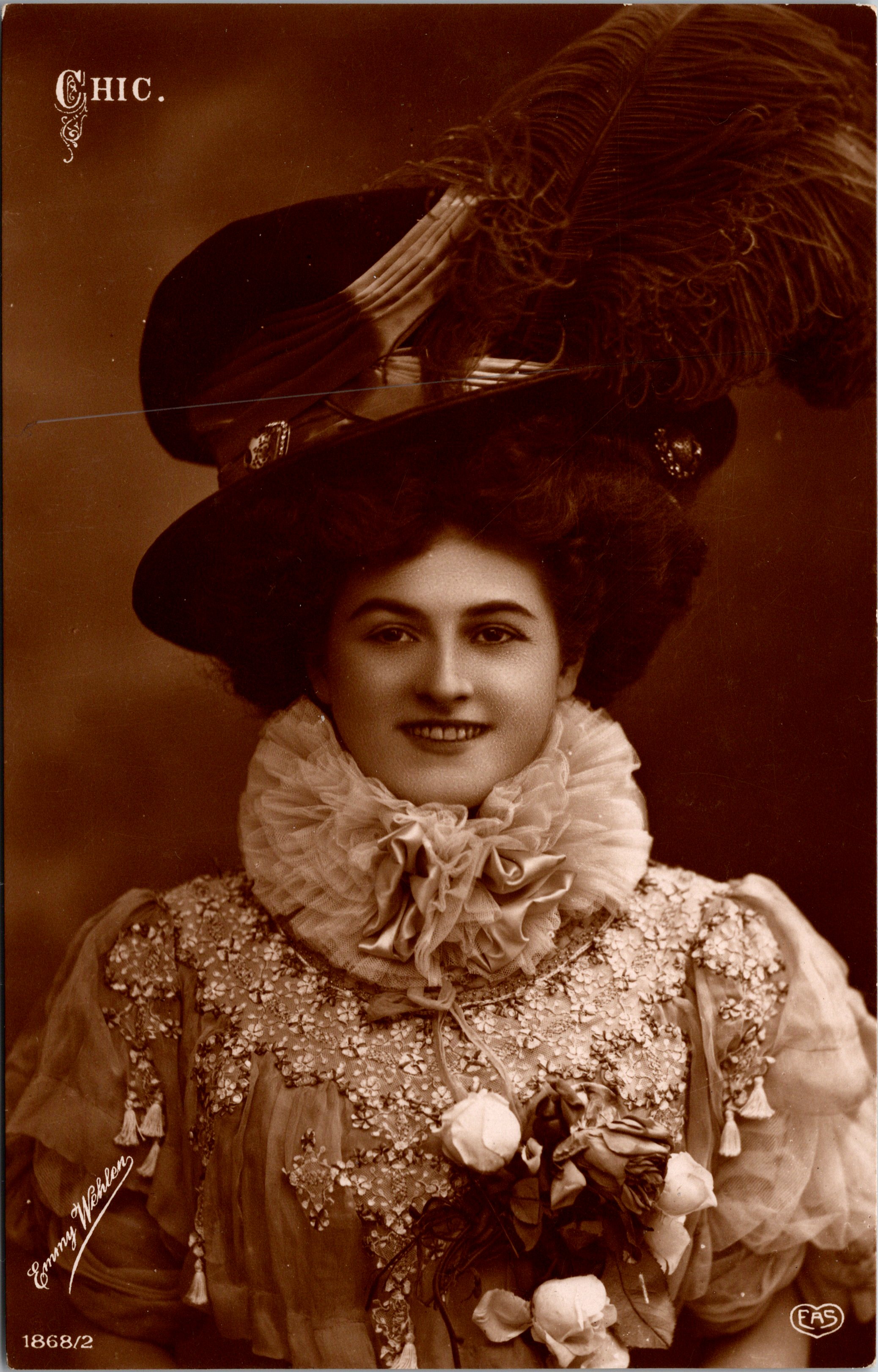
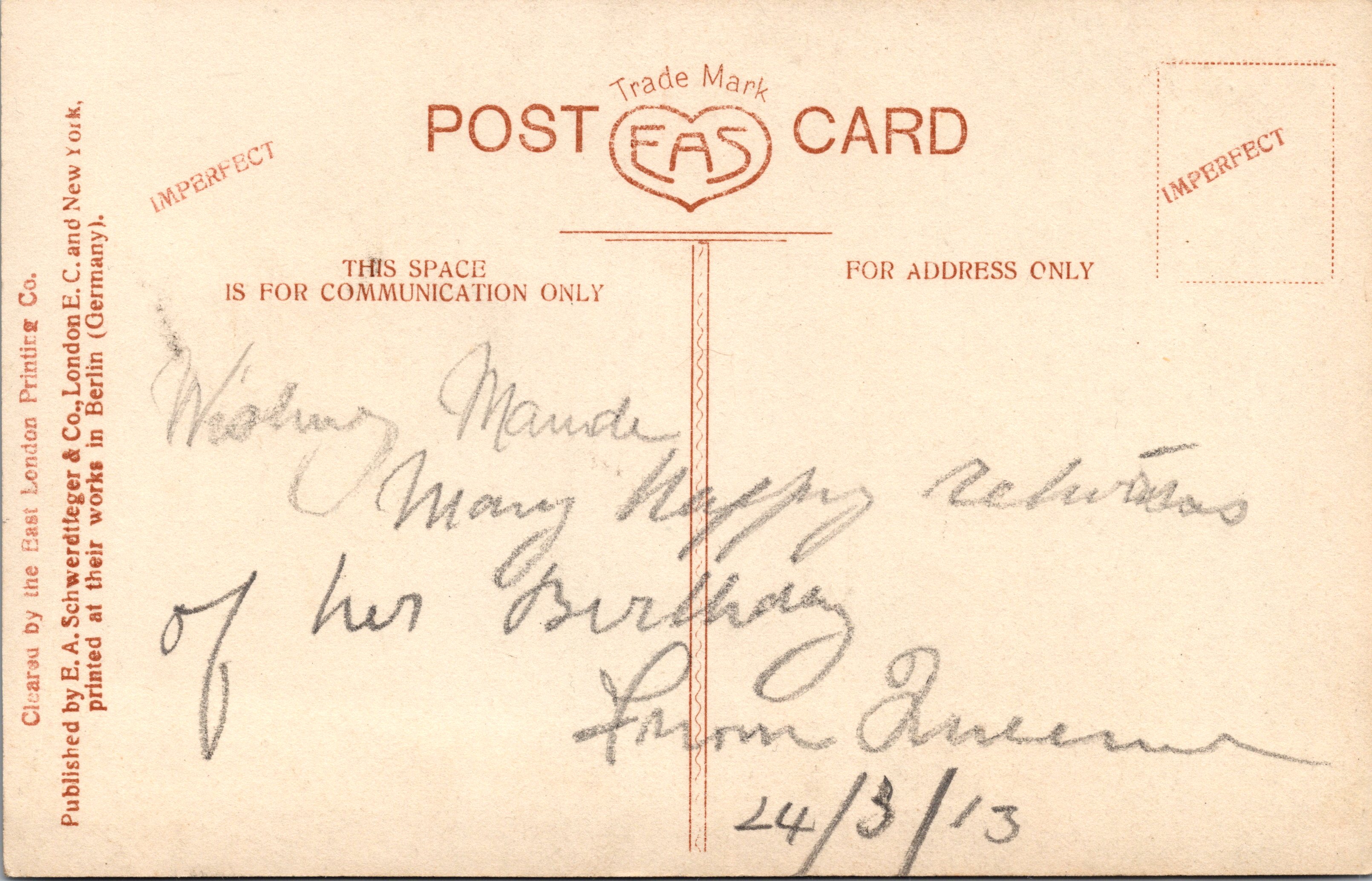
In Postcard 2, Wehlen is beautifully dressed for the portrait appearing on the postcard. She looks a bit clownish with her ruffled collar. There are flowers pinned to the front of her dress and she is wearing a jumbo feathered hat. She has a beautiful smile. The card was published by EAS as part of a series (no.1868/2). The firm was located in London and New York. The postcard was printed in Germany. Interestingly, the word “imperfect” is printed in two places on the front of the card. The word “chic” appears in the upper right hand corner of the image. Emmy Wehlen fits the bill. She is truly chic. The message on the postcard indicates that it was written in 1913.  (SOLD)

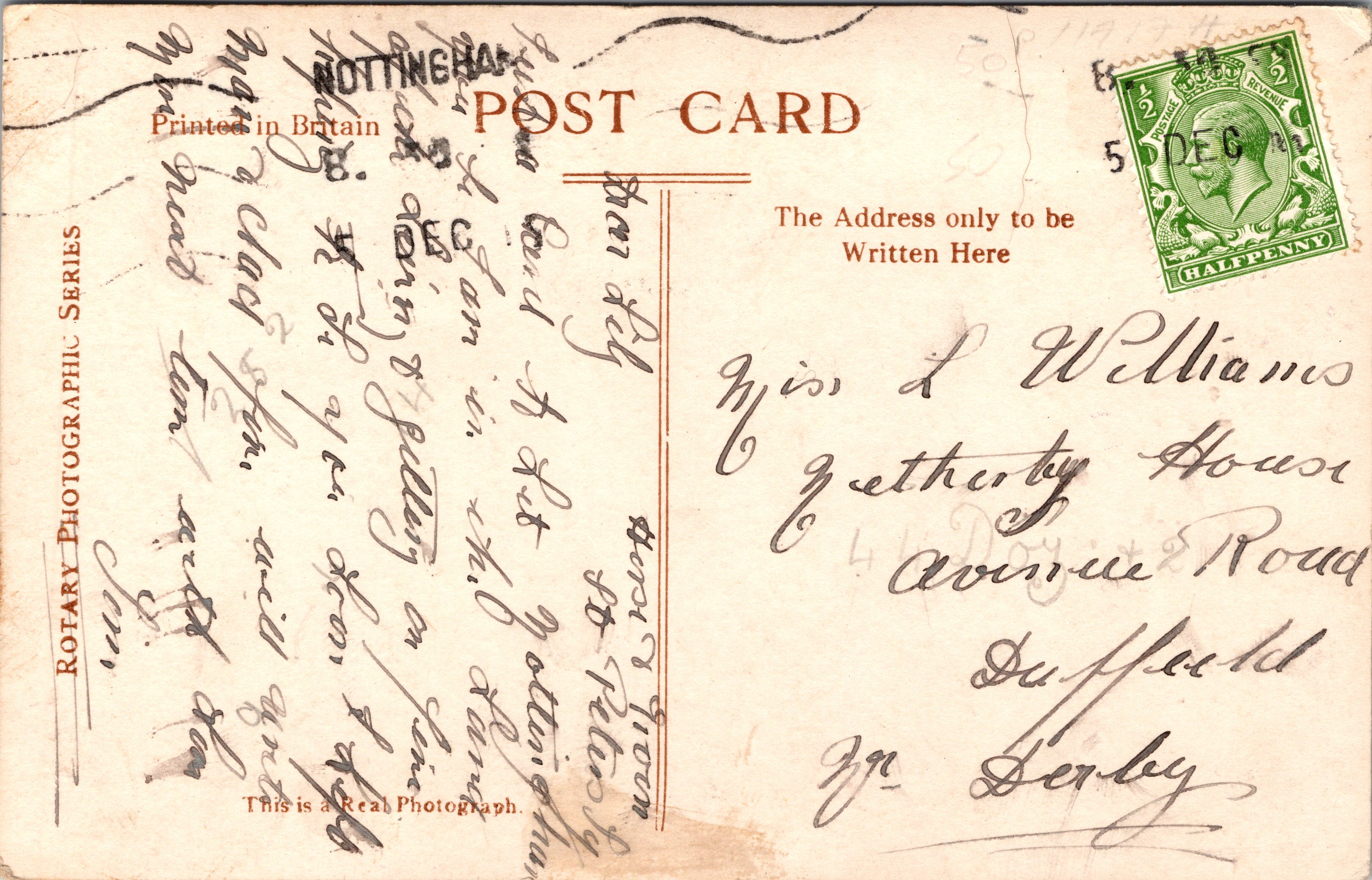
Postcard 3 features Miss Wehlen’s photograph taken by celebrity studio, Dover Street Studios. The card was published by Rotary Photo as part of a series (no.11717E). The message on the card indicates that the sender hoped that this photo postcard was meant to be an addition to the recipient’s postcard collection. (SOLD)

POSTCARD 1

POSTCARD 2
POSTCARD 3

STUNNING PORTRAIT OF A BEAUTIFUL MOTHER AND HER BEAUTIFUL DAUGHTER : RPPC

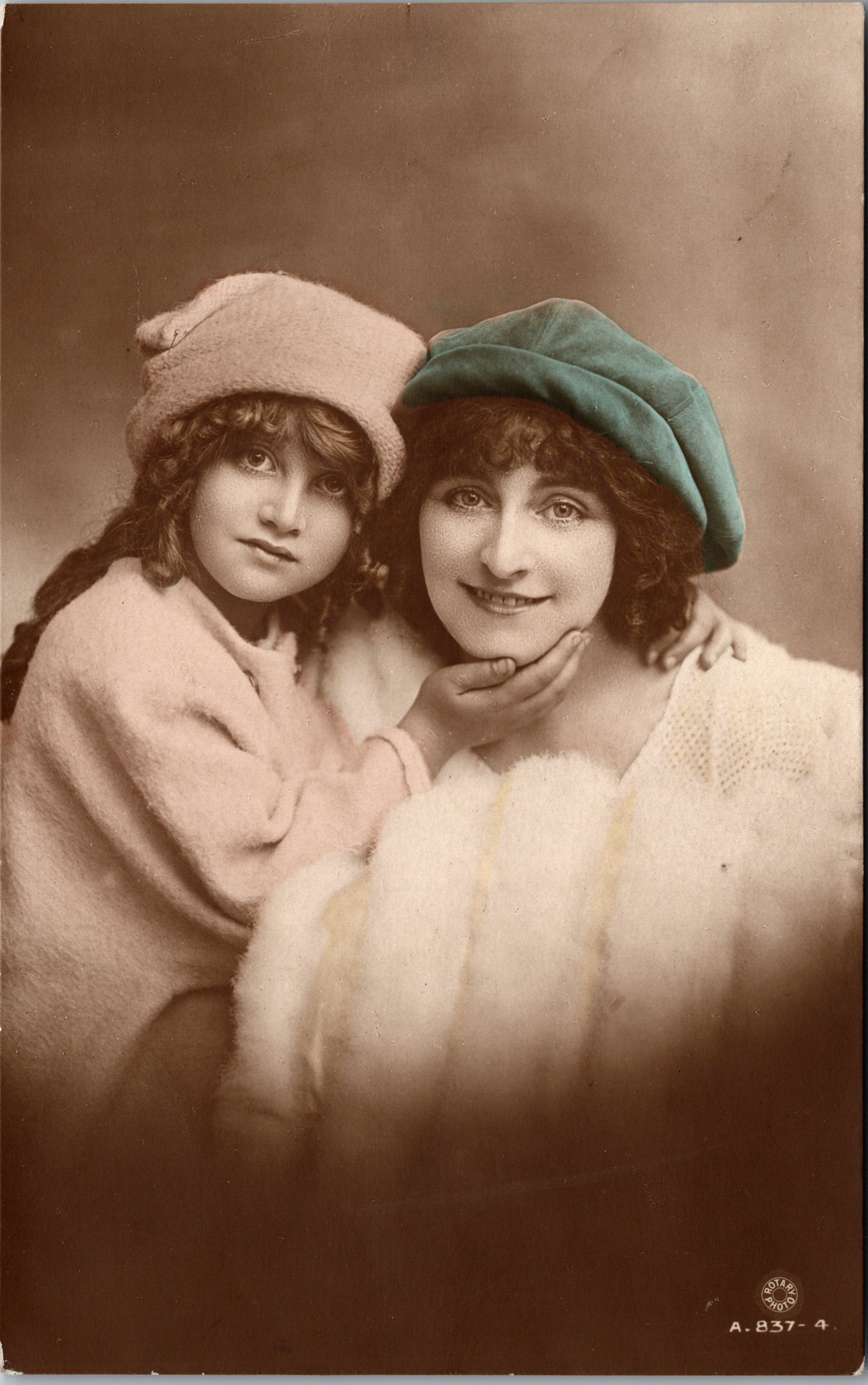
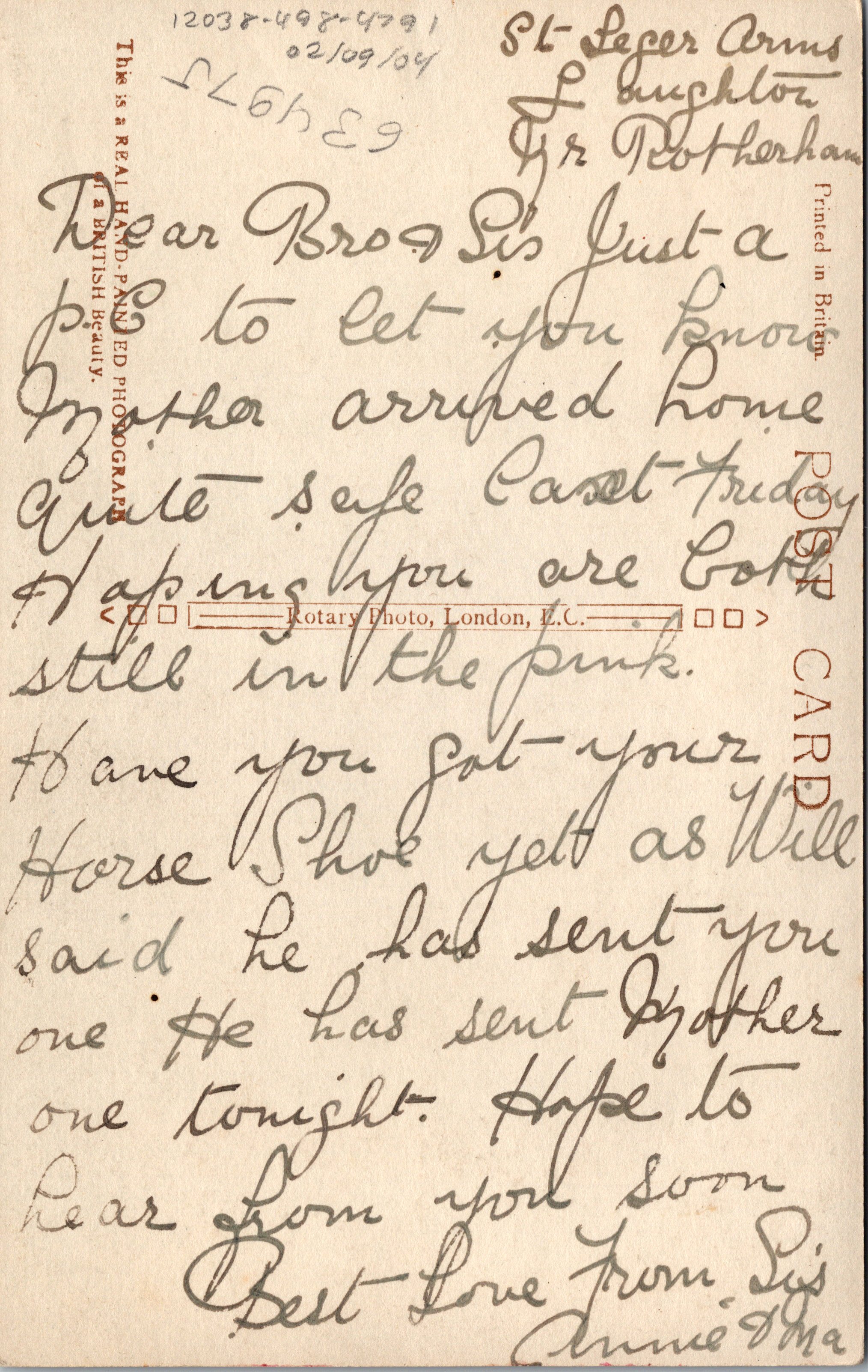
This vintage hand painted real photo postcard features a portrait of a very beautiful mother and her equally beautiful daughter. The pair are dressed for winter and looking quite fashionable. Their hats are terrific. Mom is wearing a fur coat. They have wonderful smiles. The writer of the postcard expresses to the reader, “Hoping you are both still in the pink”. I haven’t heard that expression in a while. If you don’t know, “in the pink” is a idiom that means in the peak of health. This vintage postcard was published by Rotary Photo as part of a series (No.A837-4). It was written in the first decade of the 1900’s. The postcard is in very good condition (see scans).

British Beauties_0001

Buy this Vintage Real Photo Postcard (includes shipping within the US) #5324

To purchase this item, click on the Pay with PayPal button below

$34.00

British Beauties_0001

Buy this Vintage Real Photo Postcard (includes International shipping outside the US) #5324

To purchase this item, click on the Pay with PayPal button below

$46.00

Published in: on March 15, 2025 at 12:00 pm  Leave a Comment  
Tags:

PRETTY WOMAN LACED IN ST. LOUIS, MISSOURI (CIVIL WAR HERO PHOTOGRAPHER)

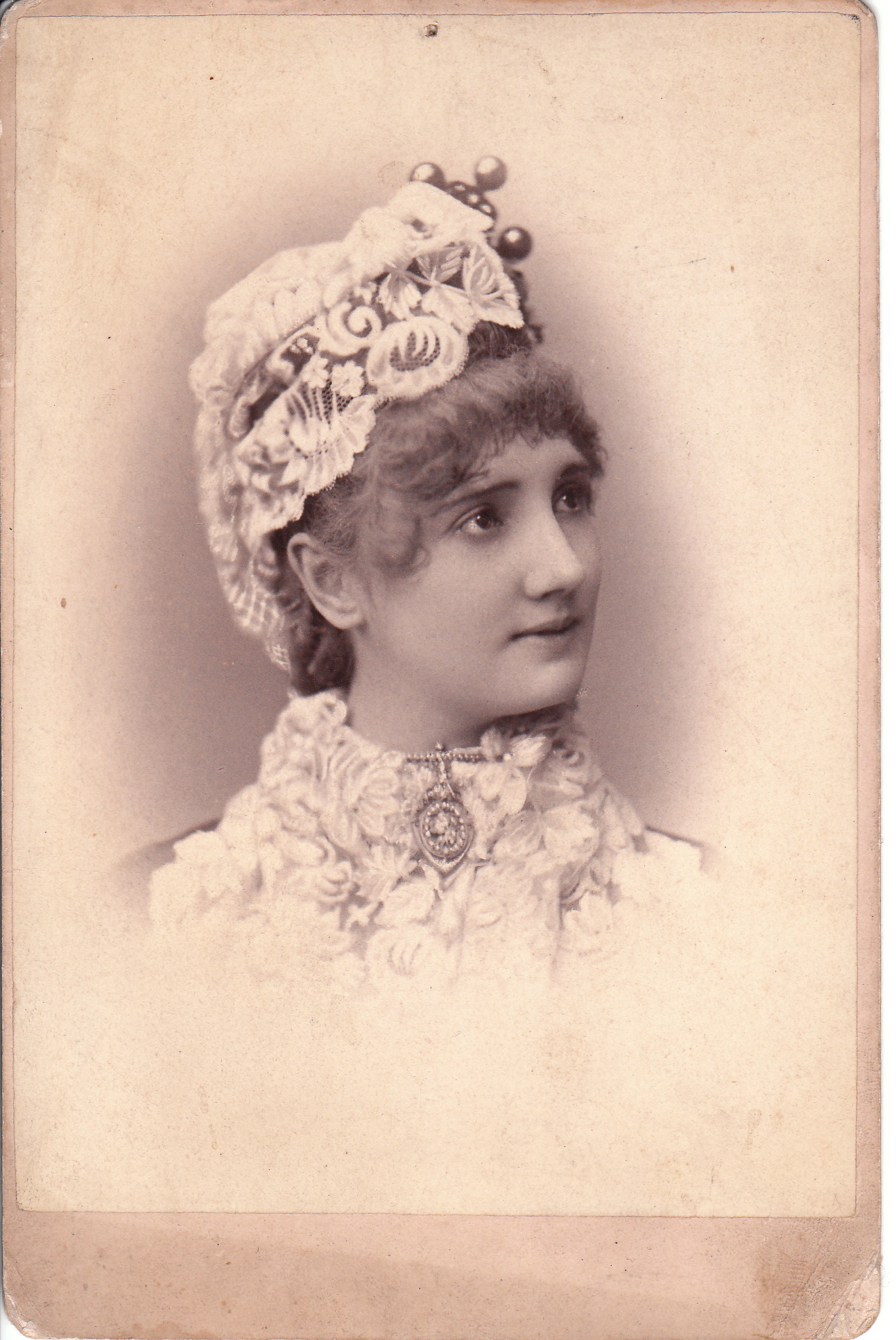
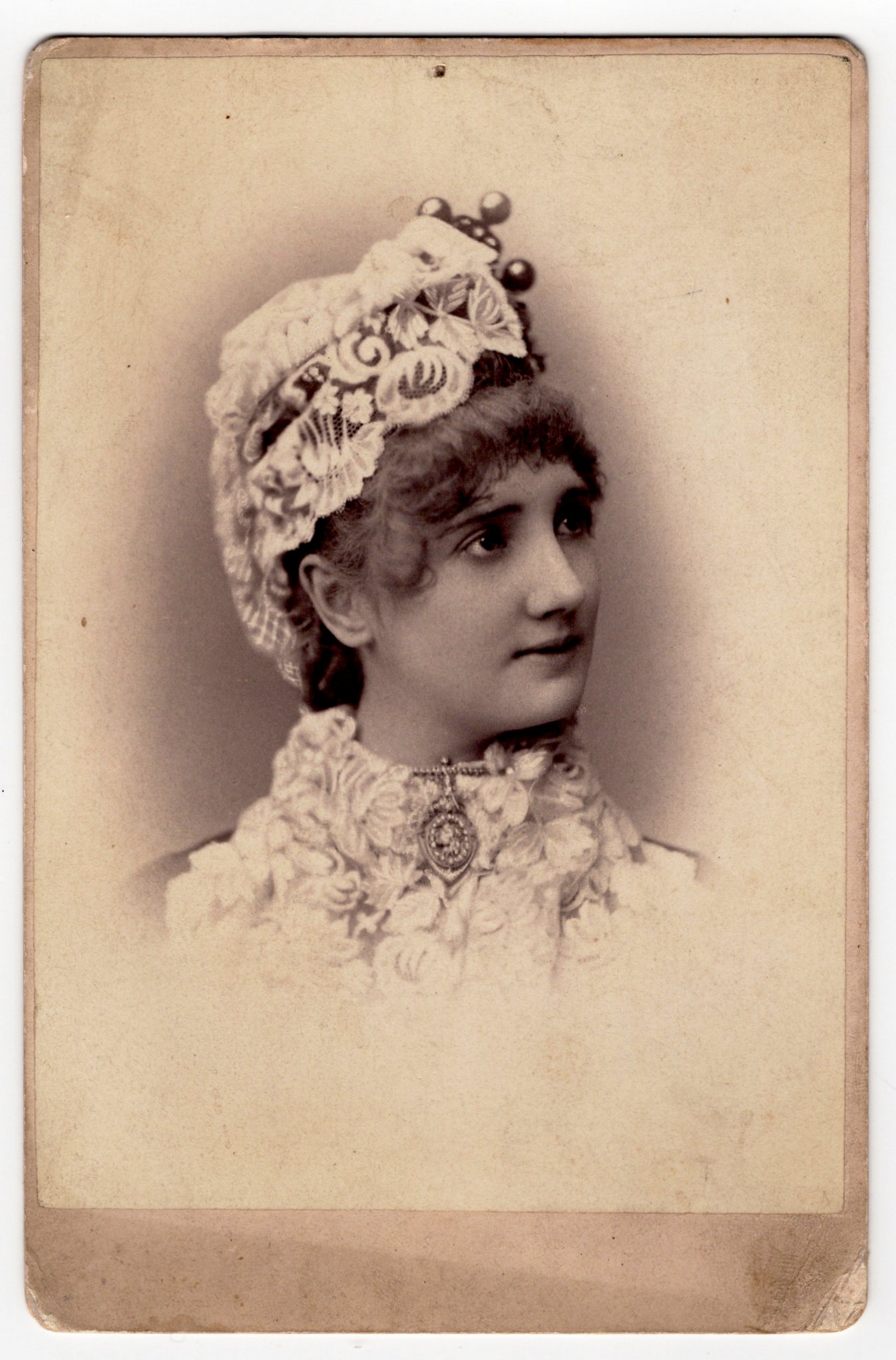
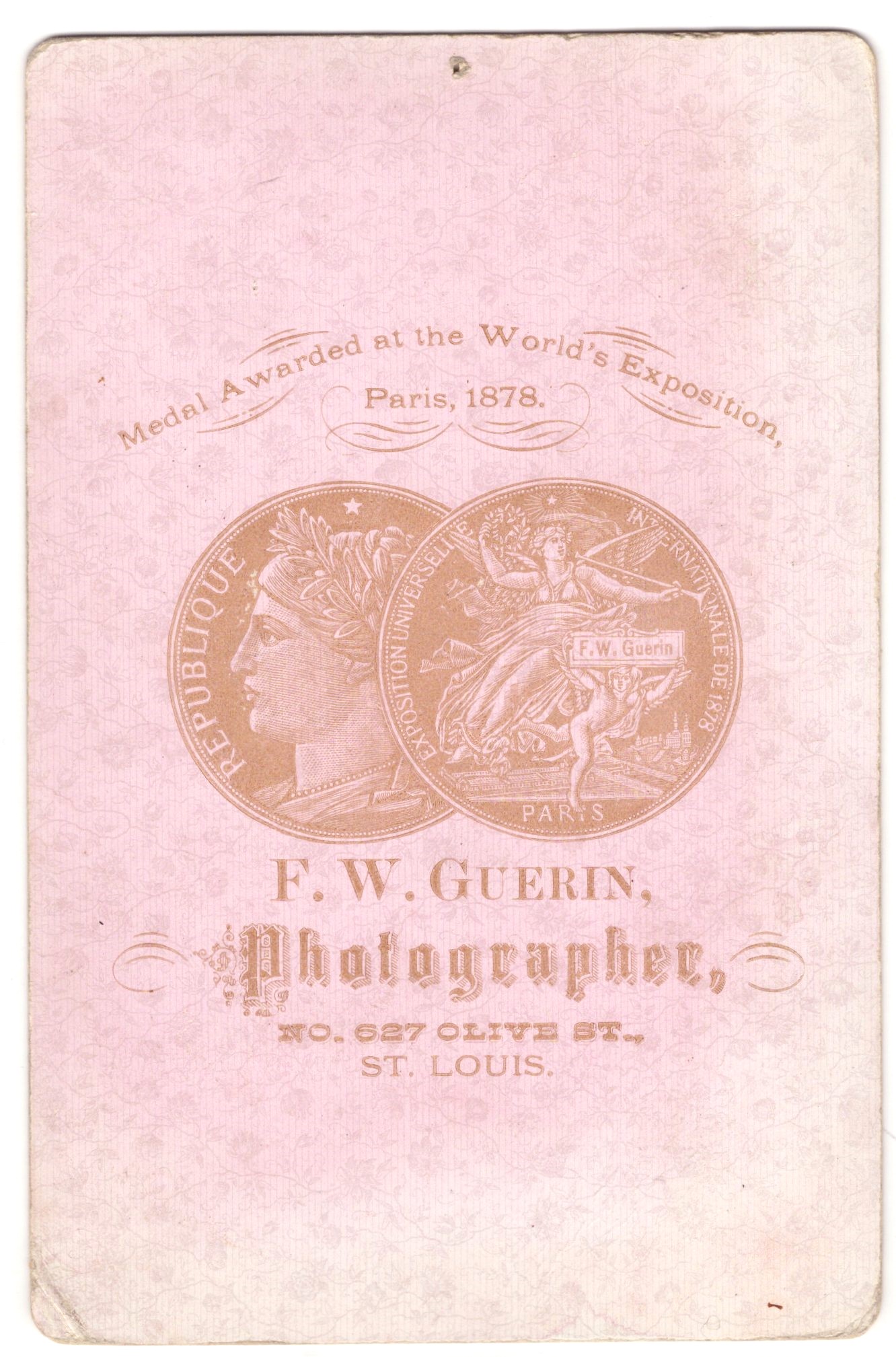
The attractive woman in this cabinet card is adorned with a lace cap and lace collar. Her outfit is a bit unusual but she would look beautiful no matter what she was wearing. The photographer of this image was F. W. Guerin, and his studio was located at 627 Olive Street, St. Louis, Missouri. Guerin received a medal for his work at the World Exposition in Paris (1878) and was similarly honored at the St. Louis Worlds Fair (1904). Fitz W. Guerin (1846-1903) was an excellent photographer but he was also a hero during the American Civil War. He was a recipient of the Congressional Medal of Honor. Guerin was a private in Battery A, 1st Missouri Volunteer Light Artillery. His citation states that along with two of his comrades, he voluntarily took a position aboard the steamer, Cheeseman, in which he took charge of all the guns and ammunition. He took this role while the steamer was unmanageable and under heavy enemy fire. After the war he became an apprentice photographer and later had a successful career photographing the well-to-do citizens of St. Louis. Guerin took many wonderfully posed photographs of beautiful women; he seems to have had an eye for the ladies. This cabinet card has corner wear and a pin hole near the center of it’s top edge. Overall this cabinet card portrait is in good condition (see scans).

6546

Buy this Cabinet Card Photograph (includes shipping within the US) #6546

To purchase this item, click on the Pay with Paypal button below

$30.00

6546

Buy this Vintage Original Cabinet Card (includes International shipping outside the US) #6546

To purchase this item, click on the Pay with Paypal button below

$42.00

PORTRAIT OF IDENTIFIED HANDSOME GENTLEMAN : BINGHAMTON, NEW YORK : CABINET CARD

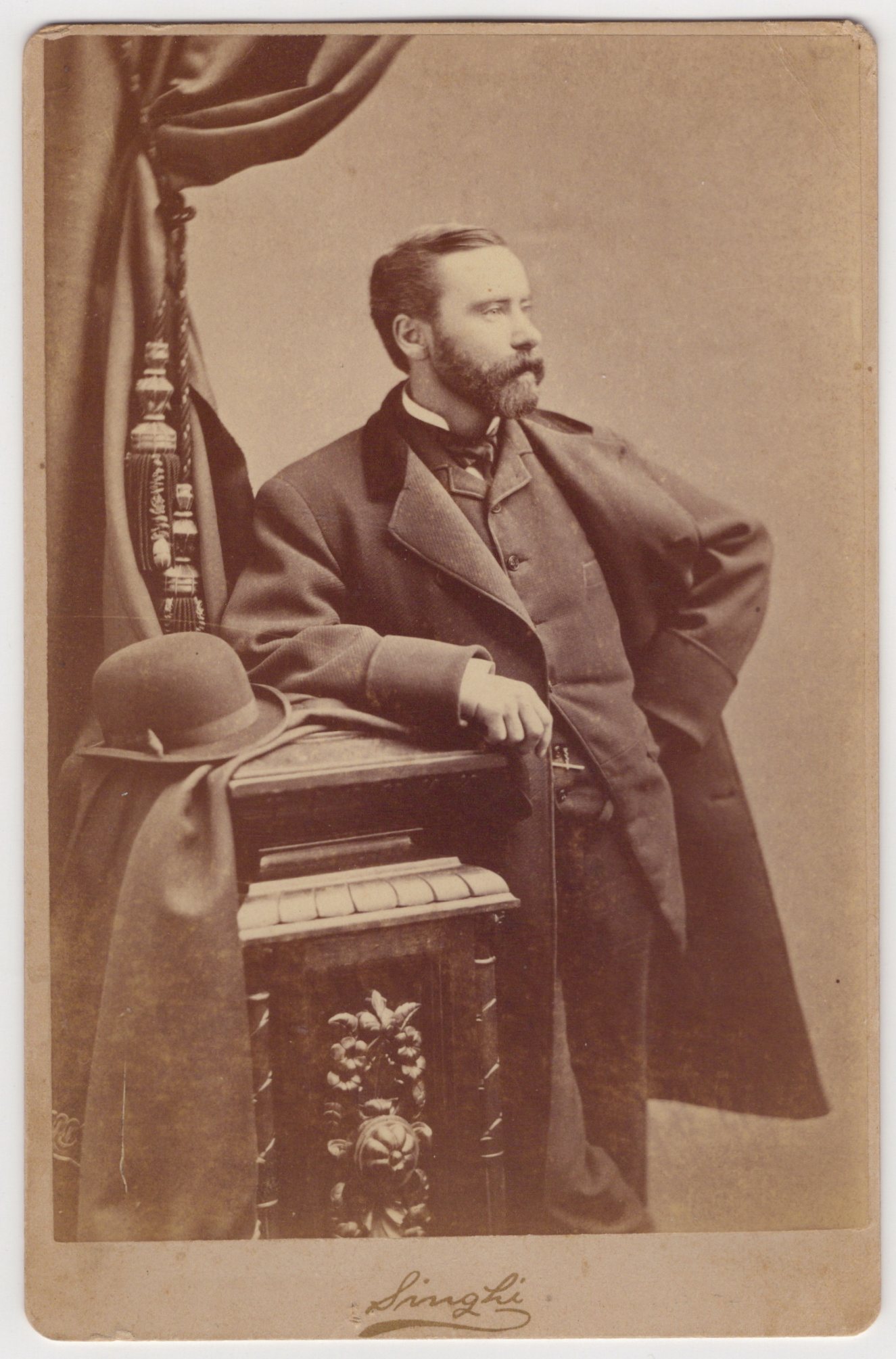
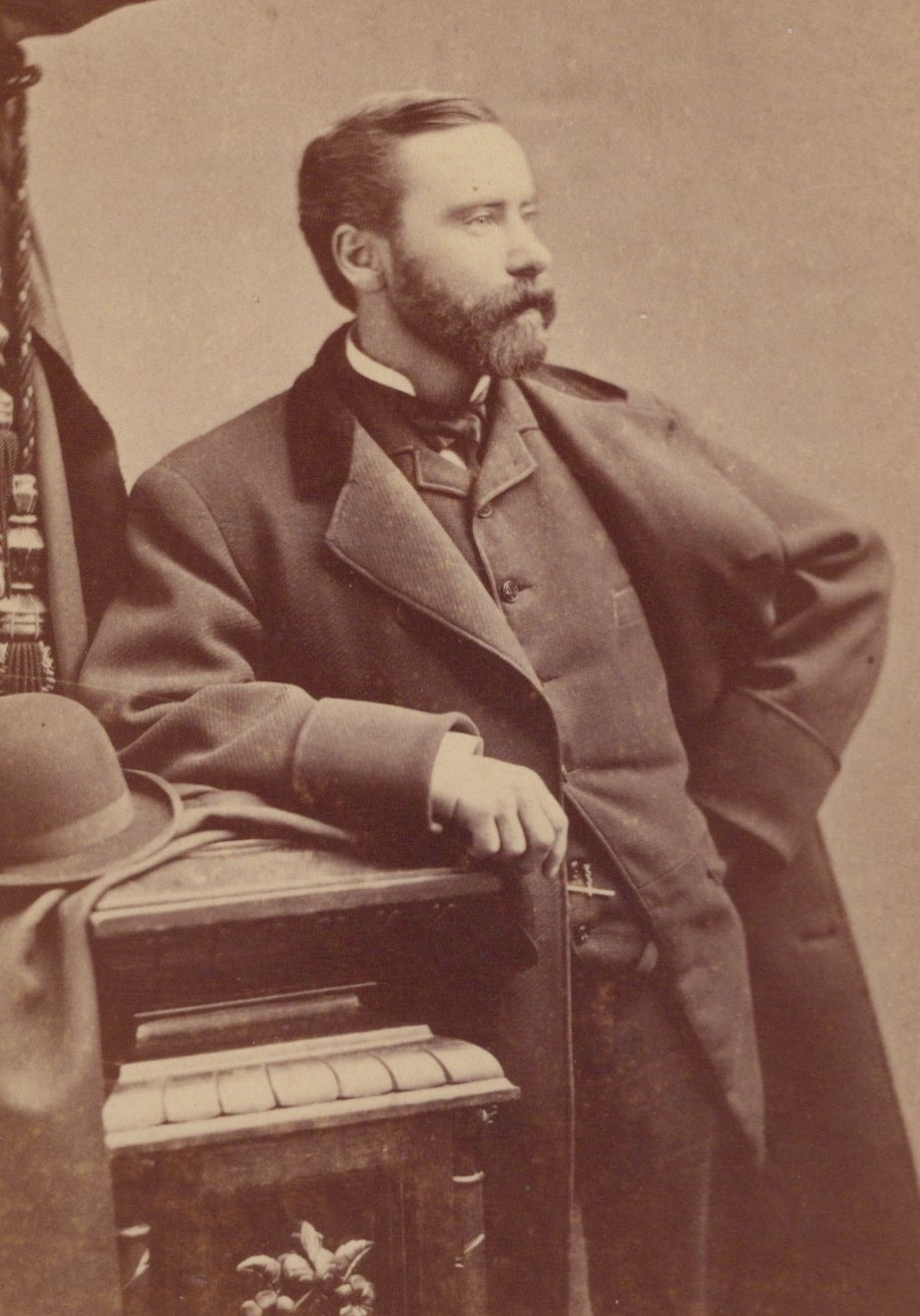
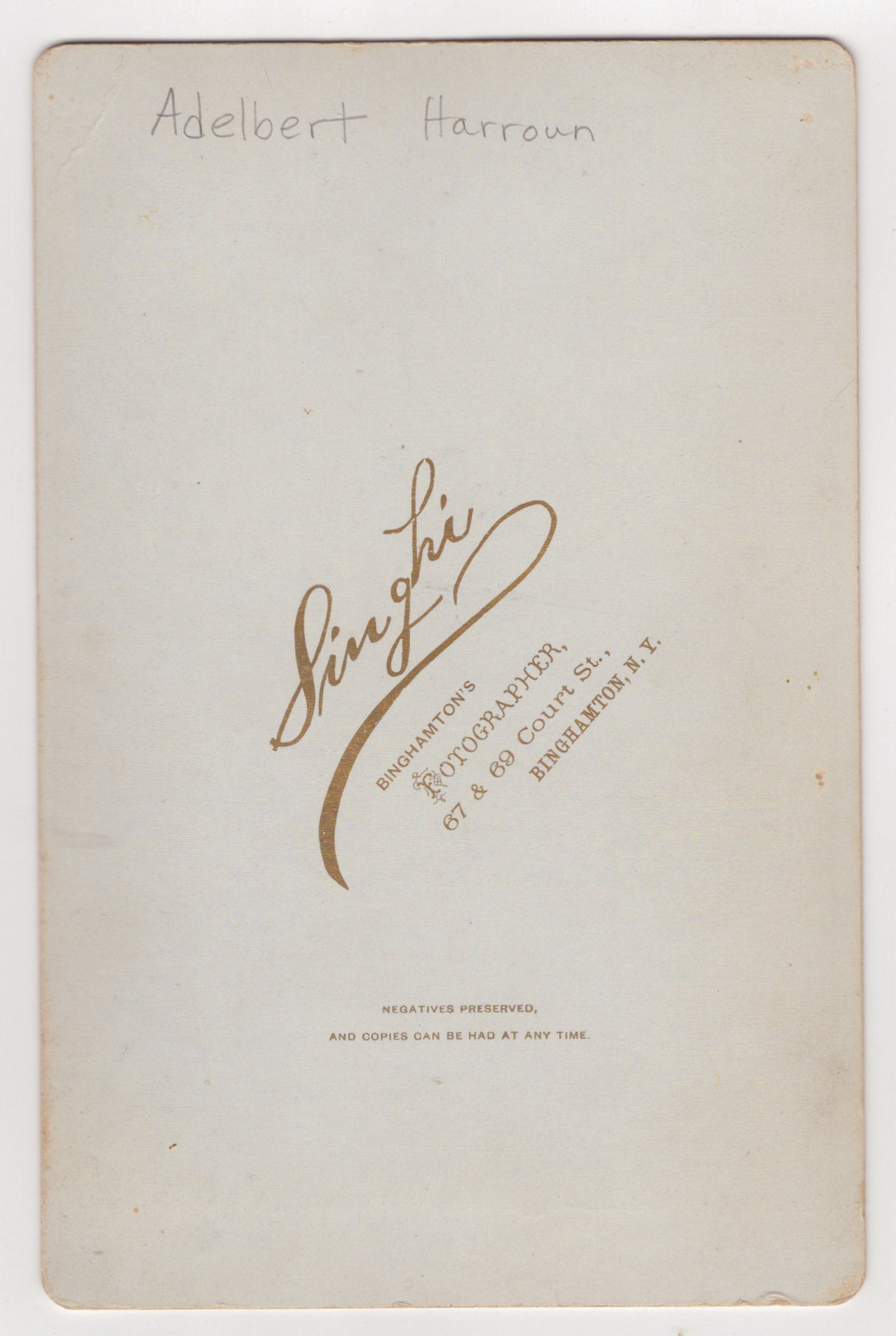
The man in this cabinet card photograph appears to be a professional gentleman. He is wearing an overcoat and a nicely trimmed beard. He is standing next to his derby hat and has a pocket watch. Perhaps the well dressed gentleman is an attorney. Maybe its not a coincidence that the Binghamton, New York based photographer, Singhi, was located on Court Street. The reverse of the photograph has an inscription which identifies the gentleman as “Adelbert Harroun”. Research reveals that Mr. Harroun was not a lawyer but instead, he was an accountant. The 1870 census notes that Thomas Adelbert Harroun (1851-?) was the 19 year-old son of  Thomas Harroun (1824-1907) and Salina King Harroun (1824-1903). His father’s occupation was listed as a “Presiding Elder”  and further research found that he was a Methodist clergyman. His mother was a homemaker. Adelbert lived with his parents and two siblings in Norwich, New York. Sister Flora (age 22) was a music teacher and brother Arthur (age 11) was a student. He married his wife, Mary Winton, in 1888. The couple had two children. The 1900 census finds the 47 year old Harroun living in Dunleith, Illinois. He was living with his wife, Mary, their son N. Winton (age 10), and daughter Anna Augusta (age 9). Harroun was working as a railroad yard clerk. Further investigation revealed that daughter Anna Augusta died in 1904 in Dubuque, Illinois. The 1920 census reports that the 67 year-old Harroun was widowed and living in Waukegan Lake, Illinois with his sister Flora. He was working as an accountant. The 1930 census locates Harroun in Prineville, Oregon and living as a boarder. At 79 years of his age, he was still working (bookkeeper). The photographer of this image is Will G. Singhi. He worked in Binghamton, New York between 1872 and 1886. His albumen print “A Winter Scene” is exhibited in the online “American Museum of Photography”. Singhi had taken a photograph that appeared to capture a snowball in mid flight heading toward a newsboy who was prepared to deflect it. The museum also has on display a funny cartoon self portrait caricature that Singhi used as an advertisement. The Photographic Times and American Photographer (1883) comments on Singhi’s wonderful sense of humor.  SOLD

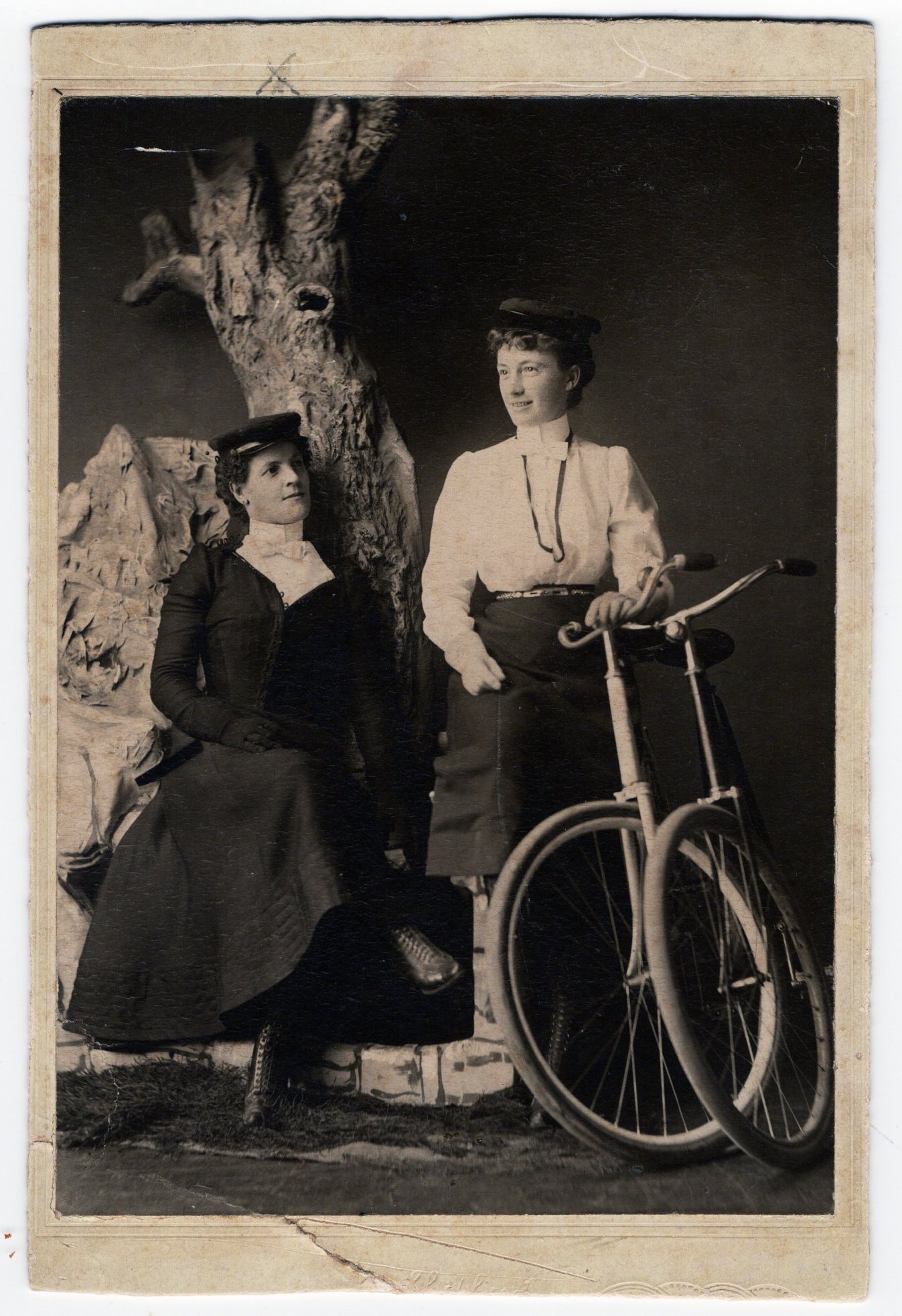
TWO VICTORIAN WOMEN AND THEIR BICYLCES AND CYCLING ATTIRE

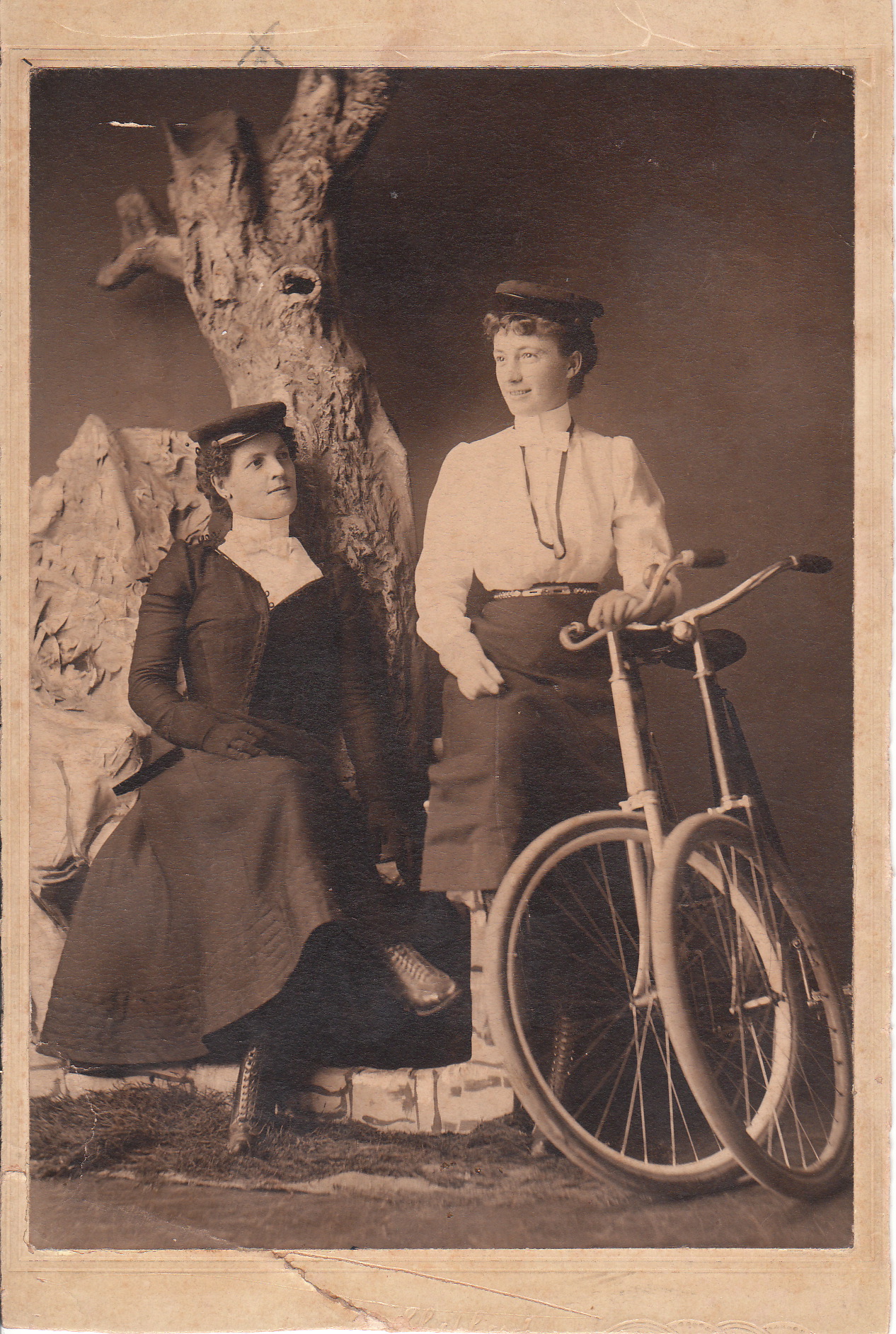
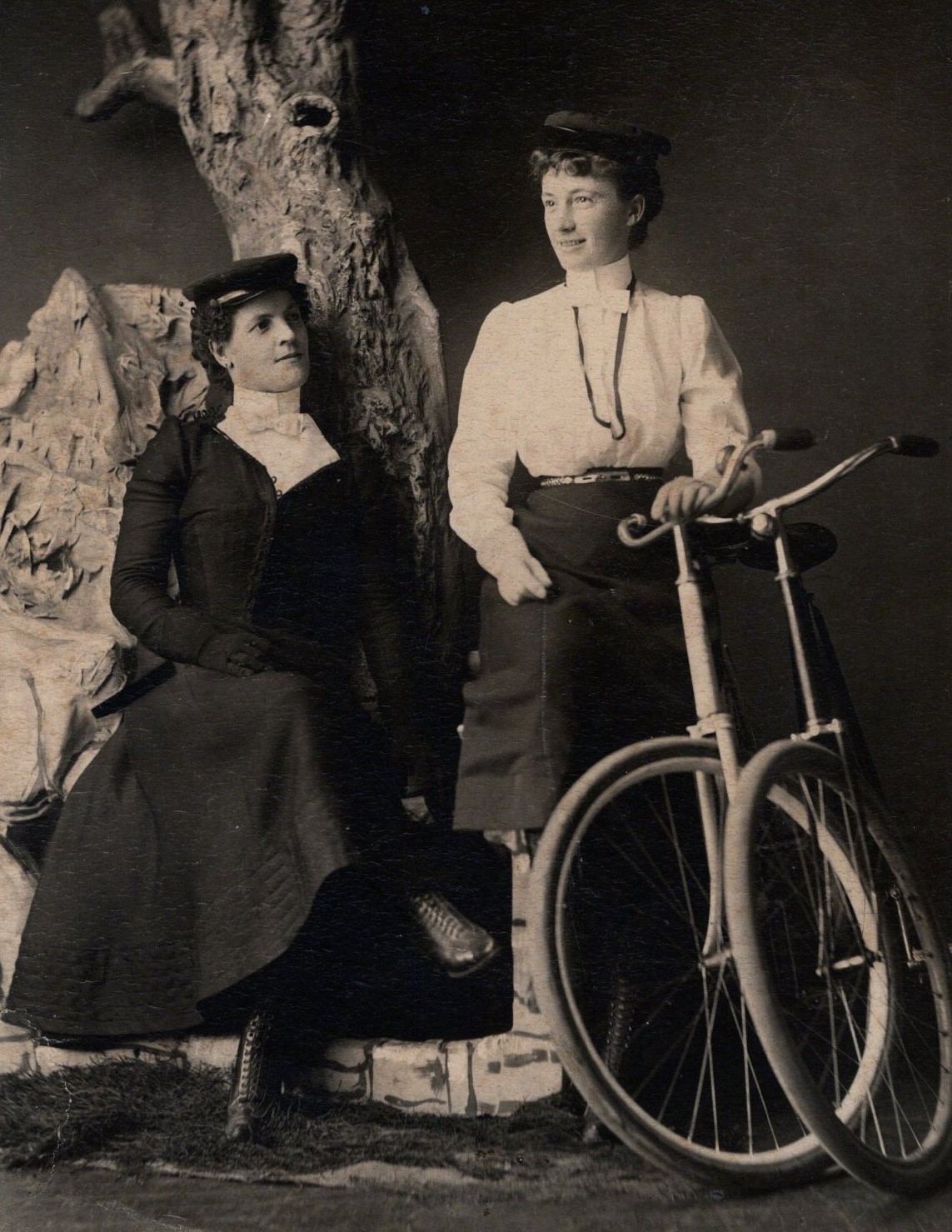
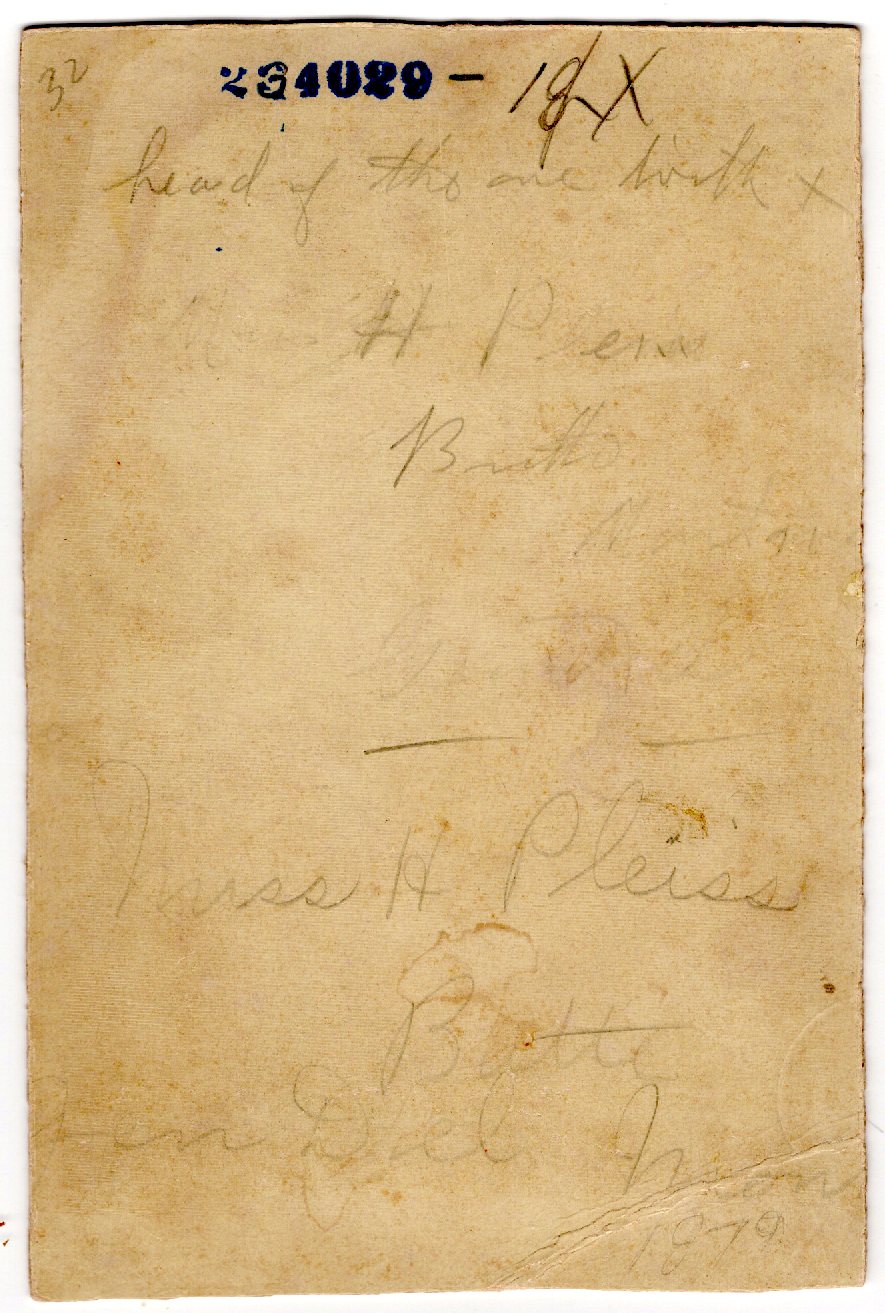
This Cabinet Card features two young woman and their bicycles. Magnification reveals that the bicycles have bells on the handle bars. The woman are wearing caps which brings up the issue of whether this is an occupational photograph. For example, were these women messengers or some other bicycle related employment. The woman on the left is wearing a dress which would make bicycling very difficult, so another possibility is that the caps and the bikes are just props from the photographic studio. The reverse of the card has an inscription that indicates that the woman under the “x” (the woman on the left), is named Miss H. Pleiss. Also in the inscription appears to be the word “Butte’. It is very possible that this cabinet card is from Butte, Montana. There is no evidence concerning the identity of the photographer. Note crease (not rip) near bottom left corner. This photograph is in Fair Condition. (see scans).

6514

Buy this Cabinet Card Photograph (includes shipping within the US) #6514

To purchase this item, click on the Pay with Paypal button below

$36.00

6514

Buy this Vintage Original Cabinet Card (includes International shipping outside the US) #6514

To purchase this item, click on the Pay with Paypal button below

$48.00

Published in: on February 11, 2025 at 12:00 pm  Comments (1)  
Tags: , , , , ,

TWO GIRLS IN UNUSUAL COSTUMES : ABERDERE & MERTHYR, SOUTH WALES : CABINET CARD

This cabinet card photograph presents two young girls, posed in a formal studio setting. The standing girl is wearing a stylish hat adorned with a large feather. Her dress has a lace collar and appears layered combining light and dark fabrics. She is wearing gloves that cover her hands and wrists. She is holding what appears to be a slender stick or cane. The seated girl is the youngest of the two. She is dressed in a dark satin or silk dress with puffed sleeves and decorative elements. Her hat is whimsical, with an unusual antenna-like detail. Her hat may suggest that her costume is meant to be playful rather than conventional fashion. The seated girl is also wearing gloves. Both girls have neutral, serious expressions. The seated girl looks directly at the camera, her gaze is steady and composed, while the standing girl appears slightly more reserved. The naturalistic backdrop features a painted outdoor scene with trees and foliage. This photograph was taken by J. W. Fyfe, whose studios were located in Aberdare and Merthyr, South Wales. SOLD

Published in: on January 29, 2025 at 12:00 pm  Leave a Comment  
Tags: , , ,