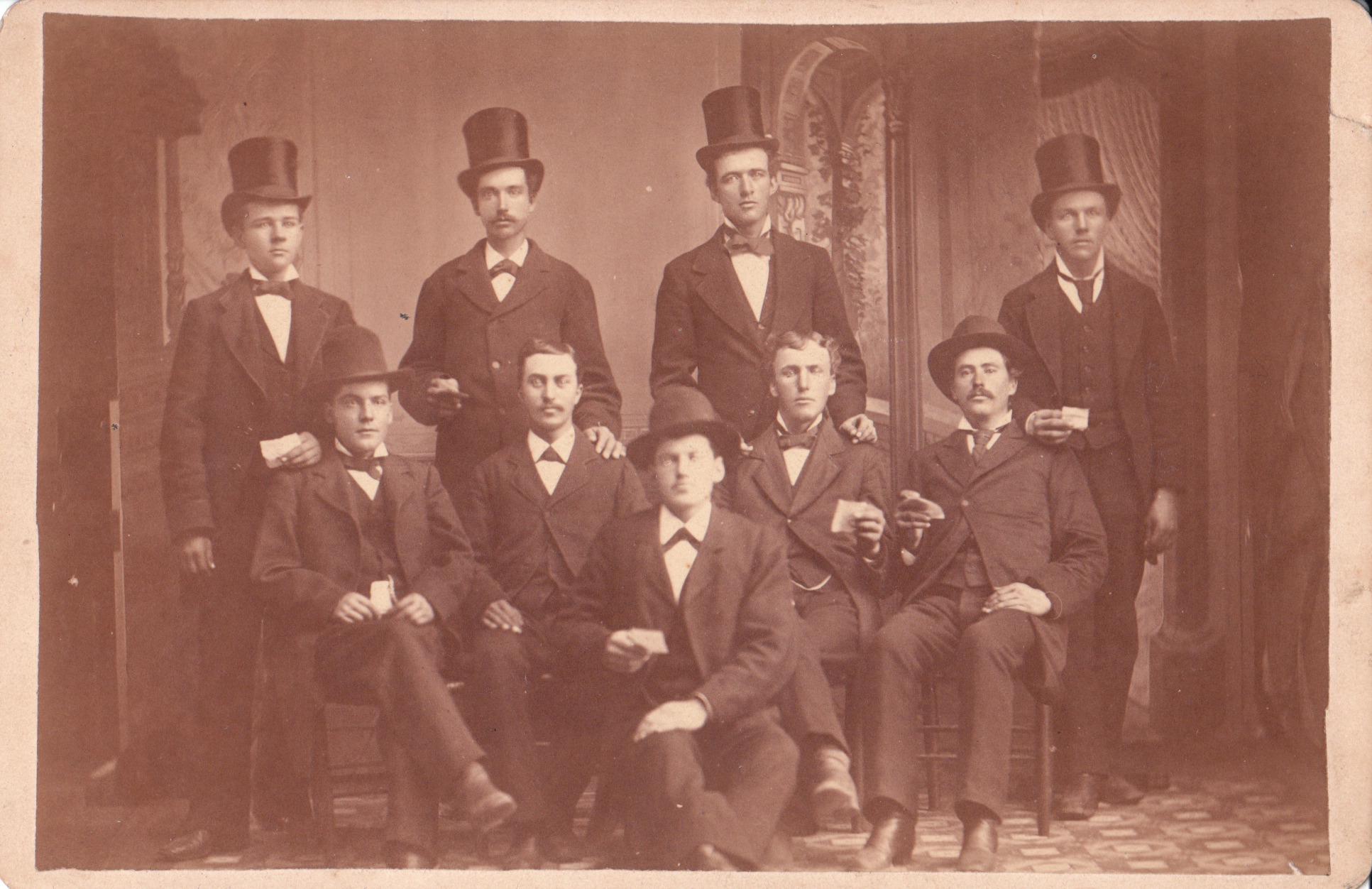
 This photograph features nine men “dressed to the nines”. What does “dressed to the nines” mean and where does the term derive from? It basically means that these guys are fashionably and elaborately dressed. Research reveals that the derivation of the phrase “dressed to the nines” is unknown. There are a lot of theories but no real evidence to support a single theory. So who are these guys and what group do they represent? We run into another wall in an attempt to answer these questions. The men in this image are unidentified and the photographer is unknown. This photograph is one of those images that is similar to a psychological projective test. We have to make up our own story to better understand the photograph. The story we create is a reflection of our experiences and personality. The story I tell myself is that these men are part of a club or organization. They are dressed formally for some sort of special organizational event. The papers that they are holding are possibly certificates for some type of accomplishment, ballots, or invitations. What’s the story you tell yourself about this image? You are invited to leave a comment with your impressions
NINE GUYS DRESSED TO THE NINES

FASHIONABLE AUSTRIAN MAN IN VIENNA
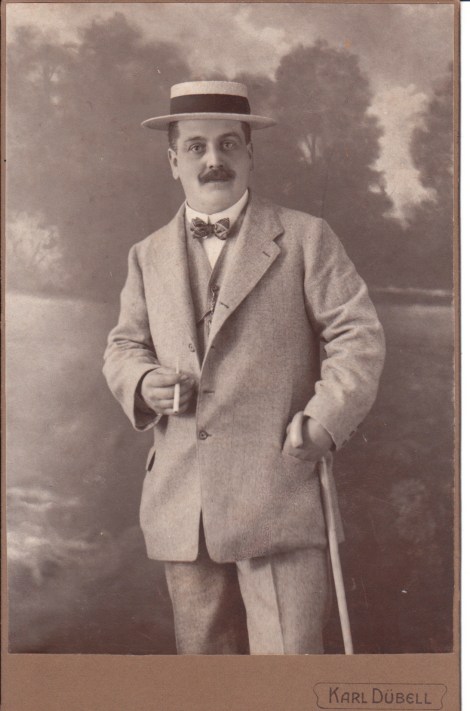
A well dressed Austrian gentleman poses for this cabinet card portrait by photographer Karl Dubell. Dubell’s studio was located in Vienna, Austria. The subject in this image is accessorized with a cane, vest, bow tie and what appears to be a straw hat. What is this fine gentleman holding in the fingers of his right hand. Is that an extra long cigarette? To view other photographs by Dubell, click on the category “Photographer: Dubell”.
MAN WITH SPIKED HAIR IN GRAND RAPIDS, MICHIGAN
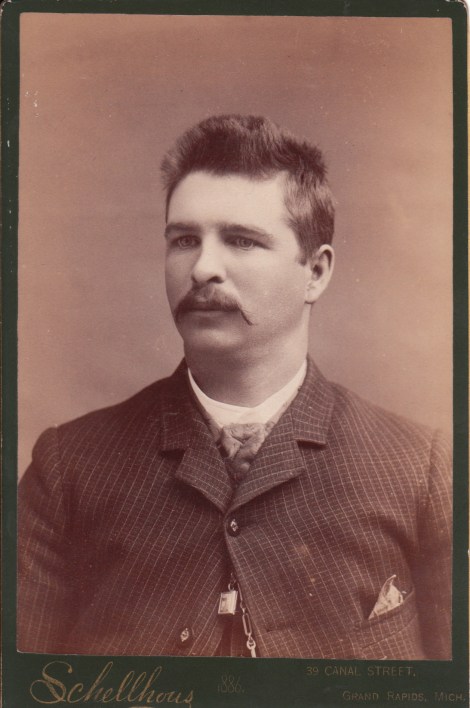 A young man with a “spiked” hairstyle poses for his portrait at the Schellhous studio in Grand Rapids, Michigan. The gentleman is wearing a checkered jacket with a pocket handkerchief, and his watch chain shows under his jacket. The photograph is dated 1886. The photographer of this image, Loran Webster Schellhous is listed in the Grand Rapids business directory between at least 1884 through 1893. He also operated photography businesses at various times in Colon, Coldwater, and Coopersville, Michigan. The Ada Historical Society (Michigan) indicates that Schellhous’s wife, Martha Catherine Faxon (1831-1905) was also a photographer. She is recognized for her work photographing leaves of various plants.
PORTRAIT OF A TIRED OLD MAN IN TEXAS (PHOTOGRAPH BY CAPTAIN HARVEY ROBERTS MARKS)
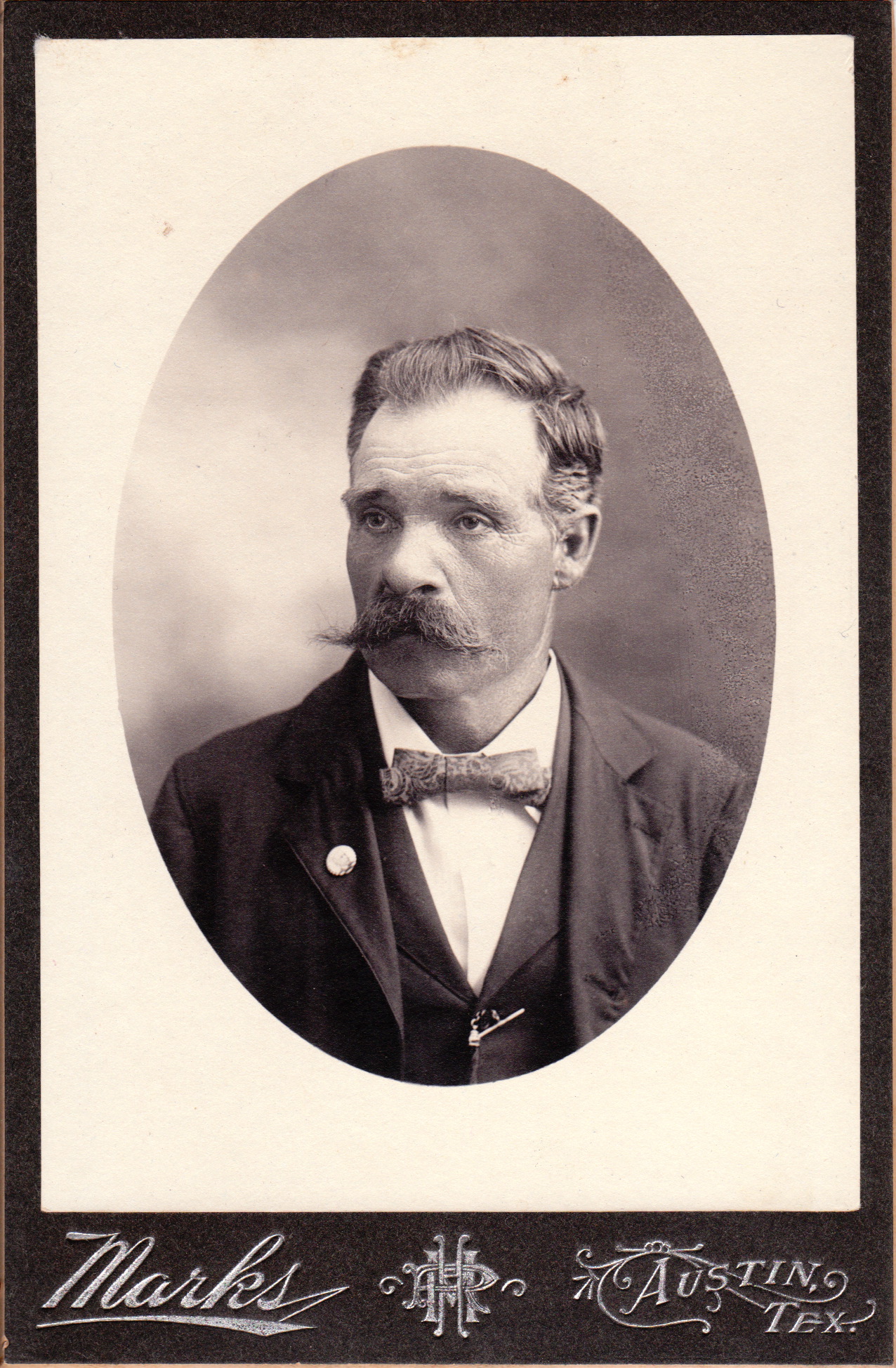
This image captures the portrait of a tired looking old man. This gentleman appears to have had better days. He looks exhausted and troubled. This photograph was taken by the Mark’s studio in Austin, Texas. The photographer of this cabinet card lived an interesting life and he was both a pioneer of Texas and a pioneer of photography. Harvey Roberts Marks (1821-1902) was a well known photographer who worked in a number of locations. He was active in Baltimore, Maryland (1849-1853), San Francisco, California (1851), Mobile, Alabama (1856-1859), Houston, Texas (1865-1870), and Austin, Texas (1870-1902). He was born in New York City. He first arrived in Texas in 1838 and received a very large land grant in Harris County (Houston). He enlisted in a company of Texas Rangers in 1840 and reached the rank of Captain. He was married to Emily H. Bassan in 1849. Research indicates that she was member of one of the most prominent families in Baltimore. In 1849 he was Jacob Shew’s partner in the Shew and Mark’s Gallery in Baltimore. He continued the gallery alone when Shew left Baltimore until 1851. The 1850 census revealed that he had three assistants in the gallery and took 5,000 daguerreotypes annually. In 1851 he took photographs of castaways from a Japanese ship involved in an incident that caught national attention. Mark’s moved to Austin in 1870 and opened a gallery a year later. During that time he became Vice President of the National Photographic Association. Marks served during the civil war. He was a member of the Houston Battalion, Texas Infantry (Detailed Men). Research was unsuccessful in gathering this Confederate regiment’s history. Marks entered the regiment and left the regiment as a Captain. Interestingly, when former Confederacy President, Jefferson Davis, visited Austin in 1875, he sat in Mark’s studio for his portrait. He died at the age of 81.
THEO SPARKS: A HANDSOME YOUNG MAN WITH A HANDLEBAR MUSTACHE

An inscription on the reverse of this image indicates that this handsome well dressed young man was named Theo Sparks. He looks quite spiffy with his winged collar shirt, wide tie, and handlebar mustache. The photographer was not identified nor was the location of the photographer’s studio. Despite a paucity of information, research found some biographical information about Mr. Sparks. Theo Sparks (1870-1956) was born in Indiana. The 1880 US census finds him at age 10, living in Linton, Indiana.He lived with his parents, Peter S. and Mary E. Sparks. His father was a farmer. He lived with four older siblings, Iris (age 18), Orian (age 17), Ishmel (age 14), and Pascal (age 12). He also lived with three younger siblings, Marco (age 8), Eura (age 6), and Cush (age 2). Also living with the family was Theo’s fraternal uncle, Wesley Sparks. Theo and his siblings had very unusual and interesting names. Peter and Mary Sparks deserve kudos for their creativity in baby naming.The 1900 census finds the 29 year-old Theo Sparks living in Denver, Colorado and newly married to Maud Sparks (age 24). He was working as a motorman. According to the 1910 census, Theo and Maud still lived in Denver and had four sons, Rolland (age 8), Warren (age 5), Glen (age 4), and Jorville (age 3 months). It seems Theo and Maud continued Theo’s parents tradition of giving some of their children unusual names. Theo supported his family with his income from working as a street car motorman. The 1920 through 1940 censuses indicate that Theo and Maud continued to live in Denver with different members of their family being part of their household in each of the censuses.
DAPPER GENTLEMAN IN JANESVILLE, WISCONSIN (WILLIAM J GRANT)
 The dapper gentleman featured in this photograph is identified on the reverse of the cabinet card as William J Grant. Mr. Grant is quite dapper in appearance but it is a bit incongruous that he is standing next to a stack of bales of hay. The photographer’s last name is Tice and his studio was located in Janesville, Wisconsin. The Wisconsin and Minnesota Gazetteer (1865) includes an advertisement for J. A Tice of Janesville. The subject of this photograph, William J. Grant, was born in 1848 in the state of New York. The 1870 US census finds the 22 year old Grant working on the family farm. He lived with his parents, William and Ann Grant (both born in Ireland) and his three sisters Mary (age 28), Elizabeth (age 24) and Euphemia (age 20). The 1880 census reveals that Grant was married but lived without his wife in a boarding house. He worked as a teamster. The 1900 census lists Grant as single and still living in a boarding house. He was employed as a drayman. Drayman? What is a drayman? A drayman is a driver of a dray. Does that help? It didn’t help me, so here is the rest of the story. A dray is a low and flat-bed wagon without sides. The wagon is usually pulled by horses or mules to transport goods.
HANDSOME MAN IN CROOKSTON, MINNESOTA
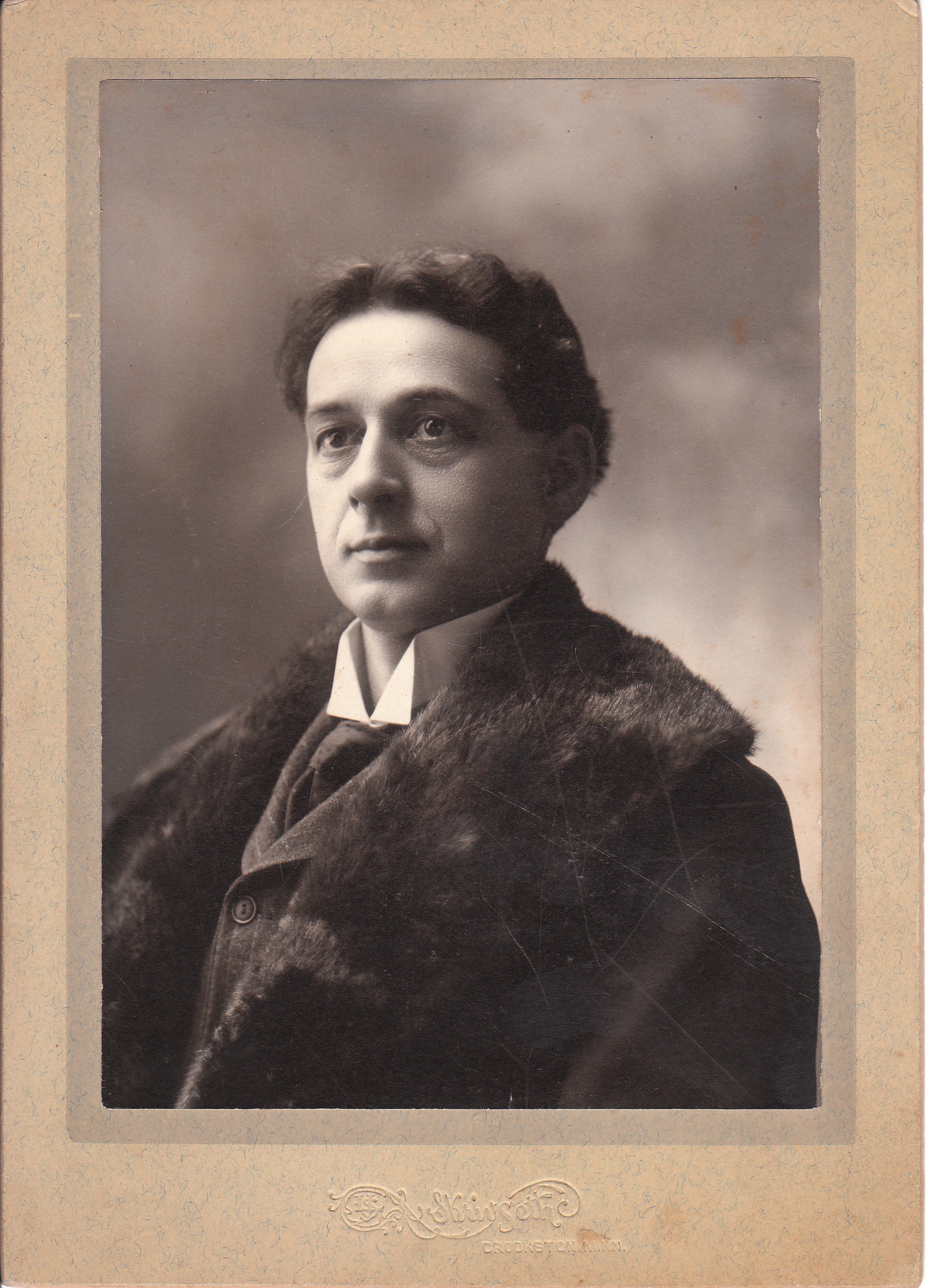 This photograph features a very handsome man posing for his portrait at the studio of Skrin Seth in Crookston, Minnesota. My spelling of the photographer’s name is questionable since his name is partially illegible as printed on the front of the photograph. The subject of this photograph has glamorous looks and is wearing a fur coat. He is identified on the reverse of the card but once again there is a legibility problem. His name is either “Mr. E. McKenzie” or “N. E. McKenzie”. Research revealed no biographical information about the image’s subject or about the photographer.
CAVALRY OFFICER WITHOUT A HORSE AND WITHOUT A COUNTRY
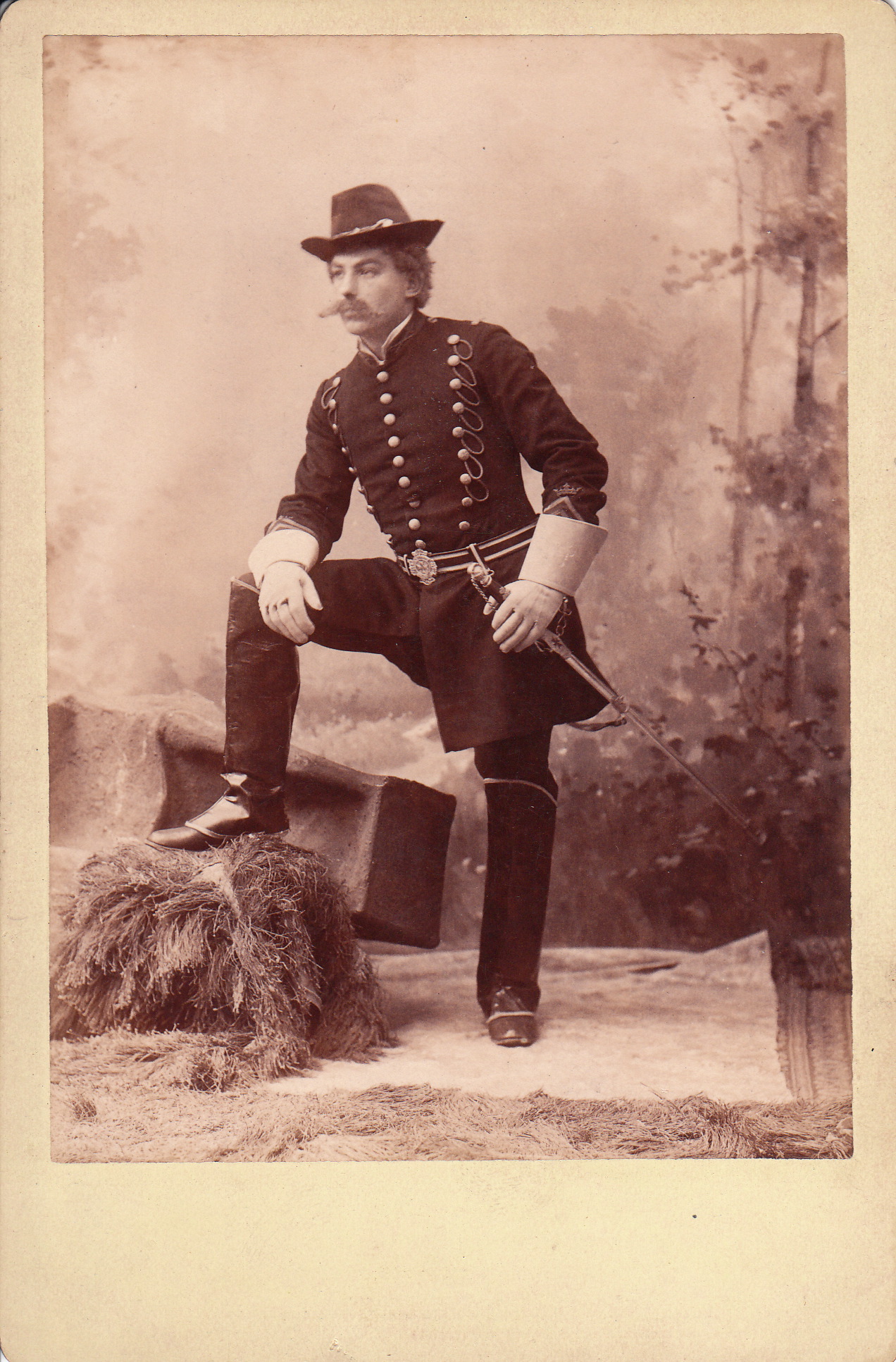
A cavalry officer poses for his portrait at an unknown studio in an unknown location. This handsome military man is wearing what appears to be riding gloves and a sword in a sheath on his belt. He also has a belt buckle which may provide some additional information. However, limited magnification availability has precluded uncovering further identifying information on the buckle. It is unlikely that the subject is a member of an American cavalry unit. There is an embroidered crown on his left sleeve which may indicate he served in a Canadian or British mounted brigade. Another possibility is that the subject is actually an actor wearing a theatrical costume. Hopefully, a cabinet card visitor will leave an enlightening comment concerning this man’s identity.
A PROFESSIONAL LOOKING GENTLEMAN IN BINGHAMTON, NEW YORK
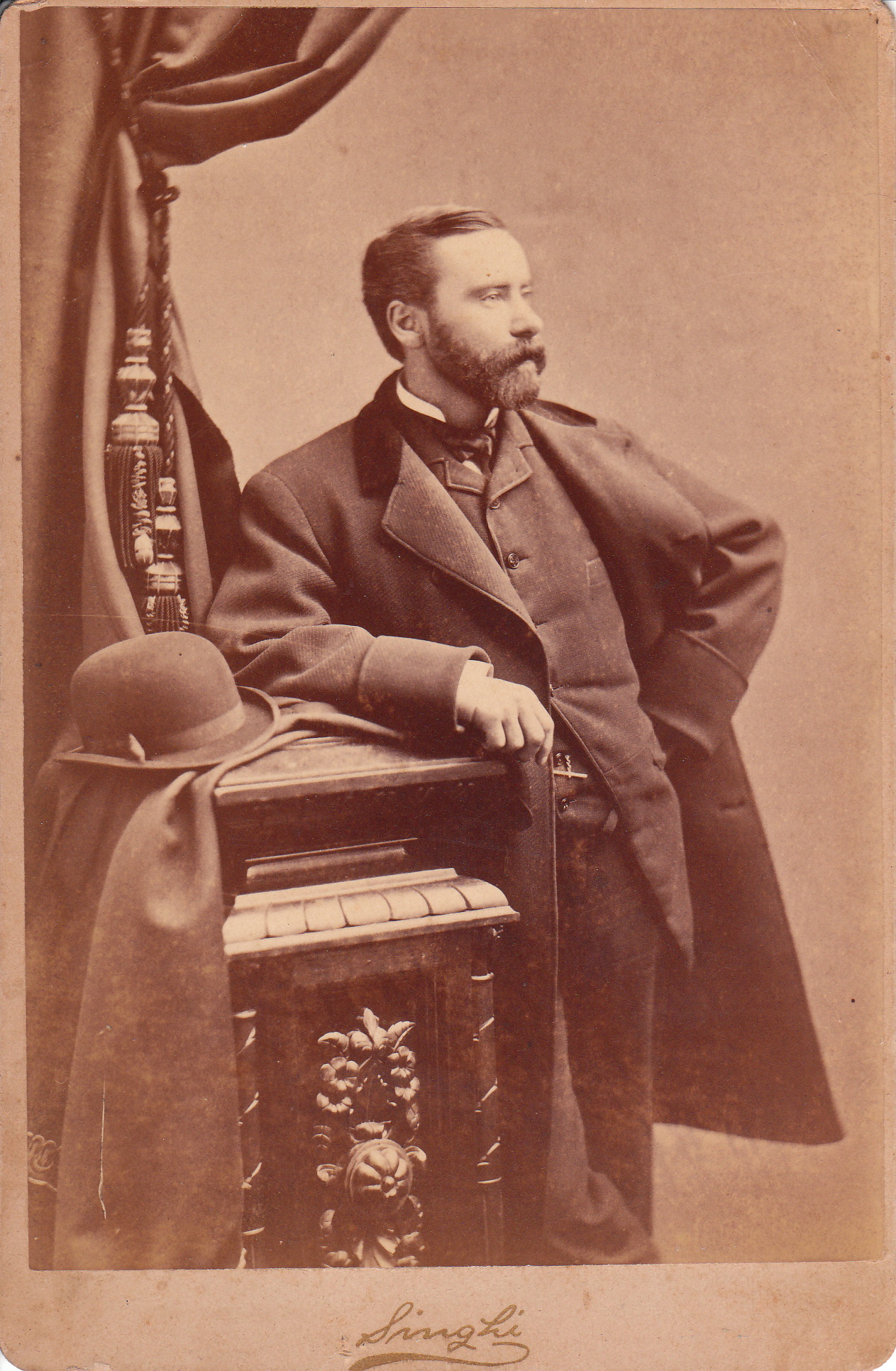
The man in this cabinet card photograph appears to be a professional gentleman. He is wearing an overcoat and a nicely trimmed beard. He is standing next to his derby hat and has a pocket watch. Perhaps the well dressed gentleman is an attorney. Maybe its not a coincidence that the Binghamton, New York based photographer, Singhi, was located on Court Street. The reverse of the photograph has an inscription which identifies the gentleman as “Adelbert Harroun”. Research reveals that Mr. Harroun was not a lawyer but instead, he was an accountant. The 1870 census notes that Thomas Adelbert Harroun (1851-?) was the 19 year-old son of Thomas Harroun (1824-1907) and Salina King Harroun (1824-1903). His father’s occupation was listed as a “Presiding Elder” and further research found that he was a Methodist clergyman. His mother was a homemaker. Adelbert lived with his parents and two siblings in Norwich, New York. Sister Flora (age 22) was a music teacher and brother Arthur (age 11) was a student. He married his wife, Mary Winton, in 1888. The couple had two children. The 1900 census finds the 47 year old Harroun living in Dunleith, Illinois. He was living with his wife, Mary, their son N. Winton (age 10), and daughter Anna Augusta (age 9). Harroun was working as a railroad yard clerk. Further investigation revealed that daughter Anna Augusta died in 1904 in Dubuque, Illinois. The 1920 census reports that the 67 year-old Harroun was widowed and living in Waukegan Lake, Illinois with his sister Flora. He was working as an accountant. The 1930 census locates Harroun in Prineville, Oregon and living as a boarder. At 79 years of his age, he was still working (bookkeeper). The photographer of this image is Will G. Singhi. He worked in Binghamton, New York between 1872 and 1886. His albumen print “A Winter Scene” is exhibited in the online “American Museum of Photography”. Singhi had taken a photograph that appeared to capture a snowball in mid flight heading toward a newsboy who was prepared to deflect it. The museum also has on display a funny cartoon self portrait caricature that Singhi used as an advertisement. The Photographic Times and American Photographer (1883) comments on Singhi’s wonderful sense of humor.
TURN OF THE CENTURY HANDSOME MAN WITH SLICKED BACK HAIR
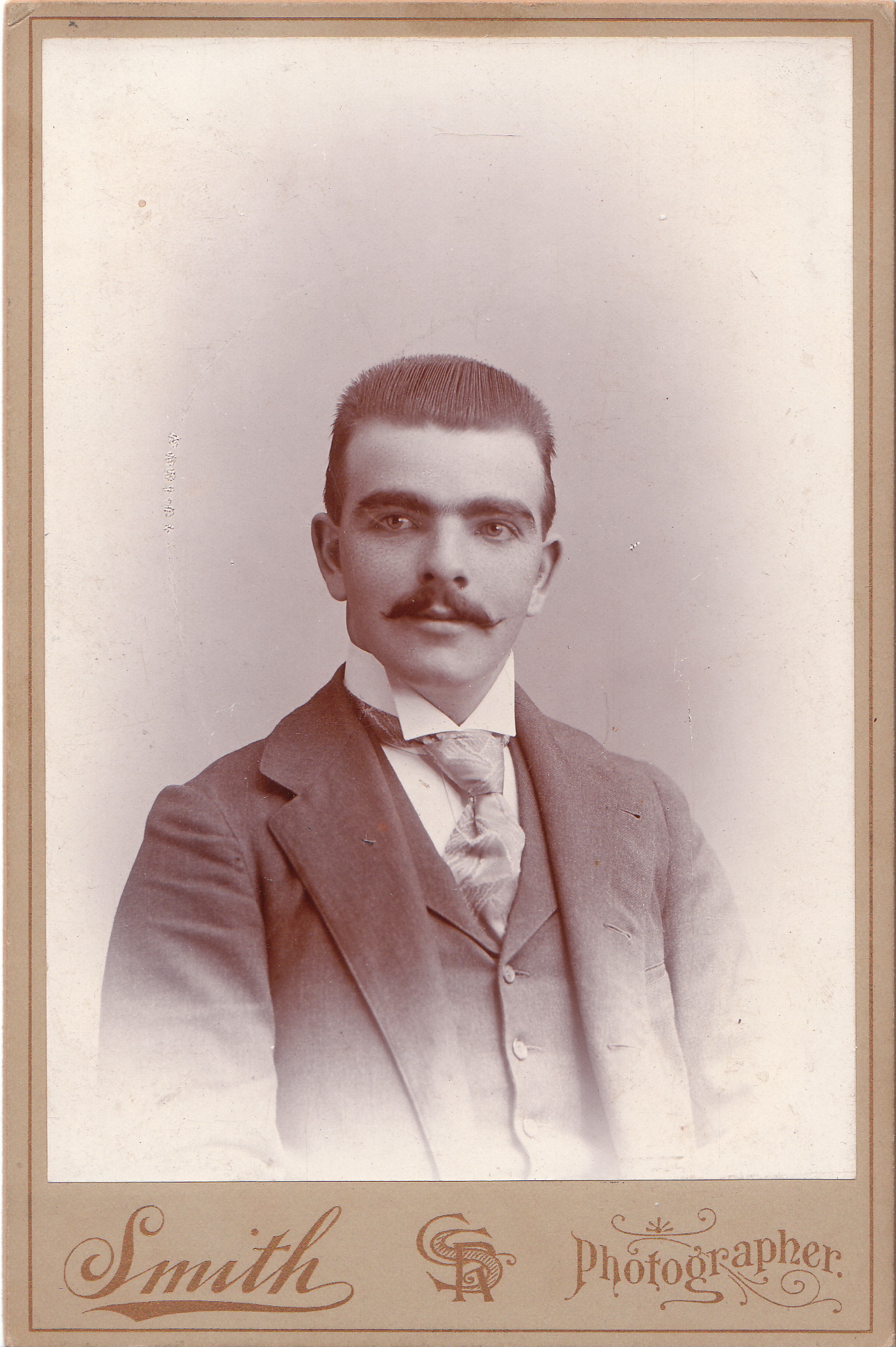
This cabinet card features a portrait of a handsome young man with slicked back hair. He is dressed beautifully and well groomed. The photographer is named Smith but the location of his studio is not listed on the front or the reverse of the photograph. The initials on the front of the card indicate that the photographers full name is C. R. Smith. There was a photographer named C. R. Smith located in Clearwater, Minnesota. He was listed in Camera Craft (1908) and also in The Photographic Journal of America (1917). It is not confirmed that this C. R. Smith is the photographer of this cabinet card. It is interesting to note that the Cabinet Card Gallery has a number of photographs by the photographer who photographed this gentleman. All of the photographs share the same logo containing the photographer’s initials. To view these photographs, click on the category “Photographer: Smith CR”


