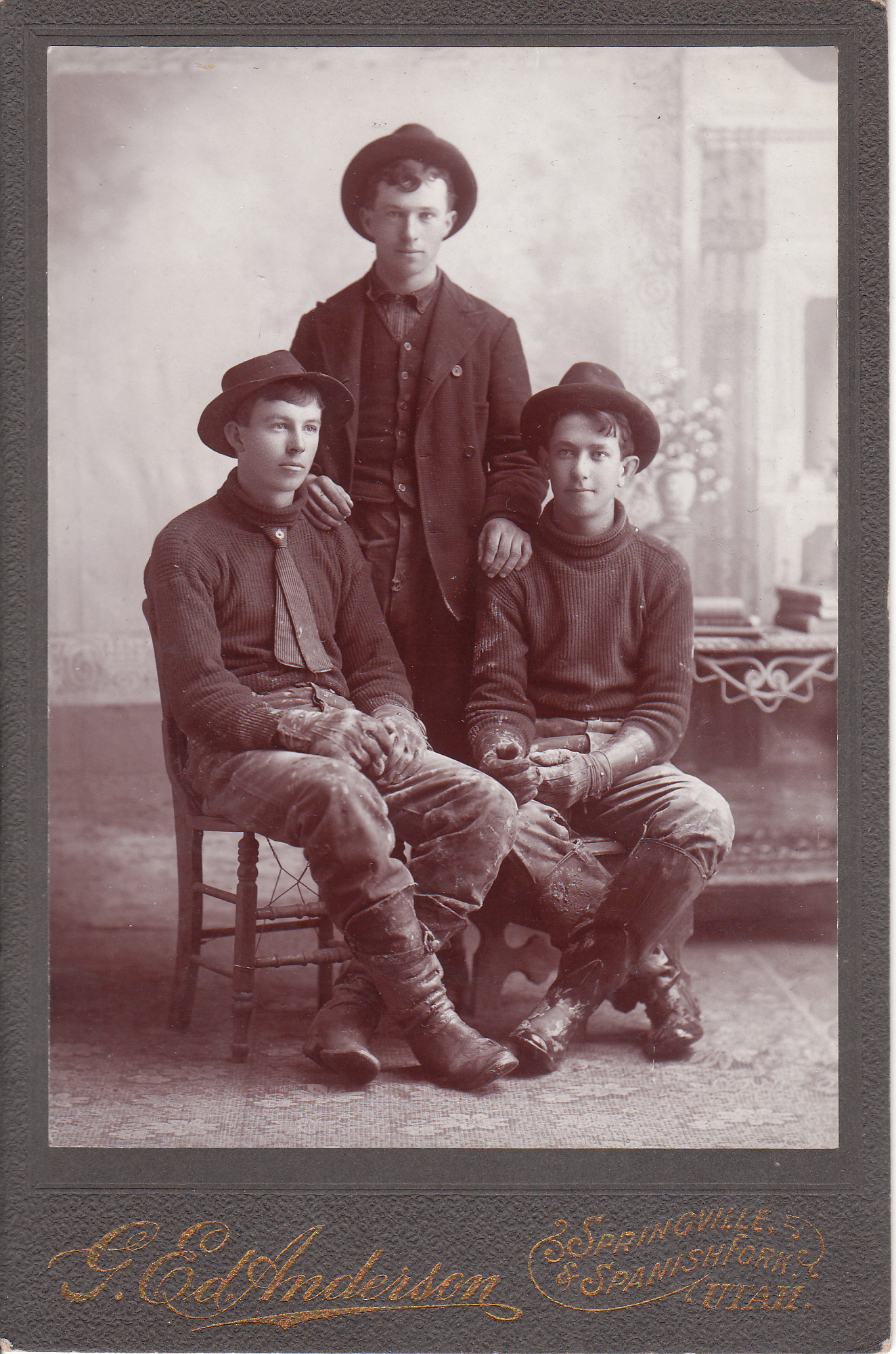
Three young men pose for their portrait at the studio of G. Ed. Anderson, located in either Springville, or Spanish Fork, Utah. The guys may have come to the studio after work. The two seated men are wearing work boots and work gloves. They are also wearing dirty trousers. Interestingly, one of the guys is wearing a turtleneck, a garment not seen often in cabinet card photographs. An inscription on the reverse of the card identifies the men as Saul Clyde, Will Rowland, and John Whiting. It would be interesting to hear some of this sites visitors opinion as to what occupation these men may have occupied. Please leave a hypothesis if you have one. Photographer, George Edward Anderson (1860-1928) was a noted photographer for his portraiture and documentary photographs of early Church of Jesus Christ of Latter-day Saints temples. He was born in Salt Lake City, Utah and was a photographer apprentice to renowned photographer Charles Roscoe Savage. At age seventeen, Anderson established a photography studio in Salt Lake City with two of his brothers. He then established a studio in Manti, Utah and in 1886, he moved his studio to Springville, Utah. Anderson became well known for his traveling tent studio which he set up in small towns throughout central, eastern and southern Utah. During that time he did an excellent job of documenting the lives of residents in the years 1884 to 1907. Although best known for his portraits, Anderson took many documentary photographs of homes, barns, businesses, Temples, mines and railroads. He went to England on his Church of Latter Day Saints mission in 1909 to 1911. After his mission, he set up a photography studio in South Royalton, Vermont, which is near the birthplace of LDS prophet Joseph Smith. In 1913, he returned to his home and family in Springville. He returned to financial and marital problems and tried to revive his traveling tent studio but met little success. The later years of his life were spent documenting families and life in Utah Valley and traveling to photograph newly constructed temples. Anderson received most of his recognition long after his death. A collection of his works is housed at Brigham Young University library.


 This excellent image is a portrait of a fire chief in Providence, Rhode Island. He is seen in his dress uniform with a fire chief badge on his hat. His coat buttons indicate he is a fireman with the Providence Fire Department. The photographer is Y. E. Rose of Providence, Rhode Island. The studio opened in 1886 in the Conrad Building.
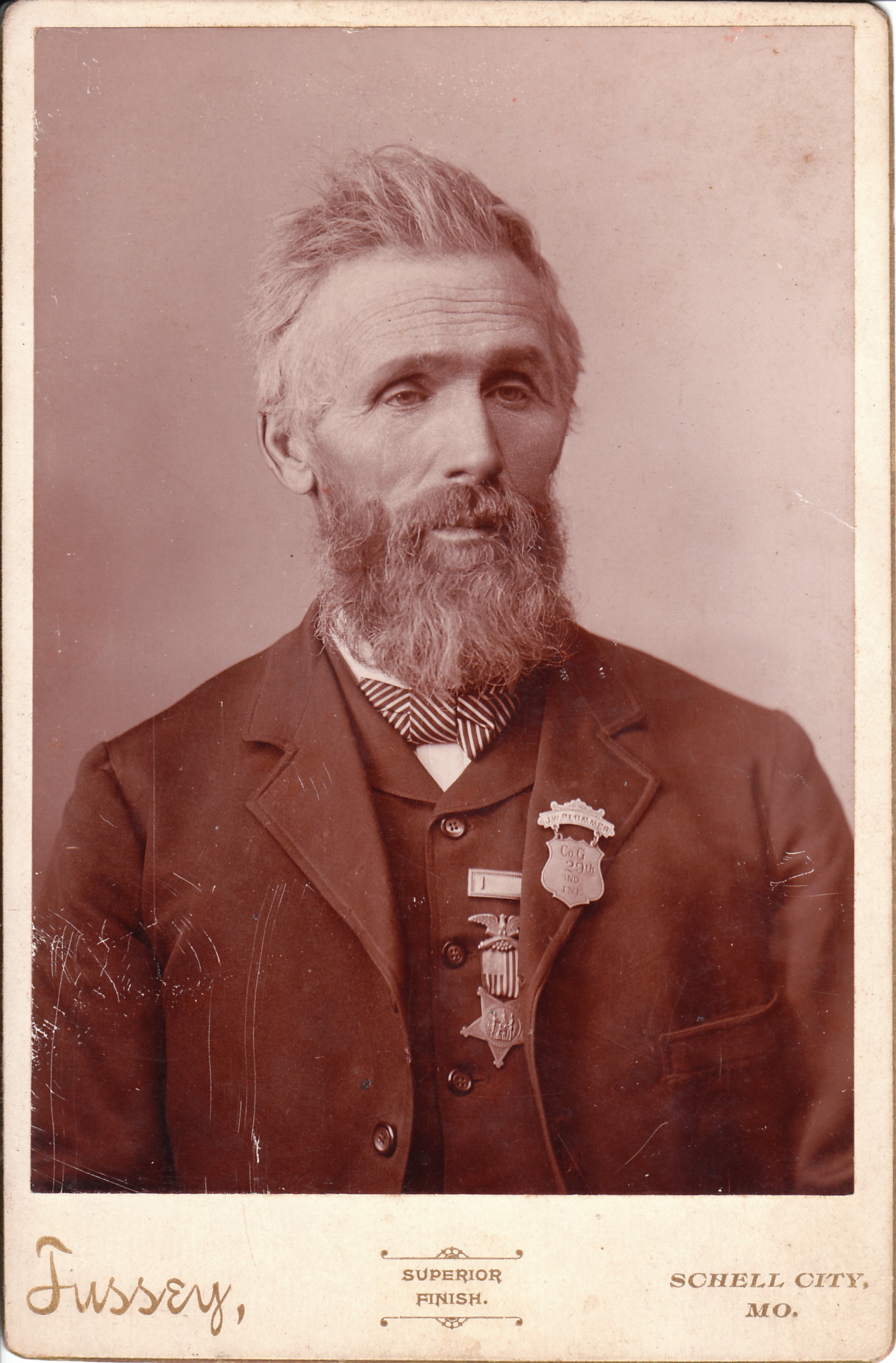 This Cabinet card is a terrific image of a union army Civil War Veteran. He is wearing three medals. One medal identifies him as J. W. Plummer, a member of company G in the 29th Indiana Infantry Regiment. The second medal represents his membership in the Civil War Veterans Group, the Grand Army of the Republic (G.A.R.). Further research reveals that Mr Plummer, is John W. Plummer and entered his unit as a private and left with the same rank. His regiment was organized in 1861 and fought at Shiloh, Corinth, Stones River, and the Battle of Chickamauga. The unit suffered 304 dead during the course of the war. The photographer is Tussey of Schell City, Missouri.
 The Sailor in this Cabinet Card is posing at an unknown photographers studio at an unknown location. Perhaps the information is classified (just kidding). It is also a mystery which nations navy this young man is serving in. Hopefully, an informed visitor can leave a comment identifying the nation this sailor represents. One can imagine that the sailor is on shore leave and wandered into a photographers studio to get a souvenir of his visit. He is looking quite dapper in his uniform.


 THE CABINET CARD GALLERY