NORMA TALMADGE : BEAUTIFUL ACTRESS : PICTUREGOER SERIES : RPPC

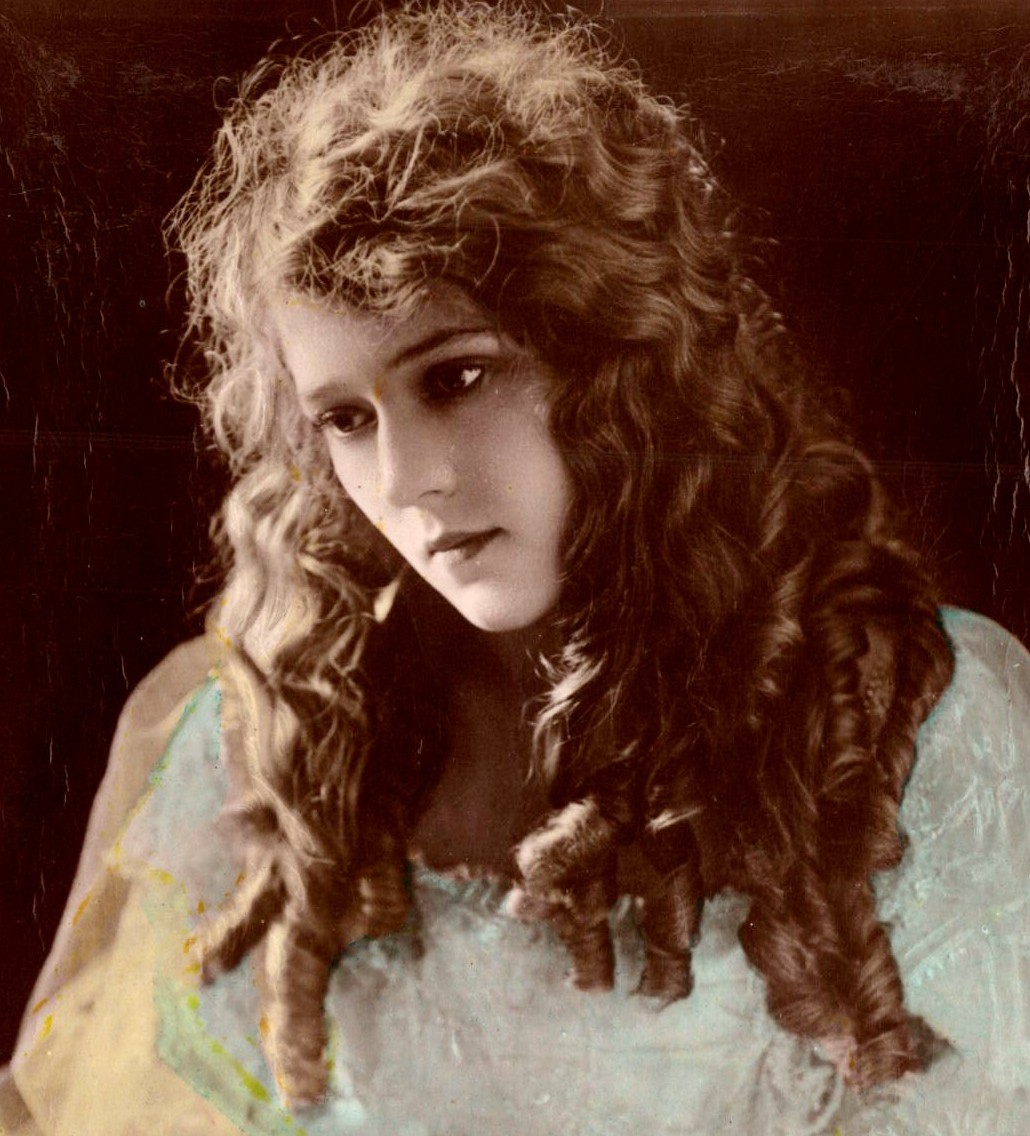
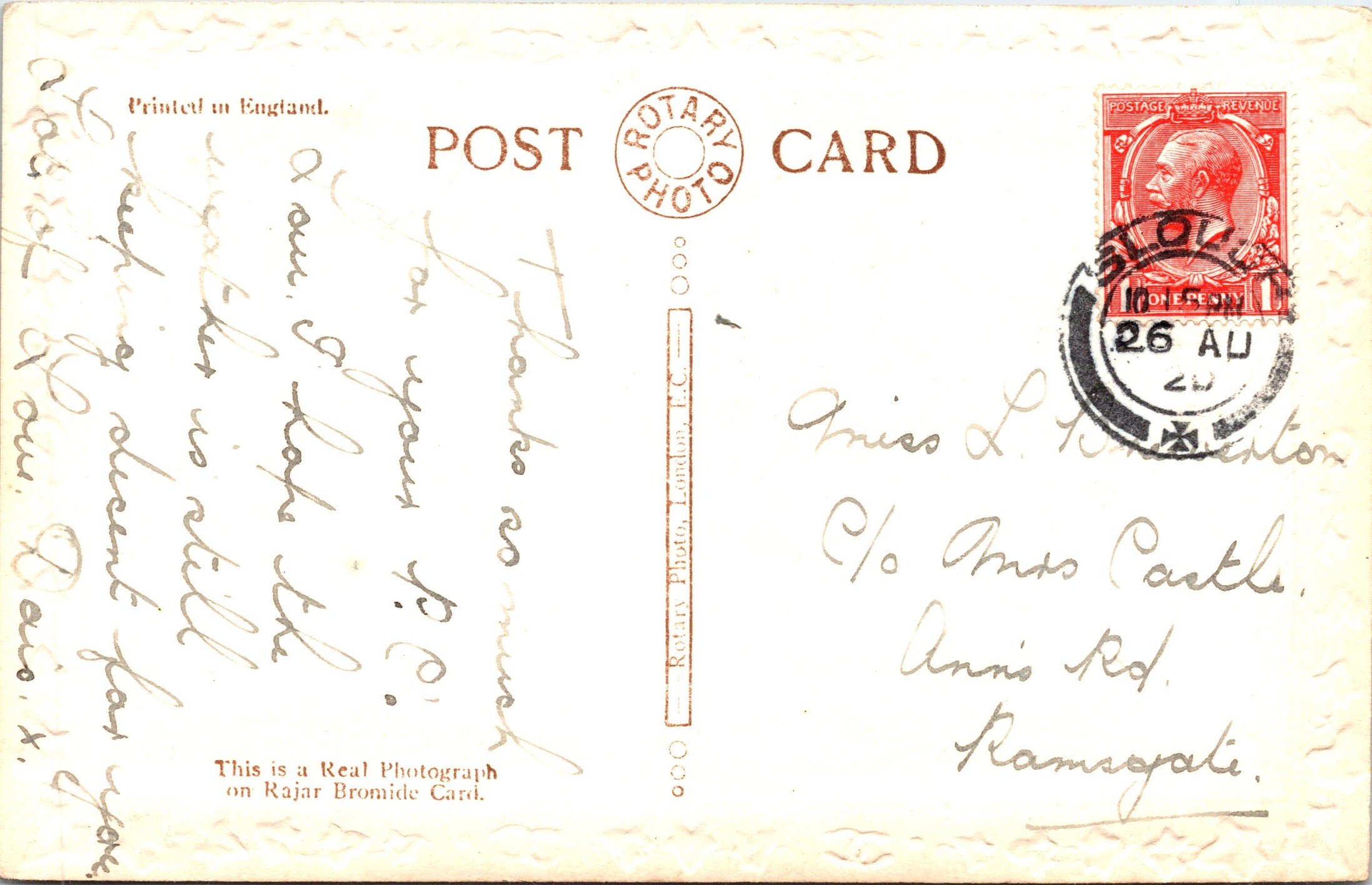
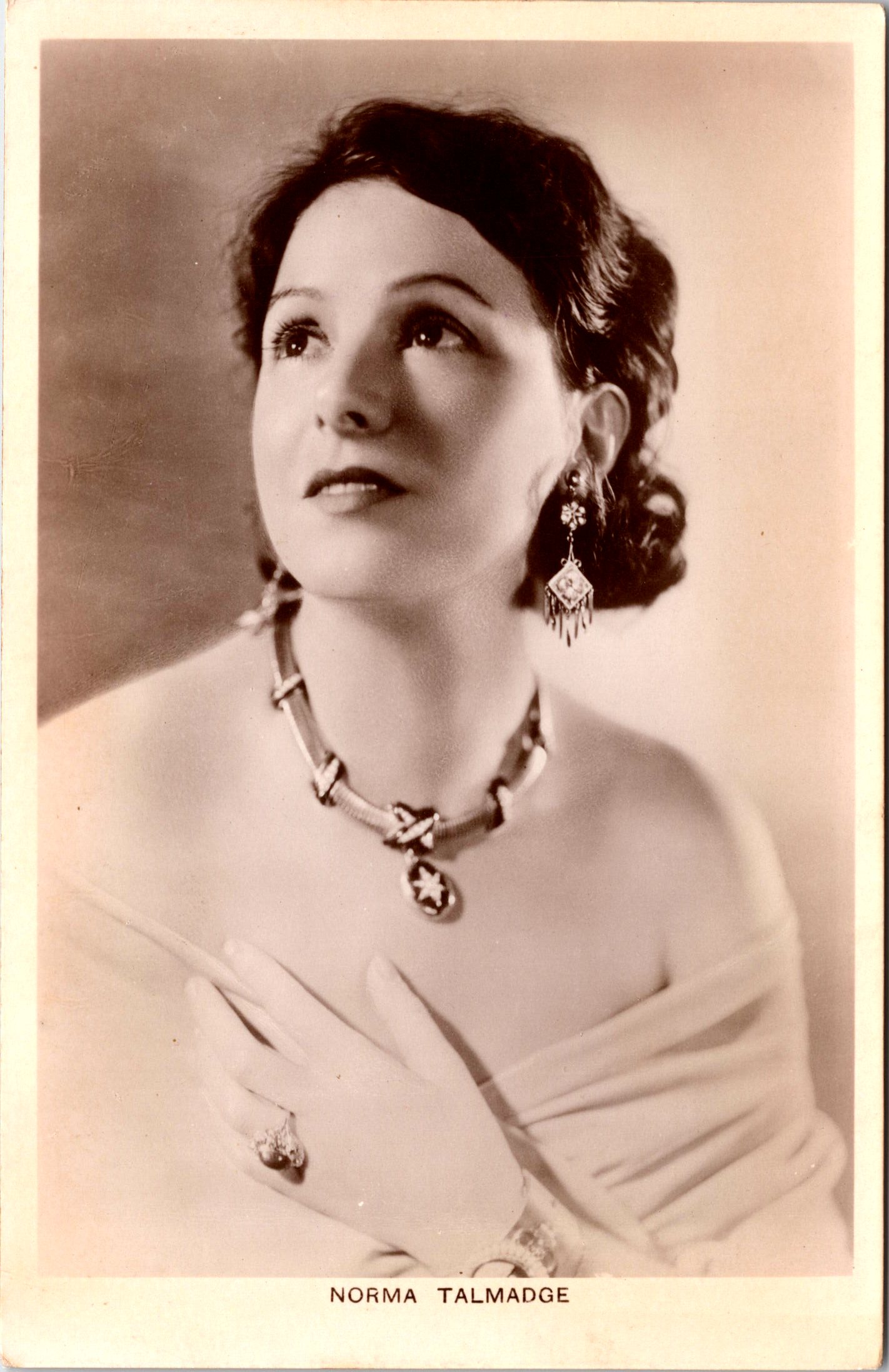
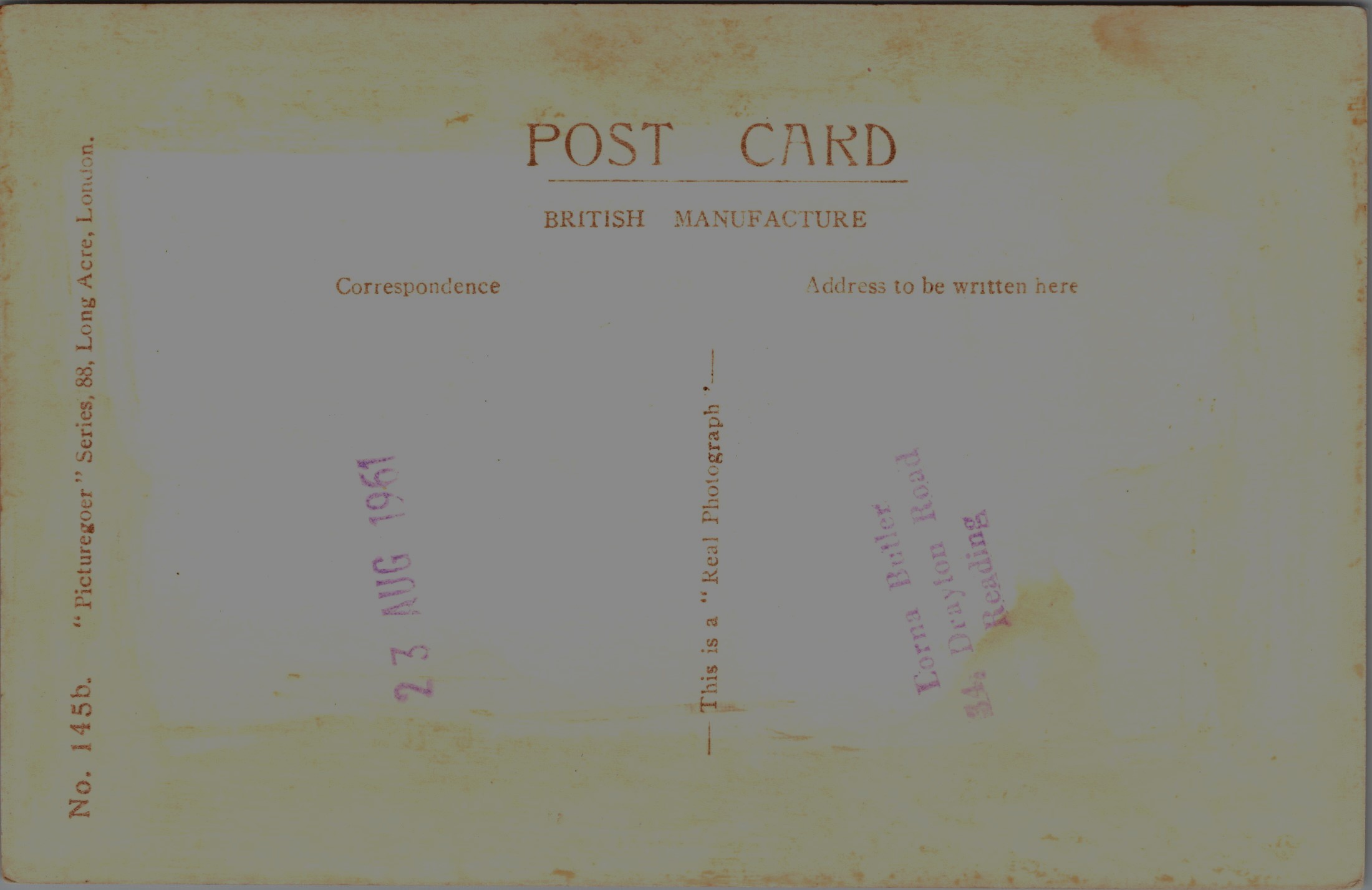
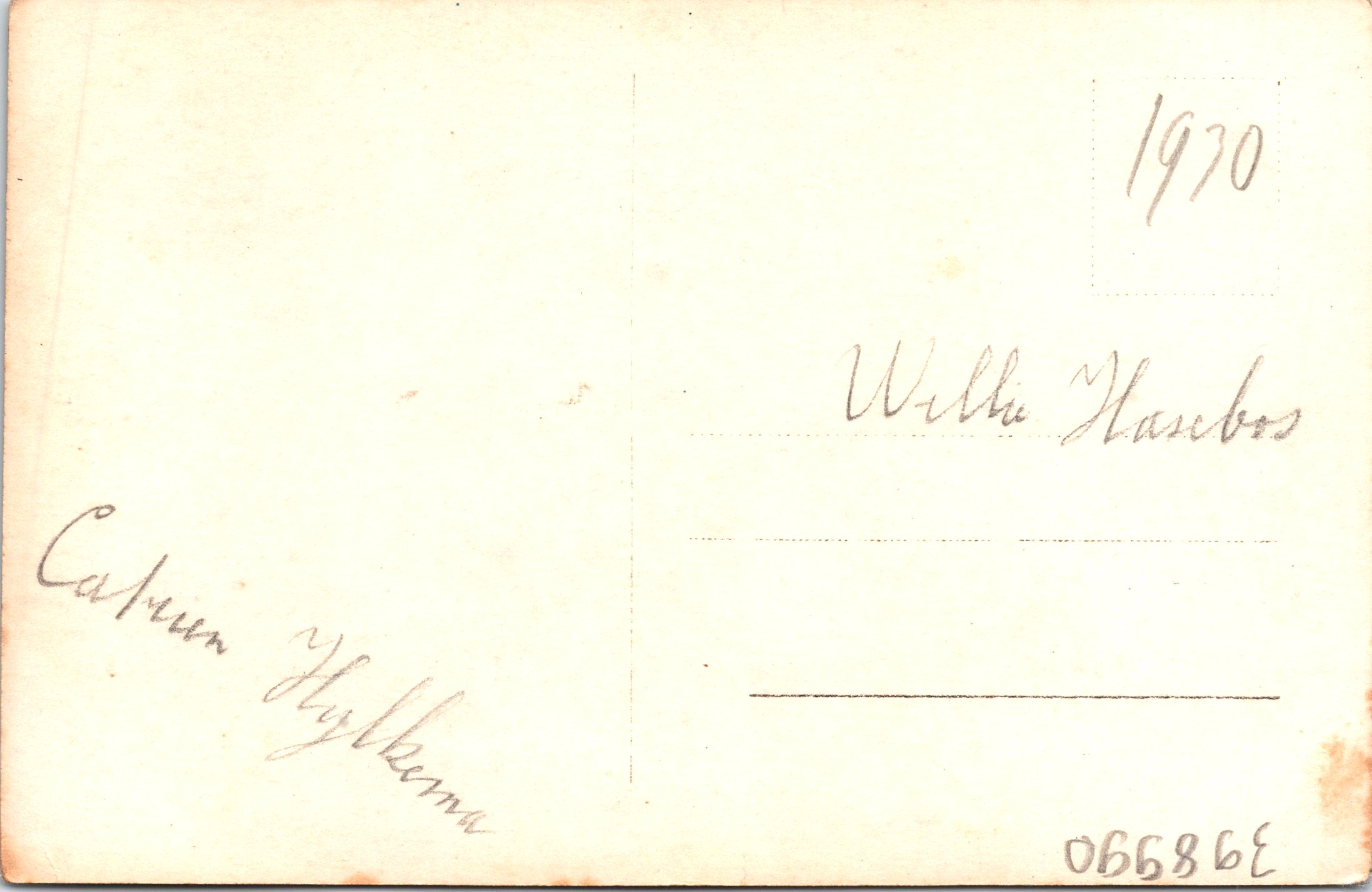
This vintage real photo postcard features American silent film actress, Norma Talmadge (1894-1957). She was noted for her dramatic and emotionally intense performances. She was one of the most popular and highly paid actresses of her era. She starred in over 200 films during her career. Raised in a show business family, Norma and her sisters Constance and Natalie Talmadge all became successful actresses. Norma began her acting career on the stage, performing in vaudeville and musical comedies. Initially, Talmadge worked for Vitagraph Studios before signing with D.W. Griffith’s Triangle Film Corporation, where she gained recognition for her talent. In the 1910s and 1920s, Talmadge became a major star, known for her ability to portray a wide range of characters. She excelled in dramatic roles, often playing heroines with complex emotions. Some of her notable films include “The Probation Wife” (1919), Smilin Through (1922), Camille (1926), and “New York Nights” (1929). Norma Talmadge was one of the few silent film stars who successfully made the transition to talkies. However, as the era of sound films emerged, her popularity waned. After her last film in 1930, Talmadge retired from acting and focused on her personal life. She married the film producer Joseph M. Schenck in 1916, and together they founded the Norma Talmadge Film Corporation. The company produced several successful films, contributing to Talmadge’s financial success and status as one of the highest-paid actresses of her time. However, her marriage to Schenck eventually ended in divorce in 1934. After her retirement from acting, Talmadge lived a private life, seldom making public appearances. She remarried in 1946 to Carvel James, a wealthy oil broker, and they remained together until her death. This vintage postcard is part of the “Picturegoer” series (No. 145B).  SOLD

LOTTE NEUMANN : PRETTY GERMAN ACTRESS, SCREENWRITER, AND FILM PRODUCER


                                                                         POSTCARD 1

POSTCARD 2

POSTCARD 3 (SOLD)

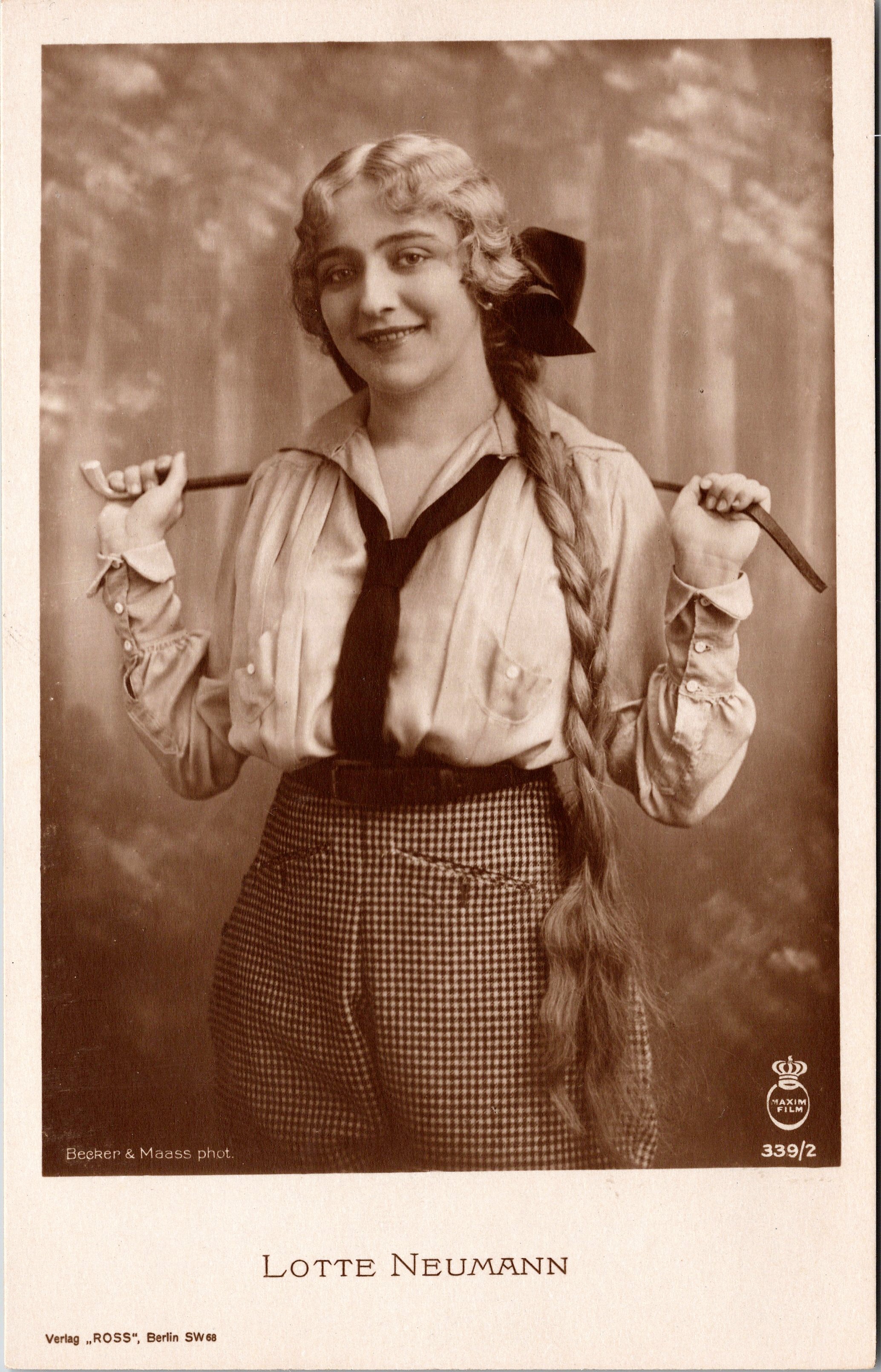
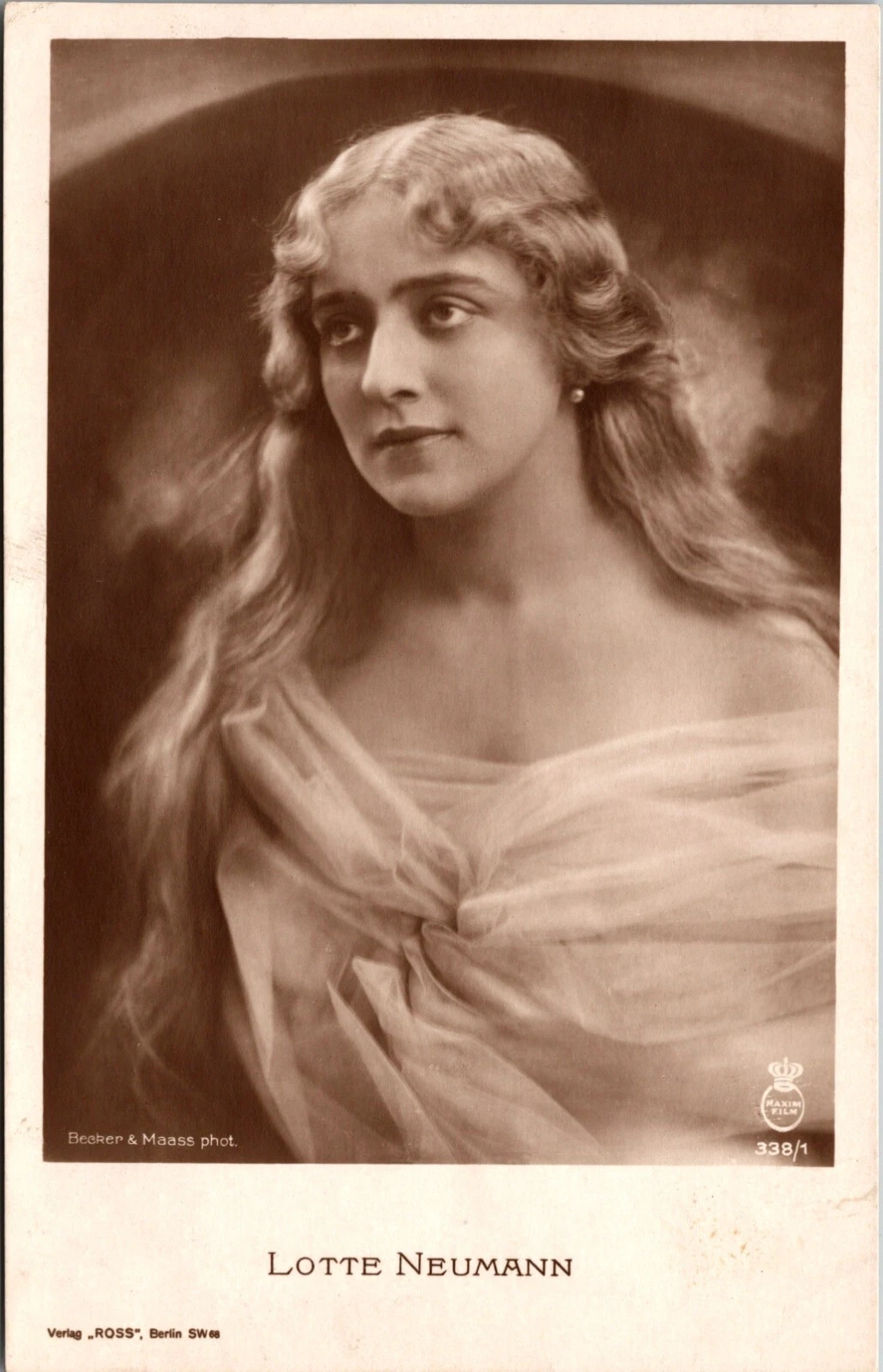
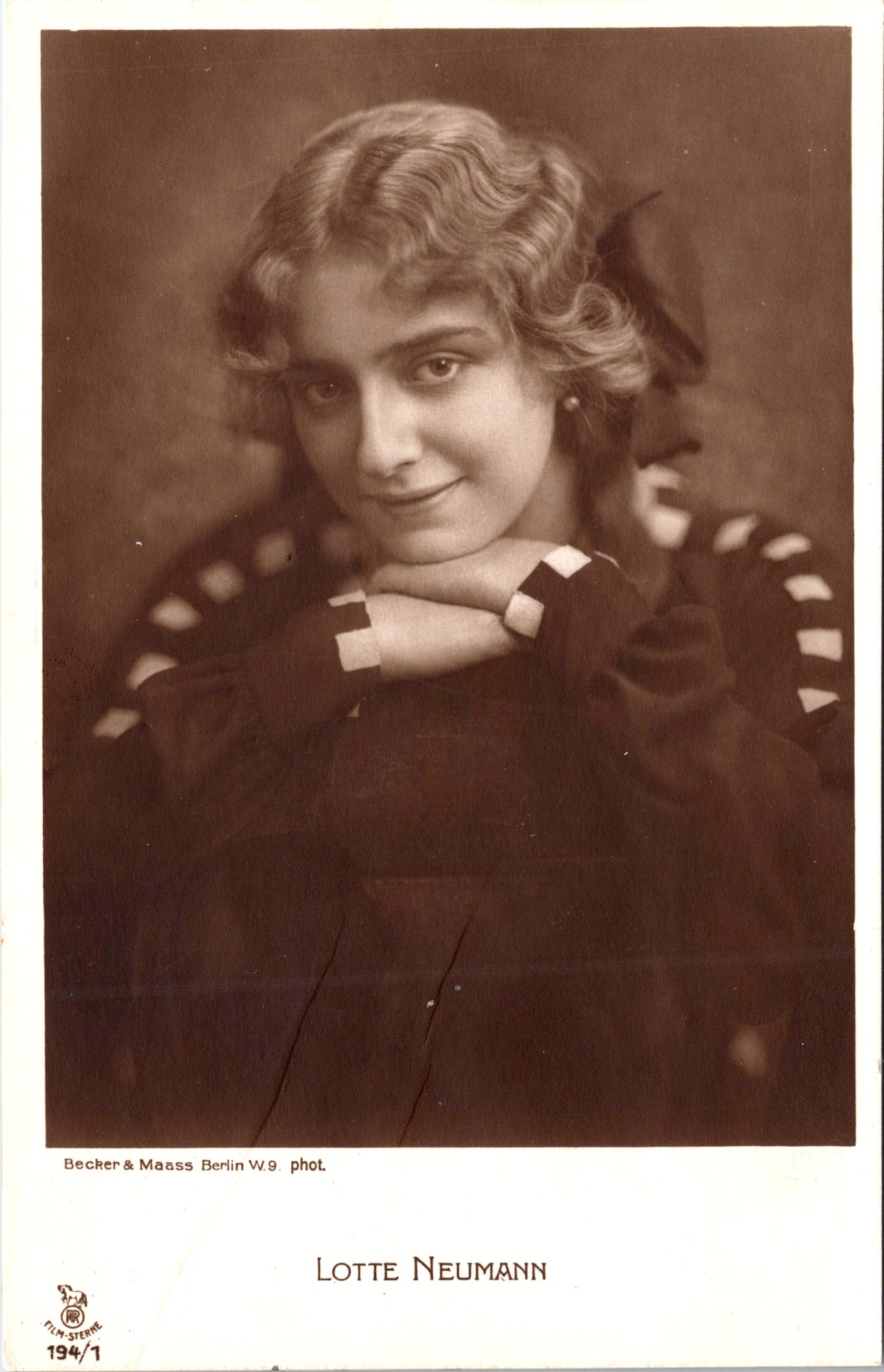
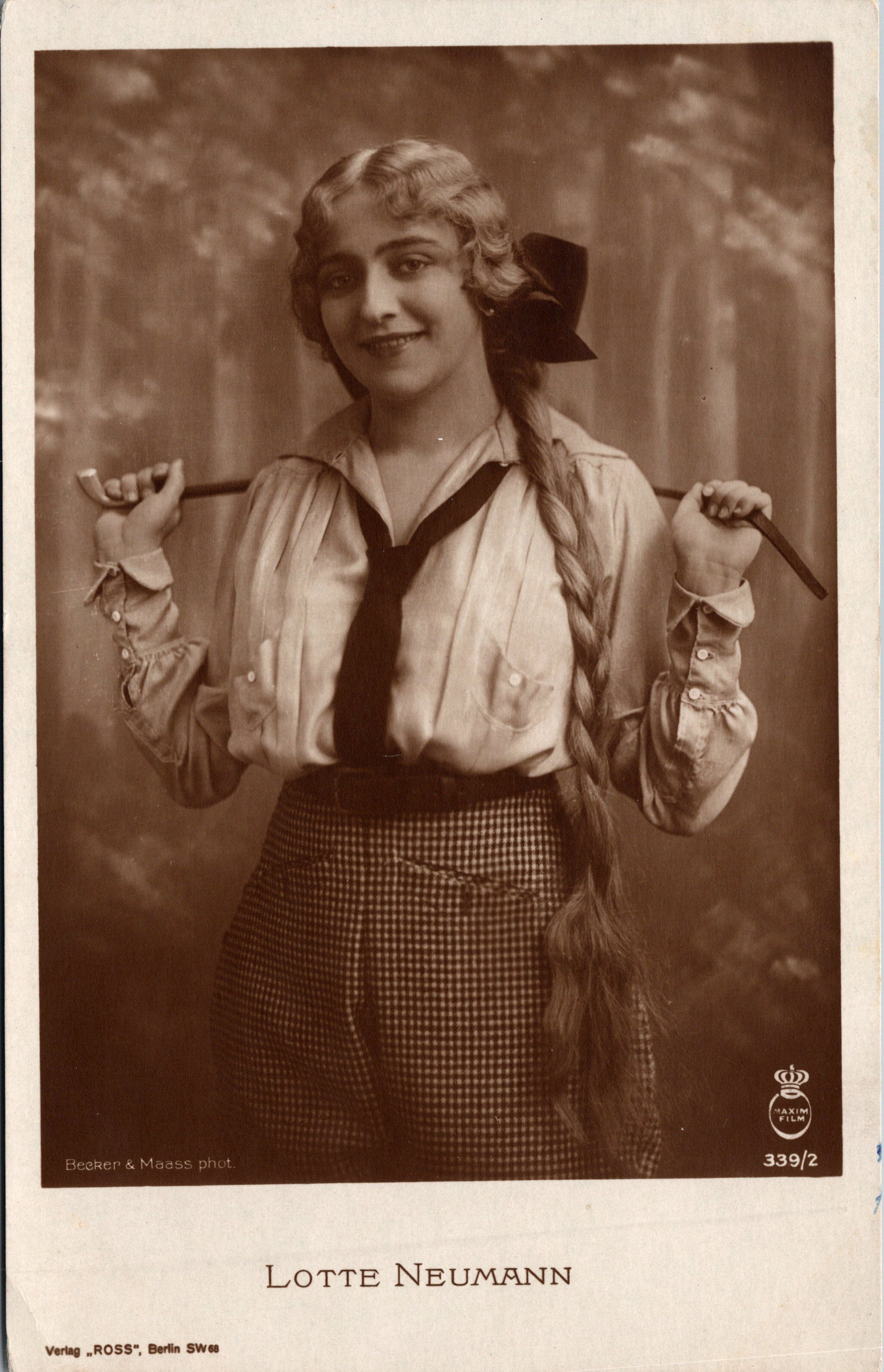
These vintage real photo postcards feature German actress, screenwriter, and producer; Lotte Neumann (1896-1977). She was active in the film industry between 1912 and 1958. Neumann was born in Berlin, Germany. At age 13, she took vocal training and acting lessons. She also studied dance and piano. Neumann also sang in two choirs. She originally desired to be a singer but after some advice from Max Mack, a German screenwriter, silent film producer and director; she chose to pursue a career in film. She made her debut in a short silent film, “Whims of Fate” (1912).  Neumann became a popular actress in Germany. In 1917 she began acting in films which she produced herself. She established her own film company (Lotte-Neumann-Film-GmbH) which operated between 1916 and 1919. In 1919, she began working for UFA, a major German film producer and distributor that was active between 1917 through the end of World War II. In 1920 she starred in two films directed by Ernst Lubitsch. He was a German born American film director, producer, writer, and actor. It was prestigious for Neumann to appear in his productions. She remained popular through the 1920’s but her career declined with the advent of sound film. This was a dreaded fate suffered by many actors and actresses during the transition to talkies. Her final screen appearance was in 1931. After retiring from acting she continued to write screenplays and partnered with her her husband, Walter Wassermann, in creative endeavors. They worked together from 1935 until his death in 1944. The IMDb reports that Neumann appeared in 69 films, wrote 24 films, and produced 14 films. Neumann’s film career accomplishments are very impressive.

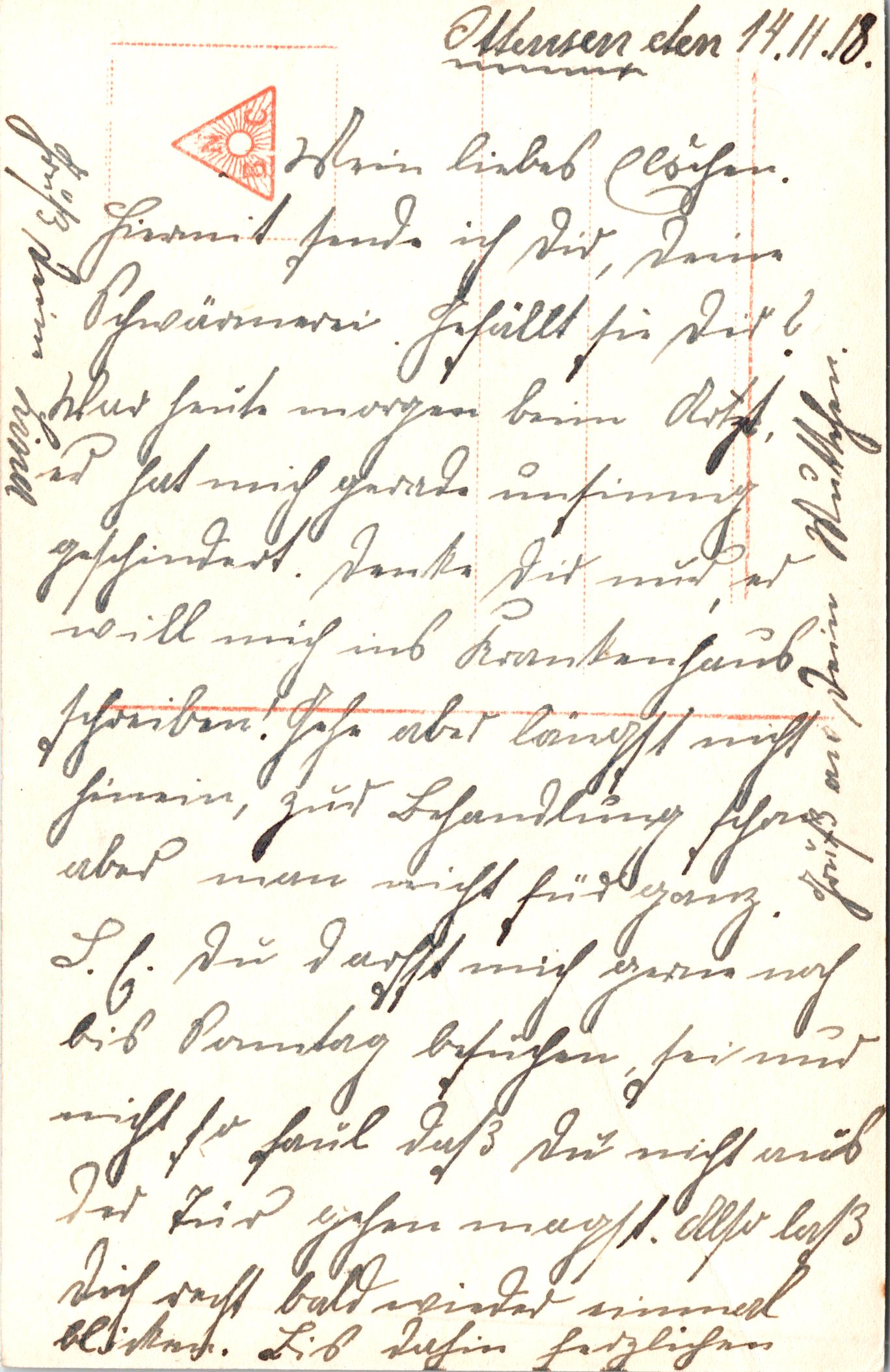
Postcard 1 was published by Film-Sterne as part of a series (no.194/1). The photographer of Miss Neumann’s photo was the Becker & Maass studio in Berlin. The message on the reverse of the postcard was written in 1918. The stamp box of this postcard has an interesting story. “NBC” (Neue Bromsilber Convention) was a price cartel established in 1909 that continued until the 1930’s. The purpose of the cartel was to ensure that the minimum price charged for postcards was kept at a sufficiently profitable level. A number of postcard publishing companies joined the cartel in an effort to stave off the effect of competition on the pricing of postcards. This postcard is in fair condition. Please note that there are two very thin creases located on the left and center bottom of the card. The photo postcard is priced accordingly.

Postcard 2 was published by Ross Verlag (Berlin) as part of a series (no.339/2). The photographer of Miss Neumann’s photo was the Becker & Maass studio in Berlin. Note the Maxim Film logo in the bottom right hand corner of the image. This postcard is in very good condition. 

Postcard 3 was published by Ross Verlag (Berlin, Germany) as part of a series (No.338/1). A logo for Maxim Films can be seen in the lower right hand corner of the image. Neumann must have been under contract with Maxim when this portrait was taken. The photographer of Miss Neumann’s photo was the Becker & Maass studio in Berlin. This postcard was likely published circa 1918. The stamp box of this postcard has an interesting story. “NBC” (Neue Bromsilber Convention) was a price cartel established in 1909 that continued until the 1930’s. The purpose of the cartel was to ensure that the minimum price charged for postcards was kept at a sufficiently profitable level. A number of postcard publishing companies joined the cartel in an effort to stave off the effect of competition on the pricing of postcards. SOLD

Buy this Vintage Real Photo Postcard (includes shipping within the US) #6031

To purchase this item, click on the Pay with PayPal button below

$10.00

Buy this Vintage Real Photo Postcard (includes International shipping outside the US) #6031

To purchase this item, click on the Pay with PayPal button below

$22.00

Buy this Vintage Real Photo Postcard (includes shipping within the US) #5304

To purchase this item, click on the Pay with PayPal button below

$14.00

Buy this Vintage Real Photo Postcard (includes International shipping outside the US) #5304

To purchase this item, click on the Pay with PayPal button below

$26.00

POSTCARD 1

POSTCARD 2

POSTCARD 3 (SOLD)

BRIGITTE HELM : TAKES A PHOTO : CAMERA ON TRIPOD : PHOTOGRAPHER : ACTRESS : RPPC

POSTCARD 1 (SOLD)

POSTCARD 2 (SOLD)
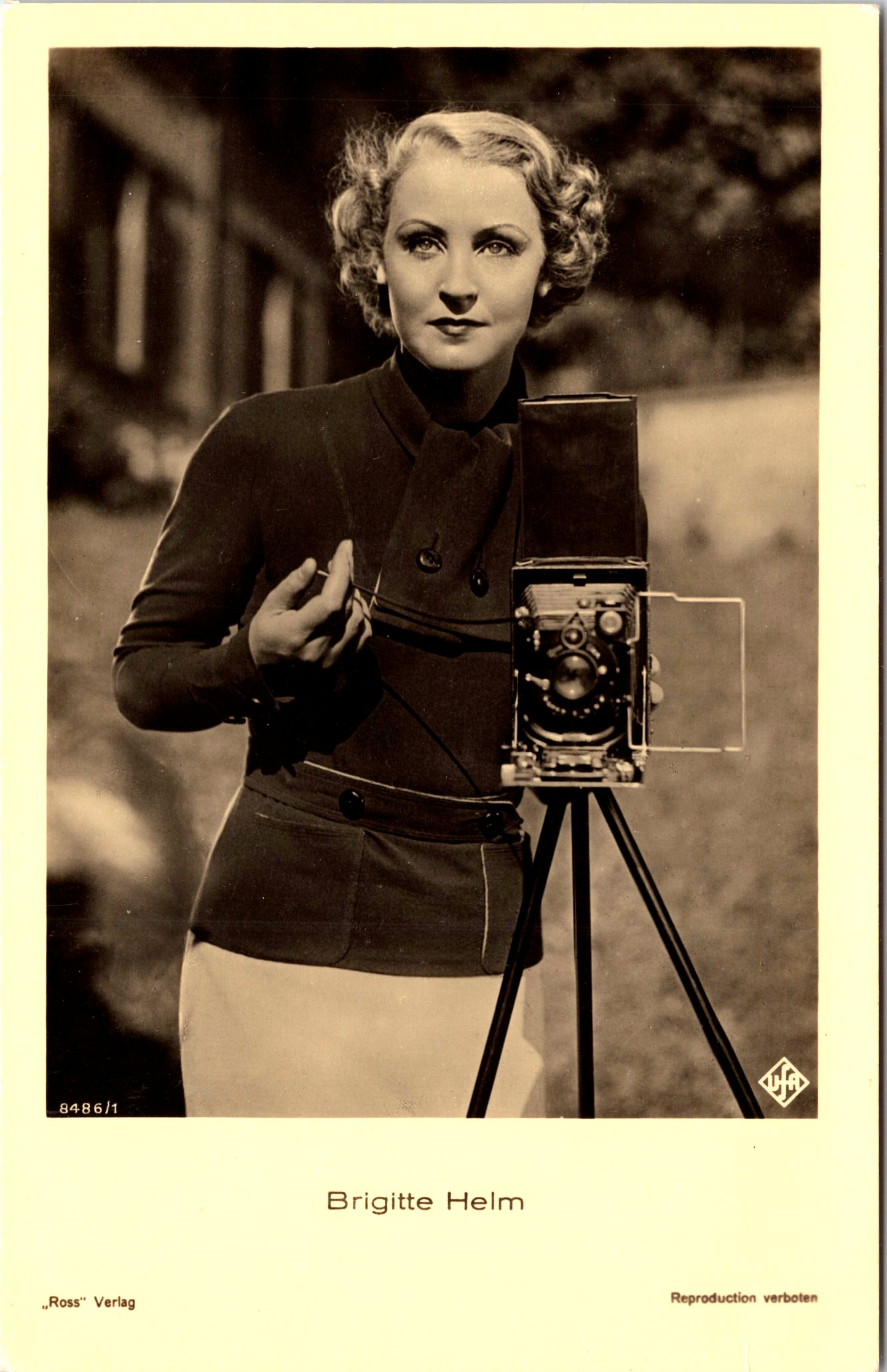
Postcard 1 features German actress, Brigitte Helm (1908-1996). The postcard captures Miss Helm taking a photograph with a camera on a tripod. Photographs of photographers in action are quite collectible. Now, back to Brigitte Helm. She is best known for her dual role in Fritz Lang’s 1927 silent film, Metropolis. After “Metropolis” she played in a long string of movies where she typically had the starring role. Helm was typecast as a Vamp or a femme fatale. She was born in Berlin. Her father was a Prussian Army officer. She was interested in acting at an early age and by age 12, was taking lead parts in school plays. At the age of 17, she acted in “Metropolis”. In 1925 she signed a ten year contract with UFA. She performed in both silent films and talkies. Beside “Metopolis” (1927), Helm was best known for “A Daughter of Destiny” (1928), “L’Argent” (1928), and “Alraune” (1929). Helm had an eventful personal life. Helm was involved in several traffic accidents. In fact, she was briefly placed in prison for manslaughter charges. She married industrialist, Dr Hugo Kunheim. The Nazis were not very pleased with her choice in men because Kunheim was Jewish. In 1935, Helm retired and moved with her husband to Switzerland where they started a family. Helm explained her retirement was because of disgust about the Nazi’s taking over the German film industry. This postcard was published by Ross Verlag as part of a series (No.8486/1). The card has the UFA logo which reveals it was published between 1925 and 1935. (SOLD)

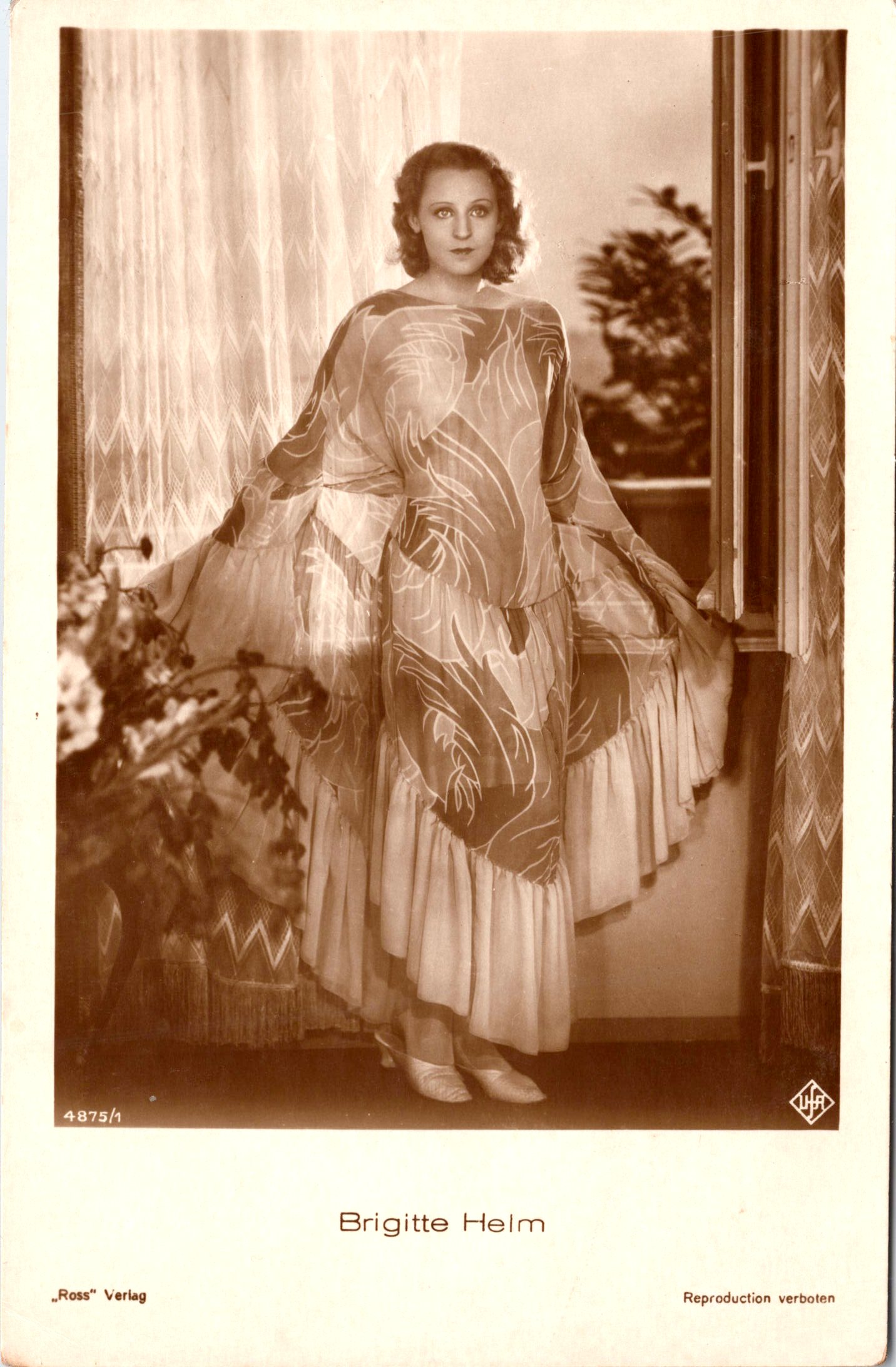
Postcard 2 captures Miss Helm in a beautiful dress that illustrates her nice figure. This postcard was published by Ross Verlag as part of a series (No.8486/1). The card has the UFA logo which reveals it was published between 1925 and 1935.  (SOLD)

POSTCARD 1

POSTCARD 2

JEAN AYLWIN : SCOTTISH ACTRESS & SINGER : DOVER STREET STUDIOS : RPPC 1908

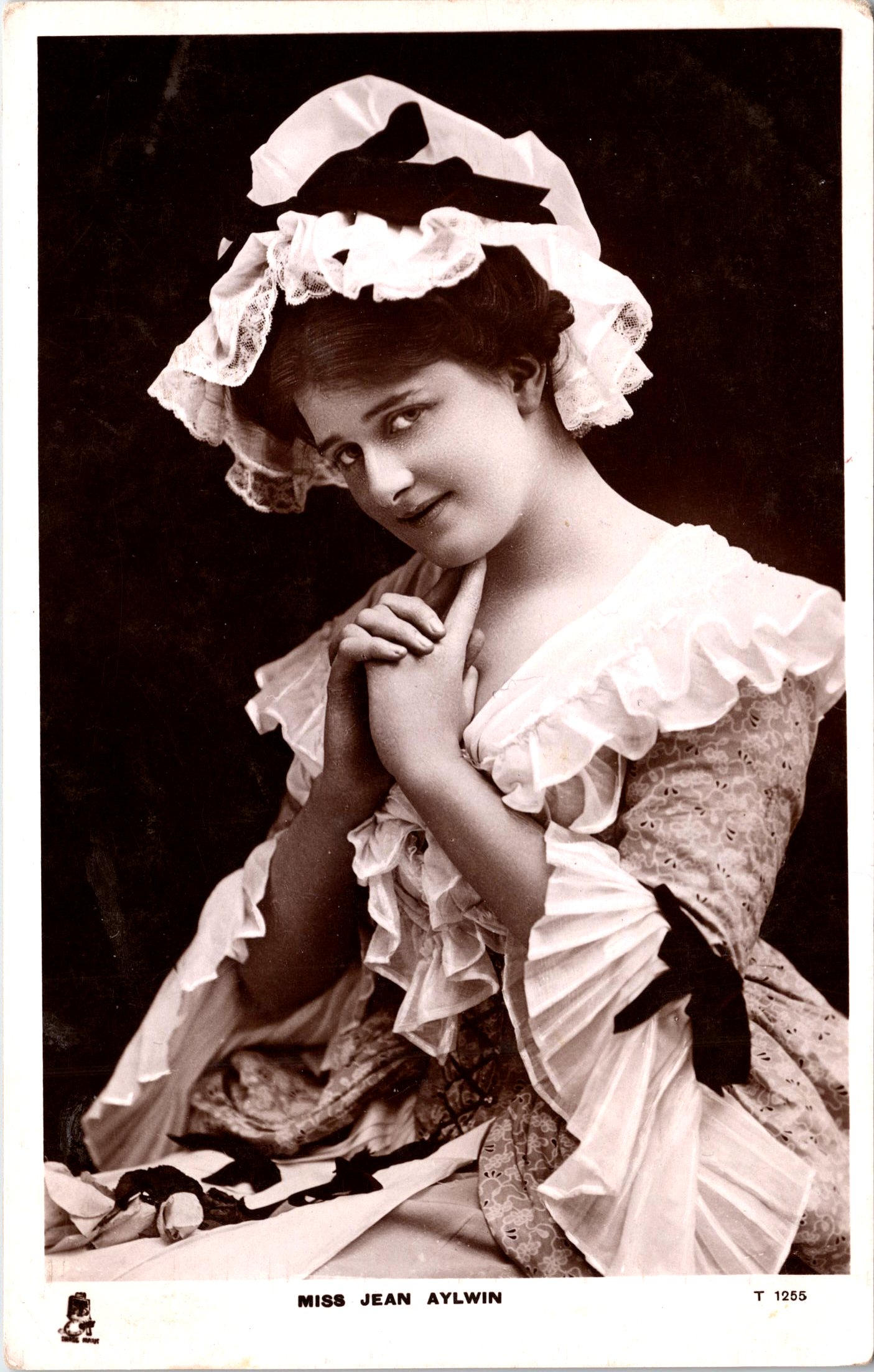
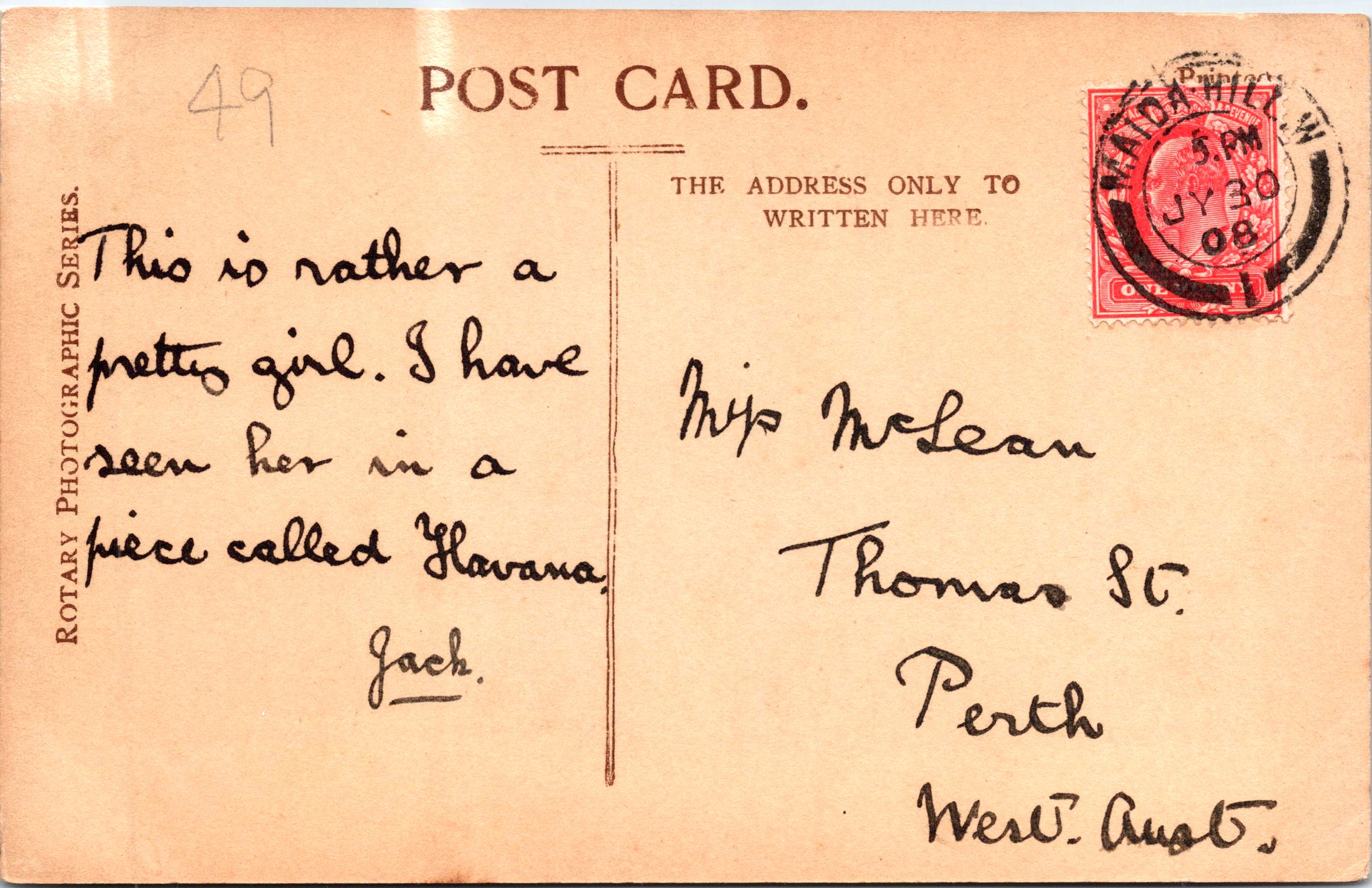
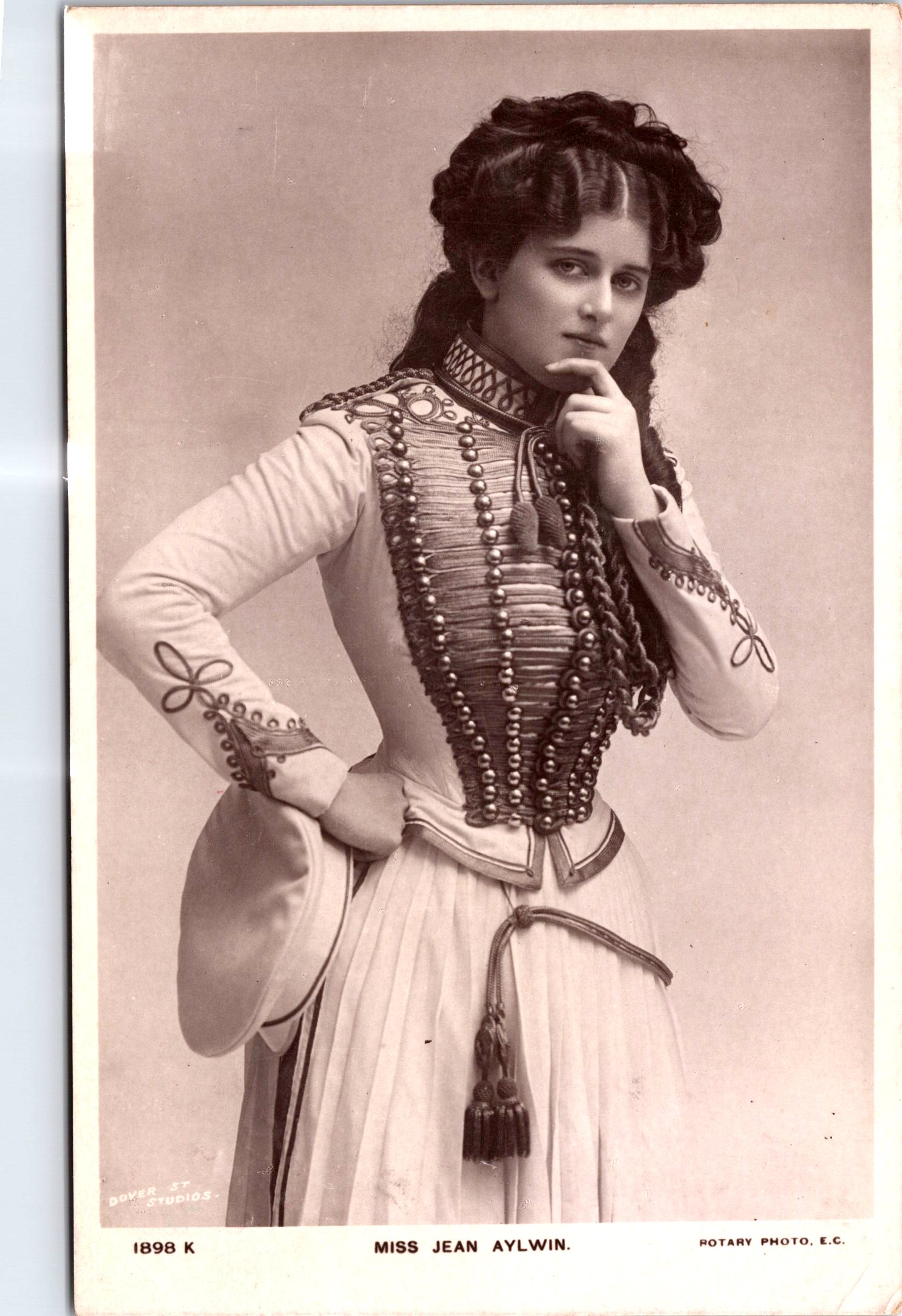
This vintage real photo postcard features a striking portrait of Jean Aylwin (1885-1964), a pretty British actress and singer from the early 20th century. She gained fame for her performances in musical comedies and plays in London and she also toured internationally. Aylwin was associated with the popular Gaiety Theater productions. She had notable performances in several successful productions including “The New Aladdin” (1906), “The Girls of Gottenberg” (1907) and “Our Miss Gibbs” (1909). Aylwin also appeared in two silent films. She married in 1913 but the marriage ended in divorce in 1924. She was accused of adultery with a noted composer of her time. After her divorce, her career declined. She later worked as a housekeeper. In 1926, she briefly worked as a BBC radio broadcaster.  Aylwin looks elegant in this dramatic studio pose. She stands three-quarter length with a thoughtful, hand-to-chin expression, the other hand set firmly at her hip. Aylwin wears a striking military-style costume—a fitted jacket heavily braided with ball buttons and tasselled cords, over a pleated skirt; a matching hat rests at her side. Her hair is dressed in full Edwardian waves, completing the theatrical look. Thd photographer of this portrait is the Dover Street Studios. The card was published by Rotary Photo as part of a series (no1898K). The postcard has a Wandsworth (London) postmark from 1908. The postcard is addressed to someone in West Australia. The message on the card is “This is rather a pretty girl. I have seen her in a piece called Havana. Jack.” The front of this card is has rich, sharp sepia tones. Holding the card at a certain angle, one can see dimples caused by the postmark. (SOLD) 

VALLI VALLI : PRETTY SILENT FILM & STAGE ACTRESS : RPPC 1908

POSTCARD 1 (SOLD)

POSTCARD 2 (SOLD)
POSTCARD 3 (SOLD)

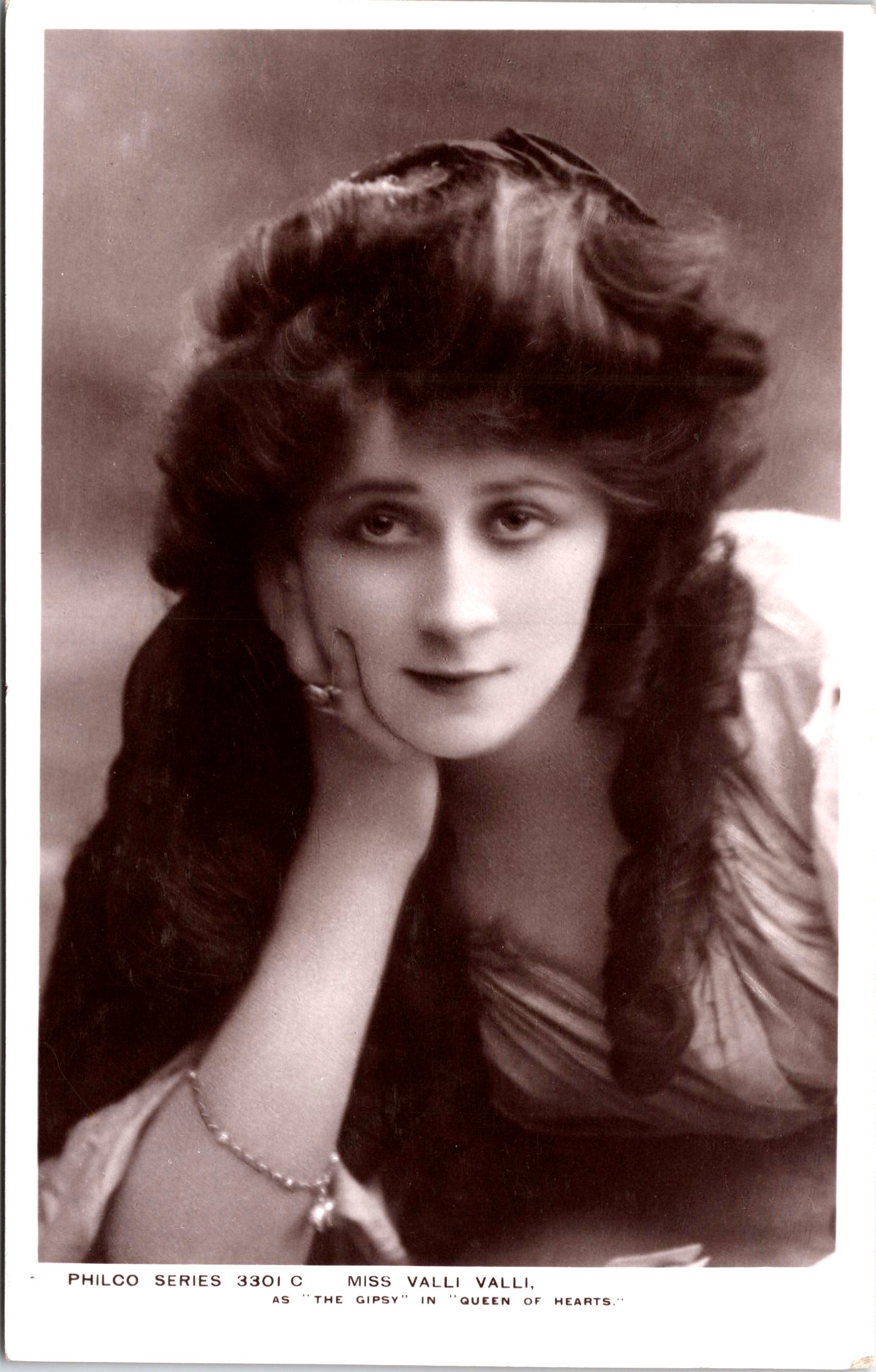
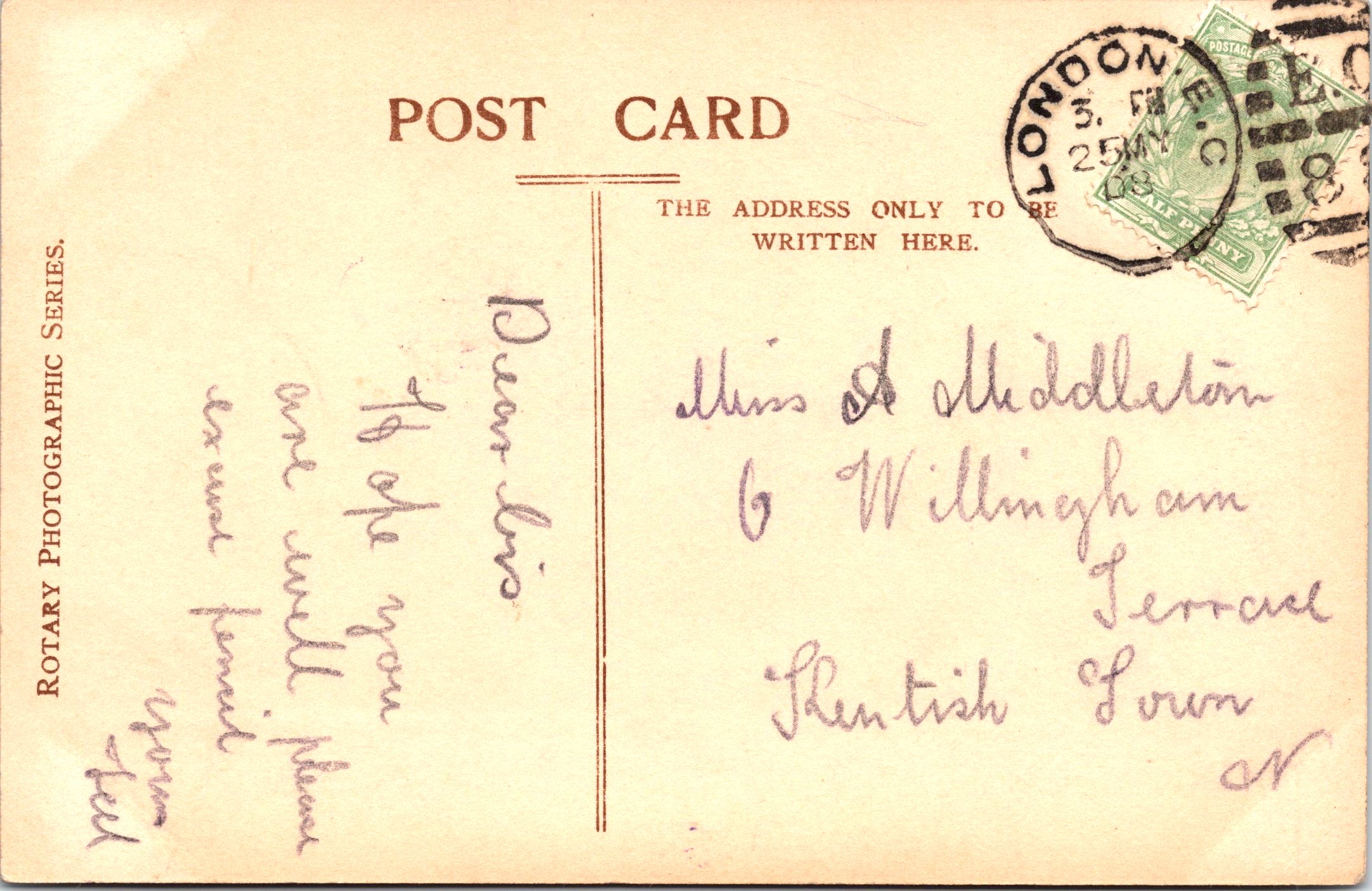
These vintage real photo postcards feature British beauty and actress, Valli Valli (1882-1927). She was a British musical comedy actress and a silent film performer. She was born in Berlin but spent most of her life in England. Her sisters, Lulu and Ida Valli were both actresses. Her father was a merchant. She was educated in London and Paris. She made her stage debut in London at the age of twelve. At thirteen years of age she had a successful run in the musical comedy “Morocco Bound” in Berlin. The next year she performed at London’s Drury Lane Theatre in a pantomime version of Cinderella. As an adult, Valli was a beautiful woman. She performed mostly on the English stage but did tour the United States a number of times. These plays include “The Dollar Princess” and her final New York City performance in “Miss Millions” (1919). In all, she appeared in seven Broadway plays between 1905 and 1920. Valli appeared in four films during 1915 and 1916. These films included “The Turmoil” which was an adaptation of a Booth Tarkington novel. In 1917, she married Louis Dreyfus, head of a music publishing house, and later, a theatrical producer. Valli died from tuberculosis at the young age of forty-five.

Postcard 1 captures Valli, in a pensive, or possibly, dejected mood. The card was published by Rotary Photo as part of a series (No.1760G). Miss Valli was photographed by the Bassano studio. (SOLD)

Postcard 2 features Valli, in a pensive or imploring mood, identical to the mood she exhibits in postcard 1. This card was published by Rotary Photo as part of a series (No.11415A).  (SOLD)

Postcard 3 captures Valli in her role as “The Gipsy” in “Queen of Hearts” . The card was published by Rotary Photo as part of a series (No.11415A). (SOLD)

POSTCARD 1 (SOLD)

POSTCARD 2 (SOLD)
POSTCARD 3 (SOLD)

DOROTHY GISH : PRETTY SILENT FILM STAR : FASHIONISTA :PARAMOUNT : RPPC 1928

This vintage real photo postcard features actress, Dorothy Gish (1898–1968). She was a prominent American actress best known for her work in silent films and later in theater. She was also quite pretty which is apparent in this postcard portait. In addition, she was quite fashionable. She was born in Dayton, Ohio, into a family with roots in the performing arts. Dorothy and her older sister, Lillian Gish, are often remembered as significant figures in early American cinema, particularly for their work with director, D.W. Griffith. Dorothy and Lillian’s parents separated when they were young, leaving their mother to support the family. In 1902, the Gish family moved to New York City, where their mother sought work in the theater. Both sisters began acting on stage as children to help support their family. Dorothy made her stage debut at a young age, and by the time she was a teenager, she had already gained experience in theater. In 1912, Dorothy and Lillian were introduced to D.W. Griffith by their friend, actress Mary Pickford. Griffith immediately saw potential in the sisters and cast them in his films, launching their film careers. Dorothy’s early work with Griffith included supporting roles in films like The Musketeers of Pig Alley (1912) and The Birth of a Nation (1915). However, Dorothy’s specialty was comedy, and she developed a distinct, lively style that set her apart from her sister Lillian, who typically played more dramatic roles. Dorothy’s popularity rose as she starred in a series of comedic silent films, including Hearts of the World (1918) and Orphans of the Storm (1921), both of which also featured Lillian. While Lillian’s characters often embodied innocence and vulnerability, Dorothy’s roles allowed her to showcase a playful, often mischievous side, bringing her critical acclaim and a strong fan following. With the advent of sound films in the late 1920s, Dorothy, like many silent film stars, found it challenging to transition to “talkies.” She made a few sound films, but she gradually shifted her focus to theater, where she had always felt at home. Dorothy was well-suited to the stage, bringing her charm and humor to roles in productions such as Young Love (1928), which was a hit on Broadway, and The Chalk Garden (1956). Throughout the 1930s and 1940s, Dorothy toured in various plays and continued to appear in films occasionally. She remained active in theater well into the 1950s, and her stage career extended her professional life even as her work in film slowed. In contrast to her sister, who continued to receive accolades in film well into the sound era, Dorothy’s legacy was tied more to her stage performances and her beloved silent film roles. Dorothy was known for her wit, independence, and close bond with her sister Lillian. The two were inseparable and supported each other throughout their lives, both personally and professionally. In 1920, Dorothy married James Rennie, a Canadian-born actor. However, their marriage ended in divorce in 1935, and she did not remarry. After retiring from the stage, Dorothy lived a quiet life but remained connected to the arts and close to her sister. She passed away in 1968. This postcard was published by Ross Verlag as part of a series (No.3513/1). The card was published in 1928/1929. SOLD

JOSEPHINE DUNN : IN “EXCESS BAGGAGE” : MGM SILENT FILM STAR : RISQUE RPPC 1928

Josephine Dunn (1906 –1983) was an American actress known primarily for her work in silent and early sound films during the late 1920s and early 1930s. She was a glamorous starlet of the Jazz Age, often cast in flapper and socialite roles. Josephine Dunn was born in New York City, where she was raised. Little is known about her early years, but she entered show business as a teenager, joining the world of vaudeville before making the transition to film. Her natural beauty, charisma, and fashionable style made her a popular choice for film producers during Hollywood’s silent era. Dunn made her film debut in 1926 and quickly became a sought-after actress, starring in a variety of silent and early talkie films. She was often cast as the “other woman” or as a carefree flapper, fitting the Roaring Twenties’ archetype of modern femininity. One of her most notable films was “Our Modern Maidens” (1929), in which she starred alongside Joan Crawford and Douglas Fairbanks Jr. She also appeared in: “Excess Baggage” (1928),”The Broadway Melody” (1929),  “Tanned Legs” (1929), and “Montana Moon” (1930). Her transition from silent films to talkies was fairly successful, though she never achieved the same level of fame as some of her contemporaries, such as Crawford or Norma Shearer. By the early 1930s, her film career began to slow down. While primarily a screen actress, Dunn had early experience in vaudeville and stage performances, though she never became a major Broadway star. She retired from acting in the mid-1930s and lived a largely private life afterward. Dunn was married multiple times, including to millionaire oil executive Carroll Case. Her personal life was often the subject of media gossip. Although she was never a top-tier star, Josephine Dunn was emblematic of 1920s and early 1930s Hollywood glamour. This postcard features Dunn in her starring role in the 1928 silent film, “Excess Baggage”. The romantic comedy film was produced by Metro-Goldwyn-Mayer (MGM). She played the role fo a glamourous and sophisticated young woman. Unfortunately, like many silent films of the era, Excess Baggage is considered lost, meaning no known copies are available today. In this image, Josephine Dunn is dressed in a delicate, ruffled ballet-style costume, with a short, voluminous tutu and an intricately adorned bodice. The dress features lace and embellishments, reflecting the flapper era’s fascination with femininity and luxury. Her feet are adorned with soft, ballet-like slippers, adding to the graceful, almost ethereal appearance of her outfit. Her pose is both playful and weary—leaning on the large travel trunk with one arm propped up and her hand resting gently against her face. Her expression is one of wistful contemplation, with her eyes gazing off to the side, giving a sense of melancholy or quiet amusement. This pose complements the humor suggested by the film’s title, Excess Baggage, possibly hinting at the idea of emotional or romantic burdens rather than just literal luggage. Her curled, short blonde hair, typical of the 1920s, frames her face beautifully, reinforcing her status as a Jazz Age beauty. This risque postcard was published by Berlin based, Ross Verlag. In the card’s lower right corner, we see the logo of MGM. This vintage real photo postcard was issued in 1928. (SOLD)

SILENT FILM ADVERTISING POSTCARD : “THE BROKEN COIN” : FRANCIS FORD & GRACE CUNARD

This vintage lithographic postcard advertises the American adventure-mystery silent film, “The Broken Coin”. The film was released by Universal Motion Pictures in 1915 and it was part of a 22 episode serial. The “Broken Coin” was the first chapter in the series which included thirty reels over 15 weeks. The film starred Francis Ford and Grace Cunard. The film was directed by Francis Ford and Grace Cunard was one of the two writers of the screenplay. Francis Ford (1881-1953) was an early American film actor, writer, and director. He was the older brother and mentor of film director John Ford. Francis Ford is reported by IMDb to have appeared in 495 acting roles, directed 180 films, and wrote 31 different screenplays. Grace Cunard (1893-1967) was an American actress, screenwriter and film director. She starred in over a hundred films during the silent film era. She cowrote at least 44 of these film and directed at least 8 of them. Cunard also edited many of her films. It is unfortunate to note that no copies of the “Broken Coin” series appear to have survived. This vintage postcard is an excellent purveyor of American silent film history. 

Published in: on September 25, 2025 at 12:00 pm  Leave a Comment  
Tags: , , , ,

ALMA BENNETT : RISQUÉ 1920s RPPC OF SILENT FILM ACTRESS : PATHE : IRIS VERLAG

This sepia-toned, real photo postcard features the glamorous silent film actress Alma Bennett (1904-1958) in a striking, risqué pose. Published by Iris Verlag of Austria, this collectible is numbered 5234 and credits the prominent studio Pathé as the photographer—known for its high-quality film stills and star portraits during the silent era. The image captures Bennett draped in a sheer, flowing fabric that barely conceals her chest. With her hands placed carefully to cover herself, the pose is both sensual and elegant—clearly intended to appeal to fans of 1920s starlets and risqué glamour. Her expressive face is tilted upward in a dramatic fashion, with her dark, wavy bob framing large, expressive eyes. Her parted lips and gaze suggest a moment of theatrical longing or awe, characteristic of the silent film aesthetic. This postcard falls squarely into the risqué category due to its suggestive styling and scant coverage, though it retains a refined and artistic tone rather than being overtly provocative. Alma Bennett was an American silent film actress who appeared in over 60 films between 1919 and 1931. Known for her beauty, versatility, and ability to play both dramatic and comedic roles, she became a recognizable face during the peak years of silent cinema. Bennett began her career in Hollywood in the late 1910s, likely transitioning into film from stage or local beauty contests, as was common during the period. Her breakout years came in the 1920s, with notable roles in films such as: “Orphans of the Storm” (1921, uncredited, directed by D.W. Griffith), “The Prairie Pirate” (1925), “A Woman Against the World” (1928), “The Night Flyer” (1928). and “The Arizona Kid” (1930).  Alma’s personal life was somewhat tumultuous, mirroring that of many silent-era actresses whose careers were overshadowed by the transition to sound films. She was married to Fred Bennett, though the marriage reportedly ended in divorce. Little is documented about her life after retiring from film around 1931, and she never returned to the screen during the sound era. (SOLD)

RENEE ADOREE : HOLLYWOOD SILENT & “TALKIE” FILM STAR : TRAGIC DEATH AT 35

POSTCARD 1

POSTCARD 2
POSTCARD 3 (SOLD)

These vintage real photo postcards feature French stage and film actress, Renee Adoree (1898-1933). She also appeared in silent movies produced by Hollywood in the 1910’s. Her most well known film was the melodramatic romance and war epic, “The Big Parade”. She played the love interest of John Gilbert. Renee’s parents were circus artists. She would perform with them at times. She was a dancer, acrobat artist, and bareback rider. She perfomed throughout Europe. She made her movie debut in 1918. In 1919, she went to New York City and played in a vaudeville-style musical. Several other stage appearances followed. In 1920, she began to perform in movies again. In total, Renee performed with John Gilbert nine times. She appeared with actor Ramon Novarro four times. In a 1928 Howard Hughes film, “The Mating Call”, Renee had a brief scene in which she swam in the nude. This act created much controversy. Renee’s personal life included two marriages and two divorces between 1921 and 1929. Renee, unlike many other actresses of her time, was successful in making the transition to sound film. She appeared in four “talkies” before her early death. In all, by the end of 1920, Renee had appeared in forty-five films. The IBDb reports that she appeared in two Broadway productions, both occurred in 1919, It was in 1930 that Renee was diagnosed with tuberculosis. Despite her doctor’s advice, she continued her participation in the filming of a movie. After completing the movie, she was rushed to an Arizona sanitorium. She was flat on her back for two years during her recovery. Post discharge, Renee’s health began to deteriorate until she died in 1933. She was only about 35 years old at the time of her death.

Postcard 1 features Renee in a risque pose. She is dressed quite provocatively. This postcard was published by “Ross Verlag” as part of a series (No.4350/1). Note sticker on reverse of card. This vintage postcard is in overall good condition. (see scans).

Postcard 2   features Renee standing in front of a horse. She is holding the horse’s harness. Apparently, she liked animals and possessed a sense of humor. She had a dog named “Useless”, and a cat named “Worthless”. The logo for MGM can be seen in the lower right hand corner of the image. She was under contract with MGM from 1930 until her death. This postcard was published by “Europe” as part of a series (No.395). This postcard is in very good condition (see scans).

Postcard 3 offers a view of Renee that illustrates her beauty. She is fashionable and her attire includes a jacket with a fur collar. The card features a logo for MGM in its lower right corner. The card was published by Ross Verlag and is part of a series (No.3794/1). SOLD

Buy this Vintage Real Photo Postcard (includes shipping within the US) #5137

To purchase this item, click on the Pay with PayPal button below

$22.00

Buy this Vintage Real Photo Postcard (includes International shipping outside the US) #5137

To purchase this item, click on the Pay with PayPal button below

$32.00

Buy this Vintage Real Photo Postcard (includes shipping within the US) #5299

To purchase this item, click on the Pay with PayPal button below

$19.00

Buy this Vintage Real Photo Postcard (includes International shipping outside the US) #5299

To purchase this item, click on the Pay with PayPal button below

$29.00

POSTCARD 1

POSTCARD 2