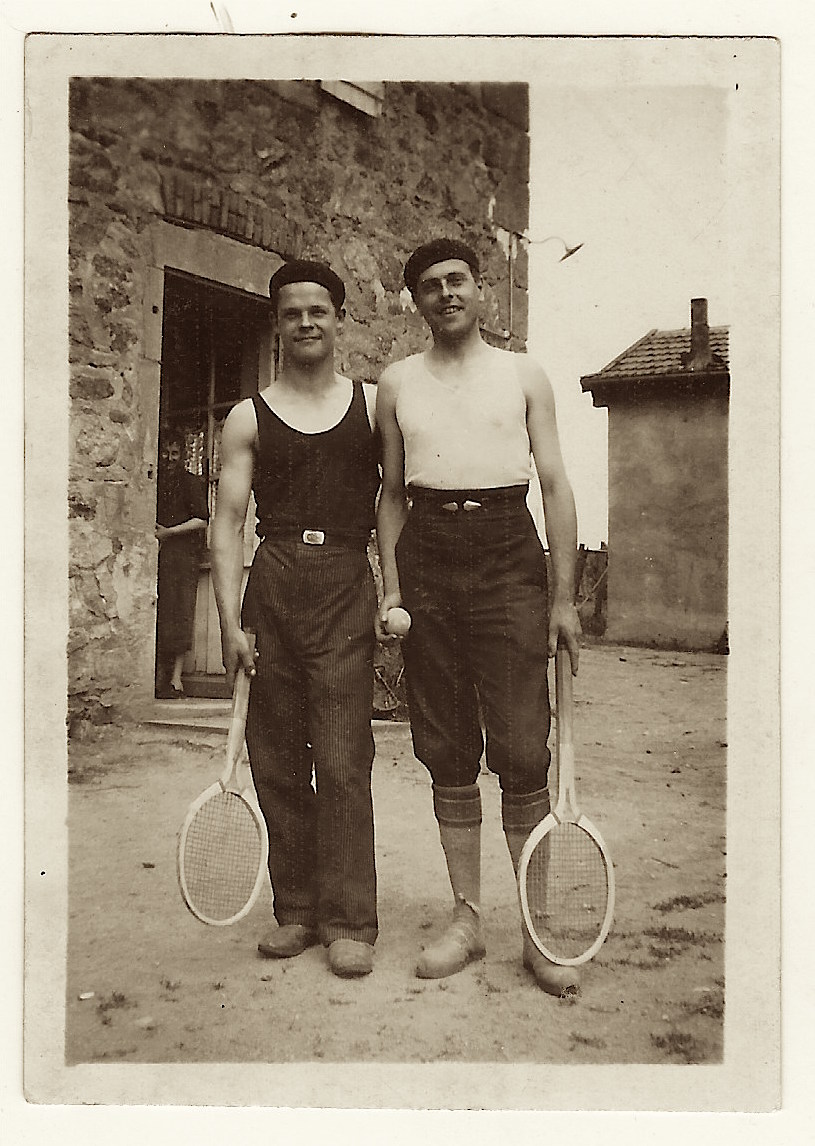
This vintage photograph features two athletic and handsome men posing with tennis gear. They are holding racquets and one of them is grasping a tennis ball. These guys look like they exercise regularly. Judging by their smiles, they seem to be very happy. SOLD
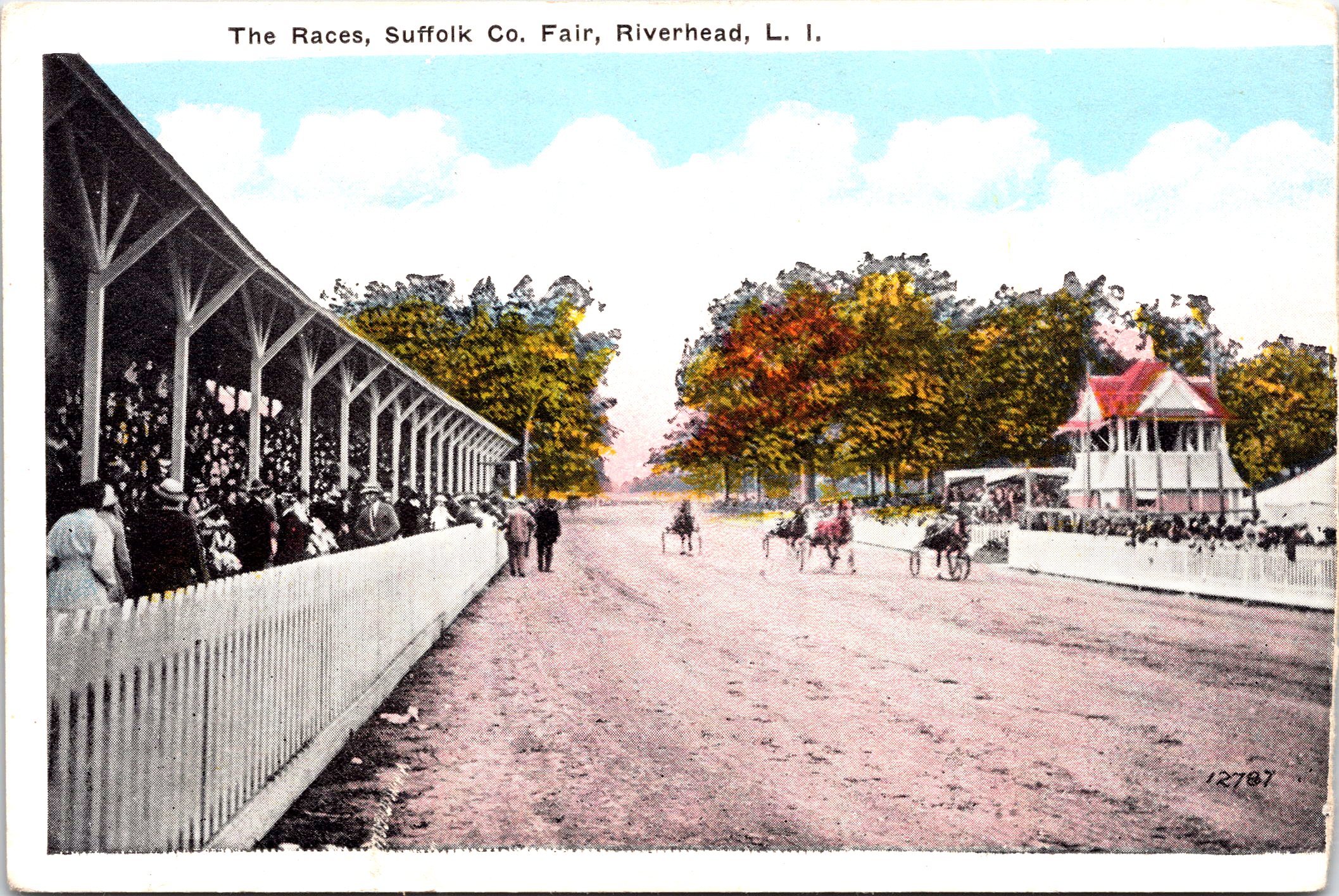
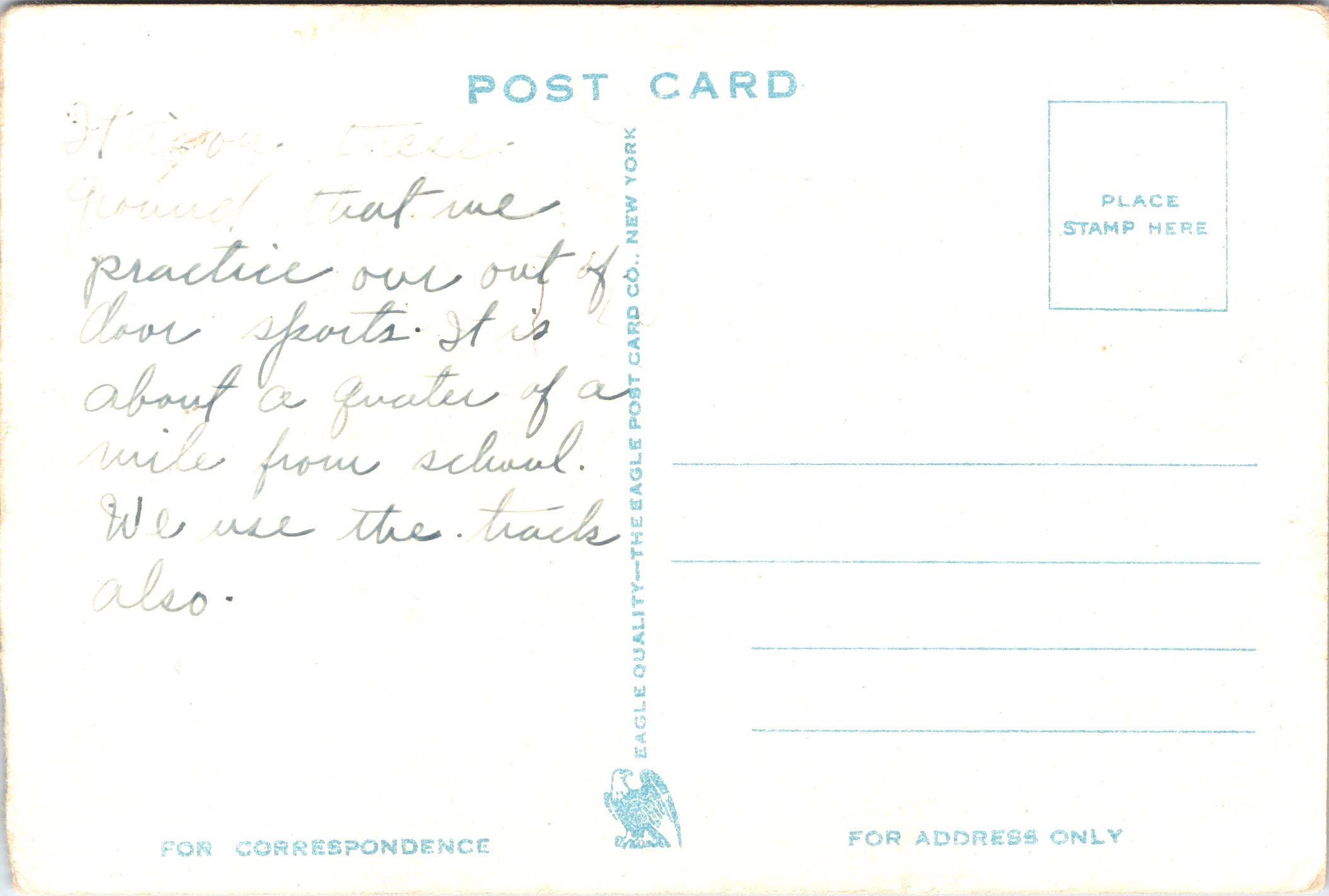
This vintage colorized postcard captures a lively scene at the Suffolk County Fair Grounds in Riverhead, New York, during the early 1900s. The image shows harness racing in progress, with several sulky drivers and their horses trotting down the dirt track. A covered grandstand filled with spectators lines the left side of the view, while on the right a tall judges’ or announcer’s stand rises above the crowd beneath autumn-colored trees. The postcard vividly conveys the excitement of fair-time races and the bustling atmosphere of an agricultural fair. On the reverse, the card is published by the Eagle Post Card Company of New York. A handwritten message reads: “It is on these grounds that we practice our out of door sports. It is about a quarter of a mile from school. We use the tracks also.” This personal note suggests that the track and fairgrounds were used for more than public events—they were also a community resource. The Suffolk County Fair was a major institution on Long Island for nearly a century. The Suffolk County Agricultural Society began holding fairs in the 1840s, and in 1867 Riverhead citizens purchased and donated 20 acres to establish permanent fairgrounds, which opened the following year. The fair showcased livestock, poultry, produce, and machinery, and it quickly became known for its popular horse and bicycle races. The site grew to prominence, hosting events such as political rallies—Theodore Roosevelt campaigned there—and even sporting spectacles; Babe Ruth is said to have played baseball on the grounds in 1923. The fair operated annually through the 1930s, until the land was sold to the Riverhead School District between 1934 and 1936. The grandstand and racetrack, however, lived on in postcards like this one, which now serve as visual records of an important part of Suffolk County’s history. SOLD
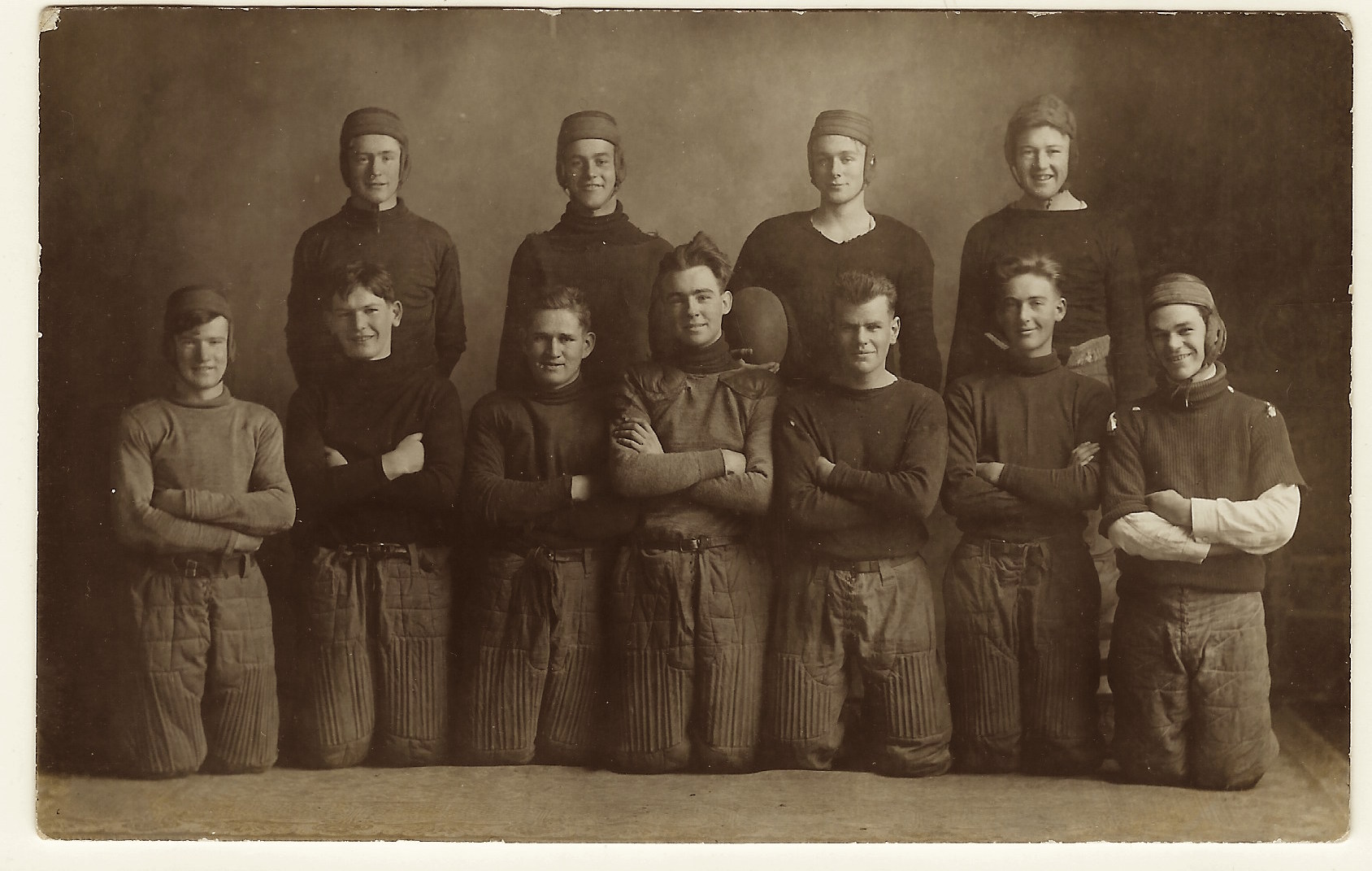
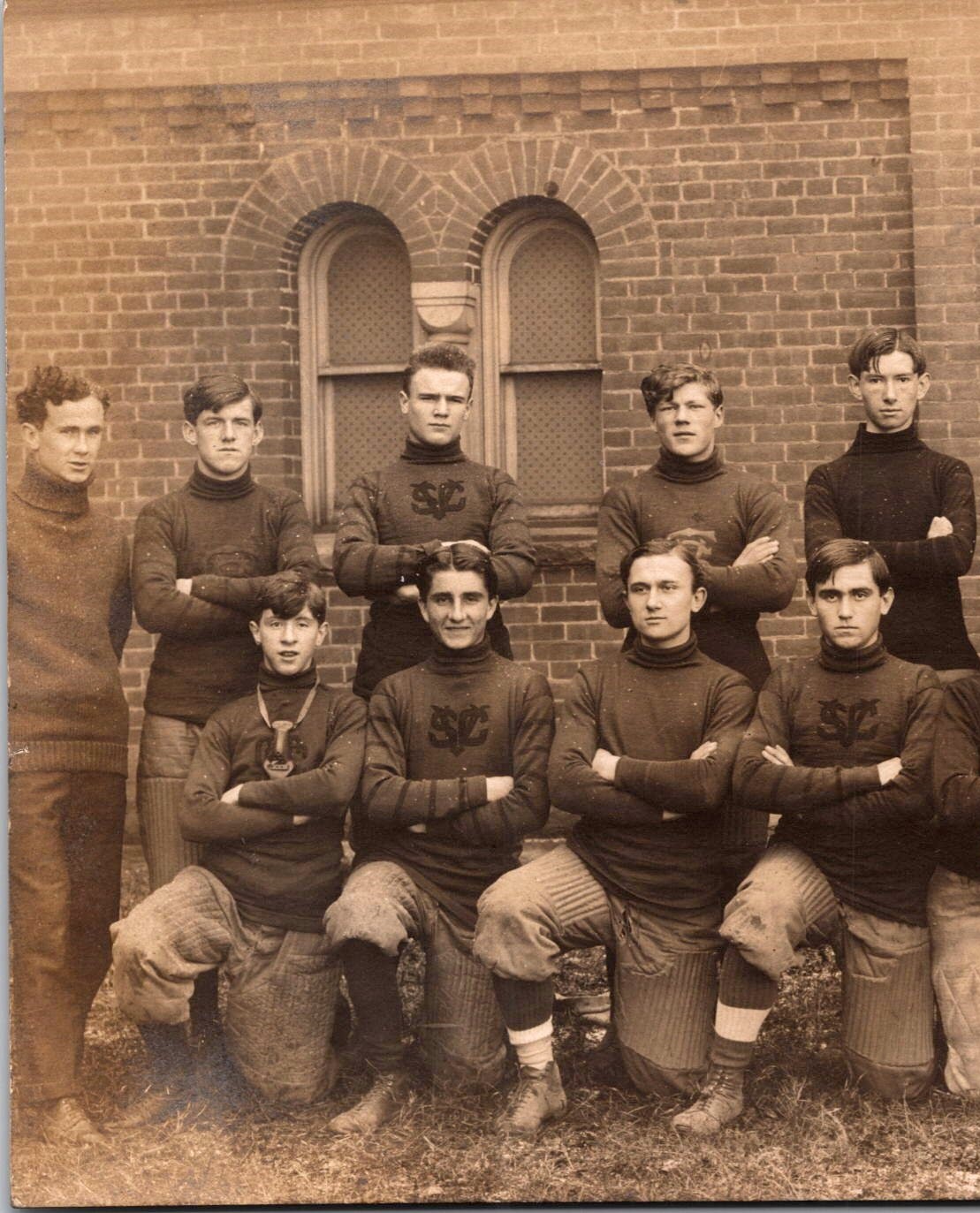
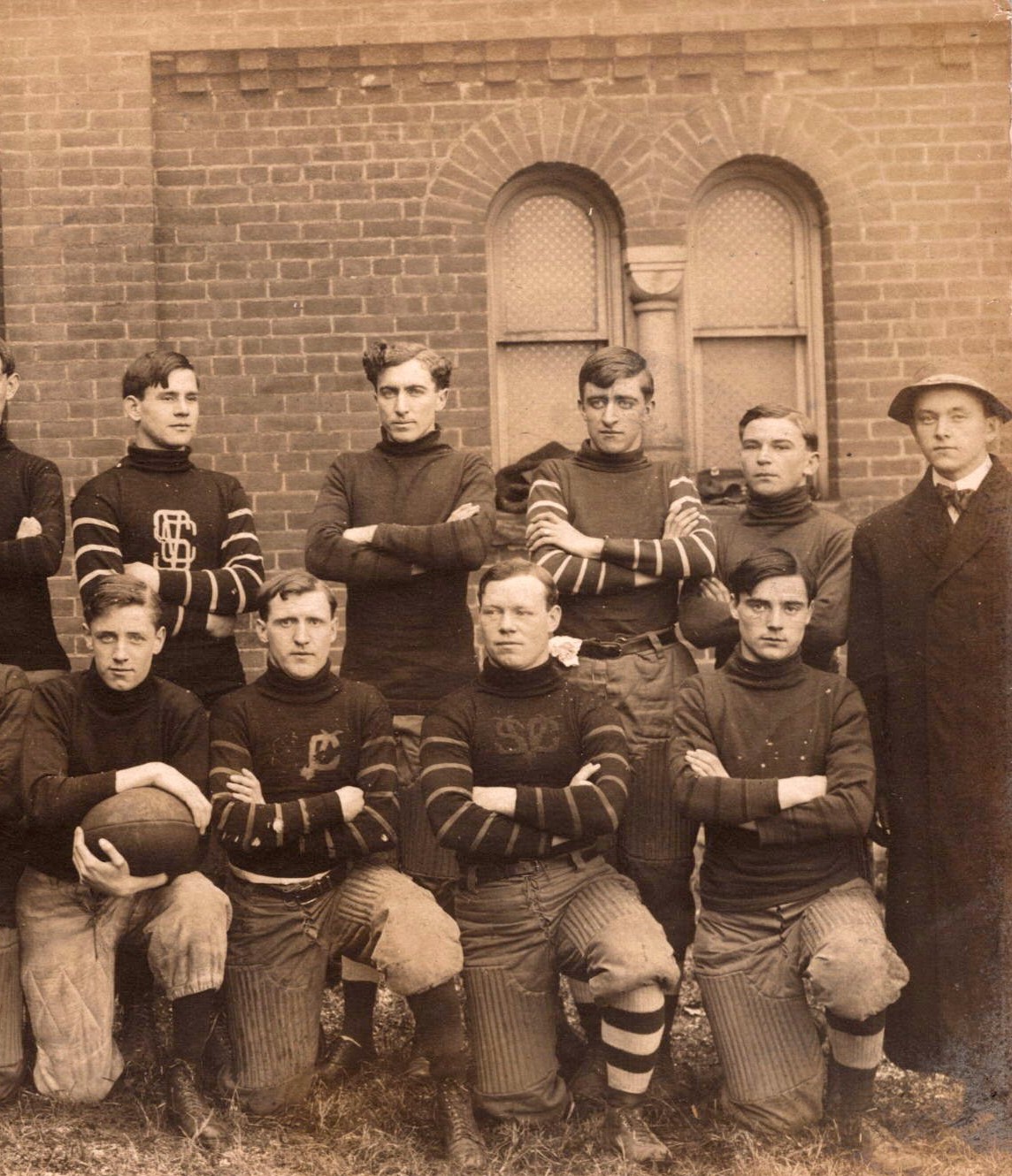
This vintage real photo postcard features a portrait of a football team. These eleven heroes of the gridiron are wearing their uniforms for this group photograph. Six of the young men are wearing their helmets. Unfortunately, these thin leather helmets didn’t offer much protection against concussions or Chronic Traumatic Encephalopathy (CTE). At first glance, I thought this team may actually be a rugby team. I based my impression on the odd shape and size of the football. The ball looked more like a rugby ball than a football. A little investigating revealed that today’s football has evolved over time. Basically, footballs have gone from round, to watermelon shaped, to today’s shaped football. The modern football became commonly used in 1935. In 1869 (first collegiate football game), the ball used was round, resembling a soccer ball. In 1874, a rugby-type ball was introduced. Shaped like a watermelon, it was as difficult to throw as the round ball. In 1912, an oversized version of today’s football was introduced. This football gave the quarterback more control of the ball when passing. The football in this photo postcard appears to be the rugby style ball, and that is compatible with the AZO stamp box which indicates that this portrait was taken between 1904 and 1918. The players and their team are unidentified. SOLD
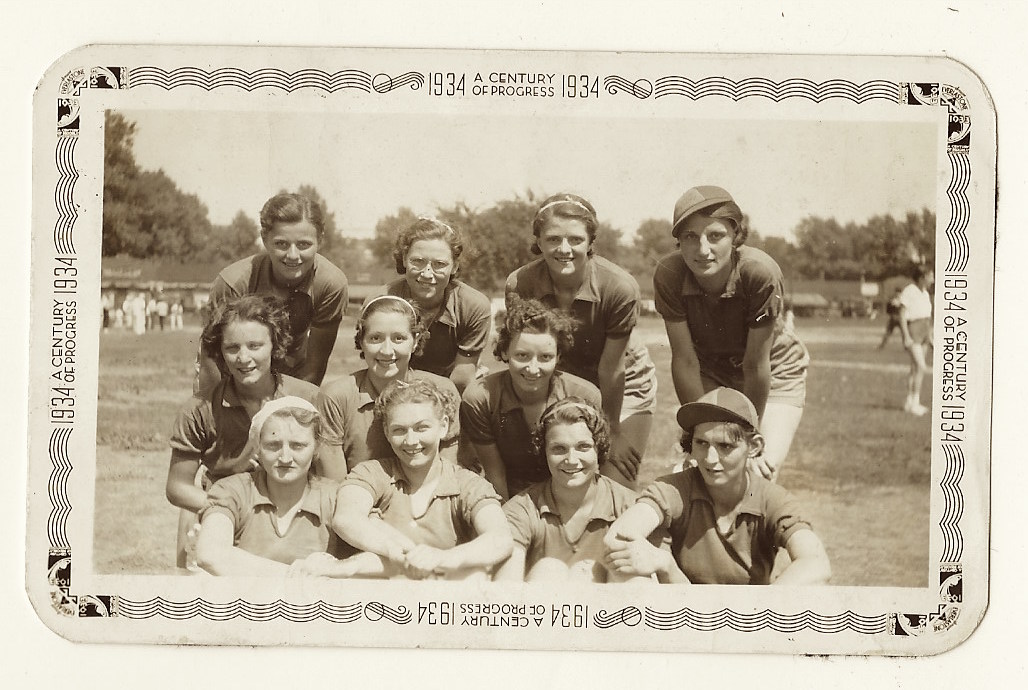
This vintage photograph features a women’s softball team. Judging by their smiles, the ladies were in a happy mood at the time this photograph was taken. The image was produced in the year 1934 which the text on the photo indicates celebrates “a century of progress”. Two of the players are wearing baseball caps but no baseball equipment or team logo is visible in the photograph. At that time in softball history, many leagues required the players not to use gloves. It is also notable that this team photo includes eleven players rather than the expected baseball nine. Women’s softball teams of that era employed ten players on the field with the tenth player occupying the position of short centerfield. Perhaps the eleventh player in the photo is the coach/manager or possibly a substitute. It is also interesting to note that “A Century of Progress” was the slogan for the 1933 World’s Fair.The exposition was held along the lakefront of Chicago, Illinois. The fair was operated from June 1-November 1, 1933, and May 26-October 31, 1934. It is a safe assumption that this image was taken at the Chicago Worlds Fair grounds. Softball was one of the few team sports available to women during the 1930’s, 1940’s,and 1950’s. During the 1930’s, softball was a very popular sport around the United States. In 1933 the newly established Amateur Softball Association sponsored the first national fast pitch softball tournament for women. The association tied the tournament to the Chicago Worlds Fair. In the initial competition, eight women’s teams competed against each other. It is worth mentioning that some sources report that the games were actually sponsored by a duo comprised of a sports writer and a sporting goods salesman. This wonderful memento of softball history measures 3″ x 4 3/4″ and based on the black paper residue on it’s reverse, once found it’s home in someone’s photo album. SOLD
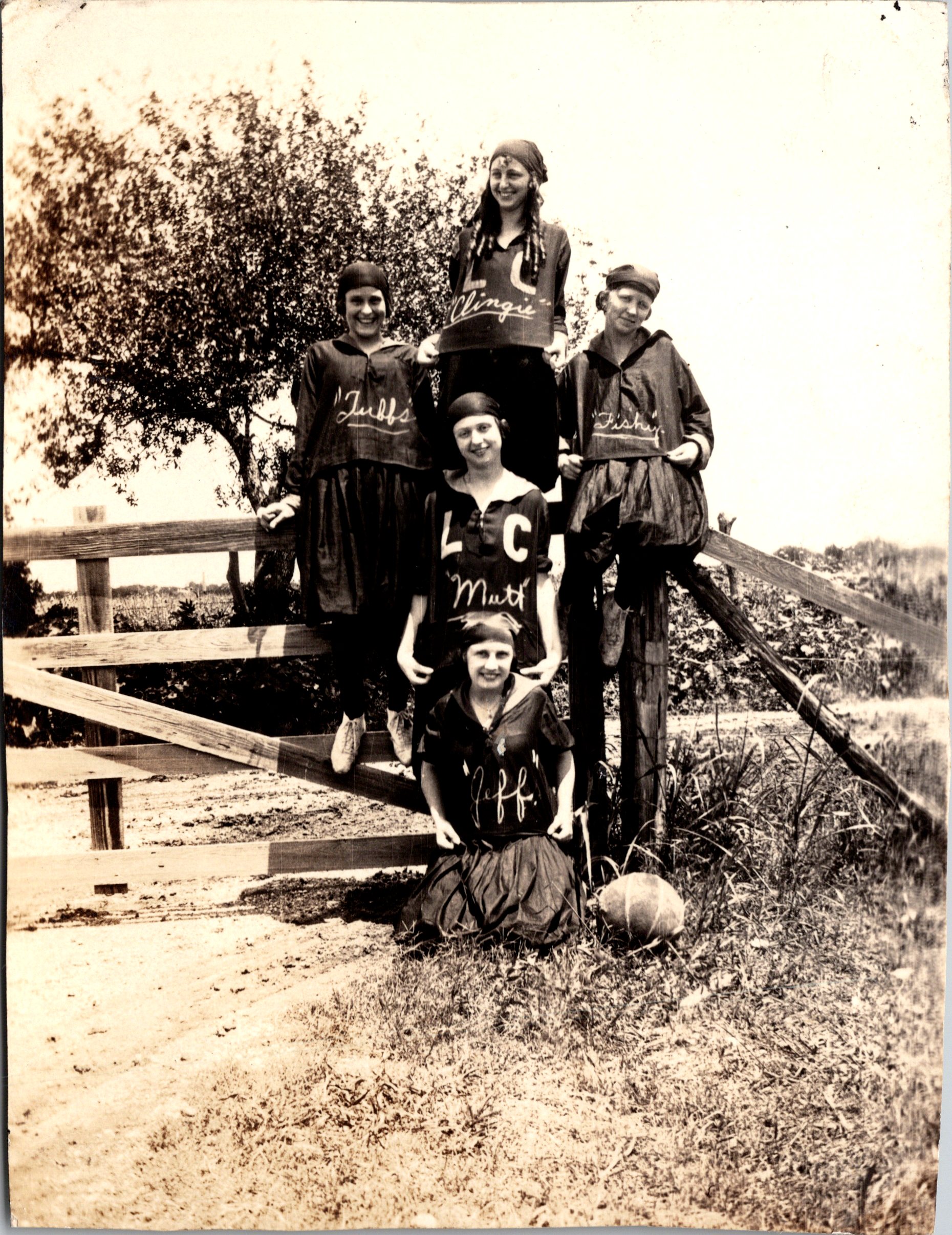
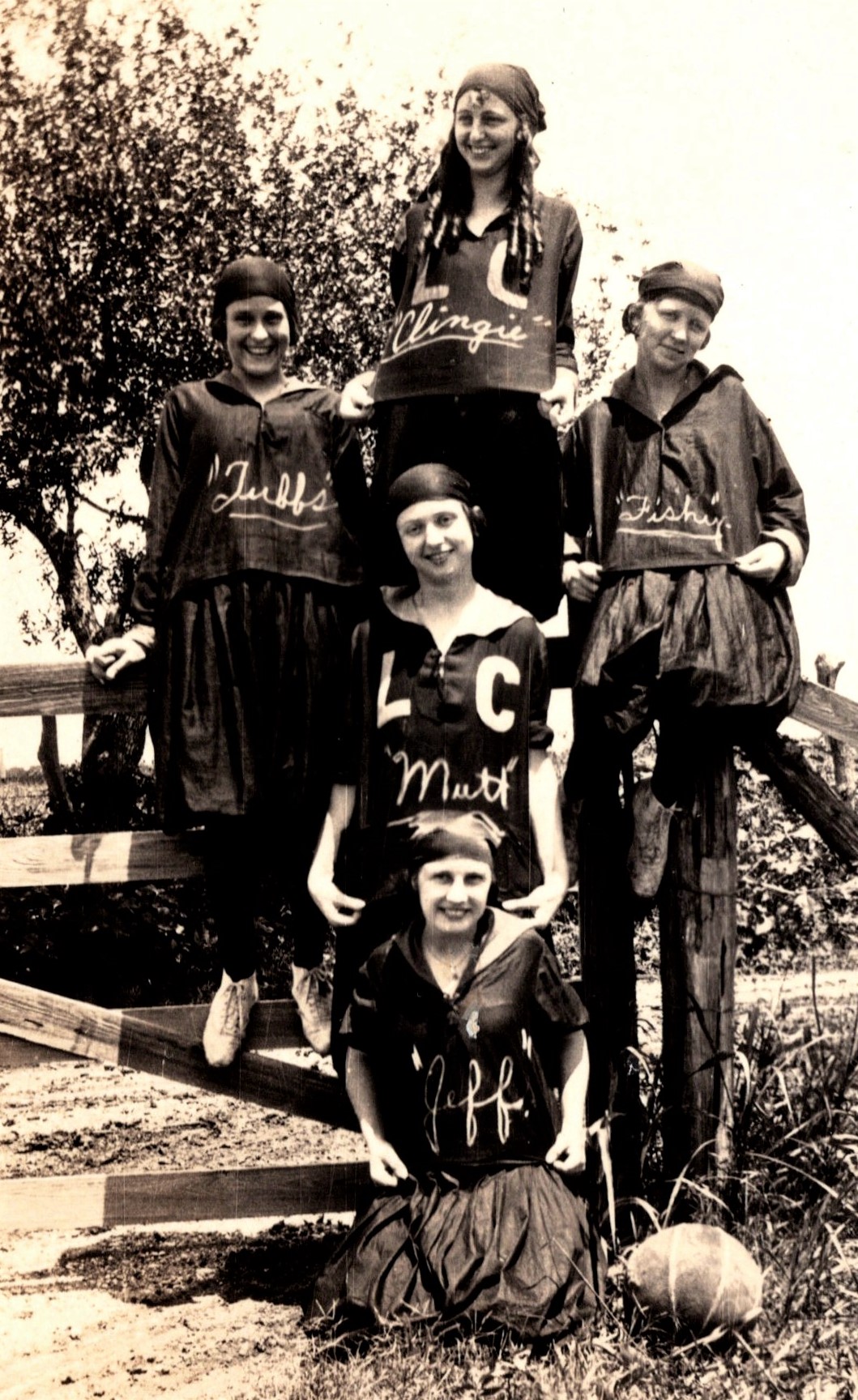
This vintage real photo postcard features the women’s basketball team from Lutheran College. There were, and are, many Lutheran Colleges in the United States and it is unclear which campus these girls attended. The girls seen on this postcard are charming. The five team members seen in this image are all wearing shirts that bear their nicknames. The girls monikers are Mutt and Jeff, Fishy, Clingie, and regrettably, Tubbs. I am unsure of the veracity of Tubbs because the handwriting is difficult to decipher. Note the basketball on the ground in front of the girls. This postcard has been trimmed. SOLD
This vintage lithographic postcard features “War Glory”, a famous thoroughbred stallion race horse. The horse was born in 1930 and was the son of the very famous race horse named “Man o War”. War Glory ran in 59 races and had 11 wins,12 places, and 8 shows. In other words, the horse was highly successful. This postcard was published by Standard Arts (Berkeley, California) and was part of a series (H-2). SOLD
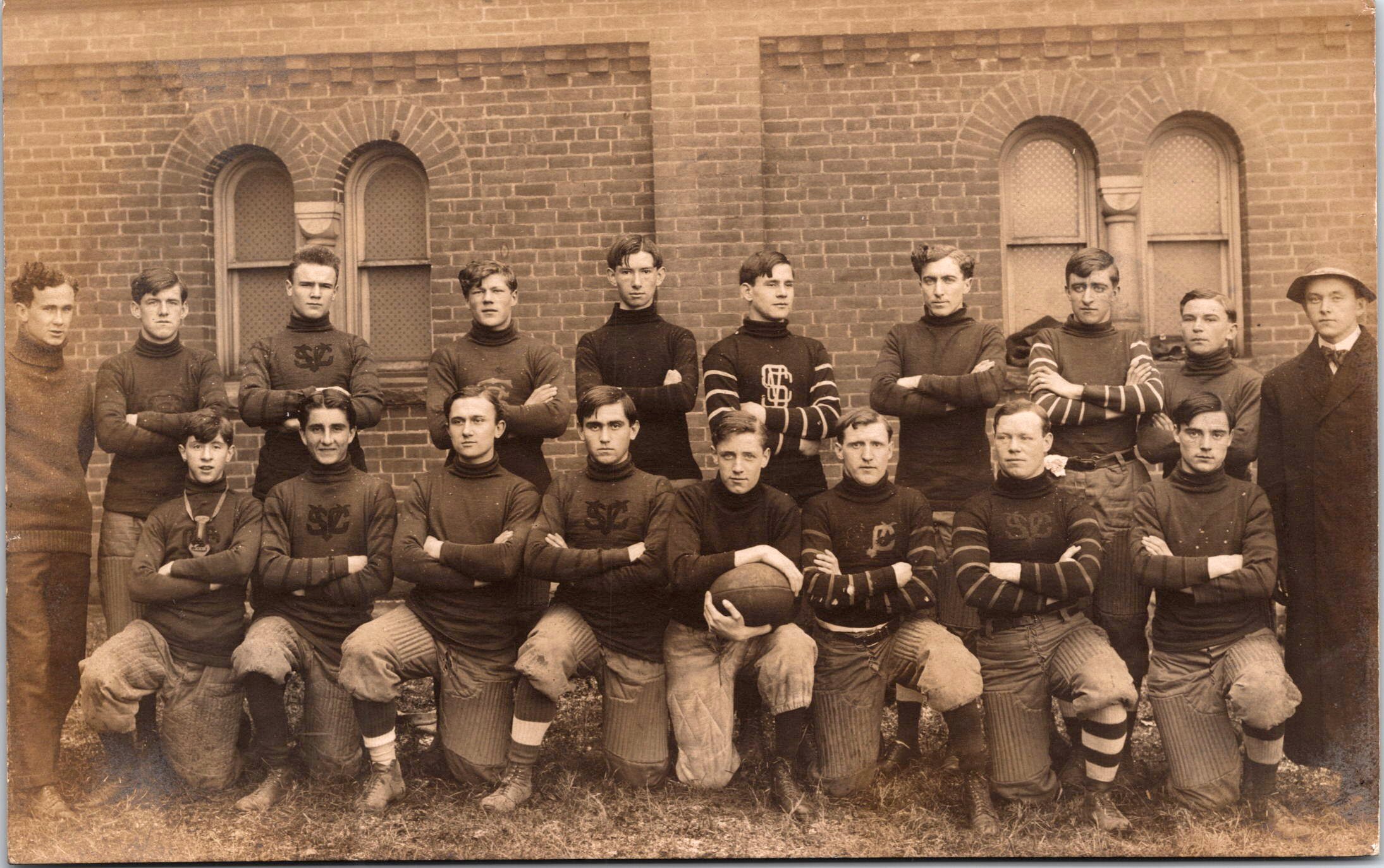
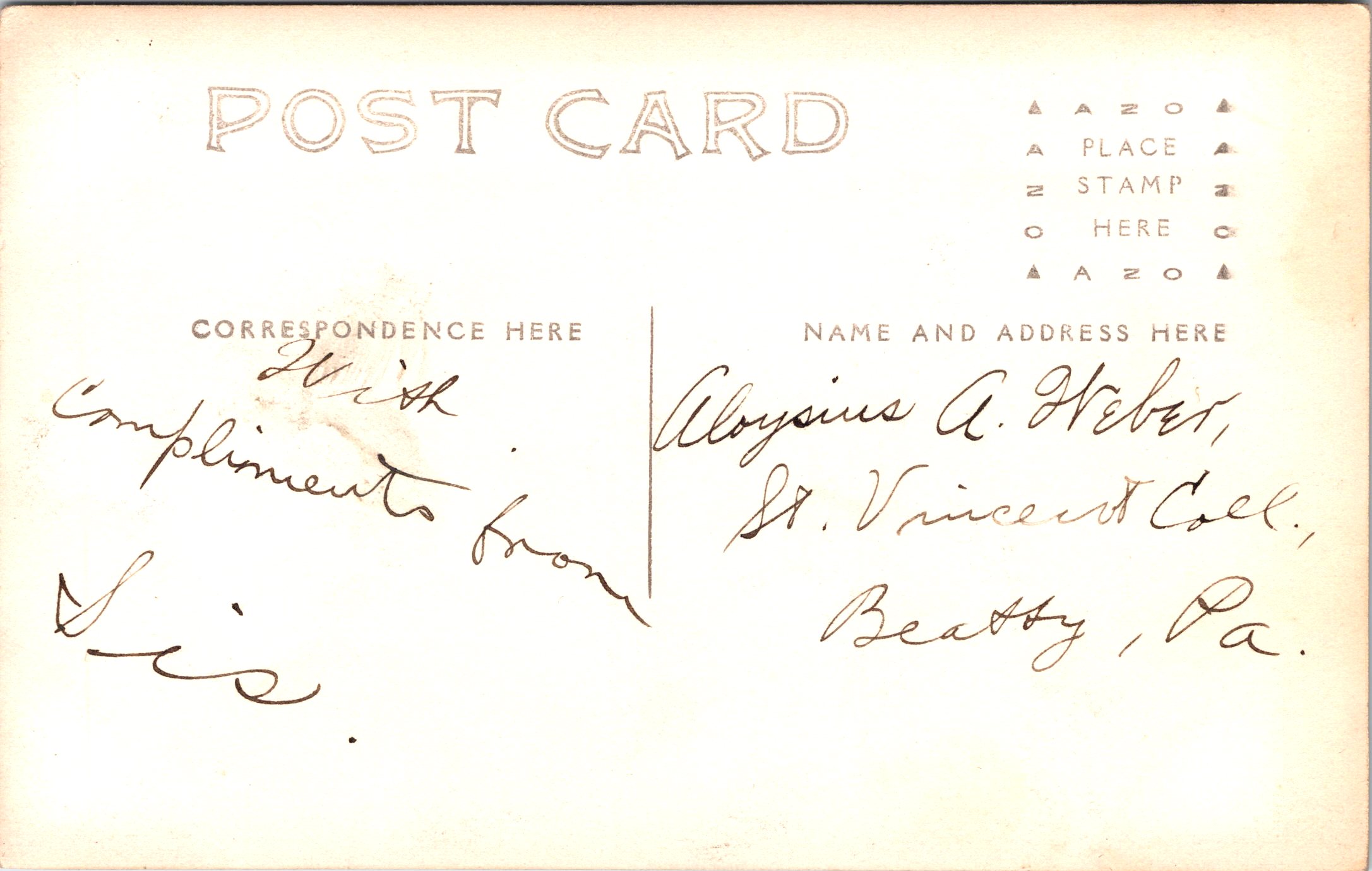
This vintage real photo postcard features the St. Vincent’s College Rugby Team. The players are dressed in their uniforms. The boys are beautifully posed for their team photo. St. Vincent College is a private Benedictine college in Latrobe, Pennsylvania. The school was founded in 1846, In regard to sports, one of the college’s claims to fame is that since 1966, the campus has served as the training camp host for the Pittsburgh Steelers. The AZO stamp box on the reverse of this postcard indicates that the card was published sometime between 1904 and 1918. SOLD
This vintage real photo postcard (Postcard 1) features a portrait of beautiful stage and film actress, and businesswoman, Maxine Elliott (1868-1940). Her photograph was taken by celebrity photographer Benjamin Falk at his New York City studio. Elliott was more than a stage actress. She managed her own theater and experimented with silent films in the 1910’s. Elliott was an extremely popular actress. Apparently she was popular with the men too. It is thought that she had affairs with famous people including King Edward VII and J. P. Morgan. It is also reported that she dated baseball hall of famer, John Montgomery Ward and heavyweight champion Gentleman James Corbett. During World War I she was very involved with the cause for Belgian relief. Elliott was born in Rockland, Maine. Her father was a sea captain. She had at least three siblings including her sister Gertrude Elliott, who also became a successful actress. When Maxine was 15, she was seduced and impregnated by a 25 year-old man. She may or may not have married the man but it is known that she lost the baby. In 1890 she made her first stage appearance. Her big break came in 1895 when she was hired by Augustin Daly to be the supporting actress for the highly acclaimed actress, Ada Rehan. In 1898, after divorcing husband number one, she married comedian Nat C. Goodwin. The two starred together in a number of productions including “Nathan Hale” and “The Cowboy and the Lady”. In 1903, Maxine appeared in the Broadway production of “Her Own Way” (1903). The play launched Maxine into stardom. In 1905, the play went to London where King Edward VII requested an introduction to the pretty actress. They met and then rumors started about the pair having an intimate relationship. In 1908, Goodwin obtained a divorce from Elliott. This is about the time she met 70 year-old J. P. Morgan. They became friends and rumors of their romantic involvement were never confirmed. Financial advice from Morgan helped her become a wealthy woman. The same year as her divorce, she opened her own theater, “The Maxine Elliott” in New York City. She was both the owner and the manager. In fact, she was the only woman in the US, at the time, managing her own theater. In regard to acting on Broadway, Elliott had an extensive resume. She appeared in 22 Broadway productions between 1894 and 1920. In 1913, she began acting in silent films. The IMDb reports that she was in five films including “From Dusk to Dawn” (1913), “Fighting Odds” (1917), and “The Eternal Magdalene” (1919). In 1913, Elliott went to England and started dating tennis star Anthony Wilding, fifteen years her junior. According to one source, the pair planned to marry, but he was killed in action in World War I. As a result, Elliott became obsessed with the war and moved to Belgium where she volunteered her money and time toward Belgian relief. It is reported that she also nursed wounded soldiers. Belgium recognized her by awarding her the Belgian Order of the Crown. Elliott retired from the stage in 1920. She stated that she “wished to grow middle-aged gracefully”. This postcard portrait features a young and beautiful Maxine Elliott. This image is a beautiful remnant of turn of the century theater history. This postcard was published by the Rotograph Company which was based in New York City. The postcard is part of a series (No.B888). SOLD
Postcard 2 features a photograph taken by female celebrity photographer, Lizzie Caswall Smith. Lizzie Caswall Smith (1870-1958) was a British photographer who operated in the early 1900’s. She specialized in photographing members of society and celebrities. Many of her photographs were used for postcards. She was involved in the Women’s Suffrage movement and photographed many of the leading suffragettes. She also photographed many actors including Billie Burke and Maude Fealy. She operated the Gainsborough Studio from 1907 through 1920 (309 Oxford Street) and moved to a new location (90 Great Russell Street) where she remained until she retired in 1930 at the age of 60 years-old. Her most famous photograph is a portrait of Florence Nightingale taken in 1910. It was auctioned in 1908 and sold for 5500 pounds which is an equivalent today of nearly 8,000 dollars. The National Portrait Gallery has 84 portraits associated with Lizzie Caswall Smith. This postcard was published by the Rotograph Company which was based in New York City. The postcard is part of a series (No.B636). SOLD
Postcard 3 features a nice portrait of Maxine Elliott. This image, taken by William Morrison (Chicago, Illinois) is a beautiful remnant of turn of the century theater history. This postcard was published by the Rotograph Company, which was based in New York City. The postcard is part of a series (No.B636). (SOLD)
Postcard 4 features Miss Elliott’s portrait by Ernest Walter Histed (1862-1947). Histed was born in England but achieved his success as a photographer in Chicago, and later, in Pittsburgh. He then returned to England and opened a photography studio there. His subjects there included Clara Butt (Opera Star) Pope Pius X, and the Empress of Germany. Histed returned to the US and opened a studio on Fifth Avenue in New York City. He later moved to Palm Beach, Florida and continued his profession until 1934. The Museum of the City of New York has a large collection of his work. The National Portrait Gallery (England) has 32 of his photographs in their collection. This postcard was published by London’s J. Beagles & Co. as part of a series (No. G386).The company was started by John Beagles (1844-1909). The company produced a variety of postcards including an extensive catalog of celebrity (stage and screen) portrait postcards. After Beagle’s death, the business continued as J. Beagles & Co. until it closed in 1939. (SOLD)
Postcard 5 comes from the studio of celebrity photographer, William McKenzie Morrison of Chicago, Illinois. Morrison’s studio was in the Haymarket theater building. This postcard was published by the Rotograph Company which was based in New York City. The postcard is part of a series (No.B658). (SOLD)
Postcard 6 features a pretty portrait of Miss Elliott taken by R. W. Thomas. It is likely that he is the same man that authored “The Modern Practice of Photography” (1927).This postcard was published by London’s Davidson Bros. as part of a series (No.1200). The message from the sender of this card introduced me to a new word. The writer asks “Isn’t this a beauteous maiden?”. I looked up the word “beauteous” to see if it existed. I learned that the word exists and means “beautiful”. I also learned that “Beauteous” is a word that is customarily used in literature and not conversation. (SOLD)
Postcard 7 Elliott photrographed in costume for her role as Gipsy in “Under the Greenwood Tree”. Her photograph was taken by famed celebrity female photographer, Lizzie Caswall Smith. This image is a beautiful remnant of turn of the century theater history. This postcard was published by Rotary Photo as part of a series (No.187E). (SOLD)
Postcard 8 was published by London’s Ralph Dunn & Co. as part of a series (No. A342). (SOLD)
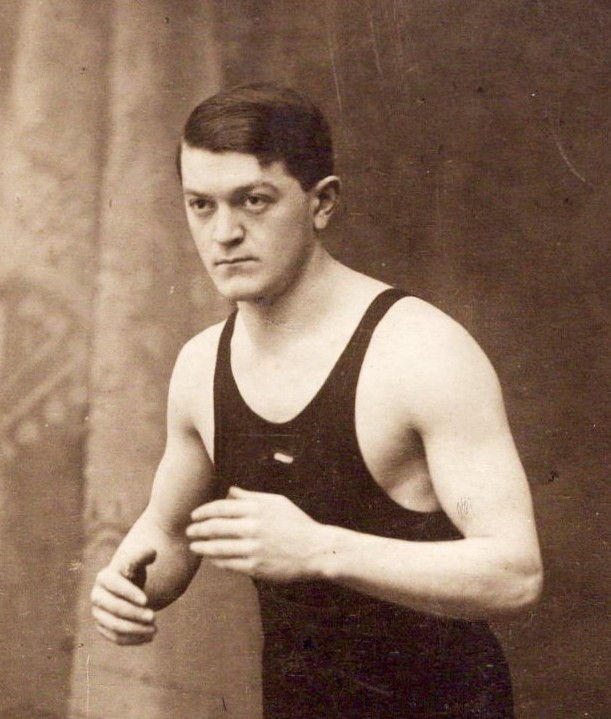
This vintage real photo postcard features a beefcake portrait of a handsome and athletic looking man. He is wearing gym clothing and has a competition medal hanging around his neck. It is not evident what sport he competed in. Possibilities include track, wrestling, gymnastics, and weight lifting. It is likely, but not certain, that this postcard was published by Alberto Traldi. SOLD
This uncommon vintage real photo postcard features a shirtless body builder named Mstr. Merino. The caption on the postcard states “Mstr. Merino, Muscle & Strength Phenomenon”. The body builder’s muscles have muscles. Note his right bicept. It appears that he has barbed wire looped around his right upper arm. Merino has something wrapped around his wrists. The wraps purpose is unknown to me. This postcard was published by Ernst Schneider & Company. The firm was located in Lubeck, Germany and was known for publishing a collection of postcards with portraits of male and female impersonators and cross dressers. These cards were produced between 1900 and 1930. SOLD