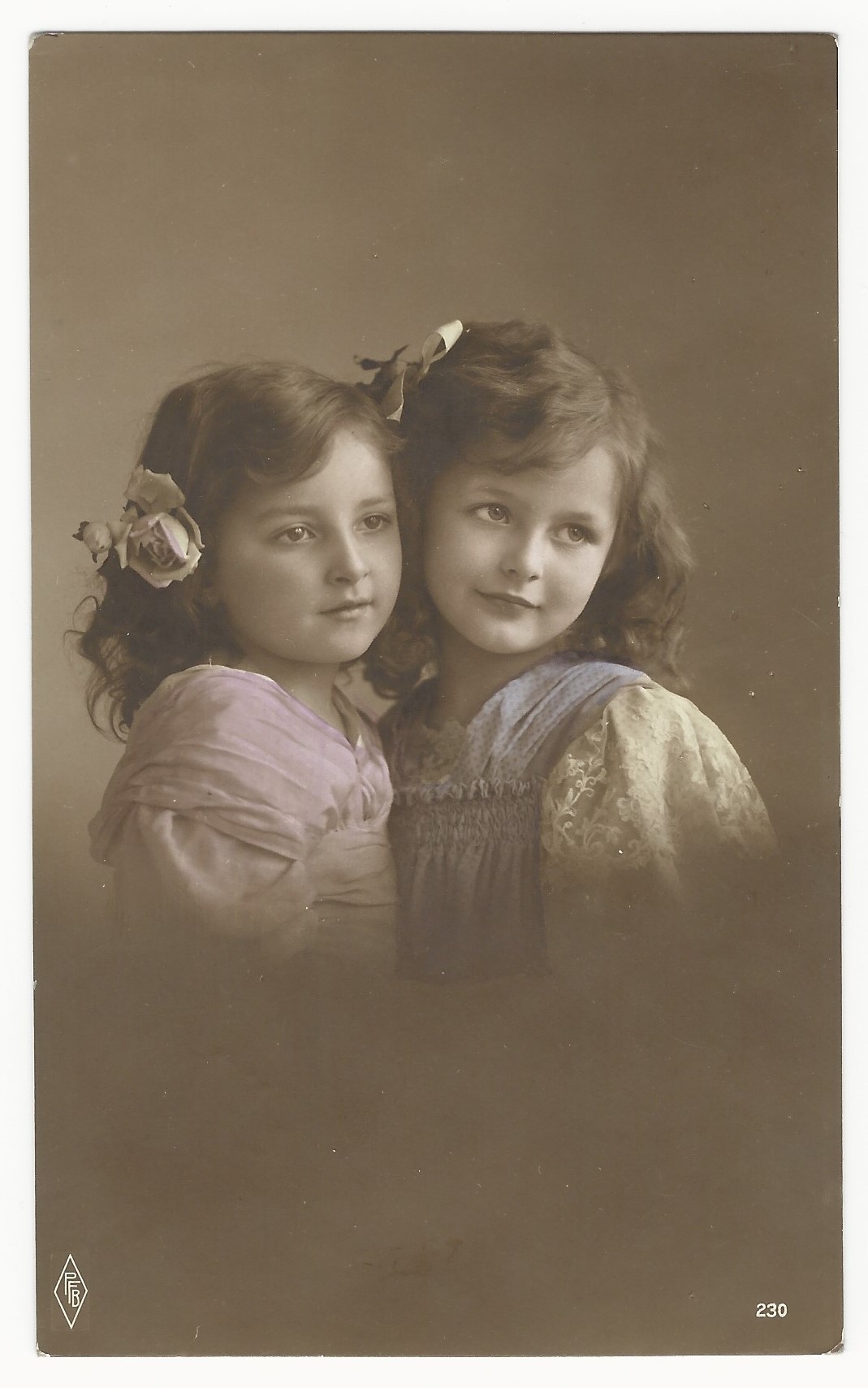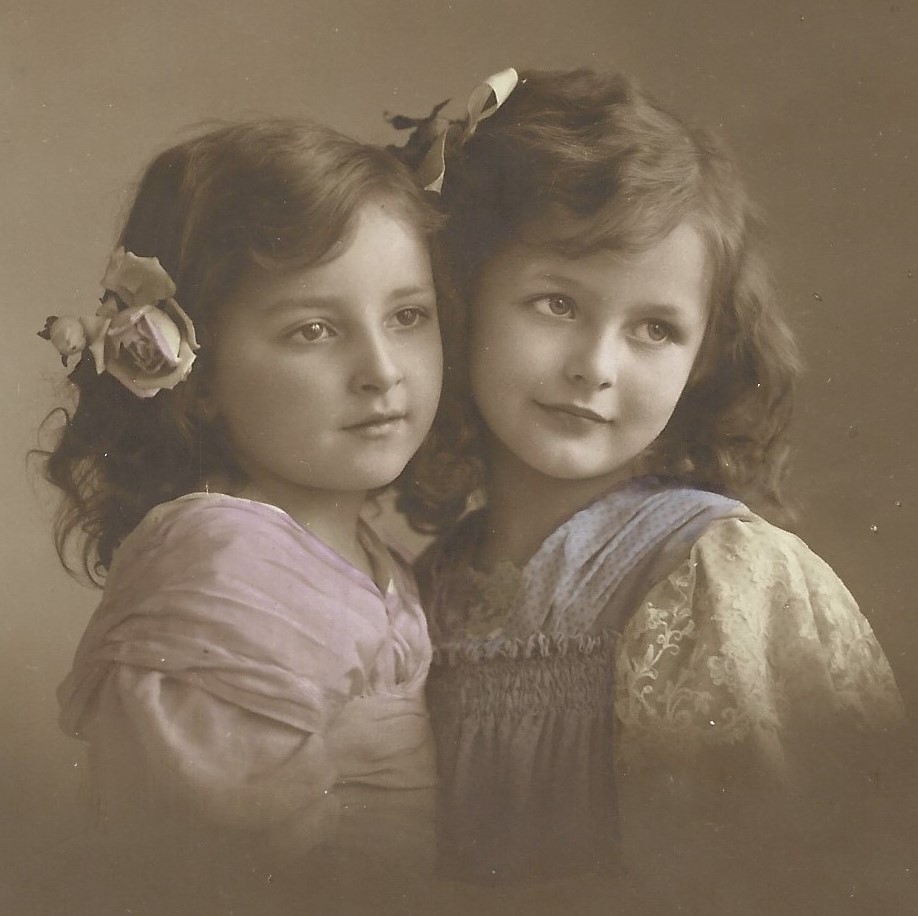
Two lovely young women pose next to an open picture book which is sitting atop a stool-like table. The woman are nearly identically dressed. Their style of fashion is conservative. Their heads are close to each other and tilted toward each other. This pose suggests that there is some intimacy between them. Perhaps they are sisters. The photographer of this image is W. Gerlich and some of his photography medals are exhibited at the bottom front of this photograph. The medals are from exhibits held in 1900 and 1901 and this image likely was produced shortly after that time. An inscription on the reverse of the photograph indicates that the photo is from 1905. W. Gerlich conducted his photography business in “Neu Ruppin”, which was a Prussian town in Brandenburg, Germany. The studio was located on a street named for “Paradeplatz”, or Parade Square, which was located in downtown Zurich, Switzerland. This cabinet card photograph measures about 8″ x 4″. (SOLD)


Two young women pose for their portrait in Newport, Pennsylvania. Both women are grasping one end of a fan that they hold behind their heads. Their raised arms highlight their hour glass figures which are given an assist by the corsets they are wearing. The photographer is named William Easter Lenney. He was located in Newport in the early 1890’s and moved to Atlanta, Georgia where he became a well known portrait photographer between 1894 and 1920. He and his family then moved to California. (SOLD)

A uniformed chauffeur leans against his “woodie” station wagon. Peering out the window is a young woman, possibly, a teenager. An inscription on the reverse of the photo indicates that this snapshot was taken in 1948. The pictured automobile is called a woodie because part of the rear body is made of wood or material that resembles wood. Woodies were popular in the United States in the 1930’s and 40’s. The wagons were made as versions of sedans as well as station wagons. Some were basic and some of these autos were luxury vehicles. Generally, they were manufactured by third party conversion companies. The last year of production of real wood construction in American station wagons was 1953. From then on, only faux wood was used. The uniformed driver and the thatched roof on the brick building may offer a hint of where this snapshot photo was taken. The previous owner of this image suggested that the photo was taken somewhere in Africa. This snapshot photograph measures about 3 1/2″ x 2 3/8″. SOLD

This vintage real photo postcard features Russian actress Vera Vasilyevna Kholodnaya (1893-1919). Sometimes she is referred to as Holodnaja). She was the first star of Russian silent film. The number of films that she appeared in, is unknown. It is estimated the number of appearances is somewhere between fifty and one hundred. It is unfortunate that only five of her films survived the passage of time. She was born in Poltava which was part of the Russian Empire, and is now located in the Ukraine. At the age of two, she moved to Moscow to live with her grandmother. As a child, she fantasized about becoming a classical ballerina. She eventually enrolled in the Bolshoi Theatre ballet school From early childhood, she participated in family theater productions, While attending her school prom to celebrate her graduation she met Vladimir Kholodny, whom she married in 1910. He is known as one of Russia’s first race car drivers. The pair had two children. In 1908, after seeing actress Vera Komissarzhevskaya in a stage role, she decided that she wanted to pursue a career in films. She sought out Vladimir Gardin, a major Russian film director, and he gave her a minor role in Anna Karenina. In 1915, film director Yevgeni Bauer was searching for an actress who possessed great beauty. After meeting Vera Kholodnaya, he found the enchantress that he was looking for. Bauer’s film was a resounding success. He then made a second film starring Kholodnaya. These two Bauer films made Vera a major celebrity. She soon became known as “the Queen of Screen” and had great successes with other films. By 1918, she was a film phenom. When Russia entered World War I, her husband joined the military. She participated in charity concerts to support the soldiers and their families. It is reported that she was “worshipped” by soldiers. By the time of the Russian Revolution (1917), a new Kholodnaya film was released every three weeks and she continued to experience acclaim and success. Around this time, the actress moved with her film company to Odessa. She died there, at age 25, during the 1918 flu pandemic.This version of the flu, was known as the “Spanish Flu” and it infected 500 million people around the world between 1918 and 1920. Estimates are that between 50 and 100 million people died during the pandemic. (SOLD)
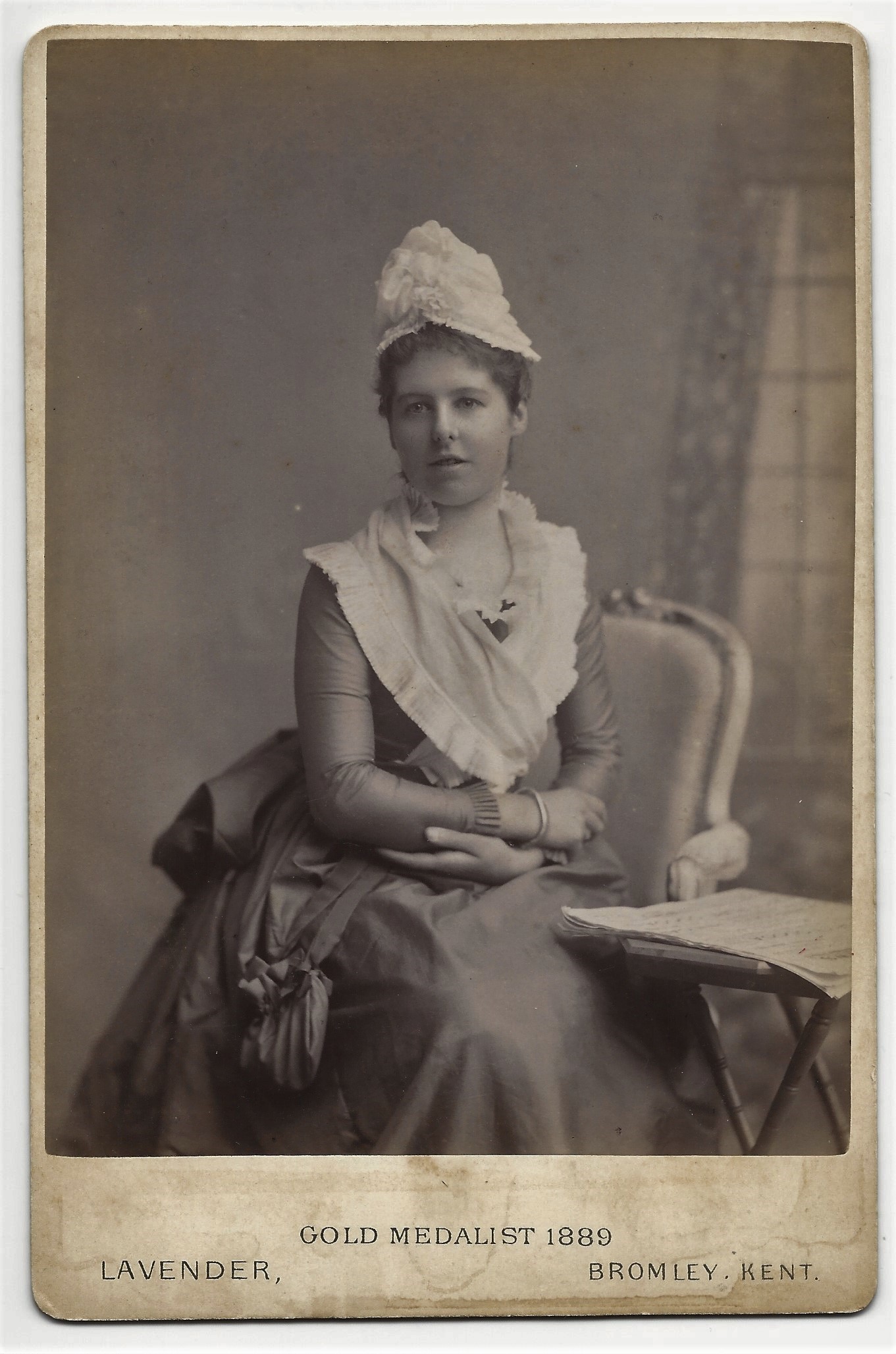
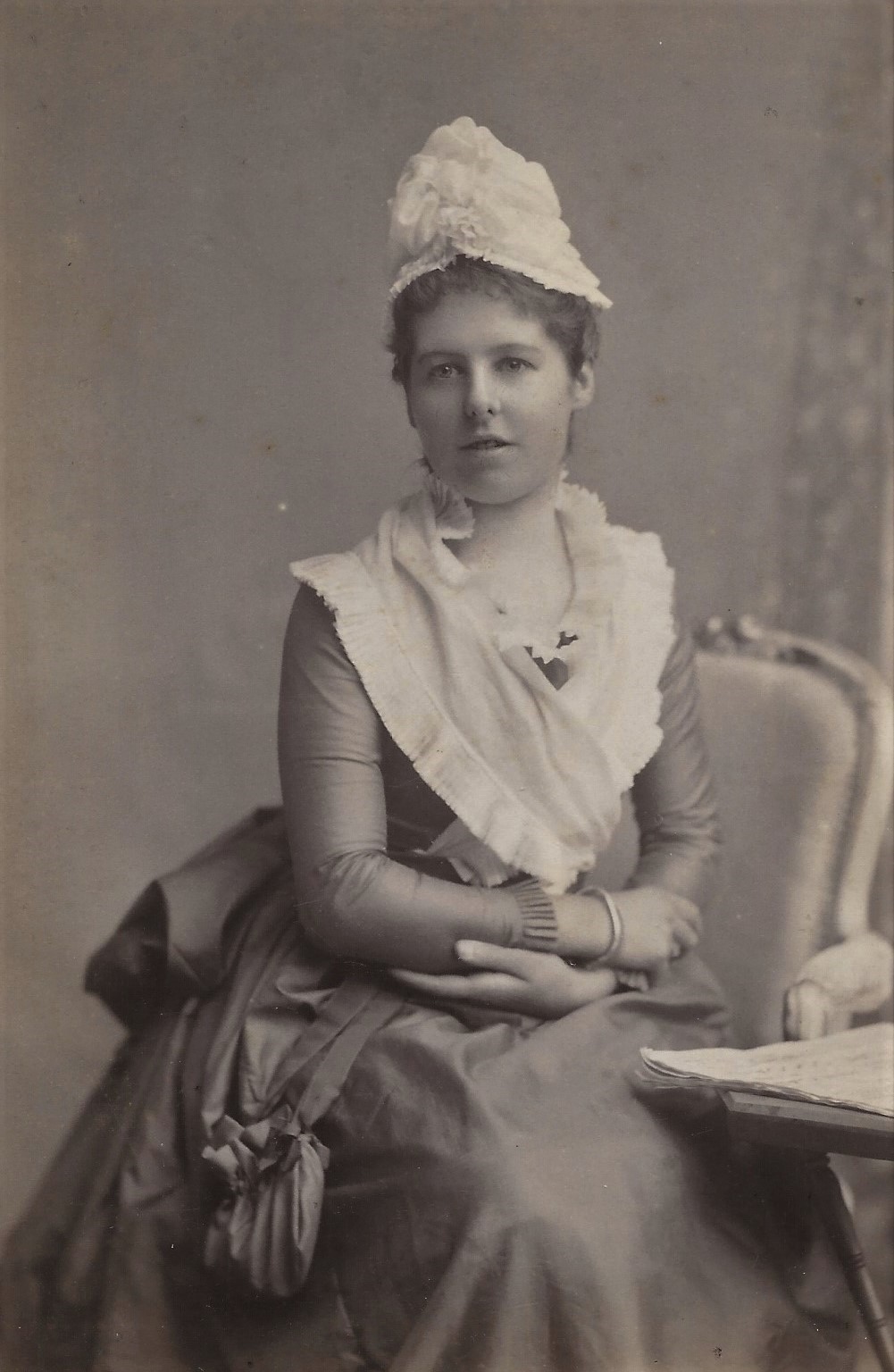
This vintage photograph features a young woman dressed in a dance costume. The previous owner of this image reported that the woman was a dance school student ,and that at the time of this photo, she was at a recital or a recital rehearsal. The student appears to have been in her teenage years. Her costume is unusual and interesting. Note her wide wristbands and striped cap. She may also be wearing a cape although her pose blocks an adequate view of that part of her costume. The subject of this photo is identified by an inscription on the reverse. Her name is Louise J. Howlan (1915-1970). Her father worked for a gas and electric company. At the age of 25, she worked as a stenographer. This photograph was taken by a Utica, New York studio. I am unable to decipher his name which can be found on the lower right hand corner of the image. The photo is from circa 1920’s. The photograph measures about 4 1/8″ x 6 1/4″. (SOLD)
PHOTOGRAPHERS NAME
This vintage postcard features a “Bedouin Beauty” with wonderful smile. Everything she is wearing is interesting. Her traditional dress, the flowers in her hair, and her necklace are all intriguing. This postcard offers some sexual provocativeness which was typically seen in ethnographic postcards from this era. It seems that if women from other cultures, or non white ethnicities, were photographed for postcards, than some nudity was acceptable. Western photographers, postcard publishers, and postcard consumers all appear to have been “suffering” from ethnocentrism. The woman in this photo, as stated earlier, is a Bedouin. Bedouins are a group of nomadic Arab people. Historically, they have inhabited the desert regions in the Arabian Peninsula, North Africa, Iraq, and the Levant. This image was produced by the team of Rudolf Franz Lehnert (1878-1948) & Ernst Heinrich Landrock (1878-1966). 
This action packed postcard features a rugby player getting past the defense and making a score (try). In rugby, a “try” earns moret points (5) than other type of scores. A “try” occurs when a player puts the ball down inside the opposing team’s designated area near the goal. This postcard was published by Raphael Tuck & Sons and is part of the “Oilette ” series (no. 1746). Oilette cards are copies of the work of commissioned artists. This postcard is part of a sub series entitled “Football Incidents”, and the card itself is captioned “A Try”. This rugby image was modeled after a black & white drawing by S. T. Dadd. The postcard was postmarked in 1907, but was issued in 1904. Raphael Tuck and his wife started their photography business in 1866 in London. Their store sold pictures, greeting cards, and in time, postcards. Their success came from the sale of postcards during the late 1890’s and early 1900’s. In the early 1900’s the firm conducted postcard competitions for collectors of Tuck postcards. These competitions offered cash prizes and they were very popular. The winner of one of these competitions had a collection consisting of over twenty-five thousand cards. Three of Tuck’s four sons participated in the business. The company was devastated by German bombing during World War II. In 1959 the company merged with two other printing companies. This postcard is in very condition (see scans).