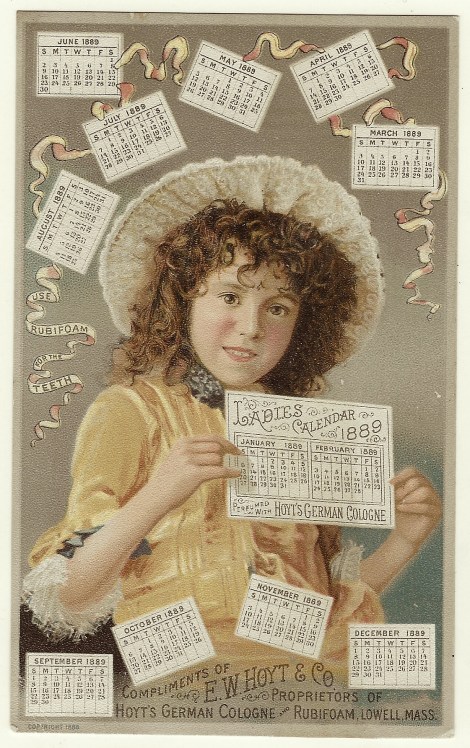
This vintage trade card was distributed as a premium by E. W. Hoyt & Co which was headquartered in Lowell, Massachusetts.The 1889 calendar was distributed as an advertisement for Hoyt’s German Cologne and Rubifoam (for the teeth). Hoyt’s cologne is billed as “The most fragrant and lasting of all perfumes”. In 1889, you could purchase a large bottle of the fragrance for just $1.00. Interestingly, this trade card calendar was scented with the cologne it advertised in order to serve as a sample. The year 1889 was a year full of interesting events in the United States. North Dakota, South Dakota, Washington, and Montana all became US states. Benjamin Harrison was sworn in as the 23rd President. The Johnstown flood killed more than 2200 people in Pennsylvania. The Wall Street Journal was first published. This trade card measures about 3 3/8″ x 5 3/4″. (SOLD)


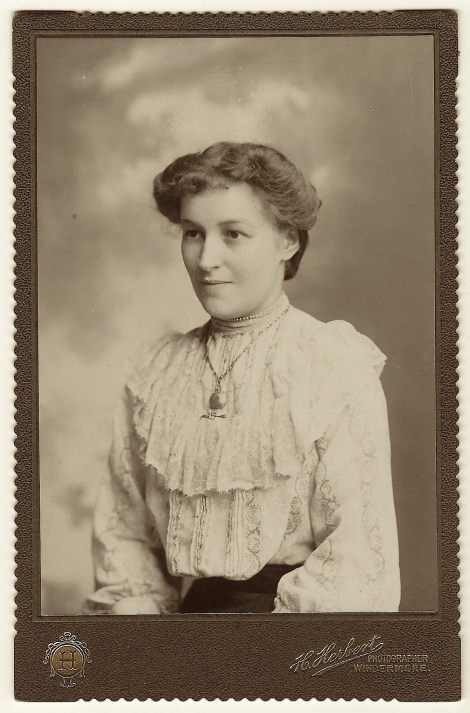 A young woman poses for her portrait at the Herbert studio in a town called Windermere. Where is Windermere. Thats a tough question. There are towns named Windermere in the United States, Australia, England, Canada, and the Bahamas. I am going to rule out the United States as being the home of the Herbert studio because of the regal type logo. The logo is more relevant to England or to a former or present English colony than to the United States. SOLD

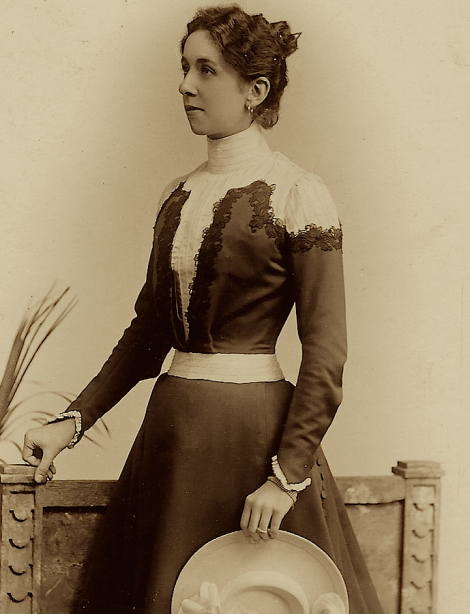 This Cabinet Card photograph features a pretty wasp waisted young woman. She is wearing a beautiful dress. She is quite elegant. This photograph was taken by Wilhelm Otto Jr at his studio in Vienna, Austria. Mr Otto is no stranger to the Cabinet Card Gallery. If you place his name in the gallery’s search box; as of this date, you will find two more of his photographs. According to the print on the reverse of the photograph, Otto established his studio in 1887. This cabinet card is in very good condition (see scans). (SOLD)
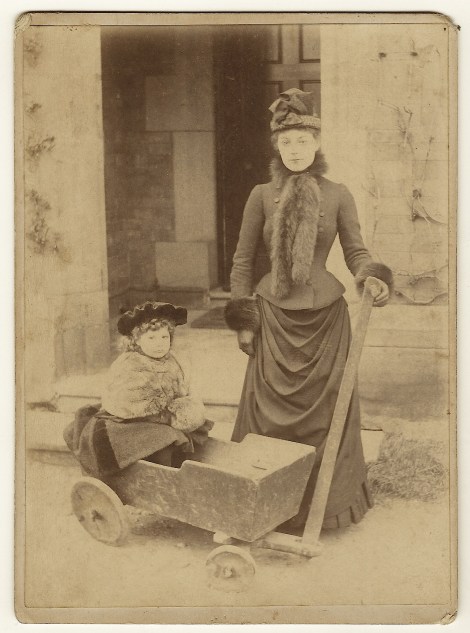
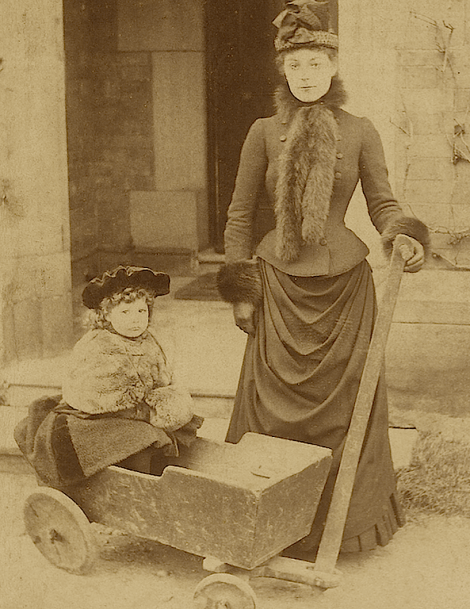 This vintage photograph features a mother pulling her daughter in a wooden wagon. The photograph appears to have been taken during the winter. The child is bundled in a heavy coat and has her hand protected from the cold by a fur muff. She is sitting on a heavy blanket. Mom is also prepared for winter. She is wearing a long dress and is accessorized with a fur scarf and she has fur cuffs on her sleeves. This photographed was purchased from a collector in England. A sticker on the reverse of the photo indicates the photographer’s name. His name is Oscar Hurt, though I am not certain about the accuracy of his last name since the writing is difficult to decipher. This photograph measures about 4 1/2 x 6 1/4. (SOLD)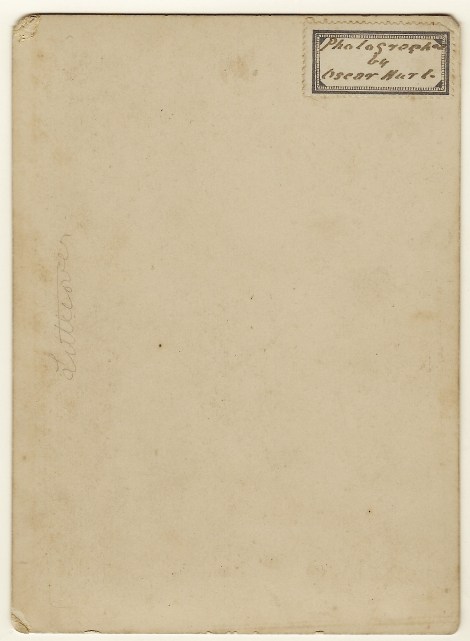



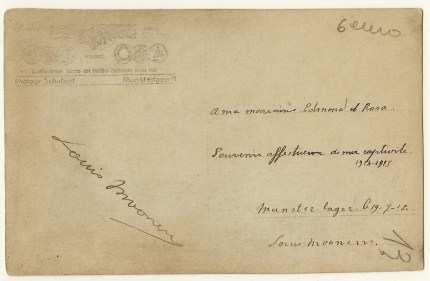
 This vintage real photo postcard features a handsome soldier. He is wearing a military uniform and cap. The pin on his hat indicates that he was a member of the 9th regiment of the infantry. I do not know the soldiers nationality. The message on this card includes the word “captivite”. Captivite, translated from the French means “captivate”. Was the writer of this postcard talking about capturing the town of Munsterlager, or was he referring to himself as being a prisoner of war? Perhaps a visitor to the cabinet card gallery will be able to translate the message for those of us with a French language deficit. This photo was taken in the mid 1910’s by the Schubert studio in Munsterlager. During the first World War (1916), the Breloh Camp was built in Munster by a regiment of gas warfare engineers. The next year there was construction of a facility for gas munitions. In all, three factories were built for the purpose of manufacturing chemical war material and related munitions. (SOLD)


 THE CABINET CARD GALLERY