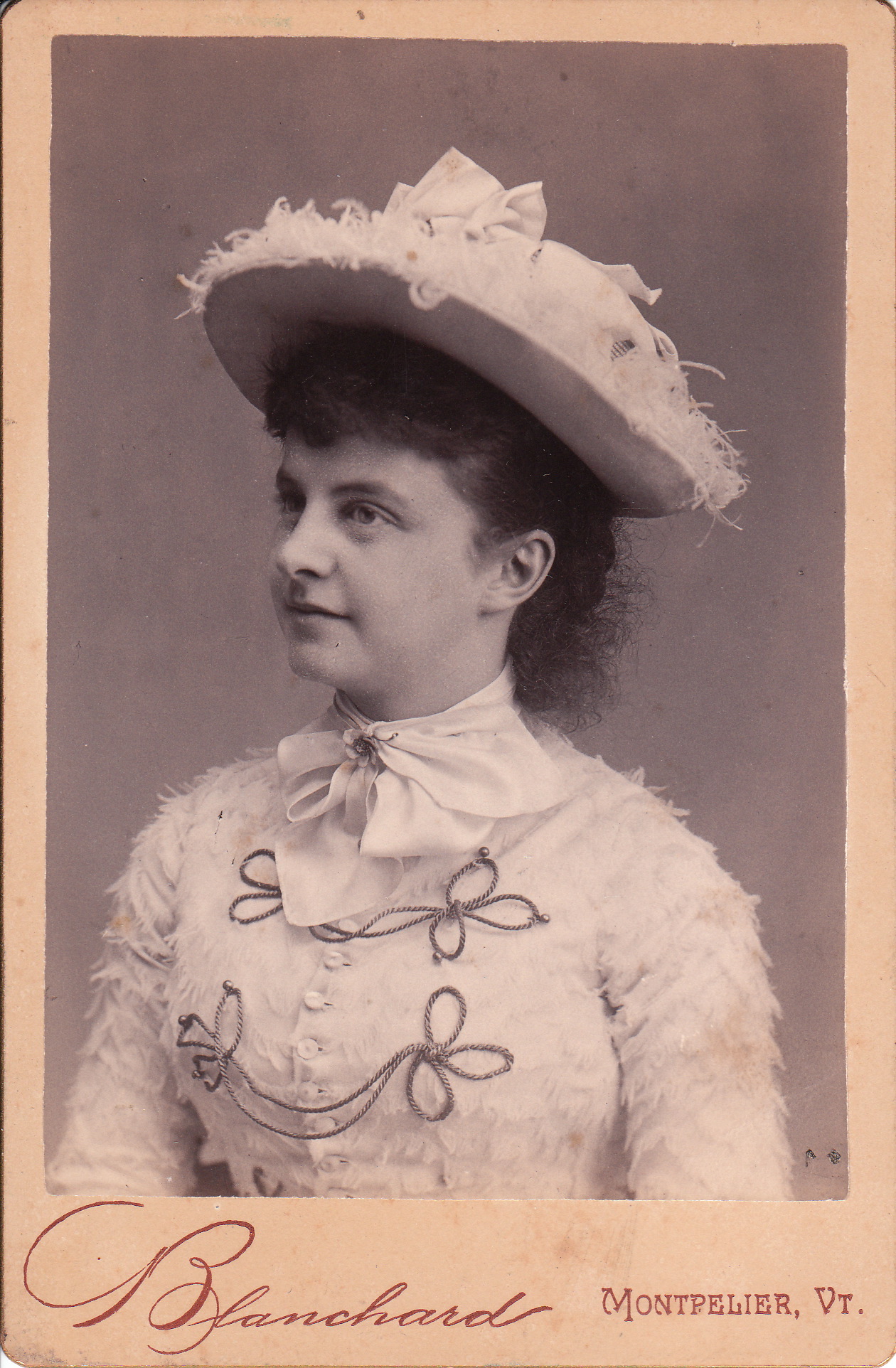
 This cabinet card is a portrait of a pretty feathered woman. It is probably misleading to call her a feathered woman, when in fact, it is her dress and hat that is covered with feathers. She is certainly wearing a creative, albeit, odd dress, especially since the photograph was made pre “Big Bird”. The photographer was A. N. Blanchard, and he was located on State Street, in Montpelier, Vermont. Azel Norman Blanchard (1843-1923) was a Civil War veteran who was a member of the 1st US Sharpshooters (Co. F). He established a photography business in Barre, Vermont, in 1865 and moved to Montpelier where he established a studio in 1880. Research reveals that his photography business was listed in the Montpelier directories of 1883 and 1887. He was buried in Green Mountain Cemetery, in Montpelier.
FEATHERED LADY OF MONTPELIER, VERMONT

KATE CLAXTON: STAGE ACTRESS ASSOCIATED WITH DEADLY THEATRE FIRE
 CABINET CARD 1 (SOLD)
 CABINET CARD 2
Kate Claxton (1848-1924) is the subject of this cabinet card portrait. Claxton was an American stage actress who made her first appearance in Chicago with Lotta Crabtree in 1870. That same year she joined Augustin Daly’s Fifth Avenue Theatre in New York. In 1872, she became a member of A. M. Palmer’s Union Square Theatre in New York. She played mostly in comedic roles. She began starring in theatrical tours in 1876. In 1876 she was performing the play “The Two Orphans” at the Brooklyn Theatre (in New York City) when a fire broke out killing 278 people. Soon after the tragic fire, she was in a St. Louis hotel when it caught fire and she made a narrow escape. After the two fires, Claxton was viewed by some audiences and theater professionals, as bad luck and a performer to be avoided. There are some interesting asides about Claxton. First, the town of Claxton, Georgia was named after her in 1911, Second, her father was Colonel Spencer W. Cone, who was the commander of the 61st New York Regiment in the American Civil War. Cabinet Card 1 was photographed by Schloss, a famous New York celebrity photographer. To view other photographs by Schloss, click on this site’s category “Photographer: Schloss”. The reverse of this card has a hand written notation stating “Empire Theatre”. Perhaps this photograph captures Kate Claxton in costume for a role she played at the Empire. (SOLD)
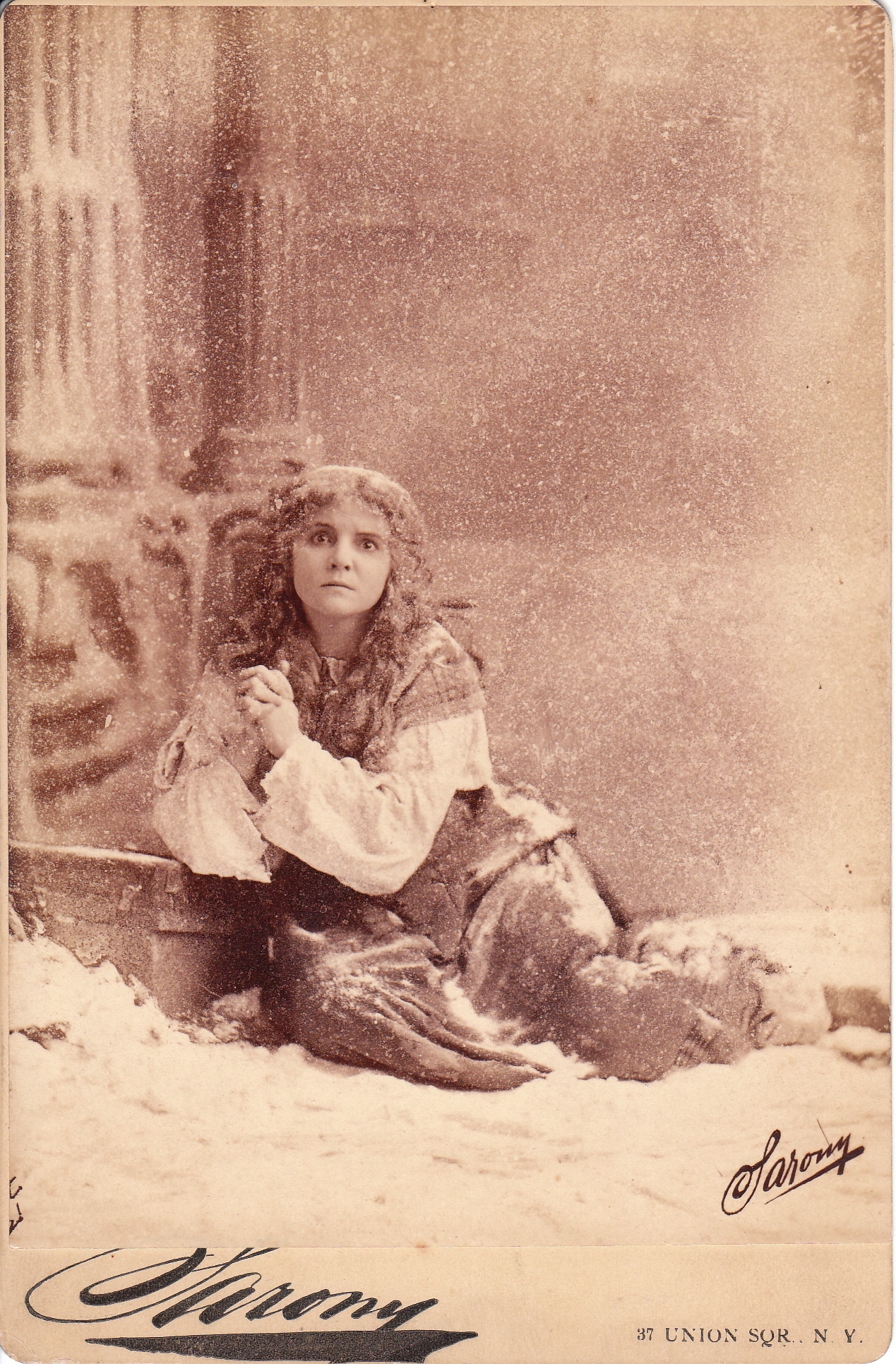
Cabinet Card 2 captures Claxton sitting on the ground during a snow storm. The staged scene in this image is likely from one of Claxton’s performances. This photograph is by Sarony, famed New York City photographer. To view other images by Sarony, click on Cabinet Card Gallery’s category “Photographer: Sarony”.
PAULINE MARKHAM: TURN OF THE CENTURY BURLESQUE ACTRESS
 This risque (lots of cleavage shown for this era) cabinet card is a portrait of Pauline Markham (1847-1919), a singer and burlesque dancer during the civil war period in the United States. She was born in England where she made her stage debut as a child. She came to New York and appeared in “Black Crook” and “Pinafore”. She was a member of the Lydia Thompson troupe (British Blondes). After the civil war, she had relations with Northern Generals and Reconstructionists In the 1870’s she formed her own stage company and in 1879 she took her company on a tour of the West during which they performed Gilbert and Sullivan. A member of that troupe was Josephine Marcus, who later married lawman, Wyatt Earp. She retired from the stage in 1889 after breaking her leg. She must have taken the old show business saying of “break a leg” literally. This cabinet card was photographed by Fredricks, of Brooklyn, New York. It is possible that the photographer is Charles DeForest Fredricks (1823-1894) who was an innovative American photographer. Fredricks learned the art of daguerreotypes from the great photographer , Jeremiah Gurney (see category “Photographer: Gurney”). Fredricks worked in South America through the early 1850’s and then he operated out of Charleston, South Carolina; and Paris, France. He was the first photographer to make life-size portraits, which he then hired artists to color them using pastel. He then returned to New York City and rejoined Gurney. In 1854 he developed a new enlarging process and in 1855 he ended his association with Gurney. In the late 1850’s Fredricks ran his studio in Havana, Cuba, and in the 1860’s he opened a studio on Broadway, in New York City. He retired in 1889. Research has not confirmed that Fredricks ever had a studio in Brooklyn, so it is quite uncertain whether the Fredricks who photographed Markham is actually Charles D. Fredricks.
A MAN AND HIS MEDAL IN PHILADELPHIA, PENNSYLVANIA
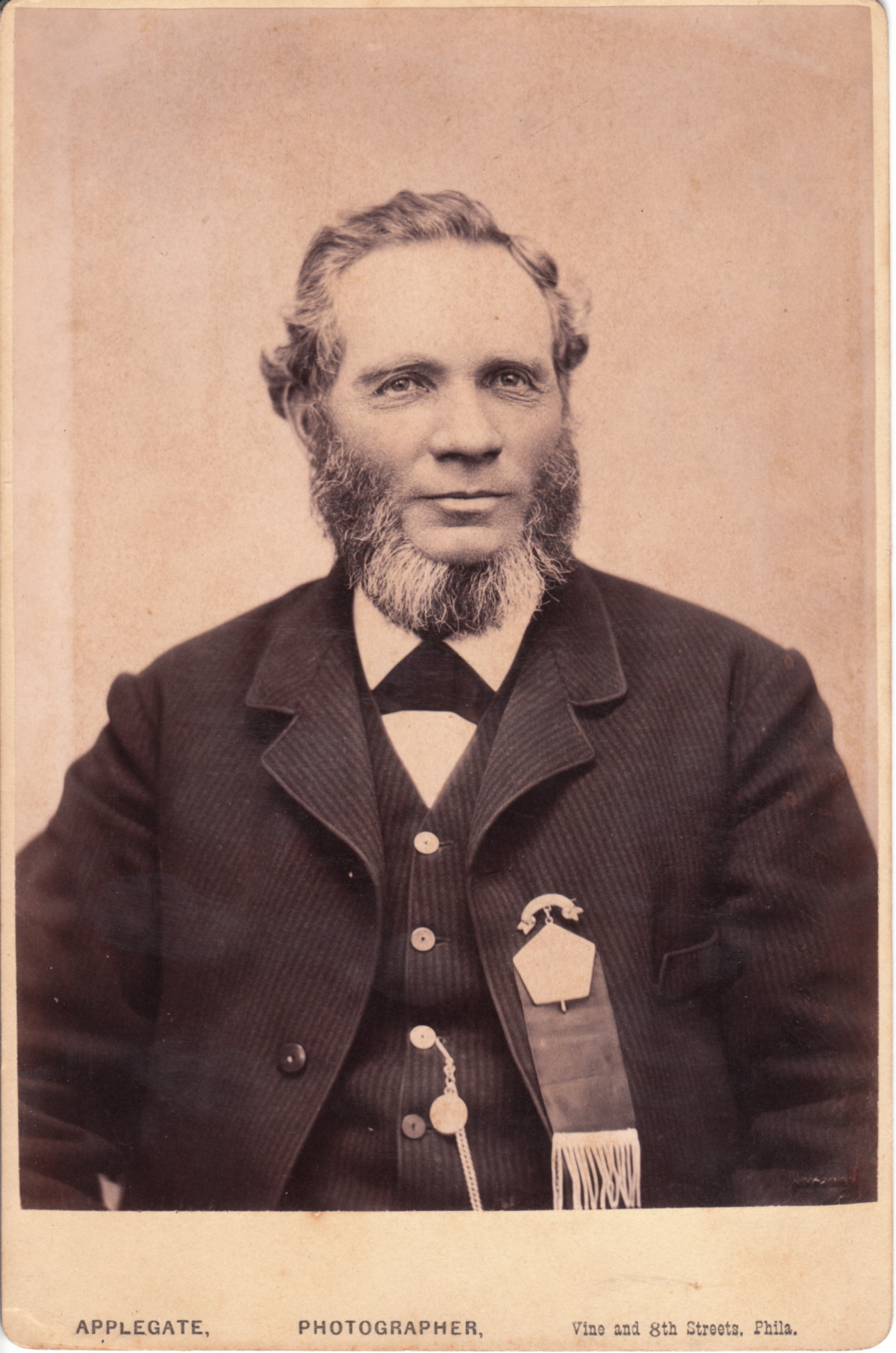 This dapper gentleman is wearing a medal and ribbon as he poses for this portrait at the studio of Applegate, in Philadelphia, Pennsylvania. What does this medal and ribbon represent? Is this gentleman a veteran of the civil war? Is he a member of a fraternal organization or political party? The answer to these questions will be very difficult to obtain but perhaps a visitor to this site may have some ideas to share about the type of medal and ribbon the subject is wearing. The gentleman’s beard is quite interesting. He has no mustache or whiskers immediately under his lower lip. He qualifies for Cabinet Card Gallery’s category of “Beards (Only The Best). The photographer of this cabinet card led an interesting life. In 1860, James R. Applegate had a photographic studio in Philadelphia that was three floors high. In 1877, a St. Louis photography magazine visited Applegate’s studio and wrote that he “encases 50 portrait faces every minute…. with a bevy of young ladies finishing the same and scores waiting to be set”. In 1884, Applegate opened the first successful amusement pier in Atlantic City, New Jersey. The boardwalk included one of his photography studios. In 1891, he moved the carousel from the boardwalk to Philadelphia and a year later, the police raided the carousel and arrested him and 200 guests. He was charged with “keeping a disorderly house” and an unnamed more serious offense.
ODETTE TYLER: THEATER ACTRESS AND DAUGHTER OF A CONFEDERATE GENERAL
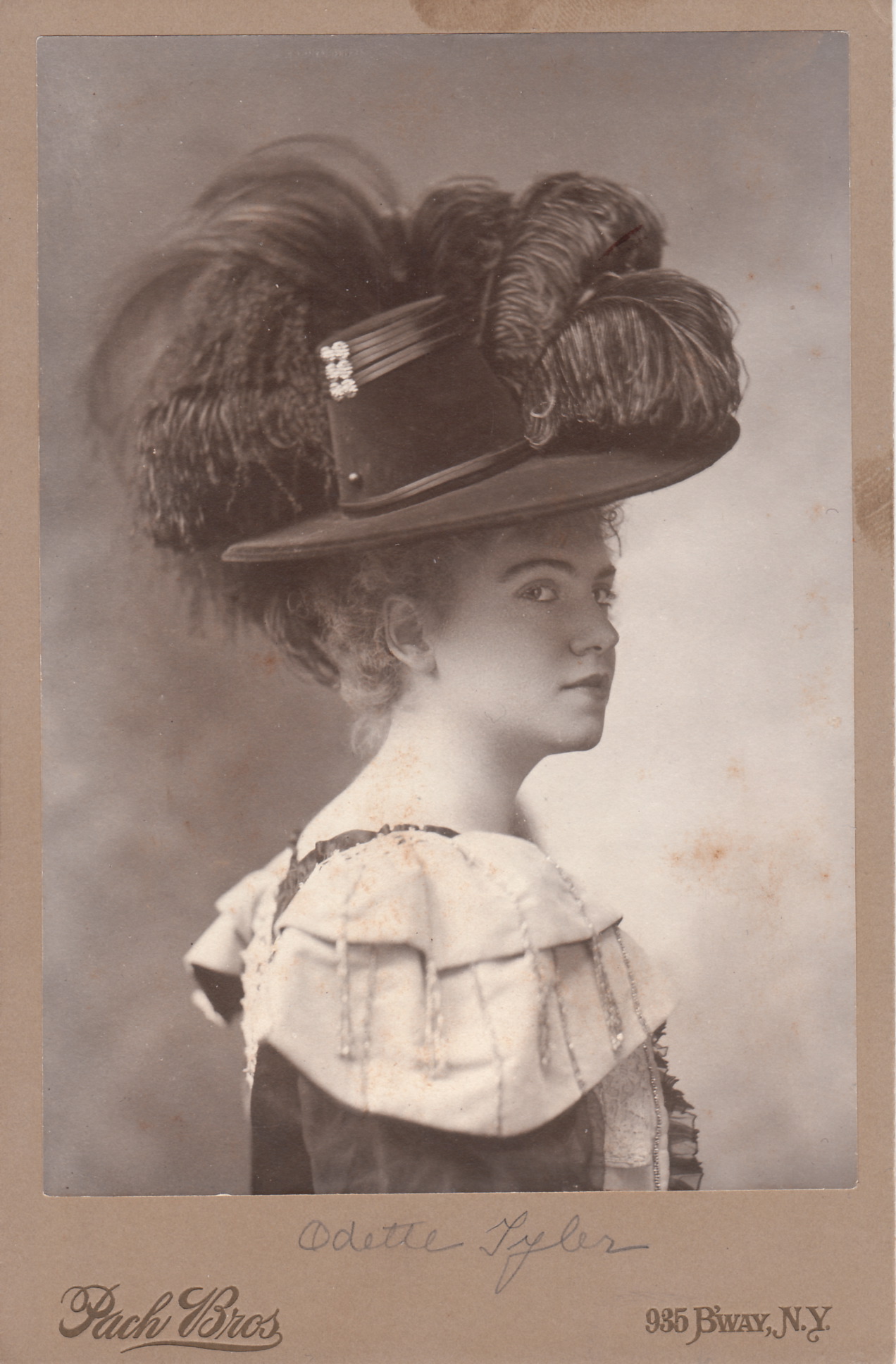 This Cabinet Card is a photograph of actress Odette Tyler (1869-1936) and it is photographed by famed celebrity photographic studio, the Pach Brothers. Tyler appeared in many productions including “The Love Route” (1906) which appeared on Broadway. She was an American actress and comedienne. She worked for Charles Frohman and was a member of a number of theater companies including the Madison Square Company (1884-1885). She authored a book, “Boss: A Story of Virginia Life”. Tyler was born Elizabeth Kirkland in Savannah, Georgia. Tyler’s father was a West Point graduate and served as a Confederate General during the Civil War (General William Kirkland). Odette Tyler is quite pretty in this image and her feathered hat can be described as elaborate. To view other photographs by this studio, click on the category “Photogapher: Pach Bros.”.
BEAUTIFUL BELLE IN CHARLESTON: EFFE MAY BLANCHARD-WALTER
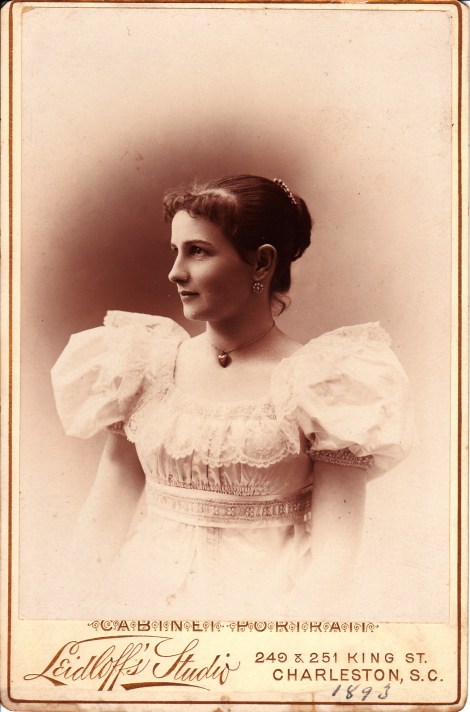
This Cabinet card is a portrait of a beautiful woman named Effe May Blanachard-Walter. Effe was from Newark, New Jersey where her father, Noah Farwell Blanchard ran a successful leather business. His company made knapsacks, haversacks and other leather goods for the Union Army during the civil war. In 1879 he became the President of a start-up company that became Prudential Life Insurance Company. He also was a religious man who served as President of the Board of Trustee at Trinity Church in Newark, New Jersey. Effe married Julian Hazelhurst Walter in about 1896. Interestingly, a book on the history of Newark, New Jersey, spells her name as Affie rather than Effe. Another source reveals that Julian H Walter (1870 – ?) was born in New Jersey but at age 2 he and his family returned to their native South Carolina. As a young adult he worked in his fathers cotton business and then at age 26 moved to New York where be became a prominent businessman. He worked in the seed business founding the firm Stumpp and Walter Company. Now, back to the Cabinet Card. This photograph captures Effe in a beautiful white dress with much lace and puffed sleeves. The photographer is Leidloff of Charleston, South Carolina. Herman Leidloff came to the United States from Berlin, Germany in 1872. After living in New York, Boston and Baltimore he came to Charleston in the late 1870’s and by 1881 had begun operating his photographic studio.
CIVIL WAR VETERAN BEDECKED WITH MEDALS IN MISSOURI
 This Cabinet card is a terrific image of a union army Civil War Veteran. He is wearing three medals. One medal identifies him as J. W. Plummer, a member of company G in the 29th Indiana Infantry Regiment. The second medal represents his membership in the Civil War Veterans Group, the Grand Army of the Republic (G.A.R.). Further research reveals that Mr Plummer, is John W. Plummer and entered his unit as a private and left with the same rank. His regiment was organized in 1861 and fought at Shiloh, Corinth, Stones River, and the Battle of Chickamauga. The unit suffered 304 dead during the course of the war. The photographer is Tussey of Schell City, Missouri.
MUSTACHE IN NEW YORK: STYLED AFTER GENERAL AMBROSE BURNSIDE
 This cabinet card is a worthy addition to the mustache (only the best) category. This fine looking gentleman sports a mustache that is very reminiscent of the style worn by civil war General Ambrose Burnside. The photographer is Merrill of Geneseo, New York.
Benjamin Wade: American Civil War Senator and Anti Slavery Figure (Photographed by Matthew Brady)
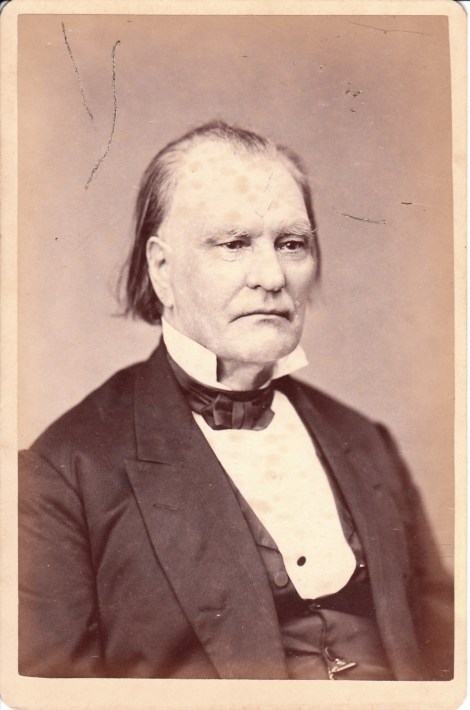 Benjamin Wade (1800-1878)) was born in Massachusetts. He worked as a laborer on the Erie Canal, taught school and then studied and practiced law in Ohio. As a member of the Whig Party he was elected to the Ohio State Senate and served two terms. He later became an Ohio court judge. Wade joined the Republican Party and in 1851 was elected to the US Senate. He became a Radical Republican along with Thaddeus Stevens and Charles Sumner. He fouhgt against the Fugitive Slave Act and the Kansas-Nebraska Act. He was very radical and supported women suffrage, trade union rights and equality for African Americans. In 1861 as chairman of the Committee on Territories he witnessed the defeat of the Union Army at the First Bull Run and was nearly captured by the confederates. During the American Civil War, Wade was extremely critical of Lincoln. After the war he pushed for African American units in the Regular Army. He was also instrumental in the impeachment of American President Andrew Johnson. Wade was considered by some as a good choice for Ulysses S Grant’s running mate but Grant refused. This cabinet card is from Matthew Brady’s National Portrait Gallery in Washington, D.C..


 THE CABINET CARD GALLERY