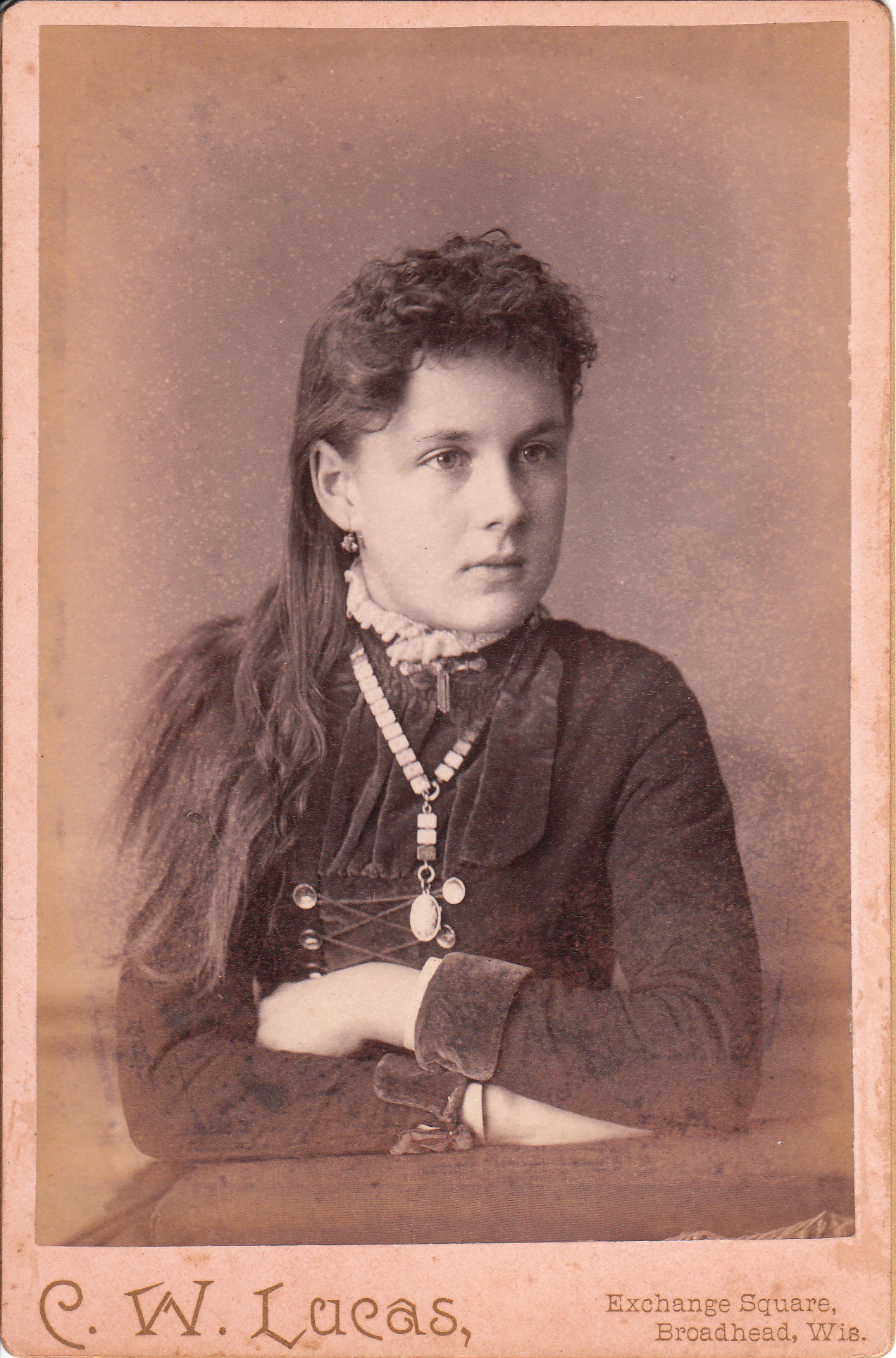
 A young woman poses for her portrait at the studio of C. W. Lucas in Brodhead, Wisconsin. She has long dark hair and is dressed nicely but not fancy. She is wearing an interesting necklace. The necklace is a string of small cubes. Hanging from the necklace is a small cameo. Photographer, Charles W. Lucas located to Brodhead in 1869, He was born in 1841 and was a native of Maine. He entered the field of photography in 1866 and moved to Wisconsin in 1868. He partnered with others in photography studios until 1871 when he began to operate independently. He was married to Bashie Springstead of Brodhead. It is interesting to note that there is an error on the front of this cabinet card. The name of the town of “Broadhead” is misspelled. The name should be spelled “Brodhead”. One wonders why Charles Lucas kept the card stock even though part of his address was spelled incorrectly.
YOUNG WOMAN AND HER INTERESTING NECKLACE IN BROADHEAD, WISCONSIN

A BOY AND HIS TRICYCLE IN BEAVER DAM, WISCONSIN

Photographer P. Veling & Bro produced this portrait of a boy and his tricycle. Note the clarity of the trike in this image. The child is dressed adorably and is wearing a wonderful hat. This studio photograph was taken in Beaver Dam, Wisconsin. The photographer, Peter Veling was born in Germany in 1855. He immigrated to the United States as a baby. He married his wife, Theresa, in 1881. He is listed as a photographer in the 1880, 1900, and 1910 US censuses. However, the 1920 census indicates that Veling had became the postmaster of Beaver Dam.
TWO WOMEN AND THEIR BOOKS IN WEST SUPERIOR, WISCONSIN (WINTER SCENE)
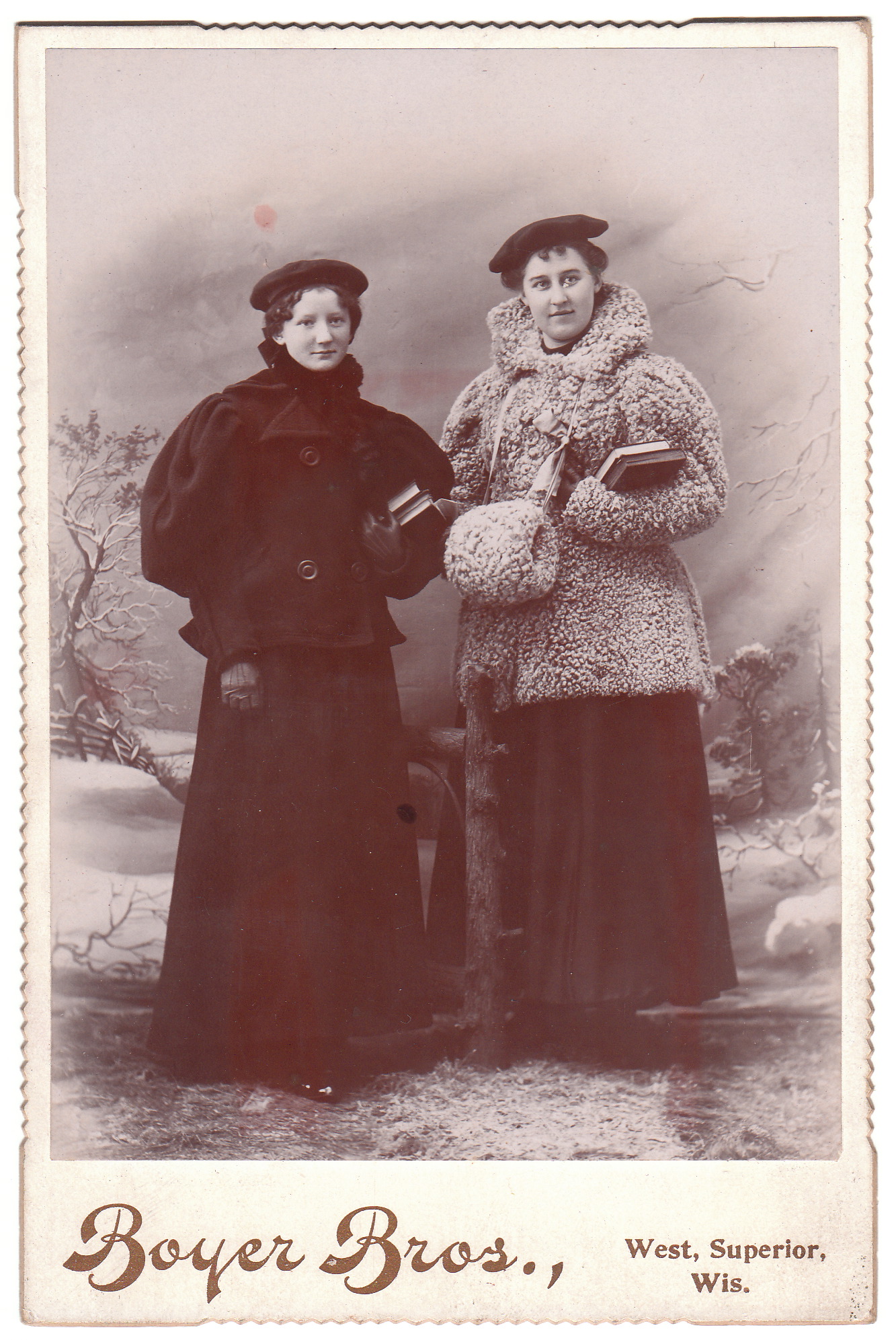
Two women dressed in winter coats pose for their portrait at Boyer Brothers studio in West Superior, Wisconsin. They appear well prepared for the winter scene that is hanging behind them. Both women are holding books in their arms. Unlike most subjects appearing in cabinet cards, these two ladies are smiling. The Boyer Brothers include Hans R. Boyer, Henry Boyer, and Robert H. Boyer. The brothers worked in various combinations and in a number of partnerships in Superior, Wisconsin and Duluth, Minnesota. They were associated with studios from the 1880s through the 1910’s.
YOUNG MAN WEARING SALVATION ARMY UNIFORM IN MARSHALLTOWN, IOWA

A young man wearing a Salvation Army uniform poses for his portrait at the Cottage Gallery in Marshalltown, Iowa. The photographer is named Beverage. The uniform is well decorated with Salvation Army identification. He is wearing a badge on his jacket, S’s on his collars,a badge on his hat, and lettering stating Salvation Army on a band around his hat. An inscription on the reverse of the cabinet card states that the subject’s name is “Charlie Phillips” and that he is the brother of the writer’s mother, “Uncle Charlie”. The 1890 Iowa census reveals that a Charlie Phillips, born in Marshalltown, was living in Lake Creek, Iowa. This eighteen year old young man, may be the subject of this photograph. The 1900 United States census reports that Maurice C. Beverage was born in 1841 in the state of Maine and was living with his 20 year old daughter in Marshalltown. He was of Scottish and French Canadian descent. The census listed his occupation as a photographer. Beverage began his photography career in Oconto, Wisconsin. In 1871 he was married to Hattie Crum and they had four children. The Oconto shop was at the corner of Maine and Section Streets. He worked in Oconto between 1869 and 1876. he then moved to Marshalltown where he opened the Beverage Cottage Gallery. He had partnerships there with Benjamin Jarvis and S. E. Jessup. In 1931, Beverage’s obituary appeared in the Times Republican, a Marshalltown newspaper. The obituary states that Beverage lived in Canada from infancy to age 15, when he went to Michigan, and then Oconto where he learned photography. He ran the Cottage Gallery from 1876 until 1912. His son Herbert Morris Beveridge was a photographer in Butte, Montana in 1900. The Cabinet Card Gallery has a large collection of Salvation Army cabinet cards. To view these photographs, click on the category “Salvation Army”. SOLD
THE CHAMPIONSHIP SEASON: HILLSBORO WISCONSIN HIGH SCHOOL BASKETBALL TEAM (1900-1901)
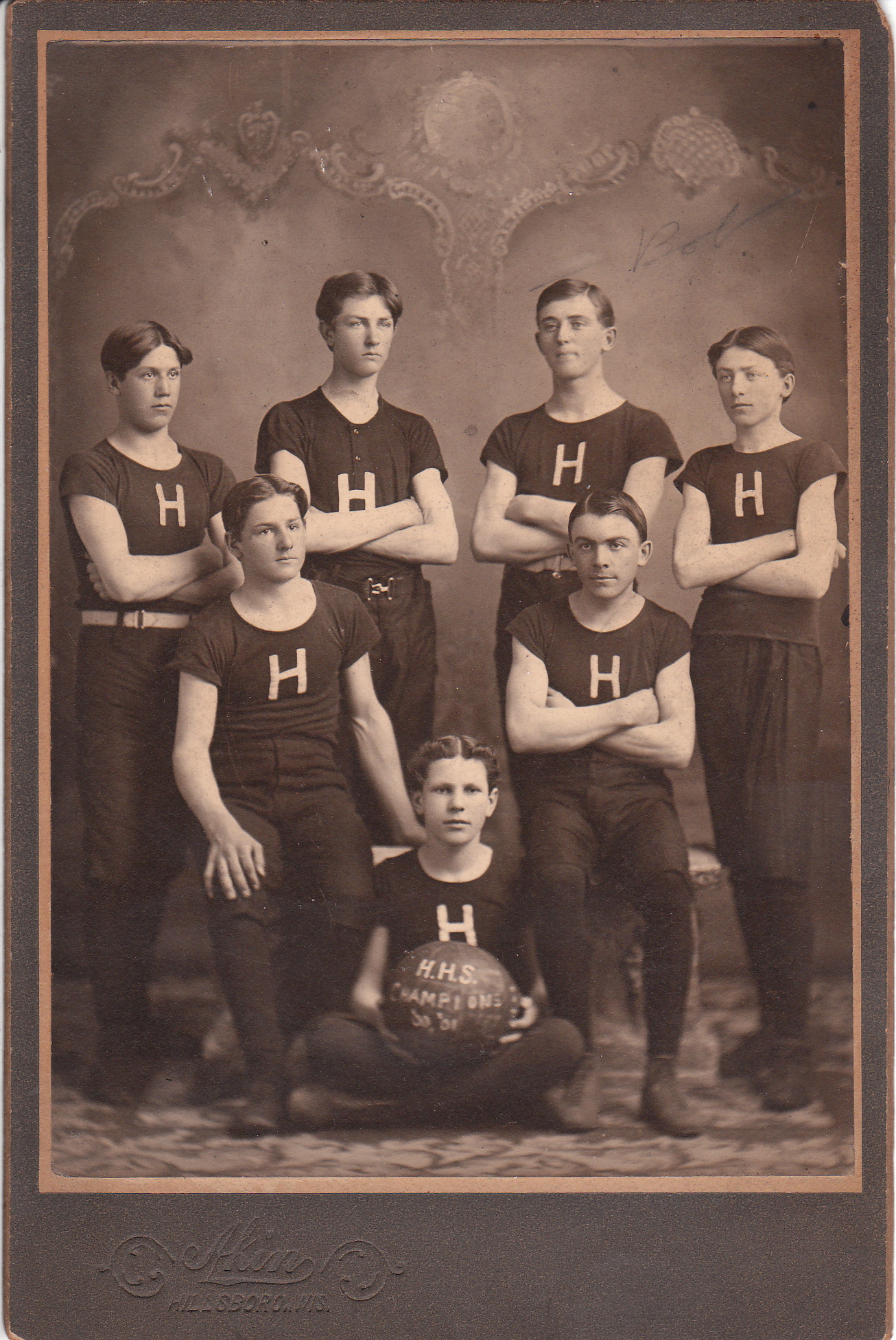
This photograph features the Hillsboro High School basketball team. The team proudly poses with a trophy basketball marking their championship season of 1900-1901. The name “Bob” is written above the second boy to the left in the back row. Could any of these boy been future Wisconsin Badger basketball players? It is certainly a possibility that one of these guys may have played college basketball with the Badgers. The Wisconsin Badger basketball program played their first game in 1899. In 1906-1907 season they won their first share of a Big Ten championship.The likely photographer of this image is Earle D. Akin. The town of Hillsboro was named for early settler Valentia Hill and his brothers. They arrived in the area beginning in 1850. Many of the earliest settlers were of German descent. They were followed by many Czech settlers and in fact, Hillsboro was known as the “Czech Capital of Wisconsin”. When the town was settled, it did not take much time for a saw mill to arrive, followed by stores , a blacksmith, a hotel, and a school, as well as a grist mill established along the Barabee River. In the 1880’s dairy farms and a creamery began business in Hillsboro.
WIDE-EYED BABY IN GREEN BAY, WISCONSIN

A wide eyed baby is photographed by F. W. Schneider, in Green Bay, Wisconsin. the baby is lying on fur and wearing a long gown. The book, “A History of Brown County, Wisconsin, Past and Present Vol. 2” (1913) reveals that Schneider was born and raised in Niederschelden, Germany. He emigrated to the United States in 1868 and settled in Green Bay in 1874. Schneider operated a photographic gallery until 1911, when his son, C. Alvin Schneider, succeeded him. “The Bulletin of Photography” (1922), noted F. W. Schneider’s death from heart disease. Schneider was 68 years old at the time of his death, and it was reported that he had operated his studio for 38 years. An interesting side note about Green Bay is that it was established in 1634 by the French as a small trading post. The town’s original name was “La Baie des Puants” (“The Stinking Bay”).
THREE LOOK-ALIKE SISTERS IN RIVER FALLS, WISCONSIN
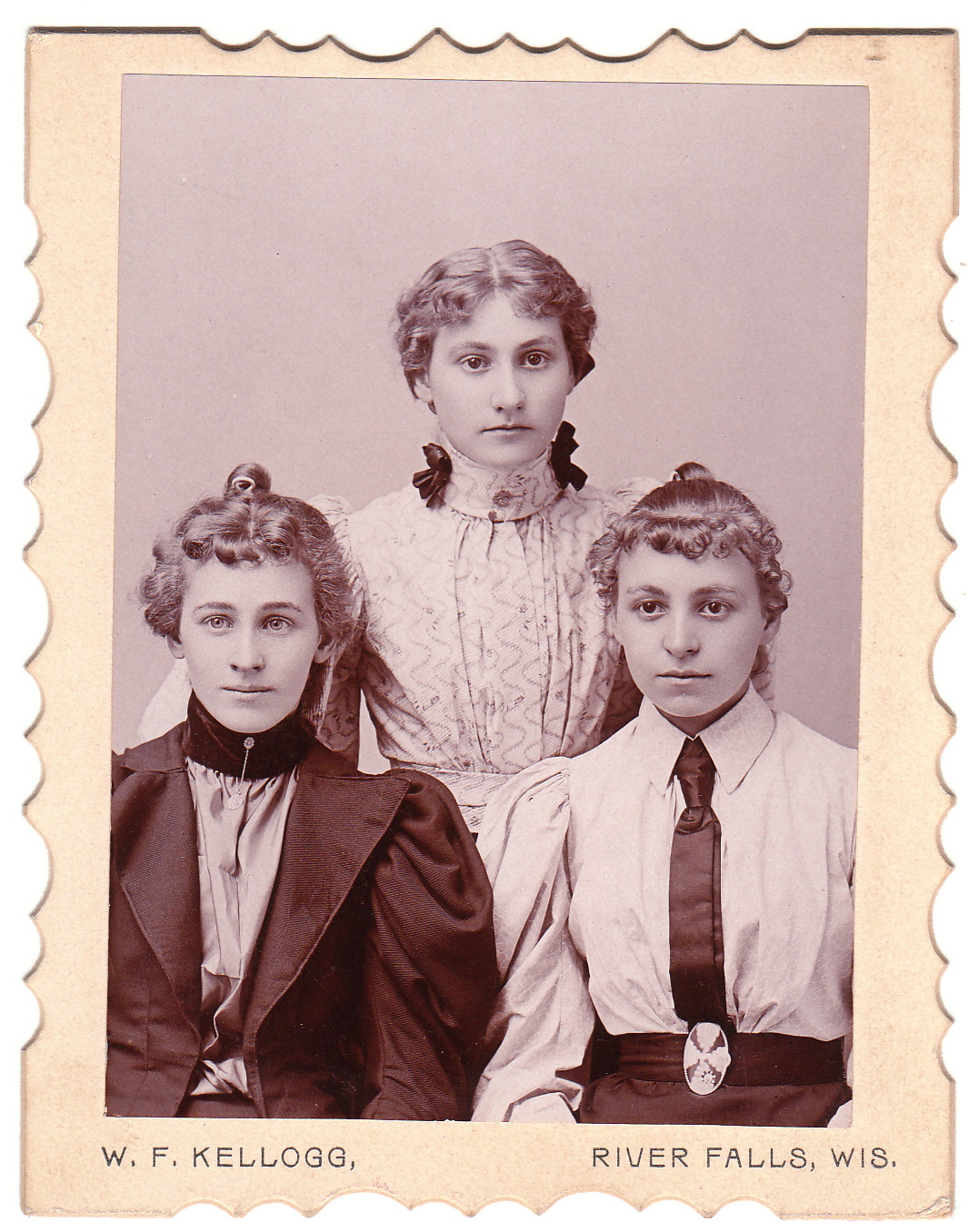 This cabinet card is a portrait of three sisters with a strong family resemblance. The woman are attractive and nicely dressed. Note that the woman on the right is wearing a necktie, and the sister in the center has ribbons on her collar. The photographer is W. F. Kellogg of River Falls, Wisconsin. The Kellogg studio was established in 1877 by Douglas Wright Kellogg (1840-1913). The studio was built on the southeast corner of Main and Walnut Street. In 1878, Douglas Kellogg sold the studio to to his older brother, Wilbur Fiske Kellogg (1836-1920). Wilbur Kellogg is the photographer who produced the above portrait. Another brother, John D. Kellogg operated a gallery in Red Wing, Minnesota from 1868 until 1899. Douglas Kellogg eventually moved to Reedsburg, Wisconsin and opened a gallery there. All three brothers were born in Danby, New York, and learned photography in Beaver Dam, Wisconsin. Wilbur was a farmer prior to entering the photography business. In 1900, he was thought to be the oldest photographer in Wisconsin. When he sold the studio, Wilbur and his wife moved to Spokane, Washington. In 1899, he partnered with John R. Boals (1872-1959) to establish a photographic studio which was eventually sold to Stella Thayer (1875-1934).
MINNIE DUPREE: AMERICAN STAGE AND FILM ACTRESS
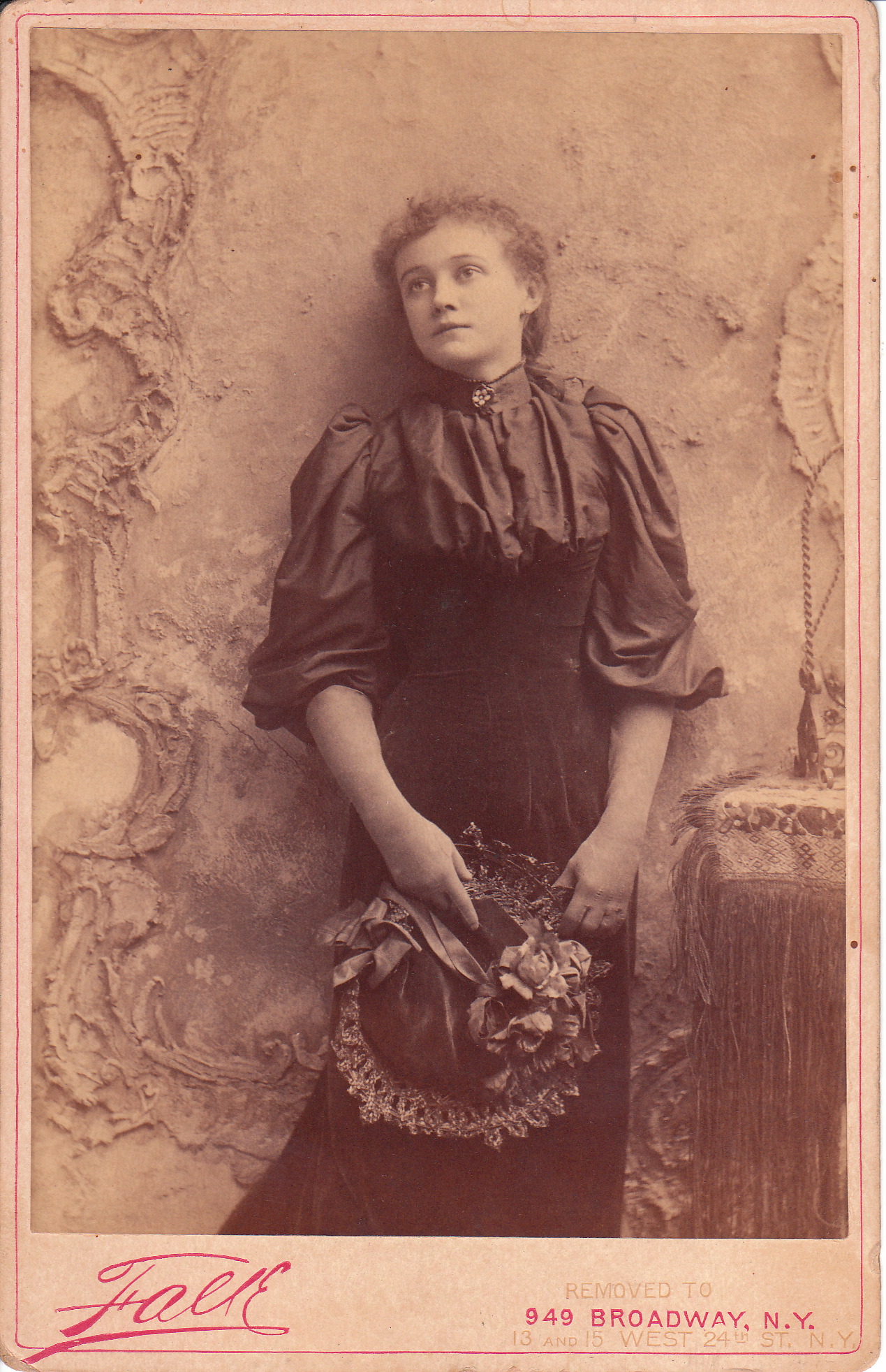
Photograph 1
Photograph 1 is a cabinet card portrait of Minnie Dupree (1873-1943). She was an American stage and film actress. She was born in La Crosse, Wisconsin. She made her acting debut in a touring company in 1887. In 1888, she was a sensation in a small role in William Gillette’s New York play. “Held by the Enemy”. This role propelled her into a number of supporting roles with the some of the leading actors of the day. She finally got a starring role in the 1900 production of “Women and Wine”. Many other leading roles followed as well as a number of notable successes. However, critics agreed that her later career was less successful than her early and middle career. Dupree also made a small number of films including “The Young in Heart” (1938). Costars in this film included Janet Gaynor, Douglas Fairbanks Jr., Billie Burke, and Paulette Goddard. This cabinet card photograph captures Miss Dupree holding her had and looking dreamily away from the camera. The photograph was taken by celebrity photographer, B. J. Falk. Falk’s address is listed as 949 Broadway, New York City. However, there is a light stamp over the Broadway address indicating that the studio had “removed” to 13 & 15 West 34th Street, New York City. To see other photographs by Falk, click on the category “Photographer: Falk”.
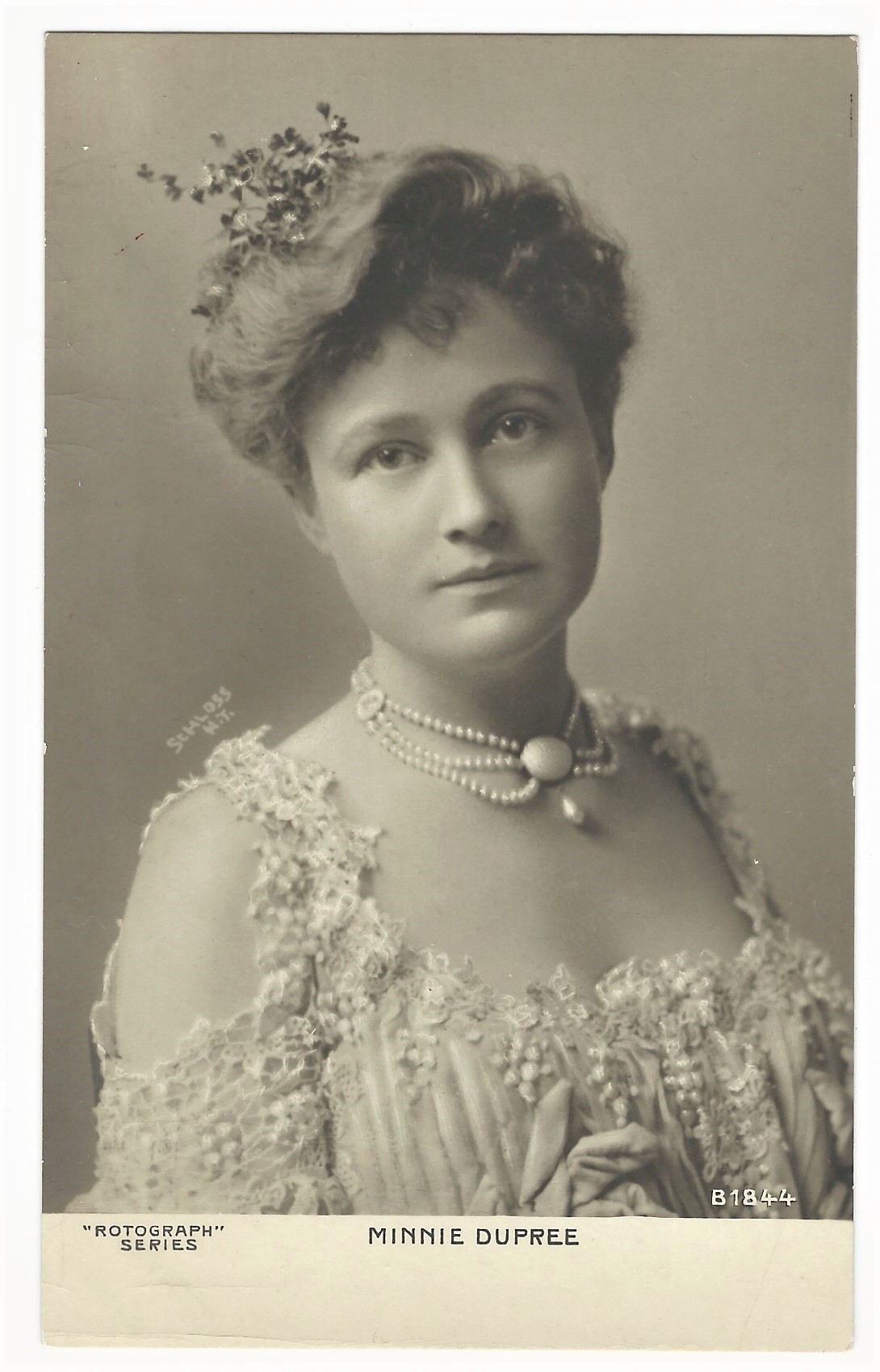
Photograph 2 is a vintage real photo postcard featuring Miss Dupree. The image provides a wonderful close-up view of the actress. She is wearing a fancy dress that is low-cut. Note her pearl necklace. Her hair is styled perfectly, providing a very fresh and clean look. The photographer credited with this fine portrait is celebrity photographer, Jacob Schloss (1856-1938). His studio was located in New York City (Manhattan). He received his education at the Cooper Union in New York City. He graduated in 1872 as an etcher. He joined Benjamin J. Falk’s photography studio and worked there in the mid 1870’s. He left Falk’s employ to open his own studio (54 West 23rd Street) where like Falk, he specialized in theatrical photography. He tended to favor photographing actresses in costume in front of generic studio furnishings. He produced many cabinet card photographs but also was active in the production of magazine images. By the 1890’s he was particularly known for his photographs of beautiful women, much like photographer Jose Maria Mora. Schloss also was an activist for photographers rights. He was very involved in the movement to copyright images. He sued those who used his photographs without crediting or paying him. He was an active participant in national photographer associations and was an worked as a photographer until the 1910’s. The photograph was published by the Rotograph Company as part of the “Rotograph Series” (no.B1844). The postcard has a stamp stating “From Robert S. Simmons”, whom I believe, but can not confirm, was a well known collector of photographs. (SOLD)
THE OTHER BOOGIE WOOGIE BUGLE BOY OF COMPANY B……… IN ALBERT LEA, MINNESOTA
 This cabinet card features a uniformed bugle boy, posed holding his instrument, and wearing a satchel bag strapped over his shoulder. The boy’s cap has a badge indicating that he was in company B of the “ALC”. “ALC” likely stands for Albert Lea C……”. Perhaps a visitor to the Cabinet Card Gallery can leave a comment identifying the “C” word. The bugle boy, judging by his uniform, was a member of a band. Albert Lea is the name of the Minnesota town where the photographic studio that produced this cabinet card was located. Albert Lea is ninety miles south of Minneapolis, Minnesota; and was named after a topographer with the US Dragoons who surveyed the area in 1835. The photographer of this cabinet card was Joseph A. Fuller (1851-?). Fuller was born in Walworth County, Wisconsin. He worked as a photographer in Decorah, Iowa and Chatfield, Minnesota; before moving to Albert Lea in 1873. At the time of this photograph, Fuller’s studio was on the corner of Williams and Broadway Streets, “over Brown & Cos Bank”. His later studios in Albert Lea included 202 South Broadway (1914-1922) and 204 South Broadway (1924). He worked in Minnesota from the 1870’s through part of the 1920’s.
FORLORN BRIDE AND DISTANT GROOM ON THEIR WEDDING DAY IN MILWAUKEE, WISCONSIN (CAN THIS MARRIAGE BE SAVED?)
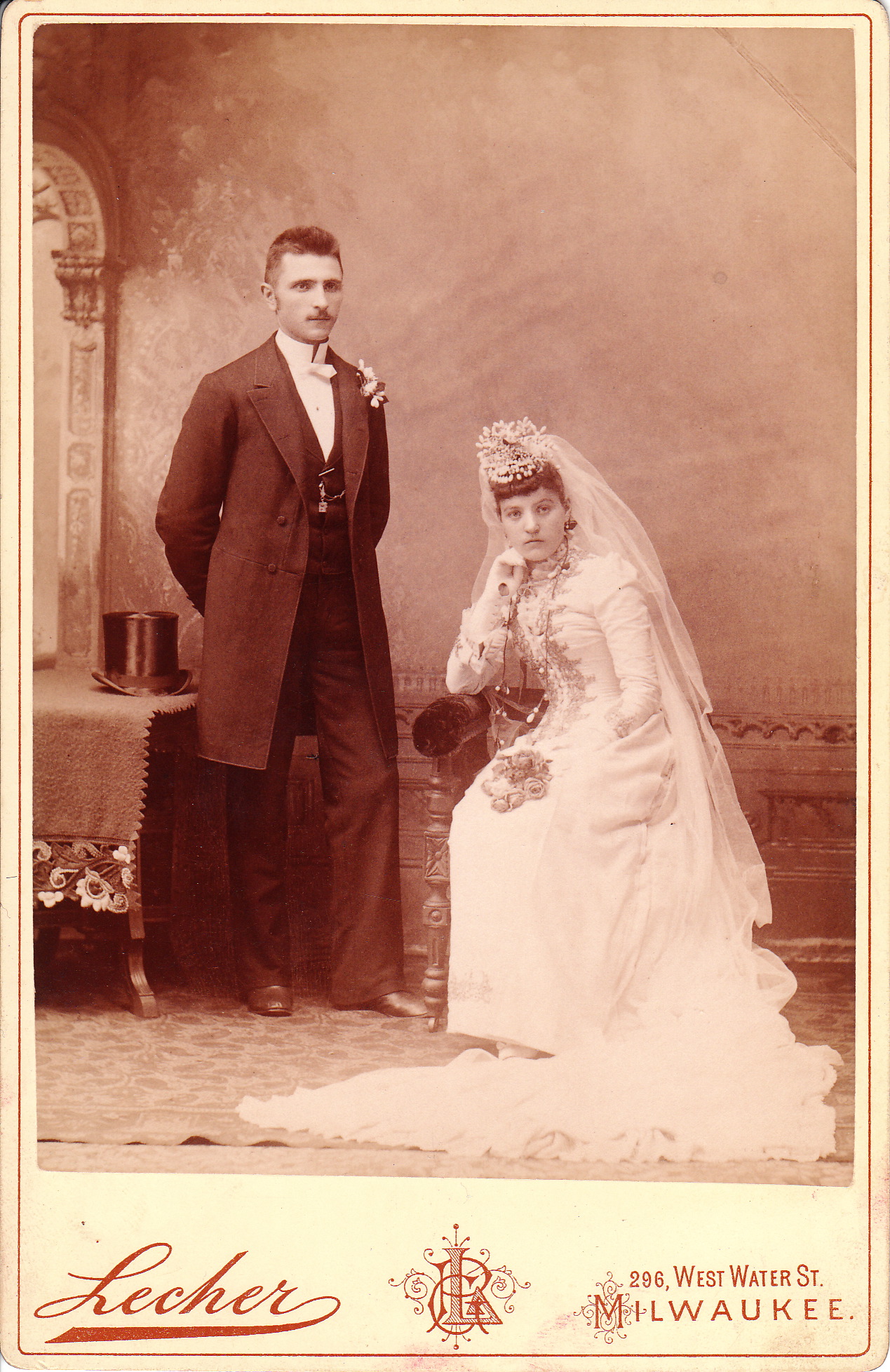 This cabinet card is a wedding portrait photographed by Lecher, in Milwaukee, Wisconsin. The bride in this picture appears quite attractive in her wedding gown. She has a lovely veil and has a bouquet of flowers on her lap. The bride seems troubled. Is she questioning her decision to marry her husband? Did her Maid of Honor look more beautiful than she did? The well dressed groom appears quite concerned as he stands quite far from his bride with his hands clasped behind his back, and his top hat rests on the table next to him. The posing of this wedding couple is quite unusual. The couple seem emotionally and physically very distant from each other. Can this marriage be saved? The photographer, Paul G. Lecher, was a native of Germany, who came to the United States at two years of age. Research reveals that he definitely operated his studio in 1889 and 1890, and perhaps, in other years too.


 THE CABINET CARD GALLERY