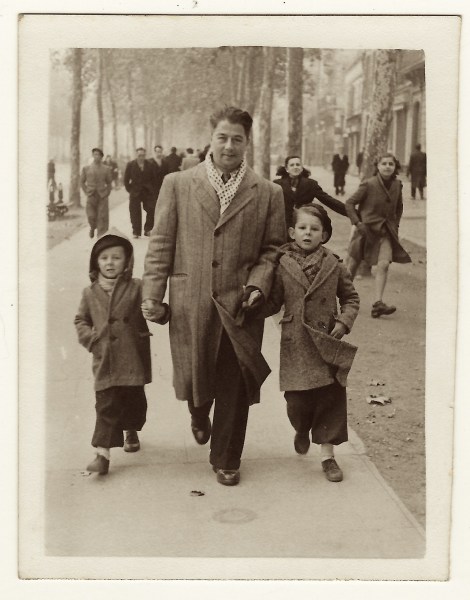
 This snap shot photograph tells a story. It may go something like this. It is a cool winter day in France. Its 1966. A handsome father puts on his winter coat and scarf, bundles up his two adorable children, and the family goes for an enjoyable brisk walk down the boulevard. They are not alone. A number of pedestrians are occupying the sidewalk. The man and his children are well dressed and appear fairly affluent. An inscription, written in French, can be found on the reverse of the photo. Perhaps a visitor to the Cabinet Card Gallery will be able to translate the inscription for the rest of us. The photograph measures about 2 3/4″ x 3 1/2″ and is in very good condition (see scans).

Buy this Vintage Snapshot Photograph (includes shipping within the US) #2961
To purchase this item, click on the Pay with PayPal button below
$17.50

Buy this Vintage Snapshot Photograph (includes International shipping outside the US) #2960
To purchase this item, click on the Pay with PayPal button below
$26.00


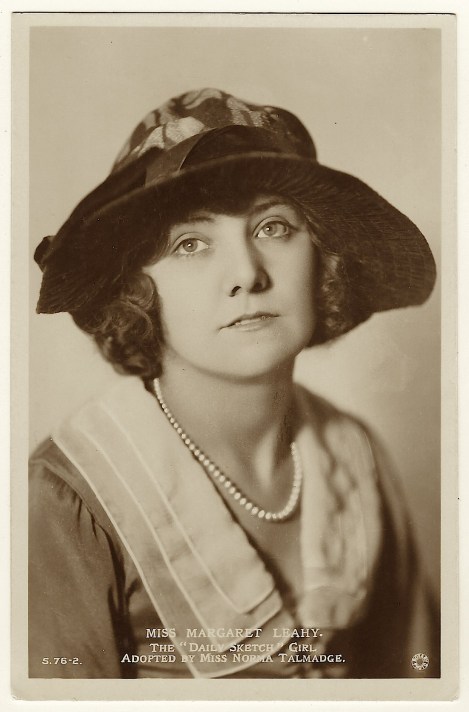 Margaret Leahy (1902-1967) was a British actress. She was born in London. At the age of eighteen, she set up a costume shop and designed women’s clothing. She also modeled her designs for her customers. The story of how she got her start in acting is an interesting one. After winning a beauty contest, she seemed destined for stardom. Unfortunately, despite her rapid launch into filmdom, her career quickly crashed. She made only one film in her short-lived career. The beauty competition occurred in 1922. Actresses, Constance and Norma Talmadge, Joseph Schenck (film studio executive), and Edward Jose (film director) held a beauty contest in England. It’s purpose was to find a new leading lady. The “Daily Sketch”, an English newspaper, offered a starring role in a major Hollywood film to the winner of the contest. Eighty thousand women entered the contest and three girls were chosen to the final competition. The finals were held in Hollywood and Miss Leahy was the winner. Norma Talmadge described Leahy as “the most ravishing girl in England”. Leahy’s start in films was a disaster. She was dismissed from “Within the Law” (1923). The film’s director found her acting talent was nearly non-existent. He threatened to quit unless Leahy was terminated. The year 1923 wasn’t all bad for Miss Leahy. She was named one of thirteen WAMPAS Baby Stars. Evelyn Brent, Eleanor Boardman, and Laura La Plante were among the thirteen. All but Leahy became successful film actresses. Between 1922 and 1934, WAMPAS association supported a promotional campaign that named thirteen young actresses thought to be destined to become stars. Margaret’s next stop was an appearance in a Buster Keaton comedy, “Three Ages” (1923). Leahy received little attention for her role in the movie and her career was stopped in it’s tracks. Leahy did not return to England. Instead she got married and remained in California. She became an interior decorator and was known to despise the movie industry. In fact, she burned all her movie related scrap books. Sadly, Leahy committed suicide at the age of sixty-four in California. This vintage postcard was published by Rotary Photo and printed in England. The postcard is part of a series (no. 5.76.2). The postcard is in very good condition (see scans). SOLD

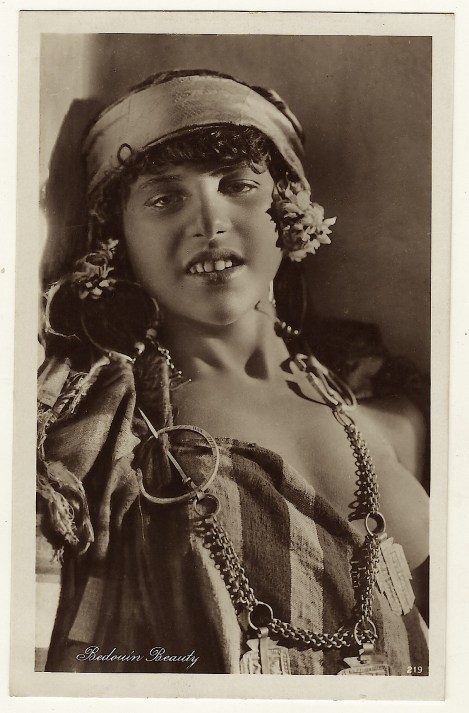 This vintage postcard features a “Bedouin Beauty” with wonderful smile. Everything she is wearing is interesting. Her traditional dress, the flowers in her hair, and her necklace are all intriguing. This postcard offers some sexual provocativeness which was typically seen in ethnographic postcards from this era. It seems that if women from other cultures, or non white ethnicities, were photographed for postcards, than some nudity was acceptable. Western photographers, postcard publishers, and postcard consumers all appear to have been “suffering” from ethnocentrism. The woman in this photo, as stated earlier, is a Bedouin. Bedouins are a group of nomadic Arab people. Historically, they have inhabited the desert regions in the Arabian Peninsula, North Africa, Iraq, and the Levant. This image was produced by the team of Rudolf Franz Lehnert (1878-1948) & Ernst Heinrich Landrock (1878-1966).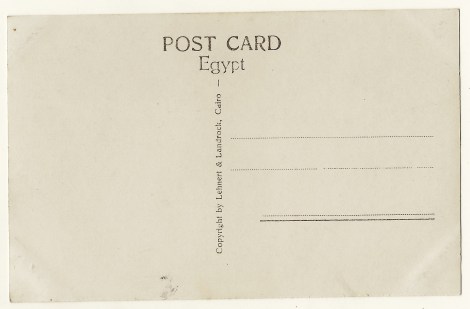
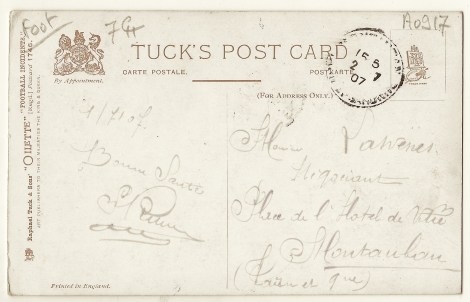
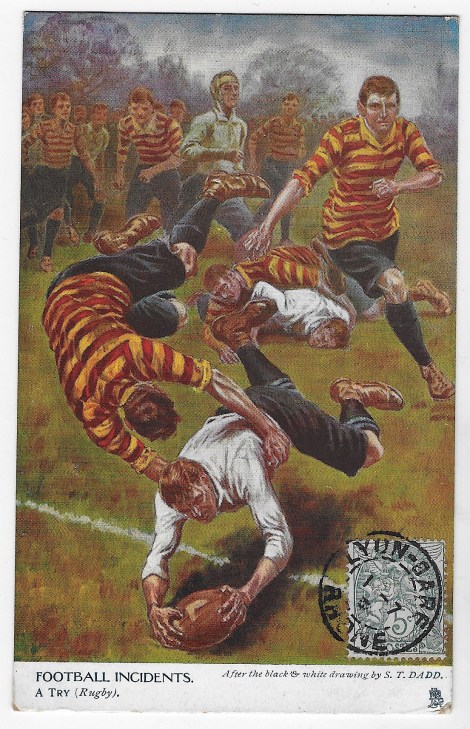 This action packed postcard features a rugby player getting past the defense and making a score (try). In rugby, a “try” earns moret points (5) than other type of scores. A “try” occurs when a player puts the ball down inside the opposing team’s designated area near the goal. This postcard was published by Raphael Tuck & Sons and is part of the “Oilette ” series (no. 1746). Oilette cards are copies of the work of commissioned artists. This postcard is part of a sub series entitled “Football Incidents”, and the card itself is captioned “A Try”. This rugby image was modeled after a black & white drawing by S. T. Dadd. The postcard was postmarked in 1907, but was issued in 1904. Raphael Tuck and his wife started their photography business in 1866 in London. Their store sold pictures, greeting cards, and in time, postcards. Their success came from the sale of postcards during the late 1890’s and early 1900’s. In the early 1900’s the firm conducted postcard competitions for collectors of Tuck postcards. These competitions offered cash prizes and they were very popular. The winner of one of these competitions had a collection consisting of over twenty-five thousand cards. Three of Tuck’s four sons participated in the business. The company was devastated by German bombing during World War II. In 1959 the company merged with two other printing companies. This postcard is in very condition (see scans).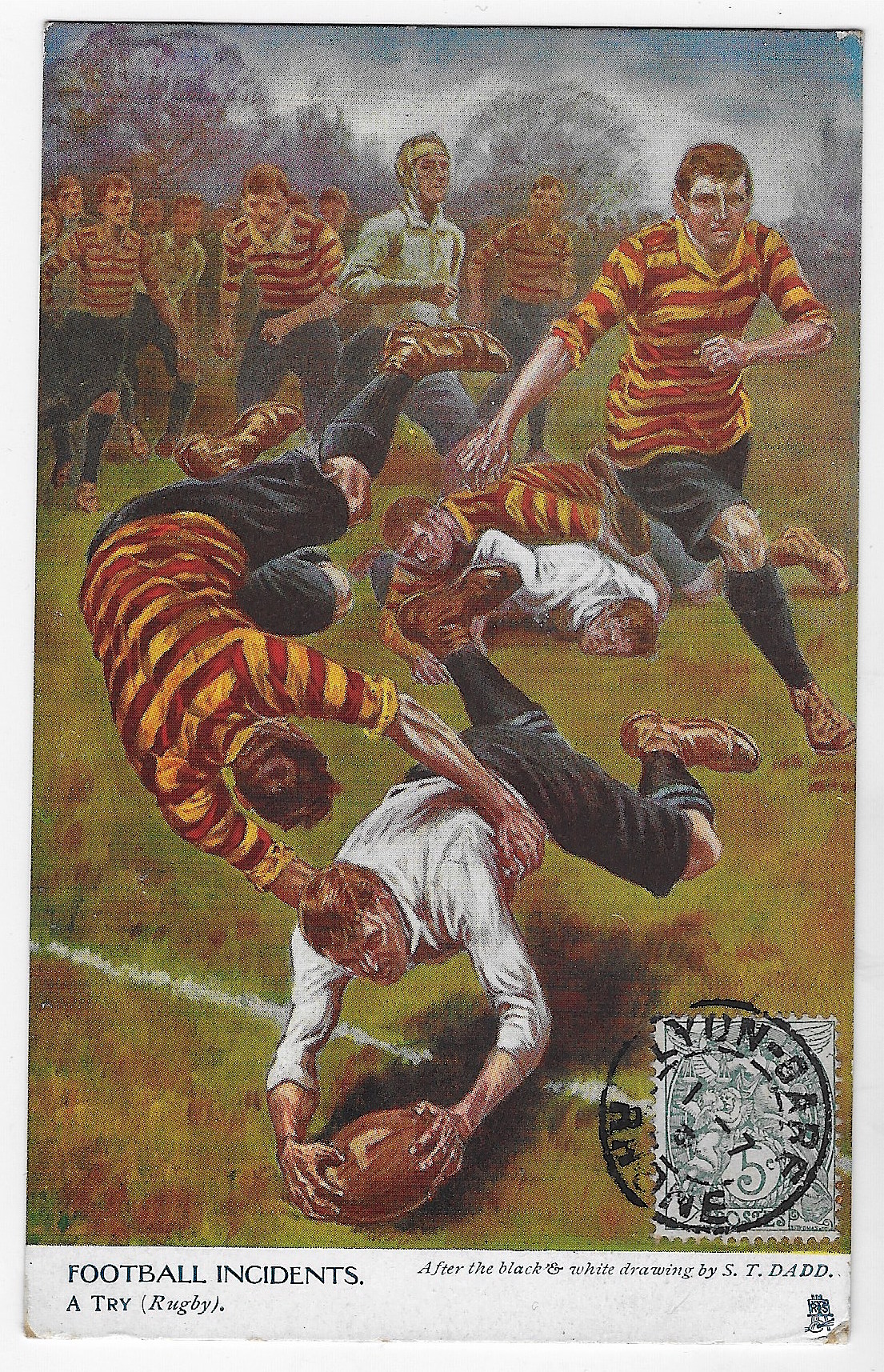
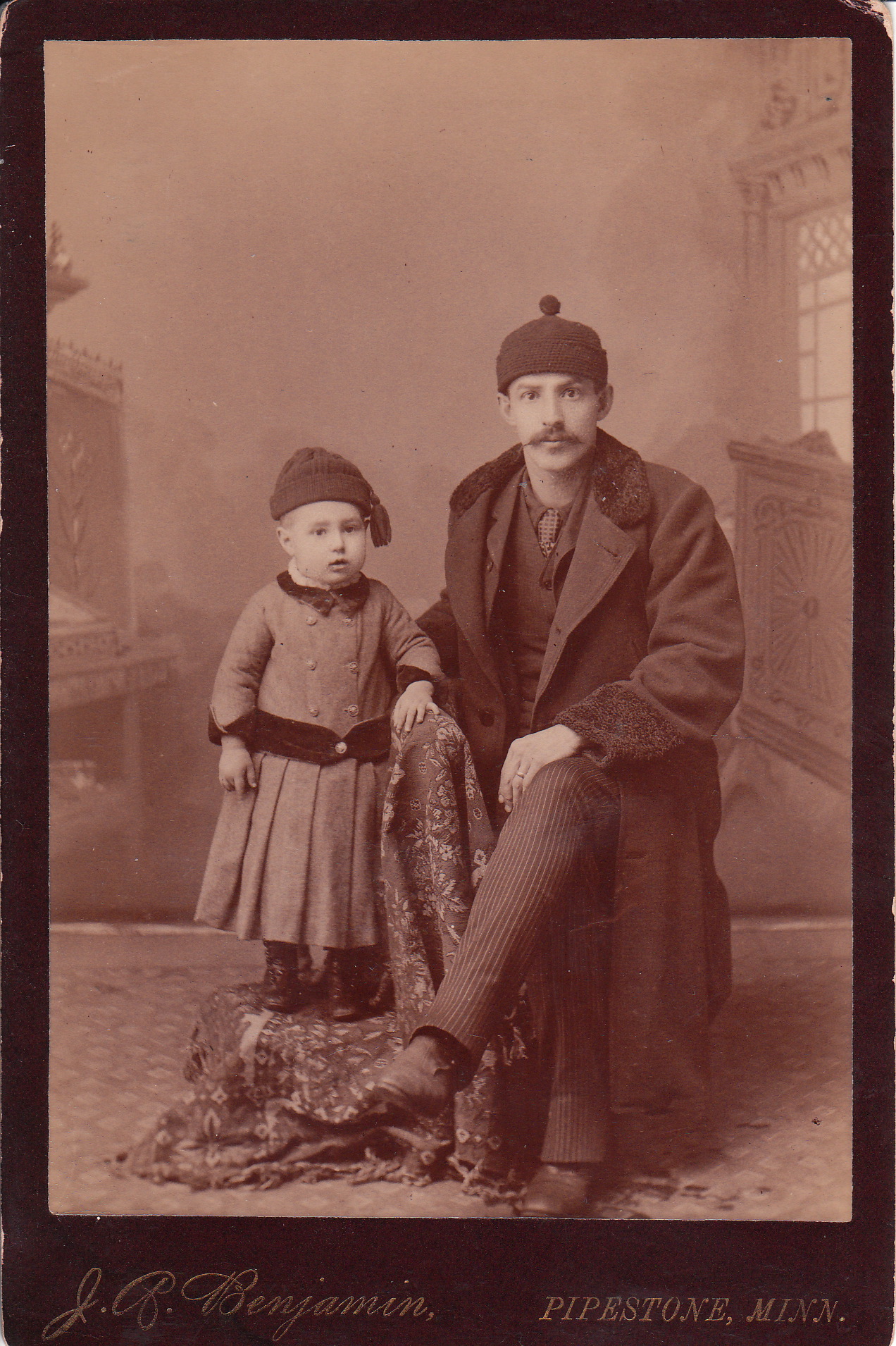
 A father and his child pose in their winter clothing for photographer J. P. Benjamin in Pipestone, Minnesota. Both are wearing outer coats and snow hats. No biographical information could be found concerning the photographer of this cabinet card other than he was active in Minnesota in the 1880’s. Pipestone is located in southwest Minnesota. Henry Wadsworth Longfellow mentioned the beautiful stone area around Pipestone in one of his poems (Hiawatha). The town was established by two settlers who wanted to visit the site mentioned in the poem. A pipestone quarry is located about a mile north of the town and it was named a National Monument in 1937. This cabinet card has a very slight bow and is in very good condition (see scans).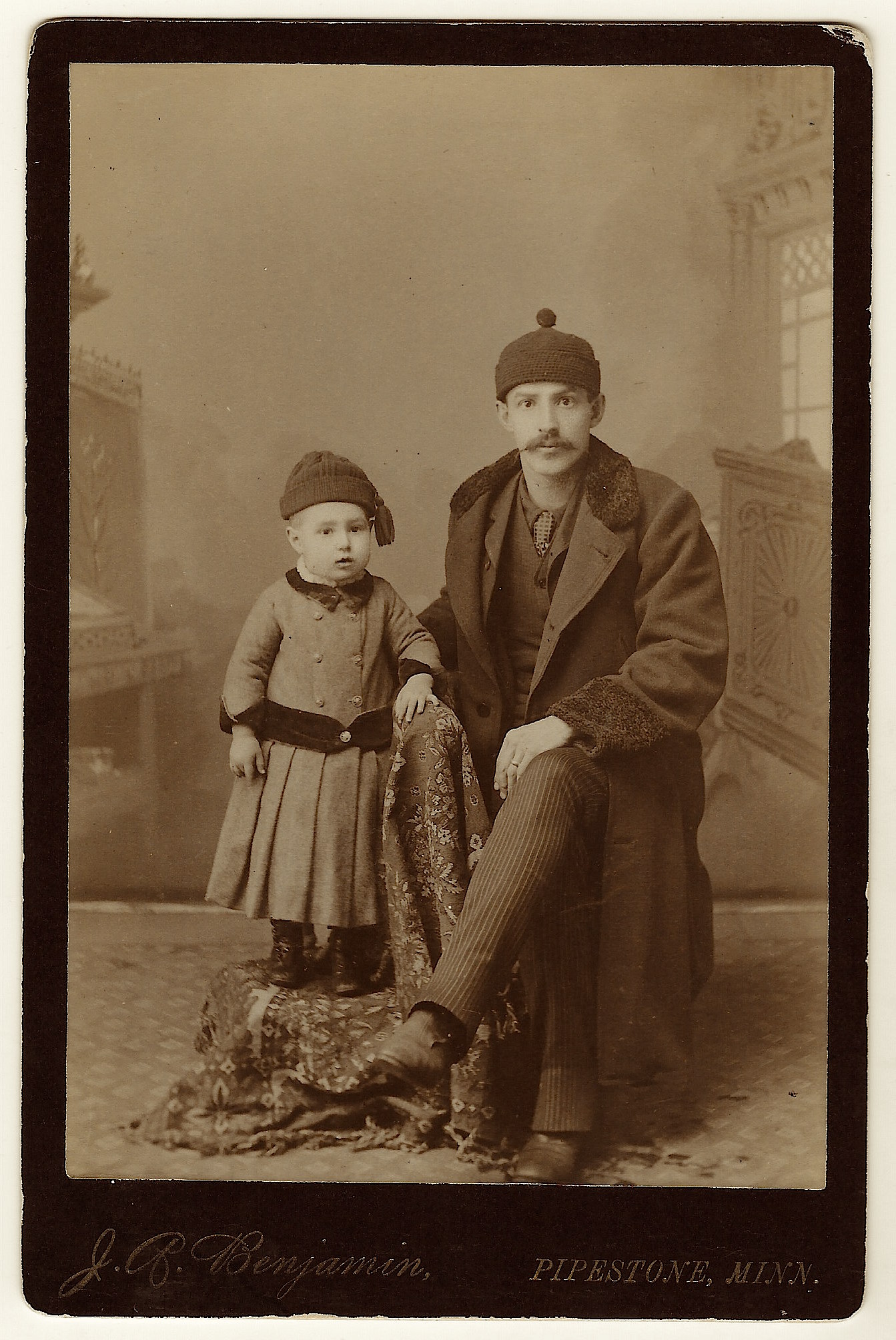

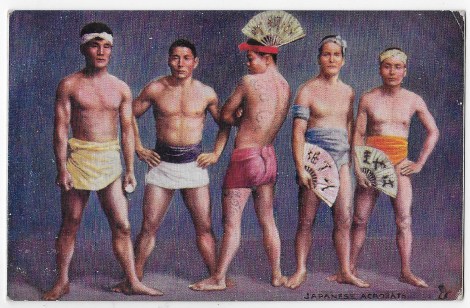 This vintage postcard was published by Raphael Tuck & Sons and is titled “Japanese Acrobats” (no. 6465). The performer in the middle has tattoos on his back, as well as on the back of his left leg. Note the acrobats are holding paper fans and that the center acrobat is wearing his fan on his head. The card is part of a sub-series named “Japanese at Home”. The postcard is also a member of the “Oilette ” series, which was introduced in 1903. The 1930 Tuck catalog states that the oilettes are “veritable miniature oil paintings;” with six designs in a packet. These postcards were printed with the “finest modern colour methods direct from original paintings”. Raphael Tuck and his wife started their photography business in 1866 in London. Their store sold pictures, greeting cards, and in time, postcards. Their success came from the sale of postcards during the late 1890’s and early 1900’s. In the early 1900’s the firm conducted postcard competitions for collectors of Tuck postcards. These competitions offered cash prizes and they were very popular. The winner of one of these competitions had a collection consisting of over twenty-five thousand cards. Three of Tuck’s four sons participated in the business. The company was devastated by German bombing during World War II. In 1959 the company merged with two other printing companies. (SOLD)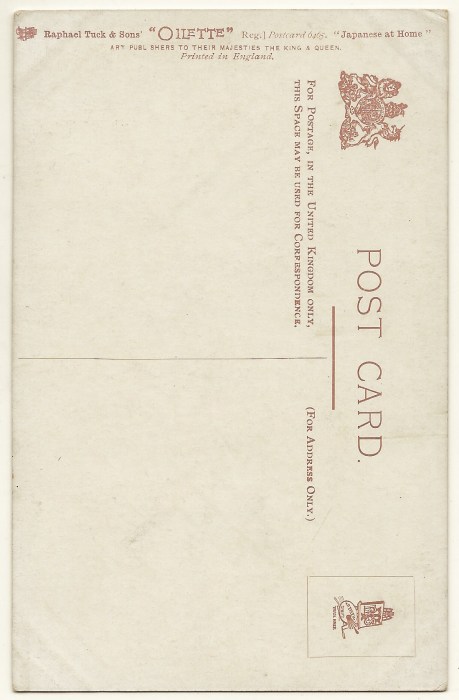
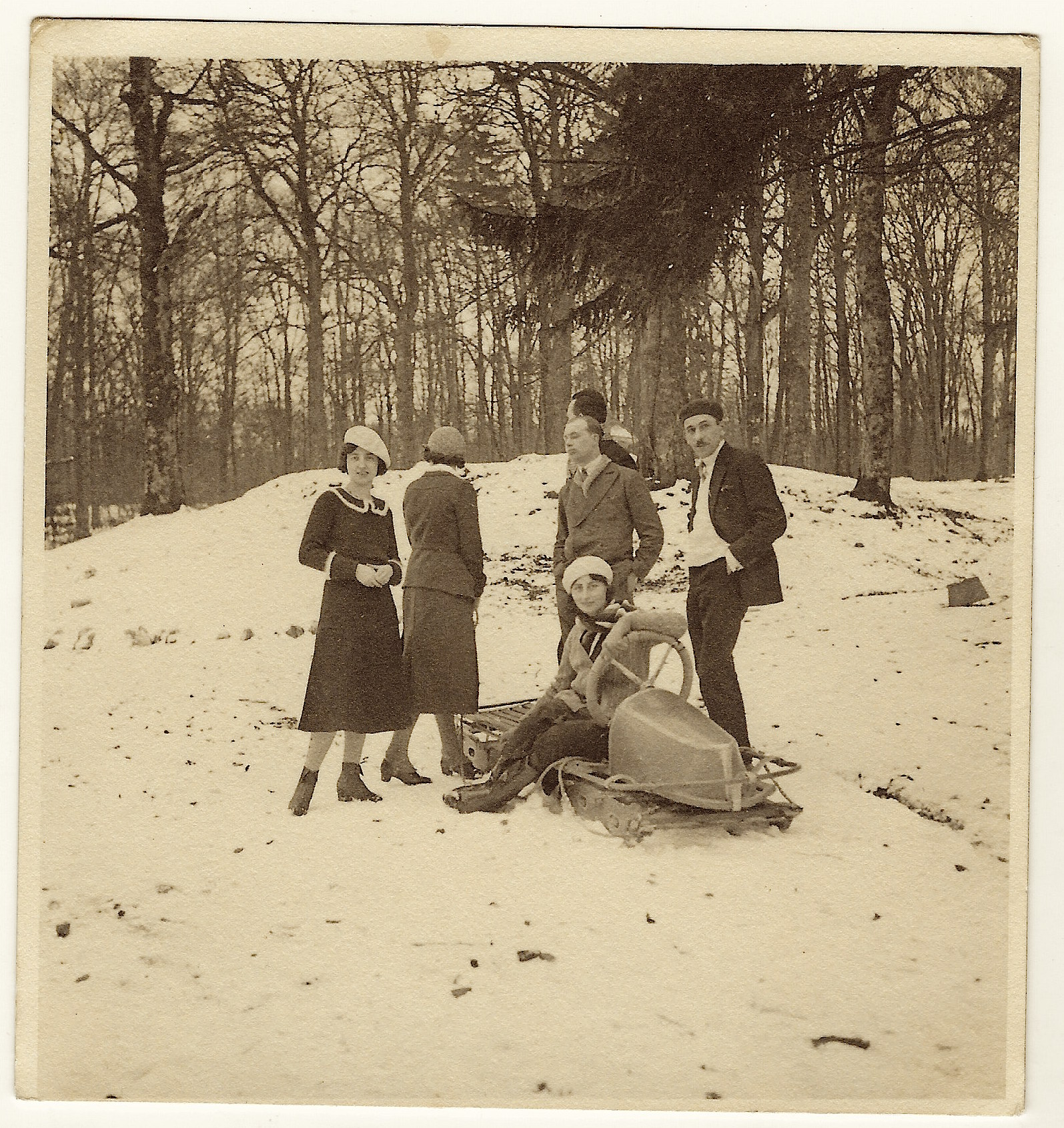
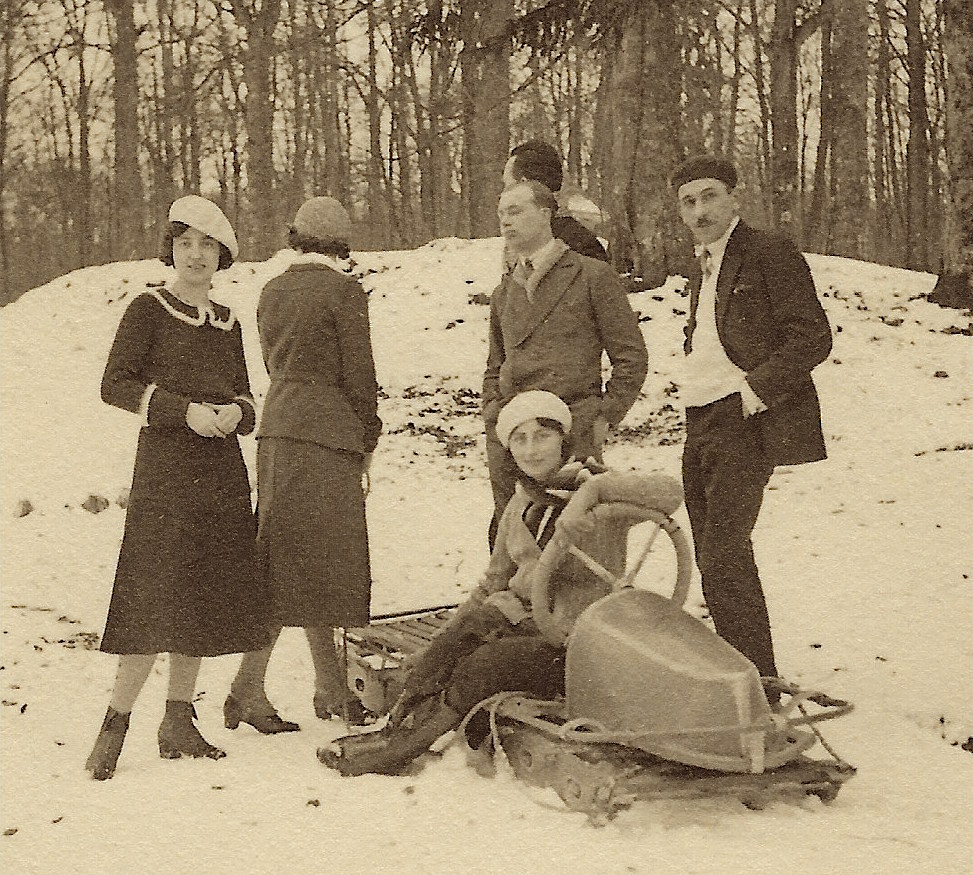 This photograph captures three couples gathered around a “tricked out” sled on a winter day. There is snow on the ground and the woman are wearing weather appropriate footwear. Interestingly, only three of the subjects are paying attention to the camera. It is also notable that the individuals in this image are not dressed for frolicking in the snow. My guess is that they may have been out walking and happened upon the sled. One of them may have thought the sled presented them with a terrific photo opportunity. This photograph, according to an inscription on the reverse of the image, was taken in Spa, Belgium. The photograph was shot at the Chalet de Geronstere in 1933. Spa is a town in the Province of Liege, Belgium. It is situated in a valley in the Ardennes mountains. SOLD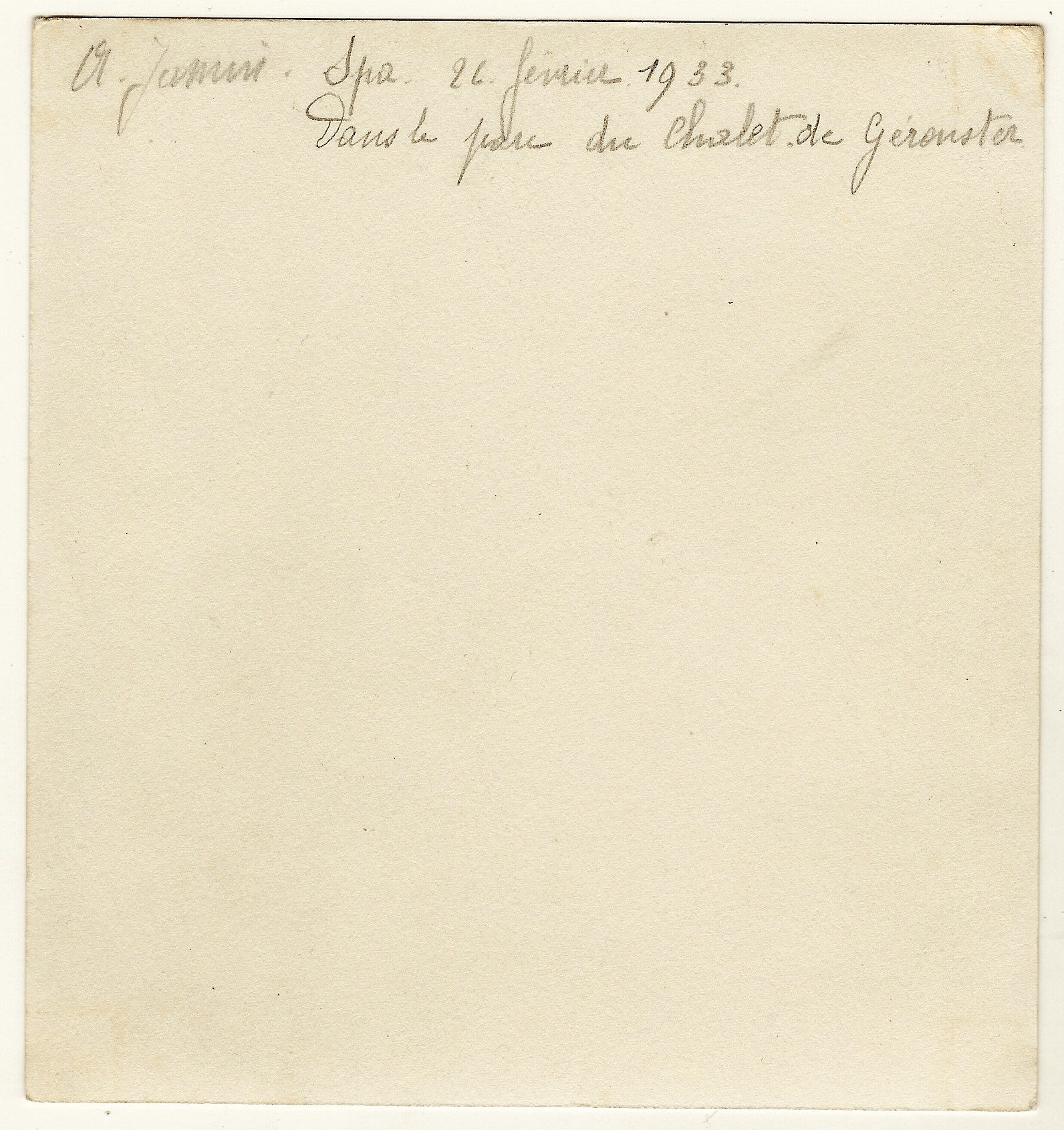
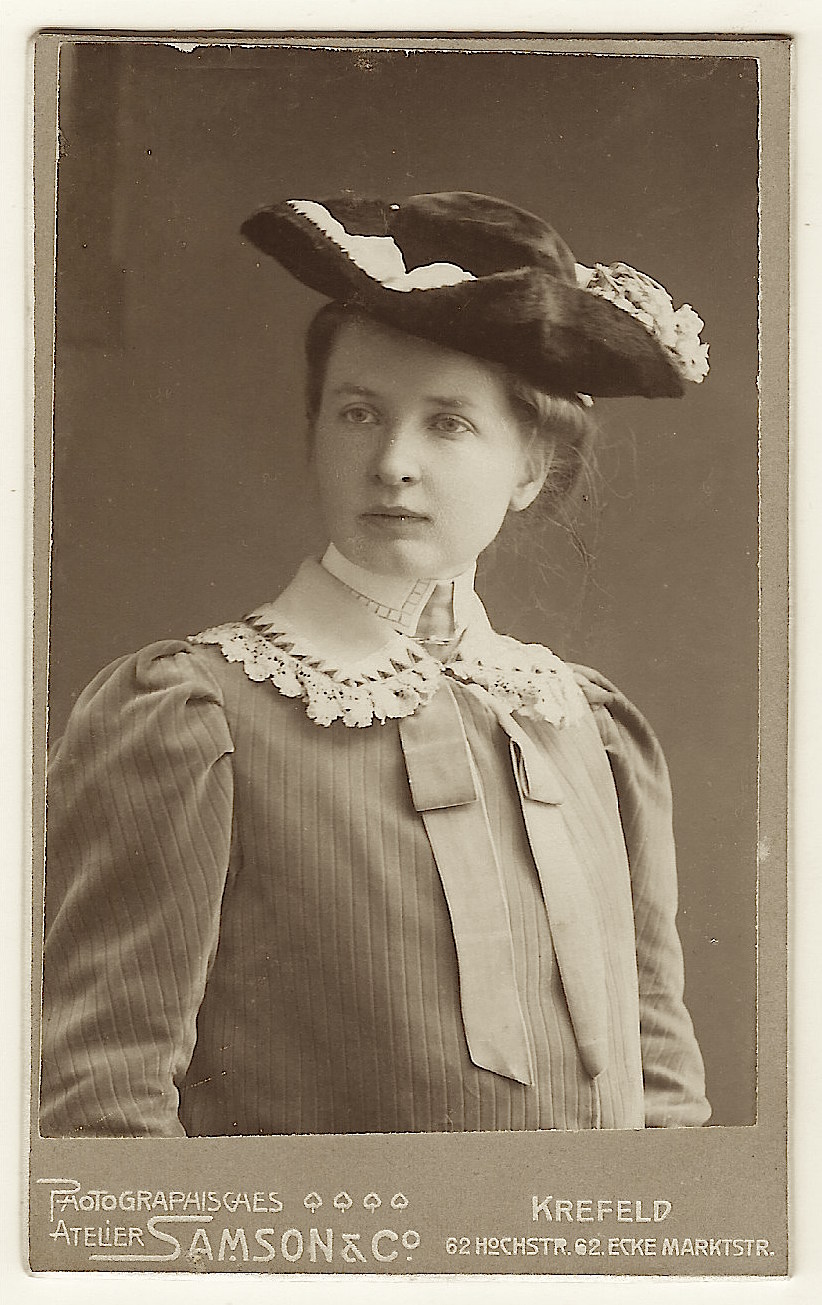
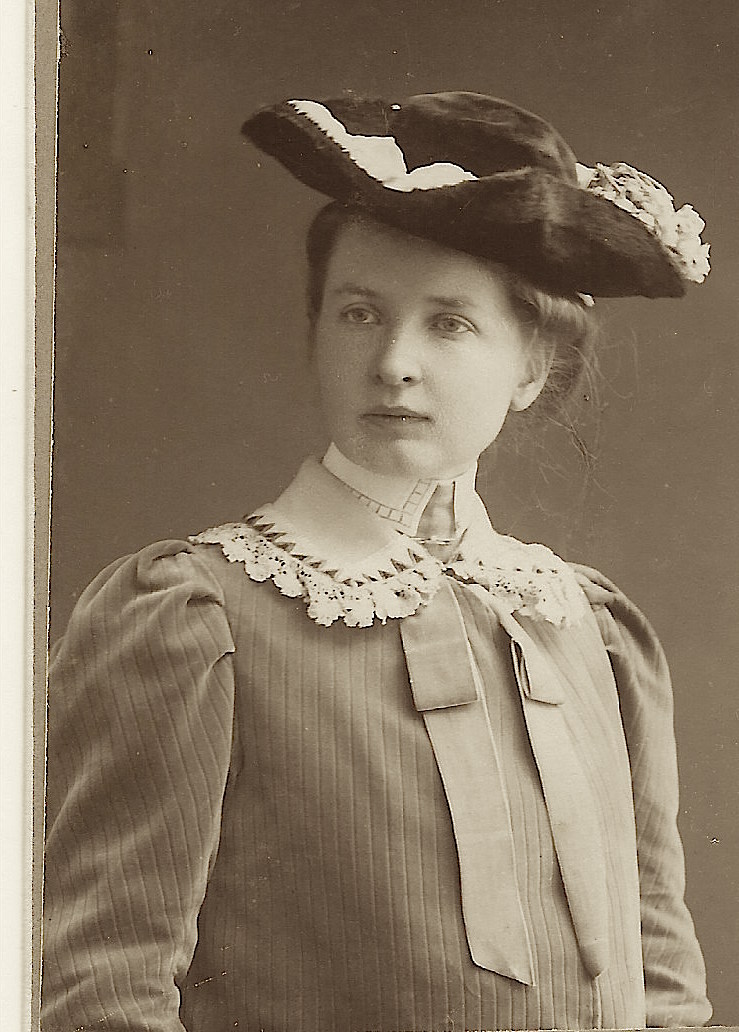 This carte de visite portrait features a a nicely dressed pretty young woman. The top of her dress is quite busy. It includes a high collar, lace trimming, and two wide ribbons. Her dress seems rather large for her figure. Perhaps she had recently lost a significant amount of weight. Another possibility is that she borrowed the dress from the studio’s wardrobe collection. Some photographer’s did in fact provided their subjects with clothing for their photographs. This photo was taken by Samson & Company. The studio operated in Krefeld, Germany. At the time of this writing, the Cabinet Card Gallery had three other German photographs that were taken by “Samson & Co.”. The other Samson photos were taken by studios located in three different German cities (Duisburg, Barmen, and Karlsruhe). I do not know if the four studios were independent of each other, or if they were all owned by the same individual. If they shared an owner, it would mean that “Samson & Son” was like the “Starbucks” of retail German photography. This cdv portrait is in good condition (see scans).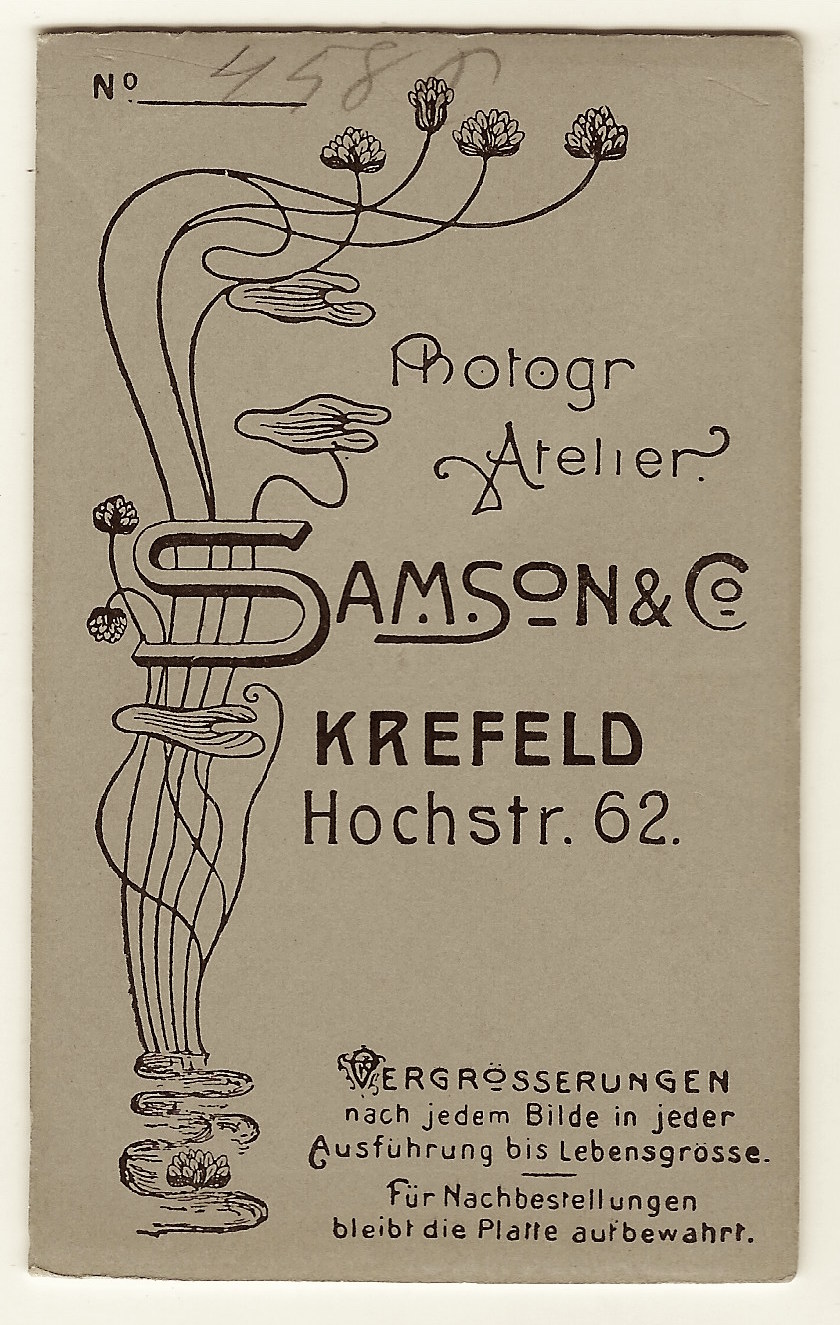
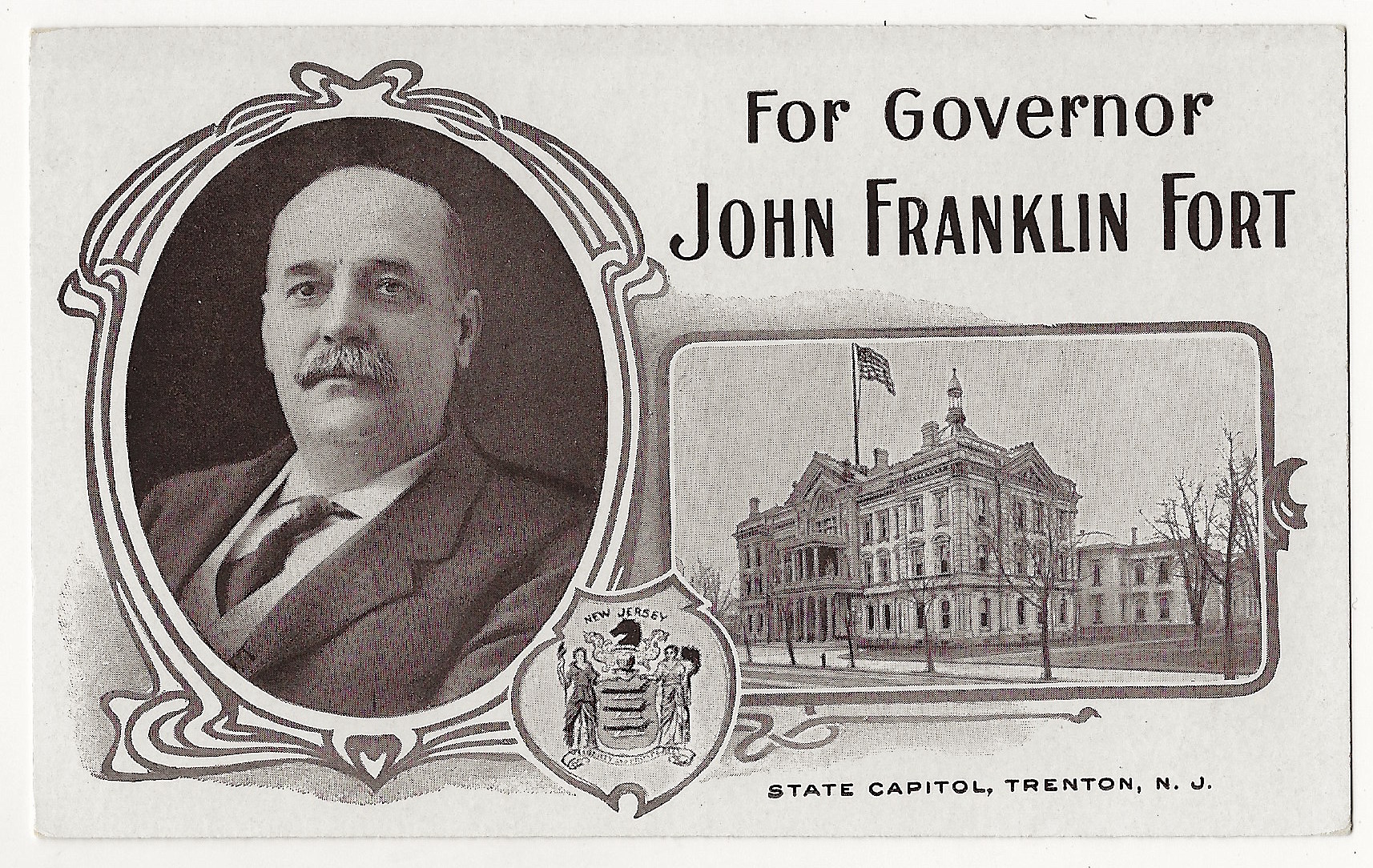
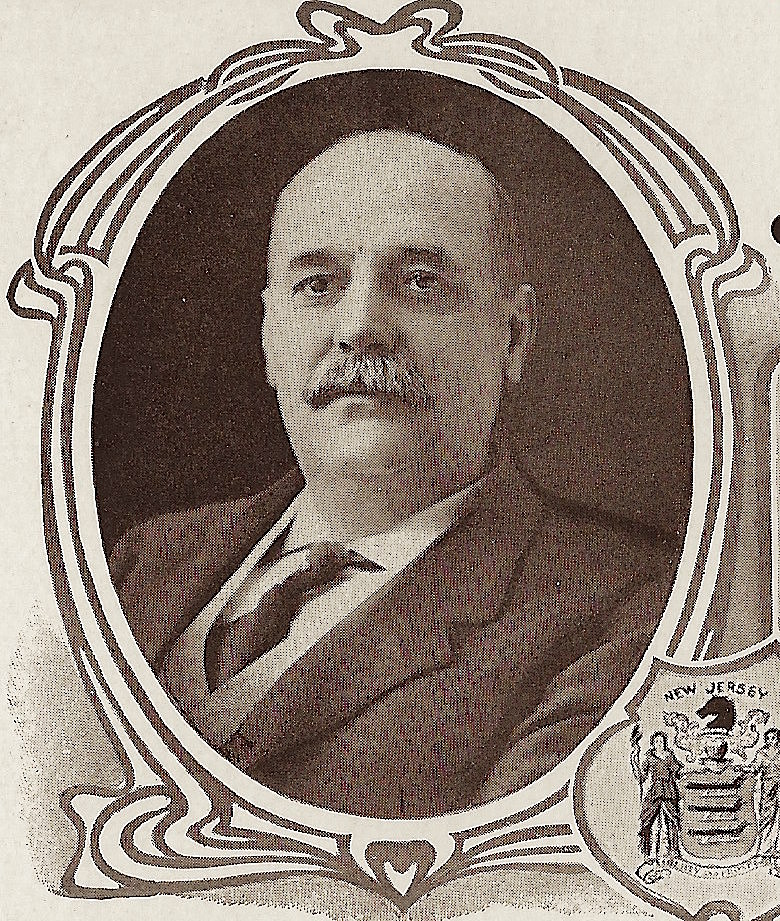 This vintage postcard was employed as advertising for New Jersey Governor candidate, John Franklin Fort (1852-1920). Fort was a Republican and won his race to become the 33rd Governor of New Jersey. He served between 1908 and 1911. He defeated Democrat, Frank S. Katzenbach. In 1908, Fort participated in New Jersey’s first radio broadcast. In 1910 he established New Jersey’s first Department of Education. Fort was followed by Woodrow Wilson in the position of Governor. Wilson went on to become the President of the United States. Fort was a lawyer. He obtained his law degree at the Albany Law School. Governor and ex civil war General, George B. McClellan, appointed Fort to serve as a judge in a Newark district court. In 1884, 1896, and 1912 he served as a delegate to the Republican National Convention. In 1900, he was appointed to the New Jersey Supreme Court. In 1915, Wilson, now President, appointed Fort to the Federal Trade Commission. He held the position for about four years but was forced to resign due to failing health. At one point,Wilson appointed Fort to act as US Ambassador to Haiti and the Dominican Republic. Besides featuring a portrait of John Franklin Fort, the postcard also displays a drawing of the state capital building in Trenton. It is interesting to note that


 THE CABINET CARD GALLERY