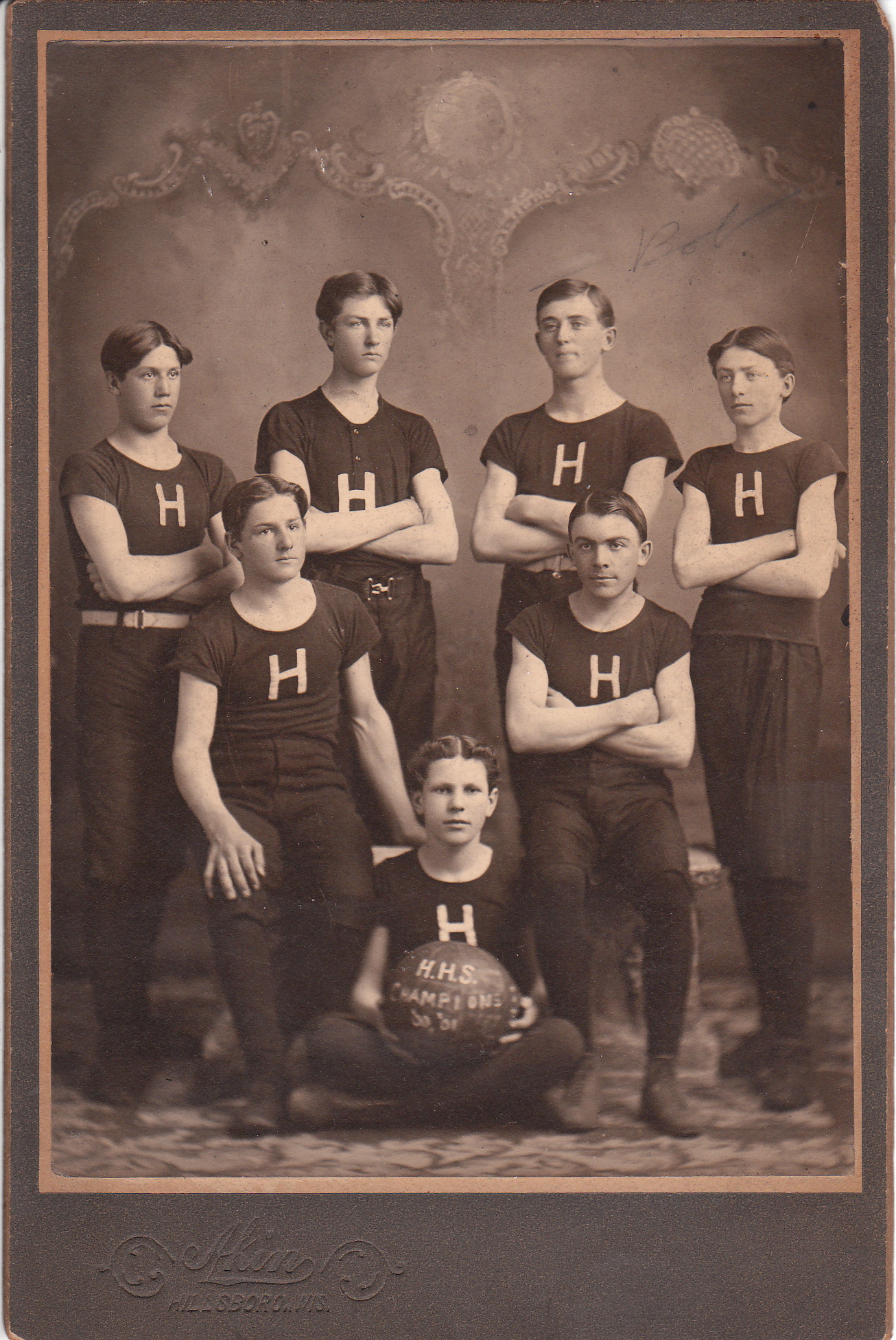
This photograph features the Hillsboro High School basketball team. The team proudly poses with a trophy basketball marking their championship season of 1900-1901. The name “Bob” is written above the second boy to the left in the back row. Could any of these boy been future Wisconsin Badger basketball players? It is certainly a possibility that one of these guys may have played college basketball with the Badgers. The Wisconsin Badger basketball program played their first game in 1899. In 1906-1907 season they won their first share of a Big Ten championship.The likely photographer of this image is Earle D. Akin. The town of Hillsboro was named for early settler Valentia Hill and his brothers. They arrived in the area beginning in 1850. Many of the earliest settlers were of German descent. They were followed by many Czech settlers and in fact, Hillsboro was known as the “Czech Capital of Wisconsin”. When the town was settled, it did not take much time for a saw mill to arrive, followed by stores , a blacksmith, a hotel, and a school, as well as a grist mill established along the Barabee River. In the 1880’s dairy farms and a creamery began business in Hillsboro.
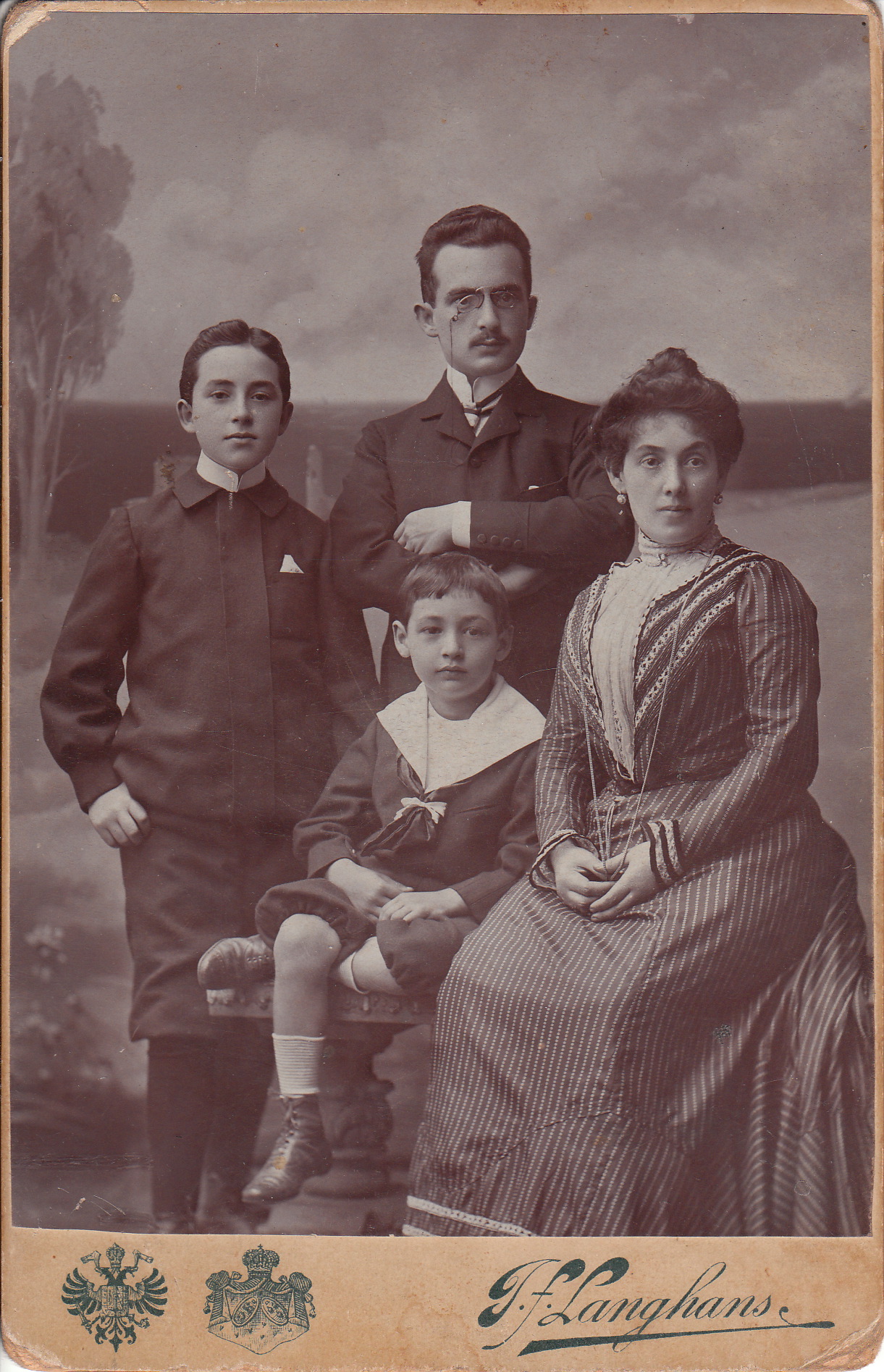
ATTRACTIVE FAMILY IN PRAGUE, CZECHOSLOVAKIA (PORTRAIT BY LANGHANS)
This cabinet card features an attractive family posing for their portrait at the studio of J. F. Langhans in Prague, Czechlosvakia. Mother, father, and their two sons are all beautifully dressed. Father appears to be small of stature and looks quite austere with his hands folded across his chest and his stern facial expression. The children in this photograph seem significantly more relaxed than their parents. Take note of the style of father’s eye glasses Jan Langhans (1851-1926) is the best known figure in Czech photography and his gallery is still in existence. There is a wealth of information about Langhans online at the “Langhans Archive”. The site provides biographical and historical information as well as the “Gallery of Personalities”. The gallery has photographs of many prominent Czech citizens as well as well known visitors to Czechoslovakia.. These portraits date from 1890 through 1948. The studio was founded by Jan Langhans, who was a food chemist by training but developed a passion for photography. He opened his first studio in 1876 and was the preeminent portrait photographer of the region. He opened a number of branch studios throughout Czechoslovakia. He photographed many celebrities and aristocrats. After World War I the gallery possessed over a million negatives. He gave the studio to his daughter Marie and her husband Viktor Meisner. After World War II, his grandson Viktor Meisner took over the studio. In 1948, soon after the Communist take-over, the studio was nationalized and most of the negatives were destroyed. Fortunately, more negatives were discovered and they comprise the Gallery’s current collection. To view other photographs by Langhans, click on the category “Photographer: Langhans”.
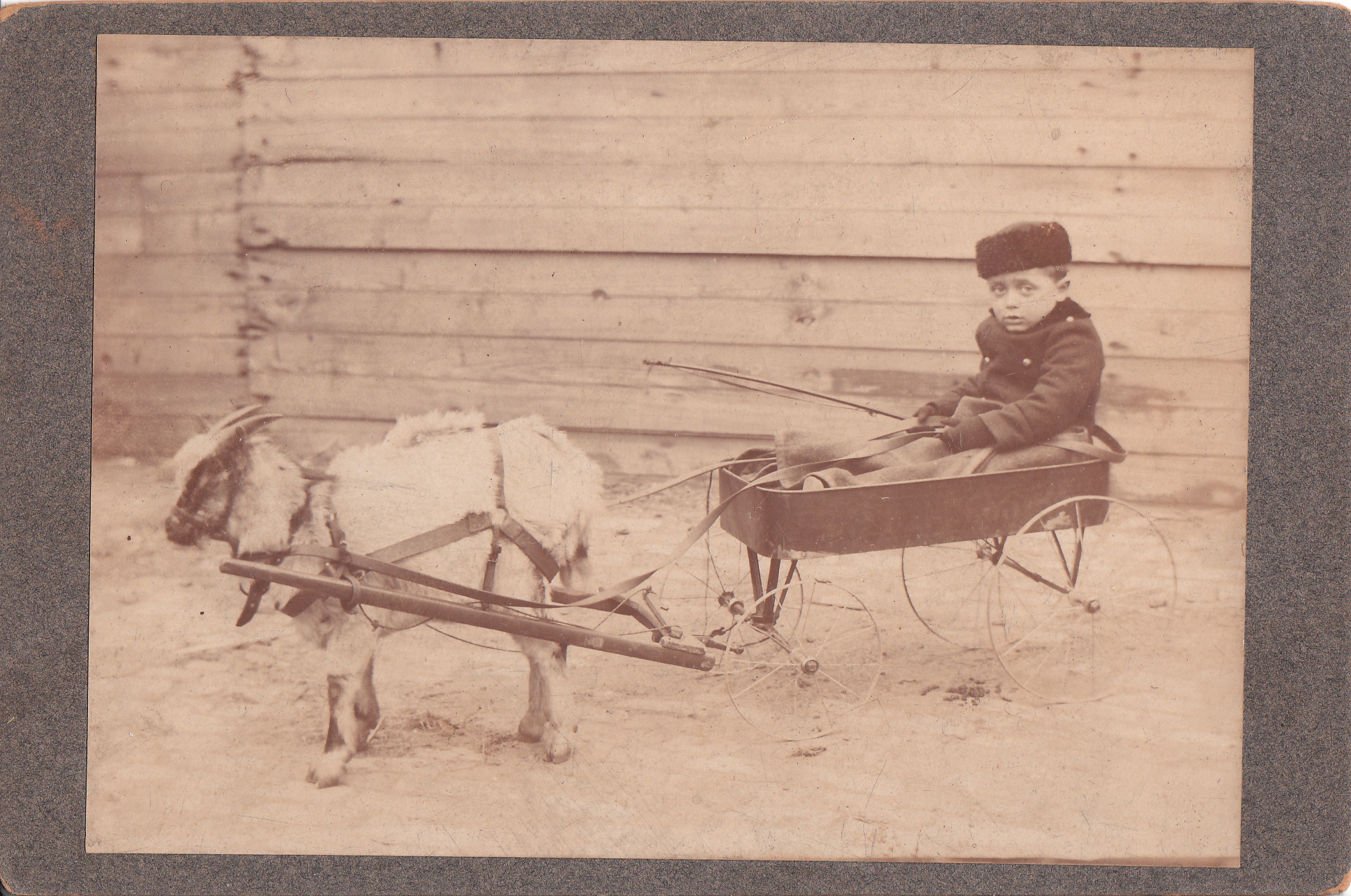
A KID, A GOAT, AND A GOAT CART
This photograph was taken outside and features a kid, a goat, and a goat cart. The child is dressed for cold weather as he sits in the cart holding a whip. The cart is more of a wagon than a cart. Note the large thin wheels. The goat is wearing a harness. The identity of the child and photographer are unknown. The location where the photograph was taken is also unknown. To view other images of goats, click on the category “Goats”.
FIREMAN IN READING, PENNSYLVANIA
Photographer John D. Strunk photographed this young fireman at his studio in Reading, Pennsylvania. The subject is wearing a dress uniform with buttons with the letters F. D. (Fire Department). He has a ribbon and medal pinned to his chest. He is handsome and has a terrific mustache. To view other firemen, click on the category “Firemen and Policemen”. Other photographs by Strunk can be viewed by clicking on the category “Photographer: Strunk”.
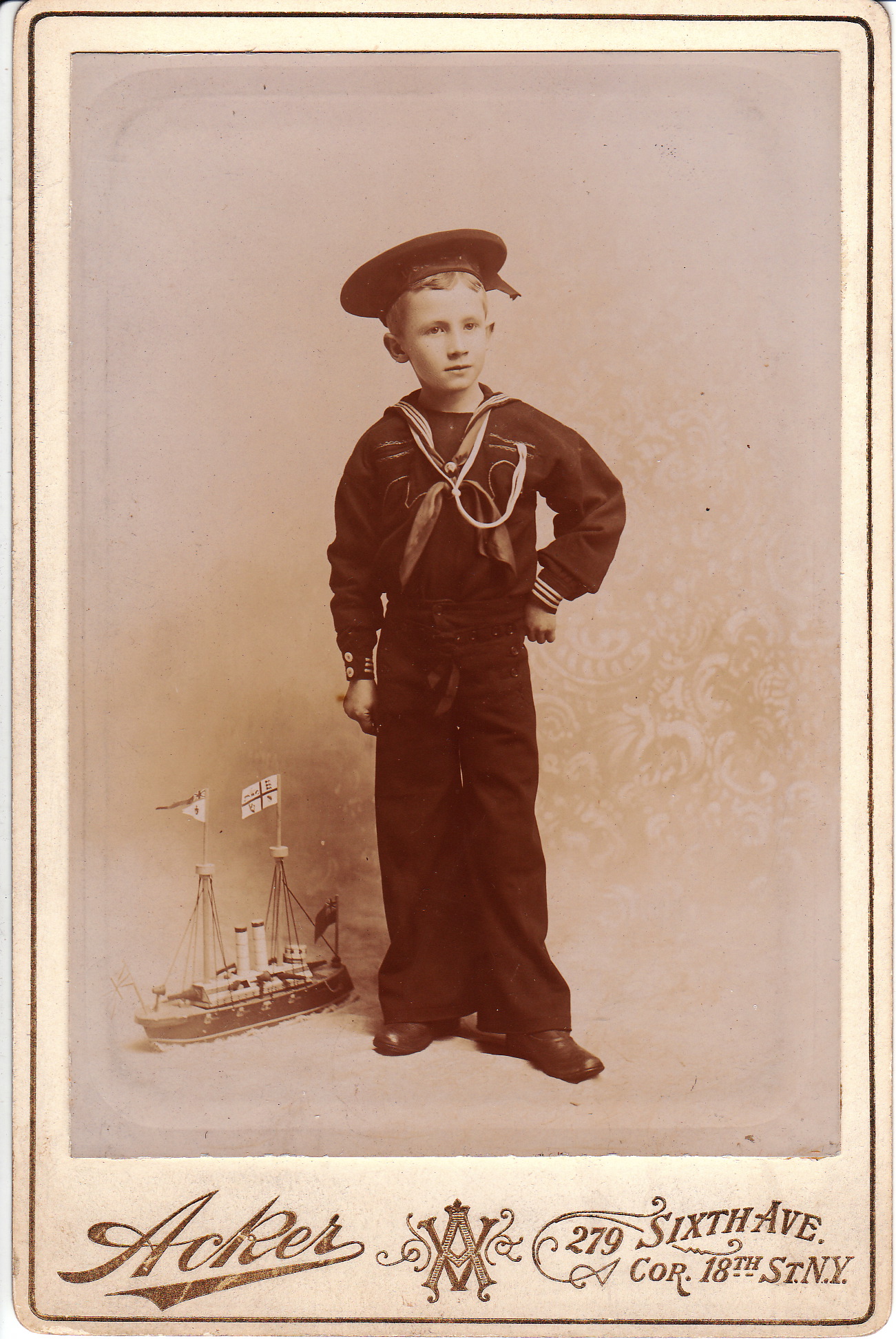
THE LITTTLE ADMIRAL IN NEW YORK CITY: A BOY AND HIS BOAT
A young boy poses proudly wearing a very realistic looking naval uniform. He is standing next to his very detailed toy boat. The ship appears to be a war vessel and appears to be flying a flag similar to the flag of Great Britain. The little admiral was photographed by a New York City photographer named Acker. Perhaps a visitor to the cabinet card gallery can identify the navy represented by the lads uniform and the vessel’s flag. (SOLD)
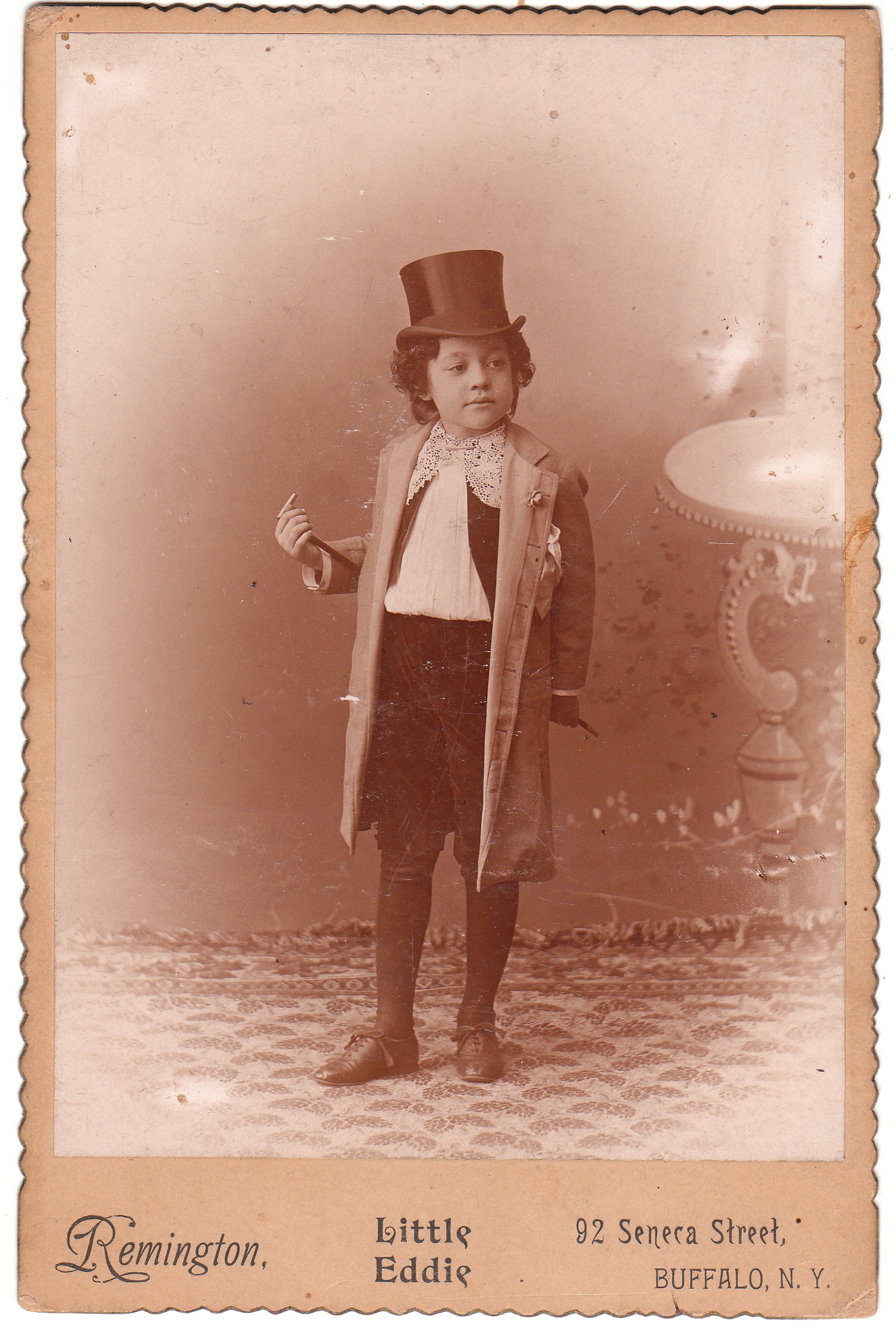
LITTLE EDDIE : WEARING A TOP COAT AND TOP HAT : BUFFALO, NEW YORK : CABINET CARD
Who is Little Eddie? “Little Eddie” is the subject of this cabinet card photograph but research yielded no information about him. In this image, long haired Little Eddie is wearing a top coat and top hat. He is also wearing a lace collar with a triangular bib. He has a flower pinned to his lapel and a white handkerchief in his breast pocket. He is holding a wand type stick. The object has a small handle. The boy in this picture has a look of a showman. Perhaps he wasn’t even a boy but instead an adult midget (the term “little person” was not yet used). The photographer of this image was Edward A. Remington who was a native of Greenfield, Massachusetts and came to Buffalo, New York from Chicago, Illinois. Remington’s obituary appears in The Professional and Amateur Photographer (1909). The article states that he was a “widely known” photographer in Buffalo for 15 years. He left behind a widow, Mrs. Mamie Remington. (SOLD)
PORTRAIT OF IDA PEASE IN BLISSFIELD, MICHIGAN (1885)
This cabinet card portrait features an attractive woman named Ida Pease. At the time of the photograph, she was seventeen years old. She was photographed by Dorus Griffeth Freeman (1848-1936) of Blissfield, Michigan. An inscription on the reverse of the photograph indicates the subject’s name and the date of the photograph (1885). Ms. Pease is wearing dark clothing and her top appears to be velvet. She is wearing a bracelet and a collar pin. Her beautiful figure gets an assist from a corset. Research reveals that Ida Pease was born in 1868 in Michigan. According to the 1880 U.S. census, she was the daughter of Seth and Esther Pease who were both born in New York. At the time of the census, she was 12 years old and her father was working as a farmer. Her brother Richard (age 18) also lived in the household. (SOLD)
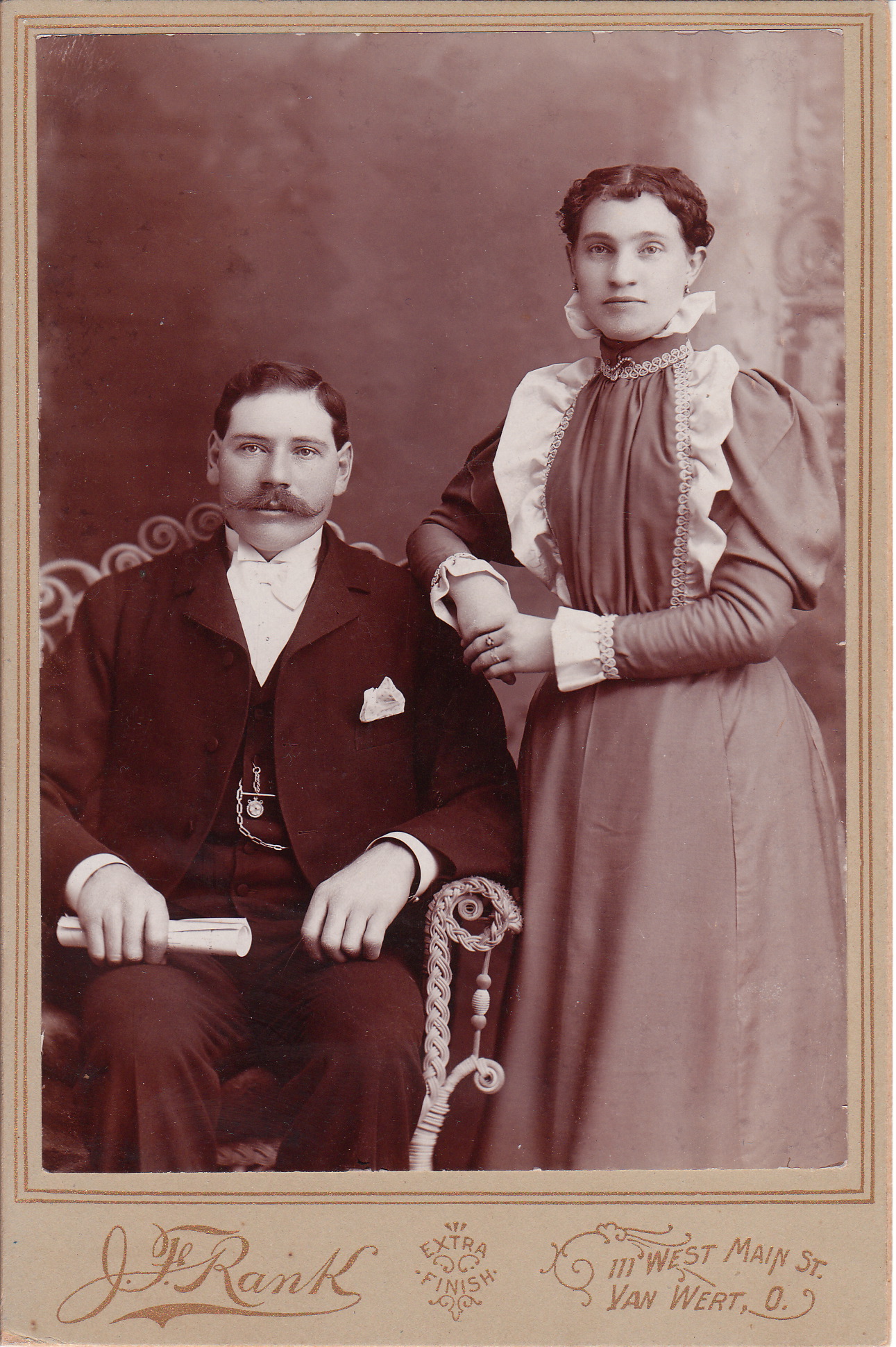
PROUD COUPLE AND A DIPLOMA IN VAN WERT, OHIO
A young couple poses for their portrait in this cabinet card photographed by J. F. Rank of Van Wert, Ohio. The man in the image is holding a rolled document that appears to be a diploma. He is dressed in formal clothing which suggests that the portrait may be a graduation picture. He has a fine handle bar mustache and is wearing a pocket watch. The woman in this picture is nicely dressed and well adorned with jewelry. Jeremiah F. Rank (1847-1913) was born in Shelby, Ohio. He learned the trade of photography from I. S. Hartsock in Van Wert, Ohio, in 1872. After being trained, he quickly bought Hartsock’s studio and operated the business until 1892 when he sold the gallery. After traveling around the United States for two years, he opened galleries in Schuyler and Lincoln, Nebraska. He eventually returned to Van Wert and opened another studio there. In 1874, Rank was married to Mary I. McBride of Oskaloosa, Iowa. To view other photographs by this photographer, click on the category “Photographer: Rank”.
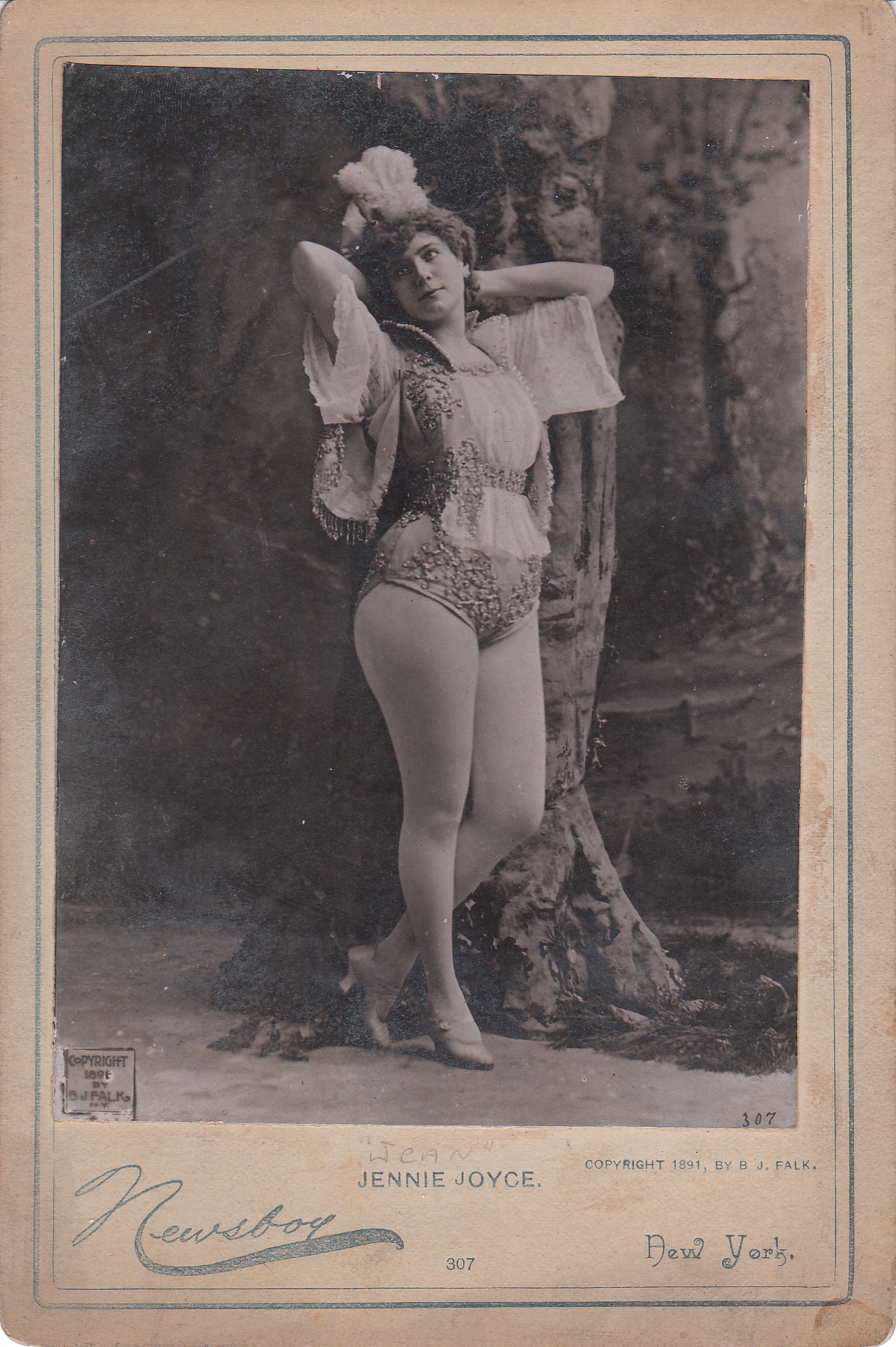
JENNIE JOYCE: TROUBLED STAGE STAR PHOTOGRAPHED BY FALK FOR NEWSBOY
This photograph, by celebrity photographer B. J. Falk, features stage star Jennie Joyce. She was photographed for the Newsboy tobacco company and the image was used as a premium to reward purchasers for buying Newsboy products. The image has a copyright date of 1891 and is number 307 in the Newsboy series. This photograph is risque for its era. Miss Joyce is showing much of her nearly bare legs and is exhibiting a sexually provocative pose. The New York Times (1892) published an article reporting that Jennie Joyce was sued by her husband for divorce. John E. Stanley’s request for a divorce was uncontested. The newspaper described Jennie Joyce as a variety actress and singer. An 1899 article in the same newspaper reported a story about problems in the marriage of Joyce and sportsman Phil Daly Jr.. Daly had told Joyce that he would be out all night but according to plan, returned home at two in the morning only to find his wife with another man (Phillip Wood). Daly fired a number of shots at Wood but missed. Daly’s parting shot was to file for divorce and end his five year marriage. The bad publicity caused by Joyce’s marital problems cause her to speculate in another 1899 Times article that she planned to leave the United States to perform pantomime in London until the fallout from her divorce had diminished. An additional conflict was in the news when the New York Times (1901) printed a story about Joyce successfully suing theatre manager, Alexander Hashim for unpaid salary. Jennie Joyce was clearly a gossip magnet for the press and she provided them with a lot of material. SOLD
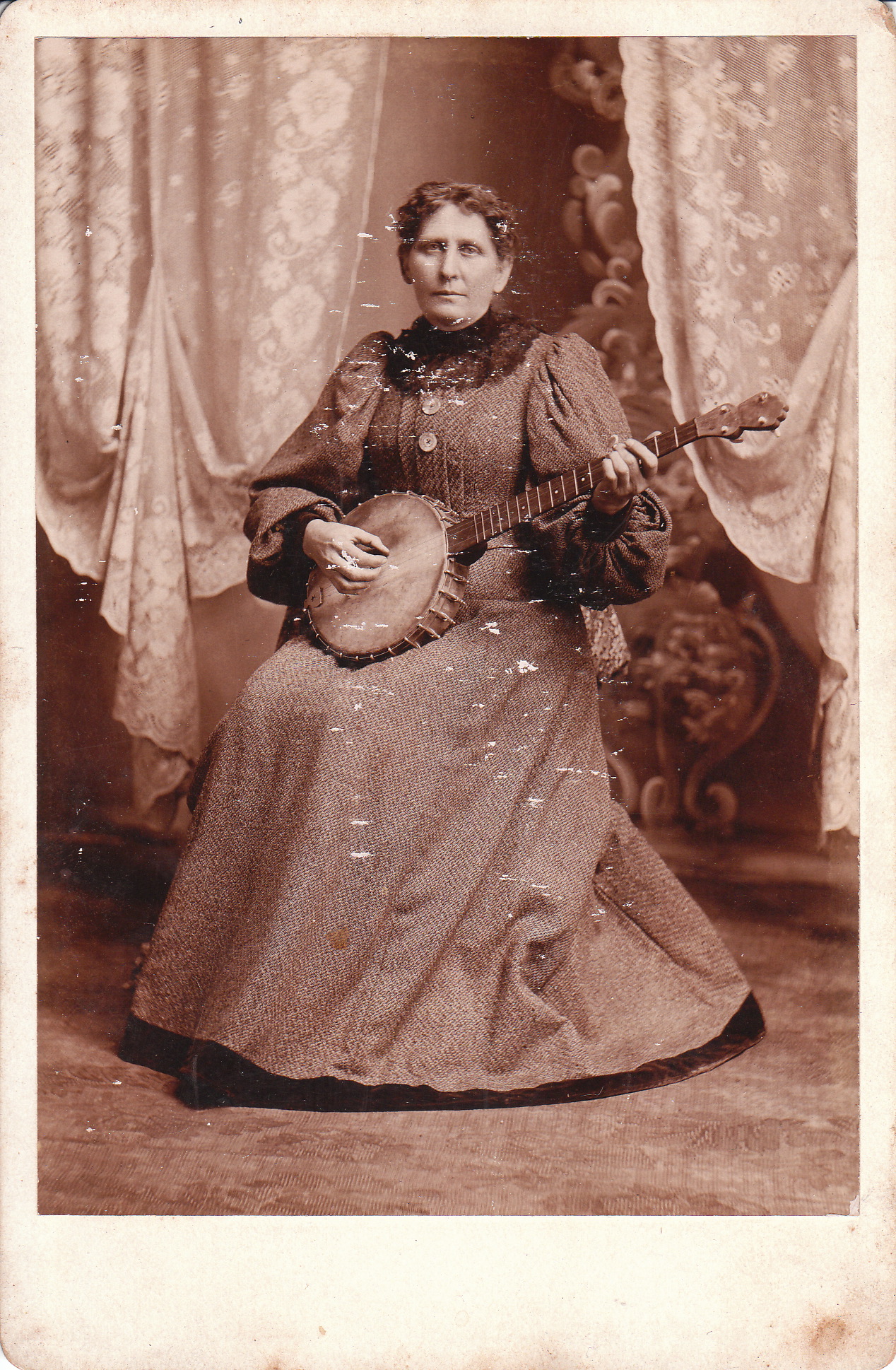
LADY AND A BANJO
A lady and her banjo are the subject of this cabinet card portrait. She is posed as if she is performing. She sits with the banjo on her knees and curtains draped behind her. Although the photograph is marred by age, it is still a spectacular image because it captures the role music played in home entertainment at the turn of the nineteenth century. The performer and the photographer are unidentified. SOLD