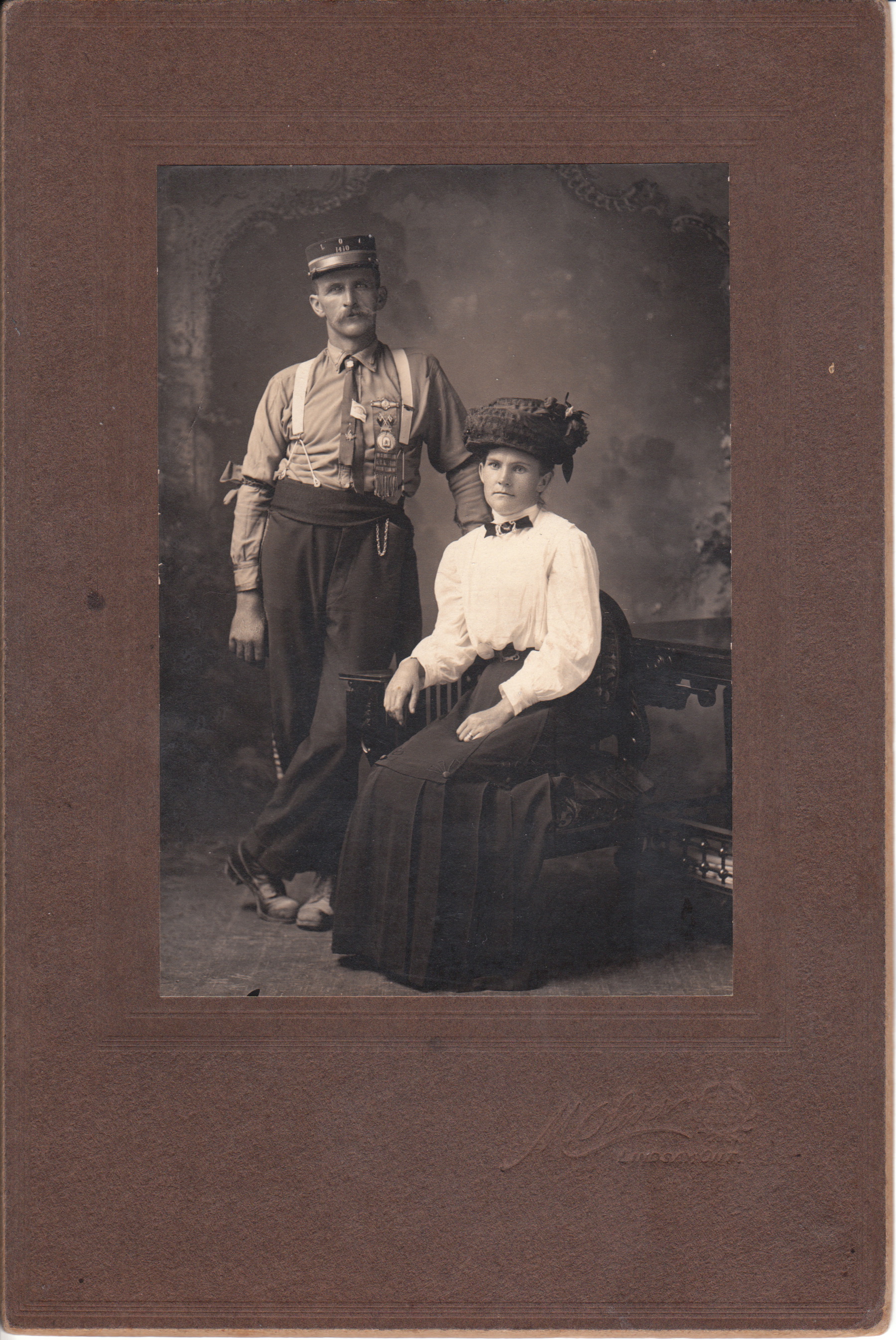
 A middle aged couple photographed by M. Oliver of Ontario, Canada. he is wearing what looks to be a uniform of some sort, maybe masonic. He has a ribbon and pins and looks to be wearing a sash around his waist. His cap is labeled with what may be an id number “1410” and what looks to be “L O I”. He may be a member of a military or fraternal organization or fire or police department.He is wearing terrific suspenders. Lets not forget that his wife is also in the picture. She is wering a nice hat and bow tie with jewelry on her collar. He has ribbons around his sleeves which gives them a bunch look.
CANADIAN COUPLE POSE IN ONTARIO, CANADA (MAN IN UNIFORM OF AN UNKNOWN ORGANIZATION)

EVA McGINLEY: CHARACTER CHANGE ARTIST
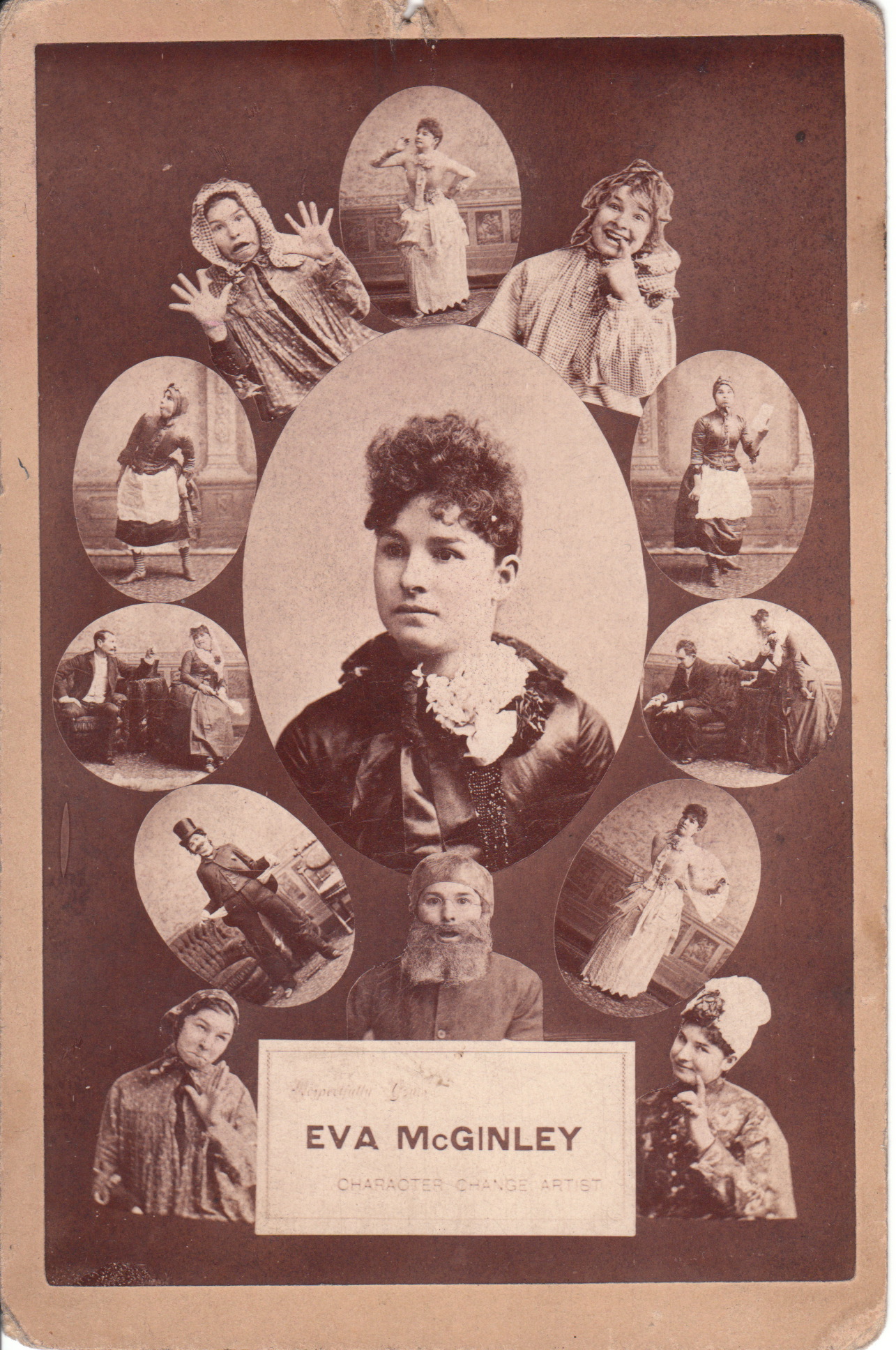 This composite cabinet card features Eva McGinley and is subtitled indicating that she was a “character change artist”. The central portrait on the card shows a prim and proper lady but the image is surrounded by other images displaying Miss McGinley’s versatility and talent to play disparate character roles. Eva McGinley was not a major actress which is apparent by the dearth of information readily available in my preliminary research. However, two newspaper articles were found pertaining to Miss McGinley. The New York Dramatic Mirror (1900) reported that “Eva McGinley’s voice failed her at Greenfield, Iowa last week” and she and her husband Bob went to Omaha to recuperate. A second article appeared in the New York National Police Gazette (1900) which proclaimed that Miss McGinley and her husband were enjoying themselves in Lakeview, Iowa and that she had shot and killed the largest pelican ever killed on Wall Lake. Imagining Miss Mcginley hunting pelicans with a rifle is distasteful to me but it certainly indicates that she really was quite a “character”. The photographer of this image is unidentified.
PRETTY LADY AND HER PARASOL IN CHICAGO, ILLINOIS (IDENTIFIED AS AIDA BUSHNELL)
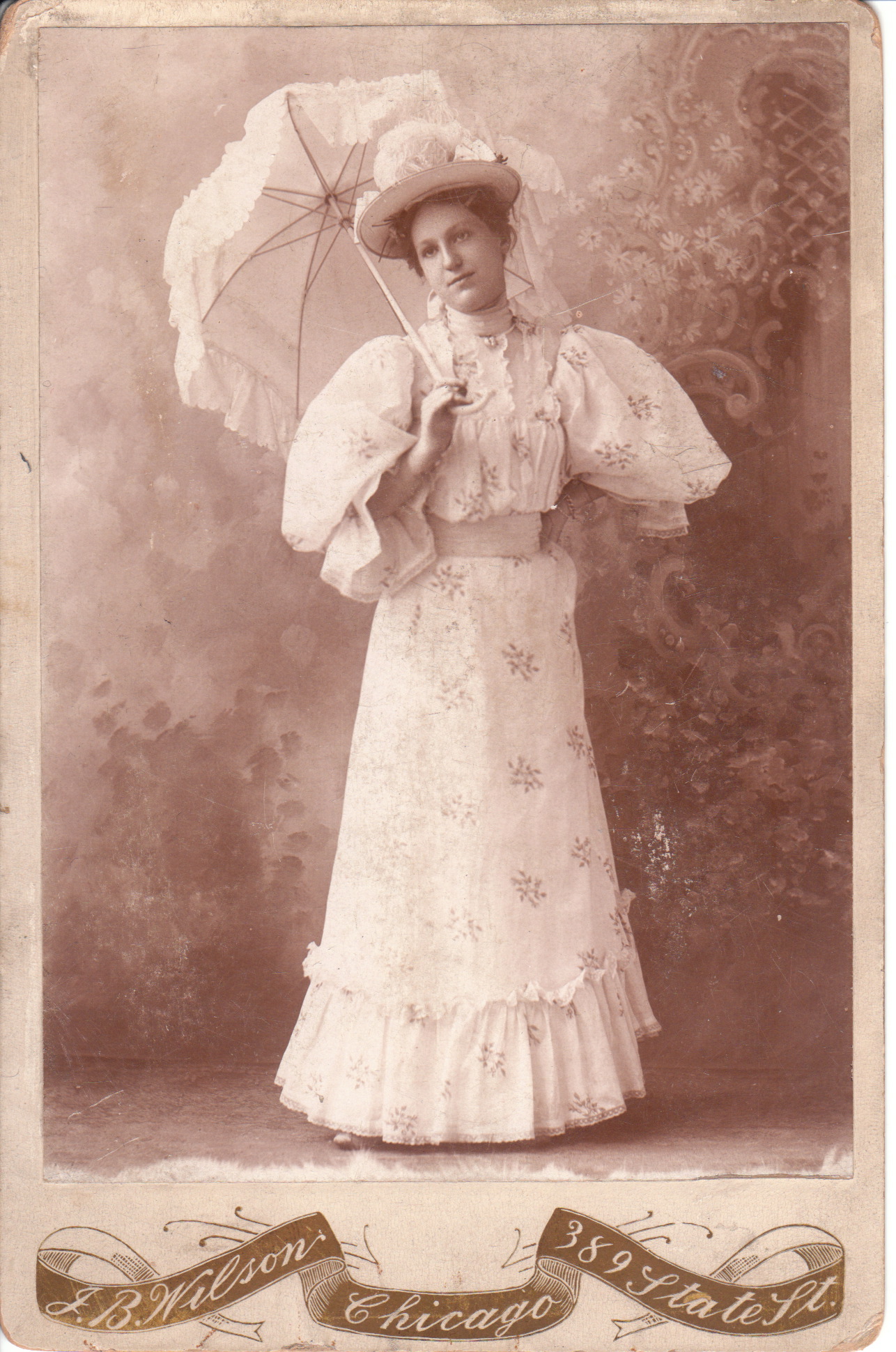 A pretty woman is a stylish dress poses for her portrait at the J. B. Wilson studio in Chicago, Illinois. She is wearing a pretty hat and is holding an open parasol over her shoulder. Her left arm is hidden but magnification shows that she has placed her left hand on her hip. She is thin waisted, probably courtesy of a corset. The reverse of the photograph has an inscription that identifies the young woman pictured in the image. However, the identification is somewhat tentative. The inscription states “Aida Bushnell, I think”. To view other photographs by J. B. Wilson, click on the category “Photographer: Wilson (JB)”. The 1900 US census lists the subject as “Addie” and reports that she was born in 1866 and was married to Henry Bushnell since 1888. She and her husband had three children; Howard (age 11), David (age 8), and Miriam (age 4). Henry worked as a laborer while Addie was a dressmaker.The family was living in Lisbon, Illinois. The 1910 census finds the family living in St. Charles, Illinois. The only child remaining home was Miriam (listed as Marion). Henry still worked as a laborer. The 1920 census identifies Aida as “Ada”. She and her husband were still living in St. Charles. Henry was disabled and not working while Ada was also unemployed. The 1930 census indicates that the 74 year-old Henry and 64 year-old “Addie” remained in St. Charles. The 1940 census reveals that Addie had become a widowed boarder in a St. Charles residence.
OLD MAN AND HIS HORSE AND BUGGY IN NUNDA, ILLINOIS
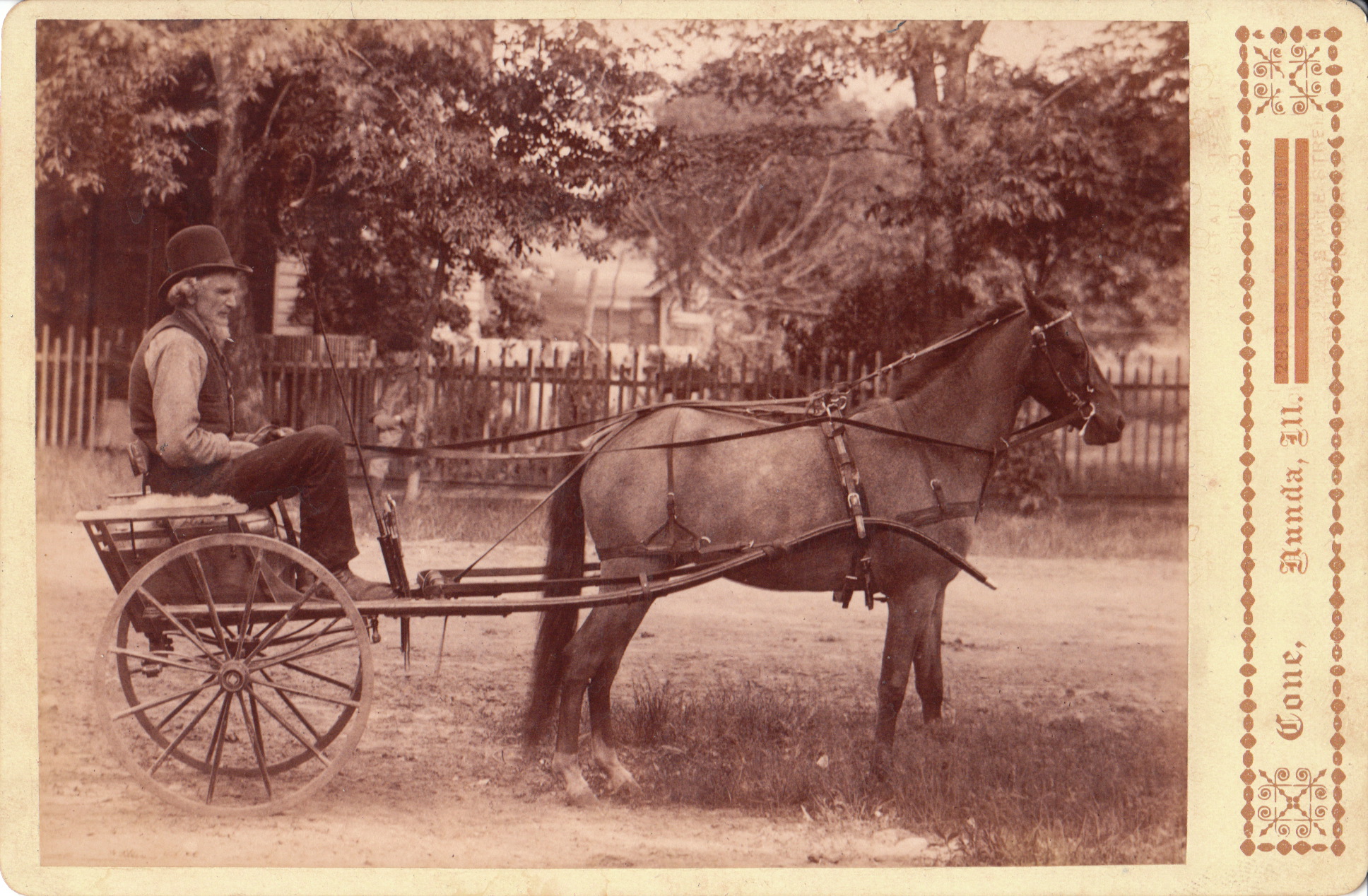 This cabinet card photograph features an old man sitting in his horse drawn cart. Note that the cart has only two wheels. The cart seems to be on a road in front of a fenced house. The gentleman is wearing a derby style hat. The photograph was produced by the Cone studio in Nunda, Illinois. The township of Nunda was established in 1849 and was originally called Brooklyn. In 1850 the name of the town was changed to Nunda to honor a community leader whose birthplace was Nunda, New York. The photographer of this photograph may be Joseph C. Cone. The Portrait and Biographical Album of Fulton County, Illinois (1890) reports that Cone was a Union soldier for three years in Company C of the 103rd Illinois Infantry and became a photographer in Farmington, Illinois. The book also states that he was married to Maria Union. Farmington and Nunda are 190 miles apart and it was not uncommon for photographers of the era to frequently move their businesses from community to community in order to find better economic opportunities. However, Joseph Cone’s identity as the photographer of this image is purely speculative.
TWO GIRLS PLAYING A BOARD GAME ON SEVEN SISTERS ROAD
 This cabinet card photograph captures two girls playing a board game. It would be nice to see the kids of today spending a little time playing board games instead of isolating themselves in front of their computer or video game system. Hopefully, a member of the “vast unpaid research department” of the cabinet card gallery will leave a comment identifying the game that these girls are playing. This photograph was produced by The Eclipse Photo Company which was located at 103 Seven Sisters Road. Where is Seven Sisters Road? Printing on the reverse of the photographs states “103 Seven Sisters Road N.” What is “N”? Perhaps “N” means North or the abbreviation for a City or Province. Research reveals that a “Seven Sisters Road” exists in London, England.
PRETTY YOUNG MOTHER WITH TODDLER SON IN HARTFORD, CONNECTICUT
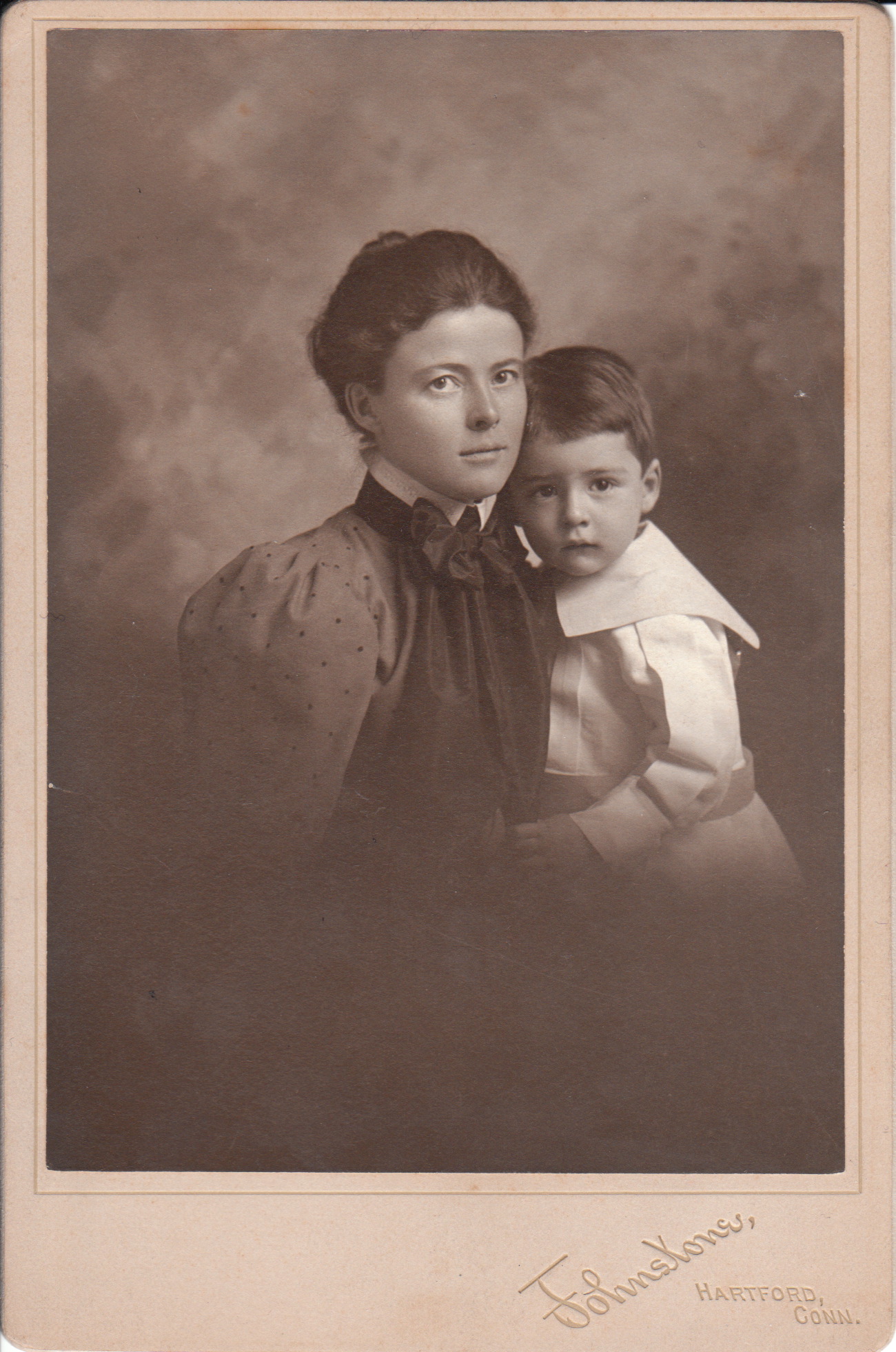 A pretty young mother and her toddler son pose for their portrait at the Johnstone studio in Hartford, Connecticut. Mom is looking at the photographer with a suspicious expression while her son appears quite unhappy and terrified. Photography Journals of this era often contained articles about how to achieve the best photographs of children. Either this child was exceptionally difficult to distract or calm down, or Mr Johnstone was unfamiliar with the aforementioned literature. The 1903 Hartford directory lists Christopher Johnstone as a photographer located at 45 Pratt Street. Wilson’s Photographic Magazine (1904) reports that Johnstone was the President of the Photographers Association of New England.
PORTRAIT OF A SULTRY GORGEOUS YOUNG LADY
 This portrait of a sultry gorgeous young lady must speak for itself. The image has been trimmed and if there was any information on the photograph to help identify the woman or the studio, it is now gone. The woman’s bare shoulders and other exposed areas make this photograph somewhat risque for it’s time. (SOLD)
MAN WITH A TRUMPET IN ALBION, NEW YORK
 A man in a plaid suit, winged collar shirt, and matching vest poses for his photograph at an unidentified studio. He is holding a horn of some kind (Trumpet?, Bugle?, or Cornet?) and wearing a cap which has the lettering “WCB”. I am guessing that the “CB” part is an abbreviation for “community band”. Inscribed on the reverse of the photograph are the following; “Burnette” and “Albion, NY”. “Burnette” is likely the subject’s name and Albion was likely his hometown. Research found too many men sharing the name “Burnette” in Albion to make a positive identification of his name and background. The over zealous previous owned of this cabinet card described the subject as a civil war veteran holding his bugle and wearing his kepi hat. Collectors of antique photographs must be careful of people making such unsubstantiated claims. Call me an optimist, but I think the majority of such people are more unaware than unscrupulous.
LULU GLASER: ROCKET ASCENT FROM UNDERSTUDY TO STAGE STAR
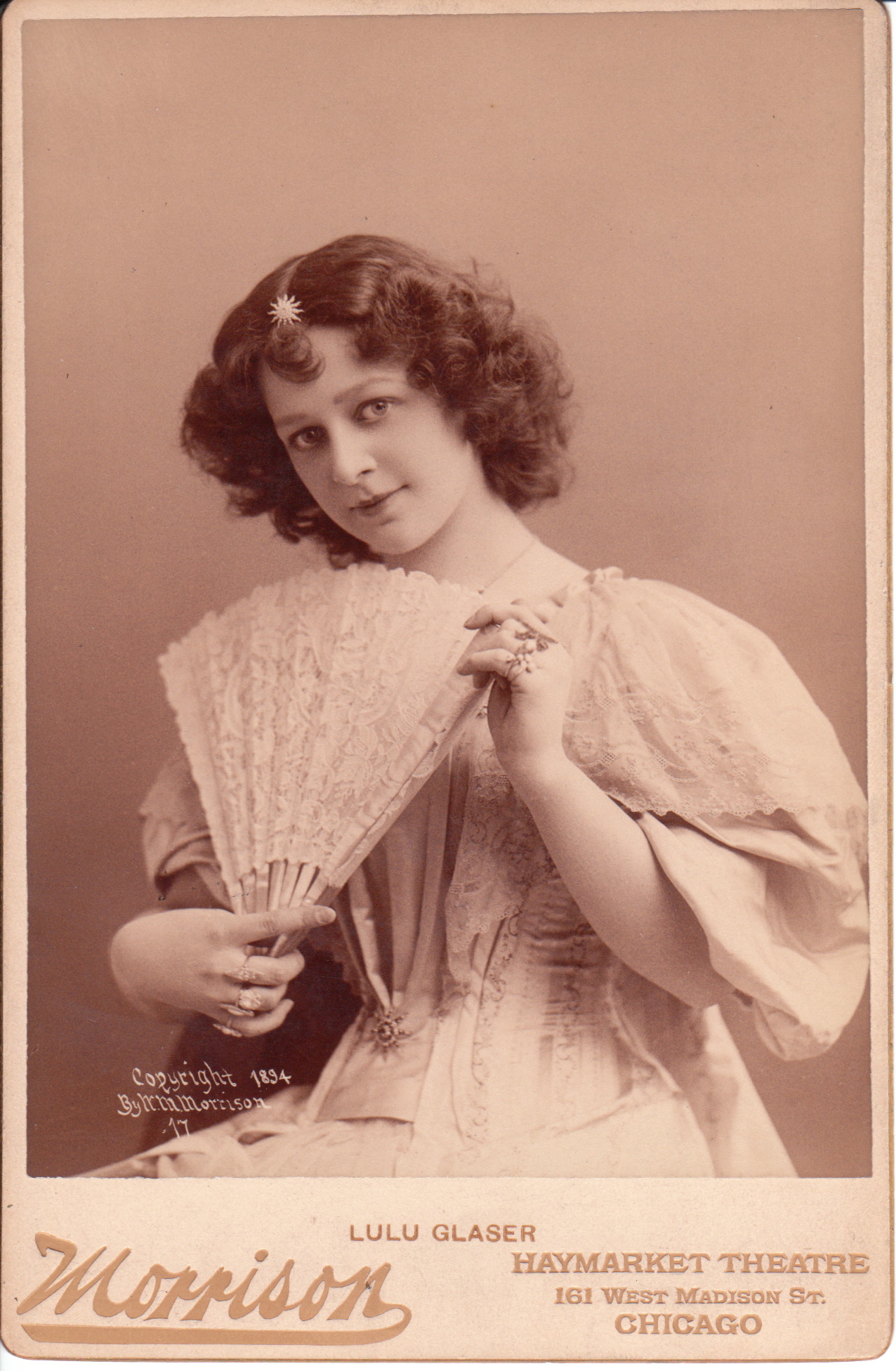 CABINET CARD 1 (SOLD)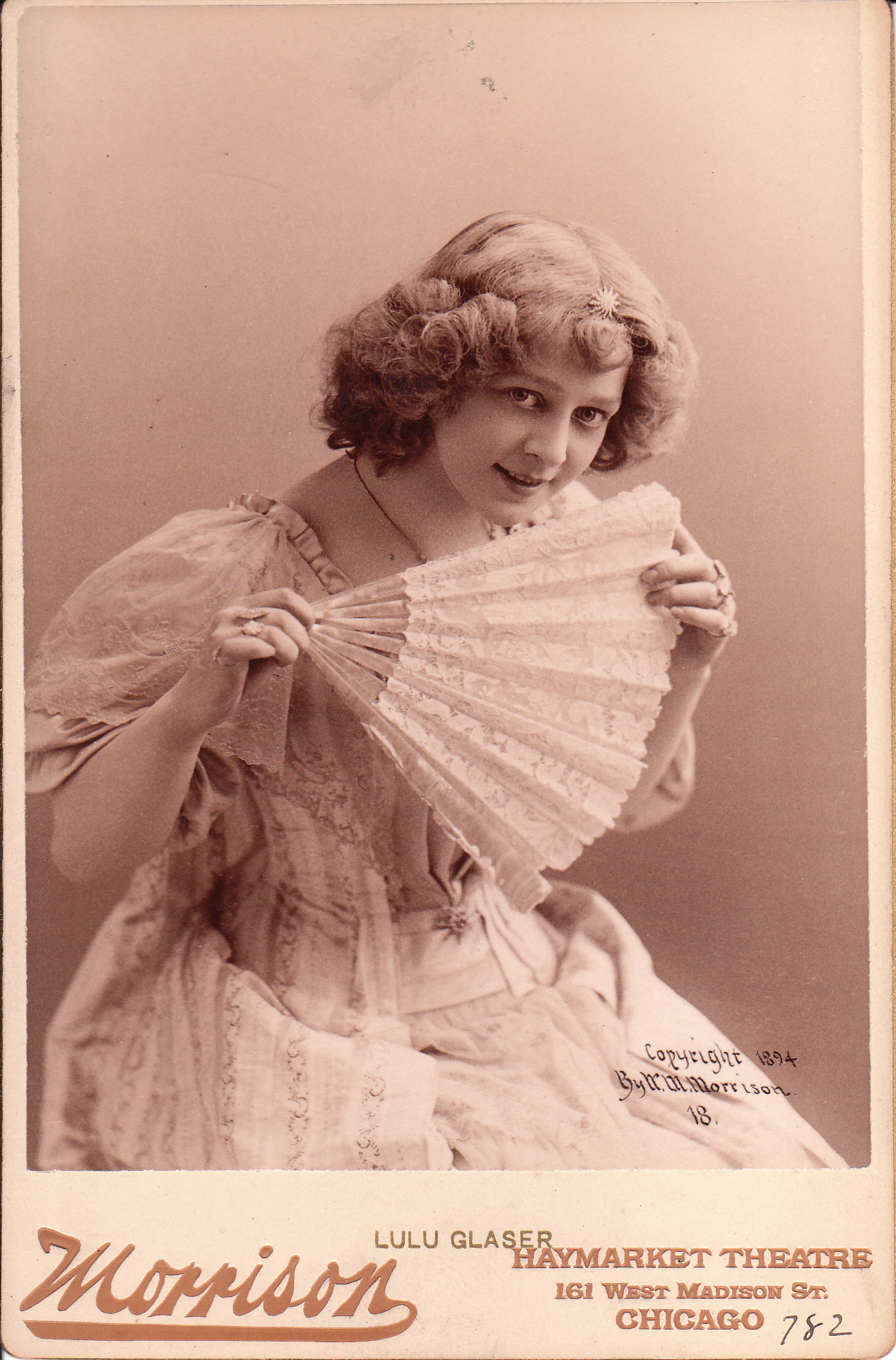
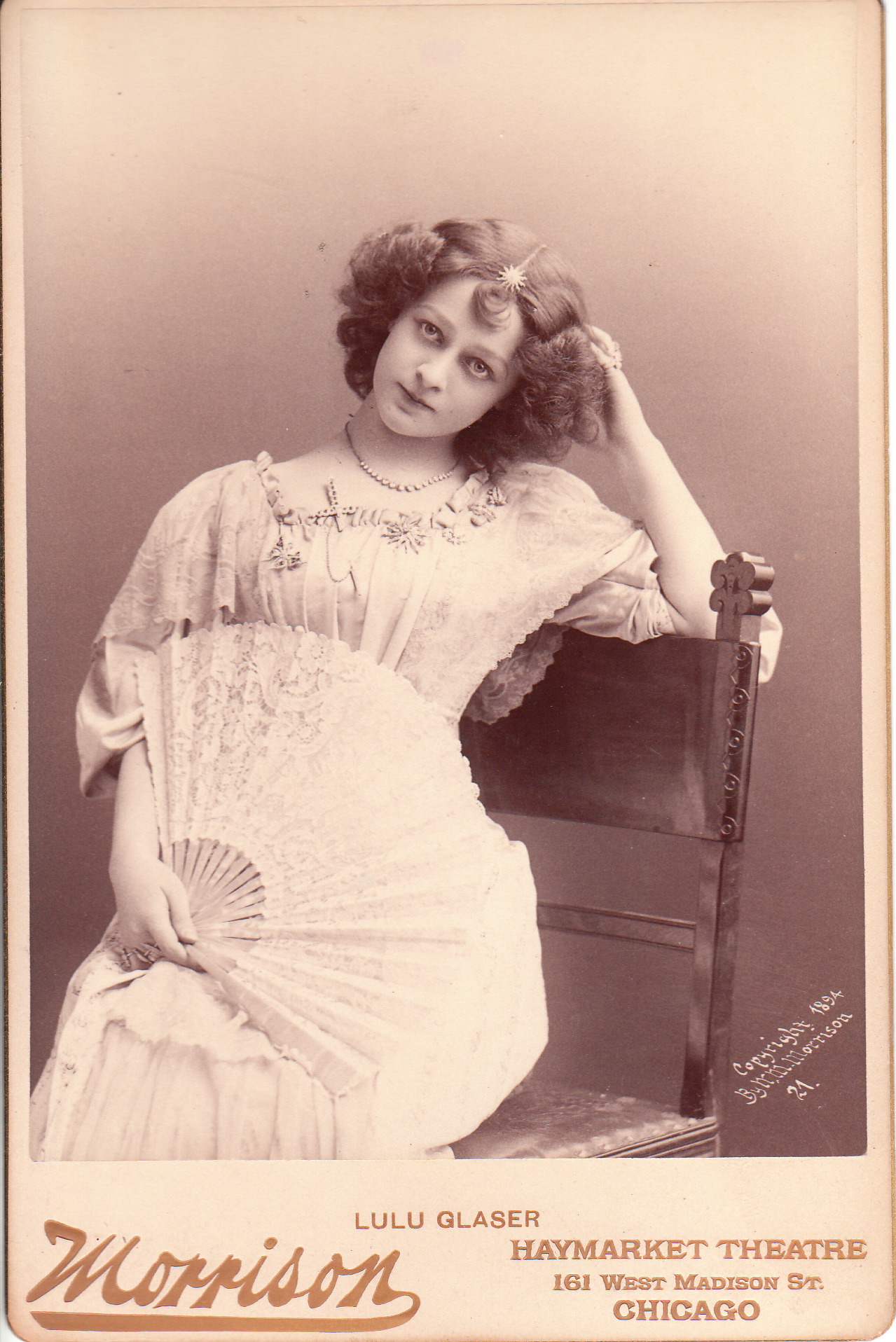
CABINET CARD 2 & 3
CABINET CARD 4
CABINET CARD 5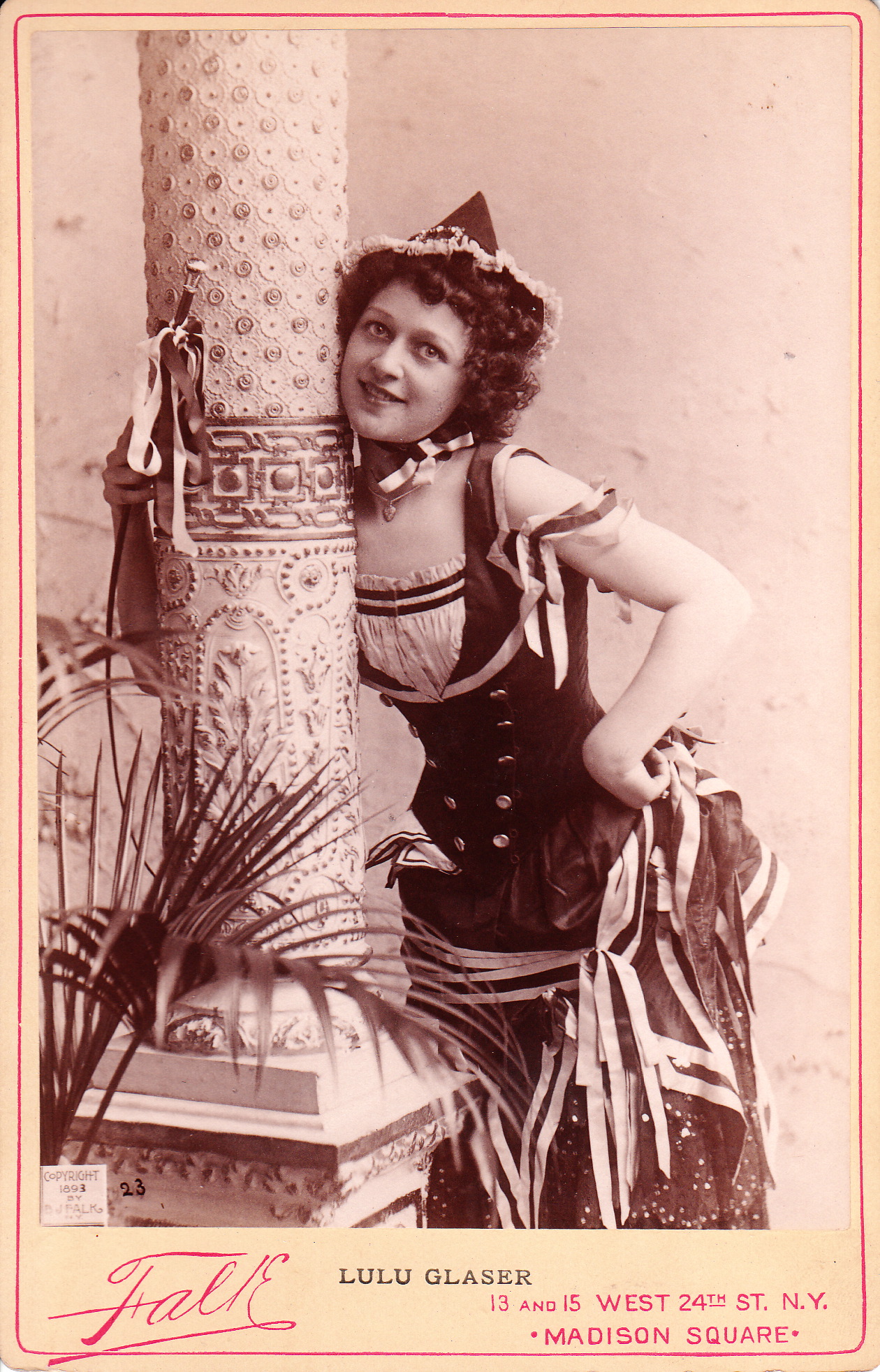
CABINET CARD 6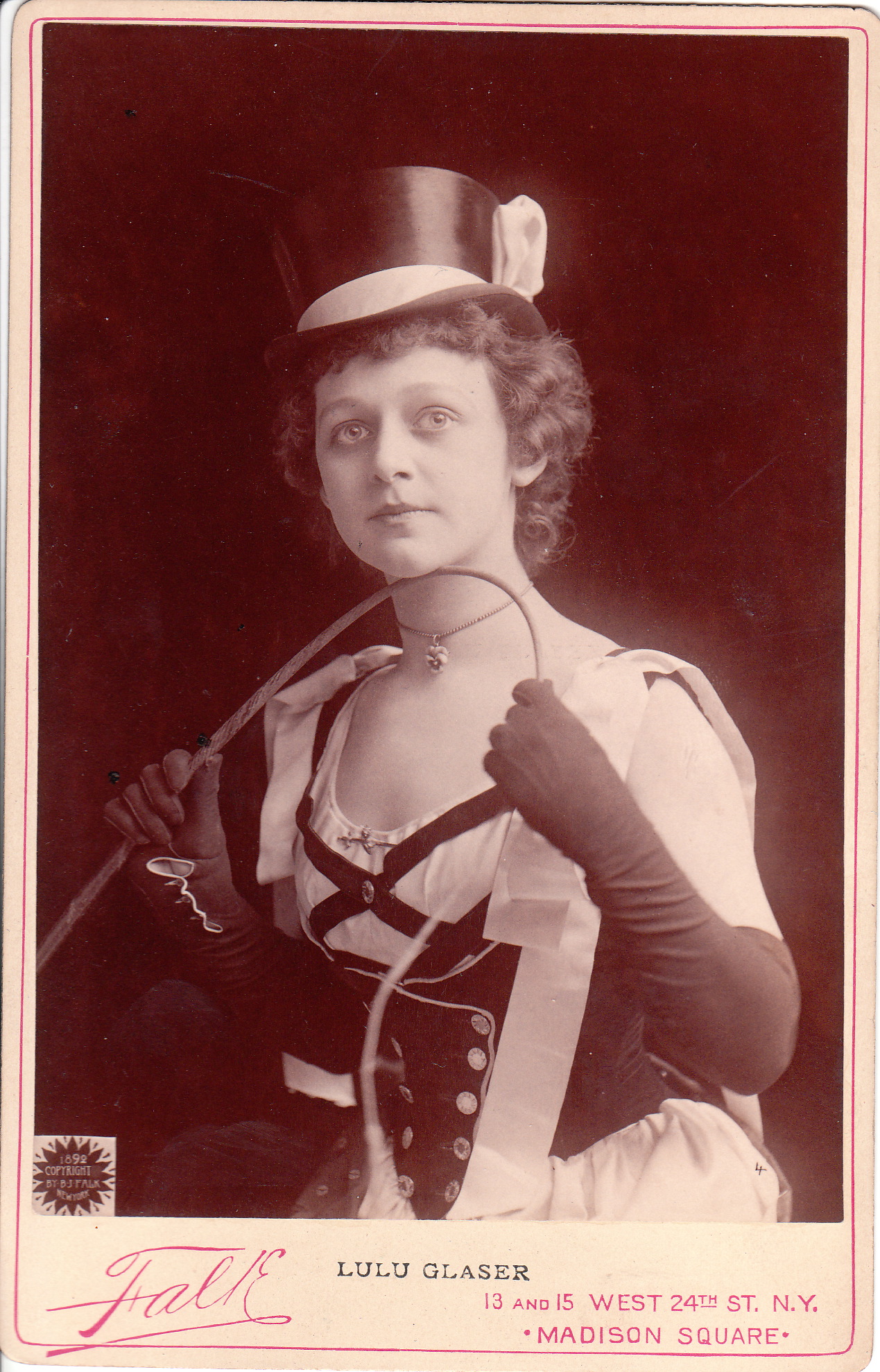
CABINET CARD 7
 CABINET CARD 8
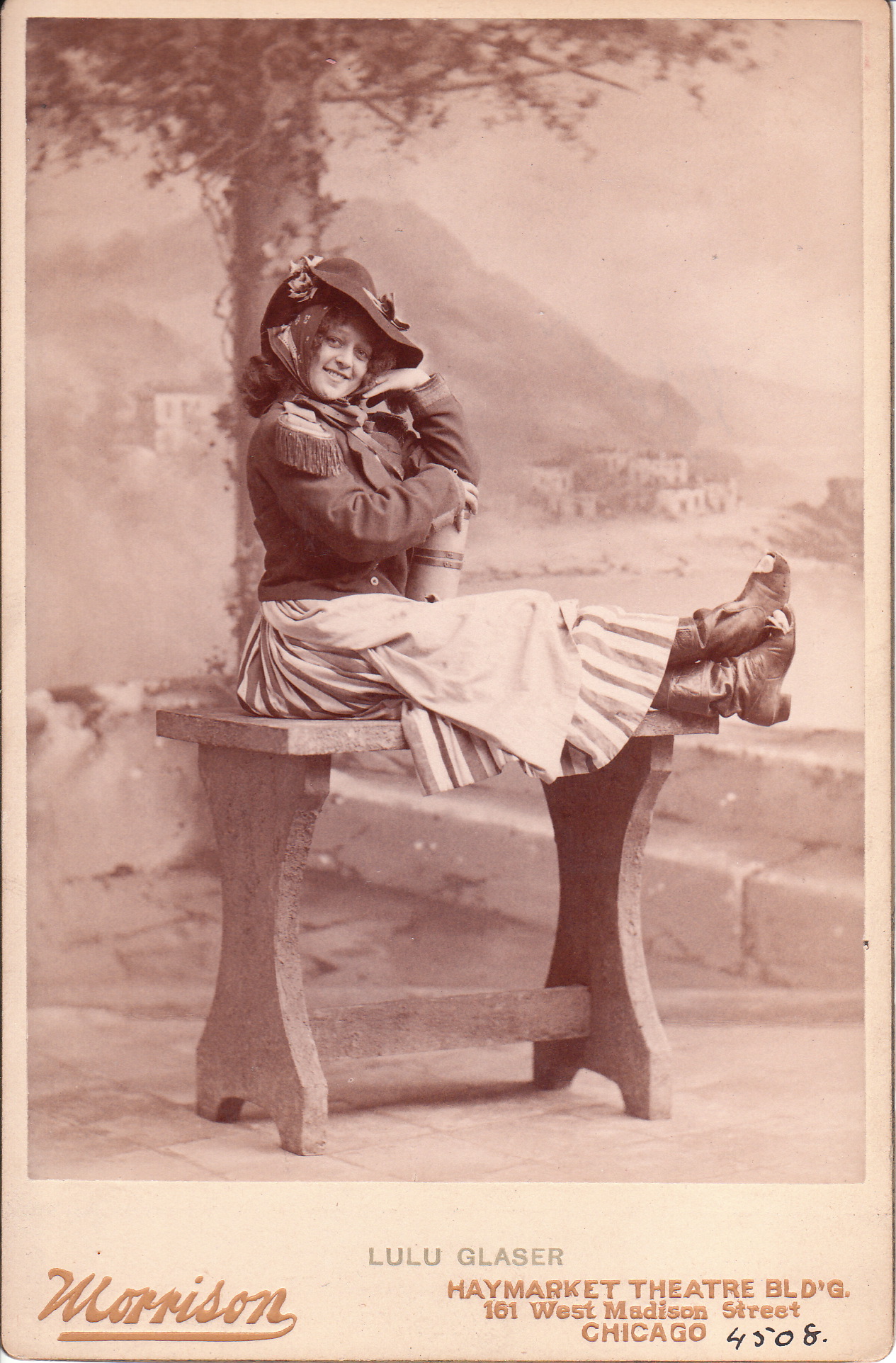
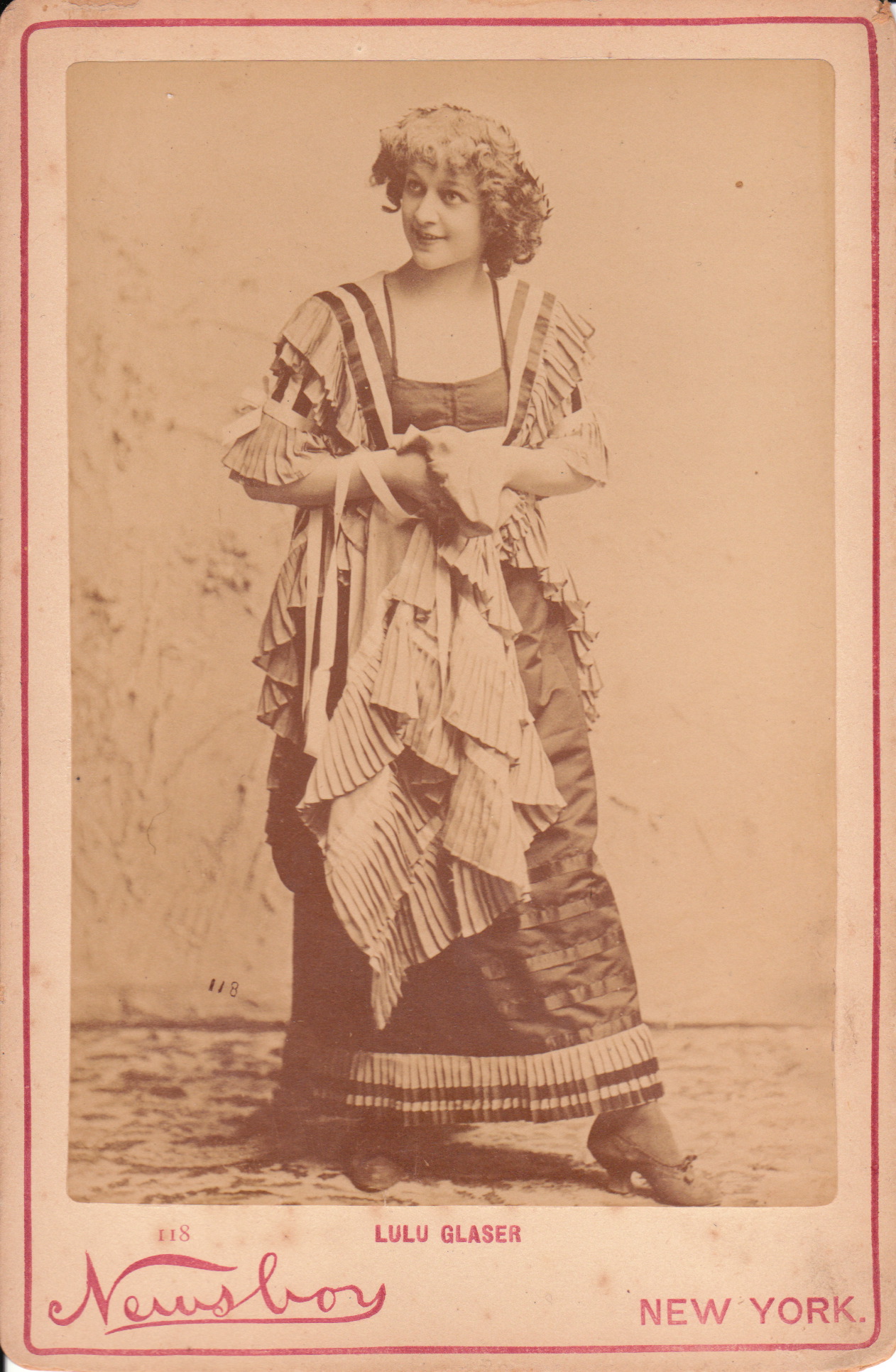
These cabinet cards features Lulu Glaser (1874-1958), a Pennsylvania born actress and singer. She came to Broadway with no previous professional experience when she was hired to play in the chorus of “The Lion Tamer (1891)”. She was also given the role of understudy to the Prima Donna. After the star fell ill, Lulu Glaser took over the role and began a meteoric rise to stardom. For the next twenty plus years, Glaser played many roles in such productions as “The Merry Monarch” (1892), “Erminie” (1893), “The Little Corporal” (1898), and “Miss Dolly Dollars” (1895). She achieved her greatest success in “Dolly Varden” (1902). Lulu Glaser was a beautiful woman and this portrait confirms that assessment.
In Cabinet Card 1 Glaser is holding a fan and her expression could be described as coy. She is adorned with a great deal of jewelry including multiple rings, a hair pin and a pin on the midsection of her dress. The photographer of this image, as well as the next four images, is Morrison, of Chicago, Illinois. The photographs have a copyright date of 1894. Morrison was a well known celebrity photographer and his studio was housed in the Haymarket Theatre. To view other photographs by Morrison, click on this site’s category “Photographer: Morrison”.
The sixth photograph of Glaser is by celebrity photographer, Falk, of New York City, New York. This photograph is copyrighted 1893. The seventh photograph, also by Falk, captures Glaser in costume for an unknown titled play. She is holding a whip and not looking particularly friendly. The image looks like it would be appropriate accompanying an ad on one of the controversial sections of Craig’s List. The photograph is dated 1892. To see other photographs by Falk, click on the category “Photographer: Falk”.
Photograph number eight captures Lu Lu Glaser in the same costume she is wearing in photograph number five. The eighth photo was published by Newsboy as a premium used to accompany the sale of their tobacco products. The image is number 118 of a series of celebrity photographs. To view other Newsboy photographs, click on the cabinet card gallery category “Photographer: Newsboy”.
PARTHENON GIRL: GREEK GIRL IN TRADITIONAL COSTUME AT A WELL
 This cabinet card features a girl in traditional Greek clothing posing by a well. She is holding a water jug up behind her left shoulder. The jug is either empty or she is quite strong. The reverse of the photograph has an inscription of a name which likely belongs to the subject. The back of the cabinet card also has a printed drawing of the Parthenon. The Parthenon is a temple dedicated to the goddess Athena, whom the people of Athens viewed as their patron. The name of the subject and the photographer, as well as the location of the photographic studio are undecipherable to this writer. In other words, “Its all Greek to me”. Hopefully, a visitor to the Cabinet Card Gallery will be able to identify the photographer and the studio’s location.


 THE CABINET CARD GALLERY