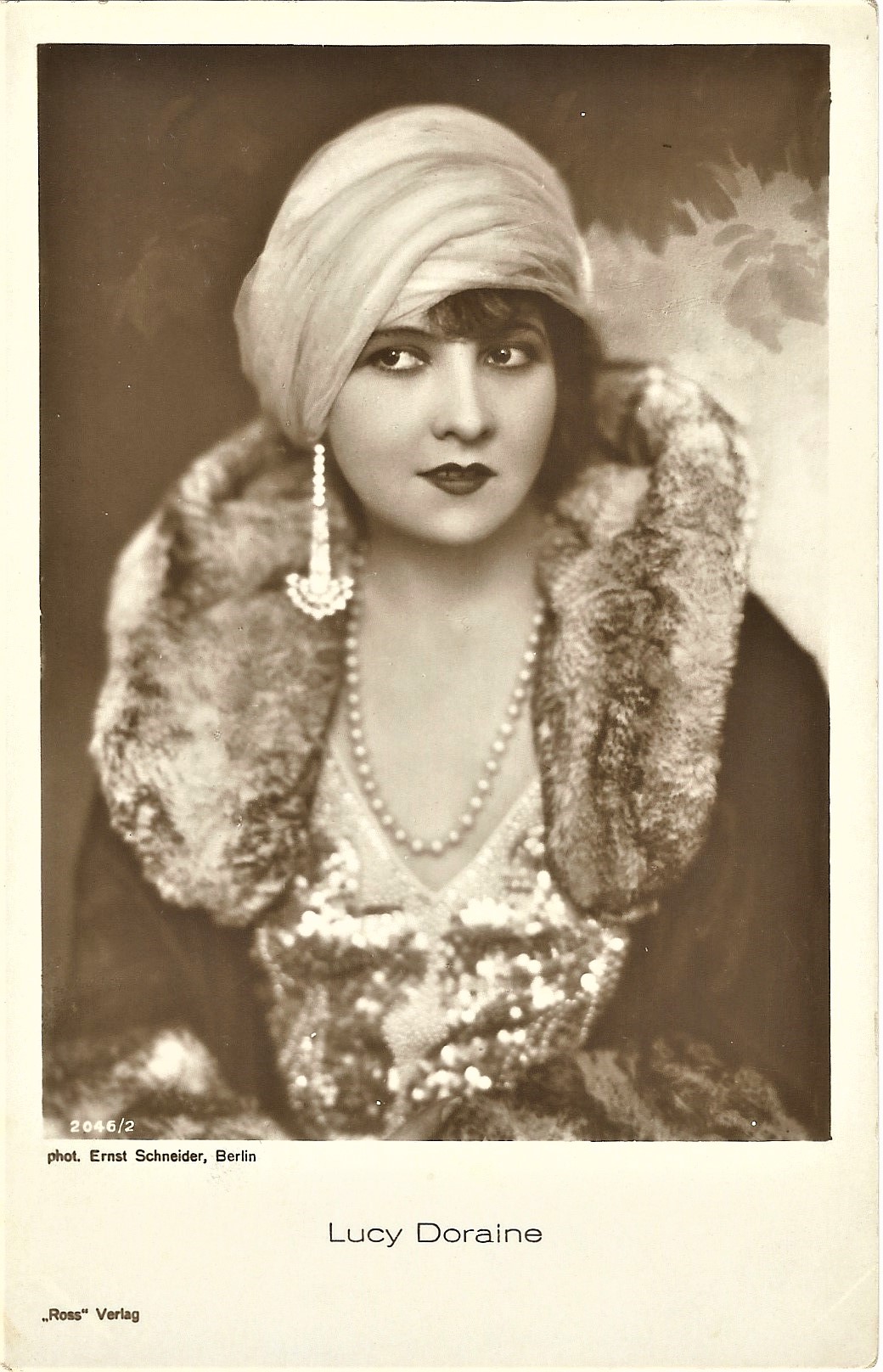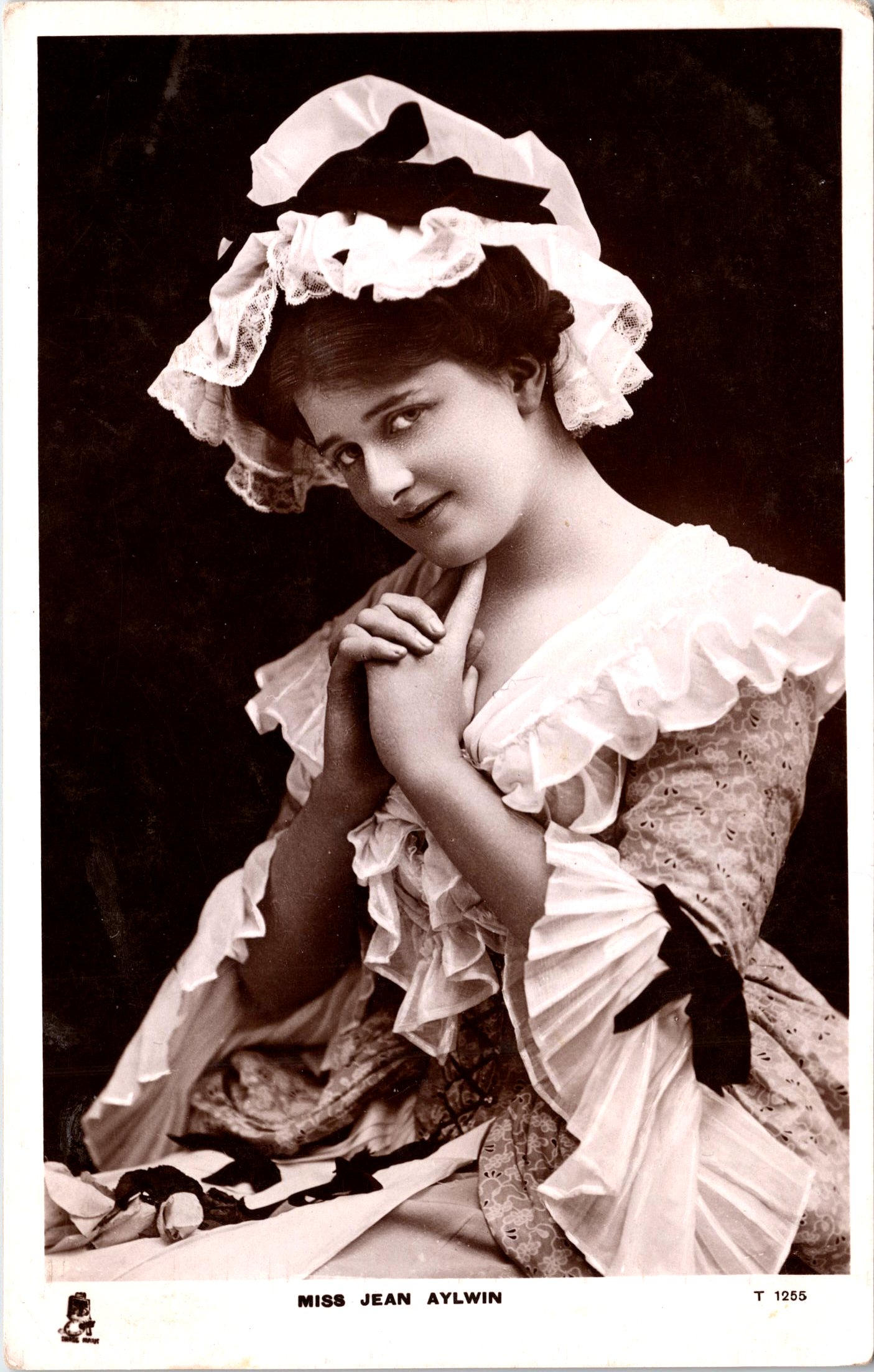
JEAN AYLWIN : PRETTY BRITISH ACTRESS & SINGER : RAPHAEL TUCK : RPPC

This vintage real photo postcard features a striking portrait of Jean Aylwin (1885-1964), a pretty British actress and singer from the early 20th century. She gained fame for her performances in musical comedies and plays in London and she also toured internationally. Aylwin was associated with the popular Gaiety Theater productions. She had notable performances in several successful productions including “The New Aladdin” (1906), “The Girls of Gottenberg” (1907) and “Our Miss Gibbs” (1909). Aylwin also appeared in two silent films. She married in 1913 but the marriage ended in divorce in 1924. She was accused of adultery with a noted composer of her time. After her divorce, her career declined. She later worked as a housekeeper. In 1926, she briefly worked as a BBC radio broadcaster. In this portrait, Jean Aylwin is presented with a soft, coquettish elegance that was typical of early 20th-century stage and postcard imagery. She is shown seated and slightly angled toward the camera, her head gently tilted, with her hands clasped at her chest in a demure, almost confessional pose. Her expression is warm and inviting—large, dark eyes looking directly at the viewer beneath delicately arched brows, with a faint, knowing smile that suggests charm rather than overt theatricality. She wears an ornate period costume with layers of lace and sheer fabric, the bodice trimmed with ruffles that frame her neckline and sleeves. Dark ribbon accents at the sleeves and waist provide contrast against the pale, airy textiles. Her hair is styled neatly and topped with a frilled cap or bonnet, finished with a prominent dark bow that adds visual drama and balance to the composition. Overall, the image emphasizes her youthful femininity, grace, and approachability, qualities that clearly made her well suited for popular theatrical and postcard circulation of the era. Jean’s career in the performing arts overlapped with the golden age of postcards, and her image frequently appeared on souvenir postcards like this one. The card is published by Raphael Tuck, a notable postcard company active in England during the early 20th century. The card is part of the series, numbered T1255, and was published and printed in England. This postcard is in good condition (see scans).

This vintage postcard is available for purchase at The History Peddler for $14.00 or Best Offer.   

Interested collectors may view the listing here:

https://www.ebay.com/itm/236552839717

MISS MARJORIE VILLIS : RISQUE PORTRAIT OF A STRIKINGLY PRETTY BRITISH ACTRESS

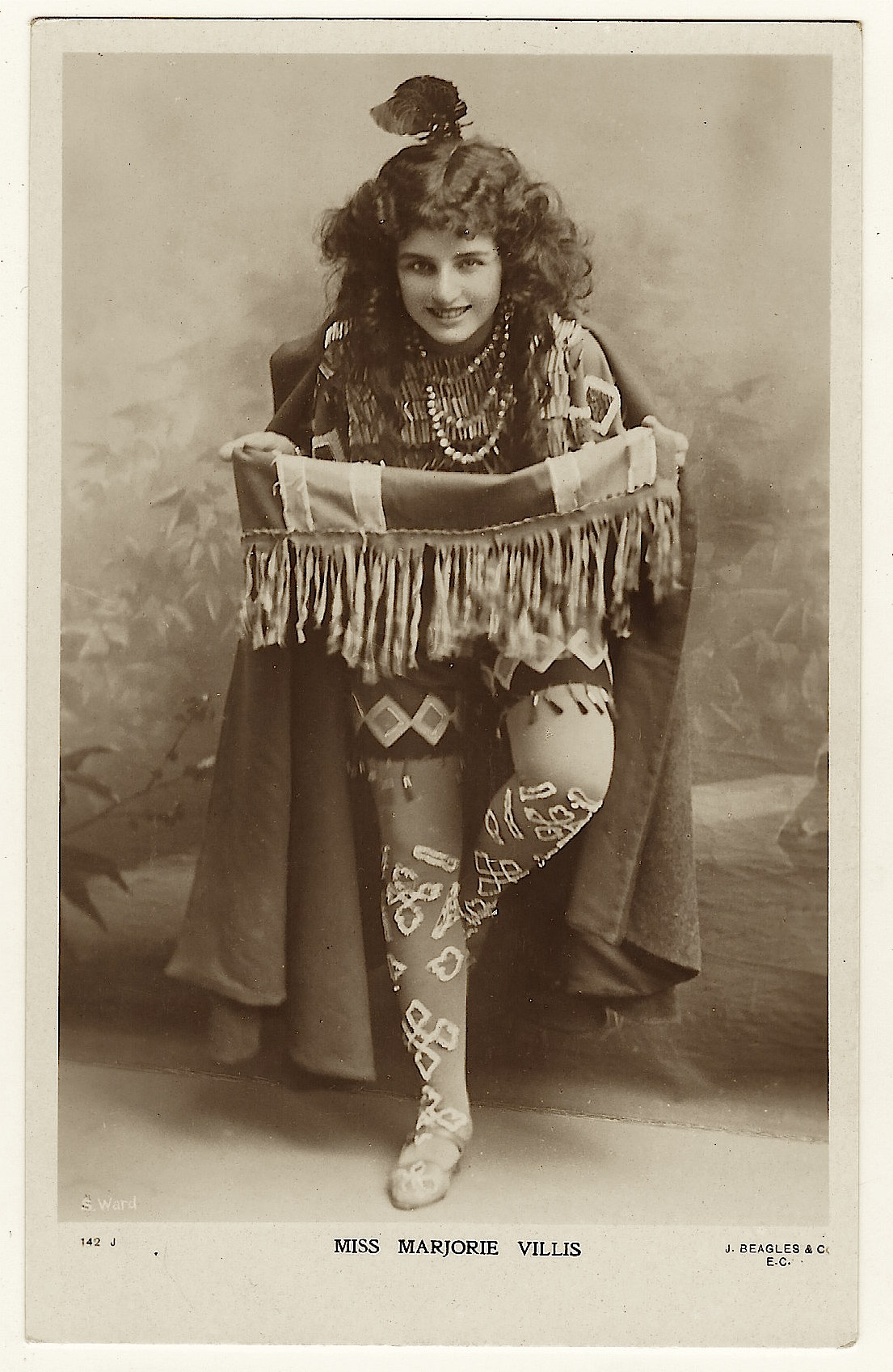
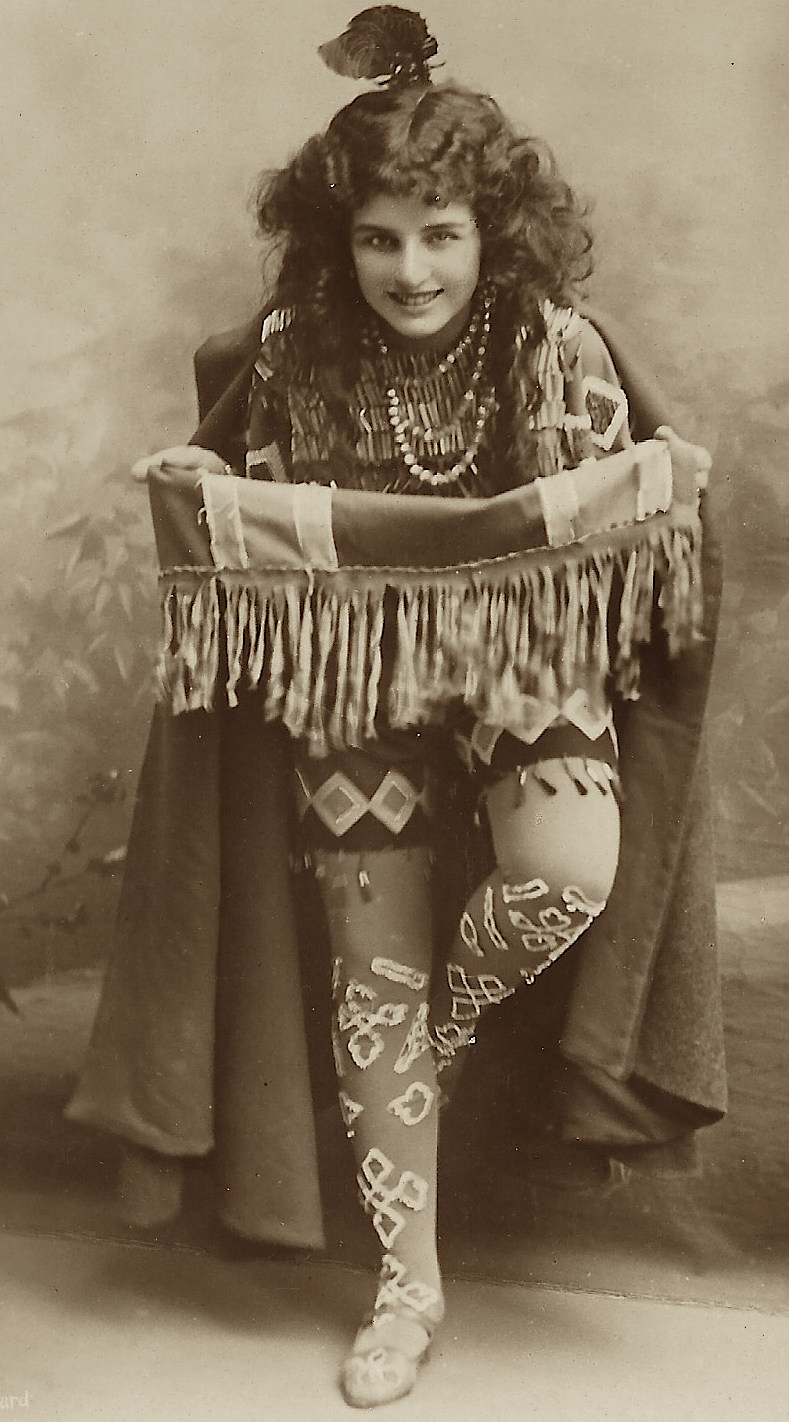
This vintage real photo postcard portrait feature British silent film actress, Marjorie Villis (1891-1981). Miss Villis is quite pretty and has a wonderful smile. This photograph captures her in a risque pose and a risque costume. What an amazing elaborate and busy costume. When I first saw this image, I immediately became motivated to find information about this provocative actress. I met little success in learning about Marjorie Villis. Photographs of her appear to be uncommon, and I could not find the postcard above anywhere online. I did learn that she sat for seven postcard portraits that can be found in the UK’s National Portrait Gallery, All of the portraits were taken by celebrated photographer, Alexander Bassano. The IMDb credits Villis with 15 film roles between 1915 and 1922. Villis was most noted for her roles in “The Rugged Path (1918), “A Romany Lass (1918)”, and  “Brenda of the Barge (1920). She had a relatively short career. I wonder why her career ended so abruptly? The first talkie feature film did not get released until 1927, so we know that, unlike many other silent film stars, Villis was not shut out of the film industry because of an unsuitable voice or foreign accent. This postcard was published by J. Beagles & Company (London)  as part of a series (no.142 J). The wonderful portrait of Miss Villis was taken by S. Ward. This vintage postcard is in very good condition (see scans)
This cabinet card is available for purchase at my store, The History Peddler, for $35.00 or best offer.

Interested collectors may view the listing here:

https://www.ebay.com/itm/336231732840

MARY PICKFORD : AMERICA’S SWEETHEART : ROTARY PHOTO : HAND TINTED RPPC 1920

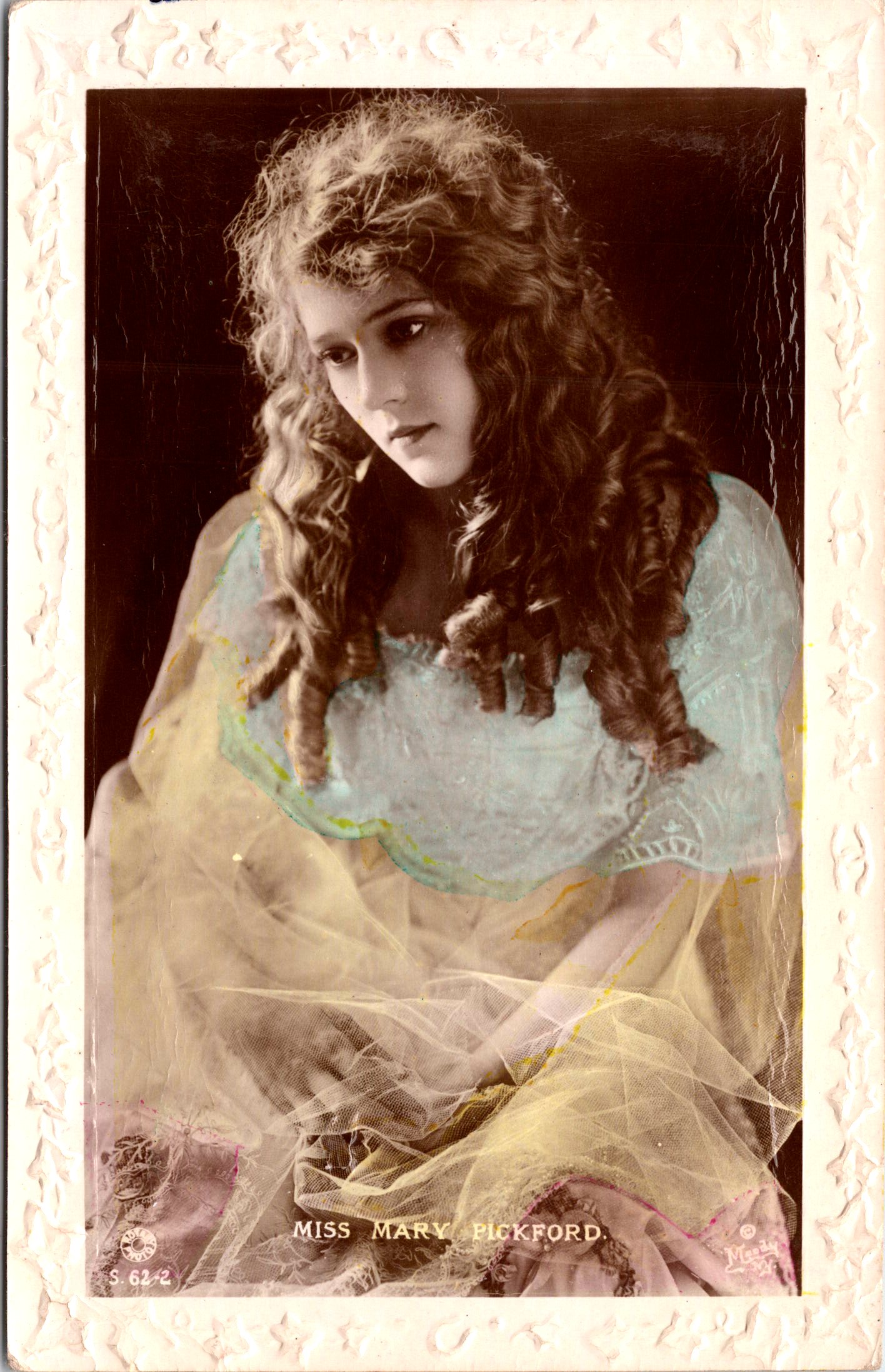
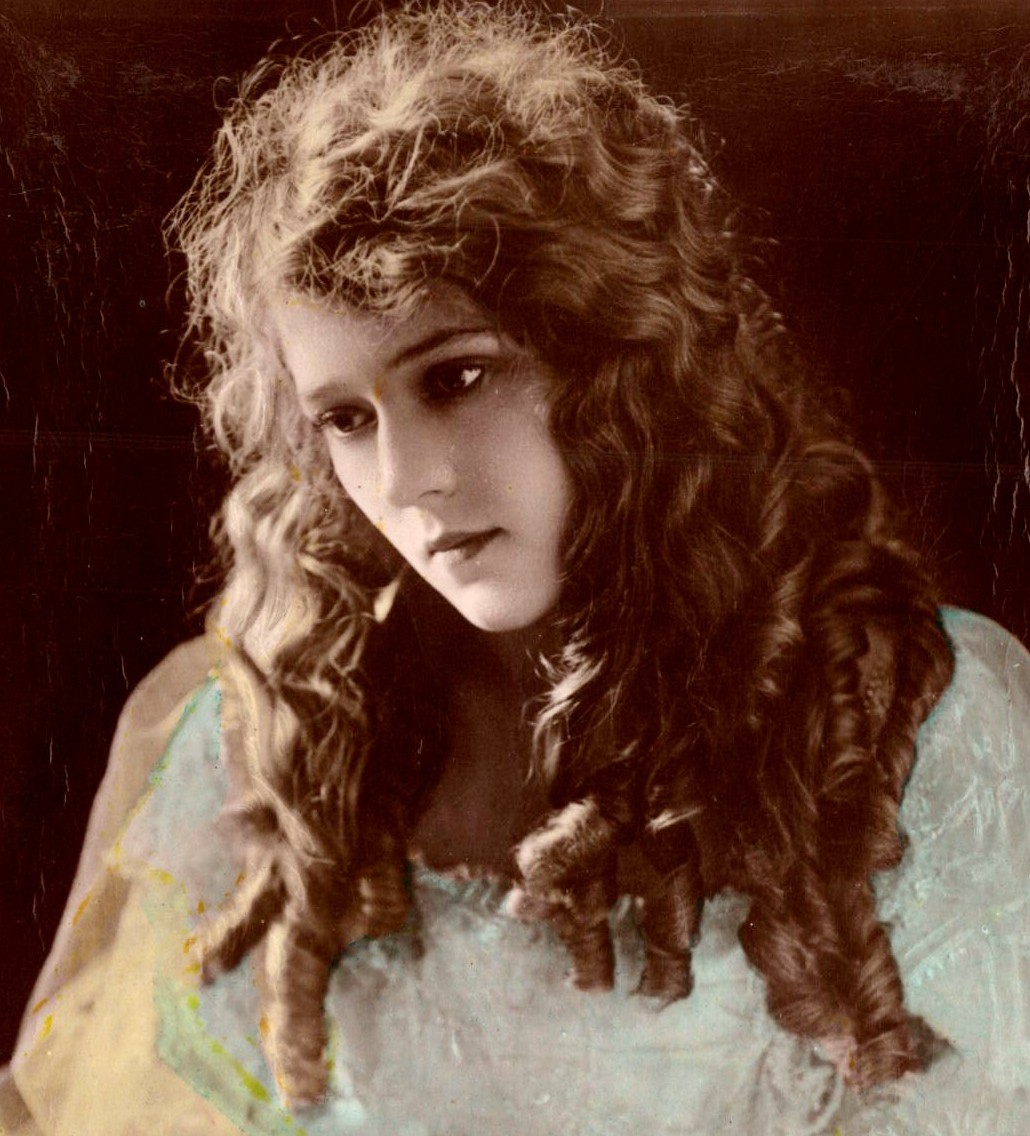
This beautiful vintage real photo postcard features Mary Pickford, shown here in a soft, introspective portrait that perfectly captures the romantic visual style of the early 1910s. Pickford is posed in three-quarter profile, her gaze cast downward, with her signature long curls cascading over her shoulders. She wears a delicate, flowing gown rendered in subtle hand-applied color, with pale blue and warm cream tones carefully brushed over the original photograph, lending the image a dreamy, ethereal quality. The overall effect is gentle and luminous, emphasizing her youthful features and expressive eyes. This postcard was produced by Rotary Photo, one of the most prolific and collectible publishers of celebrity real photo postcards in the early 20th century. The image is identified by the ID No. S.62-2, printed at the lower edge, and the reverse confirms it was printed in England via (Rajer Bromide). Mary Pickford needs little introduction; often called “America’s Sweetheart,” she was one of the most beloved and influential actresses of the silent film era, helping to define early Hollywood stardom. This particular image emphasizes her emotional subtlety and screen presence rather than theatrical glamour, making it especially appealing to collectors of classic film portraiture. The reverse reveals the postcard was postally used and that it is bearing a British King George V one-penny red stamp, postmarked in 1920. The card was mailed to someone in Harrogate, England. The handwritten message reads, in part “Just a card to let you know I am quite well. Hoping you are the same. Best love…”.  (SOLD)

NORMA WHALLEY : PRETTY STAGE & FILM ACTRESS : JOHNSTON & HOFFMAN : UNCOMMON RPPC

The pretty actress seen on this vintage real photo postcard is Norma Whalley (?-1954). She was an Australian stage and film actress performing in the United States and Great Britain. Whalley toured South Africa during the late 1890’s. She married J. Sherrie Matthews in 1901. He was an American Vaudeville performer. In 1902, a stroke left him permanently disabled. She divorced him in 1904 and married barrister Sir Percival Clarke. Whalley came to the US to perform on the stage with George Edwardes company. She worked in Chicago and New York for several years from the late 1890’s. She performed on Broadway in “The Man in the Moon” (1899). Whalley also had a film career. The IMDb credits her with 21 films between 1920 and 1935. This postcard was published by Aristophot as part of a series (No.E92). 
Aristophot was known for publishing “made in Germany” real photo postcards. They operated from Germany (Saxony) and New York and produced high quality postcards. The firm’s focuses included capturing images of stage and film starsWhalley was photographed for this portrait by the Johnston & Hoffman studio. The postcard is in good condition (see scans). There is minor corner and surface wear. (See Scans). Postcards featuring Miss Whalley are not difficult to find, however, this particular postcard portrait of the actress is uncommon.

This cabinet card is available for purchase at my store, The History Peddler, for $22.00 or best offer.

Interested collectors may view the listing here:

https://www.ebay.com/itm/336367805879

GERTRUDE QUINLAN AS ANNETTE IN “KING DODO” : STAGE ACTRESS : CHICAGO : 1906

This scarce and evocative antique theatrical portrait photograph, measures 5 x 7 inches, and depicts actress Gertrude Quinlan in her role as Annette from the musical comedy King Dodo, as performed at Daly’s Theatre in Chicago, Illinois. The photograph was taken by the Gibson Art Galleries of Chicago, a prominent studio known for producing high-quality portraits of stage performers and society sitters in the late 19th and early 20th centuries. In this portrait, Quinlan is presented in a softly lit, pictorialist style, wearing a flowing costume and an elaborate floral headpiece that frames her face. Her pose—head gently inclined, hand raised thoughtfully toward her chin—reflects the refined, expressive aesthetic favored in Edwardian theatrical portraiture, designed to emphasize character, mood, and feminine grace rather than strict realism. The image would have served both as a promotional likeness and as a collectible souvenir for theatergoers. Gertrude Quinlan was an early 20th-century American stage actress active during the height of musical comedy and light operetta in the United States. She sang in over 125 operas. While not a headlining star of the era, she was part of the important working class of professional actresses who sustained touring companies and long theatrical runs in major cities such as Chicago. Performers like Quinlan frequently appeared in chorus and featured roles, and their images were commonly commissioned by studios like Gibson Art Galleries for publicity and personal distribution. Her appearance as Annette in King Dodo places her squarely within the lively theatrical culture of Chicago in the first decade of the 1900s, when the city rivaled New York as a major center for touring Broadway and London productions. King Dodo is a musical comedy that originated in London in 1906, produced by George Edwardes, with music by Walter Slaughter and a libretto by Harry B. Smith. The show was quickly brought to the United States, where it enjoyed considerable success on tour. The production appeared in Chicago at Daly’s Theatre during the 1906–1907 season, part of the American run that followed its London popularity. King Dodo is a lighthearted romantic farce centered on a fictional European kingdom where a young king—nicknamed “King Dodo” due to his naïveté—navigates court intrigue, romantic entanglements, and mistaken identities. The character Annette is typically portrayed as a charming and sympathetic young woman whose relationships and choices help drive the comedic and romantic elements of the story. Like many Edwardian musical comedies, the play emphasized humor, romance, and spectacle over realism. This vintage photograph is in good antique condition. The photo has edge and corner wear, mild surface toning, and handling marks consistent with age. Note the surface issue on the mount near the top right corner. The image itself remains strong, with pleasing tonal range and soft focus characteristic of early 20th-century theatrical portraiture (see scans). ADDENDUM: A fellow collector offers a correction to my item description. The helpful individual asserts that  “King Dodo” was an American operetta by the team of Pixley and Luders, premiering in 1902.”

This cabinet card is available for purchase at my store, The History Peddler, for $45.00 or best offer.

Interested collectors may view the listing here:

https://www.ebay.com/itm/236552620239

Published in: on December 26, 2025 at 12:00 pm  Leave a Comment  
Tags: , , , ,

CAMILLE CLIFFORD : THE GIBSON GIRL : STAGE ACTRESS : HAND TINTED : ROTARY RPPC

Camille Clifford (1885–1971) was a Belgian-born stage actress and fashion icon best known as the quintessential “Gibson Girl”, a feminine ideal created by American illustrator Charles Dana Gibson. Born in Antwerp, Belgium, she was raised in Sweden and later in Boston, Massachusetts. In 1902, she entered and won a contest sponsored by Gibson seeking the perfect embodiment of his Gibson Girl drawings, which rocketed her to fame. Clifford’s signature look — an hourglass figure, piled-high coiffure, and aristocratic bearing — made her an immediate sensation in Edwardian society. She soon transitioned to the London stage, where her statuesque beauty often overshadowed her acting roles. Her most famous performance was in the musical comedy The Catch of the Season (1904), where she appeared as the aristocratic Lady Crystal. In 1906, Clifford married the Hon. Henry Lyndhurst Bruce, son of the 2nd Baron Aberdare, and largely retired from the stage after marriage, though she made occasional returns in the 1910s and 1920s. After her husband’s death in World War I, she lived a quieter life but remained a symbol of Edwardian elegance. This is a striking hand tinted Rotary Photographic Series real photo postcard featuring Miss Clifford, serial number (4180 I). It was published by Rotary Photo, one of the most prolific and respected postcard publishers in early 20th-century Britain.  In this image, Camille Clifford appears wearing an immense, lavishly plumed hat in rich tones of red and deep pink, its dramatic sweep perfectly framing her elaborately coiffed dark hair. Her gown, light and sheer with a delicate floral pattern, is accented by a high ruffled collar and ribbons tinted in shades of crimson and coral. The colorist has applied subtle blush to her cheeks and a soft rose tint to her lips, heightening her serene yet alluring expression. She gazes slightly upward and away from the camera, her eyes thoughtful and composed, embodying the calm confidence and refined beauty that made her one of the most photographed women of the early twentieth century. The reverse of the postcard is written and postally used, addressed to Mrs. Clinch, in Cheltenham. The message, written in ink, reads: Dear Aunt, Hope this finds all well again. Sorry to hear of your fall being queer. Today is the first real drizzly day we’ve had yet. How are those “lazy little devils” of girls? Nephew Ernie. The postcard bears a green half-penny King George V stamp, which was first issued in 1911. The postmark is partially legible but shows London, and appears to read 1912. This dating aligns perfectly with the height of Camille Clifford’s stage fame and with the active period of Rotary Photo, E.C. and Foulsham & Banfield, the photographers credited at the right. Together these details place the postcard firmly in the early 1910s, likely around 1912, when hand-colored photographic postcards of theatrical personalities such as Clifford were immensely popular with collectors throughout Britain.  (SOLD)

ILSE WERNER : GERMAN FILM STAR : GLAMOUR PORTRAIT : BY FOTO-QUICK : RPPC

This striking vintage real photo postcard features a glamorous close-up portrait of Ilse Werner, a celebrated German-Dutch actress and singer known for her charismatic screen presence and unique whistling talent. In this image, Werner is draped in a shimmering veil that frames her face with a soft, radiant glow. Her expressive eyes, long lashes, and glossed lips project a poised, serene beauty, while the glinting fabric around her adds a mystical, almost cinematic aura. The postcard was published by Film-Foto-Verlag, a major distributor of German film star postcards during the 1930s and 1940s, and is marked “A 3732/1” in the lower left corner. The photo credit goes to Foto Quick. .On the reverse is the wartime disclaimer: “Zivile Verwendung im Inland für Autogrammzwecke nicht gestattet” (Civilian use for autograph purposes not permitted), reflecting its origin in Nazi Germany. The cards were meant for building national morale and not private autograph collecting. A small fawn symbol in the stamp box area marks it as part of the Film-Foto-Verlag series. Ilse Werner was born in 1921, in Batavia, Dutch East Indies (now Jakarta, Indonesia), where her father worked as a Dutch colonial official. Her mother was German, and the family moved to Germany when she was a child. She trained at the Max Reinhardt Seminar in Vienna, one of the premier acting schools in the German-speaking world, and made her film debut in 1939. Her breakout role came in the film Wunschkonzert (1940), one of the most popular and propagandistic films of the Nazi era. She quickly became a favorite among German audiences, known not only for her acting but also for her unusual skill as a professional whistler, which she often demonstrated in her recordings and film appearances. During the Nazi period, Ilse Werner became one of Germany’s most beloved film stars, appearing in state-approved entertainment. Though she never joined the Nazi Party, her films were often apolitical and aligned with the regime’s values of escapism and wholesome entertainment. Her popularity made her a public symbol of the Third Reich’s cultural life, though she was not considered an overt political supporter. After the war, her Dutch citizenship initially barred her from performing in postwar Germany due to denazification policies, which caused a temporary decline in her career until restrictions were lifted. lse Werner was married to actor Tony Rödel for a brief period. The marriage ended in divorce. She did not have children. Her later years were marked by occasional television appearances and nostalgic performances of her trademark whistling songs. She passed away in 2005 at the age of 84.  (SOLD)

DOROTHY GULLIVER : PRETTY ACTRESS : ROSS VERLAG : UNIVERSAL PHOTO PORTRAIT : RPPC

This is a beautifully composed real photo postcard (RPPC) of Dorothy Gulliver, produced by Ross Verlag, bearing the series number 4472/1. The photograph credit on the front says “Universal phot.”, indicating the image was taken under Universal’s photographic unit. Dorothy is shown in an elegant three-quarter pose, her head slightly tilted, her eyes bright and engaging, and a gentle, confident smile touching her lips. Her coiffed hair is waved softly around her face. She wears a silky, draped garment with geometric patterned panels, possibly a robe or decorative wrap, giving a graceful, glamorous look. The lighting highlights her complexion and facial features delicately, lending the image an enchanting, almost glowing quality. Her expression is poised but warm — she seems aware of her image and projecting a subtle star quality, rather than an overly stiff studio pose. The overall look is refined, feminine, and suited to her identity as a screen actress. This postcard is part of Ross Verlag’s cinema star series, a popular line of European film star postcards in the 1920s–1930s.The inclusion of “Universal phot.” connects this portrait directly to the film studio world. Take note that Dorothy produced relatively few postcards, and this is an attractive example. Dorothy Kathleen Gulliver was born in 1908, in Salt Lake City, Utah. She was raised in a Mormon family, one of six children, and even from youth expressed a desire to act. Her break came in 1925 when she won a Universal-sponsored national contest (after earlier local pageant success) which awarded her a six-month contract with Universal. She began appearing in silent short films and serials such as The Winking Idol (1926) and Strings of Steel (1926). In 1928, she was honored as one of the WAMPAS Baby Stars, a promotional campaign that highlighted rising actresses. Throughout the late 1920s, Dorothy appeared in The Collegians series of short films produced by Universal, often paired with George J. Lewis. When sound came in, she successfully made the transition and worked frequently in 1930s serials and Westerns — titles include The Galloping GhostThe Phantom of the WestThe Shadow of the EagleThe Last Frontier, and Custer’s Last Stand. Her film career spanned decades (officially credited in nearly 100 films), though after the 1930s her roles tended toward smaller or uncredited parts.  Remarkably, in 1968 she had a notable role in John Cassavetes’ Faces. Her final film appearance was a cameo in Won Ton Ton, the Dog Who Saved Hollywood (1976). On the personal side, Dorothy’s first marriage was in 1926 to Chester De Vito (an assistant director), which ended in divorce by 1932.  In 1947 she married Jack R. Proctor, and they remained together until his death in 1976. She passed away in 1997, in California. Interestingly, her life story encompasses the classic arc of early Hollywood: beauty contest discovery, silent film stardom, adaptation to talkies, and then gradual fading into character work.  (SOLD)

NORMA TALMADGE : BEAUTIFUL ACTRESS : PICTUREGOER SERIES : RPPC

This vintage real photo postcard features American silent film actress, Norma Talmadge (1894-1957). She was noted for her dramatic and emotionally intense performances. She was one of the most popular and highly paid actresses of her era. She starred in over 200 films during her career. Raised in a show business family, Norma and her sisters Constance and Natalie Talmadge all became successful actresses. Norma began her acting career on the stage, performing in vaudeville and musical comedies. Initially, Talmadge worked for Vitagraph Studios before signing with D.W. Griffith’s Triangle Film Corporation, where she gained recognition for her talent. In the 1910s and 1920s, Talmadge became a major star, known for her ability to portray a wide range of characters. She excelled in dramatic roles, often playing heroines with complex emotions. Some of her notable films include “The Probation Wife” (1919), Smilin Through (1922), Camille (1926), and “New York Nights” (1929). Norma Talmadge was one of the few silent film stars who successfully made the transition to talkies. However, as the era of sound films emerged, her popularity waned. After her last film in 1930, Talmadge retired from acting and focused on her personal life. She married the film producer Joseph M. Schenck in 1916, and together they founded the Norma Talmadge Film Corporation. The company produced several successful films, contributing to Talmadge’s financial success and status as one of the highest-paid actresses of her time. However, her marriage to Schenck eventually ended in divorce in 1934. After her retirement from acting, Talmadge lived a private life, seldom making public appearances. She remarried in 1946 to Carvel James, a wealthy oil broker, and they remained together until her death. This vintage postcard is part of the “Picturegoer” series (No. 145B).  SOLD

BIJOUX : PERFORMER : WALERY : CASINO DE PARIS : RPPC 1908

This uncommon, color tinted vintage real photo postcard features a one-name performer named Bijoux. The card is risque for it’s era. Bijoux was a performer at the Casino de Paris and apparently, she was popular enough to merit her own postcard portrait, but not popular enough for me to find information about her online. Bijou was photographed by Lucien Walery. He was a celebrated Paris photographer known for his portraits of artists and cabaret dancers from the city’s music halls. He is very well known for his portraits of Mata Hari and Josephine Baker. Walery did a lot of work in the genre of nude/erotic photography. He photographed the beautiful women of Paris between the early 1900’s and the 1920’s. The postcard was published by a combined printing group in Nancy, France.  SOLD