WOMAN MODELS REPTILIAN WEAR IN PENACOOK, NEW HAMPSHIRE

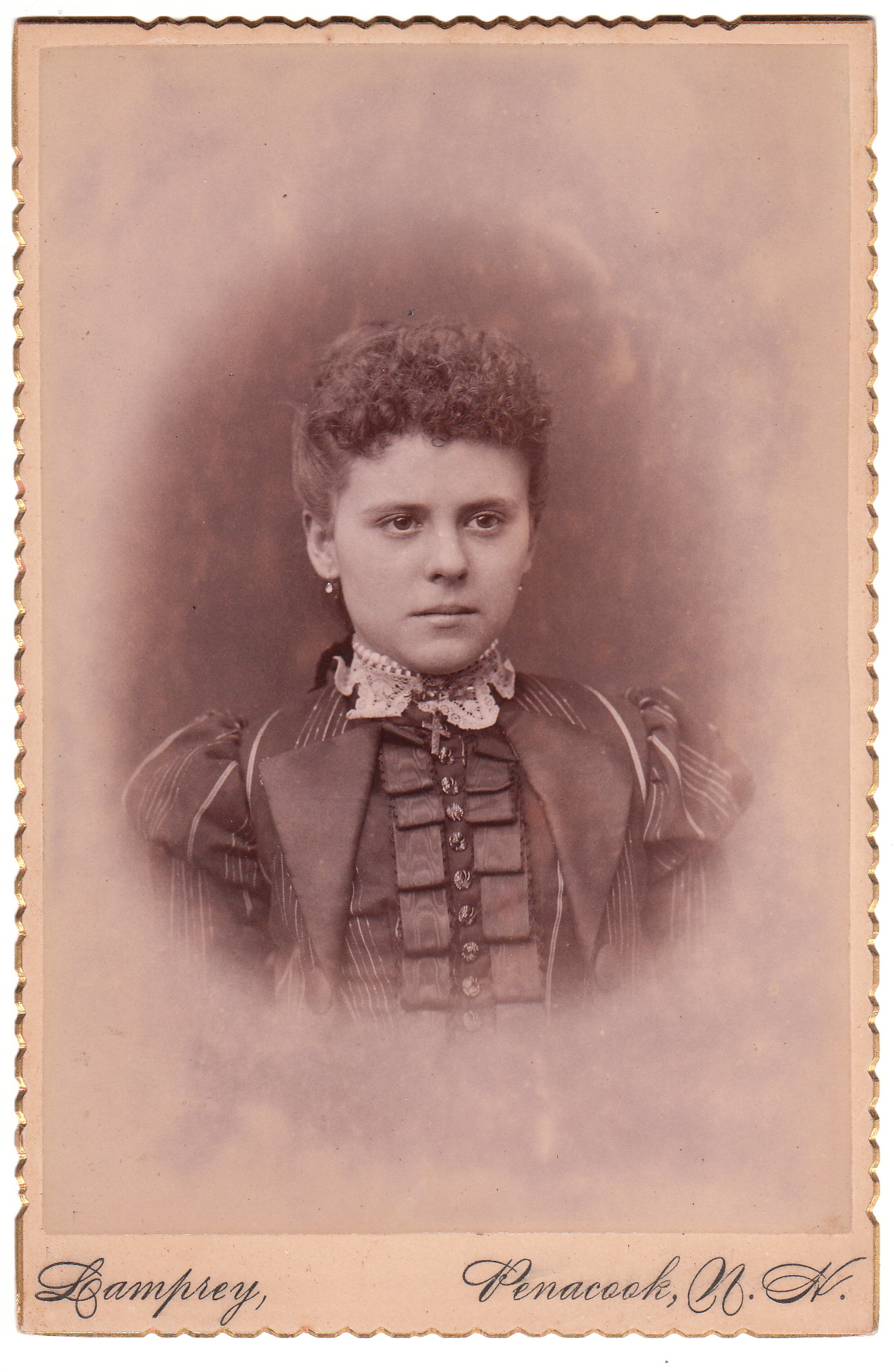
Most people don’t think of Penacook, New Hampshire as the center of turn of the century fashion. However, in 1890, a new fashion trend was born in tiny Penacook. Traditional fashion centers like Paris and New York City were blindsided by the innovative dress designs coming out of Penacook. Reptilian Wear was introduced in 1890 and was overwhelmingly the most well received of all these designs. Penacook area photographers quickly were called upon to sharpen their skills in fashion photography because their services were in high demand by the rapidly growing local clothing industry. This cabinet card was produced by the studio of M. S. Lamprey who began operating in Penacook in 1858. The woman in this image is wearing an excellent example of a Reptilian Wear dress. This particular dress was sold under the Iguana label. The model in this photograph was not identified. She is wearing a necklace from which hangs a cross. If you doubt the veracity of this story; you would be correct to do so. Here is some non fiction commentary about this cabinet card. The photographer is Maurice S. Lamprey (1835-1912). The 1860 census finds Lamprey living with his parents and siblings and working as a varnisher. He enlisted in the 10th New Hampshire Volunteer Infantry in 1862 as a private and was transferred to the Signal Corp which is where he remained throughout the war. The earliest city directory found that lists him as a photographer was from 1872. The 1900 US census reports that Lamprey was 64 years old, living alone, and working as a photographer in  Concord. The town of Penacook was named after the Penacook Native American tribe which lived in the area. The town was a village located within the city of  Concord. Penacook was involved in the textile industry. The town was located along the Contoocook River. This location attracted the hydro power industry and Penacook became a mill town.

ACTRESS MARY ANDERSON: BEAUTIFUL STAR OF THE AMERICAN AND ENGLISH STAGE


Cabinet Card 1  (SOLD)

These cabinet cards feature American stage actress, Mary Anderson (1859-1940). Interestingly, Anderson’s father was an Oxford educated New Yorker who after Mary was born, moved his family to Kentucky. He then joined the Confederate army and was killed in action when Mary was just three years old. Mary was not much of a student but loved to read Shakespeare. Her step father sent her to New York at age 14 to take ten professional acting lessons. In 1875, at age 16, Mary Anderson began her stage acting career in a Kentucky production of Romeo and Juliet. She continued acting in Kentucky and then appeared in a number of other cities, including New York. Her critical reviews tended to be mixed but she was well loved by the public. She then worked the New York and touring company stages for twelve years until she spent the next six years on the English stage (appearing in a lot of Shakespeare productions). She then returned to the United States, and at age 30, collapsed on  stage with a case of nervous exhaustion.   This experience, likely coupled with less than favorable reviews, caused her to retire from acting.

Cabinet Card 1 features Anderson in the role of  Galatea. A review of Mary Anderson’s performance in this role appeared in the New York Times in a September 1884 edition. She was appearing opposite British actor William Terriss, in the play “Pygmalion and Galatea”,  at the Lyceum Theatre in London. Many notables were in attendance, including Oscar Wilde. The review states ” Miss Anderson surpassed herself and that the performance was throughly artistic and finished”. The cabinet card was photographed by The Vanderweyde Light of London, England (182 Regent Street W.). Henry Van Der Weyde (1838-1924) was an artist and photographer. In 1877, he became the first photographer to install and take photographs by electric light.  (SOLD)

The second cabinet card was photographed by celebrity photographer, Sarony. The image reflects Mary Anderson’s great beauty. To view other photographs by Sarony, click on Cabinet Card Gallery’s category “Photographer: Sarony”.

The third cabinet card was photographed by “The Sparks Studio”. The studio was located in Philadelphia, Pennsylvania and the artist/manager was Elliott Houseworth. This cabinet card offers a profile portrait of the attractive Ms. Anderson. The 1880 census lists Elliott A. Houseworth as being born in 1855, residing in San Francisco, California, and working as a photographer. Houseworth also appears in the 1900 census as living in Norwood, Pennsylvania and working as a manager. These demographics fit the photographer of this image, since Houseworth managed Sparks Photography Studio and Norwood is only about eleven miles from Philadelphia.  To view other photographs of actresses by Sparks, click on the category “Photographer: Sparks Photo Publishing Co.”.

The  fourth cabinet card features a smartly dressed Mary Anderson and was photographed by George Rockwood, of New York City. To learn more about Rockwood and to view more of his photographs, click on the category “Photographer: Rockwood”.  A sticker on the reverse of the photograph indicates that the image was once part of the Kean Archives in Philadelphia, Pennsylvania. The Kean Archives was a company that served as a source of illustrations and photographs for various modes of media. They eventually were purchased by Getty Images.

PORTRAIT OF AN ADORABLE BABY FUTURE SCHOOL TEACHER

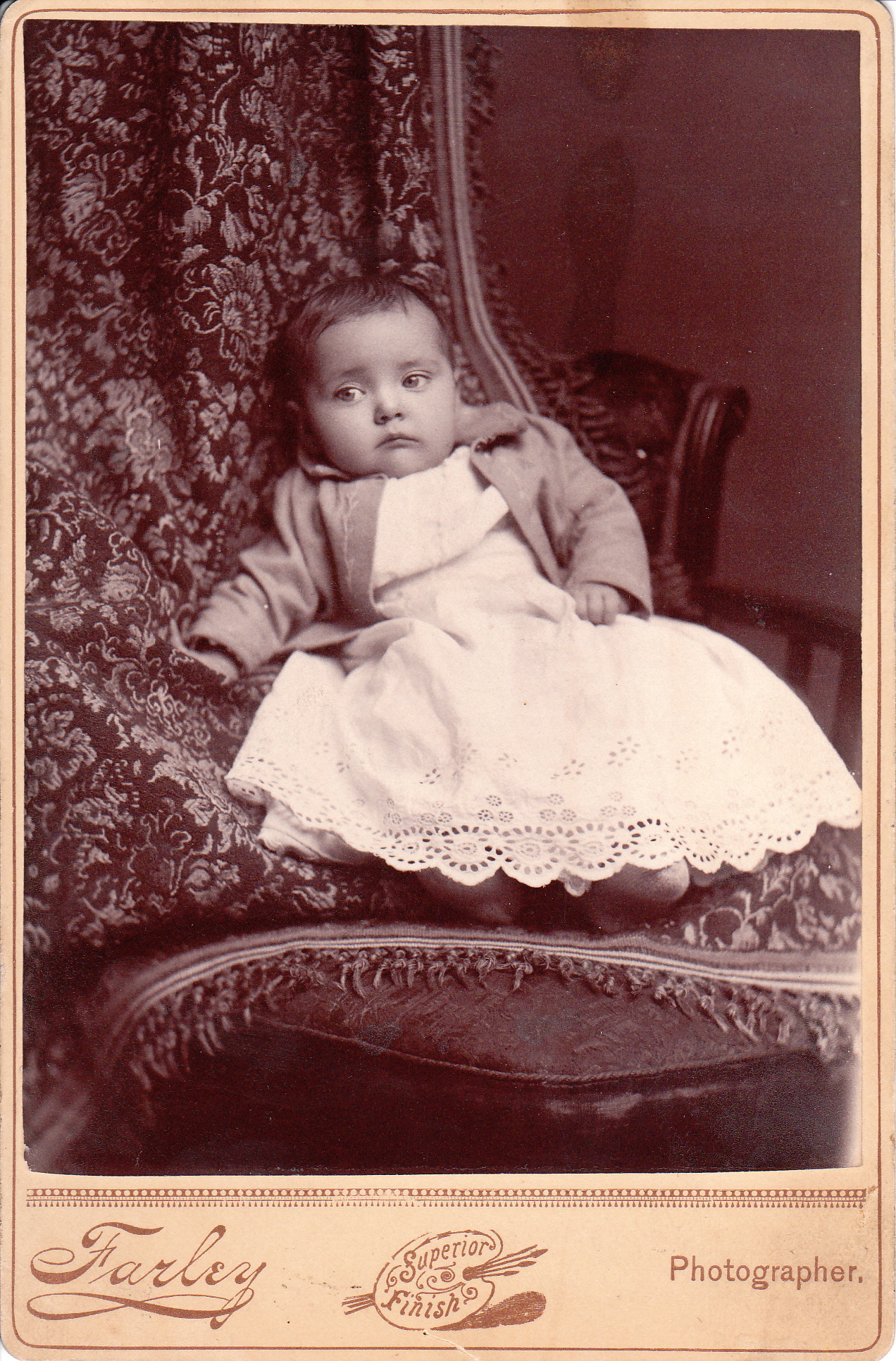
This cabinet card photograph features a very cute baby wearing a gown and sweater. She has beautiful big eyes According to an inscription on the reverse of the image, the baby is named  Atalie Jean Crum and she was five months and two days old, at the time the photograph was taken. Atalie Crum can be found on both the 1900 and 1910 U.S. census. She was born in 1890 and resided in Penn, Illinois. She lived with her parents, Brooke W. Crum, and Laura V. Crum. Both of her parents were born in Pennsylvania and her father was a farmer. The 1910 census reveals that at age twenty, Atalie was employed as a school teacher. A 1913 publication from the Illinois Office of Public Instruction, states that Atalie taught school in Stark County, Illinois (District 53). At an unknown age, she married Claude Sterling, a local farmer. An obituary in the Peoria Star (1936), reports the death of John Wesley Crandell. He died at the age of 78 in Castleton, Illinois. He was his community’s last surviving civil war veteran. A male quartet sang at the funeral and they were accompanied by a Mrs Atalie Sterling at the piano. This is likely the Atalie Sterling in the photograph. Atalie lived a long life, dying in 1969 at age eighty in Wyoming, Illinois. The photographer of this cabinet card is difficult to identify with any certainty. There was a photographer named W. H. Farley who operated in Crete and Gibson Illinois in the 1880’s. A photographer named A. Farley also had a studio in Illinois. Research uncovered another cabinet card with the same Farley logo as this cabinet card. The card was from a studio located in Tampico, Illinois. Tampico is the likely place that Atalie Crum was photographed.

THREE NATIVE AMERICAN SIBLINGS IN EL RENO, OKLAHOMA TERRITORY (PHOTOGRAPHED BY STOTZ)

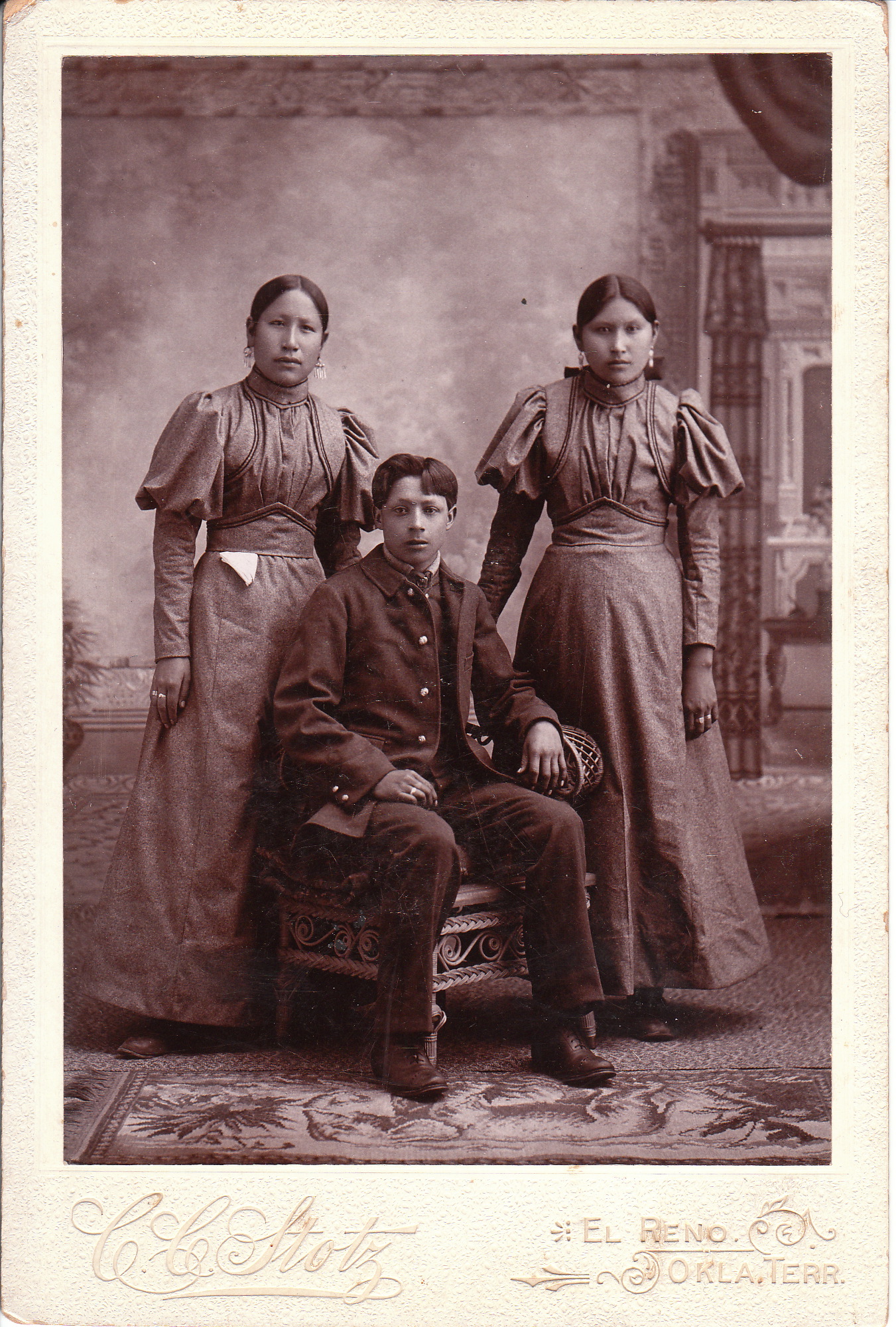
This cabinet card is chock full of history. The photograph features three young Native Americans posing for their portrait at the studio of Christopher Charles Stotz (1851-1932), in El Reno, Oklahoma Territory. The subjects of this image are likely siblings. The young women are wearing identical dresses and are adorned with rings and beautiful earrings. The specific Indian tribe that these three young people represent, is unknown. Oklahoma was the home of many Indian Tribes including Pawnee, Creek, Apache, Arapaho, Choctaw, and others. Many tribes were relocated there from other states. As mentioned earlier, the photographer of this cabinet card is C. C. Stotz and his studio was located in El Reno, Oklahoma Territory. Oklahoma became a state in 1907 which means that this photograph was taken before that year. El Reno is located in central Oklahoma, about 25 miles from Oklahoma City. Fort Reno was built in 1874 and it’s first commander was Civil War hero, General Philip Sheridan. Sheridan named the fort after his friend, General Jesse L. Reno, who was killed in the Civil War. The fort was near the Cheyenne-Arapaho reservation. One of the fort’s missions was to “protect” the “Five Civilized Tribes”. This group was comprised of the Cherokee, Chickasaw, Choctaw, Creek, and Seminole tribes. Employing the term “civilized tribe” was evidence of the special prejudice held against the tribes not among the designated five civilized tribes. Tribes described as civilized were tribes that had adopted many of the customs and values that were held by  European-Americans at the time.  Who was C. C. Stotz?  Stotz was born in Columbia, Pennsylvania.  He  established a studio in El Reno in 1889; the same year El Reno was founded. Therefore, this photograph was taken between 1889  (El Reno founded) and 1907 (Oklahoma statehood). During the 1880’s and 1890’s, he made field and studio photographs of Southern Plains Indians. Stotz is an acclaimed early photographer  of Native American’s and Native American life.

PRETTY WOMAN WITH SNOW SHOE BROOCH IN DANBURY, CONNECTICUT

A pretty young woman poses for her portrait at Folsom’s gallery in Danbury, Connecticut. She is wearing a snow shoe brooch at her collar. Joseph H. Folsom (1841-?) married Sarah Elizabeth Lockwood n 1869. At the time he married, he was a veteran of the American Civil War. He had enlisted in the New York First Regiment in 1861 and had fought in several battles before being taken prisoner at Gaines Mill, in June, 1862. He was a prisoner of war in Libby Prison. After the war, he returned to his photography business in Danbury. A photography journal published in 1883 announced that his estate had sold the business. Interestingly, it seem that his wife, reestablished the photography studio. The Anthony Photographic Bulletin (1888) reported that she had opened her own photographic studio in a new location.

ADORABLE BABY IN A WASHBOWL IN BALTIMORE, MARYLAND

A very cute baby poses for a photographer, artistically placed in a washbowl. The baby appears inquisitive about the proceedings. Bachrach & Bro. is the studio that produced this portrait. The gallery was located in Baltimore, Maryland. Kudos for the photographer for this creative close-up image. The Bachrach studio was nationally known and is still known today. David Bachrach (1845-1921) was an American commercial photographer based in Baltimore. He made significant contributions in technical, artistic and professional advancements in the field of photography. He was a national spokesperson for photographers and published many articles and photographs in photography journals. He experimented with self toning papers and developed the first practical process of photographic printing on canvas, a precursor to photo engraving. Bachrach Inc., founded in 1910, is still headed by the Bachrach family. The company owned studios in all major east coast cities. One of Bachrach’s earliest photographs was taken on assignment to cover the dedication of the Soldiers National Cemetery at Gettysburg in 1863. He photographed President Lincoln delivering what would become, a very famous speech. Bachrach’s home is listed on the National Register of Historic Places. He once shared the home with a celebrated relative, Gertrude Stein. Among his famous portraits are images of Ulysses Grant, Theodore Roosevelt,Mark Twain, and Alexander Graham Bell. Bachrach’s business was truly a family business. Among the relatives who were involved  in the business was a brother,  a son, and two grandsons.

BIG HEADED MAN WITH A LITTLE BEARD IN SULLIVAN, INDIANA

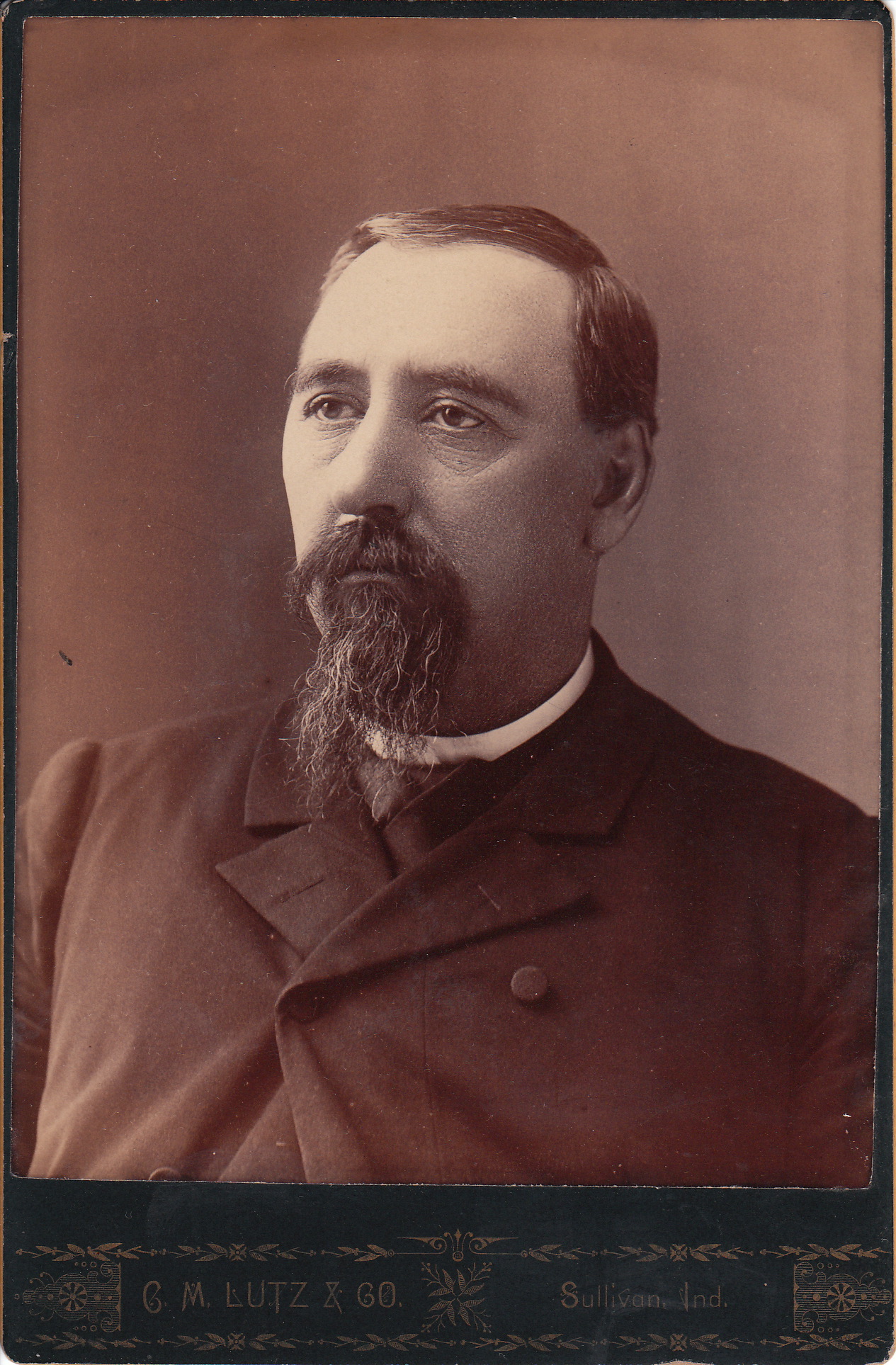
This cabinet card features a man with a big head and a little beard. This gentleman could not commit himself to growing a full beard so he restricted its growth to his chin area. He even lacks sideburns. To view other interesting images of beards, click on the category “Beards (Only the Best).  The photographer of this image is Charles M. Lutz & Co. The studio was located in Sullivan, Indiana. A Sullivan County directory (1896) reveals some biographical information about C. M. Lutz. He was born in 1842 in Huntingburg, Indiana. He began working as a photographer in 1861. He served in the 27th Indiana Volunteer Infantry during the civil war. He mustered in the unit as private and mustered out with the same rank. Lutz served in Company B of the 27th. Lutz married Sarah South in 1884 and came to Sullivan County in 1887. In 1891, he entered a partnership with photographer, W. F. Devol.

FEATHERED LADY OF MONTPELIER, VERMONT

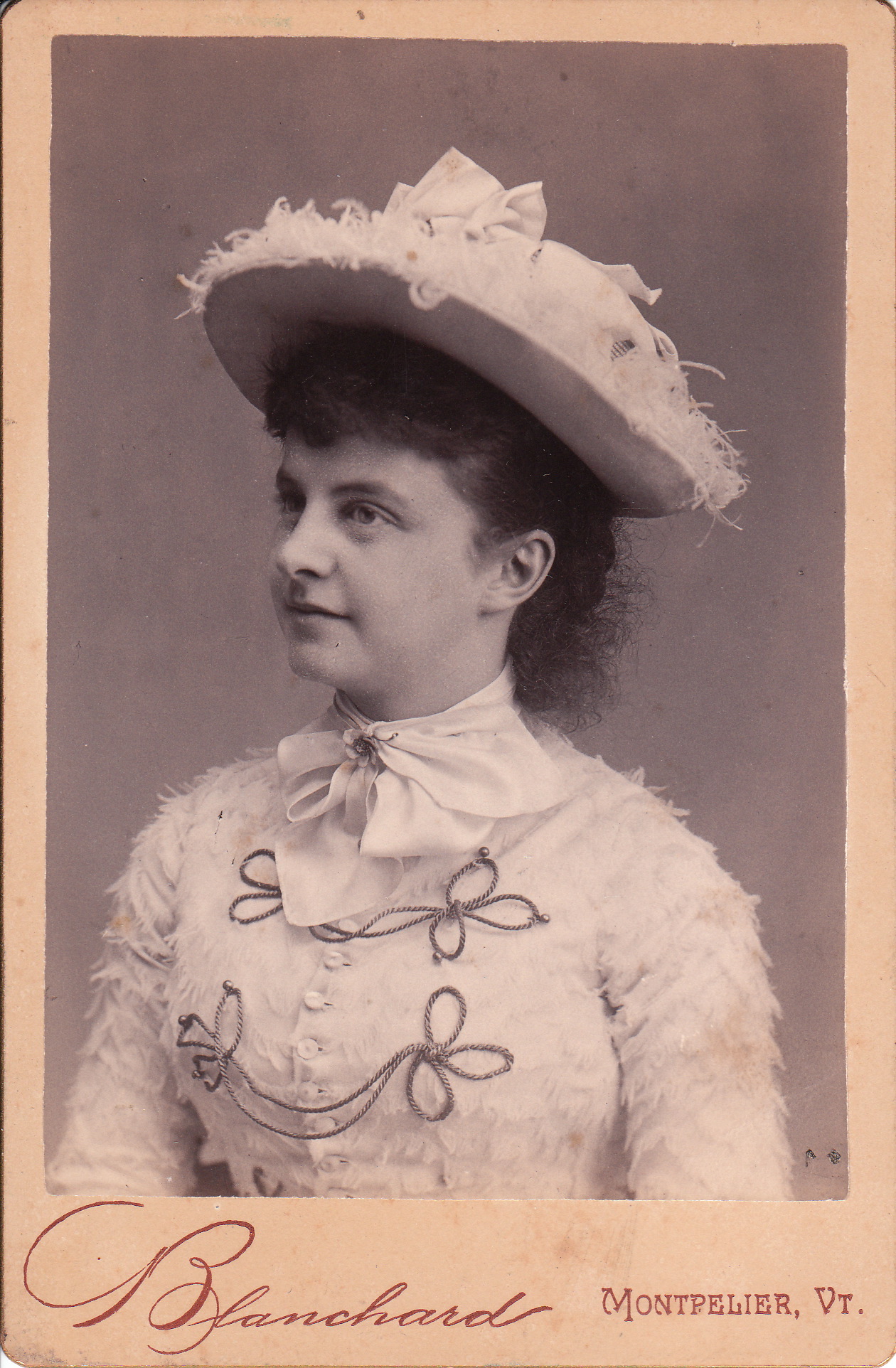
This cabinet card is a portrait of a pretty feathered woman. It is probably misleading to call her a feathered woman, when in fact, it is her dress and hat that is covered with feathers. She is certainly wearing a creative, albeit, odd dress, especially since the photograph was made  pre “Big Bird”. The photographer was A. N. Blanchard, and he was located on State Street, in Montpelier, Vermont. Azel Norman Blanchard (1843-1923) was a Civil War veteran who was a member of the 1st US Sharpshooters (Co. F). He established a photography business in Barre, Vermont, in 1865 and moved to Montpelier where he established a studio in 1880. Research reveals that his photography business was listed in the Montpelier directories of 1883 and 1887. He was buried in Green Mountain Cemetery, in Montpelier.

A MAN AND HIS MEDAL IN PHILADELPHIA, PENNSYLVANIA

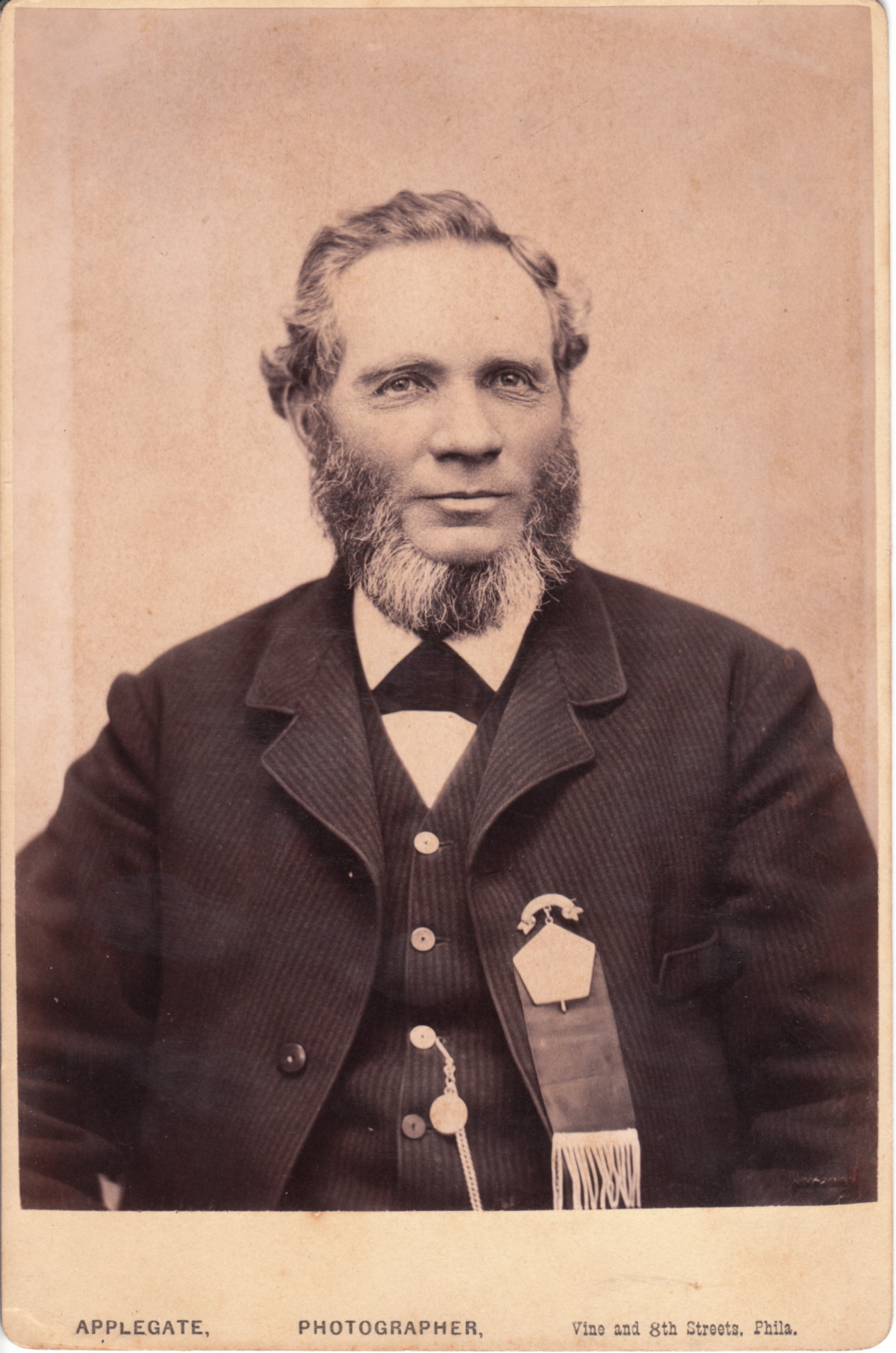
This dapper gentleman is wearing a medal and ribbon as he poses for this portrait at the studio of Applegate, in Philadelphia, Pennsylvania. What does this medal and ribbon represent? Is this gentleman a veteran of the civil war? Is he a member of a fraternal organization or political party? The answer to these questions will be very difficult to obtain but perhaps a visitor to this site may have some ideas to share about the type of medal and ribbon the subject is wearing. The gentleman’s beard is quite interesting. He has no mustache or whiskers immediately under his lower lip. He qualifies for Cabinet Card Gallery’s category of  “Beards (Only The Best). The photographer of this cabinet card led an interesting life. In 1860, James R. Applegate had a photographic studio in Philadelphia that was three floors high. In 1877, a St. Louis photography magazine visited Applegate’s studio and wrote that he “encases 50 portrait faces every minute…. with a bevy of young ladies finishing the same and scores waiting to be set”. In 1884, Applegate opened the first successful amusement pier in Atlantic City, New Jersey. The boardwalk included one of his photography studios. In 1891, he moved the carousel from the boardwalk to Philadelphia and a year later, the police raided the carousel and arrested him and 200 guests. He was charged with “keeping a disorderly house” and an unnamed more serious offense.

ODETTE TYLER: THEATER ACTRESS AND DAUGHTER OF A CONFEDERATE GENERAL

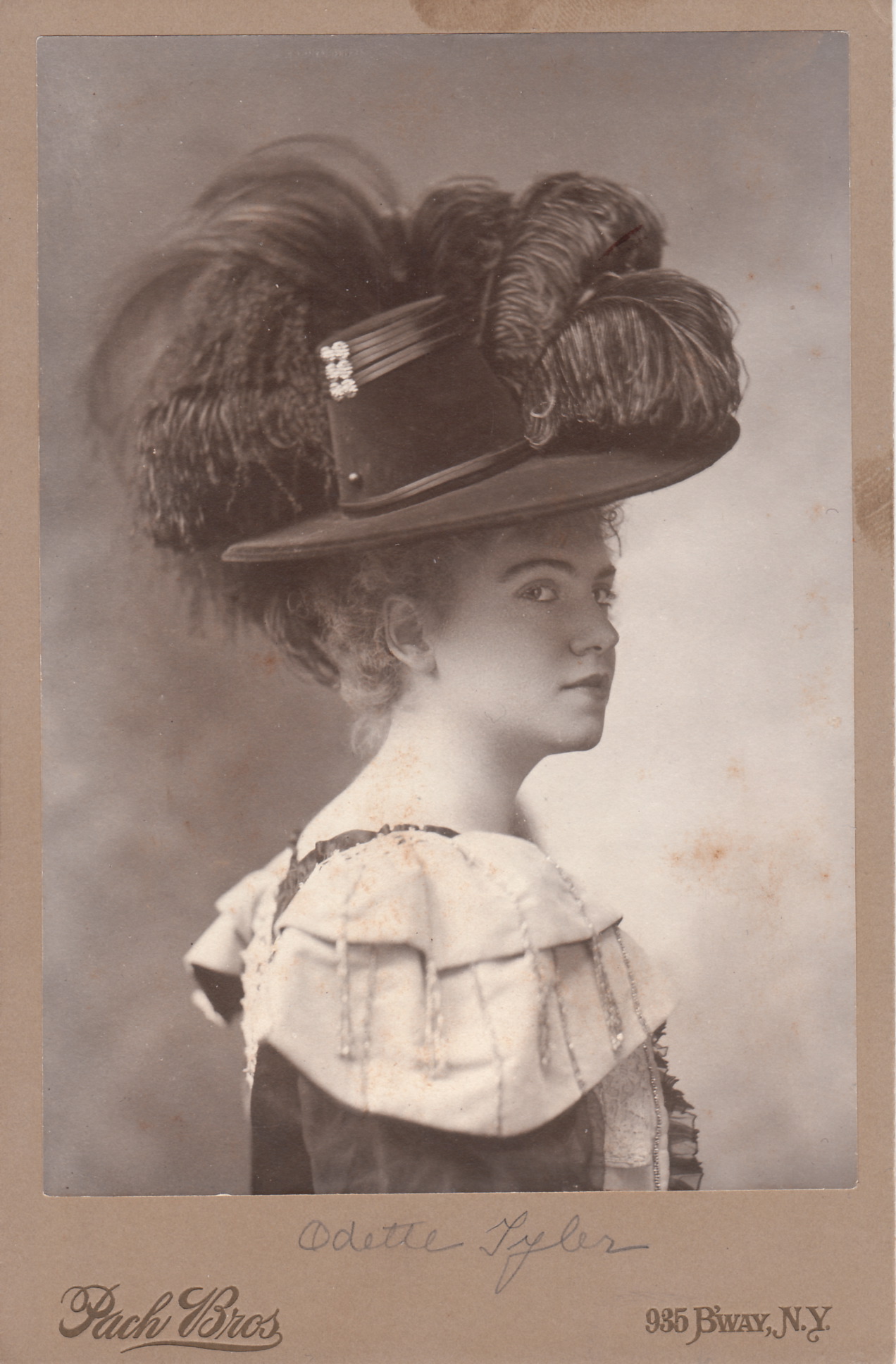
This Cabinet Card is a photograph of actress Odette Tyler (1869-1936) and it is photographed  by famed celebrity photographic studio, the Pach Brothers. Tyler appeared in many productions including “The Love Route” (1906) which appeared on Broadway. She was an American actress and comedienne. She worked for Charles Frohman and was a member of a number of theater companies including the Madison Square Company (1884-1885). She authored a book, “Boss: A Story of Virginia Life”. Tyler was born Elizabeth Kirkland in Savannah, Georgia.  Tyler’s father was a West Point graduate and served as a Confederate General during the Civil War (General William Kirkland). Odette Tyler is quite pretty in this image and her feathered hat can be described as elaborate. To view other photographs by this studio, click on the category “Photogapher: Pach Bros.”.