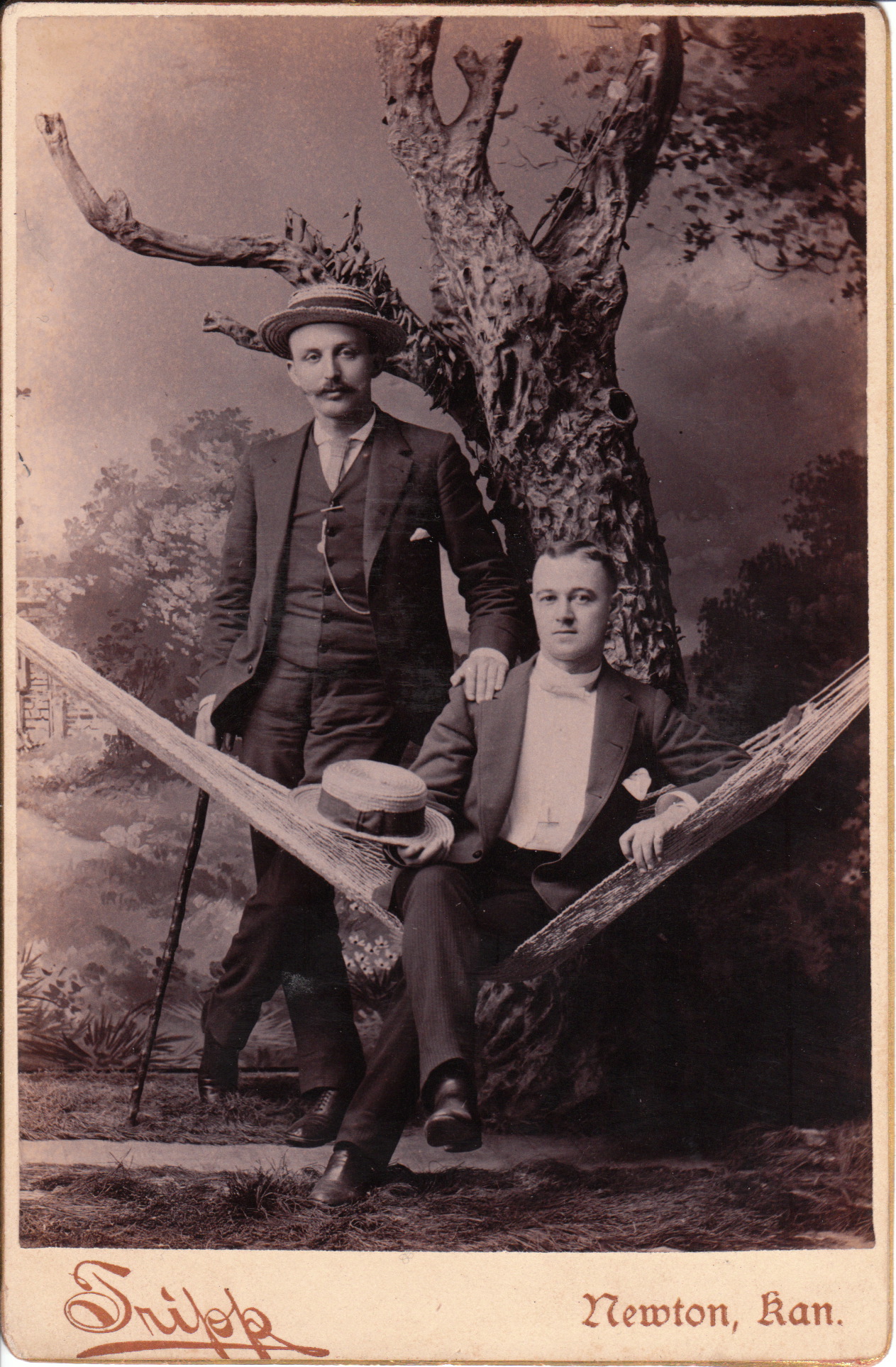
Two affectionate men pose for their portrait in Newton, Kansas. The men look quite dapper in their suits and with their straw hats. Note that the gentleman wearing the suit and vest has a pocket watch chain visible atop his vest. He is also holding a walking stick.The man standing, and the man sitting on the hammock are showing some shared affection. They could be friends, relatives, or even lovers. It is impossible to guess their relationship. One wonders if homophobia was much of a factor in the cabinet card era in regard to men showing affection to men in public or in photographs. Perhaps a visitor to the cabinet card gallery can competently comment on this issue. The photographer of this image is the Tripp studio in Newton, Kansas. According to print on the reverse of the photograph, the studio was located on the corner of Main Street and Broadway. The photographer, Frank D. Tripp is cited in Anthony’s Photographic Bulletin (1896) as the President of the Photographers Association of Kansas. Another source states that Tripp “flourished” as a photographer in Newton during the 1880’s. Tripp’s obituary appears in The Evening Kansan Republican (1947). He died in Denver, Colorado at age eighty. He was described in the article as a pioneer photographer in Newton. He was an officer in the Newton Masonic Lodge. At some point he moved to Pueblo, Colorado where he was a partner in the Tripp and York photography studio.
AGNES EVANS: THEATRE ACTRESS DRESSED IN QUITE RISQUE FASHION

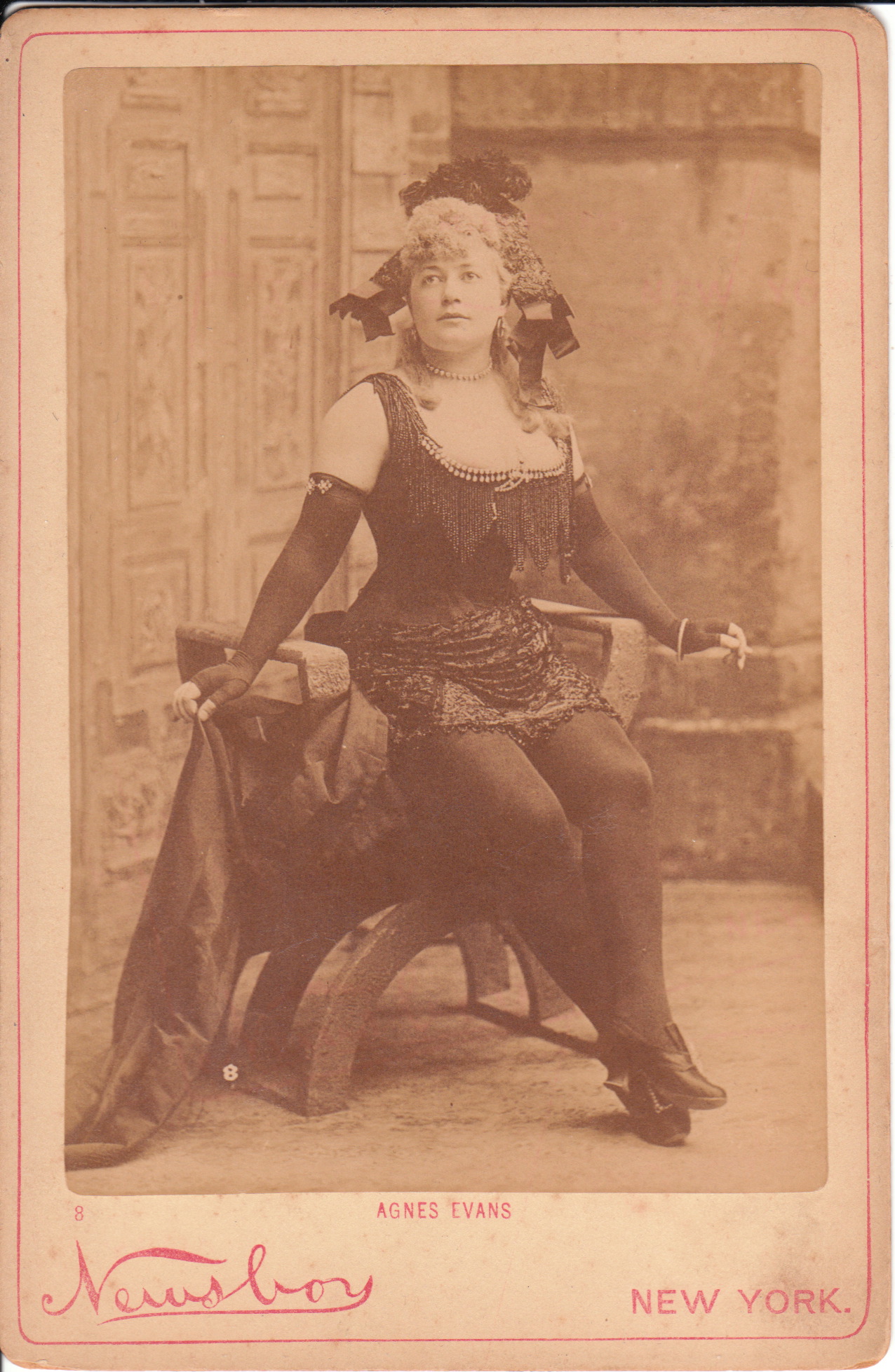
Agnes Evans poses for this cabinet card (top) photographed by Newsboy of New York. Agnes Evans was a theatre actress who performed in the Broadway production of the Pit (1904). The actress is wearing a very revealing risque dress. Further research by myself or assistance from visitors to this site will hopefully further illuminate her life and career. Newsboy was a brand of plug tobacco and Newsboy photographs were given away as a premium by tobacconists and drug stores who sold the tobacco. The images were produced by the National Tobacco Works of New York. They were likely produced and issued in the early 1890’s. The bottom image features Miss Evans in another Newsboy cabinet card (number 8 in a series). She is wearing a risque costume that includes fingerless gloves.
WOMAN IN DEEP CONCENTRATION STUDIES A PHOTOGRAPH IN LINCOLN, ENGLAND
George Hadley of the Castle Studio produced this portrait of a woman in deep concentration. She is studying what appears to be a small framed photograph. One of her hands rests on a table. The table top holds an inkwell. Printing on the reverse of the cabinet card indicates that the studio had won prizes at exhibitions at Cornwall (1884), London (1884), and Northampton (1884). The studio was located in Lincoln. Lincoln is a cathedral city and county town of Lincolnshire, England.
PORTRAIT OF A LADY RIDER WITH HER HORSE AND INDIAN GROOMSMAN
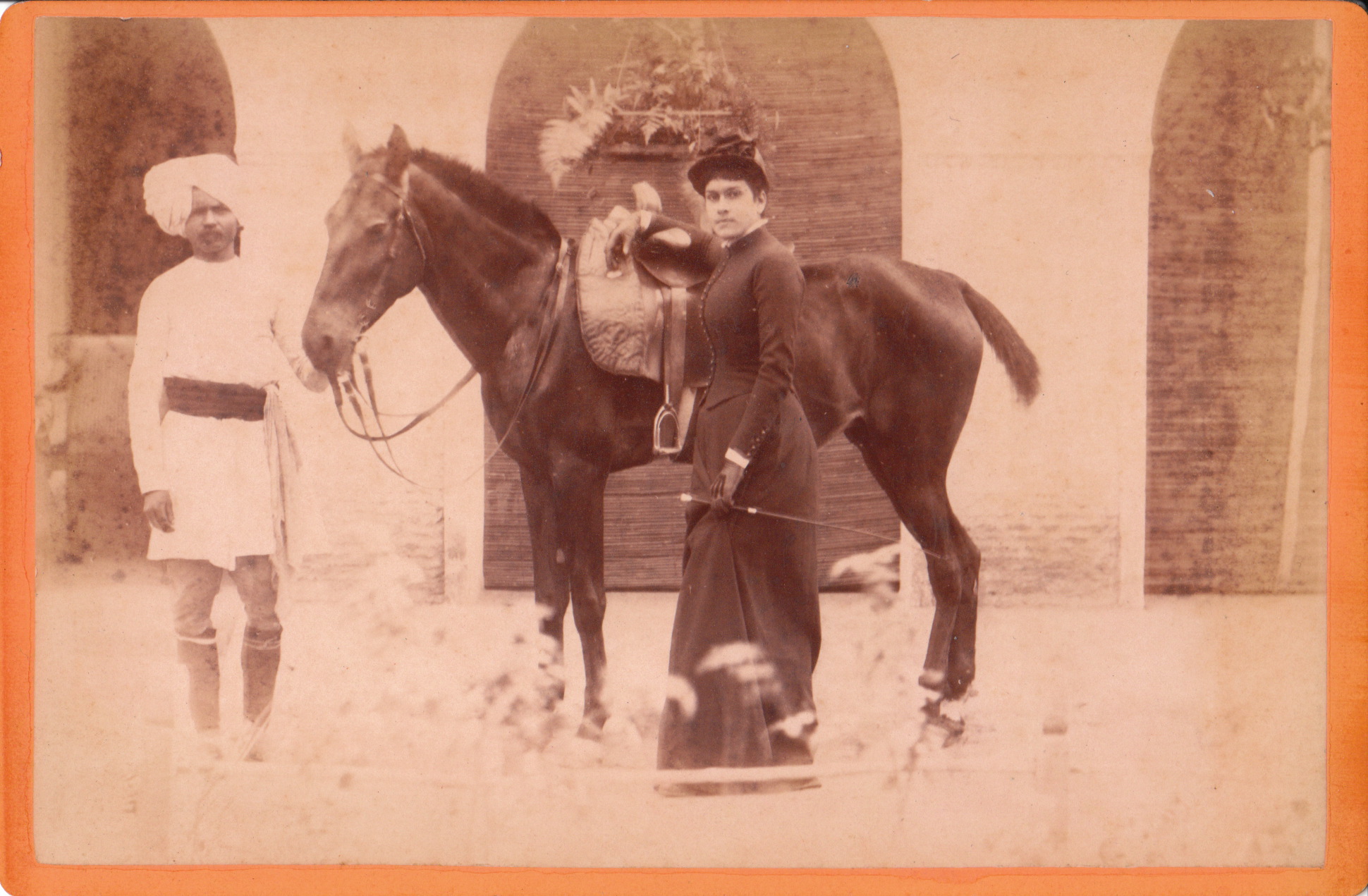
A woman in her riding habit and holding a riding crop, poses with her horse and servant. The servant is wearing a turban and holding the bridle of the lady’s mount. It is likely that this photograph was taken in India. The subjects and the photographer are unidentified.
NOTED STAGE ACTOR: J. FORBES ROBERTSON
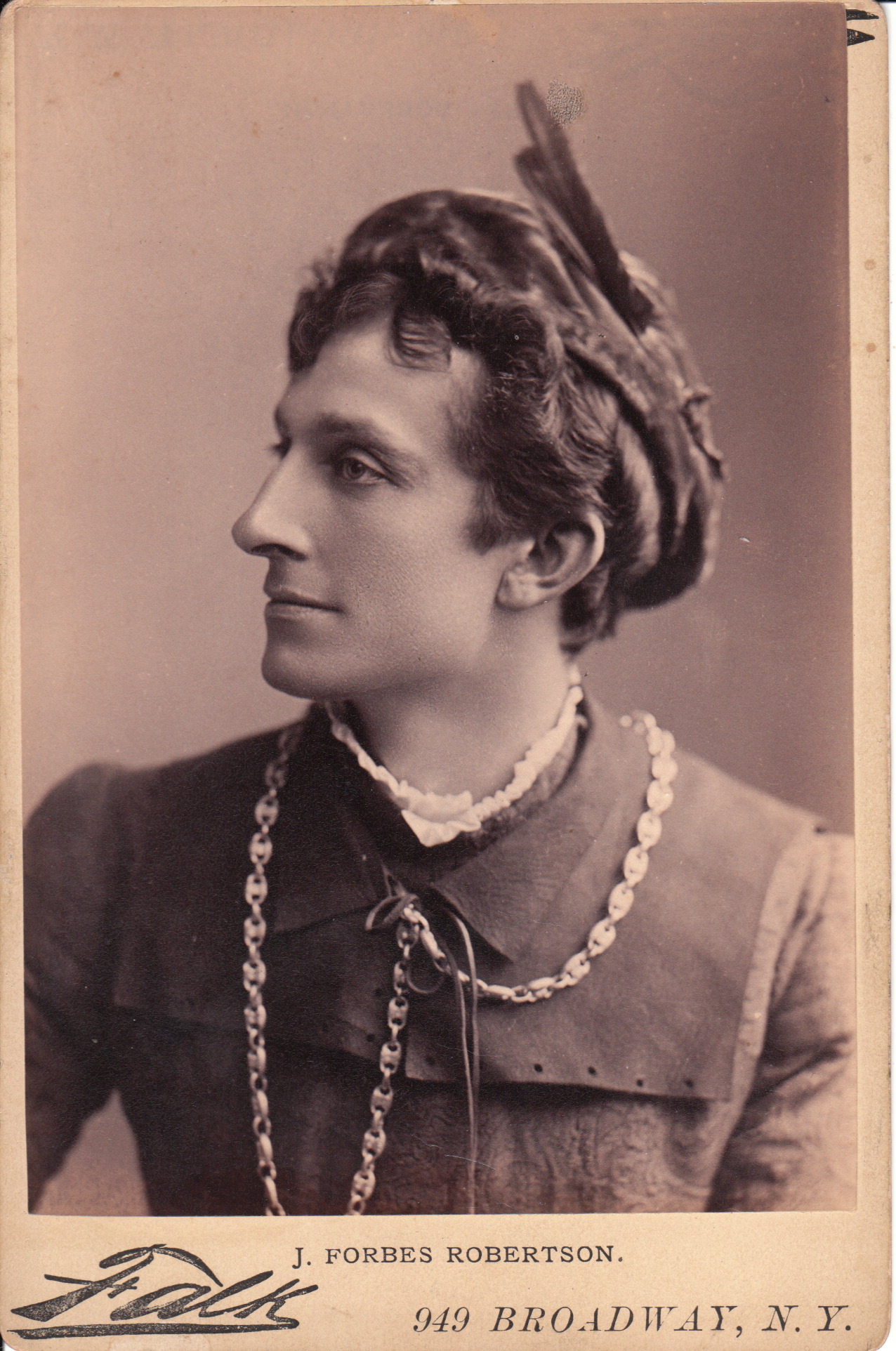
Johnston Forbes-Robertson (1853-1937) was a celebrated English actor and theater manager. He was considered to be one of the finest actors of his time. He was particularly noted for his portrayal of Hamlet. He did not profess a passion for his acting profession. He was born in London. His father was a journalist and theater critic. He had ten siblings and four of them pursued acting. His original interest was to become an artist, but to support himself financially he entered acting. He worked with Sir Henry Irving for some time as a second lead actor. He then became a lead actor. His starring roles included Dan’l Druce, Blacksmith and The Parvenu (1882). George Bernard Shaw wrote the part of Caesar for him in Caesar and Cleopatra. Forbes Robertson acted in a number of Shakespeare plays and also appeared a number of times with actress Mary Anderson in the 1880’s. In 1900 he married the American actress, Gertrude Elliott (1874-1950). In 1930, Forbes Robertson was knighted. This cabinet card portrait was produced by photographer Benjamin Falk who’s studio was located in New York City. Forbes Robertson is captured in costume in this image. The reverse of the photo is stamped “J. M. Russell 126 Tremont Street, Boston”.
TWO LITTLE GIRLS AND A BALE OF HAY
The two young girls in this cabinet card portrait are probably sisters. They are posing with a bale of hay in front of a fake brick house. Both girls are wearing necklaces and the older girl is displaying some religiosity by wearing a cross. The photographer and the location of the photographer’s studio are unknown.
MOM CRADLING HER LONG GOWNED BABY
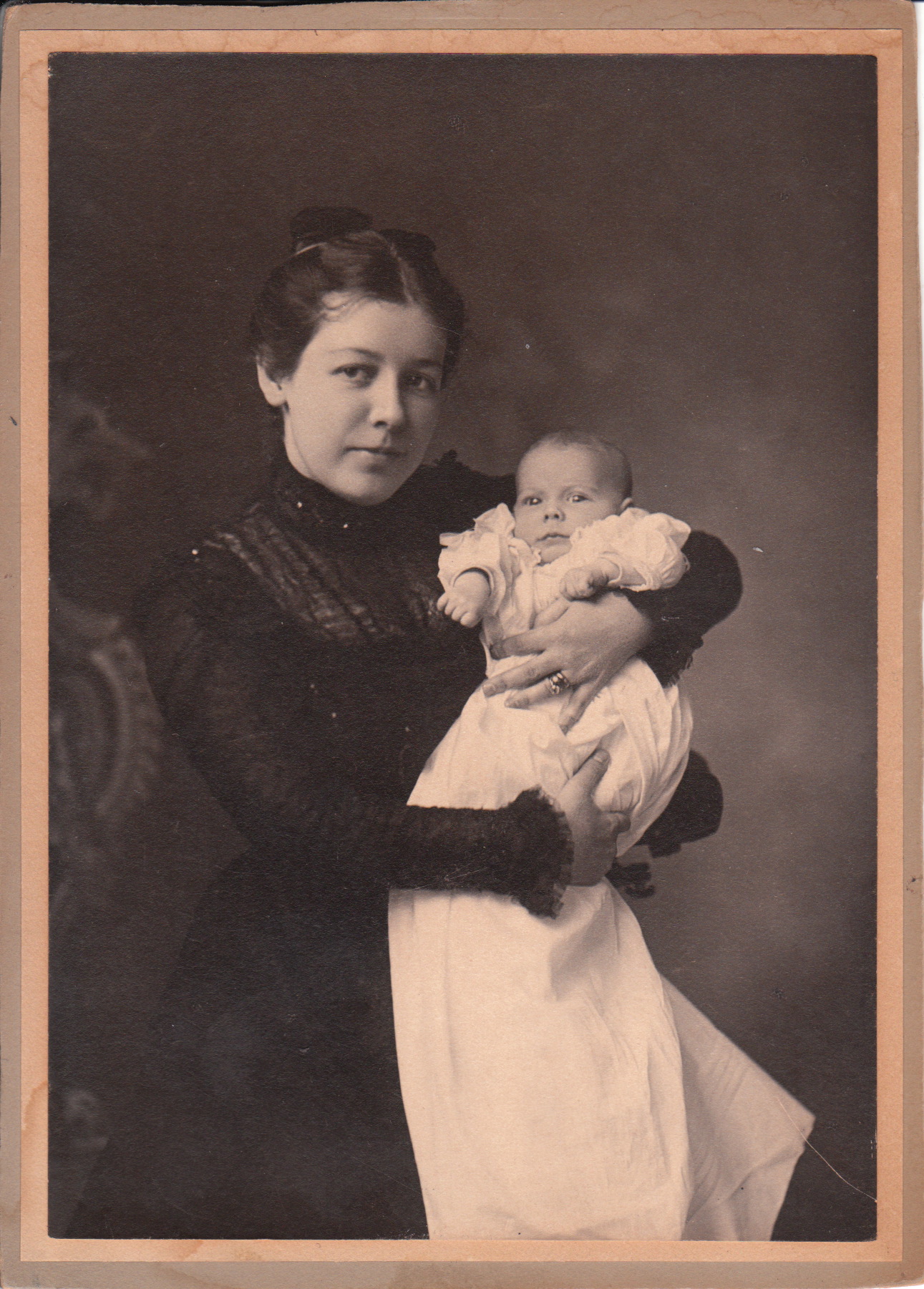
A young mother and her baby pose for an unknown photographer in an unknown studio. The baby is wearing a long gown and the baby’s proud mom dressed up for this portrait. An inscription on the reverse of the photograph indicates that the photograph was taken sometime between 1900 and 1909. The year is not definite because when someone trimmed the photograph they cut off the last digit of the year leaving “190” as the year.
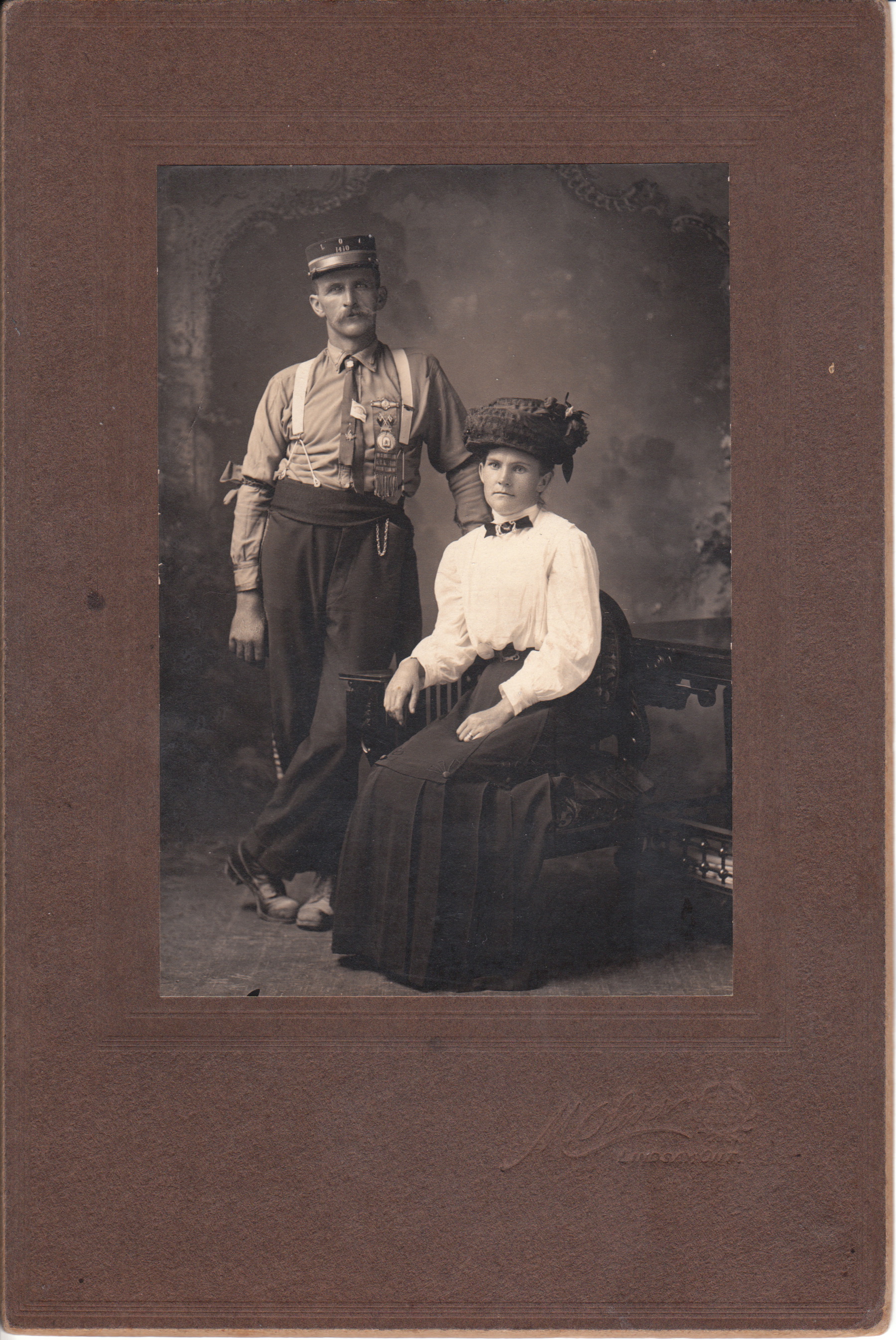
CANADIAN COUPLE POSE IN ONTARIO, CANADA (MAN IN UNIFORM OF AN UNKNOWN ORGANIZATION)
A middle aged couple photographed by M. Oliver of Ontario, Canada. he is wearing what looks to be a uniform of some sort, maybe masonic. He has a ribbon and pins and looks to be wearing a sash around his waist. His cap is labeled with what may be an id number “1410” and what looks to be “L O I”. He may be a member of a military or fraternal organization or fire or police department.He is wearing terrific suspenders. Lets not forget that his wife is also in the picture. She is wering a nice hat and bow tie with jewelry on her collar. He has ribbons around his sleeves which gives them a bunch look.
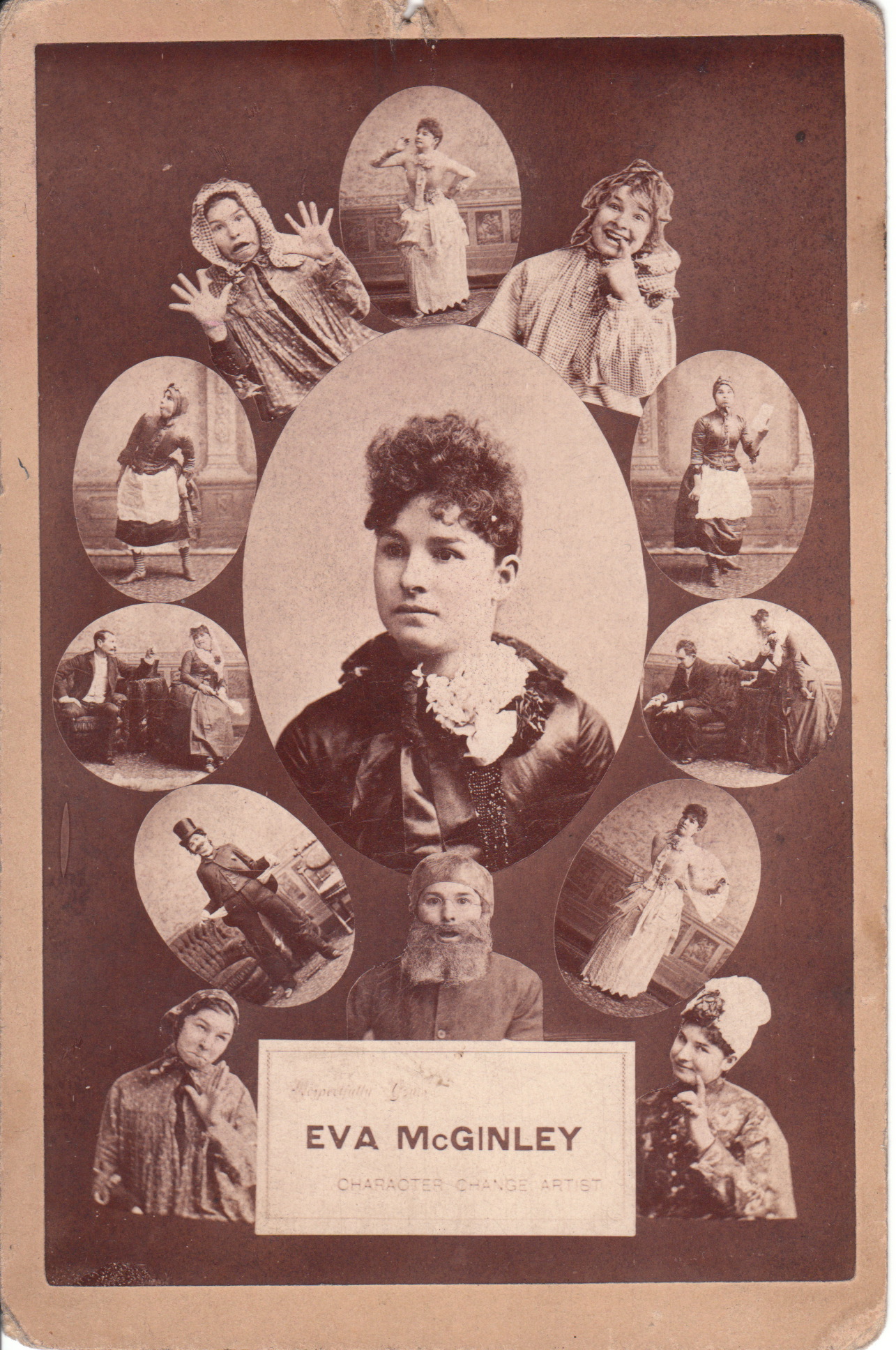
EVA McGINLEY: CHARACTER CHANGE ARTIST
This composite cabinet card features Eva McGinley and is subtitled indicating that she was a “character change artist”. The central portrait on the card shows a prim and proper lady but the image is surrounded by other images displaying Miss McGinley’s versatility and talent to play disparate character roles. Eva McGinley was not a major actress which is apparent by the dearth of information readily available in my preliminary research. However, two newspaper articles were found pertaining to Miss McGinley. The New York Dramatic Mirror (1900) reported that “Eva McGinley’s voice failed her at Greenfield, Iowa last week” and she and her husband Bob went to Omaha to recuperate. A second article appeared in the New York National Police Gazette (1900) which proclaimed that Miss McGinley and her husband were enjoying themselves in Lakeview, Iowa and that she had shot and killed the largest pelican ever killed on Wall Lake. Imagining Miss Mcginley hunting pelicans with a rifle is distasteful to me but it certainly indicates that she really was quite a “character”. The photographer of this image is unidentified.
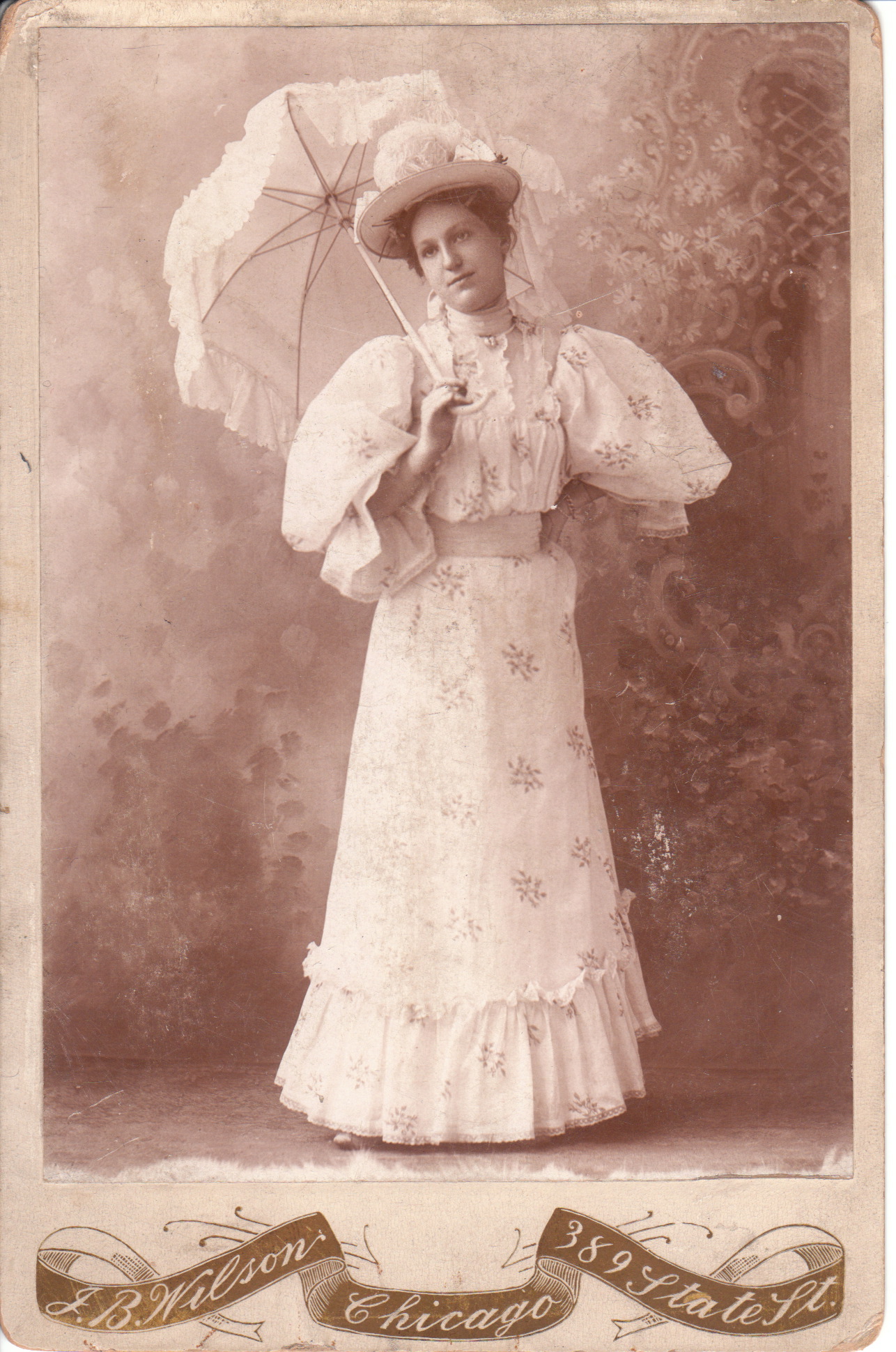
PRETTY LADY AND HER PARASOL IN CHICAGO, ILLINOIS (IDENTIFIED AS AIDA BUSHNELL)
A pretty woman is a stylish dress poses for her portrait at the J. B. Wilson studio in Chicago, Illinois. She is wearing a pretty hat and is holding an open parasol over her shoulder. Her left arm is hidden but magnification shows that she has placed her left hand on her hip. She is thin waisted, probably courtesy of a corset. The reverse of the photograph has an inscription that identifies the young woman pictured in the image. However, the identification is somewhat tentative. The inscription states “Aida Bushnell, I think”. To view other photographs by J. B. Wilson, click on the category “Photographer: Wilson (JB)”. The 1900 US census lists the subject as “Addie” and reports that she was born in 1866 and was married to Henry Bushnell since 1888. She and her husband had three children; Howard (age 11), David (age 8), and Miriam (age 4). Henry worked as a laborer while Addie was a dressmaker.The family was living in Lisbon, Illinois. The 1910 census finds the family living in St. Charles, Illinois. The only child remaining home was Miriam (listed as Marion). Henry still worked as a laborer. The 1920 census identifies Aida as “Ada”. She and her husband were still living in St. Charles. Henry was disabled and not working while Ada was also unemployed. The 1930 census indicates that the 74 year-old Henry and 64 year-old “Addie” remained in St. Charles. The 1940 census reveals that Addie had become a widowed boarder in a St. Charles residence.