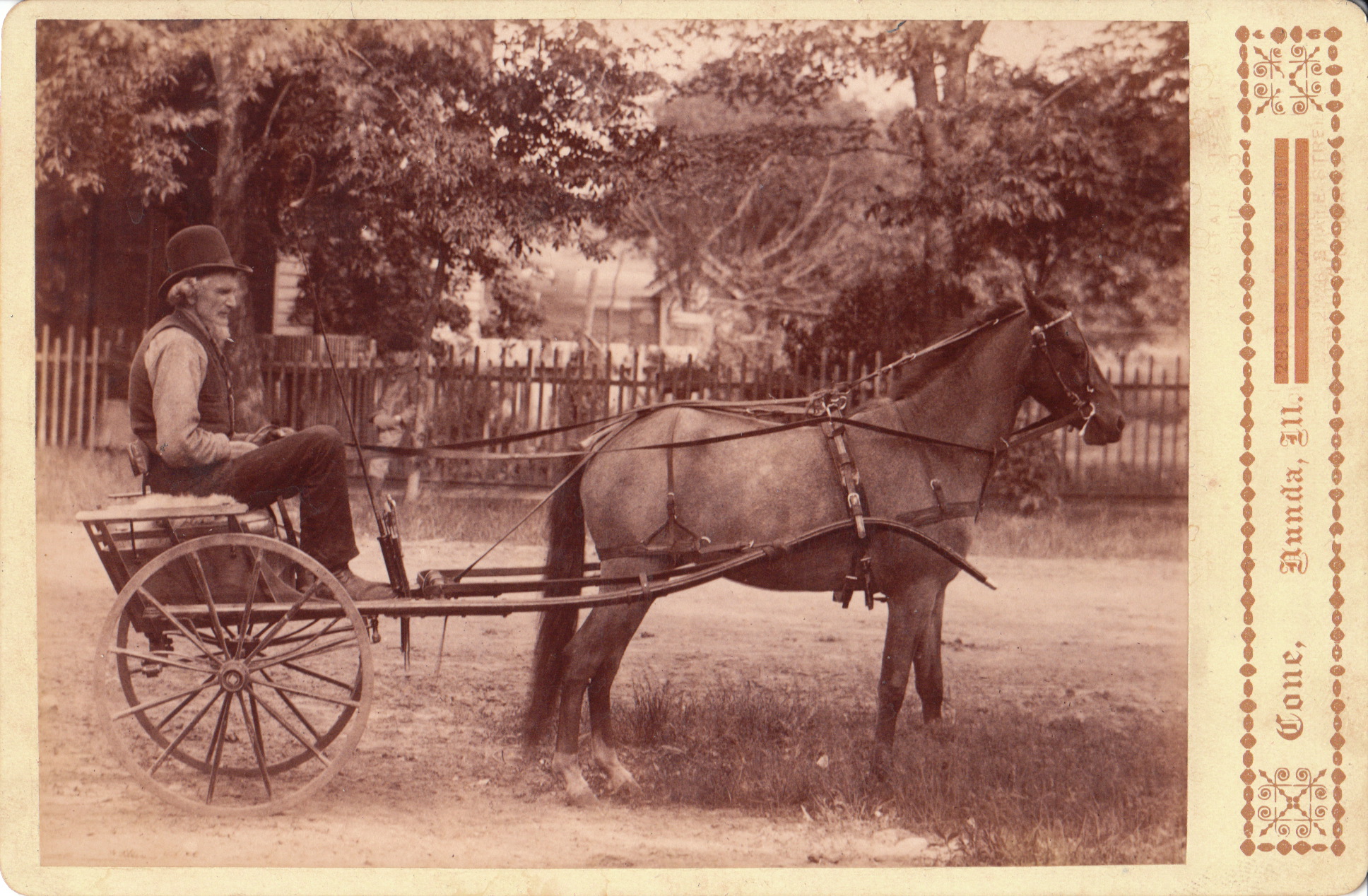
 This cabinet card photograph features an old man sitting in his horse drawn cart. Note that the cart has only two wheels. The cart seems to be on a road in front of a fenced house. The gentleman is wearing a derby style hat. The photograph was produced by the Cone studio in Nunda, Illinois. The township of Nunda was established in 1849 and was originally called Brooklyn. In 1850 the name of the town was changed to Nunda to honor a community leader whose birthplace was Nunda, New York. The photographer of this photograph may be Joseph C. Cone. The Portrait and Biographical Album of Fulton County, Illinois (1890) reports that Cone was a Union soldier for three years in Company C of the 103rd Illinois Infantry and became a photographer in Farmington, Illinois. The book also states that he was married to Maria Union. Farmington and Nunda are 190 miles apart and it was not uncommon for photographers of the era to frequently move their businesses from community to community in order to find better economic opportunities. However, Joseph Cone’s identity as the photographer of this image is purely speculative.
OLD MAN AND HIS HORSE AND BUGGY IN NUNDA, ILLINOIS

TWO GIRLS PLAYING A BOARD GAME ON SEVEN SISTERS ROAD
 This cabinet card photograph captures two girls playing a board game. It would be nice to see the kids of today spending a little time playing board games instead of isolating themselves in front of their computer or video game system. Hopefully, a member of the “vast unpaid research department” of the cabinet card gallery will leave a comment identifying the game that these girls are playing. This photograph was produced by The Eclipse Photo Company which was located at 103 Seven Sisters Road. Where is Seven Sisters Road? Printing on the reverse of the photographs states “103 Seven Sisters Road N.” What is “N”? Perhaps “N” means North or the abbreviation for a City or Province. Research reveals that a “Seven Sisters Road” exists in London, England.
PRETTY YOUNG MOTHER WITH TODDLER SON IN HARTFORD, CONNECTICUT
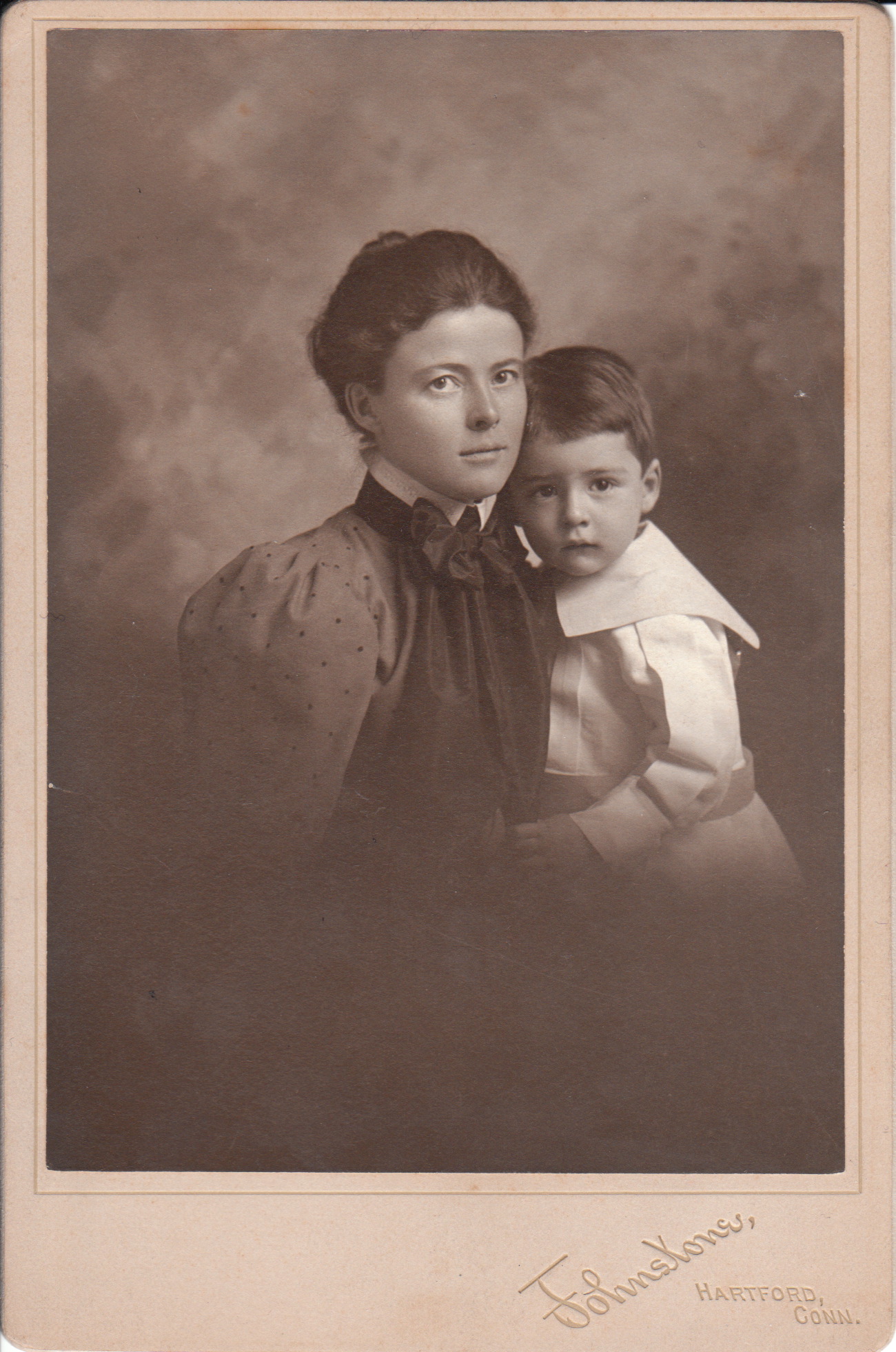 A pretty young mother and her toddler son pose for their portrait at the Johnstone studio in Hartford, Connecticut. Mom is looking at the photographer with a suspicious expression while her son appears quite unhappy and terrified. Photography Journals of this era often contained articles about how to achieve the best photographs of children. Either this child was exceptionally difficult to distract or calm down, or Mr Johnstone was unfamiliar with the aforementioned literature. The 1903 Hartford directory lists Christopher Johnstone as a photographer located at 45 Pratt Street. Wilson’s Photographic Magazine (1904) reports that Johnstone was the President of the Photographers Association of New England.
PORTRAIT OF A SULTRY GORGEOUS YOUNG LADY
 This portrait of a sultry gorgeous young lady must speak for itself. The image has been trimmed and if there was any information on the photograph to help identify the woman or the studio, it is now gone. The woman’s bare shoulders and other exposed areas make this photograph somewhat risque for it’s time. (SOLD)
MAN WITH A TRUMPET IN ALBION, NEW YORK
 A man in a plaid suit, winged collar shirt, and matching vest poses for his photograph at an unidentified studio. He is holding a horn of some kind (Trumpet?, Bugle?, or Cornet?) and wearing a cap which has the lettering “WCB”. I am guessing that the “CB” part is an abbreviation for “community band”. Inscribed on the reverse of the photograph are the following; “Burnette” and “Albion, NY”. “Burnette” is likely the subject’s name and Albion was likely his hometown. Research found too many men sharing the name “Burnette” in Albion to make a positive identification of his name and background. The over zealous previous owned of this cabinet card described the subject as a civil war veteran holding his bugle and wearing his kepi hat. Collectors of antique photographs must be careful of people making such unsubstantiated claims. Call me an optimist, but I think the majority of such people are more unaware than unscrupulous.
LULU GLASER: ROCKET ASCENT FROM UNDERSTUDY TO STAGE STAR
 CABINET CARD 1 (SOLD)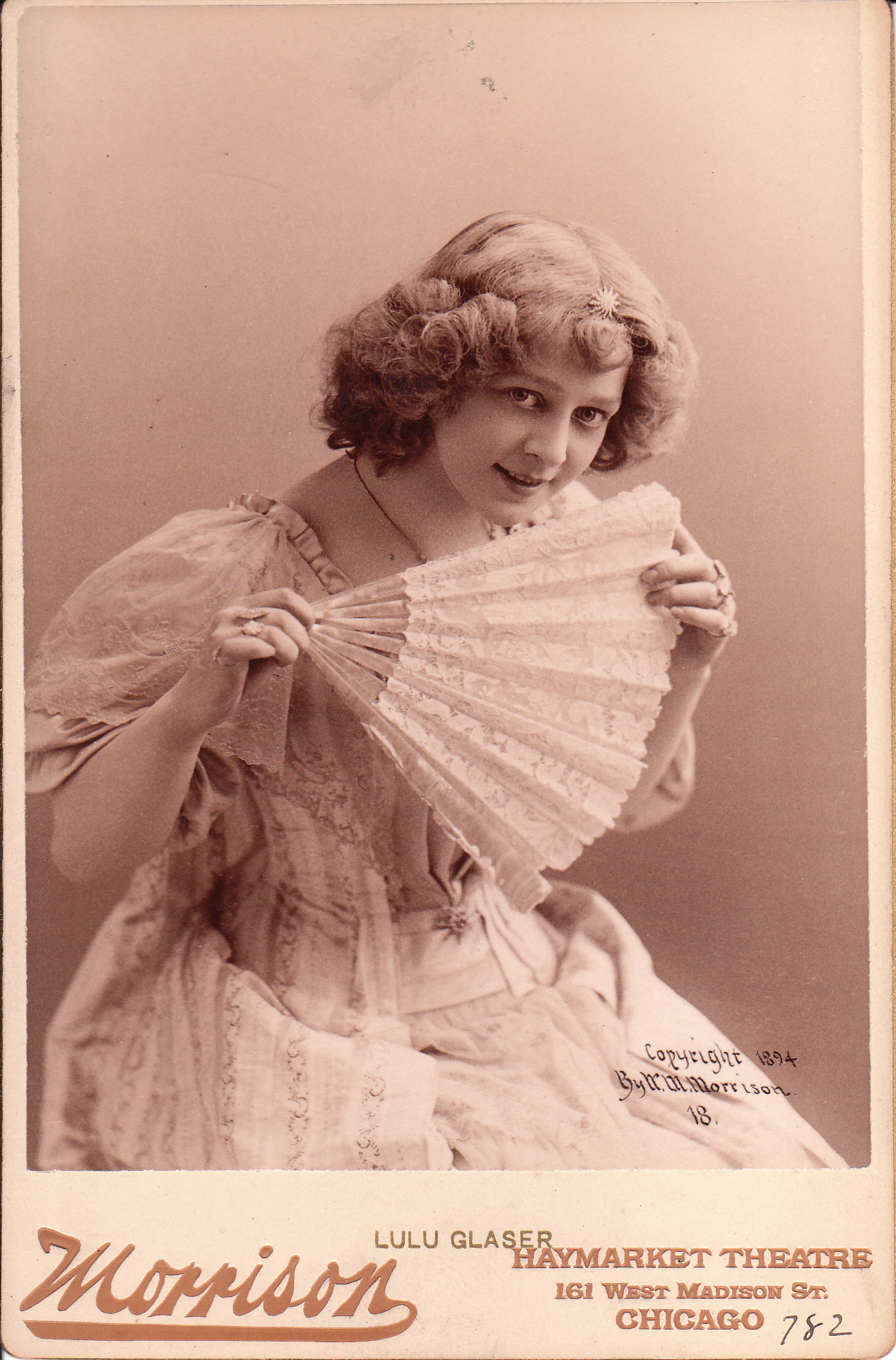
CABINET CARD 2 & 3
CABINET CARD 4
CABINET CARD 5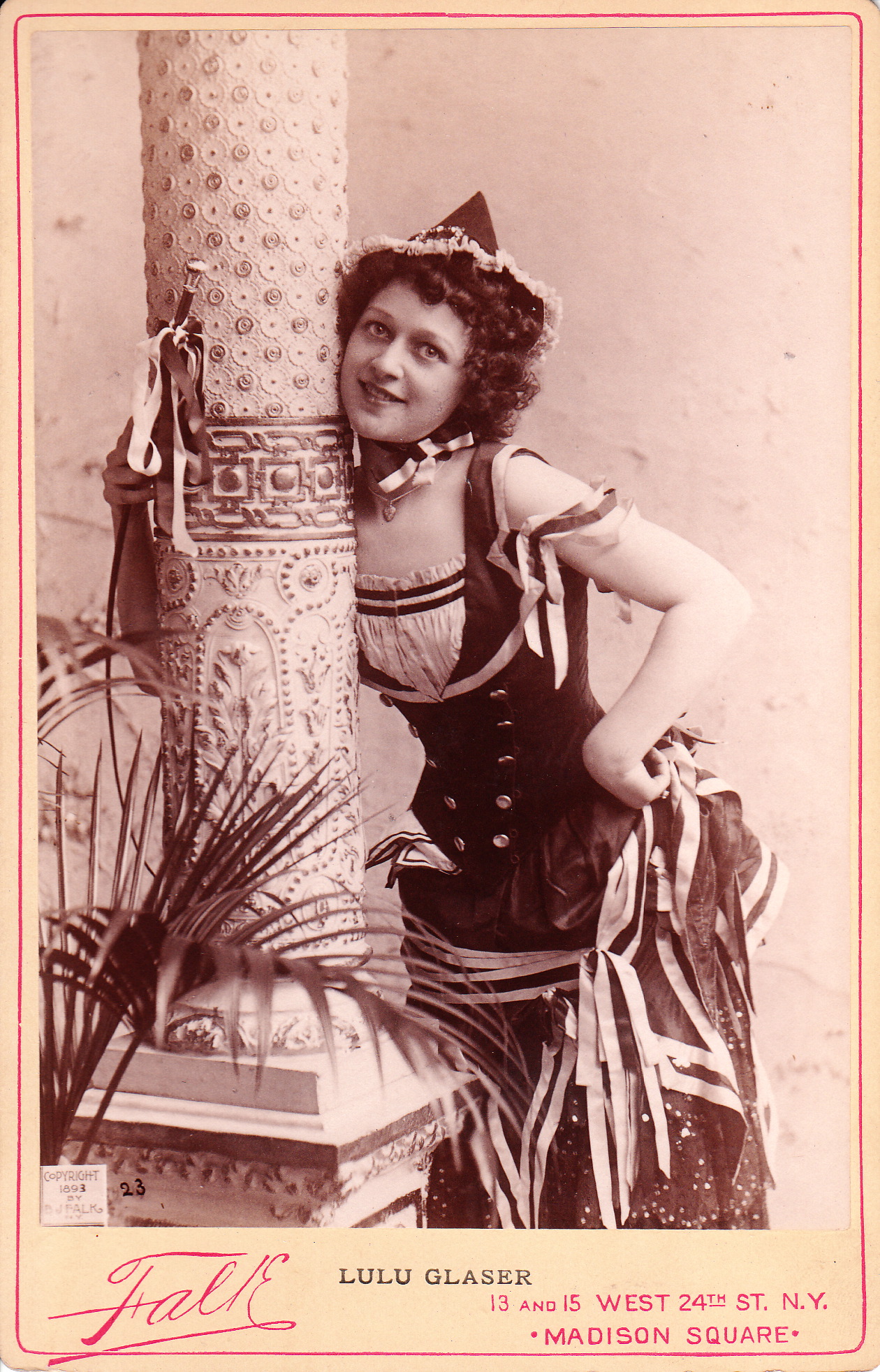
CABINET CARD 6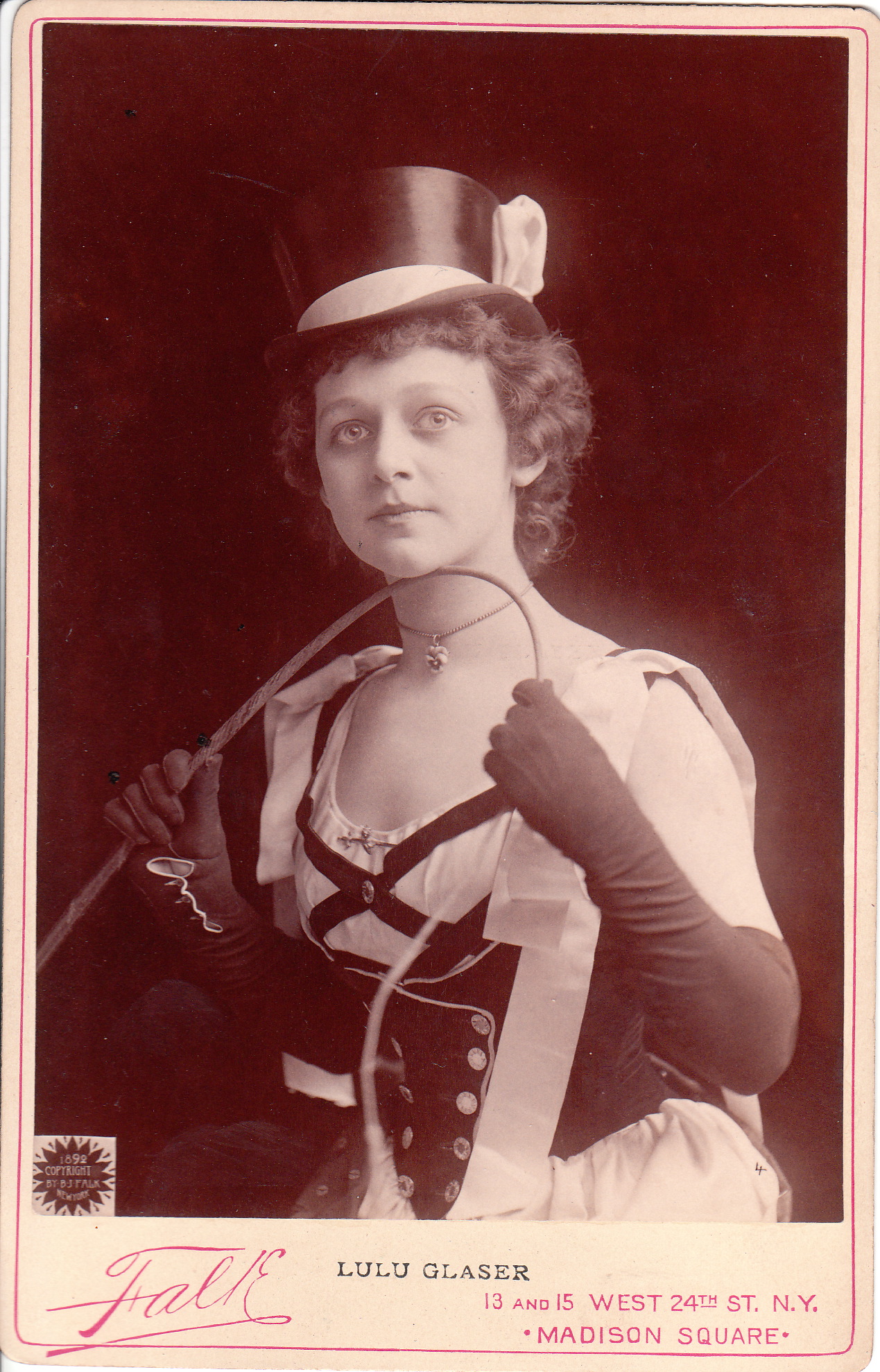
CABINET CARD 7
 CABINET CARD 8
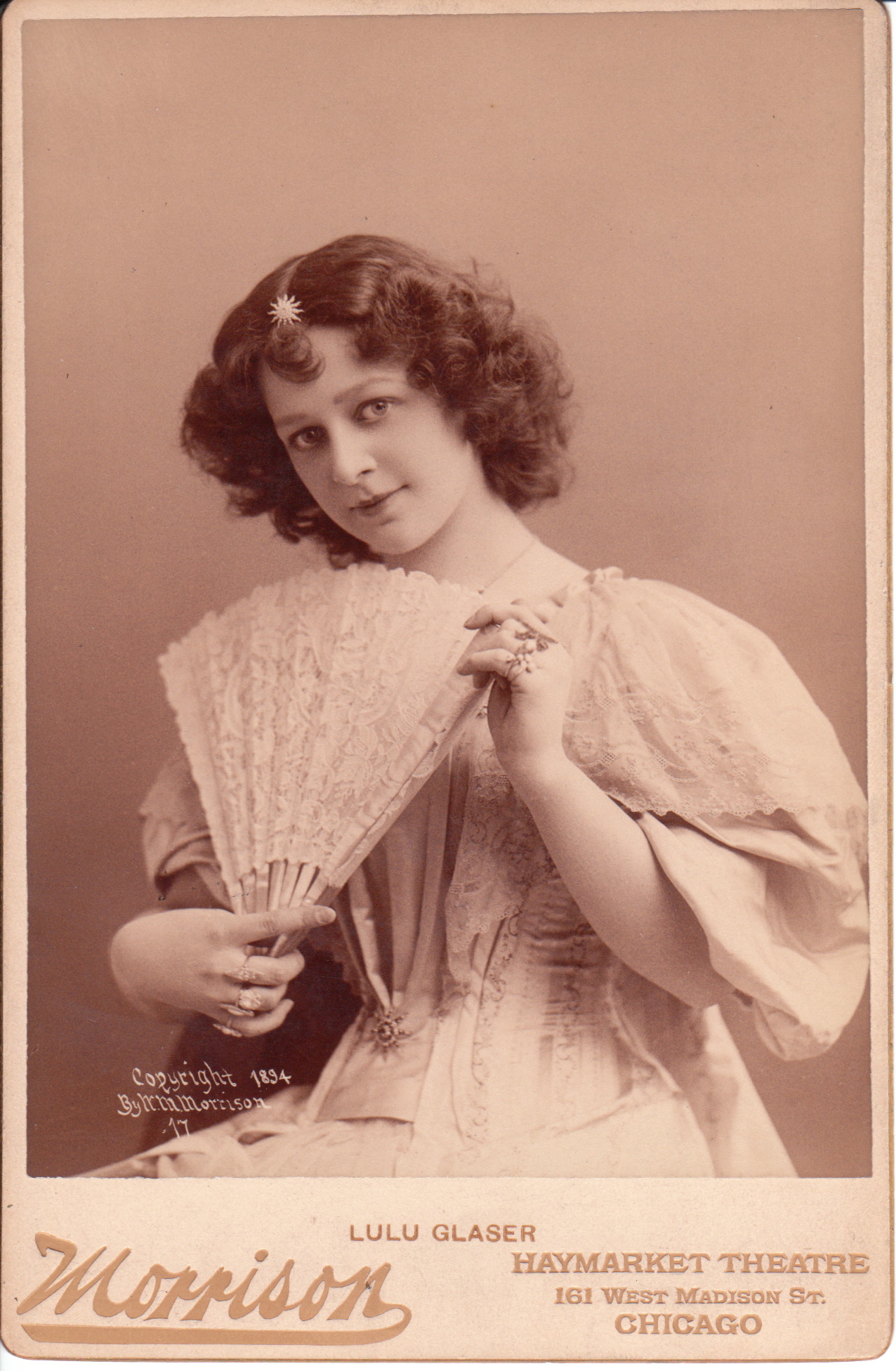
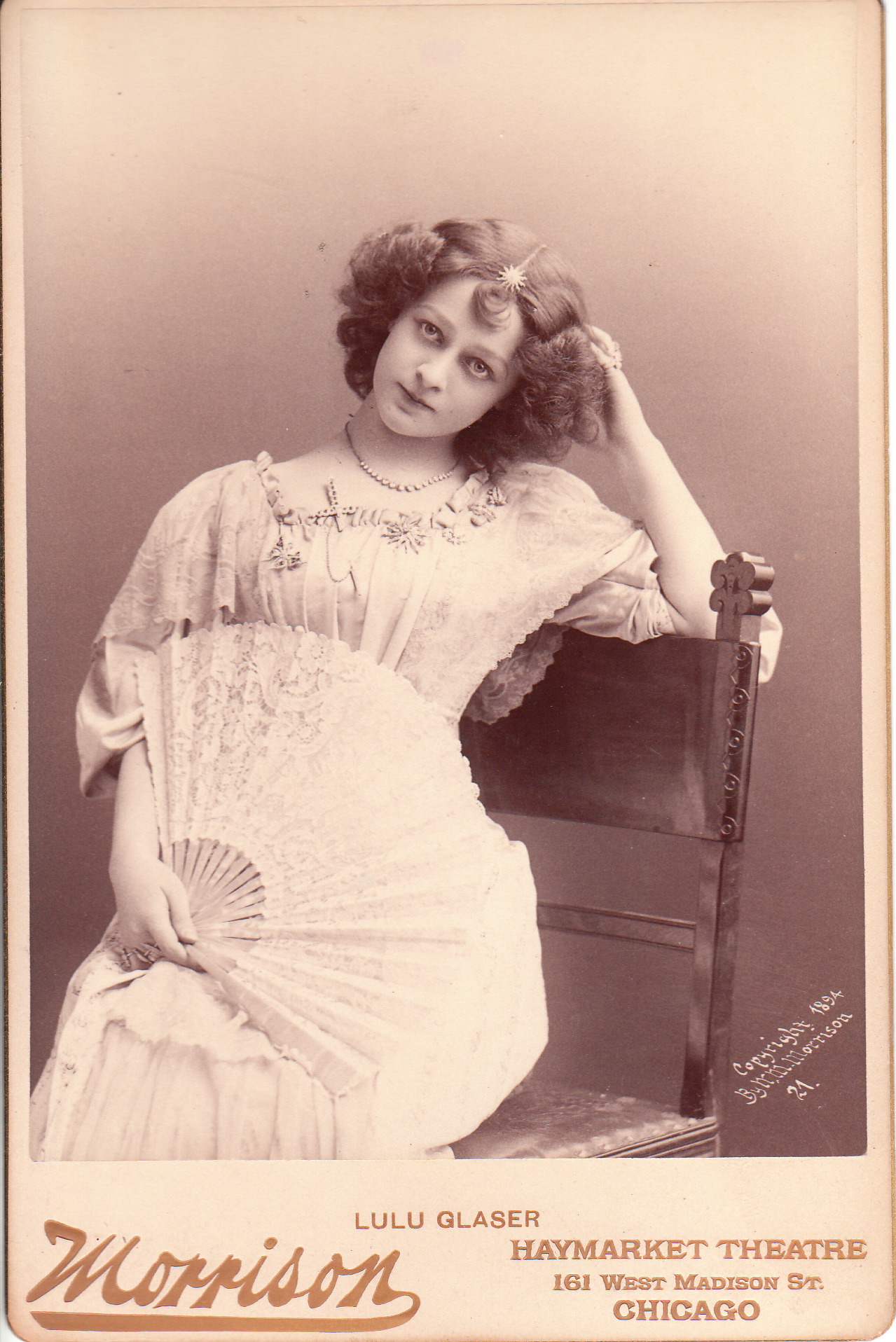
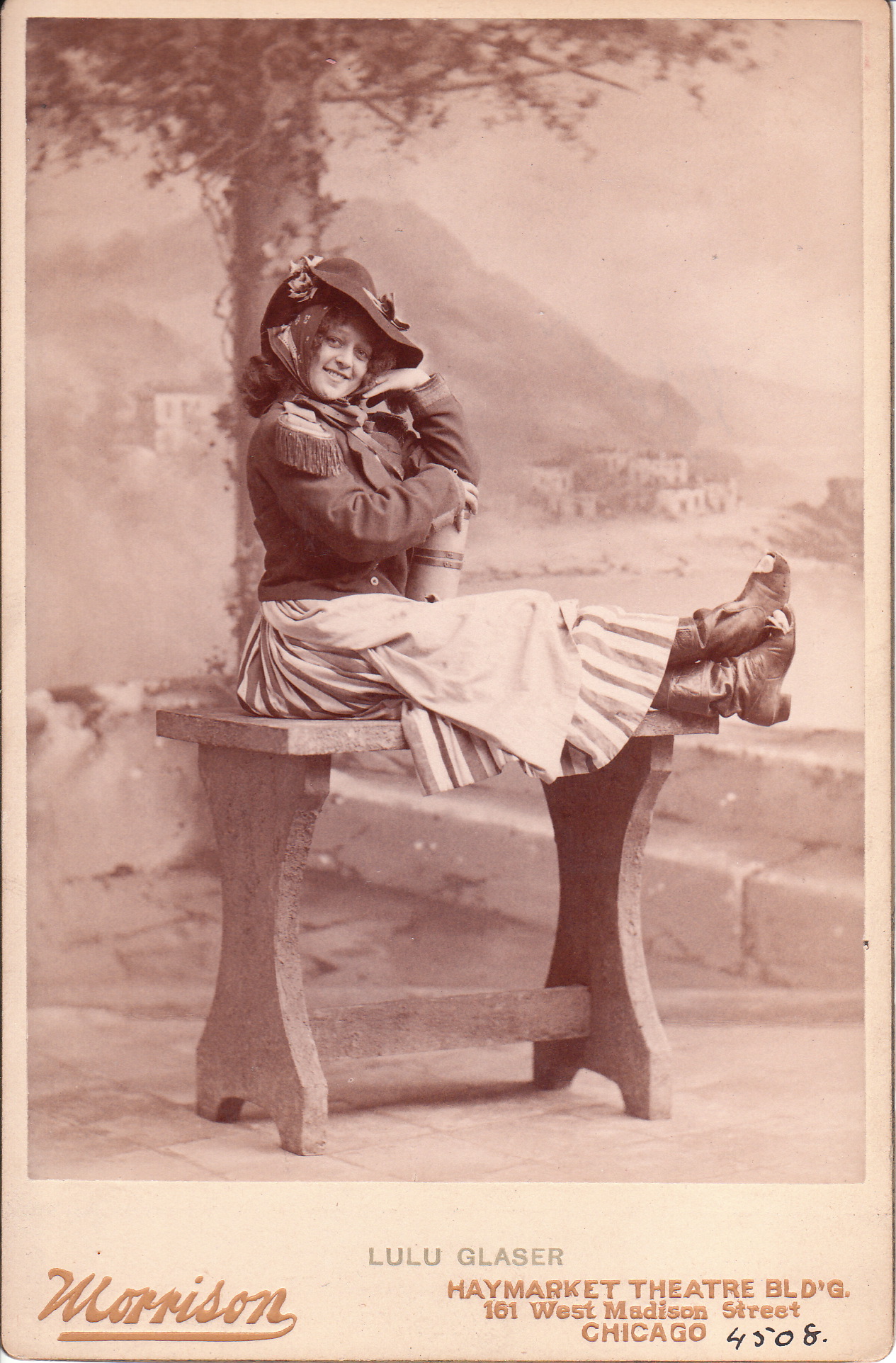
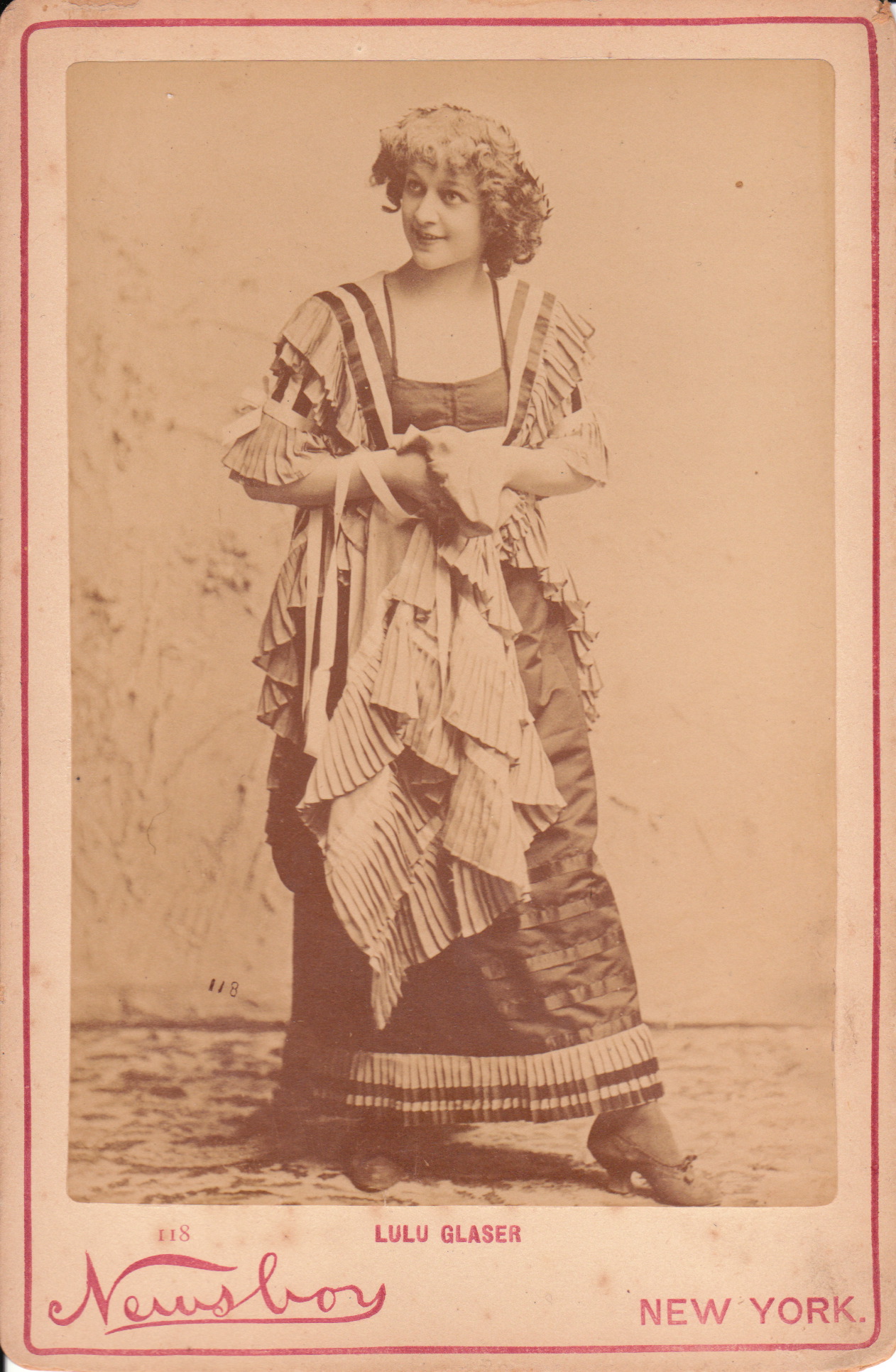
These cabinet cards features Lulu Glaser (1874-1958), a Pennsylvania born actress and singer. She came to Broadway with no previous professional experience when she was hired to play in the chorus of “The Lion Tamer (1891)”. She was also given the role of understudy to the Prima Donna. After the star fell ill, Lulu Glaser took over the role and began a meteoric rise to stardom. For the next twenty plus years, Glaser played many roles in such productions as “The Merry Monarch” (1892), “Erminie” (1893), “The Little Corporal” (1898), and “Miss Dolly Dollars” (1895). She achieved her greatest success in “Dolly Varden” (1902). Lulu Glaser was a beautiful woman and this portrait confirms that assessment.
In Cabinet Card 1 Glaser is holding a fan and her expression could be described as coy. She is adorned with a great deal of jewelry including multiple rings, a hair pin and a pin on the midsection of her dress. The photographer of this image, as well as the next four images, is Morrison, of Chicago, Illinois. The photographs have a copyright date of 1894. Morrison was a well known celebrity photographer and his studio was housed in the Haymarket Theatre. To view other photographs by Morrison, click on this site’s category “Photographer: Morrison”.
The sixth photograph of Glaser is by celebrity photographer, Falk, of New York City, New York. This photograph is copyrighted 1893. The seventh photograph, also by Falk, captures Glaser in costume for an unknown titled play. She is holding a whip and not looking particularly friendly. The image looks like it would be appropriate accompanying an ad on one of the controversial sections of Craig’s List. The photograph is dated 1892. To see other photographs by Falk, click on the category “Photographer: Falk”.
Photograph number eight captures Lu Lu Glaser in the same costume she is wearing in photograph number five. The eighth photo was published by Newsboy as a premium used to accompany the sale of their tobacco products. The image is number 118 of a series of celebrity photographs. To view other Newsboy photographs, click on the cabinet card gallery category “Photographer: Newsboy”.
PARTHENON GIRL: GREEK GIRL IN TRADITIONAL COSTUME AT A WELL
 This cabinet card features a girl in traditional Greek clothing posing by a well. She is holding a water jug up behind her left shoulder. The jug is either empty or she is quite strong. The reverse of the photograph has an inscription of a name which likely belongs to the subject. The back of the cabinet card also has a printed drawing of the Parthenon. The Parthenon is a temple dedicated to the goddess Athena, whom the people of Athens viewed as their patron. The name of the subject and the photographer, as well as the location of the photographic studio are undecipherable to this writer. In other words, “Its all Greek to me”. Hopefully, a visitor to the Cabinet Card Gallery will be able to identify the photographer and the studio’s location.
PRETTY, YOUNG, AND WASP WAISTED IN OTTAWA CANADA: PORTRAIT OF MARY DEVLIN (1890)
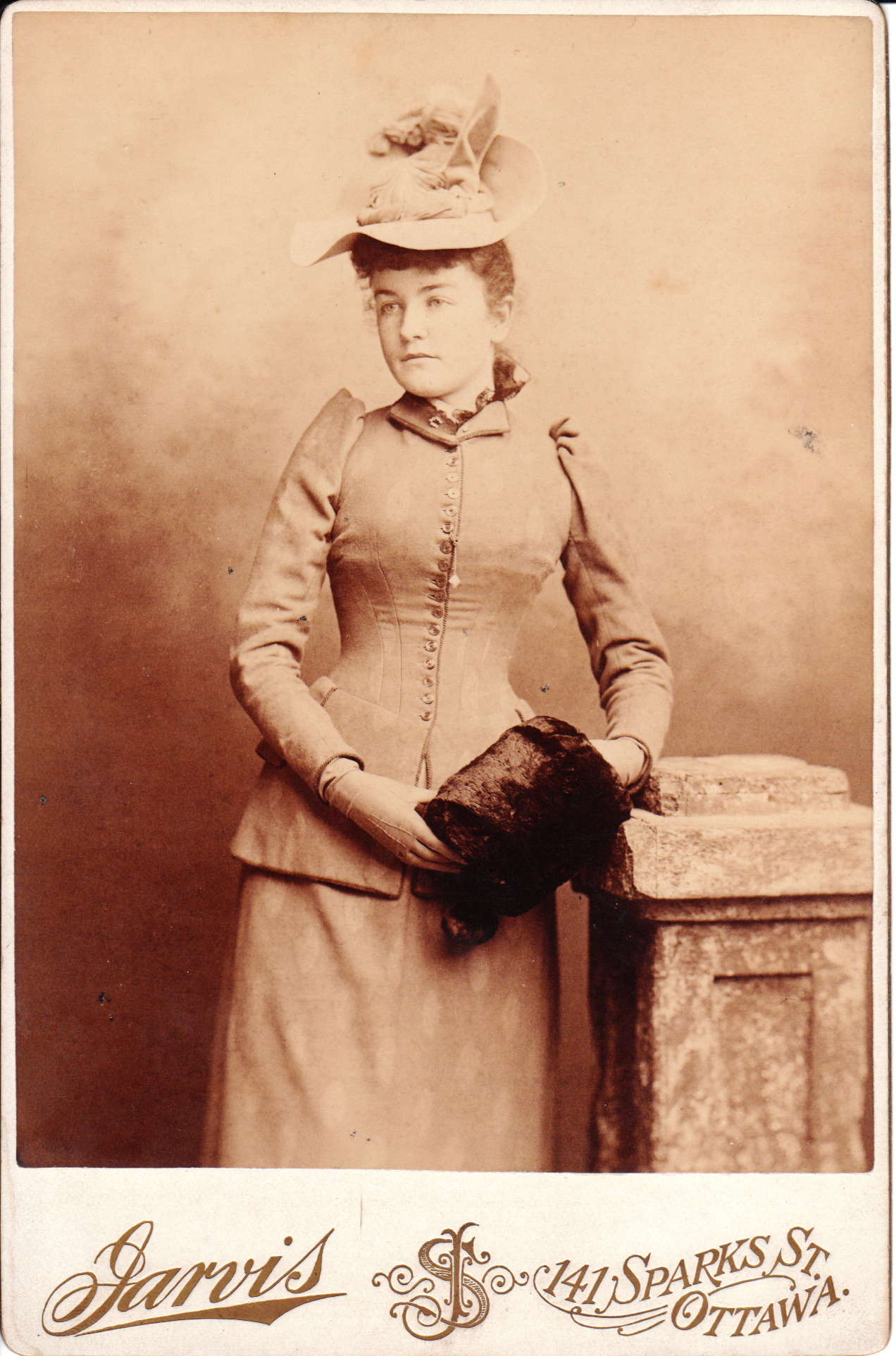 A pretty young wasp waisted woman, holding a muff and wearing gloves, poses for what is likely a winter portrait at the Jarvis studio in Ottawa, Canada. According to an inscription on the reverse of the photograph, the corseted woman is named Mary Devlin and the photograph was taken in 1890. The photographer, Samuel J. Jarvis was a famed Ottawa photographer who opened a studio with partner Alfred Pittaway in 1882 while both were still teenagers. In 1890 they split up and became competitors. They joined forces again in 1907 and worked together until Pittaway’s retirement in 1928. Their studio did photo portraits, photojournalism, and operated a photographic supply shop and developing studio. The pair hired an artist who created elaborate sets and backdrops. The Ottawa Citizen (1948) published a feature story about Jarvis and his pioneering days in photography. Samuel J. Jarvis should not be confused with his photographer uncle, Samuel Jarvis.
BLANCH WALSH: STAGE ACTRESS IN PROVOCATIVE POSE (PUBLISHED BY NEWSBOY)
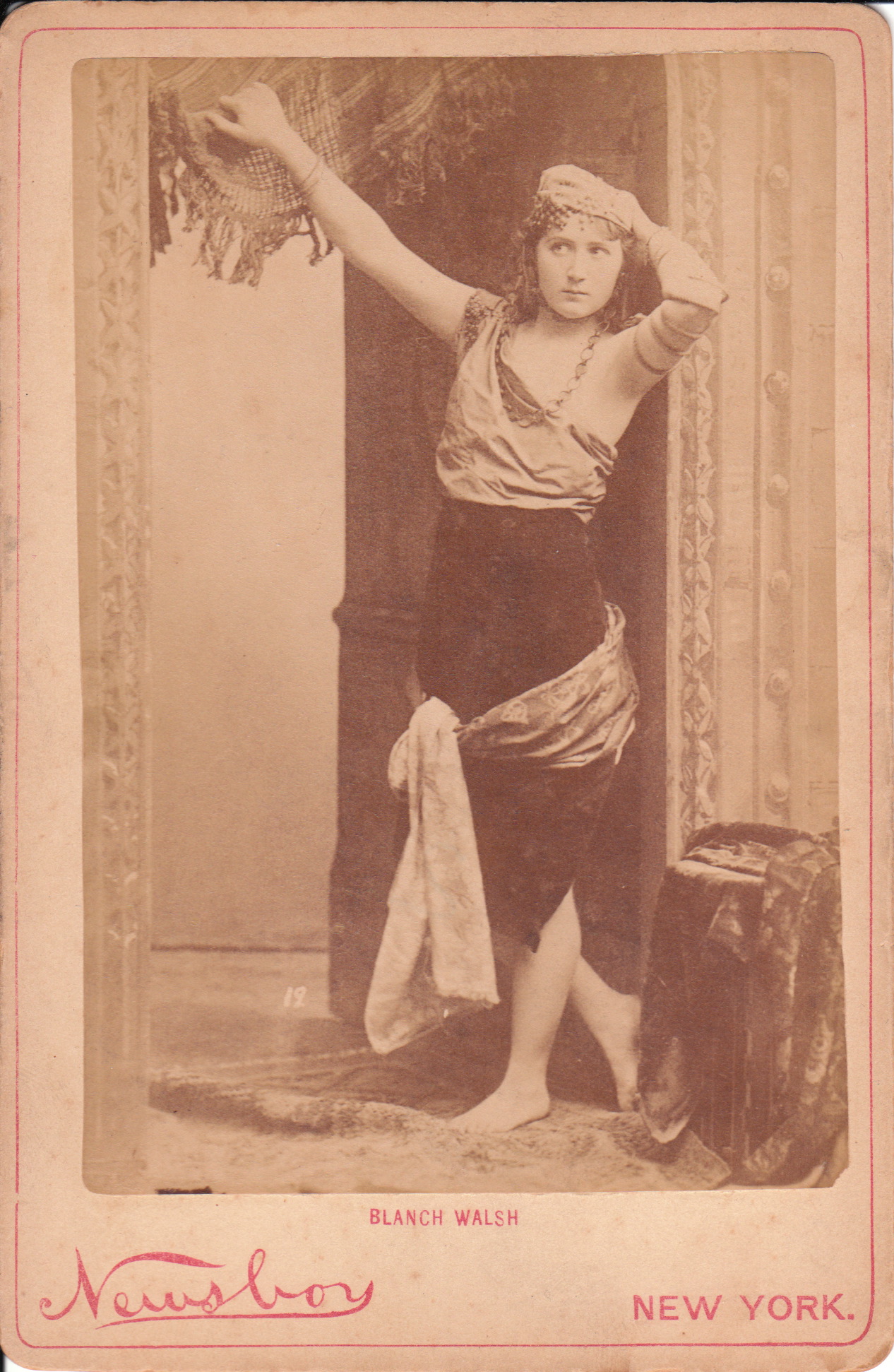 This cabinet card photograph of actress, Blanch Walsh, was published by Newsboy and was given as a premium to buyers of the company’s tobacco products. The photograph was number 12 of a series of celebrity photographic portraits. This particular photograph is particularly provocative and risque. Miss Walsh is exhibiting a great deal of exposed skin. Her pose and expression add to the subliminal sexuality. Miss Walsh is costumed as if to portray a gypsy. Note her jewelry. She is wearing a chain around her neck and multiple bracelets on her left arm. To view other theatrical images by Newsboy, click on category “Photographer: Newsboy”. Blanch Walsh (1873-1915) was a highly regarded American stage actress. She also appeared in one film, “Resurrection” (1912). She was born in New York City and educated in the public schools. Her father was T. P. Fatty Walsh, a Tammany politician and prison warden (The Tombs). Her stage debut was in 1888. She worked in the Charles Frohman Company as well as the William Gillette Company. She looked like a younger version of stage star Fanny Davenport. When Miss Davenport was ill for some time before dying in 1898, Blanch Walsh was given a number of her emotional roles. To view photographs of Miss Davenport, write Fanny Davenport in cabinet card gallery’s search box. Walsh’s most sensational role was as Maslova in Tolstoy’s “Resurrection” (1903). She also received much acclaim for her performance in “The Woman in the Case” (1905). The New York Times printed an article about Walsh upon her post surgical death. She was viewed as a major actress who likely would have risen to greater heights in the theater world if her life had not been cut short by her unfortunate early demise.
PORTRAIT OF A JOCKEY WEARING HIS COLORS IN SARATOGA, NEW YORK
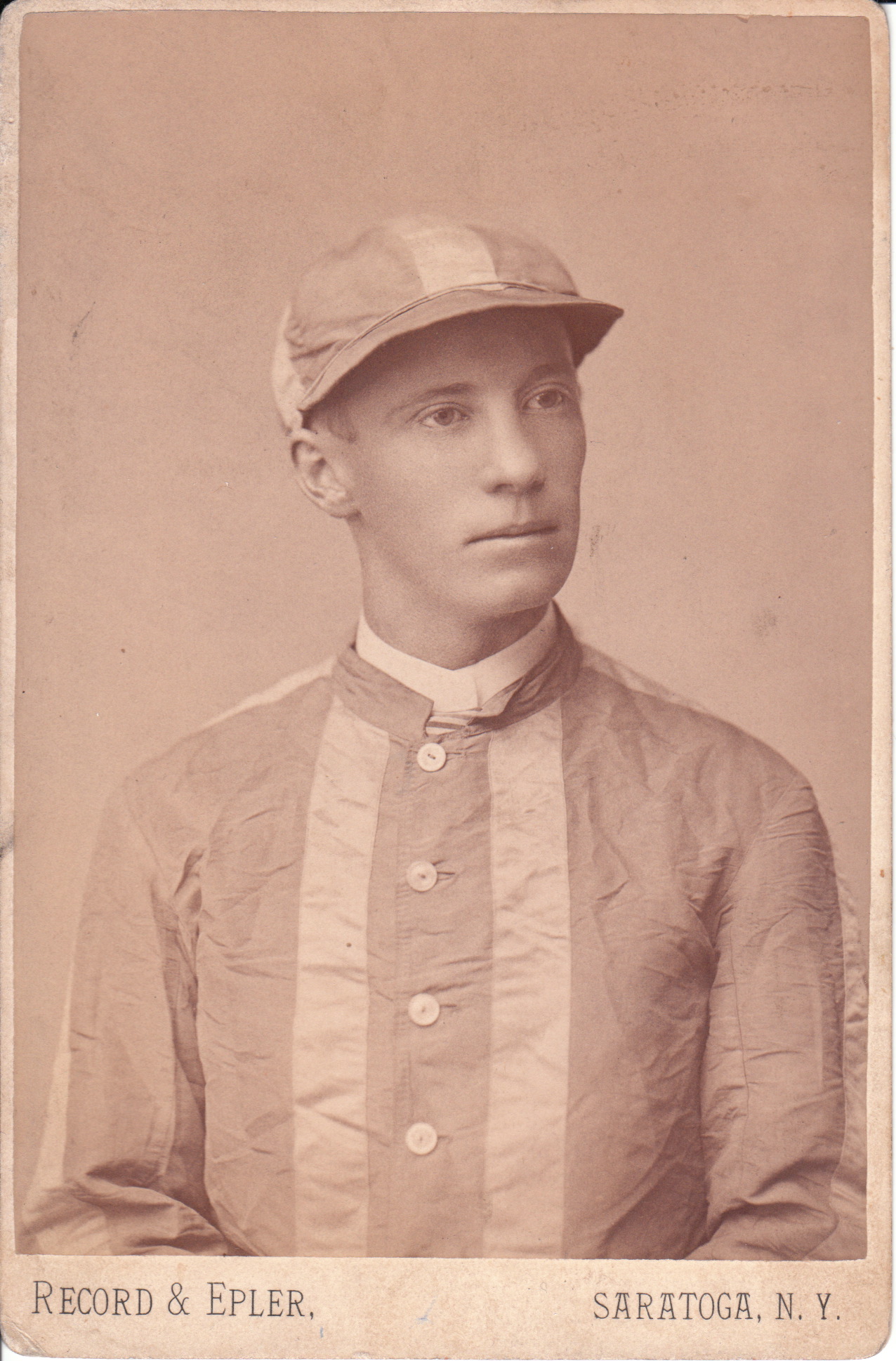
This cabinet card is a portrait of a horse racing jockey wearing his colors. The photograph was taken by the Record & Epler studio in Saratoga, New York. According to the printing on the reverse of the photograph, the studio was located on the corner of Broadway and Phila Street. To view other photographs by this studio, click on category “Photogapher: Record & Epler”. Saratoga is a resort and horse racing town. The Saratoga Race Course is a Thoroughbred horse racing track in Saratoga Springs. The track opened in 1863.


 THE CABINET CARD GALLERY