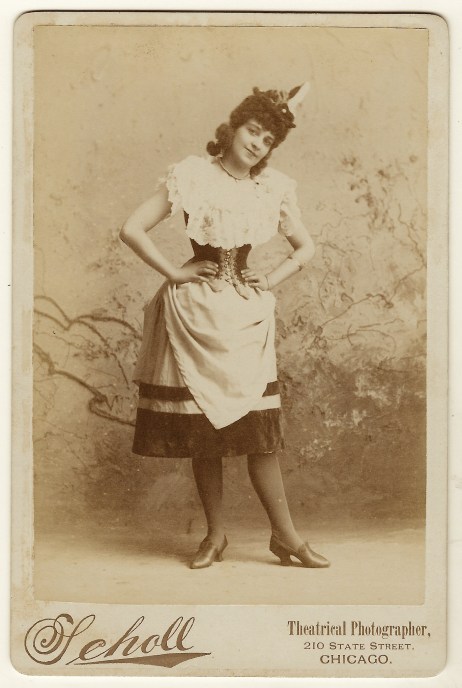
 CABINET CARD 1 (SOLD)
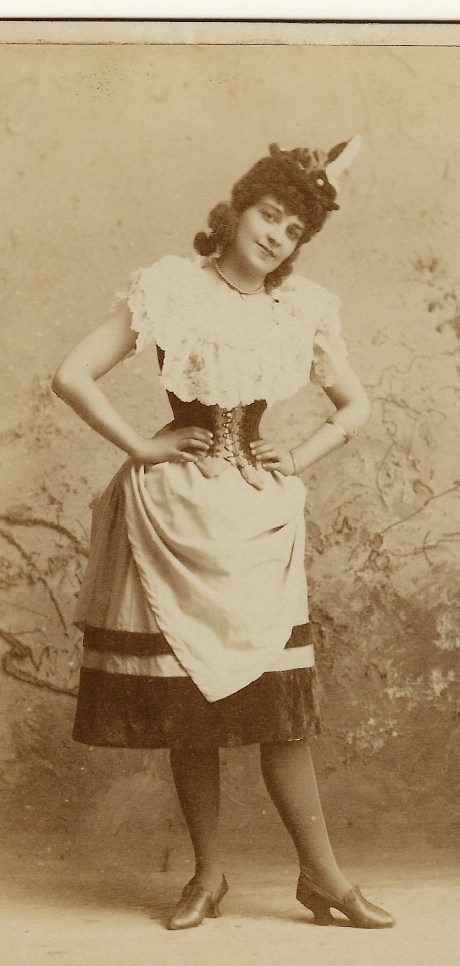 CABINET CARD 1 (SOLD)
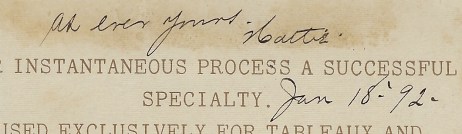 CABINET CARD 1
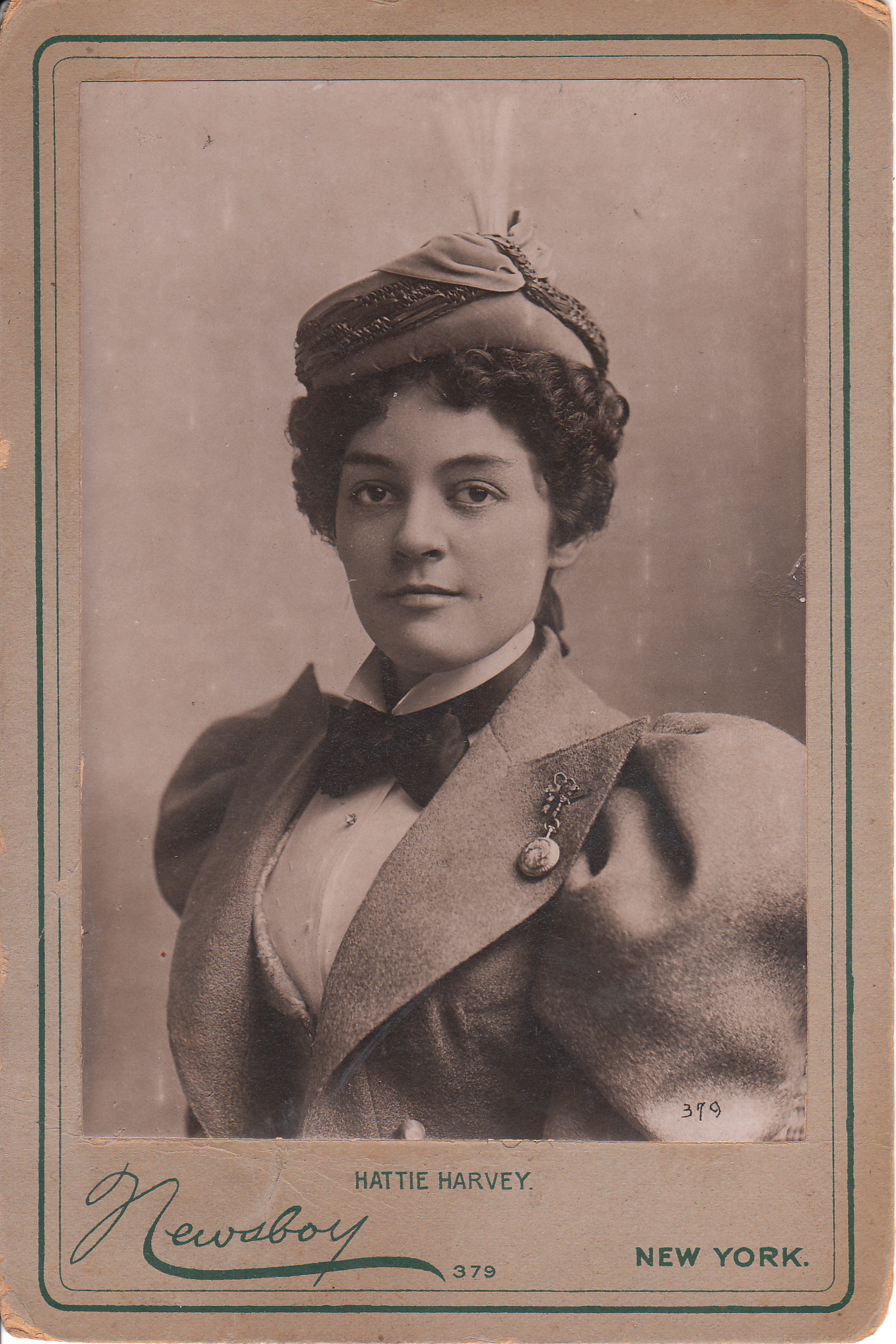 CABINET CARD 2
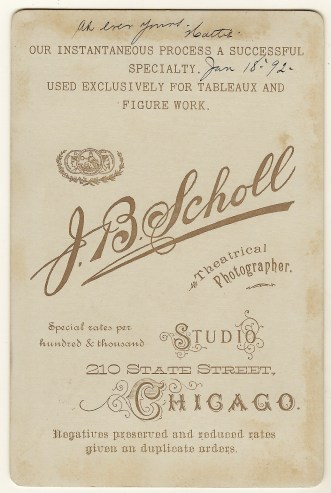
A pretty corseted actress poses for this cabinet card portrait by theatrical photographer, J. B. Scholl, in Chicago, Illinois. The wasp waisted actress is posed a bit provocatively by the photographer. She has her hands on her hips and her head is slightly tilted. She is also exhibiting a mischievous grin.The reverse of the image is inscribed and dated. The cabinet card is signed “As ever yours, Hattie”. There is a possibility that her name is “Nattie” because the first letter of the name is not very legible. The back of the card is dated 1892. In addition to the State Street address, during his career, Scholl also had studios at two locations on South Halsted in Chicago. Perhaps a visitor to the cabinet card gallery can identify this actress. It is my opinion that this actress is Miss Hattie Harvey. The opinion is formulated by viewing other images of Miss Harvey and by her connection to Chicago. An article about Hattie Harvey appeared in the New York Times (1892). The article was entitled “Hattie Harvey’s Infatuation”. It seems the young Chicago actress had developed an infatuation for an Englishman in her company named Brooks (now we know why she has such a mischievous grin in this photograph). Her parents were not pleased and when the company’s production closed, her father promised to arrange more engagements for the company if his daughter would give up Mr Brooks. She refused his manipulative offer and there were some “exciting scenes” that occurred in the Grand Hotel concerning this family conflict. In addition, Hattie’s mother had two fainting spells “over the affair”. The newspaper article described Harvey as a “very pretty girl of nineteen” and reported that she declared she would marry the fifty year-old Brooks. However, public speculation was that Brooks, who was recently divorced, still had another wife back in England. Hattie Harvey’s parents threatened to “cast her off” if she continued the relationship with the”adventurer”. (SOLD)
The second photograph produced by Newsboy (#379) as part of a series of tobacco premiums, is a portrait of “Miss Infatuation”, Hattie Harvey. Compare the photograph with the one above and decide whether the two women are one and the same. It is my view that the portraits both feature Miss Harvey. Please leave a comment if you have an opinion about this matter. In the second photograph, Miss Harvey appears to be in wardrobe for one of her stage appearances. She certainly was an attractive woman.

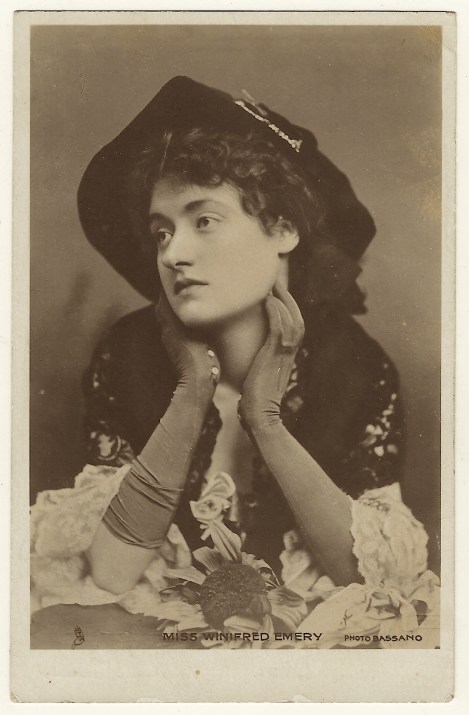
 Miss Winifred Emery (1861-1924) is the subject of this vintage real photo postcard. She was an English actress and actor-manager during the late 19th and early 20th centuries. She was married to actor Cyril Maude (m. 1888). It is not hard to imagine that the fact that she was born into a family of actors, played a role in her career choice. She began as a child actress and during the 1880’s and 1890’s her career blossomed as she played many leading roles in London’s West End theatres. Interestingly, her first London appearance was in 1874 in the pantomime,”Beauty and the Beast”. She later joined Marie Litton’s company, Herbert Beerbohm Tree’s theatre company, Henry Irving’s theatre company, and Wilson Barrett’s company. She eventually started her own touring theatre company with her husband. In 1896, her husband became actor-manager of the Haymarket Theatre and Emery became his leading lady. Among the plays that Emery appeared in are number of productions of Shakespeare. Emery had a successful stage career that spanned over forty years. This postcard was published circa 1910 by Raphael Tuck & Sons’ as part of the “Stage Favourites” Series (No. 5062). The photographer of this portrait of Miss Emery was Alexander Bassano, a very respected celebrity photographer. (SOLD)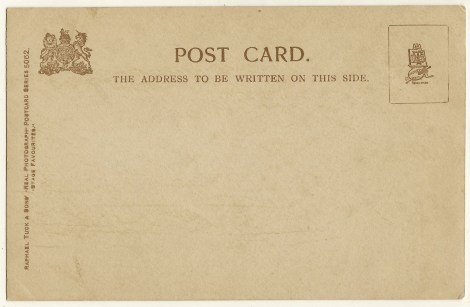

 Miss Dorcy poses for her photograph at the Reutlinger studio in Paris, France. She is quite pretty and has a wonderful smile. The operator of the studio was celebrated theatrical photographer, Leopold Reutlinger. The postcard was published by Societe Industrielle de Photograpie (SIP) of Rueil, France. The Casino de Paris is advertised on the front of the postcard. The Casino de Paris was one of the better known music halls in Paris. Dorcy clearly performed there. I could find little information about this performer. In one article she was referred to as “Paulette Dorcy” but I can not confirm that “Paulette” is her first name. The card has a French stamp that was postmarked in 1905. This vintage postcard is in very good condition (see scans).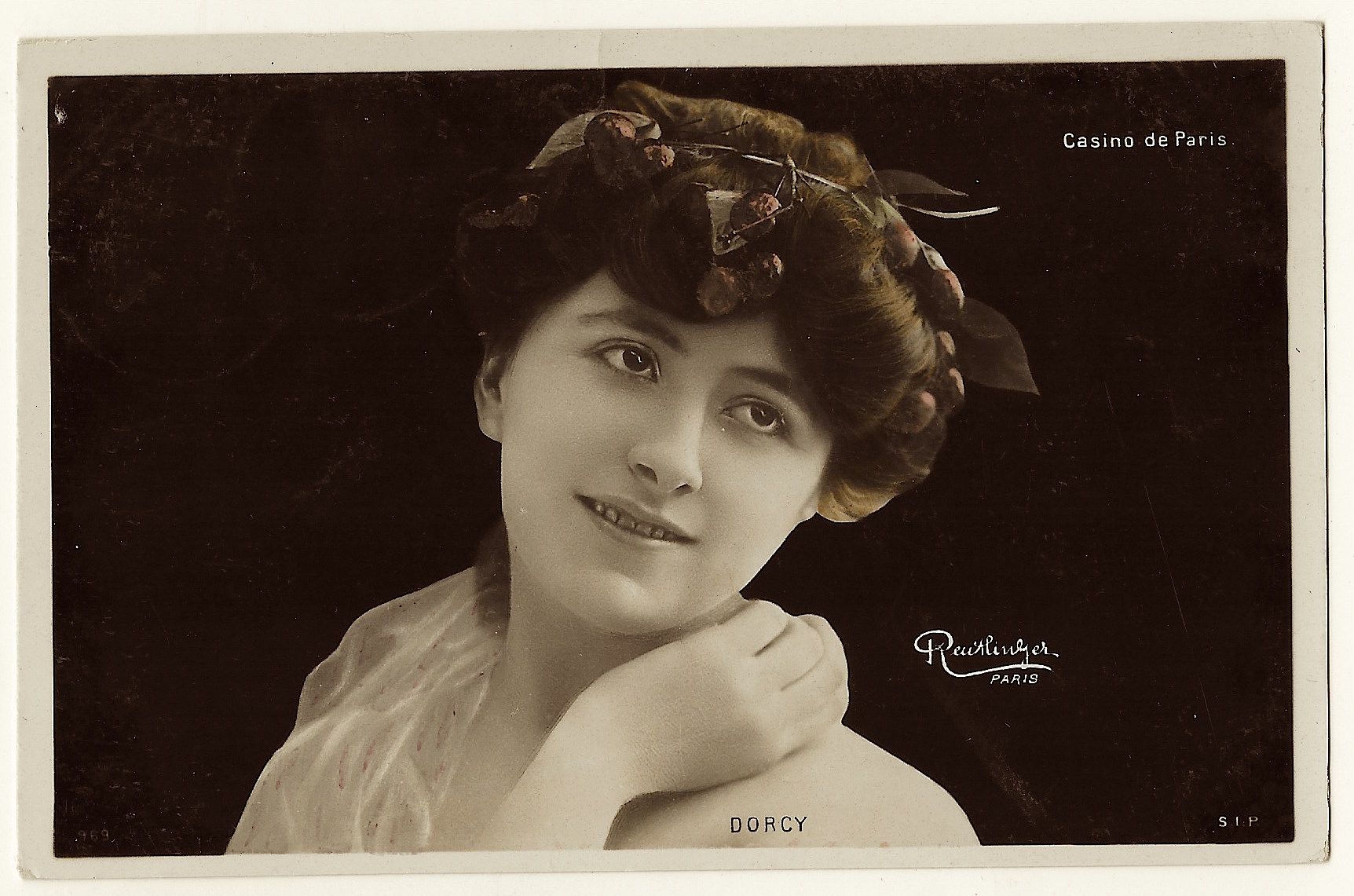
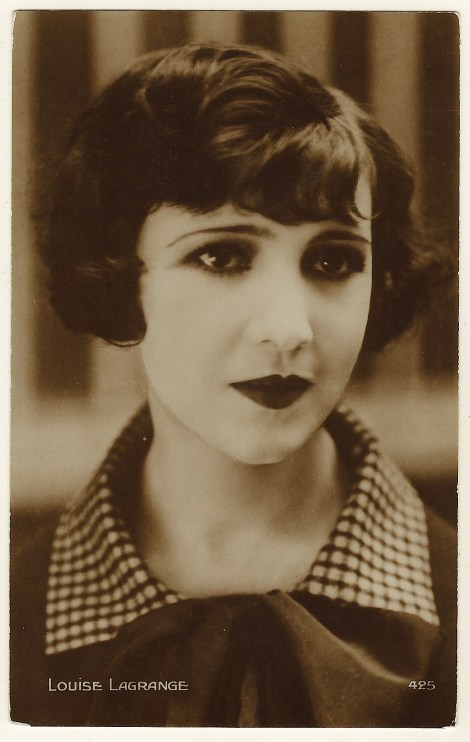 This vintage real photo postcard features pretty French film actress, Louise Lagrange (1898-1979). She was born in Oran, France, which is now in Algeria. Her movie debut occurred when she was nine years of age. Her first marriage was to film director Maurice Tourneur. Her second marriage was to actor, William Elliot. The IMDb credits her with 48 film credits between 1907 and 1952. Her appearances included such films as “A Roman Orgy” (1911), “The Nude Woman” (1926), “In the Shadow of the Harem” (1928), and “Cage of Girls” (1949). Do I detect a pattern here? Lagrange certainly acted in a large number of films with sexually provocative movie titles. Cinemagazine (Paris Edition) is the publisher of this card. It was part of a series (no. 425). SOLD

 This vintage real photo postcard features German actress, Else Kupfer (1888-1974) as she appearss in Nestroy’s play, “Revolution im Krahwinkel” (1908) at the Deutsches Theater in Berlin, Germany. She is most known for her performance in “A Dangerous Woman” (1913). The IMDb lists this performance as her only film credit. This postcard portrait of Miss Kupfer presents her wearing a pretty dress and carrying a parasol. She looks adorable. Kupfe was married to Albert Arnold, brother of artist Karl Arnold. The Becker Maass studio photographed Else Kupfer for this postcard. The publisher of this card is Louis Blumenthal. His company operated in Berlin, Germany. (SOLD)
 This vintage real photo postcard features beautiful actress, Berthe Bady (1872-1921). She was born in Belgium but her nationality was French. Berthe Bady attended the Brussels Conservatory and was active on the stage between 1893 and 1913. She was a companion to both Lugne-Poe and Felix-Henri Bataille. Lugne-Poe was a French actor, theatrical director, and scenic designer. He and Bady were involved in symbolist movement of the arts. Bataille was a French dramatist and poet. A brief explanation of symbolism seems to be merited. In theatre, symbolism is a way to bring a greater meaning to something than is apparent at face value. The use of color, characters, movement, props and costumes are all methods of presenting symbolism. In 1897 Bady was the subject of a portrait by Toulouse Lautrec and her death was the subject of a poem by a leading French poet, Louis Aragon. In addition, playwright Fernand Crommelynck dedicated a play to her. Wikipedia credits her with sixteen “notable” play appearances between 1893 and 1913. She appeared in Ibsen’s “The Master Builder” on an international tour. The tour took her to London, Brussels, Amsterdam, Milan, and additional cities. In 1918 she appeared in her one and only film, “Ecce Homo”. This photo of Miss Bady was taken by the studio of Boyer & Bert. Paul Boyer (1861-1908) operated his studio in Paris. He was very talented and won many awards. He produced many portraits of theater performers as well as other celebrities. This postcard was published by F. C. & C. (Frederick Charles Cooper. The firm was located in Eastbourne, England. It was published circa 1905.This portrait postcard is in very good condition (see scans).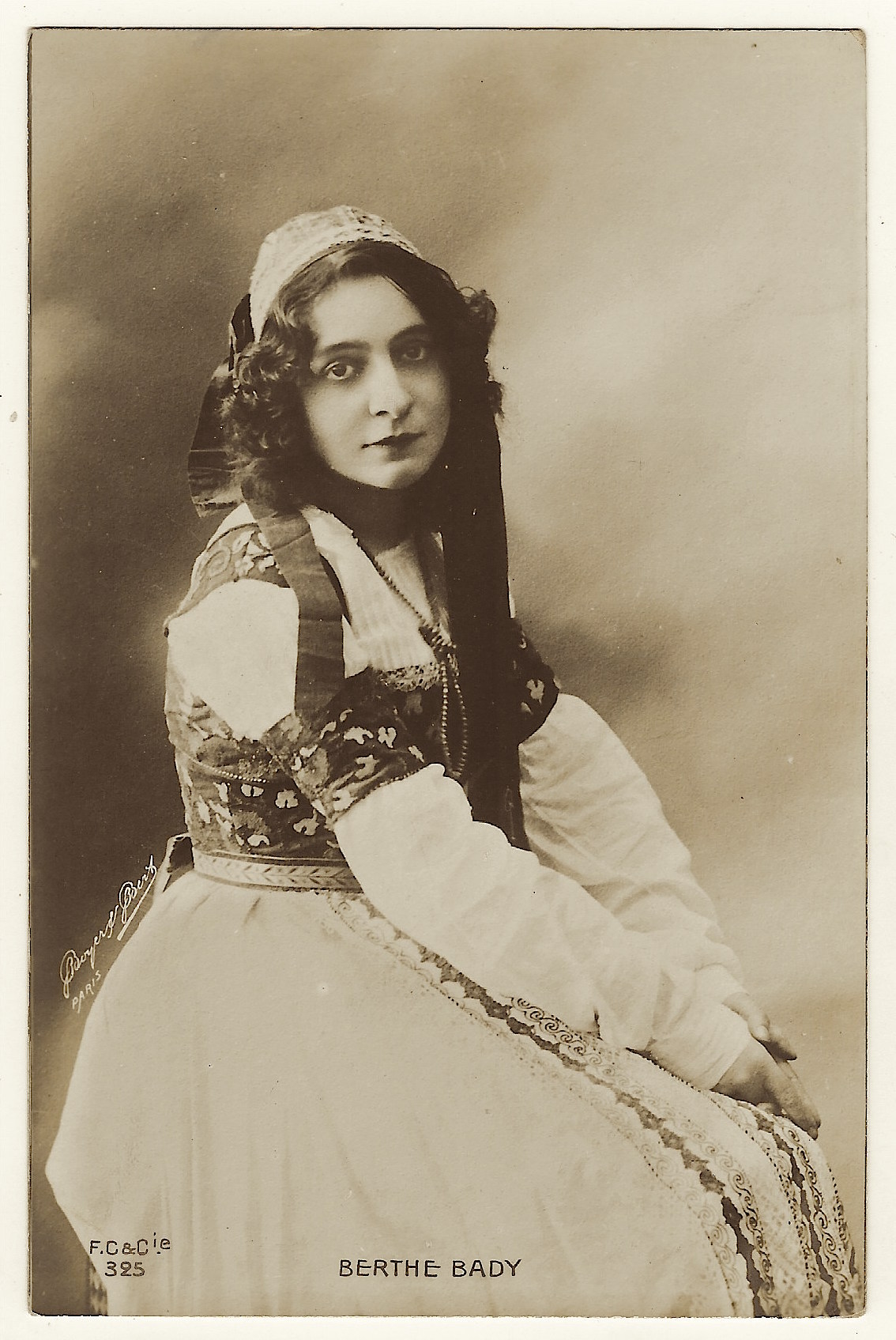

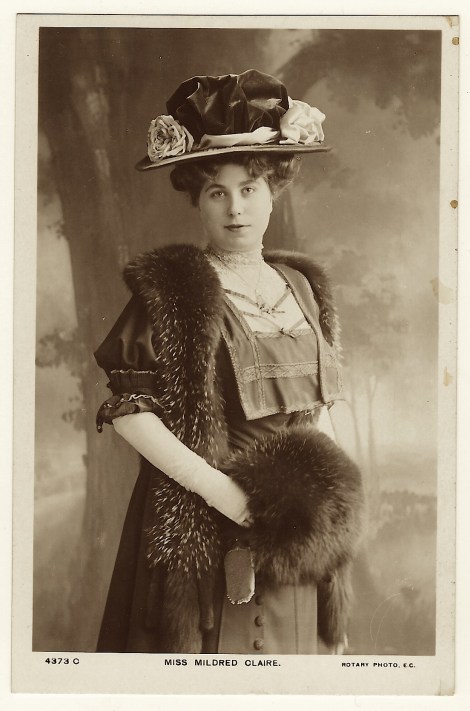
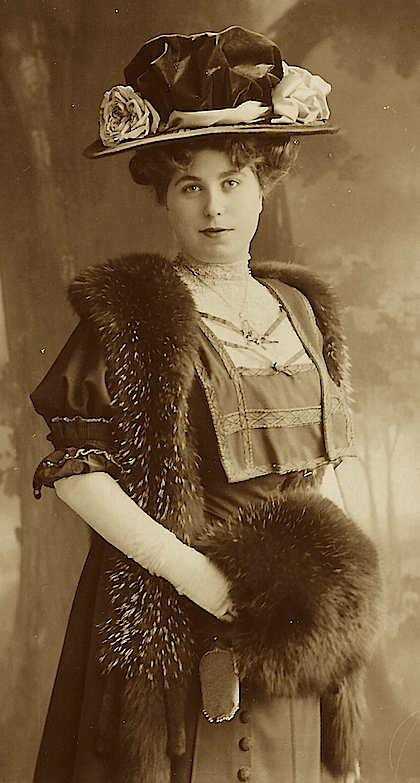 This vintage real photo postcard features actress Miss Mildred Claire. She is quite pretty and is dressed for cold weather (pre global warming). A fur muff protects her hands and a fur stole (pre PETA) wrapped around her shoulders. I could find very little information on this pretty actress. I learned from the Internet Broadway Data Base (IBDb) that Mildred Claire had acted in three Broadway shows between 1900 and 1905. I discovered little else. An actress named “Mildred Clair” appeared in a film titled “Treason” (1918). Perhaps this film actress was our Mildred Claire. There was also an actress named Mildred Claire who changed her name to Claire Rochelle and than had a successful film career. I do not believe the two “Mildred Claire’s” are one and the same person because Claire Rochelle was born in 1908, too late to be an adult when this postcard was issued. This portrait postcard was published by Rotary Photo as part of a series (no.4373 C). It was part of the Rotary Photographic series. The postcard is in very good condition (see scans). (SOLD)
 POSTCARD 1 (SOLD)
 POSTCARD 2
  POSTCARD 2
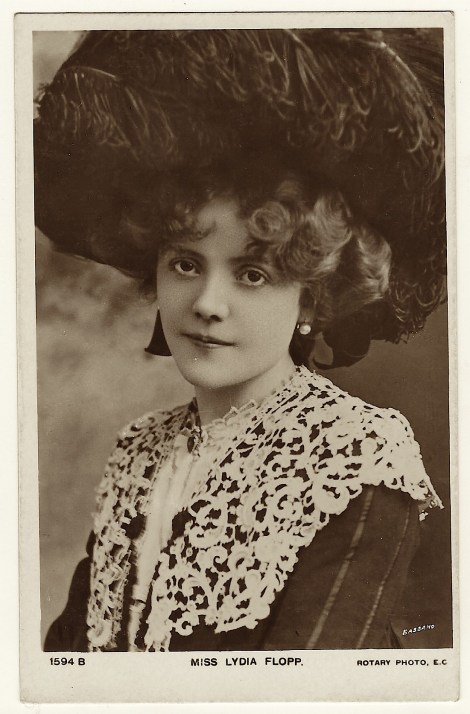 This vintage real photo postcard features theater actress Miss Lydia Flopp (1877-1963). “Flopp” is an unfortunate name for a stage performer. However, it did not get in the way of her success on the stage. Lydia was one of the five “Rudge Sisters”. The women were British actresses and dancers. Some of them were quite successful. The sisters performed as Letty Lind, Millie Hylton, Adelaide Astor, Fanny Dango, and the aforementioned Lydia Flopp. The sisters were primarily dancers but over time developed their singing ability. They performed in pantomime, variety, music hall, and Victorian burlesque realms of theater. Their venues included the Gaiety and Daly theaters in London. Letty Lind was a popular skirt dancer and star of musical comedies. Hylton worked in music halls and theatre and had much success appearing in varieties as a male impersonator. Miss Astor was a West End actress and Fanny Dango worked in London and then launched a successful career performing in Australia. Lydia Flopp’s specialty was pantomime. She was a sitter for two photo portraits in the collection of the National Portrait Gallery. The photographer of Miss Flopp’s portrait is Alexander Bassano (1829-1913). Bassano) was a leading royal and high society photographer in Victorian London. This postcard was published in England by the Davidson Brothers. Davidson Brothers was located in both London and New York City. The firm operated between 1901 and 1911. This postcard is published by Rotary Photo as part of the Rotary Photographic Series (no.1594 B). This vintage postcard portrait has excellent clarity and is in excellent condition (see scans). (SOLD)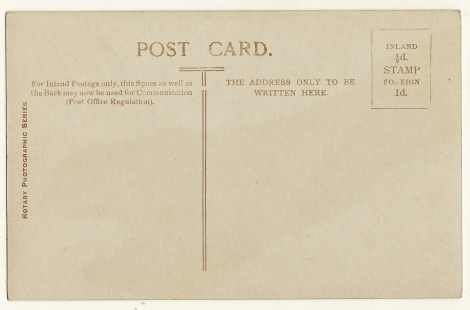



 THE CABINET CARD GALLERY