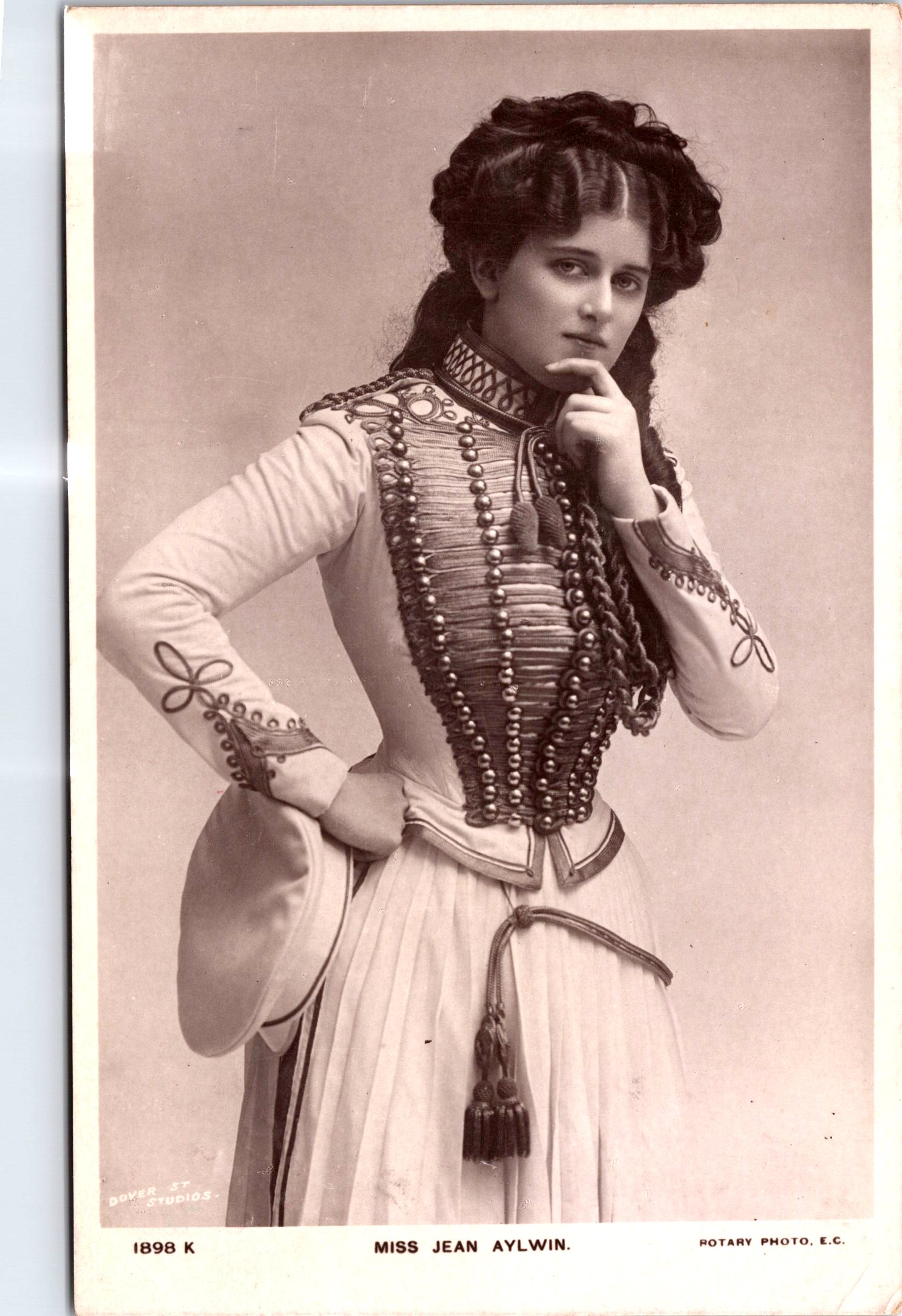
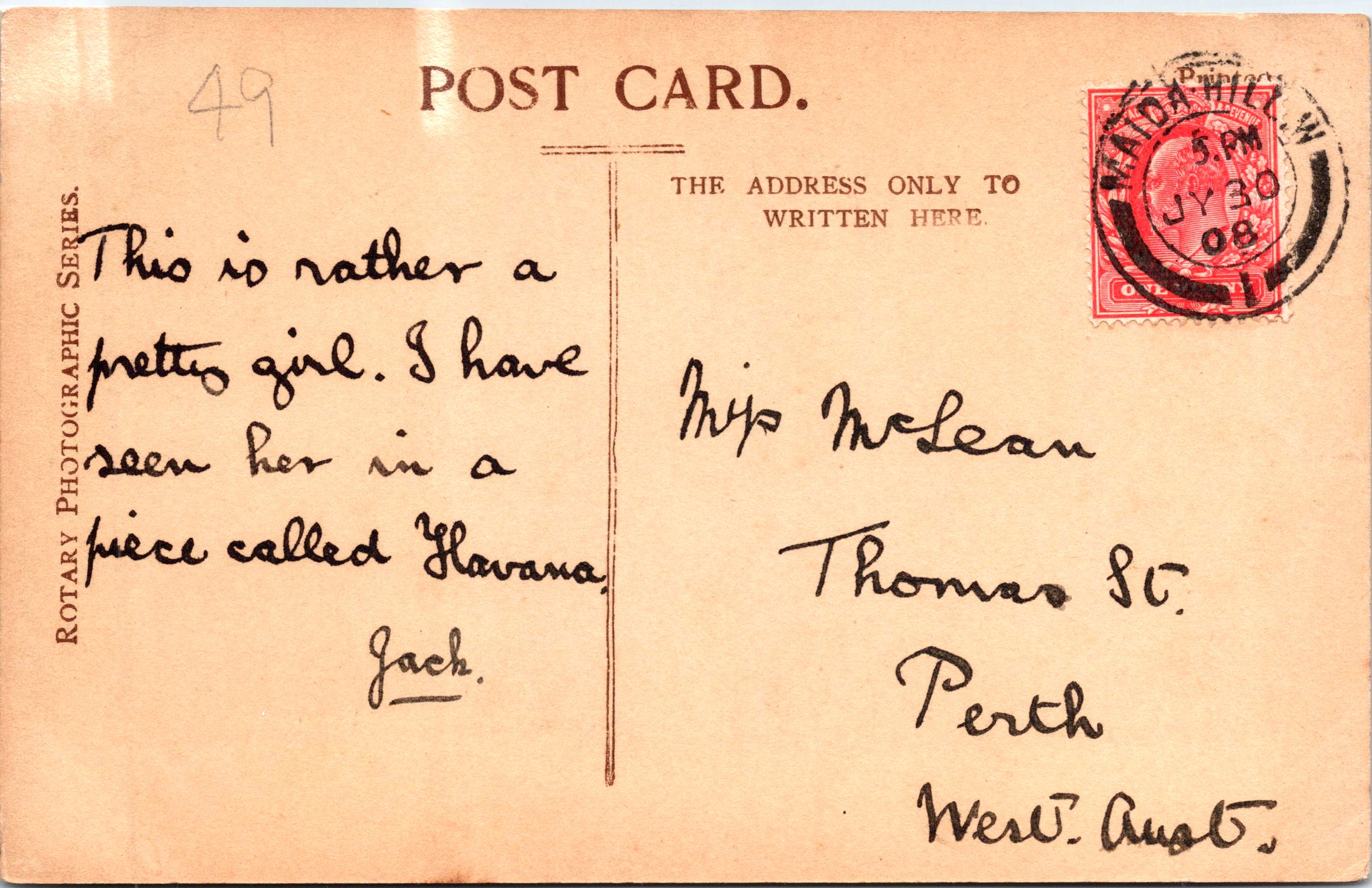
This vintage real photo postcard features a striking portrait of Jean Aylwin (1885-1964), a pretty British actress and singer from the early 20th century. She gained fame for her performances in musical comedies and plays in London and she also toured internationally. Aylwin was associated with the popular Gaiety Theater productions. She had notable performances in several successful productions including “The New Aladdin” (1906), “The Girls of Gottenberg” (1907) and “Our Miss Gibbs” (1909). Aylwin also appeared in two silent films. She married in 1913 but the marriage ended in divorce in 1924. She was accused of adultery with a noted composer of her time. After her divorce, her career declined. She later worked as a housekeeper. In 1926, she briefly worked as a BBC radio broadcaster. Aylwin looks elegant in this dramatic studio pose. She stands three-quarter length with a thoughtful, hand-to-chin expression, the other hand set firmly at her hip. Aylwin wears a striking military-style costume—a fitted jacket heavily braided with ball buttons and tasselled cords, over a pleated skirt; a matching hat rests at her side. Her hair is dressed in full Edwardian waves, completing the theatrical look. Thd photographer of this portrait is the Dover Street Studios. The card was published by Rotary Photo as part of a series (no1898K). The postcard has a Wandsworth (London) postmark from 1908. The postcard is addressed to someone in West Australia. The message on the card is “This is rather a pretty girl. I have seen her in a piece called Havana. Jack.” The front of this card is has rich, sharp sepia tones. Holding the card at a certain angle, one can see dimples caused by the postmark. (SOLD)
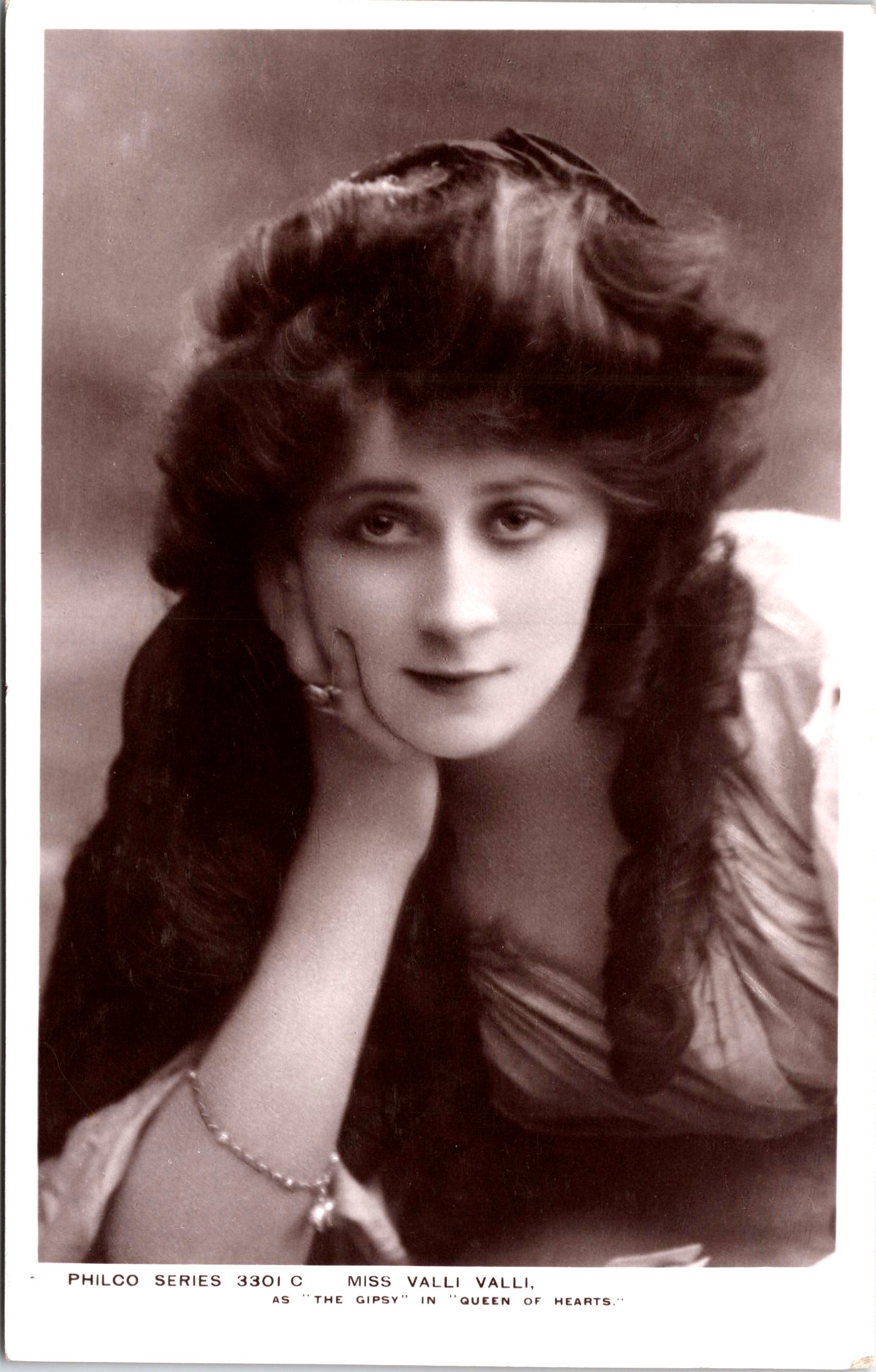
These vintage real photo postcards feature British beauty and actress, Valli Valli (1882-1927). She was a British musical comedy actress and a silent film performer. She was born in Berlin but spent most of her life in England. Her sisters, Lulu and Ida Valli were both actresses. Her father was a merchant. She was educated in London and Paris. She made her stage debut in London at the age of twelve. At thirteen years of age she had a successful run in the musical comedy “Morocco Bound” in Berlin. The next year she performed at London’s Drury Lane Theatre in a pantomime version of Cinderella. As an adult, Valli was a beautiful woman. She performed mostly on the English stage but did tour the United States a number of times. These plays include “The Dollar Princess” and her final New York City performance in “Miss Millions” (1919). In all, she appeared in seven Broadway plays between 1905 and 1920. Valli appeared in four films during 1915 and 1916. These films included “The Turmoil” which was an adaptation of a Booth Tarkington novel. In 1917, she married Louis Dreyfus, head of a music publishing house, and later, a theatrical producer. Valli died from tuberculosis at the young age of forty-five.
Postcard 1 captures Valli, in a pensive, or possibly, dejected mood. The card was published by Rotary Photo as part of a series (No.1760G). Miss Valli was photographed by the Bassano studio. (SOLD)
Postcard 2 features Valli, in a pensive or imploring mood, identical to the mood she exhibits in postcard 1. This card was published by Rotary Photo as part of a series (No.11415A). (SOLD)
Postcard 3 captures Valli in her role as “The Gipsy” in “Queen of Hearts” . The card was published by Rotary Photo as part of a series (No.11415A). (SOLD)
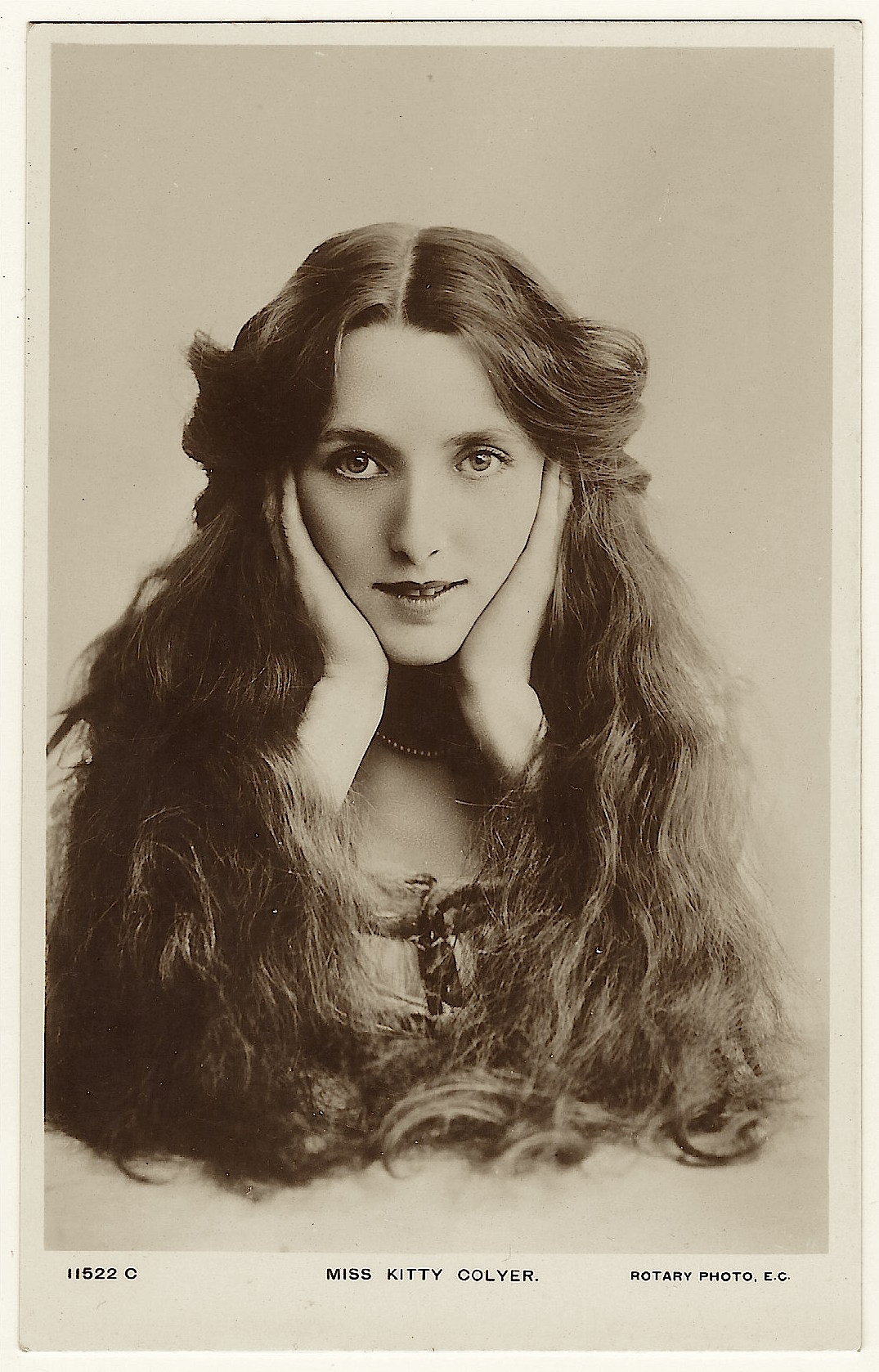
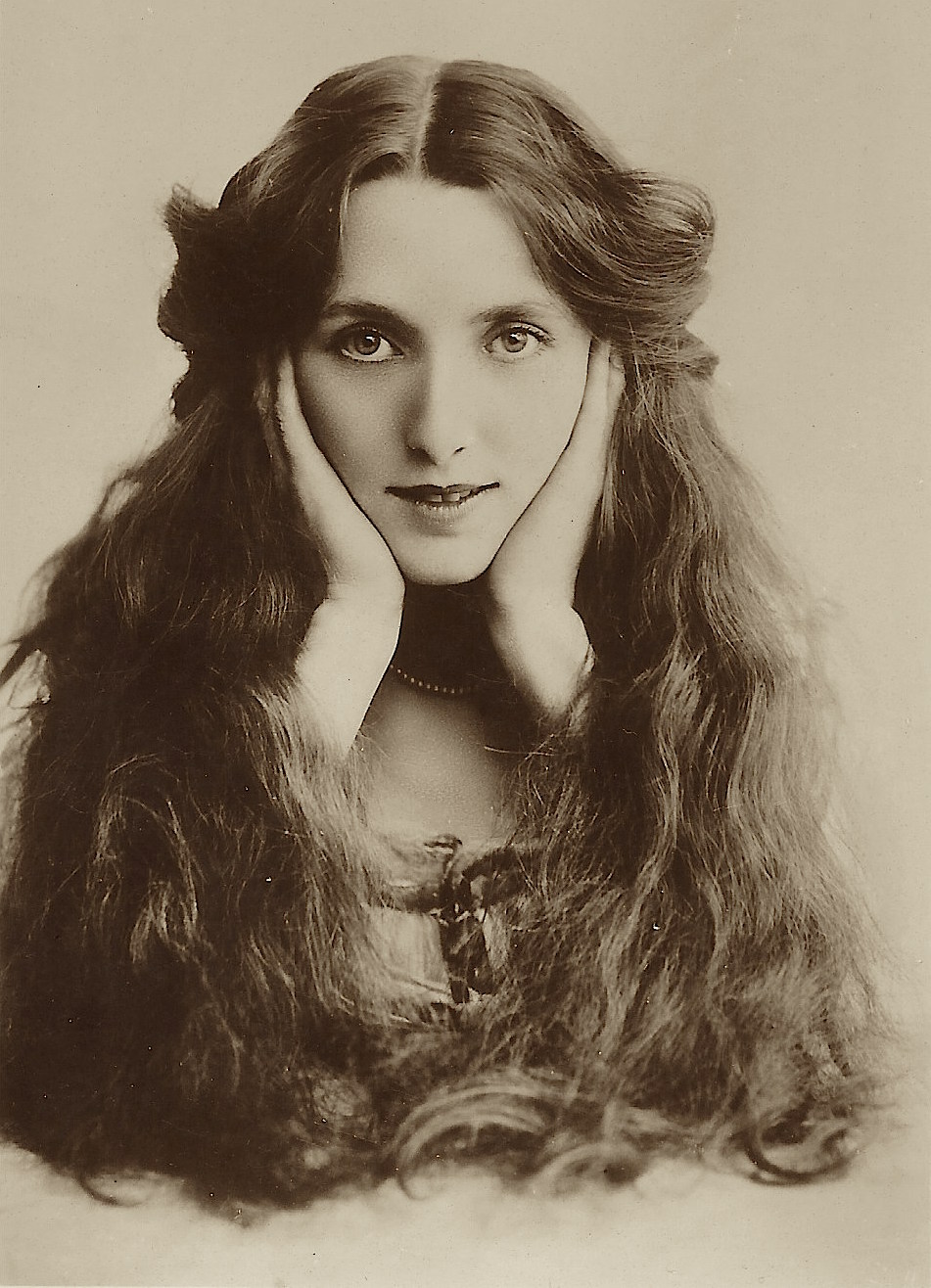
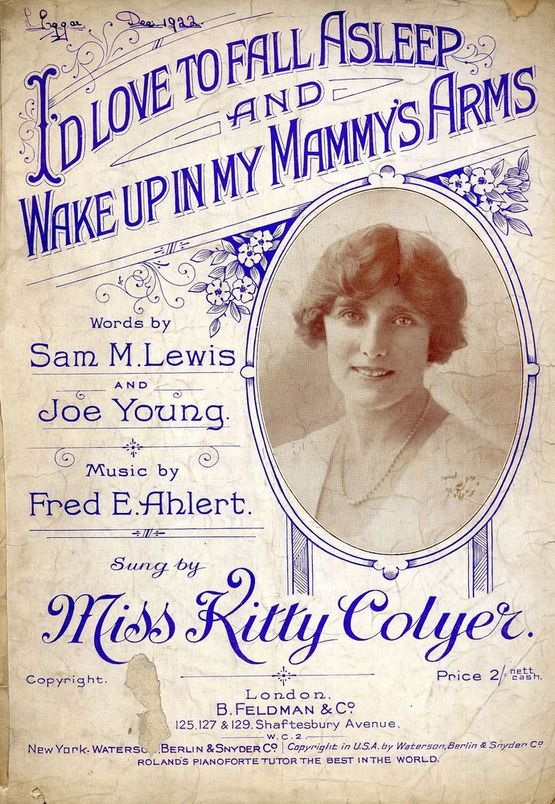
The pretty actress seen in this vintage real photo postcard, is Miss Kitty Colyer (1897-?). Here are some biographical facts that I discovered in preliminary research about the English actress. She started her career at age eleven. In addition to being an actress, she was also a dancer. She has also been described as a music hall singer and a comedian. Her dance routines were varied but her favorites were acrobatic, toe, buck, and national dancing. She performed primarily in the 1920’s. She played the role of Cinderella in “Cinderella” (1920). As the roaring twenties came to a close, her career fizzled out and she left the entertainment business. A review of Miss Colyer can be found in John Culme’s “Footlight Notes” (website). A writer from “The Era” (1911) wrote “Miss Kitty Colyer’s sensational dancing reaches its climax in some very energetic handsprings and her lissomness and activity are quite irresistible in her rendering of “By the Light of the Silvery Moon”. Look below to see an example of sheet music (1920) featuring Kitty Colyer. Now, back to the vintage postcard. It was published by Rotary Photo and is part of the Rotary Photographic Series (no. 11522 C). The photographer is unknown. SOLD
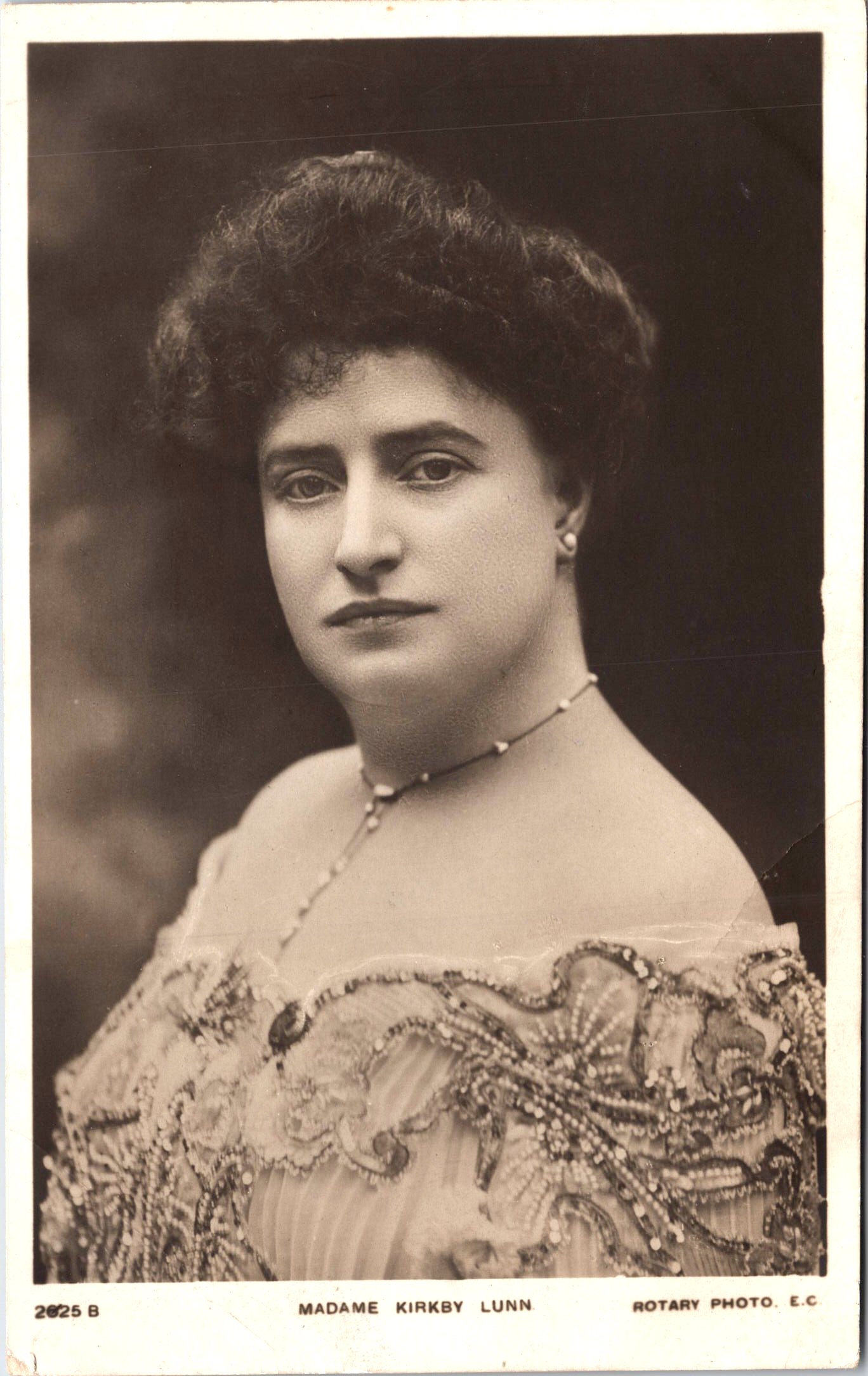
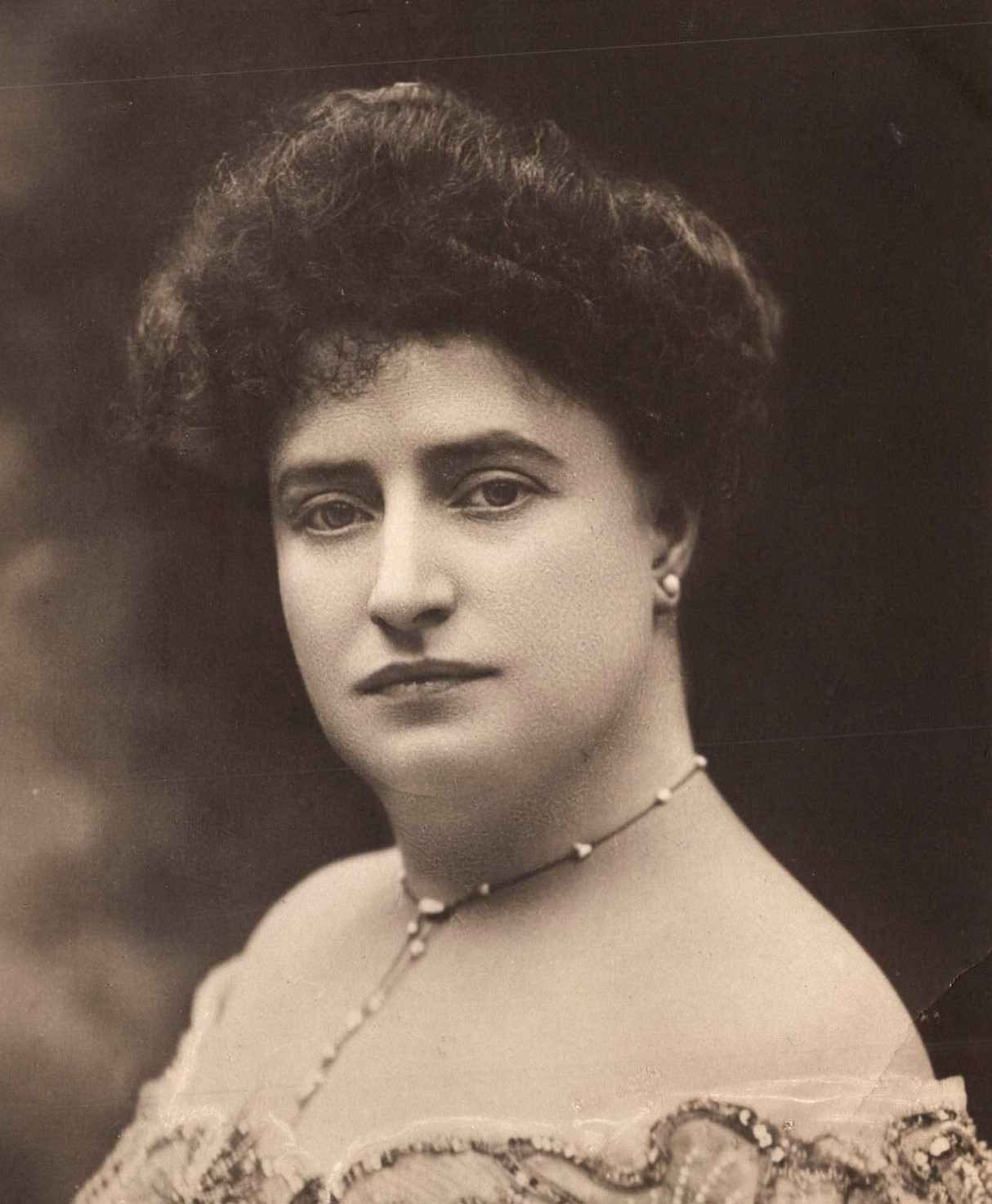
This vintage real photo postcard features English mezzo soprano, Louise Kirkby Lunn (1873-1930). She appeared in many French and Italian operas. She was best known for singing operas by Richard Wagner. She had many appearances at the Royal Opera House, Convent Garden as well as at the Metropolitan Opera in New York City. This postcard was published by Rotary Photo as part of a series (No.2025B) The card was produced around 1905. SOLD
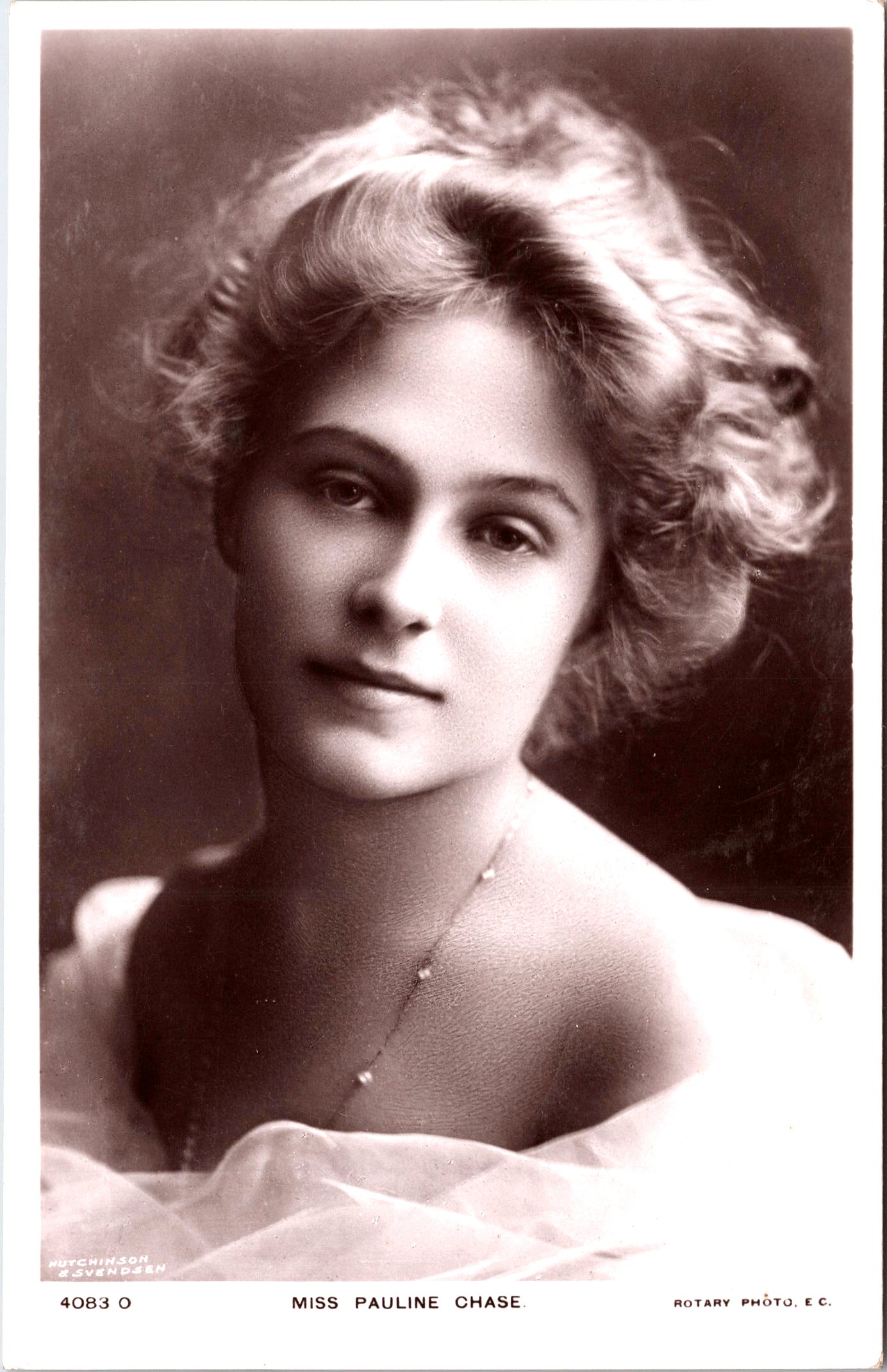
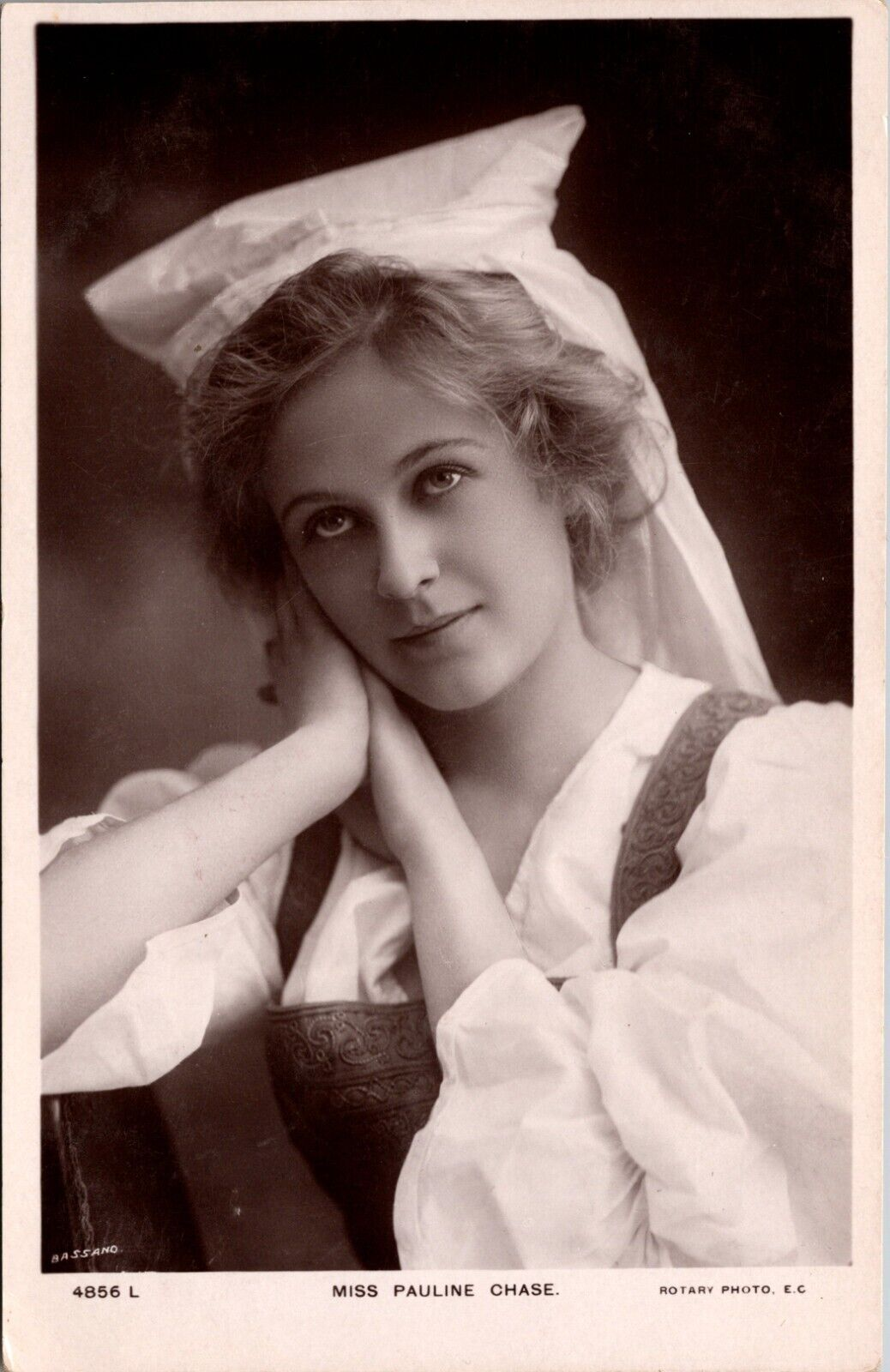
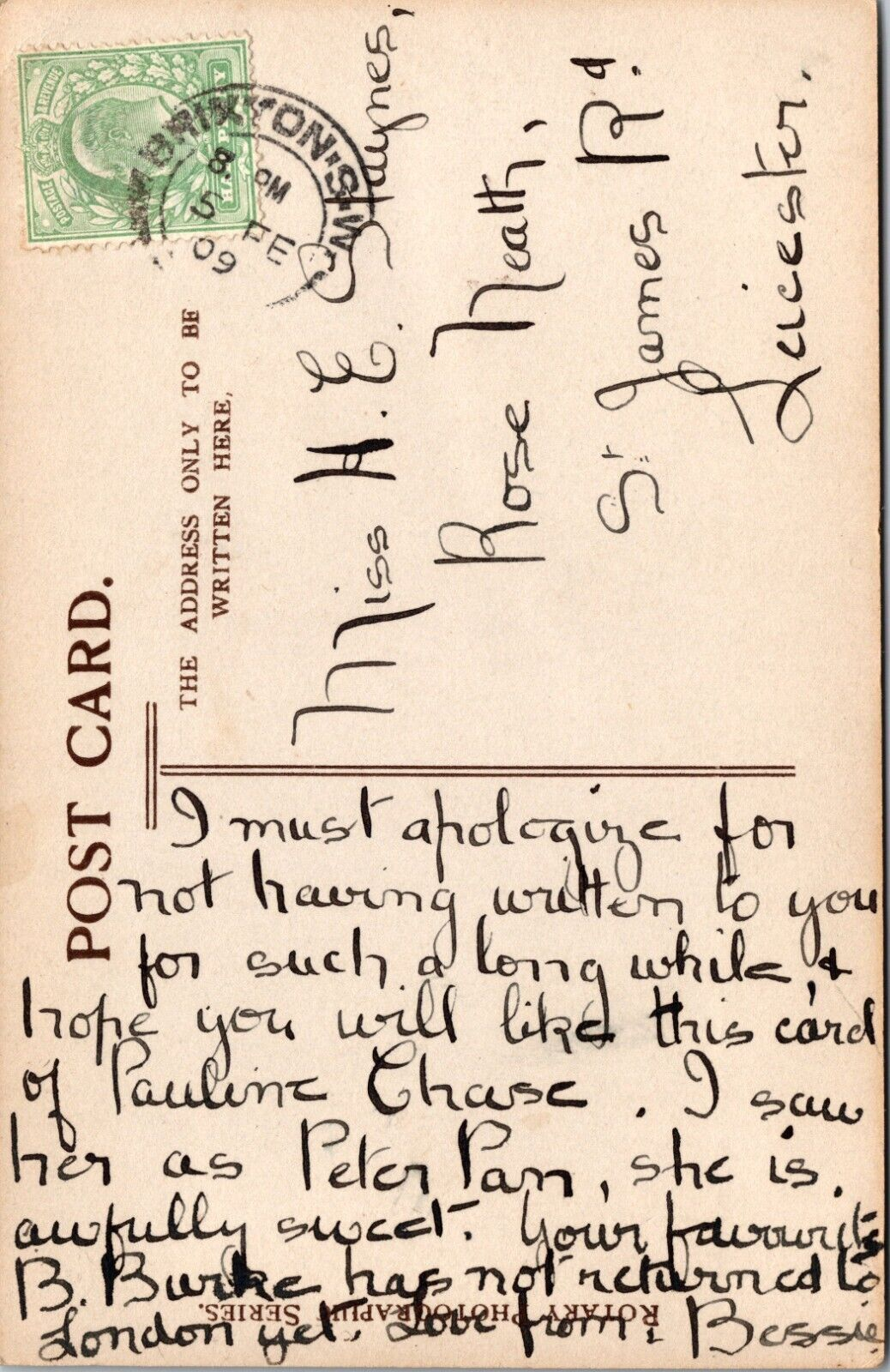
This vintage real photo Postcard 1 features pretty American actress and dancer, Pauline Chase (1885-1962). She was a regular performer both in the United States and the United Kingdom. She is especially known for her extended starring role in the British production of “Peter Pan, The Boy Who Wouldn’t Grow Up”. Her nickname was the “Pocket Venus of New York”. She was born in Washington D.C. and attended school in New York. She began acting when she was just fifteen years old. In 1901, producer, Charles Frohman recruited her to play in the London production of “The Girl From Up There”. She was just 15 years old. Upon her return to the US, she created a sensation as the “Pink Pajama Girl” in “The Liberty Belles”. She played one of the “lost boys” in the debut of Peter Pan (1904) in London. In 1906 she was chosen by producer, Charles Frohman, and playwright, J. M. Barrie, to play the title role in the production (1906-1913). This role brought her much fame and financial security. While in England, over the years, Chase developed quite a following. Charles Frohman had become her friend and mentor. Chase was a social beauty with many influential friends and admirers. She was a member of the socially elite and lived an extravagant life style. In 1913, Chase retired from the stage to marry a banker. The pair had three children. In 1916, Chase came out of retirement to play in her one and only movie appearance. There are 52 portraits of Chase in the National Portrait Gallery. The film “The Real Thing At Last” was a satirical film, based on MacBeth, written by Barrie. This postcard has a 1907 postmark. The card was published by Rotary Photo as part of a series (No.4083O). Miss Chase’s photograph was taken by the Hutchinson & Svendsen studio. (SOLD)
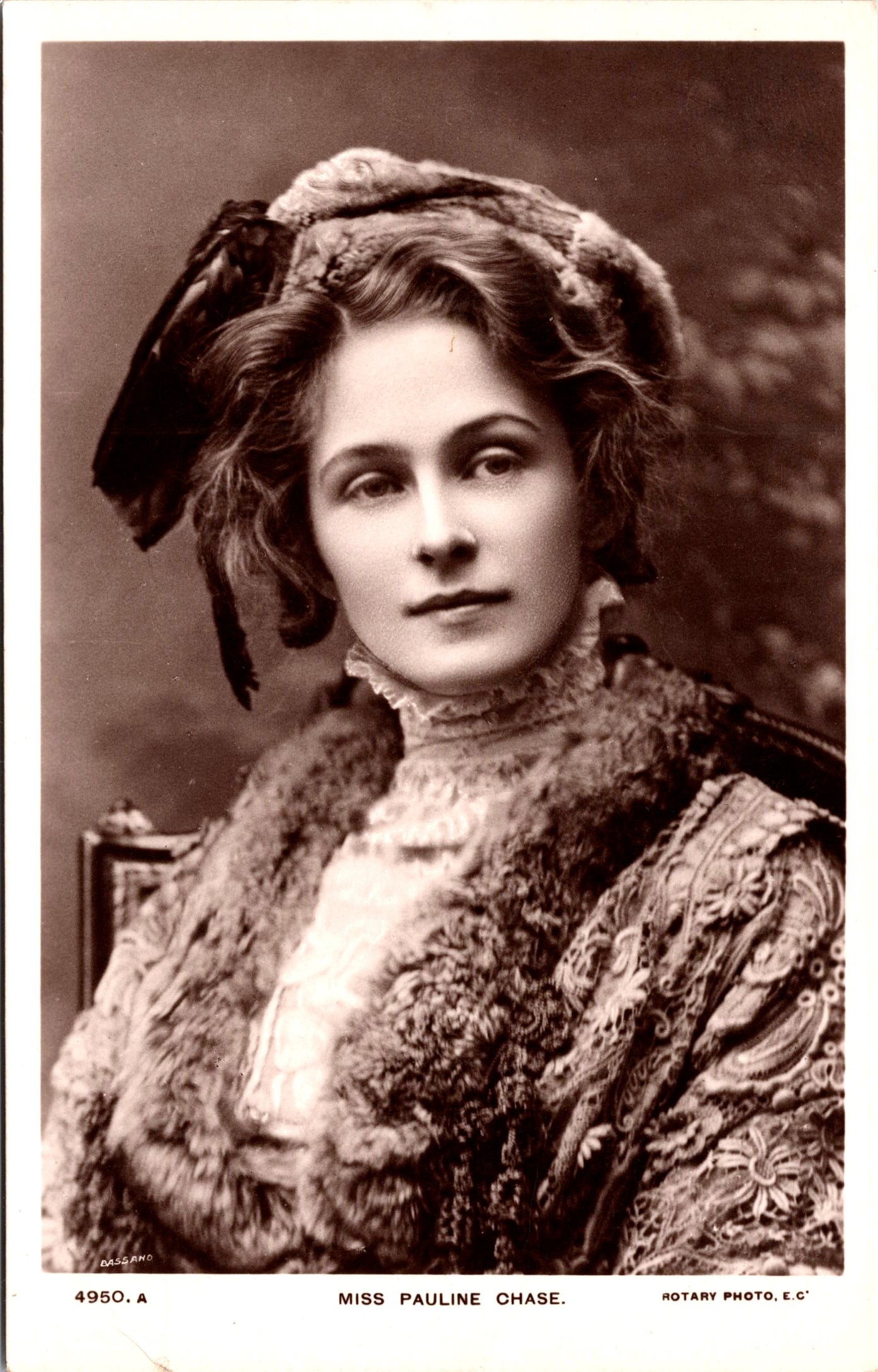
Postcard 2 was published by Rotary Photo as part of a series (No.4950A). Miss Chase’s photograph was taken by Alexander Bassano. (SOLD)
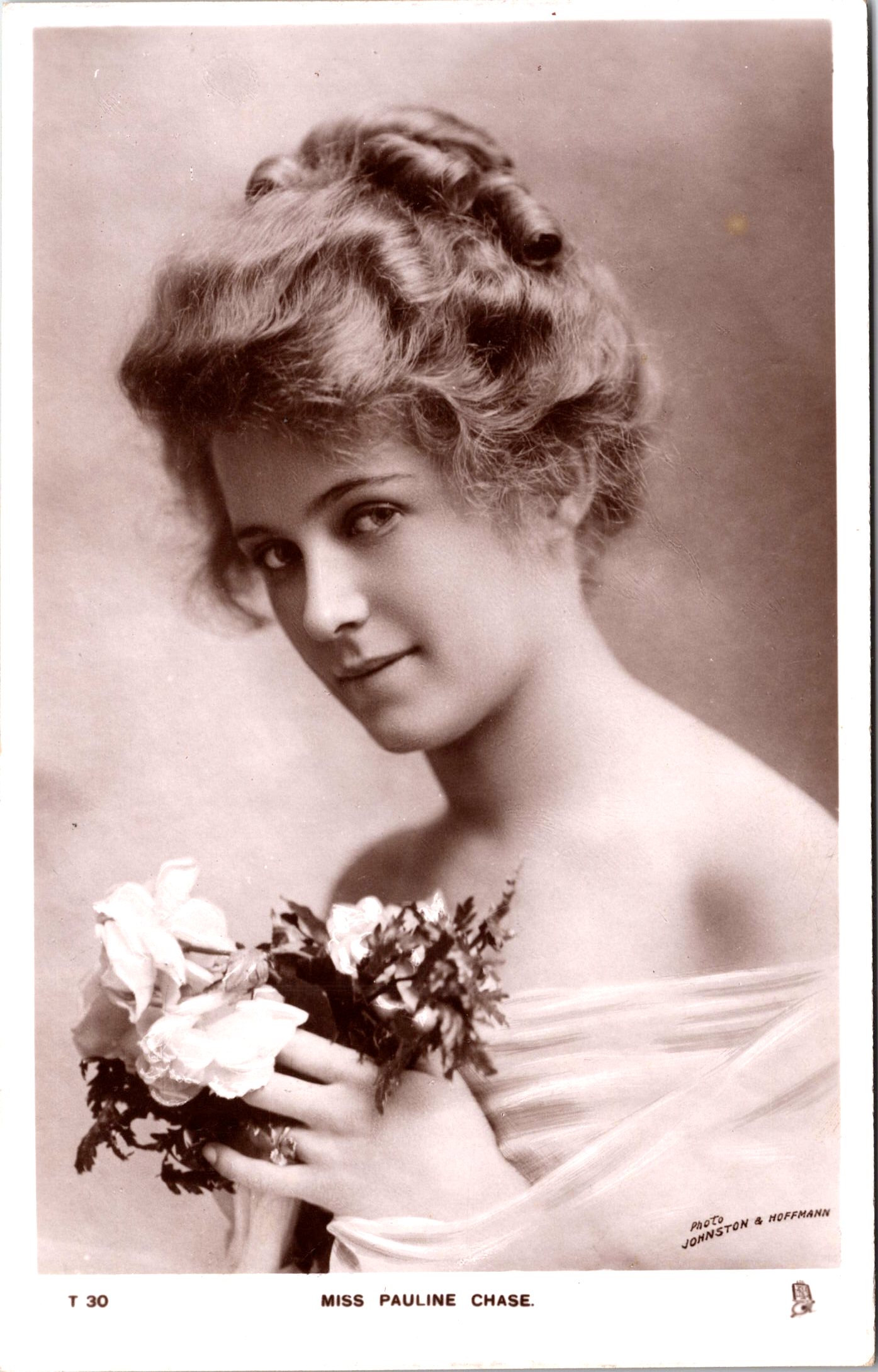
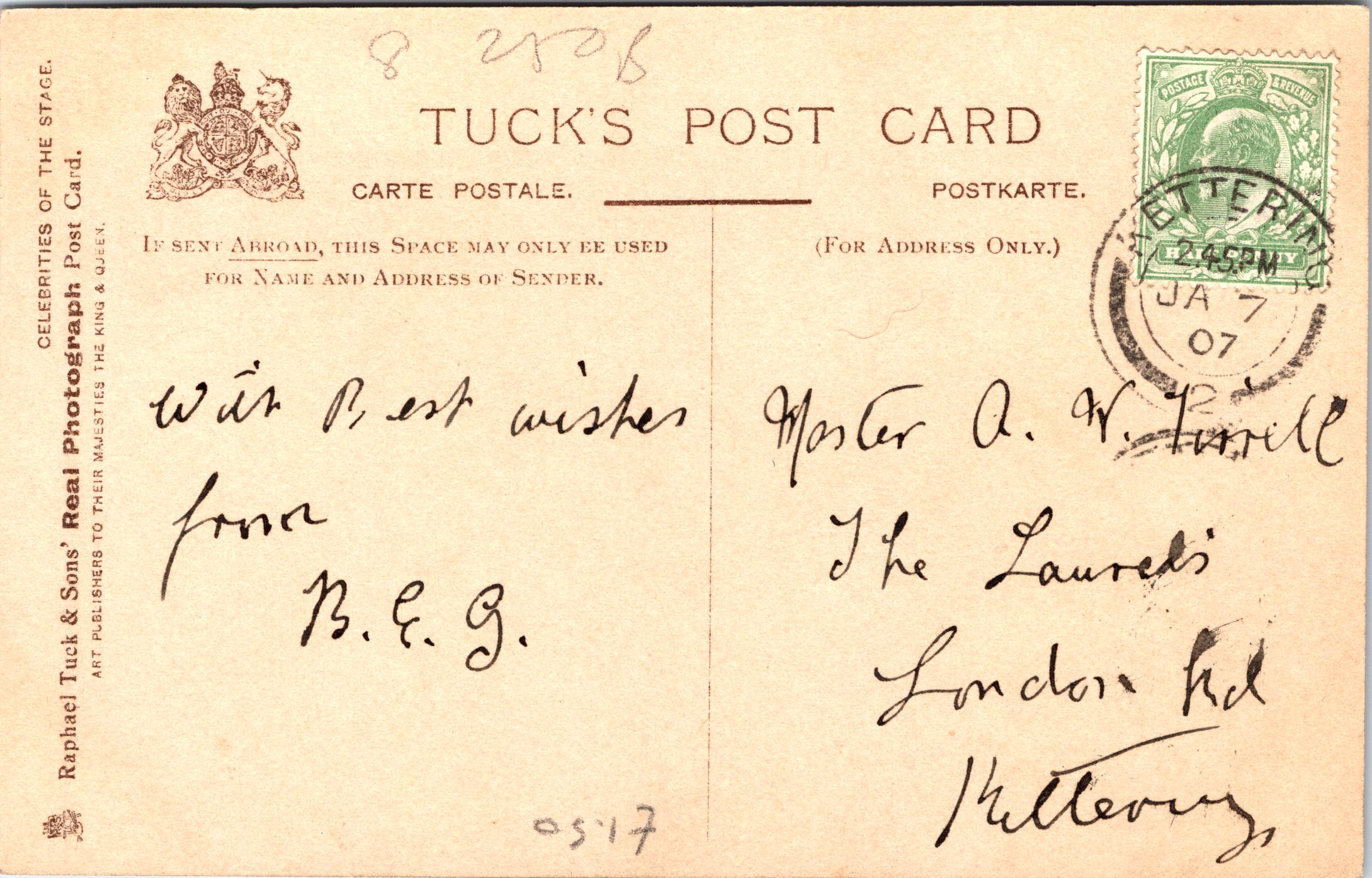
Postcard 3 has a 1907 postmark. The card was published by Raphael Tuck & Sons as part of a series (No.T30). Miss Chase’s photograph was taken by the Johnston & Hoffmann studio. (SOLD)
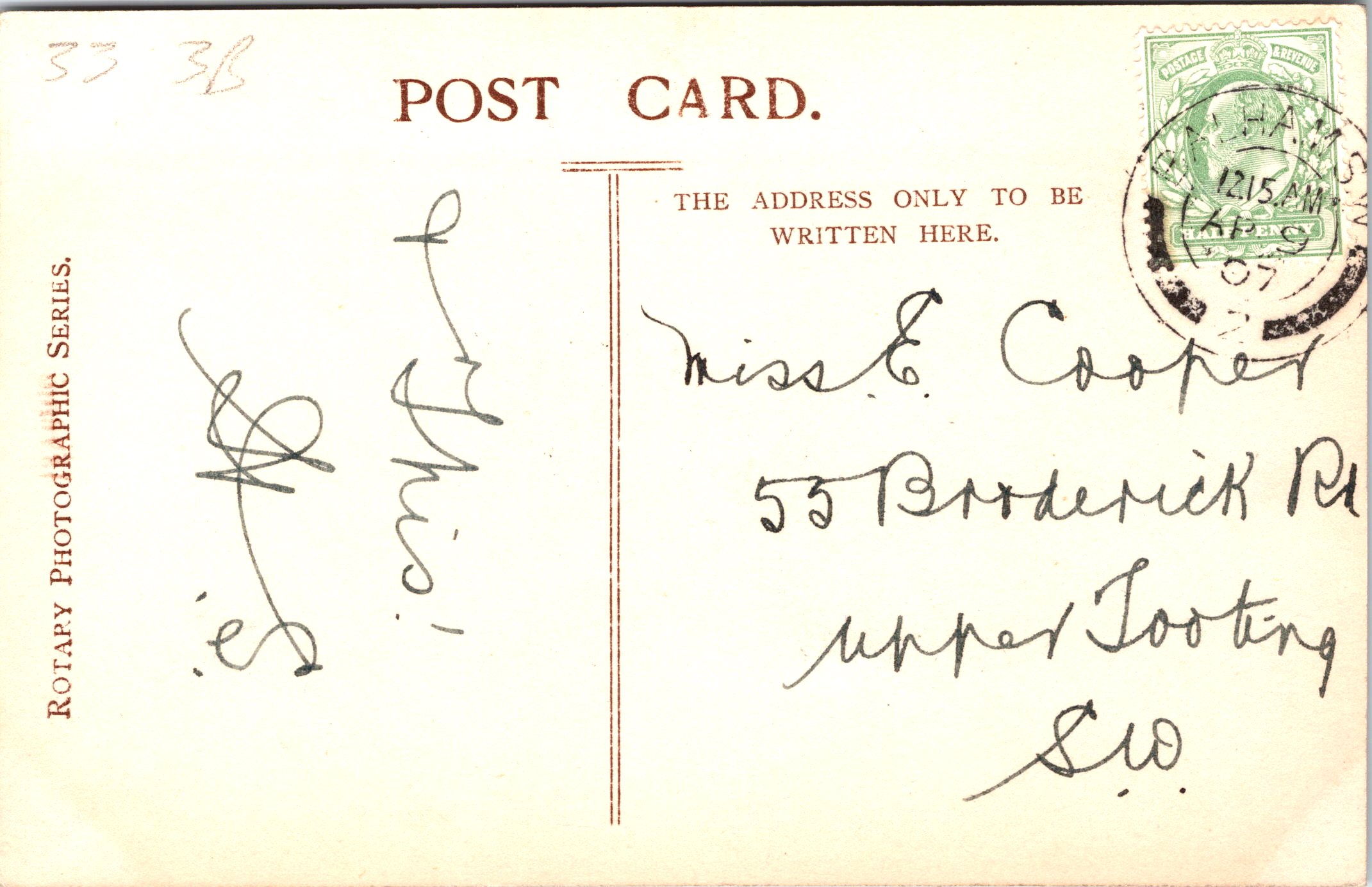
Postcard 4 features Chase wearing an interesting lace hat and she has a sweet, pure, and innocent appearance. This postcard was published circa 1909, the date of the cards postmark. The card was published by Rotary Photo as part of a series (No.4856L). Miss Chase’s photograph was taken by the Bassano studio. (SOLD)
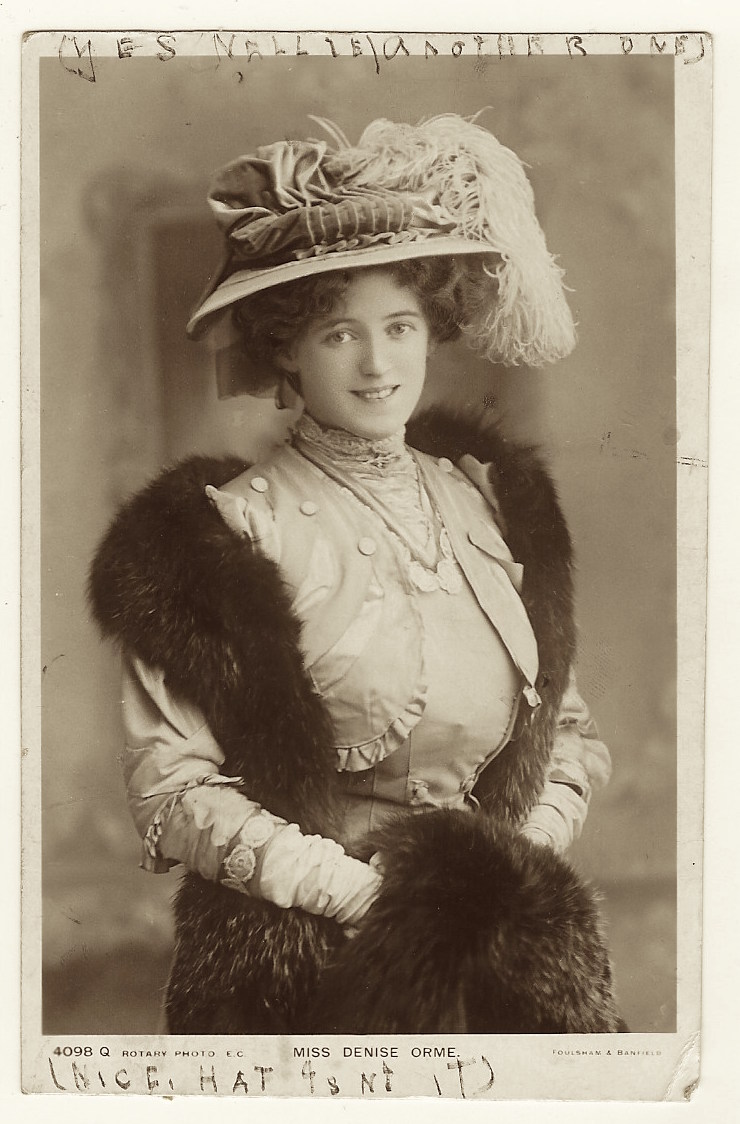
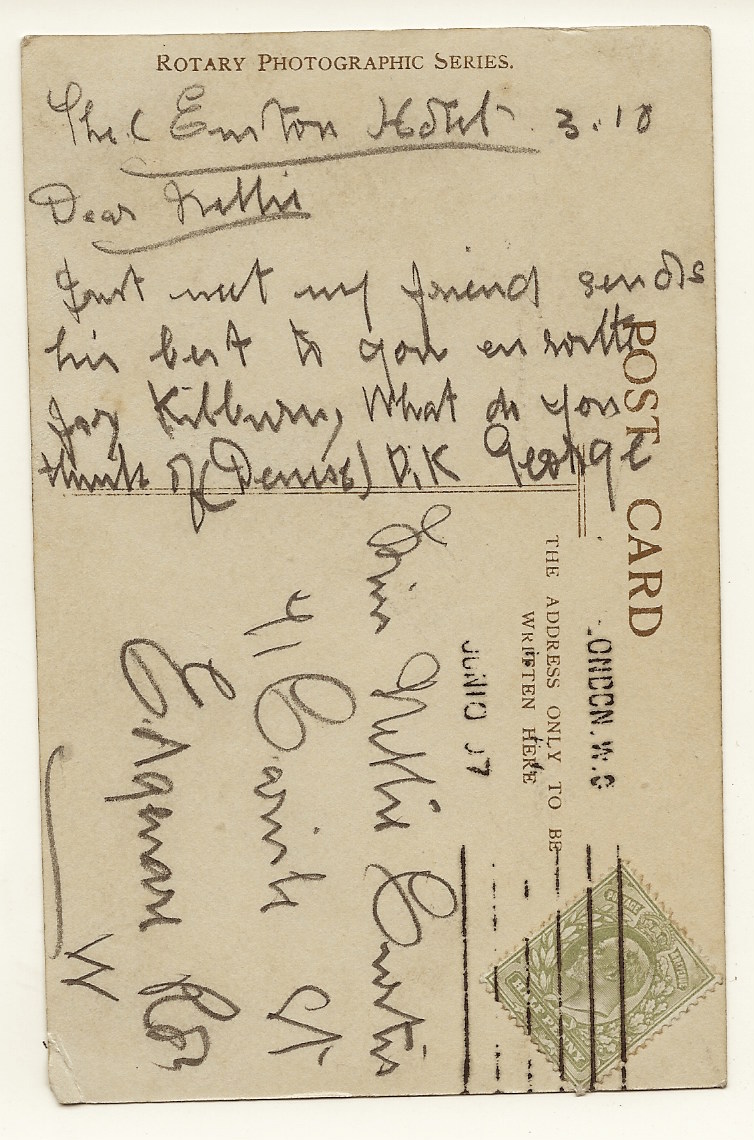
Postcard 1 features stage actress Miss Denise Orme. She is very attractive and beautifully dressed. She is wearing a fur stole and and fur muffs. She has a lovely hat and wonderful smile. Miss Orme’s given name was Jessie Smither, and was later known as Duchess of Leinster. Denise Orme (1885-1960) was an English music hall singer, actress and musician who was a regular performeer at the Alhambra and Gaiety Theatres in London during the early years of the twentieth century. Her mother was a professor of music. She trained for her theatrical career at the Royal Academy of Music and the Royal College of Music. Her stage debut was in 1906 in the chorus at Daly’s Theatre in London. Later that same year she appeared in the title role of “See See” at the Prince of Wales Theatre. In 1906 she participated in gramophone recordings of Gilbert and Sullivan’s “The Mikado”. Her marital history reveals that she had a predilection to choosing husbands that were “rich and famous”. She was married to an English Baron, A Danish millionaire, and an Irish duke. She was the maternal grandmother of Aga Khan IV.who is the current Imam of Nizari Ismailism which is a denomination of of Ismailism within Shia Islam with 15 million adherents. He is also a British business magnate. Miss Orme’s photographic portrait was taken by the Foulsham and Banfield Studio. Foulsham & Banfield were well known celebrity photographers. Frank Foulsham and A. C. Banfield operated a studio in the 1900’s through the 1920’s. The postcard was published by Rotary Photo and is part of the Rotary Photographic Series (#4098 Q). The postcard has a postmark from London, England, and dated 1907. The postmark date reveals that this portrait of Miss Orme was taken at the beginning of her stage career. In the message section of the postcard, the sender asks the receiver, “What do you think of Denise?”. In addition, the sender asserts on the front of the postcard “Nice hat, isn’t it?”. I have to agree; not only is Miss Orme lovely, so is her hat…….
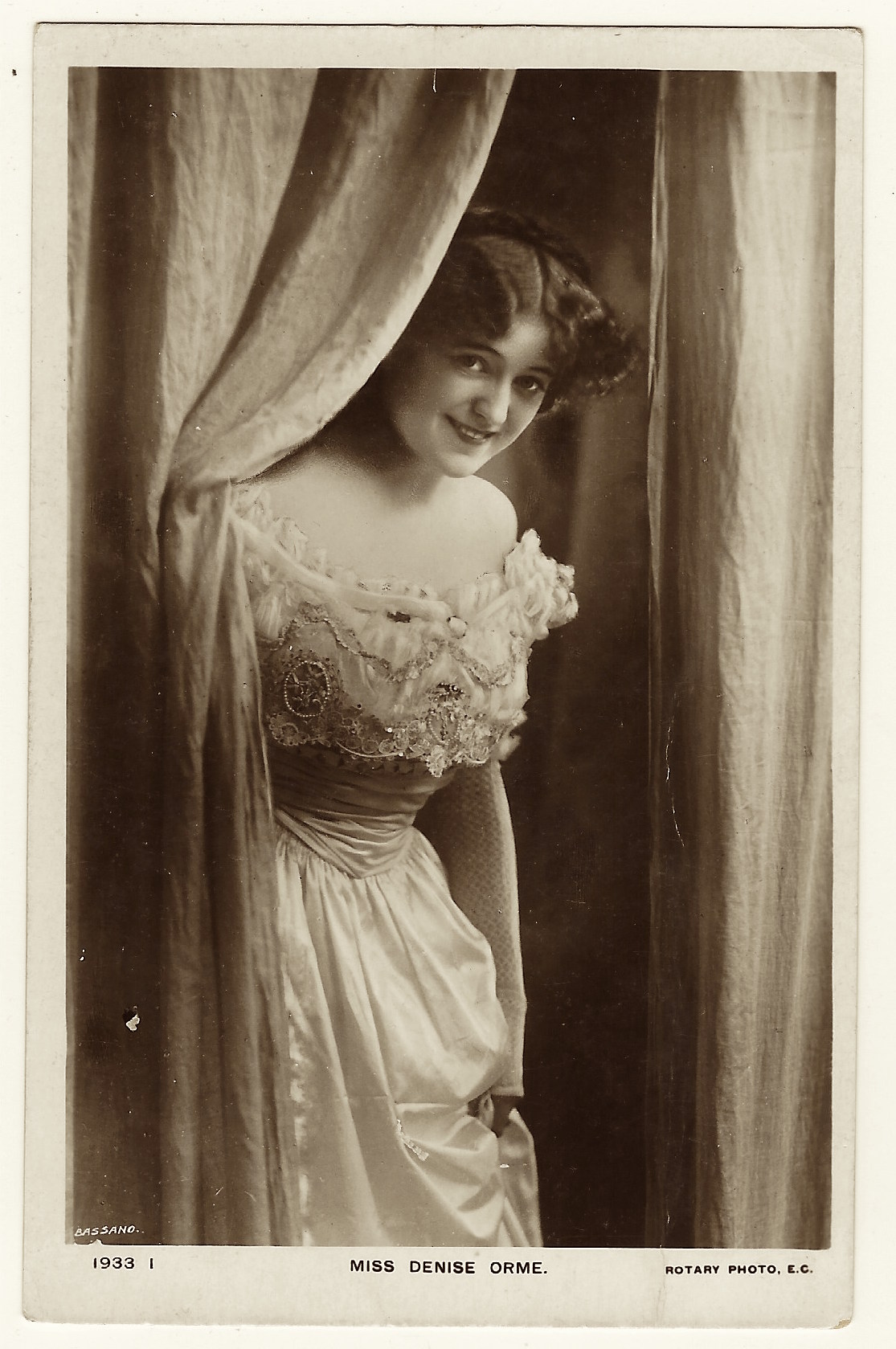
Postcard 2 shows the beautiful and well dressed Miss Orme peeking out from behind a curtain. The photographer is Alexander Bassano (1829-1913) who was a leading royal and high society photographer located in London. This postcard, like the first was published by Rotary Photo and is part of the Rotary Photographic Series (no. 1933 I).
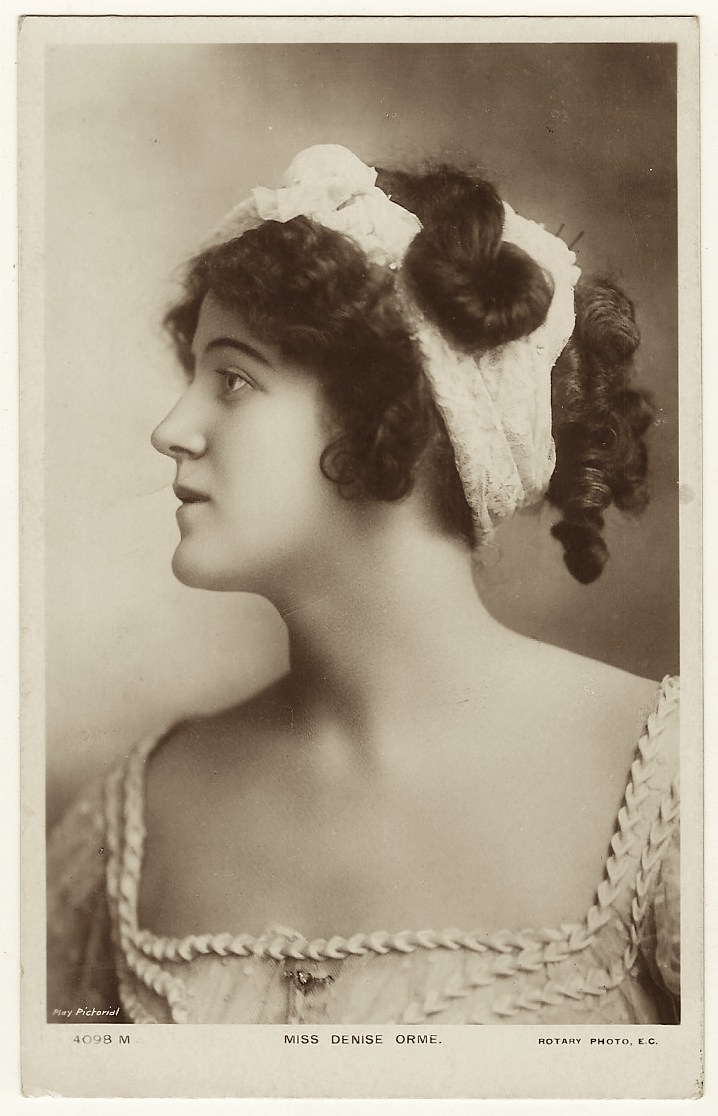
Postcard 3 presents a close-up profile view of this stunningly pretty young actress. Like the first two photo postcards, this one is also published by the Rotary Photo company and is part of the Rotary Photographic Series (no. 4098 M). The photograph was taken by “Play Pictorial” which was an English theatre magazine published in London between 1902 and 1939. The publication provided a pictorial presentation of West End theatrical productions with each issue focusing on just one play. (SOLD)
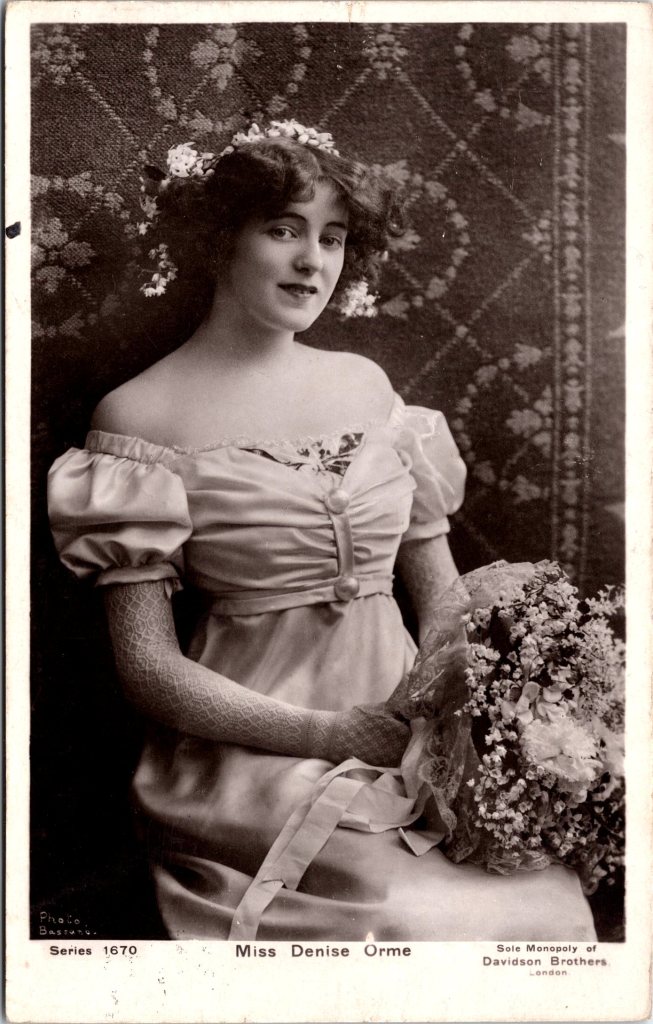
Postcard 4 presents a close-up profile view of this stunningly pretty young actress. It is published by the Davidson Brothers and is part of the Real Photographic Series (no.1670). The photograph was taken by Alexander Bassano. Bassano (1829 –1913) was a leading royal and high society photographer in Victorian London. (SOLD)
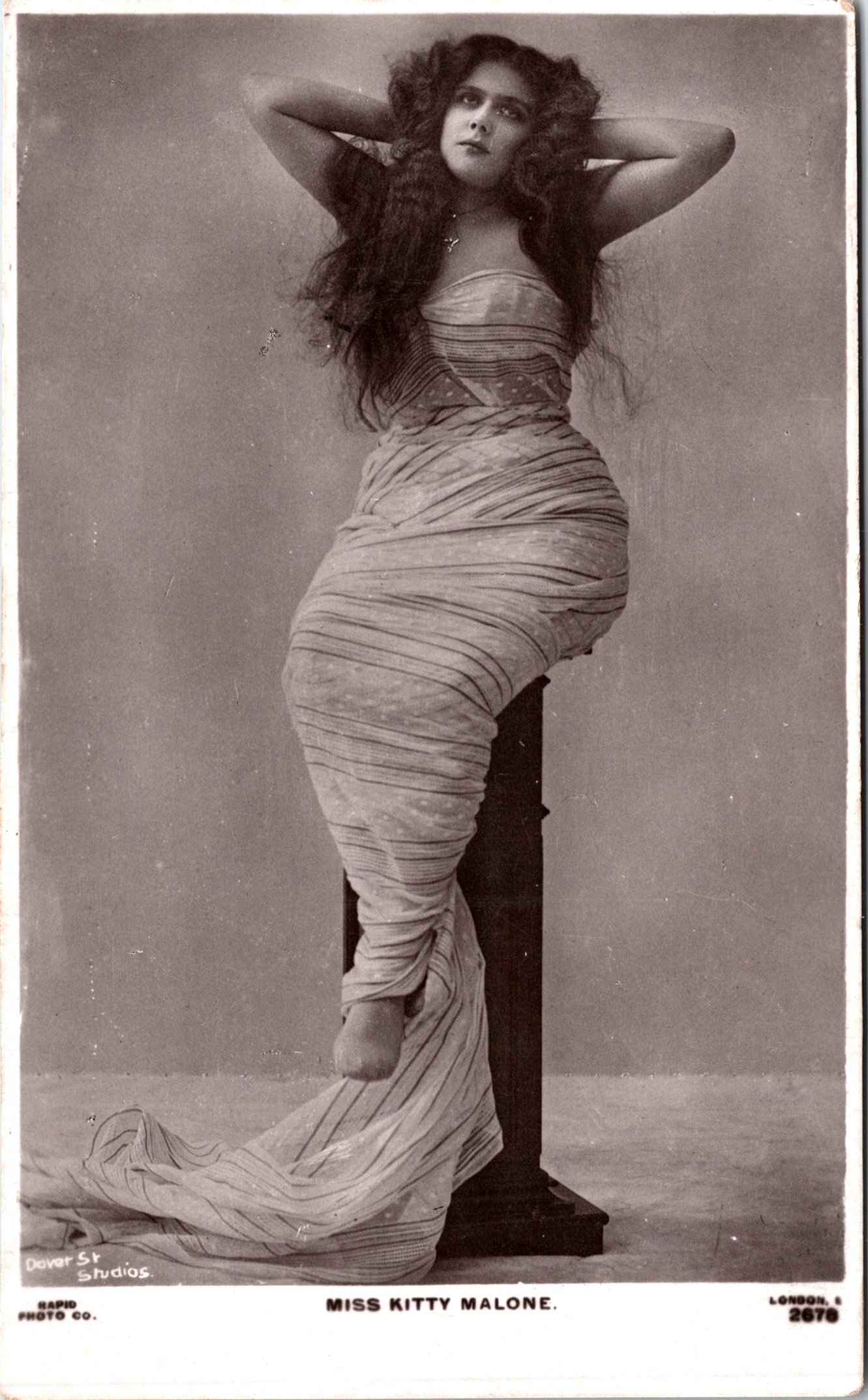
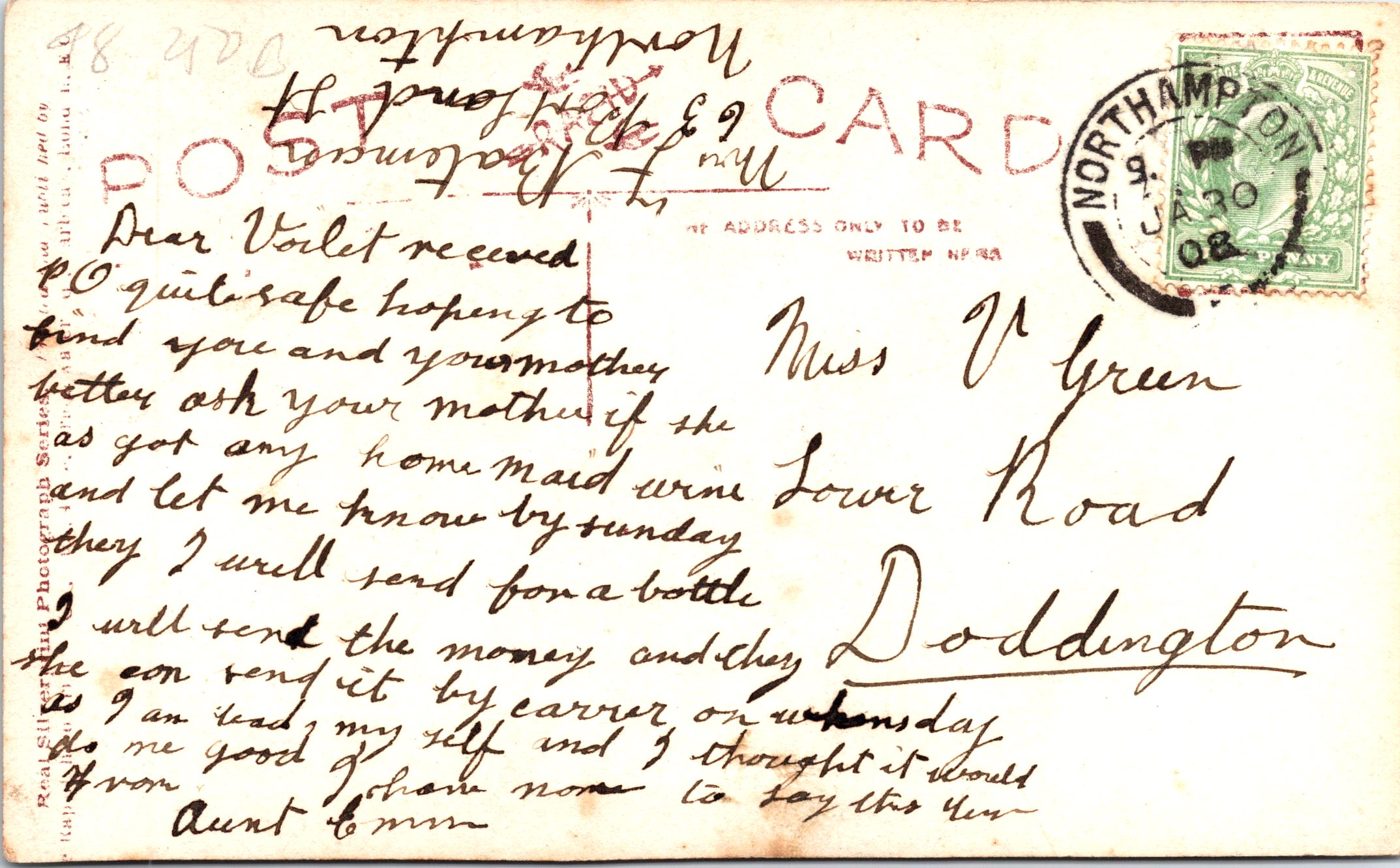
Postcard 1 is a risque original real photo postcard (RPPC) featuring Miss Kitty Malone, an early 20th-century stage performer or model. Malone is wrapped in a tight gown that accentuates all of her curves. The postcard was produced by Rapid Photo Co. in London, with the photograph taken at Dover St. Studios. In the image, Miss Kitty Malone strikes a dramatic pose, wrapped in a flowing, textured gown reminiscent of Grecian or theatrical costume styles. Her long, voluminous dark hair cascades down her shoulders, framing her striking face. She gazes directly at the camera with an intense and almost mysterious expression, her lips slightly parted. Her arms are lifted behind her head, adding to the dramatic, posed aesthetic that was characteristic of early Edwardian stage and artistic photography. This postcard is part of a series and numbered 2676 . This antique real photo postcard (RPPC) was postally used and sent in 1908. It features a green half-penny King Edward VII postage stamp, which was commonly used in the early 20th century for domestic postcards. The handwritten message is addressed to Miss V. Green and is written in black ink in elegant cursive handwriting. The sender, signed as “Aunt Emma”, writes to Violet, mentioning that she has received a postal order (P.O.) safely and hopes Violet and her mother are doing well. She asks if Violet’s mother has any homemade wine available and requests that she let her know by Sunday so she can send for a bottle. Aunt Emma also states that she will send money so it can be delivered by carrier on Wednesday, mentioning that she finds it beneficial for herself and thought Violet’s mother might feel the same. SOLD
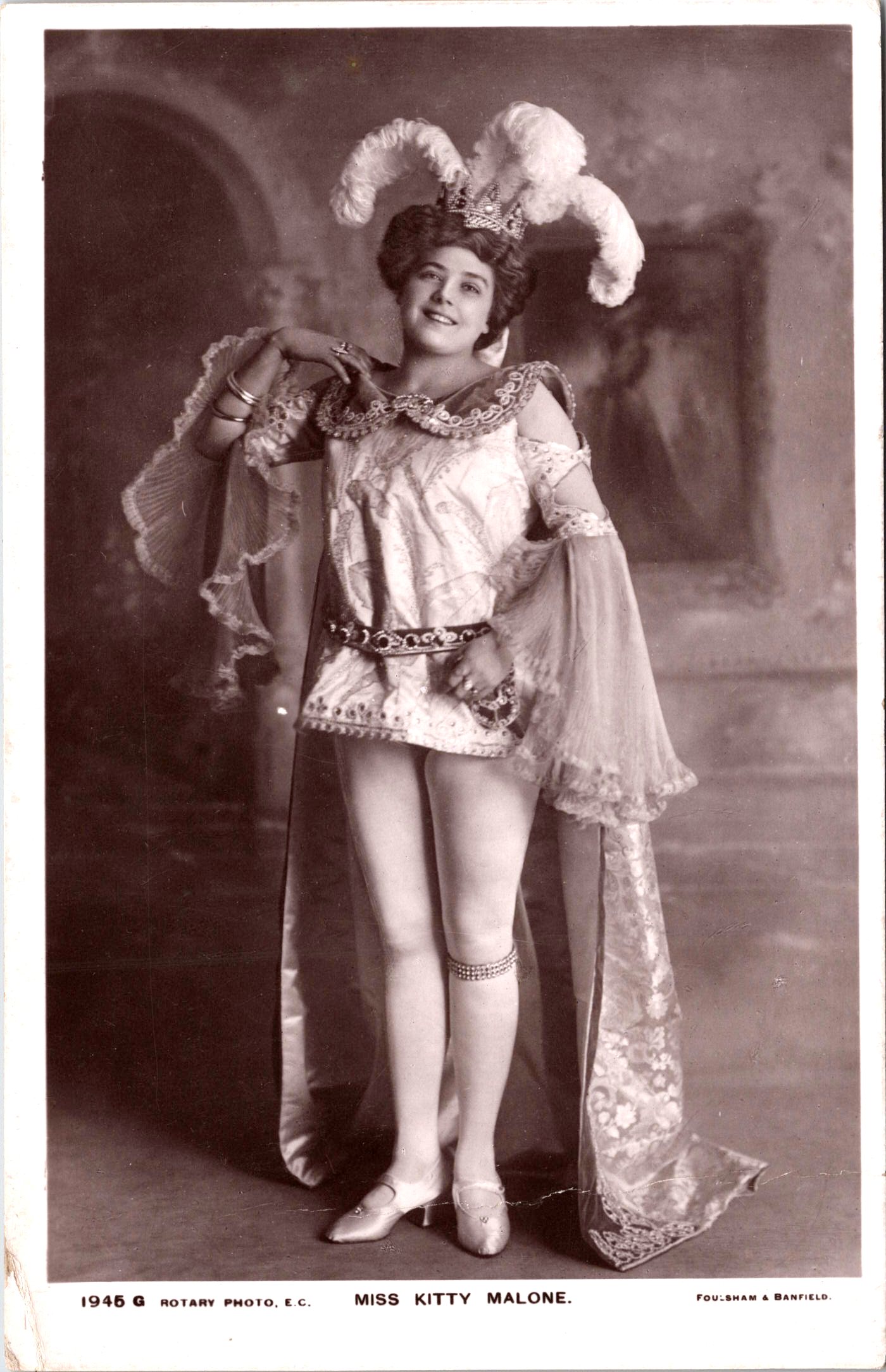
Postcard 2 is a risque vintage postcard, published by Rotary Photo and numbered 1945G in the series, features Miss Kitty Malone in an elaborate theatrical costume. This card earns the title of risque because Miss Malone’s top is exceedingly short, exposing much of her legs. The photograph was taken by the renowned Foulsham & Banfield studio. Miss Malone is dressed in an ornate, short tunic-style dress adorned with intricate embroidery and decorative trim. The outfit is cinched at the waist with a bejeweled belt, and she wears sheer, flowing sleeves that drape elegantly from her arms. She also sports shimmering stockings, one of which is embellished with a delicate garter, and dainty, pointed shoes. Her regal headpiece, topped with tall, white feathered plumes, adds to the opulent and theatrical nature of her attire. Her expression is warm and confident, with a slight smile and a poised demeanor. She gazes directly at the camera, her head tilted slightly to one side. Her dark, voluminous hair is styled in an elegant updo, framing her face beautifully. Her pose, with one hand resting on her hip and the other raised near her face, conveys a sense of grace and charisma, suggesting she was a performer or stage actress. The background of the image is softly blurred, allowing the intricate details of her costume and expression to stand out. The overall aesthetic of the postcard captures the glamour and theatrical style of the era. SOLD
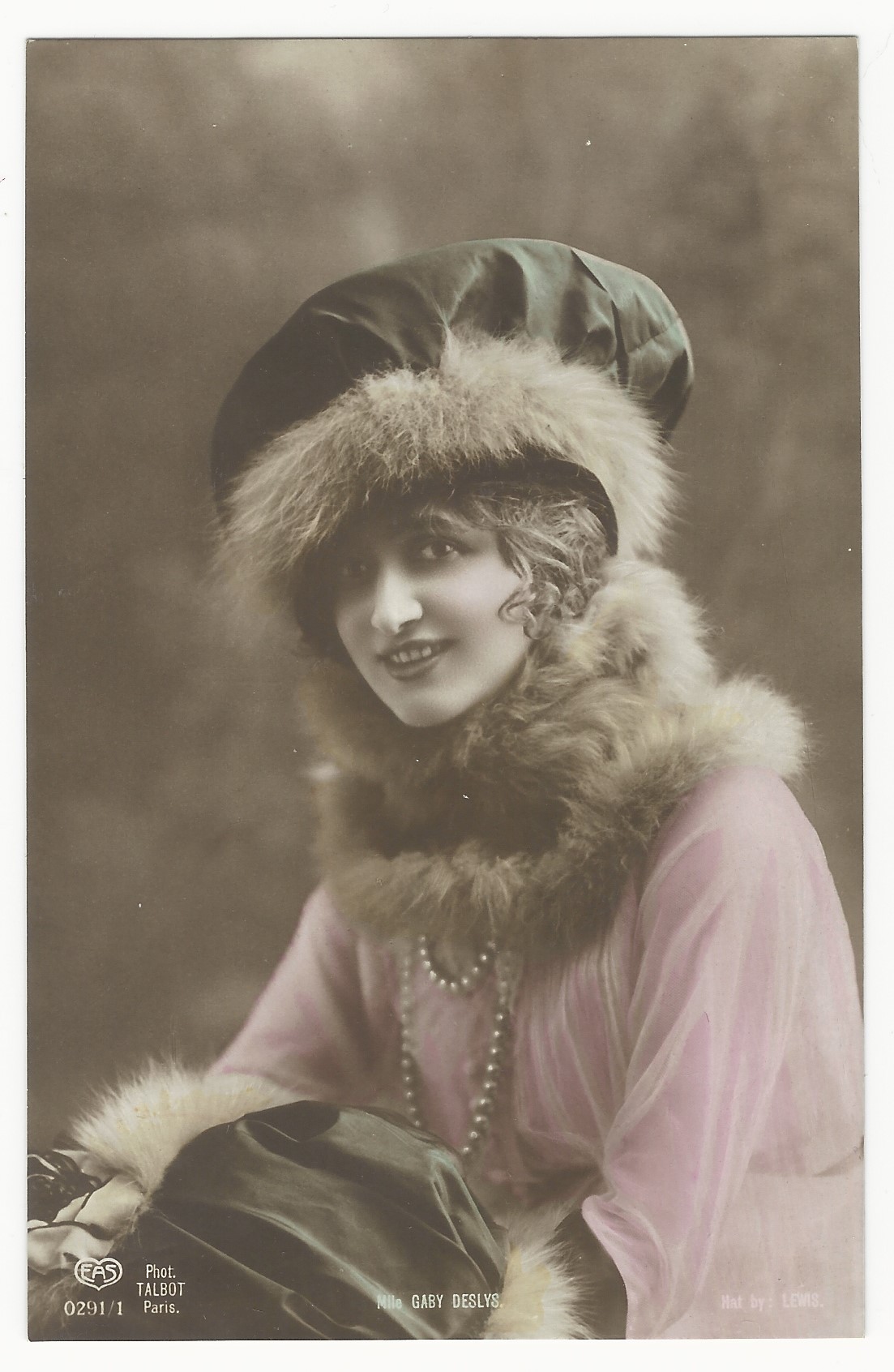
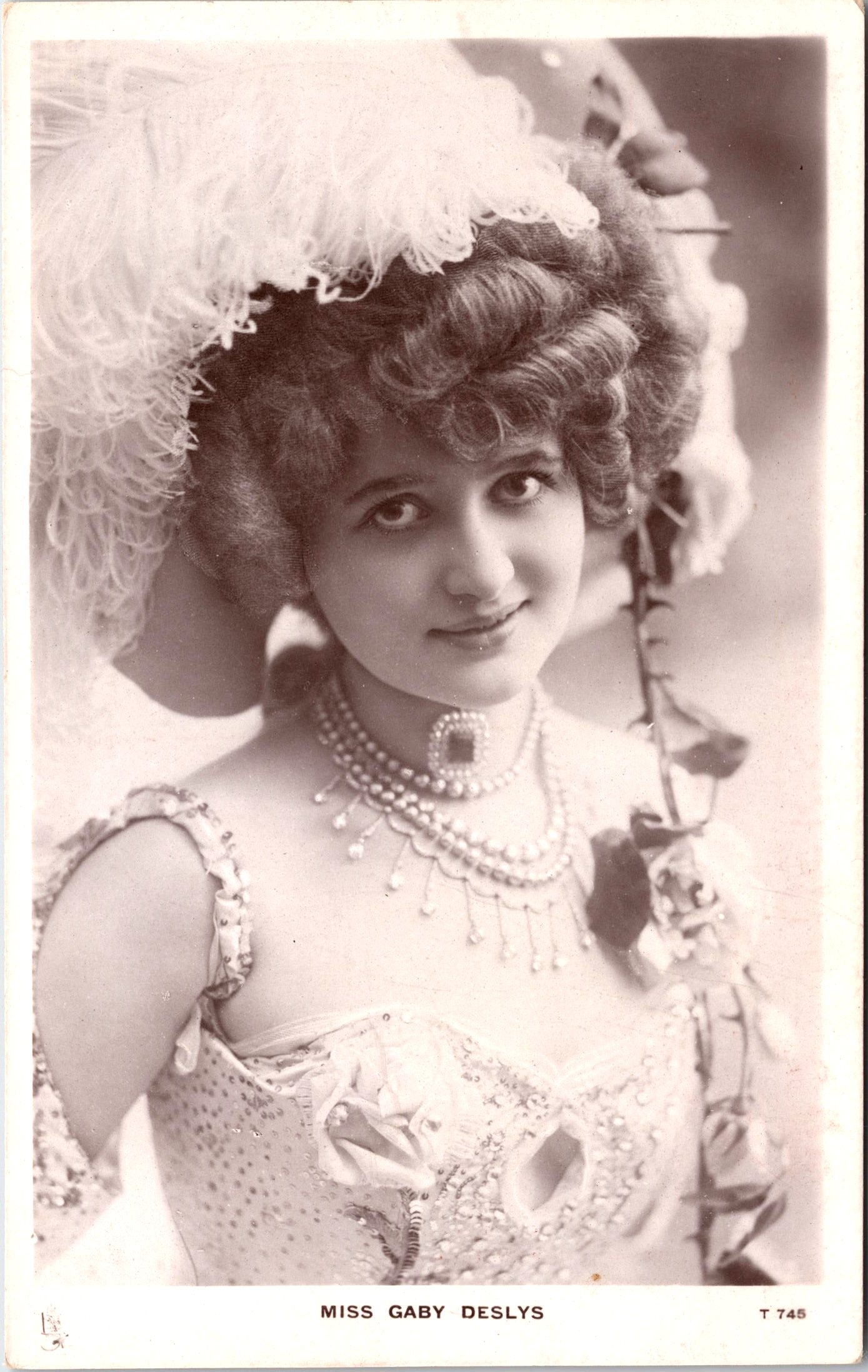
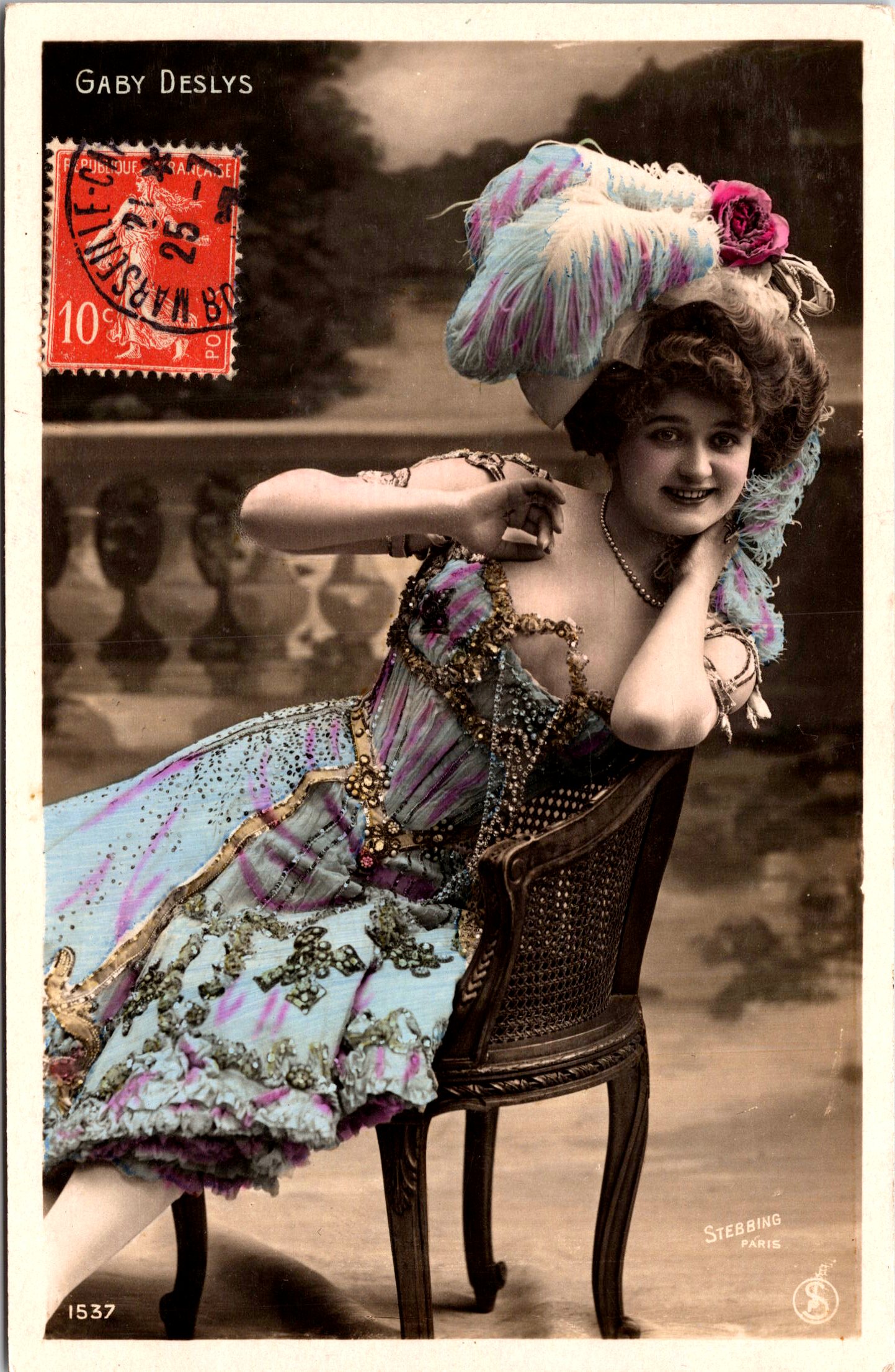
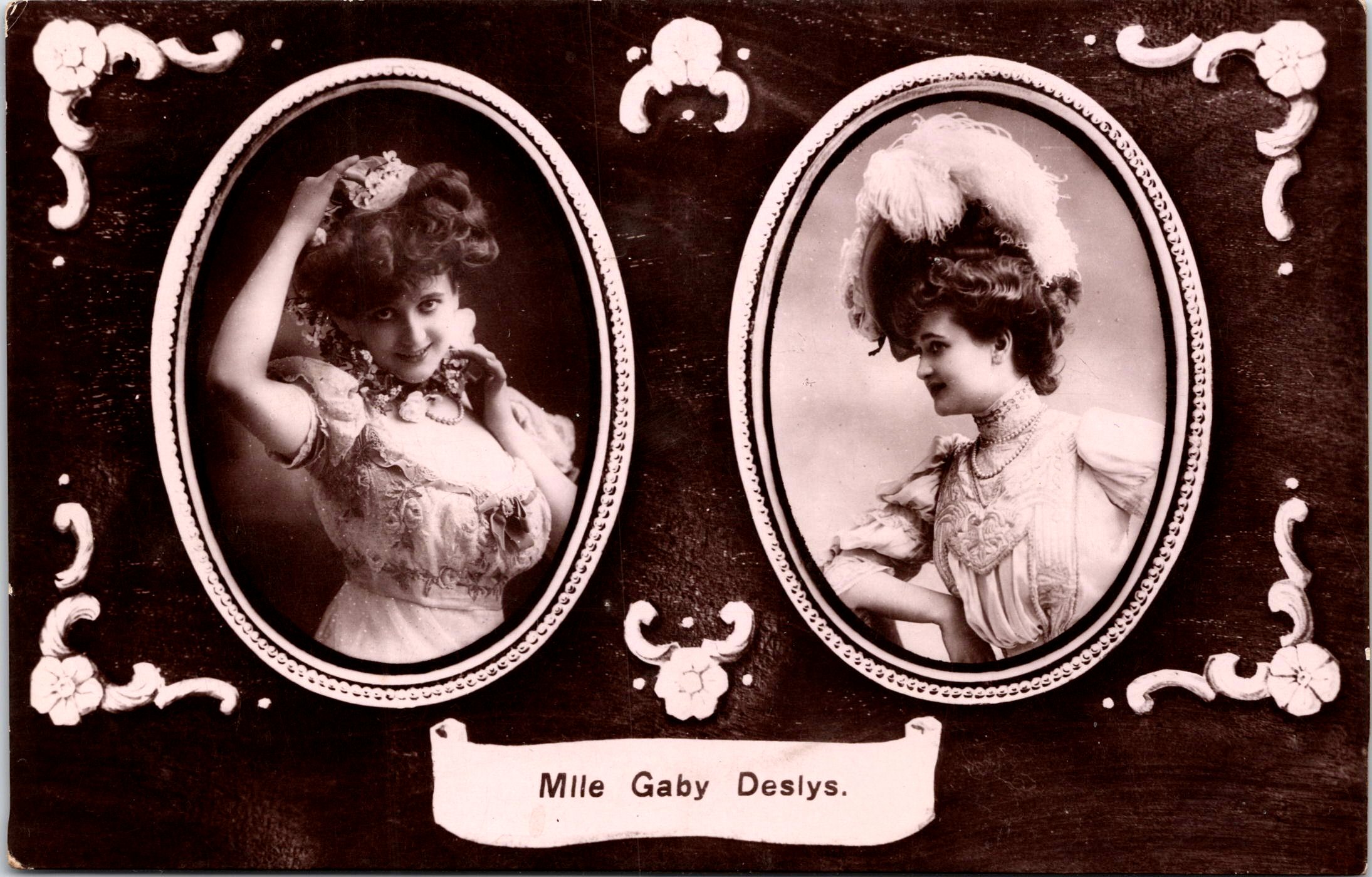
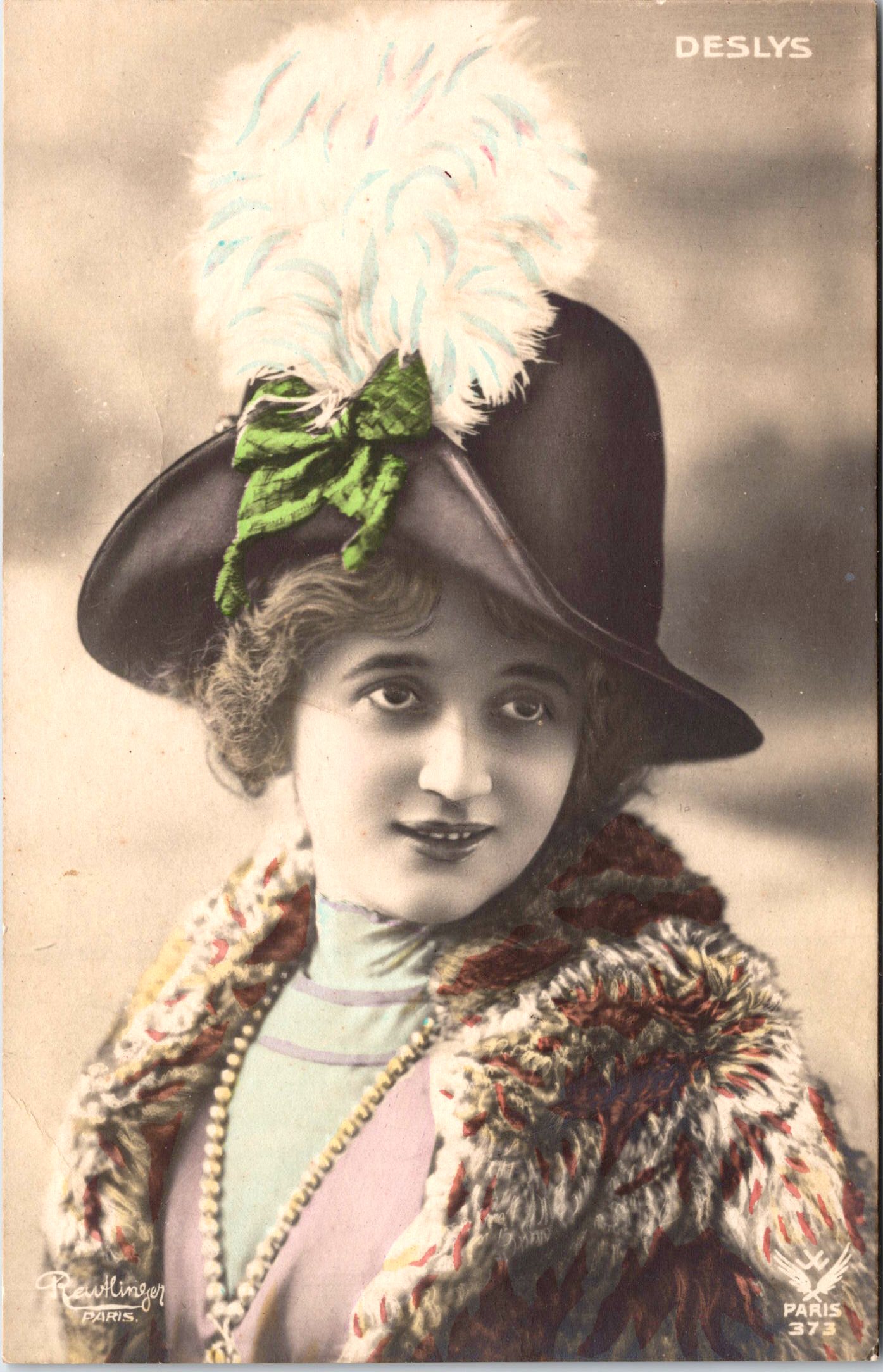
Vintage real photo Postcard 1 features a portrait of the multi talented actress, dancer, and singer, Gaby Deslys (1881-1920). Miss Deslys performed at the beginning of the twentieth century in both Europe and the United States. She was extremely popular worldwide. In fact, she was able to earn four thousand dollars a week when performing in the United States. She performed several times on Broadway. She had a dance named after her, “The Gaby Glide” (1911). You can find the sheet music, with Gaby on the cover, elsewhere on ebay. Her love life was the topic of much public gossip. She probably added to the sensationalism surrounding her by posing in a number of risque postcards. She was courted by many wealthy and powerful men, including the King of Portugal. Her life was cut short by the “Spanish” influenza. Postcard 1 is not at all common. It was published by E. A. Schwerdtfeger Company of London and printed in Berlin (no. 0291/1). The company also had an office in New York (opened in 1910). This publishing house printed many different types of real photo postcards but was known for its hand-colored real photo postcards of actresses and fashionable women in exotic costumes. The photographer was the Talbot studio. The creator of Miss Deslys’s hat is also credited (Lewis). This particular real photo postcard stands out because it offers a colorized and very clear view of this beautiful and talented performer. SOLD
Postcard 2 was photographed by Edouard Stebbing. He was active in Paris between 1890 and 1910. Stebbing taught at a University in Paris and invented the stebbing camera, and was known for his work with emulsions. It is reported that he was friends with the artist Monet. He died in 1914 and his wife (Celestine) died five years earlier. Stebbing was a prolific photographer during the Belle Epoque Paris. He appears to have been an expatriate from England. He published many articles in British Photographic journals. Stebbing photographed many theatrical stars. A frequent publisher of these postcards was Monsieur G.Piprot, of “Etoille” or “Star” publishing in Paris. The “Photographic Times and American Photographer” (1883) cited Stebbing as “one of the bright lights of the French Photographic Society. The card has a 1908 postmark. SOLD
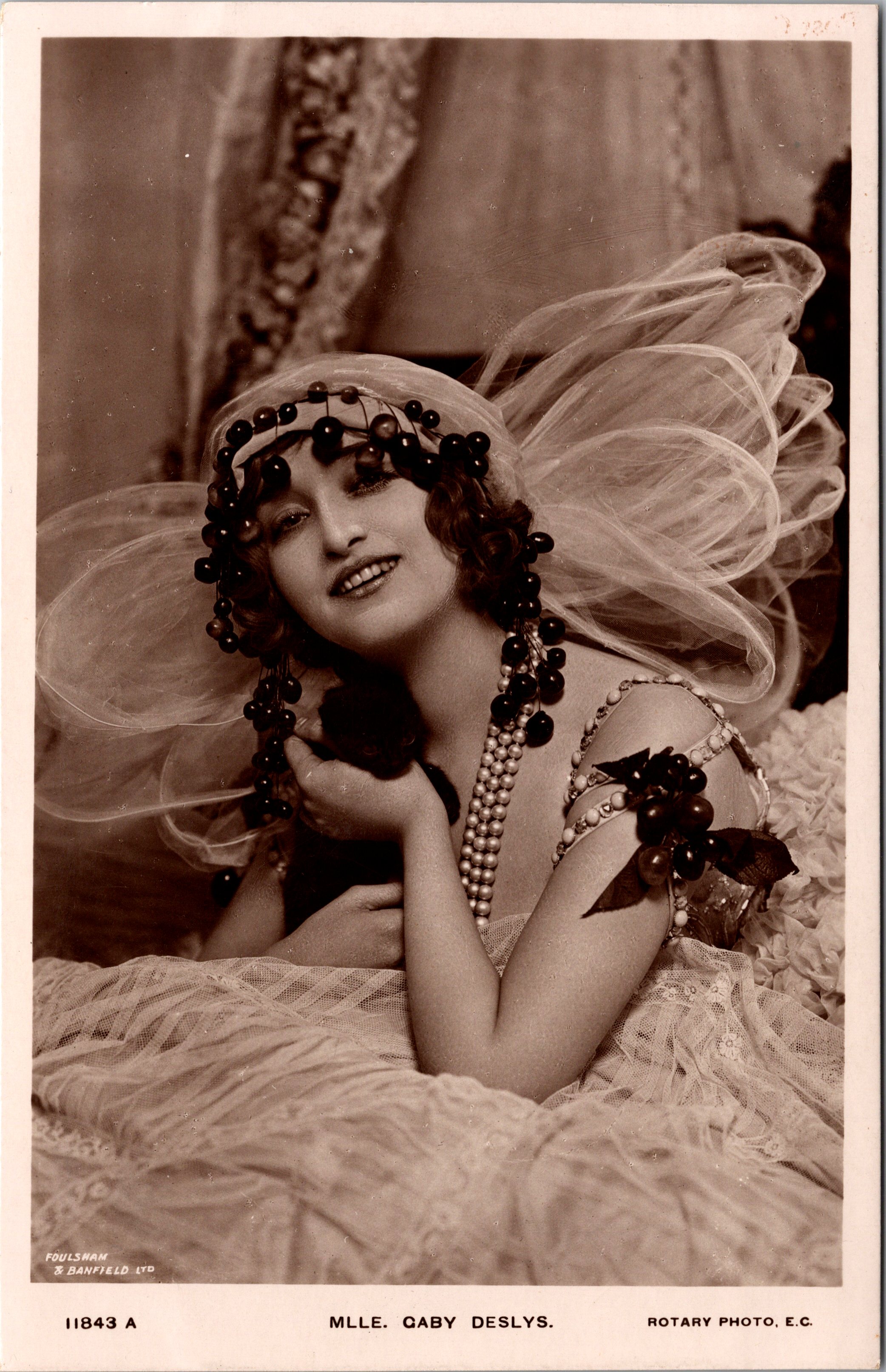
Postcard 3 is not common. It was published by Rotary Photo of Great Britain as part of a series (no.11843 A). This postcard portrait was taken by the Foulsham & Banfield studio. Gaby Deslys was certainly a beautiful and talented performer. SOLD
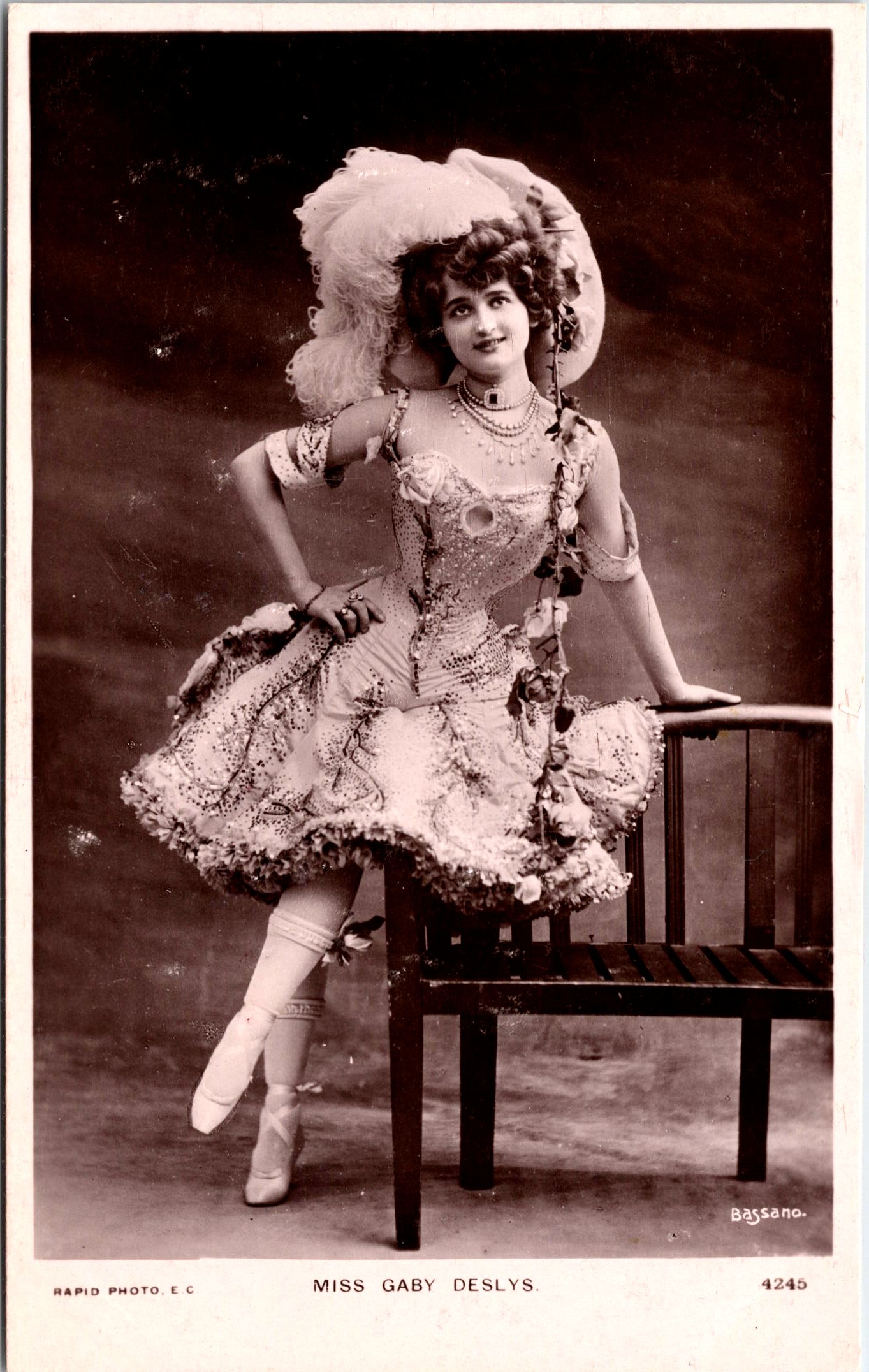
Postcard 4 was published by Rapid Photo of Great Britain as part of a series (no.4245). The company was active between 1901 and 1910. The firm specialized in taking theatrical portraits and was located in London. This postcard portrait was taken by the Bassano studio. SOLD
Postcard 5 was published by Raphael Tuck & Sons of Great Britain as part of the Celebrities of the Stage series (no.T745). The company produced a variety of postcards including an extensive catalog of celebrity (stage and screen) portrait postcards. The firm began publishing this Deslys postcard in 1903. Miss Deslys was photographed by Dover Street Studio for the portrait seen on this postcard. (SOLD)
Postcard 6 was published by J. Beagles of Great Britain as part of a series (no.70H). This real photo postcard is uncommon. This risque vintage real photo postcard features Deslys wearing a provocative costume for her time. She is flashing an infectious smile. Note her corset assisted wasp thin waist.
Postcard 7 was published by Societe Industrielle de Photograpie (SIP) of Rueil, France, and is part of a series (no.1537).The photographer was Edouard Stebbing who was active in Paris between 1890 and 1910. Stebbing taught at a University in Paris and invented the stebbing camera, and was known for his work with emulsions. It is reported that he was friends with the artist Monet. He died in 1914 and his wife (Celestine) died five years earlier. Stebbing was a prolific photographer during the Belle Epoque Paris. He appears to have been an expatriate from England. He published many articles in British Photographic journals. Stebbing photographed many theatrical stars. This real photo postcard is uncommon. (SOLD)
Postcard 8 is an uncommon vintage real photo postcard. It was published by Davidson Brothers of Great Britain. Davidson Brothers was located in both London and New York City. The firm operated between 1901 and 1911. (SOLD)
Postcard 9 has a portrait taken by esteemed celebrity photographer, Leopold Reutlinger. This real photo postcard is very uncommon. Gaby Deslys was certainly a beautiful and talented performer. (SOLD)
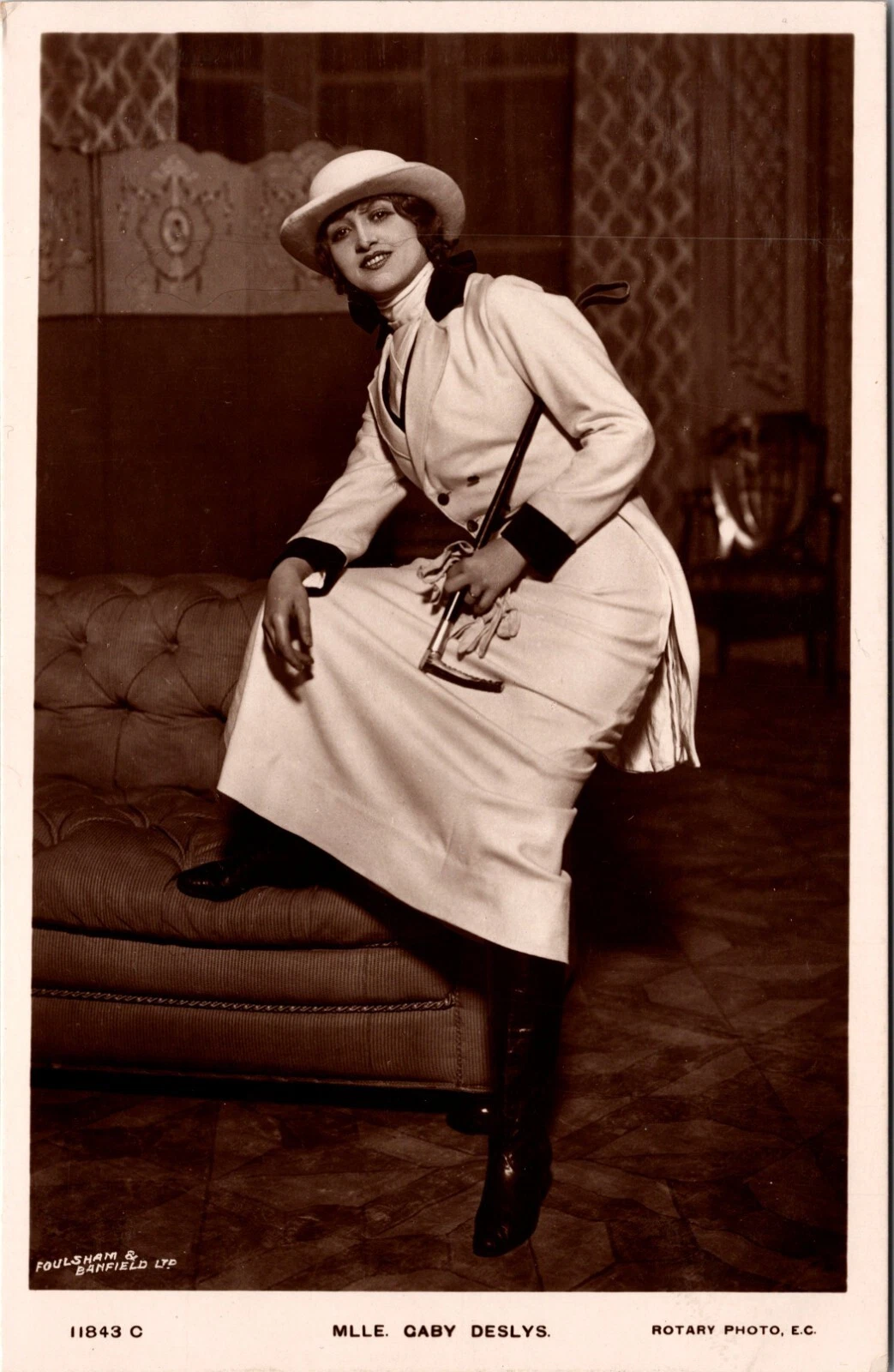
Postcard 10 is not at all common. It was published by Rotary Photo of Great Britain as part of a series (no.11843 C). This postcard portrait was taken by the Foulsham & Banfield studio. SOLD
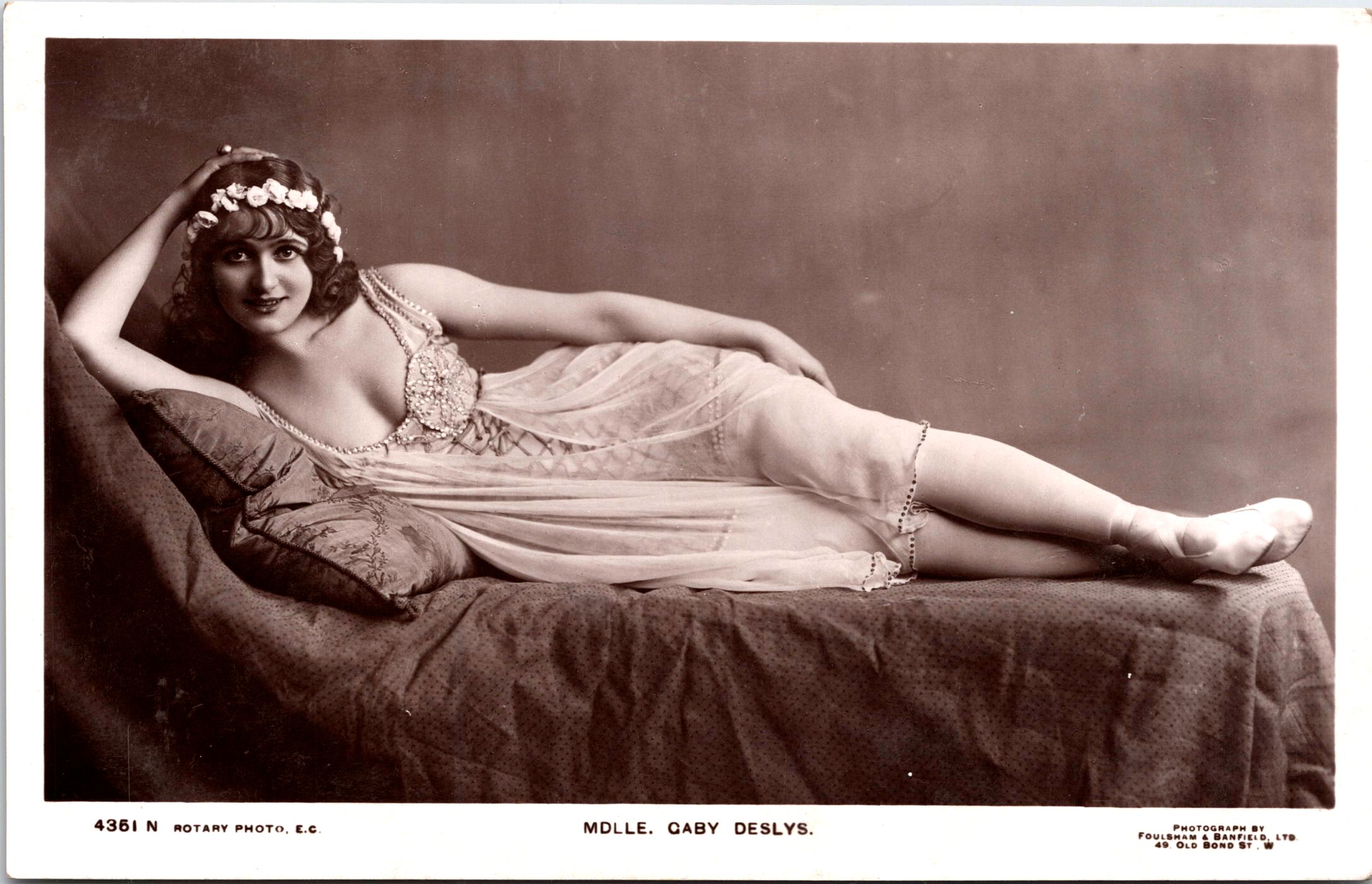
Postcard 11 captures Deslys in a pose that blends theatrical glamour with unabashed sensuality. Reclining languidly on a divan, Deslys gazes directly into the camera with a confident, coquettish smile. Her expression, both inviting and self-assured, evokes the knowing charm that made her a sensation on both sides of the Atlantic. She is dressed in a diaphanous, low-cut gown adorned with delicate lace and sparkling embellishments. The sheer fabric reveals the contours of her form beneath, and the bodice dips dramatically to showcase her décolletage. A garter peeks out from beneath the hem of her dress, holding up one of her stockings—a provocative detail that contributes to the postcard’s risqué nature. At a time when societal norms placed great emphasis on modesty, such a revealing pose and costume would have been seen as daring, bordering on scandalous. Her hair is crowned with a wreath of artificial flowers, emphasizing both her stage persona and the romanticized ideal of feminine beauty in the Belle Époque. Every detail of this image—from the suggestive pose to the luxurious styling—speaks to Deslys’ identity as a performer who captivated audiences not just with her talent, but also with her bold charisma and sex appeal. The card is numbered 4361 N and was published by Rotary Photo, E.C., a major British publisher known for high-quality celebrity postcards. The photograph itself was taken by Foulsham & Banfield, Ltd., a prominent London studio located at 49 Old Bond St. W, famed for its theatrical portraits.
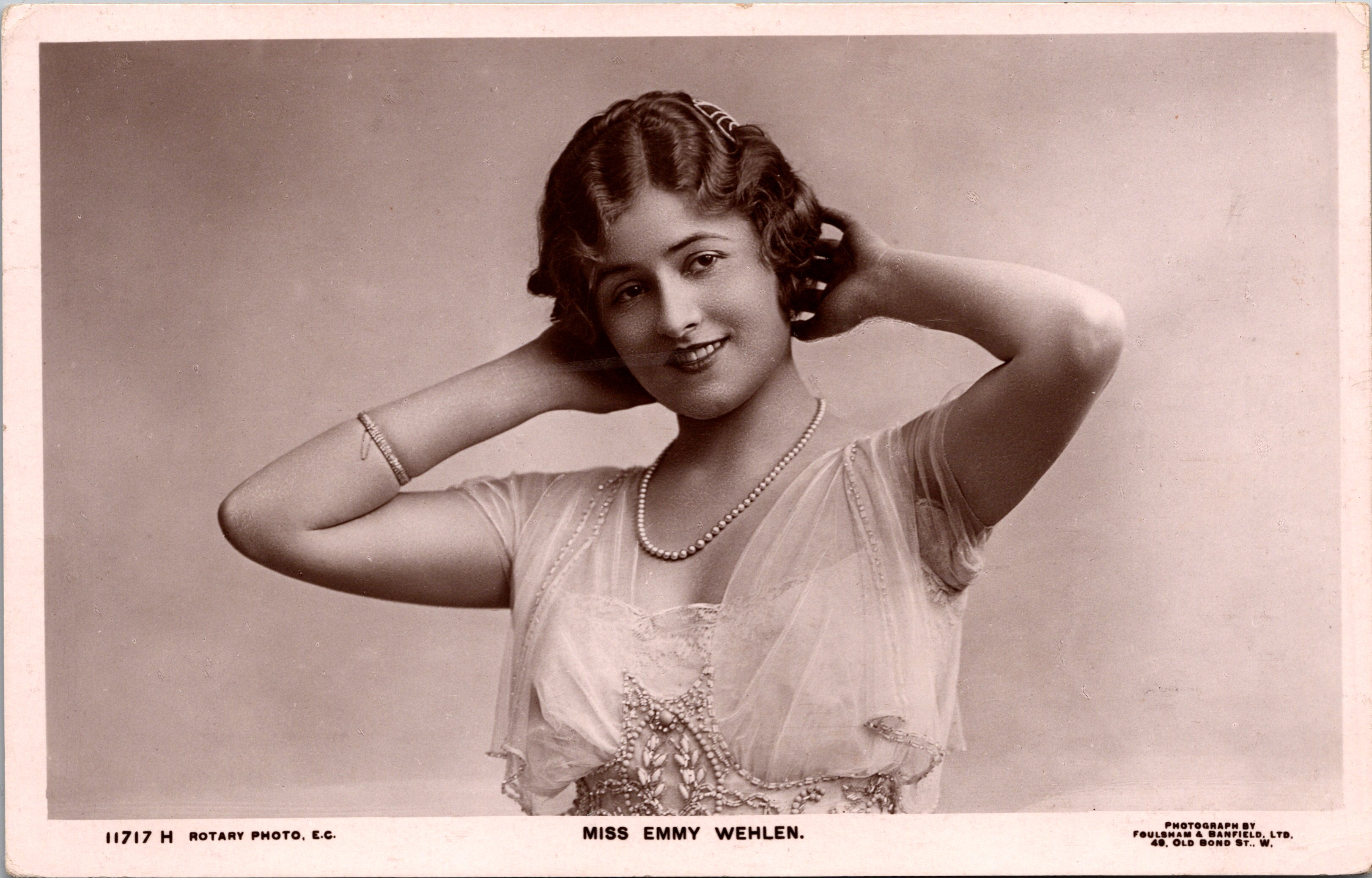
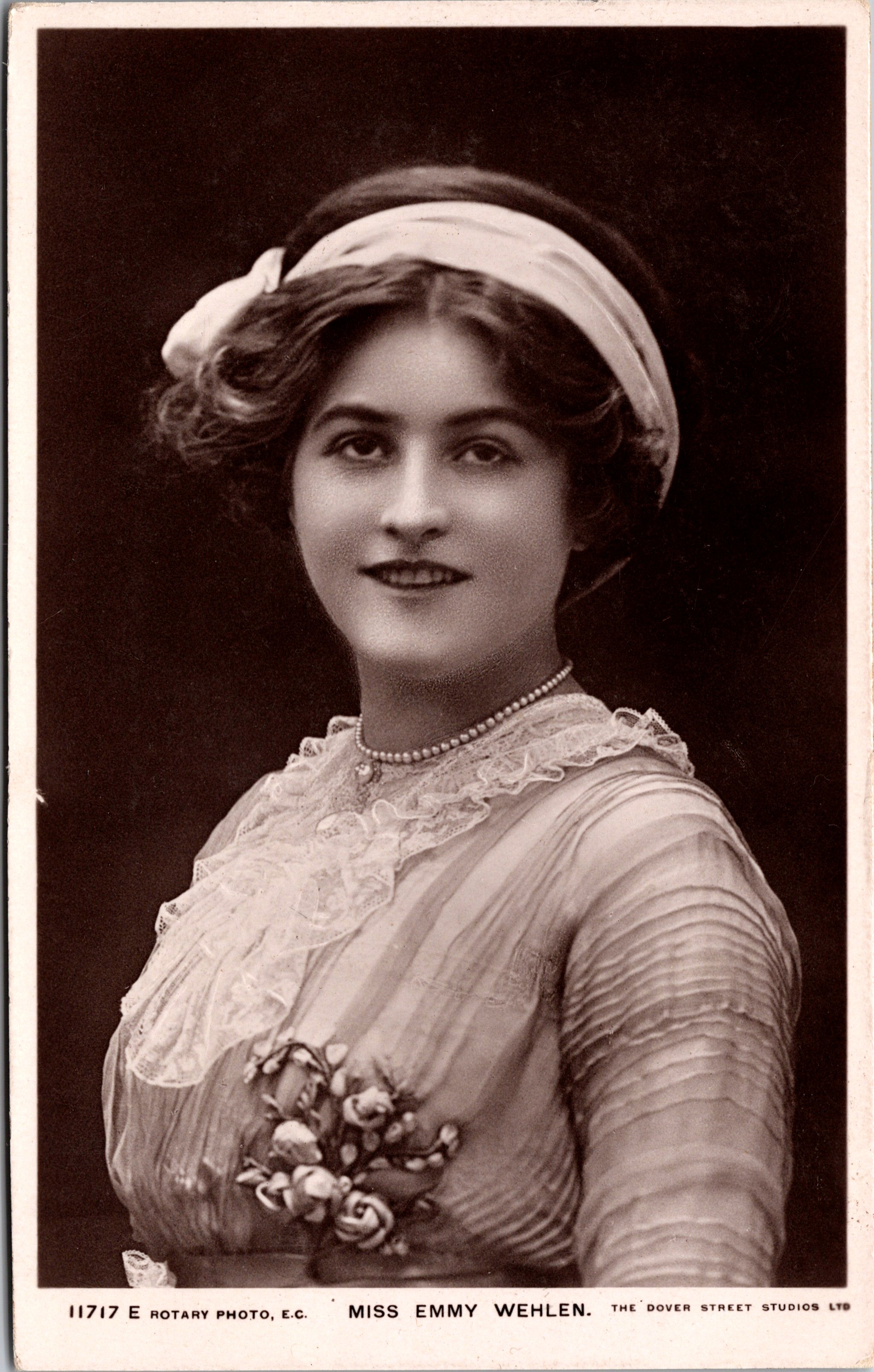
Postcard 1 features German actress, Emily “Emmy” Wehlen (1887-1977). She was a Edwardian musical comedy and silent film actress. She retired from acting at a young age (early 30’s), Wehlen received her musical training at the Mannheim Conservatory. She then joined the Thalia-Theatre and performed in musical comedies in several German cities. She was then invited to London and was considered as a possible successor to Lily Elsie. Wehlen played the lead role in “The Merry Widow” (1909). Later that year she appeared in the hit musical “The Dollar Princess” which ran for 428 performances. Next stop was New York, where she appeared in four Broadway plays between 1911 and 1915. Shortly after her last Broadway appearance, Wehlen left the stage and pursued a film career. She appeared in over twenty films between 1915 and 1920. “Everybody’s Magazine (1911) reported that Wehlen was very pretty and very graceful. Her acting and voice were also praised. In addition, the article stated that “she has the indescribable charm of personality” and that audiences liked her and wanted her to never leave the stage during a production. Miss Wehlen’s photograph on this postcard was taken by celebrity studio, Foulsham & Banfield. The card was published by Rotary Photo as part of a series (no.11717H).
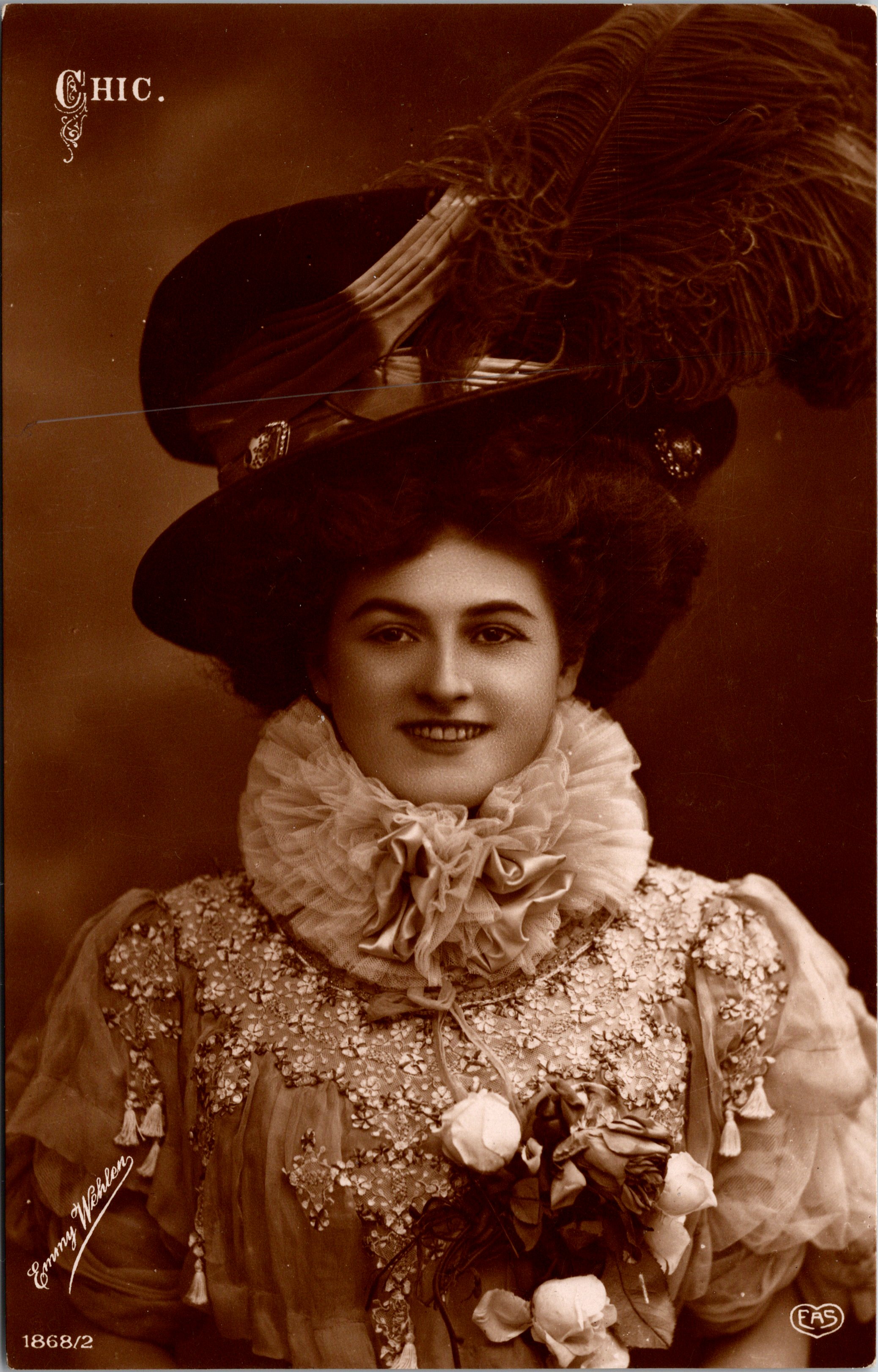
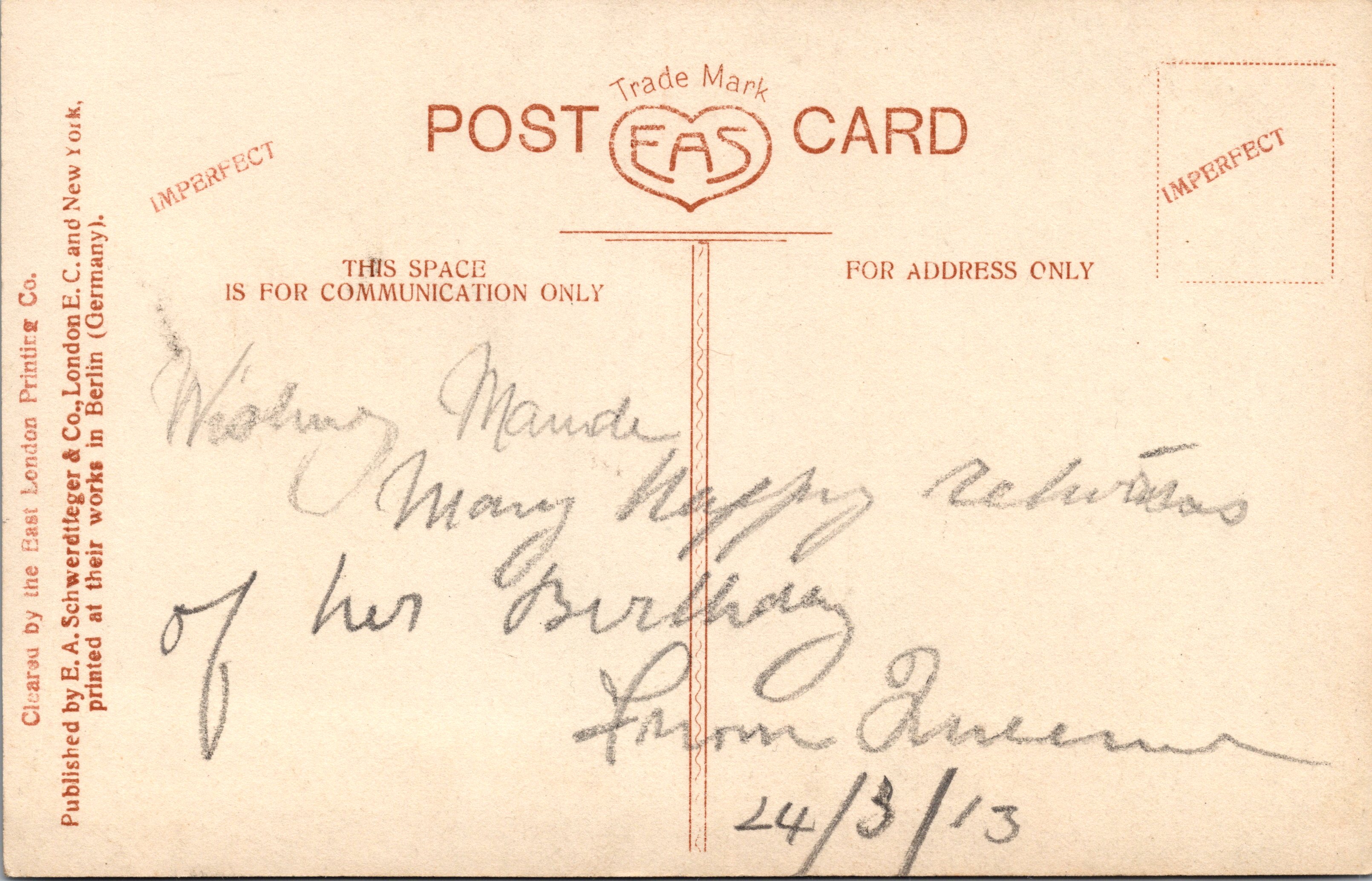
In Postcard 2, Wehlen is beautifully dressed for the portrait appearing on the postcard. She looks a bit clownish with her ruffled collar. There are flowers pinned to the front of her dress and she is wearing a jumbo feathered hat. She has a beautiful smile. The card was published by EAS as part of a series (no.1868/2). The firm was located in London and New York. The postcard was printed in Germany. Interestingly, the word “imperfect” is printed in two places on the front of the card. The word “chic” appears in the upper right hand corner of the image. Emmy Wehlen fits the bill. She is truly chic. The message on the postcard indicates that it was written in 1913. (SOLD)
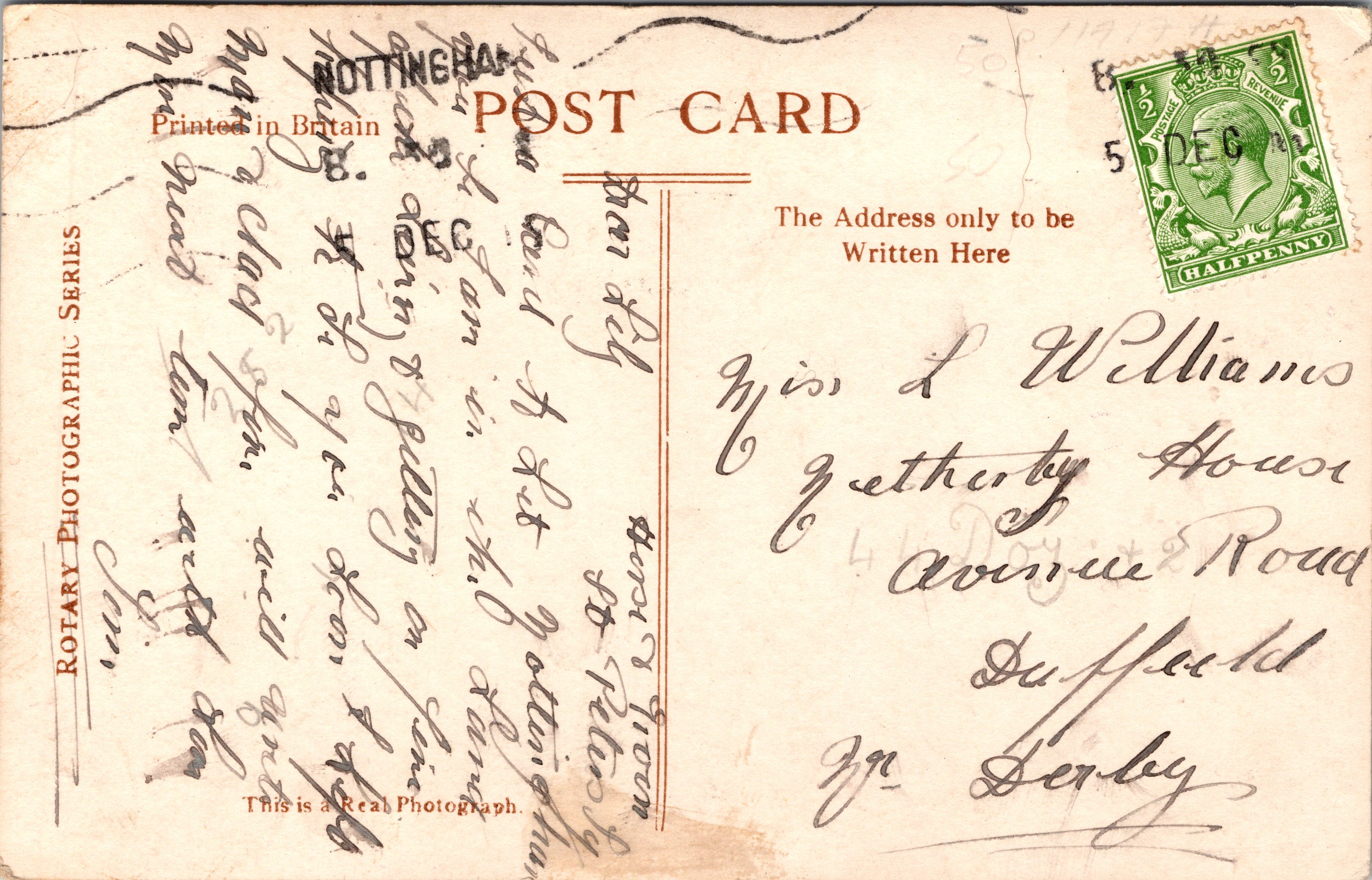
Postcard 3 features Miss Wehlen’s photograph taken by celebrity studio, Dover Street Studios. The card was published by Rotary Photo as part of a series (no.11717E). The message on the card indicates that the sender hoped that this photo postcard was meant to be an addition to the recipient’s postcard collection. (SOLD)
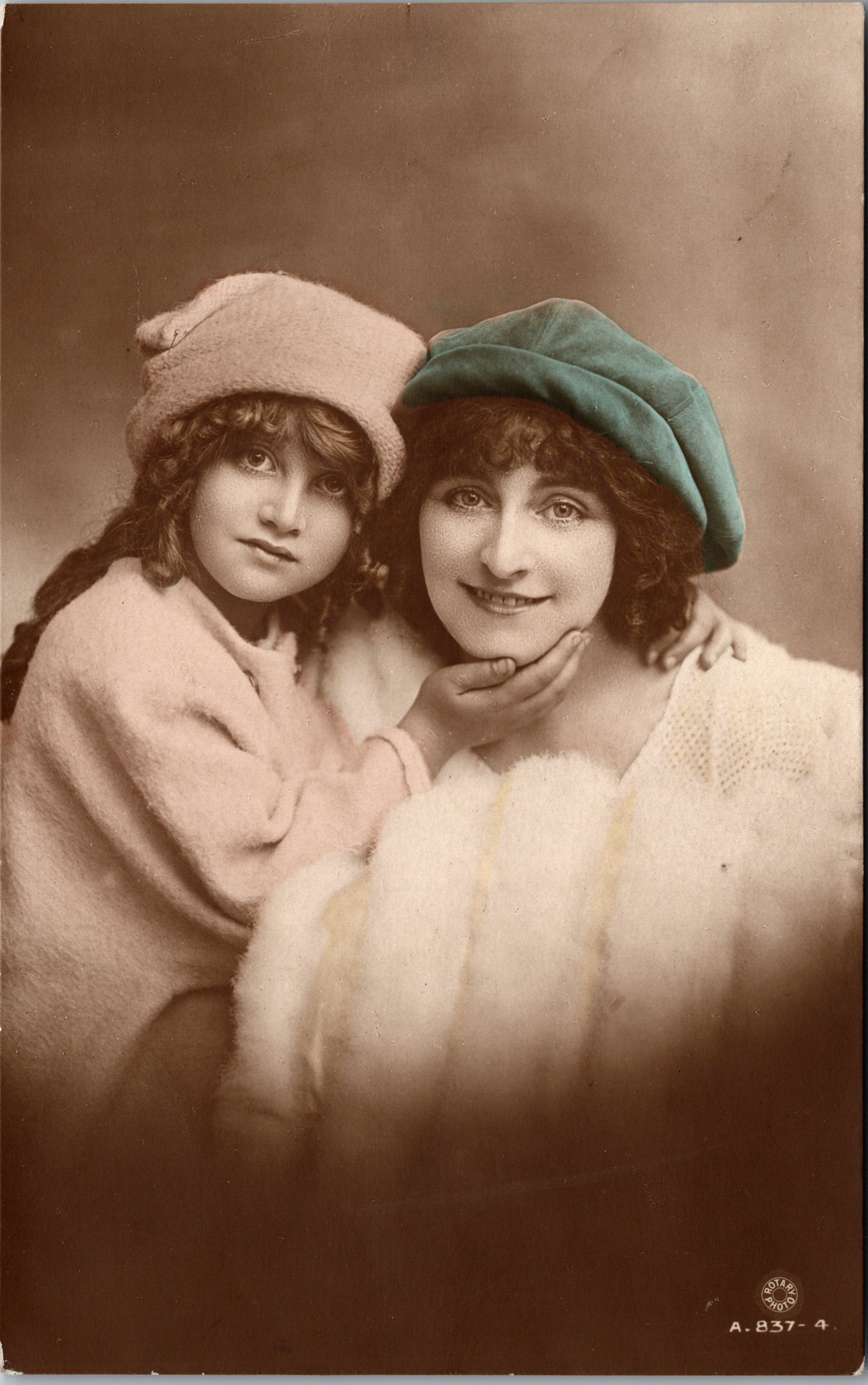
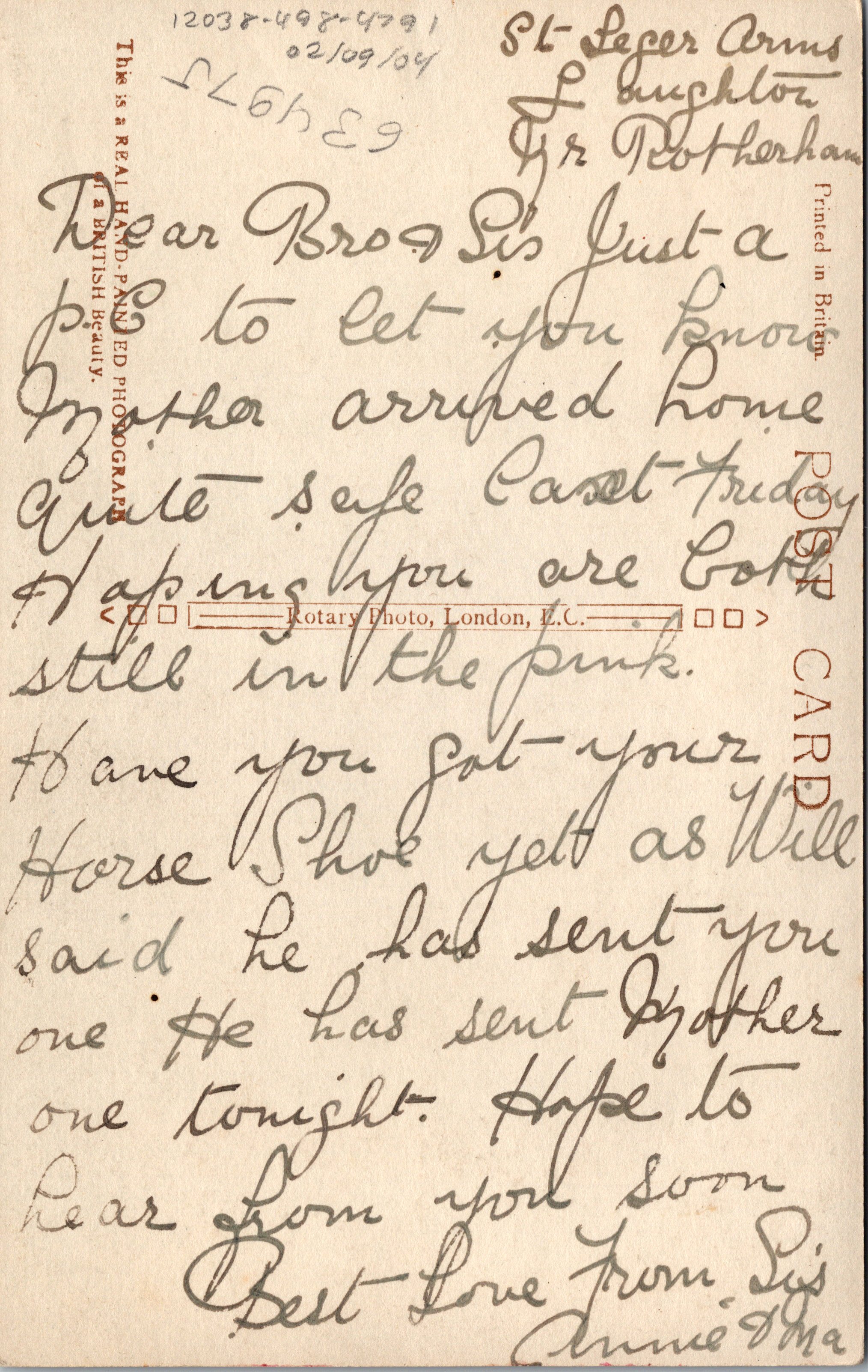
This vintage hand painted real photo postcard features a portrait of a very beautiful mother and her equally beautiful daughter. The pair are dressed for winter and looking quite fashionable. Their hats are terrific. Mom is wearing a fur coat. They have wonderful smiles. The writer of the postcard expresses to the reader, “Hoping you are both still in the pink”. I haven’t heard that expression in a while. If you don’t know, “in the pink” is a idiom that means in the peak of health. This vintage postcard was published by Rotary Photo as part of a series (No.A837-4). It was written in the first decade of the 1900’s. The postcard is in very good condition (see scans).
Buy this Vintage Real Photo Postcard (includes shipping within the US) #5324
To purchase this item, click on the Pay with PayPal button below
$34.00
Buy this Vintage Real Photo Postcard (includes International shipping outside the US) #5324
To purchase this item, click on the Pay with PayPal button below